Introduction
Dysphagia following head and neck cancer treatment is common, multifactorial and has a significant impact on quality of life.Reference Gillespie, Brodsky, Day, Lee and Martin-Harris1 Some degree of post-treatment dysphagia is reported in up to 50 per cent of head and neck cancer patients.Reference Nguyen, Sallah, Karlsson and Antoine2 Post-treatment swallowing disorders include weakness of posterior motion of the tongue base, incoordination of swallow phases, reduced laryngeal elevation and closure, and reduced epiglottic inversion. Cricopharyngeal muscle relaxation at the end of the pharyngeal phase of a normal swallow, assisted by the anterior–superior displacement of the larynx, allows the passage of the food bolus. Poor cricopharyngeal opening, confirmed during videofluoroscopic swallowing study, is a major factor contributing to a significant reduction in oral intake following cancer treatment.Reference Pauloski, Rademaker, Logemann, Newman, MacCracken and Gaziano3 Cricopharyngeal dysfunction incorporates several pathologies that include failure of muscle relaxation, fibrosis, hypertrophy and incoordination between pharyngeal constriction and cricopharyngeal opening.
Wang et al.Reference Wang, Goldsmith, Holman, Cianchetti and Chan4 reported an overall risk of 7.2 per cent for pharyngoesophageal stricture formation following radiotherapy (RT) with or without chemotherapy ((chemo)RT), confirmed at barium swallow or direct endoscopy. In their meta-analysis of 26 published studies, the authors reported late dysphagia as correlating with: (1) radiation technique (conventional vs intensity-modulated RT, with increased dysphagia in intensity-modulated RT); (2) radiation dose to the cervical oesophagus and pharyngeal constrictors; and (3) chemotherapy use. Specifically, intensity-modulated RT to the lower neck exposes the inferior pharyngeal constrictor muscles to a greater radiation dose and is associated with increased pharyngoesophageal stricture rates compared with conventional RT (16.7 per cent vs 5.7 per cent; odds ratio = 3.3).Reference Wang, Goldsmith, Holman, Cianchetti and Chan4 Cricopharyngeal fibrosis presents in a varied and non-specific manner that may include a globus sensation, progressive dysphagia and, ultimately, gross aspiration.
Several management options exist for benign upper oesophageal sphincter pathologies including bougienage, botulinum toxin injection and open cricopharyngeal myotomy. Carbon dioxide (CO2) laser is an established procedure for the treatment of non-malignant cricopharyngeal disorders, and specifically for cases in which there may be uncoordinated cricopharyngeal muscle relaxation or a prominent cricopharyngeal bar.Reference Pitman and Weissbrod5 One published abstract presented CO2 laser cricopharyngeal myotomy following RT alongside barium swallow and subjective swallow outcome measures in 12 patients, and reported no complications.Reference Silver6 To date, no published series has reported its use, together with objective outcome measures, in the context of cricopharyngeal-related dysphagia following treatment for head and neck cancer. We sought to report our experience of laser cricopharyngeal myotomy with objective swallowing outcome measures, before and after treatment.
Methods
We performed a retrospective analysis of patients undergoing CO2 laser cricopharyngeal myotomy for post-treatment, cricopharyngeal fibrosis-related dysphagia. At our hospital in Sunderland, UK, swallowing function is jointly assessed as part of the first combined head and neck cancer clinic review, following (chemo)RT for head and neck cancer. In the first instance, the assessment usually consists of a clinical examination and a fibreoptic endoscopic evaluation of swallowing. If the patient is not following the expected trajectory as their acute (chemo)RT side effects resolve, we proceed to a videofluoroscopic swallowing study or examination under anaesthesia. We review patients regularly thereafter as swallowing function can deteriorate over time. This complement of tests gives a fuller picture of all the various components of the swallowing mechanism. Findings are jointly discussed and an individual management plan is devised to maximise swallowing safety and efficiency. Management techniques include specific swallowing exercises, postures, manoeuvres, diet modification or surgical procedures. Patients with cricopharyngeal opening problems confirmed by videofluoroscopic swallowing study would be considered for a CO2 laser cricopharyngeal myotomy as a component of their treatment plan.
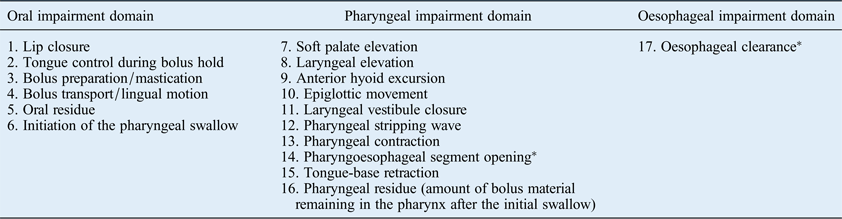
We rated the videofluoroscopic swallowing studies performed before and after cricopharyngeal myotomy on the Modified Barium Swallow Impairment Profile.Reference Martin-Harris, Brodsky, Michel, Castell, Schleicher and Sandidge7 The Modified Barium Swallow Impairment Profile is a validated, standardised rating scale of the Modified Barium Swallow Study with 17 components and 3–5 associated scores describing progressive levels of oral, pharyngeal and oesophageal impairment (Table I). Ratings in our analysis were based on the first ‘cup sip’ of the videofluoroscopic swallowing study examination: a speech and language therapist and ENT specialist trainee independently reviewed the videofluoroscopic swallowing study with results correlated to achieve a consensus score. We analysed the differences in Modified Barium Swallow Impairment Profile scores using a Wilcoxon signed-ranks test for paired, non-parametric, ordinal data, with a two-tailed p value of < 0.05 considered significant.Reference Bonett and Price8
Modified barium swallow impairment profileReference Martin-Harris, Brodsky, Michel, Castell, Schleicher and Sandidge7

*The variables numbered 14 and 17 are specific to cricopharyngeal muscle function.
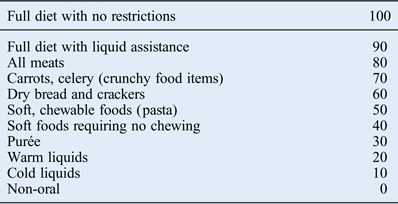
The normalcy of diet subsection of the Performance Status Scale is a well-validated, clinician-rated measurement of food textures designed for head and neck cancer patients (Table II).Reference List, Ritter-Sterr and Lansky9 We recorded this scale pre- and post-laser treatment.
Normalcy of diet subsection of the performance status scaleReference List, Ritter-Sterr and Lansky9*
*Patients are asked what type of textures they are eating at present and they are then scored on the scale; they end up with a single score according to the most difficult texture they can manage.
To perform the cricopharyngeal myotomy, we inserted a bivalve Weerda diverticuloscope (KARL STORZ GmbH & Co. KG, Tuttlingen, Germany) into the post-cricoid space, with the anterior blade towards the oesophageal lumen and the posterior blade placed at the base of the cricopharyngeal muscle on the posterior pharyngeal wall. We incised the cricopharyngeal mucosa using a CO2 laser (Lumenis UK Ltd, London, UK) set on continuous delivery at a power of 2 W. If the cricopharyngeal muscle could be mobilised or placed under some lateral tension, the lead author (CH) aimed to resect a portion of the muscle to prevent fibrosis and restenosis. The dissection proceeded until it was either apparent that the muscle was divided and the underlying fascia visualised, or we deemed it unsafe to progress. We did not close the mucosal incision.
We achieved haemostasis by a diffused laser beam or adrenaline-soaked pledgets. If this approach was inadequate, we used endoscopic diathermy, though this could cause a greater degree of post-operative fibrosis and subsequent scarring, and thus we kept its use to a minimum. Many patients experienced some degree of trismus following RT treatment. Although this may have led to poor operative access, no patients in our series were excluded due to failed insertion of the diverticuloscope.
Results
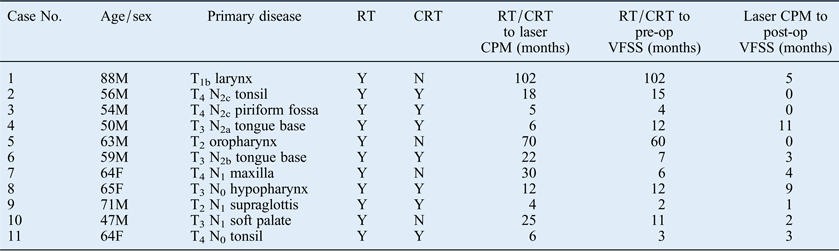
We identified 13 patients who experienced dysphagia, and they successfully underwent cricopharyngeal myotomy for cricopharyngeal fibrosis-related symptoms. No cases were excluded in which the procedure was abandoned due to limitations in operative access or co-morbidities. We did not record any procedure-related complications. All patients had undergone RT with or without chemotherapy for a variety of head and neck cancers between January 2006 and July 2011. We excluded two patients for having insufficient videofluoroscopic swallowing study data available: the image quality for one post-cricopharyngeal myotomy videofluoroscopic swallowing study was insufficient for analysis and another patient had significant fibrosis, which necessitated a tracheostomy and ultimately pharyngolaryngectomy for a dysfunctional larynx. This meant that complete pre- and post-procedure videofluoroscopic swallowing studies were available for interpretation in 11 patients (Table III).
Patient characteristics and timings of interventions
RT = radiotherapy; CRT = chemoradiotherapy; CPM = cricopharyngeal myotomy; VFSS = videofluoroscopic swallowing study
Pre- and post-laser cricopharyngeal myotomy, and median Modified Barium Swallow Impairment Profile scores showed improvements, with a lower score signifying a better swallowing performance. Individual scores are presented in a radar plot for the total Modified Barium Swallow Impairment Profile (Figure 1) and cricopharyngeal-specific variables (Figure 2).
Individual patients' total MBSImP scores pre- (blue line) and post-CO2 laser cricopharyngeal myotomy (red line). CO2=carbon dioxide; MBSImP = Modified Barium Swallow Impairment Profile
Individual patients' cricopharyngeal function-specific MBSImP scores (variables 14 and 17) pre- (blue line) and post-CO2 laser cricopharyngeal myotomy (red line). CO2 = carbon dioxide; MBSImP = Modified Barium Swallow Impairment Profile
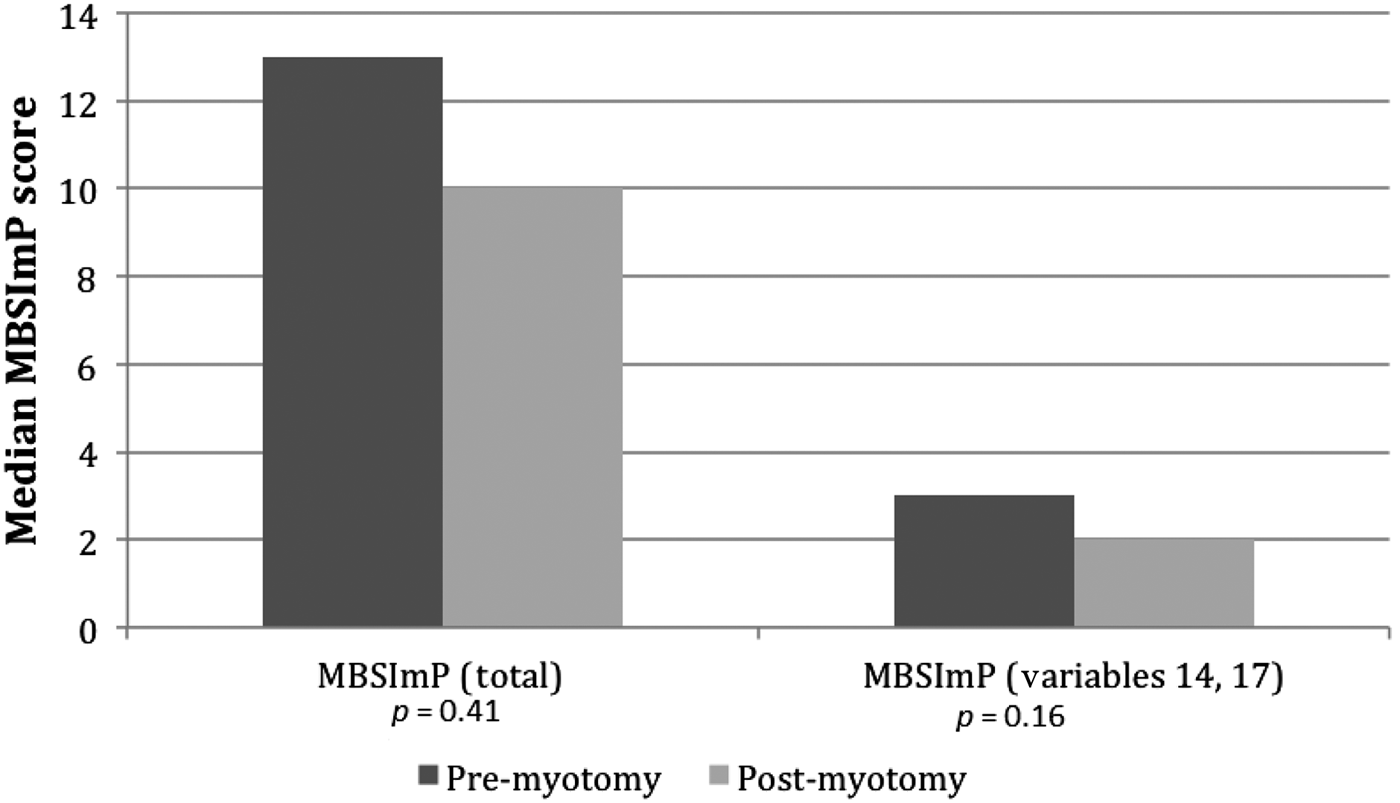
These overall differences, however, were not significant for either the total or the cricopharyngeal-specific (variables 14 and 17) Modified Barium Swallow Impairment Profile scores (Figure 3). The median total Modified Barium Swallow Impairment Profile score improved from a pre-myotomy score of 13 (95 per cent confidence interval (CI); 8.21, 17.79) to a post-myotomy score of 10 (95 per cent CI; 4.15, 15.85), with a lower score signifying a better swallowing performance. This difference in median Modified Barium Swallow Impairment Profile scores was non-significant (p = 0.41, 95 per cent CI; −4.56, 10.56). The median Modified Barium Swallow Impairment Profile score of the cricopharyngeal-specific function (variables 14 and 17) improved from 3 (95 per cent CI; −0.19, 6.19) to 2 (95 per cent CI; 0.4, 3.6), but was also non-significant (p = 0.16, 95 per cent CI; −2.57, 4.57). A score of 0 or 1 on each parameter of the Modified Barium Swallow Impairment Profile is considered within the normal range, and thus a move of greater than one point on each parameter may be considered meaningful as a measure of swallowing impairment (B Martin-Harris, personal communication).Reference Sandidge10
Graph showing the improved median total and cricopharyngeal-specific (variables 14 and 17) MBSImP scores following CO2 laser cricopharyngeal myotomy. MBSImP = Modified Barium Swallow Impairment Profile
Patients with the greatest overall swallowing impairment (i.e. higher Modified Barium Swallow Impairment Profile scores; cases 1, 2 and 9) demonstrated improvement post-intervention. Of particular note, case 9 presented with a high pre-intervention Modified Barium Swallow Impairment Profile score, which dropped by 17 points post-intervention. For the remaining eight patients assessed, four out of eight had worse overall Modified Barium Swallow Impairment Profile scores post-intervention. Notably, 2 out of 8 patients (cases 3 and 6) had worse cricopharyngeal-specific variables post-intervention, measured at 5 and 25 months respectively. These four patients with a worse overall Modified Barium Swallow Impairment Profile score (particularly case 6) presented with multiple problems with bolus propulsion, in combination with poor cricopharyngeal opening. They developed progressive fibrosis accounting for their worsening swallowing performance. This fibrosis was so significant in one patient that they were excluded from analysis, and as previously mentioned ultimately they went on to have a pharyngolaryngectomy due to an incompetent fibrotic larynx.
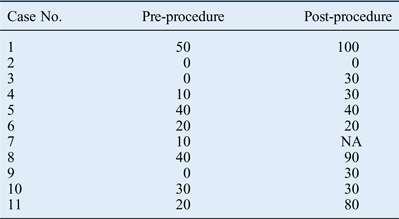
Clinical aspiration or radiological penetration was evident in 8 out of 11 patients pre-cricopharyngeal myotomy, and this remained in 4 of these patients post-cricopharyngeal myotomy. Normalcy of diet data were available for 10 out of 11 patients (Table IV). The median score improved from 20 out of 100 pre-cricopharyngeal myotomy to 30 out of 100 post-cricopharyngeal myotomy.
Discussion
In this study, we have demonstrated a trend for improved median Modified Barium Swallow Impairment Profile swallowing scores following CO2 laser cricopharyngeal myotomy in patients previously treated with (chemo)RT for head and neck cancer. Although this finding did not achieve statistical significance, this is the first description of the use of this technique in the management of patients following non-surgical treatment for cancer. The Performance Status Scale normalcy of diet scores provided a further descriptive report of the type of oral diet patients were able to achieve, and showed variation across cases.
Our mixed results in this case series reflect the complexity of post-(chemo)RT dysphagia. When considering the remarkable improvement in swallowing described by the Modified Barium Swallow Impairment Profile for case 9 (Figures 1 and 2), this was reflected in the eating habits of the patient as recorded by the Performance Status Scale normalcy of diet scale; the patient progressed from having no oral intake to managing a puréed diet (Table IV). One possible explanation for this is a ‘use it or lose it’ theory, with the best exercise for swallowing, being swallowing itself.Reference Rosenthal, Lewin and Eisbruch11 Patient number 11 experienced major diet changes, but relatively small changes in Modified Barium Swallow Impairment Profile scores following the intervention. This patient had a focal problem with cricopharyngeal opening, thus the procedure led to a dramatic change in the ability to eat and drink. In our analysis of the heterogeneous response to cricopharyngeal myotomy reported in our series, we have acknowledged that several patients presented with complex swallowing problems. It is this complexity that likely accounts for the relative mix of outcomes following cricopharyngeal myotomy.
Normalcy of diet subsection of the performance status scale
Cricopharyngeal myotomy has been recommended and widely used to improve swallowing both alongside, and following surgical treatment of head and neck cancer.Reference Horowitz and Sasaki12 One prospective study examined the role of external approach cricopharyngeal myotomy in those undergoing surgical management of tongue-base and supraglottic laryngeal cancer.Reference Jacobs, Logemann, Pajak, Pauloski, Collins and Casiano13 The authors concluded that the procedure failed to provide any benefit and criticised purported widespread reporting of its application for dysphagia in the literature despite a lack of evidence.
The applications of laser cricopharyngeal myotomy for cricopharyngeal dysfunction following non-surgical head and neck cancer treatment are less clearly documented. Small, uncontrolled case series routinely present endoscopic cricopharyngeal myotomy data for a heterogeneous mix of benign and malignant cricopharyngeal pathologies, limiting direct comparison with our series. Methods of swallowing assessment pre- and post-cricopharyngeal myotomy are equally heterogeneous and apply non-objective outcome measures.
Dauer et al.Reference Dauer, Salassa, Iuga and Kasperbauer14 performed a retrospective review of CO2 laser cricopharyngeal myotomy (n = 14) versus an external approach (n = 8), using pre-operative manofluorography and a functional outcome swallowing scale, concluding that the technique was safe and effective. BrøndboReference Brøndbo15 presented 17 cases with pre-operative videofluoroscopic swallowing study and manometry, reporting subjective improvement in the majority of cases using a swallowing questionnaire.
Lawson and RemacleReference Lawson and Remacle16 retrospectively analysed 29 patients undergoing CO2 laser cricopharyngeal myotomy for a multitude of underlying pathologies. They were assessed pre- and post-operatively by videofluoroscopic swallowing study, flexible nasendoscopy and a subjective patient score for dysphagia and aspiration, each graded 0–4, and reported an improvement in each score. Similarly, several further key studies have reported mixed pathologies and pre-operative assessments.Reference Pitman and Weissbrod5, Reference Herberhold and Walther17–Reference Takes, van den Hoogen and Marres19
This paper demonstrates the feasibility of the laser cricopharyngeal myotomy procedure and highlights the need to report valid, objective outcome data for comparison with other techniques.
Dysphagia following (chemo)RT is usually multifactorial, may deteriorate over time and typically requires a combined approach to rehabilitation. There is substantial diversity in the reported methods of measuring swallowing before and after laser cricopharyngeal myotomy. The variety of pre-procedure measurement scales applied in the literature presents clinicians with considerable difficulty in effective patient selection. No effective methods exist to predict success prior to cricopharyngeal myotomy; the use of manometry and intrabolus pressures to measure pharyngoesophageal pressures is considered unreliable; however, it may well have an adjunctive role alongside dynamic swallow examinations.Reference Bammer, Salassa and Klingler20 In our study, we selected patients for the procedure following multidisciplinary team discussion, clinical assessment and videofluoroscopic swallowing study findings, which allowed an objective measure of the swallowing impairment. It appears that laser cricopharyngeal myotomy is ideal for patients presenting with a focal cricopharyngeal opening problem. This procedure may also have a role in managing patients with oropharyngeal dysphagia in addition to cricopharyngeal opening dysfunction. However, we feel it is not indicated in patients where progressive fibrosis is identified.
Halvorson and KuhnReference Halvorson and Kuhn21 first described endoscopic cricopharyngeal myotomy using a potassium titanyl phosphate laser. The CO2 laser is advantageous as it delivers a more localised thermal injury and improved haemostasis. The advantages of endoscopic approaches over open cricopharyngeal myotomy include reduced anaesthesia time and the avoidance of potential complications, including pharyngocutaneous fistula, recurrent laryngeal nerve injury, haematoma, seroma and infection. Based on cadaveric studies in benign disease, the procedure is theorised to preserve the integrity of the buccopharyngeal fascia – the visceral layer of the middle layer of the deep cervical fascia – which maintains a protective layer and isolates the transmucosal myotomy site from the retropharyngeal space.Reference Chang, Liou and Netterville22
Laser cricopharyngeal myotomy following head and neck cancer treatment presents an additional challenge when these fascial planes may be disrupted by tissue fibrosis. Chitose et al.Reference Chitose, Sato, Hamakawa, Umeno and Nakashima23 emphasised the need to ensure myotomy of both horizontal and oblique parts of the cricopharyngeal muscle and suggested the technique may be developed further to limit post-operative stenosis arising from adhesion of the cricopharyngeal muscle and mucosal scarring through resection of the cricopharyngeal muscle and horizontal suturing of the mucosa. In our series, we aimed to resect muscle whenever feasible, however, the nature of irradiated tissues limited this in most cases and we were unable to draw conclusions between the technique and outcomes in individual cases.
• Dysphagia following head and neck cancer treatment is common, multifactorial and has a significant impact on quality of life; cricopharyngeal dysfunction is one of the causes, reflected by the small number of cases presented here
• Symptoms of cricopharyngeal fibrosis occurring after radiotherapy and chemotherapy treatment are varied and relatively non-specific, but may include a globus sensation, progressive dysphagia to solids and subsequently liquids, and ultimately gross aspiration
• Dysphagia assessment may include clinical examination, videofluoroscopy and examination under anaesthetic, to identify all components contributing to the impairment
• Where cricopharyngeal dysfunction is identified, carbon dioxide (CO2) laser cricopharyngeal myotomy remains a viable option in carefully selected patients, in the absence of signs of progressive fibrosis
• In this case series, we observed a trend for improved Modified Barium Swallow Impairment Profile swallowing scores following CO2 laser cricopharyngeal myotomy in 7 out of 11 patients, but this was not statistically significant
This study is limited by a small sample size. We did not undertake videofluoroscopic swallowing studies at set time points as we used them solely for clinical (non-research) purposes in patients complaining of dysphagia, which itself may continue to evolve following the completion of (chemo)RT.Reference Logemann, Pauloski, Rademaker, Lazarus, Gaziano and Stachowiak24 Nevertheless, the results provide an encouraging account of the application of this technique in patients following head and neck cancer treatment. The data supports the case for further investigation of this technique in the form of an adequately powered prospective study.
Conclusion
Our data suggest cricopharyngeal myotomy is effective in selected patients experiencing dysphagia following non-surgical treatment for head and neck cancer. The Modified Barium Swallow Impairment Profile also provides a clinically accessible, standardised measure of oropharyngeal impairment.Reference Martin-Harris, Brodsky, Michel, Castell, Schleicher and Sandidge7 A sensitive method of identifying those at risk of cricopharyngeal dysfunction, either based on treatment protocols or using the Modified Barium Swallow Impairment Profile, may permit a more effective and targeted role of CO2 laser cricopharyngeal myotomy.