Implications
Understanding of ruminal biohydrogenation, particularly of less common, highly unsaturated fatty acids such as 22:6n-3, is still poor and the current in vitro study aims at providing further insight. Complete conversion of 22:6n-3 to 22:0 only occurs at low initial 22:6n-3 concentrations. Addition of an adsorbent did not reduce 22:6n-3 biohydrogenation, which obviously is not advantageous when aiming at increasing 22:6n-3 content of ruminant products but can be used in vitro to facilitate studies on hydrogenation pathways and bacteria involved in this process.
Introduction
Upon entering the rumen, lipids are extensively hydrolysed and hydrogenated, causing marked differences in fatty acid (FA) profile between the diet and digesta leaving the rumen. The major biohydrogenation pathways of the main 18-carbon unsaturated FA (cis-9 18:1, 18:2n-6 and 18:3n-3), and some of the factors influencing the formation of specific intermediates have been documented (Jenkins et al., Reference Jenkins, Wallace, Moate and Mosley2008; Shingfield et al., Reference Shingfield, Kairenius, Arola, Paillard, Muetzel, Ahvenjarvi, Vanhatalo, Huhtanen, Toivonen, Griinari and Wallace2013). Much of this information is based on analysing the products formed during incubations of labelled or unlabelled cis-9 18:1, 18:2n-6 and 18:3n-3 with pure or mixed cultures of ruminal bacteria. Even though the long-chain polyunsaturated FA (PUFA), 20:5n-3 and 22:6n-3 are known to be hydrogenated extensively (Fievez et al., Reference Fievez, Vlaeminck, Jenkins, Enjalbert and Doreau2007), the metabolic pathways responsible and intermediates formed are not well characterized (Jenkins et al., Reference Jenkins, Wallace, Moate and Mosley2008). Based on a detailed analysis of omasal digesta of cows fed fish oil, biohydrogenation of 20:5n-3 and 22:6n-3 were proposed to involve an initial reduction of the double bond closest to the carboxyl group (Kairenius et al., Reference Kairenius, Toivonen and Shingfield2011). One of the major limitations in identifying the main biohydrogenation pathways is the scarcity of bacterial isolates capable of metabolizing 20:5n-3 or 22:6n-3. Addition of 22:6n-3 is known to inhibit the growth and activity of Butyrivibrio fibrisolvens and Butyrivibrio proteoclasticus (Wasowska et al., Reference Wasowska, Maia, Niedzwiedzka, Czauderna, Ribeiro, Devillard, Shingfield and Wallace2006; Maia et al., Reference Maia, Chaudhary, Figueres and Wallace2007), the major bacterial species capable of biohydrogenation. The antibacterial property of unsaturated free FA is thought to involve alterations in cell membrane function (Desbois and Smith, Reference De Weirdt, Coenen, Vlaeminck, Fievez, Van den Abbeele and Van de Wiele2010). It therefore follows that the inhibitory effects of unsaturated FA on bacterial growth may be lessened by minimizing the interaction between free FA and bacteria. The present study tested the hypothesis that the addition of adsorbant decreases the interaction of free FA with rumen bacteria. A total of six experiments were performed. Two experiments were established based on incubations of 22:6n-3 with mixed rumen bacteria without or with one of four adsorbants (bentonite, silicic acid, mucin and gum arabic) and involved the measurement of the distribution of 22:6n-3 in incubation contents and disappearance of 22:6n-3 over a 24-h period. Based on their capacity to interact with free FA, bentonite (Palatsi et al., Reference Palatsi, Affes, Fernandez, Pereira, Alves and Flotats2012), silicic acid (Proctor and Palaniappan, Reference Proctor and Palaniappan1990), mucin (De Weirdt et al., Reference Desbois and Smith2013) and gum arabic (Xiang et al., Reference Xiang, Yao, Zhang, Zhang, Fang, Nishinari, Phillips and Jiang2015) were used in the current experiment. As both mucin and gum arabic provide fermentable substrate for rumen bacteria, two additional experiments were performed to distinguish between (1) decreasing the interaction of free FA and bacteria and (2) stimulation of bacterial growth. In addition, we evaluated the effect of gum arabic on growth of B. fibrisolvens and B. proteoclasticus. A final experiment was performed to evaluate differences in the rate of disappearance between 22:6n-3 and 18:2n-6.
Material and methods
In vitro incubations with ruminal fluid
All experimental procedures were approved by the ethical commission of the Institute of Agricultural and Fisheries Research, Belgium (ILVO, approval number EC2009/114). Batch in vitro incubations were established using rumen contents collected from adult sheep according to Vlaeminck et al. (Reference Vlaeminck, Braeckman and Fievez2014). Rumen contents were obtained from three mature wethers fitted with ruminal cannulae fed grass hay ad libitum and a grain-based concentrate (200 g/day) twice daily at 0900 and 1700 h to meet their maintenance requirements (van der Meer, Reference Van der Meer1985). Approximately 0.5 l of ruminal digesta was collected from each animal just before the morning feeding. The rumen fluid was filtered through a sieve with a pore size of 1 mm under a stream of CO2 at 39°C. Donor fluid from each animal were kept separate except for experiment 1 where donor rumen fluid was combined. Rumen inocula was diluted (1 : 4, v/v) in bicarbonate/phosphate buffer containing a mixture of fermentable substrates (0.21 g glucose, 0.21 g cellobiose, 0.19 g xylose, 0.19 g arabinose, 1.3 g acid casein hydrolysate, 1.3 g peptone and 1.3 g yeast extract per litre of distilled water (Vlaeminck et al., Reference Vlaeminck, Braeckman and Fievez2014)). Diluted buffered rumen fluid (25 ml for experiment 1, 50 ml for experiment 2 and 500 ml for experiment 3) was added to incubation flasks (120 ml flasks for experiments 1 and 2 and 1 l flasks for experiment 3) containing none (control) or one of four adsorbants and 22:6n-3 (Nu-check-Prep, Elysian, MN, USA) dissolved in ethanol (20 mg/ml) according to the experimental design (c.f. below). On the day before inoculation, adsorbents were added to the incubation flasks. On the day of inoculation, the 22:6n-3 solution was added after which the flasks were closed. After flushing with CO2 during five cycles of 900 mbar underpressure and 600 mbar overpressure, diluted buffered rumen fluid was added. Diluted buffered rumen fluid was added between 30 and 45 min after adding the 22:6n-3 solution, allowing 22:6n-3 to interact with the adsorbant before inoculum addition. Before incubation flasks were placed at 39°C, overpressure was released. Flasks were maintained under anaerobic conditions at 39°C, with intermittent shaking in a batch culture incubator (Edmund Bühler GmbH, Hechingen, Germany). At the end of each incubation period, the flasks were removed from the incubator and the reaction was stopped by cooling the flasks in an ice bath. Sub-samples were collected for analysis of volatile FA (VFA: 2 ml) and long-chain FA (LCFA: 5 ml). All treatment combinations were performed in duplicate (technical replicates).
Experiment 1 was performed as a 9×3 factorial experiment in a randomized block design to examine the effect of four adsorbants (mucin, gum arabic, bentonite and silicic acid) at two different concentrations (1 and 5 mg/ml) plus a control treatment on the disappearance and metabolism of 22:6n-3 added to incubation flasks at three concentrations (0.02, 0.06 and 0.10 mg/ml corresponding to 25, 75 and 125 µl ethanol solution, respectively). Each flasks received the same amount of ethanol. Statistical replicates were obtained by using a mixed inoculum of three wethers in three different runs on separate days. After incubation for 24 h, composition of the gas phase (Hassim et al., Reference Hassim, Lourenco, Goel, Vlaeminck, Goh and Fievez2010) and pH was measured (Hanna Instruments, Temse, Belgium) and culture contents were sampled for analysis of VFA and LCFA.
Experiment 2 was a 7×3 factorial experiment in randomized block design. Cultures containing 0.06 mg/ml of 22:6n-3 (corresponding to 150 µl ethanol solution) were incubated up to 48 h (6, 24 and 48 h) to evaluate the disappearance of 22:6n-3 in the presence of gum arabic, mucin, cellulose, xylan or starch (5 mg/ml). Two additional treatments were included in the design: a treatment containing no gum arabic, mucin, cellulose, xylan or starch (i.e. only the substrate present in the buffer solution was provided) and a treatment without additional substrate nor carbohydrates in the buffer solution (i.e. removal of glucose, cellobiose, xylose and arabinose from the buffer solution). Statistical replicates were obtained by using inocula from three donor animals. Samples were collected after 6, 24 and 48 h of incubation by removing temporarily the flasks from the incubator and taking 10 ml of incubation fluid using a syringe. After pH was measured, culture contents were sampled for analysis of VFA and LCFA.
In experiment 3, a single-factor repeated-measures design was used to compare rate of disappearance of 18:2n-6 and 22:6n-3. Three fermenters (1 l) were used, all containing gum arabic (5 mg/ml), 18:2n-6 (0.1 mg/ml, corresponding to 1000 µl ethanol solution prepared by dissolving 18:2n-6 (Nu-check-Prep) in ethanol (50 mg/ml)) and 22:6n-3 (0.02 mg/ml, corresponding to 500 µl ethanol solution), and were inoculated with diluted rumen fluid (500 ml) and incubated for 24 h in a water bath at 39°C. The concentration of 18:2n-6 and 22:6n-3 were chosen to allow formation of 18:0 and 22:0, when incubated separately. Inocula for each fermenter was obtained from a different sheep (statistical replicate). Culture content was continuously mixed by means of a magnetic stirrer and the headspace continuously flushed with CO2 to assure anaerobic conditions. Samples were taken after 0.5, 1, 2, 3, 4, 5, 6, 7, 8, 9, 10 and 24 h of inoculation for analysis of VFA and LCFA. Samples were pipetted directly from the fermenter (2 ml for VFA and 5 ml for LCFA) through a closable opening in the lid.
Distribution of 22:6n-3 in incubation contents
Two experiments were performed to determine the effect of adding an adsorbant or fermentable substrate on the distribution of 22:6n-3 between the solid and liquid phase of diluted rumen fluid. Experiments were carried out in polycarbonate tubes containing 10 ml of diluted buffered rumen fluid supplemented with 0.06 mg/ml of 22:6n-3. Diluted buffered rumen fluid was prepared as described before. In experiment 4, the effect of four different adsorbents (mucin, gum arabic, bentonite and silicic acid at 5 mg/ml) on the distribution of 22:6n-3 between liquid and solids was determined. In experiment 5, the effect of gum arabic, mucin, cellulose, xylan and starch (5 mg/ml) was evaluated. All treatment combinations were mixed using a multiple vortex. After 30 min, reactions were stopped followed by centrifugation for 10 min at 3400 g at 4°C. Supernatant and pellet were stored at −20°C before LCFA analysis. Preliminary experiments showed that gum arabic and mucin were recovered in the liquid phase and bentonite and silicic acid in the solid phase.
Effect of gum arabic on growth of B. fibrisolvens and B. proteoclasticus
B. fibrisolvens D1 (DSM 3071) and B. proteoclasticus P18 (Rowett Institute of Nutrition and Health) were grown anaerobically for 48 h at 39°C in medium 704 (DSMZ) or RM02 medium (Kenters et al., Reference Kenters, Henderson, Jeyanathan, Kittelmann and Janssen2011) in 12.5×1.5 cm culture tubes closed with screw caps fitted with butyl rubber septa (Bellco Biotechnology, Vineland, NJ, USA). The medium 704 was modified by omitting the VFA mixture, haemin and glycerol, and by increasing the proportion of rumen fluid to 20% (v/v). Rumen fluid was collected from three mature wethers. Donor animals were the same as those used for in vitro incubations with ruminal fluid and were fed the same diet. Rumen fluid was filtered through a sieve with a pore size of 1 mm and then fine particles were removed from the filtrate by centrifugation at 27 000 g for 20 min at 4°C. The supernatant was sterilized by autoclaving for 20 min at 121°C and stored frozen at −20°C. The stored rumen fluid was thawed before use and any new precipitates formed were removed by centrifugation at 27 000 g for 15 min at 4°C. Incubations were carried out anaerobically with and without gum arabic (5 mg/ml). The 22:6n-3 solution was prepared by emulsifying 30 mg of 22:6n-3 with polyoxyethylene sorbitan and diluting the mixture in 50 ml of distilled water (0.6 mg/ml) and was added to the medium before autoclaving. Several concentrations of 22:6n-3 were evaluated (0, 10, 20, 40, 80 mg/l corresponding to 0, 167, 333, 667 and 1333 µl of the 22:6n-3 solution, respectively). Amounts of polyoxyethylene sorbitan (0.1 mg/ml) were kept the same in all tubes by adding 1333, 1166, 1000, 666 and 0 µl of the polyoxyethylene sorbitan solution without 22:6n-3. At this concentration, polyoxyethylene sorbitan did not negate the growth inhibitory effects of 18:2n-6 on growth of Propionibacterium freudenreichii (Rainio et al., Reference Rainio, Vahvaselkä, Suomalainen and Laakso2001). Inoculum volumes were 5% (v/v) of a fresh culture that was grown in the same media for 12 h. Growth was measured from the increase in optical density at 600 nm (Ultraspec10, Amersham Biosciences Corp., Piscataway, NJ, USA) for duplicate cultures incubated on the same day. Each set of culture experiments was repeated on three different days.
Analysis
VFAs in 2 ml of culture contents were prepared according to Castro-Montoya et al. (Reference Castro-Montoya, De Campeneere, Van Ranst and Fievez2012). Samples were analysed using a gas chromatograph (HP 7890A, Agilent Technologies, Diegem, Belgium) equipped with a flame ionization detector (Agilent Technologies) and a Supelco Nukol capillary column (30 m×0.25 mm×0.25 µm, Sigma-Aldrich, Diegem, Belgium). The temperature program was initially set at 120°C for 0.2 min; increased at 10°C/min up to 180°C and held at 180°C for 3 min; injector temperature: 250°C; detector temperature 255°C. For this temperature program, 0.3 µl was injected with a split/splitless ratio of 25 : 1 using H2 as carrier gas at 0.8 ml/min. VFA peaks were identified based on their retention times, compared with external standards (acetic acid, propionic acid, isobutyric acid, butyric acid, iso-valeric acid and valeric acid; Sigma-Aldrich). Samples for LCFA (5 ml) were freeze dried and LCFA were extracted and methylated as described by Vlaeminck et al. (Reference Vlaeminck, Braeckman and Fievez2014). Analysis for FA methyl esters was carried out by gas chromatography (GC) (HP 7890A, Agilent Technologies) using a SP-2560 column (75 m×0.18 mm, i.d. ×0.14 µm thickness, Supelco Analytical, Bellefonte, PA, USA) and a flame ionization detector. The temperature program was initially set at 70°C for 2 min, increased at 15°C/min to 150°C, then increased at 1°C/min up to 165°C, held at 165°C for 12 min, increased at 2°C/min to 170°C, held at 170°C for 5 min, increased at 5°C/min to 210°C, held at 210°C for 20 min, increased at 5°C/min to 220°C and held at 220°C for 15 min. Inlet and detector temperatures were 250°C and 255°C, respectively. The split ratio was 50 : 1. Hydrogen was used as the carrier gas at a flow rate of 1 ml/min. Peaks were identified based on retention time comparisons with a mixture of FA methyl esters (FAME) standards (GLC463, Nu-Check-Prep and CLA cis-9, trans-11-18:2 and trans-10, cis-12-18:2, Larodan Fine Chemicals AB, Malmö, Sweden). Moreover, aliquots of methylated samples were pooled and subsequently fractionated by Ag+-SPE as described by Kramer et al. (Reference Kramer, Hernandez, Cruz-Hernandez, Kraft and Dugan2008). FAs commercially not available were identified by order of elution based on Shingfield et al. (Reference Shingfield, Bonnet and Scollan2006) and Kramer et al. (Reference Kramer, Hernandez, Cruz-Hernandez, Kraft and Dugan2008). The GC run time was chosen as to allow conjugated isomers of 22:6 to be detected, which would be expected to elute after 22:6n-3. As no standards of conjugated isomers of 22:6 are commercially available, conjugated isomers of 22:6 were prepared by alkaline treatment according to Association of Official Analytical Chemists (Reference Helrich1990) with modifications. A mixture of potassium hydroxide in ethylene glycol 21% (w/w) was prepared and degassed for 5 min with nitrogen. A total of 10 mg of 22:6n-3 was added to a clean 10 ml test tube containing 4 ml of 21% KOH solution. The mixture was degassed with nitrogen gas, capped and allowed to stand for 5 min at 160°C. After cooling to room temperature, the reaction mixture was acidified to below pH 2 with HCl. The conjugated products were extracted twice with 3 ml of hexane. Spectrophotometric readings (Shimadzu UV-1700; Shimadzu Europe, Duisburg, Germany) confirmed the formation of conjugated dienes (at 233 nm), trienes (268 nm), tetraenes (315 nm), pentaenes (345 nm) and hexaenes (375 nm) (Pitt and Morton, Reference Pitt and Morton1957). Initially, the GC run time was extended with the oven temperature at 220°C for 120 min instead of 15 min. As no compounds were observed after the 15 min at 220°C, this temperature program was used in subsequent analysis.
Calculations
The net amount of VFA produced during the 24 h incubation period was calculated by subtracting the amount of VFA in the rumen fluid/buffer mixture present before and after incubation. Biohydrogenation or disappearance of 22:6n-3 was calculated based on the proportional loss of 22:6n-3 during the incubation period as the difference of the amount of 22:6n-3 before and at the end of the incubation divided by the amount before the incubation. Formation of 22:0 was calculated by subtracting the amount of 22:0 in the rumen fluid/buffer before the incubation from the amount at the end of incubations with 22:6n-3.
Rate of disappearance of 18:2n-6 and 22:6n-3 in experiment 3 were estimated according to a first-order exponential model as:
 $${\rm Residual}\,{\rm 18\colon \!2}n{\rm {\hbox \-}6}\,\,{\rm or}\,\,{\rm 22\colon6}n{\rm {\hbox \-}3\,{\equals}\,}a{\rm {\plus} }b{\rm {\times} exp}\,{\rm ({\minus}}c{\rm {\times}(time\,{\minus}\, lag))}$$
where a is the amount of FA substrate not hydrogenated, b the amount of FA that can potentially disappear during the incubation with ruminal fluid, c the fractional rate of disappearance of fraction b (1/h) with a lag time, h. Parameters were fitted to the data using the NLIN procedure of the SAS (version 9.2; SAS Institute Inc., Cary, NC, USA).
Statistical analysis
Analytical duplicates were averaged before statistical analysis. All statistical analyses were completed using the MIXED procedure of SAS (version 9.2). Differences among means at P<0.05 were considered significant. Differences among least square means were evaluated by the Tukey–Kramer multiple comparison test.
Data from experiment 1 were analysed with a model that included the fixed effects of treatment, 22:6n-3 concentration and their interaction and random effect of incubation run. Sums of squares were separated into single degree of freedom orthogonal contrasts to evaluate the linear component of adsorbant addition at each 22:6n-3 concentration. For experiments 2 and 3, data were analysed by ANOVA for repeated measures. For experiment 2, the model included the fixed effects of treatment, incubation time and their interaction and random effect of rumen inoculum. The effect of incubation time was evaluated as a repeated measure using the heterogeneous autoregressive covariance structure based on the Akaike’s information criterion. For experiment 3, the model included the fixed effect of incubation time and inoculum source as a random effect. The effect of incubation time was evaluated as a repeated measure using the heterogeneous autoregressive covariance structure based on the Akaike’s information criterion. Data from the experiments evaluating the distribution of 22:6n-3 between pellet and supernatants (experiments 4 and 5) were analysed with a model that included the fixed effect of treatment and the random effect of biological replicate (i.e. sheep inoculum). Data from the pure culture experiment were evaluated with a model that included the fixed effect of treatment (without or with gum arabic) and 22:6n-3 concentration and their interaction. Incubation run was included as a random effect. The analysis was performed separately for B. fibrisolvens and B. proteoclasticus for each growth media.
Results
Influence of adsorbant on the distribution and metabolism of 22:6n-3
After 30 min of mixing, a greater proportion of 22:6n-3 was recovered in the supernatant when mucin or gum arabic were added (0.345, 0.632 and 0.647 for the control, gum arabic and mucin, respectively, SEM=0.073, P<0.05). Bentonite or silicic acid did not alter the distribution of 22:6n-3 between liquid and solids relative to the control (0.345, 0.227 and 0.398 for the control, bentonite and silicic acid, respectively, SEM=0.073, P>0.05).
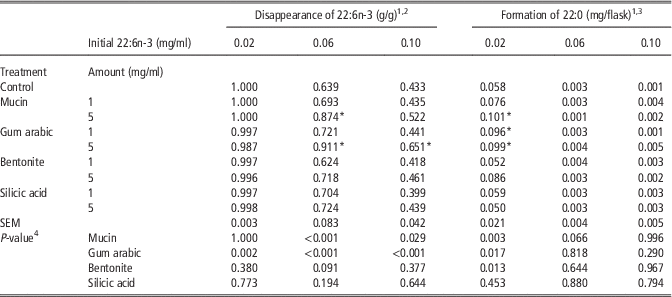
In the follow-up experiment, the effect of adsorbants on the biohydrogenation of 22:6n-3 over a 24 h batch in vitro incubation was evaluated (experiment 1). Irrespective of treatment, metabolism of 22:6n-3 when added at a low concentration (0.02 mg/ml) was extensive (Table 1). Increasing the amount of added 22:6n-3 resulted in lowered disappearance of 22:6n-3. Increasing amount of mucin or gum arabic increased linearly (P<0.05) 22:6n-3 disappearance, at initial 22:6n-3 concentrations of 0.06 and 0.10 mg/ml. Addition of bentonite or silicic acid did not alter the disappearance of 22:6n-3 compared with the control. Formation of 22:0 was observed when the initial concentration of 22:6n-3 was 0.02 mg/ml. At this concentration of 22:6n-3, increasing amounts of mucin, gum arabic and bentonite linearly increased the formation of 22:0 (P<0.05). For incubations containing a higher initial concentration of 22:6n-3 trace amounts of 22:0 were detected.
The effect of mucin, gum arabic, bentonite and silicic acid on the disappearance of 22:6n-3 and formation of 22:0 during 24-h incubations with mixed rumen fluid

1 Values represent least square means (n=3).
2 Disappearance of 22:6n-3 was calculated based on the proportional loss of 22:6n-3 during the incubation period.
3 Formation of 22:0 was calculated by subtracting the amount of 22:0 in the rumen fluid/buffer before the incubation from the amount at the end of incubations with 22:6n-3.
4 Significance of linear components of the response to adsorbant concentration.
*Indicates mean is different from the corresponding control value (P<0.05).
Influence of amount and type of fermentable substrate on metabolism of 22:6n-3
Addition of mucin or gum arabic resulted in a higher proportion of 22:6n-3 being recovered in the supernatant (0.386, 0.558 and 0.543 and for the control, gum arabic and mucin, respectively, SEM=0.037, P<0.05). Starch, cellulose, xylan and the substrate-depleted control did not alter the distribution of 22:6n-3 in incubation contents compared with the control (0.429, 0.397, 0.404 and 0.431 for the starch, cellulose, xylan and the depleted control, respectively, SEM=0.037, P>0.05).
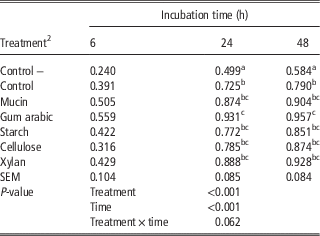
Inclusion of carbohydrates in the media resulted in greater disappearance of 22:6n-3 (Table 2). Gum arabic resulted in greater (P<0.05) disappearance of 22:6n-3 compared with the control. Replacing gum arabic with equal amounts of cellulose, starch or xylan did not alter 22:6n-3 disappearance compared with gum arabic or control.
The effect of substrate on the disappearance of 22:6n-3 (g/g) during incubation with mixed rumen bacteriaFootnote 1

a,b,cMeans with different superscript within a column differ (P<0.05).
1 The initial 22:6n-3 concentration was 0.06 mg/ml. Disappearance of 22:6n-3 was calculated based on the proportional loss of 22:6n-3 during the incubation period. Values represent least square means (n=3).
2 Control−: no carbohydrates present in the media, control: control− with carbohydrate mixture (0.64 mg/ml), mucin, gum arabic, starch, cellulose, xylan: control with 5 mg/ml of the respective components.
Metabolism of 18:2n-6 in presence of gum arabic and 22:6n-3
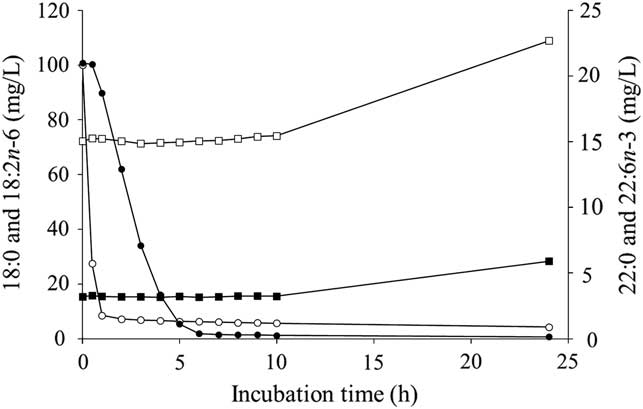
Initial concentrations of 18:2n-6 were found to decline rapidly during incubations of rumen fluid with 0.1 mg 18:2n-6/ml and 0.02 mg 22:6n-3/ml (Figure 1). Decreases in 18:2n-6 were accompanied by the transient accumulation of conjugated 18:2 isomers, mainly cis-9, trans-11-18:2, which were further hydrogenated to 18:1 isomers, mainly trans-11-18:1 (data not shown). Only after 24 h was an increase in 18:0 detected. Disappearance of 22:6n-3 occurred at a slower rate compared with 18:2n-6 (rate of disappearance 4.277 v. 0.973/h for 18:2n-6 and 22:6n-3, respectively, SEM=0.209, P=0.005). Isomerization of 18:2n-6 occurred at a high rate, whereas metabolism of 22:6n-3 was associated with a lag of 1.79 h after addition to the incubation flask (lag time of 0.13 v. 1.79 h for 18:2n-6 and 22:6n-3, respectively, SEM=0.309, P=0.021). Only after 24 h was 22:0 formed.
Temporal changes in the concentration of 18:2n-6 (open circles), 22:6n-3 (filled circles), 18:0 (open squares) and 22:0 (filled squares) during incubation of 18:2n-6 (100 mg/l) and 22:6n-3 (20 mg/l) with mixed rumen bacteria in presence of gum arabic (5 mg/ml). Values represent least square means (n=3) (SEM=1.13, 7.96, 1.13, 0.56 for 18:2n-6, 18:0, 22:6n-3 and 22:0, respectively).

Influence of gum arabic and 22:6n-3 on growth of B. fibrisolvens and B. proteoclasticus
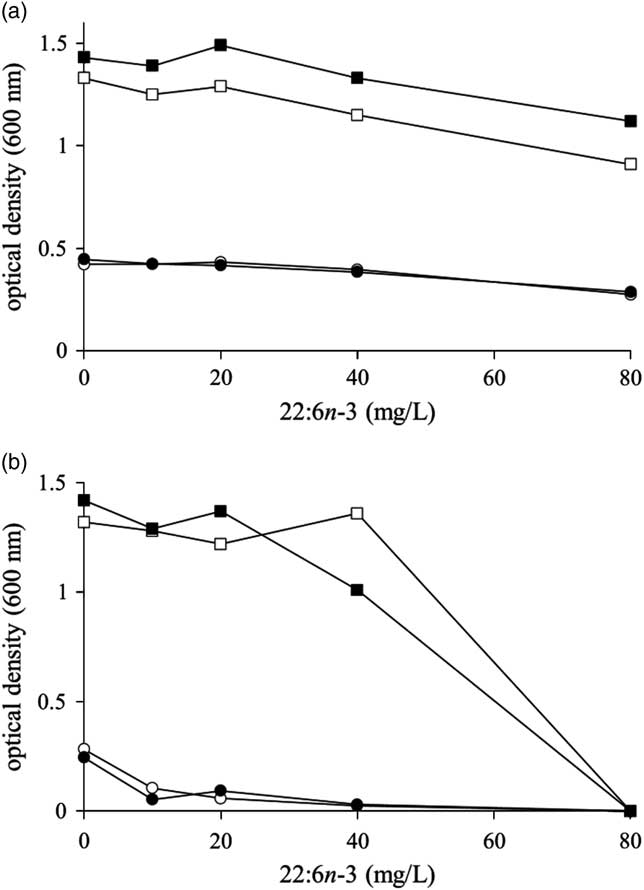
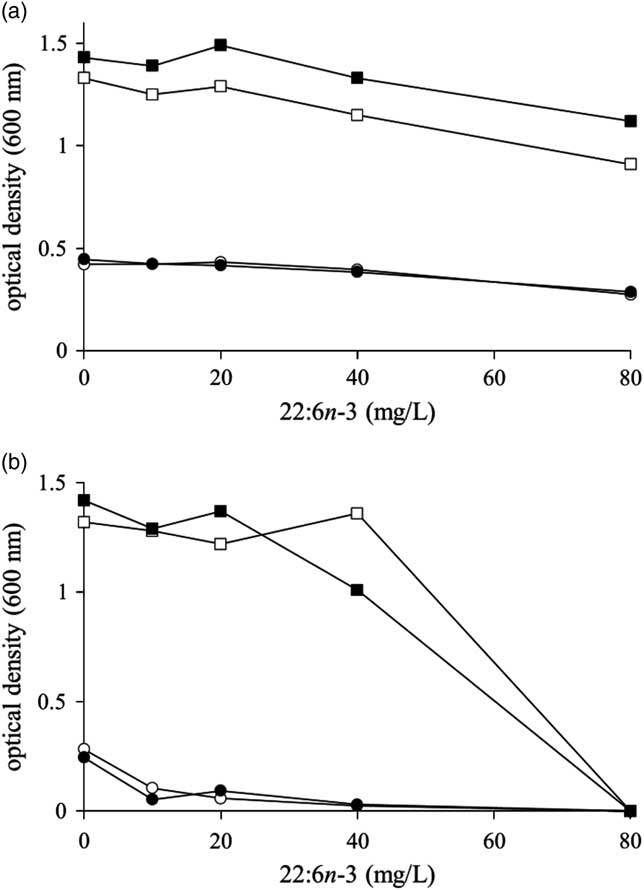
Increasing 22:6n-3 at inoculation lowered the optical density values measured after 24 h, with the decrease being more pronounced in cultures of B. proteoclasticus compared with B. fibrisolvens. Addition of gum arabic did not (P>0.05) negate the inhibitory effect of 22:6n-3 (Figure 2).
The effect of 22:6n-3 concentration without (open symbols) and with (filled symbols) gum arabic on maximum optical density during growth of Butyrivibrio fibrisolvens (a) and Butyrivibrio proteoclasticus (b) in medium 704 (squares) and RM02 medium (circles). Values represent least square means (n=3) (SEM=0.052, 0.058, 0.069, 0.027 for B. fibrisolvens grown in medium 704 and RM02 medium and B. proteoclasticus grown in medium 704 and RM02 medium, respectively).
Discussion
Disappearance of 22:6n-3
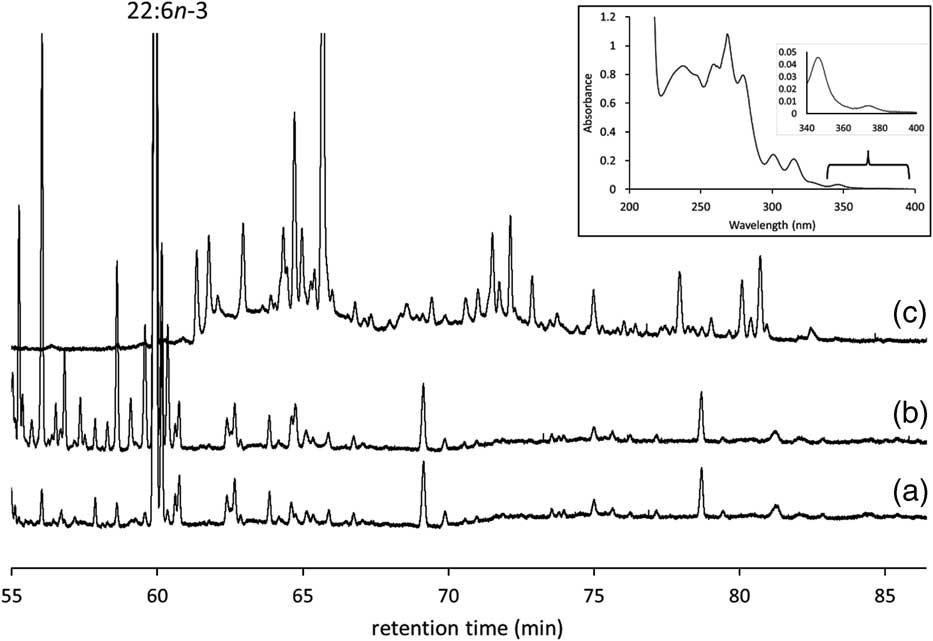
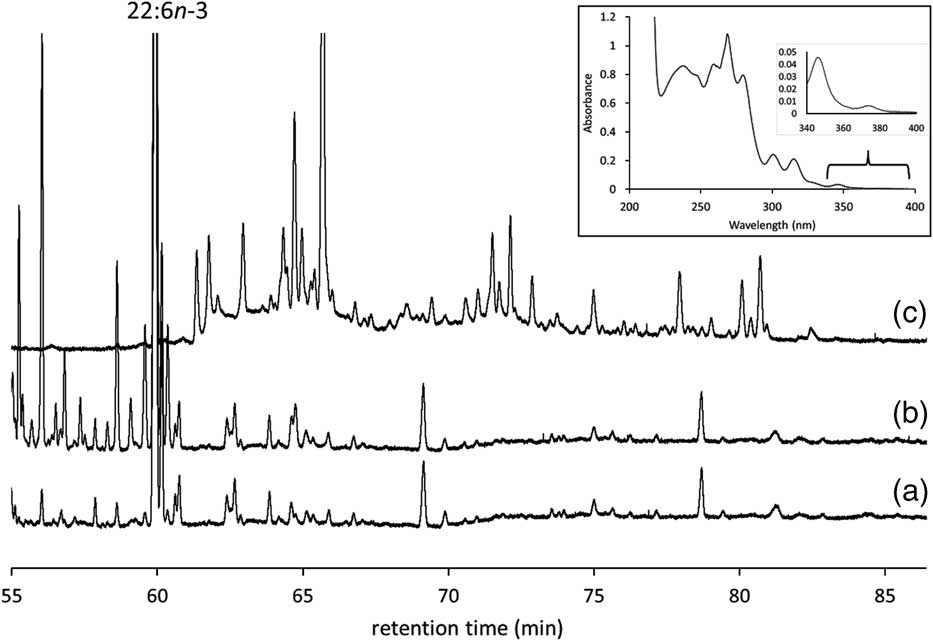
Both 18:2n-6 and 18:3n-3 are extensively hydrogenated in the rumen. A similar series of isomerization and reduction reactions has been suggested to be involved in the conversion of 22:6n-3 to 22:0 by rumen bacteria (Jenkins et al., Reference Jenkins, Wallace, Moate and Mosley2008). If the initial step of 22:6n-3, biohydrogenation is analogous to that described for 18:2n-6 and 18:3n-3, initial isomerization of a cis double bond would be expected to yield a 22-carbon conjugated product containing six double bonds that is subsequently reduced to a 22:5 intermediate (Jenkins et al., Reference Jenkins, Wallace, Moate and Mosley2008). However, no 22:6 conjugated FA was detected in omasal digesta of cows fed fish oil suggesting that the biohydrogenation of 22:6n-3 may differ from 18-carbon PUFA, by proceeding via the reduction of the cis double bond closest to the carboxyl group (Kairenius et al., Reference Kairenius, Toivonen and Shingfield2011). In the present series of experiments, no accumulation of products eluting in the GC chromatogram with a retention time greater than 22:6n-3 was observed (Figure 3), a region where conjugated isomers of 22:6 would be expected to elute with the polar column used in the present study. In order to identify the time window during which conjugated isomers of 22:6 elute, the latter were prepared by an alkaline treatment. Alkali isomerization of 22:6n-3 will produce numerous conjugated double bond systems. FA methyl esters of this mixture then have been analysed by GC to identify the retention time window during which these conjugated 22:6 isomers elute. No accumulation of products eluting in the GC chromatogram in this time window were observed (Figure 3). The lack of accumulation of a conjugated FA might indicate they are transient products which did not accumulate at the time of sampling. This is possible when the rate of formation of this conjugated FA is an order of magnitude smaller than the rate of disappearance. Alternatively, this might also indicate the initial product of 22:6n-3 metabolism is not a conjugated FA. Additional investigations based on, for example, GC-MS analysis of the products of 22:6n-3 metabolism in the rumen might provide an answer on whether a conjugated FA is the initial product of 22:6n-3 metabolism.
Partial gas chromatogram from (a) 0-h incubation and (b) 6-h incubation of mixed rumen bacteria with 22:6n-3 (0.02 mg/ml) in presence of gum arabic (5 mg/ml) and (c) conjugated 22:6 prepared by using alkaline treatment. The insert depicts the UV-spectra of conjugated 22:6.
In low amounts, disappearance of 22:6n-3 was extensive, but biohydrogenation was much lower when higher doses of 22:6n-3 were incubated, consistent with previous reports (AbuGhazaleh and Jenkins, Reference AbuGhazaleh and Jenkins2004; Klein and Jenkins, Reference Klein and Jenkins2011; Aldai et al., Reference Aldai, Hervas, Belenguer, Frutos, Mantecon and Kramer2012; Vlaeminck et al., Reference Vlaeminck, Braeckman and Fievez2014). In the present study, mucin, gum arabic, bentonite or silicic acid were added to incubation flasks to evaluate if they would influence the disappearance of 22:6n-3. We hypothesized these compounds provide an alternative site for adsorption for 22:6n-3. As a result, decreasing amounts of 22:6n-3 would be available to adhere to bacterial cells and hence adverse effects on bacterial growth and metabolic activity are expected to be reduced. The distribution of 22:6n-3 between the pellet and supernatant suggested that addition of bentonite and silicic acid did not largely alter the adsorption of 22:6n-3 between liquid and solids. In contrast, addition of gum arabic and mucin resulted in a lesser recovery of 22:6n-3 in incubation solids. Our preliminary experiments showed that gum arabic and mucin were recovered in the liquid phase. These findings suggest that both gum arabic and mucin may have provided an alternative to feed particles and bacteria for the adsorption of 22:6n-3. At the same time, mucin and gum arabic increased the disappearance of 22:6n-3 during the 24 h incubation assay, whereas bentonite and silicic acid had no effect. The relation between partitioning and disappearance of 22:6n-3 might indicate that the phase distribution plays a critical role in the biohydrogenation of 22:6n-3. Consistent with this, mucin was shown to protect Lactobacillus reuteri from the inhibitory effects of 18:2n-6 by trapping 18:2n-6 into the gel-like compartment of mucin lowering the interaction of 18:2n-6 with the bacterial cell membrane (De Weirdt et al., Reference Desbois and Smith2013). Similarly, the growth inhibitory effect of 18:2n-6 on P. freudenreichii was eliminated by dispersing it in a sufficient concentration of polyoxyethylene sorbitan monooleate detergent (Rainio et al., Reference Rainio, Vahvaselkä and Laakso2002).
The effect of gum arabic on growth of bacteria in presence of 22:6n-3 was evaluated using B. fibrisolvens and B. proteoclasticus, species known to be involved in the biohydrogenation of 18-carbon PUFA. However, gum arabic did not prevent 22:6n-3 inhibiting the growth of either species. Although the contribution of these species to biohydrogenation of 22:6n-3 in mixed cultures is unclear (Maia et al., Reference Maia, Chaudhary, Figueres and Wallace2007), these results might indicate the stimulating effect of mucin and gum arabic on hydrogenation of 22:6n-3 in mixed cultures is not directly related to the protection from the growth inhibitory effect of 22:6n-3.
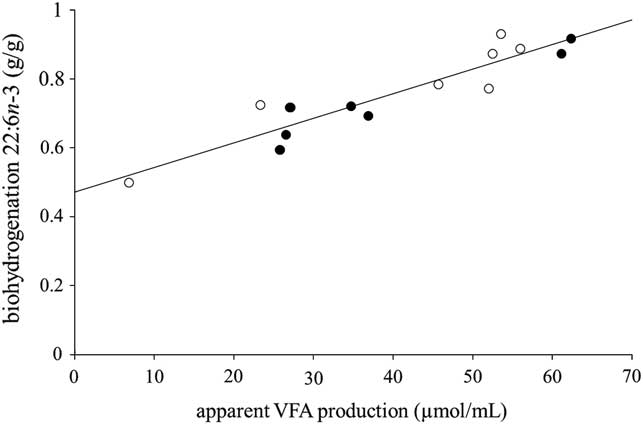
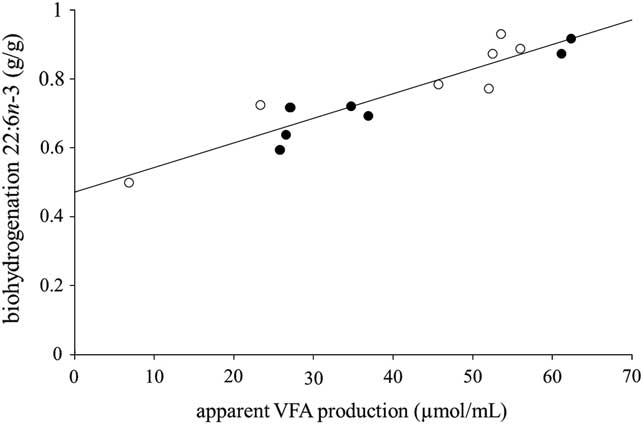
Addition of mucin or gum arabic stimulated not only the disappearance of 22:6n-3 but also production of VFA during the 24-h batch incubation assay (Supplementary Tables S1–S4). Gum arabic is a complex mixture of glycoproteins and polysaccharides and mucins are large glycoproteins (Bansil and Turner, Reference Bansil and Turner2006). Hence, aside from its colloidal properties, both gum arabic and mucin could potentially serve as fermentable substrate for rumen bacteria. As both VFA production and partitioning of 22:6n-3 between the pellet and supernatant were related to disappearance of 22:6n-3, an additional experiment was performed in order to differentiate between the protective effect and the substrate effect of gum arabic and mucin. The results illustrate the importance of amount of substrate for extensive disappearance of 22:6n-3 but the lack of significant effects between substrates indicates the type of substrate is of lesser importance. Hence, the stimulating effect of mucin and gum arabic most probably is largely due to an increased amount of fermentable substrate and not directly related to the provision of an alternative site for adsorption as originally hypothesized. Combined data from experiments 1 and 2 illustrate disappearance of 22:6n-3 was related to apparent VFA production (Figure 4). Overall, these data suggest a close association between production of VFA and disappearance of 22:6n-3.
Association of apparent production of volatile fatty acid (VFA) production and disappearance of 22:6n-3 during 24-h incubations with 22:6n-3 (0.06 mg/ml). Values represent mean values (n=3) obtained in experiment 1 (filled circles) and experiment 2 (open circles). Y=0.472(SE=0.034, P=0.046)+7.14×10⁻³ (SE=0.804×10⁻³ , P<0.001)×X.
Formation of 22:0
When 22:6n-3 was added at a low concentration, up to 0.1 mg 22:0 was formed. At higher initial concentrations of 22:6n-3 only trace amounts of 22:0 were formed in agreement with other reports (AbuGhazaleh and Jenkins, Reference AbuGhazaleh and Jenkins2004; Aldai et al., Reference Aldai, Hervas, Belenguer, Frutos, Mantecon and Kramer2012; Vlaeminck et al., Reference Vlaeminck, Braeckman and Fievez2014). The production of 22:0 from 22:6n-3 by ruminal batch cultures has been reported, but only in trace amounts (Klein and Jenkins, Reference Klein and Jenkins2011) and its production seemed of minor to negligible importance (Shingfield et al., Reference Shingfield, Lee, Humphries, Scollan, Toivonen, Beever and Reynolds2011 and Reference Shingfield, Reynolds, Hervas, Griinari, Grandison and Beever2012). When low concentrations were added, up to 20% of the 22:6n-3 was recovered as 22:0 indicating that the mixed rumen population is capable of the reduction of all six double bonds. However, the absence of 22:0 formation when initial 22:6n-3 increased might indicate that the capacity of rumen microbial communities to reduce double bonds of long-chain PUFA in the rumen is limited (Shingfield et al., Reference Shingfield, Reynolds, Hervas, Griinari, Grandison and Beever2012). The appearance of 22:0 was only observed after long incubation times, indicating that the process is slow. This might be due to the inhibitory effect of 22:6n-3 on its biohydrogenation to 22:0, or is merely a reflection of the different steps needed before the substrates of 22:0 formation (i.e. 22:1 isomers) become available.
Previous reports show that the inclusion of 22:6n-3 in the diet of ruminants increase the accumulation of 18:1 isomers with little 18:0 formed (e.g. Vlaeminck et al., Reference Vlaeminck, Mengistu, Fievez, de Jonge and Dijkstra2008), most likely due to the inhibitory effect of 22:6n-3 on the bacteria able to convert 18:1 into 18:0 (Boeckaert et al., Reference Boeckaert, Vlaeminck, Fievez, Maignien, Dijkstra and Boon2008; Kim et al., Reference Kim, Huws, Lee, Wood, Muetzel, Wallace and Scollan2008). The formation of the saturated product 22:0 raised the question whether under the same conditions, 18:0 is also formed from 18:2n-6. Although the substrates for 18:0 formation (i.e. 18:1 isomers) reached a maximum level after 2 h of incubation, an increase in 18:0 was not detected until the 24-h sampling time. The fact that the inhibitory effect of 22:6n-3 on 18:0 formation is reversible, suggests that it is partially driven by 22:6n-3 and that 18:0 formation may continue once 22:6n-3 concentrations have decreased to a certain threshold. It should be noted that 22:6n-3 was absent from 5 h onwards (Figure 1), which might suggest that intermediate products of 22:6n-3 metabolism are equally effective in inhibiting the conversion of 18:1 to 18:0. Biohydrogenation is required to lower toxicity and therefore the reduction of products containing more double bonds are a greater priority that explains the lack of 18:1 reduction at time points where biohydrogenation of 22:6n-3 did occur. Once most of the initial 22:6n-3 is transformed to less toxic products, both 18:1 and 22:1 isomers are metabolized to their saturated counterparts.
Conclusions
The present study tested the hypothesis that the addition of adsorbant provides an alternative site for adsorption of 22:6n-3 decreasing the amount available to adhere to bacterial cells and, hence lower the adverse effects on growth and metabolic activity. Both mucin and gum arabic increased the disappearance of 22:6n-3 during the 24-h in vitro assay. The increased disappearance of 22:6n-3 observed with mucin and gum arabic was probably due to stimulation of bacterial growth rather than the provision of an alternative site for adsorption. A relatively high proportion of 22:6n-3 can be reduced to 22:0 provided the initial concentration is low.
Acknowledgements
Research funded by the Fund for Scientific Research-Flanders (Belgium) and the Special Research Fund of the Ghent University (Belgium). L. P. T. received a mobility grant within The Erasmus Mundus Action Two Partnership programme (Lotus Unlimited).
Supplementary Material
To view supplementary material for this article, please visit http://dx.doi.org/10.1017/S1751731116000367