Palpitations are a common complaint among children presenting for outpatient cardiology evaluation. Palpitations are defined as an unpleasant sensation of rapid, irregular, and/or forceful beating of the heart. The incidence of structural or functional cardiac pathology causing palpitations is very low. Reference Lang, Bolin, Hardy, Tang and Collins1,Reference Weber and Kapoor2
In 2014, the American College of Cardiology published appropriate use criteria for echocardiography in children, including recommendations for the evaluation of palpitations in outpatient paediatric cardiology clinics. Reference Campbell, Douglas, Eidem, Lai, Lopez and Sachdeva3 Prior to this, there were no standardized guidelines on the use of echocardiography in outpatient paediatric cardiology clinics, and the utilization of echocardiography was influenced by factors, such as younger patient age, sex, insurance, distance from clinic, and physician experience. Reference Sachdeva, Travers and McCracken4
The appropriate use criteria was retrospectively applied to patients presenting to our outpatient paediatric cardiology clinics. Our objectives were to identify the frequency and diagnostic yield of echocardiograms performed for palpitation-related indications at outpatient practices in relation to the appropriate use criteria.
Materials and methods
A single-centre, Institutional Review Board approved, retrospective study was conducted of patients 4–18 years presenting for initial chief complaint of palpitations to an outpatient paediatric cardiology clinic. Charts from 2015 to 2017 were reviewed. Patients were included in the study based on International Classification of Diseases 10 (ICD-10) codes. Patients were excluded if they had additional complaints of chest pain or syncope, murmur, prior echocardiogram, or history of congenital heart disease. These additional complaints and physical examination findings can confound echocardiography recommendations, based on the 2014 appropriate use criteria. No specific interventions were taken to educate providers on the 2014 appropriate use criteria.
The patients’ charts in the electronic medical record were reviewed. Data on demographics, provider, clinic location, electrocardiogram findings, and echocardiogram findings were obtained. Seven clinic sites and eight different paediatric cardiologists were included. The echocardiograms were ordered by the cardiologists following history and physical examination. Indications for echocardiograms in patients were classified based on the appropriate use criteria as “appropriate,” “may be appropriate,” or “rarely appropriate.” “Appropriate” indications for echocardiography in patients with palpitations include patients with known cardiomyopathy, a family history of sudden cardiac death <50 years of age or death and/or pacemaker or implantable cardioverter defibrillator placement, family history of cardiomyopathy, and patients with supraventricular tachycardia. “May be appropriate” indications included patients with palpitations who had abnormal electrocardiogram, known cardiomyopathy, premature ventricular contractions in the prenatal or neonatal period, and premature ventricular contractions after the neonatal period. “Rarely appropriate” indications included patients with palpitations without signs or symptoms of cardiovascular disease, benign family medical history, no recent/normal electrocardiogram, family history of channelopathy, premature atrial contractions in the prenatal or neonatal period, premature atrial contractions after the neonatal period, sinus bradycardia, or sinus arrhythmia.
Echocardiography findings were classified as abnormal, incidental, or normal based on criteria established in the appropriate use criteria implementation study. Reference Sachdeva, Allen and Benavidez5 Incidental findings were findings not thought to contribute to the chief complaint. Incidental findings included findings such as patent foramen ovale, small patent ductus arteriosus, and left aortic arch with aberrant right subclavian artery. Abnormal echocardiograms were stratified based on minor, moderate, and severe. Minor findings were those that were not incidental findings and may require follow-up but no intervention. Moderate findings altered patient management but did not require urgent intervention, and severe findings required urgent hospitalization or management. Normal findings had no structural abnormalities.
Continuous variables, such as age, were reported as median values with ranges. Discrete variables are reported as counts or percentages.
Results
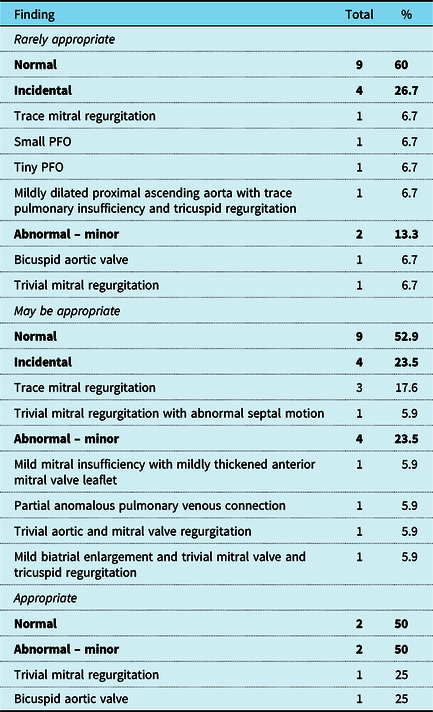
A total of 286 patients presenting with palpitations were identified, with 128 (52% female) patients meeting inclusion criteria. A majority of the patients that were excluded had concomitant symptoms, such as chest pain, syncope, or murmur on exam. All patients included in the study had normal physical examination and no history of arrhythmia. Median age at time of echocardiogram was 14 years (range, 4–18 years). Echocardiograms were performed on 28% (36) of patients. The appropriate use criteria were retrospectively applied, and indications for echocardiogram were classified as “appropriate,” “may be appropriate,” or “rarely appropriate.” Echocardiogram findings were classified as abnormal, incidental, or normal (Table 1). Incidental findings were noted in 22% (n = 8) of echocardiograms.
Echocardiographic findings
PFO = patent foramen ovale
Of the 128 patients included, five met the “appropriate” criteria. Of the five patients meeting “appropriate” criteria, four received an echocardiogram. Among the four patients in the “appropriate” category who received an echocardiogram, three studies were due to a family history of cardiomyopathy, and one was due to a family history of sudden cardiac death. Minor abnormalities were seen in two (50.0%) of the echocardiograms ordered for indications rated “appropriate.”
Of the 128 patients included, 29 met the “may be appropriate” criteria, with 17 receiving an echocardiogram. Of the 17 patients in the “may be appropriate” category who received an echocardiogram, all patients had an abnormal electrocardiogram. Abnormal findings included premature ventricular contractions (n = 2), nonspecific ST changes (n = 1), incomplete right bundle branch block (n = 1), left ventricular hypertrophy (n = 4), abnormal atrial rhythm or enlargement (n = 4), sinus tachycardia (n = 2), ventricular pre-excitation (n = 2), and long QT (n = 1). Minor abnormalities were seen in four (23.5%) of the echocardiograms ordered for indications rated “may be appropriate.”
Of the 128 patients included, 94 met the “rarely appropriate” criteria, with 15 receiving an echocardiogram. Of the 15 patients in the “rarely appropriate” category, 13 cases had a normal electrocardiogram, and two patients had sinus bradycardia on electrocardiogram. Minor abnormalities were seen in two (13.3%) of the echocardiograms ordered for indications rated “rarely appropriate.”
No echocardiograms had moderate or severe abnormal findings, regardless of appropriate use criteria classification.
Discussion
At our institution, echocardiograms were obtained for “rarely appropriate,” “may be appropriate,” and “appropriate” palpitation-related indications. Echocardiography in the evaluation of “rarely appropriate,” “may be appropriate,” and “appropriate” palpitation-related indications is of low diagnostic yield, with only minor echocardiographic abnormalities.
Nearly a decade prior to the paediatric appropriate use criteria, adult appropriate use criteria were published to help guide the use of echocardiograms. Studies on the adult appropriate use criteria have shown that even when echocardiograms were done for “appropriate” indications, the diagnostic yield and management changes were low. Reference Bethge, Penciu, Baksh, Parve, Lobraico and Keller6 This study found similar outcomes with only minor abnormalities that do not warrant intervention in the echocardiograms ordered for indications rated “appropriate.”
Similar studies have also been performed on the diagnostic yield of echocardiograms performed for chest pain and syncope according to the appropriate use criteria, reaffirming low diagnostic yield in echocardiograms for the “rarely appropriate” indications. Reference Pelletier, Blanchard, Chamberlain, Hornik, Campbell and Hill7,Reference Chamberlain, Pelletier, Blanchard, Hornik, Hill and Campbell8
Preliminary studies assessing paediatric appropriate use criteria did show that a greater percentage of patients with abnormal echocardiograms had an “appropriate” indication for echocardiography; however, patient outcomes and management decisions were not studied. Reference Sachdeva, Allen and Benavidez5 Measuring patient outcomes and management decisions is the next step in evaluating the paediatric appropriate use criteria, as our data indicate that the appropriate use criteria may need to be re-evaluated to be more stringent, especially for palpitation-related indications.
Furthermore, the nature of the appropriate use criteria indications considered appropriate is such that echocardiographic abnormalities might not manifest at the time of presentation. Incidental abnormalities such as bicuspid aortic valve require further follow-up and augment healthcare costs. Limiting the unnecessary use of echocardiograms can curb patient healthcare expenses. Initiatives such as transparency and education regarding the cost and use of echocardiograms may reduce the number of echocardiograms ordered. Reference Kozak, Trumbo, Christensen, Leverenz, Shotwell and Kingeter9
Limitations of this study include the single centre retrospective methods of the study. This study also had a small sample size, with a small number of patients falling within the “appropriate” category.
Further areas of research can assess changes to patient outcomes and management decisions as a result of the appropriate use criteria. Furthermore, other modes of non-invasive testing, such as the Holter monitor and loop recorders, are also options to assess palpitations. Reference Rajagopalan, Potts and Sanatani10 Several studies have been conducted to assess the yield of such testing, but there exists no appropriate use criteria for these tests. Reference Aman, Qureshi and Sadiq11 In conclusion, the diagnostic yield of echocardiography for palpitations in outpatient paediatric cardiology clinics is low.
Acknowledgements
None.
Financial Support
This research did not receive any specific grant from funding agencies in the public, commercial, or not-for-profit sectors.
Conflicts of Interest
None.
Ethical Standards
This study was approved by the University Hospitals Institutional Review Board. This research does not involve human experimentation.