

Introduction
For a long time, scholars have focused on whether police behavior is consistently characterized by racial disparities and discrimination. Leveraging multiple data sources, among which are administrative records that measured the race of the person stopped, scholars have shown that across different periods, contexts, outcomes, and often imperviously to reform efforts, law enforcement in the United States disproportionately targets minorities in their routine activities (Alexander Reference Alexander2010; Baumgartner et al. Reference Baumgartner, Epp and Shoub2018; Knox et al. Reference Knox, Lowe and Mummolo2020; Shoub et al. Reference Shoub, Epp, Baumgartner, Christiani and Roach2020). However, the field has seldom dedicated the same attention to studying how the police interact with other minorities, such as LGBTQ+ people, and rarely using the same type of administrative data that dominates the study of racially biased policing. This is despite the fact that law enforcement has played a key role in reproducing the marginalization of the queer community in the United States, particularly through their criminalization and labeling as “deviant” (Dwyer Reference Dwyer, Peterson and Panfil2014; Lvovsky Reference Lvovsky2021; Mogul et al. Reference Mogul, Ritchie and Whitlock2011; Shoub Reference Shoub2025).
In this article, I aim to cover this gap in the literature by exploring disparities in policing towards LGBTQ+ civilians, leveraging a unique data collection effort where both race and queerness are recorded, using information on 3.1 million police stops in San Francisco and Los Angeles between 2018 and 2025. In particular, the aim of the article is to estimate whether being identified as queer increases the likelihood of being searched, arrested, or having force used against oneself by the police, both by itself and in its interaction with race. Across different tests and models, I find consistent evidence that the two departments examined disproportionately targeted LGBTQ+ people in their policing activities. Unequal treatment against queer people, compared to cishet (Cisgender and Heterosexual) civilians, is consistently found in law enforcement decisions to search, arrest, and use force.
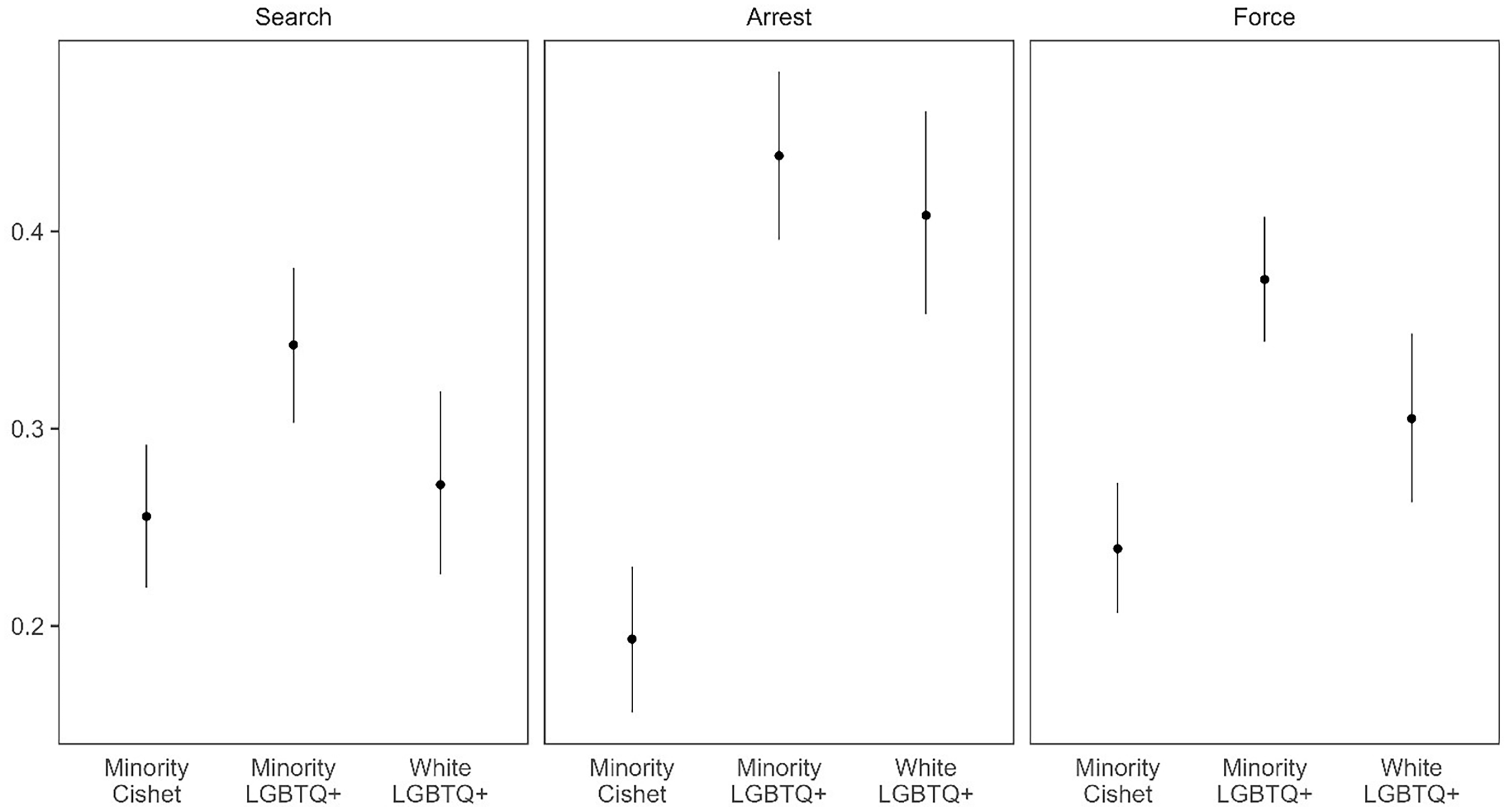
I also take advantage of the unique nature of the data to apply an intersectional framework to the study of policing and test whether the interplay of race with queerness is associated with harsher police treatment. In this regard, models consistently show that being LGBTQ+ significantly increases the probability of being searched, arrested, or having force used against them, both for White and minority civilians. My findings reveal that LGBTQ+ and intersectional discrimination in post-stop decisions is deep: 34% of searches, 44% of arrests, and 38% of uses of force against LGBTQ+ and minority civilians (27%, 41%, and 31% against LGBTQ+ and White civilians) would not have happened had the person been cisgender, heterosexual, and White.
The study contribution is thus both theoretical and empirical. These findings have important relevance for the study of policing, as well as for intersectional theory, as many authors in recent years have stressed how necessary it is to integrate this perspective for social sciences (Choo and Ferree Reference Choo and Ferree2010), and especially in the field of police studies (Gaynor and Blessett Reference Gaynor and Blessett2022; Morgan Reference Morgan2022). Theoretically, I posit that in order to understand how the police operate, scholars must understand that oppression does not come exclusively from racialization, but it is the result of interlocking systems of oppression that coexist next to one another and work together when minoritized identities and positionalities intersect to multiply a person’s vulnerabilities (Christiani Reference Christiani, Brown, Block and Stout2020). In this sense, queerness works as a great example of how this plays out in policing, by itself and in its intersection with racialization. Empirically, demonstrating the existence of an intersectional, double disadvantage in relation to race and queerness, this study makes it clear that future research on police discrimination must include, whenever possible, an analysis of how intersecting marginalized identities are treated by law enforcement.
Intersectionality, hence, greatly matters, and it is a relevant theoretical framework for the study of law enforcement biases too (Paik Reference Paik2017). The second finding also has important methodological implications for the literature on racially biased policing. Specifically, the results suggest that treating racial groups as internally homogeneous may obscure meaningful within-group variation. In particular, failing to account for LGBTQ+ identity can mask how policing patterns differ among White and minority civilians, complicating inferences about the magnitude and structure of law enforcement discrimination. As the study of police discrimination is making both methodological and substantive leaps (Knox et al. Reference Knox, Lowe and Mummolo2020), scholars must address the lived experience of all oppressed identities in police-civilian interactions to gain a comprehensive understanding of how policing works and how biases can be addressed.
Finally, this research is also timely outside its academic scope: the United States is facing a rise of anti-LGBTQ+ prejudice and discrimination, with FBI data demonstrating that hate crimes against this community were on the rise in the 2021–2023 period. Recent news has also shown that the Department of Homeland Security has just shed its regulations that prohibited it from surveilling people only because of their gender or sexual orientation (Gilmer Reference Gilmer2025), opening the door to the over policing of LGBTQ+ people in the country, while many States are introducing bills criminalizing being transgender (American Civil Liberties Union 2025). This, moreover, is all happening at a moment when more people identify as LGBTQ+ in the country (Jones Reference Jones2025). As the LGBTQ+ community, together with racialized individuals, faces increasing precariousness and vulnerability, studying the real-life consequences of police discrimination against them is thus of fundamental importance.
Biased Policing: Race and Beyond
The nature of policing in the United States has historically been connected with race and the racialization of Blacks and Hispanics in particular. For this reason, academics have extensively dealt with research questions that study how law enforcement behaves towards racial minorities. Studies have consistently found racial disparities and bias across a wide range of outcomes: stops (Gelman et al. Reference Gelman, Fagan and Kiss2007; Goel et al. Reference Goel, Rao and Shroff2016; Grogger and Ridgeway Reference Grogger and Ridgeway2006), frisks (Levchak Reference Levchak2017; Ryan Reference Ryan2016), searches (Pierson et al. Reference Pierson, Simoiu, Overgoor, Corbett-Davies, Jenson, Shoemaker, Ramachandran, Barghouty, Phillips, Shroff and Goel2020), arrests (Baumgartner et al. Reference Baumgartner, Epp, Shoub and Love2020), ticketing (Dunn Reference Dunn2009), use of force (Donahue and Torrats-Espinosa Reference Donahue and Torrats-Espinosa2024; Knox et al. Reference Knox, Lowe and Mummolo2020; Legewie Reference Legewie2016), and spatial patterns of patrolling (Bass Reference Bass2001; Capers Reference Capers2008; Meehan and Ponder Reference Meehan and Ponder2002). African American citizens have been found to be more likely to be policed when involved in political activity such as protesting (Davenport et al. Reference Davenport, Soule and Armstrong2011). We also have a clear view of how these biased interactions can then shape the civic and political engagement of minorities, making them less likely to report crimes (Desmond et al. Reference Desmond, Papachristos and Kirk2016) and vote in elections (Ben-Menachem and Morris Reference Ben-Menachem and Morris2023). This extensive knowledge on how police-civilian interactions are shaped by race and in turn shape the lived experiences of racial minorities has spurred strong calls throughout the years to reform the police (Akbar Reference Akbar2020; Vitale Reference Vitale2017).
Outside of this established field, however, much less is known about how law enforcement behaves towards other groups, such as the LGBTQ+ community. When it comes to estimating if police discrimination exists against marginalized identities beyond race, the academic literature becomes scarce, especially due to a lack of data. In the last decade or so, some scholars have started to turn their heads to how policing relates to queerness. Yet, evidence is still scant, and most studies are either qualitative or conducted using survey data. Although extremely important, they fall short of providing the same big-picture estimates that comprehensive analyses of administrative records of stops can give. A recent exception is a study by Shoub (Reference Shoub2025), examining police behavior towards LGBTQ+ and disabled people, although limiting its scope only to simple disparities in searches and without looking at the interaction of these identities with each other or with race. Moreover, Shoub (Reference Shoub2025) considers these identities separately, rather than jointly. Here, on the other hand, I aim to look at the intersection of race and LGBTQ+ status, under an intersectional framework and using a multiplicative approach, drawing from an understanding of biased policing as coming from intersectional stereotyping, too (Christiani Reference Christiani, Brown, Block and Stout2020; Gaynor and Blessett Reference Gaynor and Blessett2022).
Hence, this paper aims at filling this gap and provide more comprehensive estimates of bias across all policing activities, with a focus on answering two relevant research questions: (1) are post-stops decisions to search, arrest, and use force influenced by the LGBTQ+ status of the civilian?; and (2) how does the intersection of queerness with race shape police-civilian interactions?
The Policing of Queerness in the United States
The objective of this research is hence to study whether significant disparities and bias exist when agents come into contact with people whom they perceive as being LGBTQ+ and if the interaction of belonging to LGBTQ+ identities with racial minority status exposes people to more severe police targeting in post-stop decisions. By registering the officers’ perception of whether a person is LGBTQ+ or a racial minority, the data used in this study help to identify the mechanism that can lead to discrimination dependent on the individual’s identity: regardless of whether the person stopped really belongs to one of these categories, it is the agent’s perception that will mediate the transformation of its possible prejudice into discriminatory behavior.
It is crucial to understand policing, to study how identities in the spectrum of queerness shape police-civilian interactions and in which directions. The police are oftentimes understood as an institution that is also crucial in maintaining the status quo, reproducing socioeconomic inequalities through the criminalization and the marginalization of vulnerable groups (Rios et al. Reference Rios, Prieto and Ibarra2020; Vitale Reference Vitale2017). Whether it is Alexander (Reference Alexander2010) or Wacquant (Reference Wacquant2001) describing how police and prisons have been crucial in maintaining the racial status quo in the United States; Soss and Weaver (Reference Soss and Weaver2017) speaking about its role in shaping what they call “Race-Class Subjugated Communities”; or Knox et al. (Reference Knox, Lowe and Mummolo2020) framing it as a “a political act in and of itself [that] determine[s] who gets protected, punished, or left to fend for themselves” (621), law enforcement undoubtedly plays a key part in shaping the (mis)fortunes of minoritized communities all around the country, across the spectra of race, gender identity, or sexual orientation.
Considering LGBTQ+ identities, the role of law enforcement (as well as that of prisons or mental institutions) in reproducing their marginalization has been clear throughout history (Stanley and Smith Reference Stanley and Smith2011). Lvovsky (Reference Lvovsky2021) cites, among others, U.S. police departments creating “moral squads” in the 50s, whose objective was to suppress the “public manifestations of queer life” (5). Through institutional practices like this, LGBTQ+ people have been disproportionately targeted by police agents in their spaces and communities for at least a century, with the daily harassment, surveillance, and patrolling of officers culminating in high-profile clashes between the police and the queer community that shaped the future of LGBTQ+ liberation in the country (Lvovsky Reference Lvovsky2021; Stanley and Smith Reference Stanley and Smith2011). Law enforcement played an active part in violently repressing LGBTQ+ spaces in the United States in episodes such as during the raid at the Compton Cafe in 1966 or at the Stonewall Inn in 1969 (Hanhardt Reference Hanhardt2008) or when deploying violence during AIDS protests in the 1990s (Stockdill Reference Stockdill2002). The criminalization of HIV has also been, in the 1980s and 1990s, a means to police and criminalize non-conforming gender and sexualities (Stanley and Smith Reference Stanley and Smith2011). None of this is ancient history either: just in 2003, the police raided a gay club in Detroit, addressed its customers with slurs, and used violence against them (Mogul et al. Reference Mogul, Ritchie and Whitlock2011). It is also relevant to remember that until the same year, homosexuality was still criminalized in many U.S. states, when the Supreme Court’s decision in Lawrence v. Texas struck the remaining so-called “Sodomy Laws” still standing, and that we are recently witnessing a wave of criminalization against transgender identities and gender affirming care in many U.S. states (Movement Advancement Project Reference Project2025).
Criminalization and harassment are hence not a thing of the far past, and police misconduct against LGBTQ+ people is to this day “systemic and commonplace” (Mogul et al. Reference Mogul, Ritchie and Whitlock2011, 5). Recent literature on the topic has consistently found that LGBTQ+ interactions with the police are still characterized by profiling, harassment, and violence (Hodge and Sexton Reference Hodge and Sexton2020; Mallory et al. Reference Mallory, Hasenbush and Sears2015; Mogul et al. Reference Mogul, Ritchie and Whitlock2011). A 2005 report by Amnesty International describes widespread violence, brutality, and abuses in policing and imprisonment of LGBTQ+ people in the United States, and data from the 2015 United States. Transgender Survey (James et al. Reference James, Herman, Keisling and Mottet2019) saw 58% of respondents reporting some sort of mistreatment in their interaction with law enforcement. Recent scholarship (Girardi Reference Girardi2022) finds that, in the European context, “queer visibility and performativity were associated with higher risks of being victimized and criminalized by law enforcement” ( 859), a finding mirrored by Fileborn (Reference Fileborn2019) when analyzing the context of regional Victoria. Sexual and gender minorities are also disproportionately incarcerated in the United States and face a higher risk of victimization or sanctions (e.g., solitary confinement) when imprisoned (Meyer et al. Reference Meyer, Flores, Stemple, Romero, Wilson and Herman2017). As a result, scholars have found that LGBTQ+ people are more likely to support police reform than cishet people (Jenness and Vogler Reference Jenness and Vogler2025), as well as more likely to perceive law enforcement negatively and as a foe (Owen et al. Reference Owen, Burke, Few-Demo and Natwick2018; Vogler and Jenness Reference Vogler and Jenness2023).
Policing from an Intersectional Perspective
As Shoub (Reference Shoub2025) argues, individual officer biases and the historical perception of some identities as “deviant” can set the scene for police discrimination against them, and this has paved the way for the over policing of LGBTQ+ people, alongside communities of color, across U.S. history.
This is why there is a need, when analyzing police-civilian interactions, to apply an intersectional framework, when possible, as policing has clearly had great implications for the marginalization of both LGBTQ+ people and racial minorities in the United States. “Intersectionality” is a term coined by Kimberlé Crenshaw (Reference Crenshaw1991) to describe how interconnected identities—in Crenshaw’s case, those of women of color—create unique, marginalized positionalities that are shaped by multiple systems of oppression, which intersect and converge to create specific “patterns of subordination” ( 1249) and of marginalization in the socio-economic world. In this regard, marginalized identities and the processes of discrimination leveraged against them (by institutions like the police, too) should be understood as given significance by systems of oppression, such as white supremacy, cisheteronormativity, and the patriarchy, which slot racialized and LGBTQ+ people into subordinate positionalities in the U.S. society and beyond.
Considering the interaction with other marginalized identities—to say, other axes of oppression—when studying police discrimination is hence crucial (Collins Reference Collins2015). In this regard, an intersectional framework can guide us to understand how the structural discrimination and oppression that society leverages against both racial minorities and LGBTQ+ people should be reflected, too, in how the police exercises its power to oppress civilians who belong to a racial minority, the LGBTQ+ community, or both.
Some scholars have recently started to rely on intersectionality to analyze policing at the intersection of race, class, gender, or age, finding that the interplay of these positionalities is indeed a factor in who is targeted by law enforcement and why (Brunson and Miller Reference Brunson and Miller2006; Christiani Reference Christiani, Brown, Block and Stout2020; Cooper Reference Cooper2021; Gonzalez Reference Malone Gonzalez2019; Roach et al. Reference Roach, Baumgartner, Christiani, Epp and Shoub2020). Drawing from an intersectional perspective, a recent study has shown that transgender women of color in New York City are subjected to higher rates of police violence and victimization, compared to both cisgender and transgender White women (Duncan et al. Reference Duncan, Park, Dharma, Torrats-Espinosa, Contreras, Scheinmann, Watson, Herrera, Schneider, Khan, Lim, Trinh-Shevrin and Radix2024). Other authors (Gaynor and Blessett Reference Gaynor and Blessett2022) have delved into what they call the “intersectional subjection” of LGBTQ+ people of color by law enforcement in New Orleans, and how predatory policing furthers the marginalization of these identities. Queerness can hence intersect with race (and class) in making people extremely vulnerable when interfacing with the policing and the carceral system and put them at a higher risk of citation, arrest, or use of force by law enforcement (Morgan Reference Morgan2022, Reference Morgan2021; Nelson Reference Nelson2010). The intersection of queerness and race has also been recently linked to a higher vulnerability to violent crime (Flores et al. Reference Flores, Wilson, Langton and Meyer2023).
This is eliciting calls to broaden the scope of analysis when studying law enforcement profiling. As Morgan (Reference Morgan2022) states, an intersectional approach is fundamental to deepen our understanding of how the police operate in society, as well as how it interacts not only with gender or sexuality but also with race. Mogul et al. (Reference Mogul, Ritchie and Whitlock2011) also correctly note that current scholarship of policing focuses on racial minorities as “monolithic […] when it comes to class, gender, and sexuality” ( 51), while discrimination is probably determined by the intersection of these categories too. With queerness being, by itself, a risk factor in police-civilian interactions, this framework matters greatly both for those who are White but not cisgender or heterosexual, as well as for racial minorities who are LGBTQ+.
This is hence the core argument of the paper, informing its empirical strategy: other marginalized identities like gender and sexual minorities, that have historically been over policed and pushed to the margins through biased policing, matter to study how law enforcement discriminates against civilians. Importantly, these identities matter both by themselves and in their interaction with race. This is what this research aims to explore, understanding policing as an institution that has played a key role in pushing both racialized and LGBTQ+ people to the margins of society.
The Case Study: Los Angeles & San Francisco
Administrative records usually do not record officers’ perception of a civilian’s LGBTQ+ identity: the LAPD and the SFPD data used in this study are hence precious because of their rarity. Most importantly, these cities can be an interesting case study to investigate this phenomenon, especially from an LGBTQ+ perspective, not only because of the unique availability of the data. Despite their reputation as liberal areas, Los Angeles and San Francisco have, more than other urban areas in California, a history of particularly troubled relationships between the LGBTQ+ community and police officers: outside of the cited episode of Compton’s Cafeteria in 1966, the homicide of Harvey Milk in 1978 by a former policeman and the following White Night riots of 1979 are other milestones that signify the tensions that have existed for a long time between the SFPD and LGBTQ+ people (Dwyer Reference Dwyer, Peterson and Panfil2014). Los Angeles has also witnessed similar episodes, such as raids on gay bars, like the Cooper Do-nuts uprising in 1959, considered maybe the first LGBTQ+ uprising in the country, or the 1967 raid and following demonstrations at the Black Cat Tavern, a historic gay bar in the city. Such episodes have spurred clashes between the city’s LGBTQ+ community and law enforcement. Police violence and harassment against the LGBTQ+ communities in the cities have been denounced by many associations in recent years, first amongst them the National Coalition of Anti-Violence Programs (NCAVP). In a 2001 report, the organization extensively documented harassment and violence by law enforcement agents against the LGBTQ+ community of San Francisco in particular (National Coalition of Anti-Violence Programs 2001). Both places are, hence, exemplary sites of conflict between the police and LGBTQ+ communities, marked by the systemic criminalization of sexual and gender minorities by law enforcement.
Despite this, in recent years, the departments have shown some signs of change in their relationship with the LGBTQ+ community. Dwyer (Reference Dwyer, Peterson and Panfil2014) cites, for example, the explicit support of the SFPD to young LGBTQ+ people in an own video for the “It Gets Better” project. The SFPD has also released in March 2018 (so about 4 months before the data collection started) an internal order to establish procedures for interactions with Transgender, Gender-Variant, and Nonbinary individuals (San Francisco Police Department 2018). Guidelines include how to conduct a search, strip-search policies, restroom use, detention in holding cells, and use of correct pronouns. This is particularly relevant as extant research has shown that many police departments in the United States do not have policies regulating interactions with LGBTQ+ people (Ritchie and Jones-Brown Reference Ritchie and Jones-Brown2017). In recent years, the department’s force has also become more diverse in terms of queerness, too, as now the SFPD employs around 200 LGBTQ+ officers, representing about 10% of the force (Borba Reference Borba2022). The LAPD has tackled relationships with the LGBTQ+ community in recent years as well, for example, through training courses (LAPD 2022). It has also addressed the violent harassment towards the LGBTQ+ community in the 50s and 60s (McMillan Reference McMillan2023). The purpose of this research is not to evaluate whether these cultural changes have brought any effect, as it would be impossible due to the lack of data from the period before these took place, but it can still be useful to assess whether disparities are persistent in the departments’ treatment of gender and sexual minorities, despite all these efforts.
These histories and policies do not, however, make San Francisco and Los Angeles unique cases in the U.S. landscape: as mentioned in Section The policing of queerness in the United States, violence and discrimination against LGBTQ+ individuals have been a nationwide phenomenon, rather than one limited to some cities or regions. More than anything else, these two cities can be seen as the epitome of how queerness has shaped police-civilian interactions in urban areas across the country, and their results can be, at least to a degree, generalizable to other contexts.
Data and Methods
In this article, I use administrative records of ∼3,100,000 stops that were recorded by the police departments of Los Angeles and San Francisco between July 1st, 2018, and 2025. I included both traffic and pedestrian stops for two reasons. First, combining the two types of stops increases the sample size of relatively small intersectional groups. Second, this approach is consistent with prior studies in the literature (Powell Reference Powell2023; Roman et al. Reference Roman, Fredriksson, Cassella, Epp and Walker2025). Nevertheless, the stop type is included as a control variable in all main models. In addition, Section 10S of the Online Appendix presents a compositional analysis of outcomes by stop type, showing that the observed patterns are similar across traffic and pedestrian stops (as well as regarding the reason for the stop), hence supporting the robustness of this choice.
Agents who conducted the stops had to record many variables that defined the characteristics of the interaction, as well as of the person stopped. For this study, the variables of interest that define the outcome of a stop are whether the person was searched, arrested, or if force was used against them. Use of force includes use of physical contact, use of handcuffs/flex-cuffs, pointing a firearm, using a baton or an electronic control device, being bitten or held by a canine, use of chemical spray, discharge of an impact projectile, and discharge of a firearm. It was recorded by the SFPD only since 2024. Citations were excluded as a possible outcome for reasons discussed in the Online Appendix, Section 3S, as the disparities linked to this outcome appear to be an indication of leniency towards White, cishet people, as other authors also discuss (Christiani Reference Christiani, Brown, Block and Stout2020).
Regarding the characteristics of the person, I look at their status as a racial minority (if they were perceived as either Black or Hispanic), and if the officer perceived them as LGBTQ+ (i.e., if they were perceived as lesbian, gay, bisexual, gender nonconforming, or transgender).
Regarding racial and ethnic status, the decision to focus on Black and Hispanic individuals, rather than including other groups such as Asian citizens, follows established findings in the literature on policing and racial inequality. A substantial body of research shows that disparities in police stops, searches, and use of force are most consistently and disproportionately concentrated among Black and Latino populations, while Asian individuals tend, on average, to experience patterns of police interaction that are closer to those observed among White populations (Lim et al. Reference Lim, Lawton and Sloan2023; Moon and Corley Reference Moon and Corley2007). Scholars commonly attribute this divergence to distinct processes of racialization, criminalization, and stereotyping. Black and Latino groups have historically been more strongly associated with criminal stereotypes, while Asian citizens have often been seen through different racial narratives, that construct them as more law abiding (Baluran Reference Baluran2023). As a result, including Asian individuals would risk obscuring the specific mechanism of criminalization that, I argue, drives the over-policing that disproportionately affect Black and Latino communities. For these reasons, and due to the very small sample size of other racial/ethnic groups, the analysis focuses on Black and Hispanic citizens as the “minority” groups under study.
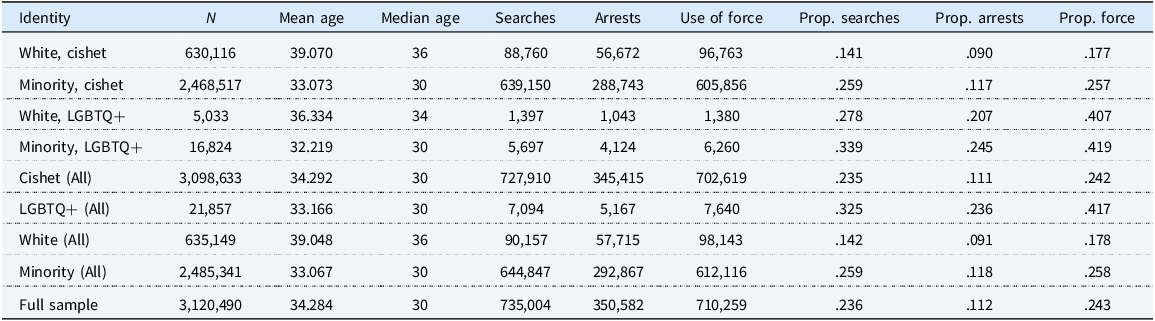
Summary statistics of the sample are presented in Table 1 below. The table presents the sample size, the number and the proportion of searches, arrests, and use of force (i.e., the outcomes of interest in the study) by identity and for the interaction of race and LGBTQ+ status, as well as the mean and median ages of the groups.
Summary statistics

Table 1. Long description
The table presents summary statistics of a sample, focusing on identity categories that include race and LGBTQ status. It has 11 rows and 10 columns. The columns are labeled Identity, N, Mean age, Median age, Searches, Arrests, Use of force, Prop. searches, Prop. arrests, and Prop. force. The rows are labeled with different identity categories such as White, cishet; Minority, cishet; White, LGBTQ+; Minority, LGBTQ+; Cishet (All); LGBTQ+ (All); White (All); Minority (All); and Full sample. Each row provides data on the sample size (N), mean age, median age, number of searches, arrests, use of force, and the proportions of searches, arrests, and use of force. For example, the first row for White, cishet shows a sample size of 630,116, a mean age of 39.070, a median age of 36, 88,760 searches, 56,672 arrests, 96,763 use of force, a proportion of searches at 0.141, a proportion of arrests at 0.090, and a proportion of use of force at 0.177. The table provides a detailed comparison of these statistics across different identity groups.
Before delving into the analysis, it is important to note that administrative records can be useful to explore disparities in police behavior, but as Knox et al. (Reference Knox, Lowe and Mummolo2020) demonstrate, using them to infer bias in law enforcement behavior brings a unique set of challenges for researchers. Outside of classic omitted variable issues, the most prominent problems arise due to the nature of the data, which is biased by post-treatment selection. Simply put, the records we observe omit the universe of people—pedestrians or drivers, depending on the data—that the police observes before deciding to stop someone: as they explain, “the effect of civilian race on the outcome of a police encounter is mediated by whether the civilian is stopped by police, but analysts only have data for one level of the mediator—that is, data on stopped individuals” (Knox et al., 619). In addition to this, administrative records of police stops are very likely tarnished by under-reporting from agencies, which further biases estimates of discrimination downwards (Cook and Fortunato Reference Cook and Fortunato2022).
To study policing through administrative records of stops, different descriptive tests exist, such as benchmarking or hit-rate comparisons, which I all use in the study, together with logistic regressions to estimate the association between the likelihood of searched/arrested/victim of use of force and being LGBTQ+, interacted with being a racial minority. These descriptive estimates can be somewhat informative about police behavior. While by no means indicative of bias by themselves, they can show if after a stop, civilians who are searched, arrested, or have force used against them are more likely to be LGBTQ+, a minority, or a combination of these.
To interpret these quantities as anything more, we would have to assume away any bias in the initial decision to stop. However, as Knox et al. (Reference Knox, Lowe and Mummolo2020) state when analyzing racially biased policing, [discriminatory] stops are “too plausible to dismiss by assumption” due to the substantial body of research pointing to their existence. Even though no such abundance of literature exists for bias in stops against LGBTQ+ people, I believe it is a necessary assumption for this study too. Regarding policing and queerness, a 2021 report found that LGBQ people reported being stopped by the police at a six-fold rate than the general population (Luhur et al. Reference Luhur, Meyer and Wilson2021). Moreover, the evidence of harassment and violence perpetrated by law enforcement towards both communities documented in Section The policing of queerness in the United States makes it unreasonable to lightly assume away any bias in stopping decisions.
To address this issue as best as current methods allow to, I follow Knox et al. (Reference Knox, Lowe and Mummolo2020) procedure to estimate the Average Treatment Effect on the Treated (ATT) for searches, arrests, and use of force. The quantity derived is an estimate of bias in post-stop outcomes, which is conditioned on the (estimated) proportion of discriminatory stops derived from a hit-rate approach, for people who are perceived to be LGBTQ+ by police officers (and in the interaction of queerness with race). I hence delineate the following categories in my identification strategy:
-
• civilians who are White, cisgender and heterosexual—this is the reference category
-
• civilians who are White and LGBTQ+
-
• civilians who are Black/Latino, cisgender and heterosexual
-
• civilians who are Black/Latino and LGBTQ+
Estimating this quantity allows me to answer a question that is central to the scope of this paper: if we were to substitute White and cishet civilians in stops where the person was White and LGBTQ+/a racial minority and LGBTQ+, how many times would the police not have searched, arrested, or used force against the individual stopped? In this regard, splitting LGBTQ+ civilians into two further categories (White and racial minority) lets me see whether the interaction with race makes a substantial difference in shaping police discrimination across these outcomes.
For transparency, I also note that at the moment, I make no attempt to correct for the mentioned issue, reported by Cook and Fortunato (Reference Cook and Fortunato2022), of under-reporting in police data. All these reasons, as well as the fact that as Knox et al. (Reference Knox, Lowe and Mummolo2020) state that discriminatory stops are at least the estimate given by a hit-rate approach—when in reality they could be higher—make it so the results presented in Section Inferring Police Bias in Post-Stop Decisions might represent only the lower bound of the real incidence of bias in policing uncovered in this research, which might be more severe.
Results
This section first presents the results of some descriptive statistics, i.e., the benchmarks and the outcome tests, and then the logit interaction models with controls and fixed effects, for a first glance at the distribution of the variables of interest shown in Table 1. In the second part, then, the ATT estimators are presented and discussed to delve into how queerness and its interaction with race affect law enforcement’s discrimination in post-stop decisions to search, arrest, and use force.
Describing Disparities in Police Behavior
As a first step, I look at whether any differential treatment in post-stop outcomes can be seen through benchmark tests, as well as by calculating hit rates by group. A benchmark test is simply a ratio of the number of searches, arrests, or uses of force over the total number of stops. A hit rate test, also known as the outcome test (Anwar and Fang Reference Anwar and Fang2006; Ayres Reference Ayres2002), indicates the likelihood of retrieving contraband when performing a search, and it has been used as a measure that can show whether groups are held after different standards of evidence. The simple idea is that if a group (e.g., Blacks) has a significantly lower hit rate than Whites, it would imply that law enforcement is applying different thresholds for when to decide to conduct a search against different groups.
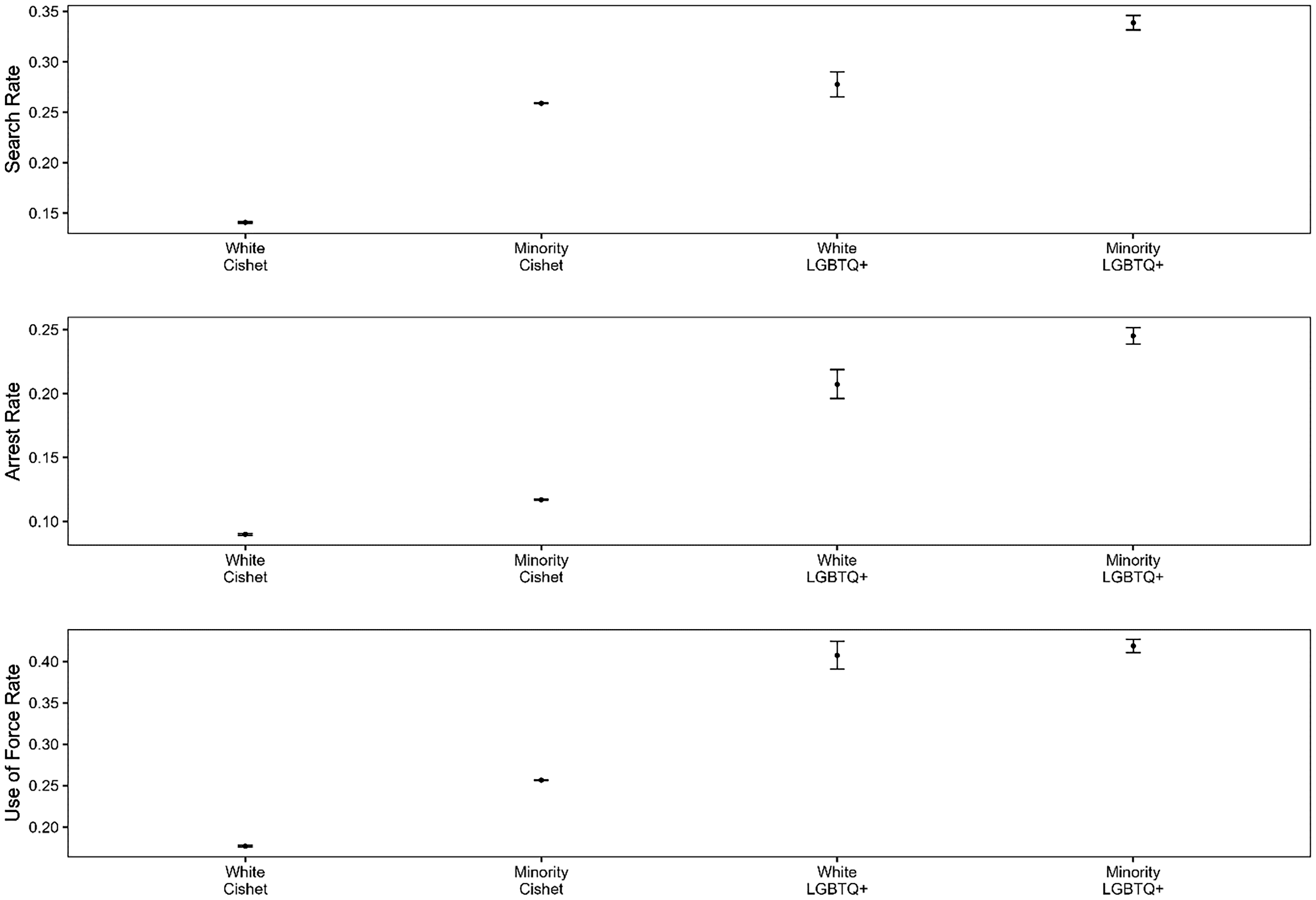
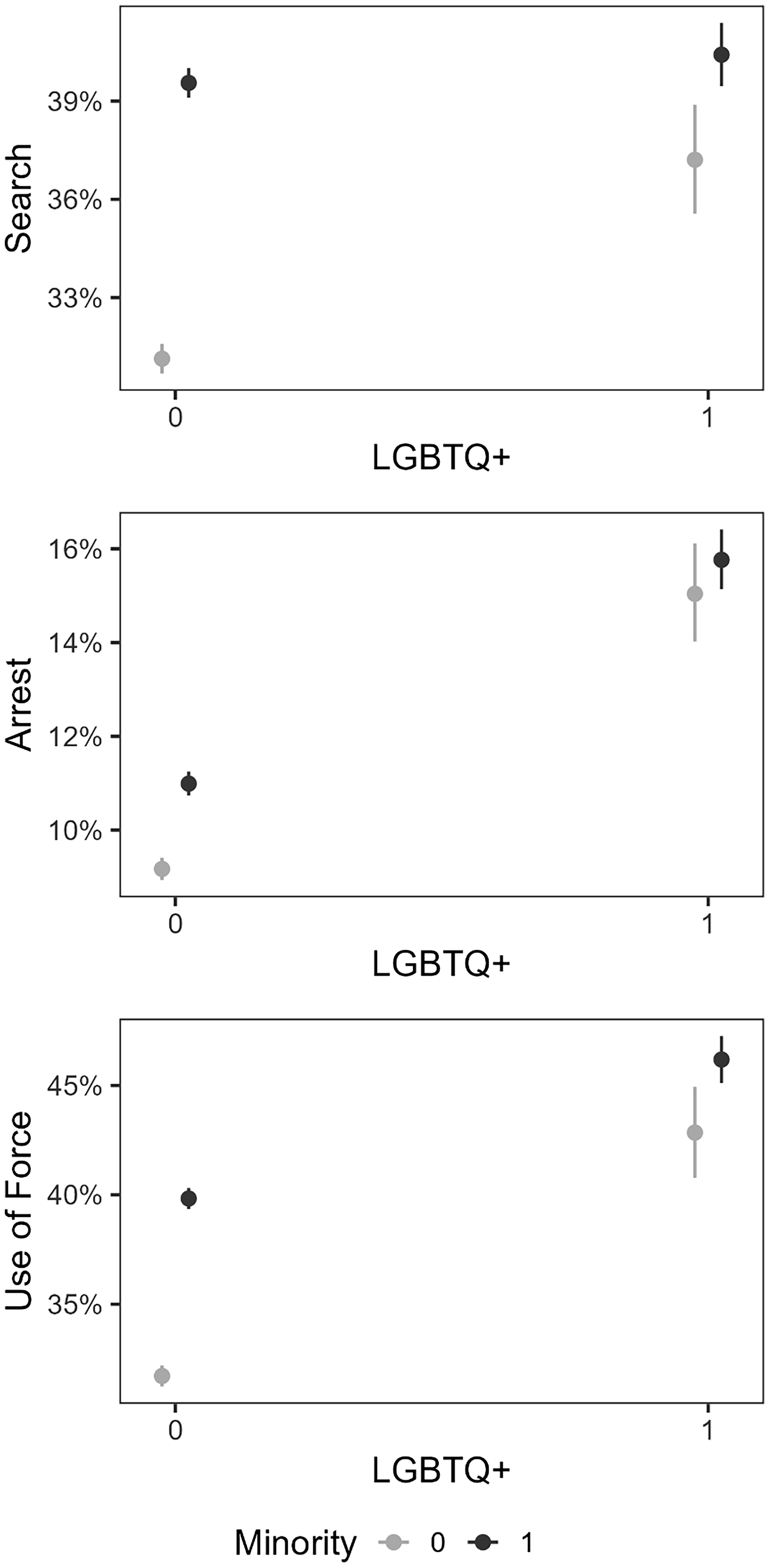
Figure 1 shows the likelihood of being searched, arrested, and of force being used for the interactions between queerness and race (Numeric coefficients are shown in the SI File, Section 9S). A few trends jump to the eye, above all: the likelihood is always the lowest for Whites who are also cishet; being LGBTQ+ significantly increases the risk of being searched, arrested, or a victim of use of force, for racial minorities and Whites alike. Figure S1 in the SI File presents the aggregated estimates for the two main categories (race and queerness) and confirms the trends we observe here.
Benchmark tests for searches, arrests, and use of force. Points represent the proportions of post-stop outcomes by identity group, with 95% confidence intervals.

Figure 1. Long description
Three bar graphs depict the proportions of post-stop outcomes by identity group, with 95% confidence intervals. Panel A: The first bar graph shows search rates. The x-axis lists four identity groups: White Cishet, Minority Cishet, White LGBTQ+, and Minority LGBTQ+. The y-axis represents the search rate, ranging from 0.15 to 0.35. The graph indicates that Minority LGBTQ+ individuals have the highest search rate, followed by White LGBTQ+, Minority Cishet, and White Cishet individuals. Panel B: The second bar graph displays arrest rates. The x-axis lists the same four identity groups, and the y-axis represents the arrest rate, ranging from 0.10 to 0.25. The graph shows that Minority LGBTQ+ individuals have the highest arrest rate, followed by White LGBTQ+, Minority Cishet, and White Cishet individuals. Panel C: The third bar graph illustrates the use of force rates. The x-axis lists the same four identity groups, and the y-axis represents the use of force rate, ranging from 0.20 to 0.40. The graph indicates that Minority LGBTQ+ individuals experience the highest use of force rate, followed by White LGBTQ+, Minority Cishet, and White Cishet individuals.
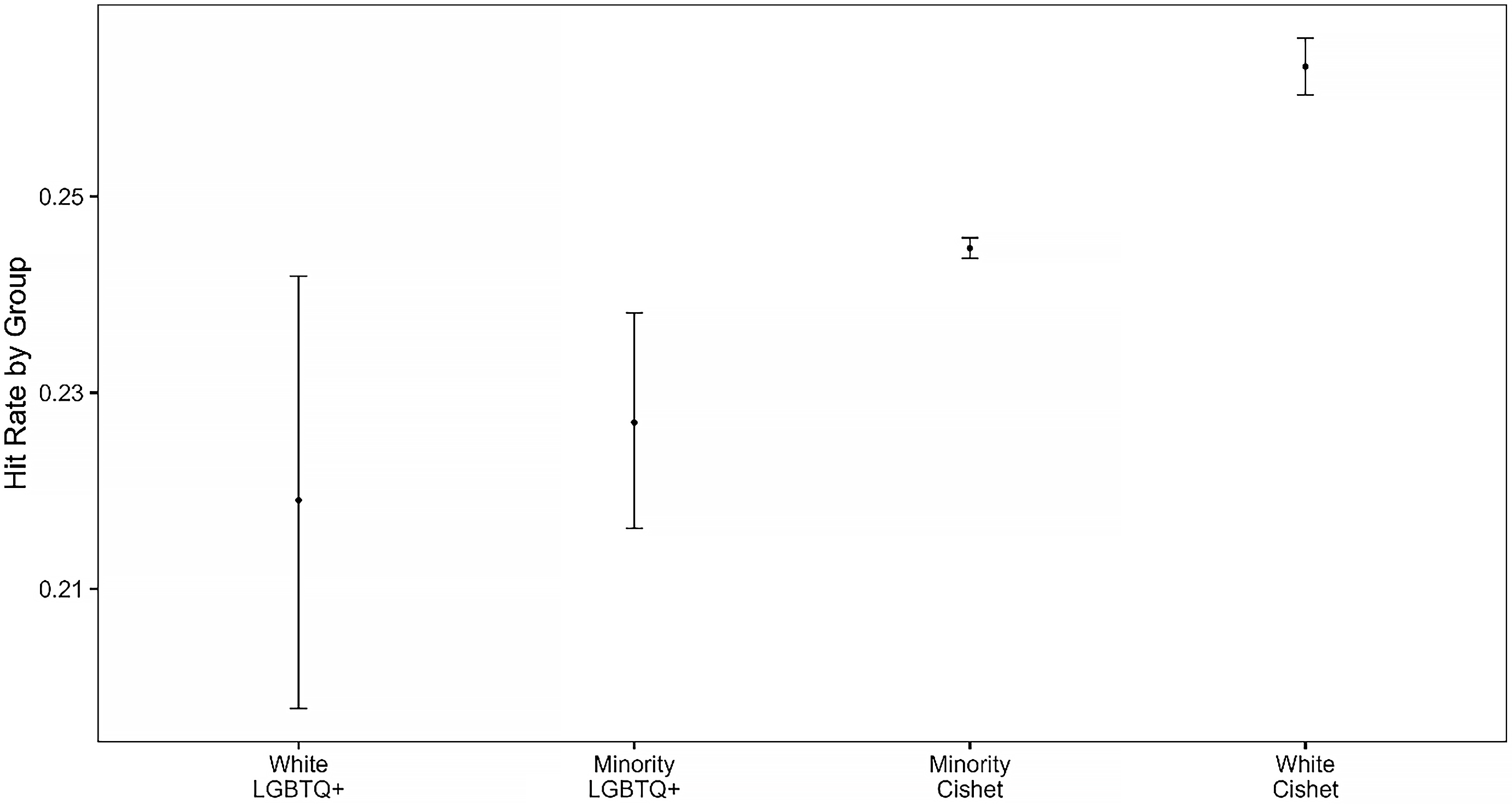
Essentially the same can be said when comparing these estimates with hit rates (i.e., the outcome test), as presented in Figure 2: stopped civilians who are LGBTQ+ have a significantly lower standard of evidence applied to them (both when they are White or a racial minority), according to the test, when compared to the reference category of White and cishet civilians. Results also hold when looking at variation between districts (see Figure S4, Online Appendix).
The outcome test. Points represent the proportion of successful searches (i.e., retrieving contraband) by identity group, with 95% confidence intervals.

I then move on to focus on the interaction of race with queerness, the objective of the second research question. To do so, I run logistic regressions to predict the probability of agents searching, arresting, or using force during a stop, interacting racial status with queerness. For these models, as well as those presented in Section Inferring police bias in post-stop decisions, I include controls for age, type of stop, whether the person had limited or no English, and the stated reason for the stop (RFS in the equation below). Moreover, I add fixed effects for the district, as well as the month, the day of the week, and the 4-hour slice of the day in which the stop happened, which is relevant since police activity is not randomly distributed over weekdays, months, daytime, or area. This allows me to control, as best as the data allows, for a lot of unobserved characteristics of the place and time where the stop happened, while also making the sample of officers making the stop and of people stopped likely more homogeneous and comparable. The model specification, with controls and fixed effects terms, is shown in the equation below.
 $\eqalign{&log\left( {{{Pr\left( {outcom{e_i} = 1} \right)} \over {1 - Pr\left( {outcom{e_i} = 1} \right)}}} \right) \cr & = {\beta _0} + {\beta _1}LGB{T_i} + {\beta _2}Minorit{y_i} + {\beta _3}\left( {LGB{T_i} \times Minorit{y_i}} \right) + {\beta _4}Ag{e_i} \cr & + {\beta _5}NoEnglis{h_i} + {\beta _6}Typ{e_i} + {\beta _7}RFS_i^{consensual} + {\beta _8}RFS_i^{parole} \cr & + {\beta _9}RFS_i^{wanted} + {\beta _{10}}RFS_i^{education} + {\beta _{11}}RFS_i^{reasonable} + {\beta _{12}}RFS_i^{probable} \cr & + {\beta _{13}}RFS_i^{traffic} + {\delta _{month}} + {\gamma _{weekday}} + {\theta _{dist}} + {\phi _{timestop}} \cr}$
Results are presented in Figure 3 and again are in line with what was previously found: being LGBTQ+ is positively associated with a higher probability of being searched/arrested/subjected to the use of force. Regression coefficients are presented in the SI File, Table S2.
The joint effect of race and queerness on police searches, arrests, and uses of force. Lines represent 95% confidence intervals.

The interaction with minority status tends to increase said probabilities, although the effect of being perceived as LGBTQ+ is much stronger for Whites. As can be seen, the effect tends to be bigger when we consider the interaction between queerness and being White, rather than the interaction of queerness with belonging to a racial minority. This is, possibly, because of a lower starting floor for White civilians, and/or a ceiling effect for minority individuals. As a result, we observe that the probability of being subjected to any of the post-stop outcomes associated with being White and LGBTQ+ is almost as high, across all models, as that associated with belonging to a racial minority and being LGBTQ+, and higher than the same probability compared to those civilians who belong to a racial minority but are cishet. Results are robust when using a linear probability model instead of logit.
All the results presented here point in the same direction, signaling that queerness is associated with harsher disparities in police treatment across searches, arrests, and force use. In the next section, I then present the bias-corrected ATT estimator for these same outcomes, with the aim of approximating a better measure of bias in policing and how it affects the groups considered in the study.
Inferring Police Bias in Post-Stop Decisions
In this last section of the empirical analysis, I hence apply the corrective procedure suggested by Knox et al. (Reference Knox, Lowe and Mummolo2020), conditioning the estimates of discrimination in post-outcomes on an approximation of the proportion of biased stops, which I derived from a hit rate test. Figure 4 shows the bias-corrected estimator, i.e., the ATT, among LGBTQ+ civilians, for searches, arrests, and use of force. Basically, the estimands reveal how many searches, arrests, or uses of force would not have occurred had the civilian been White and cishet (when compared with White and LGBTQ+ civilians/minority and LGBTQ+ civilians). A more thorough explanation of how the test works can be found in Section 7S of the Online Appendix.
ATT estimates of the proportion of discriminatory searches, arrests, and use of force against LGBTQ+ civilians, by race. Lines represent 95% confidence intervals.

As mentioned before, inferring discrimination is a complicated issue, and particularly so when dealing with police data. Hence, and as with the interaction regressions, I include here a wide range of controls that define the police-civilian interaction and civilian behavior (i.e., the same control variables used in the logit interaction models presented in Figure 3). Doing this, I approximate—as best the data allows—an estimand of bias that eliminates as many confounders as possible and isolates the effect of queerness, in its interaction with race, on the police agents’ decisions to search, arrest, or use force.
As can be seen, Figure 4 displays findings in line with what the interaction models of Figure 3 show. A situation of double-disadvantage, where being LGBTQ+ and a racial minority appear to have an additive effect in worsening police discrimination, is apparent across all outcomes. Being identified as LGBTQ+ and a minority significantly increases the risk of being searched, arrested, or subjected to force compared to both white, cishet individuals (i.e., the reference category) and to cishet racial minorities. Hence, while race is definitely an important variable in and of itself, its intersection with being LGBTQ+ has implications that perfectly fit the understanding of society posited by intersectionality: the convergence of marginalized positionalities has a substantial impact in multiplying the threats that the police pose to Black or Hispanic individuals who are also perceived to be LGBTQ+.
Secondarily, but equally importantly, it also appears that White civilians who are also LGBTQ+ face substantially higher discrimination in post-stop decisions compared to the reference categories of White and cishet civilians, on levels often as high as those of racial minorities. The fact that for this subset of White civilians the jump in discrimination is much higher, while for racial minorities the increase resulting by the interaction is smaller, suggests that there may be some ceiling effect at play in determining the incidence of discrimination against minoritized groups, particularly those that are already highly targeted by law enforcement.
These results on aggregate not only confirm the initial hypotheses of the paper relating to intersectional theory and how the interaction of different axes of oppression can multiplicate the incidence of police bias but have also quite relevant implications for our understanding of how policing works in actively furthering the process of marginalization of vulnerable identities. The effect on whiteness is also interesting and signifies how any deviation from the “norm”—being White, cisgender, and heterosexual—can automatically slot people into a marginalized position and increase their risk of suffering discrimination in society at large, and in police-civilian interactions too.
Since this analysis as a proof of bias rests on some assumptions that might not be universally accepted, I also plot the estimates for the ATT assuming that discriminatory stops are the same and null for each group, to see if the results would change. Figure S5 in Section 7S of the SI shows how the ATT changes under this assumption: as it displays, no substantial change is detected in patterns of police bias across the categories. Discrimination towards all other groups is persistent and follows the same motif recognizable in Figure 4, showing that the bias seen in the results is not entirely dependent on conditioning on the assumptions on which these estimands rest.
To conclude, I note that while variation over time is outside of the scope of this paper, I plot the trend over time of stops, including all observations, and then minority and LGBTQ+ stops separately, to check whether any time-variant factors (such as differences in reporting, over time, by police agents particularly, of who is LGBTQ+ or a Black/Latino civilian) could induce any bias in the results. Figure S6 is shown in the SI File and does not show any heterogeneity in the stop trends across the minoritized groups considered in the study. Moreover, Section 10S of the Appendix displays a compositional analysis of stops by type, reason, city, and year, and it shows that, when considering these possible sources of variation (which are also controlled for in the models), patterns of disparity hold for each outcome.
Conclusions
The aim of this paper is to provide a comprehensive analysis of disparities and bias in policing when civilians stopped are LGBTQ+, by itself and especially in the interaction with race. Multiple tests provide a coherent picture of how police-civilian interactions are shaped by the intersection of these minoritized identities: first, being LGBTQ+ creates a substantially higher probability of being subject to disparate treatment from law enforcement. This should not come as a surprise: as mentioned before, a 2021 report by the Williams Institute found that LGBQ people reported being stopped by the police at a significantly higher rate than minorities, and in equal proportion when driving a vehicle, regardless of race, while recent scholarship found that LGBTQ+ individuals are searched more by officers (Shoub Reference Shoub2025). Proof of this disparate treatment is evident in this paper’s results as well. Second, the intersection of queerness with race is shown to be indeed significant for minorities: models display substantial differences in how police agents discriminate against racialized individuals, and how bias can get worse for them if they are also perceived as LGBTQ+. These combinations of marginalized identities converge and put these individuals at a particularly high risk when they interact with law enforcement.
These results are relevant for three reasons: first, empirically, they show that being part of any minoritized identity, even if a person is White, puts civilians at a significantly higher risk of being subjected to police mistreatment. Second, theoretically, they show that intersectionality is a paradigm that is necessary for the study of police discrimination, as race itself cannot fully explain the differential treatment in stops, searches, arrests, and use of force by law enforcement. This study tells us that the police is, still today, an institution playing a key role in the continuous marginalization of racial, sexual, and gender minorities, and that the intersectional vulnerability of being LGBTQ+ and racialized is also a consequence of criminalization and subordination through over policing. Third, methodologically, results have an interesting and pertinent implication for the study of racially biased policing: considering the two sub-samples of data of White and minority civilians, I find queerness to have a substantial impact on police discrimination, especially for White civilians. This suggests that estimates based on racial categories alone may conceal important within-group heterogeneity among these. In particular, because the effect of LGBTQ+ identity on policing is more pronounced among White civilians, pooling LGBTQ+ and non-LGBTQ+ individuals within the White category may obscure observed differences between White and minority groups. By contrast, while a similar effect is present among racial minorities, it is comparatively smaller, likely due to a higher baseline level of police contact for them, vis-à-vis a much lower floor for Whites. Taken together, these patterns indicate that failing to account for queerness may distort estimates of racial disparities, not by uniformly biasing them in one direction but by masking how intersecting identities shape exposure to policing within racial groups.
This research also has some important caveats and limitations. The findings are consistent and robust across multiple models and tests: this high degree of coherence is welcomed, but each of these tests has its own limitations that cannot be fully addressed by the present methodologies. Omitted variables, post-treatment selection, and systematic under-reporting might be biasing the estimates, despite the effort to deal with them as best as current methodologies and data constraints allow us to. Results are also limited in their external validity, as it is reasonable to assume that the social construction and perception of queerness might be different in liberal, urban places like Los Angeles and San Francisco, where vibrant LGBTQ+ communities are present, than in rural and conservative communities across the United States. Finally, some caveats related to the data and the fact it relies on officers recording their perception of identities: as authors such as Luh (Reference Luh2022) describe, this may induce agents to systematically underreport potential discrimination of minorities, often without encountering punishment (Cook and Fortunato Reference Cook and Fortunato2022; Eckhouse Reference Eckhouse2022). Officers may also unintentionally misreport, particularly when it comes to inferring someone’s Latino or LGBTQ+ identity, which has also been found to deflate real disparities in policing (Laniyonu and Donahue Reference Laniyonu and Donahue2023). All this makes it likely, as Shoub (Reference Shoub2025) argues, that the disparities found here are floor estimates.
Ultimately, this research shows that police discrimination remains a big problem, going far beyond racialization alone: all historically minoritized identities face a higher risk of being subjected to unequal treatment during police-civilian interactions. A risk, this, which becomes even greater when different historically oppressed positionalities intersect. At a moment where the vulnerability of marginalized communities in the United States seems to be much more evident and growing, policing still seems to be posing more problems than solutions to their protection.
Supplementary material
The supplementary material for this article can be found at https://doi.org/10.1017/rep.2026.10097.
Data availability statement
The data used in the article is available for public download here: https://data.sfgov.org/Public-Safety/Police-Department-Stop-Data/ubqf-aqzw/about_data & https://data.lacity.org/Public-Safety/LAPD-RIPA-AB-953-STOP-Person-Detail-from-7-1-2018-/bwdf-y5fe/about_data. Replication files are available at: https://doi.org/10.34810/DATA3433.
Acknowledgements
I thank professors Toni Rodon Casarramona, the DemoSoc research group at Pompeu Fabra University, the two anonymous reviewers, as well as audiences at the 2025 Italian Political Science Conference, and the RC33 Eleventh International Conference on Social Science Methodology, for the useful comments and suggestions.
Funding statement
This article did not benefit from any funding source.
Competing interests
The author does not acknowledge any relevant conflict of interest.


 Open access

