In his Nobel Prize Lecture, Al Gore (Reference Gore2007) implored his audience to take swift action to contend with “a planetary emergency—a threat to the survival of our civilization that is gathering ominous and destructive potential.” President Barack Obama (Reference Obama2010), after suffering what he described as a “shellacking” in the November 2010 midterm elections, held a press conference where he asserted priorities related to climate change: “promoting a clean energy economy” and “making the investments in technology that will allow us to keep our competitive edge in the global economy.” Later that month the United Nations (UN) kicked off an important climate change conference in Cancún, Mexico—the 16th Conference of the Parties, or COP 16—where Obama's themes would be taken up full-force in a multilateral setting.Footnote 1
Much was at stake in Cancún. As Cristine Russell (Reference Russell2010) pointed out in the Columbia Journalism Review, the conference was “likely to be a turning point” because “[m]any climate experts, as well as journalists, question whether the cumbersome UN Framework Convention on Climate Change [UNFCCC] will even survive after this in its current form.” The UNFCCC framework was challenged at the 2009 Copenhagen climate change meetings where a last-minute backroom deal was hammered out between the United States, China, India, Brazil, and South Africa. Eventually, 140 parties signed the nonbinding Copenhagen Accord rooted in voluntary emissions reduction commitments as determined by individual parties. These mitigation efforts often hinged on the passage of national legislation, which in the case of the United States, increasingly appears unlikely in the near term.Footnote 2
The Copenhagen Accord marked a potential pivot point for global climate governance. Environmental law professor David Hunter (Reference Hunter2010, 12) wrote, “Both the substance of the Accord's pledge-and-review approach and the process by which it was negotiated arguably undermine the importance of the United Nations, particularly the UNFCCC Secretariat, in future climate governance.” Fast-forwarding to Cancún, a number of vital issues faced policymakers, scientists, business leaders, nongovernmental organizations (NGOs), and activists: observers wondered whether negotiations in Mexico would solidify the backroom deliberation trends established in Copenhagen or whether the UN would boldly reassert itself and its relatively transparent, consensus-based process. Some observers believed the international community would push back for a legally binding agreement like the Kyoto Protocol—thereby reviving the UN process—while others suggested a voluntary program rooted in bilateral agreements and self-assigned reductions targets was more likely. Meanwhile, political considerations threatened to outweigh the findings of peer-review science. The global media's challenge was to address these complex, overlapping issues in a clear, comprehensible manner that captured the urgency of the situation. As Manuel Castells (Reference Castells2005, 14) pointed out in PS, “The public sphere in our time is largely dependent on the communication media system.” He noted, “a shift from a public sphere anchored around the institutions of society to a public sphere constituted around the media system.”
How media frame climate change inflects public understanding and public engagement of this important issue. Journalists place frames around real-world events, thereby zeroing our attention on particular issues, ideas, and individuals while eliding that which lies outside the frame. Framing makes particular solutions appear more plausible than others (Entman Reference Entman2004). Communications scholar Matthew Nisbet (Reference Nisbet2009, 16–17) notes, “Framing a policy problem or issue endows certain dimensions” of climate change “with greater apparent relevance than they would have under an alternative frame.” He adds, “To make sense of policy debates, audiences use frames provided by the media as interpretive shortcuts but integrate these media presentations with preexisting interpretations forged through personal experience, partisanship, ideology, social identity, or conversations with others.”Footnote 3
Recent research on the US media system and its coverage of climate change has been consistently critical. Freudenburg and Muselli (Reference Freudenburg and Muselli2010) found that US media tend to portray the Intergovernmental Panel on Climate Change (IPCC) findings as exaggerated whereas its consensus-based assessments should actually be viewed as conservatively understating climate disruption.Footnote 4 Other scholars have pointed to evidence of “balance as bias” (Antilla Reference Antilla2005; Boykoff and Boykoff Reference Boykoff and Boykoff2004) whereby the press uses the journalistic norm of balance—telling “both” sides of the story. When it comes to anthropogenic global warming, employing balance is a form of bias in favor of those who either deny global warming or humankind's hand in it. Researchers have found specific media outlets like Fox News to promote climate-change skepticism through the balance-as-bias mechanism although it is out of tune with mainstream scientific consensus (McKnight Reference McKnight2010). In a series of papers McCright and Dunlap (Reference McCright and Dunlap2000, Reference McCright and Dunlap2003, Reference McCright and Dunlap2010) have demonstrated how US conservatives have acted strategically to muddy the discursive waters in regards to climate change thereby undermining climate-science consensus and stultifying climate-change policy. Despite the pervasive influence of conservatives on climate-change policy, the mainstream US press has improved its coverage of climate change, essentially ameliorating the balance-as-bias issue by 2006 (Boykoff Reference Boykoff2007; Nisbet Reference Nisbet2011).
Nevertheless, US media are still reliant on journalistic norms that help determine what becomes news as well as how the content of that news is shaped. Baseline, generative “first order” norms, such as personalization, dramatization, and novelty, mean that when conflict exists between well-known political personalities, media coverage is almost sure to ensue. Furthermore, the cliché “if it's not new it's not news” maintains relevance in contemporary journalism. These concatenating norms not only trigger the “second order” norm of balance, but also the authority-order norm, whereby journalists turn to authority figures as sources who assure the public that socio-political issues will be addressed in short order (Boykoff and Boykoff Reference Boykoff and Boykoff2007, 1192–93). The tendency to turn to authority figures—or, “official sources”—for their political opinions is a deeply ingrained facet of news coverage as is the related tendency toward indexing; media coverage is bracketed—or indexed—according to the range of views and policies found within the corridors of institutional power. In other words, the discursive bandwidth correlates with the amount of disagreement among policymaking elites (Iyengar and McGrady Reference Iyengar and McGrady2007), which is related to the “first-order” norms of dramatization and personalization. Mass-media scholars usually apply indexing to foreign policy issues (e.g., Hayes and Guardino Reference Hayes and Guardino2010; Mermin Reference Mermin1999). It is also relevant, however, to “intermestic” issues like climate change, the quintessential transnational environmental issue with implications that are interwoven into both domestic and international affairs (Barilleaux Reference Barilleaux1985). Understanding journalistic norms helps us analyze and forecast the quantity and quality of media coverage of the Cancún Climate Change Conference.
In a recent study by the Reuters Institute for the Study of Journalism at the University of Oxford, James Painter (Reference Painter2010) analyzed newspaper coverage of the Copenhagen conference that appeared in 12 countries. The study was critical of the media for underplaying scientific aspects of climate change, finding only 9% of the sample dedicated 50% or more of its content to elucidating the science while 80% of the sample discussed science in less than 10% of its space (Painter Reference Painter2010, 54). The author (Reference Painter2010, 3–4) concluded: “Most journalists reported extensively on the drama and minutiae of the negotiations. But in the balance between capturing the drama of Copenhagen and explaining the essential background to the science, understandably—but perhaps regrettably—the science was under-reported.”Footnote 5
However, the point of the Copenhagen climate change conference—and the COP 16 in Cancún that followed—was to hammer out a political deal that would lead to global climate change policies, not to rehearse the science underlying climate change. Therefore, it is not surprising that journalists focused on geo-political machinations or the “minutiae of the negotiations.”Footnote 6 More importantly, the science of climate change did not divide the negotiators in Copenhagen and Cancún as much as economics and politics continued to cleave deep divisions. Therefore, in this article I examine how the US media covered vital issues that not only affected on-the-ground negotiations, but issues that continue to be critical and contentious as talks press forward: the economics of climate change and the role of China. I also focus on the role of indexing by analyzing the sources journalists turn to in their stories and segments.
DATA
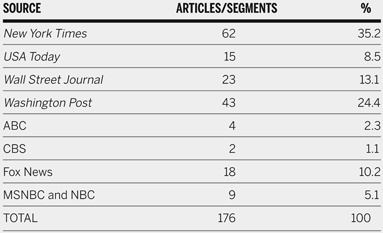
The UNFCCC capped its issuance of journalist accreditations at 2,000 in Cancún, whereas more than 3,200 accredited journalists were on hand in Copenhagen to cover the proceedings.Footnote 7 These journalists produced a trove of output, and a targeted slice of this media yield comprises the empirical data in this study. Media outlets under consideration include four major US newspapers—the New York Times, USA Today, the Wall Street Journal, and the Washington Post—and five television networks—ABC, CBS, Fox News, MSNBC, and NBC. Because of geographical circulation, national stature, and influence on public officials, the general population, smaller news outlets, and each other, these media entities constitute a powerful and significant segment of the US mass-media system.Footnote 8 Although most media analyses focus on newspapers, I expanded this study to include television because, according to a recent Pew study (Purcell et al. Reference Purcell, Mitchell, Rosenstiel and Olmstead2010, 3), people in the United States rely more on television for political news than on any other medium including the Internet: 78% watch local news and 73% derive news from national networks or cable television.Footnote 9 Using the Lexis-Nexis and ProQuest databases and the search terms “global warming” or “climate change” resulted in 176 newspaper articles, editorials, op-eds, and television segments during the Cancún conference and 507 during Copenhagen.Footnote 10 The timeframe stretched from one week before the commencement of each conference through a one-week post-meeting period.Footnote 11 Table 1 summarizes the data for Cancún according to source.
Media Coverage of Cancún Climate Change Conference by Source

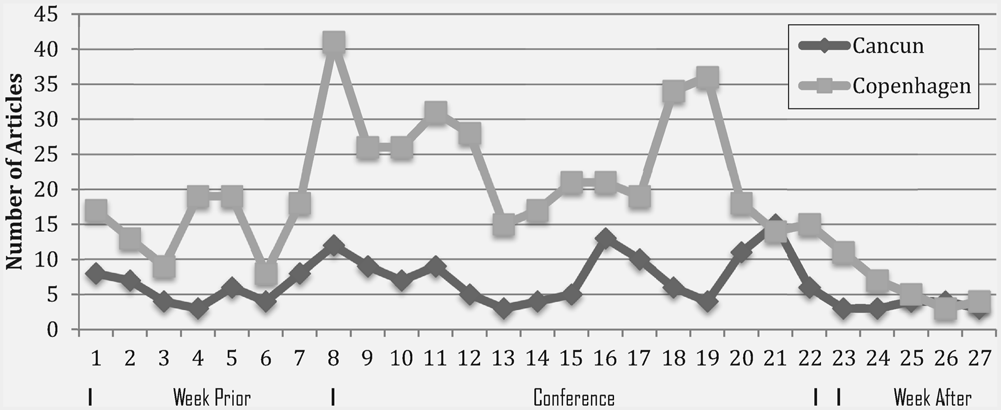
US media coverage of the 2009 climate change conference in Copenhagen was copious. We might expect similar levels of coverage during the Cancún conference, especially because big changes were afoot, including the possible demise of the Kyoto Protocol. Also, as the conference commenced, a preliminary analysis from the World Meteorological Organization was released that found the year 2010 to rank among the three warmest years—along with 1998 and 2005—since instrumental climate records started in 1850. Toward the end of the conference, NASA announced 2010 to be the hottest year on record. Weather, such as Russia's scorching summer and Pakistan's monsoon-induced floods, was causing concern around the globe in 2010. Climate change was also being mentioned laterally in WikiLeaks revelations, which, according to the Pew Research Center's Project for Excellence in Journalism, was one of the top five news stories during both weeks of the Cancún conference.Footnote 12 Additionally, the meeting promised a dramatic face-off between China and the United States, the world's top two greenhouse gas emitters, as well as the novel possibility of the World Bank assuming an invigorated role in mitigating climate change and assisting with adaptation measures. Combined, these factors would logically produce a high quantity of news coverage of the conference. Some people believed the meetings would be more aspirational than inspirational because few world leaders committed to attending the events, and political analysts forecasted few concrete advances. However, the Cancún climate change conference did not garner the attention of the US media, especially when compared to the quantity of coverage of Copenhagen. As figure 1 indicates, Cancún consistently received approximately one third the coverage of Copenhagen; 176 news packets containing the term “global warming” or “climate change” appeared in the sources under consideration during Cancún while 507 packets appeared in the same sources during Copenhagen.
Quantity of Coverage—Copenhagen and Cancún

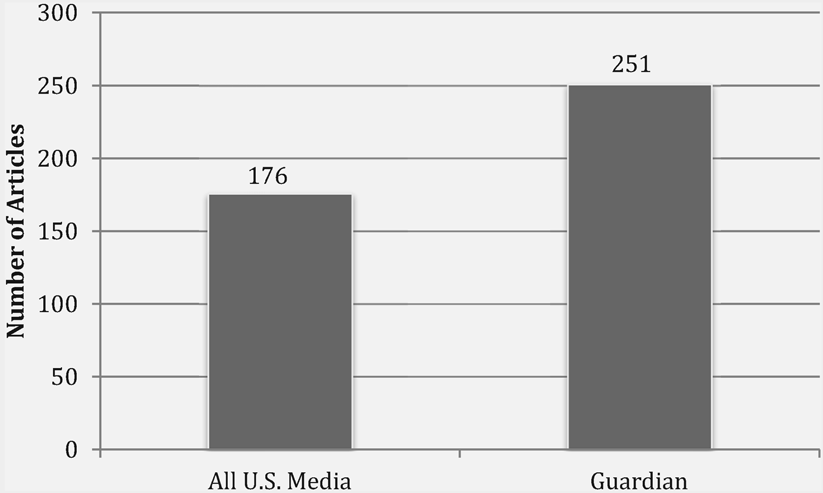
While US newsrooms have been cutting their environmental and science staff, with CNN slicing its entire science, technology, and environment reporting team in 2008, the UK's Guardian has concertedly bolstered its environmental staff, boosting its number of environmental correspondents to eight (Painter Reference Painter2010, 22). Such decisions regarding the allocation of journalistic human-power affect the quantity of climate-change coverage. During the Copenhagen conference, the Guardian published 251 articles mentioning global warming or climate change while all the US news outlets in this study combined produced 176 pieces (figure 2).
Quantity of Coverage—All U.S. Media Compared to the Guardian (UK)

Beyond the quantity of coverage, placement matters, too. When journalists select real-world events and convert them into political news they engage in what Maxwell McCombs and Donald Shaw (Reference McCombs and Shaw1972) call “the agenda-setting function” whereby media coverage augments public salience of particular issues. Although the media do not necessarily tell news consumers what to think, they do encourage readers and viewers what to think about. One cue newspaper editors use is article placement, with front-page stories implicitly carrying more weight and demanding more attention than back-page accounts. During the month of coverage bracketing the Cancún conference, the newspapers under study published eight front-page articles related to climate change, with six appearing in the New York Times and two in the Washington Post.Footnote 13 Of these, one article (Eilperin and Booth Reference Eilperin and Booth2010a) focused directly on the negotiations in Cancún.
With agenda setting, it is also crucial to consider the content of coverage. In particular I focused on two facets of coverage that are important as negotiations proceed: the economic impacts and opportunities that climate change creates and the role that China plays in negotiations and green-technology development. The key issues that dominated the discussions in Cancún—greenhouse gas mitigation, adaptation strategies, verification of emissions reductions, the Reducing Emissions from Deforestation and Forest Degradation program (REDD), and green technology sharing—all relate to the economics of climate change and the role of China. In examining these two areas, I narrowed the dataset to articles in which climate change was addressed in a head-on, substantive manner. I did this by excluding articles in which climate change or global warming was mentioned only once, rendering the topic peripheral to the thrust of the story. This process eliminated 78 articles, leaving 98 articles to analyze.Footnote 14
ECONOMICS
Since the “Stern Review on the Economics of Climate Change” was released in the UK in October 2006, economists, environmentalists, and political actors have paid more heed to the potential impacts of climate change on the global economy. The reframing of climate change as an economic issue has emerged as a narrative journalists can use to convert the long-term incrementalism of global warming into a more urgent issue that affects almost everyone. Economics perennially tops the list of concerns in “most important problem” public opinion polls in the United States.Footnote 15 This relates to what environmental studies professor Roger Pielke, Jr. (Reference Pielke2010, 46) calls “an iron law of climate policy,” whereby economic growth trumps climate-change mitigation efforts. This “iron law” implicitly presents a challenge to journalists: how to portray—and perhaps challenge—the tacit dichotomy that supports it.
US media coverage of the economic opportunities that climate change presented was relatively common, especially leading up to the Cancún conference, appearing in 11% of the newspaper articles and television segments.Footnote 16 For example, as part of a discussion on energy and the environment covered by the Wall Street Journal (Ball Reference Ball2010), Alan Mulally, the chief executive officer of Ford Motor Company, used green terminology to discuss economic opportunity: “We really focused on the fundamental enabling technology that would have the most synergy for economic development, energy independence and security, and also environmental sustainability.” Other panelists voiced the desire for consistent federal legislation signaling a price on carbon so industry could attempt to jumpstart the economy with greener technology. Not all the articles that adopted the economic opportunities frame focused on the positive possibilities. In a front-page article, the Washington Post interviewed people who had received training for green jobs only not to find work; the article sent the message that the economic opportunities created to confront climate change were unsuccessful, at least in the short term (Fletcher Reference Fletcher2010). In general, however, when this frame was adopted, journalists pointed to positive economic opportunities that had emerged in the face of climate change, even if these opportunities had yet to be capitalized upon.
Economists have warned with increasing urgency that climate change could damage not only the environment but also the global economy. Former World Bank chief economist Nicholas Stern recommended spending 1% of global GDP each year to help stave off the effects of climate change. Without such measures, he argued, we can eventually expect significant damage to the global GDP, in the range of 5% to 20% loss. In light of this, environmental economists Graciela Chichilnisky and Kristen Sheeran (Reference Chichilnisky and Sheeran2009, 41) argued, “By all measures, insuring the future against catastrophic climate change is a prudent investment. The logic is so compelling there are only two possible reasons to deny it. Either we don't believe in the science, or we discount the well-being of future generations.” However, the US media have not grabbed the discursive baton from Stern and environmental economists to discuss the detrimental economic impacts of climate change. Only three of the 98 news packets (3.1%) addressed the negative impacts climate change will have on the global economy, all of them appearing in the New York Times. One was an op-ed piece written by a Minnesota farmer who—highlighting personalization and dramatization—discussed how climate change was threatening his family's and neighbors' economic viability (Hedin Reference Hedin2010); a second article, which appeared on page A32 and drew on the authority-order norm, was a profile of an “atmospheric perils specialist” for Swiss Reinsurance America Corporation (Finn Reference Finn2010); the third example was an op-ed by the former chairwoman of President Obama's Council of Economic Advisers, Christina Romer (Reference Romer2010). In fact, it was just as common for the media—in particular the Wall Street Journal—to discuss the negative economic impacts that could potentially accrue from taking actions to combat climate change.Footnote 17 The dearth of the economic impacts frame derives, in part, from the fact that journalists only turned to two economists as sources—Robert Stavins of Harvard University and David W. Kreutzer of the Heritage Foundation—in all 98 news packets.Footnote 18 Sourcing is discussed in more detail later in this article.
CHINA
With the emergence of China as a key economic player on the global terrain, questions regarding environmental degradation have ascended astride the country's gross domestic product. China is keen to keep the “common but differentiated responsibilities” tenet of the Kyoto Protocol as a facet of any deal going forward. This has been an enduring point of disagreement with the United States because China is now the world's biggest greenhouse gas emitter (although on a per capita basis the United States is number one). Although China has received ample US media attention for its pollution problems, it has also been actively developing and implementing green technology. Lucia Green-Weiskel (Reference Green-Weiskel2011, 23) of the Beijing-based Innovation Center for Energy and Transportation recently pointed out, “China is reorienting its economy toward sustainability and renewable energy in a way that is nothing short of revolutionary. It has invested billions in renewable energy, energy efficiency, public transportation … and developing standards for products, buildings, vehicles and fuels.” She also noted that in July 2010, China's lead climate negotiator, Xie Zhenhua, declared that China's 2011–2015 five-year plan would include a cap-and-trade system. China has quickly become the world's biggest producer of photovoltaic panels. Its 2006 five-year plan set out an ambitious schedule for clean energy, including the goal of making 15% of its energy consumption renewable (Carey et al. Reference Carey, Chu, Hedden and Sulavik2010). In November 2010, Ernst & Young (2010) placed China atop its “Renewable Energy Country Attractiveness Indices,” beating out the United States.
In Cancún, China's delegation opted for a constructive approach to brokering a deal rather than obstructing forward movement. This strategy presented the US media with an opportunity to weigh China's dual roles as top-tier greenhouse gas emitter and green innovator. Such coverage was important politically: if China were portrayed monolithically as obstructionist rather than constructively moving forward, it would give the US government discursive space to refrain from acting. Overall, nearly two in five articles (39%) discussed China and its position vis-à-vis climate change. Most of these articles correctly pointed out that China—along with the United States—is the top emitter of greenhouse gases. But rather than only focusing on China's enormous coal consumption and greenhouse gas emissions, 24% of the articles that featured China discussed investments the Chinese government and domestic entrepreneurs are making in green technology, with the Wall Street Journal and New York Times taking the lead on that angle (e.g. Ball Reference Ball2010, Bradsher Reference Bradsher2010b).Footnote 19 For example, a front-page article in the New York Times titled “Beijing Turbine: China Sets Rules and Wins Wind Power Game” describes how Chinese green-energy firms “have flourished and now control almost half of the $45 billion global market for wind turbines” (Bradsher Reference Bradsher2010a). In an op-ed for the Wall Street Journal, Ted Nordhaus and Michael Shellenberger (Reference Nordhaus and Shellenberger2010) called Chinese investments in green technology “epic” while also noting the country's “cavalier attitude toward intellectual property.”
On the question of whether China was flexible or obstinate during the Cancún negotiations, it was a near even split, with 26% of the articles featuring China portrayed it as contributing to a stalemate while 32% depicted its actions as adaptable and sometimes accommodating. The media zeroed in on the geopolitical maneuvering of China and the United States—what the Washington Post colorfully called “the smackdown in the center ring” (Booth and Eilperin Reference Booth and Eilperin2010)—and did not engage in China-bashing. For example, in an article appearing on page A12, (Eilperin and Booth Reference Eilperin and Booth2010b) the Post described Chinese negotiators as open to external verification of emissions reductions, indicating “it would subject its voluntary carbon cuts to detailed international scrutiny,” which was a key “sticking point” for the United States. The New York Times (Broder Reference Broder2010), in a story on page A15, echoed China's flexibility on the verification issue, which “was a major factor in the torpedoing of last year's climate negotiations in Copenhagen.” In Cancún, however, China “significantly softened its position,” which “greatly improved the mood” of negotiators trying to work out a deal.
SOURCING
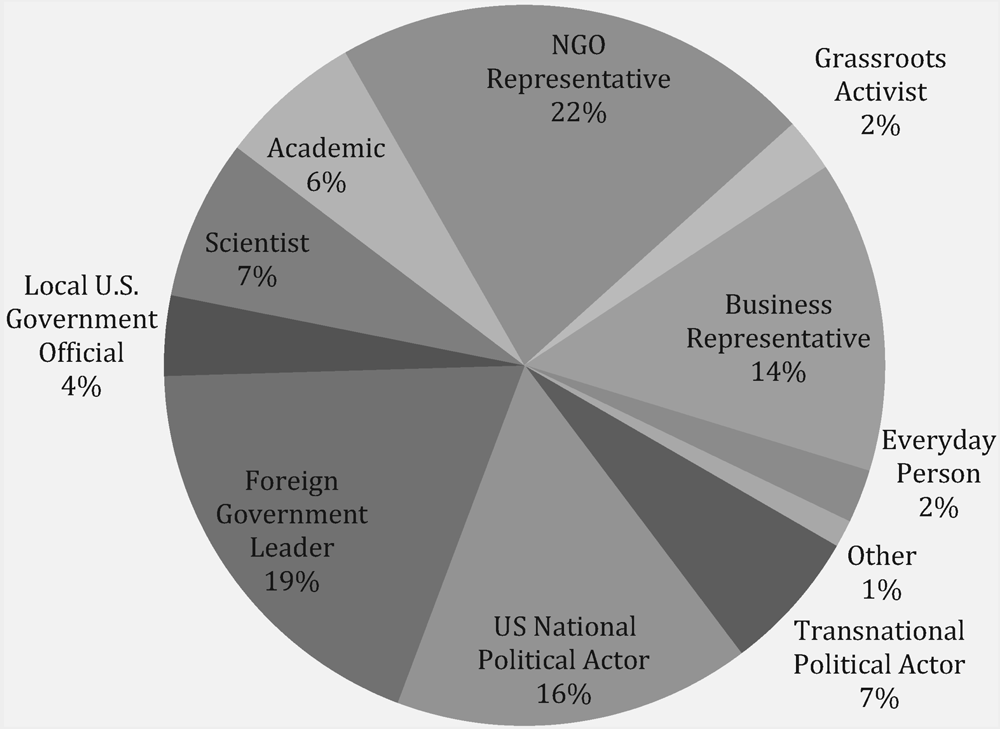
Journalists make dozens of microdecisions in each article or television segment. One key consideration is who they will turn to as sources to bolster and animate their descriptions and explanations.Footnote 20 US media coverage of climate-change issues during the Cancún conference conformed to the indexing hypothesis whereby the spectrum of debate and discussion among political elites governed the spectrum of debate within the news media. Of the 250 sources in the 98 substantive stories on climate change, 45% of them were transnational political actors (e.g., UNFCCC officials like executive secretary Christiana Figueres), US national political actors (e.g., Todd Stern, the US climate envoy), foreign government leaders (e.g., India's environment minister, Jairam Ramesh), or local US government officials (e.g., the director of public works in Norfolk, Virginia).Footnote 21 (See figure 3 for a specific breakdown.) Representatives of NGOs were the most frequently cited supplier of information and commentary, comprising almost 22% of all sources. Fortified by lobbyists and public-relations personnel, environmental organizations like the Natural Resources Defense Council and Environmental Defense Fund have successfully worked their way into the US mass-media's discourse on climate change. With federal climate-change legislation doubtful for the near future, probing questions regarding the effectiveness of NGOs have been raised by a number of scholars (e.g., Nisbet Reference Nisbet2011). Industry groups like the American Petroleum Institute have also emerged as frequent newsmakers; business representatives made up 14% of all sources. Meanwhile, economists comprised 1.6% of all sources, with Robert Stavins, the director of Harvard University's environmental economics program, and David W. Kreutzer, an energy economist at the Heritage Foundation, each appearing twice.
Sources in US Media Coverage

Grassroots activists comprised only 2.4% of all sources, precisely the same percentage as everyday people off the street who were asked for their views. Activists in Cancún were not only ready to offer their informed criticisms and their preferred alternatives, but they also carried out an array of actions aimed at satisfying the media's novelty norm, from an underwater performance designed to raise awareness to a crowd of activists digging their heads into the Cancún sand as a symbolic action. La Vía Campesina, a network of peasant organizations, organized a high-profile caravan across Mexico that culminated in Cancún. The Indigenous Environmental Network staged workshops and protests. Despite a strong presence at the conference, indigenous activists were only mentioned twice in hard-news articles, both times in the Washington Post (Eilperin and Booth Reference Eilperin and Booth2010b, Reference Eilperin and Booth2010c). Indian Country Today, a weekly, national newspaper that focuses on indigenous issues across the Americas, ran an editorial (2010) on the urgency of addressing climate change, but indigenous voices were sidelined in the mainstream media.
Jonathan Mermin (Reference Mermin1999, 146–47), author of a book on indexing and US foreign policy, suggests one way for journalists to brighten the spectrum of debate is to include the ideas and viewpoints of informed, engaged citizens. Nevertheless, only one news article mentioned grassroots activism within the flow of conference machinations, an article by the Washington Post's Juliet Eilperin and William Booth (Reference Eilperin and Booth2010b, A12), who briefly described activist groups marching in Cancún to protest proposed forest policies before drawing a comparison to Copenhagen: “Activists are much fewer in number and have done nothing to disrupt the proceedings.” Otherwise, when grassroots activists were quoted—or simply mentioned—it conformed to media scholar Daniel Hallin's (Reference Hallin1984, 14) finding that “dissenters appeared in stories primarily about dissent itself while official spokespeople appeared in stories which reported the actual news.”Footnote 22 Such subtle marginalization prevents dissident citizens from injecting alternative viewpoints into the discursive arena. If we are to believe E. E. Schattschneider (Reference Schattschneider1960, 68, emphasis in original), that “the definition of the alternatives is the supreme instrument of power,” then grassroots activists did not wield much discursive power on the US mediascape.
MOVING FORWARD
Although media coverage of the Cancún climate change conference was relatively scarce and limited in terms of who was afforded entry to speak, there were some bright spots. In discussing the science of global warming there was no evidence of “balance as bias” in coverage, except on Fox News where the year-old “climategate” scandal was used to cast doubt on the integrity of climate science. With the exception of MSNBC and Fox News, skeptics who denied the existence of global warming or humanity's role in it were boxed out of the media discussion in favor of scientists within the consensus and policy makers working in Cancún.Footnote 23 The media often offered clear, reliable analysis of what was happening in Cancún; for example, drawing from a range of sources and viewpoints, Juliet Eilperin and William Booth provided consistently informative coverage of the conference proceedings and what they meant for the future of global governance.
Nevertheless, there is significant room for improvement. In closing I offer three suggestions for environmental journalists as they continue to cover this vital issue. First, as a way of injecting urgency and gravity, journalists could concertedly demonstrate how climate change is an economic story. While global warming often ranks near the bottom of issues in US public opinion polls, the economy almost always ranks near the top. By reframing climate change as an issue with serious economic implications and impacts, journalists can make the incremental issue of climate change relevant, if in indirect fashion. The Wall Street Journal (Ball and Sweet Reference Ball and Sweet2010) got it right when it wrote, “The two-week United Nations climate conference in the resort city of Cancún underscored that future global efforts to address climate change will likely depend more on economic incentives than on environmental mandates.” Journalists should more persistently seek out environmental economists who are carrying out climate-change-related research; this would help widen the discursive bandwidth.
Second, another possibility is to reframe climate change as a national security issue. The US Department of Defense (2010, xv) has demonstrated concern over climate change, stating in its February 2010 Quadrennial Defense Review Report, “Climate change and energy are two key issues that will play a significant role in shaping the future security environment.” The Pentagon noted it is actively “developing policies and plans to manage the effects of climate change on its operating environment, missions and facilities.” The National Intelligence Council has issued a series of reports on the dangers of climate change and what it would mean for geopolitics, as have other think tanks like the Army Environmental Policy Institute, the Center for Strategic and International Studies, and the Center for a New American Security.Footnote 24 In this study only one article adopted this frame in a substantive manner: Thom Shanker's (Reference Shanker2010) New York Times article “Why We Might Fight, 2011 Edition.” Military officials and their counterparts in think tanks were otherwise underutilized as sources in climate-change news. Material on the national security issues related to climate change could be woven into news alongside new scientific studies and on-the-ground political analysis.
Finally, many reporters have realized that climate change challenges the compartmentalization of media topics. Guardian environmental reporter John Vidal (Reference Vidal2009) acknowledged this, writing climate change “crosses so many traditional journalistic boundaries, it has become a specialist area that suits generalists. Equally, there is no specialist political, business or feature writer who does not now regularly report on the environment. To paraphrase Al Gore, we are all environment journalists now.” Journalists ought to take Vidal's shibboleth seriously. With creativity and lateral thinking, climate change and its socio-political weightiness could be worked into an array of hard and soft news stories. To facilitate this, media outlets should require its editors and journalists writing in a range of fields to undergo additional training on the basics of climate change. Part of this training could also involve a rethinking of the sources tapped for commentary on climate-change issues. This would allow journalists to widen their go-to source lists in ways that inject renewed breadth and depth into their coverage.
ACKNOWLEDGMENTS
The author wishes to thank Kaia Sand and the anonymous reviewers for their insightful, critical comments on this work. Thanks also to Sara Brells for research assistance and Brian King for technology assistance.