
Introduction
Diplostomids comprise a widespread and species-rich group of fish-eating trematodes and rarely mammals across the world (Niewiadomska, Reference Niewiadomska, Gibson, Jones and Bray2002). Diplostomids exhibit a three-host life-cycle, with snails and freshwater fishes as their first and second intermediate hosts, respectively (Spall and Summerfelt, Reference Spall and Summerfelt1970). The metacercaria of this group of trematodes is regularly found in almost any part of the fish body in all biogeographical regions of the world. Species in the genera Diplostomum von Nordmann, 1832, Tylodelphys Diesing, 1850, Austrodiplostomum Szidat and Nani, 1951, and Posthodiplostomum Dubois, 1936, are commonly found in freshwater fish throughout the globe (see Achatz et al., Reference Achatz, Martens, Kostadinova, Pulis, Orlofske, Bell, Fecchio, Oyarzún-Ruiz, Syrota and Tkach2021). A growing number of parasite surveys of freshwater fishes has uncovered an unexpected genetic diversity of diplostomid metacercariae, revealing in most cases more species than presently described (e.g. Galazzo et al., Reference Galazzo, Dayanandan, Marcogliese and McLaughlin2002; Locke et al., Reference Locke, McLaughlin, Dayanandan and Marcogliese2010, Reference Locke, Al-Nasiri, Caffara, Drago, Kalbe, Lapierre, McLaughlin, Nie, Overstreet, Souza, Takemoto and Marcogliese2015; Chibwana et al., Reference Chibwana, Blasco-Costa, Georgieva, Hosea, Nkwengulila, Scholz and Kostadinova2013; Georgieva et al., Reference Georgieva, Soldánova, Pérez-del-Olmo, Dangel, Sitko, Sures and Kostadinova2013; Blasco-Costa et al., Reference Blasco-Costa, Faltynková, Georgieva, Skirnisson, Scholz and Kostadinova2014; García-Varela et al., Reference García-Varela, Sereno-Uribe, Pinacho-Pinacho, Hernández-Cruz and Pérez-Ponce de León2016; Boone et al., Reference Boone, Laursen, Colombo, Meiners, Romani and Keeney2018; López-Hernández et al., Reference López-Hernández, Locke, Melo, Rabelo and Pinto2018; Achatz et al., Reference Achatz, Martens, Kostadinova, Pulis, Orlofske, Bell, Fecchio, Oyarzún-Ruiz, Syrota and Tkach2021).
The metacercariae of Posthodiplostomum minimum (MacCallum, Reference MacCallum1921) Dubois, 1936 are probably the most representative larval forms of diplostomids found in freshwater fishes of North and Middle America. For instance, Hoffman (Reference Hoffman1999) reported the Neascus-type metacercaria of P. minimum in at least 123 fish species across the USA, whereas Gibson (Reference Gibson, Margolis and Kabata1996) reported its presence in 53 fish species across Canada. In Mexico and Central America, an area of an intense biotic exchange where the Nearctic and Neotropical biogeographical region converge (see Choudhury et al., Reference Choudhury, García-Varela and Pérez-Ponce de León2017, and references therein), referred to as Middle America, P. minimum has been reported from a wide array of fish species (e.g. Aguirre-Macedo et al., Reference Aguirre-Macedo, Scholz, González-Solís, Vidal-Martínez, Posel, Arjona-Torres, Siu-Estrada and Dumailo2001; Vidal-Martínez et al., Reference Vidal-Martínez, Aguirre-Macedo, Scholz, González-Solís and Mendoza-Franco2001; Pérez-Ponce de León et al., Reference Pérez-Ponce de León, García-Prieto and Mendoza-Garfias2007; Pinacho-Pinacho et al., Reference Pinacho-Pinacho, García-Varela, Hernández-Orts, Mendoza-Palmero, Sereno-Uribe, Martínez-Ramírez, Andrade-Gómez, López-Jiménez, Hernández-Cruz and Pérez-Ponce de León2015). Just in Mexico, where the sampling effort to establish an inventory of the freshwater fish parasite fauna has been intense in the last decades (see Pérez-Ponce de León and Choudhury, Reference Pérez-Ponce de León and Choudhury2010; Scholz and Choudhury, Reference Scholz and Choudhury2014), the metacercariae of P. minimum have been reported from 109 freshwater fish species (included in 16 phylogenetically unrelated families), in 195 localities across the country (Pérez-Ponce de León et al., Reference Pérez-Ponce de León, García-Prieto and Mendoza-Garfias2007, Reference Pérez-Ponce de León, Rosas-Valdez, Mendoza-Garfias, Aguilar-Aguilar, Falcón-Ordaz, Garrido-Olvera and Pérez-Rodríguez2009, Reference Pérez-Ponce de León, Rosas-Valdez, Aguilar-Aguilar, Mendoza Garfias, Mendoza-Palmero, García-Prieto, Rojas-Sánchez, Briosio-Aguilar, Pérez-Rodríguez and Domínguez-Domínguez2010). Interestingly, the metacercariae of P. minimum, known as the ‘white grub’, can be found in the eyes, brain, kidney, liver or mesentery from a broad spectrum of freshwater fishes causing severe damages to their hosts (Mitchell et al., Reference Mitchell, Smith and Hoffman1982; Osorio-Sarabia et al., Reference Osorio-Sarabia, Pérez-Ponce de León and García-Marquez1986; Grizzle and Goldsby, Reference Grizzle and Goldsby1996).
The adult of P. minimum was first reported from the intestine of a Great blue heron (Ardea herodias L.) found dead at the New York Zoological Park (MacCallum, Reference MacCallum1921). This species is apparently a parasite of fish-eating birds of the family Ardeidae including the Great blue heron, the Black-crowned night-heron (Nycticorax nycticorax L.), the Great white egret (Ardea alba L.) and the Snowy egret (Egretta thula Molina) in Canada, USA, Mexico, Colombia and Cuba (see Miller, Reference Miller1954; Pérez-Vigueras, Reference Pérez-Vigueras1955; Lumsden and Zischke, Reference Lumsden and Zischke1963; Dubois, Reference Dubois1970; Rietschel and Werding, Reference Rietschel and Werding1978; Lamothe and Pérez-Ponce de León, Reference Lamothe and Pérez-Ponce de León1986). Adults and metacercariae of P. minimum exhibit some degree of morphological variability. Phenotypic plasticity of P. minimum has been documented throughout North America. For instance, Palmieri (Reference Palmieri1976, Reference Palmieri1977a, Reference Palmieri1977b, Reference Palmieri1977c), and Pérez-Ponce de León (Reference Pérez-Ponce de León1992, Reference Pérez-Ponce de León1995) conducted experimental infections of metacercarial and adult stages to describe patterns of host-induced morphological variation of P. minimum. These studies found a correlation between morphological variability of P. minimum and the size and host species in which individual trematodes reached maturity; a great variation within and among hosts was found in the absolute and relative lengths of forebody and hindbody, as well as in the shape of the forebody; however, this was considered as intraspecific morphological variability and was not used to establish a potential case of species delineation.
Currently, the use of molecular data in parasitology allows the recognition of genetic lineages that may represent candidate species, even when larval forms are sequenced in the absence of a molecular link with adult forms obtained from their definitive hosts (see Pérez-Ponce de León et al., Reference Pérez-Ponce de León, García-Varela, Pinacho-Pinacho, Sereno-Uribe and Poulin2016). Recent molecular studies demonstrated the existence of at least eight genetic lineages of Posthodiplostomum metacercariae in freshwater fishes, showing that the diversity is greater than previously thought, although a molecular link with adults representing species described in the literature has not been established yet (see Locke et al., Reference Locke, McLaughlin, Dayanandan and Marcogliese2010; Stoyanov et al., Reference Stoyanov, Georgieva, Pankov, Kudlai, Kostadinova and Georgiev2017; Boone et al., Reference Boone, Laursen, Colombo, Meiners, Romani and Keeney2018). Here, we followed a molecular prospecting approach (sensu Blouin, Reference Blouin2002) to determine whether the larval forms of P. minimum sampled in a wide host and geographic range represent a single species irrespective of the host and geographical distribution. The main aim of the current study was to assess the genetic variation, phylogenetic relationships and morphological variation of the metacercariae of P. minimum sampled in freshwater fish allocated in seven fish families, from across Mexico and Central America, using ITS1-5.8-ITS2 of the ribosomal gene and the mitochondrial gene COI.
Materials and methods
Samples collected
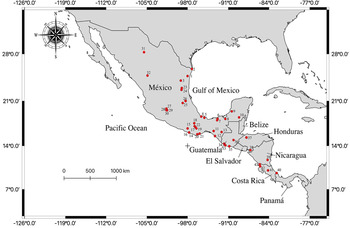
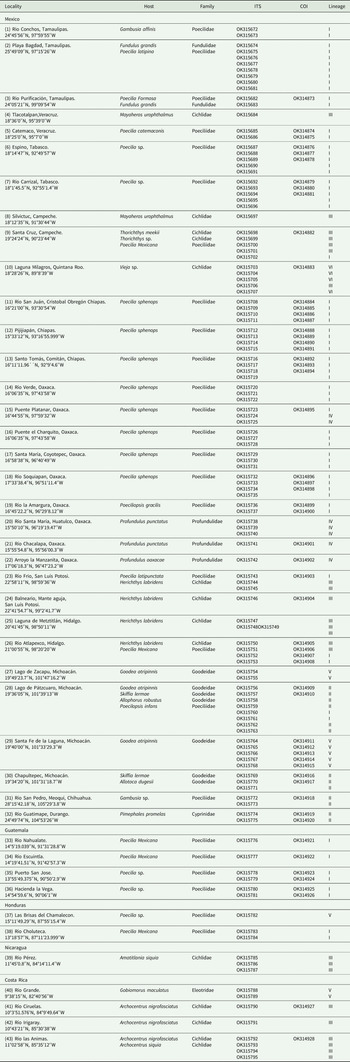
Between February 2013 and February 2019, metacercariae of Posthodiplostomum spp. were collected from the liver or mesentery of 550 individual fish representing 25 species; fish were sampled in 32 locations in Mexico, four in Guatemala, two in Honduras, one in Nicaragua and four in Costa Rica (Table 1, Fig. 1). Fish were captured with seine nets and electrofishing, kept alive and transported to the laboratory, individual fish were euthanized by spinal severance (pithing) following the American Veterinary Medical Association (AVMA, 2013) and immediately examined. Brain, body cavity, kidney, liver and eyes were placed in Petri dishes with 0.6% saline and examined for parasites under a stereomicroscope. For the morphological study, most metacercariae were released from the cyst using fine needles and placed in saline for approximately 15 minutes to relax and then fixed in hot (nearly boiling) 4% formalin; others were preserved in 100% ethanol for DNA extraction and sequencing. Fish were identified following Miller et al. (Reference Miller, Minckley and Norris2005) and Bussing (Reference Bussing2002).
Map showing the 32 localities sampled for Posthodiplostomum spp., in Mexico and Central America; localities correspond to those in Table 1.


Morphological study
Some metacercariae were stained with Mayers' paracarmine, Harris' haematoxylin or Gomoris' trichrome, dehydrated in a graded ethanol series, cleared in methyl salicylate and mounted as permanent slides with Canada balsam. Drawings were made with a drawing tube attached to the light microscope. Voucher specimens were deposited in the Colección Nacional de Helmintos (CNHE), Instituto de Biología, Universidad Nacional Autónoma de México (UNAM), with the accesion numbers: 11606-11611.
DNA extraction, PCR amplification, sequencing and phylogenetic analyses
Individual metacercariae of P. minimum released from the cyst were placed individually in tubes and digested overnight at 56 °C in a solution containing 10 mm Tris-HCl (pH 7.6), 20 mm NaCl, 100 mm Na2-EDTA (pH 8.0), 1% Sarkosyl, and 0.1 mg mL−1 proteinase K. Following digestion, DNA was extracted using DNAzol reagent (Molecular Research Center, Cincinnati, Ohio) according to the manufacturer' instructions. The ITS1 and ITS2 region and 5.8S gene from nuclear ribosomal DNA (rDNA) were amplified using the forward primer BD1, 5′-GTCGTAACAAGGTTTCCGTA-3´ and the reverse primer BD2, 5′-ATCTAGACCGGACTAGGCTGTG-3′ (Bowles and McManus, Reference Bowles and McManus1993). We attempted to sequence the cytochrome c oxidase subunit 1 barcode gene (COI) following the protocols described in previous studies (Moszczynska et al., Reference Moszczynska, Locke, McLaughlin, Marcogliese and Crease2009; Locke et al., Reference Locke, McLaughlin, Dayanandan and Marcogliese2010, i.e. using two sets of primers). The first set were the primers Plat-diploCOXF, 5′-CGTTTRAATTATACGGATCC-3′ and Plat-diploCOXR, 5′-AGCATAGTAATMGCAGCAGC, the second set were the primers Mplat-COX1dF, 5′-TGTAAAACGACGGCCAGTTTWCITTRGATCATAAG −3′ and the reverse primer Mplat-COX1dR, 5′- CAGGAAACAGCTATGACTGAAAYAAYAIIGGATCICCACC −3′ (Moszczynska et al., Reference Moszczynska, Locke, McLaughlin, Marcogliese and Crease2009). However, we were unsuccessful in achieving the amplification, which is noteworthy because the same set of primers and protocols were followed by us when studying other diplostomids (e.g. García-Varela et al., Reference García-Varela, Sereno-Uribe, Pinacho-Pinacho, Hernández-Cruz and Pérez-Ponce de León2016; Sereno-Uribe et al., Reference Sereno-Uribe, Andrade Gómez, Ostrowski de Nuñez, Pérez-Ponce de León and García-Varela2019a, Reference Sereno-Uribe, Andrade-Gómez, Pérez-Ponce de León and García-Varela2019b). To report the genetic variation of a mitochondrial gene among lineages uncovered by ITS, albeit not useful for comparison with other Posthodiplostomum isolates, a subsample was sequenced using the forward primer JB3, 5′-TTTTTTGGGCATCCTGAGGTTTAT-3′ and the reverse primer JB4, 5′-TAAAGAACATAATGAAATTG-3′ (Bowles and McManus, 1993). PCR reactions (25 μl) consisted of 10 μ m of each primer, 2.5 μL of 10 X buffer, 1.5 μL of 2 mm MgCl2, 0.5 μL of dNTP´s (10 mm), 1 U of Taq DNA polymerase (Platinum Taq, Invitrogen Corporation, São Paulo, Brazil) plus 2 μL of the genomic DNA plus 16.7 μL of distilled water. PCR cycling parameters for both amplifications included denaturation at 94 °C for 5 min; followed by 35 cycles of 94 °C for 1 min, annealing at 50 °C for 1 min and extension at 72 °C for 1 min, followed by a post-amplification incubation at 72°C for 10 min. Sequencing reactions were performed using ABI Big Dye (Applied Biosystems, Boston, Massachusetts) terminator sequencing chemistry and reaction products were separated and detected using an ABI 3730 capillary DNA sequencer. Contigs were assembled and base-calling differences were resolved using Codoncode Aligner version 9.0.1 (Codoncode Corporation, Dedham, Massachusetts). Sequences obtained in the current research for ITS, were aligned with sequences of other species of the genus Posthodiplostomum plus sequences of species of the genera Diplostomum, Tylodelphys, Neodiplostomum Railliet, 1919, Mesoophorodiplostomum, Dubois, 1936, Ornithodiplostomum Dubois, 1936, downloaded from GenBank. In addition, sequences of the strigeids Australapatemon Sudarikov, 1959, Parastrigea Szidat, 1928 and Uvulifer Yamaguti, 1934 were used as outgroups.
The novel COI sequences were aligned with other sequences of the genera Neodiplostomum, Alaria Schrank, 1788, Uvulifer and Bolbophorus Dubois, 1935 that were used as outgroup (see Supplementary Table 1). Sequences were aligned using the software Clustal W (Thompson et al., Reference Thompson, Gibson, Plewniak and Jeanmougin1997). The nucleotide substitution model was selected using jModelTest v0.1.1 (Posada, Reference Posada2008) and applying the Akaike criterion, the selected model was TVM + I + G for both datasets, for Bayesian analysis, and GTRGAMMAI model was used for the maximum likelihood (ML) analyses. Phylogenetic trees were constructed through ML with the program RAxML v7.0.4 (Stamatakis, Reference Stamatakis2006); and 10 000 bootstrap replicates were run to assess nodal support. We also estimated gene trees using MrBayes 3.2.2 (Ronquist et al., Reference Ronquist, Teslenko, Van der Mark, Ayres, Darling, Höhna, Larget, Liu, Suchard and Huelsenbeck2012), with two runs of the Markov chain (MCMC) for 10 million generations, sampled every 1000 generations, a heating parameter value of 0.2 and burn-in (25%). Trees were drawn using FigTree version 1.4.0 (Rambaut, Reference Rambaut2012). The genetic divergence among taxa was estimated using uncorrected ‘p’ distances with the program MEGA version 6 (Tamura et al., Reference Tamura, Stecher, Peterson, Filipski and Kumar2013).
Results
Alignment
One hundred twenty-four sequences of P. minimum were obtained for the internal transcribed spacers (ITS1, ITS2) and the 5.8S gene from nuclear ribosomal DNA, and the cytochrome oxidase subunit I (COI), from mitochondrial DNA. The ITS alignment contained 124 new sequences, plus 10 sequences of Posthodiplostomum centrarchi Hoffmann, 1958, four of Posthodiplostomum cuticola von Nordmann,1832, two of Posthodiplostomum nanum Dubois, 1937, eight of Posthodiplostomum brevicaudatum von Nordmann, 1832, two of Posthodiplostomum cf. minimum and 19 of various lineages of Posthodiplostomum sp. (Table 1), plus other sequences from different diplostomoid genera, namely Diplostomum, Tylodelphys, Mesoophorodiplostomum, Neodiplostomum, Parastrigea, Ornithodiplostomum, Australapatemon and Uvulifer. The dataset contained 195 sequences with a length of 1135 bp. Instead, the COI alignment included 55 new sequences of P. minimum, and were aligned with eight sequences of other diplostomids conforming a data set of 64 sequences of 396 bp long.
Phylogenetic analyses, geographic distribution and genetic distances
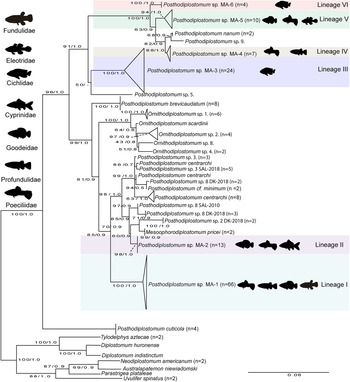
The phylogenetic analyses inferred with the ITS data set revealed the genus Posthodiplostomum as paraphyletic because species in the genera Ornithodiplostomum and Mesoophorodiplostomum are nested within a major clade that include all the species (or genetic lineages) of the genus Posthodiplostomum for which sequences of the internal transcribed spacers are available (Fig. 2). The base of the tree included four isolates of P. cuticola, as the sister species of all the remaining species which are resolved in two large monophyletic subgroups, with high nodal support values. Mesoophorodiplostomum pricei appeared as the sister species of Posthodiplostomum sp. 2 of Boone et al. (Reference Boone, Laursen, Colombo, Meiners, Romani and Keeney2018), a species from centrarchids in Ohio, USA; Ornithodiplostomum species were recovered as the sister group of several Posthodiplostomum species, most of them occurring in centrarchids. The only available sequences of P. minimum (identified as Posthodiplostomum cf. minimum, GenBank MF171004, MF170998, from eastern Europe centrarchids and probably requiring further verification) were nested with Posthodiplostomum sp. 8 DK-2018 from centrarchids in Europe, within a clade containing sequences of P. centrarchi from different eastern Europe locations. The ITS divergence strongly suggests P. cf minimum and P. centrarchi are the same taxonomic entity
Maximum likelihood tree and consensus Bayesian inference trees inferred from the ITS1, 5.8S and ITS2 dataset. Numbers near internal nodes show ML bootstrap clade frequencies and posterior probabilities (BI), n = number of sequences.

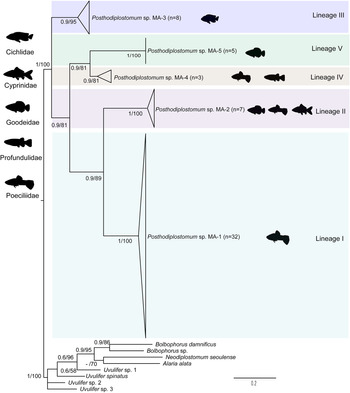
All the newly generated sequences of Posthodiplostomum were grouped in six well-supported lineages (Fig. 2). The first lineage included 66 isolates that were found parasitizing several fish species of the families Poeciliidae, Fundulidae, Profundulidae and Goodeidae, all of them, members of the order Cyprinodontiformes; these individuals were widely distributed in poeciliids of nine localities across the Gulf of Mexico slope, in goodeids of Lake Patzcuaro in central Mexico, and in profundulids and poeciliids across the Pacific Ocean slope between southwestern Mexico and Central America. Lineage II was formed by 13 isolates sampled from fish species belonging to three fish families, i.e. Cyprinidae, Goodeidae and Poeciliidae. This lineage was found in four localities of central and northern Mexico. Lineage III was formed by 24 isolates sampled exclusively in cichlids from eight localities of the Gulf of Mexico slope, one from the Atlantic coast of Nicaragua and three localities of Costa Rica. In this case, there seems to be strong host specificity towards species in the family Cichlidae over a wide geographic range in Middle America (see Fig. 2). The fourth lineage was formed by seven isolates of Posthodiplostomum sp., associated with species allocated in two cyprinodontiform fish families (Poeciliidae and Profundulidae), in localities along the Pacific slope of southwestern Mexico. Lineage V included 10 isolates associated with diverse fish families, i.e. Poeciliidae, Goodeidae and Eleotridae across a wide geographic range spanning from central Mexico southwards to Costa Rica. Finally, the sixth lineage was formed by four isolates recovered from the cichlid Vieja sp. in Milagros lagoon, Quintana Roo, Mexico (Fig. 2); we only sampled these four specimens and were all used for DNA amplification; no specimens were available for morphology; also, we were unable to obtain COI sequences of these isolates. Therefore, the phylogenetic analysis of COI only included sequences of five of the six lineages uncovered by ITS. Figure 3 depicts the relationships among five of the newly uncovered lineages through ML and BI. The topology shows two well-supported clades, one containing Lineages I and II and one including Lineage III as the sister taxa of Lineages IV and V.
Maximum likelihood tree and consensus Bayesian inference trees inferred from the COI dataset. Numbers near internal nodes show ML bootstrap clade frequencies and posterior probabilities (BI), n = number of sequences.

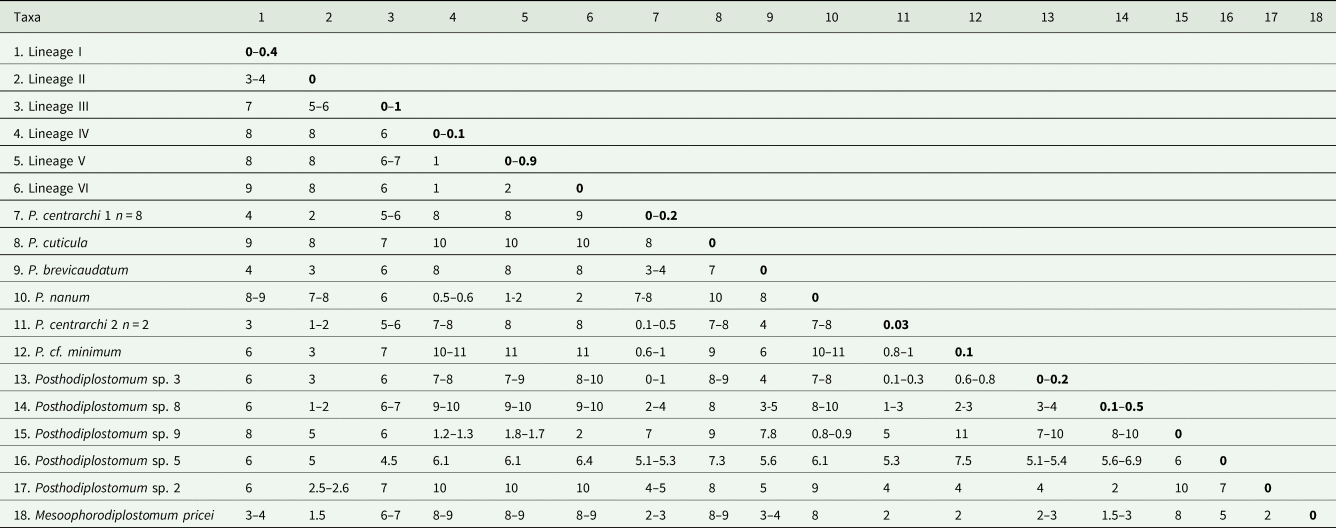
The genetic divergence estimated for ITS among the six lineages ranged between 1 and 9% (Table 2); the lowest value was found between the lineages IV and V (1%). The estimated COI genetic divergence among lineages corroborated the findings shown by ITS; divergence values were very high, varying between 14 and 18% (Table 3); unfortunately, we were unable to amplify the same region of the barcode gene to compare with other congeneric species. COI divergence between Lineages IV and V was also the lowest among lineages; however, divergence was still very high (14–15%), corroborating that they represent independent evolutionary units. Intraspecific genetic divergence was low for both molecular markers, except within Posthodiplostomum Lineage III where divergence may reach 1% and up to 8% for ITS and COI, respectively. Interrelationships within the lineage thus require further scrutiny.
Pairwise nucleotide sequence comparisons among samples of Posthodiplostomum spp. from the aligned ITS1, 5.8S and ITS2 sequences (N = 1135 nt). In bold is represented the genetic intraspecific divergence

Pairwise nucleotide sequence comparisons among samples of Posthodiplostomum spp., estimated from the COI alignment (N = 396 nt). In bold the genetic intraspecific divergence is represented

With few exceptions, a host and geographic pattern of association were not clearly discernible. In poeciliids there are at least four candidate species of Posthodiplostomum, some of them occurring in the same host species and the same locality (see Table 1, Fig. 1). The same pattern is shown for those lineages found in goodeids in lakes of central Mexico, where this fish family is native. Lineages I, II and V occur in different species of goodeids; interestingly, the Blackfin goodea, Goodea atripinnis Jordan is infected by candidate species represented by Lineages II and V. The case of cichlids is also remarkable, as they seem to have their own species of Posthodiplostomum, one widely distributed in several species of cichlids between northeastern Mexico and Costa Rica (Lineage III), and one apparently endemic lineage in Laguna Milagros, Quintana Roo, Mexico (Lineage VI).
Morphology
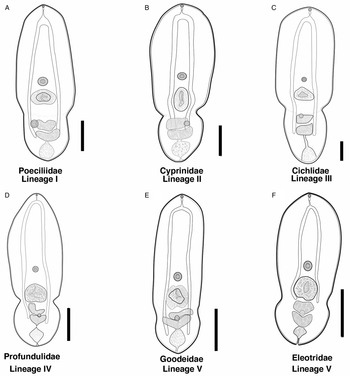
Morphologically, the metacercariae representing the lineages uncovered genetically are similar, particularly in terms of overall body size, in the proportion between fore and hindbody, the shape and size of the ventral sucker and pharynx, the extension of the intestinal caeca, and the position of ventral sucker and tribocytic organ on posterior half of forebody (Fig. 4). There seems to be, however, a slight difference in the shape of testes, and in the position of an ovary with respect to testes depending on the development of the metacercaria; the ovary can occupy a pretesticular, lateral or intertesticular position (Fig. 4).
Line drawings of Posthodiplostomum spp. metacercariae showing the main morphological traits observed in these larval forms. Lineage I ex Poecilia sphenops from Pijijiapan, Chiapas, Mexico (locality 12 in Fig. 1 and Table 1). (a); Lineage II ex Pimephales promelas from Río Guatimape, Durango, Mexico (locality 32 in Fig. 1and Table 1). (b); Lineage III ex Mayaheros urophthalmus from Tlacotalpan, Veracruz, Mexico (locality 4 in Fig. 1 and Table 1) (c); Lineage IV ex Profundulus punctatus from Río Santa Maria Huatulco, Mexico, locality (20 in Fig. 1 and Table 1). (d); Lineage V ex Goodea atripinnis from Santa Fe de la Laguna, Michoacán (locality 29 in Fig. 1. and Table 1) (e); Lineage V ex Gobiomorus maculatus from Río Grande, Costa Rica (locality 40 in Fig. 1 and Table 1) (f); scale bars = 200 μm.

Discussion
This study provides empirical data showing that the metacercariae of Posthodiplostomum minimum in Middle American freshwater fishes represent a species complex constituted at least by six putative species. Morphologically they are very similar, and it is not possible to establish an objective species delimitation since the reproductive traits which are commonly used to discern among species are not developed in the larval stages. As larval forms, characters related with the relative position of gonads might not be reliable to separate species because these structures may vary when the metacercaria develop into an adult, once they reach their definitive host (Palmieri, Reference Palmieri1976, Reference Palmieri1977a, Reference Palmieri1977b, Reference Palmieri1977c; Pérez-Ponce de León, Reference Pérez-Ponce de León1992, Reference Pérez-Ponce de León1995). This is probably why most records of the metacercaria in freshwater fish were made as P. minimum (see Pérez-Ponce de León et al., Reference Pérez-Ponce de León, García-Prieto and Mendoza-Garfias2007). However, the molecular result in this study agrees with several recent investigations demonstrating a large genetic diversity, and potential for genetic lineages to represent independent taxonomic units or species within the genus (see Locke et al., Reference Locke, McLaughlin, Dayanandan and Marcogliese2010; Boone et al., Reference Boone, Laursen, Colombo, Meiners, Romani and Keeney2018). The genus Posthodiplostomum currently contains 24 species distributed worldwide, primarily in association with fish-eating birds of the family Ardeidae, which serve as the definitive hosts (Dubois, Reference Dubois1970; Niewiadomska, Reference Niewiadomska, Gibson, Jones and Bray2002; Ritossa et al., Reference Ritossa, Flores and Viozzio2013; López-Hernández et al., Reference López-Hernández, Locke, Melo, Rabelo and Pinto2018), although species of other bird families also have been reported as definitive hosts. In the Americas, 11 species of Posthodiplostomum have been described, representing 46% of the biodiversity of the genus. Four of these species are distributed in North America, two in Canada, i.e. Posthodiplostomum boydae Dubois, 1969 and P. opisthosicya Dubois, 1969 and two in the United States, i.e. P. prossostomum Dubois and Rausch, 1948, and P. minimum (see Ritossa et al., Reference Ritossa, Flores and Viozzio2013). The first three species have not been reported after their original description as adults, and their metacercariae have never been characterized morphologically. Posthodiplostomum minimum is the only species reported thus far as adult and metacercaria in Mexico and Central America, although some additional records of the larval form have been published as Posthodiplostomum sp. (see Pérez-Ponce de León et al., Reference Pérez-Ponce de León, García-Prieto and Mendoza-Garfias2007). The remaining seven congeneric species in the Americas were described as parasites of fish-eating birds in several locations throughout South America (Travassos et al., Reference Travassos, Teixeira de Freitas and Kohn1969; Dubois, Reference Dubois1988; Lunaschi et al., Reference Lunaschi, Cremonte and Drago2007; Pinto et al., Reference Pinto, Mati and Melo2013; Fernandes et al., Reference Fernandes, Justo, Cárdenas and Cohen2015). Rietschel and Werding (Reference Rietschel and Werding1978) reported the presence of P. minimum in ardeids of northern Colombia; however, this record requires further verification since it was not recognized as a valid species by Fernandes et al. (Reference Fernandes, Justo, Cárdenas and Cohen2015) in their list of trematodes of birds from South America. In the case of the South American species, P. grande (Diesing, 1850) Dubois, 1936; P. miscrosicya Dubois, 1936; P. magnum Boero, Led and Brandetti, 1972; and P. giganteum Dubois, Reference Dubois1988, have been reported only once (as the original description). Instead, P. macrocotyle Dubois, 1937 has been reported in Accipitridae and Rhinchopidae from Brazil and Argentina; P. obesum (Lutz, 1928) Dubois, 1977 from Phalacrocoracidae in Argentina, Brazil and Venezuela, and the most widely distributed species, P. nanum in Ardeidae (mostly) across all South America.
Of the 11 species reported across the Americas, only two have been sequenced, P. nanum and P. centrarchi (a species originally considered as a subspecies, P. minimum centrarchi, but see Stoyanov et al. (Reference Stoyanov, Georgieva, Pankov, Kudlai, Kostadinova and Georgiev2017) who elevated the subspecies to the species level). In this study, on the one hand, Posthodiplostomum sp. MA-3 (Lineage IV) was resolved as the sister species of P. nanum plus Posthodiplostomum sp. 9. Genetic divergence for the ITS region was very low, varying between 0.4 and 0.5 with respect to P. nanum. This evidence suggests that Lineage IV could be conspecific with P. nanum. This species is widely distributed across South America (Argentina, Brazil, Colombia, Paraguay and Venezuela), parasitizing seven species of ardeids, (although it has been also found in other bird families), i.e. accipitrids (1 species), anatids (1 species), threskiornithids (1 species), tyrannids (1 species) (see Fernandes et al., Reference Fernandes, Justo, Cárdenas and Cohen2015 and references therein); additionally, P. nanum was also reported from ardeids from Cuba (Dubois, Reference Dubois1970). The life-cycle of P. nanum has been experimentally and molecularly elucidated (Ostrowski de Nuñez, Reference Ostrowski de Núñez1973; Pinto and Melo, Reference Pinto and Melo2012; López-Hernández et al., Reference López-Hernández, Locke, Melo, Rabelo and Pinto2018). Interestingly, the metacercariae of P. nanum were found naturally infecting poeciliids in Brazil and Argentina; the guppy, Poecilia reticulata Peters, was experimentally infected with the cercaria of P. nanum. Posthodiplostomum sp. Lineage IV was found as metacercaria in two families of cyprinodontiforms, i.e. Poeciliidae and Profundulidae. Therefore, the phylogenetic position, ITS genetic divergence, geographical distribution, and the host association of the metacercariae may suggest that Lineage IV might be conspecific with P. nanum; however, we took a conservative position and refrain considering conspecificity. COI sequences are required to test this hypothesis, and to determine if the geographic pattern mirrors that of other trematodes parasitizing migratory fish-eating birds (e.g. Briosio-Aguilar et al., Reference Briosio-Aguilar, Rodríguez-Santiago, López-Garcia, García-Varela and Pérez-Ponce de León2018; Sereno-Uribe et al., Reference Sereno-Uribe, Andrade Gómez, Ostrowski de Nuñez, Pérez-Ponce de León and García-Varela2019a).
On the other, the molecular data revealed that none of the remaining five newly discovered genetic lineages corresponds with sequences of P. centrarchi; this species is widely distributed and specific to centrarchids in North America. This species has also been introduced to Europe, following the introduction of two species of centrarchids in that continent, the pumpkinseed sunfish, Lepomis gibbosus L., and the largemouth black bass, Micropterus salmoides Lacèpede (Kvach et al., Reference Kvach, Jurajda, Bryjová, Trichkova, Ribeiro, Přikrylová and Ondračková2017; Stoyanov et al., Reference Stoyanov, Georgieva, Pankov, Kudlai, Kostadinova and Georgiev2017). Hoffman (Reference Hoffman1958) was the first to propose the subdivision of P. minimum in two subspecies, P. minimum minimum MacCallum, Reference MacCallum1921, and P. minimum centrarchi Hoffman, Reference Hoffman1958; the first subspecies showed a strong specificity towards cyprinids as second intermediate hosts, whereas P. minimum centrarchi was specific towards centrarchids. Several authors accepted the validity of these two subspecies (e.g. Gibson, Reference Gibson, Margolis and Kabata1996; Hoffman, Reference Hoffman1999). In fact, in the landmark monographic work by Dubois (Reference Dubois1970), the adult of P. minimum was characterized, but the author recognized the validity of the two subspecies based on the host specificity of the metacercaria. Sequence data on P. minimum minimum are not currently available for comparison; however, following the same line of reasoning as in Stoyanov et al. (Reference Stoyanov, Georgieva, Pankov, Kudlai, Kostadinova and Georgiev2017), since P. minimum centrarchi was elevated to species level, then the subspecies P. minimum minimum should be elevated to represent the metacercaria of P. minimum sensu stricto. Some isolates of Posthodiplostomum Lineage II were sampled in northern Mexico from the fathead minnow, Pimephales promelas, which is a member of the family Cyprinidae. Hoffman (Reference Hoffman1958) suggested a strict host specificity of P. minimum minimum towards that fish family in North America. The fathead minnow is widely distributed in North America, from Quebec to Northwest Territories and British Columbia in Canada and south to Alabama, Texas in USA and northern Mexico (Page and Burr, Reference Page and Burr2011); it is possible that Lineage II could be conspecific with P. minimum; however, some isolates of Lineage II were also sampled from poeciliids and native goodeids in the north and central part of Mexico, respectively, casting doubts about the allegedly strong host specificity of P. minimum towards cyprinids. Still, sequences of Posthodiplostomum metacercariae in cyprinids from northern areas of North America (and sequences from adults sampled from ardeids) are needed to corroborate this hypothesis.
Host specificity has been thoroughly studied in P. minimum (Hunter and Hunter, Reference Hunter and Hunter1940; Klak, Reference Klak1940; Ferguson, Reference Ferguson1943; Avault and Allison, Reference Avault and Allison1965; Avault and Smitherman, Reference Avault and Smitherman1965; Spall and Summerfelt, Reference Spall and Summerfelt1970; Lane et al., Reference Lane, Spier, Wiederholt and Meagher2015; Boone et al., Reference Boone, Laursen, Colombo, Meiners, Romani and Keeney2018). Our study emphasizes the idea that a proper species delineation is fundamental to better understand the patterns and processes that determine host specificity as one of the most important drivers of parasite diversification. Not achieving the correct species identification of the larval forms of diplostomids (and any other trematode larval form) may lead to gather wrong conclusions. Lane et al. (Reference Lane, Spier, Wiederholt and Meagher2015) precisely concluded that ‘it is important to note that our analysis of host specificity in P. minimum rests explicitly on the currently accepted view that all P. minimum reported from centrarchids are members of a single species’. These authors reinforced the view of the importance of identifying genetically how many species of Posthodiplostomum use centrarchids as second intermediate hosts. Host specificity has been a central issue in diplostomoid systematics; extensive taxonomic revisions by Dubois' over more than 50 years were based on an allegedly strict host specificity towards their definitive hosts (see Dubois, Reference Dubois1970). Molecular tools currently provide the opportunity to test more objectively cases of host specificity at different stages of the trematode life cycles. For instance, we cannot ascertain whether studies on host-induced morphological variability by Palmieri (Reference Palmieri1976, Reference Palmieri1977b, Reference Palmieri1977c) and Pérez-Ponce de León (Reference Pérez-Ponce de León1992, Reference Pérez-Ponce de León1995) dealt with the metacercaria of P. minimum, or with another congeneric species. Studies by Palmieri reported the use of an experimental approach using metacercariae from centrarchid fishes from Utah, USA, to infect diverse potential definitive hosts of P. minimum; based on the second intermediate hosts (centrarchiids), these studies must refer to P. centrarchi, as currently conceived. Pérez-Ponce de León (Reference Pérez-Ponce de León1992, Reference Pérez-Ponce de León1995) also analysed the host-induced morphological variability of P. minimum based on metacercariae obtained from the pike silverside, Chirostoma estor Jordan, a native fish of Pátzcuaro Lake in central Mexico; metacercariae were used to infect chickens, ducks, and mice as definitive hosts to compare with adults obtained naturally from fish-eating birds in the same locality. Based on the results of our current study, it is not clear if the author was dealing with only one species although at the time, only morphological characters were assessed. Interestingly, species of goodeids from the same locality (another endemic family of hosts) harbour at least two genetic lineages; it is unclear yet if at least one of them correspond to P. minimum.
The same premise (correct species delineation) must be considered when analysing other facets of the studies on Posthodiplostomum species. For instance, P. minimum has been considered as the species of trematode whose metacercaria (referred to as the ‘white grub’), causes a detrimental effect on freshwater fish health (e.g. Mitchell et al., Reference Mitchell, Smith and Hoffman1982; Osorio-Sarabia et al., Reference Osorio-Sarabia, Pérez-Ponce de León and García-Marquez1986; Grizzle and Goldsby, Reference Grizzle and Goldsby1996). Whether the detrimental effects are only caused by P. minimum requires a correct species identification of the aetiological agent causing the disease. It is possible that different species of Posthodiplostomum possess different infectivity towards their fish hosts.
Our results shed light on the diversity of species of the genus Posthodiplostomum in Middle America. At least six putative species should be recognized in what once was P. minimum. In this way, it seems plausible to postulate that studies aimed at addressing the diversity of larval forms of Posthodiplostomum in other latitudes will result in the discovery of an unexpected genetic diversity, particularly if species of fish from diverse families are analysed. Some general patterns seem to emerge; for example, Pérez-Ponce de León et al. (Reference Pérez-Ponce de León, García-Varela, Pinacho-Pinacho, Sereno-Uribe and Poulin2016) uncovered a genetic lineage that resulted in a new species of Clinostomum Leidy, 1856, C. cichlidorum Sereno-Uribe, García-Varela, Pinacho-Pinacho and Pérez-Ponce de León, 2018, highly specific to cichlids, and widely distributed between Costa Rica and southeastern Mexico. A similar result was found by López-Jiménez et al. (Reference López-Jiménez, Pérez-Ponce de León and García-Varela2018) regarding the lineages of Uvulifer in Middle American cichlids. In our study, Posthodiplostomum Lineage III was also found exclusively in cichlids within the same geographical range. Molecular data provide a reliable source of information upon which different aspects of the systematics and evolutionary biology of parasitic organisms can be tested. Our study shows that molecular data on Posthodiplostomum are fundamental to understand the diversity of this important group of trematodes and contributes further to a better understanding of the overall diversity of diplostomids around the world. Additionally, the data we provide herein will be useful to establish a link between the metacercariae and the adults sampled from fish-eating birds, which is the next step in our research on Posthodiplostomum. Once adults are sequenced, we will be able to determine if some of the lineages uncovered in this study correspond with previously described species of Posthodiplostomum in the Americas, or if they represent new species that require a formal description.
Supplementary material
The supplementary material for this article can be found at https://doi.org/10.1017/S0031182021001748.
Data
Sequence data are available at the GenBankData Availability Statements are brief statements telling readers how they can access the data and other materials that would be necessary to replicate the findings of an article, in the interests of research transparency.
Acknowledgements
We thank Leopoldo Andrade Gómez, Eduardo Hernández Cruz, and Jesus Hernández Orts for their help during field work in Mexico and Central America; Luis García Prieto for providing specimens for comparison deposited at the Colección Nacional de Helmintos. We also thank Laura Márquez Valdelamar and Nelly López Ortíz, Laboratorio Nacional de la Biodiversidad for their help with the use of the automatic sequencer. Hosts in Mexico were collected under the Cartilla Nacional de Colector Científico (FAUT 0202 and 0057) issued by the Secretaría del Medio Ambiente y Recursos Naturales (SEMARNAT), to MGV and GPPL, respectively. Special thanks to Arturo Angulo for his help to collect fish specimens in Costa Rica under the collecting permit issued by the Costa Rican government.
Author contribution
GP and MG conceived and designed the study. MG, AS and DP conducted data gathering. MG and DP performed statistical analyses. GP, MG, AS and DP wrote and edited the article.
Financial support
This research was supported by grants from the Programa de Apoyo a Proyectos de Investigación e Innovación Tecnológica (PAPIIT-UNAM) IN207219 and IN212621 to MGV and GPPL, respectively, and from the Consejo Nacional de Ciencia y Tecnología (CONACYT) No. A1-S-21694 to GPPL.
Conflicts of interest
The authors declare there are no conflicts of interest.
Ethical standards
Fish were euthanized by spinal severance (pithing) following the procedures accepted by the American Veterinary Medical Association (AVMA, 2013)