1. INTRODUCTION
People interact with artifacts, either products or services, in their lives. These interactions are based on two-way communication between people and artifacts. The characteristics of artifacts that induce natural activities of people, affordances, play critical roles in making interactions successful and meaningful. While many authors have emphasized the importance of affordances (Gibson, Reference Gibson1979; Norman, Reference Norman2002), not many systematic methodologies to design in such affordances have been developed.
A systematic method to identify affordances using the interaction between functions (Pahl & Beitz, Reference Pahl and Beitz1988; Kirschman & Fadel, Reference Kirschman and Fadel1998; Stone & Wood, Reference Stone and Wood2000) and tasks has been proposed by Galvao and Sato (Reference Galvao and Sato2005, Reference Galvao and Sato2006). In associating user tasks and technical functions, three types of interactions are considered: physical interactions, cognitive interactions, and both. Groupings of these interaction elements are identified to produce the affordances. The function–task interaction (FTI) method has been applied in other work (Kim et al., Reference Kim, Kim, Lee, Lee, Lee and Lim2007). Maier et al. (Reference Maier, Ezhilan and Fadel2007) introduced the affordance-structure matrix for evaluating what affordances are associated in each component of a product. This matrix can illustrate correlations of affordances and also of components (Maier et al., Reference Maier, Ezhilan and Fadel2007).
The notion of affordance features, structural elements of artifacts that provide affordances, has been proposed by Kim, Jeong, et al. (Reference Kim, Kim and Jeong2008). The subjective aspect of people in perceiving affordances, that is, the differences of the way affordance features are perceived by individual users, has been discussed (Kim, Kim, et al., Reference Kim, Kim and Jeong2008). Three kinds of affordance feature classes have been introduced, and some critical affordances for a typical household product such as a toaster have been discussed (Kim et al., Reference Kim, Lim and Park2009). Murakami et al. (Reference Murakami, Cheng, Higuchi and Yanagisawa2006) tried the formulation of affordance features for products by showing that relations between geometric attributes, such as the height and aspect ratio between the width and length, are strongly associated with human activities such as pushing, pulling, turning, and tilting (Murakami et al., Reference Murakami, Cheng, Higuchi and Yanagisawa2006).
A study to identify affordance features of a simple medical device, a portable infrared crystal lamp, has been conducted (Kim et al., Reference Kim, Cho and Kim2011). A task model has been developed based on the usage of a medical expert, and observation of activities of normal users has been conducted. Affordances have been identified through the TFI method of Galvao and Sato. Based on the structural elements of the device identified by state changes in user activity observation, affordance features have been identified. Affordance features of existing artifacts can be compiled to provide help with designing new artifacts (Lim, Reference Lim2011).
In this paper, a methodological framework for design for affordances is proposed where a repository of affordance features is used. The key for this design for affordance method is to compile affordance features in repositories so that new affordance feature design can exploit affordance features in the repositories. To demonstrate the design for affordance method, simple product design tasks have been conducted by several designers. This paper introduces the proposed framework of design for affordance and two case studies to demonstrate the utility of the design framework. One case study addresses the design process in the proposed framework with think-aloud protocol analysis. The other case study with practicing designers is to show specific design improvements obtained through the design for affordance approach, where design improvements are made one affordance at a time using affordance feature repositories.
2. DESIGN FOR AFFORDANCE FRAMEWORK
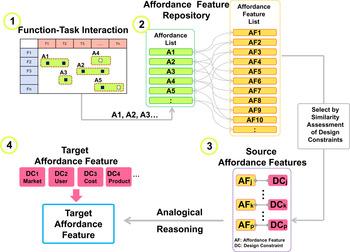
The proposed framework of design for affordances is composed of three major steps. In the first step, affordances are identified for the given design problem. This can be done in a few different ways. Using the FTI method of Galvao and Sato, affordances can be identified considering tasks and activities of user and functions of the product or the service to be designed. Alternatively, affordances could be identified by observing user activities (Kim, Joeng, et al., Reference Kim, Jeong, Kim and Lee2008; Kim, Kim, et al., Reference Kim, Kim and Jeong2008). The output of the first step is the list of affordances. The first step is marked by 1 in the figure illustrating the framework of design for affordance (Fig. 1).
Design for affordance framework.

In the second step, using a repository of affordance features where multiple affordance features for a given affordance are compiled, affordance features for each affordance identified in Step 1 are browsed as marked by 2 in Figure 1. Then affordance features of a given affordance are selected considering design constraints and contexts of those in the repository. For a specific affordance, many affordance features are stored in the repository. Those affordance features have their relevant design constraints and contexts explicitly described as illustrated in the next section of the case study. The affordance features with design constraints and contexts similar to the current design constraints and contexts are to be selected and used in the subsequent process. The second step includes the selection of affordance features in the repository.
In the third step, using the clues given by the selected affordance features, the new affordance feature is to be designed through analogical reasoning. Analogical reasoning is a fundamental cognitive tool in design problem solving. Design solutions in previous, existing problems, called the “source” problems, are used to derive a design solution in the current, given problem, called the “target” problem. The third step in this framework is the analogical reasoning step that converts the source affordance features in the repository into the target affordance features to support the affordance of the current design problem as noted in Figure 1 as the transformation from 3 to 4.
The facilitation of the proposed design for affordance method is made by having a well-prepared affordance feature repository where affordance features and the corresponding design constraints and contexts are properly described. Before using the repository, the step of affordance identification should be done by the designers with thorough function and task analysis. Especially when stakeholders interact with each other, as is typical in service design cases, activities of all relevant stakeholders involved in the interaction should be identified (Kim, Lee, et al., Reference Kim, Lee, Kim, Jeong and Kim2012). The creative process of analogical reasoning from the source affordance features into the target affordance features would be done in many different ways reflecting the corresponding designer's design approaches. Some comparison of design processes in this framework has been reported in Kim, Shin, et al. (Reference Kim, Shin, Kim, Noh and Kim2012), where design steps of several designers have been recorded with sketches and analyzed through interviews with designers. Target affordance features could be compared based on the distances from the source affordance features in analogical reasoning of the proposed method (Kim et al., Reference Kim, Noh and Kim2013). The process of the proposed design for affordance framework is explained through the case studies in the following sections. Case Study 1 helps understanding the proposed design for affordance process. Case Study 2 shows how the method is used to design practical, useful solutions for affordances and user activities.
3. CASE STUDY 1 OF DESIGN FOR AFFORDANCE USING REPOSITORY: TUMBLER
3.1. Design for affordance task
To illustrate how the proposed design for affordance framework is to be used, a product design case study has been conducted. In the case study, the task was to make design improvements of a tumbler, a portable coffee cup, as shown in Figure 2. The whole intent of the proposed design for affordance method is to design the artifact better so that human activities in fulfilling the function of the artifact can be naturally induced. Affordance identification using FTI has been done beforehand and presented to the designers. For a tumbler, affordances identified are the following: place-ability, hand grasp-ability, finger grasp-ability, hand position-ability, separate-ability, store-ability, align-ability, pour-ability, and heat prevent-ability (Kim, Shin, et al., Reference Kim, Lee, Kim, Jeong and Kim2012). The affordance feature repository has been provided with guidance to use. The design time duration of the experiment was limited to 60 min.
Tumbler.

The design process of each designer has been recorded using a computer tablet sketchpad synchronized with think-aloud narratives. The design process was recorded through the progressions made on the sketchpad. In addition, designer think-aloud remarks throughout the design process were analyzed with time synchronization. Once each designer finished her design, a retrospective interview was done to capture the designer's intent and reflections. By observing the design processes, the utility of the proposed design for affordance framework can be assessed. In addition, the process characteristics in this method could be understood in this way.
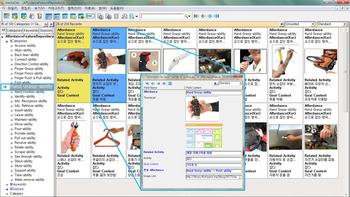
In the proposed design for affordance method, designers would select source affordance features in the affordance feature repository by assessing similarities between the design constraints of sources and targets. Affordance features in the repository as shown in Figure 3 are described with the affordance name, an image or drawing of the specific affordance feature, and the activity that the feature supports. Particularly the activity is described using the context-based activity modeling method, where activity elements such as actors, object, tools, and context are systematically represented (Kim & Lee, Reference Kim and Lee2011). Here, context is represented with goals, relevant structures, physical contexts, and psychological contexts. Note that this representation of activities forms the core of a systematic product–service systems design framework where service activities are designed together with the product elements supporting the activities. Specific elements of the corresponding activity including context elements form the design constraints for the affordance feature. Alternatively, specific design constraints could be listed for each affordance feature in the repository.
Affordance feature repository with context-based activity modeling.

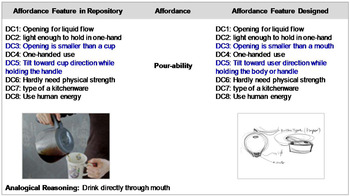
To illustrate this, the pour-ability affordance of a tumbler could be considered. Suppose there are five different affordance features in the repository as shown in Figure 4. A designer would select the first one, the pour-ability affordance feature of a coffee pot, as a source affordance feature. As shown in Figure 5, the affordance feature of a coffee pot had eight different design constraints, which can lead to a pouring activity. Among those, six design constraints (DC1, DC2, DC4, DC6, DC7, and DC8) were similar to those of the tumbler's pour-ability affordance feature. The designer could convert the pour-ability affordance feature of a coffee pot features into a lip line-like feature in the new tumbler design as shown in Figure 5.
Affordance features for pour-ability.

Pour-ability affordance features with constraints in a coffee maker and a tumbler.

3.2. Design for affordance process
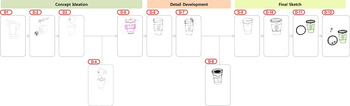
Several designers designed their new tumbler by using the affordance feature repository. Each designer's process can be depicted in two different ways: sketches made in the design for affordance process are shown in a time sequence in Figure 6, where the design for affordance process of a designer is shown. Source affordance features used are shown together with corresponding sketches in the second depiction (Fig. 7). In this way, the design process flow can be easily observed in the first depiction, while specific reasoning clues are identified where source affordance features are shown together with target sketches.
Designer D's sketch process.

Designer D's sketch process with source affordance features used.

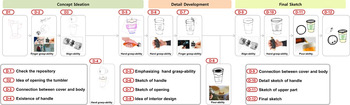
The design process could be divided into four stages: activity review, concept ideation, detail development, and final sketch. When there is no source affordance feature attached, the corresponding design process has been done without using the repository. When the reference of affordance features and sketches were made but are not in the main design development, they are shown underneath the main horizontal time line, as found in the case of D-4 and D-8 in Figure 6.
Designer D, whose process is shown in the figures, actively used the affordance feature repository. Designer D got clues from the source affordance feature, but did not make big modifications from the source affordance features in her analogical reasoning process. Designer D started off by checking every affordance and selected source affordance features needed for design improvements. Designer D made a steady progress using the affordance feature repository in an affordance by affordance way, where design improvements are made addressing one affordance at a time in a sequential manner. Sketch D-9 shows a new structure of the tumbler's body and cover influenced by the image of the coupling in the align-ability affordance feature as shown in Figure 7, D-9.
3.3. Protocol data analysis of design process
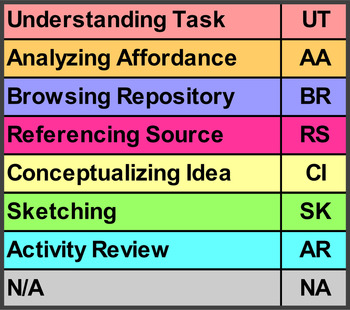
After the designers' experiment in designing a new tumbler, an analysis was conducted to understand details in the design process. A commercial software called Interact (Mangold, Reference Mangold2014) was used to analyze the think-aloud protocol data of designers' process. Designer D's design process is taken as an example to explain the analysis. The coding scheme for the analysis is composed of eight design activities as needed in the proposed process of design for affordance. The designer needs to understand the design task (understanding task). The designer will analyze those identified affordances (analyzing affordance). Each affordance supports a specific activity. Those activities are reviewed (activity review). The repository contains multiple affordance features. The designer will look at those affordance features in the repository [browsing repository (BR)]. When a source affordance feature is selected, the source affordance feature is specifically referred to [referencing source (RS)]. By analogical reasoning, new target affordance feature is conceptualized [conceptualizing idea (CI)]. The new affordance feature sketch is finalized [sketching (SK)]. Some activities of the designer not applicable will be classified as not applicable. This coding scheme is shown in Figure 8.
Eight design activities in the coding scheme.

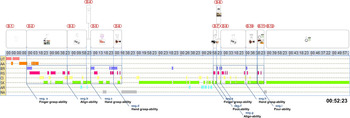
The design for affordance process diagram can be obtained from the analysis using the coding scheme as shown in Figure 9. Note that this designer herself conducted the FTI method to identify affordances. She was so familiar with the affordances that she did not need to return to analyzing affordance more than once in the beginning. The designer's activities of BR, RS, CI, SK, and activity review appear repeatedly. Not applicable activity appeared three times. SK activities were lengthy, because of the operation of the sketch software program requiring saving and resketching, and should be treated extrinsic to the design for affordance process. The long SK at the end corresponds to the final touches to make the sketch clear.
Data analysis of Designer D's design process.

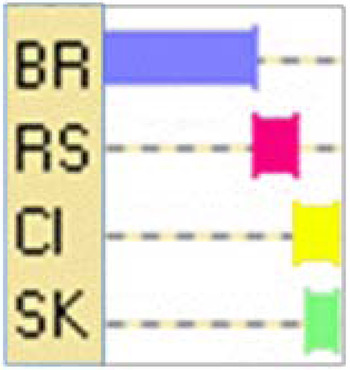
By associating the design for affordance activities with specific design sketches and using the affordance features from the repository as shown in Figure 10, a more concrete process pattern can be observed as in the early part of the segment in the figure. A pattern of design activities composed of BR, RS, CI, and SK in sequence as shown in Figure 11 can be identified. This pattern repetitively appears in the other segments of Designer D's design process. For example, Designer D reflected a finger grasp-ability in segments a and e; align-ability in segments b and g; hand grasp-ability in segments c, d, and h; and pour-ability in segments f and i. Finger grasp-ability, align-ability, hand grasp-ability and pour-ability were reflected multiple times in the design process.
Data analysis of Designer D's design process with sketches and source affordance features synchronized with the design process in Figure 7.

Design process pattern.

3.4. Remarks on Case Study 1
This case study contributed to the understanding of the design process of the proposed design for affordance method. Interviews with designers and protocol analysis with synchronized association of source and target affordance features were helpful. Designers address one affordance at a time and conduct the design process with a pattern of repository browsing, source affordance feature selection, target affordance feature conceptualization, and sketching. Designers would visit some affordances more than once as they improved their design.
4. CASE STUDY 2 OF DESIGN FOR AFFORDANCE USING REPOSITORY: HAND CARRIER CART
4.1. Design for affordance task
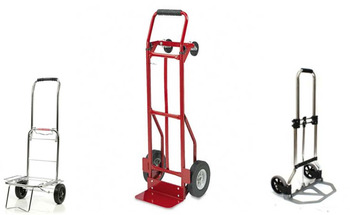
Another product design case study has been conducted to illustrate how the proposed design for affordance framework is to be used. In this case study, the task was to redesign a hand carrier cart like those shown in Figure 12. The design time duration of the experiment was limited to 60 min. This task has been done at two different occasions: with students and practicing designers in a laboratory/classroom setting and with practicing designers in their company workshop. The laboratory/classroom case included a brief retrospective interview to capture designers' intent and reflections, and some of the results have been discussed earlier (Kim et al., Reference Kim, Lee, Kim, Jeong and Kim2013). The company workshop case could not include retrospective interviews.
Hand carrier cart design.

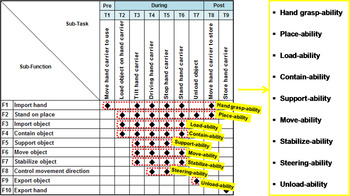
Affordances have been identified using the FTI method. The interactions between 10 functions and 9 activities have been determined and grouped to identify 9 affordances as shown in Figure 13: hand grasp-ability, place-ability, load-ability, contain-ability, support-ability, move-ability, stabilize-ability, steering-ability, and unload-ability.
Affordances identified by function–task interaction of hand carrier.

The affordance feature repository has been provided to the participants. For each affordance, five affordance features have been provided as stickers as shown in Figure 14. The stickers of the affordance features selected by participants as sources are to be attached around their target affordance feature sketch with comments about their design and selected affordance features in the repository. Note that the sticker version intentionally has a small number of affordance features with limited information compared to the software version. This allows handy workshop-like experiments with reduced time in the similarity assessment process.
Nine affordances and their affordance features (five each).

4.2. Evaluation of level of analogy for design for affordance
To understand the way the design for affordance method was used, design sketches done through analogical reasoning from source affordance features selected from the repository to target affordance features can be evaluated. Evaluation criteria are like the following. The case of direct analogy from the source to target was given 1 point. When shapes of source and target affordance features were different, 2 points were given. When function enhancements were made as well as shape change, 3 points were given. In the case of wrong interpretation of the source affordance features, –1 point was given. When affordance feature sketches came from other than the repository, 2 points were given. The overall evaluation strategy in this case is based on the idea that analogical reasoning to a remotely related affordance feature is evaluated more creative as usually regarded in analogical reasoning. Three practicing designers' sketches are discussed as examples.
4.2.1. Designer A
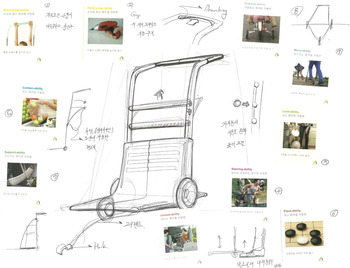
The sketch of Designer A received 9 points out of nine affordance features. Except unload-ability, marked by 3 in Figure 15, eight remaining affordance features are direct analogies from selected source affordance features. While two source affordance features are attached for steer-ability, marked 1 and 2, the target feature is almost identical to the bar-type steering in source 1. The support-ability affordance feature is used in fixing objects in the cart, rather than supporting the cart from gravity. Thus, this seems a misinterpretation, resulting in –1 point. Function enhancement and shape change occur for unload-ability as the moving belt is a composition of two source features of 3 and 4, as it moves along the belt, not vertically as in feature 4. The overall score of Designer A's sketch is 9 points.
Final sketch of Designer A.

4.2.2. Designer B
In Designer B's sketch (Fig. 16), seven direct analogy affordance features appear except those on hand grasp-ability and place-ability. For hand grasp-ability, two source features of 1 and 2 were combined with an enhanced new function of braking, resulting in 3 points. While place-ability affordance feature 6 is used, it is used for unloading-ability to tilt the bottom to ease unloading. This received 3 points. Otherwise, the target affordances are the result of direct analogy. Contain-ability feature 5 is directly used as a secondary affordance feature for contain-ability. The overall score of Designer B's sketch is 13 points.
Final sketch of Designer B.

4.2.3. Designer C
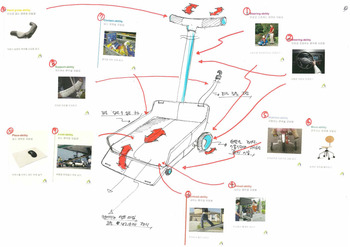
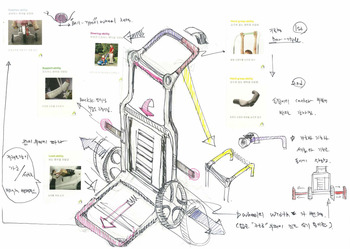
In Designer C's sketch, four affordances of place-ability, contain-ability, move-ability, and unload-ability have not been specifically addressed with stickers, leaving these features of the typical original cart designs unchanged. The hand grasp-ability feature combined two source features as the shape transforms from a single bar type feature to two separate handles, as depicted in the arrow shown in the upper-right corner of Figure 17. Particularly, two different grasping orientations are enabled through this transformation from horizontal bar to vertical handle. This would get 3 points. These kinds of more flexible use of the affordance feature repository would be an interesting aspect. Note that the role of creative stimuli of various images has been studied in a European research project (Bouchard et al., Reference Bouchard, Omhover, Mougenot, Aoussat, Westerman, Gero and Goel2008).
Final sketch of Designer C.

Load-ability also takes shape change to accommodate various object volumes by sliding out the bottom plate and two side wheels as noted with arrows. The support-ability affordance feature changes from a strip to buckled strips, though they support objects, not the cart itself as originally intended with support-ability. Stabilize-ability affordance is given with two small additional wheels as in the source of a kid's bike, but the shape of the wheels is changed to ball-type. This change from the source feature received 2 points. The steering-ability feature is different from the source as the handle transforms its shape. Note that this designer did not change four affordance features. If those were modified, his design could have been a far superior design.
4.3. Remarks on Case Study 2
Note that practicing designers in Case Study 2 used the proposed design for affordance method in design to improve the hand carrier cart in a very effective manner. The design task has been well decomposed into affordances so that they focus the design process addressing these issues. Affordance features in the repository, although it is with only five affordance features for each affordance, helped the designers in deriving improved design. Sometimes direct analogies were used, while flexible analogies, even combining more than one source, have been used. Overall, the most important contribution of the method is that user activities are treated as the key drivers for design improvements.
5. DISCUSSION AND CONCLUSION
This paper introduced a new framework for design for affordances using an affordance feature repository. The method is composed of three major steps. First, affordances in the current design problem are identified using functions of an artifact and the tasks and activities of users. Second, affordance features stored in the repository for those identified affordances are selected by comparing design constraints and context, between the repository affordance features and the current design task. Third, new affordance features are designed by analogical reasoning where selected affordance features are converted and transformed so that the current design constraints and contexts can be reflected. The effectiveness and quality of design for affordance in this framework would be influenced by all the three steps and a designer's ability to deal with the method and information available. The constructive aspect of accumulating knowledge and experiences in the design for affordance framework would enable sustainable design ability of design for affordances. Such sustainable accumulation could be done for individual designers and for a group of designers as in the case of designers in a company. Design and implementation of an effective affordance feature repository to strengthen and broaden the utility of the proposed design for affordance framework would be desirable in enabling a concrete methodology for design for affordance. Note that the proposed framework may present a practical, meaningful methodology in enhancing design for affordances.
Applications of the design for affordance method using an affordance feature repository have been described so that ways to achieve practically meaningful usage of the design for affordance method could be identified. The design for affordance method addresses affordances identified from function and task analysis one by one to devise corresponding product structure to give the affordance, through analogical reasoning from the corresponding affordance features stored in the repository. To understand the design process using the proposed design for affordance method, an investigative design project has been conducted where designers were asked to redesign a tumbler with specific affordances presented with a repository of affordance features in a software system. Think-aloud protocol data have been analyzed to identify a key pattern composed of repository browsing, referencing affordance features in the repository, idea conceptualizing, and sketching. This design for affordance method has also been introduced in a workshop at a design company. Some of resulting sketches with source affordance features from the repository were presented with brief evaluations on the level of analogy. Development of the metrics to assess the effectiveness of the use of the affordance feature repositories would be interesting future work.
The proposed framework of design for affordance would help enhance design and eventually people's activities and experiences through accumulation of design knowledge about affordance features. Design companies or groups, even individual designers, could accumulate their design for affordance knowledge in the form of their own repositories.
ACKNOWLEDGMENTS
This work was supported by the Korean Ministry of Trade, Industry and Energy. I greatly appreciate the redesign tasks by four designers for a tumbler and the efforts by the designers of Seol Design who participated in the workshop for design for affordances. I thank J.H. Noh for preparing the affordance features used in the workshop and the reviewers who helped to improve the quality of and the expressions in the paper.
Yong Se Kim is the Director of the Creative Design Institute, a Professor in the Mechanical Engineering Department, and Chair of the Service Design Institute (a new interdisciplinary graduate program) at Sungkyunkwan University. He attained his graduate education at the Design Division of Stanford University. Dr. Kim taught at the University of Illinois and the University of Wisconsin before returning to Korea in 2000. He is a member of the Advisory Board of the Design Society, the representative of the new Asia Chapter of the Design Society, and an Associate Editor of the Journal of Design Sciences.