First described by Muller and Dammann in 1952, Reference Muller and Dammann1 pulmonary artery banding can resolve heart failure symptoms and improve growth in infants with large intracardiac shunts. This potentially reduces the risk of subsequent complete repair in high-risk patients but comes with costs of repeat hospitalisation, increased inter-stage surveillance, and sub-normal blood oxygen saturations in some settings. It has previously been shown that not all patients respond well to pulmonary artery banding, with prolonged hospitalisation and early complete repair being necessary in some. Reference Alsoufi2− Reference Takayama, Sekiguchi, Chikada, Noma, Ishizawa and Takamoto5
As the results of primary repair in small infants have improved over time, the staged approach has decreased in popularity. Reference Alsoufi2 Nevertheless, the risks of primary repair in some complex anatomies and/or the presence of significant co-morbidities still outweigh the risks of the staged approach in certain settings. Reference Alsoufi2,Reference Inohara, Ichihara and Kohsaka6,Reference Atz, Hawkins and Lu7 Institutional preferences and resource limitations are thought to have an important impact on how these relative risks are viewed. Reference Brooks, Geldenhuys, Zuhlke, Human and Zilla8 Unfortunately, direct comparison of the outcome of pulmonary artery banding versus primary repair is challenging because of major differences in risk profiles in retrospective studies, and randomised trials remain unlikely in view of centre preferences and the large number of cases that would be required. Furthermore, attempts at propensity matching are unlikely to balance the risks and co-morbidities in patients undergoing staged repair.
As such, we chose to analyse the outcome of pulmonary artery banding in patients with large left-to-right shunts and planned bi-ventricular repair without a comparator group of primary repair, to explore if the outcome of the staged approach justifies the ongoing shift towards primary repair even in patients with significant co-morbidities and complexities.
Material and Methods
A retrospective cohort study included all patients with intracardiac shunting and planned bi-ventricular repair who underwent pulmonary artery banding between January 2010 and December 2019 in a single centre. The study excluded all patients on the single ventricle pathway and pulmonary artery banding for ventricular training. Cases of double outlet right ventricle with/without transposed great arteries were included. The study was approved by the Institutional clinical audit department (Reference: 30519) and due to the use of only routinely collected patient data, the need for individual patient consent was waived.
Operative details
The ductus arteriosus was ligated if patent, and a limited dissection of the proximal main pulmonary artery performed. A silicone-impregnated 3 mm nylon umbilical tape was passed around the main pulmonary artery and secured at the circumference indicated by Trussler’s formula. Reference Trusler and Mustard9 The band tightness was then adjusted guided by epicardial Doppler velocity ± direct distal pulmonary artery pressure measurement to obtain a pressure equivalent to half of systemic pressure in the distal pulmonary vasculature. Definitive repair procedures involved closure of the intracardiac shunts and removal of the band with patch augmentation of the main pulmonary artery and/or bifurcation using bovine pericardium when required.
Data collection
Data were collected from the patients’ records and included demographic data, indications and outcomes of pulmonary artery banding procedures, the outcome of definitive repair, and the patients’ status at the end of data collection on 30 June 2020, 6 months after the last pulmonary artery banding was applied. In-hospital mortality included all patients who died prior to hospital discharge, including those who underwent anatomical repair during the same admission as pulmonary artery banding. Inter-stage mortality included deaths after hospital discharge and before definitive repair. Additional outcome measures were inter-stage hospital re-admission rate and unplanned cardiac re-interventions. Post-repair complications, re-intervention rate, and mortality were also collected. Any intervention other than pulmonary artery de-banding or anatomical repair was considered as an unplanned re-intervention.
Statistical analysis
Continuous variables are presented as medians followed by ranges in brackets, and categorical variables as the number followed by percentage of total in brackets. Time-dependent outcomes, death, and survival to the definitive repair procedure after pulmonary artery banding were modelled in competing risks analysis using the method of Fine and Gray. The Kaplan-Meier method was used for survival analysis stratified by the presence or absence of associated complexities using the Log Rank test of significance and 95% confidence interval of survival estimates. Statistical tests used a significance threshold of 5% unless otherwise stated. Analyses were performed using R 4.1.0 and R Studio 1.4.1717 using packages survival and cmprsk.
Results
Patient characteristics
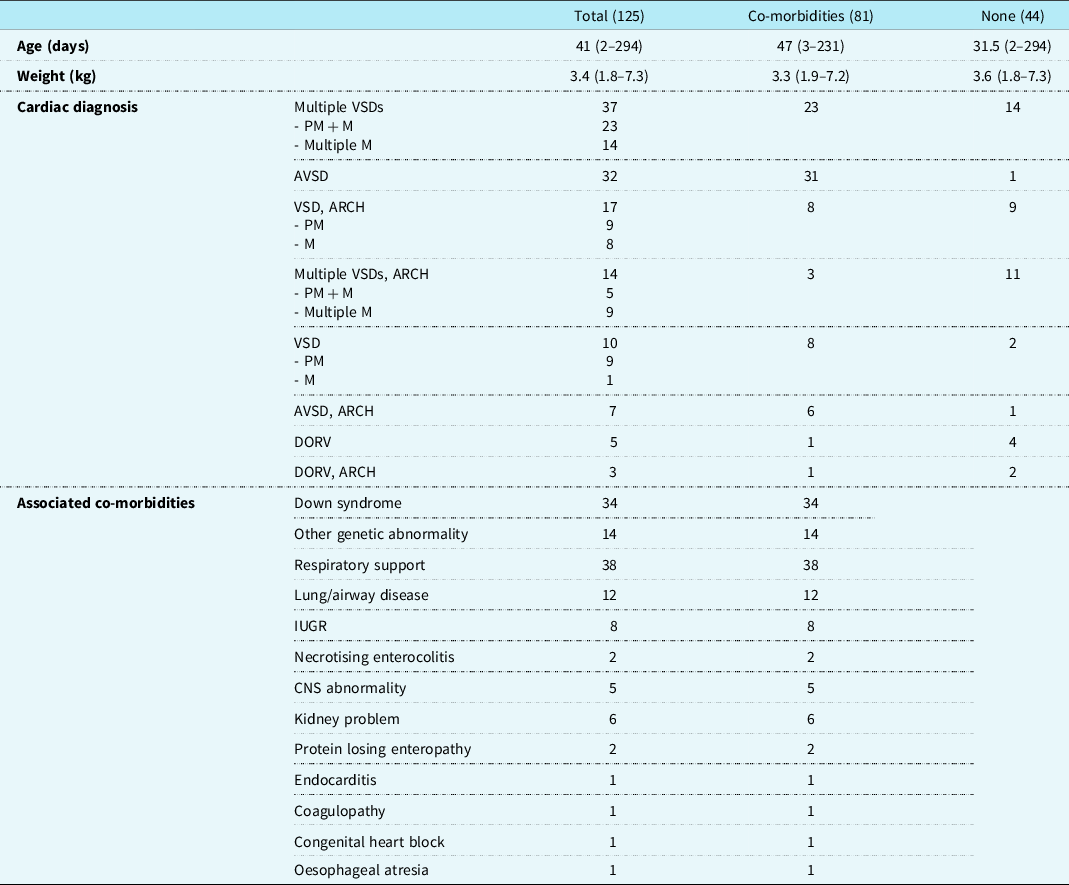
During the study period, 125 patients (76 females and 49 males) underwent pulmonary artery banding (2.5% of all cardiac surgeries done in the same period) and were followed up for a median of 4.1 years (0.6–10.6). The median age at pulmonary artery banding was 41 days (2–294) and the median weight 3.4 kg (1.8–7.32). The demographic data and primary diagnoses are shown in Table 1. Of all patients who underwent pulmonary artery banding, 81 (64.8%) had significant co-morbidities such as genetic abnormality, extra-cardiac anomalies, and/or pre-procedural requirement for respiratory support. In 44 patients (35.2%), there was no significant co-morbidity, but the complexity of the cardiac lesion (in conjunction with the patient size) was the primary justification for the staged strategy. Pulmonary artery banding was performed as an isolated procedure in 82 patients (65.6%), whereas the remaining 43 patients (34.4%) underwent concomitant procedures including aortic arch repair in 41 (32.8%), closure of an accessible ventricular septal defect in 2, aortopexy in 1, and balloon atrial septostomy in 1 patient.
Baseline characteristics of patients undergoing pulmonary artery banding contrasting the group with significant co-morbidities to those in which patient size and anatomical features predicated staged repair

AVSD = atrioventricular septal defect; DORV = double outlet right ventricle; M = muscular; PM = perimembranous; VSD = ventricular septal defect; IUGR = intra-uterine growth retardation; CNS = central nervous system.
Early post-operative course
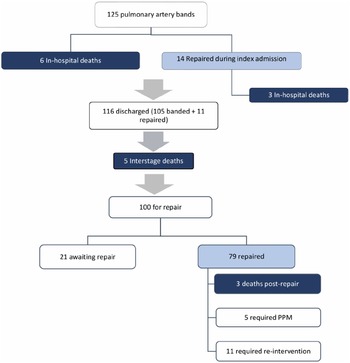
Post-operatively, 80 patients (64%) were extubated successfully within 3 days and 16 patients (12.8%) required mechanical ventilation for 7 days or more. Three patients required extracorporeal life support, of which two survived and one died. The first required 4 days of extracorporeal life support following cardiac tamponade and the second had 6 days of extracorporeal life support following post-extubation cardio-respiratory arrest. The third patient underwent concomitant aortic arch repair on cardiopulmonary bypass and developed post-procedural severe systemic inflammatory response syndrome, and was supported on extracorporeal life support for 8 days but developed multiorgan failure and did not survive. The median ICU stay post-banding was 3 days (interquartile range 2–6), with an overall median hospital stay of 14 days (interquartile range 8–33.5). Infants with body weight <2.5 kg demonstrated a median post-operative mechanical ventilation time of 2 days (interquartile range 0.5–2.5), median ICU stay of 3.5 days (interquartile range 2–5), and median hospital stay of 18.5 days (interquartile range 8.5–43). Infants weighing ≥2.5 kg required a median of 2 days on mechanical ventilation (interquartile range 0.5–4), a median ICU stay of 3 days (interquartile range 2–6), and a median hospital stay of 14 days (interquartile range 8–33). Fourteen patients (11.2%) needed anatomical repair during the same admission, in only one of which the strategy of rapid stabilisation and complete anatomical repair was planned (Supplementary material Table S1). In these 14 patients, the median mechanical ventilation time after pulmonary artery band was 2 days (interquartile range 1–3.5), median ICU stay was 3.5 days (interquartile range 2–10), and median hospital stay was 71.5 days (interquartile range 59–123). These patients generally managed to wean from mechanical ventilation relatively quickly but remained dependent on non-invasive ventilatory support for prolonged periods, necessitating anatomical repair during the same admission. This was successful in (11) cases, but three patients sadly died. On discharge, the median pulmonary artery banding peak Doppler velocity was 3.6 m/seconds (2–5.1 m/seconds). Six patients (4.8 %) post-band and 3 of the 14 post-anatomical repair patients died prior to hospital discharge resulting in an overall in-hospital mortality rate of 7.2% (Fig 1, Table Supplementary material S2).
Flow chart demonstrating the outcome of the patients who had pulmonary artery banding. PPM=permanent pacemaker.

Inter-stage outcome
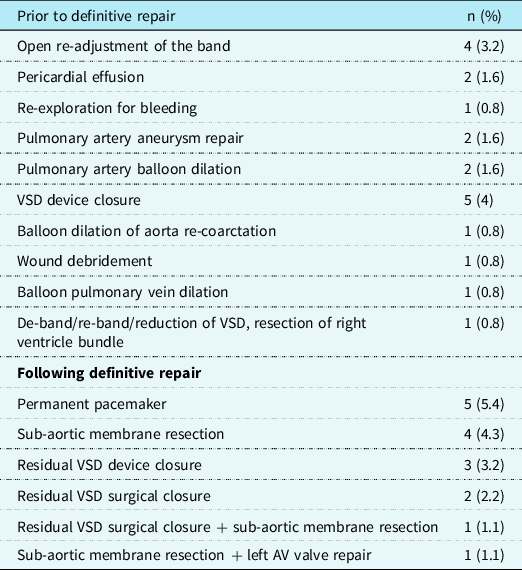
Twenty unplanned re-interventions were required in 18 of 125 patients (14.4%) before reaching definitive repair. This included device closure of muscular ventricular septal defects in five patients, which could alternatively be viewed as part of the planned staged management of multiple ventricular septal defects or managed as a hybrid intervention (Table 2). However, due to the unpredictability of the clinical course of large muscular ventricular septal defects after pulmonary artery banding and the rarity of requiring inter-stage device closure in patients with multiple ventricular septal defects (5/51), these were considered as unplanned interventions.
Unplanned re-intervention prior to and following definitive repair in patients following pulmonary artery banding

AV = atrioventricular; RV = right ventricle; VSD = ventricular septal defect.
Of the 105 banded patients discharged from hospital, 19 (18.1%) required re-admission due to respiratory tract infections and 5 patients died (4.8%). Prior to pulmonary artery banding, 54% of patients were below or at the 0.4th centile for weight and only 1% were above the 50th weight centile. At the time of definitive repair, 28% of patients remained at or below the 0.4th weight centile and 20% had reached the 50th weight centile.
Post-repair outcomes
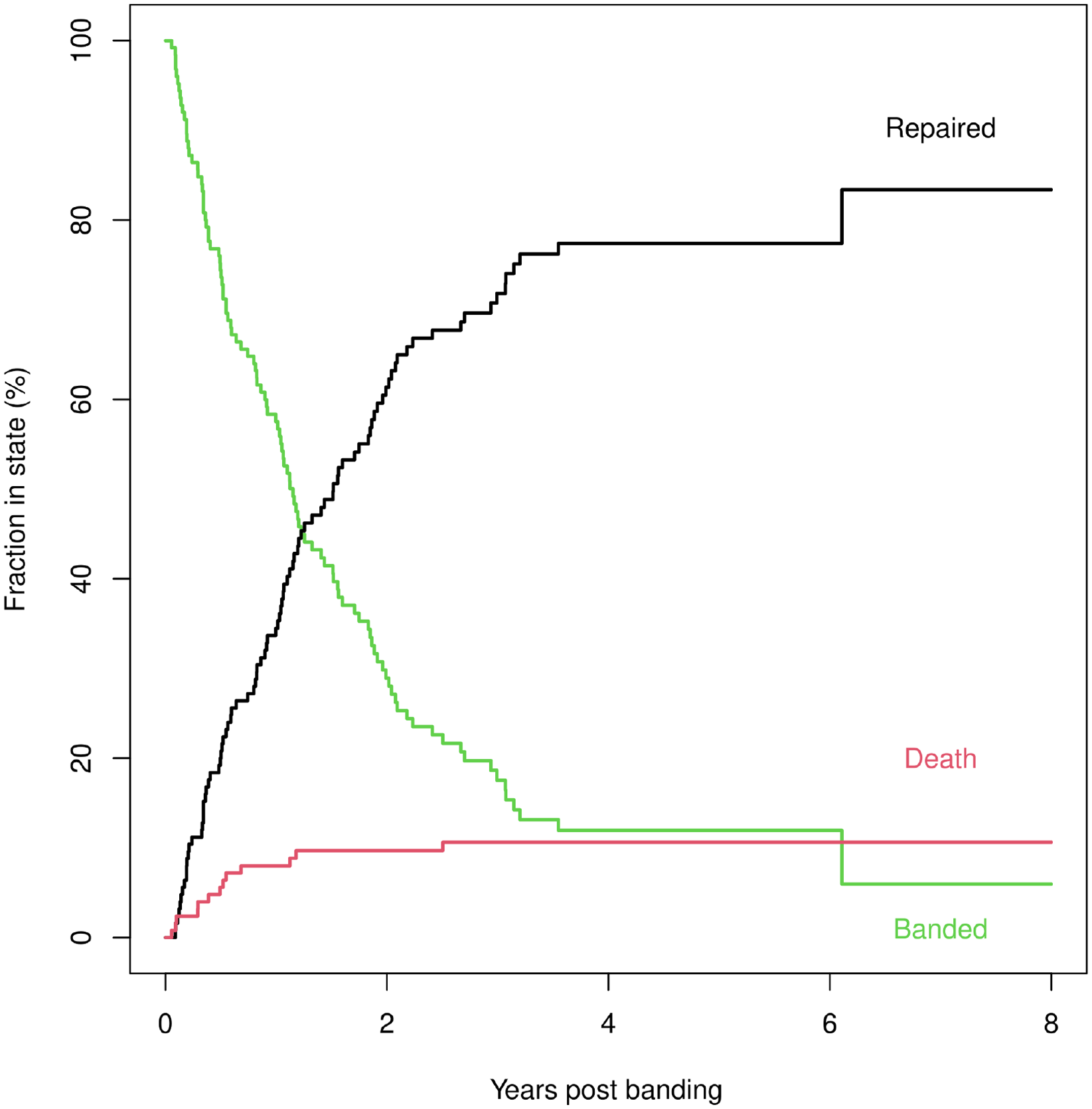
Ninety-three patients reached definitive repair, 14 (15%) during the same hospital admission as pulmonary artery banding, and 79 (85%) following discharge. Median age at the time of repair was 13 months (3.1–49.9 months) and median weight 8.5 kg (3.08–16.8). The median inter-stage duration was 12.5 months (1.2–42.6). Definitive repair included 30 atrioventricular septal defect repairs, 53 ventricular septal defect closures, 8 double outlet right ventricle repairs, and complete de-banding. In two patients, only de-banding was required as all ventricular septal defects had closed spontaneously. Five of the 93 patients (5.4%) developed atrioventricular block and required permanent pacemaker. Of these, two had complete atrioventricular septal defect, one had single perimembranous ventricular septal defect, and two patients had multiple ventricular septal defects (one underwent anterior muscular ventricular septal defect device closure and the other had surgical closure of a perimembranous ventricular septal defect). This equates to 2/30 (6.7%) of atrioventricular septal defect, 2/35 (5.7%) of multiple ventricular septal defects, and 1/20 (5%) of single ventricular septal defect repairs. Post-repair, patients were followed up for a median of 38 months (3.5–109). Eleven patients (11.8%) needed other forms of re-intervention post-repair (Table 2). The post-repair mortality was 6/93 (6.5%), resulting in an overall mortality of 17/125 (13.6%) for the staged approach (Figs 1,2). The majority of these deaths (14/17 = 82.4%) were related to associated co-morbidities (Supplementary material Table S2). By the study closing date, 21 patients were awaiting definitive repair (Fig 1,2).
Overall mortality and risk factors
Overall survival for the entire cohort after pulmonary artery banding surgery was 98.4% at 1 month, 96% at 3 months, and 89.6% at 1 year (Fig 2). Risk factors for mortality were the presence of associated genetic (p = 0.002, Supplementary material Figure S1) or major extra-cardiac anomalies (p = 0.003, Supplementary material Figure S2). Of note, concomitant arch repair at the time of pulmonary artery banding was not found to be associated with a significant effect on overall survival (p = 0.82, Figure Supplementary material S3).
Competing outcomes after pulmonary artery banding. In-hospital mortality 7.2 %, inter-stage 4.8%. Full repair was completed in 93 (74.4%) at a median age of 13 months. Twenty-one patients were awaiting repair at the conclusion of the study.

Discussion
Although results of primary repair of left-to-right shunting lesions in small infants have improved significantly, Reference Alsoufi2,Reference Trusler and Mustard9 pulmonary artery banding remains a useful option in selected cases where the associated co-morbidity or intracardiac anatomy is unfavourable. As in many other institutions, we have limited the staged approach to patients considered high risk for primary repair due to significant co-morbidity or anatomical features via multidisciplinary team consensus. This has resulted in pulmonary artery banding forming 2.5% of all procedures performed during the study, where once it had been a relatively common procedure. We excluded pulmonary artery banding in single ventricle heart disease and for ventricular training from this analysis, where banding still forms an integral part of the management. The aim of the study was to evaluate outcomes of the staged bi-ventricular repair approach, accepting that primary repair does not form a realistic alternative in many of these patients, and that a comparator group of primary repair with matching co-morbidity and anatomical features would not be available. We considered that the analysis would be useful as a comparison to the perceived outcomes of high-risk primary repair where possible, and to help inform counselling of parents and carers.
In our cohort, recovery following pulmonary artery banding was often complicated and prolonged, although this may be expected in patients with similar co-morbidities. The median hospital stay was 2 weeks, with only 21.6% being discharged within 7 days of surgery. Moreover, in the same admission, 2.4% of patients needed extracorporeal life support, 11.2% of patients required early definitive repair, and 7.2% died. It is our opinion that this mostly reflects the complexity of the population rather than the procedural risk alone. As a comparator, the hospital stay and need for mechanical ventilation were higher in a report from Nagashima and colleagues, which divided a pulmonary artery banding cohort into low weight group (<2.5 kg) and a higher weight group (≥2.5 kg). Reference Nagashima, Okamura and Shikata3 The low weight group required mechanical ventilation for a median of 6 (2–123 days) with an overall hospital stay of 74 (23–347 days). The higher weight group needed mechanical ventilation for a median of 3 (0–10 days) with an overall median hospital stay of 36 (18–124 days). In contrast, this report demonstrated no early and only two late deaths, although direct comparison of co-morbidities between these reports is not possible. In our study, the low weight group did not show a significantly slower post-operative recovery as in the study by Nagashima et al. This may be due to the relatively small number of babies less than 2.5 kg in our study (9.6% of the whole cohort) as compared to 39.5% in the earlier report.
Between pulmonary artery banding and definitive repair, recurrent respiratory infections remained common in our experience, with 18.1% of patients requiring unplanned re-admission. In addition, 20 interim interventions were required in 18 patients (14.4%). This rate of re-intervention is relatively higher than other studies but may reflect the increasing utilisation of transcatheter closure of ventricular septal defects (5/20) and balloon dilation of pulmonary artery bands as compared to historical reports. A recent report analysing only patients with atrioventricular septal defect showed that 7% (3/43) needed reoperation for re-adjustment of the band. Reference Buratto, Hu and Lui4 In a study with a more comparable diverse spectrum of lesions, 2/38 (5.3%) patients required unplanned reoperation, one retightening of the band and one Blalock-Taussig shunt for hypoplastic pulmonary artery secondary to band migration. Reference Nagashima, Okamura and Shikata3 As this study was conducted in the 10 years preceding our investigation, transcatheter interventions were likely less common as techniques have evolved significantly during this time. Pulmonary artery banding was generally effective in improving weight gain before repair. Median weight increased from 3.4 kg at pulmonary artery banding to 8.5 kg at repair with just under half of patients achieving better weight centiles. In contrast, 11.2% of patients had persistent symptoms, poor weight gain, or dependence on respiratory support mandating repair during the same admission.
With regard to post-pulmonary artery banding mortality, in-hospital mortality was 7.2%, while inter-stage mortality was 4.8%. This compares favourably to a recent cohort of atrioventricular septal defect staged repair, where inter-stage mortality was 18.6%, Reference Buratto, Hu and Lui4 and earlier studies, where hospital mortality rates of 13.8% were documented 20 years ago. Reference Takayama, Sekiguchi, Chikada, Noma, Ishizawa and Takamoto5 In contrast, Nagashima and colleagues demonstrated no early hospital mortality and an inter-stage mortality of 5.26% in 38 patients with a mixture of lesions. Reference Nagashima, Okamura and Shikata3 The ability to maintain careful follow-up during the inter-stage is an important requirement for low mortality, leading to poor outcomes in one study of the staged approach in a developing country. Reference Brooks, Geldenhuys, Zuhlke, Human and Zilla8 Nevertheless, results of pulmonary artery banding for atrioventricular septal defect over the past 30 years were still associated with 18.6% inter-stage mortality in the setting of a developed country. Reference Buratto, Hu and Lui4
Five of the 93 patients who reached complete repair (5.4%) developed atrioventricular block requiring a permanent pacemaker. By diagnosis, the incidence was 6.7% in atrioventricular septal defect, 5.7% in multiple ventricular septal defects, and 5% in single ventricular septal defect repair. This is higher than the incidence reported in previous studies of mixed lesions Reference Lin, Mahle and Frias10 and isolated atrioventricular septal defect repair, Reference Loomba, Flores, Villarreal, Bronicki and Anderson11 but slightly lower than some reports in atrioventricular septal defect alone. Reference Vohra, Chia and Yuen12 In the setting of multiple ventricular septal defects, a large series using a mixed approach of banding and repair demonstrated a higher requirement for permanent pacing (9%). Reference Daley, Brizard and Konstantinov13 We conclude that the staged approach certainly does not preclude the occurrence of this important complication. In our study, the staged approach was furthermore associated with a significant incidence of re-intervention after definitive intracardiac repair, as 11 patients (11.8%) needed 13 re-interventions. This compares favourably to published rates of re-intervention in atrioventricular septal defect (24.7%) and multiple VDS’s (38%), Reference Vohra, Chia and Yuen12,Reference Daley, Brizard and Konstantinov13 although post-repair follow-up is relatively short in our series, at a median of 3.2 years (0.3–9.1).
After repair, 6 further patients died (6.5%), bringing the overall mortality to 17/125 (13.6%). The survival for the entire cohort after pulmonary artery banding was therefore 98.4% at 1 month, 96% at 3 months, and 89.6% at 1 year. The most significant predictors of mortality were the presence of genetic and extra-cardiac abnormality, but concomitant arch repair was found to have no apparent impact. It is challenging to decouple these two risk factors due to considerable overlap, as out of 48 patients with identified extra-cardiac abnormalities, 18 (38%) also had an identified genetic abnormality. Twenty-seven (60%) of 45 patients with a known genetic abnormality had no extra-cardiac abnormality identified. From review of the causes of death, cardiac causes were in the minority. It is therefore challenging to place these outcomes into context with primary repair, as a similar set of risks are likely not present in other series. Early repair of complete atrioventricular septal defect has been found to have excellent results in some single-centre series, with early mortality of 3.3% (5/151) for patients under 3 months of age with a median weight of 3.9 kg. In the same institution, staged repair through pulmonary artery banding was associated with inter-stage mortality of 18.6% (8/43) and survival at 20 years was 92.0% for primary repair, and 63.2% for pulmonary artery banding. Reference Buratto, Hu and Lui4 In contrast, multi-centre data from the Society of Thoracic Surgeons Congenital Heart Surgery Database for 2399 atrioventricular septal defect primary repairs between 2008 and 2011 were more sobering. Reference St Louis, Jodhka and Jacobs14 In-hospital mortality was 9.5% for children under 2.5 months of age, and 15.2% for children under 3.5 kg suggesting that although some centres can achieve excellent results with early primary repair, the results may not be generalisable. It is worth noting the strong correlation with results of pulmonary artery banding in patients with single ventricle physiology, where genetic and extra-cardiac abnormalities were strongly associated with mortality, and overall survival was very similar, being 86% at 5 years. Reference Alsoufi, Manlhiot and Ehrlich15 This suggests that genetic and extra-cardiac abnormalities are the major determinant of outcomes in all patients undergoing pulmonary artery banding, irrespective of cardiac morphology. Nevertheless, optimising cardiovascular physiology through complete repair as soon as this is feasible and safe should provide the best outcomes in most patients, even in those with associated complexity.
Limitations
A randomised trial comparing primary repair to the staged approach is unlikely to be feasible in view of the need for multi-centre involvement and strong institutional preferences. True equipoise only exists in a very small subgroup of patients, as most centres would likely offer primary repair where this is feasible. The cardiac lesions treated in this way form a diverse group, and different co-morbidities form a spectrum along which the decision to opt for a staged approach remains subjective and experience based. Propensity matching is unlikely to balance these factors adequately to improve the analysis.
Conclusion
In a cohort with a high incidence of co-morbidity, pulmonary artery banding is associated with significant risks of re-intervention and of mortality. In the absence of a comparator group or randomisation, comparison of the relative risk of this approach to that of primary repair in high-risk patients is difficult. Pulmonary artery banding is successful in achieving weight gain prior to definitive repair in the majority but still is associated with high incidence of heart block following repair.
Supplementary material
To view supplementary material for this article, please visit https://doi.org/10.1017/S1047951122002918.
Financial support
This research received no specific grant from any funding agency, commercial, or not-for-profit sectors.
Conflict of interest
None.
Author contribution statement
All listed authors contributed significantly to this work, have had access to the data, and reviewed/approved this final manuscript.