Executive function (EF) is conceptualized as a multidimensional goal-directed system, often linked to the brain's prefrontal cortex (PFC) which modulates human cognitive and behavioral processes (Miyake & Friedman, Reference Miyake and Friedman2012). These processes empower us to effectively overcome habits, weigh benefits and costs, prioritize goals, decide strategically, and respond adaptively. Multiple EF components have been linked consistently to numerous facets of human functioning, physical health, and interpersonal distress (Wright et al. Reference Wright, Lipszyc, Dupuis, Thayapararajah and Schachar2014). EF and general cognitive capacities are also considered key features in the research domain criteria (RDoC; Cuthbert & Insel, Reference Cuthbert and Insel2013) for mental illness, such as depression (Snyder, Reference Snyder2013) and anxiety (Beaudreau et al. Reference Beaudreau, Mackay-Brandt and Reynolds2013).
Two theories have posited that cognitive capacities might be linked to pathological worry, the cardinal symptom of generalized anxiety disorder (GAD). Attentional control theory posits that poor EF and related processes produce worrying (Eysenck & Derakshan, Reference Eysenck and Derakshan2011). Similarly, the cognitive model theorizes that unconscious processing biases (threat representations) and voluntary processing abilities (e.g. attention), increase the probability of developing verbal-linguistic worry (Hirsch & Mathews, Reference Hirsch and Mathews2012). These theories thus assume that inhibition, set-shifting, and working memory (WM) updating deficits are related to worry.
Inhibition is the ability to refrain volitionally from autopilot responses in order to select a less conventional and more task-pertinent response (Miyake et al. Reference Miyake, Friedman, Emerson, Witzki, Howerter and Wager2000). On several tasks (e.g. Stroop, go-no-go, Flanker tasks), participants with higher trait worry and GAD (v. controls) displayed poorer inhibition (Beaudreau & O'Hara, Reference Beaudreau and O'Hara2009; Price et al. Reference Price, Siegle and Mohlman2012; Hallion et a l. Reference Hallion, Tolin, Assaf, Goethe and Diefenbach2017). Engagement in worry also led to impaired inhibition (Righi et al. Reference Righi, Mecacci and Viggiano2009; Waters & Valvoi, Reference Waters and Valvoi2009; Larson et al. Reference Larson, Clawson, Clayson and Baldwin2013; Hallion et al. Reference Hallion, Ruscio and Jha2014), and inhibition deficits uniquely predicted worry topic frequency (Kircanski et al. Reference Kircanski, Johnson, Mateen, Bjork and Gotlib2015). Set-shifting (degree of versatility to change between cognitive sets) builds on inhibition. Set-shifting was worse in GAD (v. controls) (Tempesta et al. Reference Tempesta, Mazza, Serroni, Moschetta, di Giannantonio and Ferrara2013), and negatively predicted GAD 12 years later (Zhang et a l. Reference Zhang, Norton, Carriere, Ritchie, Chaudieu and Ancelin2015). Collectively, these findings led us to hypothesize that inhibition and set-shifting deficits would predict future GAD.
WM refers to the maintenance and manipulation of task-relevant material. Theoretically, verbal WM deficits are inextricably intertwined with worry (Hirsch & Mathews, Reference Hirsch and Mathews2012). Overall, studies that found WM differences when comparing GAD to controls used complex WM tasks that required recognizing, recalling, rearranging, and creating novel stimuli online (e.g. letter-number sequencing, task-irrelevant unpleasant stimuli, random number generation paradigm; Hayes et al. Reference Hayes, Hirsch and Mathews2008; Butters et al. Reference Butters, Bhalla, Andreescu, Wetherell, Mantella and Begley2011; Leigh & Hirsch, Reference Leigh and Hirsch2011; MacNamara & Proudfit, Reference Macnamara and Proudfit2014; Moon & Jeong, Reference Moon and Jeong2015). However, simpler backward digit span performance (Wechsler, Reference Wechsler1997) was equivalent among older adults with and without high trait anxiety (Wetherell et al. Reference Wetherell, Reynolds, Gatz and Pedersen2002) and GAD (Price & Mohlman, Reference Price and Mohlman2007). We thus forecasted that verbal WM as indexed by the digit span would not significantly predict GAD.
WM updating is the capacity to use WM maintenance to monitor for and swiftly and accurately incorporate new task-specific information. Individuals with GAD (v. controls) and high (v. low) worriers were slower on WM updating tasks (e.g., n-back; Stefanopoulou et al. Reference Stefanopoulou, Hirsch, Hayes, Adlam and Coker2014; Gustavson & Miyake, Reference Gustavson and Miyake2016; Vytal et al. Reference Vytal, Arkin, Overstreet, Lieberman and Grillon2016; Balderston et al. Reference Balderston, Vytal, O'Connell, Torrisi, Letkiewicz and Ernst2017), which prospectively predicted higher worry severity (Bredemeier & Berenbaum, Reference Bredemeier and Berenbaum2013). Moreover, worry led to inefficiencies in swiftly eliminating non-pertinent data and determining whether target cues corresponded with material maintained in WM (Gustavson & Miyake, Reference Gustavson and Miyake2016). Further, high (v. low-) worriers also showed higher general switch costs on several switch tasks (Beckwé et al. Reference Beckwé, Deroost, Koster, de Lissnyder and de Raedt2014; Gustavson et al. Reference Gustavson, Altamirano, Johnson, Whisman and Miyake2017). Based on this evidence, we posited that WM updating deficits indexed by general switch costs would predict future GAD.
Understudied non-EF cognitive capacity constructs in GAD include global cognition, inductive reasoning, processing speed, verbal fluency, and episodic memory (EM). Prospectively, global cognition negatively predicted GAD in one study (Zhang et al. Reference Zhang, Norton, Carriere, Ritchie, Chaudieu and Ancelin2015) but not others (De Beurs et al. Reference De Beurs, Beekman, Deeg, van Dyck and van Tilburg2000; Schoevers et al. Reference Schoevers, Deeg, van Tilburg and Beekman2005). We hence made no a priori hypothesis with regard to whether global cognition predicted future GAD. Inductive reasoning refers to the ability to use present observations to make sensible predictions about novel cases. Inductive reasoning is thus important for making rational decisions and regulating emotions effectively. Despite the absence of direct studies of inductive reasoning in GAD, higher trait anxiety uniquely accounted for poor cognitive abstraction (Yochim et al. Reference Yochim, Mueller and Segal2013) and adults with GAD (v. controls) showed weaker concept formation (Butters et al. Reference Butters, Bhalla, Andreescu, Wetherell, Mantella and Begley2011). Further, individuals with (v. without) GAD tended to construe benign/ambiguous stimuli as threatening/negative (Hirsch et al. Reference Hirsch, Meeten, Krahé and Reeder2016), suggesting deficiencies in accurately deducing data. Accordingly, we surmised that inductive reasoning would negatively forecast future GAD.
With regard to verbal fluency, in community-dwelling older adults (Beaudreau & O'Hara, Reference Beaudreau and O'Hara2009; Yochim et al. Reference Yochim, Mueller and Segal2013) and general adults (Airaksinen et al. Reference Airaksinen, Larsson and Forsell2005), it was similar between high and low anxious persons. Also, processing speed (Trail Making Test A) did not differ between elderly with and without GAD (Mantella et al. Reference Mantella, Butters, Dew, Mulsant, Begley and Tracey2007). Processing speed measured by simple time-pressured tests (e.g. backward counting; Lachman et al. Reference Lachman, Agrigoroaei, Tun and Weaver2014) would hence probably not differ between GAD and controls. Plausibly, we hypothesized that verbal fluency and processing speed would not predict GAD. EM requires consciously remembering events. Most studies found no link between EM and worry/anxiety (e.g. Beaudreau & O'Hara, Reference Beaudreau and O'Hara2009; Yochim et al. Reference Yochim, Mueller and Segal2013), especially when the Rey Auditory Verbal Learning Test (Rey, Reference Rey1964) was tested on anxious youths (Günther et al. Reference Günther, Holtkamp, Jolles, Herpertz-Dahlmann and Konrad2004) and adults (20–64 years; Airaksinen et al. Reference Airaksinen, Larsson and Forsell2005). Therefore, we postulated that EM deficits would not sequentially predict GAD.
In summary, specific impairments in EF and non-EF constructs were hypothesized based on theory and research to predate the onset of pathological worry (Eysenck & Derakshan, Reference Eysenck and Derakshan2011; Hirsch & Mathews, Reference Hirsch and Mathews2012). However, no studies have used comprehensive cognitive measures (e.g. Brief Test of Adult Cognition by Telephone; Lachman et al. Reference Lachman, Agrigoroaei, Tun and Weaver2014) to prospectively examine the neuropsychological-GAD link and test the core tenets of attentional control theory and the cognitive model of worry. Thus far, the bulk of literature on anxiety disorders has focused mainly on ‘hot’ affect-laden cognition (e.g. see meta-analysis by Bar-Haim et al. Reference Bar-Haim, Lamy, Pergamin, Bakermans-Kranenburg and van Ijzendoorn2007). However, there is a dearth of studies on ‘cold’ cognition in GAD. We attempted to fill this knowledge gap. For primary analyses, we predicted that inhibition, set-shifting, and WM updating deficits would predate the onset of GAD. However, we made no predictions with regard to whether accuracy and/or latency would strongly predict GAD, as the nascence of these topics precluded us from making such a priori hypotheses. Also, we hypothesized that verbal WM (digit span) would not significantly forecast GAD. For secondary analyses, we explored the possibility that global cognition may be linked to GAD in later life. We predicted that inductive reasoning (number series) would be negatively sequentially related to GAD. However, we hypothesized that processing speed (30-seconds-and-counting task), verbal fluency (category), and EM (word list recall) would not predict GAD.
Method
Participants
Participants were members of the Midlife Development in the United States (MIDUS) study at waves two and three (Brim et al. Reference Brim, Ryff and Kessler2004; Ryff & Lachman, Reference Ryff and Lachman2017; Ryff et al. Reference Ryff, Almeida, Ayanian, Binkley, Carr and Coe2017). Of the initial 4206 participants, 2605 had complete data of the neuropsychological tests and symptoms at Time 1 and of symptoms at Time 2. Compared with non-completers, completers were significantly more likely to be younger [odds ratio (OR) 0.99, 95% confidence interval (CI) 0.98–0.99], p < 0.0001), female (χ2 (df = 1) = 12.34, p = 0.00047), educated (OR 1.14, 95% CI 1.11–1.17, p < 0.0001), and had better global cognition (OR 1.57, 95% CI 1.47–1.70, p < 0.0001). However, they did not significantly differ in terms of GAD (OR 1.00, 95% CI 0.93–1.08, p = 0.97), panic disorder (OR 0.96, 95% CI 0.91–1.02, p = 0.96), and major depressive disorder diagnosis (OR 0.97, 95% CI 0.94–1.01, p = 0.097) at baseline.
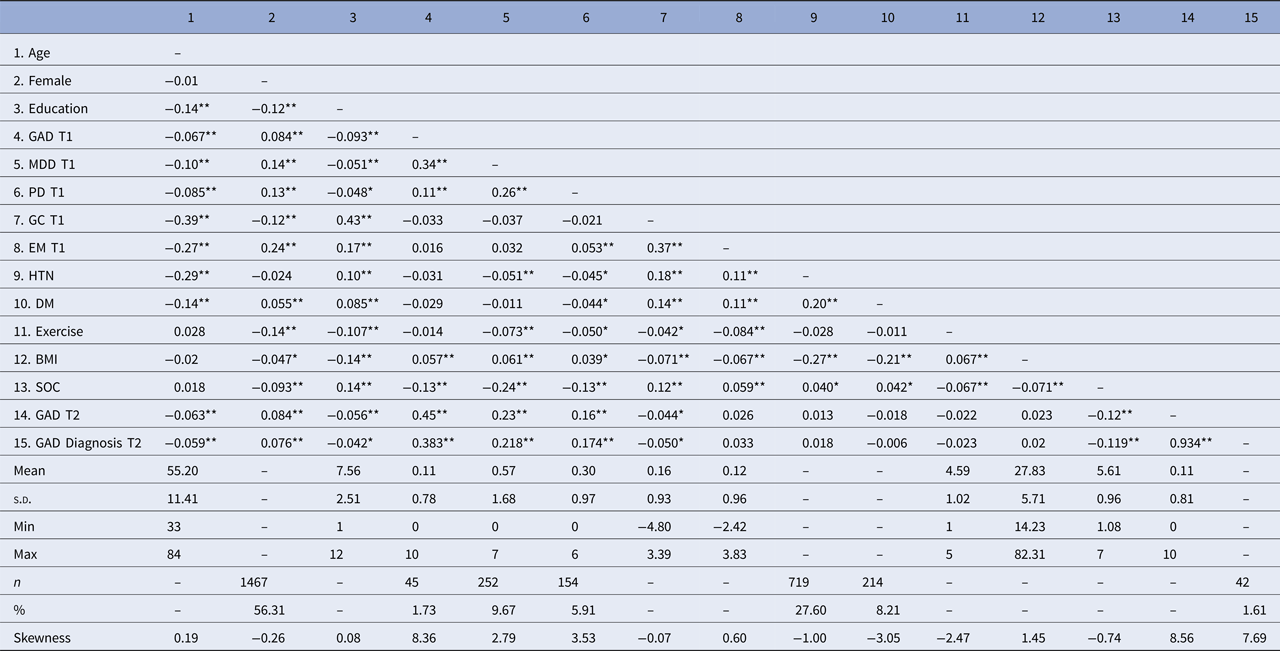
Table 1 demonstrates baseline descriptive study variables. Overall, 56.31% were female, 92.21% were Caucasians, 2.70% were African American, and 4.40% were Asian, Pacific Islander, and other ethnicities. Mean age was 55.20 (s.d. = 11.41, range = 33–84). 71.60% received education beyond high school. Among 1.73% of participants who met criteria for baseline GAD, 77.78% and 24.44% presented with comorbid major depressive disorder and panic disorder respectively. Among 1.61% of respondents who met GAD criteria at Time 2, 73.81% and 40.48% had comorbid major depressive disorder and panic disorder. The second assessment took place after 9.11 years on average (s.d. = 0.53, range = 6–11). At Time 2, respondents had a mean age of 64.32 years (s.d. = 11.42, range = 42–93).
Descriptive and Pearson's correlations of study variables at baseline

GAD, generalized anxiety disorder; MDD, major depressive disorder; PD, panic disorder; EF, executive function; EM, episodic memory; HTN, hypertension; DM, diabetes mellitus; BMI, body mass index; SOC, sense of control; GC, global cognition; Min, minimum; Max, maximum
Note: Gender was coded as 1 = male and 2 = female. EF and EM reflect composite z-scores. Education level ranged from 1 = no school/ some grade school to 12 = medical, law, or doctoral degree. HTN and DM medication use were coded as 1 = yes and 2 = no. Exercise status was coded as 1 = yes and 2 = no. Sense of control was coded from 1 = strongly disagree to 7 = strongly agree. *p < 0.05; **p < 0.01.
Measures
Measures of inhibition, set-shifting, WM updating, verbal WM, global cognition, inductive reasoning, processing speed, verbal fluency, and EM were administered only at baseline. Diagnoses were attained at both baseline and 9-year follow-up.
Brief test of adult cognition by telephone (Tun & Lachman, Reference Tun and Lachman2006; Lachman et al. Reference Lachman, Agrigoroaei, Tun and Weaver2014)
Subtests were administered in the following sequence: Word List Recall–Immediate, Backward Digit Span, Category Fluency, Stop-and-Go Switch Task, Number Series, 30-Seconds-and-Counting-Test, and Word List Recall–Delayed. EM was assessed by the ability to correctly recall as many words read aloud from a 15-word list within a minute (Rey, Reference Rey1964). Verbal WM [Digit Span (Wechsler, Reference Wechsler1997)] required participants to correctly reiterate increasingly lengthy digit strings backwards. For verbal fluency (semantic), participants named as many unique animals/foods within 1 min (Tombaugh et al. Reference Tombaugh, Kozak and Rees1999). Inductive reasoning required responding with the correct final number in a series by inferring a pattern (Number Series; Salthouse & Prill, Reference Salthouse and Prill1987). Processing speed (novel 30-Seconds-and-Counting-Task) required counting backwards from 100 rapidly and accurately within 30 s.
Inhibition, set-shifting, and WM updating were assessed using the Stop-and-Go Switch Task (Tun & Lachman, Reference Tun and Lachman2006) and indexed by accuracy and latencies. Baseline, Single-Task blocks comprised two conditions: Normal and Reverse. In the Normal condition, respondents had to answer ‘STOP’ or ‘GO’ in response to cues ‘RED’ and ‘GREEN’, respectively. The Reverse condition entailed stating the diametrically opposite answer (i.e. ‘STOP’ for ‘GREEN’ and ‘GO’ for ‘RED’). In the Mixed-Task block, respondents alternated between Normal and Reverse conditions at random periods of two to six trials following cues of ‘NORMAL’ or ‘REVERSE.’ Latencies were recorded in milliseconds (ms) i.e. time between cue and accurate response. In Switch trials, respondents had to alternate from one condition to another. Non-Switch/Repeat trials referred to blocks with virtually no change in cues. Respondents first received 20 Normal and 20 Reverse trials (Single-Task block). Next, the Mixed-Task block included 32 trials. Lower latency denoted faster response times. Good associations were observed between the telephone-administered Brief Test of Adult Cognition and a face-to-face interview with good 6-month retest reliability (Tun & Lachman, Reference Tun and Lachman2008). Inhibition was assessed by Single-Task block reverse trials. Set-shifting was indexed by Mixed-Task block trials and local switch costs. WM updating was indicated by general switch costs. Switch costs capture ability to swiftly change between distinct WM representations and update responses accordingly (Rogers & Monsell, Reference Rogers and Monsell1995). General switch costs (WM updating) were computed as the distinction between latency on the Mixed-Task and Single-Task trials (Ryff & Lachman, Reference Ryff and Lachman2017). Local switch costs (set-shifting) refer to the latency difference between Mixed-Task Switch and Repeat trials. Absolute costs [score difference between the simple and complex condition (A–B)] and relative costs [proportional reduction in performance from the simple to complex condition to adjust for baseline performances (i.e. (A–B)/A)] were computed. Larger switch costs indicated greater impairment.
Global cognition and episodic memory composites
Following Lachman et al. (Reference Lachman, Agrigoroaei, Tun and Weaver2014), scores on the Backward Digit Span, Categorical Verbal Fluency, Number Series, 30-Seconds-And-Counting-Task, and Stop-and-Go Switch Task–Mixed Task Trials were standardized and averaged to obtain a global cognition z-score. A composite EM score was derived by standardizing and averaging Immediate and Delayed Word List Recall. Exploratory and confirmatory factor analyses revealed a two-factor solution offering the most parsimonious model fit of the Brief Test of Adult Cognition by Telephone with factors comprising the stated subtests within each composite (see Fig. 1 in Lachman et al. Reference Lachman, Agrigoroaei, Tun and Weaver2014). All tests showed strong convergent and discriminant validity.
Composite international diagnostic interview – short form (CIDI-SF; Kessler et al. Reference Kessler, Wittchen, Abelson, Mcgonagle, Schwarz and Kendler1998)
GAD diagnosis was based on the Diagnostic and Statistical Manual for Mental Disorders–Third Version–Revised criteria using the CIDI-SF. GAD severity was also based on the CIDI-SF and DSM-III-R (Wittchen et al. Reference Wittchen, Zhao, Kessler and Eaton1994; Kessler et al. Reference Kessler, Wittchen, Abelson, Mcgonagle, Schwarz and Kendler1998). Respondents who experienced a period of a month or more of worry and anxiety rated on a 4-point Likert-type scale (1 = most days to 4 = never) their level of worry-linked cognitive, somatic, or behavioral symptoms in the past 12 months (e.g. restlessness). Diagnosis required participants to report that they worry ‘a lot more’ than most people, worried almost every day, and endorsed at least 3 out of 10 symptoms on most days. The CIDI-SF showed adequate retest (agreement = 0.89; κ = 0.69) and inter-rater reliability (agreement = 0.98; κ = 0.96) with psychiatric diagnoses. Internal consistency of the 10-item GAD severity scale was good at Time 1 (α = 0.86) and Time 2 (α = 0.89).
Lifestyle factors and perceived control
Participants answered whether or not they regularly exercised, and were managing chronic diabetes/hypertension during the past 12 months on a binary scale (1 = yes; 2 = no). Perceived control was measured with 12 items on a 7-point Likert scale (1 = strongly agree to 7 = strongly disagree; α = 0.67; Lachman & Weaver, Reference Lachman and Weaver1998). Scores were reverse coded i.e. higher scores reflected greater control.
Data analytic plan
Given the count nature of GAD severity and diagnosis, assumptions of normality, homogeneity of error variance, and linearity of the association were not met. Conducting ordinary least squares regression analyses were thus inappropriate, as various transformation methods failed to normalize the GAD outcome variable. We thus used Poisson and negative binomial regressions to predict GAD severity and diagnosis respectively (Agresti, Reference Agresti2002; Vives et al. Reference Vives, Losilla and Rodrigo2006; Atkins & Gallop, Reference Atkins and Gallop2007; Karazsia & van Dulmen, Reference Karazsia and van Dulmen2008). In Poisson regression models, computing the exponential of the regression coefficient generates an incident rate ratio i.e. a multiplicative degree that the predicted symptom count would be expected to rise or fall with each unit increase in the predictor. Negative binomial regression models yield an OR i.e. the probability of meeting GAD criteria increases/reduces with each unit change in the predictor. Whereas an OR greater than 1 denoted higher likelihood for GAD, an OR below 1 reflected a lower probability. All multivariate Poisson and negative binomial regression models offered the best fit to the data (all p values for the χ2 goodness-of-fit tests were >0.05). No over-dispersion was detected. Importantly, we removed individuals with GAD at baseline and focused on new onsets to determine whether cognitive deficits predated GAD across 9 years. We included the following covariates to test if each cognitive construct independently predicted GAD. First, we included age (Ramsawh et al. Reference Ramsawh, Raffa, Edelen, Rende and Keller2009), gender (Craske, Reference Craske2003), and education (Rhebergen et al. Reference Rhebergen, Aderka, van der Steenstraten, van Balkom, van Oppen and Stek2017) as these have been associated with GAD. Second, as GAD, panic disorder, and major depressive disorder are linked sequentially (e.g. Moffitt et al. Reference Moffitt, Caspi, Harrington, Milne, Melchior and Goldberg2007), we controlled for their baseline severity. Also, as perceived uncontrollability (Gallagher et al. Reference Gallagher, Bentley and Barlow2014), low exercise frequency (Gonçalves & Byrne, Reference Gonçalves and Byrne2012; Zschucke et al. Reference Zschucke, Gaudlitz and Ströhle2013), body mass index (Hasler et al. Reference Hasler, Pine, Gamma, Milos, Ajdacic and Eich2004), as well as diabetes mellitus and hypertension were associated with GAD in the MIDUS and other culturally diverse samples (Barger & Sydeman, Reference Barger and Sydeman2005; Culpepper, Reference Culpepper2009; Grimsrud et al. Reference Grimsrud, Stein, Seedat, Williams and Myer2009; Carroll et al. Reference Carroll, Phillips, Gale and Batty2010), we adjusted for those variables. The pattern of correlations among the predictors of GAD suggested no multicollinearity (all of rs were <0.39; see Table 1). Last, as set-shifting builds on inhibition, we controlled for inhibition when examining set-shifting as a predictor. Multicollinearity was absent (small correlations; all rs < 0.23). We followed up significant effects with comparisons using the Simes Bonferronni correction procedure to protect for Type I error (Simes, Reference Simes1986). Normal and reverse trials of the Stop-and-Go Switch Task were each run in separate models in terms of either accuracy or latency predicting for GAD, as with absolute or relative switch costs.
Results
Primary analyses of EF constructs predicting for GAD
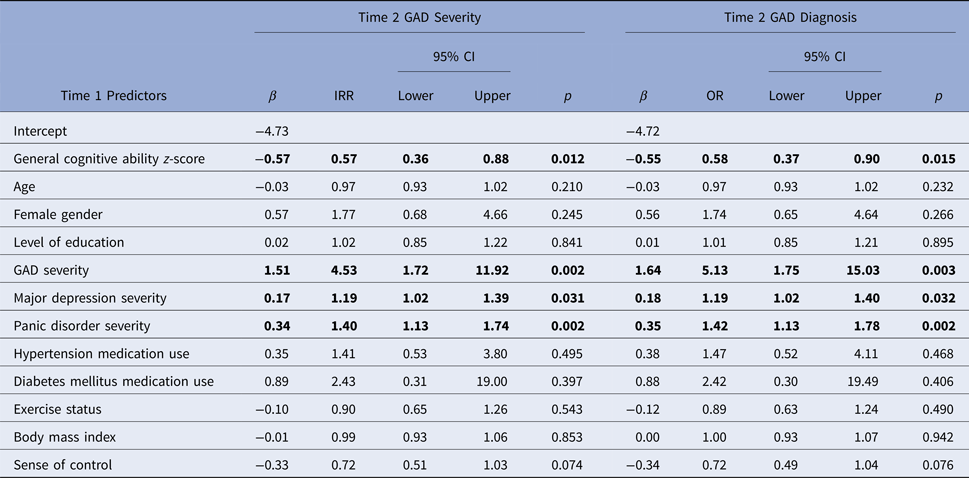
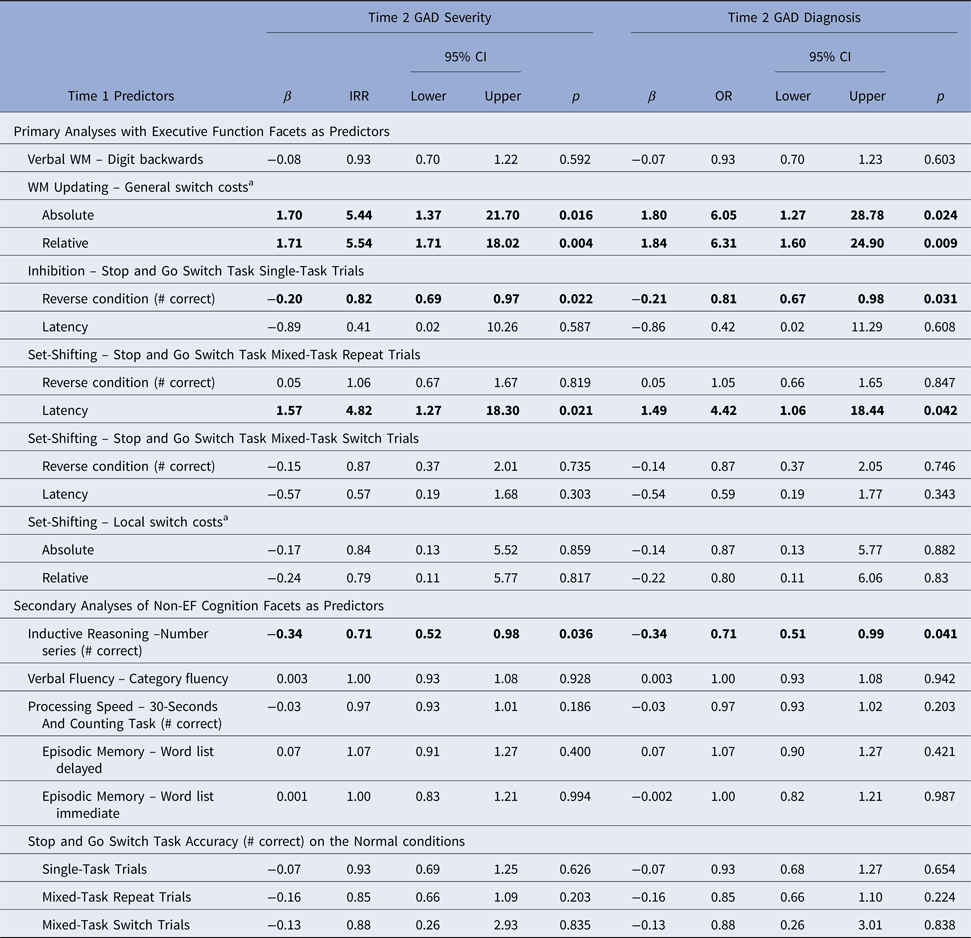
Tables 2 and 3 summarize results for cognitive constructs as predictors of GAD. For inhibition (Stop-and-Go Switch Task; Single-Task Reverse condition), Time 1 accuracy was negatively associated with Time 2 GAD severity and diagnosis. Time 1 inhibition latency, however, was not substantively related to Time 2 GAD. Set-shifting (latency scores on the Stop-and-Go Switch Task; Mixed-Task Repeat Trials) was positively longitudinally associated with Time 2 heightened GAD. As predicted, verbal WM (backward digit span) did not significantly forecast GAD. However, WM updating (general switch costs) positively forecasted GAD. Last, local switch costs were not significantly linked to Time 2 GAD.
Longitudinal and multivariate Poisson and negative binomial regression analyses of Time 1 factors predicting novel cases of Time 2 GAD severity and diagnosis by removing participants at Time 1 who met clinical GAD (n = 2605)

GAD, generalized anxiety disorder; IRR, incidence risk ratio
Note: Gender was coded as 1 = male and 2 = female. Education level ranged from 1 = no school/ some grade school to 12 = medical, law, or doctoral degree. Hypertension and diabetes mellitus medication use were coded as 1 = yes and 2 = no. Exercise status was coded from 1 = yes and 2 = no. Overall model statistic were χ2(13) = 50.24, p < 0.0001 (GAD severity) and χ2(13) = 49.36, p < 0.0001 (GAD diagnosis). Text in bold denote findings which are statistically significant.
Longitudinal and multivariate Poisson and negative binomial regression analyses of Time 1 factors predicting Time 2 GAD severity and binary GAD diagnosis using distinct facets of executive function predicting for GAD in separate models (n = 2605)

ms, milliseconds; 30-SACT, 30 s and counting task.
Note: Latency is measured as Score Difference on the trials (Reverse – Normal) [in milliseconds (ms)]; Each cognitive construct predicting for GAD severity or diagnosis were run in separate models. The following covariates were entered simultaneously into each model: age, gender, education level, generalized anxiety disorder severity, major depressive disorder severity, panic disorder severity, hypertension and/or diabetes mellitus medication use, exercise status, body mass index, and sense of control. Text in bold denote findings which are statistically significant.
aAbsolute costs [score difference between the simple and complex condition (A–B)] and relative costs [proportional reduction in performance from the simple to complex condition to adjust for baseline performances (i.e. (A–B)/A)] were computed. Larger switch costs indicated greater impairment.
Secondary analyses of non-EF cognitive constructs predicting for GAD
Lower Time 1 global cognition z-score was independently significantly linked to higher Time 2 GAD severity and diagnosis. Consistent with predictions, for inductive reasoning (number series), accuracy was negatively linked to Time 2 GAD severity and diagnosis. On the other hand, processing speed (30-Seconds-and-Counting), verbal fluency (semantic category), and global/immediate/delayed EM (word list) were not significantly associated with Time 2 GAD.
Discussion
This is the first study to show that poor global cognition, as well as specific EF and non-EF facets, were precursors of heightened GAD 9 years later. Multivariate analyses revealed that inhibition, set-shifting, WM updating, inductive reasoning, and global cognition deficits independently predicted future elevated GAD after controlling multiple covariates and removing those who met criteria for GAD at baseline. This study thus presents original evidence that EF and other cognitive deficits function as distal risk factors of GAD in mid-adulthood.
The novel finding that inhibition deficits contributed to GAD validates the proposition that processing deficits engender worry (Eysenck & Derakshan, Reference Eysenck and Derakshan2011). Accuracy on the Reverse, but not Normal, condition of the Stop-and-Go Switch Task Single-Task trials predicted GAD arguably because there is an incongruity between top-down/volitional and bottom-up/stimulus-driven inhibition processes in the former, but not latter condition. Deficient top-down voluntary cognitive control processing thus may be instrumental in producing excessive worry (Hirsch et al. Reference Hirsch, Hayes and Mathews2009). Accordingly, high- (v. low-anxious) persons showed longer accurate anti-, but not pro-saccade latencies (Derakshan & Eysenck, Reference Derakshan and Eysenck2009). Further, a meta-analysis showed that GAD persons displayed above normative levels of inappropriately abstaining responses (z = 2.14) on other inhibition measures (Wright et al. Reference Wright, Lipszyc, Dupuis, Thayapararajah and Schachar2014). Moreover, anxiety induction (Fox & Knight, Reference Fox and Knight2005) and GAD status (Hallion et al. Reference Hallion, Tolin, Assaf, Goethe and Diefenbach2017) uniquely predicted lower Stroop paradigm accuracy. Inhibition issues may also reflect abnormalities in neural coupling between the ventromedial PFC and dorsal raphe nucleus that regulates anxiety (Munakata et al. Reference Munakata, Herd, Chatham, Depue, Banich and O'Reilly2011) and cerebral blood flow patterns (Andreescu et al. Reference Andreescu, Gross, Lenze, Edelman, Snyder and Tanase2011). Prospective neuroimaging studies should test these proposals.
Accompanying inhibition, higher general switch costs and latencies on the Stop-and-Go Switch Task Mixed-Task Repeat Trials suggested that WM updating and set-shifting predicted future GAD. These results concur with studies that used other set-shifting measures. GAD persons (v. controls) insisted on applying the same rule despite negative feedback (Mantella et al. Reference Mantella, Butters, Dew, Mulsant, Begley and Tracey2007; Tempesta et al. Reference Tempesta, Mazza, Serroni, Moschetta, di Giannantonio and Ferrara2013). General switch costs reflect problems in sustaining and improving selection among two or more distinct possible response sets between trial blocks (Reimers & Maylor, Reference Reimers and Maylor2005) and thus includes basic WM maintenance and updating. Our results are largely aligned with recent findings of higher general switch costs among high (v. low) worriers towards emotional (Beckwé et al. Reference Beckwé, Deroost, Koster, de Lissnyder and de Raedt2014) and non-emotional (Gustavson & Miyake, Reference Gustavson and Miyake2016; Gustavson et al. Reference Gustavson, Altamirano, Johnson, Whisman and Miyake2017) material. Furthermore, we observed medium-to-large effect sizes implying that WM updating deficits were potent antecedents of late-life GAD (average OR estimates were 6.05–6.31 herein) (Chen et al. Reference Chen, Cohen and Chen2010). Of note, is that verbal WM did not portend future GAD. This observation is congruent with studies on elderly reported by Wetherell et al. (Reference Wetherell, Reynolds, Gatz and Pedersen2002) (high v. low trait anxious) and Price & Mohlman (Reference Price and Mohlman2007) (GAD v. non-GAD) who performed similarly on the digit span. WM (digit span) did not predict GAD perhaps because it taps into verbal (v. visuospatial) WM (Shackman et al. Reference Shackman, Sarinopoulos, Maxwell, Pizzagalli, Lavric and Davidson2006). Verbal WM requires primarily left pre-frontal and posterior cortical activities which remain largely intact among anxiety patients. Also, the digit span did not require overriding a prepotent schema.
Several justifications may account for why inductive reasoning deficits predicted GAD. Persistent failure to examine, weigh, or draw valid conclusions from available data may lead to the habit of generating inaccurate hypotheses without sufficient forethought. Persons with GAD and high trait anxiety were impulsively faster than controls at proposing explanations for arbitrary statements (Pélissier & O'Connor, Reference Pélissier and O'Connor2002) and probabilistic decision-making (Bensi et al. Reference Bensi, Giusberti, Nori and Gambetti2010). Also, inductive reasoning deficits may interfere with effective problem-solving (e.g. Kail, Reference Kail2007), prevent insight into self-defeating patterns, and prepare for recurring difficulties (Overholser, Reference Overholser1993). Further, GAD persons showed a proclivity to generate threat-linked, instead of benign, words on a homophone task (e.g. ‘die/pain’ instead of ‘dye/pane’; Mathews et al. Reference Mathews, Richards and Eysenck1989; Mogg et al. Reference Mogg, Baldwin, Brodrick and Bradley2004). These issues, if not remedied, understandably generate anxious apprehension by overestimating threats and underestimating ones' coping abilities. Subsequent studies could test these ideas by including other inductive reasoning paradigms.
The observation that global cognition predicted GAD in our study aligns with the aging study conducted in France (Zhang et al. Reference Zhang, Norton, Carriere, Ritchie, Chaudieu and Ancelin2015) but not the Netherlands (De Beurs et al. Reference De Beurs, Beekman, Deeg, van Dyck and van Tilburg2000; Schoevers et al. Reference Schoevers, Deeg, van Tilburg and Beekman2005). These prior studies used the Mini Mental State Examination (Folstein et al. Reference Folstein, Folstein and Mchugh1975) to measure global cognition. Variable findings may thus be due to distinctive assessments (Brief Test of Adult Cognition by Telephone v. Mini Mental State Examination) and sample characteristics (e.g., age ranged from 55 to 88 years in De Beurs et al. (Reference De Beurs, Beekman, Deeg, van Dyck and van Tilburg2000) compared with the wider age range herein). Continued longitudinal work is clearly needed to better understand the global cognition-GAD relationship.
Findings concerning verbal fluency and processing speed concur with current evidence. Verbal fluency necessitates initiating new cognitive tasks. That verbal fluency was not a risk factor for GAD accords with former cross-sectional studies showing no link between anxiety severity and verbal fluency in clinical (Airaksinen et al. Reference Airaksinen, Larsson and Forsell2005; Smitherman et al. Reference Smitherman, Huerkamp, Miller, Houle and O'Jile2007) and community samples (Beaudreau & O'Hara, Reference Beaudreau and O'Hara2009; Yochim et al. Reference Yochim, Mueller and Segal2013). To our knowledge, this is the first study to use a backward counting task (Lachman et al. Reference Lachman, Agrigoroaei, Tun and Weaver2014) to investigate processing speed in future GAD. Beaudreau & O'Hara (Reference Beaudreau and O'Hara2009) who used the symbol digit modality test (Smith, Reference Smith1982) found a negative processing speed-trait anxiety correlation (r = −0.35). The symbol digit modality test is a more complex processing speed test than the counting task, and subsequent studies may test whether task complexity determines the sequential processing speed-GAD association.
With regard to EM, our findings were largely concordant with the literature but discrepant from two prior studies which showed weaker EM in GAD patients (v. controls) (Mantella et al. Reference Mantella, Butters, Dew, Mulsant, Begley and Tracey2007; Butters et al. Reference Butters, Bhalla, Andreescu, Wetherell, Mantella and Begley2011). Perhaps this is because the EM indices used in Butters et al. (Reference Butters, Bhalla, Andreescu, Wetherell, Mantella and Begley2011) were an aggregate score of the list, story, and figure recall that vastly differed from the singular 15-word list recall used herein. Similarly, Mantella et al. (Reference Mantella, Butters, Dew, Mulsant, Begley and Tracey2007) used more sensitive 16-item word list and dementia measures. Also, lack of concordance in the EM-GAD relationship across studies may be partly due to age differences (e.g. older adults above 65-years-old in the two prior studies compared with the middle-aged sample of MIDUS project who was a year short of meeting the definition of ‘older adults’ at follow-up). Last, although EM deficits may not precede and predict GAD, worry itself may negatively affect recollection capacities and impair EM ahead of time. Slightly heightened worry severity (v. minimal worry) compromised visual memory and learning as well as delayed verbal recall 2 years later among community-dwelling middle-aged adults (Pietrzak et al. Reference Pietrzak, Maruff, Woodward, Fredrickson, Fredrickson and Krystal2012). A similar pattern may hold true for processing speed and verbal fluency, which may emerge several years after the onset of GAD, but are not by themselves predictive of GAD.
Noteworthy is that GAD itself may be a predictor of future general and specific EF impairments. For instance, acute anxiety induction compromised set-shifting capacities (Shields et al. Reference Shields, Moons, Tewell and Yonelinas2016). Moreover, verbal (v. imagery) worry induction diminished WM abilities (Leigh & Hirsch, Reference Leigh and Hirsch2011) and increased undesirable intrusive thoughts were associated with impaired inhibition (Stokes & Hirsch, Reference Stokes and Hirsch2010). Further, trait worry was considerably related to deficits in WM ability to filter out threat distractors (Stout et al. Reference Stout, Shackman, Johnson and Larson2015). Worry induction also led to enhanced electrophysiology in WM-linked areas (Moran et al. Reference Moran, Bernat, Aviyente, Schroder and Moser2015) reflective of diminished error-monitoring WM updating capacities. Collectively, the EF-GAD link may be bi-directional. For instance, greater initial worry severity was associated with larger reductions in WM, and lower baseline WM was related to sharper increases in worry (Trezise & Reeve, Reference Trezise and Reeve2016). The same iterative pattern may apply to WM updating, set-shifting, and inhibition in predicting GAD, and vice versa (White et al. Reference White, Mcdermott, Degnan, Henderson and Fox2011).
Strengths, limitations, and future directions
Several limitations of the study deserve mention. First, this sample lacked ethnic and economic diversity, thereby limiting generalizability. Future research should thus investigate this phenomenon in a more heterogeneous sample. Second, few participants met criteria for DSM-III-R-defined GAD at both time points, which is common in community-dwelling samples (Schoevers et al. Reference Schoevers, Deeg, van Tilburg and Beekman2005). Large, well-characterized at-risk or clinical samples are recommended moving forward. Also, replication is required to corroborate these initial observations. The limitations notwithstanding, this study presented with strong statistical power, used psychometrically strong measures, and has important mental health implications. A fruitful line of research would involve testing whether improving EF, inductive reasoning, and global cognition are effective as preventative measures against the development of GAD.
Acknowledgements
The data used in this publication were made available by the Data Archive on University of Wisconsin – Madison Institute on Aging, 1300 University Avenue, 2245 MSC, Madison, Wisconsin 53706-1532. Since 1995 the Midlife Development in the United States (MIDUS) study has been funded by the following: John D. and Catherine T. MacArthur Foundation Research Network. National Institute on Aging (P01-AG020166). National Institute on Aging (U19-AG051426). The original investigators and funding agency are not responsible for the analyses or interpretations presented here.
Declaration of interest
The authors do not have any conflicts of interest or financial disclosures.
Ethical standards
The authors assert that all procedures contributing to this work comply with the ethical standards of the relevant national and institutional committees on human experimentation and with the Helsinki Declaration of 1975, as revised in 2008.