INTRODUCTION
Young children acquiring English often produce bare verb forms in contexts in which an inflected form is required (e.g., Brown, Reference Brown1973; Brown & Bellugi, Reference Brown and Bellugi1964; Cazden, Reference Cazden1968). For example, young English-speaking children often produce utterances such as the following (taken from Becky in the Manchester corpus; Theakston, Lieven, Pine & Rowland, Reference Theakston, Lieven, Pine and Rowland2001) in 3sg present tense contexts:
(1) *Andy want it.
(2) *Daddy like lettuce.
(3) *Pingu go here.
Since the mid 1990s, such utterances have tended to be treated as Optional Infinitive (OI) errors (or Root Infinitive errors; Rizzi, Reference Rizzi1994), because they typically appear during a period in which the child is also producing correctly inflected forms (Bromberg & Wexler, Reference Bromberg and Wexler1995; Harris & Wexler, Reference Harris, Wexler and Clahsen1996; Wexler, Reference Wexler, Hornstein and Lightfood1994, Reference Wexler1998). The suggestion is that, during this stage of grammatical development (approximately between the ages of two and four years), children may ‘optionally’ use an untensed (non-finite) verb form in a context in which, for adults, a tensed (finite) form is required. It is important to emphasize that under OI accounts, errors such as *Andy want it explicitly do not reflect either (a) simple omission or dropping of the -s morpheme (e.g., due to its low phonological/communicative salience) or (b) defaulting to the form of the relevant verb with the highest lexical frequency or phonological simplicity. Rather, OI accounts assume that when a child produces an utterance such as *Andy want it, she is producing a non-finite form that is fully licensed by her grammar (and, as such, is an ‘error’ only when viewed from the perspective of the adult grammar). A detailed account of exactly why children's grammars license non-finite forms in such contexts is given by Wexler (Reference Wexler1998).
One obvious advantage of treating unmarked verb forms in English as OI errors is that it allows the data from English-speaking children to be assimilated into a unified account of the cross-linguistic pattern of verb-marking error (e.g., Wexler, Reference Wexler, Hornstein and Lightfood1994; Reference Wexler1998; Schutze & Wexler, Reference Schutze and Wexler1996; Freudenthal, Pine, Aguado-Orea & Gobet, Reference Freudenthal, Pine, Aguado-Orea and Gobet2007; Legate & Yang, Reference Legate and Yang2007). The claim is that utterances such as *Andy want it reflect the use of a non-finite form, which – due to a quirk of English – just so happens to be identical in its surface form to the bare stem (and to all present tense forms other than 3sg). In OI languages other than English, the equivalent non-finite forms carry a distinct infinitival morpheme, and so do not share this superficial similarity with the bare stem (though they are sometimes indistinguishable from some of the forms in the present tense paradigm). For instance, a French child might produce *La fille jouer ‘The girl play-inf’ for La fille joue ‘The girl plays’, and a Dutch child might produce an OI error such as *Papa koffie drinken ‘*Daddy coffee drink-inf) for the adult target sentence Papa drinkt koffie ‘Daddy drinks coffee’. These errors are characterized by the use of forms with overt infinitival markers (-er and -en, respectively). In the case of Dutch, the same marker is used for both the infinitive and present tense plural forms of the verb, but the fact that the verb is generally preceded by its complement (i.e., occurs in non-finite position) suggests that the majority of these errors are non-finite forms, as opposed to present tense plurals.
The OI approach has resulted in models – both generativist and constructivist – that make quite fine-grained predictions about the rate at which OI errors will occur in different languages, and the speed with which children emerge from the OI stage (Freudenthal et al., Reference Freudenthal, Pine, Aguado-Orea and Gobet2007; Legate & Yang, Reference Legate and Yang2007). However, as these models have been tested against a wider range of languages, it has become clear that they struggle to explain the very high rate of OI errors and the particularly extended nature of the OI stage in English.
Legate and Yang's (Reference Legate and Yang2007) Variational Learning Model (VLM; see also Yang, Reference Yang2002, Reference Yang2004) proposes that young children entertain several different grammars (where a grammar is defined as a set of parameter values) at the same time, with these grammars competing probabilistically. Parameter settings that are consistent with the linguistic input are reinforced, and the probability that they will be used again in the future increases. Parameter settings that are inconsistent with the input are punished, and the probability that they will be used in the future decreases. The relevant parameter here is the TENSE parameter: The +TENSE setting is rewarded by input utterances with overt tense marking (e.g., He goes), and the −TENSE setting is rewarded by verb forms with no overt tense marking (e.g., We go). It is important to note that the VLM operates at the level of the clause, not the individual verb form. For example, He doesn't play and He wants to play would both reward the +TENSE grammar, as both forms have overt tense marking, the first on the auxiliary and the second on the main verb. On the other hand, They don't play, They play, and He can play would all reward the −TENSE grammar as, whilst the clauses are marked for tense, this marking is null, not overt. According to the VLM, OI errors occur when children learning languages that use tense marking have yet to definitively set the TENSE parameter to +TENSE, but are still entertaining the −TENSE setting (which is the target setting for languages such as Mandarin Chinese). Legate and Yang (Reference Legate and Yang2007) provide evidence that, as predicted, across three languages (English, French, and Spanish) the length of the OI stage is positively correlated with the proportion of clauses in the input with no overt tense marking.
An alternative explanation of the observed pattern of cross-linguistic variation with respect to the rate of OI errors is offered by a recent computational model: the Model of Syntax Acquisition in Children (MOSAIC; Freudenthal, Pine & Gobet, Reference Freudenthal, Pine and Gobet2006; Freudenthal et al., Reference Freudenthal, Pine, Aguado-Orea and Gobet2007; Freudenthal, Pine & Gobet, Reference Freudenthal, Pine and Gobet2009, Reference Freudenthal, Pine and Gobet2010). According to MOSAIC, OI errors are truncated verb forms learned from compound-finite structures in the input (e.g., He can go →*He go) in a way that reflects information-processing constraints on the language-learning mechanism. When processing a new utterance, elements at the beginning and end of the utterance are preserved, due to a small primacy and larger recency effect in learning. These effects are instantiated in the model by having it learn utterances gradually from the right and left edge with a bias towards right- as opposed to left-edge learning. Note that earlier versions of the model (e.g., Freudenthal et al., Reference Freudenthal, Pine and Gobet2006) only learned from the right edge of the utterance. However, this meant that OIs with subjects were produced as a result of the model learning strings from questions (e.g., Can he go→*He go). This is somewhat implausible, as children are presumably able to differentiate between declarative and interrogative utterances. The version of the model described in the present paper, differentiates between declarative and interrogative input and learns declaratives from the former and questions from the latter. The inclusion of both an utterance-final and utterance-initial bias not only allows the model to learn OIs with subjects from declarative input (e.g., He can go→*He go), but also to simulate the cross-linguistic pattern of OI errors in wh-questions by learning OIs in wh-questions from interrogative input.
Freudenthal et al. (Reference Freudenthal, Pine and Gobet2010) show that MOSAIC provides a good fit to the cross-linguistic patterning of OI errors in Dutch, German, French, and Spanish. They also provide evidence for MOSAIC's prediction that the rate at which OI errors occur with different lexical verbs will be correlated with the proportion of non-finite verb forms in compound finite structures in the input. However, in an explicit comparison of MOSAIC and the VLM, they conclude that both models fail to account for the very high rates of OI error observed in English. In the case of the VLM, the model has no ready explanation for the finding of Freudenthal et al. (Reference Freudenthal, Pine and Gobet2010) that this error rate is higher for English than for Dutch or German, despite the fact that input corpora from the three languages contain similar levels of evidence in favour of the +TENSE parameter (if anything, Dutch contains slightly less evidence than English). In the case of MOSAIC, the model is unable to simulate the very high rate of OI errors in English (87%), which is more than 20 percentage points higher than the rate at which such errors occurred in MOSAIC's output (63%).
One possible reason for these difficulties is that apparent OI errors in English are actually the result of two separate processes: (i) producing non-finite verb forms, either as the result of an incorrect parameter setting (VLM) or through the truncation of compound finite verb forms (MOSAIC); and (ii) defaulting to the most frequent form of the verb when unable to access or retrieve the less frequent marked form. This possibility reflects the fact that, in English, at least for the vast majority of main verbs, the most frequent form is likely to be the bare form, which is indistinguishable from the infinitive. Defaulting errors in English are therefore likely to be indistinguishable from OI errors and hence to increase the rate of (apparent) OI errors in English. Note that, in this context, the term ‘bare form’ refers to any lexical verb form that does not carry overt tense marking. Thus ‘bare forms’ include simple finite forms with null marking (e.g., I/we/you/they go), imperatives (Go!), ‘no-change’ past tense forms (e.g., She hithim) and also the lexical verbs in compound finite forms (e.g., He will/can/should/does/doesn't go).
It is important to emphasize that the ‘defaulting hypothesis’ outlined here is intended not as an alternative account of the OI phenomenon per se, but rather as a complementary mechanism that can explain why OI errors are more common in English than would be predicted by current models of the OI stage. The claim is not, therefore, that all OI errors reflect a process of defaulting to the most frequent form of the verb. Rather, we suggest that, in addition to errors produced by the mechanisms instantiated in MOSAIC or the VLM, children also sometimes default to the form of each particular verb that is most frequent in the input. This may occur because children are unsure which form is required in a given context, or because they are unable to retrieve the correct form from memory (for example, under conditions of high cognitive load). Since all English present tense main verb forms except for 3sg (e.g., goes) are bare forms, the bare form is likely to be the most frequent form of any given verb, and hence the form to which children are predicted to default. Because, in English, bare forms are indistinguishable from genuine non-finite forms (whether licensed by an OI grammar or produced as a result of modal omission), defaulting to the bare form increases the rate of (apparent) OI errors (for a similar proposal from a generativist perspective, see Blom, Reference Blom2007). Note that, even for languages such as Dutch and German, it is possible that some apparent OI errors are, in fact, a consequence of defaulting to a high-frequency present tense form that shares the same inflection as the infinitive (e.g., present tense plural -en in Dutch and German). However, in OI errors in Dutch and German, verbs tend to occur in non-finite position (i.e., after their complements), suggesting that the majority are, indeed, OI rather than defaulting errors (Jordens, Reference Jordens1990; Poeppel & Wexler, Reference Poeppel and Wexler1993).
Note that, in English, the bare form is not only the most frequent form but also, by virtue of its lack of additional morphemes, the most phonologically simple. The fact that the bare form is the easiest to produce constitutes another reason why children may default to it, perhaps particularly in cases where they are having difficulty planning an utterance. Indeed, there is evidence from naturalistic studies that children learning languages other than English often make errors in which they default to verb forms in the input that are frequent and phonologically simple. For example, Aguado-Orea (Reference Aguado-Orea2004) reported that the two Spanish children studied produced errors involving defaulting to the 3sg present tense verb form (particularly in 3pl contexts, e.g., *Javier y Fernando juega), which is both the most frequent and the phonologically simplest form. Similarly, although Finnish children probably do not produce OI errors, they do sometimes ‘default’ to the second person singular (2sg) imperative form, which bears no overt morphological marking, and is hence indistinguishable from the stem form (Toivainen, Reference Toivainen1980; Laalo, Reference Laalo1994, Reference Laalo, Bittner, Dressler and Kilani-Schoch2003). It should be clear from this definition that we are arguing that the bare form is a ‘default’ only in the sense that – by virtue of its frequency and phonological simplicity – it is the form that is easiest for the child to recall and produce. We are not arguing that the bare form is some kind of morphosyntactic default form that can be used even when its features are not licensed by the subject (as, for example, Radford & Ploennig-Pacheco, Reference Radford and Ploennig-Pacheco1995, argue for 3sg).
To our knowledge, the idea that English children will sometimes default to a bare form when a 3sg -s form is required (i.e., in simple finite contexts) has been tested in only a single study (though see Theakston, Lieven & Tomasello, Reference Theakston, Lieven and Tomasello2003; Finneran & Leonard, Reference Finneran and Leonard2010, for studies investigating children's acquisition of 3sg -s more generally using novel verbs, and Oetting & Horohov, Reference Oetting and Horohov1997, and Van der Lely & Ullman, Reference Van der Lely and Ullman2001, for studies investigating verb frequency and tense inflection with children with Specific Language Impairment). Song, Sundara, and Demuth (Reference Song, Sundara and Demuth2009) found that the raw frequency of the verb in 3sg -s form in the CHILDES database (MacWhinney, Reference MacWhinney2000) did not account for any variability in children's production of 3sg -s forms versus OI errors. Although this finding would seem to count against the defaulting hypothesis, it seems likely that the important factor is not the raw frequency of 3sg -s forms in the input but the relative frequency of 3sg -s vs. bare forms. Any account under which two stored forms (e.g., plays and play) are competing for activation in memory predicts an effect of relative – as opposed to absolute – frequency. Bare forms of a particular verb in the input pull the child towards producing a bare form for that verb, whilst 3sg forms pull her towards producing a 3sg form (note that the VLM also operates in this manner, though at a higher level of abstraction). Following this logic, Matthews and Theakston (Reference Matthews and Theakston2006) demonstrated that the likelihood of correct irregular plural production (e.g., feet) was predicted not by the overall frequency of this form but by the relative frequency of the plural vs. singular form (feet vs. foot).
In the present study, we thus test the idea that at least some apparent OI errors in English reflect a process of defaulting to the bare stem, using an elicited production paradigm in which items vary in the extent to which the verb occurs in 3sg -s as opposed to bare form in the input language. It is predicted that the extent to which children produce bare verb form errors will correlate with the extent to which particular verbs occur in bare as opposed to 3sg -s form in the input language.
METHOD
Participants
The initial sample comprised 36 participants, recruited from three nurseries in Liverpool. All were typically developing, monolingual speakers of British English. No standardized language tests were used, but all the children were described by their teachers as displaying normal language development. Thus, there is no reason to believe that the children had any language disorders or particular problems with production of consonant clusters that could have affected the production of 3sg -s (none were reported by their teachers). In order to make sure that 3sg -s deletion was not a characteristic feature of the local dialect, a corpus search of the six Liverpool mothers' speech in the Post-Manchester Corpus (Rowland and Theakston, Reference Rowland and Theakston2009) was conducted. The rate of 3sg -s deletion was 0·6% (22 instances out of a possible 3,765). There is therefore no evidence that 3sg -s deletion is a characteristic feature of the local dialect.
Eleven children were excluded because they did not attempt to repeat any sentences during the training phase (all children who completed the training phase also successfully completed the test phase). This relatively high attrition rate is consistent with previous elicited-production studies of morphology (e.g., Gerken, Reference Gerken1996; Valian & Aubry, Reference Valian and Aubry2005; Song et al., Reference Song, Sundara and Demuth2009). As the aim of the study was to explain between-verb variability in children's OI errors, data from another three children who made no OI errors were excluded from the statistical analysis. The final sample consisted of 22 participants with a mean age of 3;7 years (range 3;1–4;1).
Design and materials
The study used a between-verbs, within-subjects design, with the number of correct uses of 3sg -s in the elicited-production task as the dependent variable. The stimuli consisted of 48 sentences and accompanying pictures, presented on a laptop computer. To develop the stimuli, verb frequency counts were obtained from the child-directed speech of the 12 mothers in the Manchester corpus (Theakston et al., Reference Theakston, Lieven, Pine and Rowland2001), chosen to be representative of British-English child-directed speech heard by preschool children.
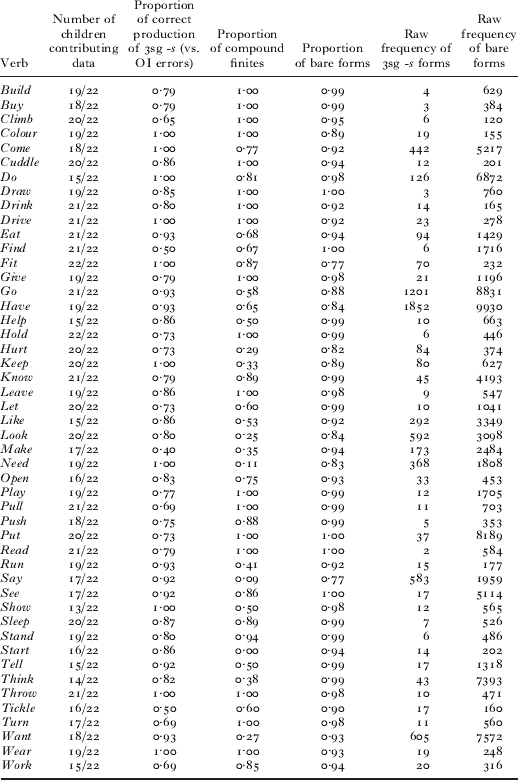
The main continuous predictor variable – designed to test the defaulting hypothesis – was the proportion of uses of each verb in this corpus that were bare forms as opposed to 3sg -s forms, regardless of discourse context, collapsing across all 12 mothers (henceforth referred to simply as the ‘defaulting’ measure). Recall that, for the purposes of this study, a bare form is defined simply as a form that lacks overt tense marking on the verb itself, whether or not it is a true non-finite form. For example, the proportion of bare forms for eat (0·94) was calculated as follows:
 $${{{\rm Occurrences\ of\ }eat{\rm \ }\lpar 1429\rpar } \over {{\rm Occurrences\ of}\ {eat\ } + {\rm \ Occurrences\ of\ }eats{\rm \ }\left( {1429 + {\rm \ }94} \right){\rm \ }}} = 0 \cdot 94$$
Since the aim of the study was to investigate the effect of the relative frequency of 3sg -s forms vs. bare forms, any other inflected forms (i.e., present progressive and past tense) were ignored. This is because these forms do not pull towards either the 3sg -s or bare form.
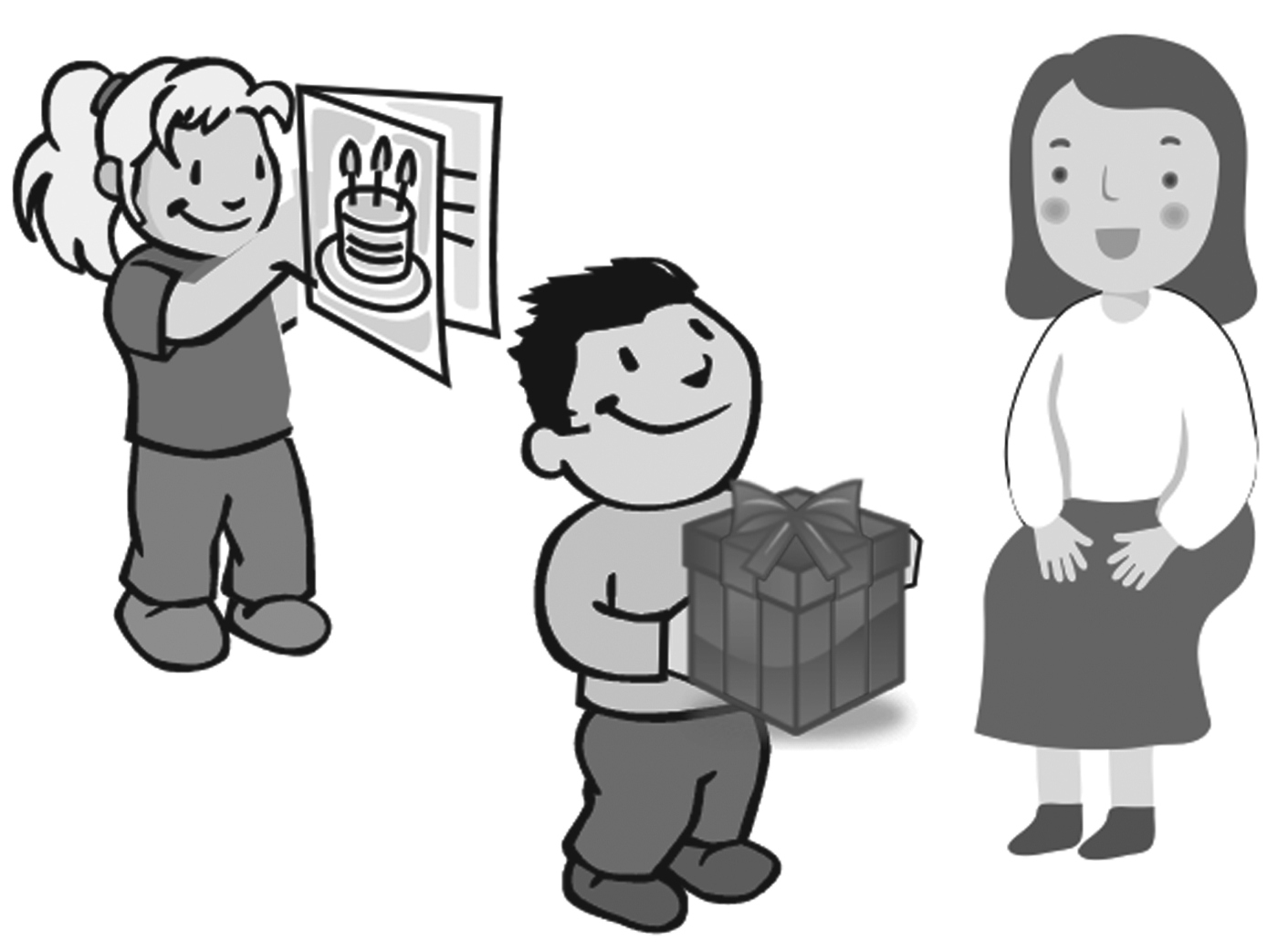
From the 100 verbs with the highest overall frequency in the Manchester corpus input data, we selected a set of 48 verbs designed to vary continuously in terms of their values with respect to the predictor variable (excluding verbs that appear only as auxiliaries). Using these verbs, 48 trials were created (see ‘Appendix’ for the full set). Each trial consisted of a ‘set-up’ sentence beginning Every day …, where the relevant verb was presented in a ‘bare’ (3pl) form (e.g., the children give), followed by a sentence containing two clauses conjoined with and. Each of these two clauses included a 3sg subject and 3sg -s verb form (e.g., Kate gives … and Sam gives …). For example, the complete trial for give was as follows (see Figure 1 for the pictorial stimuli used):
Every day the children give Mum something. Kate gives a card and Sam gives a present.
Illustration for the trial ‘Every day the children give Mum something. Kate gives a card and Sam gives a present.’

The second clause (underlined in the example above) was designated the target clause (i.e., the clause that children attempted to repeat in the training session, and to produce in the elicited-production test session). This clause always began with a one-syllable word, which was either the name of the character (Sam or Kate) or, occasionally, the name of a toy (e.g., Po). In every target clause, the verb was followed by a phrase consisting of three syllables. Thus, except for five two-syllable verbs (colours, cuddles, pushes, tickles, opens), the target clause always contained the same number of syllables (five). The three-syllable phrase following the verb always started with a vowel in order to ensure that it would be easy to detect whether or not the child produced the 3sg -s morpheme. Importantly, because all target clauses used a 3sg subject (e.g., Sam), the use of a bare form (e.g., *Sam give a present) always constituted an OI error. In other words, the target clause to be produced by the child always constituted an obligatory context for 3sg -s.
Note that the use of the Every day … context sentence ensured that the use of the 3sg -s form (e.g., Sam gives) as opposed to the present progressive (Sam is giving) or past tense form (Sam gave) was natural. Although the Every day … prompt sets up a context of habitual aspect rather than ongoing action, this was unavoidable, as – in everyday spoken English – the use of a simple present tense form to describe an ongoing action (e.g., Sam gives a present) is extremely unnatural; the present progressive form (e.g., Sam is giving a present) would be used instead. In any case, this does not affect the predictions of the present study, which relate solely to the use of 3sg -s, regardless of aspect.
For each trial, an illustration (see Figure 1 for an example) was presented on a laptop computer (with a 17-inch screen) using PowerPoint (children were invited to press the button to proceed to each subsequent picture, which served as an incentive to continue). A microphone (Shure SM58) connected to the computer (running Audacity 1.3.12-Beta recording software) was used to record children's responses. Loudspeakers connected to the laptop allowed the children to hear their own amplified voices, which constituted an incentive to copy the experimenter (in the training session) and to produce their own sentences (in the test session).
Procedure
Each child completed a training session then, on the following day, a test session, with each session lasting approximately 15–30 minutes, depending on the child. In both sessions, each child completed all the trials in one of four predetermined pseudo-random orders. Each child was tested individually with a member of nursery staff present.
Day 1 – training session
The aim of the elicited-imitation training session was to teach children the relevant target response for each trial, and hence to ensure that, in the subsequent elicited-production test session, they attempted this ‘target clause’ (as opposed to making up their own utterances, perhaps using non-target verbs). The child was seated in front of the laptop, and was told that he or she would be playing a turn-taking game with the experimenter, in which they would describe some pictures together. First the child completed a brief warm-up that involved ‘testing the microphone’ by producing her own name and those of the story characters. The experimenter then brought up the first picture and produced the set-up sentence (e.g., Every day the children give Mum something) and the conjoined-clause sentence ending in the target clause (e.g., Kate gives a card and Sam gives a present). The experimenter then asked ‘Can you say [target clause]?’ to elicit an attempted repetition (though most children spontaneously imitated the target clause after the first one or two training trials). If the child did not attempt to repeat the sentence after three prompts of this nature, the experimenter moved on to the next picture. Eleven children were excluded from the study for failing to repeat four consecutive trials during this training phase (there were no additional drop-outs during the test phase).
Day 2 – test session
For the elicited-production test session, children were told that they would be playing the same game as previously, but this time it would be up to them to try to remember what happens in each picture. The experimenter followed the same procedure as for the training session (e.g., saying Every day the children give Mum something. Kate gives a card and …), except that, instead of producing the target clause, she simply pointed at the relevant character and awaited the child's response. Very occasionally, the child did not attempt a response, in which case the experimenter modelled the beginning of the target clause (e.g., Sam …) up to three times, before moving on to the next picture.
Transcription, scoring, and reliability
The responses were transcribed from the audio-recordings and coded by the first author. Each response was coded solely on the basis of the form of the target verb produced: 3sg -s (e.g., gives) (N=696), non-finite (e.g., give) (N=197), or other/unscorable (including non-target verbs, no response, past tense/present progressive responses, incomprehensible/inaudible responses) (N=164). Other deviations from the target clause (e.g., substitution of subjects or objects) were ignored. The responses were also transcribed independently by a trained undergraduate research assistant who was blind to the hypotheses under investigation. Inter-rater reliability, as measured by Cohen's kappa, was 0·88 (96% agreement). Any disagreements regarding the presence of a 3sg -s were subjected to re-listening until agreement was reached.
RESULTS
The mean proportion of children producing the correct 3sg -s form for each verb (excluding trials for which no valid attempt at the target verb was made) is shown in Table 1. Note that because trials with missing data were excluded, correct 3sg -s forms and OI errors sum to 100%. Overall, children's performance was good (M=77·91% correct production of 3sg -s, SD=41·51), as would be expected given their relatively advanced age (M=3;7) (The mean proportion of correct 3sg -s production in the training session=0·82 [SD=0·32]). Table 1 also shows the proportions of bare forms versus 3sg -s forms (defaulting measure) in the input corpus, as well as the raw frequencies of bare and 3sg forms. Note that even the verb with the lowest proportion of bare forms (fit=0·77) still occurs considerably more frequently in bare than 3sg -s form. The data appear to pattern broadly as predicted by the defaulting hypothesis, with more OI errors (i.e., fewer correct productions) for verbs that have a high proportion of bare forms relative to 3sg -s forms in the input.
Mean proportion of correct production of 3sg -s on the elicited production task for each verb, the proportions of bare forms in all contexts and compound finites as opposed to 3sg -s present tense verb forms and the raw frequencies of 3sg -s and bare forms in the Manchester corpus input
The prediction under investigation is as follows. If children show an effect of defaulting to the bare form, then the overall proportion of bare versus 3sg -s forms in the input (defaulting measure) will be a significant negative predictor of the rate of 3sg -s production across verbs. To test this prediction, mixed-effects regression models with participants and items as random effects (see Baayen, Reference Baayen2008) were fitted to the data. The advantage of using such an approach as opposed to traditional by-subjects/items regression analysis is that the former takes into account both by-subject and by-item variation, and thus has more power. The fixed effects varied by analysis, but included the defaulting measure as described above, age (in months), a compound-finites measure (described with the relevant analysis below), raw bare form and 3sg -s form frequencies, and two control predictors: the total length of, and serial position of the verb in, the child's response. As the outcome measure was dichotomous (each child produced either a 3sg -s form or an OI error for each verb, with other responses treated as missing data), logistic regression models were used. The outcome measure was coded as 1=correct production of 3sg, 0=bare form (OI error) produced. All model comparisons were made using likelihood ratio tests performed in R with the ANOVA function.
The first (baseline) model (Model A) included age, the length of the child's response, and the serial position of the verb in the child's response as fixed effects. A significant effect of age was observed (β=0·15, SE=0·06, z=2·34, p=·019), reflecting the fact that, as expected, the proportion of correct 3sg -s production increased with age. Neither the length of the response (β=0·23, SE=0·14, z=1·68, p=·092), nor the serial position of the verb in the response (β=0·28, SE=0·29, z=1·00, p=·319), had any significant effect on the production of the 3sg -s. These two non-significant predictors were thus omitted from the subsequent models, and Model A with only age as a fixed effect was used as a reduced model against which subsequent models were tested (see Table 2 for model details).
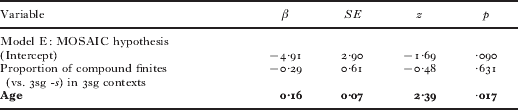
The mixed-effects regression models fitted to the data notes: Model log likelihood=−399·38; Random effects: Participant (Var=1·31, SD=1·14), Verb (Var=0·65, SD=0·81). Bold values indicate that the effect is statistically significant at p<·05 or greater. note: Model log likelihood=−395·35; Random effects: Participant (Var=1·29, SD=1·14), Verb (Var=0·49, SD=0·70). Bold values indicate that the effect is statistically significant at p<·05 or greater. notes: Model log likelihood=−399·35; Random effects: Participant (Var=1·30, SD=1·14), Verb (Var=0·65, SD=0·81). Bold values indicate that the effect is statistically significant at p<·05 or greater. notes: Model log likelihood=−397·83; Random effects: Participant (Var=1·29, SD=1·14), Verb (Var=0·57, SD=0·75). Bold values indicate that the effect is statistically significant at p<·05 or greater. notes: Model log likelihood=−399·27; Random effects: Participant (Var=1·30, SD=1·14), Verb (Var=0·65, SD=0·81). Bold values indicate that the effect is statistically significant at p<·05 or greater.
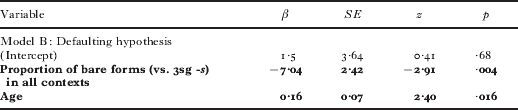


The fixed effects in the second model (Model B) were age and the defaulting measure, in order to investigate the effect of bare forms on the production of 3sg -s. Whilst the fixed effect of age remained significant (β=0·16, SE=0·07, z=2·40, p=·016), a significant negative effect of the proportion of bare forms in the input (defaulting measure) on children's 3sg -s production across verbs was also observed (β=−7·04, SE=2·42, z=−2·91, p=·004). Thus, the more often a verb appeared in bare form in the input, the more often children produced an OI error – and the less often they produced a correct 3sg -s form – for that verb. The AIC values revealed that this model (AIC=800·70; logLik=−395·35) was indeed a significantly better fit to the data than the reduced model (Model A) (AIC=806·76, logLik=−399·38) (p=·005). By-verb regression on the mean correct performance revealed the R2 value to be 0·08 (simple Pearson correlation r=−0·28).
In order to validate the use of proportional as opposed to absolute frequency as a predictor in the above analysis, models were also derived which included, in addition to age, the raw frequency of the verb in bare stem form (Model C) and the raw frequency of the verb with 3sg -s (Model D) as fixed effects. Although there was a marginal effect of raw frequency of the verb with 3sg -s, neither model provided a significantly better fit to the data than the reduced (age-only) model A (AIC=808·69, logLik=−399·35, p=·971 for model C; AIC=805·66, logLik=−397·83, p=·078 for model D). Furthermore, Model B with the proportion of bare forms constituted a significantly better fit to the data than either Model C or D (p<·001 and p=·024, respectively). These findings are consistent with the view that proportional frequency is the more appropriate measure, and provide a potential explanation of the null effect observed in a similar study that used only the raw 3sg -s frequency measure (Song et al., Reference Song, Sundara and Demuth2009).
One possible objection to the present results is that children could be producing apparent ‘defaulting’ errors (e.g., Sam gives→Sam give) by truncating compound finite structures in modal contexts, as assumed by MOSAIC (e.g., Sam can give→Sam give) (although this does not seem particularly likely given the discourse context of the game, which sets up a habitual 3sg context, rather than a modal context). If this is the case, then the defaulting measure may be a significant predictor of the error rate only because the rate at which verbs occur in bare form (defaulting measure) is an effective proxy for the rate at which they occur in compound finite structures. Indeed, the defaulting measure (proportion of bare vs. 3sg forms) includes compound finite uses (e.g., Sam can give) – which are, by definition, bare forms – in its counts. In order to eliminate this possibility, we therefore calculated the rate at which each verb occurs in the input in compound finite structures only, and ran a final analysis including only this predictor and age as fixed effects (Model E).
This compound finite measure (or MOSAIC measure) reflected the proportion of uses of each verb that were non-finites in 3sg compound-finite constructions as opposed to 3sg -s forms. These proportions were calculated by hand-coding the input data of one child (Becky) selected at random from the Manchester corpus. (The input estimates for the compound-finite measure were restricted to one child's input data simply because of the need to hand-code the data for this particular analysis. Hand-coding the data from all 12 children in the Manchester corpus would have been extremely time-consuming. For example, just for the verb eat, the number of utterances to hand-code would have been 1,517). The measure included all semi-modal/modal/auxiliary utterances (e.g., He's going to eat; He can eat; He does[n't] eat) in 3sg declarative contexts. For example, the proportion of compound finites for eat (0·68) was calculated as follows:
 $${{{\rm Occurrences\ of\ }eat{\rm \ as\ non{\hbox {-}}finite\ in\ declarative\ 3sg\ compound\ finites\ \lpar }15{\rm \rpar }} \over \eqalign{{\rm Occurrences\ of\ }eat{\rm \ as\ non{\hbox {-}}finite\ in\ declarative\ 3sgcompound\ finites\ \lpar }15{\rm \rpar } \cr \quad + {\rm Occurrences\ of\ }eats{\rm \ }\left[ {{\rm all\ in\ declarative\ 3sg\ contexts}} \right]{\rm \ \lpar }7{\rm \rpar } \cr} } = 0 \cdot 68$$
Note that the analysis was restricted to declarative contexts because all the sentences elicited in the present study were declaratives, and because it is somewhat implausible to assume that children take strings learned from questions and use them in declarative contexts. Thus, the MOSAIC measure maps more closely onto the current version of MOSAIC than it would have done had we also included questions.
In order to investigate whether the MOSAIC measure was a significant predictor of the children's performance, this measure was included – in addition to age – in a final model (Model E). No effect of compound finites was observed (β=−0·29, SE=0·61, z=−0·48, p=·631) with Model E (AIC=808·54, logLik=−399·27) failing to offer a significantly better fit to the data than the reduced Model A (AIC=806·76, logLik=−399·38, p=·64). Furthermore, Model B provided a significantly better fit to the data (AIC=800·70, logLik=−395·35, p<·001) than Model E. Thus, consistent with the defaulting hypothesis, the compound-finite measure was not a significant predictor of the error rate. Note also that an additional analysis using a version of the MOSAIC measure that included both declaratives and questions yielded a very similar pattern of results. These results appear to be at odds with the results of Freudenthal et al. (Reference Freudenthal, Pine and Gobet2010), who did find a significant by-verb correlation between the proportion of compound finites in the input and OI errors. However, it is worth noting that Freudenthal et al.'s measure of OI errors is based on a much wider range of contexts than those elicited in the present study. This is an issue to which we return in the ‘Discussion’.
To summarize, the elicited production paradigm was successful in eliciting OI errors in young English-speaking children. The results indicated that the higher the proportion of bare forms in the input, the higher the rate of OI errors in children's productions, thus providing evidence for the defaulting hypothesis. The findings also demonstrate that defaulting to the frequent, phonologically simple bare form accounts for variance that cannot be explained in terms of differences in the rate at which verbs occur in compound finites in the input.
DISCUSSION
The present study was designed to examine the Optional Infinitive phenomenon by investigating whether defaulting to the most frequent and phonologically simplest form of each verb – the bare form – can explain why English-speaking children produce OI errors at higher rates than would be predicted by current accounts (both the VLM and MOSAIC). The study took the form of a picture-description task designed to elicit attempts at 3sg -s verb forms in simple finite contexts. In support of the defaulting hypothesis under investigation, it was found that – across verbs – the proportion of bare vs. 3sg -s forms in the input was a significant negative predictor of the rate at which children produced correct 3sg -s forms vs. OI errors. The truncated compound-finite structures learned from the input did not, on the other hand, predict any significant variance in children's performance. Our results, therefore, suggest that the process of defaulting is a factor in explaining OI errors in English.
One possible interpretation of these findings is that all apparent OI errors in English can be explained in terms of a process of defaulting to the most frequent (and/or phonologically simple) verb form. This interpretation cannot be ruled out on the basis of the present results. However, it appears somewhat implausible given the cross-linguistic data. This is partly because it is clear that some additional mechanism is required to explain OI errors in languages in which the non-finite form is clearly an infinitival form (Wexler, Reference Wexler1998), and not the most frequent and/or phonologically simplest form in the input. Such a mechanism is likely to generate OI errors in English as well as in these languages.
A more plausible interpretation is therefore that apparent OI errors in English reflect the operation of two distinct processes: one that results in the production of non-finite forms, and one that results in the production of bare stems (although these forms are, of course, indistinguishable in English). For example, one possibility is that OI errors in modal contexts reflect the learning of non-finite forms from compound finite structures (as implemented in MOSAIC), whereas apparent OI errors in simple finite contexts reflect a process of defaulting to the most frequent (and/or phonologically simple) verb form. Although clearly less parsimonious than a single-factor model, a two-factor model of this kind has a number of empirical advantages over its competitors.
First, a two-factor model is consistent with the data from languages such as Spanish in which children have been reported to produce both OI errors (at low rates) and defaulting errors. In the ‘Introduction’ to the present study, we reviewed evidence suggesting that learners of languages such as Spanish and Finnish show defaulting behaviour, but that this leads to forms with incorrect person/number marking (e.g., the use of a 3sg verb form with a 3pl subject), as opposed to OI errors (e.g., Aguado-Orea, Reference Aguado-Orea2004, for Spanish;; Toivainen, Reference Toivainen1980; Laalo, Reference Laalo1994, Reference Laalo, Bittner, Dressler and Kilani-Schoch2003, for Finnish; see also Dabrowska & Szczerbinski, Reference Dabrowska and Szczerbinski2006, for Polish noun morphology). Thus, an account combining learning from compound finites and defaulting has the potential not only to account for both OI errors and incorrect person-/number-marking errors, but also to predict how the relative frequency of each error type will vary across languages, as a function of which particular surface form is of the highest frequency (and/or phonological simplicity). Indeed, it is important to emphasize that our claim is not that defaulting errors are unique to English. All that is unique about English is the fact that defaulting errors result in forms that happen to resemble non-finite forms, as opposed to incorrect person-/number-marked forms.
Second, a two-factor model provides a potential explanation of a key difference between English, in which OI errors occur in both modal and non-modal contexts, and other Germanic languages, in which OI errors virtually always have a modal reading (the well-known modal reference effect; e.g., Hoekstra & Hyams, Reference Hoekstra and Hyams1998; Josefsson, Reference Josefsson2002; see also Ingram & Thompson, Reference Ingram and Thompson1996; Wijnen, Reference Wijnen1998): English-speaking children produce both modal OI errors by truncating compound finites and non-modal OI errors by defaulting. Learners of other Germanic languages produce modal OI errors by truncating compound finites, but do not produce non-modal OI errors by defaulting. Defaulting in these languages would lead to person-/number-marking errors (as observed in Spanish) and sometimes serendipitously to correct forms, as both Dutch and German have a number of homophonous person-/number-marked forms.
Third, a two-factor model provides a way of resolving the apparent discrepancy between the results of the present study, which found no relationship between error rates and the proportion of non-finite forms in compound finites in the input (for English) and the results of Freudenthal et al. (Reference Freudenthal, Pine and Gobet2010), who found a significant correlation, both in English and in a number of other languages. The apparent discrepancy arises because OI error rates based on naturalistic speech (Freudenthal et al., Reference Freudenthal, Pine and Gobet2010) collapse together OI errors in modal (i.e., compound finite) and non-modal (i.e., simple finite) contexts. One would therefore expect these error rates to be related to the rate at which verbs occur in compound finites in the input. In contrast, the error rates reported in the present study are based only on non-modal contexts. One would therefore expect these rates to be related to the rate at which verbs occurred in bare as opposed to 3sg -s form in the input, rather than the rate at which they occurred in compound finites.
An important goal of future research is to establish the relative contributions of defaulting and other mechanisms such as the truncation of compound finites (MOSAIC) or probabilistic setting of the TENSE parameter (VLM). It will also be necessary to explain how the relative contributions of each mechanism vary across languages, and change with development. Focusing on the MOSAIC account, one way to tease apart the factors of (a) truncating compound finites and (b) defaulting would be to compare children's OI error rates in modal and non-modal contexts (e.g., for the target sentences Adam will eat an apple vs. Adam eats an apple). If, for a given verb, children produce OI errors for the former but not the latter sentence type, this constitutes clear evidence for a pure effect of truncating compound finites. We are currently investigating this two-factor account by conducting a study of this type, comparing across different ages and different languages (English vs. Swedish).
Future research should also explicitly test the prediction of the defaulting hypothesis that, across all languages, defaulting errors will be produced for items where a particular target form (e.g., 3pl) is of much lower frequency than a competing form (e.g., 3sg). In principle, the relative frequency of the target and competing forms should predict the error rate, regardless of the particular error type (e.g., OI vs. 3sg for 3pl substitution) and the particular language under consideration. In practice, the factors of phonology (ease of production) and type frequency (the number of different verbs and grammatical functions to which a given morpheme applies) will presumably complicate the picture somewhat. Indeed, given the impoverished in flectional morphology of English, the present study does not allow for investigation of the extent (if any) to which the apparent ‘default’ status of the bare form is a consequence of its type frequency and phonological simplicity, as opposed to simple token frequency. This, too, is a question for future research.
A final issue that should be addressed by future research concerns the nature of children's representations. For example, when children produce a correctly inflected 3sg -s form, we do not know whether they are (a) directly retrieving a stored form, (b) retrieving the stem and applying a productive ‘add -s’ rule, or (c) something in between (e.g., conducting an online generalization over stored forms weighted by frequency and phonological similarity to the target). Conversely, when children produce an (apparent) OI error, we do not know whether they have (a) erroneously stored the bare form as the 3sg form of that verb, (b) know the appropriate 3sg -s form, with the problem purely one of lexical retrieval, or – again – (c) something in between (e.g., perhaps both the bare and 3sg -s forms of each verb are stored in memory, each linked probabilistically – and, for children, imperfectly – to its role(s) in the inflectional paradigm). The findings of the present study suggest that any successful account will have to incorporate a role for the relative input frequencies of bare and 3sg -s at some stage (storage, retrieval, or both). Answering the more detailed questions outlined here will require future research using paradigms better suited to revealing participants' underlying representations (e.g., reaction-time measures).
To conclude, the findings of the present study provide evidence that the process of defaulting to a high-frequency/phonologically simple form is a real phenomenon. This phenomenon offers a possible explanation of why English-speaking children produce more OI errors than would be expected by current models of the OI stage. Defaulting and producing OIs by truncating compound-finite input structures should, however, be seen as complementary rather than as competing explanations of the OI phenomenon, as only the latter is able to explain the cross-linguistic error pattern, suggesting the need for a model that combines both factors.
Appendix
Complete set of test sentences used in the present study (in alphabetical order). The target clause is in italics.