

Background
Maintaining labour force attachment for people who are ill or disabled has been a key focus for policymakers in jurisdictions around the world for the past 25 years. Since the early 1990s, a paradigm shift that emphasises the healthy dimensions of work participation (Costa-Black, Feuerstein, & Loisel, Reference Costa-Black, Feuerstein, Loisel, Loisel, Anema, Feuerstein, MacEachen and Costa-Black2014; Nastasia, Coutu, & Tcaciuc, Reference Nastasia, Coutu and Tcaciuc2014; Waddell, Reference Waddell1998) has been accompanied by an implementation of work reintegration programs in most advanced economies. These policies replace prior approaches that focused on withdrawal from the labour force and pensions (Clasen & Oorschot, Reference Clasen and Oorschot2002; Loisel et al., Reference Loisel, Anema, Feuerstein, MacEachen, Pransky and Costa-Black2014; Schultz & Gatchel, Reference Schultz and Gatchel2016). In many jurisdictions, these changes have occurred against a context of growing program expenses and reduced labour market participation (Dropping, Hvinden, & Oorschot, Reference Dropping, Hvinden and Oorschot2000; Oorschot & Boos, Reference Oorschot and Boos2000).
Notwithstanding policy changes to enhance work reintegration that have been implemented in many jurisdictions, work disability remains a key contemporary problem. The term ‘work disability’ describes a loss of employment or decreased work productivity ostensibly due to an impairment or health condition (Loisel & Cote, Reference Loisel, Cote, Loisel, Anema, Feuerstein, Pransky, MacEachen and Kosta-Black2013; Pransky, Loisel, & Anema, Reference Pransky, Loisel and Anema2011). The 2010 Organisation for Economic Co-operation and Development (OECD) Report on Sickness, Disability and Work noted that ‘working age disability policy today is one of the biggest social and labour market challenges for policy makers’ (p. 9). Key challenges are the increasing number of work disability claims for mental health conditions and claims related to health conditions associated with ageing populations (OECD, 2010). Changing forms of work, such as the growth of temporary and self-employment, create employment instability and also require consideration in work reintegration policy and programs (Law Commission of Ontario, 2012; Quinlan, Reference Quinlan2004; Shuey & Jovic, Reference Shuey and Jovic2013). Finally, the complexity of work disability policy design and implementation can lead to unintended consequences for work reintegration outcomes (MacEachen, Kosny, Ferrier, & Chambers Reference MacEachen, Kosny, Ferrier and Chambers2010; Seing, MacEachen, Ekberg, & Stahl, Reference Seing, MacEachen, Ekberg and Stahl2015; Jetha, Pransky, & Hettinger, Reference Jetha, Pransky and Hettinger2016).
The ability of policymakers to formulate effective policies to reduce work disability is dependent, in part, on evidence produced by academic research (Morgan, Reference Morgan2010). As well, the ability of researchers to contribute to knowledge is enhanced by comprehensive scans of existing scientific literature, such as scoping reviews (Tricco et al., Reference Tricco, Lillie, Zarin, O'Brien, Colquhoun, Kastner and Straus2016). To this end, we conducted a scoping review of peer-reviewed research articles published between 2000 and 2014 in order to identify the foci of recent international research articles that address government laws, policies and programs designed to foster labour market integration of people who, due to illness or disability, face challenges entering or staying in the workforce. A secondary goal was to create a searchable international database relevant to researchers and partners with the Centre for Research on Work Disability Policy.
Methods
Scoping reviews are used to map existing research about an issue in order to understand topics, research designs and other aspects of how the issue is being approached by researchers. They involve systematic search and data extraction approaches and are distinguished from systematic reviews in that they have a relatively broad focus, do not specify study designs in advance or involve a structured quality appraisal process (Arksey & O'Malley, Reference Arksey and O'Malley2005). As such, scoping reviews provide descriptive results (e.g., how studies are conducted, their substantive focus) rather than definitive findings (e.g., conclusions about effectiveness of policy interventions). A scoping review suited our goal of mapping the recent work disability policy literature.
The research team was composed of researchers, a librarian, a stakeholder and graduate trainees. The team spanned disciplines of sociology, economics, psychology, kinesiology and law and had detailed knowledge of North American, European and Australian work disability policy jurisdictions. Researchers also had specialised expertise in the method of scoping and systematic reviews and qualitative and quantitative methodologies. The research team is affiliated with the Centre for Research on Work Disability Policy, which has an active knowledge dissemination network across Canadian and international researchers and stakeholder groups.
Identifying Relevant Studies
Our literature search was limited to studies published in English in the year 2000 or later. The starting year was selected to capture established policies and practices emerging from a general trend to return-to-work policies that began in the 1990s. The search for peer-reviewed articles was conducted using four databases. Embase (Ovid), MEDLINE (Ovid) and PubMed were selected for their coverage of health and medicine-focused journals, and PubMed provided access to MEDLINE articles that were in progress. Web of Science was selected for its coverage of science, engineering, law, and occupational health and safety journals.
The key concepts used in the search strategy were developed by the research team with the support of a university librarian experienced in scoping and systematic review searches for health topics. Four key concepts were central to the search: (a) work, (b) disability, (c) policy, and (d) government. Synonyms were identified for each concept, including keywords and phrases as well as database-specific subject headings (MeSH headings and Emtree terms). Further, keywords from a list of ‘must have’ references provided by content experts were also reviewed and categorized into the four concepts.
To determine if additional terms were necessary or if terms were redundant, search terms were tested by conducting a search with and without the term. If a search yielded no relevant references, then the term was removed (e.g., benefit*, state*, welfare*). If relevant articles were retrieved, then the term was kept (e.g., occupational health, public).
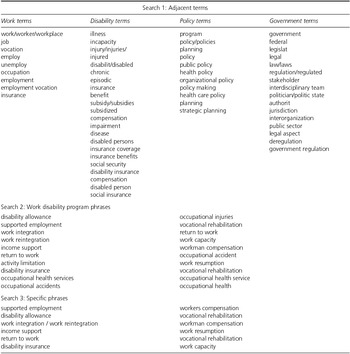
Due to the complexity of the terminology and the breadth of research in the work disability field, three different search strategies were used to ensure a comprehensive literature search. Table 1 shows each search and how the searches were combined using Boolean Logic. In Search 1, we sought ‘work’ terms that were adjacent to ‘disability’, ‘policy’, and ‘government’ terms. In Search 2, the adjacent requirement was replaced with ‘and’. Search 3 involved specific phrases and ‘government’ terms.
Search Terms

Study Selection
Titles and abstracts of all articles were screened to ensure that included articles were from peer-reviewed journals, published in the year 2000 or later in English language, and were more than two pages long (to screen out very brief news, commentaries or editorials). The articles could be based on any study design (qualitative, quantitative, mixed) and could include reviews and narrative commentaries, such as editorials or legal case studies. A key requirement was that the article address government-led programs, policy or legislation on work integration and/or income support after injury, illness or impairment. Therefore, articles focused on policies created by workplaces for internal management were excluded. Overall, our key guiding questions were: Does this article address research, intervention, evaluation, policies, laws or key contextual conditions for work integration of people with disabilities or health conditions? Does the article include a discussion or explanation of government laws, programs and policies to address work disability?
Title and Abstract Screening
The first and second authors tested and refined screening questions on a subset of articles that included a mix of studies ranging from high to low relevance. Throughout the study, articles were screened for relevance by the first three authors. Interrater reliability testing was conducted across several sets of 20 articles until agreement between reviewers was 95% consistent. After this point, reviewers screened independently, although group discussion continued about inclusion or exclusion of certain articles considered by a reviewers to be ‘unsure’ for inclusion.
Charting the Data
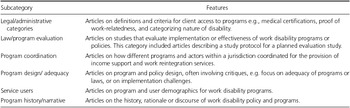
Articles in the final sample were sorted by themes and sub-categories. The themes were developed inductively by the first author following a process similar to that used in grounded theory. The first three authors then reviewed an additional 300 articles to test suitability of the themes and to make modifications. Six main themes were created, as described in Table 2.
Themes

Data Extraction
For each theme, key study characteristics were extracted by reviewing the title and abstract and, where those were unclear, with full paper review (approximately 1 of every 6 articles). These characteristics were: program type, disability type, jurisdiction, method and year published.
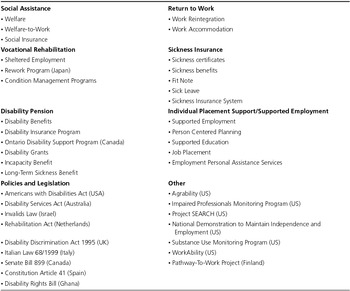
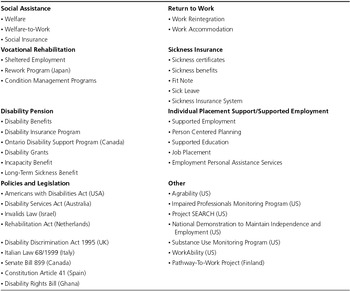
Programs discussed in the articles were organised into eight categories. Table 3 describes what programs, policies and laws were identified in the articles and included in each category.
Programs, Policies and Laws
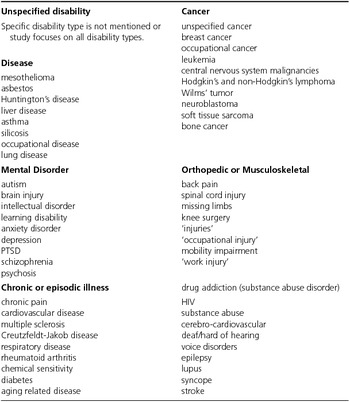
Disability conditions that were the foci of articles were organised into six categories. Table 4 describes what conditions were identified in the articles and included in each category.
Disability Types

Methods were sorted into qualitative, quantitative, mixed methods, narrative, and reviews.
Results
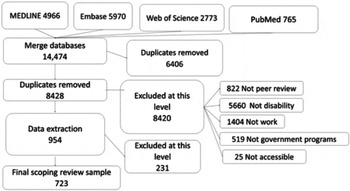
The search of four databases was completed on November 17, 2014 and produced 14,474 articles. Once duplicates were removed, 8428 articles remained. Application of inclusion and exclusion criteria to titles and abstracts yielded 954 articles. During the scrutiny of the data extraction process, a further 231 articles were excluded, yielding a final sample of 723 articles (see Figure 1). The included articles are published on the Centre for Research on Work Disability Policy (2016) database.
Flow diagram of article search.

The number of articles published that address work disability policies and programs increased steadily between 2000 and 2014, jumping from high points of 33 articles published in 2002, to 53 published in 2007 and to 92 in 2012. The specific legal or programmatic focus of most articles was policy and legislation (177), return-to-work and workers’ compensation programs (170), and vocational rehabilitation programs (149). Fewer articles focused on social assistance programs for people with disability (53).
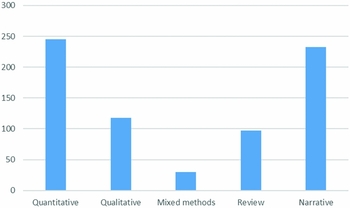
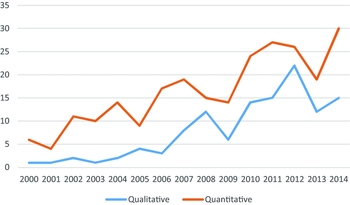
Just over twice as many articles reported on studies using quantitative than qualitative methods. Many articles did not involve original research and instead consisted of narrative commentaries. Few articles reported on mixed method studies (see Figure 2). Interestingly, the growth in articles published year by year showed similar rates of increase in both quantitative and qualitative research articles (see Figure 3).
Articles by method.

Qualitative and quantitative articles by year.

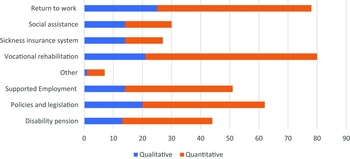
Across program types, we find the same pattern of almost twice as many articles based on quantitative as qualitative research methods, except when considering the social assistance and sickness insurance systems where we see relatively even numbers for the two methods (see Figure 4).
Qualitative and quantitative articles by program type.

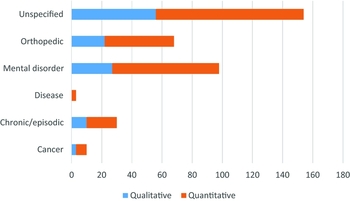
Most articles in this review addressed general disability, rather than a specific impairment or illness. Among those articles that did have a specific disability focus, mental disorder was most common, followed by orthopedic or musculoskeletal disability or injury, and chronic or episodic illness. Relatively few articles focused on disease or cancer When looking at what methods are used in relation to disability types addressed in articles, we see proportionally more qualitative methods studies for the studies that did not adopt a specific disability focus (see Figure 5).
Qualitative and quantitative articles by disability type.

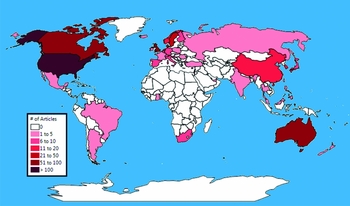
Jurisdictions investigated the most in articles on work disability policy were the USA (326), United Kingdom (61), Canada (55) and Australia (54). Next were Sweden and the Netherlands, which were the focus of a similar number of articles (32 and 30) and then China and South Korea (13 and 12 articles). Denmark, Germany, Norway, Italy, Spain and South Africa were between 5 and 9 articles each. Jurisdictions that were the focus of fewer than 5 articles between 2000 and 2014 were mainly in Asia, South America, and Africa (see Figure 6).
Articles by jurisdiction.

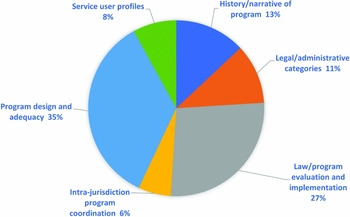
When sorting articles by theme (see Figure 7), we found that most articles focused on program design and adequacy, and on formal evaluations or implementation trials of policies or programs. Articles on the history or rationale of work disability policy and programs ranked third and articles on legal and administrative definitions and criterion for access to programs had a similar number. Fewer articles were found that focused on program and user demographics and on coordination of different programs within a jurisdiction.
Articles by theme.

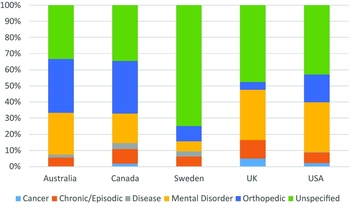
The proportion of mental health-focused articles grew steadily between 2000 and 2014. Mental health and orthopedic injury/disability articles were relatively tied as leading disability types of interest until 2010, after which the relative number of mental health articles increased. When looking at the disability foci of the top five countries studied in articles on work disability policy (see Figure 8), only three jurisdictions produced articles addressing disease and Australia produced no articles addressing cancer. Articles on mental disorders were proportionally less prevalent in Sweden than in the other four jurisdictions.
Disability focus for top 5 countries.

Discussion
Our finding of a growing body of peer-reviewed literature that address work disability programs and policies related to mental health is in line with the growth of problems in this area, as work disability pension claims continue to climb. According to a 2009 OECD report, disability claims doubled for people with common metal disorders between 1999 and 2009 (OECD, 2009). Based on 2010 data, in Ontario, Canada's largest province, mental disorder formed the largest disability support claim category, surpassing all claims for work disability resulting from physical disorders (Dewa, Trojanowski, Loong, & Hoch, Reference Dewa, Trojanowski, Loong and Hoch2013).
A key finding of this scoping review is that there is a steadily growing peer review literature base that addresses work disability policy, or government laws, policies and programs designed to foster labour market integration of people who, due to illness or disability, face challenges entering or staying in the workforce. This growth of research interest in the field is reflected in a new Cochrane Library section on ‘insurance medicine’ established in 2015. However, articles published are mostly limited to North American, northern European and Australian jurisdictions. We know little about how work disability programs and policies work in South America, Africa, and parts of Asia. For comparative purposes, it would be useful for stakeholders and policy makers to be able to access English language articles focused on these jurisdictions.
This review finds that just over twice as many quantitative as qualitative research articles are being published on work disability policy. This relative difference is less than what was reported in 2011 for clinical journals, where qualitative articles formed only 6% of articles in health services and policy research journals (Gagliard & Dobrow, Reference Gagliard and Dobrow2011). It may reflect the popularity of qualitative research methods in rehabilitation-focused fields such as nursing and occupational therapy as well as in socio–legal research. Articles in this scoping review based on mixed-method studies were few. The very low proportion of mixed method studies is similar to that reported for the field of health services research (Wisdom, Cavaleri, Onwuegbuzie, & Green, Reference Wisdom, Cavaleri, Onwuegbuzie and Green2012). This may be because of difficulties with adequately reporting on qualitative and quantitative methods and findings within usual journal word limits. Mixed method studies can add valuable knowledge to topics with their ability to consider both large scale datasets and also in-depth data that goes ‘behind the numbers’ (Morgan, Reference Morgan2015).
Within our sample, we find that some jurisdictions have gaps in their specific disability focus. For instance, there is an absence of cancer-focused articles in Sweden, a gap for work disability policy in relation to disease in the United States, and there were relative few articles focused on orthopedic/musculoskeletal disability in Sweden and the United Kingdom. Much of the work disability policy literature focused on illness and disability in general. This general approach is useful for very broad policy and programs. However, we would encourage researchers to consider addressing work disability policy in relation to specific conditions. For instance, chronic and episodic illnesses can be very difficult to accommodate in workplaces (Oldfield, MacEachen, Kirsh, & McNeil, Reference Oldfield, MacEachen, Kirsh and McNeil2016) and state policy that considers accommodation for long-term and fluctuating conditions may improve work reintegration rates. Certainly, with ageing populations (Gu, Gomez-Redondo, & Dupre, Reference Gu, Gomez-Redondo and Dupre2015), policies and programs will need to better address non-acute health conditions.
The foci of work disability laws, policies and programs in this review are a reflection of our search criteria. For instance, that social assistance programs were found less frequently than return-to-work programs reflects our focus on work re-integration. The organisation of articles by types of policies and programs was useful for our knowledge translation activities including setting up our publicly available and searchable database (MacEachen et al., Reference MacEachen, Du, Bartel, Tompa, Stapleton, Kosny and Ekberg2015), which is now established on the website for the Centre for Research on Work Disability Policy (http://www.crwdp.ca/en/work-disability-policy-scoping-review-database).
Our next steps for this scoping review are full paper review, analysis and synthesis of segments of this scoping review. Our in-depth foci include (a) an analysis of evaluation study designs and how return-to-work is measured; (b) an examination of what kinds of work disability program design and adequacy issues have been investigated in jurisdictions with cause-based (e.g., workers’ compensation) versus noncause-based (e.g., comprehensive system such as Denmark) work disability systems; (c) identification of issues at the juncture of work disability policy, vocational rehabilitation and physical disability; and (d) a legal critique of how policy conditions have been considered in work disability research designs and conclusions.
Strengths and Limitations
This scoping review has some limitations. Our article search was limited to four databases and therefore to the journals captured by them. Another limitation is that full article review was conducted only for articles with unclear abstracts, rather than for every article. Therefore, it is possible that some articles were miscategorised. The review is restricted to English-language articles only and so we did not capture key articles published in other languages. Finally, this review includes only articles that address work disability policy. Therefore, there may be articles published about a specific topic, such as cancer and return-to-work, but these would not be included in this review unless the article also addressed the government programmatic, policy or legal context. Strengths of this study are the experience and skill of the research team together with the integrated knowledge dissemination strategy, in which an expert work disability legal stakeholder was part of the research team decision-making from early planning stages to the end of the study. The team also included researchers who are leaders and members in four national and international work disability research networks, which allows for widespread dissemination of research findings across a variety of communication forums (websites, newsletters, conferences).
Conclusions
This scoping review of peer-reviewed research articles identified the latest international research evidence on articles that address government laws, policies and programs designed to foster labour market integration of people who, due to illness or disability, face challenges entering or staying in the workforce. We find a growing number of published articles in this area and identify specific knowledge gaps for work disability policy literature in relation to mixed method study designs, chronic and episodic conditions, illness and cancer, and work disability policy outside of North America, Northern Europe and Australia. This scoping review led to the establishment of a publicly accessible database and forms the basis for full article syntheses on specific work disability policy subtopics.