


Introduction
Humans and their activities have left few ecosystems unaltered (Ellis & Ramankutty Reference Ellis and Ramankutty2008), and many systems have been converted to agricultural land uses, which now cover nearly 40% of the land area of the planet (Ellis & Ramankutty Reference Ellis and Ramankutty2008). While urban areas cover a relatively small area, they support most of the world’s human population and have disproportionately negative impacts on the surrounding environment (Grimm et al. Reference Grimm, Feath, Golubiewski, Redman, Wu, Bai and Briggs2008).
When native vegetation is converted to urban and agricultural land, local animal communities are reshaped (Vitousek et al. Reference Vitousek, Mooney, Lubchenco and Melillo1997). These land transformations have become a major threat to wildlife (Wilcove et al. Reference Wilcove, Rothstein, Dubow, Phillips and Losos1998). Nonetheless, the influence of land alterations on wildlife varies dramatically across land cover types, taxonomic groups and environmental gradients (e.g., Hansen et al. Reference Hansen, Neilson, Dale, Flather, Iverson, Currie, Shafer, Cook and Bartlein2001, Jetz et al. Reference Jetz, Wilcove and Dobson2007, Reichert et al. Reference Reichert, Sovie, Udell, Hart, Borkhataria, Bonneau, Reed and McCleery2017). Accordingly, there is a need to better understand which human-altered land covers are driving changes in wildlife communities across broad scales. Collecting data on wildlife communities and land cover across large spatial extents can be time-consuming and onerous, but integrating passive wildlife monitors with remotely sensed environment data has the potential to overcome these challenges (Turner Reference Turner2014).
Bats (order: Chiroptera) move across large landscape scales (Duchamp et al. Reference Duchamp, Arnett, Larson, Swihart, Lacki, Hayes and Kurta2007) and are sensitive to landscape alterations, and thus can function as indicators of disturbance (Jones et al. Reference Jones, Jacobs, Kunz, Willig and Racey2009). Additionally, recent advances in acoustic monitoring technology and data processing have facilitated the assessment of bat communities with passive sensors that can be placed throughout the landscape (Mac Aodha et al. Reference Mac Aodha, Gibb, Barlow, Browning, Firman, Freeman, Harder, Kinsey, Mead, Newson, Pandourski, Parsons, Russ, Szodoray-Paradi, Szodoray-Paradi, Tilova, Girolami, Brostow and Jones2018). This makes bats an excellent model species group to study the effects of human-dominated landscapes on wildlife communities. Previous research suggests that many species of bats are negatively impacted by human influences on the landscape (Gaisler et al. Reference Gaisler, Zukal, Rehak and Homolka1998, Legakis et al. Reference Legakis, Papadimitriou, Gaethlich and Lazaris2000, Jung & Threlfall Reference Jung, Threlfall, Voigt and Kingston2016). Urbanization is often more detrimental for wildlife than agricultural expansion (Jung & Threlfall Reference Jung, Threlfall, Voigt and Kingston2016); however, the influence of urbanization on bats appears to be highly species specific. While some species decline, others tolerate and even benefit from urbanization (Russo & Ancillotto Reference Russo and Ancillotto2015, Li & Kalcounis-Rueppell Reference Li and Kalcounis-Rueppell2018).
Bats also exhibit species-specific responses to variation in canopy cover, a phenomenon commonly linked to variation in bat wing morphology, echolocation call structure and roost preferences (Norberg & Rayner Reference Norberg and Rayner1987, Mancina et al. Reference Mancina, García-Rivera and Miller2012). At a community level, the structural complexity provided by canopy cover in urban areas appears to increase bat species richness (Lumsden et al. Reference Lumsden, Bennett, Krasna, Silins, Bennett, Backhouse and Clark1995, Reference Lumsden, Bennett and Silins2002, Lumsden & Bennett Reference Lumsden and Bennett2005, Dixon Reference Dixon2012) and maintain bat community diversity in agricultural systems (Williams-Guillen et al. Reference Williams-Guillen, Olimpi, Maas, Taylor, Arlettaz, Voigt and Kingston2016). Thus, bat communities may be more sensitive to changes in canopy cover than to differences among land-cover types.
Previous research on the responses of bats to land-cover change has had limitations. Some studies examined overall bat activity, without accounting for the species-level responses that shape communities (Gehrt & Chelsvig Reference Gehrt and Chelsvig2003). Additionally, many studies investigated responses to increases in a single land-cover type, such as urban development (Dixon Reference Dixon2012, Krauel & LeBuhn Reference Krauel and LeBuhn2016) or agriculture (Wickramasinghe et al. Reference Wickramasinghe, Harris, Jones and Vaughan2003, Williams-Guillen et al. Reference Williams-Guillen, Olimpi, Maas, Taylor, Arlettaz, Voigt and Kingston2016). These shortcomings can be addressed by examining bats across a suite of land covers and accounting for species-level responses and imperfect detection to inform community metrics. Bayesian hierarchical community occupancy modelling has been used to accomplish this for other animal groups (e.g., birds, butterflies and terrestrial mammals; e.g., Kery & Royle Reference Kery and Royle2016), but until now, we are unaware of this approach being applied to bats.
The goal of this study was to understand the influence of anthropogenic land covers and canopy cover on the species and communities of bats across a broad geographic area. We addressed this goal by coupling easily accessible, remotely sensed environmental data with passively detected bat species detection/non-detection data. We predicted that species-specific occurrence and species richness would be lower in urban and agricultural areas when compared to areas of native vegetation (i.e., wetlands and uplands). We also predicted that a broad-scale measure of canopy cover would be positively correlated with species occurrence, but it would not be as strong a predictor as land-cover type.
Methods
Study Area
We conducted research in 16 counties in southern Florida (Fig. S1, available online). This region is home to 8 million people and several of the nation’s critically endangered ecosystems. In the next 50 years, southern Florida is expected to lose most of its agriculture and natural areas to human development as a result of the growing population (Zwick & Carr Reference Zwick and Carr2006). In our study area, we currently estimate over 930 000 ha of upland land covers, over 13 000 000 ha of wetlands, over 3 800 000 ha of agricultural land and over 3 700 000 ha of developed land (Fig. S1).
Site Selection
Bats travel long distances while foraging (Lumsden et al. Reference Lumsden, Bennett and Silins2002), making broad-scale investigations essential to understanding their distributional patterns across human-dominated landscapes (Gehrt & Chelsvig Reference Gehrt and Chelsvig2003). To adequately cover our large study area, we used a geographic information system (ArcMap 10.1; ESRI, Redlands, CA, USA) to establish a grid system comprising 5–km × 5–km cells (25 km2) across southern Florida, using the sample framework provided by the North American Bat Monitoring Program (NABat; Loeb et al. Reference Loeb, Rodhouse, Ellison, Lausen, Richard and Irvine2015). To ensure access, we excluded grid cells that were located >2 km from any roads. To capture the dominant cover types in this rapidly changing region and to understand the responses of bats to anthropogenic land uses, we classified the land cover of each grid cell into four major categories – agriculture, developed, upland and wetland – by simplifying the Florida Natural Areas Inventory classifications (see Bailey et al. Reference Bailey, Ober, Sovie and McCleery2017). We then randomly selected 17 grid cells of each of the four land cover types (Fig. S1). Finally, we placed five random sampling points in each selected grid cell, buffering each point by >400 m.
Bat Surveys
Ten species of bats are resident in southern Florida. These species vary in their wing morphology, echolocation characteristics and roost selection (Table 1). Two of these bats were in the family Molossidae (hereafter ‘molossids’) and eight were in the family Vespertilionidae (‘vespertilionids’). The two molossids were the Florida bonneted bat (Eumops floridanus; EUFL), a federally endangered south Florida endemic (US Fish and Wildlife Service 2013), and the Brazilian free-tailed bat (Tadarida brasiliensis; TABR), a Florida species of greatest conservation need (Florida Fish and Wildlife Conservation Commission 2012). All vespertilionids found in southern Florida except for the evening bat (Nycticeius humeralis; NYHU) were Florida species of greatest conservation need (Florida Fish and Wildlife Conservation Commission 2012). These species include the Northern yellow bat (Lasiurus intermedius; LAIN), Seminole bat (Lasiurus seminolus; LASE), red bat (Lasiurus borealis; LABO), big brown bat (Eptesicus fuscus; EPFU), Rafinesque’s big-eared bat (Corynorhinus rafinesquii; CORA), southeastern myotis (Myotis austroriparius; MYAU) and tricoloured bat (Perimyotis subflavus; PESU). MYAU, LABO, CORA and EPFU are considered rare in southern Florida.
Wing morphology, echolocation call characteristics and roost structures preferred by each bat species in southern Florida, USA.

AR = aspect ratio (wingspan2/wing area); WL = wing loading (mass/wingspan); CORA = Rafinesque’s big-eared bat; PESU = tricoloured bat; MYAU = southeastern myotis; NYHU = evening bat; EPFU = big brown bat; LAIN = northern yellow bat; LABO = red bat; LASE = Seminole bat; TABR = Brazilian free-tailed bat; EUFL = Florida bonneted bat.
We used digital ultrasonic recorders and microphones (SM2BAT+ with SMX-US microphone; Wildlife Acoustics, MA, USA) for acoustic bat surveys and set them to record continuously from 15 minutes before sunset to 15 minutes after sunrise. We elevated each microphone to 3.4 m above ground and positioned them horizontally with a downward tilt (Agranat Reference Agranat2014).
To effectively model variable rates of detection, we conducted repeated surveys at 66 grid cells during 20 January–13 June 2014 and 13 January–12 May 2015 (one upland and one agricultural cell were excluded due to logistical constraints). We visited each cell three times a year, separating visits by >3 weeks. During each visit, detectors recorded bat activity for two to three consecutive nights. We placed each detector in a location <100 m from each randomly generated point in order to maximize detection (e.g., vegetation did not obstruct recordings; Loeb et al. Reference Loeb, Rodhouse, Ellison, Lausen, Richard and Irvine2015). Most points in the developed and agricultural cells were located on private land. If access permission was denied, we moved to the next closest property.
During 2014, we set a detector at five points per cell during the first visit. We sampled only four points in each cell during the second and third visits (equipment failure). We randomly rotated the unsampled points in order to ensure each point was surveyed for four or more nights per year. In 2015, we sampled all five points in each cell during all visits.
Bat Species Identification
We analysed all files in Kaleidoscope Pro 3.1.0 using the Bats of Florida 3.1.0 classifiers (Wildlife Acoustics; Maynard, MA, USA). We used a classification filter that identified bat call sequences as a series of five or more calls with a <5–second gap between them (Britzke et al. Reference Britzke, Murray, Heywood, Robbins, Kurta and Kennedy2002). High-quality calls were identified by Kaleidoscope Pro as one of nine species or species couplets: CORA, EPFU, EUFL, LAIN, LASE/LABO, MYAU, NYHU, PESU or TABR. We grouped LASE and LABO into one species class because of the relative rarity of LABO in our study region and our inability to distinguish between their calls. If the maximum likelihood p-values calculated by Kaleidoscope Pro were ≤0.05, we considered a species to be present (US Fish and Wildlife Service 2018).
We treated EUFL differently – because it has an extremely distinctive call, sequences consisting of two or more calls were used to identify this species. We manually looked at all calls identified by Kaleidoscope Pro as either ‘No ID’ (likely bat call but not identified) or EUFL (Bailey et al. Reference Bailey, Ober, Sovie and McCleery2017). We classified calls with a minimum frequency of 10–18 kHz and a maximum frequency of 16–22 kHz as EUFL (Bailey et al. Reference Bailey, Ober, Sovie and McCleery2017).
Detection Covariates
Many bat species increase activity with increasing temperature (Rodhouse et al. Reference Rodhouse, Ormsbee, Irvine, Vierling, Szewczak and Vierling2015). To account for potential changes in detection, we recorded the minimum temperature for each survey night (surveytemp). To account for potential changes in detectability of species from seasonal variability, we converted the date of each survey to a Julian date (date).
Occupancy Covariates
Our agricultural land strata included improved pasture, rangeland with native vegetation and intensively managed crops. To account for these differences, we reclassified grid cells dominated by ‘agriculture’ into two new categories. We classified land covers of ‘improved pasture’ or ‘unimproved/woodland pasture’ as rangeland and retained all other crops, orchards and nurseries as agriculture (Bailey et al. Reference Bailey, Ober, Sovie and McCleery2017). We then characterized each grid cell surveyed for bats using the ‘Tabulate Area’ feature in the Spatial Analyst toolbox in ArcMap in order to determine the percentage of each grid cell (25 km2) that was covered by upland (upland), wetland (wetland), crop-dominated agriculture (ag), rangeland (range) and developed (developed) cover types (Bailey et al. Reference Bailey, Ober, Sovie and McCleery2017). We also used the percentage of each land cover type to reclassify grid cells based on whether they contained more or less than the mean of each cover type (i.e., we converted land-cover percentage to categorical (binary) covariates for each land-cover type: upland.bin, wetland.bin, ag.bin, range.bin and developed.bin). We used these land-cover types to predict bat species occurrence. We also estimated average percentage canopy cover (cc) for each grid cell using the 30–m raster file from the 2011 National Land Cover Database (Homer et al. Reference Homer, Dewitz, Yang, Jin, Danielson, Xian, Coulston, Herold, Wickham and Megown2015).
Data Analysis
We used a hierarchical community occupancy modelling approach (Kery & Royle Reference Kery and Royle2016), which provides improved estimates of individual species occurrence probabilities by leveraging data from all recorded species and accounting for imperfect detection among species, locations and time (Zipkin et al. Reference Zipkin, Dewan and Royle2009, Kery & Royle Reference Kery and Royle2016). Used to uncover landscape-level drivers of community change in birds (e.g., White et al. Reference White, Cassey, Schimpf, Halsey, Green and Portugal2013) and terrestrial mammals (e.g., Reichert et al. Reference Reichert, Sovie, Udell, Hart, Borkhataria, Bonneau, Reed and McCleery2017), to our knowledge, this is the first time a hierarchical community occupancy modelling approach has been used to assess bats. The approach we employed assumes that species present within the sampling unit (grid) are available to be detected. If species availability varies with land-cover type or canopy cover, estimates of species occurrence could be biased low. Potential availability bias is likely a limitation of acoustic monitoring methods rather than community occupancy models.
To estimate species responses, we reduced the total number of recorded call files into species-specific detection/non-detection data, assigning a ‘1’ for every night a species was recorded by a detector and a ‘0’ when a species was not detected. Then, we modelled species-specific effects of covariates on detection and site occupancy probabilities as random effects, where species-level model coefficients were drawn from common ‘community-level’ normal prior distributions with estimated ‘hyper-parameters’ and vague, normally distributed hyper-priors (Kery & Royle Reference Kery and Royle2016). We developed a model to test for the potential effects of land cover on the probability of species k occurring at site (point location) i during survey j (ψ ijk ) for all observed species. We first tested to see whether explanatory variables were highly correlated (r2 > 0.60; Rodhouse et al. Reference Rodhouse, Ormsbee, Irvine, Vierling, Szewczak and Vierling2015). As no explanatory variables were highly correlated, we tested for categorical effects of land cover with binary variables upland.bin, wetland.bin, ag.bin, range.bin and developed.bin. We ran a model with the continuous land-cover variables upland, wetland, ag, range and developed, and we reached the same conclusions. We included linear and non-linear effects of cc by including a quadratic term (cc 2). Since many bat species fly relatively long distances each night (see Best et al. Reference Best, Kiser and Rainey1997, Best & Geluso Reference Best and Geluso2003, Elmore et al. Reference Elmore, Miller and Vilella2005), we included grid cell (25 km 2) as a covariate to account for potential spatial correlation between points located within the same cell. To ensure reasonable values for site occupancy (0–1), we modelled the relationships between explanatory covariates and site occupancy on the logit scale using the following occupancy model:
 $$logit\left( {{\psi _{ijk}}} \right) = {\mu _k} + \beta {1_{ik}}*grid + \beta {2_k}*upland.bin + \beta {3_k}*wetland.bin + \beta {4_k}*ag.bin + \beta {5_k}*range.bin + \beta {6_k}*developed.bin + \beta {7_k}*cc + \beta {8_k}*c{c^2}$$
(1)
where µ is the occurrence probability for species k at point location i and β values are the estimated model coefficients.
For this occupancy model, we assumed species detections (positive identifications from acoustic recordings) y ijk were drawn from Bernoulli distributions conditional on the latent occupancy state z,y ijk|z ik ~ Bern(z ik*p ijk), where p ijk is the probability of detecting species k given it was present during survey j at point location i. Using a logit link function, we modelled the effects of surveytemp and date on the probability of detecting each using the following detection model:
 $$logit\left( {{p_{ijk}}} \right) = {p_{ik}} + \alpha {1_k}*surveytemp + \alpha {2_k}*date$$
(2)
where p is the detection probability for species k at point location i, and site j and α are model coefficients corresponding to each variable.
We used JAGS v.3.4.0 (Plummer Reference Plummer2003) launched from RStudio v.0.98 with the R2jags library (Su & Yajima Reference Su and Yajima2015) to implement Bayesian estimation of model parameters via Markov chain Monte Carlo (MCMC) samples of posterior distributions. Posterior summaries were based on 15 000 MCMC samples of the posterior distributions from three chains run simultaneously with a thinning rate of 10, following an initial burn-in of 5000 iterations. We assessed convergence of MCMC chains with trace plots and the Gelman–Rubin diagnostic
 ${(\rm{ \widehat R})}$
; convergence was reached for all parameters according to the criteria
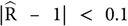 ${\rm{|\widehat R -1| \lt 0.1}}$
(Ntzoufras Reference Ntzoufras2009). We made inferences on species-level habitat relationships based on the coefficients of the saturated model. Mean values of model coefficients indicated the direction (positive or negative) of relationships between associated model covariates and species-specific detection probabilities. We considered covariates significant when 95% credible intervals (CRIs) of the β did not include zero. All variables were scaled to 0, allowing us to interpret β and CRIs as effect sizes.
We derived site-level species richness using the species-specific site occupancy results (Kery & Royle Reference Kery and Royle2016, Reichert et al. Reference Reichert, Sovie, Udell, Hart, Borkhataria, Bonneau, Reed and McCleery2017). We compared differences in mean (and 95% CRI) species richness among land-cover types and across a gradient of canopy cover, where non-overlapping 95% CRIs indicate significant differences in species richness.
Results
We recorded 1839 nights of acoustic data from 330 points (in 66 grid cells) in 2014 and 2015. These included 30 points in six cells dominated by crop-dominated agriculture, 25 points in five cells dominated by rangeland, 85 points from 17 grid cells dominated by development, 80 points from 16 cells dominated by uplands and 110 points from 22 cells dominated by wetlands. All land-cover types had overlapping ranges of canopy cover (Fig. S2).
We detected nine different species of bats. CORA was detected at only one point and excluded from further analysis. MYAU was detected at 23 points, EUFL at 61 points, NYHU at 82 points, PESU at 144 points, LASE/LABO at 171 points, LAIN at 209 points, EPFU at 247 points and TABR at 272 points. Both surveytemp and date accounted for differences in the detection of multiple species (Fig. S3). Minimum nightly temperatures had a positive influence on the detection of all species, with a significant effect on four (EPFU: β = 0.17, 0.05–0.29; LAIN: β = 0.43, 0.26–0.59; NYHU: β = 0.44, 0.23–0.68; and TABR: β = 0.22, 0.11–0.33). For all species except MYAU, Julian date was also positively associated with species detection probabilities, with a significant effect on three species (EUFL: β = 0.45, 0.08–0.82; LAIN: β = 0.23, 0.06–0.41; and LASE/LABO: β = 1.37, 1.01–1.63).
All species were detected in each land-cover type, except MYAU, which was not detected in crop-dominated agriculture. Land-cover type was not significantly correlated with occurrence for any of the species observed in this study (Fig. S4). The occurrences of all species were negatively associated with developed and wetlands, but the relationships were not significant (Fig. S4). Additionally, species richness did not change as a function of land cover (Fig. 1).
Box-and-whisker plots comparing estimated bat species richness (minimum, first quartile, mean, third quartile and maximum values) as a function of land cover type.

The percentage canopy cover in each grid cell was significantly associated with occurrence of all species except EUFL (Figs. 2, S5). Occurrence increased linearly with canopy cover for EPFU (β = 0.53, 0.08–1.02), LAIN (β = 0.52, 0.07–1.02), LASE/LABO (β = 0.74, 0.34–1.15), MYAU (β = 0.76, 0.13–1.51), NYHU (β = 0.62, 0.16–1.11) and PESU (β = 0.55, 0.12–0.95). In contrast, canopy cover was negatively associated with occurrence of TABR (β = –1.16, –1.86 to –0.54). We also found significant support for a non-linear effect of canopy cover for some species (Fig. 2). The quadratic term was negative for all species except for TABR (Fig. S5) and was significant for EPFU (β = –0.34, –0.63 to –0.10), LAIN (β = –0.30, –0.58 to –0.05), LASE/LABO (β = –0.31, –0.54 to –0.09) and MYAU (β = –0.41, –0.90 to –0.04). Furthermore, we found a positive and significant relationship between species richness and canopy cover, with the greatest species richness found when canopy cover was >40% (Fig. 3).
Canopy cover’s influence on occupancy of bats. Lines represent responses of species. TABR = Brazilian free-tailed bat; PESU = tricoloured bat; NYHU = evening bat; MYAU = southeastern myotis; LASE/LABO = Seminole/red bat; LAIN = northern yellow bat; EUFL = Florida bonneted bat; EPFU = big brown bat.

Estimated bat species richness and 95% credible intervals as a function of mean canopy cover.

Discussion
Compared to general land-cover types, we found that canopy cover had a greater influence on bat communities (Figs. 2, 3). Broad-scale canopy cover may be an important driver of the bat communities in southern Florida, with the occurrence of all eight vespertilionid species increasing with canopy cover (Figs. 2, S5). Tree cover is critical for North America’s insectivorous bats, with over half of the species using forested areas for roosting and foraging (Brigham Reference Brigham, Lacki, Hayes and Kurta2007). All bat species recorded in this study roost in trees, at least occasionally (Barclay & Kurta Reference Barclay, Kurta, Lacki, Hayes and Kurta2007, Carter & Menzel Reference Carter, Menzel, Lacki, Hayes and Kurta2007). The species that were sensitive to forest cover tended to be tree cavity or foliage roosters (Table 1).
Increased tree cover likely provides additional benefits to bats beyond roosting habitat. Insectivorous bats may benefit from insect productivity linked with increasing canopy cover (Avila-Flores & Fenton Reference Avila-Flores and Fenton2005, Lumsden & Bennett Reference Lumsden and Bennett2005). Canopy cover can also help bats avoid aerial predators by reducing light (Zimmerman & Glanz Reference Zimmerman and Glanz2000). Finally, increased canopy cover can provide bats with protection from high winds and other extreme weather events (Lewis & Dibley Reference Lewis and Dibley1970).
Tree cover may be particularly important for smaller bats such as PESU, NYHU and MYAU. The low aspect ratio, low wing loading and high-frequency calls of these bats (Table 1) make them best adapted for slow, manoeuvrable flight in cluttered, dense canopies (Norberg & Rayner Reference Norberg and Rayner1987). Bats with moderate aspect ratios, wing loading and lower-frequency calls (EPFU, LAIN and LASE/LABO; Table 1) are better adapted for flight at the interface of forest and open vegetation than the smaller species (Norberg & Rayner Reference Norberg and Rayner1987). This could explain why the occurrence of these species was greatest at intermediate levels of canopy cover and was reduced as canopy cover increased further (Fig. 2). There is also evidence that extensive canopy cover in grassland and savanna systems, like those found in southern Florida, reduces herbaceous and understory vegetation, suppressing faunal diversity (Ratajczak et al. Reference Ratajczak, Nippert and Collins2012, Darracq et al. Reference Darracq, Boone and McCleery2016, McCleery et al. Reference McCleery, Monadjem, Baiser, Fletcher, Vickers and Kruger2018). The neutral and negative relationships between molossids and canopy cover may be explained by their low manoeuvrability and low-frequency calls (Table 1), which restrict their ability to capture insects in areas with dense canopies.
Contrary to our predictions, species-specific occurrence did not change across land covers (Fig. S4). Urbanization and agricultural intensification are commonly associated with decreased richness of bats (Gaisler et al. Reference Gaisler, Zukal, Rehak and Homolka1998, Legakis et al. Reference Legakis, Papadimitriou, Gaethlich and Lazaris2000, Jung & Threlfall Reference Jung, Threlfall, Voigt and Kingston2016, Mtsetfwa et al. Reference Mtsetfwa, McCleery and Monadjem2018). However, the responses of bats to land-cover alteration vary dramatically between species and regions (Jung & Threlfall Reference Jung, Threlfall, Voigt and Kingston2016, Li & Kalcounis-Rueppell Reference Li and Kalcounis-Rueppell2018). Studies have found both positive (Gehrt & Chelsvig Reference Gehrt and Chelsvig2003, Reference Gehrt and Chelsvig2004) and negative (Gaisler et al. Reference Gaisler, Zukal, Rehak and Homolka1998, Legakis et al. Reference Legakis, Papadimitriou, Gaethlich and Lazaris2000, Jung & Threlfall Reference Jung, Threlfall, Voigt and Kingston2016) community responses, as well as varied species-level responses (Coleman & Barclay Reference Coleman and Barclay2011, Krauel & LeBuhn Reference Krauel and LeBuhn2016). Most of these studies occurred in temperate, forested areas (see Jung & Threlfall Reference Jung, Threlfall, Voigt and Kingston2016), where land-cover change is associated with decreases in tree cover (Coleman & Barclay Reference Coleman and Barclay2011). We suggest that the loss of tree cover could be the mechanism for the decreased occurrence and richness of bats in human-modified landscapes. While Gehrt and Chesvig (Reference Gehrt and Chelsvig2003, Reference Gehrt and Chelsvig2004) found increased abundance and richness of bats in urban areas, they sampled areas with increased canopy cover within the urban environment.
We recognize that smaller-scale variations in land cover can play an important role in bat occurrence (Ober & Hayes Reference Ober and Hayes2008). Each of the land-cover classifications we used included an array of vegetation types and conditions (Fig. S2). Yet the goal of this study was to understand how variation in broad-scale land covers shaped wildlife communities. Collecting data over these large spatial extents can be challenging, but this information is essential, because these are the scales of land cover change and land-use planning (Hawkins & Selman Reference Hawkins and Selman2002).
Accordingly, we found that coupling easily accessible, remotely sensed environmental measures with passive recordings of wildlife communities was a practical approach that provided meaningful insights into biodiversity at these broad landscape scales (Turner Reference Turner2014). Specifically, remote-sensed measures of canopy cover provided a coarse measure of the landscape patterns of bat diversity and were better predictors than anthropogenic land covers that are known to shape bat diversity (Jung & Threlfall Reference Jung, Threlfall, Voigt and Kingston2016). However, before using canopy cover as a proxy for bat diversity, we recommend that similar research is conducted in other biomes, such as temperate and tropical forests, to see if this pattern holds. Furthermore, our ability to link remotely sensed measures of vegetation to bat diversity is likely to be improved in the near future, as measures of vegetation structure from Light Detection and Ranging (LiDAR) become readily available (Hancock et al. Reference Hancock, Armston, Hofton, Sun, Tang, Duncanson, Kellner and Dubayah2019). Remote-sensed LiDAR can produce detailed three-dimensional information on forest structure that is more closely aligned with how bats use the environment than canopy cover alone (Humphrey Reference Humphrey1975, Froidevaux et al. Reference Froidevaux, Zellweger, Bollmann, Jones and Obrist2016).
Our study highlights the importance of broad-scale tree cover for bat communities in mosaic landscapes. Maintaining vegetation cover and large trees in urban environments may increase the diversity of bats (Threlfall et al. Reference Threlfall, Ossola, Hahs, Williams, Wilson and Livesley2016, Reference Threlfall, Mata, Mackie, Hahs, Stork, Williams and Livesley2017). Our research enhances our understanding of the relationship between bats and canopy cover by demonstrating that occupancy of all vespertilionid species in our region increased as canopy cover increased from 0% to 50%. Because further anthropogenic alteration of landscapes is inevitable, we suggest that efforts to prevent the loss of bat diversity should consider maintaining canopy cover across mosaic landscapes with diverse land cover types.
Supplementary Material
For supplementary material accompanying this paper, visit http://www.journals.cambridge.org/ENC
Supplementary material can be found online at https://doi.org/10.1017/S0376892919000109
Author ORCIDs
Holly K Ober, 0000-0003-3780-6297; Robert A McCleery, 0000-0001-7018-005X
Acknowledgements
We thank the numerous biologists and individuals from Florida Fish and Wildlife Conservation Commission, US Fish and Wildlife Service, National Park Service, Florida Forest Service, Florida State Parks and the private landowners who provided access to their properties and assistance. Any use of trade, product or firm names is for descriptive purposes only and does not imply endorsement by the US Government.
Financial Support
Financial support was provided by the State of Florida Wildlife Grants Program, Bat Conservation International and the University of Florida’s Institute of Food and Agricultural Science, the USDA National Institute of Food and Agriculture, Hatch project FLA-WEC-005125.
Conflict of Interest
None.
Ethical Standards
This study and was approved by the University of Florida IACUC (#201308070). No animals were handled or otherwise manipulated.



