Introduction
Recent studies on the southern Hudson Bay polar bear sub-population (a population shared between Ontario, Québec and Nunavut) suggest that these animals and their habitat (for example, dens and staging areas located on the mainland) are being affected by climate changes, including declining sea ice (longer periods of open water), melting permafrost and increasing precipitation, such as springtime rains (Obbard Reference Obbard2007). Therefore, while the population, at around 900 to 1000 individuals, was deemed stable (Tonge and Pulfer Reference Tonge and Pulfer2011), the precautionary principle was used to justify (without prior consultation with residents from the Fort Severn Cree nation) the listing of polar bears in 2009 as threatened under the Endangered Species Act (ESA) of Ontario (Tonge and Pulfer Reference Tonge and Pulfer2011). From the perspective of the Fort Severn Cree nation, two issues arose from the listing of polar bears in Ontario: first, the virtual elimination of the Cree traditional harvest of polar bears which is assured through constitutional and treaty rights, and second, the need to establish additional protected habitats for polar bears in northern Ontario. Both are discussed below.
In 1905–1906, the federal and provincial government of Ontario negotiated Treaty 9, also known as the James Bay Treaty, with the Anishnabee (also known as Objiway) and Cree nations of Northern Ontario. Treaty 9 was subsequently ratified in 1929–1930 (Long Reference Long1995). Treaty 9 is one of 11 treaties signed between the aboriginal peoples of Canada (Indian or first nations, Inuit and Métis) and the government of Canada. These treaties are agreements outlining the responsibility of the Crown (the government of Canada) towards aboriginal peoples. A long-standing agreement with the coastal Cree nations of Treaty 9 in Ontario stipulates that up to 30 hides can be sealed for sale annually: 12 to Fort Severn, 12 to Weenusk (Peawanuck) and six shared between Attawapiskat, Fort Albany and Kashechewan (OMNR 2008). In recent years, the Cree voluntarily reduced their harvest of polar bears in Ontario, which has averaged around 8.8 annually (Tonge and Pulfer Reference Tonge and Pulfer2011). The low harvest of polar bears in Ontario is considered sustainable (Lunn and others 2006). Despite this, the polar bear recovery strategy (PBRS) suggests that ‘there is potential for the harvest to become unsustainable’ (Tonge and Pulfer Reference Tonge and Pulfer2011: 16). Leaders and citizens of the Fort Severn Cree nation have expressed their concerns with such statements and largely oppose such management approaches, which violate traditional, constitutional and treaty rights.
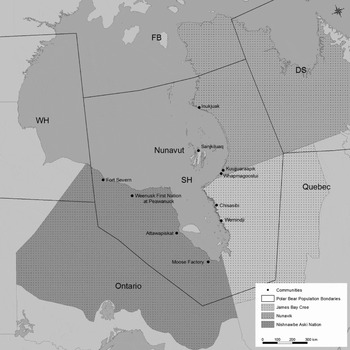
On 7 December 2011 the final recovery strategy for the management of the southern Hudson Bay polar bear (Ursus maritimus) sub-population (SHBPBSP) (Fig. 1) was released for public review. The Ontario Ministry of Natural Resources, responsible for overseeing the recovery strategy, is currently gathering input from users (such as the Fort Severn Cree nation and other Cree nations) and other jurisdictions (Nunavik, Nunavut and Quebec) regarding the management of this particular sub-population of polar bears. It should be noted that the SHBPBSP is not considered threatened or endangered in the province of Quebec or the territory of Nunavut. The information from these meetings will be considered while the government develops a response statement (GRS) outlining the actions the Government of Ontario intends to take to protect and aid the recovery of this species.
Southern Hudson Bay polar bear sub-population boundaries map.

For the Cree nation at Fort Severn, the government response statement and sections 9 and 10 of the ESA of Ontario are of particular concern primarily because section 9 of the ESA ‘prohibits the killing, harming, harassing, possession, buying, selling, trading, leasing or transportation of endangered or threatened species’ (Ontario 2007). Since it is illegal for non-aboriginals to purchase and own any polar bear products from Ontario, section 9 has eliminated the purchase of traditional polar bear crafts made in Ontario by the Cree. Section 10 of the ESA states that habitat areas prohibiting the damage or destruction of the species must be established (Ontario 2007). Excluding the coastal community of Fort Severn, the recommended polar bear habitat in the PBRS (such as inland dens and staging areas located along the coastline and some river estuaries) should include a boundary extending 5 kilometres inland and ranging from the Manitoba border in the west to Ekwan Point in James Bay in the east (Tongue and others Reference Tonge and Pulfer2011). In light of these recommendations and developments, the Fort Severn Cree nation has requested that a ministerial provision permitting the sale of polar bear hides and crafts to non-natives be provided immediately, and suggested that since harvesters do not frequent the denning areas, the recommended polar bear habitat should not be established until local and regional concerns from all affected parties (Cree communities located on the shores of the Hudson and James Bays) can be addressed. Ongoing concerns with the ESA, the PBRS and various other developments in the region (such as the Far North Act 2010) have compelled Fort Severn to create research partnerships and encouraged the first nation to assert itself in provincial and national discussions regarding the management of the SHBPBSP.
The research partnership is described next, followed by an overview of co-management strategies and Fort Severn's particular vision of a co-management strategy for the SHBPBSP based upon the indigenous stewardship model (ISM). The discussion and conclusion provide recommendations and future directions for Fort Severn's participation in polar bear management.
Research partnership
A research partnership between Fort Severn, the Keewaytinook Okimakanak Research Institute (KORI) and researchers affiliated with the Centre for Northern Studies at Lakehead University was first established in 2006 and formalised in the summer of 2008. The original goals were to examine polar bear movement patterns and behaviours in the traditional territory of the Fort Severn Cree nation and to begin community discussions on the management of the species. These goals have been reported in a journal article (see Lemelin and others Reference Lemelin and Bennett2010), two commentaries (Fidler and others Reference Fidler, Lemelin, Peerla and Walmark2008; Lemelin and others Reference Lemelin, Dowsley, Walmark, Siebel, Bird, Hunter, Myles, Mack, Gull and Kakekaspan2008) and one report (Kakekaspan and others Reference Kakekaspan, Miles, Lemelin, Dowsley, Beaulieu, Taylor, Siebel and Walmark2010). In addition, they have been expressed and presented at various provincial, national and international meetings. Since the 2009 ministerial round table on polar bears, Fort Severn has hosted or been invited to various meetings on the management of the SHBPBSP. The following chronological overview highlights some of the most important meetings.
In 2010, the university partners, through various discussions with the chief, council, community elders and other community members, decided to use scenario planning to assist the community as it considered its options in polar bear management. Recent developments indicated that the community was now striving to become an adaptive manager (for further information on the scenario strategies in Fort Severn see Dowsley and others in press). In the autumn of 2010, a management approach known as the indigenous stewardship model (ISM) was presented to the chief and band council by one of the research team members. Despite being a relatively new co-management model, the ISM was deemed particularly relevant since it provides a template to develop and implement co-management strategies from indigenous perspectives and fosters and encourages the participation of indigenous partners in the management of the SHBPBSP.
A second PBRS workshop hosted by the Chief and Council of Fort Severn was held in Fort Severn on 9–10 February 2011. Delegates from the Weenusk first nation at Peawanuck and the Attawapiskat first nation, researchers from Lakehead University, agency personnel from the OMNR, and employees from the Nature Conservancy of Canada (NCC) and the Wildlife Society attended. Other proponents of the listing process such as the polar bear biologists and WWF employees were absent. Fort Severn citizens attending this meeting expressed several concerns regarding the proposed PBRS. Using past experiences with management agencies, members of the community expressed concerns that the recovery strategy would virtually eliminate any future commercial opportunities because polar bear habitats will have to be designated along the coastline and inland along the rivers and that the listing will eliminate the harvest and the subsequent production of polar bear crafts. Since that meeting, Fort Severn and its representatives have attended a number of meetings pertaining to the management of the SHBPBSP, including a meeting held in Quebec City in the summer of 2011 and a user-to-user meeting held in Inukjuak in the autumn of 2011.
In Inukjuak the community was provided with the latest management strategies and had an opportunity to discuss polar bear management issues with harvesters from Quebec, Nunavut and Ontario, as well as agency representatives from provincial, territorial and federal governments. The outcome of this meeting was a voluntary harvest agreement for hunters in Ontario (five bears), Quebec (30 bears) and Nunavut (25 bears) for 2011–2012. Approximately three months later, Fort Severn was invited to join a working group to draft a protocol toward enhancing and improving the use and integration of aboriginal traditional knowledge (ATK) and Western science frameworks for polar bear research and management. More recently, Fort Severn representatives have attended two workshops on the PBRS; at each of these meetings the representatives for Fort Severn along with other indigenous harvesters have indicated their concerns with the scientific data used to justify the listing of polar bears and have stipulated that a co-management agreement initiated by the indigenous partners is essential.
Co-management strategies, indigenous people and the ISM
Participatory, collaborative, joint, cooperative, multi-party management and co-management can be understood as arrangements,
in which two or more social actors negotiate, define and guarantee amongst themselves a fair sharing of the management functions, entitlements and responsibilities for a given territory, area or set of natural resources. . . . The idea is that an agency with jurisdiction over an area (usually a state agency) might develop a partnership with other relevant stakeholders (primarily including local residents and resource users) which specifies and guarantees their respective functions, rights and responsibilities (Carlsson and Berkes Reference Carlsson and Berkes2005: 66).
A frequently used term that is found in the PBRS is ‘adaptive co-management’. This term refers to the ‘process by which institutional arrangements and ecological knowledge are tested and revised in a dynamic, ongoing, self-organised process of trial and error. Adaptive co-management by definition is an inclusive and collaborative process in which stakeholders share management power and responsibility’ (Carlsson and Berkes Reference Carlsson and Berkes2005: 73). Since it is the term most used by Fort Severn residents, ‘co-management’ will be used in this discussion.
Co-management strategies, suggest Castro and Nielsen (Reference Castro and Nielsen2001), can arise out of a need to address conflict, because they are mandated through land claims or as a result of community initiatives. Challenges with the crisis-based approaches are that allocations can diminish after the conflict has waned or conflicts have emerged elsewhere. That said, as Castro and Nielsen (Reference Castro and Nielsen2001: 231) observed, ‘a degree of conflict may be necessary before the state and other stakeholders are willing to enter into negotiations for a co-management agreement’.
In Fort Severn, tensions have been intensified by managers and polar bear biologists who are largely unaware of the intimate socio-cultural relationship of the Cree and polar bears. For example, unlike ‘the settlements in Nunavut, which are distributed along the coast, Indian settlements along the Ontario coast tend to be several kilometres inland, so that although people travelling on the coast see polar bears, there are few camps and no villages to attract hungry bears. The apparent result is fewer reports of human–bear conflicts’ (Stirling and Parkinson Reference Stirling and Parkinson2006: 271). Contrary to these observations, research by Honderich (Reference Honderich1991), Kakekaspan and others (Reference Kakekaspan, Miles, Lemelin, Dowsley, Beaulieu, Taylor, Siebel and Walmark2010) and Lemelin and others (Reference Lemelin and Bennett2010) illustrate that the Cree have a rich history of polar bear management.
Various comprehensive land claims throughout Canada (the James Bay and Northern Quebec Agreement, 1975) spell out examples of formal and mutually binding co-management agreements between the state and groups of resource users (Carlsson and Berkes Reference Carlsson and Berkes2005; McGregor Reference McGregor2009). Some examples involving indigenous peoples in the co-management of protected areas and wildlife are found in Australia (De Lacey and Lawson Reference De Lacey, Lawson and Stevens1997), New Zealand (Taiepa and others Reference Taiepa, Lyver, Horsley, Davis, Brag and Moller1997) and the United States (Burnham Reference Burnham2000). In Canada, Cree knowledge has been recognised in the co-management of caribou (Berkes Reference Berkes2008) and waterfowl (Peloquin and Berkes Reference Peloquin and Berkes2009). Examples of co-management agreements in Ontario have been, as the Royal Commission on Aboriginal Peoples and, more recently, the Ipperwash Inquiry in Ontario explain, much slower because there is no provincial co-management strategy for the management of either parks or wildlife. As Coyle's (Reference Coyle2005) analysis of past policies and options for the future in Ontario suggests:
Any study of Aboriginal land rights in Ontario must also come to grips with the fact that the Constitution of Canada protects ‘existing Aboriginal land treaty rights.’ Since 1990 the Supreme Court of Canada has confirmed that Aboriginal peoples have constitutionally protected harvesting rights on their traditional lands and that governments have a legal obligation to consult with Aboriginal groups when they propose to authorize activities that would interfere with those rights. Yet this review concludes that, in general, the ministries of the Ontario government have no policies, laws, or regulations to guide them on how to ascertain what treaty rights may exist in lands affected by their decisions, or how and when they should consult with Aboriginal peoples where government actions may interfere with treaty rights (Coyle Reference Coyle2005: 2).
Complicating these issues is the fact that first nations in Ontario are often perceived by provincial agencies as treaty Indians living on federal reserves. They are thus wards of the federal government and not the responsibility of provincial governments.
Despite assurance that aboriginal peoples could continue to sustain themselves on their traditional lands, specific details regarding traditional activities are largely absent from the published treaty documents (Long Reference Long2010). Thus, throughout the nineteenth and most of the twentieth centuries it was relatively easy for provincial and federal governments to pass game and fish laws that disregarded treaty rights. ‘During this time aboriginal people in Ontario were regularly prosecuted when they attempted to exercise what they understood to be their treaty rights. In this way the traditional economies of first nations were sterilized. Yet it is clear that promises of continued harvesting rights were vital to the conclusion of many of the treaties’ (Coyle Reference Coyle2005: 16).
The province of Ontario's reluctance to recognise and institute co-management strategies is further complicated by a resistance to traditional and local knowledge systems (Lemelin Reference Lemelin and Dunk2010; Lemelin and others Reference Lemelin and Bennett2010), and a general inability to address past and present management challenges (McCarthy and others Reference McCarthy, Graham, Whitelaw, Anderson, Cowan, McGarry, Robins, Gardner, Barbeau, Charania, General, Liedtke, Sutherland, Alencar, Leonard and Tsuji2012). The result from this colonial attitude, argues McGregor (Reference McGregor2009), continues to affect the participation of aboriginal people in governance issues in Ontario and elsewhere. These historical antecedents have resulted in a piecemeal approach to the development of collaborative management approaches to wildlife (the Anishinabek/Ontario Fisheries Resource Centre; see Lemelin and Bennett Reference Lemelin and Bennett2010) and protected areas (Lac La Croix co-existence agreement in Quetico Provincial Park, the proposed Pimachiowin world heritage site; see Spielmann and Unger Reference Spielmann and Unger2000) in the province. Despite these challenges, co-management remains a viable option for Fort Severn because it provides a means to reduce conflict, it will allocate appropriate resources and it will create a political forum within which first nations and other indigenous users can develop the knowledge and skills to solve their own problems (Carlsson and Berkes Reference Carlsson and Berkes2005).
While capacity building and empowerment are often the desired outcomes of co-management, studies show that power sharing may not be the result. Instead, what can transpire is a ‘strengthening of the state's control over resource policy, management and allocations’ (Castro and Nielsen Reference Castro and Nielsen2001: 230). In other situations decentralisation or downloading of responsibilities without proper transitions or transfer payments can also occur (Taiepa and others Reference Taiepa, Lyver, Horsley, Davis, Brag and Moller1997). In the case of polar bear management, the province's current hesitancy to implement co-management strategies is somewhat surprising considering that a co-management approach entitled The Wabusk Co-Management Draft Agreement was proposed in 1994. This document outlined how the OMNR and Weenusk, Washaho and Attawapiskat first nations would co-manage polar bears in Polar Bear Provincial Park (a provincially designated protected area in Ontario) and surrounding jurisdictions. The inability to ratify this document in the 1990s, to paraphrase one elder, marked a change in the province's approach to consultation and collaborative management, and essentially marginalised northern first nations in wildlife management in Ontario. Nevertheless, the document does provide essential building blocks for an examination of a contemporary collaborative approach to polar bear management.
Concerns regarding the PBRS in combination with the Ontario Woodland Caribou Conservation Plan (initiated in 2009) and Bill 191, also known as the Far North Act (implemented in 2010), have forced Fort Severn to propose a new approach to resource and wildlife management: the ISM.
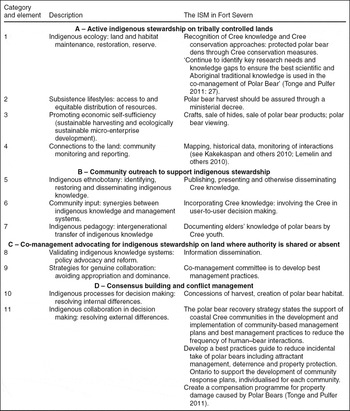
This is a comprehensive management approach addressing cultural and spiritual perspectives and the mixed economy (consisting of the subsistence, wage and social economies), and promoting sovereignty, self-governance and self-sufficiency in first nations (Ross and others Reference Ross, Pickering Sherman, Snodgrass, Delcore and Sherman2011). Further, the ISM involves indigenous nations throughout all phases of the management process: ‘[M]embers need to be involved not simply at the point of receiving dictated harvest limits, equal decision making needs to take place from the earliest planning phases, throughout regulatory formulation and into the implementation of the final regulations’ (Ross and others Reference Ross, Pickering Sherman, Snodgrass, Delcore and Sherman2011: 259). Founded upon an adaptive framework, the ISM is not a rigid prescription, but rather offers ‘suggestions of things to be aware of – recommendations, alternatives, potential solutions, cautionary tales, and encouragement – and . . . warn[s] of pitfalls’ (Ross and others Reference Ross, Pickering Sherman, Snodgrass, Delcore and Sherman2011: 241). While there are relatively few examples of the application of the ISM, leaders in Fort Severn remain the most comfortable with this model, which was developed for and by indigenous people (Table 1).
The indigenous stewardship model

© Ross and others (Reference Ross, Pickering Sherman, Snodgrass, Delcore and Sherman2011).
The implementation of the ISM would be quite timely considering that citizens of the Fort Severn Cree nation are demanding a broader involvement in the management of resources and wildlife in their traditional territory (Fidler and others Reference Fidler, Lemelin, Peerla and Walmark2008; Kakekaspan and others Reference Kakekaspan, Miles, Lemelin, Dowsley, Beaulieu, Taylor, Siebel and Walmark2010; Lemelin and others Reference Lemelin, Peerla and Walmark2008, Reference Lemelin and Bennett2010). Since the management of polar bears in this particular instance is composed of a number of other partnerships involving a variety of actors from other first nations, tribal organisations, Inuit associations, and provincial and territorial organisations, the ISM can become the new foundation for its PBRS and other future wildlife-management strategies in the province and throughout northern Canada.
Discussion
Despite thousands of years of interactions between polar bears and the Cree (Bird Reference Bird2007), agency personnel in Ontario have often falsely assumed that since no formalised management system exists within aboriginal communities (that is, there is no written documentation of one), then it is the state's responsibility and obligation to implement and enforce formal management strategies (Berkes Reference Berkes2008; Ross and others Reference Ross, Pickering Sherman, Snodgrass, Delcore and Sherman2011). Compounding this world view is the continuing notion that one of the largest threats to the well-being of animals, including polar bears, is the traditional harvest of wildlife by indigenous peoples (Peacock and others Reference Peacock, Derocher, Lunn, Obbard, Ferguson, Loseto and Mallory2010). However, Kakekaspan and colleagues (Reference Kakekaspan, Miles, Lemelin, Dowsley, Beaulieu, Taylor, Siebel and Walmark2010) and recent research by Ragen and others (Reference Ragen, Huntington and Hovelsrud2008) suggest that in the case of certain marine mammals like polar bears, reducing traditional harvest does not address the primary conservation concern for the species (that is, preventing climate change). Global and complex challenges aside, the reality is that the rights of the Cree to harvest polar bears are entrenched in treaty rights and within the Canadian constitution. Since the polar bear harvest, at present, is quite small and for the time being, sustainable, there is no logical or legal reason to suspend or prohibit the sale of crafts made from polar bears. Following the February 2011 meeting held in Fort Severn, the former chief and council, guided by the ISM, developed the following recommendations for the PBRS:
(1) A polar bear co-management committee equally composed of aboriginal peoples and agency personnel will be created. The responsibility of this co-management committee will be to oversee the implementation of the PBRS and represent aboriginal constituents at national (for example, Canadian Polar Bear Technical and Administrative Committees) and international meetings (for example, the Polar Bear Specialist Group). Existing management plans pertaining to protected areas (existing or proposed) will be subject to review by the co-management committee.
(2) A ministerial decree will be provided to Fort Severn and any other interested Cree nations in Treaty 9, thereby ensuring the Cree right to harvest and sell polar bear products to non-aboriginals. All OMNR employees associated with polar bear management will therefore be informed of this right and instructed to provide adequate support and accurate information regarding the polar bear harvest in Ontario.
(3) The province of Ontario will support the development and operation of a polar bear research and tourism facility in the traditional territory of Fort Severn. This facility would be staffed by locals; in cases where expertise would need to be imported, then a commitment to train local personnel would be implemented.
(4) The PBRS will support the development of a community-based monitoring system.
(5) A compensation fund for damage done to Fort Severn property and its citizens by polar bears will be implemented through the PBRS and administered by the co-management board.
(6) A moratorium on all darting and radio collaring of polar bears will be implemented, until a study has been conducted by a neutral third party to determine the impacts on bears of such invasive research. The co-management board will develop and implement a non-invasive research strategy for conducting polar bear research in the traditional lands of the Fort Severn Cree nation.
While many of these recommendations (1, 3, 4 and 5) are found within the present PBRS, some (2 and 6) are not. Therefore, it is crucial, that the PBRS be modified through the ISM, so that the concerns of Fort Severn (and other users) be heard and incorporated in future management strategies.
Conclusion
Fort Severn is one of the few voices reminding other users that the Cree do indeed have a voice in the management of polar bears in northern Canada. The fact that Fort Severn is present at these meetings is a result of a participatory action-research project and support from federal and some elected provincial representatives. It is also an indication of the community's desire to participate in the co-management of wildlife in Ontario. The cooperation of Fort Severn provides an opportunity for Ontario to build upon past initiatives and, this time, complete and implement a polar bear co-management strategy in the province.
Support from other users, especially actors in Nunavut, have suggested to the chief and council that the management of the SHBPBSP requires an approach that is transboundary and transdisciplinary. Developing a co-management strategy for this sub-population through the ISM will increase the self-sufficiency and self-governance of Fort Severn in their traditional territory and foster transboundary cooperation with other users.
Acknowledgements
The authors would like to thank the organisers of the Mondes polaires conference for their generosity and their willingness to provide a forum where the voice of Fort Severn could be heard. They also thank the two reviewers for their constructive comments. Last, they would like to thank the Social Sciences Research Council of Canada for its funding.