INTRODUCTION
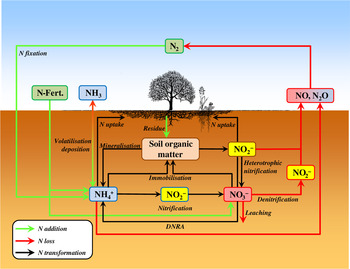
The world population is rapidly increasing and is expected to reach c. 9 billion in the middle of the 21st century with projected associated effects on all terrestrial ecosystems (Barnosky et al. Reference Barnosky, Hadly, Bascompte, Berlow, Brown, Fortelius, Getz, Harte, Hastings, Marquet, Martinez, Mooers, Roopnarine, Vermeij, Williams, Gillespie, Kitzes, Marshall, Matzke, Mindell, Revilla and Smith2012). To feed an increasing world population and enhance agricultural production, a parallel increase in nitrogen (N) consumption has been observed. The increasing amount of N, predominantly originating from industrial N fixation, has contributed to an increase in N availability in terrestrial ecosystems and in particular has enhanced the speed with which N is cycled in the environment, i.e. both the rate at which N has been added to but also lost from the environment has increased (Fig. 1). This increase of available N in the environment is also responsible for enhanced N deposition in all agriculturally dominated landscapes since the mid-19th century and will further increase till the mid-21st century (Galloway et al. Reference Galloway, Dentener, Capone, Boyer, Howarth, Seitzinger, Asner, Cleveland, Green, Holland, Karl, Michaels, Porter, Townsend and Vörösmarty2004, Reference Galloway, Townsend, Erisman, Bekunda, Cai, Freney, Martinelli, Seitzinger and Sutton2008). Thus, anthropogenically generated reactive N cascades throughout the global environment (Galloway & Cowling Reference Galloway and Cowling2002) and the increasing N availability affects the N flows and transformations, in particular the relative dynamics of mineral and organic N that are important indicators of the extent of human interference with ecosystem N dynamics (Schimel & Bennett Reference Schimel and Bennett2004). Reactive N may be lost from ecosystems as nitrate (NO3 −), via leaching, or in gaseous N forms such as ammonia, nitric oxide (NO), nitrous oxide (N2O) or dinitrogen (N2). These N losses are of significance both economically and environmentally. Despite more than 150 years of N cycling research, starting with studies by well-known scientists such as Liebig (van der Ploeg et al. Reference Van Der Ploeg, Böhm and Kirkham1999), Bausingault (Aulie Reference Aulie1970), Winogradsky (Ackert Reference Ackert2006) and others, there are still significant questions to be addressed with respect to N transformations and losses from terrestrial ecosystems. In particular, the interactions and impact of plants with the N cycle (Knops et al. Reference Knops, Bradley and Wedin2002), the key processes for the N cycle, in particular denitrification (Davidson & Seitzinger Reference Davidson and Seitzinger2006) and small-scale variability, and microsite N dynamics and interactions are to a great extent unresolved and not adequately understood. The present paper attempts to provide a brief overview of some current thinking in these areas and also attempts to review and suggest modelling concepts and new analytical approaches that might help to elucidate N flows and pathways in terrestrial ecosystems.
Terrestrial N cycle with the major N additions (green) and N losses (red) and internal N transformations (black) (colour version available online).

INTERACTIONS OF PLANTS WITH THE N CYCLE
Plant–soil interactions are an area of research attracting increasing interest with respect to N cycling. They are predominantly governed by interactions between the carbon (C) and N cycles. The microbial loop in soil is driven by recent plant C inputs (e.g. rhizodeposition), which influences the microbial activity in soils, whereas ecosystem N availability is controlled by the initial chemical composition and litter N concentrations (Parton et al. Reference Parton, Silver, Burke, Grassens, Harmon, Currie, King, Adair, Brandt, Hart and Fasth2007; Manzoni et al. Reference Manzoni, Jackson, Trofymow and Porporato2008). As the distance from the rhizosphere increases, potential N transformations, such as denitrification, decrease rapidly along a millimetre scale (Beauchamp et al. Reference Beauchamp, Trevors and Paul1989). Thus, soil aggregate–microsite reactions and the influence of roots are likely to cause microscale variations in substrate availability and environmental regulators, prompting a diverse reaction of the microbial community (Barnard et al. Reference Barnard, Leadley, Lensi and Barthes2005).
Nitrogen cycling is closely associated with plant productivity and factors affecting it. For instance, conditions that favour plant C assimilation may also enhance rhizodeposition and subsequently alter microbial community composition and function with subsequent effects on N dynamics. Conversely, a higher demand for N by plants, which may occur as a result of environmental change (e.g. favourable growth temperatures), increases competition for N between plants and microbes, potentially affecting microbial community structures and subsequent N transformations in the soil (Zak et al. Reference Zak, Holmes, White, Peacock and Tilman2003). However, very few studies have examined the links between the N cycle, plant activity and associated changes in microbial form and function that affect N transformations and fluxes. In N-limited systems, the gross N transformation rates and not the sizes of the soil N pools govern the availability of N for plants and microbes (Rastetter et al. Reference Rastetter, Ågren and Shaver1997).
Plants utilize mineral N (e.g. NH4 + or NO3 −) and low molecular organic N compounds (Schimel & Bennett Reference Schimel and Bennett2004). The latter enter the soil via rhizodeposition (e.g. amino acids) or are made available following microbial mineralization of organic material. Dissolved organic N (DON) uptake is reported to be more significant under conditions of N limitation and low pH (Jones et al. Reference Jones, Shannon, Murphy and Farrar2004). Despite the significance of DON as a loss pathway in agricultural ecosystems (Van Kessel et al. Reference Van Kessel, Clough and Van Groenigen2009), current knowledge of the organic N forms utilized by plants, with respect to soil DON dynamics over time and space, and their rates of production and utilization is still limited (Cabrera et al. Reference Cabrera, Kissel and Vigil2005). Similarly, the role DON plays in gaseous N loss pathways is also underresearched. A recent review indicates that nitrosation reactions may be an important loss pathway for gaseous N (Spott et al. Reference Spott, Russow and Stange2011).
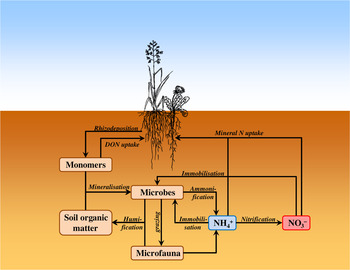
Rhizodeposition stimulates microbial biomass growth and N turnover (Knops et al. Reference Knops, Bradley and Wedin2002), which further stimulates the growth of predating organisms such as protozoa and nematodes (Sanderman & Amundson Reference Sanderman, Amundson and Schlesinger2003; Osler & Sommerkorn Reference Osler and Sommerkorn2007) (Fig. 2). Thus, soil organic matter (SOM) is mineralized/decomposed and may even be accelerated via priming processes (Stockmann et al. Reference Stockmann, Adams, Crawford, Field, Henakaarchchia, Jenkins, Minasny, Mcbratney, De Remy De Courcelles, Singh, Wheeler, Abbott, Angers, Baldock, Bird, Brookes, Chenu, Jastrow, Lal, Lehmann, O'donnell, Parton, Whitehead and Zimmermann2013). So far a quantitative evaluation of the various simultaneously occurring N transformations in plant–soil systems (Fig. 2) that lead to mineralization and immobilization of N in the rhizosphere is lacking. Can plants actively control exudation to create conditions in the rhizosphere to maximize the availability of N? Do plants actively produce compounds that deter non-beneficial organisms/pathogens directly or indirectly via relationships along trophic levels that in turn affect N cycling? Rhizodeposition of C compounds can directly influence N cycling, for instance enhancing N2O emissions in the presence of an N substrate (Uchida et al. Reference Uchida, Clough, Kelliher, Hunt and Sherlock2011). However, relatively little is known about the forms and rates of C released. Research between cell densities and exoenzyme production in the rhizosphere (quorum sensing) are likely to contribute to a quantitative understanding of N dynamics in the rhizosphere. DeAngelis et al. (Reference Deangelis, Lindow and Firestone2008) showed that the activity of extracellular enzymes and N mineralization are closely associated and the production of exoenzymes is likely to be controlled by quorum sensing.
Major N flows in the rhizosphere (colour version available online).

N LOSS FROM ECOSYSTEMS – THE IMPORTANCE OF DENITRIFICATION
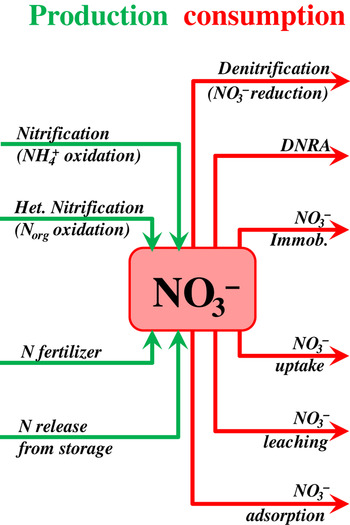
A key process in the N cycle is denitrification, which is a heterotrophic process performed by facultative anaerobic organisms that utilize various C substrates as electron donors (Beauchamp et al. Reference Beauchamp, Trevors and Paul1989; Davidson & Seitzinger Reference Davidson and Seitzinger2006). Therefore a better understanding of this process and the dynamics of associated N transformations is pivotal. Nitrate (NO3 −) is the key N species for N losses and is affected by numerous N flows that produce (e.g. nitrification) and consume (e.g. leaching) NO3 − (Fig. 3). To be rendered environmentally benign, NO3 − must be reduced to a non-reactive form (e.g. dinitrogen, N2). Three major biological pathways of NO3 − reduction are known (Fig. 3): (i) assimilatory NO3 − reduction into biomass, (ii) dissimilatory NO3 − reduction to NH4 + (DNRA) and (iii) dissimilatory NO3 − reduction to N2 (denitrification) (Robertson & Kuenen Reference Robertson, Kuenen, Revsbech and Sørensen1990; Burger & Jackson Reference Burger and Jackson2005). Dissimilatory reduction may outcompete denitrification under conditions where electron acceptors are limited and it provides an energetically favourable alternative to denitrification (Tiedje Reference Tiedje and Zehnder1988; Rütting et al. Reference Rütting, Boeckx, Müller and Klemedtsson2011). However, further research is still required to understand the importance of DNRA in terrestrial systems and to perfect methods for studying the process (Rütting et al. Reference Rütting, Boeckx, Müller and Klemedtsson2011).
Major production and consumption processes affecting the size of the soil NO3 − pool size (note the interactions of NO3 − with a hypothetical storage component follows the ideas of Müller et al. (Reference Müller, Martin, Stevens, Laughlin, Kammann, Ottow and Jäger2002) (colour version available online).

Denitrification is a key transformation process in soils with both adverse and beneficial roles, since it is both a source and sink for N2O, impairs the N use efficiency of agricultural crops and lowers the potential for NO3 − leaching to aquatic systems (Davidson & Seitzinger Reference Davidson and Seitzinger2006). In aquatic systems, autotrophic denitrification may also occur in the presence of inorganic electron donors such as sulphides or ferrous iron (Knowles Reference Knowles1982; Clément et al. Reference Clément, Shrestha, Ehrenfeld and Jaffé2005).
The reductases involved in denitrification are well recognized. The membrane-bound nitrate reductase (Nar) is the first in the denitrification sequence and occurs in very diverse microbial communities including α, β, γ and ε proteobacteria, Gram-positive bacteria and archaea, while the periplasmic NO3 − reductase (Nap) occurs only in Gram-negative bacteria (Philippot Reference Philippot2005). The key enzyme and key precursor for gaseous N emissions in the denitrification sequence is nitrite reductase that is encoded by either nirS, a cytochrome cd1-containing gene, or nirK, a copper-containing gene. The two nitrite reductases provide a functional marker for the diversity of denitrifying bacteria (Braker et al. Reference Braker, Zhou, Wu, Devol and Tiedje2000; Braker & Conrad Reference Braker and Conrad2011). The genes norB and nosZ encode NO and N2O reductase, respectively (Groffman et al. Reference Groffman, Altabet, Böhlke, Butterbach-Bahl, David, Firestone, Giblin, Kana, Nielsen and Voytek2006) and it is the dynamics of these two reductases in combination with substrate and environmental regulators and in particular the balance between nar/nir and nos that controls the net production and release of N2O. Philippot et al. (Reference Philippot, Andert, Jones, Bru and Hallin2011) showed that denitrifiers with and without nosZ encoding can co-exist and that higher N2O/N2 ratios can be related to the proportions of bacteria with and without nosZ encoding. Differential encoding may also be related to soil pH, which may differ in distinct niches (Philippot et al. Reference Philippot, Čuhel, Saby, Chèneby, Chroňáková, Bru, Arrouays, Martin-Laurent and Šimek2009). This highlights the fact that the observed overall denitrification dynamic is governed by the sum of the individual dynamics of co-existing microbes, possibly living in different niches (Philippot et al. Reference Philippot, Andert, Jones, Bru and Hallin2011) and/or soil aggregates (Miller et al. Reference Miller, Zebarth, Dandie, Burton, Goyer and Trevors2009). Moreover, aggregation affects diffusive exchange of mineral (e.g. NO3 −) and gaseous N species (e.g. N2O) and O2 between denitrifying microsite and inter-aggregate pores, which affects both total denitrification (Sexstone et al. Reference Sexstone, Revsbech, Parkin and Tiedje1985) and the product ratio of denitrification (Arah & Smith Reference Arah and Smith1989).
While available organic C and O2 have a major impact on total denitrification, soil pH mainly influences the ratio of N2O/N2 (Šimek & Cooper Reference Šimek and Cooper2002). Maximum denitrification occurs usually at relatively high pH value and a linear relationship is often observed between denitrification and pH (Focht Reference Focht1974). There is a tendency for the N2O/N2 ratio to increase with decreasing pH (Burford & Bremner Reference Burford and Bremner1975; Šimek & Cooper Reference Šimek and Cooper2002; Liu et al. Reference Liu, Mørkved, Frostegård and Bakken2010) and a more complete reduction towards N2 is found at higher pH values (Nõmmik Reference Nõmmik1956). The effect of pH may be due to an impact on substrate availability that influences membrane permeability or speciation of chemical species (Dassonville & Renault Reference Dassonville and Renault2002). Nitrous oxide reductase is more sensitive to pH than other reductases in the denitrification sequence and therefore low pH may increase the lag phase of de novo synthesis of this enzyme (Šimek & Cooper Reference Šimek and Cooper2002; Liu et al. Reference Liu, Mørkved, Frostegård and Bakken2010). Apparently the detrimental effect of low pH on N2O reductase occurs at the post-transcriptional level by interfering with translation, protein assembly or an effect on the activity of functional enzymes (Liu et al. Reference Liu, Mørkved, Frostegård and Bakken2010). Microsite variations in soil pH may support a diverse microbial community that exhibits a different sensitivity to pH (Cavigelli & Robertson Reference Cavigelli and Robertson2000; Šimek & Cooper Reference Šimek and Cooper2002). Also, chemodenitrification may play a role for N2O and N2 production in acidic microsites (Chalk & Smith Reference Chalk, Smith, Freney and Simpson1983; Stevens et al. Reference Stevens, Laughlin and Malone1998). At pH<3, chemical decomposition of NO2 − is most likely to be the dominant process for N2 production and may account for up 0·5 of N losses in tropical soils (Laudelout et al. Reference Laudelout, Germain, Chabalier and Chiang1977). Denitrifiers adapt to low pH over long periods of time; thus experimental setups including ad hoc pH manipulations are not conducive to evaluating natural soil conditions (Šimek & Cooper Reference Šimek and Cooper2002). However, one of the key unknowns is the lack of suitable field methods to quantify the N2O/N2 ratio in situ. Techniques based on the inhibition of acetylene are no longer appropriate (Bollmann & Conrad Reference Bollmann and Conrad1997) and easy-to-use 15N labelling techniques are still lacking and can be prohibitively expensive.
In general, it is the relationship between microbial communities in diverse ecosystems, the numerous proximal and distal factors and ecosystem functioning, which are not yet completely understood (Braker & Conrad Reference Braker and Conrad2011). In particular, the activities of microbial communities under various conditions and how these contribute to soil N dynamics is a very important area of research. Studies such as Jørgensen et al. (Reference Jørgensen, Struwe and Elberling2012), which examined gaseous N losses at spatial and temporal scales and the factors affecting these, make important contributions to elucidating the detail of the processes and pathways surrounding ecosystem N dynamics in situ.
UNDERSTANDING N DYNAMICS AND THE ASSOCIATED MICROBIAL COMMUNITIES
Microbial community dynamics are influenced by the interacting effects of environmental conditions together with the substrate relationships (carbon substrates) and the availability of electron acceptors (N-oxides). For instance, the most important environmental regulators for denitrification are: oxygen>pH>temperature (Focht Reference Focht1974). Mineralization activity provides substrates and is closely related to moisture/oxygen–temperature conditions (Focht & Verstraete Reference Focht, Verstraete and Alexander1977; Myrold & Tiedje Reference Myrold and Tiedje1985b ; Morley & Baggs Reference Morley and Baggs2010). A high rate of C mineralization favours oxygen (O) consumption. However, in fertilized soils, C rather than NO3 − availability limits total denitrification, but NO3 − has a pronounced effect on the ratio of N2O/N2 (Nõmmik Reference Nõmmik1956; Myrold & Tiedje Reference Myrold and Tiedje1985a , Reference Myrold and Tiedje b ; Beauchamp et al. Reference Beauchamp, Trevors and Paul1989; McCarty & Bremner Reference Mccarty and Bremner1993; Dendooven & Anderson Reference Dendooven and Anderson1994). Many studies have focused on either proximal or distal factors, as described by Groffman et al. (Reference Groffman, Tiedje, Robertson, Christensen and Wilson1988), but only a few studies so far have tried to link these factors. The C substrate determines the efficiency with which N oxides (NO3 −, NO2 −) are reduced (Beauchamp et al. Reference Beauchamp, Trevors and Paul1989). Denitrifiers are able to compete successfully for C with other heterotrophs (Myrold & Tiedje Reference Myrold and Tiedje1985b ). Thus, specific microbe–substrate relationships exist that may explain the link between decomposition products and microbial populations (Beauchamp et al. Reference Beauchamp, Trevors and Paul1989). However, these relationships are still not well understood. The availability and identity of the C substrates and in particular the ratio between C substrate to e−-acceptor also governs whether denitrification or DNRA occurs in soils. Although the need for C is universally acknowledged, there is still a need to identify assays that can predict forms of C substrate utilized by various microbial groups (Rütting et al. Reference Rütting, Boeckx, Müller and Klemedtsson2011) in various soil niches. Thus, to advance the mechanistic understanding of microbial N cycling in terrestrial ecosystems there is also a need to link microsite and not only bulk soil conditions to microbial activities.
In natural environments diverse microbial populations are observed (Tiedje Reference Tiedje and Zehnder1988). The greatest spatial aggregation is generally observed in the topsoil (Nunan et al. Reference Nunan, Wu, Young, Crawford and Ritz2002) and is most probably a response to the patchy distribution of organic material (Parkin Reference Parkin1987) and environmental conditions (Tiedje Reference Tiedje and Zehnder1988) such as aerobic–anaerobic microsites. The need to better understand the microenvironment where N transformations occur was emphasized more than 40 years ago (McLaren Reference Mclaren1970) but the progress in this area has been slow. Microbial processes are affected by substrate availability, thermodynamic regulation and inhibition, pH and redox potential (Brock Reference Brock1967; Firestone & Davidson Reference Firestone, Davidson, Andreae and Schimel1989; Dassonville & Renault Reference Dassonville and Renault2002). Interactions between these factors are not fully understood. Cavigelli & Robertson (Reference Cavigelli and Robertson2000) investigated for instance the effect of pH and oxygen on the N2O/N2 ratio in both an arable and non-disturbed successional field, and observed that differences were most probably governed by the prevailing microbial community.
NEW CONCEPTUAL FRAMEWORKS AND MODELLING CONCEPTS FOR SOIL N DYNAMICS
There is a need for new theoretical and conceptual frameworks to understand how microorganisms influence ecosystem processes (Hall et al. Reference Hall, Maixner, Franklin, Daims, Richter and Battin2011). Two aspects need to be taken into account to understand the relationships between environmental regulators and microbial activity. First, there needs to be an acknowledgement that different microsites exist in the soil, which to date have been considered as homogenous spaces with respect to environmental regulators. Secondly, there is a requirement to identify the units that represent physiologically similar microbial entities that live in mutualistic or antagonistic relationships within these microsites. For instance, while anaerobic conditions are required for denitrification to proceed, aerobic denitrification (NO3 − reduction under microaerophyillic conditions) has been observed (Bréal Reference Bréal1892). This latter process seems to be related to heterotrophic nitrification and most probably presents a detoxifying mechanism to reduce high NO2 − concentrations (Robertson & Kuenen Reference Robertson, Kuenen, Revsbech and Sørensen1990).
Thus, to understand gaseous N dynamics from terrestrial ecosystems, it is essential to understand the individual potential production processes. For instance, N2O is produced by nitrifiers and denitrifiers and also via groups that combine the two processes via nitrifier–denitrification (Wrage et al. Reference Wrage, Velthof, Van Beusichem and Oenema2001). Kool et al. (Reference Kool, Dolfing, Wrage and Van Groenigen2011) showed that the nitrifier–denitrification pathway can be a major source for N2O if conditions for denitrification are suboptimal and therefore it should not be ignored as a source of N2O from soil (Wrage et al. Reference Wrage, Velthof, Van Beusichem and Oenema2001).
Furthermore, chemical transformations may also contribute to N dynamics. Chemodenitrification may occur in low pH soils, including the van Slyke reaction where organic N together with NO2 − reacts to form N2 (Tiedje Reference Tiedje and Zehnder1988). However, understanding of the potential contribution of chemodenitrification to gaseous N losses as NO and N2O is far from complete, as demonstrated by recent studies. Further studies on chemodenitrification are warranted, especially under high N input agricultural systems (Spott et al. Reference Spott, Russow and Stange2011). Besides bacteria, fungi and archaea are capable of N transformations such as NO3 − assimilation and denitrification when NH4 + is depleted (Zumft Reference Zumft1997; Laughlin & Stevens Reference Laughlin and Stevens2002). However, quantitative understanding of both the fungal denitrification (Morozkina & Kurakov Reference Morozkina and Kurakov2007) and archaeal N transformation processes are still in their infancy.
Modelling concepts
An important tool to simultaneously consider all N cycling processes is mathematical modelling. Betlach & Tiedje (Reference Betlach and Tiedje1981) concluded that kinetic models can provide a useful guide to evaluate the physiology of microbial N transformations. Various kinetic expressions such as zero-order, first-order or Michaelis–Menten kinetics can be tested easily as well as dual-substrate relationships (Bowman & Focht Reference Bowman and Focht1974; Focht Reference Focht1974; Betlach & Tiedje Reference Betlach and Tiedje1981). In kinetic chain reactions such as denitrification the N dynamics can be governed by the dynamics of electron donors and N oxides for each reduction step and competition between organisms for NO3 −, which is governed by C availability (Dendooven et al. Reference Dendooven, Splatt, Anderson and Scholefield1994).
Diffusion and conditions in aggregated soil
Kinetic parameters in N cycling models that are applied to field situations are probably not representative of the true kinetic reaction at the reaction sites because heterogenic distribution and diffusion of N oxides and electron donors has to be taken into account (Focht Reference Focht1974; Betlach & Tiedje Reference Betlach and Tiedje1981). In aggregated soils it is important to consider diffusion to the centre of aggregates where denitrification predominantly occurs (a kind of ‘hot spot’ for denitrification) (Arah Reference Arah1990b ). Therefore microsite-specific conditions and microbial interactions need to be taken into account (Myrold & Tiedje Reference Myrold and Tiedje1985a ; Arah Reference Arah1990b ). In particular, the distribution of microbes and their activity should be included across the range of soil aggregates (Miller et al. Reference Miller, Zebarth, Dandie, Burton, Goyer and Trevors2009). In diffusion–reaction models that take into account the aeration status, the diffusion of oxygen (Greenwood & Goodman Reference Greenwood and Goodman1964; McElwain Reference Mcelwain1978) and of the various N species are required to predict N cycling in structured soils (Burford & Stefanson Reference Burford and Stefanson1973; Arah Reference Arah, Revsbech and Sørensen1990a ).
General model development
Models for microbial N dynamics should be embedded in larger models that predict microbial processes and their link to nutrient cycling and take into account the high spatial and temporal nature of these processes (Groffman Reference Groffman, Rogers and Whitman1991). Besides simple relationships, the complexity of the microbial reactions that reflect the high spatial and temporal variability need to be considered to adequately connect ecological theory with molecular–microbial composition and function (Groffman Reference Groffman, Rogers and Whitman1991). Thus spatial and temporal explicit relationships between, for example, the denitrifier community and environmental regulators should be taken into account. Furthermore, a bottom-up approach should be considered where spatial and temporal variability of microbial dynamics at the microsite level will be used to predict N flows and transformations at the field and regional scale. Furthermore, modelling concepts should be embedded in models that simulate the interactions among the various elemental cycles such as C–N–P (e.g. NCSOIL, Molina et al. Reference Molina, Clapp, Shaffer, Chichester and Larson1983; CENTURY, Parton et al. Reference Parton, Schimel, Cole and Ojima1987; DNDC, Li et al. Reference Li, Frolking and Frolking1992). Currently no model exists that takes into account all these aspects, in particular the high spatial and temporal nature of microbial processes.
ADVANCES IN ANALYTICAL APPROACHES – RESOLUTION OF SMALL SCALES
Mathematical models are only as good as the dataset addressing the various model components for model development and validation. While mathematical concepts regarding small-scale diffusion processes were already well advanced more than 20 years ago (Bouldin Reference Bouldin1961; Misra et al. Reference Misra, Nielsen and Biggar1974; McConnaughey & Bouldin Reference Mcconnaughey and Bouldin1985; Arah Reference Arah, Revsbech and Sørensen1990a ), it is only now possible to validate them with appropriate techniques that are able to resolve the small physical scales (Herrmann et al. Reference Herrmann, Ritz, Nunan, Clode, Pett-Ridge, Kilburn, Murphy, O'donnell and Stockdale2007; Vogel et al. Reference Vogel, Weller and Schlüter2010).
Stable isotope techniques (13C, 15N) in combination with suitable mathematical analysis tools are available to quantify simultaneously occurring N transformations dynamics in soil. With the latest 15N tracing models it is possible to identify more than 14 simultaneously occurring N transformations including nitrite dynamics (Rütting & Müller Reference Rütting and Müller2008) and plant uptake dynamics (Inselsbacher et al. Reference Inselsbacher, Wanek, Strauss, Zechmeister-Boltenstern and Müller2013). Together with the latest analytical techniques using nanoSIMS, it should be possible to resolve processes at μm or nm scales and the gross N dynamics at these fine spatial scales (Herrmann et al. Reference Herrmann, Ritz, Nunan, Clode, Pett-Ridge, Kilburn, Murphy, O'donnell and Stockdale2007; Clode et al. Reference Clode, Kilburn, Jones, Stockdale, Cliff, Herrmann and Murphy2009). This will most probably alter the current view of soil N dynamics because of the non-linearity among microsites (i.e. a linear relationship between microsites is inherently assumed with bulk soil determinations).
At the μm and mm scales, advanced microsensor techniques are available for a range of gaseous and mineral N species (Andersen et al. Reference Andersen, Kjær and Revsbech2001; Meyer et al. Reference Meyer, Kjær and Revsbech2002; Neumann et al. Reference Neumann, George and Plassard2009), which were recently applied in field studies (Jørgensen et al. Reference Jørgensen, Struwe and Elberling2012). Non-invasive techniques, such as X-ray computed tomography (CT), allow three-dimensional visualization of soil structures and pore geometry at μm scales (Wildenschild et al. Reference Wildenschild, Hopmans, Vaz, Rivers, Rikard and Christensen2002; Vogel et al. Reference Vogel, Weller and Schlüter2010). Together with techniques such as microdialysis (Inselsbacher et al. Reference Inselsbacher, Öhlund, Jämtgard, Huss-Danell and Näsholm2011), it will be possible to resolve N transformations at small scales in the field, which will without doubt generate data that reflect much more realistically the N transformation processes in structured soils.
CONCLUSIONS
The advancement of knowledge regarding N flows and transformations hinges on the identification of N dynamics at small scales. A combination of suitable analytical techniques with appropriate modelling will help future understanding of spatial heterogeneity in soil-plant and aggregated systems.
We thank the organisers of the 17th N workshop who invited us to present this keynote presentation. We acknowledge financial support from the OECD.