In its infamous obituary, The Times summed up the legacy of the reign that ended on 26 June 1830: “Nothing more remains to be said or done about GEORGE IV., but to pay—as pay we must—for his profusion; and to turn his bad example to some account, by tying up the hands of those who come after him, in what concerns the public money.” Considering that the cost of the British monarchy continues to provoke anger and disgust, as vividly displayed in the outcry over the prospect of the public bearing restoration expenses after the Windsor Castle fire in 1992, this was easier said than done. George IV's obituary, furthermore, treated his fantastic extravagance as aberrant. It pronounced the late king “an inveterate voluptuary” whose dominant passion was selfishness, “the true repellant of human sympathy … the charnel-house of the affections.” The Times represented the odium that this behavior provoked as universal; the paper declared “that there never was an individual less regretted by his fellow creatures” and defied its readers to find a single tear shed for him, to name one true friend.Footnote 1
An investigation into the attempts made to staunch the flow of George's prodigality suggests his behavior to have been less an aberration than an extreme case of late eighteenth-century society's conflicting expectations respecting honor, credit, spending, and debt, as well as the monarchy itself. The long evolution from an agrarian to commercial economy had affected all segments of society, including the royal household. The expansion of trade and development of a credit culture from the mid-sixteenth century, the institutionalization of banking and royal finance after 1688, the ideas about enlightened self-interest, contractual relations, and the pursuit of individual happiness all threatened traditional hierarchies.Footnote 2 The spectacle of the French Revolution then presented a vivid picture of the anarchy that a challenge to the political and social status quo could spark and placed the British polity's moral grounding under scrutiny.
This study will focus on one such occasion for ethical examination: the controversy generated by the Prince of Wales's marriage settlement in 1795, a year marked by war weariness, harvest failure, widespread suffering, and a resurgence of plebian political agitation. The debate over resolution of the prince's extensive debts shows the monarchy to have been placed in an awkward position by the contradictory value systems operating in British society. Although the monarchy traditionally had a natural affinity with the aristocracy, George III, with his domestic probity, simple tastes, unfashionable pastimes, religiosity, and thrift, served as a rallying point for the middle class.Footnote 3 With the increased scope and intimacy of newspaper reporting on the royal family after the domestic as well as political drama of the Regency Crisis of 1788, commentators and satirists often represented George III as a bourgeois paterfamilias and his sons as aristocratic libertines. The debt controversy, however, when viewed in light of arguments concerning royal spending habits in newspapers, pamphlets, parliamentary debates, and visual representations, demonstrates that the principles on either side of the divide between prince and king were not as straightforward as one might expect.
Indeed, the divisions between sections of the middle class and the landed aristocracy were not clear-cut. Although the aristocracy often professed a chivalric code and aspired to conventions of regional and social responsibility that put noblesse oblige before profit, the maintenance of such values necessitated an effective management that involved a solid business sense and financial prudence.Footnote 4 By the same token, while the middle classes forged a different set of values in a pragmatic quest for survival in the world of business—financial credibility, thrift, respectability, and professional probity—some were drawn to the metropolitan world of fashionable excess and ostentation. Not only did the larger merchants with parliamentary connections rub shoulders with the beau monde, but the higher end of tradesmen who catered to aristocratic clients often cultivated genteel manners and appearance, mores that further obscured the stereotypical distinctions between land and trade. Nonetheless, this did not stop writers and orators from invoking idioms of social identity that were class specific, even if they were not always solidly anchored to socioeconomic groups. The danger of ruin from aping one's betters and living beyond one's means became a staple of plays, fiction, satire, and proscriptive literature, and turned up in personal correspondence.Footnote 5
The perceived difference between aristocratic and bourgeois norms were brought to bear on the habits of the monarchy, which, with the decline of patriarchalism and divine right, could claim no self-evident exemption from their operation. For the purposes of this study, these competing value systems are best described as fashionable and commercial. The fashionable world evolved from the old aristocratic ethos that prized risk, prowess, and display as well as charitable acts based on patronage, gift giving, and discretionary bequests. Commerce operated on trust, plain dealing, reciprocity, and promotion of self-sufficiency. Standards of creditworthiness divided along this axis and helped produce uncertainty in the business of trade and finance as well as in political leadership. These differences caused all classes and professions, as well as the monarchy and the nation itself, to be united on one common ground, the culture of debt. The royal family came under closer commercial scrutiny, especially as the once elite sphere of sumptuous court ceremony became a spectator event popularized by print culture. This exposed the monarchy to the gaze of people accustomed to assessing value for money. George III aligned himself with the industry-and-thrift set with his personal abstemiousness and campaign against fashionable vice. Yet he still lived in palaces, had vast sums of money at his disposal, and operated at a deficit—something that did not escape the notice of satirists. The unfashionable king had to preside over a court meant to set fashion and stimulate industry with its patronage. Public discussions of royal spending and debt demonstrate why attempts to distinguish between practitioners of paternalism and proponents of laissez faire in practice proved difficult.
George IV's profligacy, a weapon in the Hanoverian oedipal struggle between king and heir apparent, as his twentieth-century biographers attest, could also be seen as a symptom of a monarchy divided between two lifestyles, each with its own set of principles. Christopher Hibbert notes the prince's contemptuous observation that the king in his stinginess “hardly allowed himself three coats a year.” Fleeing the dullness of a parsimonious court, the Prince of Wales spent hours trying on clothes, bulk buying finery, collecting art, and renovating Carlton House, a real sinkhole of expense that remained unfinished for thirty years and eventually was torn down. He entertained drunkenly and lavishly (a pastime visible in his ever-growing corpulence); enjoyed giving extravagant gifts to family, friends, lovers, and servants; and paid friends’ gambling debts. Prince George had a reputation for spontaneous acts of generosity, including a legendary dispatch of his purse containing £700 to an unpaid tradesman he heard had been driven to a suicide attempt. Although the prince had given up the gaming table by the end of the 1780s, he maintained a racing stud at great expense and a reputation as a gambler.Footnote 6
During the 1780s, the Prince of Wales acted the stereotypical aristocratic prodigal who had nothing better to do than to anticipate his inheritance and pursue expensive pleasures paid for on credit based on his prospects. Shortly after the prince reached his majority at age eighteen in 1780, George III had to fork out £5,000 in hush money to buy off the first of his son's series of discarded mistresses. The £62,000 establishment settled in 1783 included added provision for £30,000 in debts to tradesmen. By his next birthday, the Prince of Wales complained to the king of “the peculiar and very embarrassed situation of [his] affairs, arising from the necessary expenses [he] incurred during the course of last year.” The king refused to extend assistance until he received an account of the prince's spending.Footnote 7 Although during the following year the prince provided a statement of some £150,000 owed, £15,000 of this sum remained unaccounted for, and the king remained unyielding. By 1786 the debts approached a quarter of a million pounds. The prince closed up Carlton House, dismissed his servants, sold his racehorses, and retired to Brighton. When he and two of his brothers began negotiating foreign loans, politicians finally intervened. In 1787 Parliament voted £161,000 for payment of debts and £60,000 for the reopening and completion of Carlton House.Footnote 8
By the 1790s, however, the net of royal and aristocratic privilege had given way. Carlton House narrowly escaped several executions, tradesmen stopped filling the prince's orders, and he complained of creditors harassing him in public.Footnote 9 In desperation he agreed to marry so Parliament would be forced to increase his annual income. Notwithstanding £73,000 per annum (PA) and his 1787 promise never to ask for further assistance, when his father applied to Parliament on his behalf for an increased establishment upon marriage in 1795, the prince brought with him a staggering £630,000 in debts.Footnote 10 To the average British subject these sums must have been virtually unimaginable. The king himself only had a Privy Purse of £60,000 PA out of a Civil List of £900,000. As a 1795 pamphlet published by the radical republican, Richard “Citizen” Lee, observed, a peasant supporting a family on one to three shillings a day could not help but think two hundred guineas a day would be enough for anybody. The prince, however, had managed to run through four to five hundred.Footnote 11 The issue came before both Houses shortly after the April 1795 wedding. On 14 May William Pitt the Younger proposed granting the prince an income of £125,000 PA in addition to his hereditary revenues from the Duchy of Cornwall, some £13,000 PA. Pitt added subsidies for wedding jewels and plate, completion of Carlton House, and a jointure for the new princess. The prince then would set aside £25,000 of his annual income for the liquidation of his debts over a twenty-seven-year period. A commission would conduct this operation after an investigation into the sources and legitimacy of all claims against the prince. Carlton House and its furniture would become property of the crown in perpetuity. Every element of the proposal proved objectionable. Hibbert speculates that resistance to the bill would have brought down the government had not the prince agreed to appropriate £65,000 PA toward a speedier repayment in order for the bill to pass on 26 June.Footnote 12
Although much argument offered in the heat of political debate carries the taint of partisan insincerity, ideas offered in their justification had to possess some measure of plausibility. Argument in this case did not divide along party lines because the French Revolution had disrupted political alliances. Having abandoned Charles James Fox's Whig party in May 1792 in alarm over the growing violence across the Channel, and in the hope that his support of the Pitt administration would unknot the king's purse strings, the prince had few friends left. Pitt never forgave the prince's attempts to unseat him in favor of Fox during the Regency Crisis of 1788–89 and, although forced to do the king's bidding as his principal minister, was disinclined to do the prince any favors. Fox not only sanctioned Pitt's plan but even went on to propose amendments favorable to creditors and detrimental to the prince's income. Fox observed to Henry Holland that his speech “which may possibly be nearly equally displeasing to all parties and persons” had been well received. He crowed, “some people think Pitt will adopt my ideas, and be kind enough to let me act as Minister upon this agreeable occasion, which I shall not know how to avoid.”Footnote 13 Indeed, Pitt found the proposal he had to sponsor personally repugnant. Hence The Times, a Pittite organ, and at least one pamphleteer on the Treasury payroll published material damaging to the prince's reputation. In the end the prince felt that Pitt had betrayed him. Fox sensed that the king and the prince held him and his political rival in equal displeasure. He asserted in his own defense, “I am sure it is the best plan for the Prince's real interests, and the only one which can operate to soften in any degree the general odium against him.”Footnote 14
Much of the debate hinged upon whether the Prince of Wales would be considered in his personal or corporate capacity. Those who represented the prince's insolvency as a private, family affair looked to the king to behave like any landed magnate with a profligate son and take full responsibility for the debts. Those who thought that Parliament should make provision for their payment drew upon the tropes of commercial investment. The underlying base of plausibility shoring up both of these positions was the system of credit that had a stranglehold on all ranks of society. The English nobility had relied on credit to enhance the liquidity of their assets since the end of the Elizabethan era. Although historians disagree on the overall effects of aristocratic indebtedness, the consensus seems to be that the amount collectively owed increased steadily as new methods of borrowing money and new ways of spending it presented themselves. A landowner did not have to be extraordinarily immoderate to slip into debt. The expense of maintaining an estate as well as the incumbent style of life and obligations meant most families lived up to their income and had to raise cash for extras such as electioneering, additional land purchase, building projects, marriage portions, and travel abroad.Footnote 15 The lure of easy credit seduced the middling sort as well, and the habit of debt became a feature of commercial culture. Margaret R. Hunt notes that in matters of debt aristocrats enjoyed the protection of being able to fall back upon the collateral of their land and their powerful personal connections. The middling ranks and lesser gentry only had virtuous habits to protect them from the real risk of imprisonment for debt.Footnote 16 All of the debaters in the two Houses of Parliament possessed landed estates, but some were of recent acquisition, and many were heavily mortgaged.
The few politicians who still harbored sympathy for Prince George's plight pronounced him a victim of circumstance. They tapped into long-standing fears about public and private credit and the unresolved question of how much use of credit was reasonable. William Henry Lambton, a rich Foxite Whig from Durham, observed: “Hasty credit, and distant demands, are always alluring baits to youth and generosity.”Footnote 17 William Joliffe of Petersfield pursued a similar line of argument. Although his hunger for a peerage usually inspired him to appear on the side of the administration, he could barely conceal his annoyance at Pitt as he brought the issue down to a personal level.
For his part, he was not so severe in judging the conduct of young men; how many Members of that House were wild in their youth? Had they not been forgiven and had their debts paid? How many had sons who had not been perfectly strict in keeping promises of never again incurring debts once discharged? He, for his part, did not possess that severe and rigid virtue which could not so readily excuse failings which are incidental to all young men, particularly when they were the failings of a Prince whose bosom beats with philanthropy; who was the most magnanimous and most accomplished Prince in Europe.Footnote 18
The system of credit loomed over the proceedings like a specter ready to carry off the least suspecting to the underworld of insolvency. The earl of Moira represented the debt as having slowly crept up upon the prince and suddenly enveloped him.Footnote 19 Lambton explained that “those who had once got into the habit of incurring debt, felt how easy it was to supply, by their credit, the deficiency of their finances, and were more and more inclined to plunge into the vortex, a maxim, for the truth of which he appealed to many who were present and qualified to decide on the point from their own experience.”Footnote 20 Lambton and John Anstruther, whose career as the prince's solicitor-general was wrecked on the shoals of this controversy, insisted that the House preserve the new Princess of Wales from the daily mortification inflicted by creditors. Anstruther argued that her suffering such importuning would undermine the benefits of a larger income. His remarks set off vivid characterizations of the prince's situation: “disgraceful fetters and trammels,” fulminated Richard Smith, a nabob whose own debts drove him abroad in 1784; “the trammels of tawdry eclipse; in a kind of shriveled dignity, like a mouse under a canopy of state,” asserted Richard Brinsley Sheridan, no stranger to duns at the door, or to the routs at Carlton House.Footnote 21
The prince's partisans shifted attention to the king's duty as a father. Royal thrift could far too easily be construed as miserliness. William Hussey, an independent country gentleman with Foxite leanings and an obsession with public credit, demanded that George III sell off crown land to cover the debts.Footnote 22 Sheridan claimed that funds for this purpose actually already existed: the revenues from the Duchy of Cornwall that had accumulated during the prince's minority. “Was it not natural, he would ask, that a father and mother should contribute something to disencumber their child from his debts, and show examples of something like feeling and sacrifice?”Footnote 23 Pamphleteers amplified the issue of the king's responsibility for his son's obligations. A Loyal, but Solemn Expostulation, Addressed in a Moment of General Distress, Dismay, and Apprehension, to a Thoughtless and Imprudent Young Man provided a speech for the prince to recite at his father's feet as he shed tears of repentance. It had the prince suggesting that the king dip into his “notorious and immense” assets to liberate his name from “the parsimonious stigma.”Footnote 24 An editorial in The Times of 22 May recommended that the king kick in some Civil List revenues to shorten the terms of payment, as Fox had advised, in order to preserve creditors as well as the prince's popularity. “Besides,” the article concluded, “family embarrassments ought to find a resource in the generosity of those who are at the head of it.”
Supporters of the administration treated the prince as a branch of a family firm in which the whole nation had invested. After the home secretary, Henry Dundas, countered rumors of the king's amassed treasures and declared the Civil List completely encumbered, he explained that as heir apparent the prince was “the property of the people,” “the nation's charge.” Pitt built the whole justification for his plan upon this premise. He declared the restoration of the prince's credit a sound investment. Allocating an income sufficient for the prince to take care of his encumbrances without harming his splendor and appointing a commission to safeguard against future debts would preserve the independence of the House of Hanover and thus the respectability of hereditary monarchy. “Provision made for such a purpose was not a wild waste, and thoughtless profusion, it was a wise application of the public money for public advantage.” Employing the language of Edmund Burke's Reflections on the Revolution in France, Pitt contrasted visible support of the constitution by maintaining royal splendor to the “visionary and fallacious theories of giddy speculators.”Footnote 25 Given that the whole mess originated in reckless speculation on the prince's prospects, Pitt's language seems almost sardonic.
Opponents of the bill answered that such investment in the prince represented irresponsible speculation and rejected the equation of credit with opulence. Charles Grey, the career reformer, castigated the charade of having the prince pay his debts out of an inflated income when, no matter what the arrangement, the public footed the bill. The prince would recover his credit by heeding the “cries of a starving poor.” Grey declared that “he was not that slippery sycophant of the Court, who could for a moment suggest to the prince that his honour consisted in the extent of his expenditure; but one who would tell him that he would acquire more real dignity from virtue alone than from all the tinselled trappings of his situation.”Footnote 26 The evangelical William Wilberforce took this argument further by arguing that splendor was obsolete. “Now luxury had pervaded the whole mass of the people, and state, parade, and the affectation of dignity had infected the minds of all, he thought, at this time, the best and noblest admiration would be given to a dignified simplicity.” Although a great friend of Pitt, he had to vote against the war and against payment of the prince's debts out of principle. Whereas the former position angered Pitt and earned Wilberforce a snub from George III during a levee, the latter stance had Pitt's sympathy. Ironically, the reformer too had a feckless elder son whose lack of business sense would bring bankruptcy in 1830. The senior Wilberforce stuck to his convictions and refused outside assistance. He sold off his large, ill-managed estate, relied on the hospitality of friends and his three industrious younger sons, helped the elder son pay off his debts, and saved money to assist him in making a fresh start.Footnote 27
In practice, the old aristocratic attitudes toward credit and debt had obtruded upon and produced internal contradictions within the principles of commerce and political economy. Political and personal finances could not be easily separated. Smith, the debt-haunted nabob, argued that the government itself ought to set an example with retrenchments such as doing away with salaries for crown servants. He pointed out that the National Debt, which in 1737 stood at £48 million, had climbed to £300 million. Fox derided the hypocrisy of M.P.s who demanded that the prince reform his luxurious lifestyle while they themselves practiced dissipation, under which head he included the money thrown away in the war against France.Footnote 28 While Fox's cavalier disregard for the value of his own money is legend, Pitt could no better serve as a model for the prince to follow. His biographer, John Ehrman, marvels at the contradiction: “the guardian of the national finances so regardless of his own, the dedicated Chancellor so ignorantly profligate in private.” Ehrman reveals that Pitt ran his own households on a perpetual cycle of short-term loans and lost a fortune to dishonest servants and tradesmen because he neglected his accounts. Although at an early age he realized that he had a fascination for gambling and willfully broke away from the gaming tables before addiction set in, he never seemed to be out of debt. Meanwhile, the king himself, the apparent picture of frugality, had his Civil List constantly in arrears.Footnote 29
Prince George's excesses exposed the tensions between the patrician tradition of largess and the new morality of prudence, restraint, and calculation. Perhaps no one more epitomized the fusion of these clashing values than Burke did. Watching from the sidelines, he let his opinion of the matter be known to William Windham on 9 June:
What the Devil are you all doing about the Prince? If you are not to consider him as a Prince, and keep him as such, by an honourable establishment of a Court—there is no reason why you should give him any thing on his private and personal merits. What is a Prince without people of distinction about him? If he were willing to give up this Establishment, (and I am afraid he is but too ready to do it)—he ought not to be permitted to do so. Fatal! fatal Measure! Put the animal, if you will, on a short allowance: But for God's sake, save the monarchy, if you can; which, (neither in the possession, nor succession), can be any thing but by its attendance. The D. of York may as well be commander in chief without a company of Soldiers, as King or P. of Wales what they are without a Court. It ought not to go beyond decorum.—But that ought to be. He is not, and cannot be, as Mr F[ox] and Mr S[heridan] sometimes represent him—a Gentleman. He is a prince, or he is nothing.
As Burke insisted that the prince keep up appearances, he struggled to do the same. His words carry a particular poignancy, considering that he had debts of nearly £30,000 and on 5 July told Earl Fitzwilliam (whom he owed £5,000) that negotiations for a peerage or pension on his behalf appeared impolitic given the agitated state of the House regarding the prince.Footnote 30 Isaac Kramnick notes the irony of this defender of a natural aristocracy having built his reputation as a politician as the marquess of Rockingham's advisor on commerce and trade. Moreover, Burke purchased his Beaconsfield estate in 1768 with the proceeds from the East Indian stock speculation of his brother, Richard, and “kinsman,” William. Burke allowed himself to be rescued by Rockingham the following year when the stocks failed. His acceptance of government assistance in August 1795 predictably brought a barrage of criticism inside and outside of Parliament after his long crusade against patronage and staunch support of laissez faire economics.Footnote 31
Burke's riposte to his critics does not exhibit the alleged personal inconsistency; rather, it shows an individual caught in a time of transition. Burke chose to focus on one antagonist, the young duke of Bedford, whose democratic principles rendered him, in Burke's eyes, a traitor to his class. Burke's main argument—that his pension was justified on account of his service to the state—appears on the surface hopelessly bourgeois. “Poor rich man!” he said of Bedford, “He can hardly know any thing of publick industry in it's exertions, or can estimate it's compensations when it's work is done. I have no doubt of his Grace's readiness in all the calculations of vulgar arithmetick; but I shrewdly suspect, that he is very little studied in the theory of moral proportions.” Finally, in retirement, Burke threw his outcast status into his opponents’ faces: “I was not, like his Grace of Bedford, swaddled, and rocked, and dandled into a Legislator.” At the same time, Burke clung to Beaconsfield because he saw it as his duty to do so as a member of the ruling elite, even after the death of his son shattered his dynastic dreams. He was unwilling or unable to question the contradiction of supporting an estate on credit, even when it meant living with the threat of execution by creditors and with the fear of debtors’ prison.Footnote 32 By the same principle, the prince needed an impressive court at whatever the cost—“Abuse let there be; but let there be limits to the Abuse,” Burke declared in that June letter to Windham. In his Letter to a Noble Lord Burke explained that “parsimony is not oeconomy.” True economy consisted in making discriminating judgments. “Expence, and great expence, may be an essential part in true oeconomy.”Footnote 33
Disputing Kramnick, J. G. A. Pocock declares the point of conflict not to be between landed and commercial interests—aristocratic versus bourgeois principles—but rather over the issue of government patronage. Pocock presents Burke as a straightforward proponent of the Whig position “founded on an assumed identity of interests between a magisterial landed aristocracy and a system of public credit, in which a rentier investment in government stock stimulated commercial prosperity, political stability, and national and imperial power.”Footnote 34 But Burke's concerns had shifted from patronage to the preservation of the monarchy and ruling elite. Burke based his economical reform schemes of the early 1780s on the assumption that placing the crown on a strict budget would remove wasteful offices and the potential for the corrupt influence through patronage that undermined constitutional balance, the foundation of British freedom. Unfortunately, his Civil List Act of 1782 not only failed to curb debt but also had the unintended consequences of destroying the crown's financial independence and, in Burke's view, giving too much power to Parliament. This perceived imbalance toward the popular branch of government forced Burke to take up the apparently contrary position in the 1790s of the need for a strong and opulent monarchy. Additionally, the destruction of the French monarchy and aristocracy made Burke and other M.P.s more inclined to provide monetary support for enhancing royal splendor and patronage. At the same time, France offered a graphic lesson on the dangers of luxury, vice, and neglect of the lower orders. Opponents of the war against France pressed this issue as George III attempted to maintain an appearance of sumptuous munificence while his subjects suffered from want. Discussion of the royal family as consumers joined traditional debates on the Civil List's disbursements concerned with issues of crown independence, parliamentary responsibility, and “Old Corruption.”Footnote 35
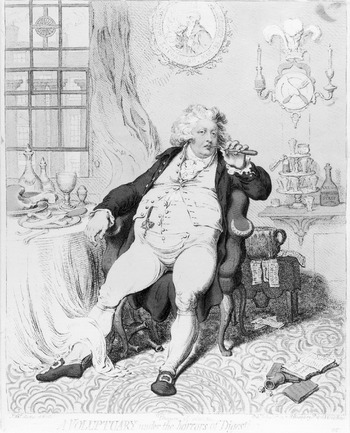
Debate kept returning to the question of who was responsible not only for the payment of the prince's debts but also for their accumulation. The M.P.s did not discuss the specific sources of the debts beyond numerous veiled references to extravagances and bad advice. In the absence of a specific breakdown of the debt, commentators had free rein to represent George's expenses as incurred for the honorable purpose of court splendor and charity or in the shameful pursuit of vice and dissipation. The press had long provided both sorts of evidence. Throughout the 1790s The Times, while it customarily admired the diamonds, embroidery, taste, and tailoring the prince displayed during court galas, also reported in disapproving tones his wins and losses at Newmarket and whatever unsuitable company he kept. Additionally, as Hibbert points out, James Gillray's visual portrayal of George as A Voluptuary under the Horrors of Digestion (fig. 1) stuck in the public mind. At the height of the debt controversy, The Times conjured this image as it advised him against “a species of luxury, which, without heightening the dignity of the Prince, degrades the character of the man, namely the luxury of the table.” The prince's immediate and enthusiastic response to the petition of ailing Birmingham buckle manufacturers by promoting their wares with his patronage in 1791 might have contributed to the fierce loyalty of the town, but such acts of munificence were swallowed up by the breadth of the prince's self-indulgence.Footnote 36
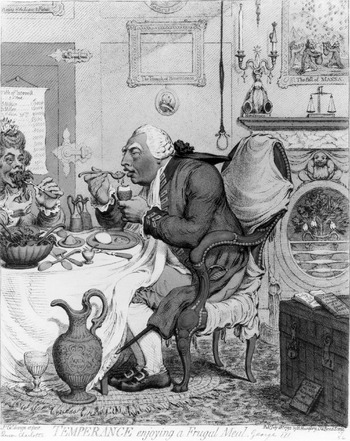
The controversy generated by the prince's disordered finances must be viewed within the larger discourse on royal spending habits. As Prince George became the poster boy for fashionable vice, George III and Queen Charlotte seemed caught in a conundrum associated with the middle class. Leonore Davidoff and Catherine Hall described it as “a tug between demonstrating worldly status—and creditworthiness—and a religious, moral rejection of the material world. … And yet, maintaining a certain material level was necessary to moral worth.”Footnote 37 The prince was not the only one to notice that his father refused to spring for more than three coats a year. When Gillray represented the prince as the picture of dissipation, his companion print had the king and queen as the exemplification of an
—James Gillray, A Voluptuary under the Horrors of Digestion, 2 July 1792, BMC, no. 8112. Courtesy of the Lewis Walpole Library.

avaricious thrift in Temperance Enjoying a Frugal Meal (fig. 2).Footnote 38 Satirists seized upon the king's unaristocratic taste for simple food and turned the royal couple's eating habits into a metaphor for false economy. Artists showed the pair stuffing their maws with cheap fare such as eggs, greens, muffins, and sprats.Footnote 39 Such economizing was wrongheaded and hypocritical when one considered that many subjects did with much less. Those who wished to present the king as moral exemplar found themselves in the same predicament as Adam Smith. When he began Theory of Moral Sentiments in 1752, Smith considered the aristocracy an outmoded luxurious order from feudal times and expected the commercial orders to set new standards of behavior by public-spirited enterprise and industry. By the time he sat down to complete the work shortly before his death in 1790, he realized that the middling sort was just as prone to selfishness and vice.Footnote 40
Authors of political satires appeared to share Smith's fears that the façade of middle-class respectability served as a screen for secret pleasure in hidden riches. At the beginning of the decade, two images of the king dominated caricature prints: farmer George and the royal miser. King George and Queen Charlotte most often appeared as the simple country couple practicing barnyard economy and exacting a price for their produce, or as a pair of miserable hoarders living in voluntary penury. Madam Schwellenberg, the queen's first lady of the bedchamber, sometimes loomed over these scenes ready to spirit away overstuffed royal moneybags back to Hanover.Footnote 41 After Britain went to war against France, Schwellenberg faded from view in the prints, and the focus of miserliness
—James Gillray, Temperance Enjoying a Frugal Meal, 28 July 1792, BMC, no. 8117. Courtesy of the Lewis Walpole Library.

shifted. The queen still coveted her Smithean trinkets and baubles as well as those ubiquitous moneybags, but William Pitt the Younger took center stage as the money-grubber who extorted higher taxes to support an unpopular war.Footnote 42 The court became an arena for the eighteenth-century debate on luxury launched by Bernard de Mandeville's 1723 edition of Fable of the Bees. Mandeville had pointed out that while the rich indulged in their hypocritical fulmination against vice, the fact remained that without vanity and acquisitiveness, industry would die. In response, writers such as Daniel Defoe expressed their fears that the market's distribution of luxury items created a new set of artificial and insatiable desires that engendered habits of profligacy.Footnote 43 Representations of royalty at the end of the century reflected the continuing preoccupation with finding a standard of luxury that would bring a healthy economy without risking moral decay. The caricaturists implied that in spite of the opprobrium attached to patronage and conspicuous consumption, when done in the spirit of hospitality and for the promotion of manufactures, they were preferable to hoarding money to attain some individualist, self-righteous performance of virtue.
Press coverage of royal birthday celebrations—when the king entertained the aristocracy and political elite with sumptuous display—illustrates the difficulty that the royal family had in attaining the correct balance of expenditure and restraint. Until the economy took a serious downward turn in 1795, most newspapers acknowledged that shows of wealth and grandeur at court demonstrated Britain's strength and consequence abroad and stimulated manufactures at home. The Morning Chronicle, aligned with the parliamentary opposition, admitted as much on the queen's official birthday in 1793, albeit grudgingly: “We should occupy a considerable part of the Paper, if we were to enumerate the names of the British and Foreign Nobility who were present. What is chiefly looked for on this day, and what, we confess, without the friendship of our female friends, we should be unable to supply, are the dresses of the Fête. The exciting circumstances, as Mr. PITT would term them, made the display unusually brilliant; and every admirer of the Arts must rejoice in occasions of magnificence like the present, that contribute so largely to the circulation of wealth.” The Morning Post, also in opposition at the time, condemned court frivolity but could not help but to support it. Noting the elaborate preparations under way on the king's birthday in 1791, the paper referred to the occasion as “the happy day when those Butterflies, who have nothing else to recommend them than splendid carriages, and fine clothes, will appear in their element.” Nonetheless, on the following day, the Post provided full descriptions of lords’ and ladies’ attire at the drawing room and ball.Footnote 44 Ambivalence toward luxuriousness at court became particularly striking after 1795, when the demands of war were touching all classes. The Morning Post, now supporting the extraparliamentary reform movement, did not hold back its punches on the queen's birthday that year as it drew attention to the wretched poor pushed aside by the expensive carriages of an uncaring nobility on their way to enjoy the gaudy pomp of Saint James’s. The paper noted that the celebrations of the Prince of Wales's nuptials that April “exceeded in extravagance even Roman luxury” as the number of starving poor swelled the streets. Yet, the Post did not begrudge royal extravagance when done in the spirit of noblesse oblige. It carried an enthusiastic account of the grandeur of Princess Amelia's birthday in August 1798 when the king invited all his servants to attend with their families to share in the roast beef and plum pudding.Footnote 45
Dress and display took on all sorts of symbolic values. The king dressed plainly on his own birthday but put on a new suit for that of his consort. Queen Charlotte, likewise, wore a proportionate number of diamonds, depending on which member of her family stood as guest of honor, and scaled back for her own birthday. The newspapers totted up the number and cost of jewels shown off at court galas as well as the relative grandeur of the equipages in which guests arrived as if performing an audit. During the war, when royal birthdays featured military reviews, ordnance replaced diamonds as a measure of respect and loyalty. On the duke of York's birthday celebration at Brighton in August 1796, all the regiments assembled on a hill and discharged their artillery, shaking the whole town at a half-mile distance. As the Telegraph, an ultraradical paper, observed of a general review in Hyde Park the previous April: “A Review is an edifying sight; for it shews a disdain of money!—Independent of the men's time, which is worth treble their pay, each cartridge costs the country rather more than two-pence!”Footnote 46
The Morning Chronicle constantly railed against impractical court fashions and often pointedly eschewed the customary description of aristocratic dress.Footnote 47 Yet the paper was not above drawing attention to royal parsimony. It concluded its account of a royal command concert in 1796 with the exclamation, “There was not supper!” The True Briton, a Treasury paper, defended their majesties by observing, “There was not supper: but there were refreshments of different kinds, both before and after the Concert, dealt out with no sparing hand.” Yet, The Times, a paper loyal to Pitt's administration, could also be critical when the king and queen skimped on splendor, as in the case of the king's birthday in 1798, when servants snuffed the candles with unseemly haste after their majesties retired. Similarly out of character was the Telegraph on the queen's actual birthday in May 1796, which for some reason went into raptures over the queen's new gold-and-silver-gilt dinner service that gave a particularly sumptuous appearance to the small celebration.Footnote 48 Observers seemed to crave a sense of intimacy and inclusiveness in royal splendor. Caroline Girle Powys, whose life appeared to consist of attending one fashionable entertainment after another, left a detailed account of a particularly lavish assembly sponsored by Lord Barrymore in which she admired the prince's relaxed and familiar manners as he mixed with the company. Years later, Powys and her friends secured a place in the shop of Mrs. Dawson, “the famous Milliner in Pall Mall,” in order to see the Princess of Wales travel to the drawing room for the first time in the new state coach. She noted, “it certainly was a fine Sight; tho’ as most such Sights almost too Gaudy to be pleasing.” Her lukewarm reaction might have had less to do with the spectacle than the mortification of having the less privileged besting her. “The crowd as one might suppose was immense no Carriages allow’d to go up or down pall Mall, but as it was a fine day, the Companies that could not get into ye Houses walk’d for some hours up and down and when ye Princes Carriages came, made a Lane for them to pass, by which means they no doubt saw her Royal Highness much better than we did.”Footnote 49
Accounts of royal-family members as consumers suggest a society not quite ready to discard aristocratic paternalism and elegance. The veneration of the duchess of York, the king's new daughter-in-law, as a moral exemplar illustrates a commercial ethos struggling to emerge. The Times observed: “The Duchess of YORK is a pattern for other persons of fashion to emulate—to her praise be it told, she pays her tradesmen's bills regularly, and writes her own drafts on her banker.” The paper also enlisted her example in its campaign against fashionable gambling habits. The duchess provided lessons for the commercial ranks as well. The Morning Post noted that she “shews neither the pride nor affectations of what we generally see in tradesmen's daughters.” Yet embourgeioisement could be taken to excess. Soon after her arrival in 1791 she showed too much concern over the prices of silks at Covent Garden. The Times explained that her questions regarding the cost of dress material showed good sense but would be disagreeable to trade should the nobility follow her example.Footnote 50 Navigating the narrow path of virtue that lay between luxury and parsimony defied even the talents of the fair duchess.
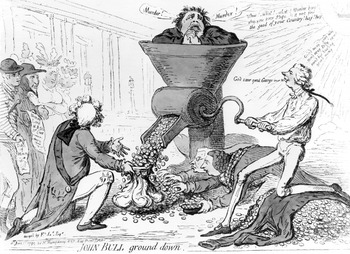
The Prince of Wales exploited the ambiguities that characterized this period of transition to a commercial economy. When he had his first bout of insolvency in the 1780s, many offered him hard cash as well as sympathy.Footnote 51 The hostility he met with in the 1790s can be attributed to the magnitude of the debts, the strained wartime economy, and his political apostasy. I believe, however, that what really damaged his credit was the prince's apparent violation of the aristocratic code of honor. Certainly credit systems and practices varied, as did attitudes toward different sorts of debt; yet, as Julian Hoppit points out, all credit “rested on personal security and confidence.”Footnote 52 Frustrated with his political impotence, young George had embraced the French aristocratic ethos lived so glamorously by Fox, which allowed one to achieve honor and esteem in fashionable society through high-stakes gambling. Thomas Kavanagh's study of this phenomenon in ancien régime France explains that the object was not to win money but rather to exhibit one's courage and skill in the same way one's ancestors risked all on the battlefield. Losing with grace and coolness established a nobleman's status as a man of honor and as superior to the “imperious rule of money.”Footnote 53 The prince forfeited this status with his involvement in a turf swindle at the end of 1791. No solid proof existed that he had tampered with a high-stakes race in which his horse, Escape, lost against great odds. Nonetheless, George's parricidal behavior during the Regency Crisis and the rakehell company he had kept since made people inclined to believe the worst. He never raced at Newmarket again and had to pension off his jockey, Chifney, who was banned by the Jockey Club.Footnote 54 The specter of Chifney continued to haunt the prince. Gillray's representation of the debts controversy has Pitt grinding John Bull into guineas that roll into the prince's crown. Burke and Dundas grub for spillage, a sizable pile lies secreted under Pitt's coat, and the king's voice issuing from a sunbeam proclaims it all for the good of the country. Chifney, proffering a list inscribed “Debts of Honour,” is the first in a line of petitioners breathing down the prince's neck (fig. 3).Footnote 55
It was shortly after the Escape scandal that Charles Pigott launched his exposé of aristocratic vice that targeted the prince's circle, tellingly entitled The Jockey Club. Nicholas Rogers notes Pigott's anger at the prospect of the Commons again paying the prince's debts without any measures to rein him in, “a situation that underscored the political elite's endorsement of gentlemanly excess and fundamental class affinity with the aristocracy.” This intertwining of interests, Rogers contends, can be counted among the reasons for the failure of this pamphlet and its sequels to fulfil Pigott's wish to overturn the corrupt order. One can see this operating earlier among John Wilkes and his supporters. Wilkes, in his privileged position, did not feel particularly concerned with the discriminatory nature of the law that sent small debtors to jail and allowed bankrupts with enormous debts a fresh start. He only added it to his catalog of wrongs generated by the discretionary power of the law in order to appease his middle-class supporters.Footnote 56 Sir John Habakkuk goes so far as to make a direct connection between the system of government finance and the expansion of gaming after the Restoration. He argues that increased opportunity for speculation spawned by funding the National Debt stimulated the gambling instinct. In spite of the increasingly negative attitude toward gaming, this element of the old aristocratic ethos proved hard to eradicate. One pamphleteer marveled at the tenacity of aristocratic vice in light of the republican movement in Europe: “Most prudent princes, would have thrown over the disproportioned form, haggard visage, and morbid excrescences of aristocracy, the wholesome veil of exterior decency and moderation.”Footnote 57
—James Gillray, John Bull Ground Down, 1 June 1795, BMC, no. 8654. Courtesy of the Lewis Walpole Library.

Moralists who fulminated against fashionable vice might have treated the most fitting plan suggested for paying off the prince's debts as a blatant manifestation of aristocratic promotion of a gambling culture, had it seen the light of day. William Fitzwilliam submitted that a lottery would raise enough revenue to pay off the debts and produce a surplus of £400,000. This sum could be held in trust by the archbishops of Canterbury and York and the bishop of London, invested in stocks, and the £16,000 yield be applied to the beneficed clergy who had less than £100 PA. He thought that the humanitarian aspect, added to the consent factor, would render the scheme favorable. “I am aware, Sir, that a Lottery is not always a very popular measure; but when the object of it is considered, I should hope, Parliament would not withhold that indulgence to the Heir Apparent, which it granted to Mess.rs Adam in the case of the Adelphi, and to Sir Ashton Lewes and Mr. Cox for their respective Museums.” Fitzwilliam drew up a scheme for selling 500,000 tickets at £4.4s. each, which would raise £2,100,100, with ten prizes at £100,000, twenty prizes at £50,000, and £50,000 applied to expenses. Judging by the popularity of private lotteries (the “little goes”) that sprang up from 1795, enough people would have overcome their scruples to generate sufficient ticket sales. Public lotteries for raising state revenue started in 1569. Pitt had no objection to the practice on moral grounds, particularly since it provided interest-free cash until payment of prizes, and it provoked less animosity than new taxes. A majority in Parliament thought otherwise and by 1792 discouraged Pitt's attempt to make lotteries a regular source of government income. Although a Commons committee would recommend outlawing state lotteries in 1808, these did not cease until 1823.Footnote 58
Tradesmen who dealt with the prince engaged in their own form of high-stakes gambling. Nathaniel Jeffreys thought his “fortune made by his smile” when the prince summoned him to Buckingham House in 1783. Indeed, he received a huge commission for jewels on the occasion of the duke of York's wedding in 1791. The trouble was, not only did he remain unpaid, but in his anxiousness to please he allowed himself to be stiffed by the prince's lady friends. When the commission reviewed his claim for £54,684 in 1795, it deemed the jewels only to be worth £45,700. Jeffreys brought the case before a court of law the following February and was awarded a sum in between. Yet, still unpaid in 1797, the jeweler filed for bankruptcy. Upon a second bankruptcy in 1806, Jeffreys published the details of his transactions with the prince spiked with claims of being privy to his secret marriage to Maria Fitzherbert. In springing to the prince's defense, Thomas Gilliland, a theater critic, presented an alternative narrative. Jefferys, dazzled by the prince's smile, vainly interpreted it as friendship, neglected his shop to court the prince, embraced an opulent lifestyle, and pursued political ambitions. Now with hopes dashed, he turned to extortion. Gilliland also related in great detail the profits that the jeweler made as a result of the business that George's patronage brought and of his habit of grossly overcharging his clients.Footnote 59 Trade with titled patrons produced mutual mistrust and undermined the confidence on which credit had to be based. Like their royal client, the prince's tradesmen could be perceived as cheats. Michael Angelo Taylor stood up in the Commons and related a long-winded tale about buckles in a shop window valued at four and a half guineas being sold to the prince for fifteen. He claimed that all gentlemen in distress faced this sort of extortion from tradesman who would extend them credit. The marquess of Buckingham declared in the Lords, “his creditors must take the chance, and suffer the fate of those who suffered before. It would be a warning and punishment to knaves and mad speculators.” The vagaries of the law caused problems for creditors and debtors alike, and meant that most disputes turned into a battle of nerves. All extensions of credit could be considered a gamble from both ends.Footnote 60
Risk was an element in all eighteenth-century business enterprise, as the high rate of bankruptcy attests. Those who expected to make a killing with fashionable clients found themselves playing a game of chance due to the different value systems buyer and seller operated under with regard to honor and credit. Some elements within the commercial classes resisted the traditional client economy and set out on an entrepreneurial path in the widening market. John Brewer notes that the complaints of tradesmen and urban groups resembled the country criticisms against Whig moneyed men, but “much more likely to connect the problem of dismantling the spoils system with those regulating credit.” They sought to liberate themselves from clientage by forming clubs, subscriptions, and charitable societies that allowed independence from patrician patronage. Wilkes would never have been able to stand in defiance of the government without such a network of support. John Sainsbury describes how Wilkes exploited the conceptual links between public and private debt. Although an inveterate spendthrift and libertine, he gained the sympathy of tradesmen by representing himself as the embattled debtor and, moreover, a victim of the corrupt systems of government patronage and finance.Footnote 61
The Prince of Wales's habits of consumption and debt exposed the contradictions underlying the commercial values espoused by George III's regime. Politicians like Pitt and Burke might have been committed to Smithean economics in principle, but in practice, country house habits prevailed among the upper echelons of society.Footnote 62 The culture of aristocratic credit and speculation on the National Debt naturalized risky borrowing practices, which then became common in business. As the market grew, creditworthiness became harder to assess. Appearances of wealth no longer guaranteed financial solvency. Although reformers like Grey and evangelicals like Wilberforce continued to reiterate the earlier cautions against luxury and display, the associations of conspicuous consumption with a cozy aristocratic paternalism and the obvious pleasures it brought preserved its attraction. Perhaps we should heed Jules Lubbock's caution against dismissing as special pleading the early modern justification for this lifestyle. Duty often operated in tandem with self-interest and ambition. “Country houses were built and maintained as theatres of a gentleman's hospitality out of a sense of duty incumbent upon status, and, indeed, as a bulwark to preserve a stable gentry against fashion, competitive consumption and social change.”Footnote 63 Commentators clearly demanded noblesse oblige from the court and castigated royal miserliness. The prince certainly overdid the hospitality, ostentation, and self-indulgent aspect of aristocratic largess, and allowed his finances to spin out of control, but then what member of the ruling elite did not? When it came to pounds, shillings, and pence, between the trap of aristocratic grandeur and the boundless temptations of the free market, royalty could never get it right.
Prince George labored under some golden-age vision of an unlimited well of royal revenue when the monarchy in fact had been on a strict budget since the creation of the Civil List in 1698. His friends helped reinforce his sense of princely entitlement. Lord Chancellor Loughborough expressed this attitude unself-consciously during debate in the Lords: “Those who stood in the exalted ranks of life, must move in their conduct by other rules than those in the lesser spheres. In them it would be low and paltry to count pounds, shillings, and pence, and to reckon with minute attention the expence of every article. If extravagance, or want of oeconomy, was to be the consequence, it was excusable; their very virtues might be turned against them; taste, liberality, generosity, benevolence, &c. were but so many incitements to error.”Footnote 64 True, the prince was in his own league as heir apparent. Anticipation of his succession to the throne and, more to the point, to control over all royal revenues and patronage, rendered speculation on his prospects a legitimate enterprise. His father's conspicuous renunciation of these principles coupled with the prince's public displays of a capacity for acting disreputably, however, damaged his credit. Moreover, by reconciling with his father and participating in a marriage settlement, he temporarily became bound to his father's rules, as was reflected in the parliamentary debaters who professed an expectation that the prince would now adhere to a reasonable program of economy. Meanwhile, the king's failure to reach into his own pockets on this occasion brought his financial probity into question as well. George III made efforts to lead, appear accessible to, and set an example for all ranks, and in so doing opened the court to commercial practices and standards. The royal family found themselves caught between the tradition of freehanded paternalism and the demands of a rational political economy, in which money did count—and was counted.