1. Introduction
For this paper, we work over the ground field
 $\mathbb {C}$
.
1.1 Main results
Let
 $(Y,D)$
be a pair where
 $Y$
is a smooth projective rational surface and
 $D\in |\!-\!K_Y|$
is either an irreducible rational nodal curve or a cycle of
 $n\geqslant 2$
smooth rational curves. We call such a pair a Looijenga pair. Write
 $D=D_1+\cdots+D_n$
where
 $D_i$
is an irreducible component. We say that
 $(Y,D)$
is positive if the intersection matrix
 $(D_i\cdot D_j)$
is not negative semi-definite.
Recall that a smooth surface
 $U$
is log Calabi–Yau with maximal boundary if and only if
 $U$
can be realized as the complement of
 $D$
in
 $Y$
for a Looijenga pair
 $(Y,D)$
. Additionally,
 $U$
is affine if and only if
 $D$
supports an ample divisor. Another equivalent condition for a Looijenga pair
 $(Y,D)$
to be positive is that the complement
 $U=\,Y\setminus D$
is the minimal resolution of an affine log Calabi–Yau surface with at worst du Val singularities.
Let
 $U$
be a smooth affine log Calabi–Yau surface with maximal boundary. Let
 $\omega$
be the canonical volume holomorphic form (unique up to scaling) of
 $U$
and
 $\mathbb {C}(U)$
the function field of
 $U$
. The set of integer tropical points
 $U^{\textrm {trop}}(\mathbb {Z})$
of
 $U$
is the set of divisorial discrete valuations
 $\nu :\mathbb {C}(U)\setminus \{0\} \rightarrow \mathbb {Z}$
such that
 $\nu (\omega )\lt 0$
together with the zero valuation. For the precise meaning of
 $\nu (\omega )\lt 0$
, see Definition 7.1.
The main result of the paper is the proof of a refined version of a conjecture announced in [Reference Gross, Hacking and KeelGHK15a, Conjecture 0.6] in the case of dimension
 $2$
.
Theorem 1.1.
Let
 $U$
be a smooth affine log Calabi–Yau surface with maximal boundary. Then, there is a decomposition
 \begin{align} H^0(U,{\mathcal {O}}_U)=\bigoplus _{q\in U^{\textrm {trop}}(\mathbb {Z})} \mathbb {C}\cdot \vartheta _q, \end{align}
of the vector space of regular functions on
 $U$
into one-dimensional subspaces, canonical up to the choice of one of the two possible orientations of
 $U^{\textrm {trop}}(\mathbb {Z})$
.
The canonical decomposition (1.1) implies the existence of distinguished vector space basis elements, unique up to scaling, called theta functions, as in [Reference Gross, Hacking and KeelGHK15a]. The original conjecture of [Reference Gross, Hacking and KeelGHK15a] says that the multiplication rule of theta functions has a combinatorial description in terms of broken lines, defined in [Reference Gross, Hacking and KeelGHK15a]. Since [Reference Gross, Hacking and KeelGHK15a], there has been rapid development of the geometric construction of structure constants for the multiplication of theta functions. Using these recent developments, we are able to prove a more refined version of the original conjecture in [Reference Gross, Hacking and KeelGHK15a], as stated in Theorem 1.9, which states that the structure constants for the multiplication rule of the canonical basis elements of
 $H^0(U,{\mathcal {O}}_U)$
has a nice geometric construction via naive counts of analytic discs in the sense of non-archimedean geometry, as in [Reference Keel and YuKY23]. There, in [Reference Keel and YuKY23], broken lines are geometrically realized as the tropicalizations, or the essential skeletons, of punctured non-archimedean analytic discs. Alternatively, these structure constants can also be constructed via the punctured Gromov–Witten invariants in [Reference Abramovich, Chen, Gross and SiebertACGS20], as we will explain later in the introduction.
Theorem 1.1, and later Theorem 1.9, follow from another main result of the paper, the identification of the mirror family associated with a positive Looijenga pair
 $(Y,D)$
constructed in [Reference Gross, Hacking and KeelGHK15a] as the universal family over a certain moduli space, as stated in Theorem 1.8. The proof of this result forms the bulk of this paper.
Before we give the precise statement of Theorem 1.8, let us briefly recall the construction of the mirror family from [Reference Gross, Hacking and KeelGHK15a]. Let
 $(Y,D)$
be a positive Looijenga pair and
 ${\textrm {NE}}(Y)$
the monoid generated by effective curve classes on
 $Y$
. We can assume that
 $U=\,Y\setminus D$
is affine. The mirror algebra
 $A$
constructed in [Reference Gross, Hacking and KeelGHK15a], as a
 $\mathbb {C}[{\textrm {NE}}(Y)]$
-module, has a basis of theta functions parametrized by
 $U^{\textrm {trop}}(\mathbb {Z})$
. The structure coefficients of
 $A$
in [Reference Gross, Hacking and KeelGHK15a] are obtained combinatorially via the machinery of the canonical scattering diagram built from the data of relative Gromov–Witten invariants of
 $(Y,D)$
, which counts rational curves on
 $Y$
meeting
 $D$
at a single point. Taking the spectrum of
 $A$
, we get an algebraic family
 \begin{equation*} \mathcal {X}:= \textrm {Spec}(A) \rightarrow S:=\textrm {Spec}(\mathbb {C}[{\textrm {NE}}(Y)]).\end{equation*}
In [Reference Gross, Hacking and KeelGHK15a], it is proved that the mirror family is a flat affine family of Gorenstein semi-log canonical surfaces with smooth generic fiber. However, it is hard to give a further concrete description of what fibers in the mirror family are by simply studying the mirror algebra
 $A$
itself.
We aim to describe the mirror family associated with a positive Looijenga pair
 $(Y,D)$
as the universal family of deformations of
 $U$
plus some extra data. To achieve this goal, we first give a canonical, fiberwise compactification of the mirror family to obtain a family of pairs,
 $(\bar {\mathcal {X}},\mathcal {D})\rightarrow S$
. We will be interested in studying the restriction of this family to the algebraic torus
 $T_Y=\textrm {Pic}(Y)\otimes \mathbb {G}_m\subset S$
. Over the torus, each fiber,
 $(\bar {\mathcal {X}}_t,\mathcal {D}_t)$
, is a pair where
 $\bar {\mathcal {X}}_t$
is a projective rational surface with at worst du Val singularities, smooth along
 $\mathcal {D}_t$
, and
 $\mathcal {D}_t\in |\!-\!K_{\bar {\mathcal {X}}_t}|$
is a rational singular nodal curve. Naturally, we would like to know what surface pairs appear as fibers in this family. To this end, we can realize our family as the universal family of what we call generalized marked pairs. The moduli functor in question is closely related to those considered in [Reference Gross, Hacking and KeelGHK15b], which gives moduli stacks for Looijenga pairs (with and without markings). The main difference in our work is that we have to account for certain types of singular surfaces. We briefly describe the objects that our mirror family will parametrize.
Definition 1.2. A generalized pair is a pair
 $(Y,D)$
where
 $Y$
is a projective rational surface,
 $D\in |\!-\!K_Y|$
is either an irreducible rational nodal curve or a cycle of
 $n\geqslant 2$
smooth rational curves,
 $Y$
is smooth along
 $D$
, and
 $Y\setminus D$
is an affine surface with at worst du Val singularities.
In particular, if
 $(Y,D)$
is a generalized pair, then given the minimal resolution
 $X\rightarrow Y$
, the strict transform,
 $\tilde {D}$
, of
 $D$
is anti-canonical and so
 $(X,\tilde {D})$
is a positive Looijenga pair.
We will then decorate a generalized pair with two types of markings.
Definition 1.3. Given a generalized pair
 $(Y,D)$
, a marking of
 $D$
is a choice of point
 $p_i\in D_i^{0 }$
for each
 $i$
, where
 $D_i^{0 }$
is the intersection of
 $D_i$
with the smooth locus of
 $D$
.
Definition 1.4. Let
 $(Y,D)$
be a Looijenga pair. A curve
 $C \subset Y$
is interior if no irreducible component of
 $C$
is contained in
 $D$
. An internal
 $(-2)$
-curve on
 $Y$
is a smooth rational curve of self-intersection −2 disjoint from
 $D$
. The pair
 $(Y,D)$
is called generic if
 $Y$
has no internal
 $-2$
curves.
Definition 1.5. Let
 $(Y,D)$
be a generalized pair. Let
 $f:X \rightarrow Y$
be the minimal resolution of
 $Y$
. Let
 $\delta _1, \delta _2, \ldots , \delta _k$
be the classes of irreducible
 $(-2)$
-curves contracted by
 $f$
. Then, define
 \begin{equation*} R(Y):=\left\{\delta =\sum a_i\delta _i \in \textrm {Pic}(X):\,a_i \in \mathbb {Z}, \quad \langle \delta , \delta \rangle = -2 \right\}. \end{equation*}
Let
 $W(Y)$
be the Weyl group associated with the root system
 $R(Y)$
. Let
 $I(Y)=R(Y)^{\perp }$
be the sublattice in
 $\textrm {Pic}(X)$
orthogonal to
 $R(Y)$
. They are the classes in
 $\textrm {Pic}(Y)$
invariant under the action of the Weyl group
 $W(Y)$
.
Definition 1.6. Fix a generic Looijenga pair
 $(Y_0, D)$
deformation equivalent to
 $(Y,D)$
. A marking of
 $\textrm {Pic}(Y)$
by
 $\textrm {Pic}(Y_0)$
is an embedding
 $\mu : I(Y)\rightarrow \textrm {Pic}(Y_0)$
which extends to an isometry
 $\tilde {\mu }:\textrm {Pic}(X)\rightarrow \textrm {Pic}(Y_0)$
where
 $X\rightarrow Y$
is the minimal resolution of
 $Y$
and
 $\tilde {\mu }$
is a marking as in Definition 2.12.
The objects that our mirror family will parametrize are then given by the following objects.
Definition 1.7. A generalized marked pair is a tuple
 $((Y,D),p_i,\mu )$
such that
 $(Y,D)$
is a generalized pair,
 $p_i$
is a marking of the boundary, and
 $\mu$
is a marking of
 $\textrm {Pic}(Y)$
. We say
 $p_i$
together with
 $\mu$
gives a marking of
 $(Y,D)$
.
Now, we give the second main theorem of this paper which leads to Theorem 1.1.
Theorem 1.8.
Given a positive Looijenga pair
 $(Y,D)$
and its mirror family
 $\mathcal {X} \rightarrow S$
, there exists a canonical compactification of
 $\mathcal {X}$
to a family of surface pairs
 $(\bar {\mathcal {X}},\mathcal {D})\rightarrow S$
such that the restriction to the algebraic torus
 $T_Y=\textrm {Pic}(Y)\otimes \mathbb {G}_m$
is a family
 $(\bar {\mathcal {X}}|_{T_Y},\mathcal {D} |_{T_Y}\!)$
of generalized marked pairs deformation equivalent to
 $(Y,D)$
. Furthermore,
 $(\bar {\mathcal {X}}|_{T_Y},\mathcal {D} |_{T_Y}\!)$
comes with a natural marking
 $p_i$
of the boundary
 $\mathcal {D}$
and a marking
 $\mu$
of the Picard group by
 $\textrm {Pic}(Y)$
such that the resulting marked family,
 $((\bar {\mathcal {X}} |_{T_Y},\mathcal {D} |_{T_Y}\!),p_i,\mu )$
, is isomorphic to the universal family of generalized marked pairs.
Now, given a smooth affine log Calabi–Yau surface
 $U$
, we fix a Looijenga pair
 $(Y,D)$
that compactifies
 $U$
and a marking of
 $D$
. By [Reference Hacking, Keel and YuHKY22, Proposition 4.10] (cf. Proposition 7.2), the structure constants of the mirror algebra
 $A$
associated with
 $(Y,D)$
can be equivalently given by the geometric construction of [Reference Keel and YuKY23]. By Theorem 1.8,
 $(Y,D)$
will appear in the canonically compactified mirror family. To get a basis of theta functions for
 $H^0(U,{\mathcal {O}}_U)$
, it suffices to specialize the coefficients of
 $A$
. However, the identification of
 $(Y,D)$
with a fiber of the compactified mirror family is not unique. As a result, the structure constants of
 $H^0(U,{\mathcal {O}}_U)$
we get by specializing coefficients depend on the identification we choose. However, once we fix a marking of
 $D$
, we will fix the set of basis elements of theta functions. Thus, we are able to prove Theorem 1.1 and Theorem 1.9, whose detailed proofs are carried out in § 7.
Theorem 1.9.
Let
 $U$
be a smooth affine log Calabi–Yau surface with maximal boundary. Fix a Looijenga pair
 $(Y,D)$
that compactifies
 $U$
and a marking of
 $D$
. Then the decomposition given in (
1.1
) has a canonical basis of theta functions such that the structure constants for multiplication of theta functions are given by the geometric construction in [Reference Keel and YuKY23]. Different choices of compactifications and markings will only result in the rescaling of basis elements and not affect the decomposition in (
1.1
).
The structure constants of the mirror algebra
 $A$
in the construction of [Reference Keel and YuKY23] are given by naive counts of non-archimedean analytic discs in the Berkovich analytification [Reference BerkovichBer90] of
 $U$
. In particular, the structure coefficients of
 $A$
are actually in
 $\mathbb {N}[{\textrm {NE}}(Y)]$
. We refer readers to § 7 for the background of [Reference Keel and YuKY23] and [Reference Keel and YuKY23, § 1.1] for the technical definition of the structure constants of mirror algebras.
We want to emphasize that the structure constants of the multiplication rule of theta functions in Theorem 1.9 can be constructed through other geometric approaches. As a special instance of the more general result in [Reference MandelMan21], the coefficients of
 $\vartheta _0$
in the expansion of products of theta functions for smooth affine log Calabi–Yau surfaces can be given the geometric interpretation as descendant log Gromov–Witten invariants. Another more systematic approach is that of punctured Gromov–Witten invariants. Originally announced in [Reference Gross and SiebertGS21] and realized in [Reference Gross and SiebertGS21] and [Reference Gross and SiebertGS22], the authors construct the mirror of a log Calabi–Yau pair
 $(X,D)$
as the spectrum of a degree zero relative quantum cohomology ring for
 $(X,D)$
. The definition of the ring and the corresponding structure constants use punctured Gromov–Witten invariants, as developed in [Reference Abramovich, Chen, Gross and SiebertACGS20]. Furthermore, [Reference Gross and SiebertGS22, Example 3.14] shows that the canonical wall structure in [Reference Gross and SiebertGS22] associated with a Looijenga pair agrees with that of [Reference Gross, Hacking and KeelGHK15a], and [Reference Gross and SiebertGS22, Theorem C] shows that mirror families constructed in [Reference Gross and SiebertGS22] agree with those in [Reference Gross and SiebertGS21], where structure constants of mirror algebras are constructed by the punctured Gromov–Witten invariants of [Reference Abramovich, Chen, Gross and SiebertACGS20].
1.2 Connections to other works
1.2.1 Tropicalization of theta functions in dimension 2
In [Reference MandelMan16], the tropicalization of theta functions of an affine log Calabi–Yau surface is studied and used to generalize the dual pairing between the character lattice and cocharacter lattice of an algebraic torus. Moreover, [Reference MandelMan16] generalizes the notion of Newton polytopes, Minkowski sums, and finite Fourier series expansions in toric geometry for regular functions on an affine log Calabi–Yau surface. It would be interesting to generalize the techniques of [Reference MandelMan16] and § 4 of the current work to the study of explicit examples of mirror families of higher dimensional log Calabi–Yau varieties, such as those examples in dimension 3 as constructed in [Reference ArgüzArg23] and [Reference Argüz and GrossAG22].
1.2.2 Theta functions in algebraic geometry
Generalized from classical theta functions of Abelian varieties, theta functions give canonical coordinates on moduli spaces of log Calabi–Yau varieties and therefore have a deep reach into moduli and deformation problems in classical algebraic geometry. Theorems 7.3 and 1.9 in the present work give an instance of the existence of theta functions on classical objects in algebraic geometry. For some explicit equations for mirror families of del Pezzo surface pairs where the boundary
 $D$
is maximally degenerate; see [Reference BarrottBar18]. Other examples of applications of mirror symmetry and theta functions to algebraic geometry include the proof of Looijenga’s conjecture on smoothability of two-dimensional cusp singularities [Reference Gross, Hacking and KeelGHK15a], theta functions and canonical compactifications of moduli spaces of polarized K3 surfaces (in a forthcoming paper by Gross, Hacking, Keel and Siebert), and the study of unirationality of Kollár–Shepherd-Barron–Alexeev moduli spaces of stable pairs [Reference Hacking, Keel and YuHKY22].
1.2.3 The symplectic cohomology of smooth affine log Calabi–Yau surfaces
In this paper, we do not justify the use of the adjective ‘mirror’ before ‘family’, i.e. we do not prove how the family is the mirror family to the original Looijenga pair in the sense of homological mirror symmetry. In the initial arXiv version of [Reference Gross, Hacking and KeelGHK15a], a series of homological mirror symmetry conjectures were formulated for the mirror family. Since then, there has been significant progress toward proving these conjectures.
One main homological mirror symmetry conjecture in [Reference Gross, Hacking and KeelGHK15a] states that the wrapped Fukaya category of a smooth affine log Calabi–Yau surface
 $U$
, viewed as a symplectic manifold with a choice of symplectic form, should be equivalent to the bounded derived category of coherent sheaves of its corresponding mirror in the mirror family. Under this conjecture, the Hochschild cohomology of the two categories is isomorphic, and in particular, the degree zero part of the symplectic cohomology
 $SH^0(U)$
of
 $U$
will be isomorphic to the ring of regular functions of its mirror. Theorems 7.3 and 1.9 of the present work then imply that
 $SH^0(U)$
should be equipped with a canonical basis as a vector space. Pascaleff [Pas15] computed
 $SH^0(U)$
and showed that it is equipped with a basis parametrized by
 $U^{\textrm {{trop}}}(\mathbb {Z})$
.
1.3 Outline of the paper
The paper starts with a review of notions pertaining to Looijenga pairs, namely markings, marked periods, and the Torelli theorem, as in [Reference Gross, Hacking and KeelGHK15b]. We then modify those constructions to allow du Val singularities on
 $Y$
and provide an adapted Torelli theorem for the new class of objects, which we call generalized marked pairs. The moduli space and universal family are made explicit as well.
After a review of the mirror construction made in [Reference Gross, Hacking and KeelGHK15a], we look at how to construct compactifications of the mirror families. This is carried out in § 4. Similar to how a convex polygon in a lattice gives rise to a polarized toric variety, the mirror family is compactified using a more general notion of a convex polygon, which no longer lives in a lattice, but in an integral affine manifold, the tropicalization of
 $U=\,Y\setminus D$
. Once the compactification is given, we then investigate the modular meaning of this family. It ends up that the compactified family can be realized as a family of generalized marked pairs, as defined in § 2.1.
To make this identification, two problems must be addressed. The first is to determine the deformation type of the family, and the second is to compute the marked periods of the compactified mirror family. To this end, modern techniques from mirror symmetry and tropical geometry are used to construct curves that correspond to exceptional curves of a toric model of
 $(Y,D)$
and to compute their corresponding periods. In doing so, we can determine the deformation type of the family along the way. The fibers in the family are deformation equivalent to the original pair,
 $(Y,D)$
. This is consistent with SYZ mirror symmetry [Reference Strominger, Yau and ZaslowSYZ96] where mirrors are given by dual torus fibrations. In this perspective, the compactified mirror should be diffeomorphic to the original pair by Poincaré Duality in dimension
 $2$
. The deformation type and period computations are carried out in § 6. The final result is that when restricted over the algebraic torus, the marked period map to
 $T_Y \simeq {\textrm {Hom}}(\textrm {Pic}(Y),\mathbb {G}_m)$
is an isomorphism (except for one special case, it is the identity map). The work done in these sections uses results from [Reference Ruddat and SiebertRS20]. This readily gives us the interpretation of our compactified family as the universal family.
2. Periods for Looijenga pairs
Definition 2.1. A Looijenga pair is a pair
 $(Y,D)$
where
 $Y$
is a smooth projective surface with
 $D\in |\!-\!K_Y|$
a reduced nodal curve. We write
 $D=D_1+\cdots+D_n$
where
 $D_i$
is an irreducible component of
 $D$
. Denote
 $U:=Y\setminus D$
, which has a holomorphic symplectic
 $2$
-form
 $\omega$
, unique up to scaling, with simple poles along
 $D$
, making
 $U$
a log Calabi–Yau surface.
Definition 2.2. Let
 $(\bar {Y},\bar {D})$
be a Looijenga pair given by a smooth projective toric surface and its toric boundary. Let
 $\pi : Y\rightarrow \bar {Y}$
be the blowup of
 $\bar {Y}$
at a finite number of smooth points of
 $\bar {D}$
and let
 $D$
be the strict transform of
 $\bar {D}$
. Then
 $(Y,D)$
is also a Looijenga pair and we call
 $(\bar {Y},\bar {D})$
a toric model for
 $(Y,D)$
.
For a Looijenga pair
 $(Y,D)$
, a blowup at a point in
 $D$
is a toric blowup if the blowup point is a node. Otherwise, it is called a non-toric blowup. Many constructions we consider are not affected by toric blowups. For convenience, we will use the following proposition.
Proposition 2.3 [Reference Gross, Hacking and KeelGHK15a, Proposition 1.3]. Every Looijenga pair
 $(Y,D)$
has a toric blowup
 $(Y',D')$
such that
 $(Y',D')$
has a toric model.
Definition 2.4. An exceptional configuration for a generic Looijenga pair
 $(Y,D)$
means an ordered collection
 $E_{ij} \in \textrm {Pic}(Y)$
of classes of exceptional divisors for a toric model. Here, for each
 $i$
, the
 $E_{ij}$
are the exceptional divisors meeting
 $D_i$
. This is an ordered collection of disjoint interior
 $(-1)$
-curves. If
 $(Y,D)$
is not generic, then by an exceptional configuration in
 $\textrm {Pic}(Y)$
we mean the parallel transport (for the Gauss–Manin connection in a family of Looijenga pairs) of an exceptional configuration on a generic pair.
We say two exceptional configurations
 $\{E_{ij}\}$
and
 $\{E'_{ij}\}$
have the same combinatorial type if, for each
 $i$
, the number of divisors meeting
 $D_i$
is the same.
More generally, we extend the notion of exceptional configurations to mean the data of a toric blowup
 $(Y',D') \rightarrow (Y,D)$
together with an exceptional configuration on
 $(Y',D')$
.
Fix a Looijenga pair
 $(Y,D)$
. Let
 $\textrm {Pic}^{0}(D)$
be the connected component of the identity of
 $\textrm {Pic}(D)$
. For each
 $i$
, let
 $D_i^{0 }$
be the intersection of
 $D_i$
with the smooth locus of
 $D$
. We now cover the notion of periods for
 $(Y,D)$
. Let us first recall the following widely known identification
 $\textrm {Pic}^0(D)\simeq \mathbb {G}_m$
determined by an orientation of
 $D$
.
Lemma 2.5 (Cf. [Reference FriedmanFri16, Lemma 1.6] and [Reference Gross, Hacking and KeelGHK15b, Lemma 2.1]). The choice of an orientation of
 $D$
gives a canonical isomorphism
 $\psi : \textrm {Pic}^{0 }(D) \xrightarrow {\sim } \mathbb {G}_m$
. Via this identification, given two points
 $p,q \in D_{i}^{0 }$
, we can choose a coordinate
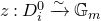 $z: D_i^{0 } \xrightarrow {\sim } \mathbb {G}_m$
so that
 $\psi ({\mathcal {O}}(p-q)) = z(q)/z(p)$
.
Proof.
Let
 $\nu :\tilde {D}\rightarrow D$
be the normalization map and
 $\tilde {D}_i$
the irreducible component of
 $D$
that is mapped to
 $D_i$
. The choice of an orientation of
 $D$
determines a generator
 $\gamma$
of
 $H_1(D, \mathbb {Z})$
. For each
 $i$
, let
 $0_i$
and
 $\infty _i$
be points on
 $\tilde {D}_i$
such that
 $\gamma |_{D_i}$
is oriented from
 $\nu (0_i)$
to
 $\nu (\infty _i)$
. In particular, since the ordering of
 $D_1, \ldots , D_n$
is compatible with
 $\gamma$
,
 $\nu (0_i) \in D_i \cap D_{i-1}$
and
 $\nu (\infty _i) \in D_i \cap D_{i+1}$
. Let
 $x_i = \nu (0_i)$
for each
 $i$
.
We have the short exact sequence
 \begin{equation*} 1 \rightarrow \mathcal {O}^{*}_{D} \rightarrow \nu _{*}{\mathcal {O}^{*}_{\tilde {D}}} \rightarrow \prod _i \mathcal {O}^{*}_{x_i} \simeq \mathbb {G}^{n}_{m} \rightarrow 1, \end{equation*}
which induces the following long exact sequence in cohomology
 \begin{equation*} 1 \rightarrow \mathbb {G}_m\rightarrow \mathbb {G}_{m}^{n} \rightarrow \mathbb {G}_{m}^{n} \rightarrow \textrm {Pic} (D) \rightarrow \textrm {Pic} (\tilde {D}) \rightarrow 0. \end{equation*}
Here, the second last arrow in the long exact sequence is the multi-degree map given by
 $L \mapsto (\deg (L|_{D_1}),\ldots , \deg (L|_{D_n}))$
. In particular, we have the exact sequence
 \begin{equation*} 1 \rightarrow \mathbb {G}_m \stackrel {\delta _1}{\rightarrow } \mathbb {G}_{m}^{n} \stackrel {\delta _2}{\rightarrow } \mathbb {G}_{m}^{n} \stackrel {\delta _3} {\rightarrow } \textrm {Pic}^{0}(D) \rightarrow 0. \end{equation*}
The map
 $\delta _1$
is given by
 $t \mapsto (t,\ldots ,t)$
and the map
 $\delta _2$
is given by
 $(t_1, \ldots , t_n)\mapsto (t_n^{-1}t_1, \ldots ,$
 $t_{n-1}^{-1}t_n)$
.
Given
 $L\in \textrm {Pic}^0(D)$
, let
 $L_i=L|_{\tilde {D}_i}$
. Then, we can recover
 $L$
from the descent data
 $\phi _i:L_{i-1} |_{\infty _{i-1}} \stackrel {\sim }{\rightarrow } L_i|_{0_i}$
. By choosing a non-vanishing section
 $\sigma _i \in \Gamma (\tilde {D_i},L_i)$
and therefore an explicit trivialization
 $L_i \stackrel {\sim }{\rightarrow } {\mathcal {O}}_{\tilde {D}_i}$
, we get an explicit identification of the set of descent data with
 $\mathbb {G}_m^{n}$
by identifying
 $\phi _i$
with
 $\sigma _i(0_i)/ \sigma _{i-1}(\infty _{i-1}) \in \mathbb {G}_m$
. Under this identification, the isomorphism class of
 $L$
is determined by
 $\prod _i \sigma _i(0_i)/ \sigma _{i-1}(\infty _{i-1})$
, which is independent of the choice of
 $\sigma _i$
’s; moreover, the image of
 $\delta _2$
, viewed as inside the set of descent data, is identified with
 $\ker \delta _3$
. Thus, we get a canonical isomorphism
 $\psi : \textrm {Pic}^{0}(D) \stackrel {\sim }{\rightarrow } \mathbb {G}_m$
given the choice of an orientation of
 $D$
such that via
 $\psi$
,
 $\delta _3$
is explicitly given by
 $(\mu _1, \ldots , \mu _n) \mapsto \mu _1 \cdots \mu _n$
.
Consider
 $L=\mathcal {O}(p-q)$
where
 $p$
and
 $q$
are on
 $D_i^{0 }$
. Let
 $z:D_i^{0 } \stackrel {\sim }{\rightarrow } \mathbb {G}_m$
be a coordinate so that
 $z(0_i)=0$
. Following the notation above, trivialize
 $L_i$
by
 $\sigma _i = {(z-z(q))}/{(z-z(p))}$
and, for
 $j \neq i$
, use
 $\sigma _j =1$
to trivialize
 $L_j$
. Then, we see that
 $\mu _i={z(q)}/{z(p)}$
and
 $\mu _j=1$
for
 $j\ne i$
. Thus,
 $\psi (\mathcal {O}(p-q)) = {z(q)}/{z(p)}$
.
Definition 2.6. For a Looijenga pair
 $(Y,D)$
, define
 \begin{equation*} D^{\perp }:=\{\alpha \in \textrm {Pic}(Y):\alpha \cdot [D_i]=0 \quad \text{for all } i\}.\end{equation*}
Define
 $D^{\perp }_{\textrm { eff}} \subset D^{\perp }$
to be the sublattice generated by classes that can be realized by effective curves on a pair deformation equivalent to
 $(Y,D)$
.
We have an exact sequence
 \begin{equation*} 0 \rightarrow \mathbb {Z} \rightarrow H_2(U, \mathbb {Z}) \rightarrow D^{\perp } \rightarrow 0. \end{equation*}
The kernel of this exact sequence is generated by the homology class
 $\Gamma$
of a real 2-torus in
 $U$
. Let
 $\omega$
be the canonical holomorphic volume (unique up to scaling) form of
 $U$
as in Definition 2.1 In this paper, following the notation in the proof of Lemma 2.5, we always assume that we normalize
 $\omega$
so that it has residue
 $1$
at
 $0_i \in D_i$
for each
 $i$
. In particular,
 \begin{equation*} \int _{\Gamma } \omega = (2\pi i )^{2}. \end{equation*}
Definition 2.7. Let
 $T_{(D^{\perp })^*}={\textrm {Hom}}(D^{\perp },\mathbb {G}_m)$
. The period point
 $\varphi _Y\in T_{(D^{\perp })^*}$
of
 $(Y,D)$
is the homomorphism given by
 \begin{equation*} \varphi _Y:D^{\perp }\rightarrow \textrm {Pic}^0(D)=\mathbb {G}_m, \hspace {.5cm}L\mapsto L|_D.\end{equation*}
In justification of calling these homomorphisms periods, the mixed Hodge structure of
 $H^2(Y\setminus D)$
is classified by the period (see [Reference FriedmanFri16]). Briefly, given
 $\gamma \in D^{\perp }$
,
 $\gamma$
can be represented by a class
 $\Sigma =\sum _k\pm [C_k]$
where
 $[C_k]$
are smooth curves in
 $Y$
meeting
 $D$
transversally at distinct points of the smooth locus of
 $D$
. A cycle,
 $\Sigma '$
, that is contained in
 $U$
and homologous to
 $\Sigma$
, can be formed and used to define the period map
 $\varphi _Y':D^{\perp }\rightarrow \mathbb {G}_m$
by
 \begin{equation*} \gamma \mapsto \exp \left (-\frac {1}{2\pi i}\int _{\Sigma '}\omega \right ).\end{equation*}
The mixed Hodge structures on
 $H^2(U)$
are indeed classified by such integrals. Then, [Reference FriedmanFri16, Proposition 3.12] shows that these integrals are equal to the periods as defined in Definition 2.7.
We will use an extended notion of the period point, which is that of a marked period point.
Definition 2.8. For a Looijenga pair
 $(Y,D)$
, a marking of the boundary is a choice of points
 $p_i\in D_i^{0 }$
, for each
 $i$
.
Definition 2.9. Let
 $(Y,D)$
be a Looijenga pair.
-
(i) Then
 $\{x\in \textrm {Pic}(Y)_{{\mathbb {R}}}:x^2\gt 0\}$
is a cone with two connected components, one of which contains all ample classes. We denote this component by
$C^+$
.
-
(ii) For an ample class
$H$
, let
$\tilde {M}$
be the set of classes
$E$
such that
$E^2=K_Y\cdot E=-1$
and
$E\cdot H\gt 0$
. Then
$C^{++}$
is defined by the inequalities
$x\cdot E\ge 0$
for all
$E\in \tilde {M}$
. -
(iii) Let
$C_{D}^{++} \subset C^{++}$
be the subcone where additionally
$x \cdot \left [ D_i \right ] \geqslant 0$
for all
$i$
. We call
$C_{D}^{++}$
the generic ample cone of
$(Y,D)$
.






Remark 2.10. For a numerical exceptional class, i.e. a class
 $E$
such that
 $E^2=K_Y\cdot E=-1$
, the condition that
 $E\cdot H\gt 0$
for an ample class
 $H$
is equivalent to the condition that
 $E$
is effective by [Reference Gross, Hacking and KeelGHK15b, Lemma 2.13]. Thus, the definition of
 $\tilde {M}$
is independent of the choice of an ample class
 $H$
.
Definition 2.11. Let
 $(Y,D)$
be a Looijenga pair.
-
(i) The roots
$\Phi \subset \textrm {Pic}(Y)$
are classes in
$D^{\perp }$
with square
$-2$
that can be realized by an internal (
$-2$
)-curve
$C$
on a deformation equivalent pair
$(Y', D')$
. -
(ii) Let
$\Delta _Y\subset \textrm {Pic}(Y)$
be the set of internal
$(-2)$
-curves. -
(iii) Let
$\Phi _{Y}\subset \Phi \subset \textrm {Pic}(Y)$
be the subset of roots,
$\alpha$
, with
$\varphi _{Y}(\alpha ) =1$
. Note that
$\Delta _Y \subset \Phi _Y \subset \Phi$
. -
(iv) Let
$W\subset {\textrm {Aut}}(\textrm {Pic}(Y))$
be the subgroup generated by reflections
$\{r_{\alpha }:\alpha \in \Phi \}$
whereLet
\begin{equation*} r_{\alpha }(\beta )=\beta +\langle \alpha ,\beta \rangle \alpha .\end{equation*}
$W_Y\subset W$
be the subgroup generated by
$\{r_{\alpha }:\alpha \in \Delta _Y\}$
.












By [Reference Gross, Hacking and KeelGHK15b, Proposition 3.4], we have
 $\Phi _Y =W_Y \cdot \Delta _Y$
.
Definition 2.12. Let
 $(Y,D)$
be a Looijenga pair, and fix a generic Looijenga pair
 $(Y_0,D)$
deformation equivalent to
 $(Y,D)$
. Then, a marking of
 $\textrm {Pic}(Y)$
by
 $\textrm {Pic}(Y_0)$
is an isomorphism of lattices
 $\mu :\textrm {Pic}(Y)\rightarrow \textrm {Pic}(Y_0)$
such that
 $\mu ([D_i])=[D_i]$
for each
 $i$
and
 $\mu (C^{++})=C^{++}$
.
Definition 2.13. Let
 $(Y,D)$
be a Looijenga pair. Let
 $\mathrm {Adm}_Y$
denote the subgroup of automorphisms of the lattice
 $\textrm {Pic}(Y)$
preserving the boundary classes
 $[D_i]$
and the cone
 $C^{++}$
. We always have
 $W \subset \mathrm {Adm}_{Y}$
. By [Reference Gross, Hacking and KeelGHK15b, Theorem 4.7], if
 $(Y',D') \rightarrow (Y,D)$
is a toric blowup, then we have a natural identification
 $\mathrm {Adm}_{Y}=\mathrm {Adm}_{Y'}$
.
Lemma 2.14.
For a positive Looijenga pair
 $(Y,D)$
, we have
 $\mathrm {Adm}_Y = W$
where
 $W$
is as in Definition 2.11
(iv).
Proof.
Recall that
 $\mathrm {Adm}$
is invariant under toric blowups. So we can assume that
 $(Y,D)$
has a toric model
 $p: (Y,D) \rightarrow (\bar {Y},\bar {D})$
. We use classifications of positive Looijenga pairs given by [Reference MandelMan19, Theorems 4.4 and 4.5]. It follows from these theorems that
 $D^{\perp }_{\textrm { eff}}$
has the following three possibilities:
-
(i)
$D^{\perp }_{\textrm { eff}} = D^{\perp } = D_n (n \geqslant 4)$
; -
(ii)
$D^{\perp }_{\textrm { eff}} = D^{\perp } = E_n (n=6,7,8)$
; and -
(iii)
$D^{\perp }_{\textrm { eff}} = A_{d_1-1}\oplus \cdots \oplus A_{d_m-1}$
.



In the first two cases, by [Reference MandelMan19, Theorem 4.4], we can assume
 $(Y,D)$
has a toric model of
 $\mathbb {P}^2$
together with its toric boundary. Then, that
 $\mathrm {Adm}_{Y}=W$
follows from [Reference Gross, Hacking and KeelGHK15b, Lemma 5.4].
In the third case, let
 $\bar {D}_{i_1}, \ldots , \bar {D}_{i_k}$
be the toric boundary divisors where we perform non-toric blowups. Let
 $N_{\bar {Y}}$
be the cocharacter lattice of the Zariski-open dense torus orbit of
 $\bar {Y}$
, and
 $\nu _i$
be the primitive generator of the ray in the toric fan of
 $\bar {Y}$
corresponding to
 $\bar {D}_i$
. By [Reference MandelMan19, Theorem 4.5], we can choose
 $p$
so that the rays generated by
 $\nu _{i_1}, \ldots , \nu _{i_k}$
are contained in one half of
 $N_{\bar {Y},\mathbb {R}}$
, and
 $d_{k} (1\leqslant k \leqslant m)$
is just the number of non-toric blowups on
 $\bar {D}_{i_k}$
in our toric model
 $p$
. Let
 $\{E_{i_k \,j}\}$
be an exceptional configuration of
 $p$
. By [Reference Gross, Hacking and KeelGHK15b, Theorem 4.7],
 $\mathrm {Adm}_Y$
acts simply transitively on the set of exceptional configurations of the same combinatorial type as
 $\{E_{i_k\,j}\}$
. First, we show that the only interior irreducible curves contained in
 $Y$
that intersect only
 $D_{i_1}, \ldots , D_{i_k}$
are the irreducible exceptional curves of the toric model
 $p$
. Then, given an element
 $g$
in
 $\mathrm {Adm}_Y$
, for each
 $k$
,
 $g$
must permute the set of exceptional curves in the exceptional configuration that intersects
 $D_{i_k}$
, and therefore
 $\mathrm {Adm}_Y = W$
. We use the same argument as used in the proof of [Reference MandelMan19, Theorem 4.5]. Indeed, let
 $C$
be such an interior curve in
 $Y$
. Let
 $\bar {C}$
be its image under
 $p$
. Then, by standard toric geometry,
 $\sum (\bar {C} \cdot \bar {D}_i) \nu _i =0$
. For
 $i$
not equal to one of
 $i_1, \ldots , i_k$
,
 \begin{equation*} \bar {C} \cdot \bar {D}_i = p^{*}(\bar {C}) \cdot p^{*}(\bar {D}_i) = C \cdot D_i =0. \end{equation*}
Since
 $\sum (\bar {C} \cdot \bar {D}_i) \nu _i =0$
and
 $\nu _{i_1}, \ldots , \nu _{i_k}$
are contained in one half of
 $N_{\bar {Y},\mathbb {R}} \simeq \mathbb {R}^2$
, this is possible only if
 $\bar {C} \cdot \bar {D_i}=0$
for all
 $i$
. Thus,
 $C$
must be supported on one of the exceptional curves of our toric model
 $p$
.
The marked period can now be defined as follows.
Definition 2.15. Given a tuple
 $((Y,D),p_i,\mu )$
, the marked period point is the homomorphism
 $\varphi _{((Y,D),p_i,\mu )}\in {\textrm {Hom}}(\textrm {Pic}(Y_0),\textrm {Pic}^0(D))$
given by
 \begin{equation*} \varphi (L):=(\mu ^{-1}(L)|_D)^{-1}\otimes {\mathcal {O}}_D\left (\sum (L\cdot D_i)p_i\right ).\end{equation*}
Definition 2.16. Two marked Looijenga pairs
 $((Y,D),p_i,\mu )$
and
 $((Y',D'),p'_i,\mu ')$
are said to be isomorphic if there is an isomorphism
 $f:Y\rightarrow Y'$
such that
 $f(D_i)=D'_i$
,
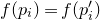 $f(p_i)=f(p_i')$
, and the induced map
 $f^*:\textrm {Pic}(Y')\rightarrow \textrm {Pic}(Y)$
satisfies
 $f^{*} = \mu ^{-1} \circ \mu '$
.
In [Reference Gross, Hacking and KeelGHK15b, Theorem 1.8], a global Torelli theorem for Looijenga pairs is given. We will use the following consequence of the theorem.
Theorem 2.17 [Reference Gross, Hacking and KeelGHK15b, Theorem 1.8, Remark 1.9, and Corollary 2.10]. Two marked Looijenga pairs
 $((Y,D),\mu ,{p_i})$
and
 $((Y',D'),\mu ',{p'_i})$
are isomorphic if and only if
 $\varphi _{((Y,D),\mu ,{p_i})}=\varphi _{((Y',D'),\mu ',{p'_i})}$
and
 $\mu (\textrm {Nef}(Y))=\mu '(\textrm {Nef}(Y'))$
.
Fix a Looijenga pair
 $(Y,D)$
. The notion of marked Looijenga pairs extends to families and gives rise to a marked period map. Meaning, for a family of Looijenga pairs
 \begin{equation*} ((\mathcal {Z},\mathcal {D}),p_i,\mu )\rightarrow S, \end{equation*}
where for the fiber
 $\mathcal {Z}_s$
over
 $s$
,
 $\mu _s$
is the marking of
 $\textrm {Pic}(\mathcal {Z}_s)$
by
 $\textrm {Pic}(Y)$
and
 $p_{i}(s)$
the marking of
 $\mathcal {D}_{i,s}$
, there is a marked period map
 \begin{equation*} \Phi :S\rightarrow {\textrm {Hom}}(\textrm {Pic}(Y),\textrm {Pic}^0(D)), \end{equation*}
where
 $s\in S$
gets mapped to the homomorphism
 \begin{equation*} L\mapsto (\mu ^{-1}_s(L)|_D)^{-1}\otimes {\mathcal {O}}\left (\sum (L\cdot D_i)p_i(s)\right ).\end{equation*}
Construction 2.18. Fix
 $((Y,D),p_i)$
, a Looijenga pair with a marked boundary and a toric model
 $p:(Y,D)\rightarrow (\bar {Y},\bar {D})$
such that an exceptional configuration is given by
 $\{E_{ij}\}$
. Let
 $v_{ij}$
be the point defined by
 $E_{ij}\cap D_i$
and consider a path
 $\gamma _{ij}$
in
 $D_i$
that connects
 $v_{ij}$
and
 $p_i$
(the marked point on
 $D_i$
), with the orientation from
 $v_{ij}$
to
 $p_i$
. Let
 $\tau (\gamma _{ij})$
be a cylinder over
 $\gamma _{ij}$
in a small normal neighborhood of
 $D_i^{0 }$
. We can glue this to the complement in
 $E_{ij}$
of a small disk around
 $v_{ij}$
to get a new cycle (with boundary)
 $\tilde {\beta }$
.
The corresponding integral
 $\int _{\tilde {\beta }} \omega$
can be computed. Using the standard Stokes’ theorem and the fact that the restriction of
 $\omega$
to
 $E_{ij}\setminus D$
is zero (since it is holomorphic on
 $U$
), it follows that
 \begin{equation} \exp \bigg (-\frac {1}{2\pi i}\int _{\tilde {\beta }} \omega \bigg )= \exp \bigg(-\int _{v_{ij}}^{p_i} \frac {dz}{z} \bigg) = \frac {z(v_{ij})}{z(p_i)}, \end{equation}
where
 $z: D_i^{0 } \xrightarrow {\sim } \mathbb {C}^{*}$
is a coordinate we choose as in Lemma 2.5.
Lemma 2.19. We have
 \begin{equation} \exp \left (-\frac {1}{2\pi i}\int _{\tilde {\beta }}\omega \right )=\varphi _{((Y,D),p_i,\mu )}({\mathcal {O}}_{Y}(E_{ij})), \end{equation}
where we assume that
 $\mu :\textrm {Pic}(Y)\rightarrow \textrm {Pic}(Y)$
is the identity.
Proof.
Let
 $z: D_i^{0 } \xrightarrow {\sim } \mathbb {C}^{*}$
be a coordinate as in Lemma 2.5. By Equation (2.1), the left-hand side of equality (2.2) is equal to
 ${z(v_{ij})}/{z(p_i)}$
. The marked period for
 $E_{ij}$
is given by
 \begin{align*} \varphi _{(Y,D,p_i,\mu )}({\mathcal {O}}_{Y}(E_{ij}))&=({\mathcal {O}}_{Y}(E_{ij}))|_D^{-1}\otimes \mathcal {O}_Y\bigg(\sum _k (E_{ij}\cdot D_k) p_k\bigg)\\ &=\mathcal {O}(-v_{ij})\otimes \mathcal {O}(p_i)\\ &=\mathcal {O}(p_i-v_{ij})\\ &=\frac {z(v_{ij})}{z(p_i)}, \end{align*}
where the last equality comes from the canonical identification
 $\textrm {Pic}^{0 }(D)=\mathbb {G}_m$
in Lemma 2.5.
We now construct universal families as in [Reference Gross, Hacking and KeelGHK15b]. Let
 $(Y,D)$
be a Looijenga pair, with
 $\pi :(Y,D)\rightarrow (\bar {Y},\bar {D})$
a toric model with an exceptional configuration
 $E_{ij}$
. Denote
 $T_{Y}^{*}:={\textrm {Hom}}(\textrm {Pic}(Y),\mathbb {G}_m)$
. Then there are sections (as in [Reference Gross, Hacking and KeelGHK15b, Proposition 2.9])
 \begin{equation*} p_i:T_{Y}^{*}\rightarrow T_{Y}^{*} \times D_i^{0 }, \end{equation*}
 \begin{equation*} q_{ij}:T_{Y}^{*}\rightarrow T_{Y}^{*}\times D_i^{0 }, \end{equation*}
such that for
 $\varphi \in T_{Y}^{*}$
, we have
 \begin{equation*} \varphi (E_{ij})={\mathcal {O}}_D(q_{ij}(\varphi ))^{-1}\otimes {\mathcal {O}}_D(p_i(\varphi ))\in \textrm {Pic}^0(D).\end{equation*}
Let
 $\Pi :(\mathcal {Y}_{\left \{ {E_{ij}}\right \}},\mathcal {D})\rightarrow T_{Y}^{*}\times \bar {Y}$
be the blowup along the sections
 $\left \{q_{ij}\right \}$
. This family then comes with a marking of the Picard group by
 $\textrm {Pic}(Y)$
on each fiber. Then
 \begin{equation*} \lambda :((\mathcal {Y}_{\left \{E_{ij} \right \}},\mathcal {D}),p_i,\mu )\rightarrow T_{Y}^{*}, \end{equation*}
is what [Reference Gross, Hacking and KeelGHK15b] calls a universal family. Note that these universal families are not unique since there is a choice of order of blowup and changing the order will give rise to a non-isomorphic family over the torus, though they will be birational to any other universal family. To avoid confusion, we call these families in this paper by the alternative term, almost-universal families.
2.1 Generalized marked pairs
The fibers of the mirror family are not necessarily smooth, and this section presents adjustments to the definition of a Looijenga pair in a way that allows for the singularities that appear. The construction here is similar to the situation for the moduli space of polarized K3 surfaces with simple surface singularities (see [Reference MorrisonMor83]).
Assume that the Looijenga pair
 $(Y,D)$
is positive. As in [Reference Gross, Hacking and KeelGHK15a, Lemma 6.9], being positive is equivalent to the existence of
 $c_i$
such that the divisor
 $-(K_Y+\sum c_iD_i)$
is big and nef. It follows that for
 $m\in \mathbb {N}$
sufficiently large, the linear system
 $|\!-\!m(K_Y+\sum c_iD_i)|$
defines a birational morphism with the exceptional locus given by all curves disjoint from
 $D$
(which is a configuration of
 $(-2)$
-curves). After contracting the internal curves, we get a pair
 $(Y',D)$
where
 $Y'$
has du Val singularities and the push forward of
 $-(K_Y+\sum c_iD_i)$
is supported on
 $D$
and is ample. Motivated by this, we now consider generalized pairs
 $(Y,D)$
as in Definition 1.2.
Recall now Definitions 1.5 and 1.7. Suppose
 $(Y,D)$
is a generalized pair such that
 $Y$
has a minimal resolution given by
 $X\rightarrow Y$
and a marking of
 $\textrm {Pic}$
given by
 $\mu$
. Note that when
 $X$
has no internal
 $(-2)$
curves,
 $\mu$
gives a marking of all of
 $\textrm {Pic}(X)$
so the regular definition of a marked pair is recovered.
Definition 2.20. An isomorphism of generalized marked pairs
 $((Y,D),p_i,\mu )$
and
 $((Y',D'),$
 $p'_i,\mu ')$
is given by an isomorphism
 $f:Y\rightarrow Y'$
that lifts to an isomorphism
 $\tilde {f}:X\rightarrow X'$
between corresponding minimal resolutions such that
 $f(D_i)=D'_i$
,
 $f(p_i)=f(p'_i)$
, and
 $\tilde {f}$
induces an isomorphism of lattices
 $\tilde {f}^*:I(Y')\rightarrow I(Y)$
such that
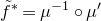 $\tilde {f}^*=\mu ^{-1}\circ \mu '$
.
Definition 2.21. The marked period point of a generalized marked pair
 $((Y,D),p_i,\mu )$
with minimal resolution
 $X\rightarrow Y$
, is given by
 \begin{equation*} \varphi _{((Y,D),p_i,\mu )}:=\varphi _{((X,D),p_i,\tilde {\mu })},\end{equation*}
where the right-hand side is as defined in Definition 2.15.
Lemma 2.22.
The marked period point in Definition 2.21 of a generalized marked pair
 $((Y,D),p_i,\mu )$
is well defined.
Proof.
Let
 $(X,D) \rightarrow (Y,D)$
be the minimal resolution of
 $(Y,D)$
. In particular,
 $(X,D)$
is a positive Looijenga pair. Let
 $W_X$
,
 $W$
,
 $\Delta _X$
,
 $\Phi _X$
, and
 $\Phi$
be as in Definition 2.11. Let
 $W(Y)$
be the Weyl group of
 $(Y,D)$
as in Definition 1.5. By [Reference Gross, Hacking and KeelGHK15b, Proposition 3.4],
 $\Phi _X = R(Y)$
and
 $W(Y)=W_X$
.
Let
 $\tilde {\mu }: \textrm {Pic}(X) \rightarrow \textrm {Pic}(Y_0)$
and
 $\tilde {\mu }': \textrm {Pic}(X) \rightarrow \textrm {Pic}(Y_0)$
be two markings of
 $\textrm {Pic}(X)$
extending
 $\mu : I(Y) \hookrightarrow \textrm {Pic}(Y_0)$
. By Lemma 2.14, there exists a unique
 $w \in W$
such that
 $w\circ \tilde {\mu } = \tilde {\mu }'$
. We want to show that
 $w \in W_X$
. Then, the statement of the lemma will follow from the fact that roots in
 $\Phi _X$
all have marked periods equal to
 $1$
. Let
 $D_{\textrm {eff}, \mathbb {R}}^{\perp } = D_{\textrm { eff}}^{\perp }\otimes \mathbb {R}$
and
 $I(Y)_{{\mathbb {R}}} = I(Y)\otimes {\mathbb {R}}$
. The three possibilities for
 $D_{\textrm { eff}}^{\perp }$
are as described in the proof of Lemma 2.14. Observe that
 \begin{equation*} D_{\textrm {eff},\mathbb {R}}^{\perp } \cap I(Y)_{{\mathbb {R}}} = \bigcap _{\alpha \in \Delta _X} ( \alpha ^{\perp } \cap D_{\textrm { eff},\mathbb {R}}^{\perp }). \end{equation*}
Suppose
 $w=s_{\beta }$
for a root
 $\beta \in \Phi \setminus \Phi _X$
. Then
 $\beta ^{\perp } \cap D_{\textrm {eff}, \mathbb {R}}^{\perp }$
is not contained in
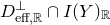 $D_{\textrm {eff},\mathbb {R}}^{\perp } \cap I(Y)_{{\mathbb {R}}}$
. In particular, there exists an element
 $x$
in
 $D_{\textrm {eff}}^{\perp } \cap I(Y)$
such that
 $x$
is not fixed under the reflection
 $s_{\beta }$
, which is a contradiction that
 $w$
fixes elements in
 $I(Y)$
pointwise. Hence, the assumption is false and
 $w \in W_X$
.
Theorem 2.23 (Global Torelli theorem for generalized marked pairs). Two generalized marked pairs,
 $((Y_1,D_1),p_1,\mu _1)$
and
 $((Y_2,D_2),p_2,\mu _2)$
, are isomorphic if and only if
 $\varphi _{((Y_1,D_1),p_1,\mu _1)}=\varphi _{((Y_2,D_2),p_2,\mu _2)}$
.
Proof.
Let
 $f_i: X_i\rightarrow Y_i$
be the minimal resolution of
 $Y_i$
. If the two generalized marked pairs are isomorphic, then it is clear that the marked periods must coincide.
Suppose the two generalized marked pairs have the same period. Consider the induced isometry on
 $I(Y_i)^{\perp }$
which gives an isomorphism of root systems. Let
 $\Phi$
be the set of roots of
 $\textrm {Pic}(Y_0)$
. Let
 $\Phi ' = \{ \delta \mid \delta \in \Phi ,\, \varphi (\delta ) =1\}$
. By [Reference Gross, Hacking and KeelGHK15b, Proposition 3.4],
 $\Phi '$
is contained in
 $\tilde {\mu }_i(R({Y_i}))$
. By Lemma 2.15 and [Reference Gross, Hacking and KeelGHK15b, Theorem 3.2], each
 $ \tilde {\mu }_i(\textrm {Nef}(X_i))$
is the closure of a connected component of
 \begin{equation*} C_{D}^{++} \setminus \bigcup _{\alpha \in \Phi '}{\alpha }^{\perp }, \end{equation*}
and the action of the Weyl group
 $W(\Phi ')$
on the set of connected components of
 $C_{D}^{++} \setminus \bigcup _{\alpha \in \Phi '}{\alpha }^{\perp }$
is transitive. Thus, there must exist
 $w\in W (\Phi ')$
such that
 $w \circ \tilde {\mu }_1(\textrm {Nef}(X_1))=\tilde {\mu }_2(\textrm {Nef}(X_2))$
. Composing an isometry with
 $w$
is still an isometry, and
 $w$
does not affect the isometry on the level of
 $I(Y_i)=R(Y_i)^{\perp }$
. Thus, replacing
 $\tilde {\mu }_1$
with
 $w\circ \tilde {\mu }_1$
keeps the marked period points for
 $((X_i,D_i),p_i,\tilde {\mu }_i)\ (i=1,2)$
the same but their Nef cones are identified. By [Reference Gross, Hacking and KeelGHK15b, Theorem 1.8], they are isomorphic marked tuples. Thus, the same is true for
 $((Y_i,D_i),p_i,\mu _i)$
 $(i=1,2)$
.
Lemma 2.24.
There are no non-trivial automorphisms of generalized marked pairs
 $((Y,D),p_i,\mu )$
.
Proof.
Let
 $((Y,D),p_i,\mu )$
be a generalized marked pair with minimal resolution
 $((X,D),p_i,\tilde {\mu })$
. Suppose
 $f\in {\textrm {Aut}}(Y,D)$
fixes
 $D$
pointwise, and
 $f^*$
induces the identity on
 $I(Y)$
which extends to an isometry on
 $\textrm {Pic}(X)$
. Consider a lift to an automorphism of
 $(X,D)$
given by
 $\tilde {f}$
. Let
 $N'$
be the cokernel of the map
 \begin{equation*}\textrm {Pic}(Y) \rightarrow \mathbb {Z}^n,\quad L \mapsto (L\cdot D_i)_{1 \leqslant i \leqslant n}.\end{equation*}
Consider the following exact sequence
 \begin{equation*} 1\rightarrow {\textrm {Hom}}(N', \mathbb {G}_m)\rightarrow {\textrm {Aut}}(X,D)\rightarrow H_{X}/W_{X}\rightarrow 1,\end{equation*}
where
 $H_X\subset {\textrm {Aut}}(\textrm {Pic}(X))$
is the subgroup that fixes the period point
 $\varphi _X$
. If
 $\tilde {f}$
maps to an element in
 $H_X$
that is not contained in
 $W_X$
, then it will not fix
 $R(Y)$
and therefore
 $I(Y)$
, in contradiction with
 $I(Y)$
being fixed. Therefore, the automorphism
 $\tilde {f}$
must lie in
 ${\textrm {Hom}}(N', \mathbb {G}_m)$
. By [Reference Gross, Hacking and KeelGHK15b, Proposition 2.6],
 ${\textrm {Hom}}(N', \mathbb {G}_m)$
is identified with
 \begin{equation*}K:= \textrm {ker}[{\textrm {Aut}}(X,D)\rightarrow {\textrm {Aut}}(\textrm {Pic}(X))], \end{equation*}
and the natural map
 $K\rightarrow {\textrm {Aut}}^0(D)$
given by restriction is an injection. Then for
 $D$
to be fixed pointwise,
 $f$
must be the identity.
We can also make sense of families of generalized marked pairs. To make this precise, we first quote a result from [Reference MorrisonMor83]. First recall Definition 1.5 for
 $I(Y)$
.
Lemma 2.25 [Reference MorrisonMor83, Corollary 3]. If
 $p:\mathcal {X}\rightarrow S$
is a proper family of surfaces with only rational double points as singularities, then there is a sheaf
 $I(\mathcal {X}/S)$
such that for each
 $s\in S$
, with
 $U$
a sufficiently small neighborhood of
 $s\in S$
, and
 $X_s$
the fiber of
 $s$
, it follows that
 $\Gamma (U,I(\mathcal {X}/S))=I(X_s)$
.
Now fix a generic Looijenga pair
 $(Y_0,D)$
. We want to show that
 $T_{Y_0}^{*}={\textrm {Hom}}(\textrm {Pic}(Y_0),\mathbb {G}_m)$
represents a fine moduli space. We will work in the analytic category and the stack we define will be over the category of analytic spaces. The stack we consider is similar to the moduli stack of marked Looijenga pairs considered in [Reference Gross, Hacking and KeelGHK15b, § 6].
Let
 $\mathcal {M}_{Y_0}$
be the moduli stack of families of generalized pairs
 $(Y,D)$
together with a marking of
 $D$
and a marking of
 $\textrm {Pic}(Y)$
by
 $\textrm {Pic}(Y_0)$
that allow simultaneous resolutions. More precisely, for an analytic space
 $S$
, the objects of the category
 $\mathcal {M}_{Y_0}(S)$
are a morphism
 $f:(\mathcal {Y},\mathcal {D})\rightarrow S$
together with sections
 $p_i:S\rightarrow \mathcal {D}_i$
and injections
 $\mu :I(\mathcal {Y}/S)\rightarrow {\underline {\textrm {Pic}(Y_0)}}_S$
where
 $I(\mathcal {Y}/S)$
is as in Lemma 2.25 such that:
-
(I)
$\mathcal {Y}/S$
is a flat family of surfaces and it admits a simultaneous resolution; -
(II)
$\mathcal {D}_i$
is a Cartier divisor on
$\mathcal {Y}/S$
for each
$i$
; -
(III) each closed fiber
$(\mathcal {Y}_s,\mathcal {D}_s,p_i(s),\mu |_s)$
is a generalized marked pair with the marking of the boundary given by
$p_i(s)$
and the marking of
$\textrm {Pic}$
by
$\mu |_s$
; and -
(IV) in the case
$n=1,2$
, we assume that we are given an orientation of
$\mathcal {D}$
, that is, an identification
$\mathbb {Z} \times S \xrightarrow {\sim } R^{1}f_{*}\mathbb {Z}_{\mathcal {D}}$
.






Notice that the sections
 $p_i$
and the orientation
 $\mathcal {D}$
determine a canonical isomorphism
 $D\times S \xrightarrow {\sim } \mathcal {D}$
. This is used to define the marked period mapping for families over an arbitrary base
 $S$
. Then given a family of generalized marked pairs,
 $((\mathcal {Y},\mathcal {D}),p_i,\mu )\rightarrow S$
, we have an induced marked period map to
 ${\textrm {Hom}}(\textrm {Pic}(Y_0),\mathbb {G}_m)$
.
Proposition 2.26. The stack
 $M_{Y_0}$
is represented by
 $T_{Y_0}^{*} = \textrm{Hom}(\textrm{Pic}(Y_0),\mathbb {G}_m)$
.
Proof.
Since objects of
 $\mathcal {M}_{Y_0}$
have no non-trivial automorphisms by Proposition 2.24, the stack
 $\mathcal {M}_{Y_0}$
is represented by an analytic space. We have the morphism
 \begin{equation*} \Psi : \mathcal {M}_{Y_0} \rightarrow T_{Y_0}, \end{equation*}
which is defined as follows. Given
 $((\mathcal {Y,D})/S,\mu , {p_i})$
, we have the associated marked period mapping
 $\phi : S \rightarrow T_{Y_0}$
as in Definition 2.21.
We want to show that
 $\Psi$
is an isomorphism. That the period mapping
 $\Psi$
is étale follows from [Reference LooijengaLoo81, II 2.5] and [Reference MorrisonMor83, § 3, Corollary 1]. That
 $\Psi$
is injective on points follows from Theorem 2.23. To show that
 $\Psi$
is surjective, consider an almost-universal family
 $\mathcal {Y}\rightarrow T_{Y_0}^{*}$
of Looijenga pairs
 $(Y,D)$
with a marking of the Picard group by
 $\textrm {Pic}(Y_0)$
as well as a marking of the boundary
 $D$
. There is a morphism
 $(\mathcal {Y},\mathcal {D}) \rightarrow (\check {\mathcal {Y}},\mathcal {D})$
contracting all the internal
 $(-2)$
-curves on each fiber in
 $(\mathcal {Y},\mathcal {D})$
. This gives rise to a family
 $((\check {\mathcal {Y}},\mathcal {D}),p_i)\rightarrow T_{Y_0}^{*}$
, where the fibers
 $\check {\mathcal {Y}}_s$
have, at worst, du Val singularities. Furthermore, the original marking by
 $\textrm {Pic}(Y_0)$
contains the data for a marking on the generalized family and the boundary marking descends as well. Thus, we get a family of generalized marked pairs
 $((\check {\mathcal {Y}},\mathcal {D}),p_i,\mu )\rightarrow T_{Y_0}^{*}$
. Furthermore, by construction, the period of the fiber over
 $\varphi \in T_{Y_0}^{*}$
is
 $\varphi$
. Note that the choice of the almost-universal family does not affect the construction. Thus
 $\Psi$
is an isomorphism as we have claimed.
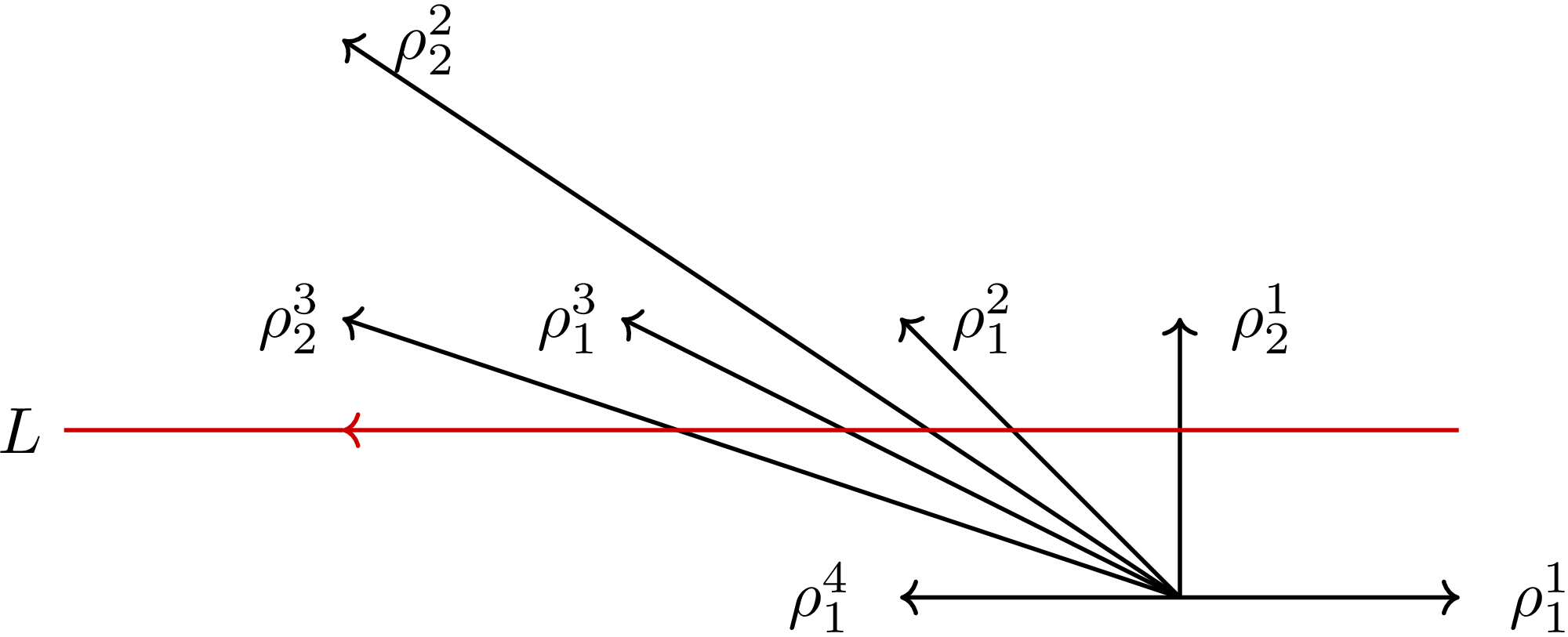
3. Review of mirror symmetry for log Calabi–Yau surfaces
We review notions and results related to the construction of the mirror family in [Reference Gross, Hacking and KeelGHK15a]. Let
 $(Y,D)$
be a positive Looijenga pair and denote
 $U=\,Y\setminus D$
. To each pair, we will associate to it an integral affine manifold with singularities.
Definition 3.1. Fix a lattice
 $M\simeq \mathbb {Z}^n$
. Let
 $M_{{\mathbb {R}}}=M\otimes _{\mathbb {Z}}{\mathbb {R}}$
. An integral affine manifold is a real manifold with an atlas of charts
 $\psi _i: U_i \rightarrow M_{\mathbb {R}}$
such that the transition functions lie in the group of affine linear transformations of the lattice
 $M$
. An integral affine linear manifold is (oriented) integral linear if the transition functions of its atlas lie in
 $\mathrm {SL}_n (\mathbb {Z})$
.
The spaces we consider do not have a global integral affine structure, so we consider integral affine manifolds with singularities. These are real manifolds
 $B$
such that there is an open subset
 $B_0\subset B$
that is an integral affine manifold such that the singular locus of
 $B$
(where the affine structure is not defined) given by
 $B\setminus B_0$
is a locally finite union of closed submanifolds of codimension at least two. There is a local system
 $\Lambda$
on
 $B_0$
given by flat integral vector fields. Given any simply connected subset
 $\tau \subset B_0$
, we write
 $\Lambda _{\tau }$
for the stalk of
 $\Lambda$
at any point of
 $\tau$
(any two such stalks are canonically identified via parallel transport) and let
 $\Lambda _{\tau , \mathbb {R}} = \Lambda _{\tau }\otimes _{\mathbb {Z}} \mathbb {R}$
. We also use
 $\Lambda _{\tau }$
to denote the local system of flat integral vector fields on
 $\tau$
since what we mean will be clear from the context. We denote by
 $\check {\Lambda }$
the local system dual to
 $\Lambda$
.
To a fixed Looijenga pair
 $(Y,D)$
, we will associate an integral affine manifold,
 $B_{(Y,D)}$
. Fix a lattice
 $M\simeq \mathbb {Z}^2$
. Recall
 $M_{{\mathbb {R}}}=M\otimes _{\mathbb {Z}}{\mathbb {R}}$
. Let
 $N = \mathrm {Hom}_{\mathbb {Z}} (M, \mathbb {Z})$
be the dual lattice of
 $M$
. Let
 $D= D_1+\cdots +D_n$
. For each node
 $p_{i,i+1}=D_i\cap D_{i+1}$
, we take a rank
 $2$
lattice
 $M_{i,i+1}$
with a basis
 $v_i,v_{i+1}$
and the cone
 $\sigma _{i,i+1}\subset {M_{i,i+1}}\otimes _{\mathbb {Z}}{{\mathbb {R}}}$
generated by the two basis vectors. We then form
 $B_{(Y,D)}$
by gluing
 $\sigma _{i,i+1}$
to
 $\sigma _{i-1,i}$
along the ray
 $\rho _i := \mathbb {R}_{\geqslant 0} v_i$
. Note that
 $B_{(Y,D)}$
is homeomorphic to
 $\mathbb {R}^2$
. Now we define the integral affine structure on
 $B_{(Y,D)}\setminus \{0\}$
. Let
 $U_i$
be the interior of
 $\sigma _{i,i+1}\cup \sigma _{i-1,i}$
. Then, we define a chart
 $\psi _i:U_i\rightarrow M_{{\mathbb {R}}} \simeq {\mathbb {R}}^2$
given by
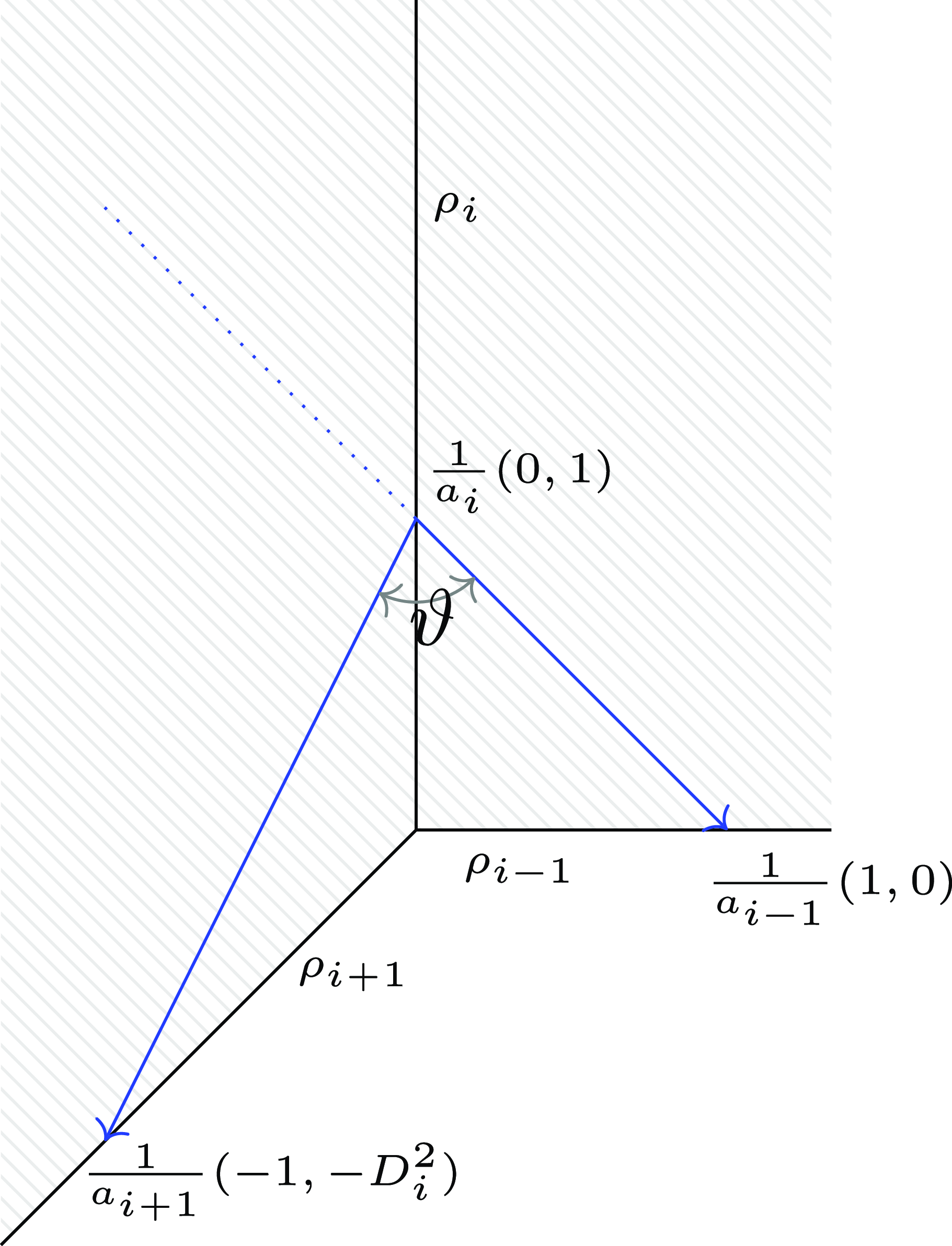
 \begin{equation*} \psi _i(v_{i-1})=(1,0), \quad \psi _i(v_i)=(0,1), \quad \psi _i(v_{i+1})=(-1,-D_i^2).\end{equation*}
Therefore,
 $B_{(Y,D)}$
is actually an integral linear manifold with a singularity at
 $0$
. Note that
 $B_{(Y,D)}$
also has a fan structure
 $\Sigma$
given by
 \begin{equation*}\Sigma = \left \{ \sigma _{i,i+1} \mid 1 \leqslant i \leqslant n\right \} \cup \left \{ \rho _i \mid 1 \leqslant i \leqslant n \right \} \cup \left \{0 \right \}.\end{equation*}
Remark 3.2. Note that the above construction also makes sense in the case where
 $n=1$
, i.e. when the anticanonical cycle
 $D$
is an irreducible nodal curve. In this case, we only have one cone
 $\sigma _{1,1}$
whose two sides are identified. The subtle point is how we define the integral affine charts. Instead of using
 $D^{2}$
, we use
 $D^{2} -2$
, the degree of the normal bundle of the map from the normalization of
 $D$
to
 $Y$
. However, this special case can complicate the arguments in the proofs in later sections of the paper. To bypass this technical complication in this case, we usually pass to the blowup of
 $D$
at the node and replace
 $D$
with the reduced inverse image of
 $D$
under the blowup. By [Reference Gross, Hacking and KeelGHK15a, Lemma 1.6], toric blowups will not change the underlying integral affine structure. Thus, in this way, we will obtain a unifying description for the integral affine manifolds associated with Looijenga pairs.
When
 $(Y,D)$
is clear from context, we will often drop the subscript and just denote the associated manifold
 $B$
instead of
 $B_{(Y,D)}$
. Note that if the pair
 $(Y,D)$
is toric, the affine structure extends over the origin (see [Reference Gross, Hacking and KeelGHK15a, Lemma 1.8]).
Denote by
 $B(\mathbb {Z})$
the set of integer points on
 $B$
. Then, we also have the identification
 $B(\mathbb {Z}) \simeq U^{\mathrm {trop}}(\mathbb {Z})$
. However, we will not use this perspective until § 7.
Let
 $(Y,D)$
be positive,
 $P={\textrm {NE}}(Y)$
and
 $R=\mathbb {C}[P]$
. Let
 $P^{\textrm {gp}}$
be the group completion of
 $P$
and
 $P^{\textrm {gp}}_{{\mathbb {R}}} = P^{\textrm {gp}}\otimes _{\mathbb {Z}}{\mathbb {R}}$
.
Notions from [Reference Gross, Hacking and KeelGHK15a, § 2.1] will be used and we recall them here.
Definition 3.3. For each cone
 $\tau \in \Sigma$
and each cone
 $\sigma \in \Sigma$
containing
 $\tau$
, there is a canonical inclusion
 $\sigma \subset \Lambda _{\tau , \mathbb {R}}$
. We define the localized fan
 $\tau ^{-1}\Sigma$
in
 $\Lambda _{\tau , \mathbb {R}}$
as the collection of cones
 \begin{equation*}\tau ^{-1}\Sigma = \left \{\sigma + \mathbb {R}\tau \subset \Lambda _{\tau , \mathbb {R}} \mid \sigma \in \Sigma , \tau \subset \sigma \right \}.\end{equation*}
Definition 3.4. Let
 $\sigma _{\pm }$
be the two maximal cones of
 $\Sigma$
contained in
 $U_i$
. A
 $\Sigma$
-piecewise linear function on
 $U_i$
with values in
 $P_{{\mathbb {R}}}^{\textrm {gp}}$
is a continuous function
 $\varphi : U_i \rightarrow P_{{\mathbb {R}}}^{\textrm {gp}}$
such that
 $\varphi \vert _{\sigma _{\pm }}$
is given by an element
 $\varphi _{\pm }$
in
 $\mathrm {Hom}_{\mathbb {Z}} (M, P^{\textrm {gp}}) = N \otimes _{Z} P^{\textrm {gp}}$
. Write
 \begin{equation*} \varphi _{+} - \varphi _{-} = \eta _{\rho _i} \otimes \kappa _{\rho _i, \varphi }, \end{equation*}
where
 $\eta _{\rho _i} \in N$
is the unique primitive element annihilating
 $\rho _i$
and positive on
 $\sigma _{+}$
and
 $\kappa _{\rho _i, \varphi } \in P^{\textrm {gp}}$
. We call
 $\kappa _{\rho _i, \varphi }$
the bending parameter of
 $\varphi$
. Notice that
 $\kappa _{\rho _i, \varphi }$
does not depend on the ordering of
 $\sigma _+, \sigma _-$
.
Definition 3.5. A
 $\Sigma$
-piecewise linear multivalued function (with values in
 $P_{{\mathbb {R}}}^{\textrm {gp}}$
) on
 $B$
is a collection
 $\varphi =\{\varphi _i\}$
where
 $\varphi _i$
is a
 $\Sigma$
-piecewise linear function on
 $U_i$
with values in
 $P_{{\mathbb {R}}}^{\textrm {gp}}$
. This is equivalent to giving a collection of
 $\rho ^{-1}\Sigma$
piecewise linear functions
 $\varphi _i:\Lambda _{\rho _i, \mathbb {R}}\rightarrow P_{{\mathbb {R}}}^{\textrm {gp}}$
. Furthermore, two such functions
 $\varphi$
and
 $\varphi '$
are considered equivalent if
 $\varphi _i-\varphi '_i$
is linear for each
 $i$
.
From a
 $\Sigma$
-piecewise linear multivalued function,
 $\varphi =\{\varphi _i\}$
, we can form a linear locally trivial principal
 $P^{\textrm {gp}}_{{\mathbb {R}}}$
-bundle
 $\pi :\mathbb {P}_0\rightarrow B_0$
together with a section
 $\varphi :B_0\rightarrow \mathbb {P}_0$
. This is constructed by gluing
 $U_i\times P_{{\mathbb {R}}}^{\textrm {gp}}$
to
 $U_{i+1}\times P_{{\mathbb {R}}}^{\textrm {gp}}$
along
 $U_i\cap U_{i+1}\times P_{{\mathbb {R}}}^{\textrm {gp}}$
by
 \begin{equation*} (x,p)\mapsto (x,p+\varphi _{i+1}(x)-\varphi _i(x)).\end{equation*}
In particular,
 $\mathbb {P}_0$
is an integral linear manifold and
 $\pi$
is linear. The section
 $\varphi$
is formed by local sections
 $x\mapsto (x,\varphi _i(x))$
. Let
 $\Lambda _{\mathbb {P}_0}$
be the sheaf of integral tangent vectors on
 $\mathbb {P}_0$
. We define a local system
 $\mathcal {P}$
on
 $B_0$
by
 \begin{equation*} \mathcal {P}:=\pi _{*}\Lambda _{\mathbb {P}_0}, \end{equation*}
which fits into the short exact sequence of local systems given by
 \begin{align} 0\rightarrow \underline {P}^{\textrm {gp}}\rightarrow \mathcal {P}\xrightarrow {r} \Lambda \rightarrow 0, \end{align}
where
 $r$
is the derivative of
 $\pi$
.
There is a unique (up to a linear function)
 $\Sigma$
-piecewise linear multivalued function
 \begin{equation*} \varphi : |\Sigma |\rightarrow P_{{\mathbb {R}}}^{\text {gp}}, \end{equation*}
where the bending parameter (as defined in [Reference Gross, Hacking and KeelGHK15a, Definition 1.11]) at
 $\rho _i$
, denoted by
 $\kappa _{\rho _i}$
, is given by
 $[D_{\rho _i}]$
. This
 $\Sigma$
-piecewise linear multivalued function is what we use throughout this paper to define
 $\mathcal P$
.
Given
 $\tau \in \Sigma$
with
 $\dim \tau \gt 0$
, write
 $\mathcal {P}_{\tau }$
for the stalk of
 $\mathcal {P}$
at any point of
 $\tau$
. Then,
 $\varphi$
determines a
 $\tau ^{-1}\Sigma$
-piecewise linear section
 $\varphi _{\tau }: \Lambda _{\tau , {\mathbb {R}}} \rightarrow \mathcal {P}_{\tau , {\mathbb {R}}}:= \mathcal {P}_{\tau } \otimes _{\mathbb {Z}}{\mathbb {R}}$
of the projection
 $\mathcal {P}_{\tau , {\mathbb {R}}} \rightarrow \Lambda _{\tau , {\mathbb {R}}}$
.
A scattering diagram on
 $B$
is the data of a collection of rays with rational slopes called walls on
 $B$
together with formal power series satisfying certain conditions attached to these walls. See [Reference Gross, Hacking and KeelGHK15a, § 2.2] for details. Below, we recall the definition of the canonical scattering diagram in [Reference Gross, Hacking and KeelGHK15a].
Fix a ray
 $\mathfrak {d}\subset B$
with a rational slope with the origin at its endpoint. If
 $\mathfrak {d}$
is not a ray of
 $\Sigma$
, then refine
 $\Sigma$
by adding
 $\mathfrak {d}$
and also other rays such that each maximal cell of
 $\Sigma '$
is affine isomorphic to the first quadrant in
 $\mathbb {R}^2$
. This corresponds to a toric blowup
 $\pi : (\tilde {Y}, \tilde {D})\rightarrow (Y,D)$
. Let
 $C$
be the irreducible component of
 $\tilde {D}$
corresponding to
 $\mathfrak {d}$
. Let
 $\tau _{\mathfrak {d}} \in \Sigma$
be the smallest cone containing
 $\sigma$
and
 $m_{\mathfrak {d}}$
the primitive generator of the tangent space to
 $\mathfrak {d}$
, pointing away from the origin. Then define
 \begin{equation*} f_{\mathfrak {d}}:=\exp \bigg( \sum _{\beta } k_{\beta }N_{\beta }z^{\pi _{*}(\beta )-\varphi _{\tau _{\mathfrak {d}}}(k_{\beta }m_{\mathfrak {d}})}\bigg), \end{equation*}
where the sum is made over
 $\beta \in A_1(\tilde {Y})$
such that
 \begin{equation*} \beta \cdot \tilde {D}_i= \begin{cases} k_{\beta } \quad \text{for }\tilde {D}_i=C,\\ 0 \quad \text{for }\tilde {D}_i\ne C, \end{cases} \end{equation*}
for some
 $k_{\beta }\gt 0$
. Here, the
 $N_{\beta }$
are the relative Gromov–Witten invariants counting stable relative maps of genus zero curves representing the class
 $\beta$
with tangency of order
 $k_{\beta }$
at an unspecified point of
 $C^{0 }$
, the complement of nodes in
 $C$
. See [Reference Li and RuanLR01, Reference Ionel and ParkerIP03] for the original symplectic definitions of these relative Gromov–Witten invariants and [Reference LiLi01, Reference LiLi02] for the algebraic definitions. Recently, the general main result of [Reference Gross and SiebertGS22] implied that
 $N_{\beta }$
can also be defined using punctured log Gromov–Witten invariants as developed in [Reference Abramovich, Chen, Gross and SiebertACGS20].
A class
 $\beta \in A_{1}(\tilde {Y})$
is called an
 $\mathbb {A}^1$
-class if
 $N_{\beta }\ne 0$
.
The canonical scattering diagram is given by
 \begin{equation*} \mathfrak {D}^{\text {can}}:=\{ (\mathfrak {d},f_{\mathfrak {d}}):\mathfrak {d}\subset B, \text { a ray of rational slope}\}.\end{equation*}
We call a pair
 $(\mathfrak {d}, f_{\mathfrak {d}})$
in
 $\mathfrak {D}^{\text {can}}$
a scattering ray.
Definition 3.6. A broken line
 $\gamma$
in
 $(B,\Sigma )$
for
 $q\in B_0(\mathbb {Z})$
with endpoint
 $Q\in B_0$
is a proper continuous piecewise integral affine map
 $\gamma :(-\infty ,0]\rightarrow B_0$
with finitely many domains of linearity, together with, for each
 $L \subset (-\infty ,0]$
, a maximal connected domain of linearity of
 $\gamma$
, a choice of monomial
 $m_L = c_L z^{q_L}$
where
 $c_L \in \mathbb {C}^{\times }$
, and
 $q_L \in \Gamma (L, \gamma ^{-1}(\mathcal {P})\vert _L)$
, satisfying the following properties.
-
(i) For the unique unbounded domain of linearity
$L_0$
,
$\gamma \vert _{L_0}$
goes off to infinity in a maximal cone
$\sigma _0$
in
$\Sigma$
as
$t\rightarrow - \infty$
and
$q \in \sigma _0$
. Furthermore, under the parallel transport of the stalks of
$\mathcal {P}$
in
$\sigma _0$
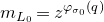
,
$m_{L_0} = z^{\varphi _{\sigma _0}(q)}$
. -
(ii) For each
$L$
and
$t\in L$
,
$-r(q_L) = \gamma '(t)$
where
$r$
is defined as in Definition 3.1. Also,
$\gamma (0) = Q \in B_0$
. -
(iii) Let
$t \in (-\infty ,0]$
be a point at which
$\gamma$
is not linear and passing from domain of linearity
$L$
to
$L'$
. Then, we require that
$\gamma (t)$
is contained in a scattering ray
$(\mathfrak {d}, f_{\mathfrak {d}})$
in
$\mathfrak {D^{\mathrm {can}}}$
such that
$\gamma$
passes from one side of
$\mathfrak {d}$
to the other at time
$t$
. Let
$n_{\sigma }$
be the primitive element of
$\check {\Lambda }_{\gamma (t)}$
such that
$\langle {n_{\sigma }, r(q_L)}\rangle \gt 0$
. Furthermore, we require that, under the parallel transport of stalks of
$\mathcal {P}$
along
$\gamma$
, we havewhere
\begin{equation*}m_{L'} = m_L \cdot (c z^s), \end{equation*}
$cz^s$
is a term in the formal power series expansion of
$f_{\mathfrak {d}}^{\langle {n_{\sigma }, r(q_L)}\rangle }$
.












Definition 3.7. For a broken line
 $\gamma$
with endpoint
 $Q \in \tau \in \Sigma$
, define
 $s(\gamma ) \in \Lambda _{\tau }$
,
 $c(\gamma )\in \mathbb {C}[P]$
by demanding that
 \begin{equation*} \mathrm {Mono}(\gamma )= c(\gamma ) \cdot z^{\varphi _{\tau }(s(\gamma ))}.\end{equation*}
Here,
 $\mathrm {Mono}(\gamma )$
denotes the monomial attached to the last domain of linearity of
 $\gamma$
.
Write
 $\mathrm {Limits}(\gamma )=(q,Q)$
if
 $\gamma$
is a broken line for
 $q$
with endpoint
 $Q \in B_0$
. We say
 $Q$
is general if the ray starting at
 $0$
and passing through
 $Q$
has irrational slope.
Theorem 3.8 [Reference Gross, Hacking and KeelGHK15a, Theorem 2.34 and Corollary 6.11]. Let
 $(Y,D)$
be positive. Consider the free
 $R$
-module
 \begin{equation*}A= \bigoplus _{q\in B(\mathbb {Z})} R\cdot \vartheta _q.\end{equation*}
For
 $p_1,p_2,q \in B(\mathbb {Z})$
and
 $z \in B_0$
a general point sufficiently close to
 $q$
, there can only be finite many pairs of broken lines
 $(\gamma _1,\gamma _2)$
such that
 $\textrm {Limits}(\gamma _i)=(p_i,z)$
and
 $s(\gamma _1)+s(\gamma _2)=q$
. Define
 \begin{equation*} \alpha _z(p_1,p_2,q)=\sum _{\substack {(\gamma _1, \gamma _2)\\ \mathrm {Limits}(\gamma _i) = (p_i, z) \\ s(\gamma _1)+s(\gamma _2)=q }} c(\gamma _1)c(\gamma _2).\end{equation*}
In particular,
 $\alpha _z(p_1,p_2,q)$
is independent of the choice of
 $z$
near
 $q$
and we define
 \begin{equation*}\alpha (p_1, p_2, q) := \alpha _z(p_1,p_2,q) \end{equation*}
for
 $z$
chosen sufficiently close to
 $q$
. Then we can define a multiplication rule on
 $A$
given by
 \begin{equation*} \vartheta _{p_1}\vartheta _{p_2}=\sum _{q\in B(\mathbb {Z})} \alpha (p_1,p_2,q)\vartheta _r.\end{equation*}
This gives a commutative and associative
 $R$
-algebra structure on
 $A$
. The induced map
 \begin{equation*} f:\textrm {Spec}(A)\rightarrow \textrm {Spec}(R) \end{equation*}
is a flat affine family of Gorenstein semi-log canonical surfaces with smooth generic fiber.
For the rest of the paper, we assume that the pair
 $(Y,D)$
is positive. As mentioned before, this means that the intersection matrix for
 $D$
is not negative semi-definite. In [Reference Gross, Hacking and KeelGHK15a, Lemma 6.9], it is stated that the following are equivalent.
-
(i) The pair
$(Y,D)$
is positive. -
(ii) The surface
$Y\setminus D$
is the minimal resolution of an affine surface with, at worst, du Val singularities. -
(iii) There exist positive integers
$a_1,\ldots ,a_n$
such that for all
$j$
,
$\left (\sum a_i D_i\right )\cdot D_j\gt 0$
.



There are several important implications of this assumption, also from the same lemma. These include the following.
-
(i) The cone
${\textrm {NE}}(Y)_{{\mathbb {R}}}$
is rational polyhedral, generated by only finitely many classes of rational curves. Furthermore, every nef line bundle on
$Y$
is semi-ample. -
(ii) The subgroup
$G\subset {\textrm {Aut}}(\textrm {Pic}(Y))$
that fixes
$[D_i]$
is finite. -
(iii) The union
$R\subset Y$
of all curves disjoint from
$D$
is contractible.





The key takeaway is that the mirror construction gives an actual algebraic family over
 $\textrm {Spec} (\mathbb {C}[{\textrm {NE}}(Y)])$
with smooth generic fibers.
Definition 3.9. Let
 $(Y,D)$
be a pair with
 $D=D_1+\cdots +D_n$
and
 $\mathbb {A}^{D} = \mathbb {A}^{n}$
be the affine space with one coordinate for each component
 $D_i$
. The relative torus
 $T^D$
is the diagonal torus acting on
 $\mathbb {A}^{n}$
whose character group is the free module with basis
 $e_{D_1},\ldots ,e_{D_n}$
.
Definition 3.10. Two types of weights will come into play associated with the action of
 $T^{D}$
on the canonical algebra generated by theta functions. One comes from the map
 $w:A_1(Y)\rightarrow \chi (T^D)$
given by
 \begin{equation*} C\mapsto \sum _i (C\cdot D_i) e_{D_i}\end{equation*}
and the other comes from
 $w:B\rightarrow \chi (T^D)\otimes {\mathbb {R}}$
, where
 $w$
is the unique piecewise linear map with
 $w(0)=0$
and
 $w(v_i)=e_{D_i}$
for
 $v_i$
the primitive generator of
 $\rho _{i}$
. Together, we get a weight map
 \begin{align*} w: B(\mathbb {Z}) \times \mathrm {NE}(Y) & \rightarrow \chi (T^{D}) \\ (q,C) & \mapsto w(q) + w(C). \end{align*}
The following theorem is a special case of [Reference Gross, Hacking and KeelGHK15a, Theorem 5.2] when
 $(Y,D)$
is positive.
Theorem 3.11 [Reference Gross, Hacking and KeelGHK15a, Theorem 5.2]. The relative torus
 $T^{D}$
acts equivariantly on the mirror family
 $\mathcal {X}=\mathrm {Spec}(A) \rightarrow \mathrm {Spec}(\mathbb {C}[\mathrm {NE}(Y)])$
. Furthermore, each theta function
 $\vartheta _{q}$
,
 $q \in B(\mathbb {Z})$
, is an eigenfunction of the action of
 $T^{D}$
with character
 $w(q)$
.
4. Compactifications via polygons
4.1 Generalized half-spaces and polygons in
$B$

In this section, the convex geometry of
 $B$
is developed. Namely, the notion of a generalized half-space is defined and we show how convex polytopes come from intersections of generalized half-spaces. Most importantly, we construct the polytopes that will be used to compactify the mirror family. First, we set up the notion of convex polygons in
 $B$
.
Definition 4.1. A closed, connected subset
 $F$
in
 $B$
with
 $0$
in the interior is a polygon in
 $B$
if for each maximal cell
 $\sigma$
in
 $\Sigma$
,
 $F\cap \sigma$
is a polygon. Given a polygon
 $F$
on
 $B$
, we say
 $F$
is convex if any immersed line segment on
 $B_0$
with endpoints in
 $F$
is contained in
 $F$
. We say a polygon is rational if for every vertex
 $v$
, we have
 $v \in B(\mathbb {Q})$
and each edge has rational slope. We say a convex rational polygon is nonsingular if for any vertex
 $v$
as the intersection of two edges
 $E_1$
and
 $E_2$
, the primitive generators of
 $E_1$
and
 $E_2$
form a basis of
 $\Lambda _{v}$
.
Remark 4.2. We emphasize that by our definition, a polygon in
 $B$
will always have
 $0$
in its interior.
Recall the notion of the developing map on
 $B_0$
.
Definition 4.3. Let
 $q:\tilde {B}\rightarrow B_0$
be the universal cover. Then the universal cover inherits an integral affine structure pulled back from
 $B_0$
. If we patch together integral affine charts on
 $B_{0}$
, then up to integral linear functions, we obtain a canonical map called the developing map
 $\delta :\tilde {B} \rightarrow \mathbb {R}^2$
. The fan
 $\Sigma$
induces a decomposition of
 $\tilde {B}$
into cones, which we denote by
 $\tilde {\Sigma }$
.
Lemma 4.4.
The developing map is one-to-one if
 $(Y,D)$
is negative semi-definite. In this case, the closure of the image is a convex cone and is strictly convex if
 $(Y,D)$
is negative definite. If the developing map is not one-to-one, then it surjects onto
 $\mathbb {R}^{2}\setminus \{0\}$
.
Proof.
Since developing maps are unique up to
 $\textrm { SL}_{2}(\mathbb {Z})$
-transformations, it suffices to prove the lemma for any particular choice of the developing map. We can assume that
 $D$
has no
 $-1$
curves by contracting irreducible
 $(-1)$
-curves in
 $D$
. Then
 $(Y,D)$
is negative semi-definite if
 $D_{i}^{2}\leqslant -2$
for all
 $i$
and negative definite if, in addition,
 $D_{i}^{2}\lt -2$
for at least one
 $i$
. If
 $D_{i}^{2}=-2$
for all
 $i$
, the developing map that takes a lift of
 $\sigma _{i,i+1}$
to the cone generated by
 $(i+1,1)$
and
 $(i,1)$
identifies
 $\tilde {B}$
with the upper half plane of
 $\mathbb {R}^{2}$
. If
 $D_{i}^{2}\lt -2$
for some
 $i$
, it follows that the developing map identifies
 $\tilde {B}$
with a strictly convex cone in
 $\mathbb {R}^{2}$
.
If
 $(Y,D)$
is positive and contains no
 $(-1)$
-curves,
 $D_{i}^{2}\geqslant 0$
for some
 $i$
. Then the image under the developing map, restricted to a lift of
 $\sigma _{i-1,i}\cup \sigma _{i,i+1}$
, will contain a half-space in
 $\mathbb {R}^{2}$
. It follows that the developing map cannot be injective and is surjective onto
 $\mathbb {R}^{2}\setminus \{0\}$
.
Corollary 4.5.
A Looijenga pair
 $(Y,D)$
is positive if and only if every immersed, directed ray on
 $B$
not passing through
 $0$
goes to infinity.
Proof.
We use the developing map
 $\delta$
. Let
 $R$
be an immersed directed ray on
 $B$
not passing through
 $0$
and choose a lift
 $\tilde {R}$
of
 $R$
to the universal cover
 $\tilde {B}$
. By Lemma 4.4, if
 $(Y,D)$
is positive, then
 $\delta$
is surjective and therefore there exists a cone
 $\sigma$
in
 $\Sigma$
such that
 $\tilde {R}$
goes to infinity in a connected component of
 $\delta ^{-1}(\sigma )$
. Conversely, if
 $(Y,D)$
is negative semi-definite, again by Lemma 4.4,
 $\delta$
is injective and the closure of its image is a convex cone
 $\mathcal {C}$
. Let
 $\tilde {\Sigma }$
be the decomposition of
 $\tilde {B} \setminus \{0\}$
into cones induced by
 $\Sigma$
. Let
 $\tilde {R}'$
be a ray in
 $\mathbb {R}^2$
not passing through the origin such that its endpoint is in the interior of
 $\mathcal {C}$
but it escapes
 $\mathcal {C}$
. Let
 $R'$
be the projection of
 $\tilde {R}'$
onto
 $B$
. Notice that
 $\tilde {R}'$
intersects rays in
 $\tilde {\Sigma }$
infinitely many times. Therefore,
 $R'$
wraps around
 $0$
infinitely many times and does not escape to infinity.
Let
 $\bar {L}\subset B_0$
be a line segment with rational slope and integral unit tangent vector
 $v$
. For
 $p\in B_0$
, we can view the vector
 $\overrightarrow {0p}$
as an element in
 $T_{p,B_0}$
, and if
 $p\in B(\mathbb {Z})$
, then, furthermore, we can view it as an element of
 $\Lambda _p$
. It is important to note that
 $\overrightarrow {0p} \wedge v$
is the same as long as we choose
 $p\in \bar {L}$
. If
 $\overrightarrow {0p}\wedge v=0$
, then
 $\bar {L}$
must be on the ray spanned by
 $\overrightarrow {0p}$
. Then, if
 $\overrightarrow {0p}\wedge v\ne 0$
for all
 $p \in \overline {L}$
, it follows that
 $\bar {L}$
can be extended to an immersed line
 $L$
which does not pass through
 $0\in B$
. The distance of
 $L$
to
 $0$
is denoted by
 \begin{equation*} d(L):= |\overrightarrow {0p}\wedge v|, \end{equation*}
for any
 $p\in L$
. Note that this is well defined even when we cross charts since the transition functions are in
 $ \rm {SL}_2(\mathbb {Z})$
. Given a line
 $L$
, there are two sides to it. On one side, there is
 $0$
and on the other side, there is
 $\infty$
. We always orient
 $L$
in a way such that
 $0$
will be on the left of
 $L$
. In particular, the distance of
 $L$
from
 $0\in B$
will always be positive.
Throughout the paper, assume that an immersed line has rational slope.
Definition 4.6. By Corollary 4.5, if
 $(Y,D)$
is positive, any immersed line
 $L$
not passing through
 $0$
has two asymptotic directions. Parametrize
 $L$
so that the orientation of
 $L$
agrees with that of
 $\mathbb {R}$
oriented from
 $-\infty$
to
 $+\infty$
. We say the line
 $L$
escapes or goes to infinity parallel to
 $q$
(respectively, comes from infinity parallel to
 $q$
) if for a maximal cone
 $\sigma \ni q$
on
 $B$
, there exists
 $t_{\sigma }$
such that for any
 $t\gt t_{\sigma }$
(respectively,
 $t\lt t_{\sigma }$
),
 $l(t)$
is contained in
 $\sigma$
and
 $l'(t)=q$
(respectively,
 $-l'(t)=q$
) via parallel transport within
 $\sigma$
. We denote by
 $L_{\infty }$
(respectively,
 $L_{-\infty }$
) the direction in which
 $L$
escapes to infinity (respectively, comes from infinity).
Given
 $x\in B_{0}$
, consider all immersed straight segments
 $I_{px} \subset B_{0}$
between
 $p$
and
 $x$
with
 $p\in L$
. Then the lemma below follows from Corollary 4.5.
Lemma 4.7.
Suppose
 $(Y,D)$
is positive. Let
 $L$
be an immersed line in
 $B_0$
. Then given a fixed
 $x\in B_{0}$
, there are only finitely many values for
 $v\wedge {\overrightarrow{px}}$
, where
 $\overrightarrow{px}\in T_{p}B$
is the displacement vector along
 $I_{px}$
as we vary immersed straight segments
 $I_{px} \subset B_0$
between
 $p$
and
 $x$
with
 $p \in L$
.
Definition 4.8. The generalized half-space
 $Z\left (L\right )$
, or simply the half-space, of an immersed line
 $L$
in
 $B_0$
with
 $d(L)\gt 0$
is the closure of all
 $x$
in
 $B_{0}$
such that
 $v\wedge \overrightarrow{px}\geqslant 0$
for all straight immersed line segments
 $I_{px}$
, as in Lemma 4.7.
The definition of
 $Z(L)$
is meant to emulate regular half-spaces in usual Euclidean geometry. However, we now give an important example to depict why
 $Z(L)$
can be more complicated than initially imagined.
Example 4.9. Let
 $(Y,D)$
be the pair where
 $Y$
is a del Pezzo surface of degree
 $1$
and
 $D\in |\!-\!K_Y|$
is an irreducible nodal curve where
 $D^2=1$
. We show what
 $Z(L)$
looks like in
 $B_{(Y,D)}$
. Let
 $L$
be a line coming from infinity parallel to
 $\rho _1$
. We work on a toric blowup of
 $(Y,D)$
. Since a toric blowup
 $(Y',D')\rightarrow (Y,D)$
does not change the integral affine structure, we draw the half-space in
 $B_{(Y',D')}$
. We perform one toric blowup to get a pair
 $(Y',D')$
where
 $D'=\tilde {D}+E$
,
 $\tilde {D}$
is the strict transform of
 $D$
, and
 $E$
is the exceptional curve from the blowup. The self-intersection numbers are:
 $\tilde {D}^2=-3$
,
 $E^2=-1$
. Figure 1 shows the developing map where
 $\rho _1$
and
 $\rho _2$
correspond to
 $\tilde {D}$
and
 $E$
, respectively.
Let
 $L$
be an immersed line coming from infinity parallel to
 $\rho _{1}$
. As we can see in Figure 1,
 $L$
also goes to infinity parallel to
 $\rho _{1}$
. As shown in Figure 2,
 $L$
intersects itself twice and
 $ Z(L)$
is a bounded polygon in
 $B_{(Y',D')}=B_{(Y,D)}$
.
The following construction will be used to prove facts about half-spaces and polygons.
Construction 4.10. Suppose that
 $(Y,D)$
is positive. Let
 $L\subset B$
be a line that does not pass through zero with the orientation such that
 $0$
is on the left. For
 $L$
, there are two (not necessarily distinct) asymptotic rays,
 $\rho _{\infty }$
and
 $\rho _{-\infty }$
, parallel to
 $L_{\infty }$
and
 $L_{-\infty }$
, respectively. We refine
 $\Sigma$
by adding these asymptotic rays if they are not already there. Now let
 $\bar {U}\subset B$
be the closure of the cones in
 $\Sigma$
that meet
 $L$
. Denote the distance from
 $0$
to
 $L$
by
 $d(L)$
. Denote by
 $\sigma$
the cone containing the
 $-\infty$
asymptotic end of
 $L$
. Note that one of the generating rays of
 $\sigma$
is
 $\rho _{-\infty }$
. Denote the other generating ray of
 $\sigma$
by
 $\rho$
. Now consider the developing map
 $\delta$
that takes a lift of
 $\rho _{-\infty }$
and
 $\rho$
to the negative
 $y$
-axis and the positive
 $x$
-axis, respectively. Then
 $\delta$
gives a canonical, multivalued, orientation-preserving immersion
 \begin{equation*} h:\bar {U}\rightarrow {\mathbb {R}}^2,\end{equation*}
which takes
 $L$
to the line
 $\{(x_1, x_2) \mid x_1=d(L)\}$
with upward orientation and
 $p$
to
 $(d(L),0)$
. Here
 $p$
is the point when
 $L$
first intersects
 $\rho$
. We can see that
 \begin{equation*} h(\bar {U})=\{(x_1,x_2) \mid x_1 \ge 0\}.\end{equation*}
We denote
 $\bar {H}:=h(\bar {U})$
. Then, when restricted to
 $\bar {H}$
, the inverse of
 $h$
is a single-valued immersion, which we call
 $g:\bar {H}\rightarrow B_0$
. Under
 $g$
,
 $L$
is the image of an affine immersion
 $l:{\mathbb {R}}\rightarrow B_0$
. Then we can get a lift
 $\tilde {l}:{\mathbb {R}}\rightarrow \tilde {B}$
by choosing a lift of
 $p$
on
 $\tilde {B}$
. Then
 $\delta \circ \tilde {l}:{\mathbb {R}}\rightarrow \tilde {B}$
gives a parametrized line. Now let
 $\tilde {H}$
be the union of cones in
 $\tilde {\Sigma }$
that meet the image of
 $\tilde {l}$
. Then we get a linear isomorphism
 $\delta :\tilde {H}\rightarrow \bar {H}$
. Now if we pullback
 $\Sigma$
along
 $g$
, we get a fan
 $\bar {\Sigma }$
whose support is
 $\bar {H}$
. Then for each maximal cone
 $\bar {\sigma }\in \bar {\Sigma }$
,
 $g:\bar {\sigma }\rightarrow \sigma$
is an isomorphism onto a cone of
 $\Sigma$
.
The developing map for the degree
 $1$
del Pezzo.

The half-space
 $Z(L)$
is a bounded polygon.
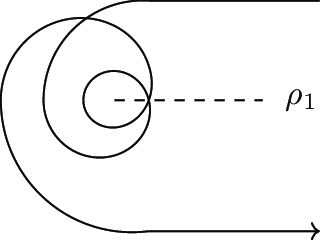
Lemma 4.11.
If
 $(Y,D)$
is positive, then given an immersed line
 $L\subset B_0$
, the generalized half-space
 $Z(L)$
is a convex polygon.
Proof.
Given
 $x\notin Z(L)$
, we want to show that the ray
 $\rho _x$
(generated by
 $\overrightarrow {0x}$
) intersects
 $L$
. Let
 $I_{px}$
be a line segment from
 $p\in L$
to
 $x$
that points to the right of
 $L$
. Then
 $d(I_{px},0)$
is a non-constant affine function as we vary
 $p\in L$
. That means there exists
 $p$
such that
 $d(I_{px},0)=0$
, meaning that the immersed line spanned by
 $I_{px}$
goes through
 $0$
. However, the immersed ray starting at
 $p$
in the
 $\overrightarrow {px}$
direction cannot contain zero since it would imply that
 $x$
is on the left-hand side of
 $L$
. Thus, we see that
 $p$
is on the ray
 $\rho _x$
.
For the rest of the proof, we use Construction 4.10 and the notation there. Now we wish to show that
 \begin{equation} Z\left (L\right )^{c}=g\left (\left \{ (x_1,x_2)\mid x_1\gt d\left (L\right )\right \} \right ). \end{equation}
As we have shown, if
 $x \notin Z(L)$
, then
 $x$
is in the image of
 $g$
. Let
 $I_{px}$
be a line segment that points to the right of
 $L$
. Then because
 $I_{px}$
is in the image of
 $g$
, we can lift it to a line segment
 $\tilde {I}_{px}\subset \bar {H}$
from a point
 $\bar {p}\in \{(x_1,x_2)\mid x_1=d(L)\}$
to a point
 $\bar {x}$
such that
 $\overrightarrow {\bar {p}\bar {x}}$
points to the right of
 $\{(x_1,x_2)\mid x_1=d(L)\}$
. Thus, we get that
 $Z(L)^c\subset g(\{(x_1,x_2) \mid x_1\gt d(L)\})$
. The other inclusion is immediate.
Now given an immersed line segment
 $I$
with endpoints
 $x$
and
 $y$
in
 $Z(L)$
, suppose that
 $I$
is not contained in
 $Z(L)$
. Then
 $I$
intersects
 $L$
at a point
 $p$
such that either
 $v\wedge \overrightarrow {px} \lt 0$
or
 $v\wedge \overrightarrow {py} \lt 0$
, in contradiction with the assumption that both
 $x,y$
are in
 $Z(L)$
. Hence the assumption is false and every immersed line segment with endpoints in
 $Z(L)$
is contained in
 $Z(L)$
, i.e.
 $Z(L)$
is convex.
For the rest of this subsection, we assume that
 $(Y,D)$
is positive.
Lemma 4.12.
Let
 $F\subset B$
be a convex polygon. If
 $E$
is an edge of
 $F$
and
 $L$
is the immersed line generated by
 $E$
, then
 $F\subset Z(L)$
and
 $F\cap L=E$
.
Proof.
By our definition of polygons,
 $0$
is in the interior of
 $F$
. Let
 $g:H \rightarrow B_0$
be as defined in Construction 4.10. We claim that
 $g^{-1}(F)$
is convex. Indeed, since
 $F$
is convex,
 $g^{-1}(F)$
is locally convex at any vertex
 $v$
. Therefore
 $g^{-1}(F)$
is convex. Since
 $0$
is contained in the interior of
 $F$
, we have
 \begin{equation*} g^{-1}(F)\subset \{(x_1,x_2) \mid 0\le x_1 \le d(L)\}.\end{equation*}
By Equation (4.1),
 \begin{equation*} F\cap Z(L)^c = g ( g^{-1}(F) \cap \{ (x_1,x_2) \mid x_1\gt d(L) \}) = \emptyset . \end{equation*}
Hence,
 $F \subset Z(L)$
.
To show that
 $F\cap L=E$
, it remains to show that
 $F\cap L\subset E$
. Let
 $q\in F\cap L$
and
 $p\in E$
. Let
 $I_{pq}\subset L$
be the immersed line segment from
 $p$
to
 $q$
. We want to show that
 $I_{pq}$
is contained in
 $E$
. If not, then
 $I_{pq}$
will cross an edge,
 $E'$
, of
 $F$
at a vertex of
 $F$
. Now let
 $L'$
be the immersed line generated by
 $E'$
. We know that
 $F\subset Z(L')$
and that
 $I_{pq}\subset Z(L')$
. Notice though that
 $I_{pq}$
must cross
 $E'$
from left to right, implying that
 $q\notin Z(L')$
, which is in contradiction with that
 $I_{pq}\subset Z(L')$
. Thus, it must be that
 $I_{pq}\subset E$
. This implies that
 $F\cap L=E$
, as desired.
Proposition 4.13.
Let
 $F\subset B$
be a convex polygon. Then
 $F$
is equal to the intersection of the half-spaces spanned by the edges.
Proof.
Let
 $E\subset F$
be an edge and
 $Z_E$
the corresponding half-space obtained by the corresponding immersed line. Then define
 $P:=\bigcap _E Z_E$
. By Lemma 4.12,
 $F\subset P$
and
 $\partial (F)\subset \partial (P)$
, which implies that
 $F=P$
.
By Lemma 4.11 and Proposition 4.13, we have the following corollary.
Corollary 4.14.
A polygon
 $F$
is convex if and only if it is the intersection of generalized half-spaces.
4.2 Passing to toric blowups and blowdowns
It will often be convenient to pass to a toric blowup or blowdown of the pair
 $(Y,D)$
. We show here that our family is essentially unaffected by such operations. Let
 $\pi :(Y,D) \rightarrow (Y',D')$
be a toric blowdown of the pair
 $(Y,D)$
and
 $L\subset \textrm {Pic}(Y)$
the subgroup generated by the
 $\pi$
-exceptional divisors. By [Reference Gross, Hacking and KeelGHK15a, Lemma 1.6],
 $\Sigma _{(Y,D)}$
is a refinement of
 $\Sigma _{(Y',D')}$
, and
 $B_{(Y',D')}$
and
 $B_{(Y,D)}$
are isomorphic as integral affine manifolds. Let
 $P=\mathrm {NE}(Y)$
and
 $P'=\mathrm {NE}(Y')$
. Then, the surjection
 $\pi _{*}: A_1(Y) \rightarrow A_1(Y')$
,
 $C \mapsto \pi _{*}(C)$
, induces a surjection
 $P+L \twoheadrightarrow P'$
, which further induces a closed embedding
 $\mathrm {Spec}(\mathbb {C}[P']) \hookrightarrow \mathrm {Spec}(\mathbb {C}[P+L])$
. Composing this closed embedding with the open embedding
 $\mathrm {Spec}(\mathbb {C}[P+L]) \hookrightarrow \mathrm {Spec}(\mathbb {C}[P])$
, we obtain a locally closed embedding
 \begin{equation*} \iota _\pi : \mathrm {Spec}(\mathbb {C}[P']) \hookrightarrow \mathrm {Spec}(\mathbb {C}[P]). \end{equation*}
Let
 $A,\,A'$
be the mirror algebra constructed from the canonical scattering diagram on
 $B_{(Y,D)}$
,
 $B_{(Y',D')}$
, respectively. Let
 $A_{L}$
be the localization of the mirror algebra
 $A$
at
 $L$
. By [Reference Gross, Hacking and KeelGHK15a, Proposition 3.10], there is a surjection
 $A_L\rightarrow A'$
given by
 $\vartheta _p\mapsto \vartheta _p$
and
 $z^{[C]}\mapsto z^{[\pi _* C]}$
. Thus, we conclude that
 \begin{equation*} \mathcal {X} |_{\iota _\pi (\mathrm {Spec}(\mathbb {C}[P']))}=\mathcal {X}', \end{equation*}
where
 $\mathcal {X} = \mathrm {Spec}(A)$
and
 $\mathcal {X}' = \mathrm {Spec}(A')$
.
Now, consider the subtorus
 $T^L\subset T^D$
whose characters are generated by
 $e_{D_i}$
where
 $D_i$
’s are
 $\pi$
-exceptional divisors. The composition of the weight map
 $w: B(\mathbb {Z}) \times {\textrm {NE}}(Y) \mapsto \chi (T^{D})$
as in Definition 3.10 with the projection map
 $e_{D_i} \mapsto e_{D_i}$
if
 $D_i$
is a
 $\pi$
-exceptional divisor and
 $e_{D_i} \mapsto 0$
otherwise, gives an action of
 $T^{L}$
on the mirror family. Moreover, the following lemma follows immediately from that the action of
 $T^{D}$
on the mirror family is equivariant.
Lemma 4.15.
Using the identification
 $ \mathcal {X} |_{\iota _\pi (\mathrm {Spec}(\mathbb {C}[P']))}=\mathcal {X}'$
as given above, we have the following commutative diagram where the horizontal arrows are isomorphisms.

As we mentioned in Remark 3.2, for the cases where
 $D$
is an irreducible curve we will pass to a toric blowup of
 $D$
at the node, without explicitly mentioning it each time. Thus, every argument we use in the proofs of this section also works for these special cases.
At the end of this section, we recall the description of the coordinate rings of the fiber
 $\mathbb {V}_n$
over the zero stratum
 $0$
of
 $\textrm {Spec}(\mathbb {C}[{\textrm {NE}}(Y)])$
in the case where
 $n=1,2$
since we need them later in this section.
When
 $n=1$
, we cut
 $B$
along the unique ray
 $\rho =\rho _1 \in \Sigma$
. Then, the set of linear coordinates
 $\psi$
identify
 $B\setminus \{\rho \}$
with a strictly convex cone
 $\sigma$
in
 $\mathbb {R}^{2}$
. Let
 $w,w'$
be the direction of the two boundary rays of the closure of
 $\sigma$
in
 $\mathbb {R}^2$
. Abusing the notation, we use
 $w+w'$
and
 $2w+w'$
to also denote the two distinct directions in
 $B(\mathbb {Z})$
corresponding to the inverse image of
 $w+w'$
and
 $2w+w'$
in
 $B \setminus \{\rho \}$
. Let
 $\nu$
be the primitive generator of
 $\rho _1$
. Then, by the proof in [Reference Gross, Hacking and KeelGHK15a, § 6.2],
 $\vartheta _{\nu }$
,
 $\vartheta _{w+w'}$
, and
 $\vartheta _{2w+w'}$
generate the coordinate ring of
 $\mathbb {V}_1$
together with the relation
 \begin{align} \vartheta _{2w+w'} \cdot \vartheta _{\nu } \cdot \vartheta _{w+w'} = \vartheta ^{2}_{2w+w'} + \vartheta ^{3}_{w+w'}, \end{align}
which we recognize as the homogeneous coordinate ring of an irreducible nodal cubic embedded in the weighted projective space
 $\mathbb {P}(3,1,2)$
.
When
 $n=2$
, we can cut
 $B$
along the ray
 $\rho _1 \in \Sigma$
. Then, the set of linear coordinates
 $\psi$
identify
 $B\setminus \{\rho _1\}$
with the union of two strictly convex cones
 $\sigma _1, \sigma _2$
in
 $\mathbb {R}$
. Let
 $u,u'$
be the direction of the two boundary rays of the closure of
 $\sigma \cup \sigma _2$
in
 $\mathbb {R}^2$
. Then,
 $\vartheta _{\nu _1}$
,
 $\vartheta _{\nu _2}$
, and
 $\vartheta _{u}$
generate the coordinate ring of
 $\mathbb {V}_2$
together with the relation
 \begin{align} \vartheta _{\nu _1} \cdot \vartheta _{\nu _2} \cdot \vartheta _u = \vartheta _{u}^{2}. \end{align}
After coordinate changes, we can identify the coordinate ring of
 $\mathbb {V}_2$
with
 $\mathbb {C}[x_1,x_2,y]/(y^2 = x_{1}^{2}x^{2}_{2})$
.
4.3 Compactified families
In toric geometry, an integral convex polytope in the character lattice of an algebraic torus gives rise to a polarized toric variety, as a compactification of the algebraic torus. In this section, we exhibit how polygons in
 $B_{(Y,D)}$
can be used to compactify the family
 $\mathcal {X}\rightarrow \textrm {Spec}(\mathbb {C}[{\textrm {NE}}(Y)])$
. More specifically, given a bounded, rational, convex polygon in
 $B_{(Y,D)}$
, we will introduce the ring
 $V$
that is the homogeneous coordinate ring of the compactification of the mirror family associated with that polygon. The ring
 $V$
will be a subring of
 $A[T]$
where
 $A$
is the mirror algebra as in Theorem 3.8, and
 $T$
is an indeterminate.
Given a bounded, rational, convex polygon,
 $F\subset B_{(Y,D)}$
, first consider a toric blowup
 $\pi :(\tilde {Y},\tilde {D})\rightarrow (Y,D)$
such that every vertex of
 $F$
is on a ray of the fan
 $\tilde {\Sigma }\subset B_{(\tilde {Y},\tilde {D})}$
. For each ray
 $\tilde {\rho }_i \in \tilde {\Sigma }$
, let
 $\tilde {v}_i$
be the primitive generator of
 $\tilde {\rho }_i$
.
Let
 $\tilde {A}$
be the mirror algebra after the toric blowup
 $p$
. Let
 $\tilde {V}\subset \tilde {A}[T]$
be the free
 $\mathbb {C}[{\textrm {NE}}(\tilde {Y})]$
-submodule with basis
 $\vartheta _q T^m$
where
 $q\in mF\cap B(\mathbb {Z})$
. Let
 $L \subset \mathrm {Pic}(\tilde {Y})$
be the subgroup generated by
 $\pi$
-exceptional divisors. Let
 $\tilde {A}_L$
be the localization of
 $\tilde {A}$
at
 $L$
and
 $\tilde {V}_L \subset \tilde {A}_L[T]$
the free
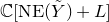 $\mathbb {C}[{\textrm {NE}}(\tilde {Y})+L]$
-submodule with the same basis as
 $\tilde {V}$
. Define the free
 $\mathbb {C}[{\textrm {NE}}(Y)]$
-submodule
 $V \subset A[T]$
analogously to
 $\tilde {V}$
. Then,
 $V$
is the image of
 $\tilde {V}_L$
under the natural surjection
 $\tilde {A}_L \rightarrow A$
, induced by
 $\pi _{*}$
.
Since everything we want to claim about
 $V$
can be deduced from
 $\tilde {V}$
, for the rest of this subsection, we just assume that we start with a polygon
 $F$
such that every vertex is on a ray of the fan
 $\Sigma$
, without explicitly mentioning passing to a toric blowup.
Recall from Definition 3.10 the weight map
 $w:B(\mathbb {Z})\times {\textrm {NE}}(Y)\rightarrow \chi (T^D)$
. By rescaling
 $F$
if necessary, we can assume that
 $F$
satisfies the following conditions:
 \begin{align} \mathrm {for \,each\, ray\,} \, \rho _i \in \Sigma ,\quad \rho _i \cap \partial F = \frac {1}{a_i}v_i \, (a_i \in \mathbb {Z}_{\gt 0}). \end{align}
Here, recall that
 $v_i$
is the primitive generator of
 $\rho _i$
.
Consider the associated Weil divisor
 $W_F =\sum _i a_i D_i$
. Let
 $T^{W_F} \subset T^{D}$
be the 1-parameter subgroup corresponding to the homomorphism
 $\mathbb {Z}^{D} \rightarrow \mathbb Z$
,
 $e_{D_i} \mapsto a_i$
. We define the height function
 \begin{equation*} g:B(\mathbb {Z})\times {\textrm {NE}}(Y) \rightarrow \chi (T^{W_{F}}) \simeq \mathbb {Z}, \end{equation*}
by composing the weight function with the homomorphism
 $\chi (T^{D}) \rightarrow \chi (T^{W_{F}})$
induced by the 1-parameter subgroup
 $T^{W_F} \subset T^{D}$
.
Lemma 4.16.
The Weil divisor
 $W_F$
is nef. Moreover, we have
 $W_F \cdot D_k \gt 0$
if and only if
 $\rho _k$
passes through a vertex of
 $F$
.
Proof.
We assume that the number of rays in
 $\Sigma$
is
 $\geqslant 2$
since the statement holds trivially when
 $\Sigma$
has only one ray. Consider the points
 $p_i:=({1}/{a_i})v_i \in \rho _i$
and take straight line segments,
 $E_{i-1,i}$
, that connect
 $p_{i-1}$
to
 $p_i$
. We claim that the angle formed at
 $p_k$
is convex (viewed from
 $0\in B_{(Y,D)}$
) if and only if
 $(\sum _i a_i D_i)\cdot D_k\geqslant 0$
, with a strict inequality if and only if the angle is strictly convex, which occurs when
 $\rho _k$
passes a vertex of
 $F$
. To see this, work in the affine chart given by
 $\sigma _{k-1,k}\cup \sigma _{k,k+1}$
so that
 $p_{k-1}=({1}/{a_{k-1}},0)$
,
 $p_k= (0,{1}/{a_k})$
, and
 $p_{k+1}=({-1}/{a_{k+1}},{-D_k^2}/{a_{k+1}})$
. Then, convexity at
 $p_k$
means the angle between
 $E_{k-1,k}$
and
 $E_{k,k+1}$
is less than or equal to
 $\pi$
. This is equivalent to checking if
 \begin{equation*} \frac {1}{a_k}\frac {1}{a_{k+1}}+\frac {1}{a_{k-1}}\left (\frac {D_k^2}{a_{k+1}}+\frac {1}{a_k}\right )\ge 0, \end{equation*}
which gives
 \begin{equation*} a_{k-1}+a_k D_i^2+a_{k+1}=\bigg(\sum _i a_i D_i\bigg)\cdot D_k \ge 0,\end{equation*}
see Figure 3.
Picture in the affine chart.
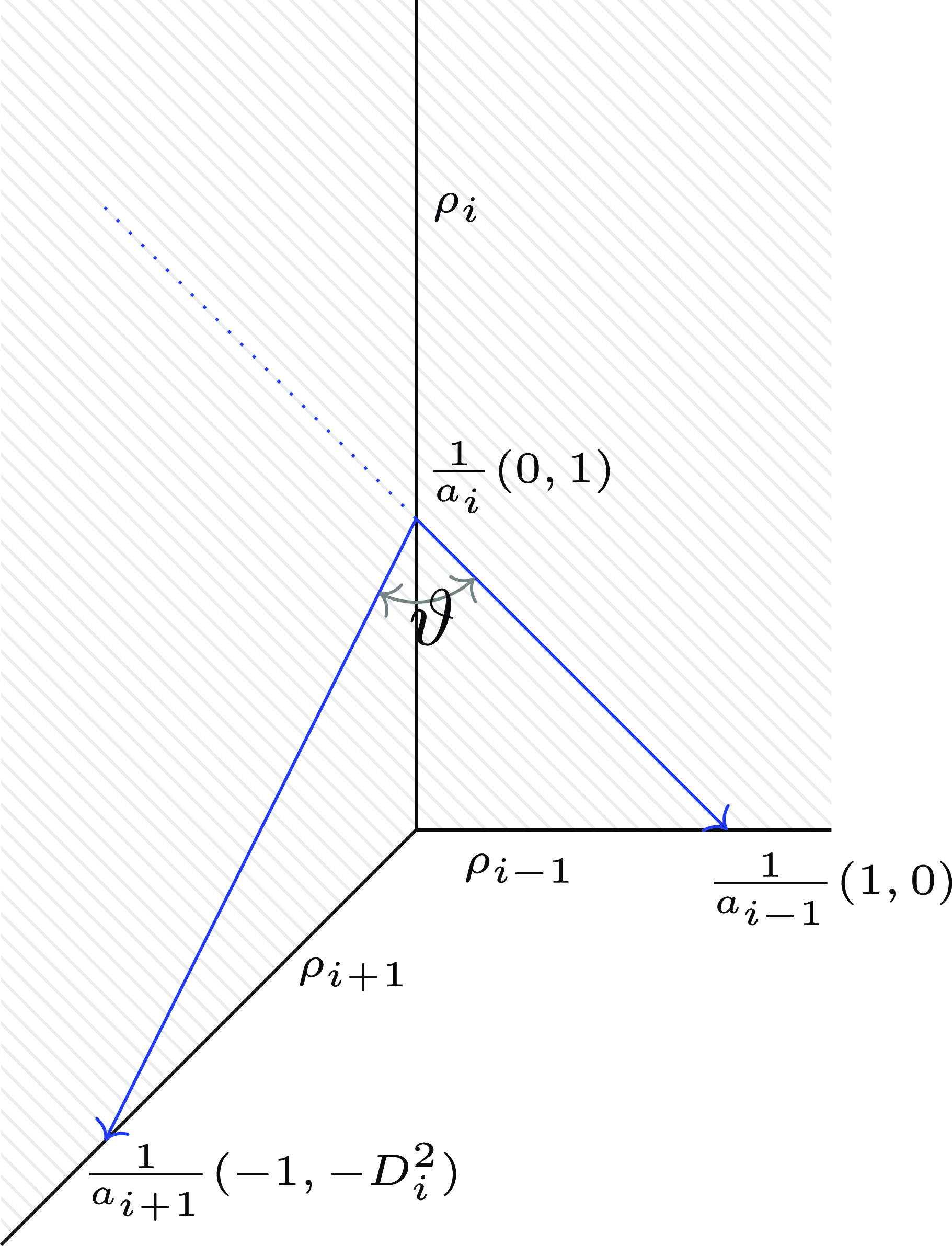
Moreover, we obtain the strict inequality if and only if when the angle between
 $E_{k-1,k}$
and
 $E_{k,k+1}$
is less than
 $\pi$
, i.e. when
 $p_k$
is a vertex of the polygon
 $F$
.
Lemma 4.17.
Let
 $g$
be as above. Then
 $q\in mF\cap B(\mathbb {Z})$
if and only
 $g(q)\le m$
.
Proof.
Consider
 $\sigma _{i,i+1}$
, a maximal cone in
 $\Sigma _{(Y,D)}$
. Then,
 $\sigma _{i,i+1}\cap mF$
is a convex triangle with vertices
 $0$
,
 $({m}/{a_i}) v_i$
, and
 $({m}/{a_{i+1}}) v_{i+1}$
. Extending
 $g$
linearly on
 $\sigma _{i,i+1}$
, the function
 $g$
has the values
 \begin{equation*} g(0)=0,\end{equation*}
 \begin{equation*}g\left ( \frac {m}{a_i} v_i \right )=g\left (\frac {m}{a_{i+1}}v_{i+1} \right )=m.\end{equation*}
Furthermore,
 $g$
is linear when restricted to a maximal cone. Thus,
 $g$
is bounded above by
 $m$
when restricted to
 $\sigma _{i,i+1}\cap mF$
. Similarly,
 $g|_{(mF)^{c}}\gt m$
.
Lemma 4.18.
Given
 $p,q \in B(\mathbb {Z})$
, consider
 \begin{equation*} \vartheta _p \cdot \vartheta _q = \sum _{r\in B(\mathbb {Z})} \alpha (p,q,r)\vartheta _r. \end{equation*}
If
 $z^{[C]} \vartheta _r$
is contained in the expansion of
 $\vartheta _p \cdot \vartheta _q$
, then we have
 \begin{equation*} w(r,C) = w(p) + w(q) \quad{and} \quad g(r,C) = g(p) + g(q). \end{equation*}
Proof. The equality between weights follows from Theorem 3.11. The equality between heights follows from the equality between weights.
Lemma 4.19.
The submodule
 $V\subset A[T]$
is a subalgebra.
Proof.
Let
 $p\in nF$
and
 $q\in mF$
, which correspond to
 $\vartheta _p$
and
 $\vartheta _q$
, respectively. If
 $z^{[C]}\vartheta _r$
is in the expansion of
 $\vartheta _p\cdot \vartheta _q$
, then we want to show that
 $r\in (n+m)F$
. Equivalently, by Lemma 4.17, we want to show that
 $g(r)\le n+m$
. By Lemma 4.18, we have
 $g(r,C)=g(p)+g(q)$
. By Lemma 4.16, we have
 \begin{equation*} g(r)\le g(r) + W_F \cdot C = g(r) + g(C) = g(r,C)=g(p)+g(q)\le n+m.\end{equation*}
Here, the last inequality follows from Lemma 4.17.
Proposition 4.20.
Here, V is a finitely generated
 $\mathbb {C}[{\textrm {NE}}(Y)]$
-algebra.
Proof.
The proof is the same as the proof for [Reference Gross, Hacking and KeelGHK15a, Proposition 6.6]. We include it here for the convenience of the reader. Let
 $J= {\textrm {NE}}(Y)\setminus \{0\}$
and consider
 $V/JV$
. Then,
 $\textrm {Proj}(V/JV)$
is given by the union of toric varieties corresponding to
 $\underline {F}$
, the polyhedral decomposition of
 $F$
induced by that of
 $B$
given by
 $\Sigma \bigcap F$
. It follows that
 $V/JV$
must be finitely generated, implying that there are a finite number of
 $\vartheta _qT^m$
in
 $V$
that generate
 $V/JV$
. Denote the largest
 $m$
in this generating set by
 $N$
. Next, we show that the finite set
 $G:=\{\vartheta _qT^m| m\le N\}$
generates
 $V$
.
Let
 $V'$
be the subalgebra generated by
 $G$
. Since the structure coefficients for the mirror algebra are deformation invariant by [Reference Gross, Hacking and KeelGHK15a, Lemma 3.9], we can choose
 $(Y,D)$
in its deformation class such that there are no internal curves. Then there exists, by the positivity assumption,
 $W=\sum a_iD_i$
,
 $a_i\gt 0$
such that
 $W$
is ample on
 $Y$
. Fix a weight
 $a \in \chi (T^{D})$
of the relative torus
 $T^D$
. For fixed
 $m$
, define the set
 \begin{equation*} V_{m,a}:=\{z^{[C]}\vartheta _rT^m:z^{[C]}\vartheta _r\text { is of weight } a,\,r\in mF\}.\end{equation*}
We claim that only a finite number of
 $z^{[C]} \vartheta _q$
have the weight
 $a$
, i.e. the weight map
 \begin{align*} w:B(\mathbb {Z})\times {\textrm {NE}}(Y) & \rightarrow \chi (T^D), \end{align*}
has finite fibers. Let
 $\sigma \in \Sigma$
be a maximal cone. Consider the restriction of
 $w$
to
 $\sigma (\mathbb {Z})\times {\textrm {NE}}(Y)$
. After the restriction,
 $w$
is linear and the domain is the set of integral points on a cone. It suffices to show that
 $\mathrm {ker}(w)\cap (\sigma (\mathbb {Z})\times {\textrm {NE}}(Y))=0$
. Let
 $(q,C)$
be such that
 $w(q,C)=0$
. We write
 $q=bv_i+cv_{i+1}$
. Then
 \begin{equation*} w(q,C)=be_{D_i}+ce_{D_{i+1}}+\sum _j (C\cdot D_j)e_{D_j}=0.\end{equation*}
If
 $C \in J$
, then since
 $b,c\ge 0$
, we must have that
 $C\cdot D_j\le 0$
for every
 $j$
. Then
 $C\cdot D_j\le 0$
implies that
 $C\cdot W\le 0$
, which contradicts the fact that
 $W$
is ample. It follows that
 $(q,C)=0$
. This shows that
 $w$
has finite fibers.
Define the order
 ${\textrm {ord}}([C])$
for
 $[C]\in \mathrm {NE}(Y)$
to be the maximal integer
 $k$
such that
 $[C]=[C_1]+\cdots +[C_k]$
, where
 $[C_i]\in J$
. We show that
 $V_{m,a}\subset V'$
by a decreasing induction on the order of
 $[C]$
. Since
 $V_{m,a}$
is finite, there is an upper bound on the possible orders. Therefore, the claim is vacuously true for large orders. Consider
 $z^{[C]}\vartheta _r T^m\in V_{m,a}$
. Since
 $G$
generates
 $V$
modulo
 $JV$
, we can write
 \begin{equation*} \vartheta _rT^m=\alpha T^m +\beta T^m,\end{equation*}
where
 $\alpha T^{m}$
is in
 $V'$
and
 $\beta T^{m}$
is in
 $JV$
. Then,
 \begin{equation*} z^{[C]}\vartheta _rT^m=z^{[C]}\alpha T^{m} +z^{[C]}\beta T^{m}, \end{equation*}
where the weight of
 $z^{[C]}\alpha$
is also
 $a$
and the weight of
 $z^{[C]}\beta$
is
 $a$
or
 $z^{[C]}\beta =0$
. The latter implies that
 $z^{[C]}\vartheta _rT^m\in V'$
. In the former case,
 $z^{[C]}\beta$
is the sum of terms
 $z^{[C']}\vartheta _q$
of weight
 $a$
where
 $\mathrm {ord}([C']) \gt \mathrm {ord}([C])$
since
 $\beta \in JV$
. By the induction hypothesis,
 $z^{[C]}\beta$
is in
 $V'$
. Hence,
 $z^{[C]}\vartheta _r T^{m}$
is in
 $V'$
.
Remark 4.21. The equivariant action of
 $T^{D}$
on
 $A$
naturally extends to
 $V$
.
Thus, given any bounded, convex, rational polygon
 $F$
, there is a canonical homogeneous coordinate ring associated with it. Indeed, a scaling of
 $F$
will satisfy Condition 4.4. Then, we can construct the corresponding homogeneous coordinate ring
 $V$
as defined above.
Let
 $\pi :(Y,D) \rightarrow (Y',D')$
be a toric blowup. We follow the notation used in § 4.2. Given a polygon
 $F'$
in
 $B_{(Y',D')}$
, we could also view it as a polygon in
 $B_{(Y,D)}$
. Let
 $\bar {\mathcal {X}}$
and
 $\bar {\mathcal {X}'}$
be the compactified mirror family we get using
 $F$
, viewed as a polygon in
 $B_{(Y,D)}$
and
 $B_{(Y',D')}$
, respectively. Then, everything we said about
 $\mathcal {X}$
and
 $\mathcal {X}'$
in § 4.2 extends to
 $\bar {\mathcal {X}}$
and
 $\bar {\mathcal {X}'}$
. In particular, we obtain the following lemma.
Lemma 4.22. Following the notation used in § 4.2 , we have the identification
 \begin{equation*} \bar {\mathcal {X}} |_{\iota _\pi (\mathrm {Spec}(\mathbb {C}[P']))}= \bar {\mathcal {X}'}, \end{equation*}
and the following diagram commutes.

Now, we want to study the family
 $\bar {\mathcal {X}}:=\textrm {Proj}(V)\rightarrow \textrm {Spec}(\mathbb {C}[{\textrm {NE}}(Y)])$
and show that it is a compactification of
 $\mathcal {X}$
. Moreover, we are specifically interested in the restriction of the family over the algebraic torus
 $T_Y:=\textrm {Pic}(Y)\otimes \mathbb {G}_m\subset \textrm {Spec}(\mathbb {C}[{\textrm {NE}}(Y)])$
.
Definition 4.23. The boundary of
 $\bar {\mathcal {X}}$
is the subscheme
 $\mathcal {D}$
defined by the equation
 $T=0$
.
Proposition 4.24.
There is a natural identification
 $\bar {\mathcal {X}}\setminus \mathcal {D}=\mathcal {X}$
. Suppose
 $F$
is bounded, convex, and rational. Then
 $\mathcal {D}|_{T_Y}\rightarrow T_Y$
is a trivial family of nodal elliptic curves with one irreducible component for each face of
 $F$
.
Proof.
Let
 $V_T$
be the localization of
 $V$
with respect to
 $T$
. On the affine scheme
 $\mathrm {Spec}(V_T)$
, the subring of degree
 $0$
elements of
 $V_T$
is equal to
 $A$
, which immediately gives
 $\bar {\mathcal {X}}\setminus \mathcal {D}=\mathcal {X}$
. We proceed to show the triviality of
 $\mathcal {D}$
over the torus
 $T_Y$
. Consider the quotient ring
 $V/(T\cdot V)$
. By Lemma 4.17,
 $\vartheta _qT^m\in V$
if and only if
 $g(q)\le m$
. Similarly,
 $\vartheta _q T^m\in T\cdot V$
if and only if
 $g(q)\lt m$
. Then
 $V/(T\cdot V)$
is generated by
 $\vartheta _qT^{g(q)}$
.
Let
 $\Sigma _F$
be the fan over faces of
 $F$
. This fan is a coarsening of the fan
 $\Sigma$
. Given
 $p,q \in B(\mathbb {Z})$
, consider
 \begin{equation} \vartheta _p T^{g(p)}\cdot \vartheta _q T^{g(q)}=\sum _{s\in B(\mathbb {Z})}\alpha (p,q,s)\vartheta _s T^{g(p)+g(q)} \mod T\cdot V. \end{equation}
We make the following claim.
Claim 4.25. If two pairs of broken lines cross a ray passing through a vertex of
 $F$
or bend at a ray in the scattering diagram, then they do not contribute to the expansion (4.5). In particular, if
 $p,q$
are not in the same
 $2$
-cell of
 $\Sigma _F$
, then
 \begin{equation*} \vartheta _p T^{g(p)}\cdot \vartheta _qT^{g(q)} \equiv 0 \mod T\cdot V, \end{equation*}
and if
 $p,q$
are in the same 2-cell of
 $\Sigma _F$
, only straight broken lines can contribute to the expansion (4.5).
Let us prove this claim. Suppose that
 $p$
and
 $q$
are not in the same 2-cell of
 $\Sigma _F$
. Then, for a non-zero
 $\alpha (p,q,s)$
, it must be of the form
 $cz^{([D_{i_0}]+\beta )}$
, where
 $D_{i_0}$
is the bending parameter for a ray passing through a vertex of
 $F$
and
 $\beta$
is in
 $\mathrm {NE}(Y)$
. By Lemma 4.16, we have
 \begin{equation*} (D_{i_0} + \beta ) \cdot W_F \geqslant D_{i_0} \cdot W_F \gt 0. \end{equation*}
By Lemma 4.18, we have
 \begin{equation*} g(s,D_{i_0}+C) = g(s) + (D_{i_0} + \beta ) \cdot W_F = g(p) + g(q). \end{equation*}
Therefore,
 $g(s)\lt g(p) + g(q)$
and
 \begin{equation*} z^{([D_{i_0}]+\beta )} \vartheta _s T^{g(p)+g(q)} \equiv 0 \mod T\cdot V. \end{equation*}
Now, suppose
 $p,q$
are in the same 2-cell of
 $\Sigma _F$
and
 $cz^{[C]}\vartheta _s T^{g(p)+g(q)}$
is in the expansion (4.5). If the two broken lines contributing
 $cz^{[C]}\vartheta _s$
bend at a wall,
 $[C]$
must be of the form
 $[C]= [C']+\beta$
where
 $[C']$
is a
 $\mathbb {A}^1$
-class and
 $\beta \in \mathrm {NE}(Y)$
. But
 $\beta \cdot W_F\gt 0$
for all
 $\mathbb {A}^1$
-classes
 $\beta$
. Again, by Lemma 4.18,
 \begin{equation*} g(p)+g(q) = g(s,C) = g(s) + C \cdot W_F \geqslant g(s) + C' \cdot W_F \gt g(s). \end{equation*}
Therefore,
 $cz^{[C]}\vartheta _s T^{g(p)+g(q)}$
is trivial modulo
 $T\cdot V$
. Thus, for
 $p,q$
in the same 2-cell of
 $\Sigma _F$
, we see that the only broken lines that contribute to the expansion (4.5) are the straight ones.
Now, we are ready to prove the statement of the proposition. First, if
 $F$
is a 1-gon, by the same computation done in [Reference Gross, Hacking and KeelGHK15a, § 6.2], to get the description of the coordinate ring of
 $\mathbb {V}_1$
, we see that
 $(V/T \cdot V)$
is isomorphic to the homogeneous coordinate ring of an irreducible nodal rational curve embedded in the weighted projective plane
 $\mathbb {P}(3,1,2)$
. If
 $F$
is not a 1-gon, then Claim 4.25 implies that by restricting to each cone in
 $\Sigma _F$
, modulo
 $T\cdot V$
, we get the homogeneous coordinate ring for the trivial family of smooth rational curves over
 $T_Y$
. Thus,
 $\mathcal {D}|_{T_Y}$
is a trivial family of nodal elliptic curves with one component for each face of
 $F$
.
Lemma 4.26.
If
 $F$
is bounded, convex, and rational, then,
 $\bar {\mathcal {X}}|_{T_Y} \rightarrow T_Y$
is smooth along
 $(\mathcal {D} \setminus \mathcal {N}) |_{T_Y}$
where
 $\mathcal {N} \subset \mathcal {D}$
is the union of nodes of
 $\mathcal {D}$
.
Proof.
We can assume that
 $F$
satisfies Condition (4.4). Let
 $W_F$
be the Weil divisor associated to
 $F$
and
 $T^{W_F} \subset T^{D}$
be the 1-parameter subgroup corresponding to
 $W_F$
. By Lemma 4.16, for any effective class
 $C \in \mathrm {NE}(Y)$
, the weight of
 $z^{[C]}$
is non-negative. Therefore, given any
 $s \in T_Y$
, the limit of
 $s$
under the action of
 $T^{W_F}$
exists in
 $S=\mathrm {Spec}(\mathbb {C}[\mathrm {NE}(Y)])$
and we denote it by
 $s_0$
.
Recall that
 $\Sigma _F$
is the fan over faces of
 $F$
. Denote by
 $\delta _s: \mathbb {A}^{1} \rightarrow S$
the morphism given by
 $T^{W_F} \cdot s$
. Denote
 $\mathcal {D} \setminus \mathcal {N}$
and
 $\bar {\mathcal {X}} \setminus \mathcal {N}$
by
 $\mathcal {D}^{0 }$
and
 $\bar {\mathcal {X}}^{0 }$
, respectively. First, we assume that
 $F$
is not a 1-gon. We claim that the fiber
 $\bar {\mathcal {X}}_{s_0}$
over
 $s_0$
is isomorphic to the union of toric varieties with a polarization given by the polyhedral decomposition
 $\Sigma _F \cap F$
. Indeed, since any
 $\mathbb {A}^1$
-class has a positive intersection with
 $W_F$
, there is no scattering restricted to
 $s_0 \in S$
. Then, the claim follows from that the statement
 $W_F \cdot D_k \gt 0$
if and only if
 $\rho _k$
passes through a vertex of
 $F$
in Lemma 4.16. In particular, we conclude that
 $\mathcal {D}^{0 }_{s_0}$
is a Cartier divisor on
 $\bar {\mathcal {X}}^{0 }_{s_0}$
, and
 $\mathcal {D}^{0 } \times _S \mathbb {A}^{1} \rightarrow \mathbb {A}^{1}$
is the trivial family. Notice that these conclusions still hold even when
 $F$
is a 1-gon.
By Proposition 4.20,
 $f: \bar {\mathcal {X}}^{0 } \times _S {\mathbb {A}^1} \rightarrow \mathbb {A}^1$
is of finite type. Since
 $\mathbb {A}^1$
is Noetherian, by [Sta, Tag 01TX],
 $f$
is of finite presentation. Since
 $\bar {\mathcal {X}}^{0 } \times _S {\mathbb {A}^1} \rightarrow \mathbb {A}^1$
is flat and
 $\mathcal {D}^{0 } \times _S \mathbb {A}^1 \rightarrow \mathbb {A}^{1}$
is the trivial family, by [Sta, Tag 062Y], for each
 $x \in \mathcal {D}^{0 }_{s_0}$
, there exists an open neighborhood
 $U$
with
 $ x \in U \subset \bar {\mathcal {X}}^{0 } \times _S {\mathbb {A}^1}$
and a relative effective Cartier divisor
 $\mathcal {D}' \subset U$
such that
 $ \mathcal {D}^{0 } \cap U = \mathcal {D}'$
and
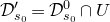 $\mathcal {D}'_{s_0} = \mathcal {D}^{0 }_{s_0} \cap U$
.
Since
 $T^{W_F}$
can push
 $s$
to be arbitrarily close to
 $s_0$
, the action of
 $T^{D}$
on
 $\bar {\mathcal {X}}$
is equivariant, and
 $\mathcal {D}^{0 } \times _S \mathbb {A}^1 \rightarrow \mathbb {A}^{1}$
is the trivial family, we conclude that for each
 $x \in \mathcal {D}^{0 }_s$
,
 $\mathcal {D}^{0 }_s \subset \bar {\mathcal {X}}^{0 }$
is Cartier near
 $x$
. Hence, we conclude that
 $\bar {\mathcal {X}}^{0 }_s$
is smooth along
 $\mathcal {D}^{0 }_s$
. Since
 $s$
is an arbitrary point in
 $T_Y$
, the statement of the lemma follows.
Now, we are ready to prove one of the main results in this section, which is the following proposition.
Proposition 4.27.
Fix a bounded, nonsingular, rational convex polygon,
 $F\subset B_{(Y,D)}$
, and let
 $(\bar {\mathcal {X}},\mathcal {D})\rightarrow S = \textrm {Spec}(\mathbb {C}[{\textrm {NE}}(Y)])$
be the corresponding family. Then, the generic fiber over
 $T_Y$
is smooth, and the restriction
 $\bar {\mathcal {X}}|_{T_Y}\rightarrow T_Y$
is smooth along
 $\mathcal {D} |_{T_Y}$
. Let
 $(\bar {\mathcal {X}}_t,\mathcal {D}_t)$
be the fiber of
 $(\bar {\mathcal {X}},\mathcal {D})\rightarrow T_Y$
over
 $t\in T_Y$
. Then
 $\mathcal {D}_t\subset \bar {\mathcal {X}}_t$
is an anti-canonical cycle of rational curves contained in the smooth locus and
 $\bar {\mathcal {X}}_t$
has, at worst, du Val singularities. In particular,
 $(\bar {\mathcal {X}}_t, \mathcal {D}_t)$
is a generalized pair in the sense of Definition 1.2
.
Proof.
Recall that in Proposition 4.24, we proved that
 $\mathcal {D}|_{T_Y}$
is a trivial family of nodal elliptic curves with one component for each face of
 $F$
. By Lemma 4.26, to show that
 $\bar {\mathcal {X}}|_{T_Y}$
is smooth along
 $\mathcal {D} |_{T_Y}$
, it remains to check that
 $\bar {\mathcal {X}}|_{T_Y}$
is smooth near every node of
 $\mathcal {D} |_{T_Y}$
.
Fix a node of
 $\mathcal {D} |_{T_Y}$
, which corresponds to a vertex of the polygon, say
 $v_i$
. Then, since every vertex lies on a ray by our assumption,
 $v_i$
also corresponds to a boundary divisor
 $D_i\subset D$
. By replacing
 $(Y,D)$
with a toric blowup as in Lemma 4.22, we could assume that
 $D_i$
is contractible (i.e. with negative self-intersection) and the number,
 $n$
, of irreducible components in
 $D$
is
 $\geqslant 3$
. We emphasize that by this procedure we do not change the polygon
 $F$
. The original compactified mirror family now embeds into the compactified mirror family after the toric blowup as in Lemma 4.22, but for the cleanliness of notation, we only implicitly acknowledge this.
Now, let
 $\pi :(Y,D)\rightarrow (Y',D')$
be the (weighted) toric blowdown that contracts
 $D_i$
and
 $Q\subset {\textrm {NE}}(Y)$
be the corresponding toric monomial ideal generated by all curve classes
 $z^{[C]}$
for
 $C$
not blowdown to a point under
 $\pi$
. Thus, the only monomials not in
 $Q$
are all of the form
 $z^{[mD_i]}$
. Now, consider
 $f:\textrm {Proj}(V/Q)\rightarrow \textrm {Spec}(\mathbb {C}[{\textrm {NE}}(Y)]/Q)$
. This family is a purely Mumford degeneration since all the
 $\mathbb {A}^1$
-classes that can appear are contained in
 $Q$
. In the family given by
 $f$
, the double curve corresponding to the ray
 $v_i$
is smoothed out by the construction of the Mumford degeneration. Since the polygon is smooth, the family
 $f$
is smooth near the node in consideration.
To further get the smoothness near the node in consideration for
 $\bar {\mathcal {X}} |_{T_Y} \rightarrow T_Y$
, we use the equivariant action of
 $T^{D}$
on the restricted compactified family. Let
 $H =\sum _j a_j D_j \,(a_j \gt 0)$
be a
 $D$
-ample divisor. By rescaling
 $H$
if necessary, we can assume that
 $\pi _{*}H$
is Cartier. Let
 $H' = \pi ^{*} \pi _{*}H = \sum _j a'_jD_j$
. Consider the one-parameter subgroup
 $T^{H'} \subset T^{D}$
given by
 $\chi (T^{D}) \rightarrow \mathbb {Z}$
,
 $e_{D_j} \mapsto a'_j$
. We claim that
 $H' \cdot D_i =0$
and
 $H' \cdot D_k \gt 0$
for
 $k \neq i$
. Indeed, notice that
 $a_j = a_j'$
for
 $j \neq i$
. The claim holds when
 $k \neq i-1,i,i+1$
just by our assumption that
 $n \geqslant 3$
. The fact that
 $H' \cdot D_i =0$
follows from the fact that
 $\pi ^{*}(a_j\pi _{*}D_{j}) \cdot D_i =0$
for
 $j=i-1,i+1$
. Write
 $ \pi ^{*}\pi _{*}(a_{i-1}D_{i-1}) = a_{i-1}D_{i-1} + aD_i$
and
 $ \pi ^{*}\pi _{*}(a_{i+1} D_{i+1}) = a_{i+1}D_{i+1} + b{D_i}$
. Then, it follows from
 $(\pi ^{*}\pi _{*}D_{j}) \cdot D_i =0$
for
 $j=i-1,i+1$
, that
 $H' \cdot D_i =0$
,
 $a_{i-1} + aD_{i}^{2} =0$
, and
 $a_{i-1} + bD_{i}^{2} =0$
. Since
 \begin{equation*} H\cdot D_i = a_i D_{i}^{2} + a_{i-1} + a_{i+1} \gt 0, \end{equation*}
and
 $D^{2}_i \lt 0$
, we conclude that
 $a+b \gt a_i$
. Therefore,
 \begin{equation*} H' \cdot D_{i-1} = a_{i-1}D_{i-1}^{2} + (a+b) + a_{i-2} \gt a_{i-1}D_{i-1}^{2} + a_i + a_{i-2} = H \cdot D_{i-1} \gt 0. \end{equation*}
Similarly, we conclude that
 $H' \cdot D_{i+1}$
>0. Thus, the claim holds. Hence, for any point in
 $T_Y$
, we can use the 1-parameter subgroup
 $T^{H'}$
to push it near the boundary stratum
 $\mathrm {Spec}(\mathbb {C}[\mathrm {NE}(Y)]/Q)$
. Since the condition of being smooth near the node is open in the base, we conclude that the entire family
 $\bar {\mathcal {X}}|_{T_Y} \rightarrow T_Y$
is smooth near the node in consideration.
By repeating the previous arguments for each node of
 $\mathcal {D} |_{T_Y}$
, we conclude that
 $\bar {\mathcal {X}}|_{T_Y} \rightarrow T_Y$
is smooth along
 $\mathcal {D} |_{T_Y}$
. Thus, combining this result with [Reference Gross, Hacking and KeelGHK15a, Corollary 6.11], we obtain that each fiber
 $(\bar {\mathcal {X}}_t,\mathcal {D}_t)$
in
 $\bar {\mathcal {X}}|_{T_Y} \rightarrow T_Y$
is Gorenstein and semi-log canonical and the generic fiber is smooth.
Recall that relative sheaf
 $\omega _{\mathcal {X} /S}$
is trivial by [Reference Gross, Hacking and KeelGHK15a, Proposition 2.31]. Let
 $0$
be the unique fixed toric point of
 $S$
and
 $(X_0,D_0)$
the fiber over
 $0$
. Consider the 1-parameter
 $T^{H} \subset T^{D}$
given by
 $\chi (T^{D}) \rightarrow \mathbb {Z},$
 $e_{D_i} \mapsto a_i$
. Then, given any
 $t \in T_Y$
, we can push
 $t$
arbitrarily close to
 $0$
using
 $T^H$
. Notice that
 $\omega _{X_0}(D_0)$
is trivial. By [Reference Gross, Hacking, Keel and KontsevichGHKK18, Lemma 8.42],
 $\omega _{\bar {\mathcal {X}}_t}(\mathcal {D}_t)$
is trivial and
 $H^1(\bar {\mathcal {X}}_t,{\mathcal {O}}_{\bar {\mathcal {X}}_t}) =0$
since
 $(X_0,D_0)$
satisfies these conditions.
Next, we show that
 $\mathcal {D}_t$
is anti-canonical and
 $\bar {\mathcal {X}}_t$
has at worst du Val singularities. We first show that
 $\bar {\mathcal {X}}_t$
has isolated singularities. Taking the closure of the orbit
 $T^{H}\cdot t$
, we obtain a morphism
 $\mathbb {A}^1 \rightarrow \textrm {Spec}(\mathbb {C}[{\textrm {NE}}(Y)])$
. Then, the pullback of
 $\mathcal {X} \rightarrow \textrm {Spec}(\mathbb {C}[{\textrm {NE}}(Y)])$
along
 $\mathbb {A}^1$
has the central fiber
 $\mathbb {V}_n$
. We use an argument from the proof of [Reference Hacking, Keel and YuHKY22, Proposition 7.4]. Suppose that the singular locus of
 $\mathcal {X}_t$
is of codimension
 $1$
. Then, the intersection of the closure of the singular locus of
 $\mathcal {X} | _{\mathbb {G}_m}$
(where
 $\mathbb {G}_m \subset \mathbb {A}^1$
) with the central fiber has codimension at most
 $1$
. Then, the total space
 $\mathcal {X} | _{\mathbb {A}^1}$
is not normal at the generic point of some double curve in
 $\mathbb {V}_n$
. However, if we base change to the completion of
 $\mathbb {C}[{\textrm {NE}}(Y)]$
at the maximal monomial ideal
 $\mathfrak {m}$
, a neighborhood in
 $\mathcal {X}$
of the interior double curve is isomorphic to the toric Mumford degeneration with the explicit equation given by [Reference Gross, Hacking and KeelGHK15a, equation (0.5)], which is clearly normal. Hence, a contradiction occurs and
 $\mathcal {X}_t$
and therefore
 $\bar {\mathcal {X}}_t$
has isolated singularities. Now, it follows from [Reference Hacking, Keel and YuHKY22, Proposition 7.2] that
 $\bar {\mathcal {X}}_t$
have, at worst, du Val singularities.
Let
 $\tilde {X}_t$
be the minimal resolution of
 $\bar {\mathcal {X}}_t$
. Since
 $\bar {\mathcal {X}}_t$
has at worst du Val singularities and is smooth along
 $\mathcal {D}_t$
, the strict transform
 $\tilde {D}_t$
of
 $\mathcal {D}_t$
in
 $\tilde {X}_t$
is anti-canonical and
 $H^1(\tilde {X}_t,{\mathcal {O}}_{\tilde {X}_t}) = H^1(\bar {\mathcal {X}}_t,{\mathcal {O}}_{\bar {\mathcal {X}}_t})=0$
. By the classification of surfaces,
 $\tilde {X_t}$
is rational. Therefore,
 $(\bar {\mathcal {X}}_t,\mathcal {D}_t)$
is a generalized pair in the sense of Definition 1.2.
Definition 4.28. Since
 $(Y,D)$
is positive, by Corollary 4.5, for any line segment on
 $B$
that can be extended to an immersed line
 $L$
not passing through
 $0$
, there exists a ray with endpoint
 $0\in B$
which is generated by the direction parallel to that which
 $L$
escapes to
 $\infty$
. We call this ray the escape ray of the line segment.
Proposition 4.29.
Let
 $F,F' \subset B$
be two bounded, rational, convex polygons. Suppose two edges
 $E \subset F$
and
 $E' \subset F'$
have the same escape ray and
 $mE$
,
 $m'E'\,(m,m'\in \mathbb {N})$
share two adjacent points
 $p_1,p_2 \in B(\mathbb {Z})$
. Here, by ‘adjacent’ we mean that for the line segment contained in
 $mE \cap m'E'$
connecting
 $p_1$
and
 $p_2$
, there are no points in
 $B(\mathbb {Z})$
between
 $p_1$
and
 $p_2$
on that line segment. We further require
 $p_1,p_2$
to be interior if one of
 $F,F'$
is a 1-gon. Let
 $(\bar {\mathcal {X}},\mathcal {D})$
and
 $(\bar {\mathcal {X}}',\mathcal {D}')$
be the compactified mirror families we get using
 $F$
and
 $F'$
, respectively. Let
 $\mathcal {D}^{c}_E$
be the sum of boundary components other than
 $\mathcal {D}_E$
if
 $F$
is not a 1-gon. Otherwise, let
 $\mathcal {D}^{c}_E$
be the node of
 $\mathcal {D}$
. Define
 $\mathcal {D}'^{c}_{E'}$
similarly. Then, the rational map
 $\bar {\mathcal {X}} \dashrightarrow \bar {\mathcal {X}'}$
restricts to an isomorphism
 \begin{equation*} (\bar {\mathcal {X}} \setminus \mathcal {D}_E^c)|_{T_Y} \rightarrow (\bar {\mathcal {X}}' \setminus \mathcal {D}'^{c}_{E'})|_{T_Y}.\end{equation*}
Proof.
For the convenience of notation, we assume that
 $F$
and
 $F'$
satisfy Condition 4.4. Let
 $V,V'$
be the homogeneous coordinate rings we get from
 $F$
and
 $F'$
. Consider
 $X_{p_i} = \vartheta _{p_i} T^{m} \in V$
and
 $X'_{p_i} = \vartheta _{p_i} T^{m'} \in V'\;(i=1,2)$
. Then,
 $X_{p_1}\cdot X_{p_2}$
and
 $X'_{p_1}\cdot X'_{p_2}$
vanish on
 $\mathcal {D}^{c}_{E}$
and
 $\mathcal {D}'^{c}_{E'}$
, respectively by Claim 4.25. Let
 $U \subset (\bar {\mathcal {X}} \setminus \mathcal {D}^{c}_{E})|_{T_Y}$
and
 $U' \subset (\bar {\mathcal {X}}' \setminus \mathcal {D}'^c_{E'})|_{T_Y}$
be the affine charts given by
 $X_{p_1}\cdot X_{p_2}\neq 0$
and
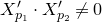 $X'_{p_1}\cdot X'_{p_2}\neq 0$
, respectively. By Proposition 4.24,
 $(\bar {\mathcal {X}} \setminus \mathcal {D})|_{T_Y}$
and
 $(\bar {\mathcal {X}}' \setminus \mathcal {D}')|_{T_Y}$
are isomorphic to
 $\mathcal {X}|_{T_Y}$
. Moreover,
 $U$
and
 $U'$
contain the boundary of
 $(\bar {\mathcal {X}} \setminus \mathcal {D}^{c}_{E})|_{T_Y}$
and
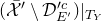 $(\bar {\mathcal {X}}' \setminus \mathcal {D}'^{c}_{E'})|_{T_Y}$
, respectively. Thus, to prove the proposition, it suffices to show that the rational map
 $U \dashrightarrow U'$
is an isomorphism. Notice that
 $\vartheta _{p_1} / \vartheta _{p_2}$
are regular on the boundaries of both
 $(\bar {\mathcal {X}} \setminus \mathcal {D}_E^c)|_{T_Y}$
and
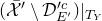 $(\bar {\mathcal {X}}' \setminus \mathcal {D}'^{c}_{E'})|_{T_Y}$
. Therefore, the rational map
 $U \dashrightarrow U'$
induces an isomorphism between the boundaries of
 $(\bar {\mathcal {X}} \setminus \mathcal {D}_E^c)|_{T_Y}$
and
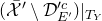 $(\bar {\mathcal {X}}' \setminus \mathcal {D}'^{c}_{E'})|_{T_Y}$
. Since
 $U \dashrightarrow U'$
is also an isomorphism away from the boundaries, it is actually an isomorphism.
Remark 4.30. In particular, the above proposition shows that rescaling the polygon we use does not change the compactification of the mirror family over the locus
 $T_Y$
.
4.4 The canonical compactification
We are now ready to construct the polygons that we will use to compactify the mirror family.
Definition 4.31. Let
 $W=\sum _i a_{i}D_{i}$
be a Weil divisor with
 $a_{i}\gt 0$
such that
 $W \cdot D_i \geqslant 0$
for each
 $i$
. Let
 $L_i$
be the immersed line going to infinity parallel to
 $\rho _i$
and lattice distance
 $a_{i}$
from
 $\rho _{i}$
. Then, we define the polygon associated with
 $W$
to be
 \begin{align} P(W):=\bigcap _{i} Z(L_{i}). \end{align}
We call such a polygon
 $P(W)$
the parallel polygon associated with the Weil divisor
 $W$
.
Let us first consider the cases where
 $(Y,D)$
has a toric model. For each
 $i$
, let
 $k_i$
be the number of non-toric blowups along
 $\bar {D}_i$
for the given toric model
 $p:(Y,D)\rightarrow (\bar {Y},\bar {D})$
. Denote the toric fan for
 $\bar {Y}$
by
 $\bar {\Sigma }$
. The Weil divisor,
 $\bar {W}=\sum a_{i}\bar {D}_{i}$
, determines a polytope
 \begin{equation*} P(\bar {W}):=\{m\in \bar {M}:\bar {v}_i \wedge m\ge -a_i \text { for all } i\}, \end{equation*}
where
 $\bar {v}_i$
is the first lattice point on the ray
 $\bar {\rho _i}$
. Then, for every
 $\bar {\rho }_i$
, there is an edge
 $\bar {F}_i\subset P(\bar {W})$
such that
 $\bar {F}_i$
is parallel to
 $\bar {\rho }_i$
and is at distance
 $a_i$
away from it on the right. Furthermore, by standard toric geometry, the length
 $l(\bar {F}_i)$
of the edge
 $\bar {F}_{i}$
is
 $\bar {W}\cdot \bar {D}_i$
. We immediately have the following lemma.
Lemma 4.32. The length
 $W\cdot D_{j}\gt 0$
if and only if
 $l(\bar {F}_{j})\gt k_{j}a_{j}$
, where
 $k_{j}$
is the number of non-toric blowups along
 $\bar {D}_{j}$
.
Proof. This can be directly computed:
 \begin{align*} W\cdot D_{j} & =a_{j+1}D_{j+1}\cdot D_{j}+a_{j}D_{j}^{2}+a_{j-1}D_{j-1}D_{j}\\ & =a_{j+1}\bar {D}_{j+1}\cdot \bar {D}_{j}+a_{j}(\bar {D}_{j}^{2}-k_{j})+a_{j-1}\bar {D}_{j-1}\bar {D}_{j}\\ & =\bar {W}\cdot \bar {D}_{j}-k_{j}a_{j}, \end{align*}
where
 $\bar {W}=\sum a_i\bar {D}_i$
.
Definition 4.33. Recall that
 $(Y,D)$
is positive if and only if there exists
 $a_i \gt 0$
 $(1\leqslant i \leqslant n)$
such that
 $W \cdot D_j \gt 0$
for each
 $j$
, where
 $W=\sum _{i=1}^{n} a_iD_i$
. We call such a Weil divisor
 $W$
a
 $D$
-ample Weil divisor.
Lemma 4.34.
Suppose
 $(Y,D)$
has a toric model and
 $W$
is a
 $D$
-ample Weil divisor. Then
 $P(W)$
is a bounded, convex, nonsingular, integral polygon with
 $0$
in its interior. Moreover, for each
 $i$
,
 $Z(L_i)$
is a supporting half-space of
 $P(W)$
.
Proof.
We argue that
 $P(W)$
is as claimed indirectly by applying a construction of Symington [Reference SymingtonSym03]. By Lemma 4.32, we can draw a triangle whose base has length
 $k_j a_j$
and is on the edge
 $\bar {F}_{j}$
such that the base of the triangle avoids the vertices of
 $\bar {F}_j$
. For each triangle, cut out the cone spanned by the interior of the triangle. Then, we glue the two rays of each cone and thus get an integral affine manifold
 $B'$
with the singularity at the origin
 $0$
. Moreover, if we denote what is remaining of
 $P(\bar {W})$
after cutting and gluing by
 $P(W)'$
, then
 $P(W)'$
is a bounded, convex, nonsingular, integral polygon on
 $B'$
with
 $0$
in its interior and each edge corresponding to an edge in
 $P(\bar {W})$
.
The integral affine structure of
 $B'$
is defined by the requirement that each edge in
 $P(W)'$
remain straight. Consider a triangle that has its base on an edge
 $\bar {F_j}$
with endpoints
 $a$
and
 $a'$
. Then
 $a$
and
 $a'$
are identified in
 $B'$
, and a piecewise linear function,
 $f$
, on
 $B'$
is linear if and only if
 \begin{equation*} f(a+v)+f(a-v)=2f(a) \end{equation*}
for any vector
 $v$
that is parallel to
 $\bar {F}_j$
.
Let
 $F'_i$
be the edge of
 $P(W)'$
corresponding to the edge
 $\bar {F}_i$
in
 $\bar {P}(W)$
. For each
 $i$
, let
 $R_{i}$
be the forward ray spanned by
 $F'_i$
, i.e. the ray containing
 $F'_i$
whose endpoint is the intersection point of
 $\bar {F}_i$
and
 $\bar {F}_ {i-1}$
and whose orientation agrees with the canonical orientation of the immersed line spanned by
 $F'_i$
. Then, we parallel transport
 $R_i$
along the line segment connecting
 $0$
and the vertex
 $F'_{i-1} \cap F'_{i}$
. As we do this, the distance between
 $R_i$
and
 $0$
decreases, and at some point the distance will be
 $0$
, which means we get a ray
 $\rho '_i\in B'$
emanating from
 $0 \in B'$
and parallel to
 $F'_i$
. Then the collection of rays
 $\rho '_i$
gives a fan
 $\Sigma '$
in
 $B'$
. Notice that
 $\rho '_i$
is parallel to
 $F'_i$
.
Note that there is a natural orientation-preserving bijection
 $\delta$
between
 $\Sigma$
and
 $\Sigma '$
which sends
 $\rho _i$
to
 $\rho _i'$
and is linear on each cone in
 $\Sigma '$
. We show that this bijection is an isomorphism between integral affine manifolds. Denote by
 $v_{i}$
the vertex shared by
 $F_{i}'$
and
 ${F\kern1pt}_{i+1}'$
. Let
 $w_{i},w_{i+1},w_{i-1}$
be the primitive vectors in
 $T_{v_{i}}B'$
parallel to
 $\rho _{i}'$
,
 ${\rho\kern1pt}_{i+1}'$
, and
 ${\rho\kern1pt}_{i-1}'$
, respectively. It follows immediately from our definition of the integral affine linear structure of
 $B'$
that
 \begin{equation*} D_{i}^{2}w_{i}+w_{i-1}+w_{i+1}=0. \end{equation*}
Hence,
 $\delta$
is an isomorphism of integral affine linear manifolds. It is clear that under this identification,
 $P(W)'$
is identified with
 $P(W)$
and therefore the statement of the lemma holds for
 $P(W)$
since it holds for
 $P(W)'$
.
Proposition 4.35.
For any positive Looijenga pair
 $(Y,D)$
and a
 $D$
-ample Weil divisor
 $W$
on
 $Y$
, the polygon
 $P(W)$
is bounded, convex, nonsingular, integral, and with
 $0$
in its interior. Moreover, each half-space in the intersection (
4.6
) is a supporting half-space for
 $P(W)$
.
Proof.
If
 $(Y,D)$
has a toric model, then the statement of this proposition follows immediately from Lemma 4.34. For the general case, let
 $\pi :(Y',D') \rightarrow (Y,D)$
be a toric blowup such that
 $(Y',D')$
has a toric model
 $p:(Y',D')\rightarrow (\bar {Y}', \bar {D}')$
. Let
 $W' = \pi ^{*}W$
, and let
 $D'_i$
be the strict transform of
 $D_i$
for each
 $i$
. Furthermore, let us assume that
 $\pi$
is minimal, i.e.
 $\pi$
does not factor through a non-trivial toric blowdown
 $(Y',D') \rightarrow (Y'', D'')$
such that
 $(Y'',D'')$
has a toric model. Then, the Weil divisor
 $\bar {W}' = p_*(W')$
is a
 $\bar {D'}$
-ample divisor.
By [Reference Gross, Hacking and KeelGHK15a, Lemma 1.6],
 $\Sigma _{(Y',D')}$
is a refinement of
 $\Sigma _{(Y,D)}$
, and
 $B_{(Y,D)}$
and
 $B_{(Y',D')}$
are isomorphic as integral affine manifolds. Let
 $P(W')$
be the parallel polygon on
 $B_{(Y',D')}$
corresponding to
 $W'$
. Consider the toric parallel polygon
 $P(\bar {W'})$
in
 $\mathbb {R}^{2}$
. If we apply Symington’s construction [Reference SymingtonSym03] as in Lemma 4.34, then for each
 $j$
, since
 $W' \cdot D'_j = W\cdot D_j \gt 0$
, we draw a triangle whose base is in the interior of the edge parallel to the ray corresponding to
 $p_*(D'_j)$
. If
 $E$
is an exceptional divisor of
 $\pi$
, we have
 $W'\cdot E=0$
. Then, we draw a triangle whose base is the entire edge parallel to the ray corresponding to
 $p_*(E)$
. Then, after deleting the cones spanned by the interior of the triangles, we draw and identify the sides of each cone. As shown in Lemma 4.34, we get an integral affine manifold
 $B'$
isomorphic to
 $B_{(Y',D')}$
. The remaining part of
 $P(\bar {W}')$
on
 $B'$
is the parallel polygon
 $P(W')$
, and the supporting half-spaces of
 $P(W')$
are precisely half-spaces corresponding to original rays in
 $\Sigma _{(Y,D)}$
. Since
 $B_{(Y',D')}$
has the same integral affine structure as
 $B_{(Y,D)}$
,
 $P(W)=P(W')$
. The statement that
 $P(W)$
is bounded, integral, and contains
 $0$
in its interior is straightforward. By Lemma 4.34 and the fact that
 $\Sigma _{(Y',D')}$
is a refinement of
 $\Sigma _{(Y,D)}$
, near each vertex of
 $P(W)$
, the chopping down of
 $P(W)$
gives a convex polygon. Therefore,
 $P(W)$
itself is convex. That
 $P(W)$
is nonsingular follows from the parallel construction of the polygon and the fact that wedge products between integral vector fields are preserved under parallel transport.
Thus, we have shown that for each
 $D$
-ample Weil divisor
 $W$
, we get a bounded, nonsingular, integral, convex polygon
 $P(W)$
which then gives a compactification
 $\bar {\mathcal {X}}(P(W)) \rightarrow \mathrm {Spec}(\mathbb {C}[\mathrm {NE}(Y)])$
of the mirror family
 $\mathcal {X} \rightarrow \mathrm {Spec}(\mathbb {C}[\mathrm {NE}(Y)])$
. As we will show in Proposition 4.38, the compactification is canonical, in the sense that it is not affected by the choice of the
 $D$
-ample Weil divisor
 $W$
.
Lemma 4.36.
Let
 $(Y,D)$
be a positive Looijenga pair and
 $W$
a
 $D$
-ample Weil divisor on
 $Y$
. Let
 $\pi :(Y,D) \rightarrow (Y',D')$
be a toric blowdown and
 $W' = \pi _{*}(W)$
. If
 $D_j$
is not an exceptional divisor of
 $\pi$
, then
 $L_j$
is a supporting half-space of both
 $P(W)$
and
 $P(W')$
. Moreover, in this case, if we let
 $F_j$
and
 $F'_j$
be the edges lying on
 $L_j$
in
 $P(W)$
and
 $P(W')$
, respectively, then
 $F_j$
is contained in
 $F'_j$
.
Proof.
Write
 $\pi ^{*}(W')=\sum _i a'_iD_i$
. We want to show that
 $a_i = a'_i$
if
 $D_i$
is not an exceptional divisor and
 $a'_i \gt a_i$
if it is. It suffices to prove this for the case where
 $\pi$
has only one exceptional divisor
 $D_k$
. In this case,
 $a_i = a'_i$
for
 $i\neq k$
is trivial. Since
 \begin{equation*} \pi ^{*}(W') \cdot D_k = -a'_k + a_{k-1} +a_{k+1} = 0 \lt W \cdot D_k = -a_k + a_{k-1} +a_{k+1}, \end{equation*}
we have
 $a_k \lt a'_k$
.
By Proposition 4.35, for each
 $j$
,
 $L_j$
is a supporting half-space of
 $P(W)$
, and it is also a supporting half-space for
 $P(W')$
if and only if
 $D_j$
is not an exceptional divisor of
 $\pi$
. If this is the case, by the numerical condition we proved in the previous paragraph, it is easy to see that
 $F_j$
is contained in
 $F'_j$
.
Let
 $E\subset P(W)$
be an edge and denote the corresponding boundary divisor by
 $\mathcal {D}_E$
. Let
 $\mathcal {D}_E^{0 } \subset \mathcal {D}_E$
be the complement of the nodes of
 $\mathcal {D}_E$
.
Proposition 4.37.
Let
 $p,q\in E\subset P(W)$
be consecutive lattice points on the same edge. If
 $n=1$
, we require these two lattice points to be in the interior of the edge. Then, the rational function
 $\vartheta _{p}/\vartheta _{q}$
is regular generically on
 $\mathcal {D}_{E}$
and restricts to a generator of the ring of regular function for each fiber in
 $\mathcal {D}_E^{0 }|_{T_Y}\rightarrow T_Y$
.
Proof.
When
 $n\geqslant 2$
, by Proposition 4.24
 $\mathcal {D}_E \rightarrow \textrm {Spec}(\mathbb {C}[{\textrm {NE}}(Y)])$
is a purely Mumford degeneration as in [Reference Gross, Hacking and KeelGHK15a, § 1.3]. Then, the statement of the proposition follows.
When
 $n=1$
, again, by Proposition 4.24,
 $\mathcal {D}_E^{0 } \rightarrow \textrm {Spec}(\mathbb {C}[{\textrm {NE}}(Y)])$
is a Mumford degeneration and statement of the proposition still holds for this case.
Proposition 4.38.
Let
 $W$
and
 $W'$
be two
 $D$
-ample Weil divisors. Then the compactified families
 $\bar {\mathcal {X}}(P(W))$
and
 $\bar {\mathcal {X}}(P(W'))$
are isomorphic over the torus
 $T_Y$
.
Proof.
When
 $n=1$
, the statement of the proposition follows trivially since rescaling the polygon does not change the homogeneous coordinate ring we get. Assume then, that
 $n\geqslant 2$
. Fix a ray
 $\rho _i$
. By the construction of parallel polygons, there are edges
 $E\subset P(W)$
and
 $E'\subset P(W')$
that have the same escape ray as
 $\rho _i$
and satisfy the conditions of Proposition 4.29. Since this is true for every
 $\rho _i$
, the result follows from Proposition 4.29.
Definition 4.39. We call the compactification of the mirror family using the parallel polygon associated with a
 $D$
-ample divisor the canonical compactification and use
 $(\bar {\mathcal {X}},\mathcal {D})$
specifically to denote the canonical compactification for the rest of this paper. The canonical compactification is not unique over the entire base
 $\textrm {Spec}(\mathbb {C}[{\textrm {NE}} (Y)])$
. But over the torus
 $T_Y \subset \textrm {Spec}(\mathbb {C}[{\textrm {NE}} (Y)])$
, the locus we mainly care about in this paper, the canonical compactification is indeed unique by Proposition 4.38.
Proposition 4.40.
Consider the restriction of the canonical compactification
 $(\bar {\mathcal {X}}, \mathcal {D})| _{T_Y} \rightarrow T_Y$
. Then, the statements in Propositions 4.24 and 4.27 hold for the restricted, canonically compactified mirror family. In particular, for each
 $t\in T_Y$
,
 $(\bar {\mathcal {X}}_t,\mathcal {D}_t)$
is a generalized marked pair.
Proof. By Proposition 4.38, we see those parallel polygons satisfy the conditions in Propositions 4.24 and 4.27, and their statements hold for the restricted, canonically compactified mirror family.
The following lemma shows that the canonical compactifications are compatible with toric blowups or blowdowns.
Lemma 4.41.
Let
 $(Y,D)$
be a positive Looijenga pair and
 $W$
a
 $D$
-ample Weil divisor on
 $Y$
. Let
 $\pi :(Y,D) \rightarrow (Y',D')$
be a toric blowdown. Let
 $\bar {\mathcal {X}}$
and
 $\bar {\mathcal {X}}'$
be canonical compactifications of the mirror families
 $\mathcal {X}$
and
 $\mathcal {X}'$
, respectively. Consider the locally closed embedding
 $\iota _{\pi }: \mathrm {Spec}([\mathrm {NE}(Y')]) \hookrightarrow \mathrm {Spec}([\mathrm {NE}(Y)])$
as in Lemma 4.22
. Then, given any
 $t \in T_{Y'}$
,
 $\bar {\mathcal {X}}_{\iota _{\pi }(t)}$
is a toric blowup of
 $\bar {\mathcal {X}}'_t$
with exceptional divisors in bijection with edges in
 $P(W)$
parallel to rays
 $\rho _i$
’s such that
 $D_i$
is an exceptional divisor of
 $\pi$
.
Proof.
Let
 $W'=\pi _{*}W$
. Denote by
 $\bar {\mathcal {X}}^{W'}$
the compactification of
 $\mathcal {X}$
using
 $P(W')$
. Then, by Lemma 4.22, we have the identification
 $\bar {\mathcal {X}}^{W'}_{\iota _{\pi }(t)} \simeq \bar {\mathcal {X}}'_t$
. Thus, to prove the lemma, it suffices to show that
 $\bar {\mathcal {X}}_{\iota _{\pi }(t)}$
is a toric blowup of
 $\bar {\mathcal {X}}^{W'}_{\iota _{\pi }(t)}$
with exceptional divisors in bijection with edges in
 $P(W)$
parallel to rays
 $\rho _i$
’s such that
 $D_i$
is an exceptional divisor of
 $\pi$
. That
 $\bar {\mathcal {X}}_{\iota _{\pi }(t)}$
is a toric blowup of
 $\bar {\mathcal {X}}^{W'}_{\iota _{\pi }(t)}$
follows from Propositions 4.24, 4.27, and 4.29. The statement about exceptional divisors of
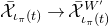 $\bar {\mathcal {X}}_{\iota _{\pi }(t)} \rightarrow \bar {\mathcal {X}}^{W'}_{\iota _{\pi }(t)}$
follows from Lemma 4.36.
4.4.1 Parallel configurations
Now, let us introduce the notion of parallel configurations. These are polygons that intersect ‘nicely’ with the fan
 $\Sigma$
. As a result, if we use these polygons to compactify the mirror family, then as we will show later in the paper, the compactified family will have ‘nice’ degenerations in agreement with the refinement of these polygons by
 $\Sigma$
over the toric boundary stratum of
 $\textrm {Spec}(\mathbb {C}[{\textrm {NE}}(Y)])$
, which makes it easy for us to compute numerical invariants.
Definition 4.42. Given a convex polygon
 $0\in F \subset B_{(Y,D)}$
and an edge
 $L$
of
 $F$
, the forward ray
 $R_L$
of
 $L$
is the ray we get by extending
 $L$
in the forward direction (given by the canonical orientation of
 $L$
). We say
 $F$
has a correct corner in
 $\sigma _{i,i+1}$
if there is a unique vertex
 $v\in F$
such that
 $v$
is in the interior of
 $\sigma _{i,i+1}$
,
 $F$
has no vertex on
 $\rho _i$
or
 $\rho _{i+1}$
, the forward ray of one edge at
 $v$
goes to infinity in
 $\sigma _{i+1,i+2}$
parallel to
 $\rho _{i+2}$
, and the forward ray of the other edge at
 $v$
goes to infinity in
 $\sigma _{i,i+1}$
parallel to
 $\rho _{i+1}$
.
Definition 4.43. Given a parallel polygon
 $0\in P(W) \subset B_{(Y,D)}$
, we say
 $P(W)$
is a parallel configuration for
 $(Y,D)$
if
 $P(W)$
has a correct corner in
 $\sigma _{i,i+1}$
for each
 $1\leqslant i\leqslant n$
.
Proposition 4.44.
Let
 $(Y,D)$
be positive,
 $n\ge 2$
,
 $D_i^2\ge 0$
for some
 $i$
. Then,
 $(Y,D)$
has a parallel configuration.
Proof.
Without loss of generality, suppose
 $D_1^2\ge 0$
. Then, using the developing map, we see that any immersed line
 $L$
that goes to infinity parallel to
 $\rho _2$
with positive lattice distance
 $a_2$
from
 $\rho _2$
is actually an embedded line on
 $B$
contained in the union
 $\sigma _{1,2} \cup \sigma _{n,1}$
. We set
 $a_2 =1$
. Suppose we have defined
 $a_i$
, then we set
 $a_{i+1} =1$
if
 $-D_i^{2} \leqslant 0$
and
 $a_{i+1} = (-D_i^{2})a_i+1$
if
 $-D_i^{2} \gt 0$
. All our indices are modulo
 $n$
. Then,
 $W=\sum _i a_iD_i$
is a
 $D$
-ample divisor and using the standard chart for
 $\sigma _{i-1,i} \cup \sigma _{i,i+1}$
, it is straightforward to see that
 $P(W)$
has a correct corner in
 $\sigma _{i-1,i}$
for each
 $i$
. Thus,
 $P(W)$
is a parallel configuration for
 $(Y,D)$
.
Proposition 4.45.
Let
 $(Y,D)$
be positive with
 $n= 1$
. Then there exists a parallel configuration for
 $(Y,D)$
if and only if
 $D^2\ge 2$
.
Proof.
A polygon with a parallel configuration for
 $(Y,D)$
is a
 $1$
-gon so it must be the half-space
 $Z(L)$
for some
 $L$
. Let
 $L$
be an immersed line with escape ray
 $\rho _1$
. Then by considering the developing map,
 $Z(L)$
has the correct corner if and only if
 $D_1^2\ge 2$
.
Lemma 4.46.
If
 $(Y,D)$
is positive and
 $D_i^2\ne -1$
for all
 $i$
, then
 $D_j^2\ge 0$
for some
 $j$
.
Proof.
Suppose that
 $(Y,D)$
is positive and
 $D_i^2\le -2$
for all
 $i$
. By the positivity, there exists positive integers
 $b_i$
such that
 $\left (\sum b_i D_i\right )\cdot D_j\gt 0$
for all
 $j$
. Then for every
 $j$
, we have
 $a_{j+1}+a_{j-1}\gt -a_j D_j^2$
. Summing up all such inequalities, we get
 \begin{equation*} 2\sum a_j\gt \sum a_j |D_j|^2.\end{equation*}
However, since
 $|D_j|^2\ge 2$
for all
 $j$
, no such collection of
 $a_i$
can exist.
Lemma 4.47.
Let
 $(Y,D)$
be a positive pair. Then, there exists a toric blowdown
 $(Y,D)\rightarrow (Y',D')$
such that either
 $(Y',D')$
has a parallel configuration or
 $(Y',D')$
is a del Pezzo surface of degree
 $1$
together with an irreducible anti-canonical cycle.
Proof.
Suppose
 $n\ge 2$
. If there exists
 $i$
such that
 $D_i^2\ge 0$
, then by Proposition 4.44, there exists a parallel configuration. Otherwise,
 $D_j^2\lt 0$
for all
 $j$
and by Lemma 4.46, there exists
 $i$
such that
 $D_{i}^{2}=-1$
. We then blowdown
 $D_i$
to obtain a new boundary,
 $D'$
. If
 $D'$
has only one component, then
 $D'^2\gt 0$
by positivity. By Proposition 4.45, either
 $(Y',D')$
has a parallel configuration or is the case of the degree
 $1$
del Pezzo surface together with an irreducible anti-canonical cycle. If there is more than one component in
 $D'$
, then again, there is either a component such that
 $D'^{2}_{i} \ge 0$
, in which case there is a parallel configuration, or there is a component we can blow down. We continue to blow down until the pair we get either has a parallel configuration or is the degree
 $1$
del Pezzo surface together with an irreducible anti-canonical cycle.
While many pairs in consideration do have a parallel configuration, some well-known pairs do not. For example, a cubic surface obtained by blowing up toric
 $\mathbb {P}^2$
twice on each boundary gives a pair
 $(Y,D)$
where
 $D$
has
 $3$
components, each with self-intersection
 $-1$
. There is no parallel configuration for this pair. To get a sense of what these polygons then look like, consider the divisor
 $W=D_1+D_2+D_3$
. Then,
 $P(W)$
is a convex polygon where the only vertices are given by the primitive lattice point on the
 $\rho _i$
and the edges connect these vertices. Another example is when
 $Y$
is a degree
 $1$
del Pezzo and
 $D$
is an irreducible nodal curve with self-intersection
 $1$
as seen in Figure 2.
4.4.2 Self-intersection numbers of boundary divisors of the canonical compactification
Fix a
 $D$
-ample Weil divisor
 $W = \sum _i a_iD_i$
. In this subsection, we use
 $P(W)$
to get the canonical compactification. Now, we want to show that the canonical compactification of a smooth fiber in
 $\mathcal {X} \rightarrow \mathrm {Spec}(\mathbb {C}[\mathrm {NE}(Y)])$
looks like the original pair
 $(Y,D)$
by showing that the self-intersection numbers of the boundary divisors of the compactification match with those in
 $D$
. In § 6, we will show that a compactified smooth fiber is deformation equivalent to the original pair
 $(Y,D)$
.
Here, we state a theorem that we will use frequently to compute the self-intersection numbers of boundary divisors in the compactification.
Theorem 4.48 [Reference VakilVak24, Theorem 24.8.1]. Suppose
 $f:X \rightarrow Y$
is a projective morphism of locally Noetherian schemes and
 $\mathcal {F}$
is a coherent sheaf on
 $X$
, flat over
 $Y$
. Then the Euler characteristic of
 $\mathcal {F}$
is locally constant in the fibers of
 $f$
.
Let
 $T^W \subset T^D$
be the 1-parameter subgroup given by the map
 $\chi (T^{D}) \rightarrow \mathbb {Z}$
,
 $e_{D_i} \mapsto a_i$
. Let
 $F$
be a polygon satisfying the conditions as in Proposition 4.27. Denote by
 $\bar {\mathcal {X}}(F)$
the compactification of the mirror family
 $\mathcal {X} \rightarrow S$
using
 $F$
. Recall that
 $S=\mathrm {Spec}(\mathbb {C}[\mathrm {NE}(Y)])$
. For each edge
 $E$
, let
 $\mathcal {D}_E \subset \bar {\mathcal {X}}(F)$
be the Weil divisor corresponding to
 $E$
. Denote by
 $X_0$
the central fiber of
 $\bar {\mathcal {X}}(F)$
over the unique toric fixed point
 $0 \in S$
.
Lemma 4.49.
Given a point
 $s \in T_Y$
, the limit
 $s_0$
of
 $s$
under the action of the 1-parameter subgroup exists in
 $S$
and
 $\bar {\mathcal {X}}(F)_{s_0}$
is isomorphic to
 $X_0$
. Denote by
 $\delta _s: \mathbb {A}^{1} \rightarrow S$
the morphism given by
 $T^W \cdot s$
. Suppose that
 $\bar {\mathcal {X}}(F)_s$
is smooth and
 $\mathcal {D}_{E,0}$
is a Cartier divisor on
 $X_0$
. Then,
 $\mathcal {D}_E \times _S \mathbb {A}^{1}$
is a relatively Cartier divisor on
 $\bar {\mathcal {X}}(F) \times _S \mathbb {A}^{1}$
for each edge
 $E$
of
 $F$
. Moreover,
 $\chi (\bar {\mathcal {X}}(F)_s, {\mathcal {O}}(\mathcal {D}_{E,s})) = \chi (X_0, {\mathcal {O}}(\mathcal {D}_{E,0}))$
.
Proof.
We use an argument similar to the one we used in the proof of Lemma 4.26. Given any
 $C\in \mathrm {NE}(Y)$
, the weight of
 $z^{[C]}$
under the action of
 $T^W$
is non-negative. Hence, the limit
 $s_0$
exists. We claim that
 $\mathcal {X}_{s_0}$
is isomorphic to
 $\mathbb {V}_n$
, and therefore
 $\bar {\mathcal {X}}(F)_{s_0}$
is isomorphic to
 $X_0$
. This follows from that the intersections of all
 $\mathbb {A}^1$
-classes with
 $W$
is positive and that
 $W \cdot D_i \gt 0$
for all
 $i$
. In particular,
 $\mathcal {D}_{E,s_0}$
is a Cartier divisor on
 $\bar {\mathcal {X}}(F)_{s_0}$
since
 $\mathcal {D}_{E,0}$
is one on
 $X_0$
.
Since
 $\bar {\mathcal {X}}(F)_s$
is smooth and the action of
 $T^{D}$
is equivariant on
 $\bar {\mathcal {X}}(F) \rightarrow S$
,
 $\bar {\mathcal {X}}(F)_{\delta _s(x)}$
is smooth for any
 $x \in \mathbb {A}^1 \setminus \left \{0\right \}$
. Thus
 $\mathcal {D}_{E, \delta _s(x)}$
is a Cartier divisor on
 $\bar {\mathcal {X}}(F)_{\delta _s(x)}$
for
 $x \in \mathbb {A}^1 \setminus \left \{0\right \}$
. By Proposition 4.20,
 $f: \bar {\mathcal {X}}(F) \times _{\mathbb {A}^1} S \rightarrow \mathbb {A}^1$
is of finite type. Since
 $\mathbb {A}^1$
is Noetherian, by [Sta, Tag 01TX],
 $f$
is of finite presentation. Since
 $\bar {\mathcal {X}}(F) \times _S {\mathbb {A}^1} \rightarrow \mathbb {A}^1$
is also flat and
 $\mathcal {D}_{E,\delta _s(x)}$
is an effective Cartier divisor on
 $\bar {\mathcal {X}}(F)_{\delta _s(x)}$
for each
 $x \in \mathbb {A}^1$
, by [Sta, Tag 062Y],
 $\mathcal {D}_E \times _S \mathbb {A}^1$
is a relative effective Cartier divisor on
 $\bar {\mathcal {X}}(F) \times _S {\mathbb {A}^1}$
. By Proposition 4.20,
 $f$
is projective. Therefore, since we have the isomorphism
 $\bar {\mathcal {X}}(F)_{s_0} \simeq X_0$
,
 $\chi (\bar {\mathcal {X}}(F)_s, {\mathcal {O}}(\mathcal {D}_{E,s})) = \chi (X_0, {\mathcal {O}}(\mathcal {D}_{E,0}))$
by Theorem 4.48.
Lemma 4.50.
If
 $\bar {\mathcal {X}}_t$
is the fiber of
 $\bar {\mathcal {X}}$
over
 $t \in T_Y$
such that
 $\bar {\mathcal {X}}_t$
is smooth, then
 $\mathcal {D}_{i,t}^2=D_i^2$
.
Proof.
Let us first consider the case where
 $P(W)$
is a parallel configuration. It is straightforward to see that
 $\mathcal {D}_{i,0}$
is a Cartier divisor on
 $X_0$
, the compactified fiber over
 $0\in \textrm {Spec}(\mathbb {C}[{\textrm {NE}}(Y)])$
, for each
 $i$
. Then,
 $\chi (\bar {\mathcal {X}}_t, {\mathcal {O}}(\mathcal {D}_{i,t})) = \chi (X_0, {\mathcal {O}}(\mathcal {D}_{i,0}))$
by Lemma 4.49. We break up the argument into two sub-cases: one for
 $n\geqslant 2$
and the other where
 $n=1$
. Recall that
 $n$
is the number of irreducible components in
 $D$
.
Case 1:
 $P(W)$
is a parallel configuration and
 $n\geqslant 2$
. Each irreducible component in
 $X_0$
is a toric ruled surface. Fix the edge
 $F_i$
which is parallel to
 $\rho _i$
and lies in two maximal cells,
 $\sigma _{i-2,i-1}$
and
 $\sigma _{i-1,i}$
. For
 $j=i-1,i$
, denote
 $P(W) \cap \sigma _{j-1,j}$
by
 $Q_{j-1,j}$
and the corresponding toric variety by
 $X(Q_{j-1,j})$
. Denote
 $R_i=F_i\cap Q_{i-1,i}$
and
 $R'_i=F_i\cap Q_{i-2,i-1}$
.
Let
 $Y_1 = X(Q_{i-1,i})$
and
 $Y_2 = X(Q_{i-2,i-1})$
and
 $Y=Y_1 \cup Y_2$
. The 1-cell
 $R_i$
corresponds to a section
 $C$
of the ruled toric surface
 $Y_1$
and has self-intersection number
 $D_i^2$
. By the Riemann–Roch theorem,
 \begin{equation*} \chi \left ( Y_1,{\mathcal {O}}(\mathcal {D}_{i,0})|_{Y_1}\right )=1+\tfrac {1}{2}C\cdot (C-K_{Y_1})=1+\tfrac {1}{2}(2C^2+2)=2+D_i^2.\end{equation*}
In
 $Y_2$
,
 $R_i'$
corresponds to a fiber of the ruled toric surface
 $Y_2$
and thus has self-intersection number
 $0$
. Again, by the Riemann–Roch theorem,
 \begin{equation*} \chi \left ( Y_2,{\mathcal {O}}(\mathcal {D}_{i,0})|_{Y_2}\right ) = 2. \end{equation*}
Denote the 1-cell
 $Q_{i-2,i-1} \cap Q_{i-1,i}$
by
 $\varrho _{i-1}$
. Then,
 $X(\varrho _{i-1}) = Y_1 \cap Y_2$
is a rational curve and we have
 \begin{equation*} {\mathcal {O}}(\mathcal {D}_{i,0}) |_{X(\varrho _{i-1})} \simeq {\mathcal {O}}_{\mathbb {P}^{1}}(1). \end{equation*}
Thus,
 $\chi (X(\varrho _{i-1}), {\mathcal {O}}(\mathcal {D}_{i,0})|_{X(\varrho _{i-1})})= 2$
by the Riemann–Roch theorem.
Recall that if
 $X$
is the union of two closed subvarieties
 $X_1, X_2$
and
 $\mathcal {F}$
is a locally free sheaf on
 $X$
, then we have the short exact sequence
 \begin{equation*} 0 \rightarrow \mathcal {F} \otimes {\mathcal {O}}_{X} \rightarrow (\mathcal {F}\otimes {\mathcal {O}}_{X_1}) \oplus (\mathcal {F} \otimes {\mathcal {O}}_{X_2}) \rightarrow \mathcal {F} \otimes {\mathcal {O}}_{X_1 \cap X_2} \rightarrow 0. \end{equation*}
Taking the Euler characteristic, we get
 \begin{equation} \chi (X, \mathcal {F}) = \chi (X_1, \mathcal {F}|_{X_1}) + \chi (X_2, \mathcal {F}|_{X_2}) - \chi (X_1 \cap X_2, \mathcal {F}|_{X_1 \cap X_2}). \end{equation}
By Equation (4.7), we get
 \begin{align*} \chi (Y, {\mathcal {O}}(\mathcal {D}_{i,0})|_{Y_1 \cup Y_2}) & = \chi (Y_1,{\mathcal {O}}(\mathcal {D}_{i,0})|_{Y_1}) + \chi (Y_2,{\mathcal {O}}(\mathcal {D}_{i,0})|_{Y_2}) - \chi (X(\varrho _{i}), {\mathcal {O}}(\mathcal {D}_{i,0})|_{X(\varrho _{i-1})}) \\ &= D_i^{2}+2. \end{align*}
Let
 $Z$
be the union of irreducible components in
 $X_0$
that are not
 $Y_1$
or
 $Y_2$
. Then
 ${\mathcal {O}}(\mathcal {D}_{i,0})|_{Z}$
is the trivial line bundle. In particular, we have
 \begin{equation*} \chi (Z, {\mathcal {O}}(\mathcal {D}_{i,0}) |_{Z}) = 1 \quad \mathrm {and} \quad \chi (Y \cap Z, {\mathcal {O}}(\mathcal {D}_{i,0}) |_{Y \cap Z})=1. \end{equation*}
Applying Equation (4.7) again, we obtain that
 \begin{align*} \chi (X_0, {\mathcal {O}}(\mathcal {D}_{i,0})) &= \chi (Y, {\mathcal {O}}(\mathcal {D}_{i,0}) |_{Y}) + \chi (Z, {\mathcal {O}}(\mathcal {D}_{i,0}) |_{Z}) - \chi (Y \cap Z, {\mathcal {O}}(\mathcal {D}_{i,0}) |_{Y \cap Z})\\ &= D_i^2+2. \end{align*}
Now, fix a generic
 $t\in T_Y$
such that
 $\bar {\mathcal {X}}_t$
is smooth. By the Riemann–Roch theorem, on
 $\bar {\mathcal {X}}_t$
,
 $\chi (\bar {\mathcal {X}}_t, {\mathcal {O}}(\mathcal {D}_{i,t}))=\mathcal {D}_{i,t}^2+2$
. Then, since
 \begin{equation*} \chi (\bar {\mathcal {X}}_t, {\mathcal {O}}(\mathcal {D}_{i,t})) = \mathcal {D}_{i,t}^2+2 = \chi (X_0, {\mathcal {O}}(\mathcal {D}_{i,0})) = D_i^2+2, \end{equation*}
we conclude that
 $\mathcal {D}_{i,t}^2 = D_i^2$
.
Case 2:
 $P(W)$
is a parallel configuration and
 $n =1$
. By Proposition 4.45, we have
 $D^2 \geqslant 2$
. We pass to a toric blowup at the node of
 $D$
and draw
 $P(W)$
in
 $B_{(Y',D')}$
, where
 $(Y',D')$
is the toric blow-up at the node of
 $D$
. See Figure 4 for an example. Let
 $\bar {\mathcal {X}}'(P(W))$
be the compactification of the mirror family
 $\mathcal {X}'$
associated to
 $(Y',D')$
using
 $P(W)$
. By Lemma 4.22, we can embed
 $\bar {\mathcal {X}}$
into
 $\bar {\mathcal {X}}'(P(W))$
. The fiber over
 $0\in \mathrm {Spec}(\mathbb {C}[\mathrm {NE}(Y')])$
consists of two irreducible components,
 $X_1$
and
 $X_2$
, whose moment map is contained in
 $\sigma _{2,1}$
and
 $\sigma _{1,2}$
, respectively. Denote by
 $C_i$
, the irreducible component of
 $X_1 \cap X_2$
whose moment map is contained in
 $\rho _i$
. Denote the central fiber by
 $X_0 = X_1 \cup X_2$
. Let
 $\mathcal {D}_0 = \mathcal {D} |_{X_0}$
and
 $H_i = \mathcal {D}_0 \cap X_i$
.
 $P(W)$
for
 $(Y,D)$
where
 $n=1$
and
 $D^2 =3$
.
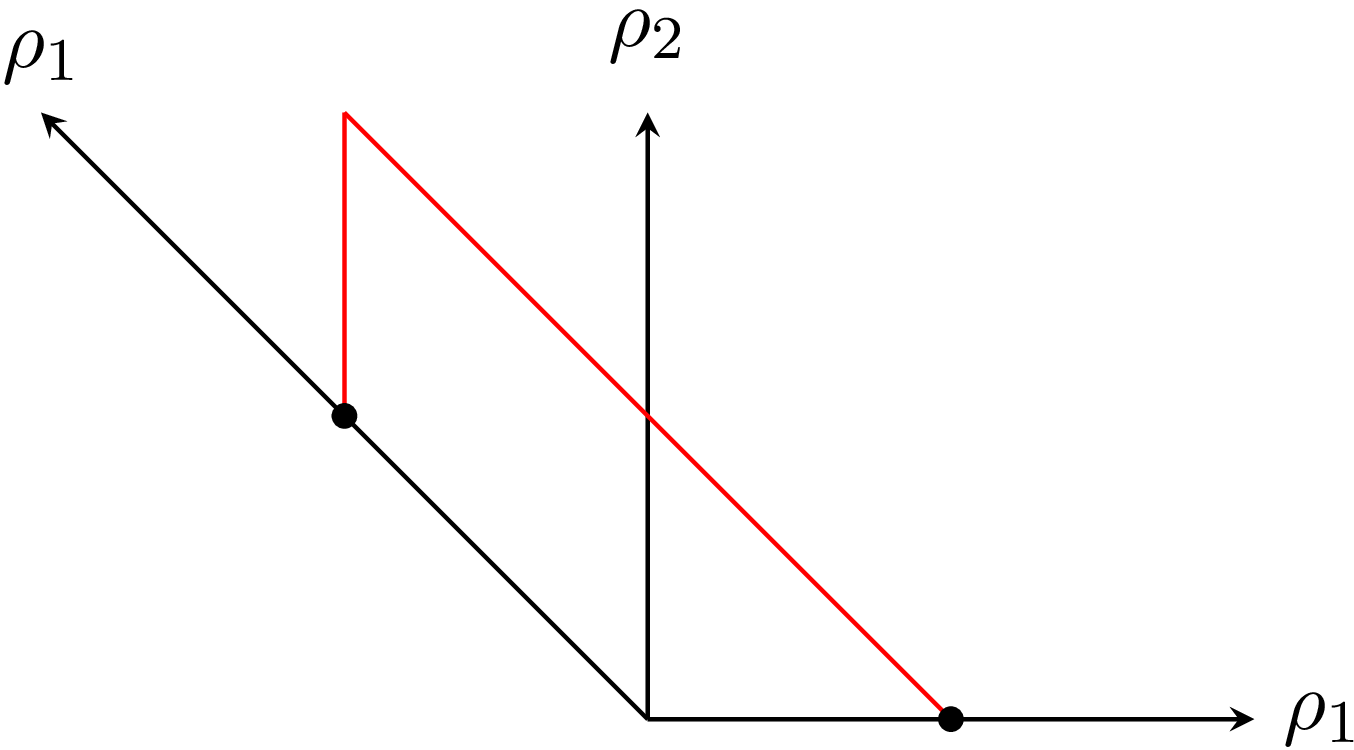
If
 $D^2 \geqslant 3$
,
 $X_1$
is isomorphic to a smooth ruled toric surface and
 $X_2$
isomorphic to
 $\mathbb {P}^2$
. The intersection of the only edge
 $F_1$
of
 $P(W)$
with
 $\sigma _{2,1}$
consists of two segments
 $R_1$
and
 $R'_1$
with
 $R_1$
parallel to
 $\rho _1$
. We have that
 $X(R_1)$
is a toric section of
 $X_1$
with self-intersection
 $D^2 -3$
and
 $X(R'_1)$
is a fiber of
 $X_1$
. Thus,
 $H^{2}_{1} = (X(R_1)+X(R'_1))^2 = D^2-1$
. If
 $D^2 = 2$
,
 $X_1$
and
 $X_2$
are both isomorphic to
 $\mathbb {P}^2$
,
 $H_1$
is an irreducible toric boundary divisor on
 $X_1$
, and
 $H^2_{1} = D^2 -1$
still holds. By the Riemann–Roch theorem,
 \begin{align*} \chi (X_1, {\mathcal {O}}(\mathcal {D}_0)|_{X_1}) & = 1+\tfrac {1}{2} H_1 (H_1 - K_{X_1}) = 1+\tfrac {1}{2} (2H^{2}_{1} +2 ) = D^2+1, \end{align*}
and
 \begin{equation*} \chi (X_2, {\mathcal {O}}(\mathcal {D}_0) |_{X_2}) = 1+\tfrac {1}{2}H_2 (H_2 - K_{X_2}) = 3. \end{equation*}
Consider the irreducible components
 $C_i$
of
 $X_1 \cap X_2$
. On
 $C_i$
,
 $ {\mathcal {O}}(\mathcal {D}_0)|_{C_i} \simeq {\mathcal {O}}_{\mathbb {P}^1}(1)$
. By the Riemann–Roch theorem,
 $\chi (C_i, \mathcal {O}(\mathcal {D}_0)|_{C_i}) =2.$
On
 $C_1 \cap C_2$
,
 ${\mathcal {O}}(\mathcal {D}_0)|_{C_1 \cap C_2}$
is the trivial line bundle over a point. By Equation (4.7) and the Riemann–Roch theorem,
 \begin{align*} \chi (X_1 \cap X_2, \mathcal {O}(\mathcal {D}_0)) & = \chi (C_1, \mathcal {O}(\mathcal {D}_0)|_{C_1}) + \chi (C_2, \mathcal {O}(\mathcal {D}_0)|_{C_2}) - \chi (C_1 \cap C_2, \mathcal {O}(\mathcal {D}_0)|_{C_1 \cap C_2})\\ &= 2+2-1=3 . \end{align*}
Applying Equation (4.7) again,
 \begin{align*} \chi (X_0, \mathcal {O}(\mathcal {D}_0)) &= \chi (X_1, \mathcal {O}(\mathcal {D}_0)|_{X_1}) + \chi (X_2, \mathcal {O}(\mathcal {D}_0)|_{X_2}) - \chi (X_1 \cap X_2, \mathcal {O}(\mathcal {D}_0)|_{X_1 \cap X_2})\\ &= D^2 +1 . \end{align*}
Now, fix a generic
 $t\in T_Y$
such that
 $\bar {\mathcal {X}}_t$
is smooth. By the Riemann–Roch theorem, on
 $\bar {\mathcal {X}}_t$
,
 $\chi (\bar {\mathcal {X}}_t, {\mathcal {O}}(\mathcal {D}_{i,t}))=\mathcal {D}_{i,t}^2+1$
. Then, since
 \begin{equation*} \chi (\bar {\mathcal {X}}_t, {\mathcal {O}}(\mathcal {D}_{i,t}) ) = \mathcal {D}_{i,t}^2+1 = \chi (X_0, {\mathcal {O}}(\mathcal {D}_{i,0})) = D_i^2+1, \end{equation*}
we conclude that
 $\mathcal {D}_{i,t}^2 = D_i^2$
.
Now, suppose
 $\pi : (Y,D) \rightarrow (Y',D')$
is a toric blowdown and that we know that the statement of the lemma holds for smooth fibers in
 $\bar {\mathcal {X}}'\rightarrow T_{Y'}$
. Let
 $\iota _{\pi }: \textrm {Spec}(\mathbb {C}[{\textrm {NE}}(Y')]) \hookrightarrow \textrm {Spec}(\mathbb {C}[{\textrm {NE}}(Y)])$
be the locally closed embedding as in Lemma 4.22. Then, given
 $t\in T_{Y'}$
such that
 $\bar {\mathcal {X}}'_t$
is smooth, by Lemma 4.41, the statement of the lemma also holds for
 $\bar {\mathcal {X}}_{\iota _{\pi }(t)}$
since it holds for
 $\bar {\mathcal {X}}'_t$
. Using the equivariant action of
 $T^{D}$
on
 $\bar {\mathcal {X}} |_{T_Y} \rightarrow T_Y$
, we know the statement of lemma has to hold for any smooth fiber in
 $\bar {\mathcal {X}} |_{T_Y} \rightarrow T_Y$
. In particular, if
 $(Y',D')$
has a parallel configuration, then by our previous computation, the statement holds for smooth fibers
 $\bar {\mathcal {X}}'\rightarrow T_{Y'}$
and therefore also holds for smooth fibers in
 $\bar {\mathcal {X}} |_{T_Y} \rightarrow T_Y$
.
If
 $(Y,D)$
does not blow down to a pair that has a parallel configuration, it must blow down to the case of the degree
 $1$
del Pezzo surface together with an irreducible anti-canonical divisor. By our discussion in the previous paragraph, it suffices to prove that the statement of the lemma holds for smooth fibers in the canonically compactified mirror family associated with the degree
 $1$
del Pezzo surface.
Let
 $(Y,D)$
be a degree
 $1$
del Pezzo surface with an irreducible nodal anticanonical divisor. Consider
 $W=D$
and the associated polytope,
 $P(W)$
, as seen in Figure 5. Again, we pass to a toric blowup
 $(Y',D') \rightarrow (Y,D)$
at the node of
 $D$
as we did in the parallel case where
 $n=1$
and follow the notation we used there. The fiber
 $X_0$
over
 $0\in \mathrm {Spec}(\mathbb {C}[\mathrm {NE}(Y')])$
consists of two irreducible components
 $X_1$
and
 $X_2$
, each of which is a copy of
 $\mathbb {P}(1,1,2)$
, whose toric fan is shown in Figure 6.
Note that due to the quotient singularity in
 $\mathbb {P}(1,1,2)$
,
 $\mathcal {D}_0$
is not Cartier but
 $2\mathcal {D}_0$
is. By Lemma 4.49, it suffices to compute
 $\chi (X_0, \mathcal {O}(2\mathcal {D}_0))$
.
 $P(W)$
for the degree
 $1$
del Pezzo.

The toric fan for
 $\mathbb {P}(1,1,2)$
.

The convex polytope of the line bundle
 $\mathcal {O}(2\mathcal {D}_0) |_{X_i}$
.

First, notice that
 $\mathcal {O}(2\mathcal {D}_0)|_{X_i} = \mathcal {O}(2\mathcal {D}_0 \cap X_i)$
is generated by its global sections since its support function is convex. The associated convex polytope is shown in Figure 7. Thus, higher cohomology groups of
 $\mathcal {O}(2\mathcal {D}_0)|_{X_i}$
vanish and we have
 \begin{equation*} \chi (X_i, \mathcal {O}(2\mathcal {D}_0)|_{X_i}) = H^{0}(X_i, \mathcal {O}(2\mathcal {D}_0)|_{X_i}) =4, \end{equation*}
which is equal to the number of lattice points in the convex polytope associated with
 $\mathcal {O}(2\mathcal {D}_0) |_{X_i}$
as shown in Figure 7.
Next, consider the two irreducible curves
 $C_1, C_2$
of
 $X_1 \cap X_2$
. We claim that
 \begin{equation*} \mathcal {O}(2\mathcal {D}_0) |_{C_2} \simeq \mathcal {O}_{\mathbb {P}^{1}}(1) \end{equation*}
and
 \begin{equation*} \mathcal {O}(2\mathcal {D}_0) |_{C_1} \simeq \mathcal {O}_{\mathbb {P}^{1}}(2). \end{equation*}
Indeed, denote the intersection point of
 $D_2$
with
 $C_1$
and
 $C_2$
by
 $r$
and
 $q$
, respectively. Denote by
 $U_{\tau _i} (i=1,2)$
the affine chart corresponding to the cone
 $\tau _i$
in the fan for
 $X_2 \simeq \mathbb {P}(1,1,2)$
. Then, on the affine chart
 $U_{\tau _1}$
,
 $\mathcal {O}(-2\mathcal {D}_0) |_{U_{\tau _1}}$
is generated by the toric monomial
 $x=z^{(0,-1)}$
. Since
 $C_2 \cap U_{\tau _1} = \mathrm {Spec}(\mathbb {C}[x])$
, we conclude that
 $\mathcal {O}(-2\mathcal {D}_{0})\otimes O_{C_2}$
is the ideal sheaf for
 $q$
. Let
 $y=z^{(-1,0)}$
. On the affine chart
 $U_{\tau _2}$
,
 $\mathcal {O}(-2\mathcal {D}_0) |_{U_{\tau _2}}$
is generated by the toric monomial
 $y^2=z^{(-2,0)}$
. Since
 $C_1 \cap U_{\tau _2} = \mathrm {Spec}(\mathbb {C}[y])$
, we conclude that
 $\mathcal {O}(-2\mathcal {D}_{0})\otimes O_{C_1}$
is the ideal sheaf for
 $2r$
.
Now, let us compute
 $\chi (X_1 \cap X_2, \mathcal {O}(2 \mathcal {D}_0)|_{X_1 \cap X_2})$
. We have
 $X_1 \cap X_2 =C_1 \cup C_2$
. Applying Equation (4.7) gives
 \begin{align*} \chi (X_1 \cap X_2, \mathcal {O}(2 \mathcal {D}_0)|_{X_1 \cap X_2}) & = \chi (C_1, \mathcal {O}(2 \mathcal {D}_0)|_{C_1}) + \chi (C_1, \mathcal {O}(2 \mathcal {D}_0)|_{C_2}) - \chi (C_1 \cap C_2, \mathcal {O}(2 \mathcal {D}_0)|_{C_1 \cap C_2}) \\ &= 2+3-1=4. \end{align*}
Apply Equation (4.7) again, we get
 \begin{align*} \chi (X_0, \mathcal {O}(2\mathcal {D}_0)) & = \chi (X_1, \mathcal {O}(2\mathcal {D}_0)|_{X_1}) + \chi (X_2, \mathcal {O}(2\mathcal {D}_0)|_{X_2}) - \chi (X_1 \cap X_2, \mathcal {O}(2\mathcal {D}_0)|_{X_1 \cap X_2})\\ &= 4+4-4=4. \end{align*}
Thus, by Riemann–Roch, we have
 \begin{align*} \chi (\bar {\mathcal {X}}_t, O(2\mathcal {D}_t)) & = \tfrac {1}{2}2\mathcal {D}_t \cdot (2\mathcal {D}_t +\mathcal {D}_t) +1 = 3\mathcal {D}_t^2 +1 =\chi (X_0, \mathcal {O}(2\mathcal {D}_{0})) = 4, \end{align*}
and we obtain that
 $\mathcal {D}_t^2 =1$
as desired.
5. The boundary and the marked period
The global theta functions provide a way to consistently give a marking on the boundary divisor of the compactified family. Later, in 6, we will use this marking on the boundary to compute the marked periods of the fibers in the compactified mirror family.
Construction 5.1 (Marking the boundary via the canonical coordinates). Given a non-self-intersecting line segment
 $\bar {L}$
in
 $B\setminus \left \{0\right \}$
, we give an order on the set of lattice points contained in
 $\bar {L}$
by letting
 $a \succ b$
if
 $a$
succeeds
 $b$
, following the canonical orientation of the immersed line containing
 $\bar {L}$
.
Fix a parallel polygon
 $F$
associated with a
 $D$
-ample Weil divisor
 $W$
. Denote by
 $F_i$
the edge parallel to the ray
 $\rho _i$
. Rescaling the polygon
 $F$
by a positive integral multiple if necessary, we can assume that for each edge
 $F_i$
, there exists a maximal cone
 $\sigma$
in
 $\Sigma$
that contains two consecutive lattice points
 $a_i \succ b_i$
on
 $F_i$
. If
 $F$
is a 1-gon, we further require the two consecutive lattice points to be contained in the interior of
 $\sigma$
. Let
 $F_{i,\sigma } = \sigma \cap F_i$
. We can extend
 $F_{i,\sigma }$
in the forward direction (given by the canonical orientation of
 $F_i$
) to a ray
 $R$
that escapes in the cone
 $\sigma _{i-1,i}$
, which is parallel to
 $\rho _i$
. Given a ray
 $\rho _j$
in
 $\Sigma$
that intersects
 $R$
, let
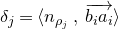 $\delta _j = \langle n_{\rho _j} \,,\,\overrightarrow {b_ia_i} \rangle$
where
 $n_{\rho _j}\in \check {\Lambda }_{\rho _j}$
is the unique primitive element annihilating
 $\rho _j$
that is positive on the parallel transport of
 $\overrightarrow {b_ia_i}$
. Here,
 $\left \langle , \right \rangle$
is the standard pairing between a vector and a covector. Let
 \begin{align} f_{\mathcal {D}_i} = z^{\sum _{\rho _j} \delta _j \cdot D_j} \cdot \frac {\vartheta _{a_i}}{\vartheta _{b_i}}, \end{align}
where the sum is over all rays,
 $\rho _j,$
that intersect
 $R$
. By Proposition 4.37,
 $f_{\mathcal {D}_i}$
restricts to a coordinate on
 $\mathcal {D}^{0 }_i |_{T_Y}$
where
 $\mathcal {D}^{0 }_i |_{T_Y}$
is the complement of the nodes. Then we can define a section
 $p_i$
of
 $\mathcal {D}^{0 }_i |_{T_Y} \rightarrow T_Y$
by letting
 $ f_{\mathcal {D}_i} = -1$
. These choices of sections
 $p_i$
give us a marking of
 $\mathcal {D}|_{T_Y}$
. An example of the marking can be seen in Figure 8.
By the definition of the
 $\Sigma$
-piecewise linear function
 $\varphi$
and Proposition 4.29,
 $f_{\mathcal {D}_i}$
and the marking
 $p_i$
are independent of the particular choice of the parallel polygon
 $F$
and the consecutive lattice points
 $a \succ b$
. By Lemma 5.4,
 $p_i$
extends to a section on
 $\mathcal {D}_i$
. We call the coordinate
 $f_{\mathcal {D}_i}$
the canonical coordinate on the boundary
 $\mathcal {D}_i$
.
An example of the marking on the boundary in the case where
 $Y$
is
 $\mathbb {P}^2$
and
 $D$
its toric boundary.

Remark 5.2. We choose the marking given by
 $f_{\mathcal {D}_i} = -1$
in this paper because, as we see later in this section and in § 6, this marking will make the period map of the compactified mirror family over
 $T_Y$
the identity map.
Lemma 5.3.
The relative torus
 $T^{D}$
acts on
 $(\bar {\mathcal {X}}|_{T_Y},\mathcal {D}|_{T_Y}\!)$
by changing the canonical marking
 $p_i$
 $(1\leqslant i \leqslant n)$
as defined in Construction
5.1
.
Proof.
The forward ray
 $R_{F_i}$
of
 $F_i$
escapes in the cone
 $\sigma _{i-1,i}$
, parallel to
 $\rho _i$
on the right. Take two consecutive lattice points
 $p \succ q$
on
 $R_{F_i} \cap \sigma _{i-1,i}$
. Then, by Proposition 4.29, restricted to
 $\mathcal {D}^{0 }_i |_{T_Y}$
,
 $f_{\mathcal {D}_i} = {\vartheta _p}/{\vartheta _q}$
. It follows from the definition of the weight function and Theorem 3.11 that restricted to
 $\mathcal {D}^{0 }_i |_{T_Y}$
,
 $f_{\mathcal {D}_i}$
is an eigenfunction of
 $T^{D}$
with weight
 $e_{D_i}$
.
Lemma 5.4.
Let
 $S=\textrm {Spec}(\mathbb {C}[{\textrm {NE}}(Y)])$
. Let
 $(\bar {\mathcal {X}},\mathcal {D})\rightarrow S$
be the compactification of the mirror family using a parallel polygon
 $F$
. Consider the degeneration
 $f_i: \mathcal {D}_i \rightarrow S$
. Let
 $p \succ q$
be two consecutive integer points in the same 1-cell
 $\varrho$
in the polyhedral decomposition of the edge
 $F_i$
given by
 $\Sigma \cap F_i$
. If
 $F$
is a 1-gon, we further require the two consecutive lattice points to be contained in the interior of
 $\varrho$
. Consider the section
 $s:T_Y\rightarrow \mathcal {D}_i |_{T_Y}$
of
 $\mathcal {D}_i |_{T_Y} \rightarrow {T_Y}$
given by
 $\vartheta _p/\vartheta _q=- 1$
as in Proposition 4.37
. Then
 $s$
extends to a section over the full base
 $S$
. Furthermore, at the unique toric fixed point
 $0\in S$
, it meets an interior point of the boundary component corresponding to
 $\varrho$
.
Proof.
Recall that
 $\mathcal {D}_i^{0 } \subset \mathcal {D}_i$
is the complement of nodes of
 $\mathcal {D}_i$
. By Proposition 4.37,
 $f_i: \mathcal {D}_i^{0 } \rightarrow S$
is a purely Mumford degeneration as in [Reference Gross, Hacking and KeelGHK15a, § 1.3]. Then, by the construction of the Mumford degeneration, since
 $p,q$
are in the same cell
 $\varrho$
in the polyhedral decomposition of
 $\Sigma \cap F_i$
, the section
 $s$
extends over the entire base
 $S$
. The last statement follows from that at
 $0\in S$
,
 $\vartheta _p/\vartheta _q$
restricts to a generator of the ring regular function of the smooth locus of the boundary component corresponding to
 $\varrho$
.
Lemma 5.5.
For
 $i\in \{1,\ldots ,n\}$
with
 $n\geqslant 1,$
let
 $(S_i,p_i,G_i,G'_i)$
be an ordered collection of smooth complete toric surfaces
 $S_i$
with a choice of two adjacent toric boundary components
 $G_i$
and
 $G'_i$
that intersect at the
 $0$
-stratum
 $p_i$
. The indices are modulo
 $n$
. Gluing
 $G_i\subset S_i$
to
 $G'_{i+1}\subset S_{i+1}$
by identifying the structure tori so that
 $p_i$
is glued to
 $p_{i+1}$
, we obtain a surface
 $S$
with normal crossing boundary cycle
 $D$
given by
 \begin{equation*} D:= \bigcup _i \partial (S_i)\setminus (G_i\cup G'_i).\end{equation*}
Each irreducible component
 $Z\subset D$
has a structure torus
 $\mathbb {G}_m\subset Z$
so there is a point
 $-1_Z\in \mathbb {G}_m\subset Z$
defined by
 $X+Y=0$
where
 $X,Y$
are homogeneous coordinates on
 $Z$
. Then, given
 $L\in \textrm {Pic}(S)$
,
 \begin{equation*} L|_D={\mathcal {O}}\bigg(\sum _{Z\subset D}(L\cdot Z)(-1_Z)\bigg).\end{equation*}
Proof.
Let
 $\pi : \amalg _i S_i \rightarrow S$
be the normalization map. It follows from [Reference Friedman and ScattoneFS86, Proposition 3.1] that the pullback map
 $\pi ^{*}: \textrm {Pic}(S)\rightarrow \oplus _i \textrm {Pic}(S_i)$
is injective. Then we can write
 $L={\mathcal {O}}_S(\sum _i C_i)$
such that
 $\tilde {C}_i = \pi ^{*}{C_i}$
is a Cartier divisor on
 $S_i$
.
Let
 $L_i$
be the pullback of
 $L$
to
 $S_i$
. Then,
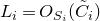 $L_i = O_{S_i}(\tilde {C}_i)$
. We can write
 $\tilde {C}_i = A_i-B_i$
where
 $A_i$
and
 $B_i$
are ample divisors, so it will be enough to prove the lemma for the case where
 $L_i$
is ample for each
 $i$
. Then, the polarized pair
 $(S_i,L_i)$
is given by a lattice polytope
 $Q_i$
. Take a linear combination
 $f$
of monomials given by lattice points on the boundary
 $\partial Q_i$
such that the restriction of
 $f$
to a boundary component
 $Z_{\rho } \subset D$
with
 $\rho$
a boundary of
 $Q_i$
, has the form
 $(X+Y)^{L_i \cdot Z_{\rho }}$
where
 $X,Y$
are homogeneous coordinates on
 $Z_{\rho }$
. Then the zero scheme given by
 $f=0$
on
 $Z_{\rho }$
is
 $(L_i \cdot Z_{\rho }) (-1_{Z_{\rho }})$
, where
 $-1_{Z_{\rho }} \in \mathbb {G}_m \subset Z_{\rho }$
is the point on defined by
 $X+Y=0$
. Let
 $C= \sum _i C_i$
. Then, we conclude that
 \begin{equation*}L|_D={\mathcal {O}}_D(C|_D)={\mathcal {O}}\bigg(\sum _{Z\subset D} (L\cdot Z ) (-1_Z )\bigg).\end{equation*}
Lemma 5.6.
Let
 $((\bar {\mathcal {X}} |_{T_Y},\mathcal {D} |_{T_Y}\!),p_i)\rightarrow T_Y$
be the family where the marking
 $p_i$
is given as in Construction
5.1
. Fix a component,
 $\mathcal {D}_i\subset \mathcal {D}$
, and let
 $\mathcal {D}_{i,t} = \mathcal {D}_i |_{\bar {\mathcal {X}}_t}$
. When
 $n\ge 2$
, we define
 \begin{equation*} \psi _i(t):=(\mathcal {O}(\mathcal {D}_i)|_{\mathcal {D}_t})^{-1}\otimes {\mathcal {O}}(p_{i-1}(t)+D_{i}^2p_i(t)+p_{i+1}(t)). \end{equation*}
When
 $n=1$
, we define
 \begin{equation*} \psi _1(t)=\psi (t):=({\mathcal {O}}(\mathcal {D})|_{\mathcal {D}_t})^{-1}\otimes {\mathcal {O}}( D^2 p(t)). \end{equation*}
Then
 $\psi _i$
defines an element in
 $\textrm {Pic}^0(\mathcal {D}_t)$
for
 $t\in T_Y$
.
Proof.
Since
 $\bar {\mathcal {X}}|_{T_Y}$
is smooth along
 $\mathcal {D} |_{T_Y}$
by Proposition 4.27,
 $\mathcal {D}_i |_{T_Y}$
is a Cartier divisor on
 $\bar {\mathcal {X}}|_{T_Y}$
by [Sta, Tag 062Y]. If
 $\bar {\mathcal {X}}_t$
is smooth, then
 ${\mathcal {D}}^{2}_{i,t} = D^{2}_i$
by Lemma 4.50. If
 $\bar {\mathcal {X}}_t$
is singular, since
 $\bar {\mathcal {X}}_t$
is still smooth along
 $\mathcal {D}_t$
, we still have
 ${\mathcal {D}}^{2}_{i,t} = D^{2}_i$
after passing through a minimal resolution of
 $\bar {\mathcal {X}}_t$
. Therefore,
 $\psi _i$
defines an element in
 $\textrm {Pic}^0(\mathcal {D}_t)$
for
 $t\in T_Y$
.
Proposition 5.7.
We follow the notation and definitions of Lemma 5.6
. Fix the canonical identification
 $\textrm {Pic}^0(\mathcal {D}_t) \simeq \mathbb {G}_m$
as in Lemma 2.5
. Suppose that
 $(Y,D)$
has a parallel configuration. Then
 $\psi _i(t)=z^{D_i}(t)$
if
 $n \geqslant 2$
and
 $\psi (t)=z^{D}(t)$
if
 $n=1$
.
Proof.
Let
 $F$
be a parallel configuration for
 $(Y,D)$
. We use
 $F$
to compactify our mirror family. Then
 $\mathcal {D}_{i,t}$
is still a Cartier divisor on
 $\bar {\mathcal {X}}_t$
for
 $t$
on the boundary strata
 $\textrm {Spec}(\mathbb {C}[{\textrm {NE}}(Y)])\setminus T_Y$
. Therefore,
 $\mathcal {D}_i$
is an Cartier divisor on
 $\bar {\mathcal {X}}$
by [Sta, Tag 062Y]. Let
 $0\in \textrm {Spec} (\mathbb {C} \left [ {\textrm {NE}}(Y) \right ] )$
be the unique toric fixed point and
 $X_0$
the fiber of
 $\bar {\mathcal {X}}$
over this point.
The hollow nodes signify the alternative marking on the boundary divisor
 $D_2$
of
 $\mathbb {P}^2$
as in the proof of Proposition 5.7.

Let us first consider the case where
 $n\geqslant 2$
. We now use notation from Construction 5.1. Denote
 $R_i=F_i\cap \sigma _{i-1,i}$
and
 $R'_i=F_i\cap \sigma _{i-2,i-1}$
. The marking on
 $\mathcal {D}_{i+1} |_{T_Y}$
is given by
 $f_{\mathcal {D}_{i+1}} = {\vartheta _{a_{i+1}}}/{\vartheta _{b_{i+1}}} = -1$
where
 $a_{i+1} \succ b_{i+1}$
are two consecutive lattice points on
 $R_{i+1}$
. Let
 $f'_{\mathcal {D}_{i+1}} = {\vartheta _{c_{i+1}}}/{\vartheta _{d_{i+1}}}$
where
 $c_{i+1} \succ d_{i+1}$
are two consecutive lattice points on
 $R'_{i+1}$
. Consider an alternative marking
 $p'_{i+1}$
on
 $\mathcal {D}_{i+1} |_{T_Y}$
by letting
 $f'_{\mathcal {D}_{i+1}} = -1$
instead. Figure 9 is an example of this alternative marking. By the definition of the
 $\Sigma$
-piecewise linear function
 $\varphi$
and Proposition 4.24, over
 $T_Y$
we have
 \begin{equation*} f_{\mathcal {D}_{i+1}} = z^{D_{i}} f'_{\mathcal {D}_{i+1}} \quad \mathrm {on}\,\,\mathcal {D}_{i+1}^{0 } | T_Y. \end{equation*}
Using the alternative marking on
 $\mathcal {D}_{i+1}|_{T_Y}$
, we define a new function
 \begin{equation*}\tilde {\psi _i}(t)=({\mathcal {O}}(\mathcal {D}_i)|_{\mathcal {D}_t})^{-1}\otimes {\mathcal {O}}(p_{i-1}(t)+D_{i}^2p_i(t)+p'_{i+1}(t)) \in \textrm {Pic}^{0}(\mathcal {D}_t).\end{equation*}
Then, it follows from the definition of the alternative marking on
 $\mathcal {D}_{i+1}|_{T_Y}$
and Lemma 2.5 that
 $\tilde {\psi _i}(t)=\psi _i(t)\otimes z^{-D_i}(t)$
on
 $T_Y$
.
Next, we show that
 $\tilde {\psi _i}$
extends to a nowhere vanishing regular function over the toric variety
 $\textrm {Spec} (\mathbb {C} \left [ {\textrm {NE}}(Y) \right ] )$
. This is equivalent to showing that over
 $X_0$
,
 $\tilde {\psi }_i$
still gives a numerically trivial line bundle. By Lemma 5.4, the sections given by the marking extend over the full base. On
 $X_0$
,
 $\mathcal {D}_{i}$
breaks into two components,
 $X(R_i)$
and
 $X(R'_i)$
. Furthermore, since
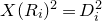 $X(R_i)^2=D_i^2$
and
 $ X(R'_i)^2 =0$
, we indeed get a numerically trivial line bundle on
 $X_0$
. Thus,
 $\tilde {\psi _i}$
extends to a non-vanishing function over the whole base
 $\textrm {Spec} (\mathbb {C} \left [ {\textrm {NE}}(Y) \right ] )$
, which tells us that
 $\tilde {\psi _i}$
is constant over
 $\textrm {Spec} (\mathbb {C} \left [ {\textrm {NE}}(Y) \right ] )$
. On
 $X_0$
, using Lemma 5.5, we can compute that
 $\tilde {\psi _i}(0)=1$
. Thus
 $\tilde {\psi _i}\equiv 1$
over
 $T_Y$
, which implies that
 $\psi _i(t)=z^{D_i}(t)$
over
 $T_Y$
.
Finally, let us consider the case where
 $n=1$
. Let
 $R_1 \subset F_1$
be the segment of the unique edge
 $F_1$
before it crosses the unique ray
 $\rho _1$
, and
 $R_2 \subset F_1$
the segment after
 $F_1$
crosses
 $\rho _1$
. Consider the alternative marking
 $p'$
on
 $\mathcal {D}|_{T_Y}$
given by two interior consecutive lattice points on
 $c \succ d$
on
 $R_1$
instead. Define
 \begin{equation*} \tilde {\psi }(t)=({\mathcal {O}}(\mathcal {D})|_{\mathcal {D}_t})^{-1}\otimes {\mathcal {O}}(p'(t)+(D^2-1)p(t)). \end{equation*}
Let
 $f:\tilde {X_0} \rightarrow X_0$
be the normalization map and
 $\tilde {X}(R_i):=f^{*}(X(R_i))(i=1,2)$
. Since
 $\tilde {X}(R_1)^2 =0$
,
 $\tilde {X}(R_2)^2 = D^2 -2$
, and
 $\tilde {X}(R_1) \cdot \tilde {X}(R_2) = 1$
, by Lemma 5.5,
 $\tilde {\psi }$
still defines a numerically trivial line bundle on
 $X_0$
and is equal to
 $1$
at
 $0$
. Then, with the same argument we used for the
 $n\geqslant 2$
case, we can show that
 $\psi = z^{D}$
on
 $T_Y$
.
Lemma 5.8.
Let
 $\psi _i$
, for
 $1\leqslant i \leqslant n$
, be defined as in Proposition 5.7
. Then
 $\psi _i$
and
 $z^{D_i}$
are eigenfunctions of the
 $T^{D}$
action with the same weight.
Proof.
Given
 $g\in T^{D}$
, it follows from Lemma 5.3 that
 \begin{align*} f_{\mathcal {D}_j}(g\cdot p_j(t)) & = z^{e_{D_j}}(g) \cdot f_{\mathcal {D}_j}(p_j(t)) = -z^{e_{D_j}}(g). \end{align*}
Since
 \begin{align*} f_{\mathcal {D}_j}(p_j(g\cdot t)) & = -1, \end{align*}
we have
 \begin{equation*} f_{\mathcal {D}_j}(g\cdot p_j(t)) = z^{e_{D_j}}(g) \cdot f_{\mathcal {D}_j}(p_j(g\cdot t)). \end{equation*}
If
 $n\geqslant 2$
, by Lemma 2.5,
 \begin{align*} \psi _i(t) &= (\mathcal {O}(\mathcal {D}_i)|_{D_{g\cdot t}})^{-1} \otimes {\mathcal {O}}(g\cdot p_{i-1}(t)+D_{i}^{2}g\cdot p_i(t)+ g\cdot p_{i+1}(t))\\ &= (\mathcal {O}(\mathcal {D}_i)|_{D_{g\cdot t}})^{-1} \otimes {\mathcal {O}}(p_{i-1}(g\cdot t) + D^{2}_ip_i(g\cdot t) + p_{i+1}(g\cdot t)) \cdot z^{-e_{D_{i-1}}-D^{2}_{i}e_{D_i}-e_{D_{i+1}}}(g)\\ &= \psi _i(g\cdot t) \cdot z^{-e_{D_{i-1}}-D^{2}_{i}e_{D_i}-e_{D_{i+1}}}(g). \end{align*}
Therefore, both
 $\psi$
and
 $z^{D_i}$
are eigenfunctions of
 $T^{D}$
with weight
 \begin{equation*} z^{e_{D_{i-1}}+D^{2}_{i}e_{D_i}+e_{D_{i+1}}}. \end{equation*}
The proof for
 $n=1$
cases is the same. There,
 $\psi _1 =\psi$
and
 $z^{D}$
are both eigenfunctions of
 $T^{D}$
with weight
 $z^{D^2 e_D}$
.
Blowing up between
 $D'_j$
and
 $D'_{j+1}$
corresponds to chopping down the corner in
 $F' \cap \sigma '_{j-1,j}$
.

Proposition 5.9.
The conclusion of Proposition 5.7 holds if
 $(Y,D)$
is not a non-trivial toric blowup of the del Pezzo surface of degree 1 together with an irreducible nodal anti-canonical cycle.
Proof.
Again, by Lemma 4.50,
 $\mathcal {D}_{i,t}^2 = D_i^2$
. It remains to prove the case where
 $(Y,D)$
does not have a parallel configuration. We will follow the notation used in the proof of Proposition 5.7.
First, we consider the case where
 $(Y,D)$
does not have a toric blowdown to the del Pezzo surface of degree 1. Then, there is a toric blowdown
 $\pi :(Y,D)\rightarrow (Y',D')$
such that
 $(Y',D')$
has a parallel configuration
 $F'$
. Let
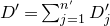 $D' = \sum _{j=1}^{n'}D'_j$
. Denote cones in
 $\Sigma '=\Sigma _{(Y',D')}$
by
 $\sigma '_{j,j+1}$
. By rescaling
 $F'$
if necessary, there exists a parallel polygon
 $F$
, viewed as a polygon on
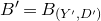 $B'=B_{(Y',D')}$
, such that if there exists a chain of
 $\pi$
-exceptional divisors over some node
 $D'_j \cap D'_{j+1}$
,
 $F \cap \sigma '_{j-1,j}$
is the chopping of
 $F' \cap \sigma '_{j-1,j}$
, with one new edge in the interior of
 $F' \cap \sigma '_{j-1,j}$
for each exceptional divisor between
 $D'_j$
and
 $D'_{j+1}$
. This chopping can be seen in Figure 10. We use a parallel polygon
 $F$
like this for expository convenience.
Let
 $\bar {\mathcal {X}}$
be the compactification of the mirror family using
 $F$
. Then, since
 $\mathcal {D}_{i,t}$
is still a Cartier divisor on
 $\bar {\mathcal {X}}_t$
for
 $t$
on the toric boundary strata of
 $\textrm {Spec}(\mathbb {C}[{\textrm {NE}}(Y)])$
,
 $\mathcal {D}_i$
is a Cartier divisor on
 $\bar {\mathcal {X}}$
by [Sta, Tag 062Y]. Let
 $S'=\textrm {Spec}(\mathbb {C} \left [ {\textrm {NE}}(Y') \right ])$
. Let us first restrict to the locus
 $\iota _{\pi } (S') \subset \textrm {Spec}(\mathbb {C} \left [ {\textrm {NE}}(Y) \right ])$
where
 $\iota _{\pi }$
is the locally closed embedding defined in § 4.2 and compute the marked periods of boundary divisors of fibers of
 $\bar {\mathcal {X}}$
over this locus. Notice that for any
 $\pi$
-exceptional divisor
 $E$
,
 $z^{[E]} =1$
over
 $\iota _{\pi } (S')$
. Therefore, it suffices to consider the polyhedral decomposition of
 $F$
given by
 $\Sigma '$
instead of
 $\Sigma$
over
 $\iota _{\pi } (S')$
.
Let
 $0'$
be the image under
 $\iota _{\pi }$
of the unique toric fixed point of
 $S'$
. Let
 $X_{0'}$
be the fiber of
 $\bar {\mathcal {X}}$
over
 $0'$
. Now, if
 $D_i$
is a
 $\pi$
-exceptional divisor over a node
 $D'_{j} \cap D'_{j-1}$
, we define
 $p'_{i}$
to be the alternative marking of
 $\mathcal {D}_i | _{T_Y}$
given by two consecutive lattice points
 $a'_{i} \succ b'_i$
on the edge
 $F_i$
parallel to
 $\rho _i$
inside
 $F \cap \sigma '_{j-1,j}$
.
Claim. Over
 $\iota _{\pi }(T'_Y)$
,
 $\psi _i(t)=z^{D_i}(t)$
.
If
 $D_i$
is not a
 $\pi$
-exceptional divisor, then by the computations done in Proposition 5.7, over
 $\iota _{\pi }(T'_Y)$
, the marked period of
 ${\mathcal {O}}(\pi ^{*}\pi _{*}(\mathcal {D}_i)|_{\mathcal {D}_t})$
is equal to
 $z^{D_i}(t) = z^{\pi ^{*}\pi _{*}(D_i)}(t)$
. Therefore, to prove the claim, it remains to consider the case where
 $D_i$
is a
 $\pi$
-exceptional divisor over a node
 $D'_j \cap D'_{j+1}$
. Then, we define
 \begin{align*} &\tilde {\psi }_i(t)\\ &=\left\{\begin{array}{l@{\quad}l} ({\mathcal {O}}(\mathcal {D}_i)|_{\mathcal {D}_t})^{-1}\otimes {\mathcal {O}}( p_{i-1}(t) + D_i^{2} p'_{i}(t) + p'_{i+1}(t)) & \text {if $D_{i-1}$ is not an exceptional divisor, i.e., $\pi _{*}D_{i-1} = D'_j$}, \\[4pt] ({\mathcal {O}}(\mathcal {D}_i)|_{\mathcal {D}_t})^{-1}\otimes {\mathcal {O}}( p'_{i-1}(t) +D_i^{2}p'_{i}(t) + p'_{i+1}(t)) & \text {if $D_{i-1}$ is an exceptional divisor}. \end{array}\right. \end{align*}
Here,
 $p'_{i+1}$
is the alternative marking on
 $\mathcal {D}_{i+1}$
given by two consecutive lattice points on the segment
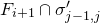 $F_{i+1} \cap \sigma '_{j-1,j}$
. In either case,
 $\tilde {\psi }_i(0')$
defines a numerically trivial line bundle on
 $X_{0'}$
. We can compute that
 $\tilde {\psi }_i(0') \equiv 1$
on
 $X_{0'}$
using Lemma 5.5. Therefore,
 $\tilde {\psi }_i(0') \equiv 1$
on
 $\iota _{\pi }(S')$
. Let
 $R_{\epsilon }$
be the forward ray
 $F_{\epsilon }$
for
 $\epsilon = i-1, i,i+1 \mod n$
. Then, the only ray in
 $\Sigma _{(Y',D')}$
that
 $R_{\epsilon }$
can intersect is
 $\rho '_j$
. Let
 $\xi _{\epsilon }$
be the direction of
 $F_{\epsilon }$
immediately after it crosses
 $\rho '_j$
. By standard toric geometry, we have
 \begin{equation*} \xi _{i-1} + \xi _{i+1} = -D_i^{2} \xi _{i}. \end{equation*}
Thus, it follows that the contribution from the kinks on
 $\rho '_j$
due to the use of alternative markings is canceled. Therefore,
 $\tilde {\psi }_i(t)= \psi _i(t) \equiv 1$
over
 $\iota _{\pi }(T_{Y'})$
and the claim is proved. Now, consider the compactified mirror family over the entire base
 $\textrm {Spec}(\mathbb {C}[{\textrm {NE}}(Y)])$
. Let
 $T^{L}$
be defined as in § 4.2. By Lemma 5.8, both
 $\psi _i(t)$
and
 $z^{D_i}$
are eigenfunctions for the
 $T^L$
action and have the same weight. Together with Lemma 4.22, we conclude that
 $\psi _i(t)=z^{D_i}(t)$
over
 $T_Y$
.
Finally, let us deal with the case where
 $(Y,D)$
is the del Pezzo surface of degree 1 together with an irreducible nodal anticanonical cycle. Let
 $F$
be a parallel polygon with at least two interior consecutive lattice points on the unique edge
 $F_1$
and
 $p'$
be the alternative marking given by them. Let
 \begin{equation*} \tilde {\psi }(t) = ({\mathcal {O}}(\mathcal {D})|_{\mathcal {D}_t})^{-1}\otimes {\mathcal {O}}(D^2p'(t)). \end{equation*}
Let
 $(X_0,D_0)$
be the fiber over
 $0\in \textrm {Spec}(\mathbb {C}[{\textrm {NE}}(Y)])$
and
 $f: \tilde {X_0} \rightarrow {X_0}$
be the normalization map. Then
 $\tilde {X_0}$
is isomorphic to
 $\mathbb {P}^2$
and
 $(f^{*}(D_0))^2 =1$
. Again,
 $\tilde {\psi }$
defines a numerically trivial line bundle on
 $X_0$
and is equal to
 $1$
at
 $0\in \textrm {Spec}(\mathbb {C}[{\textrm {NE}}(Y)])$
by Lemma 5.5. Thus, we conclude that
 $\tilde {\psi }\equiv 1$
over
 $\textrm {Spec}(\mathbb {C}[{\textrm {NE}}(Y)])$
. Since
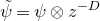 $\tilde {\psi } = \psi \otimes z^{-D}$
over
 $T_Y$
, we conclude that
 $\psi = z^{D}$
over
 $T_Y$
.
Remark 5.10. The caveat here is that we are unable to compute the marked periods of all the boundary components for the compactified mirror family associated with the non-trivial toric blowup of the degree 1 del Pezzo surface. The method we have used breaks because of the singularities in irreducible components of the central fiber in this case. However, the computation we have done for the case of the degree 1 del Pezzo surface is sufficient for us to prove Proposition 6.23 later in § 6.
6. Tropical 1-cycles and period integrals
Throughout this section, we assume that our positive Looijenga pair
 $(Y,D)$
has a toric model
 $p:(Y,D) \rightarrow (\bar {Y},\bar {D})$
that we fix. The other cases can be deduced from the toric model case.
Recall that in § 4, we gave a canonical compactification
 $(\bar {\mathcal {X}}|_{T_Y}, \mathcal {D}|_{T_Y}\!)$
of the mirror family restricted to
 $T_Y \subset \textrm {Spec}(\mathbb {C}[{\textrm {NE}}(Y)])$
and showed that for each
 $t\in T_Y$
,
 $(\bar {\mathcal {X}}_t,\mathcal {D}_t)$
is a generalized pair in Proposition 4.40. In § 5, we defined a canonical marking
 $p_i: T_Y \rightarrow \mathcal {D}_i |_{T_Y}$
for each boundary component
 $\mathcal {D}_i |_{T_Y}$
. Now, we want to give a complete geometric interpretation of the family. In particular, we want to give a marking of the Picard group for fibers
 $\bar {\mathcal {X}}|_{T_Y}$
by
 $\textrm {Pic}(Y)$
and use it, together with the canonical marking on the boundary
 $\mathcal {D}|_{T_Y}$
, to identify
 $\bar {\mathcal {X}}|_{T_Y}$
as the universal family of the moduli space of generalized marked pairs with a marking of the boundary and a marking of the Picard group by
 $\textrm {Pic}(Y)$
.
To achieve the goal mentioned above, we will compute the marked period of each fiber of the family using the canonical marking
 $p_i$
 $(1\leqslant i \leqslant n)$
. This is done by a local analysis of the Gross–Siebert locus associated with a toric model
 $(Y,D)\rightarrow (\bar {Y},\bar {D})$
. On this restriction, techniques from [Reference Ruddat and SiebertRS20] are used to construct tropical curves that correspond to an exceptional configuration of the toric model. In doing so, the deformation type of the family is determined, with the key observation being that the fibers are deformation equivalent to the original pair,
 $(Y,D)$
. Note that in Proposition 5.9, the part of the period map associated with
 $\langle D_i\rangle \subset \textrm {Pic}(Y)$
is computed. The remainder of the period map is given by an exceptional configuration of the toric model, which is carried out in this section.
Remark 6.1. Note the base of the mirror family is
 $T_Y = \textrm {Pic}(Y)\otimes \mathbb {G}_m$
while the moduli space of generalized marked pairs is given by
 \begin{equation*} T_{Y}^{*} = {\textrm {Hom}}(\textrm {Pic}(Y),\textrm {Pic}^0(D))\simeq {\textrm {Hom}}(\textrm {Pic}(Y),\mathbb {G}_m). \end{equation*}
The isomorphism given by Poincare duality
 \begin{align*} \textrm {Pic}(Y) & \rightarrow \textrm {Pic}(Y)^{*} = {\textrm {Hom}}(\textrm {Pic}(Y),\mathbb {Z}) \\ \mathcal {O}_{Y}(C) & \mapsto C, \end{align*}
between character lattices induces an isomorphism
 $T_Y \overset {\sim }{\rightarrow } T_{Y}^{*}$
. For the rest of the paper, we will implicitly use the identification between the two bases.
6.1 Gross–Siebert locus
The main results of [Reference Ruddat and SiebertRS20] give a way to construct singular cycles on smooth fibers near the central fiber of degenerations coming from [Reference Gross and SiebertGS11] and to also compute the periods of such cycles. These singular cycles come from tropical cycles on the corresponding integral affine manifold. To employ the techniques of [Reference Ruddat and SiebertRS20], we need to align our constructions with one that would come from [Reference Gross and SiebertGS11]. To do this, we look at the restriction of the mirror family over certain loci in
 $\textrm {Spec}(\mathbb {C}[{\textrm {NE}}(Y)])$
.
Definition 6.2 (Gross–Siebert locus). Let
 $p:(Y,D)\rightarrow (\bar {Y},\bar {D})$
be a toric model with an exceptional configuration
 $\{E_{ij}\}$
over
 $D_i$
. Let
 $H$
be an ample divisor on
 $\bar {Y}$
such that
 ${\textrm {NE}}(Y)\cap (p^*(H))^{\perp }$
is a face of
 $P={\textrm {NE}}(Y)$
generated by
 $\{E_{ij}\}$
. Now, let
 $G$
be the prime monomial ideal that is generated by the complement of this face. In other words,
 $G$
is the prime monomial ideal generated by classes of curves that are not contracted to a point by
 $p$
. The open torus of
 $\textrm {Spec} (\mathbb {C}[P]/G)$
, denoted by
 $T^{GS}$
, is called the Gross–Siebert locus (GS locus for short) associated with the toric model given by
 $p$
.
Let
 $(\rho _i, f_{\rho _i})$
be the wall in the canonical scattering diagram supported on
 $\rho _i$
. Let
 $X_i= z^{\varphi (v_i)}$
where
 $v_i$
is the primitive generator of
 $\rho _i$
. Given a monomial ideal
 $I \subset R=\mathbb {C}[P]$
, let
 $R_I = R/I$
. Let
 $P_{\varphi }$
be the monoid generated by elements
 $(m,\varphi (m)+p)$
with
 $m \in B$
and
 $p\in P$
. Recall the following lemma from [Reference Gross, Hacking and KeelGHK15a].
Lemma 6.3. [Reference Gross, Hacking and KeelGHK15a, Lemma 3.15]. If
 $f_{\rho _i}$
is viewed as an element of
 $\mathbb {C}[P_{\varphi }]\otimes R_I$
with
 $\sqrt {I}=\mathfrak {m}=P \setminus \{0\}$
, then
 \begin{equation*} f_{\rho _i}=g_{\rho _i}\prod _{j=1}^{l_i}(1+z^{[E_{ij}]}X_i^{-1}), \end{equation*}
where
 $g_{\rho _i}\equiv 1 \textrm { mod } G$
. Here,
 $g_{\rho _i}$
is the product of contributions from all
 $\mathbb {A}^{1}$
classes other than the
 $E_{ij}$
.
For the rest of this section, we will let
 $I$
be an ideal such that
 $\sqrt {I}=G$
. To apply the formulas in [Reference Ruddat and SiebertRS20], we need to first restrict our mirror family to a locus transverse to the GS locus
 $T^{GS}$
. More specifically, for the fixed toric model
 $p:(Y,D)\rightarrow (\bar {Y},\bar {D})$
, let
 $E\subset P^{\textrm { gp}}$
be the lattice generated by the classes of exceptional curves and
 $P_{E}=P+E$
the localization of
 $P$
by inverting elements in
 $E\cap P$
. Let
 $D^{\oplus }=\sum _{i}\mathbb {N}p^*([\bar {D}_{i}])$
. The homomorphism of monoids
 \begin{align*} P_{E}=P+E=D^{\oplus } \oplus E & \rightarrow \mathbb {N}\oplus E\\ \bigg(\sum _{i}a_{i}[p^*(\bar {D}_{i})],\sum _{i,j}n_{ij}[E_{ij}]\bigg) & \mapsto \bigg(\sum _{i}a_{i}[\bar {D}_{i}]\cdot H,\sum _{i,j}n_{ij}[E_{ij}]\bigg), \end{align*}
induces an embedding
 \begin{equation*} \iota _{G}:\textrm { Spec}(\mathbb {C}[E][t])\simeq \textrm { Spec}(\mathbb {C}[E]) \times \mathbb {A}^{1}\hookrightarrow \textrm { Spec}(\mathbb {C}[P_{E}]). \end{equation*}
Notice that the image of
 $\textrm { Spec}(\mathbb {C}[E])\times \{0\}$
under
 $\iota _{G}$
is the Gross–Siebert locus
 $T^{GS}$
(cf. Definition 6.2) and for any
 $a\in \textrm { Spec}\left (\mathbb {C}[E]\right )$
,
 $\{a\} \times \mathbb {A}^{1}$
is transverse to
 $T^{GS}$
. Denote the image of
 $\iota _{G}$
in
 $\textrm { Spec}(\mathbb {C}[P_{E}])$
by
 $S^{GS}$
and denote
 $\iota _{G}(\{a\}\times \mathbb {A}^1) \subset S^{GS}$
by
 $T_a$
.
Recall from [Reference Gross, Hacking and KeelGHK15a, § 4] that
 $\mathcal {X}|_{T^{GS}} \simeq \mathbb {V}_{n}\times T^{GS}$
where, for
 $n\ge 3$
,
 $\mathbb {V}_{n}$
is the
 $n$
-vertex surface singularity defined as the
 $n$
-cycle of coordinate planes in
 $\mathbb {A}^{n}$
:
 \begin{equation*} \mathbb {V}_{n} := \mathbb {A}_{x_1, x_2} \cup \mathbb {A}_{x_2, x_3} \cup \cdots \cup \mathbb {A}_{x_n, x_1} \subset \mathbb {A}_{x_1, x_2,\, \cdots \,, x_n}. \end{equation*}
Then, for any fixed
 $a \in \mathrm {Spec}\left (\mathbb {C}[E]\right )$
, we can view
 $\mathcal {X}|_{T_a}$
as a 1-parameter degenerating family whose central fiber is
 $\mathbb {V}_n$
. These 1-parameter families of degenerations are exactly the degenerations considered in the Gross–Siebert program and addressed in [Reference Ruddat and SiebertRS20], which is why we consider the locus
 $S^{GS}$
. Later, we will restrict our period computations to the mirror family over
 $S^{GS}$
and then extend to the entire family.
Fix a parallel polygon
 $F = P(W)$
associated with a
 $D$
-ample divisor
 $W$
. As we showed in Proposition 4.38, over
 $T_Y$
, the family
 $(\bar {\mathcal {X}} |_{T_Y},\mathcal {D} |_{T_Y}$
) is independent of choice of the
 $D$
-ample divisor
 $W$
. For each
 $a\in \textrm { Spec}(\mathbb {C}[E])$
, the central fiber at
 $0\in \mathbb {A}^1$
of the 1-parameter family degeneration
 $\bar {\mathcal {X}}|_{T_a}$
is isomorphic to the union of toric varieties whose moment polytopes come from the polyhedral decomposition
 $\underline {F}$
of
 $F$
given by
 $\Sigma \bigcap F$
.
Now, we fix an
 $a\in \textrm { Spec}(\mathbb {C}[E])$
. We denote by
 $X_{a,0}$
the central fiber of the 1-parameter degeneration
 $\bar {\mathcal {X}}|_{T_a}$
.
Definition 6.4. Given a ray
 $\rho$
in
 $\Sigma$
, let
 $X_{\rho }$
be the one-dimensional toric stratum in
 $X_{a,0}$
corresponding to
 $\rho$
. Let
 $L_{\rho } \subset X_{\rho }$
be the zero locus of
 $f_{\rho }$
. We define the log singular locus
 $L \subset X_{a,0}$
to be the union
 $L= \bigcup _{\rho \in \Sigma ^{(1)}} L_{\rho }$
. We define the tropical amoeba
 $\mathcal {A}$
to be the image of log singular locus
 $L$
under the moment map
 $\mu$
.
After compactifying the mirror family, by [Reference Ruddat and SiebertRS20, Proposition 2.1], we get a degenerate moment map
 $\mu : X_{a,0} \rightarrow B'$
where
 $B'$
is an integral affine manifold with boundary. As a topological space,
 $B'$
is obtained from
 $F$
by factoring out the singularity at the origin
 $0\in F$
. Instead of having a single singularity at the origin, singularities of the affine structure of
 $B'$
coincide with the tropical amoeba
 $\mathcal {A}$
.
By choosing a generic
 $a$
, we can assume that
 $\mathcal {A}$
consists of distinct points, i.e.
 $L$
consists of distinct points, and their image under
 $\mu$
are also distinct, as shown in Figure 11. Then, the integral affine structure of
 $B'$
can be viewed as obtained from that of
 $F$
by factoring the big singularity at the origin into
 $l_i$
simple focus–focus singularities,
 $o_{ij}$
 $(1 \leqslant j \leqslant l_i)$
, on each ray
 $\rho _{i}$
where
 $l_i$
is the number of non-toric blowups on the corresponding divisor
 $\bar {D}_i$
in the toric model given by
 $p: (Y,D) \rightarrow (\bar {Y}, \bar {D})$
. Moreover,
 $o_{ij}$
is the image of the point defined by
 $1+z^{[E_{ij}]}X_{i}^{-1}=0$
under the degenerate moment map. We call a connected component in the complement of the
 $o_{ij}$
in
 $\rho _i$
a slab.
It suffices to consider the cases where the
 $o_{ij}$
have positions as shown in Figure 11. The descriptions and computations for all the other cases are the same. Given slabs
 $\rho _{ij},\rho _{ij'}\subset \rho _{i}$
, where
 $\rho _i$
is a ray, consider the affine parallel transport
 $T$
along a path starting from a point
 $x$
in
 $\textrm { Int}\;\rho _{ij}$
via
 $\textrm {Int}\;\sigma _{+}$
to
 $\textrm {Int}\;{\rho _{ij'}}$
and back to
 $x$
through
 $\textrm { Int}\;\sigma _{-}$
where
 $\sigma _{\pm }$
are two maximal cells adjacent to
 $\rho _{i}$
. We fix the convention that
 $\sigma _{+}$
is on the right side of the ray
 $\rho _{i}$
. Then,
 $T$
is of the form
 \begin{equation} T(m)=m+\check {d}_{\rho _{i}}(m)\cdot m_{\rho _{ij}\rho _{ij'}},\quad m\in \Lambda _{x}, \end{equation}
where
 $\check {d}_{\rho _{i}} \in \check {\Lambda }_{\rho _{i}}$
is a primitive generator of
 $\rho _{i}^{\perp }\subset \check {\Lambda }_{\rho _{i}}$
such that
 $\check {d}_{\rho _{i}}$
is non-negative on
 $\sigma _{+}$
and
 $m_{\rho _{ij}\rho _{ij'}}$
is parallel to
 $\rho _i$
. Moreover, for adjacent slabs
 $\rho _{ij}$
and
 $\rho _{i (j+1)}$
, we have
 $m_{\rho _{ij}\rho _{i (j+1)}}= \nu _i$
where
 $\nu _i$
is the primitive generator of
 $\rho _i$
.
Singularities on
 $\rho _i$
.

We can obtain a consistent scattering diagram
 $\mathfrak {D'}$
on
 $B'$
from the canonical scattering diagram on
 $B$
by requiring consistency conditions around the focus–focus singularities and the origin
 $o \in B'$
. Let us first consider the consistency condition around the focus–focus singularities. For
 $0\leqslant j \leqslant l_{i}$
, the local model we have near
 $\rho _{ij}$
comes from blowing up on the divisor
 $\bar {D}_{i}$
at
 $j$
distinct points, with exceptional divisors
 $E_{i1}, \ldots , E_{ij}$
for
 $j\geqslant 1$
. Let
 \begin{equation} \kappa _{\rho _{ij}} = \left [ D_{i} \right ] + \sum _{k=j+1}^{l_{i}} \left [ E_{ik} \right ]. \end{equation}
When
 $j=l_i$
,
 $f_{\rho _{il_{i}}}$
agrees with
 $f_{\rho _i}$
in [Reference Gross, Hacking and KeelGHK15a]:
 \begin{equation} f_{\rho _i} = f_{\rho _{{il_{i}}}} =g_{\rho _i} \prod _{s=1}^{l_i} (1+z^{[E_{is}]}X_{i}^{-1}). \end{equation}
The consistency around focus–focus singularities translates into the following compatibility condition. Given any
 $\rho _{ij}$
and
 $\rho _{ij'}$
in
 $\rho _{i}$
, we have
 \begin{equation} z^{\kappa _{\rho _{ij'}}}f_{\rho _{ij'}}=z^{m_{\rho _{ij'}\rho _{ij}}}\cdot z^{\kappa _{\rho _{ij}}}f_{\rho _{ij}}. \end{equation}
Then, the kink
 $\kappa _{\rho _{ij}}$
together with the compatibility condition (6.4) determines the wall-crossing functions
 \begin{equation} f_{\rho _{ij}}=g_{\rho _i} \prod _{s=j+1}^{l_i}(1+z^{[-E_{is}]}X_i) \prod _{s'=1}^{j}(1+z^{[E_{is'}]}X_i^{-1}), \end{equation}
for
 $0 \leqslant j \leqslant l_{i}$
.
For the consistency condition around the origin
 $o\in B'$
, we need to add additional walls emanating from
 $o$
with support in the interior of two-dimensional cones in
 $\Sigma$
, i.e. walls of codimension 0. Near
 $o$
, the scattering diagram on
 $B'$
agrees with the asymptotic scattering diagram
 $\bar {\mathfrak {D}}$
, as in [Reference Gross, Hacking and KeelGHK15a, Theorem 3.25], by pushing all focus–focus singularities to infinity. However, as mentioned in [Reference Ruddat and SiebertRS20], the walls of codimension 0 do not play a role in the period computations. Therefore, we will not give explicit descriptions of these walls here.
Mimicking [Reference Gross, Hacking and KeelGHK15a, Construction 2.14], we can construct a scheme
 $X^{0 }_{I,\mathfrak {D'}}$
using the scattering diagram
 $\mathfrak {D'}$
, in agreement with the order-by-order construction of schemes used in [Reference Ruddat and SiebertRS20]. The consistency of the scattering diagram
 $\mathfrak {D'}$
guarantees that the scheme
 $X^{0 }_{I,\mathfrak {D'}}$
is well defined. For the slab
 $\rho _{ij}$
, the corresponding scheme
 $\mathrm {Spec}(R_{\rho _{ij,I}})$
is given by
 \begin{equation*} R_{\rho _{ij},I}=R_{I}\big[\Lambda _{\rho _i}\big]\big[Z_{\rho _{ij}}^{+},Z_{\rho _{ij}}^{-}\big ]/\big(Z_{\rho _{ij}}^{+}Z_{\rho _{ij}}^{-}-z^{\kappa _{\rho _{ij}}}f_{\rho _{ij}}\big). \end{equation*}
Here,
 $Z_{\rho _{ij}}^{+} = z^{\zeta _{j}}$
where
 $\zeta _{j}$
is a primitive generator of
 $\Lambda _{\sigma _{+}}/\Lambda _{\rho _{i}}$
pointing from
 $\rho _{i}$
to
 $\sigma _{+}$
and
 $Z_{\rho _{ij}}^{-} = z^{\tilde {\zeta _{j}}}$
where
 $\tilde {\zeta }_{j}$
is the parallel transport of
 $-\zeta _{j}$
via a path passing through the interior of
 $\rho _{ij}$
. For more details, see [Reference Gross, Hacking and KeelGHK15a, § 2.2].
Definition 6.5. Denote by
 $U_{\textrm{sim}}$
the locus in
 $\textrm { Spec}(\mathbb {C}[E])$
where
 $B'$
has only focus–focus singularities, i.e. where points in
 $\mathcal {A}$
do not collide as shown in Figure 11.
6.2 Singular cycles from tropical 1-cycles
Denote the singular locus of the affine structure
 $B'$
by
 $\Delta$
and the embedding of the regular locus
 $B'\setminus {\Delta }$
into
 $B'$
by
 $\iota$
. We also let
 $\check {\Lambda }$
be the sheaf of integral cotangent vectors
 $\mathcal {H}om\left ( \Lambda ,\underline {\mathbb {Z}}\right )$
on
 $B'\setminus {\Delta }$
.
Definition 6.6. A tropical 1-cycle or tropical curve is a twisted singular 1-cycle on
 $B'\setminus \Delta$
with coefficients in the sheaf of integral tangent vectors
 $\Lambda$
.
More concretely, a tropical -cycle can be viewed as an oriented graph
 $\Gamma$
with a map
 $f:\Gamma \rightarrow B'\setminus \Delta$
and a section
 $\xi _e\in (f|_e)^* \Lambda$
for each edge
 $e\subset \Gamma$
. Furthermore, at each vertex
 $v$
, the balancing condition is satisfied, i.e.
 $\sum _{e \ni v} \varepsilon _{e,v} \xi _e=0$
. Here,
 $\varepsilon _{e,v}=1$
if the edge is pointing towards
 $v$
and
 $\varepsilon _{e,v}=-1$
otherwise. Throughout the paper, we assume that
 $\xi _{e}$
is a primitive element in
 $(f|_e)^* \Lambda$
.
To a tropical
 $1$
-cycle
 $\beta _{\textrm {trop}}$
, we will give a corresponding singular cycle in
 $X_{a,0}$
. For brevity, we explain how this is done in the case that every edge
 $e$
is embedded into a single maximal cell. We refer to [Reference Ruddat and SiebertRS20] for the general construction. In [Reference Ruddat and SiebertRS20, Proposition 2.1] constructs a degenerate momentum map,
 $\mu :X_{a,0}\rightarrow B'$
, where
 $X_{a,0}$
is the singular central fiber. Each maximal cell
 $\sigma$
has a momentum map
 $\mu _{\sigma }:X_{\sigma }\rightarrow \sigma$
. Because we are in the case where the gluing data is trivial, the
 $\mu _{\sigma }$
agree on codimension 1 strata and we can form a global degenerate momentum map, which is used to construct singular cycles from tropical ones. Fix a tropical cycle
 $\beta _{\textrm {trop}}$
. Then, for each edge
 $e$
, we choose a section
 $S_e\subset X_{\sigma }$
of
 $\mu _{\sigma }$
over
 $e$
. We choose these sections so that we have compatibility at vertices. If the edge
 $e$
has a vertex
 $v$
on a codimension 1 cell
 $\rho$
, we further require the condition that
 $S_e$
is contained in the closure of an orbit of the 1-parameter subgroup of
 $\rm {Spec}(\mathbb {C}[\Lambda _{\sigma }])$
that fixes
 $X_\rho \subset X_\sigma$
pointwise. Notice that this condition is equivalent to saying that for any
 $m \in \Lambda _{\rho }$
, the monomial
 $z^m$
is constant on
 $S_e$
. To an edge
 $e$
carrying the tangent vector
 $\xi _e$
, we then associate to it a chain
 $\beta _e$
as the orbit of
 $S_e$
under the subgroup of
 ${\textrm {Hom}}(\Lambda _{\sigma },U(1))$
which maps
 $\xi _e$
to
 $1$
. At a vertex
 $v$
, the balancing condition of the tropical cycle implies that the negative of boundaries over
 $v$
of the chains
 $\beta _e$
with
 $e\ni v$
bound an
 $n$
-chain
 $\Gamma _v$
over
 $v$
. Then, the associated singular cycle in
 $X_{a,0}$
associated with
 $\beta _{\textrm {trop}}$
is
 \begin{equation*} \beta =\sum _e \beta _e+\sum _v \Gamma _v.\end{equation*}
For a vertex
 $v$
and an adjacent edge
 $e$
, we will denote the point of intersection of
 $S(e)$
with
 $\mu ^{-1}(v)$
by
 $S(v)$
. The singular 2-cycle
 $\beta$
is well defined up to integral multiples of the fiber class of the degenerate moment map.
We will specifically be interested in tropical cycles that correspond to an exceptional configuration of a toric model.
Lemma 6.7.
If a tropical curve goes around a focus–focus singularity, as shown in Figure
12
, then the edge leading away from the singularity must carry a vector
 $\zeta$
parallel to
 $\Lambda _{\rho }$
. Moreover,
 $\zeta$
is primitive if and only if the cycle carries a primitive generator of
 $\Lambda /\Lambda _{\rho }$
when it starts to surround the singularity.
Proof.
Let
 $e_{\rho }$
be a generator of
 $\Lambda _{\rho }$
and
 $\check {d}_{\rho }$
be a primitive vector such that
 $(\check {d}_{\rho })^{\perp }=\Lambda _{\rho }$
. Let
 $\xi$
be the vector the tropical 1-cycle carries when it starts to go around the focus–focus singularity and
 $\xi '$
the vector after applying the monodromy transformation to
 $\xi$
. By the balancing condition,
 \begin{align*} \xi +\zeta & =\xi '=\xi +\langle \check {d}_{\rho },\xi \rangle e_{\rho },\\ \zeta & =\langle \check {d}_{\rho },\xi \rangle e_{\rho }. \end{align*}
Therefore,
 $\zeta$
is parallel to
 $\Lambda _{\rho }$
and it is a primitive generator of
 $\Lambda _{\rho }$
if and only if
 $\xi$
is a primitive generator of
 $\Lambda /\Lambda _{\rho }$
.
A tropical cycle surrounding a focus–focus singularity.

By rescaling
 $F$
if necessary, we can assume that
 $F$
satisfies the condition in Construction 5.1, i.e. for each edge
 $F_i$
, there exists a maximal cone
 $\sigma$
in
 $\Sigma$
that contains two consecutive lattice points
 $a_i \succ b_i$
on
 $F_i$
.
Definition 6.8 (Exceptional tropical
 $1$
-cycles). Let
 $F_i$
be the edge parallel to
 $\rho _i$
. If
 $F$
is a parallel configuration, then
 $\underline {F}$
has two 1-cells contained in
 $F_i$
, one in the 2-cell
 $\sigma _{i-1,i} \cap F$
and the other in the 2-cell
 $\sigma _{i-2,i-1} \cap F$
. Denote these two 1-cells by
 $R_i, R_i'$
, respectively. Then, consider a tropical
 $1$
-cycle contained in the 2-cell
 $\sigma _{i-1,i} \cap F$
as in Figure 13 that goes around a focus–focus singularity on the ray
 $\rho _{i}$
and runs into the interior of
 $R_i$
. The labeling of the tropical
 $1$
-cycle is shown in Figure 13 where
 $d_{\rho _i}$
is a primitive generator of
 $\Lambda /\Lambda _{\rho _i}$
.
If
 $F$
is not a parallel configuration, we do a similar construction. The only difference is that the tropical
 $1$
-cycle may not be contained in a single maximal cell in
 $\Sigma \cap F$
anymore since
 $F$
is no longer a parallel configuration. In particular, the edge
 $e_0$
that runs into
 $F_i$
may pass through multiple rays in
 $\Sigma$
. Moreover, we require that
 $e_0$
runs into a 1-cell contained in
 $F_i$
that contains two consecutive lattice points. By our assumption about
 $F$
, this condition can be satisfied. The labeling on each edge remains the same. Moreover, for the simplicity of future computations, we assume that when the edge
 $e_0$
crosses a ray
 $\rho _j$
, it always crosses the slab
 $\rho _{jl_j}$
, as in Figure 11, and never crosses the same ray twice.
We call such a tropical 1-cycle as we constructed, an exceptional tropical 1-cycle.
Moreover, the following lemma follows from [Reference BauerBau17].
Lemma 6.9. [Reference BauerBau17, Lemmas 4.10 and 4.11]. Exceptional tropical 1-cycles have self-intersection
 $-1$
and two exceptional tropical 1-cycles that go around different focus–focus singularities intersect trivially.
Thus, for each focus–focus singularity
 $o_{ij}$
on the ray
 $\rho _i$
, there is an exceptional tropical 1-cycle
 $\beta _{\mathrm {trop},ij}$
 $(1 \leqslant j \leqslant l_i)$
going around it with self-intersection
 $-1$
.
An exceptional tropical cycle inside a parallel configuration.

Construction 6.10 (Construction of singular 2-cycles from tropical 1-cycles). Consider the toric model
 $p:(Y,D)\rightarrow (\bar {Y},\bar {D})$
where
 $\bar {D}_i$
is blown up
 $l_i$
times, and the locus
 $S^{GS}\subset \mathrm {Spec}(\mathbb {C}[P])$
, which is transverse to the GS locus
 $T^{GS}$
. For a fixed
 $a \in U_{\textrm{sim}} \subset \mathrm {Spec}(\mathbb {C}[E])$
, consider the 1-parameter family
 $T_a = \{a\} \times \mathbb {A}^1 \subset S^{GS}$
. By the construction in [Reference Ruddat and SiebertRS20, § 2 and Appendix A], there exists an analytic disc
 $\mathbb {D}_a \subset \mathbb {A}^1$
around
 $0\in \mathbb {A}^{1}$
such that for any
 $t \in \left \{ a \right \} \times \mathbb {D}_a$
, given a tropical 1-cycle
 $\beta _{\mathrm {trop}}$
with
 $\beta$
a corresponding singular 2-cycle on
 $X_{a,0}$
, there is a singular 2-cycle
 $ \beta _t$
on
 $\bar {\mathcal {X}_t}$
that is a deformation of
 $\beta$
.
Now, if we restrict to the locus
 $U_{\textrm{sim}} \subset \mathrm {Spec}(\mathbb {C}[E])$
, on a ray
 $\rho _i$
, we can produce
 $l_i$
exceptional tropical curves
 $\beta _{\mathrm {trop},ij}$
 $(1 \leqslant j \leqslant l_i)$
such that
 $\beta _{\mathrm {trop},ij}$
goes around the focus–focus singularity
 $o_{ij}$
. The labeling on our exceptional tropical 1-cycles guarantees that when we apply the construction in § 6.2 for each tropical 1-cycle
 $\beta _{\mathrm {trop},ij}$
, we get a corresponding connected singular 2-cycle on
 $X_{a,0}$
for each fixed parameter
 $a \in U_{\textrm{sim}}$
. Then, by considering the union of
 $\left \{ a \right \} \times \mathbb {D}_a$
for each
 $a\in U_{\textrm{sim}}$
and then taking the intersection with the locus in
 $T_Y$
that parametrizes smooth fibers, we get an analytic open neighborhood
 $W \subset S^{GS}$
parametrizing smooth fibers such that for any
 $s \in W \cap T_Y$
, the singular 2-cycle associated with the exceptional tropical 1-cycle
 $\beta _{\mathrm {trop},ij}$
on the central fiber deforms to a corresponding singular 2-cycle
 $\beta _{ij,s}$
on
 $\bar {\mathcal {X}}_s$
. By [Reference SymingtonSym03, Lemma 7.11], the self-intersection number of
 $\beta _{ij,s}$
is also
 $-1$
. We claim that for each
 $s \in W\cap T_Y$
, there is an exceptional curve
 $E_{ij,s}$
in
 $\bar {\mathcal {X}}_s$
representing the same homological class as
 $\beta _{ij,s}$
, which follows from the next lemma.
Lemma 6.11.
For each
 $s \in W\cap T_Y$
, there is an exceptional curve in
 $\bar {\mathcal {X}}_s$
representing the same homological class as
 $\beta _{ij,s}$
. Moreover,
 $(\bar {\mathcal {X}}_s, \mathcal {D}_s)$
is deformation equivalent to the original pair
 $(Y,D)$
.
Proof.
Without loss of generality, we could assume that the original pair
 $(Y,D)$
is generic. Let
 $\omega$
be the class of the
 $D$
-ample divisor
 $W$
we used to construct
 $F=P(W)$
. By [Reference Engel and FriedmanEF21, Theorem 5.4 and Lemma 5.6], there exists an almost toric fibration (in the sense of [Reference SymingtonSym03, Definition 4.5])
 $(Y, D, \omega ) \rightarrow B'$
such that a (
 $-1$
)-sphere representing the class of
 $E_{ij}$
fibers over the path
 $\gamma _{ij}$
in
 $B'$
which is identified pair of edges of the triangle with the vertex
 $o_{ij}$
and base on
 $\bar {F}_i$
that we deleted while constructing
 $F$
from
 $\bar {F}=P(\bar {W})$
(cf. § 4.4). By [Reference ArgüzArg21, Theorems 0.1, 0.2] and [Reference Alexeev, Argüz and BousseauAAB24, Lemma 8.8],
 $(\bar {\mathcal {X}}_s, \mathcal {D}_s)$
also admits an almost toric fibration over the same base
 $B'$
such that a (
 $-1$
)-sphere representing the class of
 $\beta _{ij,s}$
is mapped to
 $\gamma _{ij}$
. By [Reference SymingtonSym03, Corollary 5.4],
 $(\bar {\mathcal {X}}_s, \mathcal {D}_s)$
is diffeomorphic to
 $(Y,D)$
via a diffeomorphism
 $f$
such that
 $f^{*}([D_i]) = [\mathcal {D}_{i,s}]$
and
 $f^{*}([E_{ij}]) = [\beta _{ij,s}]$
for each
 $i$
and
 $j$
. Then, by [Reference FriedmanFri16, Theorem 5.14], the diffeomorphism
 $f$
will preserve the generic ample cones (cf. Definition 2.9) and hence
 $(\bar {\mathcal {X}}_s, \mathcal {D}_s)$
and
 $(Y,D)$
are deformation equivalent. Since
 $\bar {\mathcal {X}}_s \setminus \mathcal {D}_s$
is affine and smooth,
 $(\bar {\mathcal {X}}_s, \mathcal {D}_s)$
has no
 $(-2)$
-curves and its generic ample cone is equal to its ample cone by [Reference Gross, Hacking and KeelGHK15b, Lemma 2.15]. Since
 $(Y,D)$
is generic, its generic ample cone is also equal to the ample cone. By [Reference FriedmanFri16, Corollary 4.3], the
 $[E_{ij}]$
generate distinct faces of the ample cone of
 $(Y,D)$
. Since
 $f$
preserves the ample cones, the
 $[\beta _{ij,s}]$
also generate distinct faces of the ample cone of
 $(\bar {\mathcal {X}}_s, \mathcal {D}_s)$
and are represented by exceptional curves by [Reference FriedmanFri16, Corollary 4.3].
Remark 6.12. In the above construction, given a point
 $s \in W\cap T_Y$
,
 $s$
is contained in a unique 1-parameter family
 $T_a$
and the exceptional tropical 1-cycle
 $\beta _{\mathrm {trop}, ij}$
depends on
 $a$
. However, for exposition simplicity, we do not emphasize this dependence.
Lemma 6.13.
Let
 $W$
be the same as in Construction
6.10
. Then, under the
 $T^D$
action,
 $T^{D} \cdot ({W \cap T_{Y}})$
is a full-dimensional subset of
 $T_Y$
.
Proof.
The weight map as in Definition 3.10 induces a homomorphism
 $\varphi ': T^{D} \rightarrow T_Y$
. Let
 $\mathrm {Aut}^{0}(D)$
be the identity component of the automorphism group of
 $D$
. Using the identification
 $\mathrm {Aut}^{0}(D) \simeq \mathbb {G}_{m}^{n} \simeq {T^D}$
and the identification
 $T_Y \simeq T_{Y}^{*}$
, the homomorphism
 $\varphi ': T^{D} \rightarrow T_Y$
coincides with the homomorphism
 $\varphi :\mathrm {Aut}^{0}(D) \rightarrow T_{Y}^{*}$
as defined in [Reference Gross, Hacking and KeelGHK15b, Lemma 2.5].
Consider the injective homomorphism
 $T_{\bar {Y}} \hookrightarrow T_Y$
induced by the pullback map
 $\textrm {Pic}(\bar {Y}) \hookrightarrow \textrm {Pic}(Y)$
. Its image is the locus where
 $z^{[E_{ij}]}$
is equal to
 $1$
for all
 $i,j$
. Moreover, the composition
 $T_{\bar {Y}} \hookrightarrow T_Y \twoheadrightarrow T_{\bar {Y}}$
is the identity map. Therefore, given
 $t \in T_Y$
,
 $t$
is determined by its image under the surjective homomorphism
 $T_Y \twoheadrightarrow T_{\bar {Y}}$
and
 $z^{[E_{ij}]}(t)$
for all
 $i,j$
.
Now, consider the relative torus
 $T^{\bar {D}}$
and the injective homomorphism
 $T^{\bar {D}}\hookrightarrow T^{D}$
induced by the map
 $e_{D_i} \mapsto e_{\bar {D}_i}$
. Also consider the surjective homomorphism
 $T_Y \twoheadrightarrow T_{\bar {Y}}$
induced by
 $z^{[\bar {C}]} \mapsto z^{p^{*}(\bar {C})}$
. The composition
 $\phi :T^{\bar {D}} \hookrightarrow T^{D} \overset {\varphi '}{\rightarrow } T_Y \twoheadrightarrow T_{\bar {Y}} \overset {\sim }{\rightarrow } T_{\bar {Y}^{*}}$
agrees with the surjective homomorphism
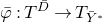 $\bar {\varphi }: T^{\bar {D}} \rightarrow T_{\bar {Y}^{*}}$
of [Reference Gross, Hacking and KeelGHK15b, Lemma 2.7] since
 $p^{*}(\bar {C})\cdot D_i = \bar {C} \cdot \bar {D}_i$
for any
 $\bar {C}\in A_{1}(\bar {Y})$
and any
 $i$
. Thus, the statement of the lemma follows from the fact that the composition
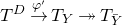 $T^{D} \overset {\varphi '}{\rightarrow } T_Y \twoheadrightarrow T_{\bar {Y}}$
is surjective.
Let
 $e(Y \setminus D)$
be the topological Euler characteristic of
 $Y\setminus D$
. Recall that the charge
 $Q(Y,D)$
of a Looijenga pair
 $(Y,D)$
is
 \begin{equation*} Q(Y,D) = 12 - D^{2} - n, \end{equation*}
where
 $n$
is the number of irreducible components of
 $D$
. By our assumption that
 $(Y,D)$
has a toric model,
 $Q$
is simply the number of non-toric blowups in the toric model. In particular, we have
 $Q(Y,D) = e (Y\setminus D) \geqslant 0$
with equality if and only if
 $(Y,D)$
is toric.
Lemma 6.14.
There exists an analytic open neighborhood
 $U\subset T_Y$
parametrizing smooth fibers such that for every
 $s\in U$
, there is a collection of
 $(-1)$
-curves on
 $\bar {\mathcal {X}}_{s}$
that has the same combinatorial type as the toric model
 $p: (Y,D) \rightarrow (\bar {Y}, \bar {D})$
. Consequently, the surface pairs of the compactified mirror family
 $(\bar {\mathcal {X}}, \mathcal {D})|_{T_Y} \rightarrow T_Y$
are generalized pairs deformation equivalent to
 $(Y,D)$
.
Proof.
We continue from Construction 6.10 and use the same notation as there. For each
 $s\in W\cap T_Y$
, let
 $Z_s = \bar {\mathcal {X}}_s$
. By constructing an exceptional tropical curve for each focus–focus singularity, for each
 $s \in W \cap T_Y$
, by Lemma 2.17 we obtain a collection of
 $(-1)$
-curves on
 $(Z_s, \mathcal {D}_s)$
with the same combinatorics as the exceptional collection of
 $p$
. Let
 $(\bar {Z}_{s},\bar {\mathcal {D}}_s)$
be the pair we get after blowing down the collection of
 $(-1)$
-curves constructed from exceptional tropical 1-cycles.
We know the self-intersection numbers of the boundary components
 $\mathcal {D}_{i,s} = \mathcal {D}_i|_{Z_{s}}$
from Lemma 4.50. Then by a simple computation, we know that the charge of
 $(\bar {Z}_{s},\bar {\mathcal {D}}_s)$
is zero. This implies that the pair
 $(\bar {Z}_{s},\bar {\mathcal {D}}_s)$
is toric and is isomorphic to the pair
 $(\bar {Y},\bar {D})$
. Thus,
 $(Z_s, \mathcal {D}_s)$
and
 $(Y,D)$
have the same toric model with the same combinatorics.
Using the equivariant
 $T^D$
action, by Lemma 6.13 we can extend
 $W \cap T_Y$
to an analytic open neighborhood
 $U$
in
 $T_Y$
such that for each
 $s \in U$
, the statements of the lemma holds for
 $\bar {\mathcal {X}}_{s}$
. The last statement of the lemma then follows from Proposition 4.24.
Proposition 6.15.
Consider a positive Looijenga pair
 $(Y,D)$
and its mirror family
 $\mathcal {X} \rightarrow \textrm {Spec}$
 $(\mathbb {C}[{\textrm {NE}}(Y)])$
. Let
 $(\bar {\mathcal {X}},\mathcal {D})\rightarrow \textrm {Spec}(\mathbb {C}[{\textrm {NE}}(Y)])$
be the canonical compactification of
 $\mathcal {X}$
as defined in §
4.4
. Then, the restriction of the compactified mirror family to the algebraic torus
 $T_Y=\textrm {Pic}(Y)\otimes \mathbb {G}_m$
is a family
 $(\bar {\mathcal {X}}|_{T_Y},\mathcal {D} |_{T_Y}\!)$
of generalized pairs deformation equivalent to
 $(Y,D)$
. Furthermore,
 $(\bar {\mathcal {X}} | _{T_Y},\mathcal {D} |_{T_Y}\!)$
comes with a natural marking
 $p_i$
of the boundary
 $\mathcal {D}$
and a marking
 $\mu$
by
 $\textrm {Pic}(Y)$
.
Proof.
It suffices to consider the case where
 $(Y,D)$
has a toric model. Indeed, by Lemma 4.41, if
 $(Y',D') \rightarrow (Y,D)$
is a toric blowup, a marking of the Picard group for
 $(\bar {\mathcal {X}'}|_{T_{Y'}}, \mathcal {D}' |_{T_{Y'}})$
will induce a marking of the Picard group for
 $(\bar {\mathcal {X}}|_{T_Y}, \mathcal {D}|_{T_Y}\!)$
.
The marking of the boundary
 $\mathcal {D}|_{T_Y}$
is already done in § 5 and the deformation type of the compactified mirror family restricted to
 $T_Y$
is established in Lemma 6.14. It remains to show that we get a marking of the Picard group by
 $\mathrm {Pic}(Y)$
. Let
 $U \subset T_{Y}$
be the analytic open neighborhood as in Lemma 6.14. For any
 $s\in U$
, let
 $E_{ij,s}$
be the exceptional curve on
 $\bar {\mathcal {X}}_s$
corresponding to the tropical 1-cycle
 $\beta _{\mathrm {trop},ij}$
. By letting
 ${\mathcal {O}}_{\bar {\mathcal {X}}_s}(E_{ij,s})$
go to
 ${\mathcal {O}}_{Y}(E_{ij})$
and
 ${\mathcal {O}}_{\bar {\mathcal {X}}_s}(\mathcal {D}_{i,s})$
go to
 ${\mathcal {O}}_Y(D_i)$
, we get a marking of the Picard group of
 $\bar {\mathcal {X}}_s$
by
 $\mathrm {Pic}(Y)$
.
Note that the marking of the compactified mirror family over the analytic neighborhood
 $U$
can be extended to the entire base
 $T_Y$
. Indeed, we can use parallel transport on the base to obtain a configuration of
 $(-1)$
-curves of the combinatorial type of the toric model
 $p:(Y,D)\rightarrow (\bar {Y},\bar {D})$
on the minimal resolution of
 $\bar {\mathcal {X}}_s$
over any point
 $s\in T_Y$
. If
 $\bar {\mathcal {X}}_s$
is singular, there is an ambiguity, coming from the existence of vanishing cycles, on the choice of the marking of the Picard group of the minimal resolution of
 $\bar {\mathcal {X}}_s$
. However, since these vanishing cycles are internal (-2)-curves on the minimal resolution, we still obtain a marking
 $\mu$
of the Picard group, in the sense of Definition 1.6, for each fiber in the family
 $\bar {\mathcal {X}} \rightarrow \textrm {Spec}(\mathbb {C}[{\textrm {NE}}(Y)])$
.
6.3 Period integrals
Let
 $S^0 \subset S=\textrm {Spec}(\mathbb {C}[P])$
be the locus where
 $\bar {\mathcal {X}}_s$
is smooth. By [Reference Gross, Hacking and KeelGHK15a, Proposition 2.31], the dualizing sheaf
 $\omega _{\mathcal {X}/S}$
is trivial. Moreover, the fiberwise compactification
 $(\bar {\mathcal {X}},\mathcal {D})$
is such that
 $\omega _{\bar {\mathcal {X}}/S} (\mathcal {D})$
is trivial by Proposition 4.27. Let
 $\Omega$
be the global section of
 $\omega _{\bar {\mathcal {X}}/S} (\mathcal {D})$
such that for each
 $s\in S^0$
,
 $\Omega | _{\mathcal {X}_s}$
is the normalized holomorphic volume form as we used in § 2. In particular,
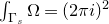 $\int _{\Gamma _s} \Omega = (2\pi i)^2$
, where
 $\Gamma _s$
is the class of a real 2-torus that generates the kernel of the exact sequence
 \begin{equation} 0 \rightarrow \mathbb {Z} \rightarrow H_{2}(\mathcal {X}_s, \mathbb {Z}) \rightarrow Q_s \rightarrow 0, \end{equation}
where
 $Q_s = \left \langle D_1, D_2 \ldots , D_n \right \rangle ^{\perp } \subset H_{2}(\bar {\mathcal {X}}_s,\mathbb {Z})$
.
Let
 $W \subset S^{GS}$
be the analytic open neighborhood as in Construction 6.10. Then, as shown in Proposition 6.15, for each
 $s \in W \cap T_Y$
,
 $(\bar {\mathcal {X}}_s, \mathcal {D}_s)$
is a pair deformation equivalent to
 $(Y,D)$
together with a marking
 $\mu : \mathrm {Pic}(\bar {\mathcal {X}}_s) \rightarrow \mathrm {Pic(Y)}$
. In § 6.4, we apply the formulas for period integrals in [Reference Ruddat and SiebertRS20] and prove the following proposition.
Proposition 6.16.
Consider the marked family as in Proposition 6.15
. Then, given
 $s\in W\cap T_Y$
, the marked period of the element in
 $\textrm {Pic}(\bar {\mathcal {X}}_s)$
marked by
 ${\mathcal {O}}_Y(E_{ij})$
is given by
 $z^{E_{ij}}(s)$
.
As mentioned in Remark 6.1, we identify
 $T_Y$
with
 $T_{Y}^{*}$
.
Recall that we choose
 $\sqrt {I}=G$
. Let
 $S_{I}^{GS}=S^{GS}\times _{S}S_{I}$
where
 $S_I = \mathrm {Spec}(\mathbb {C}[P]/I)$
. Recall, we have
 \begin{equation} f_{\rho _i} = f_{\rho _{il_{i}}}= \prod _{s=1}^{l_i} (1+z^{[E_{is}]}X_{i}^{-1}) \mod G. \end{equation}
When we restrict
 $R_{I,\rho _{il_i}}$
to
 $S_{I}^{GS}$
, it is the quotient by the ideal generated by
 \begin{equation*} Z_{\rho _{il_i}}^{+}Z_{\rho _{il_i}}^{-}-t^{\kappa _{\rho _i}}(z^{-\sum _{k=1}^{l_i}[E_{ik}]}\cdot f_{\rho _{i}}). \end{equation*}
Here
 $\kappa _{\rho _i} = [\bar {D}_{i}]\cdot H\in \mathbb {N}$
. Let
 $f_{\rho _{i}}'=z^{-\sum _{k=1}^{l_i}[E_{ik}]}\cdot f_{\rho _{i}}$
. Notice that restricting to
 $S^{GS}$
, we have
 \begin{equation*} \kappa _{\rho _{ij}} = \kappa _{\rho _i} = [\bar {D}_i]\cdot H, \end{equation*}
for any
 $j$
with
 $0 \leqslant j \leqslant l_i$
.
Again, it suffices to consider the cases where the
 $o_{ij}$
are positioned as in Figure 11 since computations for all other cases are the same. Recall that in [Reference Ruddat and SiebertRS20, § 2], the period integral involves the complex Ronkin function associated with the function
 $f'_{\rho _i}$
for a ray
 $\rho _i$
in
 $\Sigma _{(Y,D)}$
. Let
 $x \in \rho _i \setminus {\mathcal {A}}$
. Then, the complex Ronkin function at
 $x$
is defined by
 \begin{equation*} \mathcal {R}(z^{-m_x}f'_{\rho _i},x):=\frac {1}{2\pi i}\int _{\mu ^{-1}(x)}\frac {\log (z^{-m_{x}}f'_{\rho _i}(X_i))}{X_i}dX_{i}.\end{equation*}
Here,
 $m_{x} \in \Lambda _{\rho _i}$
is the unique element such that the restriction
 $z^{-m_{x}}f'_{\rho _i}: \mu ^{-1}(x) \rightarrow \mathbb {C}^*$
is contractible. More concretely, given a point
 $x_j \in \mathrm {Int}\;\rho _{ij}$
, we have
 $-m_{x_j} = (l_i - j)\nu _i$
and
 \begin{equation} z^{-m_{x_j}}f'_{\rho _i} = z^{-\sum _{k=1}^{l_i}[E_{ik}]}\prod _{s=j+1}^{l_i}(X_s + z^{\left [E_{is}\right ]}) \prod _{s'=1}^{j} (1+z^{[E_{is'}]}X_{i}^{-1}) \mod G. \end{equation}
We compute the Ronkin function
 $\mathcal {R}(z^{-m_{x_j}}f'_{\rho _{i}},x_j)$
. Notice that
 $z^{-m_{x_j}}f'_{\rho _i} = z^{-\sum _{k=1}^{j}[E_{ik}]}f_{\rho _{ij}}$
. Since
 $f_{\rho _{ij}}$
already satisfies the normalized condition as defined in [Reference Ruddat and SiebertRS20, Proposition 1.6], we have
 \begin{equation} \mathcal {R}(z^{-m_{x_j}}f_{\rho _{i}}',x_j)=\log (z^{-\sum _{k=1}^{j}[E_{ik}]}). \end{equation}
From now on, we assume that all intersection points of a tropical 1-cycle with slabs are vertices. Suppose we have a vertex
 $v$
of
 $\beta _{\textrm {trop}}$
such that it lies on a slab contained in the ray
 $\rho _i$
. Following the orientation of the
 $\beta _{\textrm {trop}}$
, let
 $e$
and
 $e'$
be the adjacent edges to
 $v$
with
 $\beta _{\textrm {{trop}}}$
oriented from
 $e$
to
 $e'$
. Now let
 $\sigma$
be the maximal cell such that
 $e\in \sigma$
, and let
 $\check {d}_e$
be the primitive generator of
 $\Lambda _{\rho _i}^{\perp }$
that evaluates positively on tangent vectors pointing from
 $\rho _i$
into
 $\sigma$
. We weight the complex Ronkin function at
 $v$
by
 $\langle \check {d}_e,\xi _e\rangle \mathcal {R}(z^{-m_{v}}f_{\rho _{i}}',v)$
. The sum of these contributions from Ronkin functions is denoted by
 $\mathcal {R}(\beta _{\mathrm {trop}})$
.
According to [Reference Ruddat and SiebertRS20], the Picard–Lefschetz transformation also contributes to the period integrals. The piecewise linear function
 $\varphi$
gives rise to a cohomology class,
 $c_1(\varphi )\in H^1(B'\setminus {\Delta },\check {\Lambda })$
. Thus, we can compute
 $\langle c_1(\varphi ),\beta _{\textrm {trop}}\rangle$
. Given a vertex
 $v$
of
 $\beta _{\mathrm {trop}}$
lying a slab contained in the ray
 $\rho _i$
,
 $v$
contributes
 $\langle \check {d}_e,\xi _e\rangle \cdot \kappa _{\rho _i}$
to
 $\langle c_1(\varphi ),\beta _{\textrm {trop}}\rangle$
, where the notation is as above. The total pairing is obtained by summing over all such contributions from vertices of
 $\beta _{\textrm {trop}}$
that lie on slabs.
The results in [Reference Ruddat and SiebertRS20] involve extra data referred to as gluing data. We are in the case in which we work with trivial gluing data so this part of the formula does not affect us.
Fix
 $a\in U_{\textrm{sim}}$
. Let
 $T_{a,I} = T_a \times _{S} S_I$
. Then
 $T_{a,I}$
is isomorphic to
 $\mathrm {Spec}(\mathbb {C}[t]/(t^{k+1}))$
for some
 $k$
. Let
 $\bar {\mathcal {X}_I}$
be the base change of
 $\bar {\mathcal {X}}$
to
 $S_I$
. Then
 $ \bar {\mathcal {X}}_I |_{T_{a,I}} /T_{a,I}$
is a flat 1-parameter family deformation of
 $X_{0,a}$
. View
 $\Omega$
as a relative holomorphic volume form on
 $\mathcal {X}_I |_{T_{a,I}}$
. Then, the following theorem follows from the main theorem of [Reference Ruddat and SiebertRS20].
Theorem 6.17 [Reference Ruddat and SiebertRS20, Theorem 1.7]. Let
 $\beta _{\textrm {trop}}$
be a tropical 1-cycle on
 $B'$
not touching the boundary and
 $\beta$
an associated singular 2-cycle on
 $X_{0,a}$
. Then
 \begin{equation*} \exp \left (\frac {1}{2\pi i}\int _{\beta } \Omega _{} \right )=\exp (\mathcal {R}(\beta _{\textrm {trop}}))\cdot t^{\langle c_1(\varphi ),\beta _{\textrm {trop}}\rangle }.\end{equation*}
This theorem implies that computations done on the central fiber of the toric degeneration are sufficient to give formulas for period integrals for the entire family as formal functions on the base. Since our mirror family is algebraic, the period integrals we get by applying the formulas in [Reference Ruddat and SiebertRS20] will be analytic.
Slightly different from [Reference Ruddat and SiebertRS20], we consider tropical 1-cycles that touch the boundary of
 $B'$
. For a singular 2-cycle on
 $X_{a,0}$
associated with an exceptional tropical 1-cycle, we need to modify it to a singular 2-chain with boundary to integrate it against
 $\Omega$
. See the next section for details.
6.4 Periods for exceptional cycles
In this section, we will first prove Proposition 6.16.
Given
 $s \in W \cap T_Y$
, consider the image of the degenerate moment map of the corresponding central fiber. Consider the exceptional tropical 1-cycle
 $\beta _{\mathrm {trop},ij}$
that goes around the focus–focus singularity
 $o_{ij}$
with the labeling as in Figure 13. We have the following lemma.
Lemma 6.18.
Let
 $\beta _1 = \beta _{e_1} + \beta _{e_2} + \Gamma _{e_2} + \beta _{e_{2}{'}} +\beta _{e_3} + \Gamma _{e_3} + \Gamma _{v_1}$
. Then
 \begin{align} \exp \left ( -\frac {1}{2\pi i}\int _{\beta _{1}}\Omega \right ) = - \frac {z^{[E_{ij}]}}{z^{\xi _{e_{0}}}\left (S\left (v_{1}\right )\right )}. \end{align}
Proof. Following the computations done in [Reference Ruddat and SiebertRS20, Sections 3.4–3.6], we have
 \begin{align*} \frac {1}{2\pi i}\bigg(\int _{\beta _{e_{1}}+\beta _{e_{2}}}\Omega +\int _{\Gamma _{e_{2}}}\Omega \bigg)= & \langle d_{e_{1}},\xi _{e_{1}}\rangle (\kappa _{\rho _i}\log t+\mathcal {R}(z^{-m_{{v_2}}}f_{\rho _{i}}',v_{2}))\\ & +\log z^{\xi _{e_{2}}}\left (S\left (v_{3}\right )\right )-\log z^{\xi _{e_{1}}}\left (S\left (v_{1}\right )\right ), \end{align*}
 \begin{align*} \frac {1}{2\pi i}\bigg(\int _{\beta _{e_{2}'}+\beta _{e_{3}}}\Omega +\int _{\Gamma _{e_{3}}}\Omega \bigg )= & \left \langle d_{e_{2}'},\xi _{e_{2}'}\right \rangle \big(\kappa _{\rho _i}\log t+\mathcal {R}\big(z^{-m_{{v_4}}}f_{\rho _{i}}',v_{4}\big)\big)\\ & +\log z^{\xi _{e_{3}}}(S(v_{1}))-\log z^{\xi _{e_{2}'}}(S(v_{3})). \end{align*}
Here,
 $\Gamma _{e_2}$
and
 $\Gamma _{e_3}$
are the slab add-ins as in [Reference Ruddat and SiebertRS20, § 3.4]. Also, we have
 $\left \langle d_{e_{1}},\xi _{e_{1}}\right \rangle =1$
since
 $\xi _{e_1}$
is a primitive generator of
 $\Lambda /\Lambda _{\rho _i}$
and points into the maximal cell containing
 $e_1$
. Similarly, we have
 $\langle d_{e_{2}'},\xi _{e_{2}'}\rangle =-1$
. Since
 $z^{\xi _{e_{2}}}=z^{\xi _{e_{2}'}}$
, we have
 \begin{align*} & \frac {1}{2\pi i}\bigg(\int _{\beta _{e_{1}}+\beta _{e_{2}}}\Omega +\int _{\Gamma _{e_{2}}}\Omega +\int _{\beta _{e_{2}'}+\beta _{e_{3}}}\Omega +\int _{\Gamma _{e_{3}}}\Omega \bigg)\\ &\quad = \mathcal {R}(z^{-m_{{v_2}}}f_{\rho _{i}}',v_{2})-\mathcal {R}(z^{-m_{{v_4}}}f_{\rho _{i}}',v_{4}) +\log z^{\xi _{e_{3}}}(S(v_{1}))-\log z^{\xi _{e_1}}(S(v_{1})). \end{align*}
It only remains to specify the contribution of the Ronkin function. By Equation (6.9), we get that
 \begin{equation} \mathcal {R}(z^{-m_{{v_2}}}f_{\rho _{i}}',v_{2})-\mathcal {R} (z^{-m_{{v_4}}}f_{\rho _{i}}',v_{4}) =-\log (z^{[E_{ij}]}). \end{equation}
We emphasize that the above formula is true regardless of the configuration of positions of the focus–focus singularities on the ray
 $\rho _i$
. At the trivalent vertex
 $v_1$
, the chain
 $\Gamma _{v_1}$
, as described in § 6.2, is non-empty. By [Reference Ruddat and SiebertRS20, Lemma 3.3], we have
 \begin{equation} \frac {1}{2 \pi i} \int _{\Gamma _{v_1}} \Omega = \pi i \mod 2 \pi i. \end{equation}
We conclude that
 \begin{align} \exp \bigg( {-}\frac {1}{2\pi i}\int _{\beta _{1}}\Omega \bigg) = -z^{[E_{ij}]} \cdot \frac {z^{\xi _{e_{1}}}(S(v_{1}))}{z^{\xi _{e_{3}}}(S(v_{1}))} = - \frac {z^{[E_{ij}]}}{z^{\xi _{e_{0}}}(S(v_{1}))}. \end{align}
The second equality in the above follows from the balancing condition
 $\xi _{e_{1}}+\xi _{e_{0}}=\xi _{e_{3}}$
at
 $v_1$
. Since
 $\xi _{e_{0}}$
is parallel to
 $\rho _{i}$
and
 $F_{i}$
is parallel to
 $\rho _{i}$
,
 $\beta _{e_{0}}$
is closed at
 $S(v_{0})$
.
Remark 6.19. Notice that the exponent in our period formula in Equation (6.10) differs from that in Theorem 6.17 by a sign. We make this choice of sign convention so that the marked period and the exponential of period integral will be equal.
Let
 $\beta _{ij,s}$
be the deformation of the singular 2-cycle
 $\beta _{1}+ \beta _{e_0}$
on
 $\bar {\mathcal {X}}_s$
as in Construction 6.10. The holomorphic form
 $\Omega$
has poles along
 $\mathcal {D}$
. In the following construction, after fixing a marking of
 $\mathcal {D}$
, we will replace
 $\beta _{ij,s}$
with a singular 2-chain with boundary in
 $\bar {\mathcal {X}}_s$
whose period will give the marked period of
 $E_{ij,s}$
.
Construction 6.20. We follow the notation in Definition 6.8. For convenience, we can assume that for a fixed
 $i$
, all the
 $\beta _{\mathrm {trop}, ij}$
ends on the same 1-cell
 $\varrho \subset F_i$
. In particular, if
 $F$
is a parallel configuration, then
 $\varrho = R_i$
. Let
 $q \succ q'$
be two adjacent lattice points on
 $\varrho$
. Let
 $D_{\varrho }$
be the boundary component corresponding to
 $\varrho$
on the central fiber. Notice that on
 $D_{\varrho }$
, the boundary component corresponding to
 $\varrho$
on the central fiber,
 ${\vartheta _q}/{\vartheta _{q'}}$
restricts to the toric monomial
 $z^{\xi _{e_0}}$
.
By Lemma 5.4,
 ${\vartheta _q}/{\vartheta _{q'}} =-1$
gives a section
 $p'_i: \mathcal {D}_i \rightarrow \textrm {Spec}(\mathbb {C}[{\textrm {NE}}(Y)])$
. If
 $F$
is a parallel configuration, then
 $p'_i$
agrees with the canonical marking
 $p_i$
in Construction 5.1. If
 $F$
is not a parallel configuration, then
 $p'_i$
and
 $p_i$
might differ. The difference is given by the contribution from bending parameters of rays in
 $\Sigma$
that will intersect with the forward ray of
 $\varrho$
, as in Construction 5.1.
Let
 $p_0$
be the point on
 $D_{\varrho }$
such that
 ${\vartheta _q}/{\vartheta _{q'}}(p_0) = z^{\xi _{e_0}}(p_0)=-1$
. Let
 $\gamma$
be an arc in
 $D_{\varrho }$
connecting
 $S(v_0)$
and
 $p_0$
. We orient
 $\gamma$
from
 $S(v_0)$
to
 $p_0$
. Let
 $N_{\gamma }$
be the cylinder over
 $\gamma$
in a small tubular neighborhood of
 $D_{\varrho }$
. We delete a small disc in
 $\beta _{e_{0}}$
around
 $S(v_0)$
and glue it to
 $N_{\gamma }$
to get a new chain
 $\tilde {\beta }_{e_{0}}$
. Thus, on the central fiber, we modify the singular 2-cycle
 $\beta _1 + \beta _{e_0}$
to
 $\beta _1 + \tilde {\beta }_{e_0}$
, a singular 2-chain with boundary.
On
 $\bar {\mathcal {X}}_s$
, by deforming
 $\tilde {\beta }_{e_0}$
, we modify
 $\beta _{ij,s}$
to a singular 2-chain
 $\beta '_{ij,s}$
whose boundary is a circle over
 $p'_i(s)$
contained in a small tubular neighborhood of
 $\mathcal {D}_{i,s}$
. Let
 $\gamma _{s}$
be an arc in
 $\mathcal {D}_{i,s}$
connecting
 $p_i(s)$
and
 $p'_i(s)$
. Let
 $N_{\gamma _{s}}$
be a tubular neighborhood of
 $\gamma _{s}$
in
 $\mathcal {D}_{i,s}$
. Gluing
 $N_{\gamma _{s}}$
to
 $\beta '_{ij,s}$
, we get a singular 2-chain
 $\tilde {\beta }_{ij,s}$
whose boundary is a circle over
 $p_i(s)$
contained in a small tubular neighborhood of
 $\mathcal {D}_{i,s}$
.
Remark 6.21. We have that
 $\tilde {\beta }_{e_0}$
and
 $\tilde {\beta }_{ij,s}$
are only well defined up to multiples of classes of real 2-tori whose integrals against
 $\Omega$
are integral multiples of
 $(2\pi i)^2$
. After we take the exponential map, this ambiguity disappeared.
We prove the following lemma.
Lemma 6.22. Using the canonical marking of the boundary defined in Construction 5.1 , we have
 \begin{equation} \exp {\bigg( {-}\frac {1}{2\pi i}\int _{\tilde {\beta }_{ij,s}}\Omega \bigg)}= z^{[E_{ij}]}(s). \end{equation}
Proof.
If
 $F$
is a parallel configuration, then
 $p_i(s)=p'_i(s)$
. Moreover, since the tropical 1-cycle
 $\beta _{\mathrm {trop},ij}$
is contained in a single maximal cell
 $F \cap \sigma _{i,i-1}$
and does not intersect with any ray in
 $\Sigma$
, there is no contribution from
 $\langle c_1(\varphi ),\,\beta _{\mathrm {trop},ij}\rangle$
. By the standard Stokes’ theorem and Equation (6.10),
 \begin{align*} & \exp \bigg( {-}\frac {1}{2\pi i}\int _{\beta _{1} + \tilde {\beta }_{e_{0}}}\Omega \bigg) = - \frac {z^{[E_{ij}]}}{z^{\xi _{e_{0}}}\left (S\left (v_{1}\right )\right )}\cdot \frac {z^{\xi _{e_{0}}}\left (S\left (v_{1}\right )\right )}{z^{\xi _{e_{0}}}\left ( p_0 \right ) } = - \frac { z^{[E_{ij}]} }{z^{\xi _{e_{0}}}\left ( p_0 \right )} = z^{[E_{ij}]}. \end{align*}
By [Reference Ruddat and SiebertRS20, Theorem 1.7 and Corollary 4.6], we obtain Equation (6.14).
If
 $F$
is not a parallel configuration, then
 $p_i(s)$
and
 $p'_i(s)$
might differ. We follow notation in Construction 6.20. Let
 $f'_{\mathcal {D}_i} = {\vartheta _q}/{\vartheta _{q'}}$
. It suffices to consider the case where
 $\beta _{\mathrm {trop},ij}$
crosses a single ray
 $\rho _{i_0}$
. The general cases follow from the same computation. Let
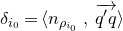 $\delta _{i_0} = \langle n_{\rho _{i_0}} \,,\,\overrightarrow {q' q} \rangle$
where
 $n_{\rho _{i_0}}\in \check {\Lambda }_{\rho _{i_0}}$
is the unique primitive element annihilating
 $\rho _{i_0}$
and is positive on the parallel transport of
 $\overrightarrow {q' q}$
. By our assumption that
 $\beta _{\mathrm {trop},ij}$
will cross the slab
 $\rho _{i_0l_{i_0}}$
, together with the period formula and Equation (6.9), the contribution to
 $\exp {( -{1}/{2\pi i}\int _{\tilde {\beta }_{ij,s}}\Omega )}$
when
 $\beta _{\mathrm {trop},ij}$
crosses
 $\rho _{i_0}$
is
 \begin{equation*} \big(t^{\kappa _{\rho _{i_0}}} \cdot \exp (\mathcal {R}(z^{-m_{x}}f'_{\rho _{i_0}},x)) \big)^{-\delta _{i_0}} = \big( t^{\kappa _{\rho _{i_0}}} \cdot z^{-\sum _{k=1}^{l_{i_0}}[E_{i_0k}]} \big)^{-\delta _{i_0}}, \end{equation*}
where
 $x$
is the crossing point of
 $\beta _{\mathrm {trop},ij}$
on
 $\rho _{i_0 l_{i_0}}$
. Recall that
 $f'_{\mathcal {D}_i}$
is the canonical coordinate on
 $\mathcal {D}_{i}$
that was defined in Construction 5.1. By Equation (5.1), restricted to
 $S^{GS}$
, we have
 \begin{equation*} f_{\mathcal {D}_i} = \big( t^{\kappa _{\rho _{i_0}}} \cdot z^{-\sum _{k=1}^{l_{i_0}}[E_{i_0k}]} \big)^{\delta _{i_0}} \cdot f'_{\mathcal {D}_i}. \end{equation*}
In particular, we have
 \begin{equation*} f_{\mathcal {D}_i}(p_i(s)) = -1 = \big( t^{\kappa _{\rho _{i_0}}} \cdot z^{-\sum _{k=1}^{l_{i_0}}[E_{i_0k}]}(s) \big)^{\delta _{i_0}} f'_{\mathcal {D}_i}(p_i(s)). \end{equation*}
It follows from Stokes’ theorem that
 \begin{equation*} \exp {\bigg( {-}\frac {1}{2\pi i}\int _{N_{\gamma _s}} \Omega \bigg)} = \big( t^{\kappa _{\rho _{i_0}}} \cdot z^{-\sum _{k=1}^{l_{i_0}}[E_{i_0k}]}(s) \big)^{\delta _{i_0}}, \end{equation*}
Hence, the contribution to
 $\exp {\big( {-}{1}/{2\pi i}\int _{\tilde {\beta }_{ij,s}}\Omega\big)}$
when
 $\beta _{\mathrm {trop},ij}$
crosses a ray in
 $\Sigma$
will be canceled with the difference between the marking
 $p_i$
and
 $p'_i$
. Therefore, we still obtain Equation (6.14).
Now, we give the proof of Proposition 6.16.
Proof of Proposition 6.16. Recall that for
 $s\in W\cap T_Y$
,
 $E_{ij,s}$
is the exceptional curve on
 $\bar {\mathcal {X}}_s$
corresponding to the tropical 1-cycle
 $\beta _{\mathrm {trop},ij}$
. Denote the point where the curve
 $E_{ij,s}$
touches the boundary divisor
 $D_i$
by
 $q_{ij}(s) \in D_i$
. We repeat what we have done in Construction 2.18. Let
 $\gamma '$
be an arc in
 $D_i$
connecting
 $q_{ij}(s)$
and
 $p_{i}(s)$
oriented from
 $p_{i}(s)$
to
 $q_{ij}(s)$
. Let
 $N_{\gamma '}$
be a tubular neighborhood of
 $\gamma '$
in
 $\mathcal {X}_s$
whose boundary circle over
 $p_i(s)$
is also the boundary of
 $\tilde {\beta }_{ij,s}$
. Then, by deleting a disc in
 $E_{ij,s}$
and glueing it to
 $N_{\gamma '}$
, we get a new chain
 $\tilde {\beta }'_{ij,s}$
with the same boundary as
 $\tilde {\beta }_{ij,s}$
. By Lemma 2.19,
 $\exp ({-{1}/{2\pi i}\int _{\tilde {\beta }'_{ij,s}}} \Omega )$
is equal to the marked period of
 ${\mathcal {O}}_{\bar {\mathcal {X}}_s}(E_{ij,s})$
, which is marked by
 ${\mathcal {O}}_{Y}(E_{ij})$
. Now, we want to show that
 \begin{align} \exp \bigg(-{\frac {1}{2\pi i}\int _{\tilde {\beta }_{ij,s}'}} \Omega \bigg) = \exp \bigg(-{\frac {1}{2\pi i}\int _{\tilde {\beta }_{ij,s}}} \Omega \bigg). \end{align}
With the equality, it would then follow immediately from Lemma 6.22 that the marked period of
 $E_{ij,s}$
is equal to
 $z^{[E_{ij}]}(s)$
if we use the canonical marking given in § 5. Observe that
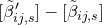 $[\tilde {\beta }_{ij,s}'] - [\tilde {\beta }_{ij,s}]$
is homologically trivial in
 $H_2( \bar {\mathcal {X}}_s, \mathbb {Z})$
. Thus, in
 $H_2(\mathcal {X}_s, \mathbb {Z})$
,
 \begin{equation*} [\tilde {\beta }_{ij,s}'] - [\tilde {\beta }_{ij,s}] \in \mathrm {ker} (H_2(\mathcal {X}_s, \mathbb {Z} ) \rightarrow H_2 ( \bar {\mathcal {X}}_s, \mathbb {Z} ) ). \end{equation*}
We know that
 $\mathrm {ker} (H_{2} (\mathcal {X}_s, \mathbb {Z} ) \rightarrow H_{2}( \bar {\mathcal {X}}_s, \mathbb {Z}) )$
is generated by
 $\Gamma _s$
, the generator of the kernel of the exact sequence (6.3). By our scaling of
 $\Omega$
, we conclude that
 \begin{equation*} \frac {1}{2\pi i} \bigg(\int _{\tilde {\beta }_{ij,s}'}\Omega - \int _{\tilde {\beta }_{ij,s}}\Omega \bigg)\in 2\pi i \mathbb {Z}. \end{equation*}
After exponentiation, we obtain the desired equality (6.15).
The kernel of the weight map
 $w:\textrm {Pic}(Y)^{*} \rightarrow \chi (T^{D})$
via the identification
 $\textrm {Pic}(Y)^{*} \simeq \textrm {Pic}(Y)$
is identified as
 $D^\perp$
. Therefore,
 $T_{Y}/T^{D}$
is identified as
 $T_{(D^\perp )^{*}}$
, the period domain in Definition 2.7.
Proposition 6.23.
Let
 $((\bar {\mathcal {X}}|_{T_Y},\mathcal {D}|_{T_Y}\!),p_i,\mu )\rightarrow T_Y$
be the marked compactified mirror family over the base torus
 $T_Y$
. Then, the induced marked period map is the identity if
 $(Y,D)$
does not have a toric blowdown to the del Pezzo surface of degree 1 and an isomorphism otherwise. In either case, given
 $t \in T_Y$
, the period point of
 $\bar {\mathcal {X}}_t$
is given by the image of
 $t$
under the surjective homomorphism
 $T_Y \twoheadrightarrow T_{(D^\perp )^{*}}$
.
Proof.
It suffices to consider the case where
 $(Y,D)$
has a toric model.
The marking of the Picard group
 $\mu$
of the compactified mirror family over
 $T_Y$
is done in Proposition 6.15. Let
 $U \subset T_{Y}$
be the analytic open neighborhood as in Lemma 6.14. Recall that we define
 $U$
to be
 $T^{D} \cdot (W \cap T_{Y})$
. By Lemma 5.3 and the weight function, we know that both the marked period of
 ${\mathcal {O}}_{\bar {\mathcal {X}}_s}(E_{ij,s})$
and
 $z^{E_{ij}}$
is an eigenfunction of
 $T^{D}$
with weight
 $e_{D_i}$
. By Proposition 6.16, we know they coincide on
 $W \cap T_Y$
. Therefore, they must also agree on
 $U$
by the equivariance of the action of
 $T^{D}$
on the family. By the uniqueness of analytic continuation, they agree on the entire base
 $T_{Y}$
.
Suppose
 $(Y,D)$
is not a toric blowup of the del Pezzo surface of degree
 $1$
. Then Proposition 5.9, together with computations for the marked periods of exceptional curves, show that the marked period map is the identity. If there is a toric blowdown of
 $(Y,D)$
to the del Pezzo surface of degree
 $1$
, we do not know if the marked period map is an identity, but it is still an isomorphism by Lemma 4.22, Lemma 5.8, and Proposition 5.9. The statement about period points in this special case follows from Proposition A.6 in Appendix A.
We can now prove the main statement, given in Theorem 1.8.
Proof of Theorem 1.8. The compactification of the family comes from the choice of a Weil divisor
 $W$
such that
 $W\cdot D_i\gt 0$
for all
 $i$
and the associated polytope. By Proposition 4.38, this does not depend on the choice of Weil divisor, giving rise to a canonical compactification. The marking of the boundary is given by Construction 5.1. The deformation type is determined by the proof of Proposition 6.15. Finally, the induced marked period map is an isomorphism by Proposition 6.23, identifying the marked compactified mirror family with the universal family of generalized marked pairs deformation equivalent to
 $(Y,D)$
.
Remark 6.24. Recall that the set of roots
 $\Phi$
is finite for a positive pair
 $(Y,D)$
. In the positive cases, the finite union of hypertori
 \begin{equation*} T_{\alpha } = \{\varphi \in T_Y \mid \varphi (\alpha )=1\}, \end{equation*}
for
 $\alpha \in \Phi$
, parametrizes generalized marked pairs with du Val singularities deformation equivalent to
 $(Y,D)$
in the mirror family, since only minimal resolutions of generalized marked pairs with du Val singularities have internal (
 $-2$
)-curves.
7. Connections to the work of Keel and Yu
For a variety
 $X$
over a non-Archimedean field
 $K$
, we have an associated
 $K$
-analytic space
 $X^{\text {an}}$
in the sense of Berkovich [Reference BerkovichBer90]. In our setting, the base field
 $k$
is equipped with the trivial absolute value.
Definition 7.1. Let
 $U$
be a connected smooth affine log Calabi–Yau variety over
 $k$
together with its canonical volume form
 $\omega$
(which is unique up to scaling). Define
 \begin{align*} U^{\mathrm {trop}}(\mathbb {Z})& :=\{0\} \cup \{ {\text {divisorial discrete valuations}\, \nu :\,k(U)\setminus \{0\} \rightarrow \mathbb {Z} \mid \nu (\omega ) \lt 0 } \}\\ & := \{0\} \cup \{(E,m) \mid m \in \mathbb {Z}_{\gt 0}, E \subset (Y\setminus U),\,\omega \, \text {has a pole along}\,E \}, \end{align*}
Here,
 $k(U)$
is the field of rational functions. Furthermore, we define
 \begin{equation*} \nu (g dz_1 \wedge \cdots \wedge dz_n) := \nu (g), \end{equation*}
for
 $z_1, \ldots ,z_n$
local coordinates in a neighborhood of the generic point of the divisor corresponding to
 $\nu$
; this is independent of the choice of local coordinates as a change of coordinates only changes
 $g$
by a unit. In the second expression,
 $E$
is a divisorial irreducible component of the boundary in some partial compactification
 $U \subset Y$
, and two divisors on two possibly different birational varieties are identified if they give the same valuation on their common field of fractions.
The set
 $U^{\mathrm {trop}}(\mathbb {Z})$
is another name for the set of integer points
 $\textrm {SK}(U,\mathbb {Z})$
on the Kontsevich–Soibelman essential skeleton
 $\textrm {SK}(U)$
.
Suppose
 $U$
contains a Zariski-open algebraic torus. Let
 $U \subset Y$
be a simple normal crossing compactification. In [Reference Keel and YuKY23], the authors construct a commutative associative algebra
 $A$
equipped with a compatible multilinear form. The mirror algebra
 $A$
is a free
 $\mathbb {Z}[{\textrm {NE}}(Y)]$
-module with basis
 $\textrm {SK}(U,\mathbb {Z})$
, the integer points on the essential skeleton
 $\textrm {SK}(U)$
of
 $U$
. The structure constants of
 $A$
as an algebra are given by naive counts of non-archimedean analytic discs with the given intrinsic skeleton, realized as counts associated with trees in
 $\textrm {SK}(U)$
.
Given
 $P_1,\ldots , P_n \in \textrm {SK}(U,\mathbb {Z})$
, we write the product in the mirror algebra
 $A$
as
 \begin{align} \vartheta _{P_1} \cdots \vartheta _{P_n} =\sum _{Q \in \textrm {SK}(U,\mathbb {Z})} \sum _{\gamma \in {\textrm {NE}}(Y)} \chi (P_1, \ldots ,P_n,Q,\gamma ) z^{\gamma }\vartheta _Q, \end{align}
where
 $\gamma \in {\textrm {NE}}(Y)$
is a curve class.
Here, we reproduce the heuristic behind the structure constants as in [Reference Keel and YuKY23, Remark 1.7] and refer the readers to [Reference Keel and YuKY23, § 1.1] for the technical definitions of these constants. Fix
 $P_1,\ldots ,P_n,Q\in \textrm {SK}(U,\mathbb {Z})$
and
 $\gamma \in {\textrm {NE}}(Y)$
. Write
 $P_j=m_j v_j$
. By passing to a blowup
 $\pi :(\tilde {Y},\tilde {D})\rightarrow (Y,D)$
, we can always assume that
 $v_j$
has divisorial center
 $D_j\subset \tilde {D}$
. Suppose
 $Q\neq 0$
. Then heuristically,
 $\chi (P_1,\ldots ,P_n,Q,\gamma )$
counts analytic maps
 \begin{equation*} g:[\mathbb {D},(p_1,\ldots ,p_n)]\rightarrow \tilde {Y}^{\textrm {an}}, \end{equation*}
such that:
-
(i)
$\mathbb {D}$
is a closed unit disk over a non-archimedean field extension
$k'/k$
and
$p_1,\ldots ,p_n$
are distinguished
$k'$
-points on
$\mathbb {D}$
; -
(ii)
$g(p_j)\in D_j^{0 }$
for all
$j$
such that
$P_j\ne 0$
; -
(iii)
$g^{-1}(\tilde {D})=\sum m_j p_j$
; -
(iv)
$g(\partial \mathbb {D})=Q\in U^{\textrm {an}}$
; -
(v) the derivative of
$g$
at
$\partial \mathbb {D}$
is
$Q$
; and -
(vi)
$(\pi \circ g)_{*}=\gamma$
.






Now, let us narrow the construction of [Reference Keel and YuKY23] to the dimension
 $2$
case. In this context, every smooth affine log Calabi–Yau surface
 $U$
with maximal boundary appears as the interior of a positive Looijenga pair
 $(Y,D)$
. Moreover,
 $\textrm {SK}(U,\mathbb {Z})$
is equal to
 $B(\mathbb {Z})$
. The following proposition from [Reference Hacking, Keel and YuHKY22] gives a geometric interpretation of the structure coefficients of the mirror algebra constructed in [Reference Gross, Hacking and KeelGHK15a] via the construction of [Reference Keel and YuKY23].
Proposition 7.2 [Reference Hacking, Keel and YuHKY22, Proposition 4.10]. Let
 $U$
be a smooth affine log Calabi–Yau surface with maximal boundary. Fix a Looijenga pair
 $(Y,D)$
that compactifies
 $U$
. Then (after base change to
 $\mathbb {C}[{\textrm {NE}}(Y)]$
), the mirror algebra constructed in [Reference Gross, Hacking and KeelGHK15a] associated with
 $(Y,D)$
agrees with that constructed in [Reference Keel and YuKY23] using the compactification
 $U\subset Y$
.
Combining Theorem 1.8 and Proposition 7.2, we obtain the following theorem of the paper which is a combination of Theorem 1.1 and Theorem 1.9.
Theorem 7.3.
Let
 $U$
be a smooth affine log Calabi–Yau surface with maximal boundary. Fix a Looijenga pair
 $(Y,D)$
that compactifies
 $U$
and a marking of
 $D$
, then there is a decomposition
 \begin{align} H^0(U,{\mathcal {O}}_U)=\bigoplus _{q\,\in\, U^{\textrm {trop}}(\mathbb {Z})} \mathbb {C}\cdot \vartheta _q, \end{align}
of the vector space of regular functions on
 $U$
into one-dimensional subspaces with distinguished basis elements of theta functions. The multiplication rule of theta functions is given by the geometric construction in [Reference Keel and YuKY23]. Different choices of compactifications and markings will only result in the rescaling of theta functions and not affect the vector space decomposition. The decomposition is canonical up to the choice of one of the two possible orientations of
 $U^{\textrm {trop}}(\mathbb {Z})$
.
Proof.
Fix a Looijenga pair
 $(Y,D)$
that compactifies
 $U$
and a choice of marking of
 $D$
. Let
 $t' \in T_Y$
be the corresponding marked period point. Let
 $\phi : T_Y \rightarrow T_Y$
be the marked period map of the compactified mirror family. Recall that by Proposition 6.23, the isomorphism
 $\phi$
is the identity except for the case of degree 1 del Pezzo surfaces. Let
 $t =\phi ^{-1}(t')$
. Then
 $(\bar {\mathcal {X}}_t, \mathcal {D}_t)$
is isomorphic to
 $(Y,D)$
as a marked pair and, in particular,
 $\mathcal {X}_t$
is isomorphic to
 $U$
. By evaluating the structure coefficients of
 $A$
at
 $t$
, i.e. evaluate
 $z^{[C]}$
at
 $t$
for
 $[C] \in {\textrm {NE}}(Y)$
, we get a basis for
 $H^0(\mathcal {X}_t,{\mathcal {O}}_{\mathcal {X}_t})$
given by theta functions parametrized by
 $U^{\textrm {trop}}(\mathbb {Z})$
. By Proposition 7.2, the multiplication rule for theta functions in [Reference Gross, Hacking and KeelGHK15a] is equivalently given by the geometric construction of [Reference Keel and YuKY23]. By Lemma 5.3, changing the marking of
 $\mathcal {D}_t$
corresponds to the action of the relative torus
 $T^{D}$
. Since theta functions are eigenfunctions of the action of
 $T^{D}$
by Theorem 3.11, different choices of marking of
 $D$
will only rescale the basis elements of
 $H^0(\mathcal {X}_t,{\mathcal {O}}_{\mathcal {X}_t})$
.
Change the marking of
 $\textrm {Pic}(\bar {\mathcal {X}}_t)$
by
 $\textrm {Pic}(Y)$
is equivalent to pre-composing with a lattice automorphism of
 $\textrm {Pic}(Y)$
that preserves
 $D_i$
for each
 $i$
and the cone
 $C^{++}$
(cf. Definition 2.9). Since the canonical scattering diagram in [Reference Gross, Hacking and KeelGHK15a] is invariant under such an automorphism, changing the marking of
 $\textrm {Pic}(\bar {\mathcal {X}}_t)$
will not change the algebra we get.
If we use another Looijenga pair
 $(Y',D')$
to compactify
 $U$
, we can always find a common toric blowup
 $(Y'',D'')$
of both
 $(Y,D)$
and
 $(Y',D')$
. By Lemma 4.22 and Lemma 4.41, toric blowups of fibers in
 $(\bar {\mathcal {X}}|_{T_Y},\mathcal {D}|_{T_Y}\!)$
,
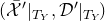 $(\bar {\mathcal {X}}'|_{T_Y},\mathcal {D}'|_{T_Y}\!)$
can be identified as fibers in
 $(\bar {\mathcal {X}}''|_{T_Y},\mathcal {D}''|_{T_Y}\!)$
. Since markings of the compactified mirror families are compatible with the toric blowup operation, we conclude that different compactifications will again result only in the rescaling of the basis elements of theta functions.
It remains to identify
 $\mathcal {X}^{\mathrm {trop}}_{t}(\mathbb {Z})$
with
 $U^{\textrm {trop}}(\mathbb {Z})$
. We recall the identification of
 $\mathcal {X}^{\mathrm {trop}}_{t}(\mathbb {Z})$
with
 $U^{\textrm {trop}}(\mathbb {Z})$
as described at the beginning of [Reference MandelMan16, § 4]. Given a primitive element
 $q$
in
 $U^{\textrm {trop}}(\mathbb {Z})$
, let
 $L$
be an immersed line that escapes to infinity parallel to
 $q$
. Then, the generalized half-space
 $Z(L)$
gives a partial compactification of
 $\mathcal {X}_t$
with an irreducible boundary divisor. The compactification is independent of the distance of
 $L$
to
 $0\in B$
and therefore depends only on
 $q$
. Thus, we can define an identification of
 $U^{\textrm {trop}}(\mathbb {Z})$
with
 $\mathcal {X}^{\mathrm {trop}}_{t}(\mathbb {Z})$
such that given an element
 $mq \in U^{\textrm {trop}}(\mathbb {Z})$
where
 $m\in \mathbb {Z}_{\gt 0}$
and
 $q$
a primitive element,
 $mq$
is sent to the pair
 $(D_q,m)$
where
 $D_q$
is the irreducible divisor of the partial compactification of
 $\mathcal {X}_t$
determined by
 $q$
that we just described. This identification depends only on the convention of the orientation of immersed lines on
 $B$
that we choose (in this paper, we choose the orientation so that
 $0$
is always on the left of an immersed line). Notice that fixing the orientation of immersed lines is equivalent to fixing the orientation of
 $U^{\textrm {trop}}(\mathbb {Z})$
. The decomposition (7.2) is canonical up to this choice of the two possible orientations of
 $U^{\textrm {trop}}(\mathbb {Z})$
.
Remark 7.4. In the mirror symmetry program for affine log Calabi–Yau varieties (with maximal boundary), it is expected that
 $H^0(U,{\mathcal {O}}_U)$
has a vector space basis parametrized by the integer tropical points of its mirror, and the structure constants of
 $H^0(U,{\mathcal {O}}_U)$
, as an algebra, should be given by the enumerative geometry of its mirror. Here, the surprising fact is that for a smooth affine log Calabi–Yau surface with maximal boundary, it appears as a fiber in its own mirror family. However, since dual Lagrangian torus fibrations in dimension 2 are topologically equivalent, this is consistent with the SYZ mirror symmetry picture.
Appendix A. Degree
$1$
del Pezzo

We now cover the exceptional case of the degree
 $1$
del Pezzo. This is the pair
 $(Y,D)$
where
 $Y=\textrm {Bl}_8(\mathbb {P}^2)$
and
 $D$
is an irreducible nodal curve whose self-intersection number is
 $1$
.
We construct tropical cycles that correspond to
 $(-2)$
-classes that have trivial intersections with the boundary and then compute the periods. For pictorial convenience, we work on a toric blowup of
 $(Y,D)$
instead. First, we find a toric blowup of
 $(Y,D)$
that has a toric model.
Lemma A.1.
There is a toric blowup
 $(Y',D')\rightarrow (Y,D)$
such that
 $(Y',D')$
has a toric model given by
 $(F_3,\bar {D})$
, where
 $F_3$
is the Hirzebruch surface and
 $\bar {D}$
is its toric boundary.
Proof.
First, blow up the unique node on
 $D$
. This gives rise to an exceptional divisor,
 $D_3$
. There are two tangent lines to the node in
 $D$
, call these
 $L_1$
and
 $L_2$
. The strict transform of
 $L_1$
intersects
 $D_3$
and the strict transform
 $D_1$
of
 $D$
. We blow up at this intersection point to get a new divisor,
 $D_2$
. Now the strict transform of
 $L_1$
only intersects
 $D_2$
. We do the same thing with
 $L_2$
, which gives a new boundary divisor,
 $D_4$
. We then get a new pair
 $(Y',D')$
where
 $D'$
has four irreducible components,
 $D_1,D_2,D_3,D_4$
with (respective) self intersections
 $(-5,-1,-3,-1)$
. Now, blowdown the strict transforms of
 $L_i$
and also the strict transforms of the original eight exceptional curves on
 $D$
to get a new pair,
 $(\bar {Y},\bar {D})$
, which has boundary intersections
 $(3,0,-3,0)$
. This is the Hirzebruch Surface,
 $F_3$
. So we have taken a toric blowup of the original pair such that it has a toric model.
Now consider the GS locus corresponding to the toric model
 $p:(Y',D')\rightarrow (\bar {Y},\bar {D})$
. We want to find tropical curves on
 $B_{(Y',D')}$
that correspond to a basis of
 $D^{\perp } \simeq D'^{\perp }$
. First, we compute
 $D^{\perp }$
. Let
 $\bar {C}$
be the class corresponding to the unique curve of self-intersection
 $-3$
of
 $F_3$
and
 $\bar {F}$
a fiber of
 $F_3$
(under its standard ruling). Also, denote their respective pullbacks under
 $p$
by
 $C$
and
 $F$
. Then we have
 \begin{equation*}\textrm {Pic}(\bar {Y})=\langle \bar {C}, \bar {F}\rangle, \end{equation*}
 \begin{equation*}\textrm {Pic}(\bar {Y})=\langle \bar {C}, \bar {F}\rangle, \end{equation*}
where
 $E_1,\ldots ,E_{8}$
are the exceptional curves on
 $D_1$
,
 $E_9$
is the exceptional curve on
 $D_2$
, and
 $E_{10}$
is the exceptional curve on
 $D_4$
. Denote the corresponding toric boundary components by
 $\bar {D}_i$
. Then
 \begin{equation*} D_1=p^{*}(\bar {D}_1)-E_1-\cdots -E_8=3F+C-E_1-\cdots -E_8, \end{equation*}
 \begin{equation*} D_2=F-E_9, \quad D_3=C,\quad D_4=F-E_{10}. \end{equation*}
Because
 $(Y,D)$
is positive,
 $D^{\perp }$
will be generated by roots. A quick computation shows that a basis for
 $D^{\perp }$
can be given by the following
 $(-2)$
-classes:
 \begin{equation*} D^{\perp }=\langle E_1-E_2,\ldots ,E_7-E_8,3F+C-E_1-E_2-E_3-E_9-E_{10}\rangle .\end{equation*}
The tropical cycle
 $\beta ^{i}_{\textrm {trop}}$
.

First, we produce tropical cycles corresponding to each
 $(-2)$
-curve. The tropical cycle
 $\beta ^{i}_{\textrm {trop}}$
that first winds around the focus–focus singularity
 $o_{1(i+1)}$
and then winds around
 $o_{1i}$
, as depicted in Figure A1, corresponds to
 $E_i-E_{i+1}$
, and
 $\beta '_{\textrm {trop}}$
in Figure A2 corresponds to
 $3F+C-E_1-E_2-E_3-E_9-E_{10}$
. The vectors on each edge are given by Lemma 6.7.
While balancing conditions for
 $\beta ^{i}_{\textrm {trop}}$
are obvious, we note that for
 $\beta '_{\textrm {trop}}$
, the unique vertex which is not at a focus–focus singularity also satisfies the balancing condition. On an edge leaving a focus–focus singularity, the edge carries a primitive vector,
 $\zeta _{\rho }$
, parallel to
 $\Lambda _{\rho }$
. Thus, at the vertex, we have the sum of vectors
 \begin{equation*} 3\zeta _{\rho _1}-\zeta _{\rho _2}-\zeta _{\rho _4}=0, \end{equation*}
since
 $v_4+3v_1+v_2=0$
.
Lemma A.2.
The tropical cycles
 $\beta ^{i}_{\textrm {trop}}$
and
 $\beta '_{\textrm {trop}}$
have self-intersection
 $-2$
.
Proof. This follows from [Reference BauerBau17, Lemmas 4.10 and 4.11].
To show that we have actually constructed a set of cycles that correspond to a basis of
 $D^{\perp }$
, we compute the intersection matrix.
The tropical cycle
 $\beta '_{\textrm {trop}}$
. On
 $\rho _1$
,
 $\beta '_{\textrm {trop}}$
winds around focus–focus singularities given by
 $1+z^{[E_i]}X_{1}^{-1}=0 (i=1,2,3)$
. On
 $\rho _2$
, it winds around the focus–focus singularity given by
 $1+z^{[E_9]}X_{2}^{-1}=0$
and on
 $\rho _3$
, around that given by
 $1+z^{[E_{10}]}X_{4}^{-1}=0$
.

Lemma A.3.
The intersection form given by
 $\beta '_{\textrm {trop}},\beta ^{1}_{\textrm {trop}},\beta ^{2}_{\textrm {trop}},\ldots ,\beta ^{7}_{\textrm {trop}}$
coincides with that of the lattice
 $E_8(-1)$
.
Proof.
It suffices to compute all the intersection numbers. The self-intersection numbers are done in Lemma A.2. Consider
 $\beta ^{i}_{\textrm {trop}}\cdot \beta ^{i+1}_{\textrm {trop}}$
. Then, there is a single intersection between the two cycles at the
 $(i+1)^{\textrm{th}}$
focus–focus singularity. Since the orientations of the two loops around the singularity are opposite, the intersection is
 $+1$
. It is clear that
 $\beta ^{i}_{\textrm {trop}}\cdot \beta ^{j}_{\textrm {trop}}$
do not intersect if
 $|i-j|\gt 1$
. Finally, we check intersections with
 $\beta '_{\textrm {trop}}$
. There is no intersection between
 $\beta '_{\textrm {trop}}$
and
 $\beta ^{i}_{\textrm {trop}}$
for
 $i\gt 3$
. Consider the case now where
 $i\in \{1,2\}$
. There is an intersection at both the
 $i^{\textrm{th}}$
and
 $(i+1)^{\textrm{th}}$
focus–focus singularity. Note that the loops around the
 $i^{\textrm{th}}$
and
 $(i+1)^{\textrm{th}}$
focus–focus singularities have opposite orientations and the edges of
 $\beta '_{\textrm {trop}}$
corresponding to those singularities are identical in terms of the vectors they carry and the orientation. Thus, the intersection contributions will cancel so
 $\beta '_{\textrm {trop}}\cdot \beta ^{i}_{\textrm {trop}}=0$
. Finally, consider
 $\beta '_{\textrm {trop}}\cdot \beta ^{3}_{\textrm {trop}}$
. Now there is only one intersection, around the third focus–focus singularity and it has the intersection number
 $1$
. To summarize, the intersection matrix (with the ordered basis as in the lemma) is given by
 \begin{align*} \begin{pmatrix} -2 & \quad 0 & \quad 0 & \quad 0 & \quad 0 & \quad 0 & \quad 0 & \quad 0\\ 0 & \quad -2 & \quad 1 & \quad 0 & \quad 0 & \quad 0 & \quad 0 & \quad 0\\ 0 & \quad 1 & \quad -2 & \quad 1 & \quad 0 & \quad 0 & \quad 0 & \quad 0\\ 0 & \quad 0 & \quad 1 & \quad -2 & \quad 1 & \quad 0 & \quad 0 & \quad 0\\ 0 & \quad 0 & \quad 0 & \quad 1 & \quad -2 & \quad 1 & \quad 0 & \quad 0\\ 0 & \quad 0 & \quad 0 & \quad 0 & \quad 1 & \quad -2 & \quad 1 & \quad 0\\ 0 & \quad 0 & \quad 0 & \quad 0 & \quad 0 & \quad 1 & \quad -2 & \quad 1\\ 0 & \quad 0 & \quad 0 & \quad 0 & \quad 0 & \quad 0 & \quad 1 & \quad -2 \end{pmatrix}. \end{align*}
Lemma A.4.
Given
 $s \in W$
, let
 $\beta _{i,s}$
be the singular cycle on
 $\bar {\mathcal {X}}_s$
corresponding to
 $\beta ^{i}_{\textrm {trop}}$
. Then
 \begin{equation*} \exp {- \bigg( \frac {1}{2\pi i} \int _{\beta _{i,s}}\Omega \bigg)}=z^{[E_{i+1}]-[E_i]}(s).\end{equation*}
Lemma A.5.
Let
 $W$
be as given in Construction
6.10
. Then, Given
 $s =(a,t) \in W \cap T_Y$
, let
 $\beta '_s$
be the singular cycle on
 $\bar {\mathcal {X}}_s$
corresponding to
 $\beta '_{\textrm {trop}}$
. Then
 \begin{equation*} \exp { \bigg( {-}\frac {1}{2\pi i} \int _{\beta '_s}\Omega \bigg)}=t^{\kappa _{\rho _1}}z^{\left [ -E_1-E_2-E_3-E_9-E_{10} \right ]}(a).\end{equation*}
Proof. This follows from Theorem 6.17 and local contributions of Ronkin functions as shown in Equation (6.11).
Proposition A.6.
Given
 $s \in T_Y$
, the period point of
 $\bar {\mathcal {X}}_s$
is given by the image of
 $s$
under the surjective homomorphism
 $T_Y \twoheadrightarrow T_{(D^{\perp })^*}$
.
Proof.
It follows from intersection pairing that
 $\beta '_s$
is in the same homology class as the curve class marked by
 $ p^{*}(\bar {D}_1)-E_1-E_2-E_3-E_9-E_{10}$
and
 $\beta _{i,s}$
the curve class marked by
 $E_i -E_{i+1}$
for
 $s\in T_Y$
.
Suppose
 $s\in U$
where
 $U = T^{D} \cap (W \cap T_Y)$
. Recall that for internal (
 $-2$
)-curves, their holomorphic periods are equal to algebraic ones. Then, it follows from Lemmas A.4 and A.5 that the statement of the lemma holds restricted to
 $W$
. Then, the lemma follows from Lemma 5.3 and the uniqueness of the analytic continuation.
Acknowledgements
This project originates from a set of preliminary notes by M. Gross, P. Hacking, and S. Keel. We thank the three of them deeply for sharing their original notes and ideas with us. We want to give special thanks to P. Hacking for suggesting using the work of H. Ruddat and B. Siebert to produce cycles homologous to
 $(-1)$
-curves and compute the corresponding periods. We would also like to thank B. Siebert for numerous conversations related to the period formula.
Conflicts of interest
None.
Financial support
The first author was supported by EPSRC grant EP/S025839/1. The second author was partially supported by the National Key Research and Development Program of China (no. 2021YFA1002000) and by the National Natural Science Foundation of China (no. 12171006).
Journal information
Compositio Mathematica is owned by the Foundation Compositio Mathematica and published by the London Mathematical Society in partnership with Cambridge University Press. All surplus income from the publication of Compositio Mathematica is returned to mathematics and higher education through the charitable activities of the Foundation, the London Mathematical Society and Cambridge University Press.