Introduction
In 1907, Alois Alzheimer described weight loss in his first patient (Inelmen et al., Reference Inelmen, Sergi, Coin, Girardi and Manzato2010) and weight loss is currently recognized as a clinical feature of Alzheimer's disease (AD; McKhann et al., Reference McKhann, Drachman, Folstein, Katzman, Price and Stadlan1984). Weight loss, a characteristic of undernutrition (Van Asselt et al., Reference Van Asselt2012), has been described in approximately 20% to 45% of community-dwelling AD patients (Wolf-Klein et al., Reference Wolf-Klein, Silverstone and Levy1992; White et al., Reference White, Pieper, Schmader and Fillenbaum1996; Gillette-Guyonnet et al., Reference Gillette-Guyonnet2000; Reference Gillette-Guyonnet, Cortes and Vellas2005; Guérin et al., Reference Guérin2005a; Besser et al., Reference Besser2014). In our own recent publication, one in seven community-dwelling elderly with newly diagnosed AD was at risk of undernutrition according to the Mini Nutritional Assessment (MNA; Droogsma et al., Reference Droogsma, Van Asselt, Schӧlzel-Dorenbos, Van Steijn, Van Walderveen and Van der Hooft2013). Other studies in community-dwelling AD patients reported even higher rates of prevalence of at risk of undernutrition (evaluated with the MNA), ranging from 26% to 80% (Guérin et al., Reference Guérin2005a; Nourhashemi et al., Reference Nourhashemi, Amouyal-Barkate, Gillette-Guyonnet, Cantet and Vellas2005; Vellas et al., Reference Vellas2005; Ousset et al., Reference Ousset, Nourhashemi, Reynish and Vellas2008; Gillioz et al., Reference Gillioz2009; Scheltens, Reference Scheltens2009; Spaccavento et al., Reference Spaccavento, Del Prete, Craca and Fiore2009; Saragat et al., Reference Saragat2012). Weight loss and (risk of) undernutrition have been associated with an accelerated progression of AD (Gillette-Guyonnet et al., Reference Gillette-Guyonnet2000; Reference Gillette-Guyonnet, Cortes and Vellas2005; Guérin et al., Reference Guérin, Soto, Brocker, Robert, Benoit and Vellas2005b; Vellas et al., Reference Vellas2005), a higher rate of institutionalization (Andrieu et al., Reference Andrieu2001), and increased mortality (White et al., Reference White, Pieper and Schmader1998; Gambassi et al., Reference Gambassi, Landi, Lapane, Sgadari, Mor and Bernabei1999; Faxén-Irving et al., Reference Faxén-Irving, Basun and Cederholm2005).
Thus, the prevalence of weight loss and risk of undernutrition in community-dwelling AD patients is high and associated with negative health outcomes. Nevertheless, in the current guidelines on diagnosis and treatment of AD (Scottish Intercollegiate Guidelines Network, 2006; Ministry of Health Singapore, 2007; Hort et al., Reference Hort2010), no attention is given to what clinicians should do in the case of poor nutritional status in community-dwelling AD patients. There are several guidelines and studies on the treatment of (risk of) undernutrition in older people without AD (Volkert et al., Reference Volkert2006; American Dietetic Association, 2009). However, in our opinion, these results cannot be extrapolated to AD patients. First, because the mechanism of weight loss and undernutrition in AD patients is probably not the same as in individuals without AD. This is supported by studies showing that the prevalence of weight loss is higher in patients with AD compared to controls without AD (Wolf-Klein et al., Reference Wolf-Klein, Silverstone and Levy1992; Barret-Connor et al., Reference Barret-Connor, Edelstein, Corey-Bloom and Wiederholt1996; White et al., Reference White, Pieper, Schmader and Fillenbaum1996). Second, because of expected differences in adherence to the nutritional interventions. Due to their cognitive impairment, AD patients may forget to take an oral nutritional supplement (ONS).
Given the adverse outcomes of weight loss and (risk of) undernutrition, there is a need for evidence-based nutritional interventions for community-dwelling AD patients with a poor nutritional status.
A systematic review (type 1 in the hierarchy of evidence) is considered the best way of assessing the evidence base for interventions (Higgins and Green, Reference Higgins and Green2011). We conducted a systematic review with the aim to critically assess the current evidence regarding the effect of nutritional interventions in community-dwelling AD patients with (risk of) undernutrition.
Methods
This systematic review was conducted according to the methods outlined by the Cochrane Collaboration (Higgins and Green, Reference Higgins and Green2011).
Review question and eligibility criteria
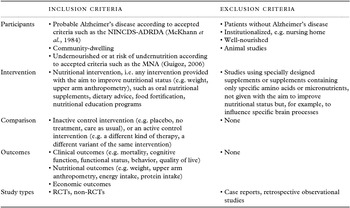
We defined eligibility criteria based on the PICO (Population, Intervention, Comparison, Outcomes) framework (Higgins and Green, Reference Higgins and Green2011) and types of studies (Table 1). Our PICO was: what is the effect of nutritional interventions (I) in community-dwelling AD patients with (risk of) undernutrition (P) compared to an inactive or active control intervention (C) on clinical, nutritional, and economic outcomes (O)? Studies were eligible for inclusion if they met the pre-determined inclusion criteria (Table 1). Although their evidence is less robust, non-randomized controlled trials (RCTs) were included to ensure capture of all of the available information. Studies in all languages were included to prevent bias (Higgins and Green, Reference Higgins and Green2011). There were no restrictions with regard to publication year.
Inclusion and exclusion criteria for selection of studies based on the PICO framework and study types

PICO = Population, Intervention, Comparison, Outcomes; NINCDS-ADRDA = National Institute of Neurological and Communicative Disorders and Stroke and the Alzheimer's Disease and Related Disorders Association; MNA = Mini Nutritional Assessment; RCT = Randomized Controlled Trial.
Search methods
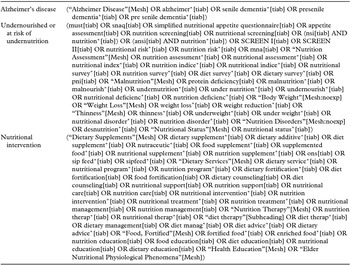
Assisted by information specialists, three electronic databases, including Pubmed, Embase, and the Cochrane Central Register of Controlled Trials, were searched from inception till April 24, 2013. In addition, three trial registers, including Clinicaltrials.gov (an American trial register), Clinicaltrialregister.eu (a European trial register), and Trialregister.nl (a Dutch trial register) were searched in order to identify unpublished trials. Search terms (Medical Subject Headings (MeSH), Emtree, keywords, and title and abstract words) for AD, undernourished or at risk of undernutrition, and nutritional intervention were combined (Table 2). Initially, we combined the terms with search terms for community-dwelling. Though, this search provided only ten records.
Search terms used in Pubmed

The search may be reproduced by adding the Boolean operator AND in between the different search sets.
MUST = Malnutrition Universal Screening Tool; SNAQ = Simplified Nutritional Appetite Questionnaire; NSI = Nutrition Screening Initiative; ANSI = Australian Nutritional Screening Initiative; SCREEN = Seniors in the Community; Risk Evaluation for Eating and Nutrition; MNA = Mini Nutritional Assessment (the MUST, SNAQ, NSI, ANSI, SCREEN, and MNA are nutrition screening tools for older adults living in the community), PNI = Prognostic Nutritional Index; ONS = Oral Nutritional Supplements; MeSH = Medical Subject Headings; tiab = title and abstract; noexp = Do not include MeSH terms found below this term in the MeSH hierarchy.
*Truncation was used to find word variants. For example a search for alzheimer* finds citations with the word alzheimers.
N.a. 1: The search terms in Embase and the Cochrane Central Register of Controlled Trials were derived from the search terms used in Pubmed and are available on request from the author.
N.a. 2: In the trial registers the following search terms were used: alzheimer, senile dementia, presenile dementia, pre senile dementia, dementia, nutritional treatment, nutrition treatment, nutritional management, nutrition therapy, nutritional therapy, dietary management, diet advice, dietary advice, fortified food, enriched food, nutrition education, food education, diet education, nutritional education, dietary education, health education.
Data selection and data extraction
Studies were selected based on eligibility criteria (Table 1) in two steps. The first step involved screening of the studies by title and abstract. Potential relevant studies identified in the first step, were subsequently assessed for eligibility based on the full-text. If necessary, authors of studies were contacted to obtain information. The data selection was done independently by two reviewers (E.D. and D.A.). The agreement between the two reviewers was measured by calculating the κ value (Higgins and Green, Reference Higgins and Green2011). Data of eligible studies were extracted by one reviewer (E.D.) and confirmed independently by the other reviewer (D.A.).
Assessment of risk of bias
Two investigators independently (E.D. and D.A.) assessed the risk of bias of the included studies following the instructions given in the Cochrane handbook (Higgins and Green, Reference Higgins and Green2011). This handbook recommends assessing the risk of bias for seven domains. Each domain was judged by categorizing it as low, high, or unclear risk of bias (Higgins and Green, Reference Higgins and Green2011).
Quality assessment
We planned to assess the quality of evidence for each outcome using the Grades of Recommendation, Assessment, Development and Evaluation Working Group (GRADE) system (Atkins et al., Reference Atkins2004; Guyatt et al., Reference Guyatt2008; Higgins and Green, Reference Higgins and Green2011). Quality assessment was performed if there were at least two studies on the same intervention and on the same outcome, because consistency (i.e. the degree of heterogeneity) of results cannot be assessed with only one study. The quality assessment was planned to be done by two reviewers, independently.
Data analysis
We planned to perform a meta-analysis according to the recommendations of the Cochrane Collaboration (Higgins and Green, Reference Higgins and Green2011). Heterogeneity would be explored by the χ 2 test and with I 2 statistics. If a meta-analysis was not suitable, we planned to perform a narrative analysis.
Results
Results of the search
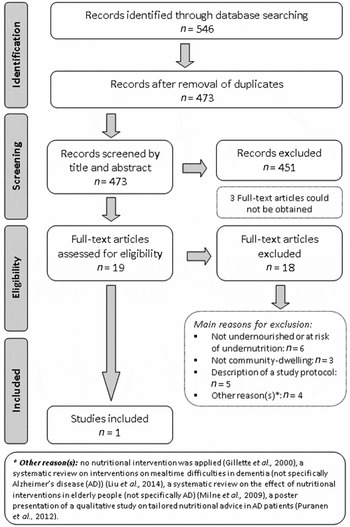
Literature search yielded 546 records. After removal of duplicates, 473 studies remained for screening of title and abstract after which 451 were excluded. The full-text of three papers could not be obtained, leaving 19 papers for full-text review. Of these, six were excluded because the study participants were not undernourished or at risk of undernutrition (Rivière et al., Reference Rivière2001; Planas et al., Reference Planas2004; Shatenstein et al., Reference Shatenstein, Kergoat, Reid and Chicoine2008; Faxén-Irving et al., Reference Faxén Irving2009; Salva et al., Reference Salva2011; Pivi et al., Reference Pivi2011). Three were excluded because the participants were not community-dwelling (Salas-Salvadó et al., Reference Salas-Salvadó2005; Navratilova et al., Reference Navratilova, Jarkovsky, Ceβkova, Leonard and Sobotkas2007; De Sousa and Amaral, Reference De Sousa and Amaral2012). Another five studies were excluded because it involved a description of a study protocol (Rivière et al., Reference Rivière, Lauque and Vellas1998; Reference Rivière, Gillette-Guyonnet, Nourhashemi and Vellas1999; George et al., Reference George, Dangour, Smith, Ruddick, Vellas and Whitehouse2009; Salva et al., Reference Salva2009; Jyvakorpi et al., Reference Jyvakorpi, Puranen, Pitkala and Suominen2012) and four studies were excluded because of other reasons (see Figure 1) (Gillette-Guyonnet et al., Reference Gillette-Guyonnet2000; Milne et al., Reference Milne, Potter, Vivani and Avenell2009; Puranen et al., Reference Puranen, Jyvakorpi, Eloniemi-Sulkava and Suominen2012; Liu et al., Reference Liu, Cheon and Thomas2014), leaving one study relevant for the purpose of this review (Lauque et al., Reference Lauque2004). The Preferred Reporting Items for Systematic Reviews and Meta-Analyses (PRISMA) flowchart in Figure 1 outlines the study selection process (Liberati et al., Reference Liberati2009). The agreement between the two reviewers with regard to the data selection was fair (i.e. a κ value of 0.49) (Higgins and Green, Reference Higgins and Green2011).
PRISMA flowchart representing the study selection process.

The search in the trial registers yielded 369 records, of which 207 were found in the American trial register, 134 in the European trial register, and 28 in the Dutch trial register. After screening of the titles and the abstracts, two trials were considered relevant (Clinicaltrials.gov.-a, 2012; Clinicaltrials.gov.-b, 2011).
Study characteristics
The study relevant for the present review is the study of Lauque et al., published in 2004 (Lauque et al., Reference Lauque2004). It was a prospective, randomized, controlled study on the effect of ONS on clinical (cognition, activities of daily living (ADL), fractures, pressure ulcers, hospitalization), nutritional (weight, body mass index (BMI), MNA, eating behavior, energy intake, protein intake, fat-free mass), and biochemical (albumin, C-reactive protein) outcomes in community-dwelling AD patients at risk of undernutrition, as evaluated with the MNA. The ONS used contained between 300 and 500 kcal in addition to the patients’ spontaneous food intake and was enriched with proteins, vitamins, and minerals. Forty-six patients received three months ONS (intervention group) and 45 patients received care as usual (control group). Three months daily ONS significantly improved nutritional outcomes in the intervention group. The nutritional status of the control group also improved after three months; although, the intervention group improved significantly more than the control group. No significant changes were found on the clinical and biochemical outcomes (Lauque et al., Reference Lauque2004).
Two trials were considered relevant for the purpose of the present review. One trial, still ongoing, aims to evaluate a diet (i.e. “T-Diet plus”; a high-protein and moderated high-energy ONS, indicated for patients with neurodegenerative diseases and related malnutrition) in patients with senile dementia at risk of malnutrition. It is not clear if the patients are community-dwelling (Clinicaltrials.gov.-a, 2012). The other trial aimed to evaluate the effect of megestrol acetate in outpatients with dementia and weight loss (Clinicaltrials.gov.-b, 2011). This trial was prematurely terminated because of insufficient recruitment.
Risk of bias
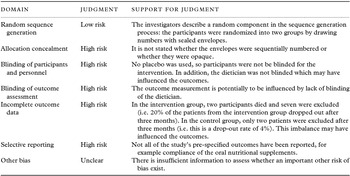
The outcome of the assessment of risk of bias in the study of Lauque et al. (Reference Lauque2004) is presented in Table 3.
Assessment of risk of bias

Assessed study: Lauque et al. (Reference Lauque2004).
N.a.: Each domain was judged by categorizing it as “low risk of bias” (i.e. plausible bias unlikely to seriously alter the results), “high risk of bias” (i.e. plausible bias that seriously weakens confidence in the results) or “unclear risk of bias” (i.e. plausible bias that raises some doubt about the results) (Higgins and Green, Reference Higgins and Green2011).
The overall risk of bias was judged as “high,” because five of the seven domains were judged as “high risk of bias” (Table 3).
Quality assessment and data analysis
It was not possible to perform a quality assessment or meta-analysis, because only one study was included.
Discussion
This is the first systematic review on the effect of nutritional interventions in community-dwelling AD patients with (risk of) undernutrition. Surprisingly, only one study was eligible for the purpose of this review. In this study, Lauque et al. showed that ONS significantly improved nutritional outcomes in community-dwelling AD patients at risk of undernutrition (Lauque et al., Reference Lauque2004). However, no effect was found on clinical and biochemical outcomes (Lauque et al., Reference Lauque2004). In addition, the risk of bias in the study of Lauque et al. was high. What does the lack of evidence mean?
It may mean that undernutrition in community-dwelling AD patients is not such an important issue as postulated. This is supported by the fact that one of the retrieved trials in the present systematic review was terminated because of difficulties in the recruitment of patients meeting the inclusion criteria, including undernutrition (Clinicaltrials.gov.-b, 2011). In addition, a recent study showed that community-dwelling patients with moderate AD did not lose weight during four years of follow-up (Secher et al., Reference Secher2013). Moreover, in our own recent published investigation, the prevalence of undernutrition in community-dwelling, newly diagnosed AD patients was 0% (Droogsma et al., Reference Droogsma, Van Asselt, Schӧlzel-Dorenbos, Van Steijn, Van Walderveen and Van der Hooft2013). This low number of undernourished patients is in line with other studies, where the prevalence of undernutrition in community-dwelling AD patients ranged from 0% to 9% (as evaluated with the MNA; Guérin et al., Reference Guérin, Soto, Brocker, Robert, Benoit and Vellas2005b; Scheltens, Reference Scheltens2009; Saragat et al., Reference Saragat2012).
Although, frank undernutrition may be a non-issue in community-dwelling AD patients, one in seven community-dwelling elderly with newly diagnosed AD was at risk of undernutrition in our recently published investigation (Droogsma et al., Reference Droogsma, Van Asselt, Schӧlzel-Dorenbos, Van Steijn, Van Walderveen and Van der Hooft2013) and other studies reported even higher rates, ranging from 26% to 80% (Guérin et al., Reference Guérin2005a; Nourhashemi et al., Reference Nourhashemi, Amouyal-Barkate, Gillette-Guyonnet, Cantet and Vellas2005; Vellas et al., Reference Vellas2005; Ousset et al., Reference Ousset, Nourhashemi, Reynish and Vellas2008; Gillioz et al., Reference Gillioz2009; Scheltens, Reference Scheltens2009; Spaccavento et al., Reference Spaccavento, Del Prete, Craca and Fiore2009; Saragat et al., Reference Saragat2012). Given the adverse outcomes of weight loss and (risk of) undernutrition, it is important to know what the best approach is to community-dwelling AD patients with a risk of developing a poor nutritional status. Unfortunately, based on the results of the present systematic review, it is not possible to state what the best approach is. Several studies investigated the effect of nutritional interventions in institutionalized patients with an advanced stage of dementia (Wouters-Wesseling et al., Reference Wouters-Wesseling, Wouters, Kleijer, Bindels, De Groot and Van Staveren2002; Gil Gregorio et al., Reference Gil Gregorio, Ramires Diaz and Ribera Casado2003; Young et al., Reference Young, Greenwood, Van Reekum and Binns2004). However, these results cannot be extrapolated to community-dwelling AD patients, because for example the compliance in institutionalized patients may be better than in community-dwelling patients, i.e. community-dwelling patients have no professional caregiver who ensures that the patient is adherent to therapy. More research is needed to be conclusive about the best approach to community-dwelling AD patients with risk of undernutrition. In addition, research should focus on establishing its risk factors in order to design targeted (nutritional) interventions. Moreover, future trials should focus on outcomes of relevance to patients and caregivers, such as improvements in function and quality of life.
Another explanation for the lack of evidence may be our strict eligibility criteria. However, we have consciously chosen for these criteria. We focused on community-dwelling AD patients because most of the AD patients are community-dwelling (i.e. in the Netherlands for example 70%; World Health Organization, 2012). Moreover, by focussing on community-dwelling patients, it is possible to figure out if a nutritional intervention can delay institutionalization. We focused on patients with poor nutritional status because they benefit the most from nutritional interventions (Stratton, Reference Stratton2000).
Unfortunately, despite our comprehensive literature search, only one study was relevant for the purpose of this review. Hence, it was not possible to perform a meta-analysis and to give firm conclusions about the effect of nutritional interventions in community-dwelling AD patients with (risk of) undernutrition. A strength of the present study is that the data selection was done by two reviewers, independently. The agreement between the two reviewers was fair. Another strength includes that studies in all languages were retrieved. Moreover, three trial registers were searched.
In conclusion, the present systematic review on the effect of nutritional interventions in community-dwelling AD patients with (risk of) undernutrition reveals a serious lack of evidence. As a result, it is not possible to state what the best approach is. Frank undernutrition in community-dwelling AD patients appears to be an infrequent condition. Many patients however are at risk of undernutrition. Therefore, research should focus on establishing its risk factors in order to design targeted (nutritional) interventions.
Conflict of interest
Erika Droogsma received funding from the “Wetenschapsfonds MCL” (science institute of the Medical Center Leeuwarden (MCL)) and Frision (the research foundation of the department of geriatric medicine of the MCL).
Description of authors' roles
Erika Droogsma was involved with the conception and design of the study, writing of the manuscript, literature search and acquisition of studies, data selection, data extraction, and assessment of risk of bias. Dieneke van Asselt was a part of the conception and design of the study, review and critique of the manuscript, data selection, data extraction, and assessment of risk of bias. Jolanda van Steijn was involved with the review and critique of the manuscript. Nic Veeger was engaged with the conception and design of the study, and review and critique of the manuscript. Ingeborg van Dusseldorp was a part of the review and critique of the manuscript, literature search, and acquisition of studies. Peter Paul De Deyn was involved with the review and critique of the manuscript.
All authors read and approved the final manuscript.
Acknowledgments
Mrs. Olga van Dijk (information specialist of the MCL) is thanked for assistance in the literature search.