Implications
Soybean meal is the most commonly used protein supplement for dairy calves due to its optimal amino acid profile. This study was conducted to evaluate the inclusion of extruded full-fat soybean in starter feed for dairy calves as replacement for soybean meal. Results indicated that extruded full-fat soybean may replace soybean meal in starter diets until 70 days of age without harming growth performance and rumen fermentation and improving nitrogen utilization efficiency.
Introduction
Soybean (SB) meal (SBM) is the most commonly used protein supplement for dairy calves due to its optimal amino acid profile (Baker, Reference Baker2000). Among oilseed meals, SBM has the highest content of essential amino acids (National Research Council (NRC), 2001). Soybean meal is treated with various methods to reduce the ruminal degradation of its high-quality protein with no negative effects on its intestinal absorption (Akbarian et al., Reference Akbarian, Khorvash, Ghorbani, Ghasemi, Dehghan-Banadaky, Shawrang and Hosseini-Ghaffari2014). Soybean meal has been used as intact (Abdelgadir et al., Reference Abdelgadir, Morrill and Higgins1996a; Kazemi-Bonchenari et al., Reference Kazemi-Bonchenari, Alizadeh, Tahriri, Jalali, Karkoodi and Sadri2015), fermented (Kim et al., Reference Kim, Yun, Kim, Kim, Kang, Lee, Ko and Ha2010), or xylose-treated (Kazemi-Bonchenari et al., Reference Kazemi-Bonchenari, Alizadeh, Tahriri, Jalali, Karkoodi and Sadri2015) forms in calves starter. Replacing SBM with fermented SBM, xylose-treated SBM and/or roasted SB, has been shown to improve performance and feed efficiency (FE) and reduce the incidence and severity of diarrhea in calves (Reddy et al., Reference Reddy, Morrill and Bates1993; Abdelgadir et al., Reference Abdelgadir, Morrill and Higgins1996a and Reference Abdelgadir, Morrill and Higgins1996b; Kim et al., Reference Kim, Yun, Kim, Kim, Kang, Lee, Ko and Ha2010; Kazemi-Bonchenari et al., Reference Kazemi-Bonchenari, Alizadeh, Tahriri, Jalali, Karkoodi and Sadri2015). Heating SB potentially decreases the degradable fraction of the dietary protein in the rumen and increases the flow of the undegradable part of the dietary protein to the small intestine (Chouinard et al., Reference Chouinard, Levesque, Girard and Brisson1997; Giallongo et al., Reference Giallongo, Oh, Frederick, Isenberg, Kniffen, Fabin and Hristov2015).
Among heat treatment methods, extrusion has been reported as one of the best processing techniques to improve the nutritional value of full-fat SB (Marty and Chavez, Reference Marty and Chavez1993). Processing of SB with extrusion method minimizes the activity of antinutritional factors (such as trypsin inhibitor, lectin and α-amylase inhibiting factor) and provides maximum availability of nutrients for digestive enzyme and protein utilization (Maiga et al., Reference Maiga, Schingoethe, Ludens, Tucker and Casper1994). The extrusion process ruptures the fat micelles within the SB, which can allow a more rapid release of oil into the rumen (Reddy et al., Reference Reddy, Morrill and Bates1993) and potentially decreases the degradable part of dietary protein in the rumen (Chouinard et al., Reference Chouinard, Levesque, Girard and Brisson1997; Giallongo et al., Reference Giallongo, Oh, Frederick, Isenberg, Kniffen, Fabin and Hristov2015). However, these alterations in protein digestibility through extrusion may influence the performance of dairy calves. In the study by Maiga et al. (Reference Maiga, Schingoethe, Ludens, Tucker and Casper1994) calves fed extruded SBM had greater starter feed intake and BW compared with those fed SBM. To our knowledge, there is a no data available regarding the effects of different concentrations of extruded soybean (ESB) on rumen fermentation and growth performance of young dairy calves both pre- and post-weaning.
Previously published data in adult cows suggested that extrusion of SB protects dietary protein and fat from ruminal fermentation and supplies more protein and energy for absorption in the lower digestive tract (Bailoni et al., Reference Bailoni, Bortolozzo, Mantovani, Simonetto, Schiavon and Bittante2004; Amanlou et al., Reference Amanlou, Maheri-Sis, Bassiri, Mirza-Aghazadeh and Salamatdust2012). Therefore, we hypothesized that increasing the concentration of dietary ESB may enhance the performance of dairy calves. The objective of this study was to determine the impacts of replacing SBM with ESB on nutrient intake, rumen fermentation and growth performance of dairy calves.
Material and methods
All calves were managed and trial managements accomplished in agreement with protocol (no. 19293) approved by the Iranian Council of Animal Care (1995). The experiment was conducted on a local dairy farm at Ghiam Isfahan Plantation and Domesticated Co., Isfahan, Iran.
Calves, treatments and management
A total of 45 male Holstein dairy calves (42±0.5 kg of BW) used in this study. Calves were separated from their dams immediately after birth, weighed and housed in individual pens (1.5×2.5 m) bedded with sawdust. The beddings were replenished every 24 or 48 h as required. The animals were fed 3 l of colostrum at each of the first two feedings (i.e. within 1.5 h after birth and at 12 h after the first feeding). Colostrum feeding was carried out for the first 2 days of life. Calves were fed 5 kg/day whole milk (temperature was set at 39.2±0.4°C using a water bath) containing 3.22±0.11% fat, 2.96±0.07% CP, 4.92±0.05% lactose and 11.7±0.15% total solids in steel buckets twice daily at 0900 and 1800 h from days 3 to 50, followed by morning feeding (2 l/day) from 51 to 56 days of age. All calves were weaned on day 56 of age and remained in the study until day 70 of age.
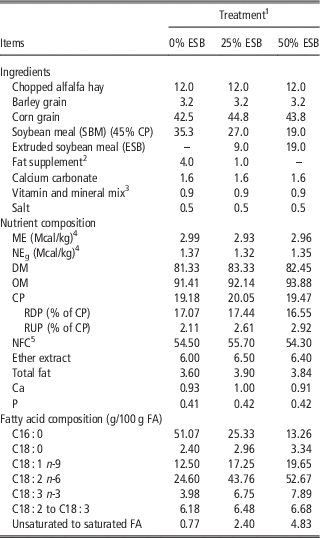
Animals received the experimental diets, including: (1) 0% ESB (Control): 35.3% SBM with no ESM, (2) 25% ESB: 27.0% SBM+9.0% ESB and (3) 50% ESB: 19.0% SBM+19.0% ESB from day 4 until day 70 of age. All the diets were isoenergetic and isonitrogenous (Table 1) and formulated according to the Cornell Net Carbohydrate and Protein System version 5.1. The fat supplement was included in the 0% and 25% ESB diets to formulate diets for energy. The diets were fed ad libitum to permit at least 10% refusals (i.e. the portion of the starter not consumed over a 24-h period). Calves had free access to fresh water throughout the study. Calves with mild scours were treated according to the standard operating procedure of the farm.
Ingredients, chemical composition (% of dry matter (DM) unless otherwise noted) and fatty acid composition of the basal diet

ME=metabolizable energy; NE=net energy; OM=organic matter; RDP=rumen degradable protein; RUP=rumen undegradable protein; FA=fatty acid; NFC=non-fibrous carbohydrate.
1 Calves were fed one of three diets: (1) 0% (diet DM) ESB plus 35.3 % SBM (0% ESB); (2) 9.0% ESB plus 27.0 % SBM (25% ESB); (3) 19.0% ESB plus 19.0% SBM (50% ESB).
2 Palmac® 80-16 (IOI Oleochemical Industries Sdn Bhd, Prai, Malaysia). Product contained: 2% C12 : 0, 5% C14 : 0, 80% C16 : 0, 2% C18 : 0, 9% C18 : 1 and 3% C18 : 2.
3 Contained per kilogram of supplement: 250 000 IU of vitamin A, 50 000 IU of vitamin D, 1500 IU of vitamin E, 2.25 g of Mn, 120 g of Ca, 7.7 g of Zn, 20 g of P, 20.5 g of Mg, 186 g of Na, 1.25 g of Fe, 3 g of S, 14 mg of Co, 1.25 g of Cu, 56 mg of I and 10 mg of Se.
4 Calculated from NRC (2001).
5 NFC=(100−(NDF%−NDIN×6.25)−CP%−EE%−ash%) (NRC, 2001).
Sampling and laboratory analyses
The individual starter feed intake was measured daily by weighing the amounts of feed offered and refused daily throughout the study. Animals approximately ate all offered milk and no milk refusals were recorded across dietary treatments. Milk nutrient composition was used to calculate nutrient intake. Individual BW was recorded weekly using an electronic balance. Pre-weaning, post-weaning and overall average daily gain (ADG) and FE (kg of BW gain/kg of total dry matter (DM) intake (DMI) (milk DM+starter feed DM)) were also calculated. Feed samples were collected every week throughout the study and stored at −20°C until chemical analysis. Body measurements of the calves including body length (distance between the points of shoulder and rump), wither height (distance from base of the front feet to the withers), body barrel (circumference of the belly before feeding), heart girth (circumference of the chest), hip height (distance from base of the rear feet to hook bones) and hip width (distance between the points of hook bones) were measured at weaning (day 56) and at the end of the study (day 70) as described earlier (Nemati et al., Reference Nemati, Amanlou, Khorvash, Mirzaei, Moshiri and Ghaffari2016). Feces were scored once daily (before the morning feeding) for physical shape and consistency according to the procedure described in Heinrichs et al. (Reference Heinrichs, Jones, VanRoekel and Fowler2003): 1=normal; 2=soft to loose; 3=loose to watery; 4=watery, mucous, slightly bloody; and 5=watery, mucous and bloody. Calves with mild scours were treated according to the standard operating procedure of the farm. Rectal temperature was also measured on weekly basis at 1400 using a clinical veterinary thermometer (Yasa Teb Co., Isfahan, Iran) inserted in the rectum.
Feed samples were collected weekly throughout the study and stored at −20°C until chemical analyses. Rumen fluid was sampled on days 35, 56 and 70 of age by a stomach tube fitted to a vacuum pump at 3 h after morning feeding, and rumen pH was measured immediately using a hand-held pH meter (HI 8314 membrane pH meter; Hanna Instruments, Villafranca, Italy). Rumen fluid samples were squeezed through four layers of cheesecloth and 8 ml of the rumen fluid was acidified with 2 ml of 25% metaphosphoric acid and stored at –20°C until analysis for volatile fatty acids (VFA) by gas chromatography (GC), as described by Kargar et al. (Reference Kargar, Ghorbani, Alikhani, Khorvash, Rashidi and Schingoethe2012).
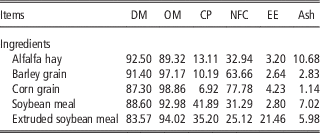
Subsamples of feeds and refusals were mixed thoroughly and were dried at 60°C for 48 h and then ground to pass a 1-mm screen in a Wiley mill (Ogawa Seiki Co., Ltd, Tokyo, Japan) before chemical analyses for DM (Association of Official Analytical Chemists (AOAC), 1990; method 934.01), CP (AOAC, 1990; method 988.05), ether-extract (EE) (AOAC, 1990; method 920.39), ash (AOAC, 1990; method 942.05), calcium (AOAC, 1990; method 985.35) and phosphorus (AOAC, 1990; method 986.24) contents. The non-fibrous carbohydrate (NFC) component was calculated as 100−(CP+NDF+EE+Ash) according to NRC (2001) (Table 2). The amount of rumen undegradable protein and rumen degradable protein of feed ingredients was measured based on the laboratory method described by Sniffen et al. (Reference Sniffen, O’Connor, Van-Soest, Fox and Russell1992) and Licitra et al. (Reference Licitra, Hernandez and Van Soest1996). Furthermore, the percentage of individual fatty acid (FA) of diets were measured by GC following isolation and methyl ester formation prepared by a one-step extraction transesterification procedure using toluene (Sukhija and Palmquist, Reference Sukhija and Palmquist1988). To calculate FA intake, the amount of starter consumed multiplied by the corresponded total FA content and then results multiplied by the respective FA composition. Milk FA content was used while calculating total FA intake.
Chemical composition (% of DM) of the experimental feed ingredients

DM=dry matter; OM=organic matter; NFC=non-fiber carbohydrate; EE=ether-extract.
Samples of milk fed to dairy calves were analyzed for fat, CP, lactose and total solids content by Milkoscan 134 BN (Foss Electric A/S, Hillerød, Denmark). Also, milk FA profile was determined using procedure as described earlier by Kargar et al. (Reference Kargar, Ghorbani, Khorvash, Kahyani, Karimi-Dehkordi, Safahani-Langarudi, Fievez and Schingoethe2017). To calculate metabolizable energy (ME) intake (Mcal/day), the amount of starter consumed multiplied by the corresponded dietary treatment ME (Mcal/kg of DM) and milk energy was used while computing dietary energy intake. Rumen fluid samples were analyzed for VFA by GC (model CP-9002; Chrompack, Middelburg, The Netherlands) with a 50 m (0.32 mm ID) silica-fused column (CP-Wax Chrompack Capillary Column; Varian, Palo Alto, CA, USA). Helium was used as the carrier gas and oven initial and final temperatures were 55°C and 195°C, respectively. Crotonic acid (1 : 7, v/v) was used as the internal standard. The detector and injector temperatures were set at 250°C.
Statistical analyses
Intake of starter feed, ADG, FE and rectal temperature data were analyzed separately for the pre-weaning (days 1 to 56), post-weaning (days 56 to 70) and overall periods (days 1 to 70) using a PROC MIXED with repeated measures (SAS, version 9.4; SAS Institute Inc., Cary, NC, USA) including calf as a random effect in the model and treatment, time (weeks), and the interaction of treatment and time as the fixed effects. The effect of dietary treatments on the categorical responses related to fecal score was analyzed by PROC GLIMMIX with repeated measures. The lowest Bayesian information criterion (fit statistic) level was used to select the covariance structure, and the autoregression structure (type 1) was accordingly modeled. Before analyses, all data were screened for normality using the UNIVARIATE procedure of SAS, and any parameter that was not normally distributed was logarithmically transformed. Ruminal fermentation data on days 35, 56 and 70 were analyzed separately using the one-way ANOVA procedure of SAS with dietary treatments used as the main factor. Initial BW was used as a covariate for weaning weight, final weight and skeletal growth. When differences were detected among dietary treatments, means separation was conducted using a Tukey adjustment for the probability. Significance was declared at P⩽0.05 and trends were considered when 0.05<P⩽0.10.
Results
Nutrient intake and performance
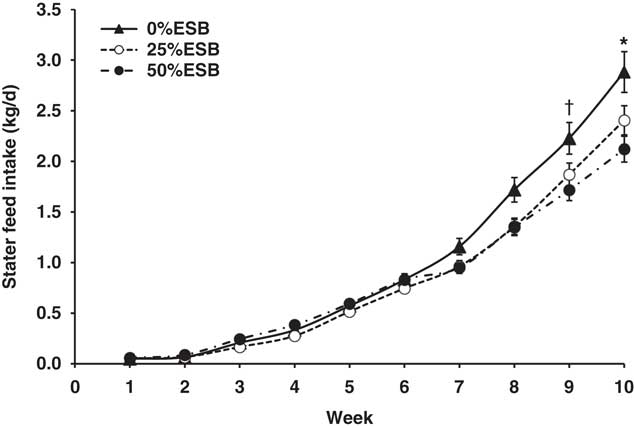
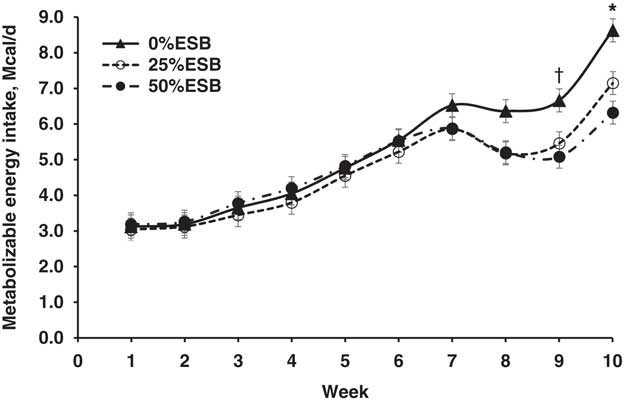
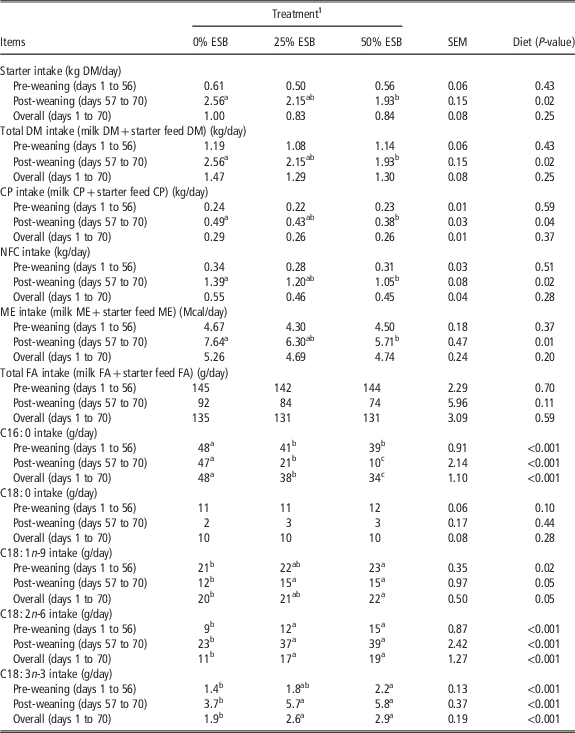
The data for nutrients intake are presented in Table 3. Intake of starter feed (Figure 1), total DM, ME (Figure 2), CP and NFC were not affected by treatments during the pre-weaning and overall periods, but 50% ESB decreased intake of starter feed (P<0.01), ME (P=0.01), CP (P=0.01) and NFC (P<0.01) during the post-weaning period when compared with 0% ESB. Substituting SBM with ESB decreased intake of C16 : 0 (P<0.001) and increased intakes of n-9 C18 : 1 (P<0.01), n-6 C18 : 2 (P<0.01) and n-3 C18 : 3 (P<0.01) during the pre-weaning, post-weaning and overall periods. Both starter feed intake and ME intake for 50% ESB were less than 0% ESB in week 9 (P=0.10) and 10 (P<0.001) but it was not different compared with 25% ESB (diet×week: P⩽0.05; Figures 1 and 2).
Weekly starter feed intake (±SE; kg/day) of dairy calves offered diets containing 0% extruded soybean (ESB) plus 35.3% soybean meal (SBM) (0% ESB), 9.0% ESB plus 27.0% ESB (25% ESB) or 19.0% ESB plus 19.0% SBM (50% ESB) over 10 weeks of age. The SEM=0.08. Effects in model: diet: P=0.25; week: P<0.001; diet×week: P=0.04. For each time point: *significant difference at P⩽0.05 and †tendency to significant difference at 0.05<P⩽0.10.

Weekly metabolizable energy intake (±SE; Mcal/day) of dairy calves offered diets containing 0% extruded soybean (ESB) plus 35.3% soybean meal (SBM) (0% ESB), 9.0% ESB plus 27.0% ESB (25% ESB) or 19.0% ESB plus 19.0% SBM (50% ESB). The SEM=0.08. Effects in model: diet: P=0.20; week: P<0.01; diet×week: P=0.03. For each time point: *Significant difference at P⩽0.05 and †Tendency to significant difference at 0.05<P⩽0.10.

Intake of starter feed, CP, non-fiber carbohydrate (NFC), metabolizable energy (ME) and fatty acids (FAs) as influenced by substitution of soybean meal (SBM) with extruded soybean (ESB) in dairy calves

a,b,cMeans within a row with different superscripts letters are significantly different (P⩽0.05).
1 Calves were fed one of three diets: (1) 0% (diet DM) ESB plus 35.3 % SBM (0% ESB); (2) 9.0% ESB plus 27.0 % SBM (25% ESB); (3) 19.0% ESB plus 19.0% SBM (50% ESB).
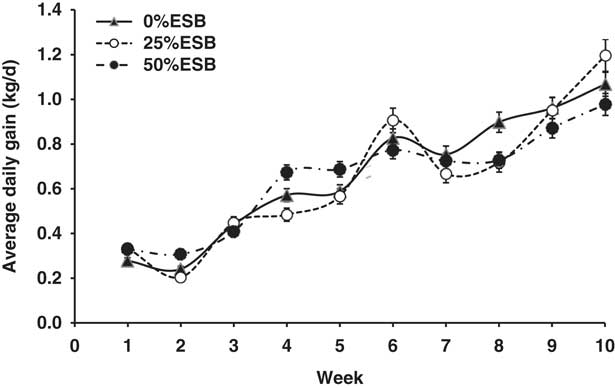
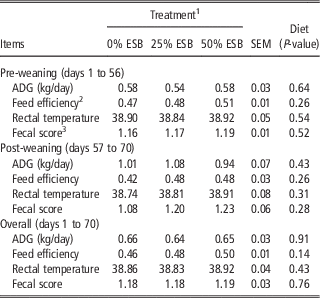
The data for ADG, FE, rectal temperature, and fecal score are given in Table 4. Average daily gain (Figure 3), FE, rectal temperature and fecal score were not affected by diets during the pre-weaning, post-weaning and overall periods. During the overall period, ADG, FE and rectal temperature were not different among diets.
Weekly average daily gain (±SEM; kg/day) of dairy calves offered diets containing 0% extruded soybean (ESB) plus 35.3% soybean meal (SBM) (0% ESB), 9.0% ESB plus 27.0% ESB (25% ESB) or 19.0% ESB plus 19.0% SBM (50% ESB). The SEM=0.03. Effects in model: diet: P=0.91; week: P<0.001; diet×week: P=0.48.

Average daily gain (ADG), feed efficiency, rectal temperature and fecal score as influenced by substitution of soybean meal (SBM) with extruded soybean (ESB) in dairy calves

DM=dry matter.
1 Calves were fed one of three diets: (1) 0% (diet DM) ESB plus 35.3 % SBM (0% ESB); (2) 9.0% ESB plus 27.0 % SBM (25% ESB); (3) 19.0% ESB plus 19.0% SBM (50% ESB).
2 Feed efficiency was calculated by dividing ADG by average total daily DM intake (milk DM+starter feed DM).
3 Fecal scores were recorded as: 1=normal; 2=soft to loose; 3=loose to watery; 4=watery, mucous, slightly bloody; and 5=watery, mucous and bloody (Heinrichs et al., Reference Heinrichs, Jones, VanRoekel and Fowler2003).
Rumen fermentation and structural growth
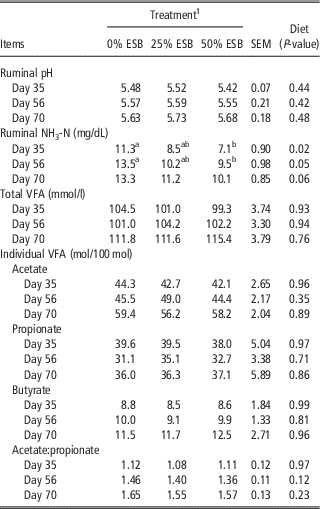
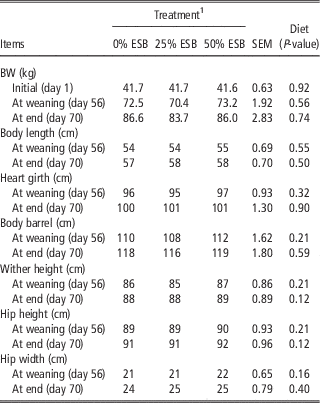
The data for rumen fermentation parameters are presented in Table 5. Ruminal pH was not affected by diets on days 35, 56 and 70 of study. Compared with control, the rumen concentration of NH3-N decreased for 50% ESB on days 35 and 56 of age and tended (P=0.10) to decrease on day 70 of the study. Total VFA concentration and the molar proportions of acetate, propionate, butyrate and also acetate to proportionate ratio in the rumen were not different among diets on days 35, 56 and 70 of the study. No differences among treatments were detected for weaning and final BW, and structural growth parameters including body length, heart girth, body barrel, withers height, hip width and hip height at weaning, and at the end of the study (Table 6).
Rumen fermentation characteristics as influenced by substitution of soybean meal (SBM) with extruded soybean (ESB) in dairy calves.

a,bMeans within a row with different superscripts letters are significantly different (P⩽0.05).
1 Calves were fed one of three diets: (1) 0% (diet dry matter) ESB plus 35.3 % SBM (0% ESB); (2) 9.0% ESB plus 27.0 % SBM (25% ESB); (3) 19.0% ESB plus 19.0% SBM (50% ESB).
Body weight and structural growth as influenced by substitution of soybean meal (SBM) with extruded soybean (ESB) in dairy calves

1 Calves were fed one of three diets: (1) 0% (diet dry matter) ESB plus 35.3 % SBM (0% ESB); (2) 9.0% ESB plus 27.0 % SBM (25% ESB); (3) 19.0% ESB plus 19.0% SBM (50% ESB).
Discussion
The objective of the current study was to examine the effect of different concentrations of ESB on nutrient intake, rumen fermentation and growth performance of Holstein dairy calves both pre- and post-weaning. In the present study, the used fat supplement was highly saturated (inert in the rumen) and contained the higher concentration of C16 : 0 (80 g/100 g FA) which led to an increase in concentration of C16 : 0 in fat supplemented diets. This fat supplement was used to avoid any potential interference with rumen fermentation and feed intake (Allen, Reference Allen2000). Increasing the proportion of ESB in the diet decreased post-weaning intakes of starter feed and ME which is consistent with the results of Daniels et al. (Reference Daniels, Cantrell and Hornsby1973) who found a decrease in feed intake of dairy heifers when expanded-extruded SB was fed at 17% of dietary DM. However, Maiga et al. (Reference Maiga, Schingoethe, Ludens, Tucker and Casper1994) observed an increase in starter feed intake of calves fed extruded SBM compared with normal SBM over 12 weeks of the trial period. The decreased starter intake with increasing ESB concentrations during the post-weaning period might be explained by increased concentration of unsaturated FA especially n-6 C18 : 2, which has hypophagic effects (Hill et al., Reference Hill, Bateman, Aldrich and Schlotterbeck2011). They observed reduced starter feed intake in calves fed diets with a blend of fats high in n-6 C18 : 2 (Hill et al., Reference Hill, Bateman, Aldrich and Schlotterbeck2011). In the current study, as ESB in the diet increased, the levels of unsaturated (mostly n-6 C18 : 2) to saturated (mostly C16 : 0) FA which mainly come from highly saturated fat supplement increased from 0.77 to 4.83. Extruded SB may also decrease starter feed intake by increasing the extent of FA release into the rumen. The extrusion process ruptures the fat micelles within the SB, which can allow a more rapid release of oil into the rumen (Reddy et al., Reference Reddy, Morrill and Bates1993). Polyunsaturated FAs can cause alterations in the rumen environment and modifications in the microbial population via inhibition of respiration and lysis of bacterial cells that result in decreased fiber digestibility and a decrease in DMI (Sutton et al., Reference Sutton, Knight, McAllan and Smith1983). However, there were no differences in rumen fermentation characteristics among diets in the current experiment. As dietary FA unsaturation increased with increasing ESB, we speculate that ESB may stimulate gut satiety signals such as cholecystokinin and glucagon-like-peptide-1 by enhancing the levels of unsaturated FA reaching the duodenum (Choi and Palmquist, Reference Choi and Palmquist1996; Harvatine and Allen, Reference Harvatine and Allen2005; Litherland et al., Reference Litherland, Thire, Beaulieu, Reynolds, Benson and Drackley2005). Allen (Reference Allen2000) observed in a meta-analysis that oil supplements differing in FA source have different hypophagic effects. Unsaturated FA supplement linearly decreased DMI with increasing dietary concentration whereas saturated FA had no effect on DMI (Allen, Reference Allen2000). The concept that absorbed FA of varying saturation have different hypophagic effects was confirmed through an abomasal infusion study, which showed that decreasing FA saturation decreased DMI (Drackley et al., Reference Drackley, Richard, Beitz and Young1992) and unsaturated FA have also been shown to increase postprandial plasma concentrations of the gut peptides including cholecystokinin (Choi and Palmquist, Reference Choi and Palmquist1996; Harvatine and Allen, Reference Harvatine and Allen2005) and glucagon-like-peptide-1 (Litherland et al., Reference Litherland, Thire, Beaulieu, Reynolds, Benson and Drackley2005) and may stimulate satiety through hepatic oxidation and or decrease gut motility (Allen, Reference Allen2000). The mechanism by which satiety is stimulated is not properly known and further targeted studies are warranted to confirm this explanation.
In the present study, despite the decrease in the post-weaning starter feed intake with increasing the ESB concentration of the diet, similar ADG was seen among treatments. As observed by Nemati et al. (Reference Nemati, Amanlou, Khorvash, Mirzaei, Moshiri and Ghaffari2016), there was the slightly large variability in gain from week to week across treatments (Figure 3) which may related to changes in DMI, number of ill calves within treatment and duration of illness (Place et al., Reference Place, Heinrich and Erb1998; Nemati et al., Reference Nemati, Amanlou, Khorvash, Mirzaei, Moshiri and Ghaffari2016). Similarly, previous studies reported decreased intake when SBM replaced with roasted SB (Kuehn et al., Reference Kuehn, Otterby, Linn, Olson, Chester-Jones, Marx and Barmore1994) or extruded cottonseed-SB (McCoy et al., Reference McCoy, Ruppert and Hutjens2003). However, in contrast to our data, the latter mentioned studies reported a decrease in ADG in animals received the roasted SB or extruded cottonseed-SB. Others have shown less starter intake and ADG but improved FE in calves fed xylose-treated SBM compared with calves fed with SBM (Kazemi-Bonchenari et al., Reference Kazemi-Bonchenari, Alizadeh, Tahriri, Jalali, Karkoodi and Sadri2015).
It has been suggested that heat processing increases post-ruminal energy availability (Lesmeister and Heinrichs, Reference Lesmeister and Heinrichs2004). Moreover, the digestibility of fats is highly dependent on the ratio of unsaturated to saturated FAs with ratios above 1.5 resulting in relatively high digestibilities of 85% to 92% (Palmquist, Reference Palmquist1988). In the current experiment, the unsaturated to saturated ratios of FAs were 0.77, 2.40 and 4.83 for calves fed 0% ESB, 25% ESB and 50% ESB diets, respectively, which could be indicative of a greater digestibility for ESB supplemented starter diets than SBM supplemented diets. In contrast to our data, Maiga et al. (Reference Maiga, Schingoethe, Ludens, Tucker and Casper1994) reported a tendency for increased ADG for calves received extruded SBM compared with normal SBM over 12-week period.
Substituting ESB for SBM did not affect ruminal pH in the current study. The rumen pH values were within the normal range of 5.4 to 6.2, reflecting no adverse effect on ruminal fermentation. These data are in agreement with results of others (Mohamed et al., Reference Mohamed, Satter, Grummer and Ehle1988) showing that heat-processed SB has no effect on ruminal pH in dairy cows. Compared with control, the rumen concentration of NH3-N decreased for 50% ESB on days 35 and 56 of age but not when compared with 25% ESB. This might be due to a higher proportion of rumen undegradable protein supplied by ESB. Extrusion of seeds rich in protein has been shown to reduce nitrogen solubility in the rumen (Akbarian et al., Reference Akbarian, Khorvash, Ghorbani, Ghasemi, Dehghan-Banadaky, Shawrang and Hosseini-Ghaffari2014), which may result in a reduction of ruminal NH3-N concentration as reported by Zerbini et al. (Reference Zerbini, Polan and Herbein1988). Similarly, other studies have shown a decrease in ruminal NH3-N concentrations when feeding heat-processed SB to Holstein dairy cows (Giallongo et al., Reference Giallongo, Oh, Frederick, Isenberg, Kniffen, Fabin and Hristov2015).
There is limited data on the effect of extrusion of oil seeds on rumen fermentation in dairy calves. In the current study, increasing the proportion of ESB in the diet of dairy calves did not appear to change the rumen fermentation and VFA profile. This was in line with results of others who showed that heat-processed SB had no effect on rumen VFA profiles in dairy cows (Giallongo et al., Reference Giallongo, Oh, Frederick, Isenberg, Kniffen, Fabin and Hristov2015). Overall, the lack of diet effect on ruminal pH and VFA concentrations lends credence to us that cellulolytic bacterial populations were not affected by feeding ESB to calves. Replacing SBM with ESB also did not affect structural/muscular growth in the current study, which may be reflective of no differences in energy intake of animals (Bowen Yoho et al., Reference Bowen Yoho, Swank, Eastridge, O’Diam and Daniels2013). Similarly, in a previous work of Maiga et al. (Reference Maiga, Schingoethe, Ludens, Tucker and Casper1994), heart girth and withers height of calves were not different between calves fed extruded SBM or SBM.
Conclusions
Substituting SBM with ESB in the diet of dairy calves appears to have some potential in improving the nitrogen utilization efficiency likely through increasing the availability of protein and energy for post-ruminal absorption. Substitution of SBM with ESB may reduce post-weaning starter intake with no negative outcomes on growth performance and rumen fermentation. However, more studies with higher number of animals per groups are required to further delineate the importance of SB extrusion processing on the performance of dairy calves.
Acknowledgments
This study was financially supported by Isfahan University of Technology (Isfahan, Iran).