Introduction
The family Balistidae (triggerfish) consists of 12 genera and about 42 species that are distributed in tropical and temperate waters around the world (Cerim et al., Reference Cerim, Yilmaz and Yapici2021). These fishes largely inhabit coral reef areas, with reefs being used for shelter and protection during the day and as a feeding ground at night (Jaroensutasinee et al., Reference Jaroensutasinee, Somchuea and Jaroensutasinee2021). They are often brightly coloured and known for their rigid dorsal spines that form a locking mechanism (Randall, Reference Randall2007). Most balistids are known from the Indian and Pacific Oceans, with certain species restricted to particular regions (Smith & Heemstra, Reference Smith and Heemstra2012). In India, these fishes are abundant in the Gulf of Kutch, Maharashtra coast (Malwan), Kerala coast (Quilon bank), Palk Bay and Andaman & Nicobar and Lakshadweep Islands (Balasubramanian et al., Reference Balasubramanian, Rajapackiam, Ameer Hamsa and Mohamad Kasim1995; Murty, Reference Murty2002). The red-toothed triggerfish Odonus niger (Ruppell, 1836) is a demersal fish popularly referred as ‘Kappuhandi’, ‘Klaati’ or ‘Kargilmeenu’ in Karnataka. It is typically a hardy species, found schooling in large groups along coral reef channels or slopes feeding voraciously on zooplankton brought in by strong currents.
Odonus niger did not form a component of a regular fishery in India until 2017. However, in 2018, the reported landings of O. niger were 72,140 tonnes, of which 41,870 tonnes was recorded from the Karnataka coast and the rest from Maharashtra, Goa, Kerala and Tamil Nadu (CMFRI, 2019). In 2019, the species was reported from an increasing area and depth range, and became a major resource at the national level with reported landings increasing to 273,705 tonnes, of which 162,398 tonnes was from Karnataka and the rest from Gujarat, Maharashtra, Goa, Kerala and Tamil Nadu (CMFRI, 2020). The harvested catch is used mainly for fishmeal and manure preparation (Abdussamad et al., Reference Abdussamad, Joshi, Balasubramanian, Zacharia and Jayabalan2009; Sarika et al., Reference Sarika, Pynadath, Sreejith and Ninan2020), and known to fetch a very low price (US$ 0.15–0.25 kg−1) (Mahesh et al., Reference Mahesh, Koya, Ansar and Babu2019). Of late, the Indian surimi processing industries procure fresh O. niger for the preparation of surimi, which is exported for the production of analogous products. Due to the increasing demand from fishmeal and surimi plants, this species is increasingly targeted by multi-day trawlers.
Information on food and feeding habits, and reproductive biology of a species is crucial for assessing the role of marine fishes in the ecosystems and for the studies on biology and population dynamics (Murua & Saborido-Rey, Reference Murua and Saborido-Rey2003; Thangavelu et al., Reference Thangavelu, Anbarasu, Zala, Koya, Sreenath, Mojjada and Shiju2012). Additionally, the abundance and distribution of fish species may be influenced by prey availability in the region (Venugopal et al., Reference Venugopal, Pillai and Prakasan2014). Reports on the feeding biology of triggerfish include Balistes vetula from the Caribbean (Reinthal et al., Reference Reinthal, Kensley and Lewis1984) and Gulf of Salamanca (Schiller & Garcia, Reference Schiller and Garcia2000) and Balistes capriscus from the Atlantic water of Florida (Vose & Nelson, Reference Vose and Nelson1994). The studies on reproductive biology include Sufflamen fraenatus from Tuticorin coast (Sahayak, Reference Sahayak2005), B. vetula from US Caribbean waters (Rivera et al., Reference Rivera, Pena Alvarado, Correa, Nemeth, Appeldoorn and Shervette2019) and B. capriscus from the south-eastern US Atlantic coast (Kelly-Stormer et al., Reference Kelly-Stormer, Shervette, Kolmos, Wyanski, Smart, Mcdonough and Reichert2017). In light of the sudden emergence and regular landings of sizeable quantities of red-toothed triggerfish since 2017 along the Karnataka coast, it is vital to study the biological characteristics of the species which have not been reported previously. Hence the present study was envisaged to provide information for the first time on the diet composition and reproductive biology of O. niger from the south-eastern Arabian Sea.
Materials and methods
Sample collection
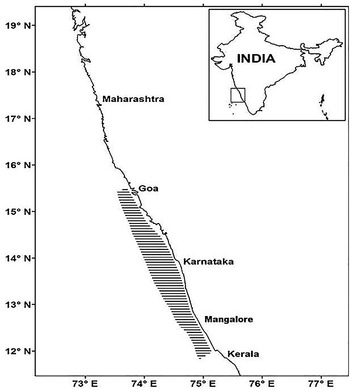
Odonus niger specimens were collected on a weekly basis from two major fishing harbours, Mangalore (12.853°N 74.833°E) and Malpe (13.347°N 74.701°E) of the south-eastern Arabian Sea, where they were landed by commercial trawlers and purse seiners operating along Karnataka coast (Figure 1). A total of 449 specimens were collected between August 2019 and March 2020 and from April to May 2021. Samples could not be collected in April and May 2020, due to limited fishing operations during the COVID-19 lockdown. Hence monthly data for April and May could only be collected in 2021. Fresh specimens were washed with tap water and cleaned to remove debris before further analysis. Using a graduated measuring scale and digital electronic weighing balance, total length (0.1 mm) and total weight (0.01 g) were recorded. Specimens were then cut open from the ventral side of the belly region to expose the internal organs in order to determine sex, maturity stage, and then the gut, gonads and liver were removed for further detailed analysis.
Geographic operational areas of trawl and purse seine fleets of Mangalore and Malpe fishing harbours, Karnataka.

Food and feeding
The stomach of each specimen was dissected and the stomach fullness recorded to evaluate the feeding intensity. The stomach fullness was visually classified into six categories (full, three-quarters, half, quarter full, trace and empty) based on the presence of food (Rajesh et al., Reference Rajesh, Rohit, Mini, Sathyavathi and Hakeem2019). Further, the total length and wet weight of the gut was measured to the nearest 0.1 mm and 0.01 g respectively. Feeding periodicity was explored by analysing the stomach fullness index (SFI) and vacuity index (VI) following the methods given by Chiou et al. (Reference Chiou, Chen, Wang and Chen2006) and Valinassab et al. (Reference Valinassab, Jalali, Hafezieh and Zarshenas2011) respectively and using the given equations:
 $${\rm SFI} = \displaystyle{{{\rm Weight}\,{\rm of}\,{\rm stomach}\,{\rm contents}\,( {\rm g}) } \over {{\rm Weight}\,{\rm of}\,{\rm fish}\,( {\rm g}) \ndash {\rm Weight}\,{\rm of}\,{\rm stomach}\,{\rm contents}\,( {\rm g}) }} \times 100$$
 $${\rm VI} = \displaystyle{{{\rm No}.\,{\rm of}\,{\rm empty}\,{\rm stomachs}\;} \over {{\rm Total}\,{\rm stomachs}\,{\rm examined}\;}} \times 100$$
Based on the range of VI index values, the species was further categorized as voracious (0–20%), relatively voracious (20–40%), moderately voracious (40–60%), slightly voracious (60–80%) and non-voracious (80–100%) feeder (Euzen, Reference Euzen1987; Alghada et al., Reference Alghada, Keivany and Paykan-Heyrati2020). Relative gut length (RGL) was estimated as a ratio of gut length to the body length (German & Horn, Reference German and Horn2006). The gastrosomatic index (GaSI) was calculated using the equation given by Desai (Reference Desai1970):
 $${\rm GaSI} = \displaystyle{{{\rm Weight}\,{\rm of}\,{\rm gut}\,( {\rm g}) \;} \over {{\rm Weight}\,{\rm of}\,{\rm fish}\,( {\rm g}) \;}} \times 100$$
The stomach was cut open and contents were weighed and transferred into a Petri dish, observed under a compound microscope and the prey items were sorted by taxa, enumerated and identified to the lowest possible taxon. If the food items were found in the advanced state of digestion, they were considered as partially digested matter, while sand and mud were categorized as detritus. The wet weight of the stomach content was measured using digital electronic balance to the nearest 0.01 g. The total volume (ml) of each stomach contents was measured using a graduated cylinder and the displacement method. The points (volumetric) method was used for the evaluation of various prey items (Pillay, Reference Pillay1952). The relative significance of different prey items in the diet was calculated using the Index of Preponderance (IP) as proposed by Marshall & Elliott (Reference Marshall and Elliott1997):
 $${\rm IP} = \displaystyle{{V_iO_i} \over {\sum V_iO_i}} \times 100$$
where, Vi is the percentage of the particular prey item in total volume of prey items and Oi is the percentage frequency of occurrence of each prey item among total prey items. Feeding strategy and prey importance from stomach content data were determined using Costello's graphical representation method (Costello, Reference Costello1990). The method consists of a scatter plot of percentage volume values in the y-axis and percentage occurrence in the x-axis. Points located near 1% of occurrence and 1% of volume showed that the predator consumed different prey in low quantity. On the other hand, points located near 100% of occurrence and 100% volume show that the predator is a specialist for a given prey. The Costello method uses information on the abundance based on volumetric values and occurrence of the prey items in the gut of fish species (Eya et al., Reference Eya, Lacuna and Espra2011).
Reproductive biology
The sex ratio of males to females was tested using the Pearson's χ2 goodness-of-fit at 5% level of significance (Zar, Reference Zar1999). The gonads were macroscopically examined based on colour, size, weight and presence of blood vessels in the testes and ovary. The ovaries were preserved in 10% buffered formalin for fecundity estimation and histological studies. Four maturity stages (immature, maturing, mature and ripe) were assigned to females and males (Prabhu, Reference Prabhu1956). The fresh ovaries were macroscopically examined for their external characteristics and microscopic examinations were made using preserved ovaries for the estimation of fecundity and oocyte diameter. Characteristics of ovarian tissue assigned to each macroscopic stage were compared and validated qualitatively using histologically prepared samples of female gonads. In males, maturity stages were classified based on macroscopic examination only, as the maturity stages were more distinct at the macroscopic level. The Gonadosomatic Index (GSI), which is the ratio between the gonad weight to the total weight of the fish, was calculated separately for males and females. The occurrence of spawning in the annual reproductive cycle was estimated based on peaks in the GSI and the frequency of different maturity phases found during different months.
The length at 50% maturity (L50) was determined using the logistic equation summarized by King (Reference King2007). The proportion of mature fish in each 10 mm length class was fitted to the following equation:
 $$P = \displaystyle{1 \over {( 1 + {\rm e}^{\ndash r( T_L\ndash L_m) }) }}$$
where, P is the proportion of mature individuals in each length group, r is the slope of the logistic curve, TL is the total length of fish (mm) and Lm is the total length which corresponds to a proportion of 0.5 in reproductive condition. Mature specimens were those in mature and ripe stages for both the sexes.
Fecundity was calculated from formalin preserved ovaries following the gravimetric method supported with histological slides of various ovarian stages (Kucheryavyi et al., Reference Kucheryavyi, Savvaitova, Pavlov, Gruzdeva, Kuzishchin and Stanford2007):
 $${\rm Fecundity} = \displaystyle{{{\rm Total}\,{\rm weight}\,{\rm of}\,{\rm ovary}\,( {\rm g} ) } \over {{\rm Weight}\,{\rm of}\,{\rm sub}\,{\rm sample}\,( {\rm g} ) }} \times {\rm No}.\,{\rm of}\,{\rm ova}\,{\rm in}\,{\rm sub}\,{\rm sample}$$
The relationship between fecundity and total length and total weight were derived from the least square method F = aXb where, F = fecundity, X = variable (total length or total weight), a = constant and b = regression coefficient. The exponential relationship was transformed into a straight-line logarithmic form based on the following equation: Log F = log a + b × log X. Oocyte diameters were measured using a compound electron microscope fitted with an ocular micrometer. The monthly variation in hepatosomatic index (HSI), which implies energy storage for reproduction, was calculated using the formula (Sulistyo et al., Reference Sulistyo, Fontaine, Rinchard, Gardeur, Migaud, Capdeville and Kestemont2000):
 $${\rm HSI} = \displaystyle{{{\rm Weight}\,{\rm of}\,{\rm liver}\,( {\rm g} ) } \over {{\rm Weight}\,{\rm of}\,{\rm fish}\,( {\rm g} ) }} \times 100$$
Statistical analysis
The one-way analysis of variance (ANOVA) followed by Duncan's post-hoc test was performed to test the significant difference in the mean values of different biological indices (SFI, RGL, GaSI and HSI) between months and various length classes. The level of significance was set at P < 0.05. IBM-SPSS statistics version 21.0 software was used for all statistical analyses.
Results
Food and feeding
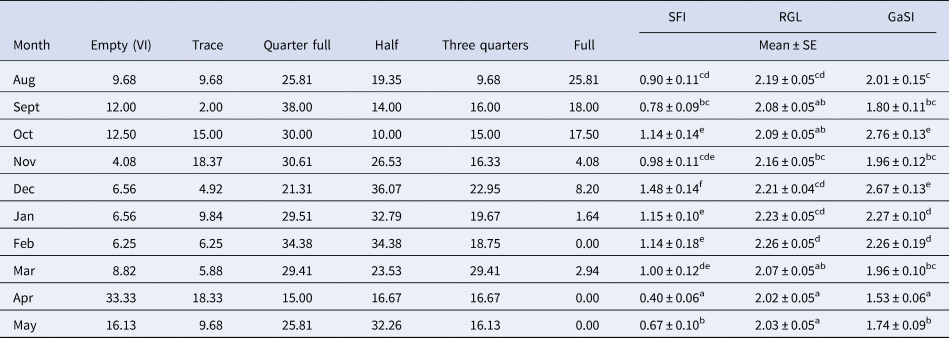
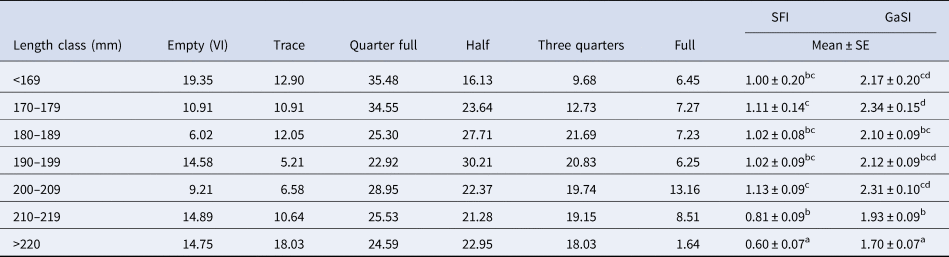
Of the 449 specimens (154–285 mm TL) of O. niger examined, only 54 (12.03%) stomachs were empty, and 395 (87.97%) contained food remains. The highest percentage of active feeding was observed during August, with 25.81% of fishes having full stomachs (Table 1). A high percentage of moderate feeding was noticed throughout the study, with the highest percentages observed in February (68.76%), January (62.30%) and May (58.07%), though it was lowest in April (31.67%). The maximum percentage of empty stomachs was found in April (33.33%) followed by October (12.50%) and September (12.00%). Higher feeding intensity was observed in the 180–189 mm (28.92%), 200–209 mm (32.90%) and 210–219 mm (27.66%) length classes, whilst lower feeding intensity was observed in the >220 mm (32.78%), <169 mm (32.25%) and 210–219 mm (25.53%) length classes (Table 2). The percentage of empty stomachs was low in all length classes, except for the <169 mm length class.
Monthly variations in the feeding intensity (%), vacuity index (VI), stomach fullness index (SFI), relative gut length (RGL) and gastrosomatic index (GaSI) of Odonus niger from the south-eastern Arabian Sea, India

Values in the same column for each attribute followed by different superscripts are significantly different (P < 0.05).
Feeding intensity (%), vacuity index (VI), stomach fullness index (SFI) and gastrosomatic index (GaSI) in various length classes of Odonus niger from the south-eastern Arabian Sea, India

Values in the same column for each attribute followed by different superscripts are significantly different (P < 0.05).
Stomach fullness index (SFI) and vacuity index (VI) values did not show any significant difference (P > 0.05) between males and females and thus data for both the sexes were pooled together for different months and length classes. Significantly (P < 0.05) higher and lower SFI values were recorded during December (1.48 ± 0.14; mean ± SE) and April (0.40 ± 0.06) respectively (Table 1). SFI in relation to various length classes showed significantly (P < 0.05) higher values in the 200–209 mm (1.13 ± 0.09) and 170–179 mm (1.11 ± 0.14) length classes, while significantly (P < 0.05) lower value was recorded in the >220 mm (0.60 ± 0.07) length class (Table 2). The mean VI for all specimens was estimated as 12.03%, indicating that the species is a voracious feeder. The VI was highest in April (33.33%) and lowest in November (4.08%; Table 1). Vacuity index in relation to various length classes showed higher values in smaller fishes (<169 mm: 19.35%) and was lowest in the 180–189 mm (6.02%) and 200–209 mm (9.21%) length classes (Table 2).
The comparison of the mean values of RGL and GaSI for males and females showed no significant (P > 0.05) variations between sexes. The monthly mean RGL values ranged from 2.02 ± 0.05 (April) to 2.26 ± 0.05 (February) indicating an omnivore feeding habit (Table 1). Significantly (P < 0.05) higher mean GaSI values were recorded during October (2.76 ± 0.13) and December (2.67 ± 0.13), while significantly lower (P < 0.05) value was recorded during April (1.53 ± 0.06). The mean GaSI values in relation to length showed significantly (P < 0.05) higher value (2.34 ± 0.15) in the 170–179 mm length class and lowest (1.70 ± 0.07) in the >220 mm length class (Table 2).
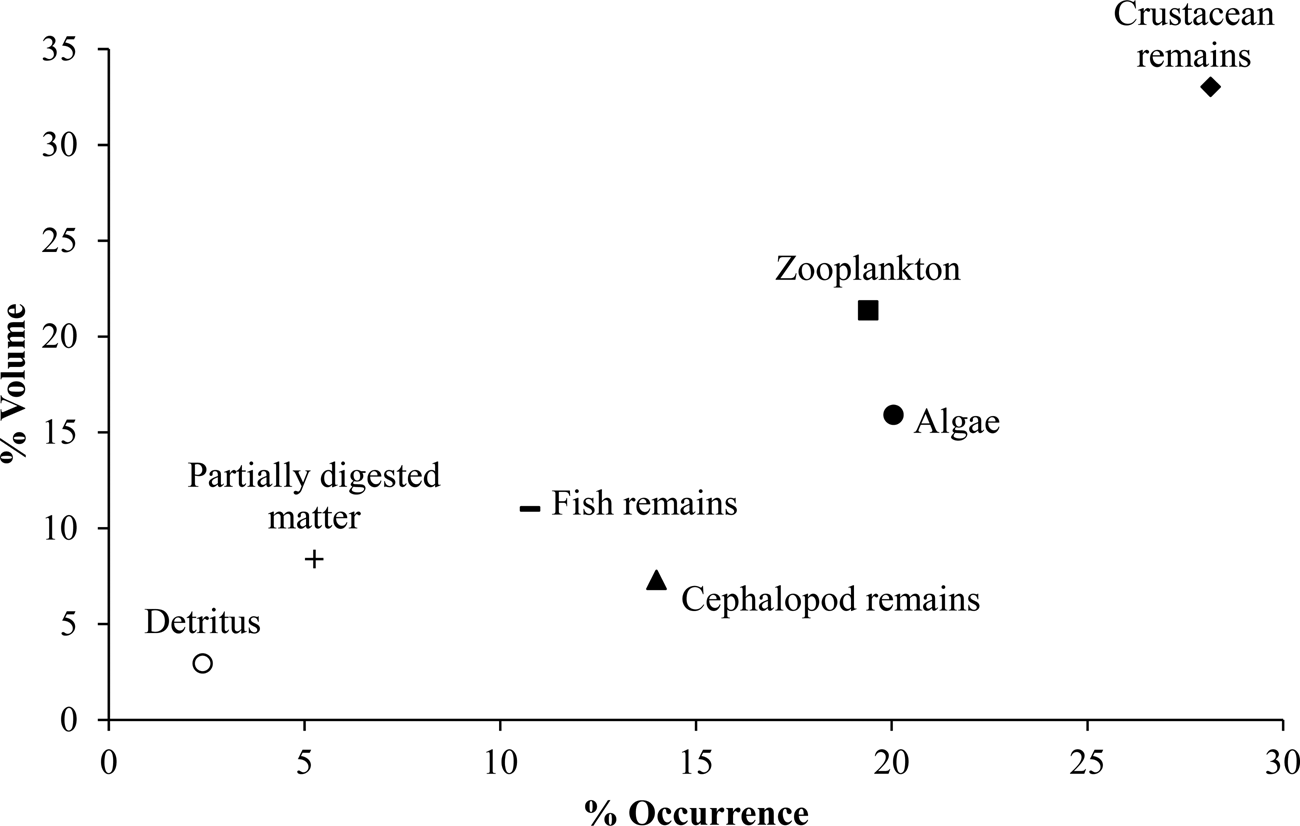
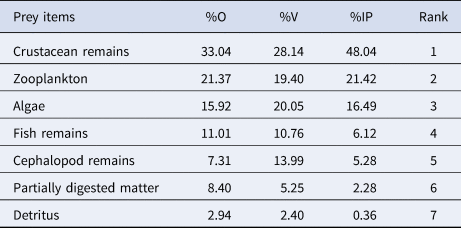
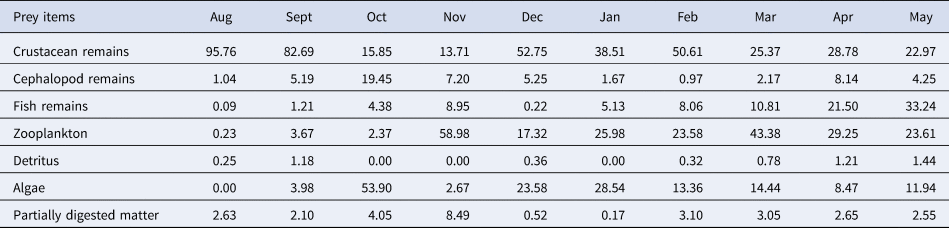
Based on the index of preponderance (%IP), the major prey items in the diet of O. niger were crustacean remains (48.04%) followed by zooplankton (21.42%), algae (16.49%), fish remains (6.12%), cephalopod remains (5.28%), partially digested matter (2.28%) and detritus (0.36%) (Table 3). The index of preponderance of different prey items did not show any significant difference between males and females and thus data for both the sexes were pooled together for different months. Crustacean remains included partially digested shrimps and fragments of exoskeleton, appendages, antennules and claws of shrimps, crabs and stomatopods. Fish remains included partially digested fish, scales, fins, skin, skeleton and muscle tissues. Cephalopod remains included tentacles, muscle tissue and eyes of squid and octopus. Zooplankton comprised copepods, copepod eggs, foraminiferans, sponge spicules, tintinnids and the larvae of gastropods, bivalves and fish. Although most gastropods were unidentified, two species of pelagic pteropods, Limacina helicina and Diacavolinia sp. (belonging to the suborder Euthecosomata) were most often found in the gut. Crustacean remains formed the major food item in all months except during October–November and March–May. Zooplankton formed the second most dominant food item with the maximum share in the month of November (58.98%). Fish remains were recorded highest during May (33.24%) and April (21.50%) (Table 4). The Costello graphical analysis showed that crustacean remains, zooplankton, algae, fish remains, cephalopod remains, partially digested matter and detritus were located below 35% for percentage volume and occurrence. Hence, O. niger was categorized as a generalist feeder based on the Costello's method (Figure 2).
Costello analysis indicating the dominant prey items in the diet of Odonus niger from the south-eastern Arabian Sea.

Percentage contribution by occurrence (%O), volume (%V) and index of preponderance (%IP) of prey items in the stomach contents of Odonus niger from south-eastern Arabian Sea, India

Monthly variations in index of preponderance (%IP) of prey items of Odonus niger from south-eastern Arabian Sea, India

Reproductive biology
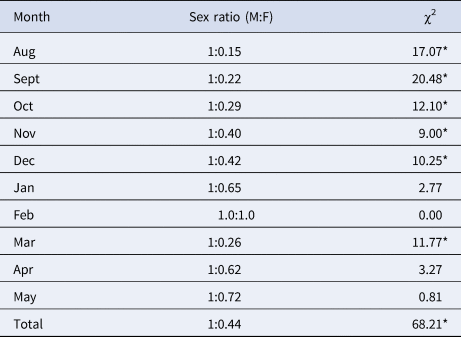
In this study, it was observed that males significantly (χ2, P < 0.05) dominated the commercial catches in almost all the months except during January, February, April and May (Table 5) with an overall sex ratio of 1:0.44 (M:F), which was significantly in favour of males (χ2, P < 0.05).
Monthly variations in the sex ratio of Odonus niger from the south-eastern Arabian Sea, India

*Significantly different (P < 0.05).
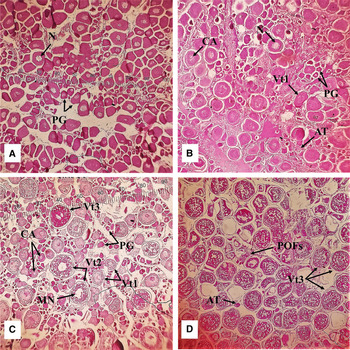
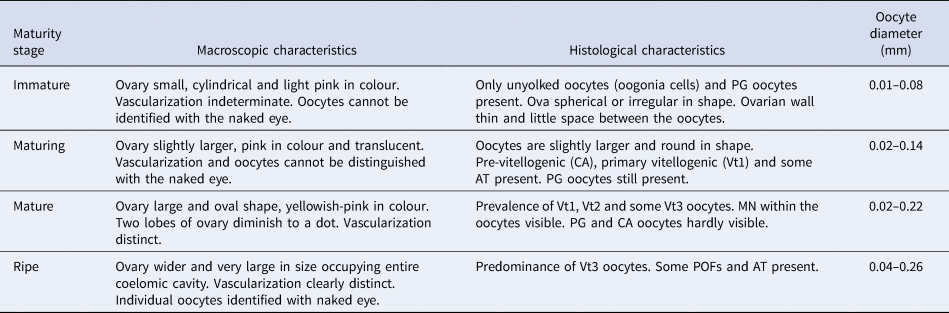
The macroscopic and histological descriptions of different developmental stages of the ovaries are presented in Table 6 and Figure 3. During the immature stage, the size of the ovary was very small and filled with oogonia cells and primary growth (PG) oocytes; the ovarian wall was thin and had little space between the oocytes. Most of the oocytes in immature ovaries ranged from 0.01–0.08 mm in diameter. In the maturing stage, the cortical alveolus (pre-vitellogenic) and primary growth oocytes were visible and also the diameter of the oocytes were increased (0.02–0.14 mm). As the development continued, the secondary and tertiary vitellogenic oocytes (in mature stage) and post ovulatory follicles (in ripe stage) were visible (Figure 3). The oocyte diameter in mature and ripe ovaries ranged from 0.02–0.22 mm and 0.04–0.26 mm respectively. During the ovarian development and succeeding phases more than two oocyte stages were observed, indicating asynchronous development. The presence of multiple oocytes (Vt1, Vt2 and Vt3) in mature ovaries indicated that the oocytes were released in batches.
Ovarian developmental phases of Odonus niger: A, Immature; B, Maturing; C, Mature; D, Ripe. Tissues and cellular structures in ovarian stages: AT, atresia; CA, cortical alveolus; MN, migrating nucleus; N, nucleus; PG, primary growth; POFs, postovulatory follicles; Vt1, primary vitellogenic; Vt2, secondary vitellogenic; Vt3, tertiary vitellogenic.

Classification of ovary maturity stage, macroscopic and histological elucidation and oocyte diameter for Odonus niger from south-eastern Arabian Sea, India

Oocyte stages code: PG, primary growth; CA, cortical alveolus; Vt1, primary vitellogenic; Vt2, secondary vitellogenic; Vt3, tertiary vitellogenic; MN, migrating nucleus; POFs, postovulatory follicles; AT, atresia.
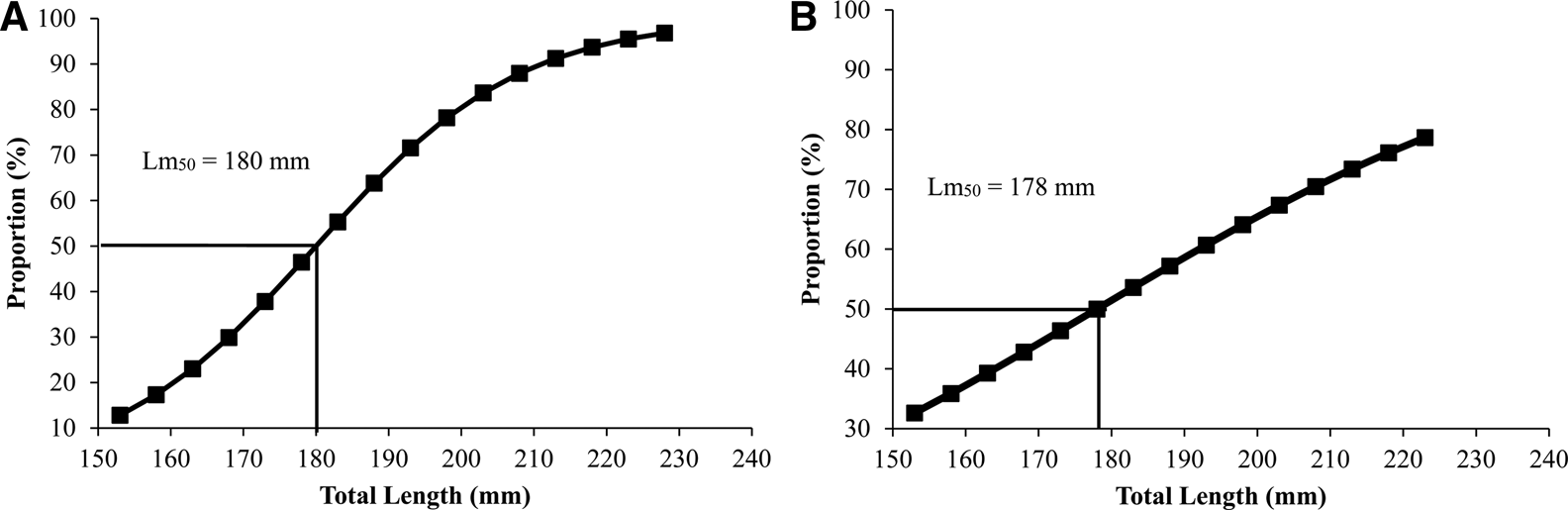
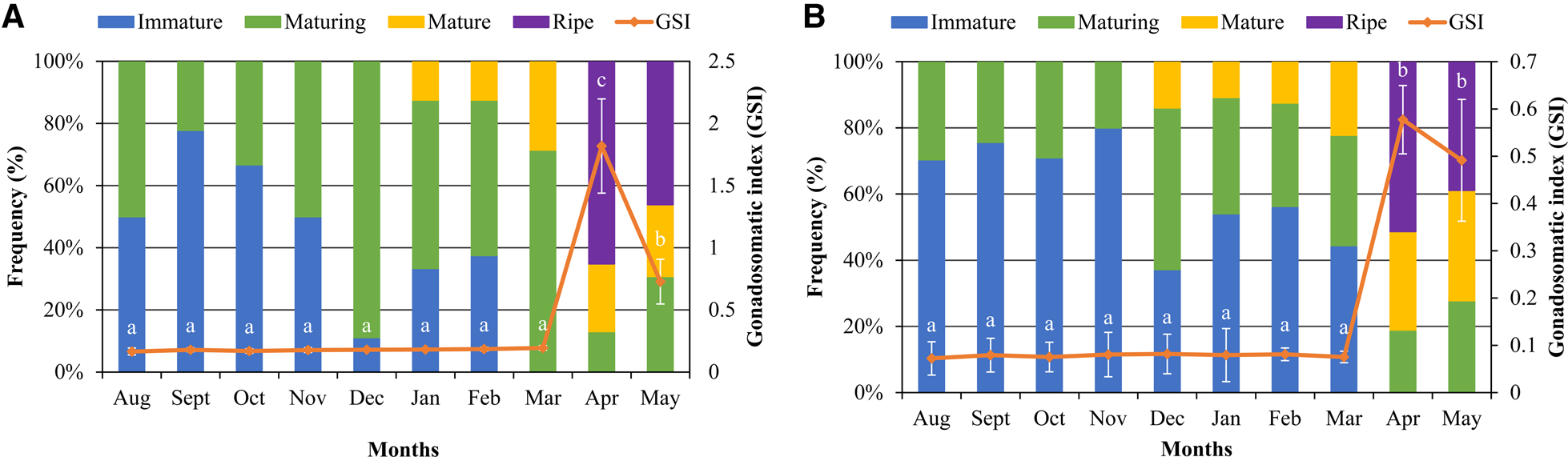
The smallest mature fish was 163 mm for both the sexes. The estimated TL at which 50% of the fishes attained maturity (L50) was 180 mm for females and 178 mm for males (Figure 4). The mean GSI values of female specimens ranged from 0.1652–1.8178 with significantly (P < 0.05) highest GSI value (mean ± SE) recorded during April (1.8178 ± 0.3790) followed by May (0.7275 ± 0.1803). Results obtained from GSI are in full resemblance to the presence of ripe ovaries (65.22% in April and 46.15% in May). The higher proportion of ripe female specimens and higher GSI values observed during April and May imply this is the peak spawning season (Figure 5A). The mean GSI values of male specimens ranged from 0.0724–0.5773 with significantly (P < 0.05) higher GSI value recorded during April (0.5773 ± 0.0722) and May (0.4913 ± 0.1288). Higher GSI values coincided with the presence of ripe testes during April (51.35%) and May (38.89%) months (Figure 5B).
Length at maturity (L50) of (A) female and (B) male Odonus niger from the south-eastern Arabian Sea.

Gonadosomatic index (GSI) and relative frequency of maturity stages of (A) female and (B) male Odonus niger from the south-eastern Arabian Sea.

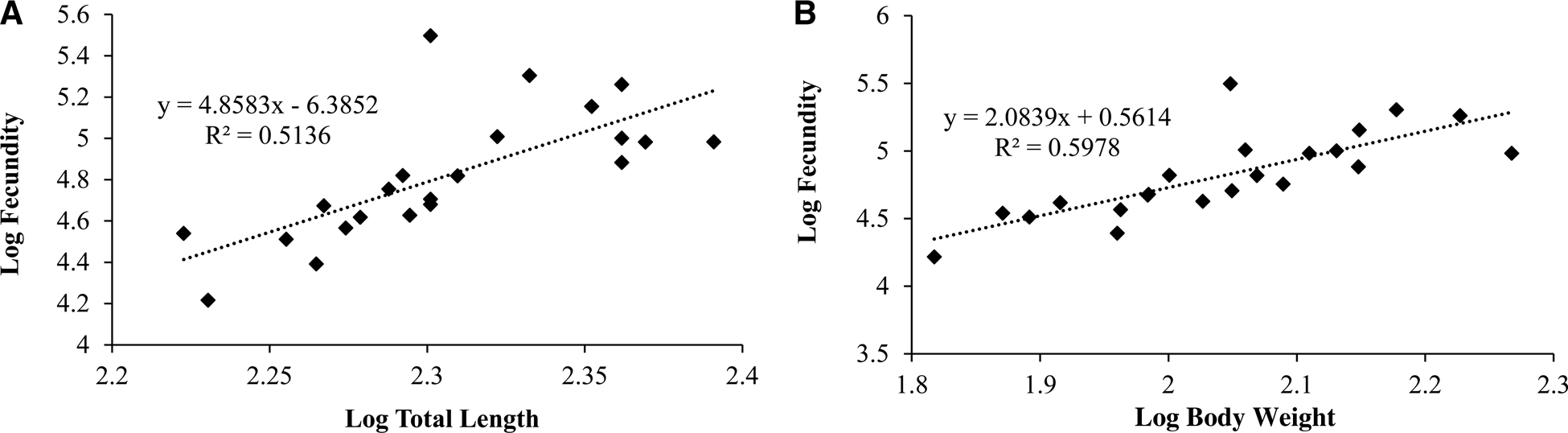
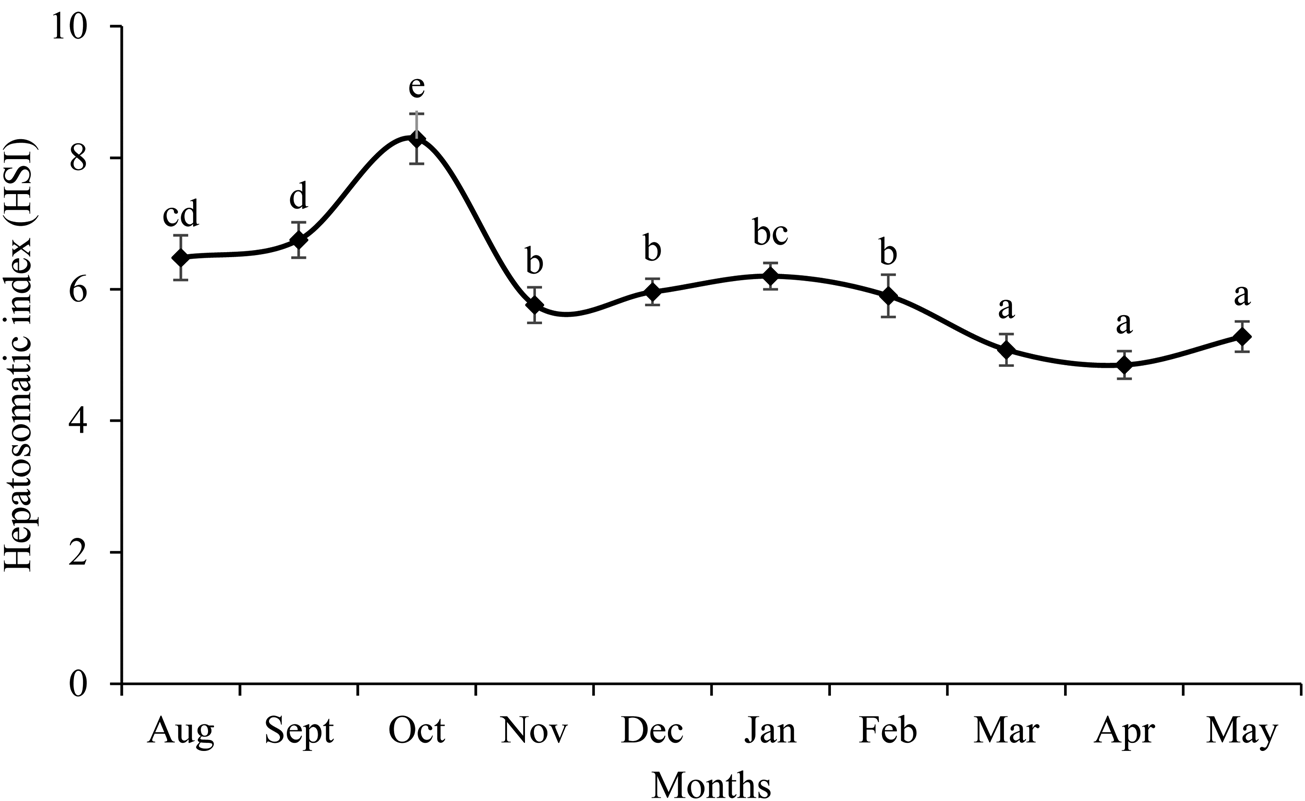
The absolute fecundity was estimated to range from 16,464 eggs (170 mm TL) to 312,420 eggs (200 mm TL) with an average of 85,253 ± 15,075 (SE) hydrated oocytes per female. Relative fecundity (per g body weight) ranged from 251 to 2812 eggs with an average of 705 ± 116 eggs. Fecundity was positively related with both total length (F = 0.0017 TL4.8583, r 2 = 0.5136) (Figure 6A) and body weight (F = 1.7532BW2.0839, r 2 = 0.5978) (Figure 6B), indicating larger O. niger produce more eggs compared with smaller individuals. The hepatosomatic index (HSI) did not show any significant difference (P > 0.05) between males and females. The monthly mean HSI values ranged from 4.85–8.29 with significantly (P < 0.05) highest value recorded during October (8.29 ± 0.38) and lowest during April (4.85 ± 0.21), March (5.08 ± 0.24) and May (5.28 ± 0.23) (Figure 7).
Relationships between fecundity and (A) total length and (B) body weight of Odonus niger from the south-eastern Arabian Sea.

Monthly variations in the hepatosomatic index (HSI) of Odonus niger from the south-eastern Arabian Sea.

Discussion
The results of the present study provide the first detailed biological information on diet composition, feeding dynamics, gonadal development through histological examination and reproductive biology of Odonus niger in the south-eastern Arabian Sea.
Food and feeding
A moderate to active feeding observed in the present study correlates with the hardy and aggressive nature of triggerfish (Randall & Millington, Reference Randall and Millington1990) which indicates the continuous feeding behaviour of the species. SFI values were significantly higher during December to February and lower during April and May, while the corresponding VI values were higher during April and May and lower during November to February. This change may be associated with reproduction, as most of the fishes in the present study were in a ripe stage during April and May (indicating this was the peak spawning season). Feeding intensity of fish is known to be affected by spawning, maturity and food availability in the environment. Further, it has been observed that during the reproductive season, the feeding habits of fishes are reduced and a higher feeding activity may occur during the pre-spawning period in order to provide energy reserves. This is in agreement with the findings of Visconti et al. (Reference Visconti, Trip, Griffiths and Clements2018), who perceived that the feeding intensity of Meuschenia scaber declined during spawning months and increased during pre-spawning and post-spawning months. A similar decline in feeding intensity was observed in Pagellus acarne (Fehri-Bedoui et al., Reference Fehri-Bedoui, Mokrani and Hassine2009) and Diplodus sargus (Figueiredo et al., Reference Figueiredo, Morato, Barreiros, Afonso and Santos2005) during the spawning months and increased feeding activity during pre- and post-spawning periods. The ripe gonads engrossing more space in the peritoneal cavity may constrict the gut during the spawning season, thus instigating the fish to follow a low feeding pattern (Renjithkumar et al., Reference Renjithkumar, Roshni and Ranjeet2020). Further, changes in feeding intensity may also relate to seasonal fluctuations of temperature and water quality parameters that influence physiological mechanism of the fish and availability of prey items (Alam et al., Reference Alam, Chadha, Joshi, Chakraborty, Sawant, Kumar, Srivastava, Das and Sharma2015).
The average relative gut length (RGL) of Odonus niger in this study indicated this species to be omnivorous, which is in agreement with the previous report of Patankar et al. (Reference Patankar, Paranjape, Tyabji, Wagh and Marathe2018), wherein they recorded omnivorous type of feeding habit in various balistids (Balistapus undulatus, Melichthys indicus, Pseudobalistes fuscus, Rhinecanthus aculeatus, Sufflamen bursa and Sufflamen chrysopterus). Omnivorous feeding habits were also documented in Balistes vetula (Randall, Reference Randall1967), Melichthys niger (Hobson, Reference Hobson1974) and Parikas caber (Russell, Reference Russell1983).
The gastrosomatic index (GaSI) depicts the fullness of the stomach and is useful in comparing the scale of feeding in different months and for determining the environmental and physiological effects on feeding habits. The GaSI of males and females did not show any significant difference. Significantly higher GaSI values were recorded during the months of October and December, indicating ingestion of more food items to store food reserves for the upcoming spawning season (April–May). Similarly, the significantly lower GaSI values recorded during April and May probably indicate the inverse relationship between feeding intensity and reproduction time. Similar type of inverse relationship with feeding and reproduction has been reported in Siganus luridus in the eastern Mediterranean (Stergiou, Reference Stergiou1988), Pampus argenteus in Kuwait waters (Dadzie et al., Reference Dadzie, Abou-Seedo and Al-Qattan2000) and Brachirus orientalis in the Persian Gulf (Alghada et al., Reference Alghada, Keivany and Paykan-Heyrati2020).
Analysis of stomach contents revealed that O. niger is a euryphagic fish consuming a wide range of food items such as zooplankton, crustaceans, cephalopods and fish remains, detritus, algae and partially digested matter, which is comparable to the feeding habits of other balistid species (Russell, Reference Russell1983; Vose & Nelson, Reference Vose and Nelson1994; Schiller & Garcia, Reference Schiller and Garcia2000; Kelly-Stormer et al., Reference Kelly-Stormer, Shervette, Kolmos, Wyanski, Smart, Mcdonough and Reichert2017). The dominant food category was crustacean remains, followed by zooplankton which comprised primarily the pelagic pteropods Limacina helicina and Diacavolinia sp. and copepods, while algae formed the third major food component in the diet of O. niger. In comparison, Dance (Reference Dance2017) recorded crabs, bivalves and gastropods as the major component of diet in B. capriscus from north-west Gulf of Mexico with unidentified partially digested invertebrates and fishes. However, Mendes et al. (Reference Mendes, Quimbayo, Bouth, Silva and Ferreira2019) reported that algal matter dominated (55.8%) in the diet of Melichthys niger from an isolated Atlantic oceanic island. Balistes capriscus inhabiting in the south-eastern USA was seen to consume barnacles, gastropods (pelagic pteropods) and decapods (unidentified shrimps) (Goldman et al., Reference Goldman, Glasgow and Falk2016). The strong jaw and specialized dentition of O. niger is adapted for feeding on well-armoured invertebrate prey. However, they do not appear to be specialized feeders, but are opportunistic feeders whose morphology provides the ability to feed on both unarmoured and armoured prey.
Crustacean remains formed the major component in the diet of O. niger in most of the months, but zooplankton formed the most dominant prey category in November. In the same line, a shift from planktonic to nektonic feeding habits during autumn compared with the spring and summer season has been reported in B. capriscus (Kauppert, Reference Kauppert2002). Some species of pteropods reproduce during spring and summer season, to enhance their numbers in autumn and this could be the main cause for the seasonal shift in predation (Dadon & de Cidre, Reference Dadon and de Cidre1992).
The dominance of crustacean remains irrespective of months and length was observed using the Costello (Reference Costello1990) method. The preference of crustacean remains could be linked to high energy content of decapod crustaceans and the regular vertical migration of many crustaceans in the water column (Company & Sarda, Reference Company and Sarda1998). The Costello method delineated that O. niger is a generalist feeder which is in agreement with the feeding habits of other triggerfish species as reported in both M. niger (Mendes et al., Reference Mendes, Quimbayo, Bouth, Silva and Ferreira2019) and B. capriscus (Blitch, Reference Blitch2000; Goldman et al., Reference Goldman, Glasgow and Falk2016; Dance, Reference Dance2017).
Reproductive biology
The mean sex ratio (male: female) of O. niger was 1:0.44 with males significantly outnumbering females in all the months except in February, when male and female counts were similar. Skewed sex ratio favouring males has been reported for other triggerfish from different geographic regions such as B. vetula in the islands of US Caribbean waters (Rivera et al., Reference Rivera, Pena Alvarado, Correa, Nemeth, Appeldoorn and Shervette2019), B. capriscus in Iskenderun Bay, Turkey (Ismen et al., Reference Ismen, Turkoglu and Yigin2004) and S. fraenatus in the Tuticorin coast (Sahayak, Reference Sahayak2005). In contrast, female-dominated sex ratios have been reported in B. capriscus (Kacem & Neifar, Reference Kacem and Neifar2014; Fitzhugh et al., Reference Fitzhugh, Lyon and Barnett2015; Kelly-Stormer et al., Reference Kelly-Stormer, Shervette, Kolmos, Wyanski, Smart, Mcdonough and Reichert2017). The disparity of the sex can be imputed to differential growth rates, differential catchability of sexes or sex-based and spatio-temporal species aggregations (Morato et al., Reference Morato, Afonso, Lourindo, Nash and Santos2003; Rossoni et al., Reference Rossoni, Amadio, Ferreira and Zuanon2010). Various authors have reported that sex ratio could be influenced by the fishery (gear selectivity and location), exploitation rate, schooling behaviour, parental care, ecological factors such as temperature (Bohlen et al., Reference Bohlen, Freyhof and Nolte2008; Imam et al., Reference Imam, Mekkawy and Hassan2012) and also may be due to vertical migrations corresponding with either feeding habits or spawning tendency (Visconti et al., Reference Visconti, Trip, Griffiths and Clements2020). In the present study, the trawlers and purse seiners employed pelagic trawl nets and purse seine nets, respectively for harvesting Odonus niger. This could be the reason for avoiding the vertically migrated fishes that moved deeper for the purpose of feeding and/or breeding, which possibly resulted in the skewed sex ratio.
The knowledge on the length at first maturity (L50) is an essential parameter for many assessments (Assana et al., Reference Assana, Mridula and Rajesh2021). The estimated L50 (TL) of males and females determined in this study were 178 and 180 mm, respectively. A more pronounced sexual difference in the length at maturity was reported by Rivera et al. (Reference Rivera, Pena Alvarado, Correa, Nemeth, Appeldoorn and Shervette2019) for B. vetula from Puerto Rico (L50 = 206 mm for males and 256 mm for females). Divergence of more energy for reproduction could be related to the longer time taken by females to mature (Rajesh et al., Reference Rajesh, Rohit and Abdussamad2021). In contrast, the maturation of females at a smaller length than males has been recorded in B. capriscus from the south-eastern US Atlantic coast (Kelly-Stormer et al., Reference Kelly-Stormer, Shervette, Kolmos, Wyanski, Smart, Mcdonough and Reichert2017; L50 = 184 mm for males and 177 mm for females) and Gulf of Gabes (Kacem & Neifar, Reference Kacem and Neifar2014). This could be explained by the fact that L50 is not only linked to environmental factors but also to genetic components (Sampson & Al-Jufaily, Reference Sampson and Al-Jufaily1999).
Histological examination of gonads is a powerful tool for reproductive studies and is regularly used for confirmation of sex, proper identification of sexual pattern, or quantification of atresia (Alonso-Fernandez et al., Reference Alonso-Fernandez, Alos, Grau, Dominguez-Petit and Saborido-Rey2011). Four ovarian developmental stages of female O. niger were classified based on the appearance of the primary and vitellogenic oocytes, cortical alveolus and postovulatory follicles (POFs). Specimens with stage III gonads were considered as mature based on occurrence of migratory nucleus or hydrated oocytes in the ovary. The macroscopic and histological examination of ovaries in this study revealed O. niger to be a batch spawner. Thus, the present investigation confirms the reproductive cycle in O. niger based on the histological examination of ovaries and monthly GSI values. The concurrent prevalence of high GSI values and the presence of ripe and mature gonads indicate that the spawning season peaks from April to May. The commencement of the spawning season was also distinctly evident by the sharp increase in GSI and the occurrence of mature and ripe stage in April. The peak spawning period observed during the summer months (pre-monsoon) correspond well with the elevated water temperature, productivity, light exposure and salinity in the study area. Water temperature and exposure to sunlight regulates the breeding activity in fishes as they are heterothermic animals, and gonadal maturation in most of the marine species is linked with the progress of the summer season (Rajesh et al., Reference Rajesh, Rohit, Vase, Sampathkumar and Sahib2015).
Estimation of fecundity of fish plays an important role in determining the spawning potential of the fish. Based on the size of the fish, the estimated absolute fecundity varied from 16,464–312,420 eggs (170–200 mm TL) with an average of 85,253 ± 15,075 (SE) eggs per female. The relative fecundity per g body weight ranged from 251–2812 eggs with a mean value of 705 ± 116 (SE) eggs. The estimation of fecundity is difficult in fishes which spawn in batches and it is influenced by abiotic factors such as changes in environmental conditions. Further, fishes are known to exhibit wide variations in fecundity even among individuals of the same species, depending upon the size and distribution range (Bagenal, Reference Bagenal1957). The absolute fecundity in different species of triggerfish such as S. fraenatus was observed to range between 404–341,516 eggs (Sahayak, Reference Sahayak2005), in B. capriscus 290,120–984,990 eggs (Kacem & Neifar, Reference Kacem and Neifar2014) and in B. vetula from 49,000–830,000 (Aiken, Reference Aiken and Munro1983). Sale (Reference Sale1992) contemplated that coral reef fishes are known to be highly fecund with annual egg production ranging from 10,000–100,000 per female. The annotation of preceding studies and observations made from the present study visibly manifests that the fishes of the family Balistidae have high fecundity. Furthermore, the fecundity of O. niger was positively correlated with the total length and body weight. The exponential value in fecundity vs total length was 4.8583 indicating that fecundity increases at a rate above the fourth power of length.
In the present study, HSI values showed no significant differences between males and females, but were seen to vary between months. The higher HSI values were recorded during August–October (pre-spawning and post-monsoon), while lower values were recorded in April and May (spawning and pre-monsoon). The HSI values of O. niger (4.85–8.29%) in the present study are similar to the findings of Immanuel & Palavesam (Reference Immanuel and Palavesam2010) in the south-west coast of India (6.21–9.15%). Similarly, the HSI values of other species of triggerfish ranged from 6.21–11.89% from B. capriscus in the Gulf of Gabes (Kacem & Neifar, Reference Kacem and Neifar2014) and M. niger ranged from 0.94–8.03% in the Caribbean (Kavanagh, Reference Kavanagh1991). Contrary to these, Chiba & Honma (Reference Chiba and Honma1981) reported slightly higher HSI value in Diodon holacanthus with 9.5% for males and 13.1% for females from the Japan Sea. The HSI value mainly depends upon the nature of food intake as well as on feeding and reproductive behaviour of the fish (Henderson et al., Reference Henderson, Sargent and Hopkins1984). In the present study, HSI value exceeded GSI in all the months, which emphasizes the importance of the liver for energy storage and mobilization (Rinchard & Kestemont, Reference Rinchard and Kestemont2003). Therefore, the liver of O. niger seems to be an important organ for energy mobilization and may help to ensure that oocyte development proceeds even when energy intake is low or when there is a hiatus in feeding during parental care (Alonso-Fernandez & Saborido-Rey, Reference Alonso-Fernandez and Saborido-Rey2012).
Conclusions
The present study forms the baseline information on feeding habits and reproductive characteristics (spawning season, fecundity and length at maturity) of red-toothed triggerfish along the south-eastern Arabian Sea that can form primary information for further studies on population dynamics as well as for the conservation, management and rational exploitation of this species. Fishery managers should fix L50 (180 mm for females and 178 mm for males) as the minimum legal size and put restrictions on harvesting the fish less than this length. As the spawning season peaks during April–May, fishing of this fish may be restricted as a management measure to enhance and conserve the resource for its sustainable exploitation. However, the reasons for its sudden appearance in huge quantities to emerge as a major fishery along the eastern Arabian Sea since 2017 is still unclear and further studies are required to resolve this issue. Further, studies on assessment of the potential yield of this species along the coast are essential to formulate suitable regulatory measures for fixing sustainable exploitation rates. Currently, this species is being used for the production of fish meal and surimi which fetch a very low price. Hence, studies are required to estimate the nutritional status of this fish and also to explore the possibilities of utilizing it for the production of value-added products as it may increase profitability.
Acknowledgements
The authors are thankful to the Dean, College of Fisheries, Karnataka Veterinary, Animal and Fisheries Sciences University, Mangaluru, Karnataka for providing necessary facilities to carry out research work successfully. We thank the efforts put in by Dr Malathi Shekar in correcting and editing the manuscript.
Financial support
This research received no specific grant from any funding agency, commercial or not-for-profit sectors.
Conflict of interest
The authors declare that they have no conflict of interest associated with the publication and as corresponding author, I confirm that the manuscript was read and approved by all the authors.