Introduction
The heavy care burden experienced by family caregivers caring for persons with dementia (PWD) has been widely documented. Extant caregiving literature shows that family caregivers frequently report feeling physically, psychologically, financially and socially burdened (Butcher et al., Reference Butcher, Holkup and Buckwalter2001; Schulz et al., Reference Schulz2006). Demands on family caregivers increase substantially as the disease progresses and formal community-based support services are often needed to reduce or alleviate some of the caregiving stress and burden they experience.
Community support services can complement the care provided by family caregivers by providing respite and sharing in the overall caregiving load (Chappell and Blandford, Reference Chappell, Blandford and 1991). In addition, caregiver-specific services have the potential to empower caregivers with knowledge and skills, and provide emotional support. Some examples of community services include support groups, training workshops, day respite care, home nursing, housekeeping services, and meal deliveries. Empirical studies have shown that the use of these support services can assist family caregivers to continue to support the PWD at home by allowing caregivers time off and decreasing caregiving hours (Collins et al., Reference Collins1991; Gaugler et al., Reference Gaugler2005). Positive outcomes reported by family caregivers who use services include reduced caregiver burden (Weuve et al., Reference Weuve, Boult, Morishita and 2000), enhanced self-efficacy in managing problem behaviors (Gitlin et al., Reference Gitlin2001), increased satisfaction and quality of life (Mohide et al., Reference Mohide1990), increased sense of well-being and attainment of new knowledge (Winslow, Reference Winslow2003). In addition to the positive outcomes for the caregiver, community services exert potential benefits for the PWD as well. PWDs who attended adult day care programs exhibited improved mood and decreased frequency of problem behaviors (Gaugler et al., Reference Gaugler2003).
Despite the documented positive outcomes of service use and the need for these services to support the intensive levels of care provided by family caregivers, findings consistently indicate low rates of service utilization (Bookwala et al., Reference Bookwala2004; Gill et al., Reference Gill, Hinrichsen and DiGiuseppe1998). Caregivers frequently do not even begin to use services until later in the disease process, which could be years after a person has taken on the caregiving role. When caregivers finally use formal services, they are often so overwhelmed by the demands of caregiving that the intensity of their need surpasses the potential of the service to help (Markle-Reid and Browne, Reference Markle-Reid, Browne and 2001). In other words, the effectiveness of services is often diminished because services are not used in a timely manner. Much remains to be understood about the reasons behind this paradox, whereby formal services are outwardly beneficial yet underused. Brodaty and colleagues (Brodaty et al., Reference Brodaty2005) aggregated the most commonly occurring reasons for service non-use and they include a perceived lack of need for services, reluctance to use services, service characteristics such as distance and costs as well as a lack of awareness about the availability of existing services. Other factors reported to influence service non-use include caregivers’ beliefs regarding responsibility and obligation to care, feelings of guilt and shame (Pedlar and Biegel, Reference Pedlar, Biegel and 1999; Robinson et al., Reference Robinson, Buckwalter and Reed2005) as well as the availability of informal support (Kosloski and Montgomery, Reference Kosloski, Montgomery and Youngbauer2001).
Given the potentially negative economic and social consequences of unsupported care by family caregivers, understanding the factors that explain the use of support services would be extremely useful to policy makers, healthcare providers, and researchers. The most frequently used framework for understanding service use in the caregiving literature is the Anderson and Newman model (Bass and Noelker, Reference Bass, Noelker and 1987). According to the model, factors that determine service use include predisposing factors such as age, ethnicity, gender, living arrangement, and relationship status, enabling factors such as family and community resources, and need factors which include problem behaviors of the PWD, severity of dementia and caregivers’ physical and psychological health.
One important factor influencing service use is ethnicity and culture (Kosloski et al., Reference Kosloski, Montgomery and Karner1999). Caregivers from different cultures cannot be expected to view their caregiving responsibilities in the same way. In Asia, caregivers are more likely to view caregiving as an obligation stemming from the cultural value of filial piety and hence may be less likely to seek help. Moreover, the majority of studies on dementia caregiver service utilization have been conducted in the West with few studies examining service use by caregivers in Asia. Therefore, the goal of this study was to explore the prevalence and reasons for service non-use and to identify factors associated with the use of available support services among family caregivers in Singapore. This study specifically distinguished services that target caregivers from those targeting PWDs because predictors of service use can be expected to differ according to the type of services (Toseland et al., Reference Toseland2002).
Methods
Participants and procedure
Ethics approval for this study was obtained from the Domain-Specific Review Board of the National Healthcare Group, Singapore. A consecutive sample of study participants was recruited from two sources, the ambulatory dementia memory clinic of a tertiary hospital and the local Alzheimer's Association of Singapore. In the former, caregivers visiting the memory clinic with the PWD were invited to participate in the study, whereas for the latter, the family caregivers were contacted through the association's client registry. The investigator explained the nature and aims of the study, the voluntary nature of participation, and the confidentiality of the responses. This information was also provided through an information sheet given to the participants. Those who agreed to participate, signed an informed consent and were given a questionnaire in either English or Mandarin according to their preference. The questionnaire was completed on site or taken by the participant along with a freepost envelop to be completed at home. If questionnaires were not returned within 2 weeks, the researcher provided reminders via telephone.
Inclusion criteria comprised (1) the caregiver had to be 18 years of age and above, (2) literate in English or Mandarin, (3) the PWD must have been diagnosed with dementia by qualified healthcare professionals, and (4) the caregiver must be a family member who is the primary person providing care or assistance of any kind to the PWD. We defined primary caregivers as family members with the main responsibility of decision-making and care for the well-being of the PWD. Data collection started on 2 June 2008 and ended on 28 Feb 2009.
Measures
All instruments were translated into Mandarin following the guidelines for cross-cultural adaptation of self-report measure (Beaton et al., Reference Beaton2000). This involved forward translation of the instruments into Mandarin by a translator and subsequently an expert review committee, consisting of a geriatrician, two medical social workers specialized in dementia care and five family caregivers, checked for cultural appropriateness and content validity of the scales.
Service use
The two categories of services, caregiver services, and services for the PWD were each measured using a dichotomous variable coded as “service non-use” and “service use.” A list of relevant services was appended to provide clearer understanding of the services available and these were categorized into services for the PWD and caregiver separately. Services for the PWD included day care, home medical and nursing care, home help, meals delivery and home respite. Support groups, educational workshops, and counseling constituted caregivers services. In addition, if the participant had used a service or was still using it, he had to indicate the type of service used by means of a check box. Participants who had never used any service also had to indicate their reasons for non-use. Participants were asked to check off their reasons for service non-use from a finite list of reasons that were generated by the researchers based on clinical experience and past qualitative research studies (Dello-Buono et al., Reference Dello-Buono1999; Brodaty et al., Reference Brodaty2005).
Severity of dementia
Dementia severity was assessed according to the categories in the Diagnostic and Statistical Manual of Mental Disorders, Third Edition Revised (DSM IIIR) (American Psychiatric Association Diagnostic and Statistical Manual of Mental Disorders, 1987). There are three levels of severity (mild, moderate, and severe) defined by DSM IIIR and respondents were asked to indicate severity of condition by choosing one of the following options: 1 = still capable of independent living, 2 = needs some assistance with daily living and, 3 = needs round the clock supervision. The DSM IIIR was selected on the basis that it is short, intuitive, and its format is relatively easy for caregivers to understand as well as to rate. Moderate relationships have also been demonstrated between the DSM IIIR criteria for staging dementia severity and the CDR scale (Juva et al., Reference Juva1994)
Revised Memory and Behavior Problems Checklist (RMBPC) (Teri et al., Reference Teri1992)
The 24-item RMBPC assesses the frequency of PWD behavioral problems. Ratings were made on a five-point scale for frequency of problem behaviors (0 = never occurred to 4 = occurred daily or more often). Higher score reflects higher frequency of problem behaviors exhibited by the PWD. The scale has good reliability with a Cronbach's α coefficient of 0.84 and cross-cultural validity (Roth et al., Reference Roth2003).
Zarit Burden Interview (ZBI) (Zarit et al., Reference Zarit, Reever and Bach-Peterson1980)
The ZBI comprises 22 items assessed by a 5-point Likert scale to determine the level of burden experienced by the caregiver. It covers major areas that affect caregiver well-being such as financial difficulties, social life, physical and psychological health, and the relationship between the PWD and the caregiver. The score ranges from 0 to 88 with higher scores representing greater caregiver burden. Reported reliabilities for the scale were high with coefficient alphas (α) in the 1990s (Papastavrou et al., Reference Papastavrou2007).
Knowledge of services
General awareness of available local support services was measured using a dichotomous variable coded “No” and “Yes.”
Sociodemographic characteristics
Sociodemographic characteristics such as gender, marital status, ethnicity, employment status, education, relationship status, duration of caregiving, living arrangement, and presence of domestic help were collected.
Data analysis
Initially, the correlation of each predictor variable to service use was examined. Only those independent variables that had a significant univariate relationship with service use were included in the multivariate analyses. Multivariate analyses were performed using logistic regression to test two separate models predicting the use of services for the caregiver and services for the PWD, respectively. For each of these dichotomous outcomes, an equation was estimated that predicted the odds of being in one or the other category of the binary dependent variable.
Results
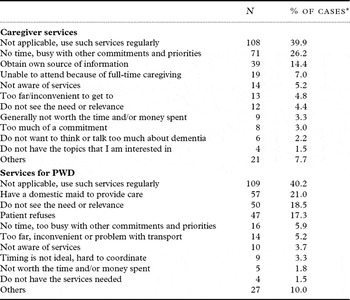
The questionnaire was given out to 369 primary family caregivers, and 272 (73.7%) were received at the end of the study. Overall, 39.9% of the caregivers used any of the available local support services. In terms of caregiver services, the most frequently used were support groups and caregiver educational and training workshops, which were used by 36.2% and 31% of the caregivers, respectively. Table 1 shows reasons for service non-use. The most common reasons given for the non-use of caregiver services were the lack of time due to other commitments and priorities (26.2%) as well as the ability of caregivers to obtain their own source of information through their own research and reading (14.4%). On the other hand, the most frequently used service by the PWD was day care, which was utilized by 44.6% of the care recipients. The principal reasons given for non-use of services for the PWD were the presence of domestic help (21.0%), the perceived lack of need (18.5%) followed by refusal on the part of the PWD (17.3%). Ninety (30%) caregivers indicated they had no knowledge of the dementia services available. Of these, 79 (87.8%) were recruited from the tertiary hospital dementia memory clinic while 11 (12.2%) belonged to the local Alzheimer's Association.
Reasons for non-use of caregiver services and services targeted at PWD

* Numbers add up to more than 100% because participants could select more than one reason.
Results for the univariate and multivariate analyses are presented separately for services targeted at family caregivers and services targeted at PWD.
Services targeted at caregiver
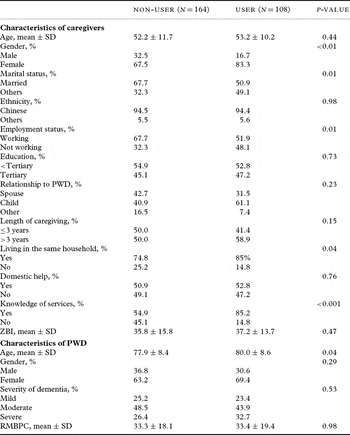
Table 2 presents the characteristics of the potential predictor variables separately for users and non-users of caregiver services. Univariate analyses showed that users of caregiver services were significantly more likely to be females (χ2(1) = 8.44, p < 0.01), to live in the same household as the PWD (χ2(1) = 4.18, p = 0.04), to be taking care of older PWDs (t(266) = –2.02, p = 0.04) and they were also more likely to be aware of available local support services for dementia caregivers (χ2(1) = 27.02, p < 0.001). In contrast, caregivers who were married (χ2(1) = 7.69, p = 0.01) and working (χ2(1) = 6.89, p = 0.01) were significantly more likely to be non-users of caregiver services.
Characteristics of caregivers and PWDs who are users/non-users of caregiver support services

Note. ZBI = Zarit burden interview; RMBPC = Revised memory and behavior problem checklist; SD = Standard deviation.
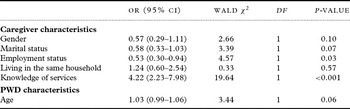
Factors that had significant univariate associations were entered into multivariate analyses estimating the likelihood of caregivers being users of caregiver services as presented in Table 3. The model that included gender, marital status, employment status, living arrangement, knowledge and age of PWD was significant (χ2(6) = 46.52, p < 0.01) and a good fit for the data (Hosmer & Lemeshow test; χ2 (8) = 10.48, p = 0.23). Both employment status (OR = 0.53, CI = 0.30–0.94) and knowledge of available services (OR = 4.22, CI = 2.23–7.98) remained significant predictors of caregiver service use. Caregivers who were working had significantly decreased odds of using caregiver services while caregivers who had some knowledge about the available services were four times more likely to be users of caregiver services.
Predictors of usage of carer services from logistic regression analysis

Note. OR = Odds ratio; CI = Confidence interval.
Services targeted at PWD
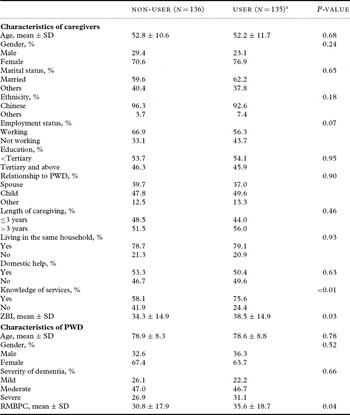
Table 4 shows the characteristics of the potential predictor variables separately for users and non-users of services targeted at PWD. Three variables had significant univariate associations with use of services by the PWD. They were knowledge of available services, caregiver burden and frequency of problem behaviors presented by the PWD. Caregivers who were aware of available services for PWD (χ2(1) = 9.32, p < 0.01), who had higher levels of burden (t(257) = –2.25, p = 0.03) and PWDs who had more problem behaviors (t(251) =–2.09, p = 0.04) were significantly more likely to be users of services targeted at PWDs.
Characteristics of caregivers and PWDs who are users/non-users of support services for PWD

Note. ZBI = Zarit burden interview; RMBPC = Revised memory and behavior problem checklist; SD = Standard deviation.
a One missing response.
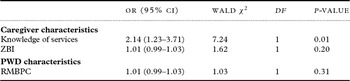
Using the significant variables above, multivariate estimates of the likelihood of being a user of services targeted at PWD were calculated and are presented in Table 5. The model that included knowledge of services, caregiver burden, and problem behaviors in PWD was significant (χ2(3) = 13.59, p < 0.01) and a good fit for the data (Hosmer & Lemeshow test; χ2(8) = 2.38, p = 0.97). Only knowledge of services (OR = 2.14, CI = 1.23–3.71) remained a significant predictor of service use. Being aware of available services increased the odds of using services targeted at PWD.
Predictors of usage of services for PWD from logistic regression analysis

Note. ZBI = Zarit burden interview; RMBPC = Revised memory and behavior problems checklist; OR = Odds ratio; CI = Confidence interval.
Discussion
This paper explored that extent of service use and examined the factors that may influence the use of local support services in a sample of Asian family caregivers of PWDs living in Singapore.
The results suggest that the overall use of support services was modest with only 39.9% of the caregivers using any of the available services. This finding is consistent with studies in Western family caregivers, suggesting that service under-utilization transcends cultural differences and despite caregivers experiencing significant levels of burden and strain (Bookwala et al., Reference Bookwala2004; Sun et al., Reference Sun2007). The reasons vary depending on the type of services examined. Caregivers cited lack of time and the ability to obtain their own information for the non-use of caregiver services, perhaps reflecting the demographics of the current sample where the majority are well-educated and in full-time employment. This calls for more innovative ways to deliver caregiver services which can include use of video conferencing to provide counseling or peer support following a support group format, web-based dementia training programs or even running caregiver programs in the workplace of the caregivers as the growing numbers of persons affected will likely justify such initiatives in time.
On the other hand, the reasons given for non-use of services for the PWD were refusal by the PWD, perceived lack of need and presence of domestic help. The availability of informal domestic support is unique to the situation in Singapore where many caregivers often employ domestic help to provide care for the PWD (Yeoh and Huang, Reference Yeoh, Huang and 2010). Having domestic workers in the home to ensure safety and to care for the PWD can explain why caregivers do not see the need for services such as day care programs. However, daycare programs, in providing structure and moderate stimulation by way of purposeful activities, can be useful adjuncts to drug treatment for dementia to improve quality of life and maintain emotional well-being. Domestic workers typically provide mere physical care and moreover, receive no formal training on dementia care. Given their intimate involvement with the PWD, it is imperative that they acquire the necessary skills to provide appropriate care. Training programs for domestic workers have recently been instituted in our local Alzheimer's Association (Alzheimer's Disease Association, 2010). There is a need to increase capacity of such services to make them available to more families of PWD.
Overall the logistic regression models showed that significant predictors varied depending on the outcome in question. This is in line with past research that has shown that different types of services are associated with different predictive factors. Use of caregiver services was predicted by employment status and knowledge of services. Caregivers who are working full-time have more commitments on their hands and less time to attend caregiver services such as support groups and the lack of time may make it difficult for them to obtain information about support services. Use of services for PWD on the other hand was only predicted by knowledge of services. Importantly, this suggests that caregiver's need in terms of high levels of burden or problem behaviors in the PWD does not necessarily lead to service use unless they possess knowledge about the network of community services available to them and have been educated on their usefulness.
Among caregivers who acknowledged they had no knowledge of dementia services, the relatively higher proportion of caregivers from the tertiary hospital memory clinic (87.8%) calls for more efforts at systematic dissemination of this information. It is conceivable that clinicians may not routinely inform caregivers about community services unless the need arises. However, it is possible for memory clinic-based clinicians to not detect unexpressed socio-emotional needs in caregivers given their primary focus on clinical issues. Hence, this calls for a conscious effort to include a caregiver information session on dementia services in any memory clinic service.
Importantly, cost of services was not mentioned by the caregivers, although ground experience tells us that it is certainly an important factor. While caregiver support groups and programs are mostly free, services for the PWD such as day care can be costly given a norm cost of approximately 30 USD per day in Singapore. Government subsidies are usually granted only after rigorous means testing. Additionally, variables which could reasonably be expected to affect service use, such as aspects of service delivery and the role of cultural beliefs and attitudes were not examined. Issues of service design and delivery may not have been given adequate attention by service providers who tend to operate with the belief that client need will dictate the use of services regardless of their preferences. However, studies have shown that service characteristics such as staff quality and timings have a significant influence on service use as well. Furthermore, in Asia, the value of “filial piety” can have an impact on the extent to which people feel morally bound to care for their relative with dementia. Some may see caregiving as a personal responsibility that should only be fulfilled by them. From this perspective, even having the PWD attend daycare can be construed as a lack of filial love.
When evaluating the results of this study, several limitations should be considered. First, the design of the study was cross-sectional in nature, hence the directionality of the observed associations cannot be determined. Longitudinal studies are recommended for more insight into whether caregivers who are non-users become users as predictors change. This is important in dementia caregiving, given the unpredictability of the course and symptoms of the disease. Second, by virtue of the recruitment procedure (i.e. recruitment from an ambulatory memory clinic and local Alzheimer's Association), the study sample was biased toward those who have had some contact with local community services and included only caregivers who were literate, indicating the possibility of selection bias. Therefore, this limits the generalizability of the study and might have an attenuating effect on the results of the study. Third, although the study examined the predictors and reasons for caregiver and PWD-related service use separately, sample size limitations precluded further separate analyses for each type of caregiver and PWD-related service use. Predictors and reasons for service use/non-use can be expected to vary depending on the specific type of service involved. For example, problems with transport would be applicable for accessing daycare but not for homemaking services or meal delivery. Therefore, the results based on aggregated measures need to be interpreted with caution.
In addition, the use of a dichotomous variable to capture caregiver general knowledge of services may have led to the paradoxical finding of some caregivers who have actually used services indicating “no” to the question about general knowledge of services. This could have occurred as these caregivers provided a negative response when they realized that they only had a limited awareness of wide range of services detailed in the questionnaire. Lastly, multiple comparisons were performed without adjusting or lowering the significance levels, which raises the risk of Type I error. However, it must be noted that the study was exploratory in nature and as such the preferred strategy was to capitalize on chance findings to have a greater certainty that no significant effects were overlooked.
Despite these limitations, the study suggests that there is a need for more efforts at education to raise awareness among caregivers about the availability and purpose of support services. As dementia progresses, some caregivers might become increasingly isolated, having few contacts with avenues of assistance outside the family. It is imperative to design strategies that promote and encourage the use of available support services and improve outreach to families who are not in contact with the formal service system. From a research perspective, more studies with larger sample sizes need to be conducted to explore the predictors for each separate type of service use as well as to delineate additional factors such as characteristics of service delivery, cost of services and sociocultural beliefs that might influence service use. As the subtleties underlying service use may not be easily understood with predesigned questionnaires, qualitative methods involving in-depth interviews should be used to uncover factors that have not normally been considered in service utilization research.
Conflict of interest
None.
Description of authors’ roles
June Lim collected the data, wrote the statistical analysis plan, cleaned and analyzed the data, and drafted and revised the manuscript.
Jenny Goh designed the data collection tools and collected the data.
Hui Ling Chionh designed the data collection tools and collected the data.
Philip Yap designed the data collection tools, monitored data collection and reviewed the draft manuscript.
Acknowledgments
This research was supported by a grant from the National Council of Social Services (NCSS) of Singapore. The authors express their sincere thanks to Theresa Lee for her kind assistance in the study and Lee Soak Mun for her help in coordinating the initial phase of the project and designing the template for data entry. Finally, we would also like to thank the nursing staff at the Ambulatory Dementia Clinic of Khoo Teck Puat Hospital for their support and the carergivers for giving us their time to complete the study questionnaire.