I
We still know very little about the pupils of early modern Europe. This is surprising for two reasons. First, the quantitative analysis of serial sources, especially the reconstruction of individual educational careers on the basis of matriculation records, makes it possible to find out more about this group of European children and youth than about just any other.Footnote 1 Second, the exploitation of matriculation records is already well established among historians of universities, the last forty years having seen a concentrated effort to reconstruct students’ geographical mobility, their matriculation behaviour, their social background, and their future careers on the basis of university matriculation records.Footnote 2 Pupils have, on the other hand, received nothing like the attention that early modern students have.Footnote 3 This lacuna of rigorous archival research into the educational strategies pupils and, by extension, their parents employed is most acutely felt for the historiography of German education and childhood since in the Holy Roman Empire of the German nation, a greater number of schools existed than in any other European region, Catholic, Protestant, and Calvinist institutions often operating in direct proximity to each other. Schooling became a fiercely contested battleground on which the confessions competed with each other over the attention of the ever-important next generation of the faithful.Footnote 4
Yet, historians of early modern German schooling still almost exclusively write on the basis of normative and consistorial sources. Visitation records and government regulations continue to provide the basis for even the most recent studies on German schools, thus giving a voice to law-givers and educationalists rather than pupils, their parents, and the communities they lived in. The most influential example remains Gerald Strauss's concept of the ‘indoctrination of the young’, Strauss arguing that reformers and rulers had been able to restructure (from top to bottom) German schooling to suit their doctrinal purposes.Footnote 5 In German historiography, a similar top-down perspective continues to persevere, though the emphasis has been more on the role of schools within the narrative of increasing centralization and the emergence of institutions of the modern ‘state’ within the superstructure of the Holy Roman Empire.Footnote 6
Pupils and their parents have not been examined as active agents within the process of change that German education underwent between the Reformation and the widespread introduction of obligatory schooling in the eighteenth and nineteenth centuries. Yet, the prevalent focus on law-givers relegates education to a marginal role within early modern society, belying the fact it was tugged at and fiercely contested by all parties that played a role within it, councils, consistories, pedagogical writers, teachers, and, last but not least, its consumers.Footnote 7 Education mattered to communities for a wide range of reasons, but mostly because it provided an avenue into the learned professions. ‘Social mobility’ is a loaded term, as it has been one of the main concerns of the social sciences since Sorokin published his famous study of the same name in 1927. Since then, the theoretical apparatus defining various forms of social mobility has become immense. In this article, the understanding of social mobility is rather basic, meaning vertical trans-generational professional mobility, that is, changes of profession from father to son.Footnote 8 Anthony La Vopa's seminal study on poor students and clerical careers in eighteenth-century Germany raised important questions on social mobility through education, the author finding that the influx of sons from a wide range of backgrounds into faculties of theology and law was in fact substantial. La Vopa also suggested that the hurdles boys encountered at German schools on their way into the learned professions were more substantial than at university (with the exception of Württemberg, where a centralized examination restricted access to the territory's universities), schools therefore playing a more important role than universities in selecting boys for the learned professions. Yet, La Vopa based his assumptions on university matriculation and stipendiary records, dealing thereby with the result of selection at school, not the process itself. As a result, La Vopa gave prominence above all to charity and institutionalized methods of helping poor pupils and students rather than the more informal educational strategies pupils and their parents employed.Footnote 9
In this article, I wish to make two interrelated points. First, that the reconstruction of pupils’ careers reveals that a wide range of options was available to pupils who wished to assemble their own educational profiles and cut both the length and cost of their preparatory education. Second, that the increasing overall percentage of pupils at preparatory schools in the wake of the Thirty Years War and the marked presence of sons from non-educated backgrounds among Zwickau pupils add extra credit to Volker Press's description of the period as one of increased social mobility and professional opportunity.Footnote 10
This substantial amount of social mobility into learned professions has implications not just for the history of German education, but also for that of the ‘estate of the learned’ and its self-representation. We must keep in mind that European scholarship was a confusingly decentralized affair in the early modern period, focused less on institutions than the elusive Republic of Letters.Footnote 11 No mere amateur quackery, the participation of men from a broad range of backgrounds was an integral part of European learned culture.Footnote 12 Teachers, physicians, clerics, scribes, and printers – that is, members of those professions to which a Latin school education and some time at university provided access – all felt entitled to add their penny's-worth to the scholarly discussions of the day. Recent scholarship has focused on the increasing efforts of the learned to distinguish themselves from their unlearned contemporaries and on the institutionalization of hereditary chairs at some universities towards the end of the period.Footnote 13 Other studies have focused on the cult of celibacy which continued to be valued among men of learning regardless of their confession even after the Reformation, a phenomenon which begs the question how the Republic of Letters could perpetuate itself from one generation to the next.Footnote 14 Yet, if we wish to account for continuity within the Republic of Letters, we need to keep in mind that the early modern school made possible a degree of social mobility into the learned professions which belied the superficial impression of insularity created by the self-representation of the Republic as a ‘state apart’.
This article suggests that the history of schooling cannot be written without taking the educational strategies pupils and their parents employed into account. On the basis of a sample of the exceptionally detailed records of a Lutheran Latin school, this article first addresses general trends of pupil numbers in the seventeenth century. It then goes on to discuss the local origin of pupils and whether the peregrinatio academica was matched by a peregrinatio scholastica. Finally, by examining the educational strategies that pupils and their parents employed alongside evidence gleaned from parish registers, education as an avenue for social mobility is discussed.
II
Pupils in early modern Germany were under no formal obligation to stay at one school and follow a particular programme of study through from beginning to end, and we should not be surprised that pupils picked and chose from the offer of early modern schools. It is, however, entirely a different matter to reconstruct how they planned their education and how they assembled their personal educational profile. Historians of education have relied on matriculation records for over a hundred years, yet only since the 1970s have their methods progressed from mere counting of pupil numbers to sophisticated quantitative analysis, thanks primarily to the ready availability of computers.Footnote 15
The most thorough exploitation to date of matriculation records as a source on pupils’ educational strategies was carried out by historians associated with the École des hautes études en sciences sociales (EHESS) in the 1970s and 1980s. Heavily influenced by sociological studies of twentieth-century French schooling, the studies carried out at the EHESS were above all concerned with the tracing of the institutionalization of social inequality described most famously by Pierre Bourdieu.Footnote 16 Yet, the method of reconstructing a significant number of individual pupils’ careers is useful not only within the teleological preoccupation with the longue durée of the formation of social elites that has been so central to French historiography of education. The serial evidence of matriculation records allows us to assess who the pupils of early modern German schools were, how they took advantage of the curriculum, and what benefit they derived from education. In other words, matriculation records, if exploited the right way, can serve to re-introduce the element of choice into the story of early modern schooling.Footnote 17
The survival in series of the detailed matriculation records of the Latin school of Zwickau in Electoral Saxony in the second half of the seventeenth century is especially fortunate for this purpose.Footnote 18 The reasons for these records being exceptionally detailed are twofold. The first is the continued self-image of Zwickau (by far the wealthiest town in the Ernestine electorate of Saxony at the time of the Reformation) as a major urban centre, something which, in fact, it had ceased to be by the second half of the sixteenth century.Footnote 19 Owing to the continued fastidiousness of the urban administration, the shrunken urban community produced quantities of detailed paperwork (council minutes, records of newly admitted burghers, and a large amount of official writing concerning the school) which belied its peripheral status within the now Albertine electorate of the seventeenth century.Footnote 20
The second reason for the detail in which the matriculation records were compiled was that Protestant towns in early modern Germany tried as hard as they could to employ established scholars as teachers. In Zwickau's case, the school's rector between 1662 and 1687, Christian Daum (1612–87), was not only a respected philologist, but also an especially conscientious compiler of records. For Daum, the matriculation records were as useful, if not more so, for his networking within the Republic of Letters as for the effective running of the school.Footnote 21 University matriculation lists of the period can by no means be taken as comprehensive records of all students who attended lectures at a given institution through the course of the year since students entered their names themselves. Daum's notes, on the other hand, are far more comprehensive, since they did not require the initiative of the student to appear at a matriculation ceremony and were kept continuously through the year.Footnote 22 For the purposes of this article, a total of 770 careers of pupils were reconstructed for the years 1662 until 1682.Footnote 23
In terms of the period during which the records were compiled and their location they could not be better placed for the positioning of pupils’ individual careers against top-down narratives of German education. First, the seventeenth century was a crucial time during which other authors have seen an ‘educational revolution’ taking place in some European countries as well as the ‘birth of modern pedagogy’.Footnote 24 In Germany, the Thirty Years War had depleted at least a third of the empire's population, the cultural effect of which is still a matter of considerable debate.Footnote 25
Second, the Zwickau Latin school, as a civic rather than territorial institution, belonged to the most common type of preparatory institution in the Holy Roman Empire: while more than capable of preparing pupils for the regional universities, it was a mid-level type of school in the sense that it received no funding from the territorial government and, unlike Jesuit academies and Protestant territorial schools (so-called Fürstenschulen or Landesschulen), also taught elementary vernacular reading skills. The school's curriculum was divided into seven forms, the Septima being the lowest and the Prima the highest form (in effect the school had six forms from the early seventeenth century onwards since the Prima and the Secunda were held together).Footnote 26 The main focus of the syllabus was Latin, followed by Greek, while the pupils of the lowest two forms were also taught to read and write in the vernacular German (see Appendix).
Third, by the late sixteenth century the curricula of Saxon Latin schools had eclipsed that of the Strasbourg academy as the most influential in the empire, both because of the electorate's cultural eminence as the motherland of the Reformation and the large number of educational institutions the territory hosted. Apart from more than a hundred Latin schools, Saxony was the home of two universities, one of which (Leipzig) was by far the largest in the empire. After the much smaller Württemberg, the electorate of Saxony – one of the most densely populated regions in Germany – was the first territory in which a formally binding church and school ordinance was introduced, a system of visitations and several regional consistories as well as a central consistory being in place to ensure the adherence to it.Footnote 27 Where if not here could uniformity in matters of education – the basic precondition for Strauss's ‘indoctrination of the young’ – be achieved?
III
Peter Schumann, Zwickau's main chronicler of the Reformation period, had claimed that by the end of the fifteenth century some 900 boys attended the school. The Zwickau council also reported a similar figure to the elector Johann Friedrich in 1546. These figures were, however, most likely considerably inflated.Footnote 28 In 1578, the visitation protocols for electoral Saxony recorded a total of ‘about 400 pupils’ at the Zwickau Latin school, making it the school with the largest recorded number of pupils in the territory. It needs to be remembered that no reliable data exists on how many pupils went to school in Germany in the early modern period and, therefore, comparisons necessarily contain a fair amount of guesswork. Whether Zwickau in actual fact catered for more pupils than any other school in Saxony, including the school of St Nicholas in Leipzig (which employed more teachers), cannot be said. What is certain is that the Zwickau Latin school was among a handful of large and prestigious civic schools which overshadowed the scores of schools in smaller towns which generally had fewer than a hundred and often no more than a handful of pupils. Compared to schools in the rest of Europe, the Zwickau Latin school was certainly a large institution: Shrewsbury school, for example (probably the largest school in England at the time) counted 360 pupils in 1581.Footnote 29
Total number of pupils, 1616–1834.

The fragmentary matriculation records that exist prior to Daum's rectorship suggest that almost 300 pupils attended the school before the Thirty Years War, that numbers dropped drastically as a result of the plague in 1632/3, and then slowly rose again to an average of 150 pupils during the 1650s, all the while being subject to considerable fluctuation from one year to the next.Footnote 30 While continuing to fluctuate during Daum's rectorship, numbers rose to an average of 165 per annum including the drastic drop in numbers during the plague years of 1681/2. The intake of 242 pupils in 1665 was only to be reached again in 1866 by the Gymnasium which succeeded the Latin school as Zwickau's preparatory institution, at a time when Zwickau’s population was ten times larger than in the 1660s (see Figure 1).Footnote 31 Indeed, the years after the Thirty Years War witnessed the highest ratio of pupils in relation to the total of inhabitants in the school's history. Since Zwickau lost two-thirds of its population during the war and did not reach pre-war levels again until the early nineteenth century, the rapid increase of pupil numbers meant that we get a ratio of 1:13 for the centre and 1:15 for the whole town (182 pupils to approx. 2,700 inhabitants in 1650). By comparison, at the height of pre-modern population levels during the first half of the sixteenth century, the ratio of pupils of the school to the total population of Zwickau was most likely about 1:18 (about 400 pupils to 7,300 inhabitants).Footnote 32
The changing relationship between the numbers of pupils and total population in Zwickau after the Thirty Years War mirrors the development of student numbers at the universities of the empire. While approximately 4,600 students matriculated each year before the war, this number declined drastically, and then rose again to an average of 4,200 during the 1650s. In other words, student numbers recovered very quickly despite the overall demographic decline of the population. The matriculation records in Zwickau show that even in a town which had been among the worst hit in terms of demographic decline, the recovery of the number of pupils could be as swift as for the universities.Footnote 33
IV
Mobility was one of the defining features of medieval and early modern education. Many factors – financial, confessional, and curriculum-related – had an influence on pupils’ choices of where to go to school.Footnote 34 The willingness to travel and the ability to pay for it were basic requirements for any boy or young man who wished to get an education. The need to travel was even greater for students, who often came from regions without any universities or ones dominated by another confession. Mobility was, however, also facilitated by the relative compatibility of curricula and the fact that Latin was the lingua franca at all European universities, both factors supporting an academic internationalism which encouraged students to study abroad and to change universities relatively effortlessly. When ideals of a well-rounded noble education came to include university study in the early sixteenth century, the ‘academic pilgrimage’ (peregrinatio academica) also became a staple component of well-heeled noblemen's education. Later on, when provisions for noble education improved across Europe, stays at foreign universities became integrated into the Grand Tours of the late seventeenth and eighteenth centuries, and became minor features among the largely aesthetic agenda of visiting European courts and collections of artefacts.
At the other end of the spectrum, ragged beggar-students populated medieval and early modern folk-songs and popular stories. The image of the semi-criminal travelling student on the margins of society has, however, recently been contested by historians, and has been supplanted with that of a small number of privileged students who tended to travel late in their university careers, letters of recommendation in hand and travel money in their pockets, in order to acquire particular knowledge not available at their alma mater. Most students in the medieval and early modern period did not change universities frequently, but stayed at the closest university that catered to their confession.Footnote 35
Though the extent to which early modern pupils travelled for pre-university education is not as well documented by contemporary accounts and has received less attention from historians than the peregrinatio academica, it is quite clear that pupils were frequently mobile. In the middle ages, they often followed their itinerant teachers from one monastery or school to the next, well before the establishment of universities in the later middle ages added students to the group of ‘intellectual vagrants’.Footnote 36 English grammar schools, schools funded directly by the government of Protestant territories, as well as many Jesuit schools, were boarding establishments, a necessary feature of elite schools meant to cater for whole territories. Boarding houses were also an inheritance of the monastic tradition of these schools, which often occupied former nunneries and priories and within which teachers and pupils adhered to a communal and celibate lifestyle.Footnote 37 Apart from a few schools in commercial centres, most civic schools in Germany did not have formal provisions for foreign pupils, but certainly attracted a large number of outsiders. Large institutions such as the Zwickau Latin school attracted enough ‘foreigners’ for the provision of lodging to become a reliable source of income for teachers and local homeowners.Footnote 38
While pupils often went to school away from their home towns, as long as there are no comparative studies of school's matriculation records it is impossible to say how frequently pupils changed schools in early modern Germany. Such a study is still sorely needed – especially so that differences between Catholic and Protestant regions can become apparent – yet the Zwickau records do contain enough information to suggest that pupils’ mobility followed certain patterns.
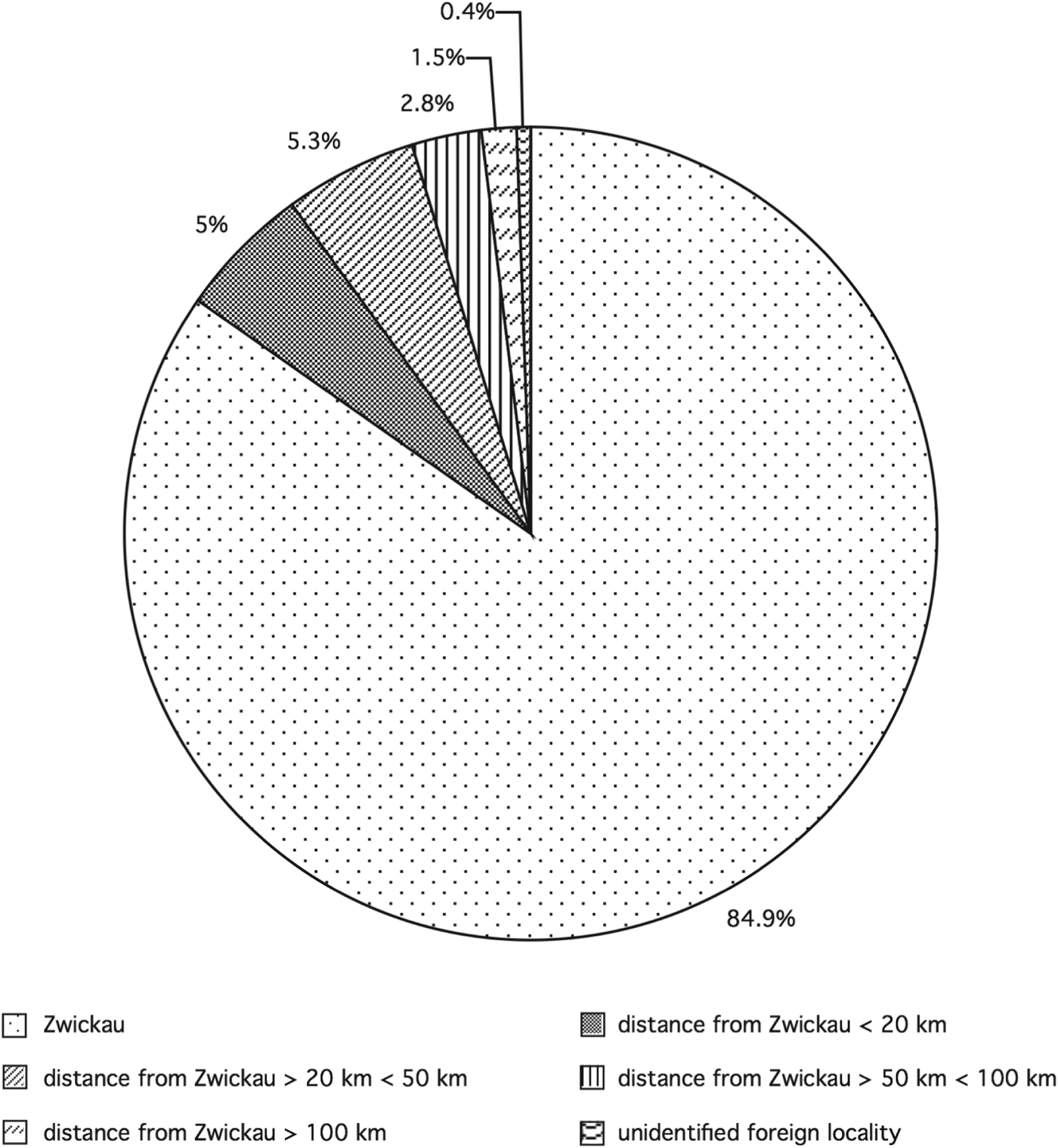
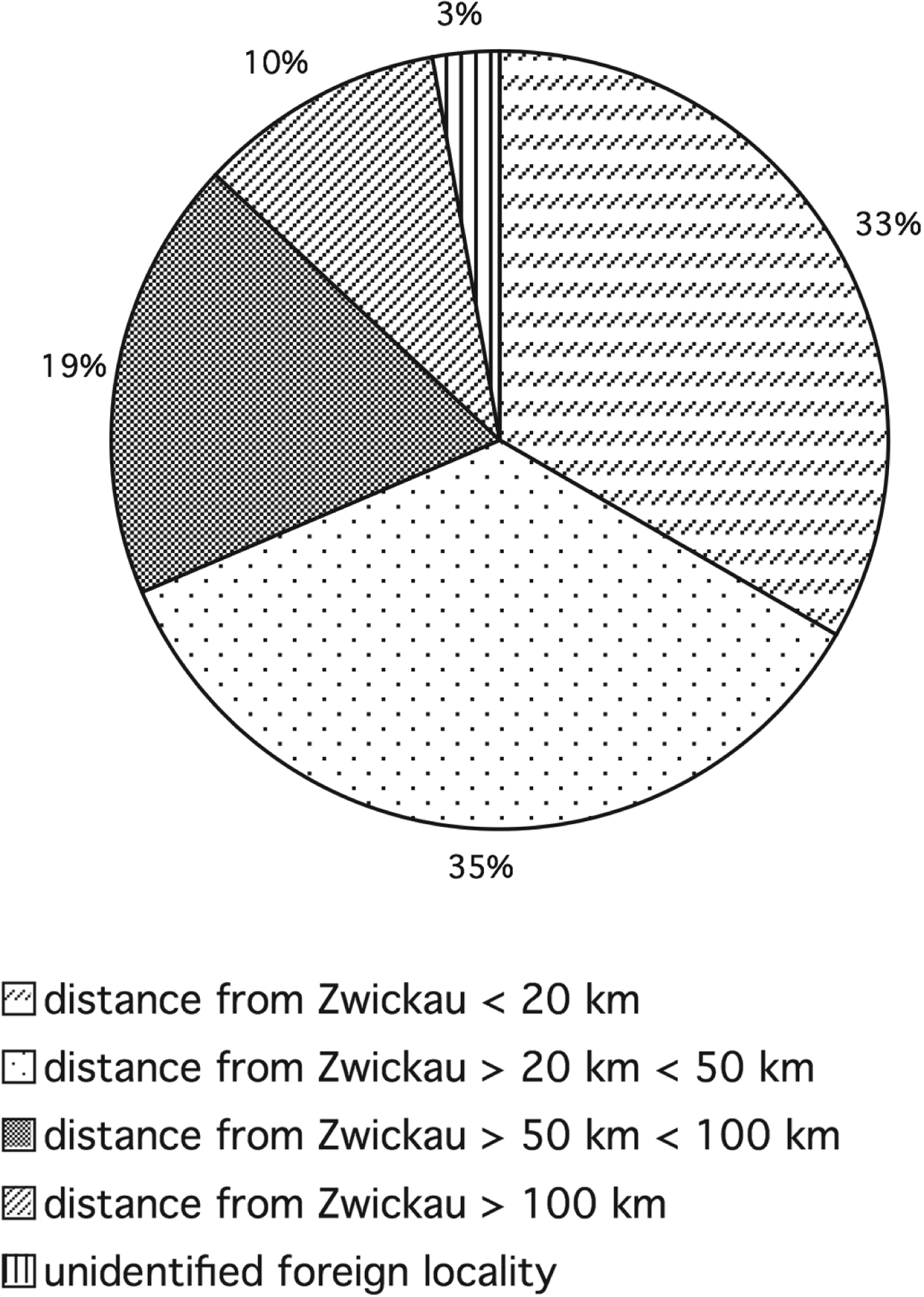
Of the 495 pupils for whom we have a place of origin, 325 came from Zwickau. If the pupils for whom no place of origin is given are assumed to have been from Zwickau, the disparity between local and foreign pupils is even higher, with 600 out of a total of 770 being locals. Except in a handful of cases, even the ‘foreigners’ were from Saxony or close-by Thuringia. The absolute majority of ‘foreign’ pupils came from the immediate surroundings of Zwickau. Of the 101 ‘foreign’ pupils from a total of 63 localities, 36 were from a radius of up to 20 kilometres from Zwickau, 38 from a radius between 20 and 50 kilometres, 20 from a radius of 50 to 100 km, and 7 from further afield (> 100 km). Of these 101 boys, 49 came from the mining communities of the Erzgebirge (Ore Mountains) immediately south of Zwickau. Only a handful of pupils from outside Zwickau appear in the lowest forms. Most were in the higher forms, despite their much smaller overall size. Indeed, in the Tertia and the Prima/Secunda, pupils from outside of Zwickau were actually in the majority. As a general rule, pupils enrolled in the lowest forms were therefore almost without exception Zwickauers.
Places from which pupils were drawn, including pupils from unnamed localities assumed to be from Zwickau.
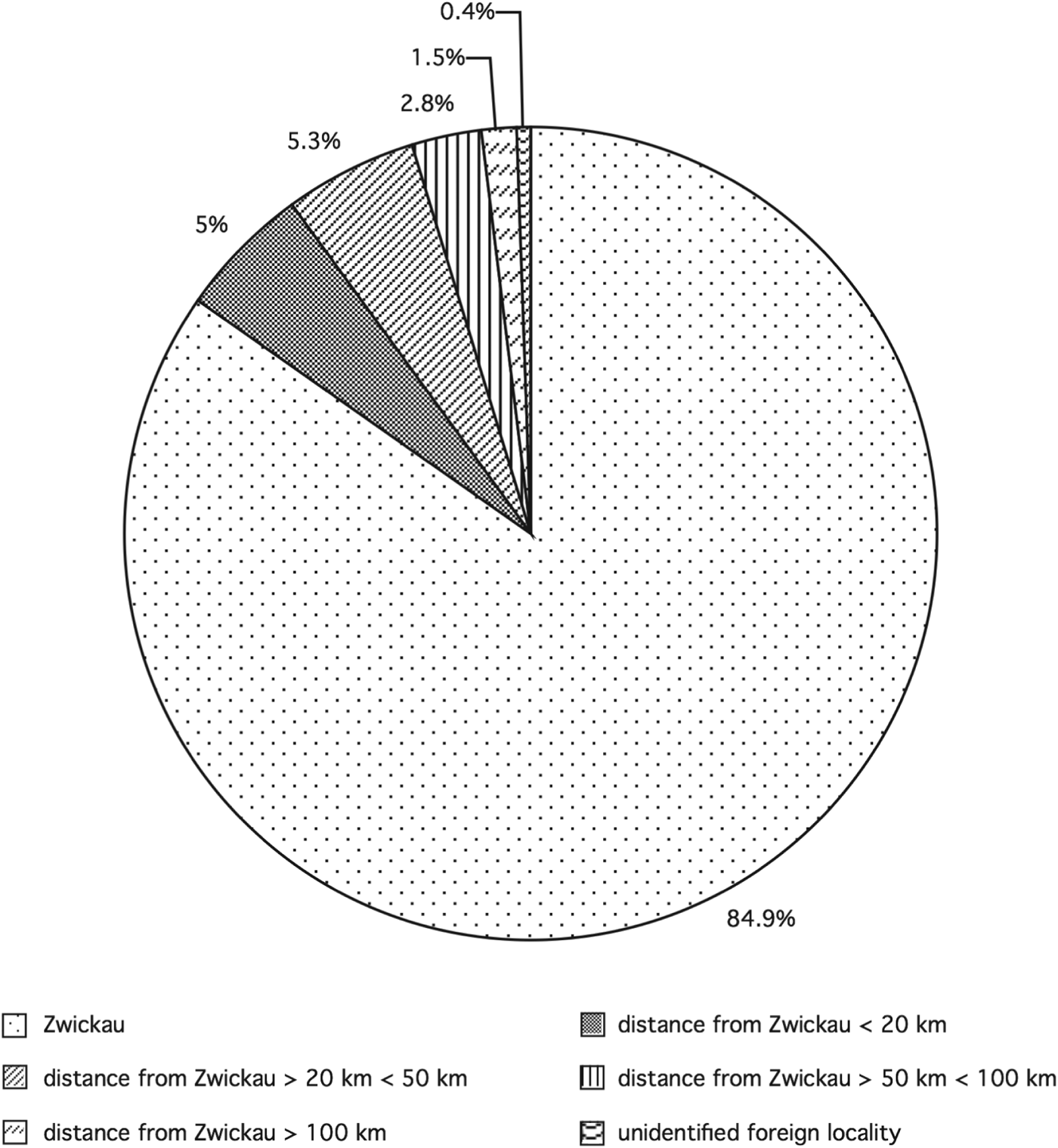
Total of ‘foreign’ pupils.
In the higher forms, there were as many from outside of Zwickau as from within. Also, the higher a form a foreign pupil was in, the more likely he was to come from further away. A total of seven pupils came from places more than 100 kilometres distant from Zwickau. Some came from other regions of Saxony, as did for instance Andreas Grempler (from Wittenberg). Two pupils came from Brandenburg, while another pupil, Philipp Schwenck, came from Frankfurt/Main. By far the most distant place of origin was that of Johannes Hanckel, who was listed as Transsilvanus.Footnote 39 The fact that Zwickau was part of Albertine Saxony did not dissuade pupils from other Protestant territories from attending the school. The actual distance to Zwickau was the most decisive factor in attracting pupils, as the largest group of pupils from other territories came from the Thuringian principalities close by. When choosing a school, pupils in the highest forms were, therefore, frequently mobile, and were prepared to cross territorial boundaries if they wanted to study at a particular school, but were relatively unlikely to travel further than a hundred kilometres from home.Footnote 40
But why did pupils go to school in another town? ‘Foreign’ pupils came to Zwickau later in their school careers. Already, the stark difference in size between the lowest two and the higher forms suggests that a dichotomy existed between the pupils of these forms. In order to find out more about these two groups and how they engaged with the school's educational offer, we need to examine their careers at the school in detail in conjunction with the school's curriculum.
V
The reconstruction of individual pupils’ careers show that, rather than progressing through the carefully devised curriculum, pupils made use of only parts of it in a highly selective manner. Only a small minority of pupils ever finished their schooling in Zwichau. Most boys left the school long beforehand. In fact, the absolute majority of pupils only ever had experience of one or two forms at the school. The higher a form a pupil was in, the more likely it was that he came from outside of Zwickau, and that he had studied at another school before coming to Zwickau. It was unusual for a pupil to have had a continuous career at the school and repeating a form was the rule rather than the exception. In fact, so common was it to change schools that, out of the sample of 770 pupils, only seven pupils who had begun their education in Zwickau also finished their schooling there!Footnote 41
Where did these pupils go when they disappeared off the Zwickau records? In the matriculation records, Daum frequently referred to pupils having either arrived from other schools or having left Zwickau to attend school elsewhere. In thirty-four cases, Daum recorded the locality of pupils who left his school prematurely, pupils tending to move to schools which were within a hundred kilometre radius, only one pupil venturing as far as Brunswick.Footnote 42 Naumburg and Altenburg were the favourites, Annaberg, Freiberg, Gera, and Schneeberg following close behind. With the exception of the Landesschule Gera (where only two pupils enrolled), these schools were all civic institutions.Footnote 43 Zwickau does not seem to have competed directly with the Saxon and Thuringian territorial schools (Fürsten- und Landesschulen), competition over pupils rather taking place among the Saxon and Thuringian civic Latin schools. There is also no evidence whatsoever that pupils crossed into Catholic territories to continue their education. Pupils had such a large number of institutions to choose from in Saxony and neighbouring Thuringia – well over a hundred civic Latin schools, territorial schools, and four universities – that there was evidently no good reason to stray outside of the Lutheran education system.
According to Gerald Strauss's portrayal of Lutheran education, there would have been little reason for such changes, since the basic content of early modern school curricula hardly diverged from each other.Footnote 44 To a modern observer, this was certainly true, as Latin school curricula generally scheduled pupils’ time in very similar ways and the range of subjects taught was very limited in comparison to that of an early twenty-first-century grammar or comprehensive school curriculum. Natural philosophy, courses on vernacular literature, history and sports were not taught at all, with arithmetic only making the odd appearance. Latin dominated the curriculum because the official function of schools was to prepare pupils for university, where Latin remained the exclusive language of instruction of all subjects until well into the eighteenth century (see Appendix).
Yet, subtle differences mattered immensely to early modern pupils. One of the factors that brought ‘foreign pupils’ to the Zwickau Latin school was that it had a longer tradition in teaching Greek than any other Saxon or Thuringian school. Apart from the differences in tuition apparent from curricula, the textbooks used also differed widely from one school to the next, allowing teachers to employ quite different teaching methods and often sneak in topics not officially sanctioned at the school. This was even more so the case as far as private tuition was concerned (often taught by the schoolteachers themselves and without which it was very difficult at some institutions to pass the end-of-year exam), prompting a prospective pupil of the Zwickau school to enquire ‘what authors are treated in the Prima as well as in private lessons’.Footnote 45
The considerable cost of keeping a boy housed, clothed, and fed in another town was also a factor which contributed to the fact that boys seldom stayed at one institution for the whole length of their school education. Narrative sources from other regions in Germany show that parents could often only afford to support their son in another town a couple of years at a time. In his memoir, the Hessian Johannes Grunelius devoted a whole section to complaining about the cost of keeping his son at school during the 1640s and 1650s, and relayed how he was only able to do so because his stepson was prepared to house and feed him. When his stepson moved from Frankfurt to Augsburg, his son needed to change schools, too.Footnote 46
Another reason that in all probability persuaded pupils to leave was the exceedingly long time it took to finish school in Zwickau, and the abundant choice of other schools in Saxony and Thuringia. In Germany, many pupils enrolled at university when they were only 12, 13, or 14 years old, though some pupils actually enrolled before they had left school. As we will see later on, by the time a pupil went on to university from Zwickau he was in his early twenties, and therefore considerably older than the average German student of the time. This was partly the case because other schools had fewer forms, and partly because challenging end-of-year exams stood in the way of pupils progressing swiftly through the six forms, earning the Zwickau school the terrifying nickname ‘the whetstone’ (Schleiffmühle).Footnote 47
VI
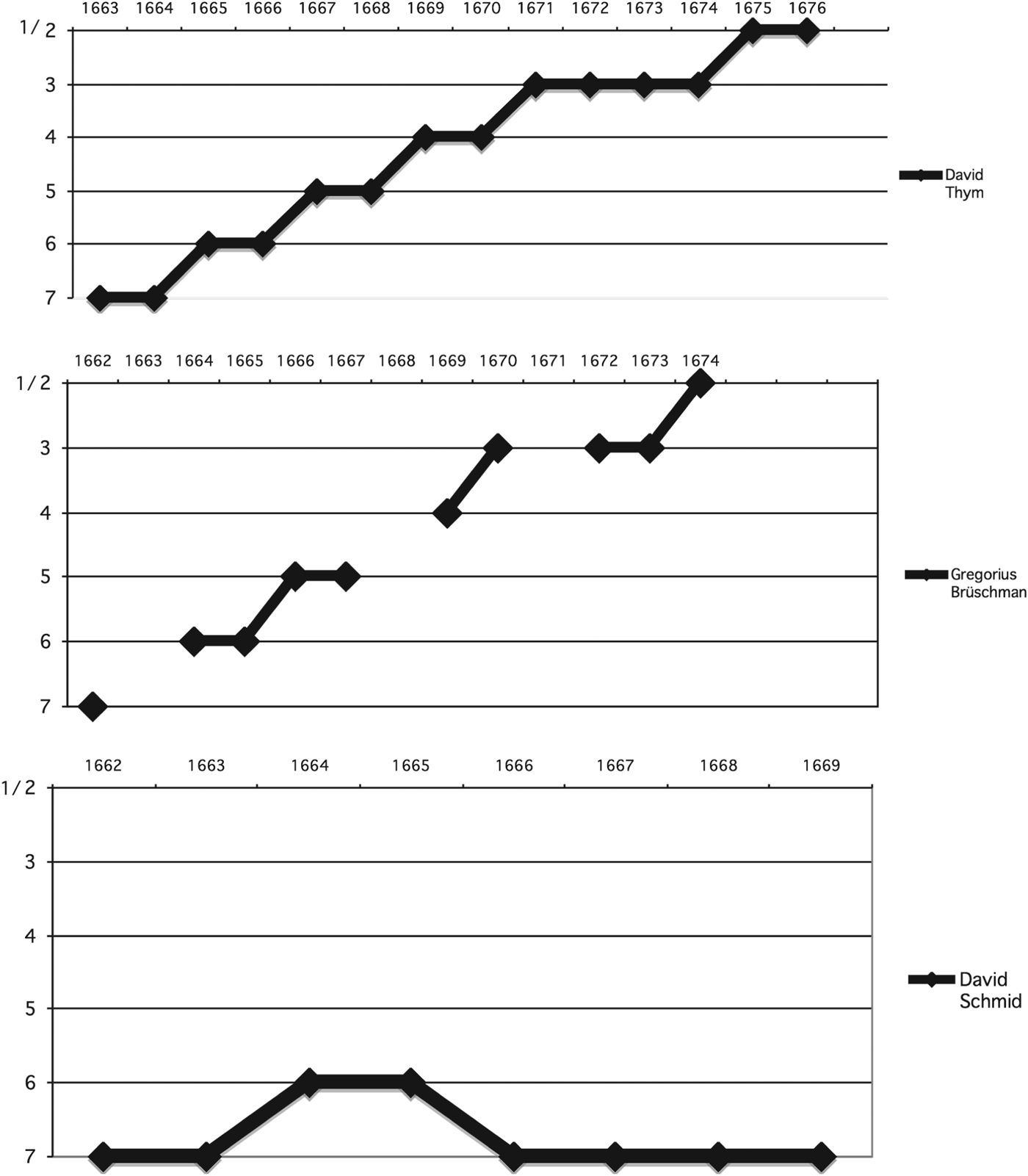
Just how different pupils’ approaches to exploiting the curriculum were is easiest to understand if the careers of three pupils are examined alongside each other. David Thym's career at the school, with its uninterrupted progression from the Septima to the Prima/Secunda, gives us a clear indication why most pupils chose to change schools at one time or another: it simply took too long to finish school in Zwickau. Thym spent two years each in the Septima, the Sexta, the Quinta, and the Quarta, and then four years in the Tertia and three in the Prima/Secunda. Altogether, it took him fifteen years to get through the six-year curriculum, even though his stays in the individual forms were not of above average length.
Gregorius Brüschman's career was two years shorter, helped by shrewd changes from one school to the next and back again. He was first enrolled in the Septima for a year in 1662, then reappeared two years later in the Sexta, where he stayed for three years. In 1667, he rose to the Quinta, but then disappeared off the records again, only to appear again in 1669, this time as a ‘novice’ in the Quarta, and within a year progressed to the Tertia, where he stayed for another three years. His stint in the Prima/Secunda lasted for two years until he left for Wittenberg. His thirteen-year school education, while by no means short by early modern standards, could presumably have been shortened further had he not returned to Zwickau for the highest forms through which even the fast pupils progressed more slowly than through the lower forms.
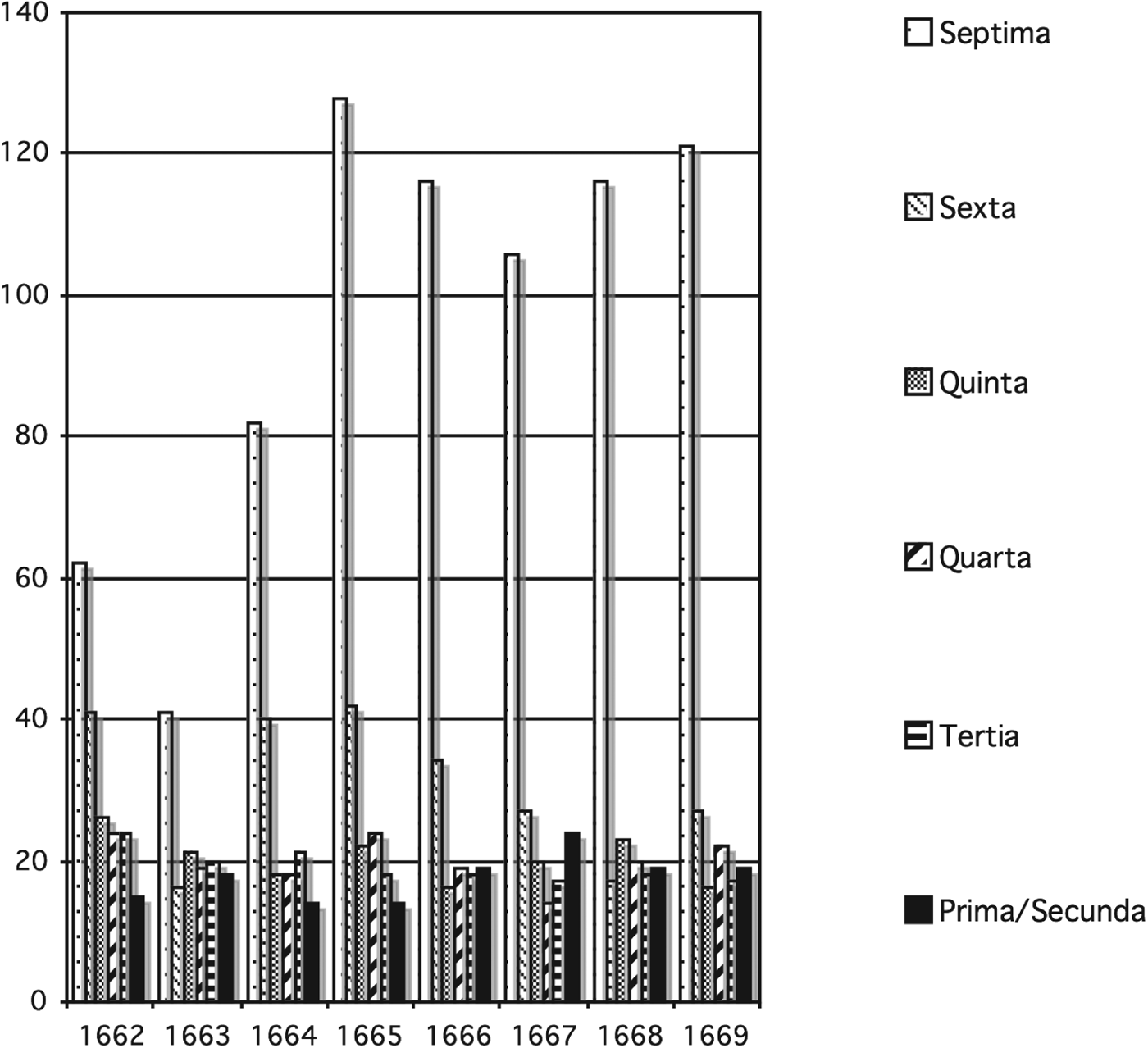
At the other end of the spectrum was someone like David Schmid, who did not progress beyond the second form (the Sexta), but nonetheless appears on the records of every year from 1662 to 1669. Enrolled in the Septima in 1662 and 1663, he then advanced to the Sexta in 1664, staying there for one further year until reverting to the Septima again, where he was still enrolled in 1669. Though rather unusual in the duration Schmid spent in the lowest two forms, he belonged to the majority of pupils who dropped out of the school at this stage and did not progress to the highest forms (see Figures 4 and 5).
Three very different careers: Thym, Brüschman, and Schmid (1/2 = Prima/Secunda).
Size of forms, 1662–9.
If the pupils’ matriculation behaviour is considered alongside the curriculum, the sudden drop in numbers after the Sexta becomes understandable.Footnote 48 The Septima was almost completely devoted to German reading and writing, the Sexta still maintaining several lessons in German. From the Quinta onwards, German does not appear on the curriculum at all. Those pupils who attended only the first two forms therefore appear to have been interested in learning to read and write in German, but not interested in staying on for the classical studies part of the curriculum. In other words, the student body was divided the way it was because the curriculum itself was divided. One segment was meant to teach basic reading and writing skills, and the other was designed to prepare pupils for university. Jan Amos Komenský is commonly credited with being the first to put into writing the pedagogical advantages of teaching in one form boys who wished to learn no more than reading and writing in the vernacular and those who would go on to learn Latin. In fact, in Zwickau as in other Protestant Latin schools, teaching vernacular reading and writing skills in the lowest form before moving on to Latin reading and writing was common practice from at least the mid-sixteenth century onwards. For a civic Latin school, this was a way of killing two birds with one stone: while the progression from reading in the children's mother-tongue to reading in Latin had widely been found to work well in practice, it also allowed teachers to broaden the appeal of their school and to attract pupils who wished only to learn rudimentary reading and writing skills. By so doing, Latin schools could compete directly with local German schools over the large market of entry-level education.Footnote 49
VII
Civic Latin schools have traditionally been described as elite institutions geared to preparing the sons of patricians for university.Footnote 50 The extent to which social mobility was possible through education in early modern Germany is still a question of debate. While some studies emphasize the fact that top positions in the clergy and in the regional administrations rarely went to anyone from humble backgrounds, others point to slower, less dramatic changes in social status which could, over several generations, gradually improve a family's social standing.Footnote 51 But were Latin school curricula only useful to a small percentage of boys from elite backgrounds? Who were these pupils? How old were they? Were they similar to each other in both age and background, or were there divergences?
These are questions which the matriculation records do not answer, apart from the fact that the background of the pupils was civic, and that the nobility did not send their sons to school in Zwickau. Though the von Bose family funded the construction of a boarding house, fit to house ten noble pupils and their servants, in 1710–12, and there was talk of re-fashioning the school into a noble academy (Ritterakademie), nothing ever came of it.Footnote 52
For the purpose of determining pupils’ age and social background, it was necessary to consult parish registers in addition to the matriculation records.Footnote 53 From 1669 onwards, Daum split the pupils of the Septima into three groups according to proficiency: the Abcdary, the Firmani, and the Duces. The sample used in this study for reconstructing the background of pupils in the Septima consists of the 59 Firmani of 1669, since their enrolment behaviour was most typical of pupils enrolled in the lowest forms. They were likely to have already spent a year or two at the school, but were relatively unlikely to stay for more than a further two years or to progress further than the Sexta.Footnote 54 Of the sample of 59 names of Firmani, it was possible to recover 48 in the baptism records.
The age difference among pupils of the Septima was considerable. The majority of pupils (38 out of 48) entered the school between the ages of six and nine. While this does suggest that there was a general consensus in Zwickau on the age at which boys should start their education, nothing stopped pupils from entering education much later, as the presence of one sixteen-year-old and three fourteen-year-olds among the Firmani shows. Just under half of the Firmani had previously spent at least a year at the school.Footnote 55 The remaining pupils had, therefore, progressed beyond the level of the Abcdary in less than a year, though it cannot be said if this was possible without previous education. According to the council minutes, pupils of the lowest forms frequently moved between the German corner schools and the Latin school, and it is also highly likely that some of them received basic teaching at home.Footnote 56
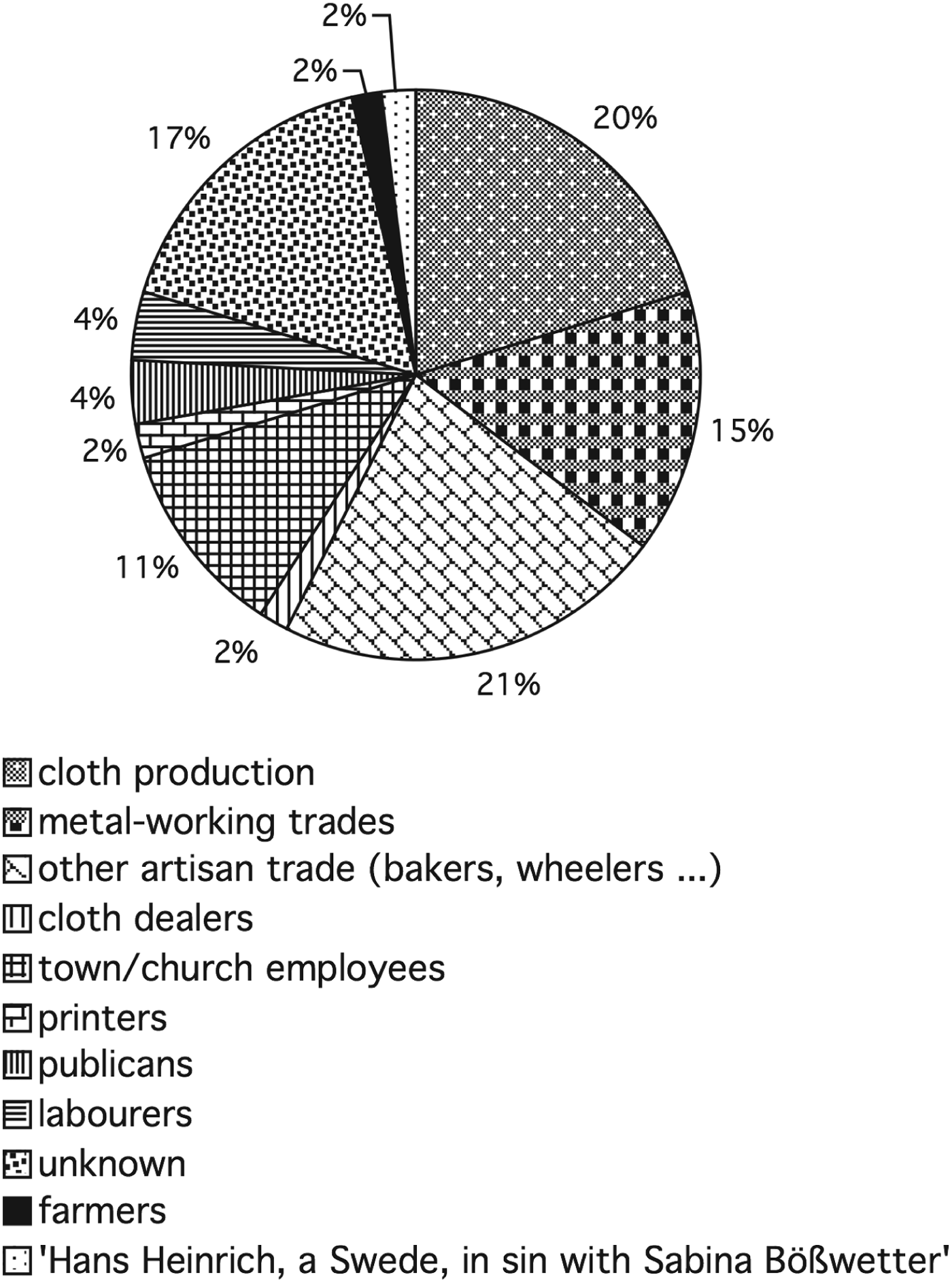
The baptism records of 47 Firmani also included a statement on the profession of the father, according to which the great majority of pupils were from an artisan background. The occupations of the pupils’ fathers actually reflected the distribution of trades among the urban populace fairly accurately.Footnote 57 Cloth production dominates as the largest single trade, with 20 per cent of the fathers working as artisans in the trade, and a single father working as a cloth-dealer. The proximity to the Erzgebirge is evident, in that 15 per cent of fathers worked as artisans in the metal-working trades in one way or another.Footnote 58 Men employed in cloth-production and metallurgy account for almost half of the overall number of artisan fathers, the rest of the artisans working in various trades, for instance as carpenters, bakers, and wheelwrights. The next group is that of civic employees, with two scribes, the postman, the town crier, and the cantor of St Catherine's. Two sons of publicans also feature among the Firmani, Carol Christian Volstädt and Fridrich Heg. Only Johann Seiffart had a farmer for a father (Andreas, Weitzenbauer (wheat farmer)); Johann's appearance among the Firmani was the only time he was enrolled at the school. The record of Johann Heinrich Eichhorn's baptism, which took place at St Mary's on 10 December 1659, is the most unusual of all. He is recorded as ‘the son of Hans Heinrich, a Swede, in sin with Sabina Bößwetter (father: Urban B., butcher)’.Footnote 59
Professions of fathers of Firmani, 1669.
As in the lower forms, boys whose fathers worked in the trades were in the majority in the Prima/Secunda.Footnote 60 Cloth-makers were again the largest group, followed by furriers, bakers, metal-workers, and carpenters. One boy's father was a soap boiler, and one a roper. A larger percentage of the boys’ fathers were educated in comparison to the lower forms. Of these, the only member of the patriciate was the lawyer Wolfgang Reyher, whose son Wolfgang Andreas would eventually become mayor in Zwickau.Footnote 61 The rest were lesser civic employees: four scribes, three clerics, and two teachers. The son of the messenger from nearby Grünhain, Paul Schilling, also attended the Prima/Secunda for several years, as did the sons of three labourers (two brewery labourers and one porter (Abläder)). Only one father, the leaseholder Georg Fritzsch, was involved in agriculture.
VIII
What careers did pupils eventually enter? When reconstructing the future careers of early modern students, historians have, quite naturally, focused on careers for which a particular education was a formal or semi-formal requirement such as the legal profession or Protestant ministry.Footnote 62
Since the Zwickau Latin school also offered vernacular education, career-paths were more diverse than for students. Judging by the fragmentary information that can be gleaned from burgher registers on the future careers of the pupils, boys who did not progress beyond the Sexta were very likely to enter the trade of their fathers. As we have seen, the predominant trades were related to cloth manufacture and metallurgy.Footnote 63 Boys often came from families in which several generations had worked within the same trade, and a disproportionate number of artisan fathers whose sons were enrolled at the Latin school occupied positions of prominence within their trade. Enrolling their sons at school presumably made sense to higher-echelon artisans, as solid reading and writing skills were of benefit to their sons if they were to take charge of the family business and take over positions of responsibility within their respective guilds.Footnote 64
If one takes into account how specialized and attuned to university curricula the subjects taught at Saxon Latin schools were, it is hardly surprising that the boys who went to the trouble of progressing to the highest forms are easily located in university matriculation records. The Zwickau pupils limited themselves to the three main Saxon and Thuringian universities: Leipzig, Wittenberg, and Jena.Footnote 65 Leipzig, Germany's largest university, was the most attractive choice since it was also conveniently close to Zwickau. About half as many pupils went to Jena, and fewer still to Wittenberg. None of the pupils appears to have enrolled in Erfurt, which, though also close by, was presumably a dubious choice because of its bi-confessionality and the abysmal state of its academic affairs by the mid-1600s.Footnote 66 Interestingly, it was common for pupils to have already been enrolled at university while still pupils in Zwickau. Some boys matriculated at university as many as ten years before they finished school and actually started studying.Footnote 67 Since they were not resident in the towns they enrolled in, early matriculation presumably made sense for Zwickau pupils not because of the privileges students enjoyed in university towns, but because they avoided the hated ritual of academic deposition.Footnote 68
Since Daum's matriculation records first and foremost contained information that could be of use to the development of his web of predominantly scholarly contacts, they only contained information on the future careers of pupils who had gone to university.Footnote 69 In almost all cases, the boys Daum mentioned had become colleagues of his, which was probably why he made a note of it: ‘now teaches boys in Zwickau’, or ‘May 1675: has become Co-Rector in Wittenberg’. It is very likely that Daum knew some of the boys’ fathers, as the note on Johann Philipp Steinbach who had ‘succeded his father as Ludimoderator [teacher of the lowest forms, my italics] in Stangengrün’ suggests. In other cases, parish registers yield information on their father's profession. Pupils whose fathers were employed in learned professions such as scribes, pastors, or teachers tended to take up similar lines of work, sons of teachers commonly becoming teachers or pastors. Yet just as common among future teachers or pastors were sons of artisans such as deacon-to-be Georg Nörner, the son of a soap boiler, or David Winter, the son of a baker who became schoolmaster in Wittenberg.
While these examples seen in isolation are not sufficient to say for certain whether education was a factor in social mobility in seventeenth-century Saxony, they fit in well with demographic data which suggests that, for future members of learned professions at least, it certainly was. The next generation of men in learned professions in Saxony often rose into the urban patriciate, most commonly through marriage. Even if employment in the administration of the church or a town did not pay very well, it did afford the bearer significant prestige, and could act as a springboard for the social advancement of the next generation. For the investment in education to be viable, however, there needed to be a market for graduates in post-Thirty Years War Germany. This seems to have indeed been the case. The war-time depletion of competent staff was without doubt a factor in this, but the educated professions had always recruited outside their ranks. In Saxony as a whole, only 20 per cent of scribes, ministers, and other educated civic and church employees were the sons of men in educated professions between the late sixteenth and early nineteenth centuries. Of all social groups, this was by far the lowest rate of regeneration from within its own ranks.Footnote 70 Social mobility into educated professions was, therefore, far more common in early modern Saxony than in France, where Julia and Frijhoff found only rare cases of social mobility that could be linked directly to education.Footnote 71
IX
Examining early modern pupils’ choices in conjunction with school curricula shows first to what extent they picked and chose from the educational offer of schools. Though school curricula were designed to provide a sensible progression from one stage of learning to the next, in practice pupils evidently compared the educational offer of a large number of institutions and approached curricula from the point of view of ‘modules’ rather than as holistic programmes that had to be followed from start to finish. This in turn suggests that the growing number of territorial regulations and ordinances meant to streamline pre-university education could achieve only very limited success. The great majority of schools continued to be funded by local communities, not territorial government, and were dependent on satisfying customer demand in an educational market that was very much defined by oversupply.
In the absence of obligatory schooling, only a strong incentive can explain why early modern pupils from diverse social backgrounds went to school and why they and their parents employed a wide range of strategies to make their education affordable. Particularly after the deluge of the Thirty Years War, but also before, the possibility of social mobility into the learned professions provided this incentive. Studies critical of the capacity for education to facilitate social advancement in early modern Germany have focused primarily on the careers and the social background of higher-level state bureaucracy. The social mobility that education made possible was a more subtle kind which in no way compared to the rare meteoric rises some men made in the clergy and the military in the seventeenth century.Footnote 72 It was a mobility of small steps, which turned cloth-makers’ sons first into students, then into village parsons, or metal-workers’ sons into schoolteachers.
This degree of mobility into learned professions in turn calls into question the narrative of the ‘estate of the learned’ becoming increasingly exclusive in the seventeenth century and the Republic of Letters being made up of a small hereditary elite. In fact, it was the permeability of the Republic of Letters that provided the backdrop to increasing attempts at demarcating lines of distinction among Republicans and between the ‘learned’ and the ‘unlearned’.
Appendix: Curriculum of the Zwickau Latin school, 1676