Introduction
Children's literature is an important resource for knowledge construction among young children. As they read the stories or have the stories read to them, children are presented with multiple ideologies and belief systems and this includes notions of masculinity and femininity (Taylor, Reference Taylor2003: 301). These ideologies are absorbed by young children and go on to influence their attitudes and behaviour as they participate in society. Perhaps for this reason, the reading of gender in children's literature has been an area that has drawn the interest of numerous researchers over the decades (Bender and Lach, Reference Bender and Lach1990; Collins, Ingoldsby & Dellman, Reference Collins, Ingoldsby and Dellman1984; Crabb & Bielawski, Reference Crabb and Bielawski1994; Dellmann-Jenkins, Florjancic & Swadener, Reference Dellmann-Jenkins, Florjancic and Swadener1993; Desai, Reference Desai2001; Dutro, Reference Dutro2002; Gooden & Gooden, Reference Gooden and Gooden2001; Kortenhaus & Demarest, Reference Kortenhaus and Demarest1993; Oskamp, Kaufman & Wolterbeck, Reference Oskamp, Kaufman and Wolterbeck1996; Poarch & Monk-Turner, Reference Poarch and Monk-Turner2001; Turner-Bowker, Reference Turner-Bowker1996; Weitzman et al., Reference Weitzman, Eifler, Hokada and Ross1972). These studies have generally pointed to evidence of sexism, that is, the denigration of females realised in tandem with the exaltation of males (Ivy & Backlund, Reference Ivy and Backlund1994: 72).
In recent years, locally published children's storybooks in the English language have been making their presence felt in Malaysian bookstores. They are increasingly found alongside the more established canon of Western children's literature. This has primarily been driven by national education policies that emphasize the importance of the English language to Malaysians. For many parents, the readily available and far cheaper Malaysian children's books have become a popular resource for helping their children get a head start in mastering the English language. However, the dramatic increase in the publication of such books gives rise to concerns about their quality, which is largely left unchecked (Desai, Reference Desai2006: 169). Considering the role that children's literature plays in helping children construct notions of their identity, there is obviously a pressing need for these books to be evaluated for sexist messages. However, before gender can be evaluated, the question of how best to identify and evaluate gender in children's texts has to be addressed.
Critical Discourse Analysis and the reading of gender
In a review of past research on reading gender in children's literature, Clark (Reference Clark2002) observes that a large number of studies focused on the representation of gender in children's literature through a type of content analysis that he refers to as the work of ‘liberal feminist social scientists’. In all those studies, gender representation was evaluated by looking at the frequencies of certain occurrences. For example, counting the frequency with which male and female characters were portrayed as main characters, or the frequency with which they appeared in illustrations. However, Clark (Reference Clark2002: 287) is critical of such studies and calls on researchers to move away from merely counting such occurrences and instead to pay greater attention to ‘nuances of expression’ and to ‘hear a variety of voices’ within the texts. This is clearly a call to accord more attention to the role of language, which is the primary aim of this paper. It is for this reason that we adopt Critical Discourse Analysis (CDA) as an approach for reading sexism in texts.
CDA is an approach to research that has as its ‘underlying commitment’ a desire ‘to understand how social inequalities are reflected and created in language’ (Pennycook, Reference Pennycook and Toolan2002: 41). Indeed, language is viewed within a CDA framework as ‘a primary force for the production and reproduction of ideology’ (Bucholtz, Reference Bucholtz, Holmes and Meyerhoff2003: 57).
The aim of the research
The aim of this study is to identify the linguistic means employed to position characters and their relationships with each other in a selection of English language texts targeted at young Malaysian children (Knowles & Malmkjaer, Reference Knowles and Malmkjaer1996: 34). It cannot be denied that the study of language and gender is a feminist issue because it is usually women who are victims of sexist practices (Swann, Reference Swann, Bonner, Goodman, Allen, Janes and King1992). Grounded in this assumption, this study is interested in examining how a female protagonist is linguistically positioned in relation to other male characters playing supporting roles in a popular Malay folktale.
Data and method
This paper reports part of a larger study that analysed gender construction in a selection of 69 texts through a content analysis and an analysis of written and visual language. The texts were selected based on specific guidelines that were set to ensure that all the texts were targeted at young Malaysian children between the ages of five and eight. For example, the selected texts had to have at least one illustration on every other page. The selected texts were further evaluated by two experienced primary school teachers to ensure that they were appropriate for Malaysian children within the said age group.
While every effort was made to include as many texts as possible with main characters who were female, only twelve such texts were found. Based on the type of content analysis that has been carried out numerous times in the past to identify gender representation in children's literature, these twelve texts would have stood out as being texts that positioned female characters well (Clark, Reference Clark2002). They are, after all, the few texts in the corpus that had females in the role of the main character. However, merely having more females as main characters, or having females appear more times than males in the accompanying illustrations, does not necessarily translate into better female representation. In fact, sexism could more effectively be transmitted through less obvious markers, as is stressed by Fairclough (Reference Fairclough2001: 71), who submits that ‘ideology is most effective when its workings are least visible’.
It is for the purpose of unpacking the subtle transmission of sexism that the present study undertakes a transitivity analysis. The text selected for analysis is The Princess of Mount Ledang by Sulaiman Zakaria (n.d.). It is perhaps one of the most famous Malay folktales with a female protagonist. Because of its popularity, several versions of the story are in circulation as different writers interpret and choose to foreground and background events differently. The linguistic construction of characters along gender lines is not just visible through the analysis of lexical choices, but also comes through in the representation of what the characters are found to be doing in the clause structures. The assumption is that the main character, in this case, the Princess of Mount Ledang, would be accorded a more active and powerful role in the story.
Halliday (Reference Halliday1985) proposes the analysis of ‘transitivity schemes’ in clause structures to unpack the positioning of social actors as they are depicted in events and actions. Transitivity has frequently been studied within critical linguistics, since it places elements such as actors, processes, goals and recipients in relation to each other. In so doing, a transitivity analysis aids researchers in determining ‘the degree of active, powerful, controlling engagement’ of social actors in texts (Toolan, Reference Toolan1998: 89). Determining the role of the social actors within clause structures helps in determining the ‘ideologically significant’ choices that have been made to code ‘happenings or relationships in the world’ (Fairclough, Reference Fairclough2001: 100).
The various processes in which social actors are found in clause structures include:
• Material process. This is where an ‘Actor’ performs the action in which a ‘Goal’ is at the receiving end of that action. By virtue of being placed in subject position, the ‘Actor’ is generally regarded as being in the more powerful position.
• Mental process. In this process, social actors exhibit feelings or mental reactions (love, hatred), perceptions (sight, hearing), and cognition (ability to consider, believe). The social actors take on the role of a ‘Senser’ (the conscious one doing the thinking, feeling or perceiving) and a ‘Phenomenon’ (that which is reacted to or thought about).
• Behavioural Process. In this intermediary process, the ‘Behaver’ is the grammatical subject who takes on the role of a ‘Senser’ involved in a process of doing (as in a Material Process).
• Relational Process. In this process, the subject is the ‘Carrier’ of certain attributes in clause structures, entailing the use of intensive verbs and verbs indicating possessive or circumstantial relations.
• Verbal Process. This is a process that includes verbs of saying or telling. The participants' roles include a ‘Sayer’ (the one who speaks), ‘Target’ (the one to whom the speech is aimed) and ‘Verbiage’ (that which, or the person who, is talked about).
• Existential Process. This process is found in clause structures which begin with the word there and it is realised in a clause that indicates the existence of something.
The aim of this paper is two-fold. The first one is to identify the transmission of gender messages through the positioning of social actors in clause structures. Second, by identifying the social actors who are accorded positions of power and control, we aim to illustrate how a CDA approach that foregrounds the role of language augments the type of content analysis that has been relied upon by liberal feminist social science researchers of the past. Both aims will be accomplished through a transitivity analysis of Sulaiman Zakaria's (n.d.) Princess of Gunung Ledang.
Findings and discussion
The text under scrutiny is a popular Malay folktale – that of a fairy princess living on Mount Ledang. As with other folktales that have been passed from one generation to another, this version of the story is just one of several interpretations. In this version of the story, a fairy princess becomes the subject of interest of a Sultan whose wife had recently passed away. During a time when he mourns the death of his wife and is thinking of his two children who are without a mother, the princess suddenly appears in his dreams. When noblemen are sent to ask for her hand in marriage, the princess (who disguises herself as an old woman) sets several difficult conditions, including having delivered to her seven trays of mosquitoes' hearts, a jar of young girls' tears, and a bowl of blood from the Sultan's own son. The Sultan decides to fulfil her demands and as a result, his people suffer. As he is about to take the life of his son, the princess appears before him and tells him that she cannot marry someone who has made his people suffer and is willing to take his son's life.
In this version, the Sultan is portrayed as a man driven by lust, as it is the princess' beauty alone that drives his actions. Meanwhile, the princess comes across as a temptress. She appears uninvited in the Sultan's dream and seduces him at a time when he is vulnerable. He finds himself alone again after the death of his wife and is sad for his children who are without a mother. The seduction is so overpowering that he is willing to kill his own son.
In this analysis of Sulaiman Zakaria's (n.d.) version of the story, all clauses that position the Princess of Mount Ledang (both as her true self and in her other form as an old woman) and Sultan Mahmud Shah, who plays a supporting role in the story, are selected for analysis and discussion. They are analysed based on the processes and participant types proposed by Halliday (Reference Halliday1985). A total of 31 clauses are found in the text and are categorised according to processes and participant types.
Material process
A total of six clauses were found to reflect the material process, that is, actors performing actions. They are as follows:
(1) Once upon a time (Circumstance), the state of Malacca (Range) was ruled by (Material Process) Sultan Mahmud Shah (Actor).
(2) The Princess (Actor) suddenly (Circumstance) disappeared (Material Process).
(3) Tun Mamat (Actor) approached (Material Process) the old lady (Range).
(4) That night (Circumstance), the Sultan (Actor) quietly (Circumstance) entered (Material Process) Raja Ahmad's room (Range) with a kris (Instrument).
(5) The Princess of Mount Ledang (Actor) suddenly (Circumstance) appeared (Material Process) before him (Circumstance).
(6) She (Actor) then (Circumstance) vanished (Material Process).
An examination of the six material process clauses in examples (1)–(5) reveals that three had the Princess of Mount Ledang in the supposedly more powerful subject position of actor. However, it must be noted that although she is made participant of active verbs in clauses (2), (5) and (6), she is part of happenings in which she appears and disappears, rather than actually actively doing something to someone or something else. Since it is this act of doing that carries with it the notion of greater active and controlling participation (Halliday, Reference Halliday1985: 103), the princess has clearly not been accorded a position of power in these material process clauses.
The idea of active participation comes across in clauses (1), (3) and (4) where the actors are male. Although the state of Malacca in (1), the old lady in (3) and Raja Ahmad's room in (4) are not goals of the respective verbs, they all ‘stand in a particular semantic relationship to the Process’ (Halliday, Reference Halliday1985: 134) and so accord an active role for the social actors in subject position. In clause (1), Sultan Mahmud Shah is positioned as the one who rules the state of Malacca, while in clause (3), Tun Mamat, a male minor character in the text, is the one who approaches the princess (in disguise as the old lady). In clause (4), it is again the Sultan who enters his son's room with the intention of killing him. Therefore, it is the male characters who appear to be playing a more significant role in the story.
Mental process
A total of five clauses were found to reflect the mental process, that is, clauses which contain verbs of feeling or mental reaction, perception and cognition. They are as follows:
(7) The Sultan (Senser) could not stop thinking (Mental Process) about the Princess of Mount Ledang (Phenomenon).
(8) He (Senser) had fallen in love (Mental Process) with her (Phenomenon).
(9) [He] (Senser) wanted (Mental Process) to marry her (Phenomenon).
(10) The Sultan (Senser) thought to himself (Mental Process), ‘I have no choice but to sacrifice my son in order to have my wish come true’ (Quoted).
(11) The Sultan (Senser) was filled (Mental Process) with remorse and shame (Phenomenon).
In identifying clauses that reflect mental processes, it was found that every clause had the male supporting character in the active subject position. It is through the Sultan's feelings, thoughts and perception that the reader effectively sees the development of the story. Also, clauses (7), (8) and (9) clearly position the Princess of Mount Ledang as the object of the Sultan's desires. He constantly thinks about her, falls in love with her and wants her. Nowhere in the text do we see the mental processes of the princess herself. Although she is the main character, her own thoughts about the Sultan and the marriage proposal are unclear. The linguistic positioning of the princess is clearly reduced to that of a temptress. Mental processes are important because they signify that readers are meant to see the unfolding of events through the eyes of the Senser (Shakila Manan, Reference Manan2001:39), and in the case of this text, it is through the lens of a male character. The positioning of the Sultan as the only Senser in the text also reflects the fact that the Sultan was indeed the ‘psychological subject’ of the text, that is, the character foremost in the writer's mind (Halliday, Reference Halliday1985: 33). In contrast, the princess disappears into the background though she is the main character.
Behavioural process
Of all clauses in which the Princess of Mount Ledang and Sultan Mahmud Shah are found, a total of five clauses were identified as reflecting the behavioural process. They are as follows:
(12) One night (Circumstance), the Sultan (Behaver) dreamed (Behavioural Process) of a very beautiful princess (Circumstance).
(13) The Sultan (Behaver) tried to get closer (Behavioural Process) [to the princess] (Circumstance).
(14) The Sultan (Behaver) would also have to prepare (Behavioural Process) seven trays of mosquitoes' hearts, a jar of young girls' tears, and a bowl of blood from his own son, Raja Ahmad! (Circumstance)
(15) The Sultan (Behaver) was eagerly awaiting (Behavioural Process) their arrival (Circumstance).
(16) On hearing about the conditions (Circumstance), the Sultan (Behaver) frowned (Behavioural Process).
Again, in every clause, it is Sultan Mahmud Shah, the supporting character, who is accorded the more powerful subject position. Because of his being placed in subject position, the clause is essentially about his behaviour and he is therefore placed foremost in the reader's mind as the story develops. The behavioural processes shed more light on the Behaver. In this text, it appears that readers have greater opportunity to learn more about the male character in a supporting role compared to the female character in a lead role. The fact that the princess has not been constructed as a Behaver suggests that her character is relatively less developed compared to the Sultan.
Relational process
Clauses of relational process are significant because it is through such clauses that readers see the development of the characters in the story. In this text, a total of four clauses were found to reflect the relational process. They are as follows:
(17) [Sultan Mahmud Shah] (Carrier) was (Relational Process) married (Attribute) to the Princess of Pahang (Circumstance).
(18) He (Identified) was (Relational Process) the proud father of two princesses and the only prince, Raja Ahmad (Identifier).
(19) The Sultan (Carrier) was (Relational Process) very sad and depressed (Attribute) for quite some time (Circumstance).
(20) The Princess (Identified) was known to be (Relational Process) a fairy (Identifier).
Children's stories are by nature brief. As such, characters in these texts are generally not as developed as characters in other types of texts such as literary texts targeted at adults. However, one would expect a certain degree of character development, especially of the protagonist, as one would expect writers to have the main character in a story foremost in their minds.
However, the clause structures above (17 to 20) reveal that only one of the four clauses typifying a relational process had the princess in subject position and this was a clause that tells readers that she is a fairy (clause 20). In contrast, the Sultan in a supporting role appears to be relatively more rounded as readers are provided with a greater amount of information about him, including the fact that he was previously married, has two children, and that he was sad and depressed after his wife died. Again, the findings suggest that the ‘psychological subject’ is indeed the Sultan, not the Princess of Mount Ledang (Halliday, Reference Halliday1985).
Verbal process
As young children are the target audience, a large part of the story develops through verbal processes, especially those with direct speech. In examining the clause structures for verbal processes, the researchers were interested in determining the number of times the female protagonist and the male supporting character are accorded the role of Sayer – the one who does the talking, and the type of process that is involved. An examination of the text revealed the following clauses containing verbal process:
(21) The Sultan (Sayer) said (Verbal Process) sorrowfully (Circumstance) to his officials (Recipient), ‘My poor children, to lose their beloved mother while they are so young!’ (Quoted)
(22) ‘I'm the Princess of Mount Ledang,’ (Quoted) said (Verbal Process) the smiling Princess (Sayer).
(23) ‘I think it is time for me to get married again,’ (Quoted) said (Verbal Process) the Sultan (Sayer) to the officials (Recipients).
(24) The Sultan (Sayer) then (Circumstance) related (Verbal Process) his dream (Verbiage) to the officials (Recipients).
(25) He (Sayer) ordered (Verbal Process) General Tun Tuah (Target) to lead a team (Circumstance) to forward his proposal of marriage to the Princess of Mount Ledang (Verbiage).
(26) [He] (Sayer) told (Verbal Process) her (Recipient) about their mission (Verbiage).
(27) The old lady, who was actually the Princess of Mount Ledang in disguise (Sayer), said (Verbal Process), ‘The princess agrees to marry the Sultan of Malacca but only after His Majesty has fulfilled several conditions.’ (Quoted)
(28) The old lady (Sayer) then (Circumstance) explained (Verbal Process) that the Sultan had to build a bridge made of gold and silver to link the state of Malacca to Mount Ledang (Verbiage).
(29) He (Sayer) asked (Verbal Process) excitedly (Circumstance), ‘Has the Princess of Mount Ledang accepted my proposal?’ (Quoted)
(30) [He] (Sayer) finally (Circumstance) said (Verbal Process), ‘I shall fulfill all her conditions.’ (Quoted)
(31) She (Sayer) said (Verbal Process), ‘I did not think that Your Majesty could be so cruel. You made your people suffer and now you are willing to kill your own son, all because you wish to marry me. We could never marry such a person!’ (Quoted)
It was found that seven of the eleven clauses typifying verbal processes are of Sultan Mahmud Shah as the Sayer. This again reflects the more dominant role accorded to him in the story compared to the Princess of Mount Ledang. While most exchanges involved processes represented by verbs such as said, asked and told, clause (25) is an instance where the Sayer, in this case Sultan Mahmud Shah, ‘is acting verbally’ on General Tun Tuah when he orders Tun Tuah to forward his marriage proposal (Halliday, Reference Halliday1985: 130). The verb orders is clearly one of authoritative power and in this text, it is accorded to the male supporting character.
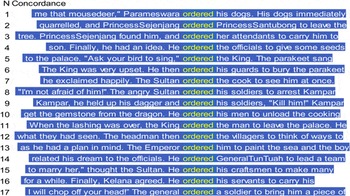
A search for similar instances of this particular verbal process across the larger corpus of sixty-nine texts reveals that the verb ordered is reserved primarily for male Sayers and this is reflected in Table 1.
Collocations of the verb ordered with Sayers

In Table 1, concordance lines N2 and N3 are the only instances where a female character orders. Both are from another popular Malaysian folktale with a female protagonist, entitled Princess Santubong. However, it is interesting to note that the recipients of this act, in both instances, are other female characters. The suggestion appears to be that verbs such as order are masculine acts and it is therefore unthinkable for a female character, even a princess, to order men.
Conclusion
Informed by a CDA approach to reading texts, this paper has attempted to unpack the linguistic means by which writers of children's stories ‘support’, consciously or otherwise, ‘particular relationships of domination’ (Knowles & Malmkjaer, Reference Knowles and Malmkjaer1996: 46). Based on Halliday's framework for analysing the positioning of social actors in clause structures, it was found that the male characters in supporting roles were more frequently accorded the more powerful subject position of ‘Actor’, ‘Senser’, ‘Behaver’ and ‘Carrier’. Furthermore, even when the female main character was accorded subject position in material processes, it was found that she was never portrayed as the one who ‘directs and extends’ an act onto someone else. Instead, she was merely a part of happenings that accord her no real sense of power.
The examination of the text undertaken in this paper should serve to alert the gatekeepers of knowledge for young children such as parents, teachers and even curriculum developers who are responsible for selecting appropriate reading texts for children. The mere inclusion of stories with female protagonists does not guarantee that children have access to texts that fairly represent both genders. Clark's (Reference Clark2002) criticism of previous studies that relied heavily on content analysis is justified. Relying on a more critical approach that examines the workings of language beneath the surface level in children's texts provides insights into how messages about gender roles are transmitted subconsciously.
When selecting a storybook such as The Princess of Mount Ledang, many parents and even teachers probably think that this is a text that would allow children, both girls as well as boys, to read a story about a female protagonist. In the case of Malaysian children's literature, this is a rarity. Of the 69 English language texts that were selected as part of the larger study that we referred to in the Data and Method section of this paper, only 12 had main characters who were female. However, as the transitivity analysis offered in this paper demonstrates, reading a story with a main character who is female does not necessarily translate into an opportunity to learn that power and authority can also be ascribed to women. As a result, even the few opportunities that we have to expose our children to stories about strong, intelligent women are lost. There is no doubt that The Princess of Mount Ledang can indeed be an excellent story that teaches children about intelligent women in control of their destiny. In another version of the same story by Kay Lyons and Martin Loh (Reference Lyons and Loh2004), the Princess of Mount Ledang is portrayed as a woman who treasures her freedom and does not want to get married. Her demand for items such as the hearts of mosquitoes was merely a ploy to rid herself of the Sultan's advances. We suggest that female characters in Malaysian folktales such as The Princess of Mount Ledang offer a global audience a much better alternative to the more popular female characters from western fairytales such as Cinderella and Snow White. However, this is on condition that the right choices are made in telling the story. In the case of Sulaiman Zakaria's (n.d.) version of the story that was examined in this paper, the same princess is disempowered and reduced to an insignificant character as a result of linguistic choices.
It might be argued that a transitivity analysis is pointless when reading children's texts because children, and for that matter most adults, would not be able to deduce that female characters lack positions of power and authority in clause structures. However, herein lies the power of language in disseminating ideology. We must revisit Fairclough's (Reference Fairclough2001: 71) assertion that the transmission of ideology is ‘most effective when its workings are least visible’.
 RAMESH NAIR is Associate Professor at the Academy of Language Studies, Universiti Teknologi MARA Malaysia. His primary research focus is on language and the construction of identity. Drawing on Critical Discourse Analysis, he is especially interested in unpacking the representation of gender and ethnicity in texts. His more recent research collaborations have allowed him the opportunity to explore the evolution of English language education in Malaysia. He welcomes cross-border research opportunities in these areas. Email: ramesh@salam.uitm.edu.my
 ROSLI TALIF is Associate Professor of English Studies at the Faculty of Modern Languages and Communication, Universiti Putra Malaysia. His main interests include issues in literature and gender, gender roles in literature and the media, gender concerns in children's literature, and language policy and planning in Malaysia. His publications interlink language and literature while re-examining existing paradigms that affect the way we conceptualize the roles, functions, and developments of language and literature in society. Email: rosli@fbmk.upm.edu.my