Introduction
Impulsivity plays a critical role in the establishment and maintenance of drug addiction (Belin et al. Reference Belin, Mar, Dalley, Robbins and Everitt2008, Reference Belin, Berson, Balado, Piazza and Deroche-Gamonet2011; Everitt et al. Reference Everitt, Belin, Economidou, Pelloux, Dalley and Robbins2008; Bird & Schenk, Reference Bird and Schenk2013). Recently, studies have begun to examine whether increased impulsivity among substance-dependent individuals (SDIs) is also associated with a greater propensity to relapse following treatment discharge (Bowden-Jones et al. Reference Bowden-Jones, McPhillips, Rogers, Hutton and Joyce2005; Passetti et al. Reference Passetti, Clark, Mehta, Joyce and King2008, Reference Passetti, Clark, Davis, Mehta, White, Checinski, King and Abou-Saleh2011; De Wilde et al. Reference De Wilde, Verdejo-Garcia, Sabbe, Hulstijn and Dom2013; Stevens et al. Reference Stevens, Verdejo-Garcia, Goudriaan, Roeyers, Dom and Vanderplasschen2014). Given that impulsivity is amenable to treatment (Alfonso et al. Reference Alfonso, Caracuel, Delgado-Pastor and Verdejo-García2011; Bickel et al. Reference Bickel, Yi, Landes, Hill and Baxter2011), a better understanding of its involvement in relapse propensity may have important clinical implications.
Impulsivity, however, is a multidimensional construct, which includes different biologically based and heritable components (Evenden, Reference Evenden1999; Whiteside & Lynam, Reference Whiteside and Lynam2001; Dawe & Loxton, Reference Dawe and Loxton2004; Reynolds et al. Reference Reynolds, Ortengren, Richards and de Wit2006; Mole et al. Reference Mole, Irvine, Worbes, Collins, Mitchell, Boltoni, Harrison, Robbins and Voon2014). Often, a distinction is made between personality-based and neurocognitive dimensions (Goudriaan et al. Reference Goudriaan, Oosterlaan, De Beurs and van Den Brink2008; Sharma et al. Reference Sharma, Clark and Markon2014). From a personality perspective, impulsivity is generally perceived as a trait that is fairly stable over time and evident across a range of situations. Dimensions of trait impulsivity are manifold and include: (1) lack of premeditation; (2) lack of perseverance; (3) sensation or novelty seeking; and (4) difficulties in resisting strong impulses driven by negative or positive affect (i.e. urgency) (Zuckerman et al. Reference Zuckerman, Eysenck and Eysenck1978; Eysenck & Eysenck, Reference Eysenck and Eysenck1985; Patton et al. Reference Patton, Stanford and Barratt1995; Whiteside & Lynam, Reference Whiteside and Lynam2001). Trait impulsivity is typically measured using self-report questionnaires, which assess subjective views and include questions that cover broad periods of time. From a neurocognitive perspective, impulsivity is generally perceived as a transitory state, sensitive to environmental and personal influences. As a state, impulsivity is typically assessed using neurocognitive tasks, which measure specific behavioural processes (Verdejo-Garcia et al. Reference Verdejo-Garcia, Lawrence and Clark2008). Often, a distinction is made between two neurocognitive expressions of impulsivity: impulsive action and impulsive choice (Winstanley et al. Reference Winstanley, Eagle and Robbins2006). The former refers to poor inhibitory control and the latter refers to impulsive decisions, often due to a distorted evaluation of delayed consequences (Dalley et al. Reference Dalley, Everitt and Robbins2011). The distinction between impulsive action and impulsive choice has been justified by animal studies showing that both constructs are involved in distinct stages of the addiction cycle and recruit different brain circuitries and may be susceptible to distinct pharmacological influences (Diergaarde et al. Reference Diergaarde, Pattij, Poortvliet, Hogenboom, de Vries, Schoffelmeer and De Vries2008; Paterson et al. Reference Paterson, Wetzler, Hackett and Hanania2011; Broos et al. Reference Broos, Diergaarde, Schoffelmeer, Pattij and De Vries2012). Accordingly, an examination of the relative contribution of separate aspects of impulsivity to the propensity to relapse in drug users could lead to the development of more specific therapies to improve addiction treatment outcomes. Still, the majority of previous studies have treated impulsivity unilaterally (see Stevens et al. Reference Stevens, Verdejo-Garcia, Goudriaan, Roeyers, Dom and Vanderplasschen2014). Similarly, personality and neurocognitive research traditions on impulsivity have historically remained largely independent (Sharma et al. Reference Sharma, Clark and Markon2014), despite evidence suggesting that self-report and neurocognitive assessments of impulsivity represent different levels of analyses (Reynolds et al. Reference Reynolds, Ortengren, Richards and de Wit2006; Sharma et al. Reference Sharma, Clark and Markon2014). Whereas preliminary evidence in pathological gamblers suggests that neurocognitive indices of impulsivity may be more promising in the prediction of relapse than personality-based self-report questionnaires (Goudriaan et al. Reference Goudriaan, Oosterlaan, De Beurs and van Den Brink2008), it remains largely unknown whether each assessment strategy is tapping unique variance in relapse. Another notable limitation of previous studies on the relationship between impulsivity and relapse is that potential mediating effects of treatment retention, i.e. the number of days spent in treatment, have rarely been taken into account. Given the growing evidence indicating that impulsivity negatively affects treatment retention on the one hand (see Stevens et al. Reference Stevens, Verdejo-Garcia, Goudriaan, Roeyers, Dom and Vanderplasschen2014), and the robust association between retention and post-treatment relapse on the other hand (Zhang et al. Reference Zhang, Friedmann and Gerstein2003), apparent effects of impulsivity on relapse propensity may result from shorter stays in treatment and, thus, less treatment exposure in the most impulsive patients.
In the current study, we explicitly adopted a multidimensional impulsivity approach while examining the relationship between impulsivity and post-treatment relapse among SDIs. We used a test battery comprising measures that are believed to index core aspects of impulsivity, including trait and neurocognitive indices. As a secondary aim, we wanted to explore whether the relationship between impulsivity and post-treatment relapse would be mediated by treatment retention. Based upon previous findings in the animal literature (e.g. Broos et al. Reference Broos, Diergaarde, Schoffelmeer, Pattij and De Vries2012), we hypothesized that impulsive choice but not impulsive action would significantly contribute to the prediction of post-treatment relapse. We further reasoned that neurocognitive measures of impulsivity would outperform trait measures of impulsivity in predicting relapse, since neurocognitive measures tap more directly into the endophenotype of impulsivity. A third prediction was that any observed effects of impulsivity on relapse would be mediated by treatment retention.
Method
Participants
Participants were recruited from three in-patient detoxification programmes. Individuals were included if they met the Diagnostic and Statistical Manual of Mental Disorders, fourth edition (DSM-IV; American Psychiatric Association, 1994) criteria for any current substance dependence and if they were abstinent for at least 3 days. Individuals were excluded if they (a) had an intelligence quotient (IQ) below 70 or did not have sufficient comprehension of the Dutch language to understand test instructions, (b) had a history of neurological condition, or (c) had a past or current DSM-IV diagnosis of psychotic disorders. None of the participants was being treated with psychostimulants before or at the time of assessment.
Treatment programme/setting
The detoxification programme included (medical) management of withdrawal symptoms, crisis support with respect to various life areas (e.g. medical, social, administrative), enhancement of abstinence motivation, information and advice with regard to further treatment options and support in the referral to these long-term follow-up treatment options. All centres required complete abstinence from drugs and alcohol, with the exception of caffeine and nicotine. Residents were not permitted to leave the centre grounds during treatment. Regular drug testing was further provided and any substance use was grounds for dismissal from the detoxification centre. Treatment in these centres typically lasts between 5 and 6 weeks. In terms of their approach, the detoxification centres were strongly based on therapeutic community concepts (De Leon, Reference De Leon2000).
Instruments
Background characteristics
Sections of the Mini-International Neuropsychiatric Interview (M.I.N.I.-plus; Sheehan et al. Reference Sheehan, Lecrubier, Sheehan, Amorim, Janavs, Weiller, Hergueta, Baker and Dunbar1998) were used to assess substance dependence and to obtain diagnoses for current or lifetime depression, psychotic disorder, attention-deficit/hyperactivity disorder and antisocial personality disorder. Data on education and information regarding drug use were assessed using a Dutch version of the European Addiction Severity Index (Europ-ASI), a semi-structured clinical assessment interview (McLellan et al. Reference McLellan, Luborsky, Woody and O'Brien1980; Raes et al. Reference Raes, Lombaert and Keymeulen2008). Additional information about the frequency, amount and duration of drug use was collected using the Interview for Research on Addictive Behavior (IRAB; Verdejo-Garcia et al. Reference Verdejo-Garcia, Lopez-Torrecillas, Aguilar de Arcos and Perez-Garcia2005). IQ was estimated using two subtests of the Wechsler Adult Intelligence Scale, third edition (WAIS-III; Wechsler, Reference Wechsler1997; WAIS-III, Dutch version, Swets Test Publishers, 2000): matrix reasoning and information. The estimated IQ obtained with this dyadic short form correlates 0.92 with the full-scale IQ scores (Ringe et al. Reference Ringe, Saine, Lacritz, Hynan and Cullum2002).
Impulsivity
Trait impulsivity
The UPPS (Whiteside & Lynam, Reference Whiteside and Lynam2001) is a self-report questionnaire containing 45 items, rated on a four-point Likert scale ranging from 1 (strongly agree) to 4 (strongly disagree). The questionnaire comprises four subscales corresponding to the four distinct personality dimensions of impulsivity as identified through factor analysis (Whiteside & Lynam, Reference Whiteside and Lynam2001): urgency (12 items); lack of premeditation (11 items); lack of perseverance (10 items); and sensation seeking (12 items). Higher scores indicate higher levels of trait impulsivity.
Neurocognitive dimensions of impulsivity: impulsive action
Inhibition of a pre-potent response was measured by a stop-signal task (SST), operated using E-Prime experiment generation software (for more detailed information, see Goudriaan et al. Reference Goudriaan, Oosterlaan, De Beurs and van Den Brink2008). Stop-signals were presented using a tracking algorithm (Logan et al. Reference Logan, Cowan and Davis1984), a procedure that dynamically adjusts the delay between the onset of the go-signal (i.e. the presentation of the airplane) and the onset of the stop-signal to control inhibition probability. The main dependent variable representing inhibitory control, the stop-signal reaction time (SSRT), reflects the time needed to inhibit the pre-potent response once the stop-signal occurs. Longer SSRTs reflect worse inhibitory control.
Neurocognitive dimensions of impulsivity: impulsive choice
The delay discounting task (DDT) measures the ability of individuals to tolerate a delay in order to obtain a larger reward instead of a smaller, immediately available reward. A computerized version of the task was administered using E-Prime experiment generation software. Participants completed six session blocks with eight preference judgment trials per block. On each trial, subjects were presented with a choice between a future reward (option 1) and an immediate reward (option 2). The future or delayed reward (i.e. option 1) was the same for all trials of a given block (i.e. 506, 476, 524, 512, 520, 488 euro), with a block-specific delay in days (i.e. 5, 30, 180, 365, 1095, 3650 days) for blocks 1–6, respectively. The value of the immediate reward was adjusted from trial to trial (depending on the responses made by the subjects) until it was deemed by the participant to be equivalent to the value of the delayed reward (the exact adjustments can be found in Wittmann et al. Reference Wittmann, Leland and Paulus2007). The k value was used as the dependent variable. As k increases, the person discounts future rewards more steeply. Accordingly, higher k values correspond to higher levels of impulsive choice. Because k values (discount rates) had a positively skewed distribution, statistical analyses were performed on the natural logarithmic transformation of these values: ln(k + 0.001).
The Iowa gambling task (IGT) was administered in order to measure impulsive decision-making. Subjects had to choose between four decks of cards: decks A, B, C and D. Unbeknownst to the participant, two decks (i.e. A and B) gave high rewards, but also resulted in high losses, and were disadvantageous in the long run. The other two decks (i.e. C and D) gave lower rewards, but also lower losses, and resulted in a net gain in the long run. Subjects were instructed to win as much money as possible. They were also informed that some decks were better than others and that, in order to win, they had to avoid the disadvantageous decks and keep selecting cards from the advantageous decks. A global outcome score (net score) was calculated by subtracting the total number of cards selected from the disadvantageous decks (A + B) from the total number of cards selected from the advantageous decks (C + D). Selecting more cards from the bad decks results in an overall net loss across the 100 trials of the task, whereas choosing more cards from the advantageous decks results in overall net gains. In order to analyse learning within the different phases of the IGT, the 100 trials were grouped into five blocks of 20 consecutive cards (e.g. block 1 equals trials 1–20, block 2 equals trials 21–40 and so forth). Net scores were calculated for each of these five blocks.
Procedure
Residents were approached for participation by the staff members within the first 4 days of their arrival at the detoxification centre. Eligible participants provided written informed consent and were interviewed and tested within the first week from starting treatment (range 3–7 days). Baseline assessment had an average duration of 150 min and participants were allowed a brief break in between the different tests.
Short-term relapse
In order to determine short-term relapse status following treatment, each participant was contacted via telephone 3 months after the baseline assessment, or as close as possible to this target date. If the individual could not be reached directly, a significant other (such as a close family member) was contacted to serve as an alternative informant. Relapse was defined as any use of an illicit substance during the follow-up period, as measured by the IRAB. Abstinence at follow-up was defined as not having used any illicit drug during this period.
Data analysis
The sample was divided into two groups based on their relapse status at the 3-month follow-up interview: those who remained abstinent and those who relapsed during this period. Data for continuous variables were analysed using Student's t test or repeated-measures analysis of variance (ANOVA), followed by post-hoc Bonferroni testing when the ANOVA revealed a significant group effect. We used χ2 tests for categorical data. A second set of analyses looked at the degree to which impulsivity predicted relapse. In order to constrain the number of independent variables within the regression analysis, only impulsivity variables on which abstinent and relapsed subjects differed at a p level of <0.10 in the bivariate analyses were entered into the multiple logistic regression models. In a final step, mediation analyses were performed to examine whether the effect of impulsivity on relapse was mediated by treatment retention. These analyses were restricted to the impulsivity variables that uniquely contributed to the prediction of relapse and were performed using Hayes’ PROCESS macro for SPSS (Reference Hayes2012) and following the criteria outlined by MacKinnon (Reference MacKinnon2008). According to these authors, two conditions need to be met in order to test for mediation: there needs to be a significant effect from the predictor to the mediator (referred to as path a) and a significant effect from the mediator to the outcome (referred to as path b). All analyses were conducted using SPSS v. 22.0 (USA).
Results
Sample description
70 SDIs were included in the present analyses. Most participants (76%) reported cocaine use as their primary substance use problem, followed by opioids (10%), marijuana (9%) and amphetamines (5%), with multiple types of concurrent substance use being common. At 3 months following the baseline assessment, 29 subjects (41%) were identified as abstainers, whereas 41 (59%) were classified as relapsers. Characteristics of the 70 SDIs, as a function of relapse status, are provided in Table 1. The abstinent and non-abstinent group did not differ with respect to any of the demographic, drug use or clinical variables measured at baseline.
Sociodemographic, drug use and clinical characteristics of participants who were abstinent versus those who relapsed 3 months following baseline assessment (n = 70)

Data are given as mean (standard deviation), unless otherwise indicated.
IQ, Intelligence quotient; ADHD, attention-deficit/hyperactivity disorder; ASPD, antisocial personality disorder.
Impulsivity
Trait impulsivity
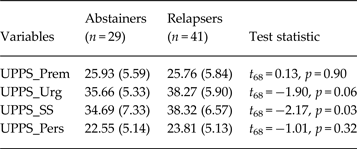
Table 2 displays UPPS impulsivity scores as a function of relapse status. Compared with abstainers, relapsers had significantly higher scores on the UPPS sensation-seeking subscale (effect size = 0.25) and showed a trend toward higher urgency scores (effect size = 0.22). Abstinent and relapsed participants did not differ significantly in their scores on the other UPPS dimensions.
Scores of abstinent and relapsed participants on the UPPS dimensions UPPS_Prem, UPPS_Urg, UPPS_SS and UPPS_Pers

Data are given as mean (standard deviation).
UPPS_Prem, (Lack of) premeditation; UPPS_Urg, urgency; UPPS_SS, sensation seeking; UPPS_Pers, (lack of) perseverance.
Neurocognitive dimensions of impulsivity
Impulsive action
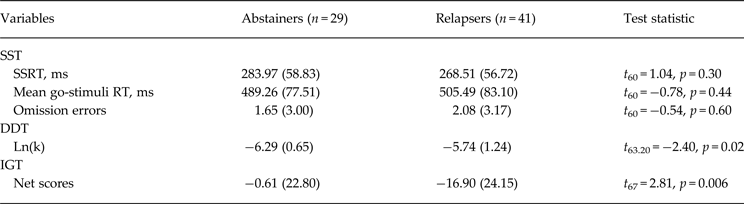
Data for the SST task were available for 26 out of 29 abstinent and 36 out of 41 relapsed participants. The probability of successful inhibition did not differ between the two groups (49% and 50%) and no participants were identified whose inhibition accuracy deviated 10% or more from the targeted 50%, suggesting that the staircase tracking algorithm was successfully applied to equalize response rates. The two groups did not differ in the time needed to inhibit pre-potent responses, as suggested by the absence of significant group differences in the SSRTs. No group difference was found in terms of the mean reaction time to go-signals and omission errors (Table 3).
Performance of abstinent and relapsed participants on neurocognitive measures of impulsivity

Data are given as mean (standard deviation).
SST, Stop-signal task; SSRT, stop-signal reaction time; RT, reaction time; DDT, delay discounting task; Ln(k), natural log transformation of discounting rate; IGT, Iowa gambling task.
Impulsive choice
On the DDT, delay discounting rates (k values) were estimated by non-linear regression using Mazur's hyperbolic model. An independent t test of transformed k values revealed that the relapsed group showed significantly greater delay discounting than the individuals who remained abstinent during the follow-up period (effect size = 0.29) (see Table 3).
On the IGT, there was a significant difference in the mean overall IGT net scores between the two groups, with abstainers achieving a higher average net score than relapsers (effect size = 0.32) (see Table 3). A repeated-measures ANOVA with block (i.e. blocks 1 to 5) as the within-subject variable and group (i.e. abstainers and relapsers) as the between-subject variable revealed a significant block × group interaction (F 4,268 = 2.50, p = 0.04). The main effect of block was only significant among abstainers (F 4,108 = 3.93, p = 0.005). In contrast to the abstinent group, relapsers did not improve/change their performance as the task progressed (F 4,160 = 2.04, p = 0.09). Pairwise post-hoc analyses comparing both groups on each of the five blocks showed that abstainers chose more frequently from the advantageous decks on block 2, 4 and block 5 relative to relapsers (see Fig. 1).
Performance on the Iowa gambling task across blocks (1–5) as a function of group (abstainers versus relapsers). Each block (1–5) represents 20 sequential card selections. Significant group differences were found on blocks 2, 4 and 5. Values are means, with standard errors represented by vertical bars.

Impulsivity and the prediction of post-treatment relapse
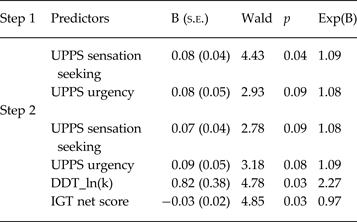
Impulsivity variables on which abstainers and relapsers differed (p < 0.10) in the primary analyses were entered into a multivariate binary logistic regression analysis in order to ascertain their independent contribution to the prediction of relapse. In order to evaluate whether trait impulsivity (i.e. sensation seeking and urgency) would still explain unique variance in relapse once neurocognitive dimensions of impulsivity (i.e. delay discounting and decision-making) were taken into account, the analysis was performed in two blocks. In the first block, sensation seeking and urgency were entered. In the second block, delay discounting and decision-making were added while keeping sensation seeking and urgency in the model. Collinearity statistics for the predictor variables in the combined model yielded tolerance values between 0.92 and 0.99 and all variance inflation factor values were below 2, indicating that the validity of the regression model was not threatened by multicollinearity.
A test of the first model against a constant-only model was statistically significant, indicating that sensation seeking and urgency reliably distinguished between abstainers and relapsers (χ 2 2 = 8.83, p = 0.012), with 16% of the (pseudo)variance in relapse explained. Inspection of the Wald criterion demonstrated that only sensation seeking contributed significantly to the prediction of relapse (see Table 4). A test of the second model (comprising sensation seeking, urgency, delay discounting and decision-making) against a constant-only model was also significant, suggesting that the four predictors as a set reliably distinguished between abstainers and relapsers (χ2 4 = 20.92, p < 0.001). A combination of these four predictors was able to explain about 35% of the variance in relapse status. Adding delay discounting and decision-making to the first block improved the prediction model significantly (χ2 2 = 12.10, p = 0.002). The sensitivity and specificity of the second model in predicting relapse were 76% and 61%, respectively. Overall, the model correctly classified 70% of the sample. Inspection of the Wald criterion demonstrated that only delay discounting and decision-making contributed significantly to the prediction of relapse in the second model (see Table 4). As such, the effects of sensation seeking on relapse propensity were partialled out once these neurocognitive variables were entered into the regression model. Finally, a test of the second model (comprising sensation seeking, urgency, delay discounting and decision-making) against a model containing only the neurocognitive variables (i.e. delay discounting and decision-making) showed that adding trait indices of impulsivity (i.e. sensation seeking and urgency) to the neurocognitive variables did significantly improve the prediction model (χ2 2 = 6.73, p = 0.04).
Multivariate prediction of relapse using a logistic regression model

s.e., Standard error; DDT, delay discounting task; ln(k), natural log transformation of discounting rate; IGT, Iowa gambling task.
Mediation model
Based on zero-order correlations, delay discounting (r = −0.271, p = 0.02) and IGT net scores (r = 0.315, p < 0.01) significantly correlated with treatment retention (criterion 1). In addition, treatment retention showed a significant correlation with relapse propensity (r = −0.378, p = 0.001) (criterion 2). As such, the conditions for testing the mediation models were met. Fig. 2 displays the results of two mediation analyses with either DDT_(ln)k values or IGT net scores as predictors, treatment retention as mediator and relapse as outcome variable. The 95% confidence interval for the estimates of both indirect effects did not contain zero, providing support for the significance of the mediation effect. In fact, once the effect of treatment retention was taken into account, the direct effects of delay discounting and impulsive decision-making on relapse became non-significant.
(a) Relationship between delay discounting task (DDT) values and relapse, as mediated by treatment retention. Unstandardized regression coefficients (B) and p values are presented. For the direct paths from delay discounting to relapse, the coefficient is presented inside the diagram, with the coefficient and confidence interval (CI) from the mediated model underneath, outside of the triangle. ln(k), Natural log transformation of discounting rate. (b) Relationship between Iowa gambling task (IGT) net scores and relapse, as mediated by treatment retention. Unstandardized regression coefficients (B) and p values are presented. For the direct paths from IGT net scores to relapse, the coefficient is presented inside the diagram, with the coefficient and CI from the mediated model underneath, outside of the triangle.

Discussion
Main findings
This study simultaneously examined the influence of multiple facets of impulsivity – covering both trait and neurocognitive dimensions – on post-treatment relapse in a heterogeneous sample of SDIs undergoing in-patient detoxification. In addition, we examined whether treatment retention served as a mediator of this relationship.
Compared with abstinent participants, those who relapsed showed a more pronounced devaluation of delayed rewards on the DDT and a tendency to make choices primarily guided by immediate prospects, rather than by long-term positive outcomes on the IGT. These findings are in keeping with a growing body of evidence indicating that delay discounting and impulsive decision-making can substantially hamper the ability to achieve and maintain abstinence among various groups of drug users (Yoon et al. Reference Yoon, Higgins, Heil, Sugarbaker, Thomas and Badger2007; Passetti et al. Reference Passetti, Clark, Mehta, Joyce and King2008; MacKillop & Kahler, Reference MacKillop and Kahler2009; Washio et al. Reference Washio, Higgins, Heil, McKerchar, Badger, Skelly and Dantona2011; Sheffer et al. Reference Sheffer, Mackillop, McGeary, Landes, Carter, Yi, Jones, Christensen, Stitzer, Jackson and Bickel2012). Abstinent and relapsed participants did not differ in their performance on a task measuring impulsive action. In line with recent suggestions that the mechanisms mediating addiction treatment outcomes differ from those involved in the aetiology of addiction (Garavan & Weierstall, Reference Garavan and Weierstall2012), it is possible that motor (dis)inhibition is implicated in the earlier (i.e. initiation of drug use) rather than in the latter stages of addiction (i.e. the ability to achieve/maintain abstinence). Consistent with this hypothesis, evidence from animal studies suggests that impulsive action primarily mediates the initial sensitivity to drugs, whereas impulsive choice is implicated in the persistence of drug-taking behaviour (Diergaarde et al. Reference Diergaarde, Pattij, Poortvliet, Hogenboom, de Vries, Schoffelmeer and De Vries2008; Broos et al. Reference Broos, Diergaarde, Schoffelmeer, Pattij and De Vries2012).
Our study is among the first to investigate the unique contribution that different dimensions of impulsivity made in relation to short-term relapse propensity using multiple regressions and performing multicollinearity diagnostics. Results of the multiple regression analyses showed that delay discounting and impulsive decision-making represented independent predictors of relapse propensity, with the DDT and IGT each tapping unique variance in relapse. Although our data suggest that the joint use of both trait and neurocognitive measures of impulsivity may have incremental predictive power over the use of either type of measure alone, some preliminary evidence also indicates that neurocognitive tasks of impulsive choice may outperform trait measures of impulsivity in predicting short-term relapse propensity. Specifically, the effects of sensation seeking on relapse were partialled out once the contribution of delay discounting and decision-making was taken into account. Accordingly, sensation seeking did not contribute significant unique variance to the prediction of relapse beyond that accounted for by delay discounting and impulsive decision-making. From a theoretical perspective, these data suggest that short-term relapse is primarily influenced by transitory behavioural states, which fluctuate in response to environmental influences. This dynamic and state-dependent interplay may be better captured by neurocognitive tasks – in particular those that involve motivational/affective components (see also Wiers et al. Reference Wiers, Ames, Hofmann, Krank and Stacy2010). Self-report questionnaires, by contrast, assess general behavioural tendencies, and, accordingly, may be less sensitive in predicting specific behaviours in a particular moment or at a particular state (Wiers et al. Reference Wiers, Ames, Hofmann, Krank and Stacy2010). Similarly, neurocognitive tasks that do not include motivationally relevant stimuli (i.e. neutral SST) may be less sensitive in predicting short-term relapse, potentially because they ‘decontextualize’ the affective nature of inhibitory impairments in SDIs. From a clinical perspective, these data indicate that – whilst many drug users may have an impulsive personality – abstinence-oriented interventions might most productively focus on abnormalities in objectively measurable cognitive and motivational processes (Powell et al. Reference Powell, Dawkins, West, Powell and Pickering2010).
Consistent with the well-established relationship between impulsivity and shorter treatment retention on the one hand (Verdejo-García et al. Reference Verdejo-García, Betanzos-Espinosa, Lozano, Vergara-Moragues, González-Saiz, Fernández-Calderón, Bilbao-Acedos and Pérez-García2012; Stevens et al. Reference Stevens, Betanzos-Espinosa, Crunelle, Vergara-Moragues, Roeyers, Lozano, Dom, Gonzalez-Saiz, Vanderplasschen, Verdejo-García and Pérez-García2013, Reference Stevens, Verdejo-Garcia, Goudriaan, Roeyers, Dom and Vanderplasschen2014), and shorter treatment retention and relapse propensity on the other hand (Zhang et al. Reference Zhang, Friedmann and Gerstein2003), the effects of impulsivity on relapse were mediated by treatment retention: once the effects of treatment retention were taken into account, the direct effect of delay discounting and impulsive decision-making on relapse propensity became non-significant. Results of the current study suggest that drug users with elevated levels of impulsive choice tend to have shorter treatment stays, which in turn places them at increased risk for relapse following treatment discharge. Future studies examining the effects of impulsivity on relapse should therefore explicitly take into account this indirect pathway by which impulsivity may influence post-treatment outcomes.
Clinical implications
Neurocognitive assessment of impulsive choice early during treatment may offer a cost-effective way to identify relapse-prone drug users, such that these subjects may subsequently receive additional monitoring. Second, results indicate that post-treatment relapse in drug users can be reduced by interventions that target the cognitive/affective processes involved in delay discounting and impulsive decision-making or by those that improve treatment retention in drug users who tend to make impulsive choices on these indices.
To date, several interventions have proven to be successful in reducing delay discounting and impulsive decision-making in SDIs. Consistent with the notion that adaptive decision-making partially depends on the integrity of the dorsolateral prefrontal loop and the executive system (Brand et al. Reference Brand, Labudda and Markowitsch2006), cognitive working memory training causes significant reductions in the preference for small immediate rewards over delayed rewards in SDIs (Bickel et al. Reference Bickel, Yi, Landes, Hill and Baxter2011). Disadvantageous decision-making has also been linked to abnormalities in the processing of emotional signals that normally work to anticipate the prospective outcomes of potential decisions (e.g. Bechara et al. Reference Bechara, Damasio, Tranel and Damasio1997; Weller et al. Reference Weller, Levin, Shiv and Bechara2007). In this regard, interventions aimed at enhancing interoceptive awareness or negative emotions linked to risky decisions may partially normalize decision-making performance (Fernández-Serrano et al. Reference Fernández-Serrano, Moreno-Lopez, Perez-Garcia, Viedma-Del Jesus, Sanchez-Barrera and Verdejo-Garcia2011). Hypothetically, a combination of both top-down and bottom-up interventions may be most fruitful in targeting impulsive decision-making (Alfonso et al. Reference Alfonso, Caracuel, Delgado-Pastor and Verdejo-García2011). With respect to pharmacological options, a recent study demonstrated beneficial effects of a single dose of modafinil on delay discounting in alcohol-dependent patients (Schmaal et al. Reference Schmaal, Goudriaan, Joos, Dom, Pattij, van den Brink and Veltman2014). These beneficial effects were accompanied by enhanced prefrontal control over ventral striatal reward processing (Schmaal et al. Reference Schmaal, Goudriaan, Joos, Dom, Pattij, van den Brink and Veltman2014). However, studies examining to what extent treatment-induced improvements in cognitive functioning are directly related to changes in clinically relevant outcomes (e.g. abstinence) are needed.
Whereas the aforementioned interventions may have the potential to improve delay discounting, impulsive decision-making and, speculatively, short-term treatment outcomes, our findings also suggest that drug users with high levels of impulsive choice may drop out of treatment before any of these cognitive–motivational impairments can be adequately addressed. Therefore, introducing elements that more directly affect retention rates early during treatment may be a priority in attempts to improve post-treatment outcomes for high-impulsive drug users. One promising strategy to improve treatment retention in drug users may be to offer motivational incentives contingent on consecutive attendance (Higgins et al. Reference Higgins, Badger and Budney2000; García-Rodríguez et al. Reference García-Rodríguez, Secades-Villa, Higgins, Fernández-Hermida, Carballo, Errasti Pérez and Al-halabi Diaz2009). Longer treatment retention may in turn enable the implementation of more specialized, cognitive–motivational rehabilitation interventions later on during treatment.
Limitations
The current findings should be considered in light of the study's weaknesses. First, we used a relatively loose definition of relapse and relied solely on self-reported abstinence. Future investigations of relapse may benefit from incorporating more objective, biological measures, e.g. hair analyses, to verify abstinence. Whereas the naturalistic sampling approach of the current study increases the generalizability of our findings, it should be noted that our study was conducted in a relatively severe population of drug users, as indicated by high levels of psychiatric co-morbidity, neurocognitive impairment, trait impulsivity and relatively extensive histories of drug use. As such, caution should be taken when transferring the presented findings to less severe (e.g. out-patient) treatment samples. Finally, our samples were relatively small, and subtle differences in impulsivity between the abstinent and relapsed groups may not have been detected.
Acknowledgements
The support of the Special Research Fund of Ghent University (Belgium) is gratefully acknowledged.
Declaration of Interest
None.