Introduction
Driving anxiety is a diverse and complex experience that can range from a reluctance to drive to a driving phobia (Taylor et al., Reference Taylor, Deane and Podd2002). Driving anxiety has been relatively neglected in research, and clinicians have underestimated its distressing nature and potential life-altering impact (Taylor and Koch, Reference Taylor and Koch1995). The limited research that exists has shown that most participants in samples of adults and older adults report no experience of driving anxiety (Taylor et al., Reference Taylor, Alpass, Stephens and Towers2011). However, 20% of adults aged 55–72 report mild driving anxiety, and 5.5% of this group endorse moderate to severe driving anxiety, whereby some driving situations are avoided to the detriment of everyday functioning (Taylor et al., Reference Taylor, Alpass, Stephens and Towers2011).
As a result of demographic aging, the next few decades will see a large proportion of older adults cease driving after spending their lives relying on driving for independence and mobility (Ragland et al., Reference Ragland, Satariano and MacLeod2005). Individuals may not drive or stop driving as a result of driving anxiety, or experience reduced confidence and anxiety regarding their driving competence (Ragland et al., Reference Ragland, Satariano and MacLeod2005). Older women are more likely to report driving anxiety, a loss of driving confidence, and the desire to avoid difficult driving situations as being contributing factors to driving cessation, whereas older men tend to cite declining health (Gallo et al., Reference Gallo, Rebok and Lesikar1999). Driving anxiety is also an independent predictor of self-regulation behaviors, as older adults may self-regulate their driving as a result of driving anxiety or low confidence rather than because of the effects of aging (Gwyther and Holland, Reference Gwyther and Holland2012).
The challenge is how to help older drivers retain as much independence and mobility as possible and to self-regulate their driving while maintaining road safety. Driving cessation, whether due to driving anxiety or other age- and health-related factors, impacts on mobility for older adults and is associated with a range of adverse consequences, such as increased depressive symptoms and functional limitation (Chihuri et al., Reference Chihuri2016; Shimada et al., Reference Shimada, Makizako, Tsutsumimoto, Hotta, Nakakubo and Doi2016). Mobility is considered to be an essential factor for maintaining health and quality of life in older adults, and older adults rely on their personal vehicles more than other age groups (Bauer et al., Reference Bauer, Rottunda and Adler2003).
Only a few studies, most not focusing on older adults, have examined the impact of driving anxiety on health and well-being. One study found that there were no differences in physical health between driving anxious and control participants, although anxious participants reported more mental health problems, such as depression and anxiety (Mathew et al., Reference Mathew, Weinman, Semchuk and Levin1982). More recently, Brazilian women without driving anxiety had slightly higher quality of life on subscales of functional capacity, social aspects, and mental health compared to those with driving anxiety (da Costa et al., Reference da Costa, de Carvalho, Cantini, da Rocha Freire and Nardi2014).
Given this lack of research on older adults, the aim of the present study was to investigate the relationships between driving anxiety and physical health, mental health, and quality of life in young older adults in New Zealand who were recruited into a longitudinal study of aging when they were between 55 and 70 year old. It was important to establish whether any such relationships remained when socio-demographic variables were controlled for. It was hypothesized that (1) driving anxiety would have negative impacts on physical health, mental health, and quality of life after controlling for socio-demographic variables (age, sex, education, marital status, ethnicity, and economic living standard), and (2) sex would moderate the impact of driving anxiety on the three dependent variables, in that the relationships would be stronger for women than men.
Method
Design. A cross-sectional design was used for analysis of data from the second wave (2008) of the Health, Work, and Retirement (HWR) study (Towers, Reference Towers2006), because it encompasses a representative sample of New Zealand's population, as well as a sub-sample of Māori, New Zealand's indigenous people (Towers and Noone, Reference Towers and Noone2007).
Sample. In 2006, the HWR study used equal probability sampling procedures (Towers, Reference Towers2006) and random selection to select two independent nationally representative subsamples (general population and exclusively Māori population) aged 55–70 years from New Zealand's electoral roll (Towers, Reference Towers2006). In order to maximize participation rates, individuals of Māori descent were oversampled as they only accounted for 12.8% of the general population aged 55–70 years (Towers, Reference Towers2006). However, over-sampling resulted in the over-representation of Māori and a post-stratified weighting variable was calculated to account for the known discrepancies between the sample and the population (Towers, Reference Towers2006).
The postal questionnaire for the first wave of data collection in 2006 was sent to 13,045 prospective participants, with 5,264 making up the general subsample and 7,781 the Māori subsample. From the 6,662 participants from the first wave, 3,071 consented to taking part in the second wave of data collection in 2008, and 2,473 of those completed the second wave questionnaire (1,274 of the general subsample, 1,199 of the Māori subsample (81% response rate)). The resulting data were both representative of the general New Zealand population as well as of Māori (Towers and Noone, Reference Towers and Noone2007).
Measures. The socio-demographic variables of age, sex, highest educational qualification, and marital status and ethnicity were based on the 2006 New Zealand Census of Population and Dwellings (Statistics New Zealand, 2007). The Economic Living Standards Index Short Form (ELSI-SF) was used to measure economic living standard, as represented by a person's consumption and personal possessions (Jensen et al., Reference Jensen, Spittal and Krishnan2005). One question used in a previous study (Taylor et al., Reference Taylor, Deane and Podd2007) asked how anxious participants were about their driving, with anxiety being described as an “unpleasant feeling of nervousness or distress that may have no explanation.” Responses ranged from 0 (not at all anxious) to 10 (extremely anxious), and were categorized as no driving anxiety (rating of 0), mild level of driving anxiety (rating of 1–4), and moderate to severe level of driving anxiety (rating of 5–10).
The Medical Outcomes Study Short Form (12) Version Two Health Survey (SF-12v2), one of the most well-known, well-used health surveys, with good construct validity, test-retest reliability and internal consistency (Ware et al., Reference Ware, Kosinski, Turner-Bowker and Gandek2002), was used to measure physical and mental health. The scores from all items were integrated using principal components extracted coefficients to generate two component scores, the Physical Component Summary (PCS) Score and the Mental Component Summary (MCS) Score (Cheak-Zamora et al., Reference Cheak-Zamora, Wyrwich and McBride2009). The eight scales were standardized based on means and standard deviations from the HWR 2006 study (Stephens et al., Reference Stephens, Alpass, Baars, Towers and Stevenson2010) and the two primary scales were generated using the New Zealand Health Survey Factor Coefficients. The range of scores for both components is from 0 (representing the worst health) to 100 (representing the best health).
The World Health Organisation's WHOQOL-8, an eight-item version of the WHOQOL-100, designed to assess quality of life in census-type surveys, was used to measure quality of life (WHOQOL Group, 1994). The total score for the WHOQOL-8 ranges from 0 (low quality of life) to 40 (high quality of life) and the scale has good internal consistency, construct validity and discriminant validity (Skevington et al., Reference Skevington, Lotfy and O'Connell2004).
Procedure. In 2006, initial data collection for the HWR study used a five-stage posting schedule based on the Tailored Design Method (Dillman, Reference Dillman2000) in order to increase and maximize return rates. The 2006 postal survey asked about health and well-being, social support and context, work and retirement, income and assets, and general socio-demographics (Towers and Stevenson, Reference Towers and Stevenson2014). The 2008 survey, used here, had additional items on physical functioning and impairment, prescriptions and drug use, quality of life, driving status, driving anxiety, and migration (Towers and Stevenson, Reference Towers and Stevenson2014).
Data analysis. Three hierarchical multiple regression analyses were used to examine the relationships among driving anxiety and mental health, physical health, and quality of life, while controlling for socio-demographic variables. Independent variables were entered in three steps. At the first step, the socio-demographic variables of age, sex, education, marital status, ethnicity, and economic living standard were entered. At the second step, driving anxiety was entered. At the third step, the interaction effect of sex × driving anxiety was entered. The N for the regression analyses was 2,539 because of the sample weighting described earlier.
For the multiple regression analyses, all categorical dependent variables were recoded and collapsed into dichotomous variables (Tabachnick and Fidell, Reference Tabachnick and Fidell2013). Given there was sufficient power to detect statistically significant effects with relatively small effect sizes, adjusted R2 values are provided as an indicator of overall model predictive accuracy (Hair et al., Reference Hair, Black, Babin and Anderson2010) alongside total R2 values and their associated effect size (f2 ) and statistical significance (p). Data were analyzed using IBM SPSS Statistics for Windows Version 21.
Results
Data screening. Driving anxiety had a limited range of scores (0–10) and was positively skewed, with the majority of participants reporting little to no driving anxiety, so logarithmic transformation was used for the multiple regression analyses. The bivariate and multivariate assumptions of multiple regression were met to an acceptable level.
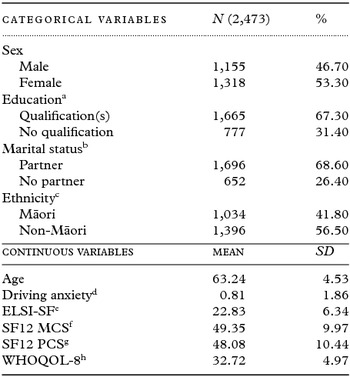
Descriptive statistics. A summary of descriptive statistics for the participants is provided in Table 1. Most participants (n = 1,718, 69.5%) reported no driving anxiety, 20% reported a mild level of driving anxiety (n = 494), and 5.5% reported a moderate to severe level of driving anxiety (n = 137; 5% had missing data). Participants had a high economic living standard and quality of life, and moderate mental and physical health.
Descriptive summary of variables for the sample

a Education – 1.3% (31) missing.
b Marital status – 5.1% (125) missing.
c Ethnicity – 1.7% (43) missing.
d Driving anxiety – 5% (124) missing, possible score range 0–10.
e ELSI-SF – 12.6% (312) missing, possible score range 0–31.
f SF12 MCS – 6.3% (157) missing, possible score range 0–100.
g SF12 PCS – 6.3% (157) missing, possible score range 0–100.
h WHOQOL-8 – 12.5% (310) missing, possible score range 0–40.
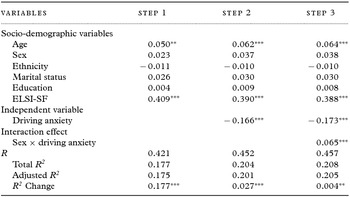
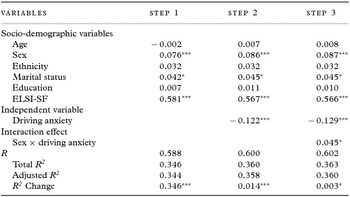
Hierarchical multiple regression analyses. When mental health was the dependent variable, driving anxiety accounted for 2.70% of the unique variance when the socio-demographic variables were controlled for (R2 change was significant, f2 = 0.03, p < 0.001; Table 2). After step three of the regression, the sex × driving anxiety interaction effect accounted for 0.40% of the unique variance in mental health when the socio-demographic variables and driving anxiety were controlled for (R2 change was significant, f2 = 0.01, p < 0.01).
Hierarchical multiple regression analyses of socio-demographic variables, driving anxiety, and interaction effects on mental health showing unstandardized regression coefficients

*p < 0.05.
**p < 0.01.
***p < 0.001.
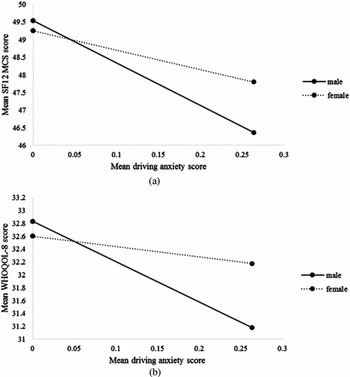
A simple slopes analysis examined the interaction effect in more detail. When predicting mental health scores, driving anxiety and the sex × driving anxiety interaction were statistically significant, whereas sex was not. Figure 1(a) demonstrates that there was a significant negative relationship between driving anxiety and mental health for both men (β = –12.04, p < 0.001) and women (β = –5.51, p < 0.001). As mean driving anxiety increased, men and women were more likely to have lower mental health, but women were more likely to have higher mental health compared to men.
(a) Interaction of gender × driving anxiety on mental health scores. (b) Interaction of gender × driving anxiety on quality of life scores.

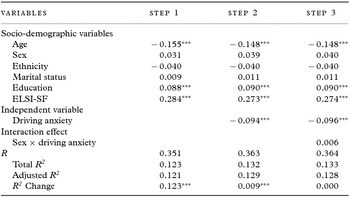
When physical health was the dependent variable, driving anxiety accounted for 0.09% of the unique variance when the socio-demographic variables were controlled for (R2 change was significant, f2 = 0.01, p < 0.001; Table 3). After step three of the regression, the sex × driving anxiety interaction effect did not explain any additional variance in physical health (R2 change was not significant, p = 0.925).
Hierarchical multiple regression analyses of socio-demographic variables, driving anxiety, and interaction effects on physical health showing unstandardized regression coefficients

*p < 0.05.
**p < 0.01.
***p < 0.001.
When quality of life was the dependent variable, driving anxiety accounted for 1.4% of the unique variance when the socio-demographic variables were controlled for (R2 change was significant, f2 = 0.02, p < 0.001; Table 4). After step three of the regression, the sex × driving anxiety interaction effect accounted for 0.30% of the unique variance in quality of life when the socio-demographic variables and driving anxiety were controlled for (R2 change was significant, f2 = 0.01, p < 0.05).
Hierarchical multiple regression analyses of socio-demographic variables, driving anxiety, and interaction effects on quality of life showing unstandardized regression coefficients

*p < 0.05.
**p < 0.01.
***p < 0.001.
When predicting quality of life scores, driving anxiety and the sex × driving anxiety interaction were statistically significant, whereas sex was not. Figure 1(b) demonstrates that there was a significant negative relationship between driving anxiety and quality of life for both men (β = –15.41, p < 0.001) and women (β = –2.46, p < 0.001). As mean driving anxiety increased, men and women were more likely to have lower quality of life, but women were more likely to have higher quality of life compared to men.
Discussion
For the young older adults in the present study, as hypothesized, increased driving anxiety was associated with decreased mental health, physical health and quality of life, independent of the effects of socio-demographic variables. However, though these associations were statistically significant, they were very small. In addition, as mean driving anxiety increased, men and women were more likely to have lower mental health and quality of life, but women were more likely to have higher scores compared to men.
Driving anxiety had a small but independent effect on mental health, physical health, and quality of life in particular. Previous research found similar results in that participants with driving anxiety reported poorer quality of life (da Costa et al., Reference da Costa, de Carvalho, Cantini, da Rocha Freire and Nardi2014), and later-life anxiety was associated with substantially diminished quality of life (Wetherell et al., Reference Wetherell, Thorp, Patterson, Golshan, Jeste and Gatz2004). This is important because when driving anxiety results in a reduction or cessation of driving, older adults may experience limited access to important and enjoyable daily activities such as visiting friends, helping in the community, and satisfying basic needs such as shopping or accessing healthcare, which may affect their mental health and quality of life (Marottoli et al., Reference Marottoli, Mendes de Leon, Glass, Williams, Cooney and Berkman2000). Driving anxiety may also result in a reduction in mobility that consequently affects older adults’ quality of life in terms of freedom and independence because they have to rely on others for transportation, take public transport, or change their routine in order to carry out daily activities (Chihuri et al., Reference Chihuri2016). Indeed, Taylor et al. (Reference Taylor, Alpass, Stephens and Towers2011) found that, of the young older adult participants who indicated some level of driving anxiety, various alternative modes of transport were used because of driving anxiety, especially engaging transport by family or friends (31.1%), walking (24.5%), and public transport (16.5%). Older adults may need information and support in order to access and make best use of these alternative modes of transport, consistent with recent calls for intervention programs to assist continued safe driving or other means of mobility (Chihuri et al., Reference Chihuri2016).
A sex difference may have been observed in mean driving anxiety scores because women generally have higher tension-anxiety scores than men while driving (Garrity and Demick, Reference Garrity and Demick2001) and tend to report driving anxiety and avoidance more than men (Gallo et al., Reference Gallo, Rebok and Lesikar1999). However, contrary to expectation, men had poorer mental health and quality of life scores as driving anxiety scores increased than women. Prior research on driving anxiety and phobia has consistently reported on predominantly female samples and has found higher levels of driving anxiety in women compared with men (e.g. Taylor et al., Reference Taylor, Deane and Podd2007), although these studies have tended to recruit on the basis of the experience of driving anxiety as opposed to drawing from the general population, which could account for the present findings. Furthermore, although it is well established that women of all ages experience higher levels of general anxiety and avoidance than men (Craske, Reference Craske2003), the experience of anxiety as it relates to driving for men and women may actually be different as people enter older adulthood, perhaps partly because of different views of the role and importance of driving. For example, women view driving as a way of meeting their everyday practical needs such as family commitments, whereas for men, driving is an important aspect of their identity, independence, and freedom (Musselwhite and Haddad, Reference Musselwhite and Haddad2010).
There were several limitations associated with the current study. First, the single-item measurement of driving anxiety likely presented an over-simplified view of driving anxiety, which could at least in part explain the small effects. Another approach could be to assess a clinical sample of older adults whose driving anxiety meets diagnostic criteria for phobia. Clinical samples tend to experience persistent driving anxiety (Koch and Taylor, Reference Koch and Taylor1995) that may have a negative impact on health and well-being for older adults. This approach would also ensure that the impact of driving anxiety was specifically identified, as opposed to the experience of more general forms of anxiety or negative affect, which are already known to detrimentally affect health and quality of life for older adults (e.g. Wetherell et al., Reference Wetherell, Thorp, Patterson, Golshan, Jeste and Gatz2004). Including more objective measures of physical and mental health, such as number of health conditions and medications, would also increase the robustness of future research. Second, the grouping of the independent variables meant that it was not possible to identify potentially unique relationships between different levels of the socio-demographic independent variables (e.g. different ethnicities and educational levels). Future research could address this by examining the interactions between different levels of the independent variables and the dependent variables. Finally, the analyses did not consider that participants may have lived rurally and encountered roads that are vastly different and more anxiety-provoking than roads in urban areas, such as uneven gravel roads, reduced lighting and sharper corners.
Conclusion
The present study examined the impact of driving anxiety on health and well-being in 2,473 nationally representative young older adults aged 55–70 years. Driving anxiety had a small but significant relationship with physical and mental health and well-being, when the effects of socio-demographic variables were controlled for. Sex was a moderator of the relationships for mental health and quality of life. As driving anxiety scores increased, men and women were more likely to have lower mental health and quality of life, but men were more likely to have lower scores compared to women. Although there are limitations to this study, further research is warranted to replicate these findings using more robust methods, given that maintaining the ability to drive is an important concern for older adults. Further research is needed to identify how psychologists and researchers can promote healthy and effective ways for older adults to continue to safely drive in a modern, changing society, to develop effective interventions if necessary, to self-regulate driving where appropriate, and to preserve good health and well-being.
Conflict of interest
None.
Description of authors’ roles
M. H. drafted the text based on her thesis. J. T. supervised the thesis and revised the text. M. C. revised the text. F. A. and C. S. performed the data collection. M. H., J. T. and M. C. read and approved the final version of the manuscript.
Acknowledgments
The authors wish to sincerely thank the participants of this study and the quantitative research group of the Health and Ageing Research Team (HART) at Massey University, New Zealand, for their feedback on an earlier draft of this manuscript. Thanks also to the Health Research Council of New Zealand who funded the research.
Ethics approval and consent to participate
Ethical approval for the HWR study was obtained from the Massey University Human Ethics Committee (HEC: PN application number 05/90).