Introduction
Although the phrase ‘healthy ageing’ is often used in the gerontological literature, there is no universal definition of this term. Research shows that older adults and health-care professionals may have contrasting views about what constitutes healthy ageing (Phelan et al., Reference Phelan, Anderson, Lacroix and Larson2004; Hansen-Kyle, Reference Hansen-Kyle2005). In fact, medical definitions may also differ so profoundly from the perspectives of older adults that no overlap or agreement may exist between the two models (Kusumastuti et al., Reference Kusumastuti, Derks, Tellier, Di Nucci, Lund, Mortensen and Westendorp2016). Additionally, different societies may also place more or less weight on the various psychological, physiological, and social aspects of ageing, based on the local socio-cultural environment (Bowling, Reference Bowling2007; Young et al., Reference Young, Frick and Phelan2009; Fernandez-Ballestros et al., Reference Fernandez-Ballestros, Garcia, Abarca, Blanc, Efklides, Moraitou, Kornfeld, Lerma, Mendoza-Numez, Mendoza-Ruvalcaba, Orosa, Paul and Patricia2010; Reichstadt et al., Reference Reichstadt, Sengupta, Depp, Palinkas and Jeste2010; Lewis, Reference Lewis2014; Ahn et al., Reference Ahn, Kwon and Kang2017; Tkatch et al., Reference Tkatch, Musich, MacLeod, Kraemer, Hawkins, Wicker and Armstrong2017; Black and Hyer, Reference Black and Hyer2019; Chen et al., Reference Chen, Ye and Kahana2019). Since there is clearly a great degree of variation between how different groups of people define healthy ageing, there remains a need to create local holistic models of healthy ageing in socio-cultural context that engage a variety of stakeholders (Soellner et al., Reference Soellner, Lenartz and Rudinger2017; Howell et al., Reference Howell, Seater and McLinden2020; Trevino et al., Reference Trevino, Canin, Healy, Moran, Trochim, Martin, Pillemer, Sirey and Reid2020).
In this article, we build from an existing definition of healthy ageing in the local context utilising the principles of concept mapping (CM) to identify the ‘importance’ and ‘feasibility’ of various aspects of healthy ageing in the urban Subarctic. Importance and feasibility are often measured by having participants rate, rank or weigh the components that comprise the definitional concept (Stormont et al., Reference Stormont, Lewis and Covington Smith2005; Kelly et al., Reference Kelly, King, Bauman, Baur, Macniven, Chapman and Smith2014). Typically, a survey will pose each question or statement twice, once where participants rate the importance of that statement and again where they rate the feasibility of that same statement (Green and Aarons, Reference Green and Aarons2011; Waltz et al., Reference Waltz, Powell, Matthieu, Damschroder, Chinman, Smith, Proctor and Kirchner2015). Importance is defined as the opinion that the concept is of great significance or value to the participant, whereas feasibility is defined as the opinion that the concept can be easily or conveniently achieved (Bowling, Reference Bowling1995; Waltz et al., Reference Waltz, Powell, Chinman, Smith, Matthieu, Proctor, Damschroder and Kirchner2014; Powell et al., Reference Powell, Waltz, Chinman, Damschroder, Smith, Matthieu, Proctor and Kirchner2015; Eldridge et al., Reference Eldridge, Lancaster, Campbell, Thabane, Hopewell, Coleman and Bond2016). Because CM is often used for conceptualising both the nature of difficult health problems and methods to resolve them (Trochim and Kane, Reference Trochim and Kane2005), this method is well-suited for the investigation of how stakeholders perceive importance and feasibility of healthy ageing in their community through a participatory framework (Rosas, Reference Rosas2012; Vaughn et al., Reference Vaughn, Jones, Booth and Burke2017). We utilised CM to define healthy ageing in Anchorage, Alaska in our previous work (Howell et al., Reference Howell, Seater and McLinden2020) and here we present further usage of CM to elicit the importance and feasibility of 12 components of healthy ageing.
Background
The term ‘healthy ageing’ and ‘successful ageing’ are often used interchangeably to describe ideal ageing in three main components: low probability of disease and disease-related disability, high cognitive and physical functional capacity, and active engagement with life (Rowe and Kahn, Reference Rowe and Kahn1987). However, this definition has been criticised over the years for focusing too heavily on physical functioning and not acknowledging individual's choices, lifestyle, interactions with their environment or social inequalities that contribute to health disparities (Katz and Calasanti, Reference Katz and Calasanti2014). In this article, healthy ageing refers to the process of change during senescence that allows the individual to modify lifestyles continually, assess strengths and redefine oneself in meaningful ways in relation to their health, families and communities (Hansen-Kyle, Reference Hansen-Kyle2005).
There is also variation in the ways that older adults define healthy ageing cross-culturally. Research has demonstrated that local environmental, cultural, political and socio-economic conditions contribute to the creation of unique definitions of healthy ageing around the world. For example, Tkatch et al. (Reference Tkatch, Musich, MacLeod, Kraemer, Hawkins, Wicker and Armstrong2017) found that older adults in two large cities in the United States of America (USA) (Phoenix, Arizona and Chicago, Illinois) define healthy ageing as maintaining functioning and psycho-social wellbeing, despite potentially living with illness or disability. However, longevity, remaining free of chronic disease and being in good physical health were important components of healthy ageing among Japanese American and White older adults in King County, Washington (Phelan et al., Reference Phelan, Anderson, Lacroix and Larson2004). Although maintaining independence is a major factor of healthy ageing for older adults around the world (Fernandez-Ballestros et al., Reference Fernandez-Ballestros, Garcia, Abarca, Blanc, Efklides, Moraitou, Kornfeld, Lerma, Mendoza-Numez, Mendoza-Ruvalcaba, Orosa, Paul and Patricia2010), Chinese older adults indicate that self-reliance is the overall goal of healthy ageing in Shanghai (Chen et al., Reference Chen, Ye and Kahana2019). Among Indigenous rural Alaskans, optimism and humour are some of the most salient aspects of healthy ageing (|Lewis, Reference Lewis2011, Reference Lewis2013). Across the circumpolar North, respecting the wisdom of elders, maintaining a relationship with the natural environment and developing psycho-social resilience are key components of healthy ageing (Howell and Peterson, Reference Howell and Peterson2020). Since socio-cultural variation clearly exists, defining healthy ageing in the local context is important because older adults’ behaviours and health outcomes are influenced by their views on healthy ageing (Torres, Reference Torres2003).
In our previous work, we created a local definition of healthy ageing in Anchorage, Alaska by eliciting the perspectives of older adults (aged 55+ years), public health professionals and other stakeholders (see Howell et al., Reference Howell, Seater and McLinden2020). Healthy ageing included access to affordable medical care, healthy food and physical activity, access to senior support services, positive attitudes and good mental health, appropriate housing options, lifelong learning, having a purpose in life, feeling a sense of physical and financial security, planning for the future, a physically accessible city, a community that values its elders and maintaining social relationships. However, these 12 components of healthy ageing in Anchorage do not necessarily indicate the importance or feasibility of each of these components to older adults. Indeed, our experience collecting data for this project indicated that discrepancies likely exist between the relative importance and feasibility of each concept from different stakeholder perspectives.
This article expands upon our previous work to further understand healthy ageing in the local context utilising the community-based participatory principles of CM to determine the importance and feasibility of healthy ageing in Anchorage, Alaska. CM integrates both qualitative and quantitative data and is well-suited for research with diverse stakeholders (Kane and Trochim, Reference Kane and Trochim2007; Vaughn and McLinden, Reference Vaughn, McLinden, Jason and Glenwick2016). The method has been applied successfully in public health (van Bon-Martens et al., Reference van Bon-Martens, van de Goor and van Oers2017) and the study of ageing (Schiller et al., Reference Schiller, Winters, Hanson and Ashe2013). This exploratory study utilised the CM methodology to address the overall research question:
• How do older adults and other stakeholders view healthy ageing in Anchorage?
Methods
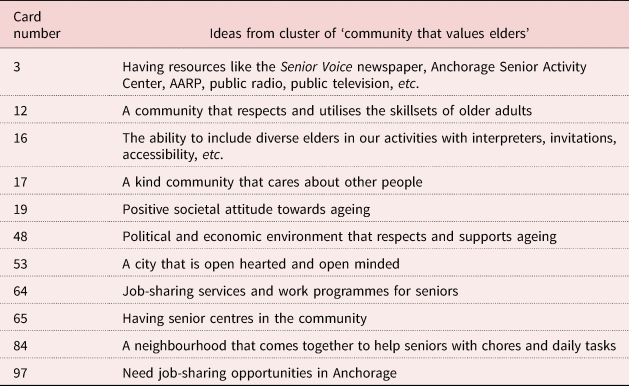
The project was conducted in two phases: Phase 1 was focused on understanding how older adults conceptualise healthy ageing in Anchorage, as previously reported in Howell et al. (Reference Howell, Seater and McLinden2020). A definition of healthy ageing arose from those analyses that suggested there are 12 essential components, or concept clusters, of healthy ageing in Anchorage (see Table 1).
Example of ideas in a cluster

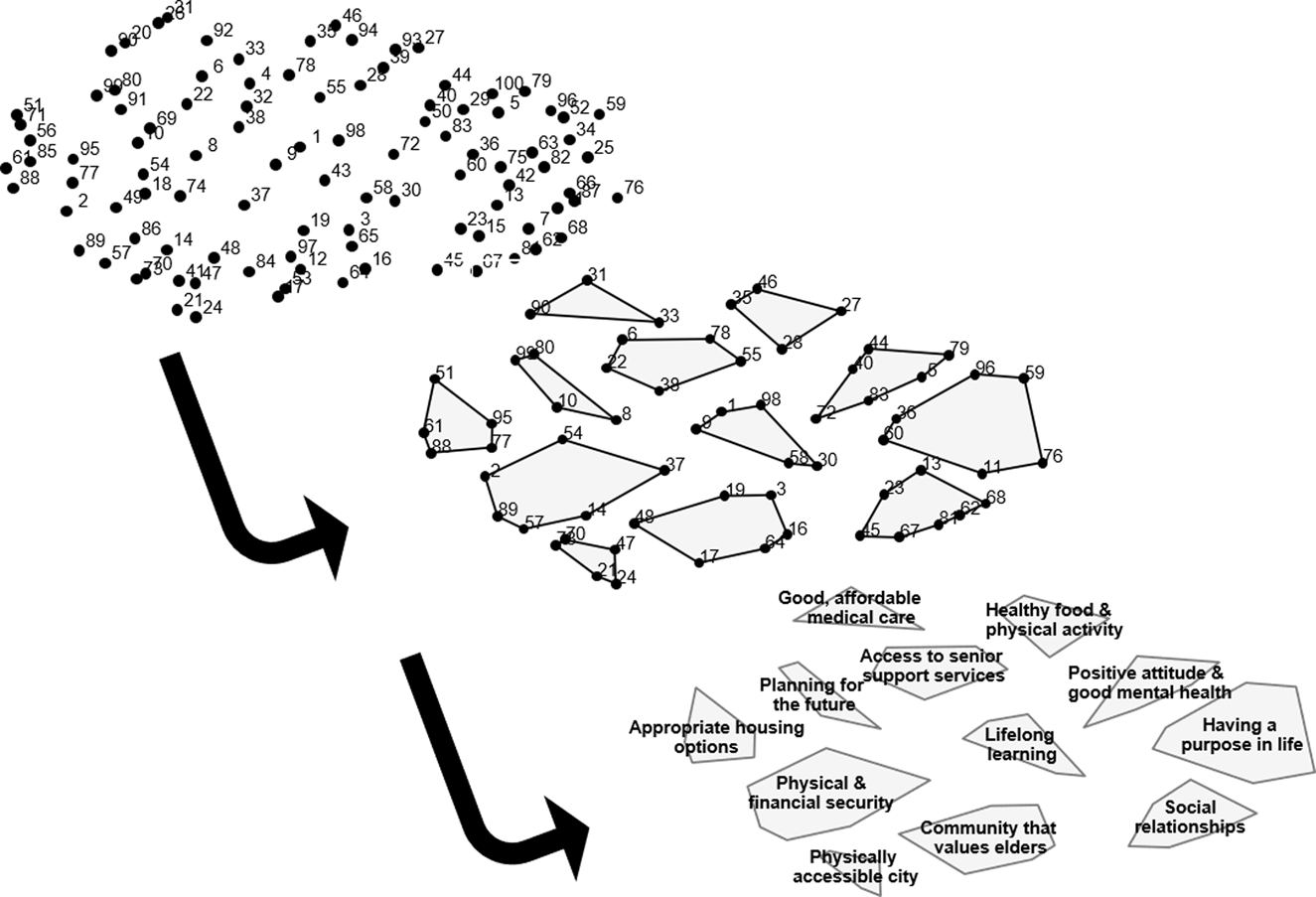
Described here is the second phase of this research project to understand older adults’ perspectives on the importance and feasibility of those components of healthy ageing by layering values on to the existing maps. Because of the intellectual effort and time it takes to conduct all steps of the CM method, it is not uncommon to break up such projects into several research phases (see e.g. Pauly et al., Reference Pauly, Martin, Perkin, van Roode, Kwan, Patterson, Tong, Prescott, Wallace and Hancock2018). For Phase 2, we brought together a sample of older adults in Anchorage to rate the importance and feasibility of 36 statements that constituted the 12 components of healthy ageing drawn from our previous work (see Figure 1) via written questionnaires.
Multiple concept maps illustrating the progression from computation of x,y co-ordinates for each idea, clustering ideas into concepts and labelling concepts.

Recruitment
Convenience sampling was used to recruit participants aged 55+ years in Anchorage using flyers in senior centres and senior housing communities, phone call invitations and via word-of-mouth. Phone invitations were extended to older adults who had participated in the first phase of this research and expressed an interest in continued participation, although only 16 individuals returned to participate in Phase 2 data collection. All 54 participants were community-dwelling older adults living in Anchorage. Previous CM research demonstrates that sample sizes of 30 participants are sufficient for revealing conceptual similarity, importance and feasibility of items (Wood and Wood, Reference Wood and Wood2008; Rosas and Kane, Reference Rosas and Kane2012).
In-person data collection sessions were held to administer a written questionnaire at three locations around Anchorage – a community centre and two senior-living housing complexes – between September and December 2019. We administered paper questionnaires in groups in order to answer questions and assist participants as needed, to provide a social environment for participants, and to increase response and survey return rate. This study was reviewed and approved by the University of Alaska Anchorage Institutional Review Board. Participants were provided with informed consent documents and researchers verbally reviewed this information and answered any questions. Participants all received a US $20 grocery store gift card as an incentive to participate and as a token of appreciation for their time.
Questionnaire development
In order to value concepts on some measure, participants typically value the ideas by providing importance and feasibility ratings for each idea. Given the number of ideas (N = 100) in this project, the response burden of rating each idea on these two measures was deemed too high. However, simply ranking the importance and feasibility of each of the 12 concepts in the definition of healthy ageing from our previous research would not yield data detailed enough to answer our central research question. An alternative approach to represent all the concepts and reduce the response burden was to select a subset of ideas from each of the 12 concepts.
While cluster analysis partitions ideas into groups of similar ideas, among the ideas in a cluster some ideas will have been sorted only with the other ideas within the cluster (i.e. more central) and some ideas will have been sorted mostly with ideas within the cluster but also sorted with ideas in nearby clusters (i.e. less central). In the CM literature, the former is considered an anchor and the latter a bridge (Kane and Rosas, Reference Kane and Rosas2018). Bridging and anchoring values are often used in CM to interpret the meaning of a map; anchors provide information about the immediate vicinity (i.e. cluster) while a bridging idea provides information about the adjacent clusters (Kane and Trochim, Reference Kane and Trochim2007). The bridging was computed for each idea within a cluster and quantified the extent to which each item can be considered an anchor or a bridge. The computation was a measure of the number of links between a given idea and other ideas in a map, that is, the number of dyads for a given idea. The dyads are weighted by the distance between each pair in order to distinguish between ideas that are mostly connected to ideas in the same cluster (i.e. less distance between dyads) versus ideas mostly connected to ideas outside a given cluster (i.e. more distance between dyads).
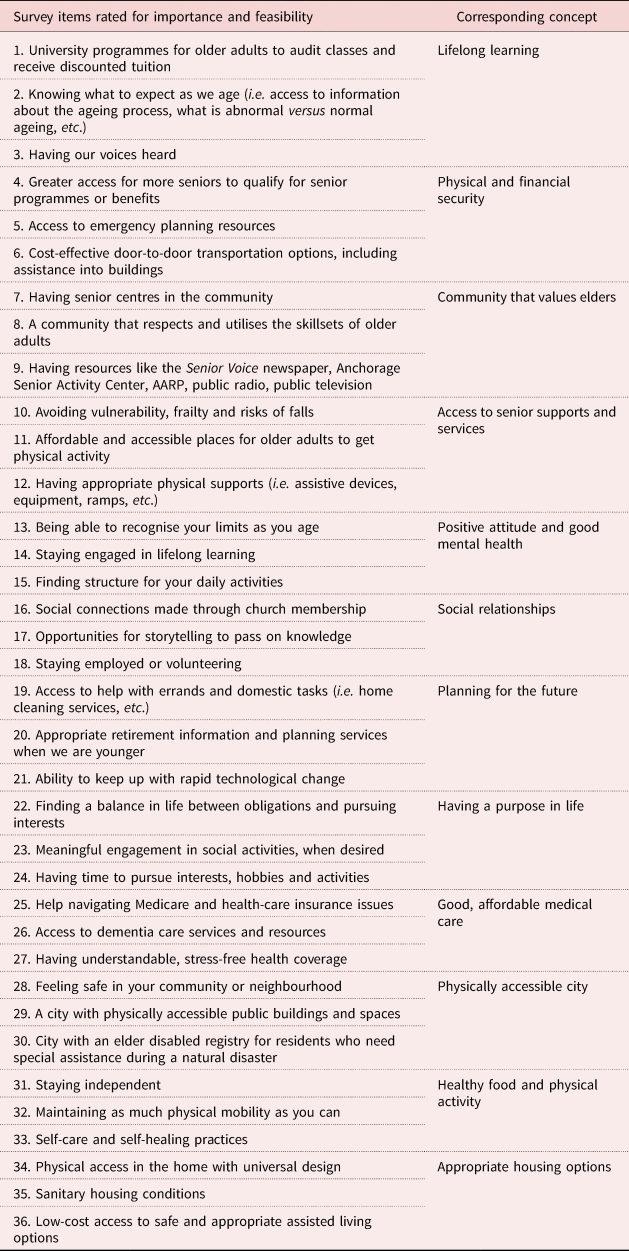
As it pertains to this study, we reduced the response burden by selecting the three ideas that were most anchored to each of the 12 clusters, resulting in a 36-item questionnaire (see Table 2). The survey asked participants to rate on a Likert scale of 1 (‘strongly disagree’) to 5 (‘strongly agree’) the importance and feasibility of each of the 36 ideas of healthy ageing, as has been utilised in other CM research (see e.g. Waltz et al., Reference Waltz, Powell, Chinman, Smith, Matthieu, Proctor, Damschroder and Kirchner2014).
The 36 survey items and their corresponding concept clusters

Participants were instructed to consider relative importance and feasibility when rating ideas. Specifically, all ideas are to some extent important to healthy ageing. Among this list of 36 important aspects of healthy ageing in Anchorage, participants were asked to rate which were considered the most important relative to the rest of the ideas, and which seem most feasible relative to the rest of the ideas. These 36-item questionnaire surveys were collected on paper and later entered into Qualtrics survey software for initial analysis. Files were then downloaded into .csv format for more specific analyses in R statistical software (R Core Team, 2017).
Data analysis
The 100 ideas elicited in Phase 1 were assigned to each of 12 concept clusters (Howell et al., Reference Howell, Seater and McLinden2020), ranging from six to 15 ideas per cluster and averaging approximately eight ideas per cluster (see Table 1, above). The average rating for each of the 12 concepts was computed by calculating the mean value for each idea on each measure (i.e. importance, feasibility) and then computing the mean of those three ideas taken together for each measure within each cluster. These cluster/concept mean values were used to visualise and interpret the meaning of values in the context of the healthy ageing map. We also compute Spearman rank order to determine the relationship between importance and feasibility ratings in this sample.
Pattern analysis
To illustrate the perspectives of older adults, we relied on pattern analysis to visualise these 36 items across the 12 concepts. A pattern analysis approach to inquiry treats relevant data participants or outcomes as patterns or as a whole rather than simply as a collection of individual measures or observations (Trochim, Reference Trochim1989). Therefore, examining patterns is a way to transform the investigation of multivariate relationships in a dataset into a pattern-recognition problem (Inselberg, Reference Inselberg2009). In the context of CM, pattern analysis is typically accomplished in two ways. First, layering values for a single measure on an existing concept map and, second, by creating a ladder graph to compare multiple measures for multiple clusters.
Layered concept map
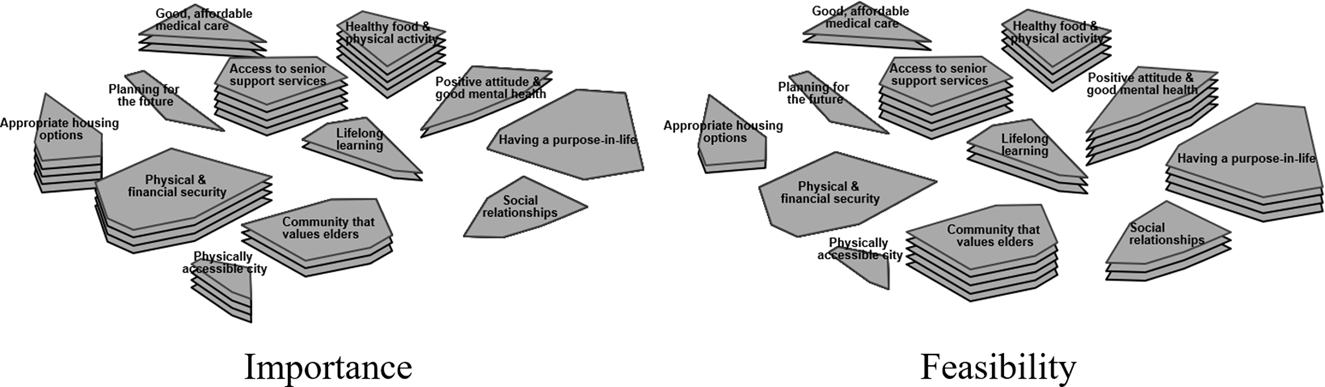
A layered concept map allows researchers to overlay the values for a measure on its respective cluster in the concept map, representing value as height. This three-dimensional model allows one to see the variation in the measure as hills and valleys among multiple clusters. Because the range of means on a Likert-type instrument is often skewed by many participants using only a few of the scale values, it is common when examining this type of map to compute quintiles based on the summarised data. The lowest quintile gets one layer on the height dimension, the second quantile gets two layers, and so on. In this case quintiles were computed to illustrate the mean cluster rating as height on the concept map (see Figure 2).
Layered concept maps indicating importance and feasibility. Quintiles were computed from cluster averages. One layer depicts the least important/feasible and five layers depicts the most important/feasible.

Ladder graphs
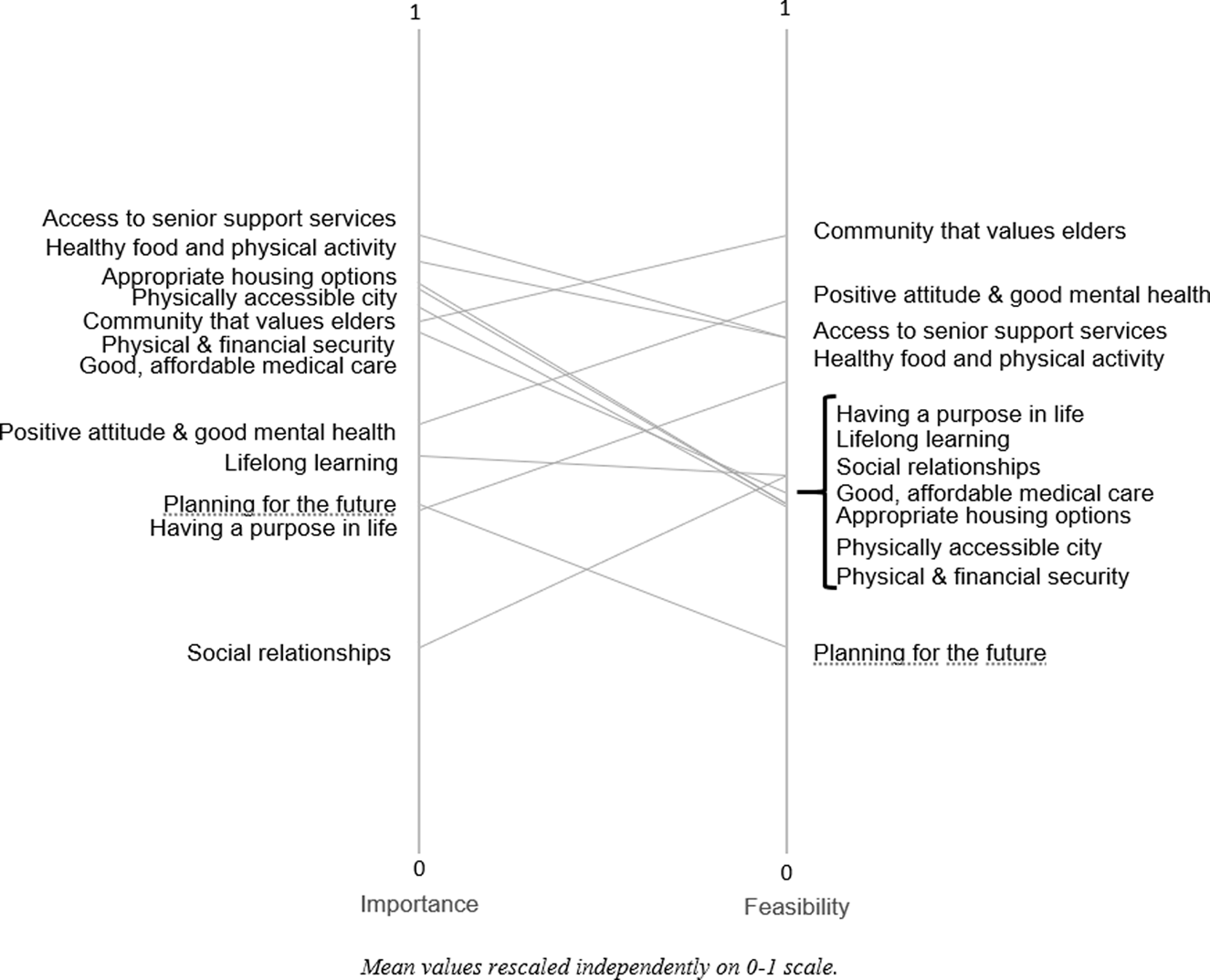
A ladder graph is created by aligning vertical parallel number lines, one for each measure, placing each of the concepts along the line according to concept's value on the measure. Then, a horizontal line links the same concepts across the multiple number lines producing a ladder-like image. This graphic can be used in multiple ways such as comparing multiple measures (e.g. importance and feasibility) or multiple stakeholder groups (e.g. management and staff) on a single measure or at multiple points in time (e.g. now and the future). This approach is similar to other pattern analysis methods such as parallel co-ordinates and slope graphs. The former has a long history and is increasingly utilised in interpreting complex multivariate data (Inselberg, Reference Inselberg2009). The latter are a more recent innovation and are used to plot data at multiple points in time (Tufte, Reference Tufte2001). In this case, the means for each item within each cluster were computed and compared.
In creating this ladder graph, we equated both scales by aligning the top-most ideas, accounting for the differences in use of the rating scale. For example, it is not uncommon for respondents to skew their responses to the extreme ends of the scale when rating mutually exclusive constructs, such as higher ratings for importance and lower ratings for feasibility (Harzing et al., Reference Harzing, Brown, Köster and Zhao2012; Huang, Reference Huang2016). Comparing the mean scores in that situation may mean that a cluster can be ranked highest on both measures but rated lower on one measure (e.g. feasibility) when compared to the other measure (e.g. importance). Focusing only on the raw score ratings in this scenario can lead to the erroneous conclusion that what is important is not feasible when in fact the most important concept is also the most feasible. In this case, means for each item were rescaled from 0 to 1 within each measure. This has the effect of equating the highest and lowest ranked item on each measure, preserving the rank order, and making clear the alignment of clusters (or lack of) within the range of the values on the rating scale for each measure (Trochim and McLinden Reference Trochim and McLinden2017). Layered concept maps and ladder graphs are essential components of CM methodology, as they produce easy-to-read maps for lay audiences, eliminating the need to understand the sophisticated statistical computations.
Results
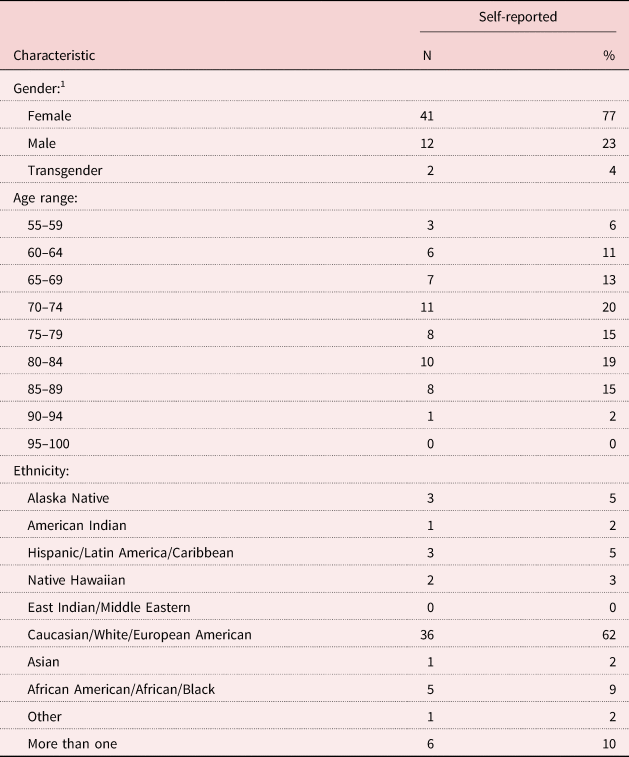
Fifty-four individuals participated in data collection, 16 of whom had also participated in the Phase 1 data collection. The majority of participants self-reported as being female, between the ages of 70 and 74 and Caucasian (see Table 3).
Demographic characteristics of participants

Notes: N = 54. 1. One participant selected ‘transgender’ but did not also select female or male.
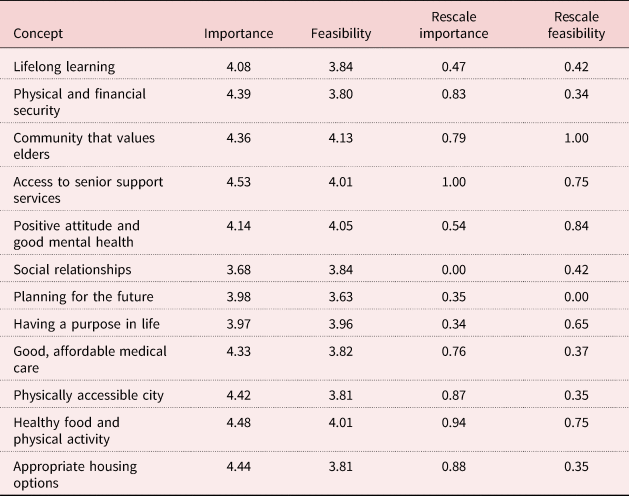
Participants rated the importance and feasibility of each of the items and cluster/concept means were computed (Table 4). The most important aspects of healthy ageing were reported to be components of the social and physical environment such as access to senior services (mean = 4.53), healthy food and physical activity opportunities (mean = 4.48), appropriate housing options (mean = 4.44), a physically accessible city (mean = 4.42), a community that values its elders (mean = 4.36), and physical and financial security (mean = 4.39).
Means of importance and feasibility for each of the 12 concepts (1–5 scale)

At the other end of the spectrum were concepts deemed less important which included psychological variables and individual behaviours such as having a positive attitude and good mental health (mean = 4.14), engaging in lifelong learning (mean = 4.08), planning for the future (mean = 3.98), having a purpose in life (mean = 3.97) and maintaining social relationships (mean = 3.68). Older adults in this sample reported that the most feasible aspects of healthy ageing to obtain in Anchorage were a community that values its elders (mean = 4.13), positive attitude and good mental health (mean = 4.05), access to senior support services (mean = 4.01), and healthy food and physical activity (mean = 4.01). Less feasible were the concepts of good and affordable medical care (mean = 3.82), physical and financial security (mean = 3.80), a physically accessible city (mean = 3.81) and appropriate housing options (mean = 3.81).
In reviewing Figures 2 and 3, there is a disconnect between some of the concepts that are most important and the most feasible. Computing the Spearman rank order correlation confirms that there is little relationship between what is important and what seems feasible for this sample of older adults in Anchorage (rho = 0.12).
Ladder graph comparing importance and feasibility rescaled on a 0–1 scale.

Participants generally viewed aspects of their physical and social community to be most important yet least feasible to achieve healthy ageing in Anchorage, including access to affordable medical care, appropriate housing options, a physically accessible city, and achieving physical and financial security. Individual aspects of healthy ageing tended to be rated as less important but more feasible, such as positive attitude and good mental health, obtaining healthy food and physical activity, having a purpose in life, social relationships and lifelong learning.
Study limitations
Most of our participants were Caucasian females which may limit the generalisability of the findings, although this is not uncommon when utilising a convenience sample of older adults for community-based research (Waters et al., Reference Waters, Galichet, Owen and Eakin2011; Ahn et al., Reference Ahn, Kwon and Kang2017; Trevino et al., Reference Trevino, Canin, Healy, Moran, Trochim, Martin, Pillemer, Sirey and Reid2020). Moreover, all research materials and tasks were conducted in English, resulting in possible bias of the data by excluding some populations. However, the survey questions were crafted from participant's own words from Phase 1 of this research project and are considered valid and reliable for understanding lay perspectives of healthy ageing in this community (Howell et al., Reference Howell, Seater and McLinden2020).
Discussion
Among sample participants, older adults tend to view some of the most important concepts of healthy ageing to be the least feasible to achieve in their community. Participants viewed aspects of their social and physical environment to be the most important yet least feasible to achieve for healthy ageing, while individual behaviours tended to be rated as less important but more feasible to achieve in Anchorage. This may be partially due to the fact that the health of older adults tends to be influenced by their physical surroundings to a greater degree than younger populations (Rowles and Bernard, Reference Rowles and Bernard2013). Since older adults may experience decreased mobility, a physically accessible neighbourhood can have a profound impact on older adults’ health and physical functioning. Anchorage is a city that does not have pavements (sidewalks) in many of its neighbourhoods. Those pavements that do exist do not all have dropped kerbs for wheelchairs and walkers, and are often used to store snow from street ploughing, making outdoor physical activity and transportation difficult during much of the year (Howell and Bardach, Reference Howell and Bardach2018).
Other research also corroborates our findings that access to high-quality, affordable medical care is an important aspect of healthy ageing that is not always feasible to obtain. In a recent survey of 11 countries, US adults reported poor health and wellbeing and were the most likely to experience material hardship, trailing other industrialised nations in providing affordable, timely access to medical care (Osborn et al., Reference Osborn, Squires, Doty, Sarnak and Schneider2016). Alaska experiences some of the greatest health-care provider shortages in the country, especially geriatric and other specialists, providing unreliable access to care for older adults (Kaiser Family Foundation, 2018; United Health Foundation, 2020). The USA also has the highest health-care costs in the world and Alaska currently experiences the highest health-care costs in the nation (Passini et al., Reference Passini, Frazier and Guettabi2018; Tikkanen and Abrams, Reference Tikkanen and Abrams2020), where residents pay roughly double the national average for medical care (Grazko, Reference Grazko2017). Research among older adult populations indicates that lacking access to affordable health-care results in poorer health outcomes (Mäkelä et al., Reference Mäkelä, Backer, Hedegaard and Larsson2013; Syed et al., Reference Syed, Gerber and Sharp2013). For example, a meta-analysis has demonstrated that high medical costs are the reason for much older adult non-adherence to prescription medications, which results in increased depression and heavy disease burden (Briesacher et al., Reference Briesacher, Gurwitz and Soumerai2007). Additionally, seniors in Anchorage have only a handful of providers who accept Medicare, a trend that has been ongoing for several years despite increases in the older adult population (Frazier et al., Reference Frazier, Foster and Leask2010). Nationwide research demonstrates that lack of access to Medicare providers and benefits results in poorer health and higher rates of hospitalisation (Mojtabai and Olfson, Reference Mojtabai and Olfson2003), making it difficult to achieve healthy ageing in Anchorage.
Seniors in this study sample indicate that appropriate housing options are important for healthy ageing but appear to be unobtainable in their community. Sample participants indicated that accessible, affordable and available housing was difficult to find in Alaska's largest city, due to lack of universal design, high housing costs and low housing stock (Howell, Reference Howell2015). For example, a recent housing report indicated that Anchorage residents need an annual income of over US $40,000 per year in order to obtain a one-bedroom unit, which averages over US $1,000 per month in rent (National Low Income Housing Coalition, 2020). However, the average annual per capita income of Anchorage residents is less than $40,000 per year, where 9.2 per cent of residents live in poverty (US Census Bureau, 2020). Research with other older adult populations also indicates that healthy ageing outcomes are determined by accessible and affordable senior housing options, where supportive housing environments can play a compensating role by providing social and material resources (Park et al., Reference Park, Han, Kim and Dunkle2017; Black and Hyer, Reference Black and Hyer2019).
Sample participants also placed high importance but low feasibility upon their ability to achieve physical and financial security. This category included concepts such as qualifying for senior benefit programmes, accessing emergency planning resources and obtaining safe, accessible transportation. Because Anchorage is located in an extreme northern environment on the seismically active Ring of Fire, emergency planning is necessary for events such as blizzards, earthquakes and tsunamis (Brooks and Hopkins, Reference Brooks and Hopkins2018). Additionally, as a state whose economy is based on tourism and transient labour in the fishery and oil industries (Knapp, Reference Knapp2012), seniors in Anchorage are highly susceptible to infectious pandemics like COVID-19 that spread quickly due to travel, increasing their need for emergency planning resources (Sohrabi et al., Reference Sohrabi, Alsafi, O'Neill, Khan, Kerwan, Al-Jabir, Iosifidis and Agha2020). Older adults are considered a vulnerable population that tend to have worse health outcomes during and after disasters than other groups (Al-Rousan et al., Reference Al-Rousan, Rubenstein and Wallace2014; CDC COVID-19 Response Team, 2020). Physical security in Anchorage depends on safe and accessible transportation options. Older adults who experience transportation barriers experience decreased social engagement, physical activity and health outcomes compared to seniors with transportation access (Syed et al., Reference Syed, Gerber and Sharp2013; Reinhard et al., Reference Reinhard, Courtin, Van Lenthe and Avendano2018). Anchorage seniors report the high importance of security and safety, but do not feel their environment provides the needed resources.
In this study, sample participants viewed several aspects of health as most feasible to obtain but somewhat less important for healthy ageing, such as maintaining a positive attitude and good mental health, having a purpose in life, maintaining social relationships and pursuing lifelong learning. Such views are not uncommon in the gerontological literature of Americans, where older adults tend to believe these are the aspects of health over which people have the most control (Swift and Tate, Reference Swift and Tate2013). Indeed, older Americans tend to view healthy ageing outcomes in terms of individual responsibility and personal attributes, where those who are ‘unsuccessfully’ ageing have only themselves to blame for their poor health behaviours and outcomes (Calasanti, Reference Calasanti2016). Critical gerontologists argue that this emphasis on personal responsibility for healthy ageing outcomes is counterproductive, resulting in increased stress and even poorer health outcomes for seniors in societies who hold such beliefs (Lamb, Reference Lamb2014; Hook and Markus Reference Hook and Markus2020). It is not surprising that this sample of seniors in Anchorage view these variables of personal responsibility to be most feasible to obtain, although it is interesting that participants view these aspects to be of less importance for overall health. Research in Norway has also found that older adults may simultaneously hold strong opinions about personal responsibility for health while also endorsing significant support for social responsibility (Traina et al., Reference Traina, Martinussen and Feiring2019). Swift and Tate (Reference Swift and Tate2013) have also found that endorsing support for social and community responsibility for healthy ageing outcomes may increase with age.
Anchorage seniors placed the most importance on physical and social environments for healthy ageing in their communities rather than on individual health behaviours, although they viewed these important variables to be least feasible. In this and other studies it is not uncommon for adults to display a disconnect in their views regarding importance and feasibility, where respondents view the most important aspects to be some of the least feasible and/or vice versa (see e.g. Lyon et al., Reference Lyon, Cook, Locke, Davis, Powell and Waltz2019). In a study assessing the importance and feasibility of early childhood education, participants also had statistically significant differences between importance and feasibility ratings, where eight items were rated as very important, only one of which was also rated as very feasible (Stormont et al., Reference Stormont, Lewis and Covington Smith2005). These study results suggest that Anchorage's seniors believe they might benefit most from changes to their physical environments and social policy rather than changes to individual health behaviours to achieve healthy ageing. Such social and environmental changes may include increasing accessibility in public spaces and transportation options; increased access to senior services, benefits and programmes; improving senior housing options and emergency planning resources; and finding ways to value seniors in our communities.
Conclusion
The most important aspects of healthy ageing were reported to be components of the social and physical environment, rather than psychological variables and individual behaviours. The most feasible aspects of healthy ageing were reported to be a mixture of environmental and individual variables, including a community that values its elders, positive attitude and good mental health, access to senior support services, and healthy food and physical activity. Importantly, the least feasible concepts were those most important aspects of the social and physical environment, including good and affordable medical care, physical and financial security, a physically accessible city and appropriate housing option. Statistical testing of our results confirms that the aspects most important to this sample of older adults in Anchorage are the least feasible.
Although these results come from an exploratory study in Anchorage and are therefore of direct relevance to Alaska, our findings may be applicable to other urban, circumpolar environments. Research suggests there are common threads in the factors that contribute to ageing patterns across the circumpolar North (Emelyanova et al., Reference Emelyanova, Golubeva and Danilova2010; Howell and Peterson, Reference Howell and Peterson2020). Therefore, these results may be helpful in similar physical and social environments, where extreme seasonal variation may present comparable barriers to accessible environments, appropriate housing options and affordable medical care. Research shows that housing and medical costs are high in the extreme North, a vulnerable region of the world on the frontlines of climate change (Huskey, Reference Huskey2005; Fried, Reference Fried2017). Additionally, urban environments in the circumpolar North may present reduced social opportunities, potentially leading to outcomes such as homelessness, poverty, malnutrition and depression (Dionigi et al., Reference Dionigi, Horton and Bellamy2011; Emelyanova and Rautio, Reference Emelyanova and Rautio2013; Hanson et al., Reference Hanson, Schiller, Winters, Sims-Gould, Clarke, Curran, Donaldson, Pitman, Scott, McKay and Ashe2013; Waldbrook, Reference Waldbrook2015). The perspectives of older adults in urban, circumpolar environments are scarce in the research literature, but how they view healthy ageing can have profound influence on their behaviours and health outcomes (Torres, Reference Torres2003). These study results suggest that changes to social policy and physical environments in the circumpolar North may alleviate some barriers to healthy ageing in this far northern location, including increasing access to senior service programmes and benefits, emergency planning resources, and accessible and affordable transportation and housing options, while decreasing health-care costs.
Acknowledgements
The authors wish to thank the research participants and community partner agencies for their support and participation in this work.
Author contributions
BMH and DM designed the study. MS was project manager and research assistant for data collection and data entry. KD was research assistant for data collection and analysis. DM analysed the quantitative data, and all authors analysed the qualitative data and contributed to data interpretation and manuscript writing.
Financial support
This work was supported by the University of Alaska Anchorage (UAA) Center for Community-Engagement and Learning (Faculty Mini-Grant Award and two Community-Engaged Student Assistant (CESA) awards); and the UAA Office of Academic Affairs (Faculty Development Award).
Conflict of interest
The authors declare no conflicts of interest.
Ethical standards
This study involves human subjects and was approved by the University of Alaska Anchorage Institutional Review Board (project #1353737).