

While defined contribution plans are now the norm in private employment, defined benefit (DB) plans remain dominant in the public sector. The additional costs incurred in closing a plan covering current workers are unaffordable for most states – instead recent legislative actions focus on changes that affect for new hires. The DB structure has been maintained with a few exceptions – recent legislation created DB hybrids or combinations with defined contribution plans for new hires that may reduce plan generosity but still maintain the pattern of DB financial influences on retirement. In the period 2009–2012, 44 states introduced changes in state pension plans for general employees and teachers to address long-term funding issues – some states more than once.Footnote 1 These changes include adjustments to generosity – contribution rates, benefit reductions, and early retirement (ER) compensation rules – as well as age/service eligibility criteria.
There is limited research to inform us on the relative importance of these parameters on the retirement choices of public sector workers. In particular, how does the structure of these plans – the eligibility age for early or normal retirement (NR) – affect retirement behavior? Do early-out offers increase the probability of retirement over and above existing incentives and the financial incentives of continued work? Given the substantial underfunding of many of these public pension plans, understanding the influences of plan generosity and eligibility requirements is critical for assessing plan solvency and evaluating the impact of these recent legislative changes.Footnote 2 State and local government budget health depend on the cost of public sector DB plans and the retirement incentives they create for employees are important tools for managing the labor force. Further, about three-quarters of public sector workers are also covered by Social Security so their retirement choices affect Social Security finances as well. More broadly, DB payments in substantially underfunded plans have implications for intergenerational equity. For example, Backes et al. (Reference Backes, Goldhaber, Grout, Koedel, Ni, Podgursky, Xiang and Xu2016) estimate that on average across state plans, over 10% of current teachers’ earnings are set aside for previously-accrued pension liabilities. As a public policy matter, it will be useful to understand the relative value participants place on aspects of these plans.
Unique features of public sector employment may allow us to compare separately the influences of eligibility for pension income, health insurance, and Social Security benefits because these eligibilities can occur at different ages. For example, many public sector workers have employer-provided retiree health insurance in retirement that provide a bridge to Medicare for those who retire before 65. In most previous research, age 65 is also the normal or full benefits retirement age for Social Security benefits. In contrast, most public sector workers can buy into group health insurance if they retire before 65 – effectively delinking the two influences at that important age. In addition, about 25% of state and local employees are not covered by Social Security and do not directly face its financial incentives and key eligibility ages. Studying the retirement behavior of public sector workers can inform us about the influence of Social Security and pension retirement incentives apart from health insurance eligibility.
In a DB plan, retirement eligibility is a function of personal characteristics – age, years of service, and some measure of salary – so the data requirements to estimate the influence of eligibility separately from financial incentives are substantial.Footnote 3 Fortunately, the Health and Retirement Study (HRS, 2016), the most comprehensive panel survey of pre-retirement respondents, includes a substantial number of public employees. In addition, HRS restricted pension data include individual-specific pension benefits and eligibility triggers. Thus, this paper directly complements Coile and Gruber's (Reference Coile and Gruber2007) work to disentangle the effects of Social Security eligibility ages and financial incentives of continued work on private sector employee retirement in the HRS.
In this paper, I explore the sensitivity of public sector employee retirement decisions to key features of state pension plans – benefit generosity and early and NR eligibility thresholds as well as the role of Social Security coverage. I use respondent-provided information on job history from 12 waves of the publicly available Health and Retirement Study (HRS, 2016) data to identify public employees and their retirement choice. I calculate respondent pension wealth and key eligibility ages using the HRS-provided Pension Estimation Program (PEP) that uses restricted data on actual employment history linked to detailed plan information. I am able to identify an important subset of public employees – teachers – using restricted detailed industry and occupation codes. Finally, because differences in state policy toward public employees are of interest, I augment these data with the restricted geographic codes to identify the state of residence. Using state of residence and job characteristics, I am able to determine if the employee is covered by Social Security and if further ER inducements from integrating with Social Security by leveling benefit payments are available.
The model underlying this analysis is a proportional hazard model with time-varying covariates that reflect state pension policy – vested pension wealth and eligibility for ER options, whether the public sector job is covered by Social Security, whether it includes employer-provided health insurance in retirement, as well as rich demographic characteristics. To preview the main results, I find that public employee retirement is responsive to program eligibility focal points – especially becoming eligible through meeting age and service requirements for the plan's ER benefit – but not to pension wealth separately. Social Security coverage increases retirement probabilities for employees age 60–64, and coordinating with Social Security through leveling is an additional incentive to retire for this age group but is imprecisely measured. Unlike previous findings on private employees, I do not find a statistically significant relationship between retirement and the gain in pension wealth from continued work. Special early-out provisions do appear to encourage earlier retirement, over and above the plan's ER provisions.
The next section presents some background on institutional features of public sector pension plans and reviews some related literature. Section 3 discusses the HRS panel of public employees and sources of pension plan information. Section 4 presents results using the sample of respondents who enter the sample while in public employment and retire from their public sector job. These results are compared with an HRS panel of non-public sector workers. The final section concludes.
1. Background and literature
Most full-time state and local public employees participate in a DB plan that offers NR benefits at relatively early ages, and these plans vary widely across the state and job descriptions in terms of pension generosity and early-out provisions.Footnote 4 Typical public sector plans, for example, may allow for ER at age 55 and NR at 60 conditional on a certain number of years of service. The retirement annuity is a function of a specific benefit rate for each year of service and the participant's final average salary over a specified period – often 3 years. For example, plans with a 2% replacement rate replace 60% of final average salary after 30 years of service. And plans also differ in eligibility thresholds – the age and service combination that determine early or NR.
A second important dimension of difference across public sector jobs is Social Security coverage. Beginning in 1991, public employees who were not members of a qualifying state or local retirement system were generally required to have Social Security coverage. Federal law permits each public employer to decide which employees to cover, and the extent to which public employees are covered varies greatly from state to state.Footnote 5 For example, the GAO (2010) reports that, based on Social Security Administration data (SSA), 98% of public employees are covered by Social Security in Vermont, but in Ohio only about 3% are covered.Footnote 6 Further, there is variation in Social Security coverage among public employees working for the same employer. For example, Missouri's school districts have two separate retirement systems – one for fulltime teachers and a separate one for fulltime non-teachers. The fulltime teachers do not generally have Social Security coverage while the fulltime non-teachers do. It is common, as in New Hampshire, to prohibit Social Security coverage for police and fire fighters who belong to a more generous plan than other public employees. Of course, public employees working in uncovered employment may still be eligible for Social Security benefits based on their spouse's or their own earnings in other, covered employment (GAO, 2003).Footnote 7 In 2007, 73% of state and local government employees were covered by Social Security, accounting for $528 billion of the $5 trillion of covered wages (GAO, 2010). This leaves over five million public employees without Social Security coverage and seven states – California, Colorado, Illinois, Louisiana, Massachusetts, Ohio and Texas account for more than 75% of noncovered payroll (GAO, 2003). In particular, teachers do not participate in Social Security in 12 states.Footnote 8 As I discuss below, I am able to identify and expand the sample to include this important subgroup of public employees using restricted HRS occupation codes.
How to measure retirement is a subject of research itself. Gustman and Steinmeier (Reference Gustman and Steinmeier2000) discuss alternative measures using HRS data: by self-report of labor force status, by an hours-worked or salary measure, or leaving a job after 10 or 20 years. Maestas (Reference Maestas2010) uses the original HRS cohort to study unretirement transitions directly. She compares alternative measures using hours of work and self-reports of retirement and finds that nearly 50% of retirees follow a nontraditional retirement path that follows partial retirement or unretirement. In what follows I use the panel structure of the HRS to identify retirement from the public sector job – few of the public sector employees who retire over my sample period report any post-retirement work.
Most previous research on the influence of retirement income – whether Social Security benefits or DBs pensions – finds significant effects on the timing of retirement from private sector employment.Footnote 9 Coile and Gruber (Reference Coile and Gruber2007) use HRS data to distinguish the differential impact of the Social Security eligibility structure – ER at age 62 or normal at (then) age 65 – from the financial incentives of these benefits on male retirement in the private sector. They develop a forward-looking measure of retirement incentives, the ‘peak value,’ whereby individuals consider incentives to work in all future years. They define peak value as the difference between Social Security wealth (SSW) at its maximum expected value and SSW at today's value to measure incentives to continued work. Using two alternative measures of retirement – changes in earnings and self-reports of first exit after age 55 – they find large effects at the key Social Security eligibility ages of 62 and 65, but they also find that retirement decisions respond negatively to accrual of retirement wealth with future work and positively to the level of retirement wealth. While the match to HRS restricted pension data is limited to about 60% for their sample, they conclude that private pension incentives have roughly similar effects. After comparing several incentive measures of future retirement income, they conclude that retirement decisions are more responsive to the entire future stream of retirement incentives than to the accrual in retirement wealth over the next year alone. In what follows, I adopt this forward-looking approach and construct the peak value measure for public pensions to capture the public pension incentive effects of working longer.
Morrill and Westall (Reference Morrill and Westall2018) use cross-sectional data from the American Community Survey (ACS) to study the influence of Social Security coverage for public school teachers. ACS data on pension incentives are limited – they approximate ‘theoretical eligibility’ for retirement from the public sector job by comparing the age of the teacher with the pension plan's earliest full retirement age. They find strong evidence of higher rates of retirement among covered teachers at key Social Security eligibility ages with variation by marital status.
This literature includes studies of teacher-only retirement choices using administrative data from a handful of states (Brown, Reference Brown2009; Costrell and Podgursky, Reference Costrell and Podgursky2009; Costrell and McGee, Reference Costrell and McGee2010; Fitzpatrick, Reference Fitzpatrick2015, Reference Fitzpatrick2018; Furgeson et al., Reference Friedberg and Webb2006; Kim et al., Reference Kim, Koedel, Ni, Podgursky and Wu2017). The primary limitation of this work is that administrative data do not include other factors that affect retirement well-being and retirement-related decisions – health, non-pension wealth, and spousal characteristics for example. Further, most public employees also have a second annuity – Social Security – so their valuation of benefits will likely differ from other public employees for whom this is the only source of a retirement annuity. But Asch et al. (Reference Asch, Haider and Zissimopolos2005) examine the retirement behavior of federal civil service workers using administrative data from the Department of Defense. These federal workers do not participate in Social Security and the authors find no ‘excess retirement’ at age 62 or 65. They estimate that civil service workers delay their retirement probability by 4% of the average retirement rate for every additional $10,000 of expected pension wealth from working another year.
Shoven and Slavov (Reference Shoven and Slavov2014) focus on another important benefit in the public sector – employer-provided retiree health coverage – on retirement decisions of federal, state, and local workers using the HRS – while controlling for a measure of pension wealth. As mentioned previously, employer-provided retiree health insurance is common in the public sector, but relatively rare in the private sector. They examine retirement before the age of Medicare eligibility at 65 when retiree health coverage is most valuable and focus on the first full time self – report work exit over the roughly 2-year period between waves. Their pension controls include the researcher-contributed supplement DB and defined contribution wealth (Gustman, et al., Reference Gustman, Steinmeier and Tabatabai2012) and a set of DB pension status indicators from self-reports of early and NR ages reported at entry into the HRS. They find that retiree health coverage raises the probability of stopping full time work over 2 years by 4.3 percentage points at ages 55–59 and by 6.7 percentage points at ages 60–64.
My analysis complements these previous studies by using some of the same controls but with individual measures of pension eligibility and wealth based on work history. I control for the same self-report of health insurance benefits, but am able to include the actual present value of pension wealth on the current job – the one that is changing with continued work – and the change in pension wealth from continuing to work another year at each age. I can control for the wealth effect of pensions as well as the ER incentives resulting from the pattern of benefit accrual with continued work. I use the person-specific eligibility for ER or NR that isolates the eligibility effect from the wealth effect. Note that since I do not combine public employees with private employees, my method is not subject to selection on unobservables into public jobs that offer generous retirement benefits relative to wages and earlier retirement options with health insurance. But I do have concerns about unobservable individual heterogeneity possibly correlated with public job characteristics. While it is not possible to fully address these concerns with survey data, I do include initial job tenure and defined contribution balances at entry to control for heterogeneous preferences for long tenure and retirement. In addition, following Shoven and Slovov (Reference Shoven and Slavov2014), I exclude individuals with fewer than 5 years of service on the current job to reduce the possibility that individual job choice was motivated by health insurance.
2. Data: public employment in the HRS
I use four comparable cohorts of the HRS – all the same age when they entered the HRS (age 51–56 in 1992, 1998, 2004, 2010) – that face different state or local DB pension landscapes as they approach and enter retirement. Respondents are re-interviewed every other year after entering the survey. I make use of the panel structure of the HRS from 1992 to 2014 to compare initial and final self-reports of retirement with dates of public employment to find their final retirement from the public sector.Footnote 10 Respondents indicate at their first interview whether they had ever worked for the federal, state, or local government and the start and end date of such jobs. In 2006, 2008, and 2010, the HRS added two new questions that determine if a respondent is currently employed by a government (question J720), and if so, what level of government (in 2008 only new interviewees and those who changed jobs were asked these questions). Going forward, this question repeats every 6 years. I determine public employment in other survey years by comparing the start and end date of any reported government job with the start and interview dates of their current job. I follow employment in each wave between 1992 and 2014 backward to earlier years that they remained in that same job. I identify job changes in and out of public employment across the waves (2-year intervals) and eventual retirement from the government job (if they retire from that job). So, the measure of retirement used here is based on self-reports with later wave confirmation that the respondent actually fully retired after leaving public employment.
I focus on respondents who self-report as state or local public employees at their entry into the survey.Footnote 11 Most of the data come from the RAND (version P) of the HRS with supplemental information from the RAND HRS Fat files.Footnote 12 I supplement these data with three restricted data sources from the HRS: detailed industry and occupation, pension plan data, and geographic codes for the state of residence. I use the industry and occupation data to identify finer job categories that are available in the public data. This is particularly relevant for teachers – an important category of public employment many of whom do not participate in Social Security. Gustman et al. (Reference Gustman, Steinmeier and Tabatabai2013) speculate that teachers are the most likely of non-Social Security covered respondents to indicate that they do not work for the government so by using the detailed industry data I can include them as public sector employees.
To examine the influence of pension wealth and eligibility for retirement under different provisions, I use detailed pension information that the HRS has matched to respondents to calculate the present value of pension wealth. These data come from four surveys of employers and from employer websites (Feng et al., Reference Feng, Butchart, Stolyarova, Nolte and Peticolas2016). For respondents that have been matched to employer plans, the HRS PEP calculates three types of present values of pension wealth for a respondent's current plan at any age: values that are available to participants who qualify for ER, values available once the respondent qualifies for the plan's NR age, and vested deferred benefits that accumulate over time prior to any eligibility for retirement.
While the early HRS pension employer surveys had low response rates, later surveys create more complete matches, particularly in the 2010 wave where much of the public plan information comes from employer websites.Footnote 13 For public employees these data are primarily DB plan parameters – benefit formulas and age and service requirements to meet early and NR. I use the PEP that uses these parameters and Social Security earnings information to calculate present values of DB pension wealth at ages 51 and older. The PEP data include defined contribution balances as well as required employee contributions to the DB plan.
Finally, I use restricted respondent geographic codes to identify the respondent's state of residence. This allows me to verify self-reports of Social Security coverage with other sources of Social Security coverage by employee type. The publicly available HRS data include estimates of SSW at key ages and an indicator of receipt, but these Social Security benefits are not necessarily due to the current job. The Wisconsin Legislative Council (2013) reports fund name, type of employee covered, as well as Social Security coverage among other features of 87 large public pension plans.Footnote 14 I match these coverage data by state of residence and employee type. Public employees who are also covered by Social Security may have another option available for ER – Social Security leveling. Clark et al. (Reference Clark, Hammond, Morrill and Vanderweide2017) summarize state annuity options for Social Security leveling for the 20 out of 85 large state-managed public pension plans that cover teachers, state, and/or local employees.Footnote 15 Leveling is the option to get a higher pension benefit before claiming Social Security, but after claiming, the pension benefit drops. Leveling is a policy variable that could be used to encourage or discourage retirement.
3. Methods and results
The sample consists of state and local public employees employed in the public sector at their baseline interview. It is natural, then, since they all start in the same employment state to model their retirement in duration framework. The model underlying the analysis is a proportional hazard model with time-varying covariates, which can be written as
 $$h(t;{\bi Z}_{it}) = base(t){\rm exp(}{\bi Z}_{it}{\bf \beta} {\rm )}$$
where the Zit include covariates that may change over time. As shown in Jenkins (Reference Jenkins1995), the proportional hazards model leads to a binary response model for retirement at age t conditional on not having retired prior to age t. The resulting response probability has the complementary log–log form, which is different from both logit and probit in that it is the cumulative distribution function of an asymmetric distribution.Footnote 16 The implied model relates the probability of retirement from a public sector job, conditional on not having retired prior to that age, to pension options available for that individual, adjusting for covariates that factor into the retirement decision such as health status, Social Security participation, and employer-provided health insurance in retirement.
To be more specific, the conditional probability that public employee i retires at age t is
 $$\eqalign{\Pr (retire_{it} & = 1{\rm \vert} \cdot ) = F(\beta _0 + \; \beta _1eligible_{it} + \beta _2pvwealth_{it} + \beta _3peakdiff_{it} \cr & + \beta_4 DC@entry_{it} + \; \beta _5SScov_{it} + \beta _6SSelig_{it} + \beta _7SSlev_{it} \cr & + \; {\bi X}_{it}{\bi \beta} _7\; + \; \beta _8wave_t + {\bi ag}{\bi e}_{{\bi it}}{\bi \beta} _9)\;} $$
where retire is a binary indicator for whether individual i retires at age t. Because retirement is taken as the final state in the analysis, it takes on zero followed by one if a person is observed to retire. The function F(u) for argument u is the complementary log–log cumulative distribution function:
 $$F(u) = 1-{\rm exp(}-\exp (u){\rm )}$$
which is used in a pooled binary response estimation.
The vector ageit represents a vector of age dummies, whose coefficients can be turned into estimates of the baseline hazard. Employee retirement options are captured by eligible, that is, the employee may be eligible for ER or NR.Footnote 17 The present value of pension wealth, pvwealth, is the present value of ER benefits if eligible, normal-age retirement benefits if eligible, or the present value of vested deferred benefits if not yet eligible for either early or NR. The peak value concept, peakdiff, is the forward-looking measure of the incentive to continued work developed by Coile and Gruber (Reference Coile and Gruber2007). It measures the difference between pension wealth at its maximum expected value and pension wealth at today's value. The HRS PEP includes defined contribution balances for the small set of employees who have them in addition to their DB plan. I include an indicator for whether they have balances at entry into the survey to control for individual saving propensity. Demographic variables are included in X. SSCov is the indicator for participation in Social Security and SSelig is an interaction between the coverage variable and age 62, when ER from Social Security is possible. I adjust the standard errors by clustering at the household level.
Many of the dollar amounts (measured in 2012 dollars) in the data are zero (before pension benefits are vested, for example) and there are extreme values for total assets and pension wealth. I use the log-modulus transformation (John and Draper, Reference John and Draper1980) to dampen extreme values without having to use a special convention for zero values.Footnote 18 For values of pension wealth away from zero, the log modulus transformation is very similar to taking the log. Therefore, when interpreting the results, it makes sense to change the log modulus by something like 0.01 (a 1% increase in pension wealth) or 0.10 (a 10% increase in pension wealth). In the latter case, this is the same as dividing the coefficient by 10. But because the model is nonlinear, I will report the average partial effects of changing each variable, but these, too, must be multiplied by the desired change on the log modulus.
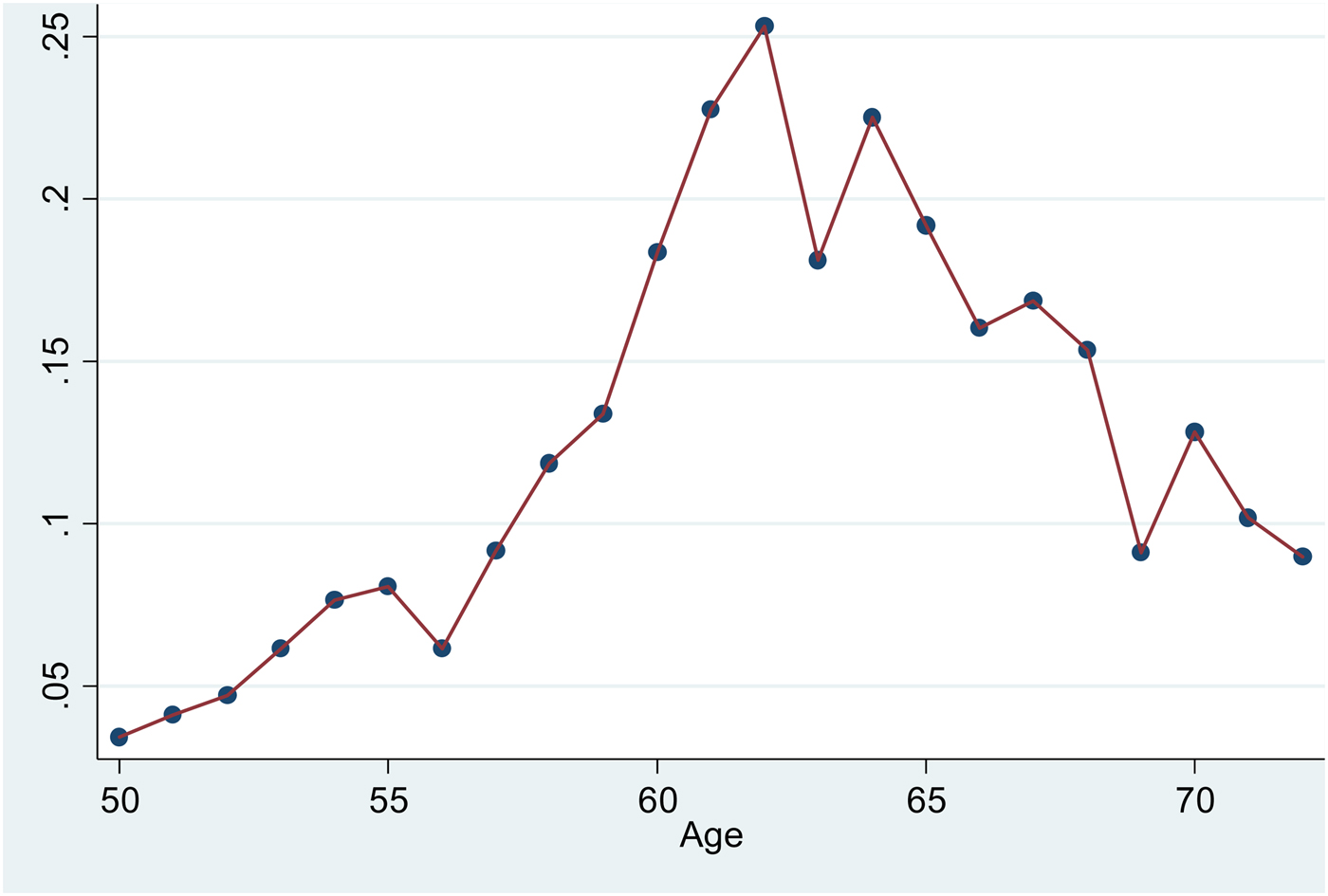
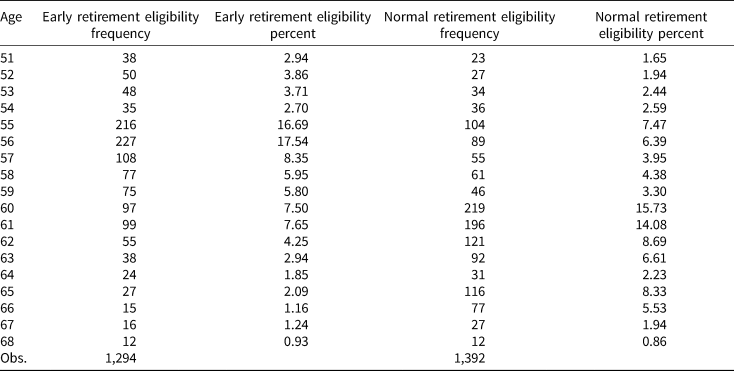
The baseline hazard, estimated with only age dummies (ages 51–72 and older) using 13,455 observations, is pictured in Figure 1. As Coile and Gruber (Reference Coile and Gruber2007) note regarding Social Security, the underlying structure of public pension plans – early and NR eligibility ages – play a critical role in determining retirement decisions. There is a small peak at age 55; that is, conditional on working to 55, the probability of retiring at this age is about 0.08. The largest spike occurs around ages 60 and 62 – the probability of exiting during this interval conditional on not having exited is 0.25. Table 1 illustrates the early and NR eligibility ages for the respondents that are calculated by the PEP program. That is, 1,294 respondents have an ER option, and based on their eventual years of service 16.69% of them (216) were eligible for ER at age 55, and 17.54% of them at age 56. The most common eligibility age is 60 in the sample, with 15.73% attaining NR at that age.
Retirement age hazard function.

Early and normal retirement eligibility ages for public employees in the hrs: frequency and percent of sample of public employees at entry

Source: Author's calculations using the HRS Pension Estimate Program (Feng et al., Reference Feng, Butchart, Stolyarova, Nolte and Peticolas2016).
Note: These are empirical eligibility ages based on an individual's age/service history.
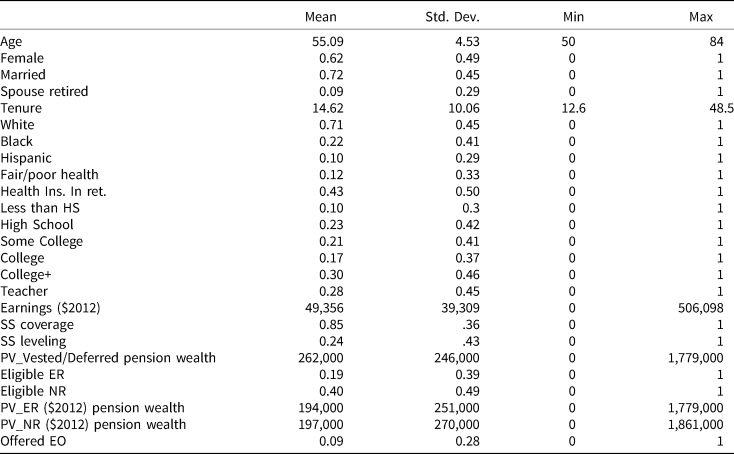
Table 2 presents summary statistics for the data used in this analysis – the teacher category is the only industry or occupation category I summarize here. The sample size for entry characteristics is 3,248 and 1,460 for characteristics measured in the retirement wave that I eventually observe. Sixty-two percent of the sample is female, and 28% enter employed as teachers. Twelve percent report being in fair or poor health and 9% have spouses that are already retired. Eighty-five percent of the sample is covered by Social Security and 24% have access to leveling. At retirement, 19% are eligible for ER benefits, and 40% are eligible for NR. Nine percent of the sample report being offered an early-out package over and above their plan's ER provisions.
Summary statistics for public employees

Source: Author's calculations from the HRS Waves 1–12.
Notes: The values in the top panel are measured at a respondent's entry into the survey with 3,248 observations. The values in the lower panel are measured in the year of retirement with 1,460 observations.
SS, Social Security; EO, offered early out; NR, normal retirement.
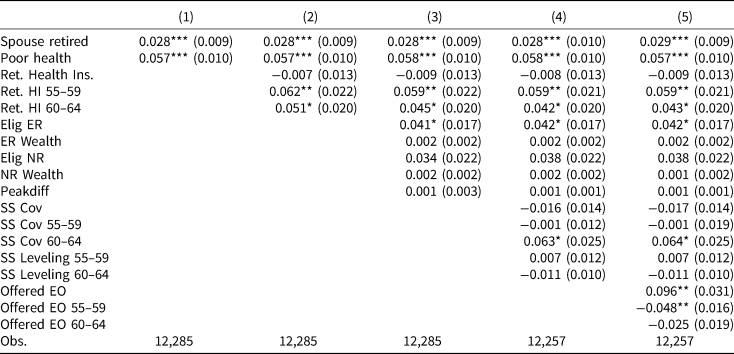
Table 3 presents the maximum likelihood estimation results of the complementary log-log response probability. I report only the marginal effects of interest, but also have included age and wave dummies, a female dummy, race, education, marital status, fair or poor health self-reported status, whether a spouse is retired, broad occupation dummies, as well as the teacher indicator, tenure and defined contribution balances at survey entry in the current job, and earnings and assets transformed as discussed earlier. These are estimated on a sample that includes missing data indicators.Footnote 19
Impact of retirement options on the probability of retiring from the public sector

Source: Author's calculations from the HRS Waves 1–12.
Notes: Marginal effects are reported above standard errors clustered at the household level. Marginal effects for wealth variables are reported at eligibility. Personal/job characteristic controls include age and wave dummies, a female dummy, race and ethnicity, marital status, fair/poor health indicator, occupation dummies, education dummies, tenure and defined contribution balances at entry, and total assets. Total assets and pension wealth variables are transformed via the logmodulus transformation in estimation.
SS, Social Security; ER, early retirement; NR, normal retirement; EO, offered early out.
*p < 0.05, **p < 0.01, ***p < 0.001.
The marginal effects of the dummy variables are interpreted as changes in the probability of retiring from one's public sector job. The results are consistent across all five specifications so I discuss the estimates from the most complete model in column 5. Two personal characteristics – having a spouse who is already retired and being in fair or poor health – increase the probability of retirement by 0.029 and 0.057, respectively. They are highly statistically significant. Employer provision of retiree health insurance encourages retirement for the two young age categories highlighted and these estimates are precisely measured. This health insurance increases the probability of retiring by 0.05 for those age 55–59 and by 0.04 for those 60–64, holding pension eligibility and Social Security coverage fixed. Social Security coverage does affect the probability of retirement for those 60–64 by about 0.05, about the same magnitude as access to health insurance in retirement. The effect of the Social Security leveling variable is statistically insignificant when it is included for the two key age groups.
I define the ER and NR indicators to be mutually exclusive. In plans without an ER option programmed in the PEP, the NR indicator is on and stays on once the NR eligibility is reached. I estimate that becoming eligible for ER increases the probability of retiring by 0.042 and this estimate is statistically significant at conventional levels. Becoming eligible for NR also increases the probability of retiring but this estimate has a p-value of 0.09. I estimate a positive as expected, but very small, statistically insignificant impact of retirement wealth on retirement itself – whether at early or NR.
The peakdiff coefficient measures the effect of forward-looking incentives – the increase in retirement wealth from continuing to work. Recall, this is measured as the difference between pension wealth in the current wave (the present value of deferred vested benefits calculated in the PEP at that age) and the maximum value of pension wealth, transformed as described previously. There appears to be no effect of these financial incentives apart from becoming eligible for retirement in these models. In other results that use complete cases of the data (not reported here) I find a statistically significant but economically very small effect – a 10% higher future value of retirement benefits is estimated to reduce the probability of retirement by 0.0006.
The HRS PEP is programed with the typical structure of the public sector pension plans but not with special one-time offers to encourage retirement. The HRS publicly available data include questions about this potentially important labor management tool and I include a general indicator for being offered an early out package as well as the indicator interacted with the two pre-retirement age groups of interest. These offers are estimated to increase the probability of retirement the most for the youngest employees – by 0.096 regardless of age, and by 0.048 for those age 55–59. The estimate for those ages 60–64 is 0.071 but is not statistically significant.
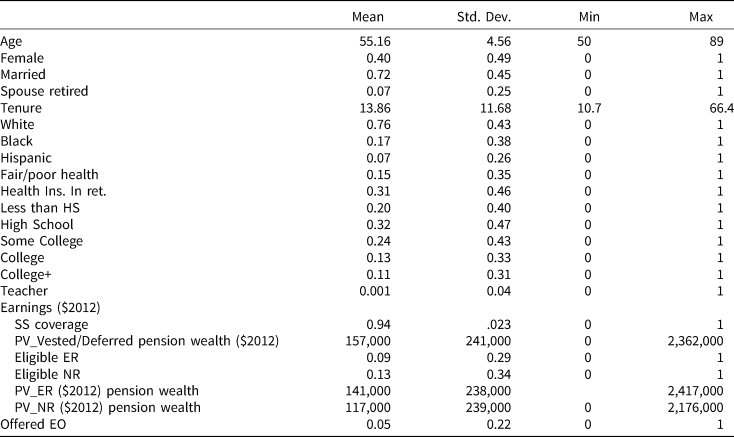
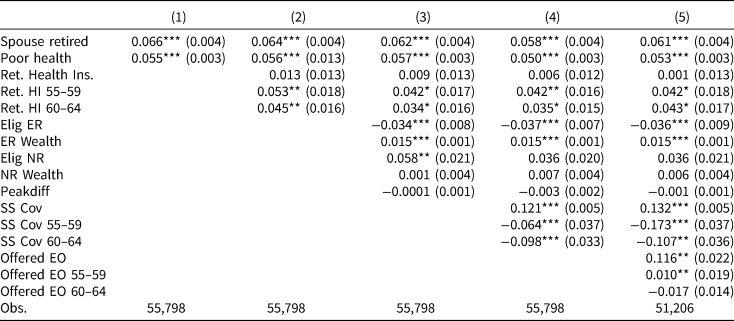
As discussed previously, it is in the public sector where DB plans play an important role now and in future retirement decisions and labor management choices – defined contribution plans now dominate in private sector employment. But for completeness and comparison purposes, I estimate similar hazard models on respondents in the HRS that I did not flag as public employees at entry – these respondents are privately employed or (a small number of) self-employed. I estimate the models on the private sector employees separately – in a model that combined public and private sectors, a test that the pension variables have a similar effect for the two types of employees was rejected with a p-value of 0.0002. Summary statistics are provided in Table 4, and hazard model estimates in Table 5. I summarize the interesting differences here.
Summary statistics for private sector employees

Source: Author's calculations from the HRS Waves 1–12.
Notes: The values in the top panel are measured at a respondent's entry into the survey with 9,980 observations. The values in the lower panel are measured in the year of retirement with 5,799 observations.
SS, Social Security; EO, offered early out; NR, normal retirement; ER, early retirement.
Impact of retirement options on the probability of retiring from the private sector

Notes: Marginal effects are reported above standard errors clustered at the household level. Marginal effects for wealth variables are reported at eligibility. Personal/job characteristic controls include age and wave dummies, a female dummy, race and ethnicity, marital status, fair/poor health indicator, occupation dummies, education dummies, tenure and defined contribution balances at entry, and total assets. Total assets and pension wealth variables are transformed via the logmodulus transformation in estimation.
SS, Social Security; ER, early retirement; NR, normal retirement.
*p < 0.05, **p < 0.01, ***p < 0.001.
The private sample is only 40% female compared with my public sample of 60%, includes fewer non-white respondents, a higher percentage in poor health, and lower percentages with post-high school education. The influence of having a retired spouse is estimated to be twice as large as that in the public sector – increasing the retirement probability by 0.061. The effect of health insurance in retirement is similar for both samples – increasing retirement probabilities for the two pre-retirement age groups by about 0.04. The most interesting differences are with respect to ER eligibility and Social Security coverage and the findings are consistent with older retirement ages observed in the private sector. Becoming eligible for ER in one's private sector job is estimated to reduce the probability of retiring by 0.036, holding pension wealth and Social Security coverage fixed. Unlike in the public sector estimates, there is a statistically significant effect of wealth at ER but the estimated effect is small – 10% higher pension wealth increases the probability of retiring by 0.002.
The effect of Social Security, while positive and large generally (0.13), is negative and statistically significant for the younger age group – I estimate that Social Security coverage reduces the probability of retiring by 0.04 for those 55–59 and increases it by 0.025 for those 60–64. Finally, an early out offer increases the probability of first retirement from a private sector job by 0.126 for those age 55–59, a much larger effect than the 0.048 for the comparable age group in the public sector.
4. Discussion and conclusion
Evidence presented here suggests that public employee retirement is responsive to program eligibility focal points – in particular becoming eligible for the plan's ER benefit through one's age and years of service. But I find no evidence that pension wealth or future pension incentives influence retirement separately. This finding is consistent with the literature on default options in 401(k) plans documented by Choi et al. (Reference Choi, Laibson, Madrian, Metrick and Poterba2002, Reference Choi, Laibson, Madrian and Metrick2003). Defaults established in these 401(k) plans affect plan participation and individual savings rates, for example, perhaps because employees view them as implicit suggestions. The results in this paper suggest that the same may true for DB plans in the public sector. It is possible that if becoming eligible for ER is perceived as a reference point, deviations from that point may be psychologically uncomfortable.Footnote 20 This effect appears particularly strong in the public sector results in comparison with the opposite impact in the private sector results.
While personal circumstances like poor health have larger economic effects, state and local governments, or school districts, can encourage retirement by offering retiree health insurance, and offering an early out package. Or, conversely, they may choose to retain employees longer by eliminating retiree health insurance (which, unlike pension benefits in most state are not constitutionally protected) or by changing the age/service combination for these suggested retirement focal points. These findings do suggest that state legislative action to affect retirement decisions and reduce future pension costs would be most effective operating through plan eligibility rules and early-out incentives rather than plan generosity. Similarly, these findings suggest that legislators may be able to reduce plan generosity without much affecting retirement decisions.
Some caveats of this work should be mentioned. I am unable to control for SSW that is known to influence retirement along with pensions, although I do control for earnings and coverage (Coile and Gruber, Reference Coile and Gruber2007). Further, this work focuses on the decision to fully retire from the public sector – that is, the employees do not return to work elsewhere. Only about 5% of this sample report later part-time employment following retirement from their public sector job. Given the use of final average salary in the DB annuity, part-time work would have to be done under a special arrangement like a DROP plan, or with another employer. In future work it may be possible to identify states where DROP plans are used. It is possible that different factors influence the decision to work part-time and future waves of the HRS may assist in the study of unretirement in the public sector.
Acknowledgements
I thank Sita Slavov and conference participants at the NBER Conference on Incentives and Limitations of Employment Policies on Retirement Transitions for useful comments. I also thank the Michigan Retirement Research Center and staff for their support of this project, as well as the staff at the Michigan Center for the Demography of Aging who have enabled my access to restricted data. Bryce S. Vanderberg provided excellent research assistance. All errors are my own.