INTRODUCTION
Behavioural alteration of the host is a well-known phenomenon in many host-parasite associations (Moore, Reference Moore2002). In many cases, these alterations are known to increase the fitness of the parasite by enhancing its reproductive and transmission capabilities or allow the host to counter these same effects. Whether these behavioural changes are specifically induced by the host or by the parasite in their fight against each other or whether they are incidental results of the pathological effects of the host-parasite association have been a source of intense debate (Thompson and Kavaliers, Reference Thompson and Kavaliers1994; Robb and Reid, Reference Robb and Reid1996). A number of researchers recognize only the first kind of behavioural changes as true parasitic manipulations because they represent situations where either the parasite pays a cost to induce the change or their specificity indicates that enhancing the fitness of the parasite was the primary focus of natural selection (Thomas et al. Reference Thomas, Adamo and Moore2005). However, rigorous tests of these criteria to differentiate between the two possibilities are few and far between.
One of the most commonly cited examples of behavioural alteration is behavioural fever whereby an infection is accompanied by a change in the thermal preference of the host (Kluger, Reference Kluger1979). In nearly all instances, fever has been suggested to be a host defence mechanism except in a few cases where it has been shown to be an act of host manipulation benefiting the parasite (Watson et al. Reference Watson, Mullens and Petersen1993; Fialho and Schall, Reference Fialho and Schall1995). Behavioural fever is particularly interesting in a social animal such as the honeybee in which thermoregulation is a behavioural outcome of the entire group. Honeybees are susceptible to infection from a number of pathogens, some of which are temperature sensitive (Bailey, Reference Bailey1981), and it is interesting to ask how the host-parasite interaction at the level of an individual could translate to a possible behavioural fever at the level of the group. Using the microsporidian honeybee pathogen Nosema ceranae, the multiplication of which is known to be highly temperature sensitive (Martín-Hernandez et al. Reference Martín-Hernández, Meana, García-Palencia, Marín, Botías, Garrido-Bailón, Barrios and Higes2009), we investigated behavioural fever at different levels by determining how infection affects (1) the distribution of bees at different thermal zones within the colony, (2) the temperature preference of individual bees outside the social context of the colony, and (3) the thermoregulatory ability of individual bees. Because N. ceranae has recently jumped host to the European honeybee, Apis mellifera (Klee et al. Reference Klee, Besana, Genersch, Gisder, Nanetti, Tam, Chinh, Puerta, Ruz, Kryger, Message, Hatjina, Korpela, Fries and Paxton2007), we also hypothesized that this new host-parasite association allows us an opportunity to investigate the manipulation versus incidental benefit debate.
MATERIALS AND METHODS
For the first 2 experiments, we collected in-hive bees from a free-foraging colony that was uninfected with Nosema ceranae and allocated them to 1 of 2 cages, feeding ad libitum one group with 20% sugar solution and the other with an inoculum of 1×10⁶N. ceranae spores/ml mixed in the same concentration of sugar. A week later, we extracted a sample of bees from these cages and confirmed their infection status before beginning the experiments. The third experiment was conducted with foragers, caught at the entrances of 2 colonies that contained both infected and uninfected bees, because they are known to have high metabolic rates and are most likely to be affected by their thermoregulatory ability or a lack thereof when flying outside the colony. Each bee participating in the experiments was later enumerated for its spore level by dissecting its gut followed with a haemacytometer count and the Nosema species was confirmed using the multiplex PCR and electrophoresis method (Martín-Hernández et al. Reference Martín-Hernández, Meana, Prieto, Martínez Salvador, Garrido-Bailón and Higes2007). Infected bees showed spore counts ranging from 0·0875×106 to 156×106. Since the uninfected or infected status of the bees was confirmed only after the experiments, this makes the second and the third experiments essentially blind to the observer.
In order to determine the spatial distribution of uninfected and infected bees inside a colony, we marked 150 bees of each type with a different colour and placed them in an already established observation hive. We also placed 4 temperature probes in the hive, one at the centre and the rest at 3 different edges of the hive. The temperature at each of these locations was automatically recorded every 30 min with a data logger. At the same instant the temperature was recorded, the distribution of the 2 types of bees within the hive was also filmed with a digital camera set on a timer. We collected these 2 types of data continuously during daylight hours for up to 15 days, the duration for which marked bees were seen in the colony. The spatial location of the individuals within the colony was mapped by dividing the hive into 2 concentric, circular zones of equal area and the number of bees seen in these 2 zones on each day was counted. Two replicates of this study were conducted.
For measuring the individual temperature preference of uninfected and infected bees outside the social context, we used a temperature gradient consisting of an aluminum plate marked in 1 cm increments and divided into 2 tracks with a barrier. The plate was enclosed in a Plexi-glass box and one end of it was immersed in ice within a cooler while the other end rested on a hot plate (Moore and Freehling, Reference Moore and Freehling2002). We calibrated the temperature gradient to a range of 18–47°C and constructed a standard curve between each position (in cm) on the plate and its corresponding temperature. Pre-trial tests were run in a gradient at room temperature to rule out the effect of the gradient itself on the bees. For each trial, we simultaneously placed an infected and a control bee at the centre of the 2 different tracks and recorded their positions every min for 20 min. Using the standard curve, the positions were converted to corresponding temperatures for each bee. Thirty bees from each group were tested in this fashion.
For measuring the body temperature of uninfected and infected bees, we immobilized individuals by chilling them in vials held in ice and then strapped them within 4·5 cm long plastic drinking straws with strips of tape. Using an infrared thermometer, we measured the thoracic temperature of all bees 30 min after the last bee was strapped and every 6 h for 24 h during which one group of bees was fed nothing and the other group was fed ad libitum amounts of 30% sucrose solution. The bees were kept in an incubator set at 25°C and 70% RH during the entire 24-h period.
RESULTS
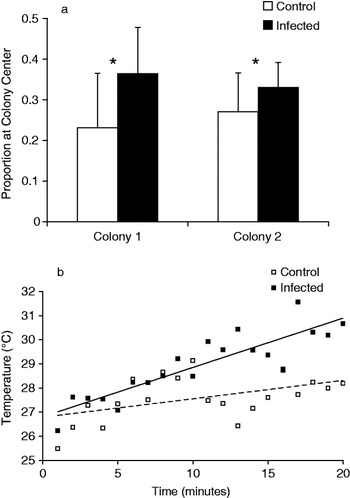
The average temperature at the centre of the hive (29·45±1·67°C) was significantly warmer than that at the edges (26·01±1·19°C) (One-way ANOVA: F1,182=226·18, P<0·0001). In both replicate colonies, a significantly higher proportion of the infected bees was found to be located at the centre of the hive compared to uninfected bees over the entire period of the experiment (Two-way ANOVA, F1,50=10·6, P=0·002, Fig. 1a) with no colony effect (F1,50=0·002, P=0·967). Even outside the social context of the colony, infected bees moved toward a significantly higher temperature over time (One-way ANOVA: F1,598=19·57, P<0·0001, Fig. 1b) while the uninfected bees did not show any such preference (F1,598=2·99, P=0·08) in the temperature gradient. At the end of 20 min, infected bees were found at a temperature of 30·66±6·65°C while control bees preferred a temperature of 28·19±7·64°C.
Temperature preference of uninfected and infected bees in (a) the colony with the data representing mean±s.d. values and asterisks representing significant differences, and (b) a temperature gradient for a duration of 20 min. Regression lines are computed for the entire data but only mean values are plotted for clarity. Control (- -): y=0·07x+26·78; Infected (−): y=0·20x+26·81.

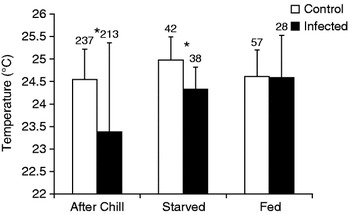
Infected bees had significantly lower thoracic temperatures than uninfected bees 30 min after waking up from the chill (One-way ANOVA: F1,438=71·80, P<0·0001) as well as for the entire 24-h period when they were starved (Repeated measures ANOVA: F1,2=230·40, P=0·004, Fig. 2). Infected bees, however, showed no significant difference from uninfected bees in their thoracic temperatures when both were fed ad libitum (Repeated measures ANOVA: F1,83=0·72, P=0·40). In addition, the variance in the thoracic temperature of infected bees after being chilled was significantly higher than that of uninfected bees (F test: F212,236=8·59, P<0·0001).
Thoracic temperature of uninfected and infected bees, measured 30 min after chilling on ice and every 6 h for 24 h, during which they were either fed or kept starved. Data represent mean±s.d. values with the sample size for each group given above the respective bars and asterisks representing significant differences.

DISCUSSION
Observations such as bumblebees preferring a colder temperature when infected with a conopid fly (Müller and Schmid-Hempel, Reference Müller and Schmid-Hempel1993) and honeybees elevating colony temperature when infected with chalkbrood (Starks et al. Reference Starks, Blackie and Seeley2000) have been interpreted as evidence for hosts using temperature as an active defence mechanism against parasites. This seems to be a reasonable argument given the thermal sensitivity of these parasites and the ability of their hosts to alter their temperature by behavioural means. In this particular study, the preference of infected bees for higher temperatures, however, seems to benefit the pathogen because it has been shown that N. ceranae has a greater reproductive potential at such temperatures (Martín-Hernandez et al. Reference Martín-Hernández, Meana, García-Palencia, Marín, Botías, Garrido-Bailón, Barrios and Higes2009). In fact, the broader thermal tolerance of N. ceranae has been suggested as a reason for its greater reproductive potential and establishment success over N. apis. Our observation that infected bees preferred to inhabit the densely populated central part of the colony due to its warmer temperature can also mean a potential increase in within-colony transmission of the pathogen.
The fact that infected bees are drawn to the colony centre due to its warmth and not by any other cue is supported by the preference of individual bees for a higher temperature on the temperature gradient. While the differences between uninfected and infected bees in their temperature preference and thermoregulatory ability might seem slight, one should in fact note that an infected bee in its natural setting is probably going to be even more thermally stressed than in our experimental setting where the bees were kept at an ideal temperature. This is supported by the observed exaggeration of the thermoregulatory differences between the two groups when they are chilled. It also means that infected bees flying on cold days might be hampered in their ability to return to the colony and such thermoregulatory stress might contribute to a general mechanism that leads to the recently observed depopulation of colonies termed as colony collapse.
Although the preference for higher temperature shown by infected bees seems to benefit the pathogen, can we label it as a case of manipulation? Our observation that the poorer thermoregulatory ability of infected bees can be remedied by feeding them ad libitum suggests that it is the result of a pathological stress arising from a lack of sufficient energy. It has been previously shown that energetic stress and a concurrent increase in the hunger level is the primary effect of N. ceranae infection in honeybees (Mayack and Naug, Reference Mayack and Naug2009). If N. ceranae by drawing energy for its own development and reproduction is causing its host to feel colder and seek higher temperatures, is the survival and reproductive benefit obtained by the parasite simply an incidental benefit? In the eyes of many, the observed phenomenon cannot be classified as a true behavioural manipulation or adaptation because the fitness of the parasite increases due to the pathological effects of the infection (Thomas et al. Reference Thomas, Adamo and Moore2005). This is in the lines of the ‘Spandrels’ argument, which demands that not all possible benefits of a trait be considered adaptive but only those for which the trait has been directly shaped by selection (Gould and Lewontin, Reference Gould and Lewontin1979). This definition of adaptation that insists on the original utility of the trait was also advocated for making distinctions between true manipulation and coincidental benefit (Poulin, Reference Poulin1995).
However, it has also been pointed out that it is almost impossible to discern between the original role of a trait and its current utility in order to figure out the primary focus of selection (Reeve and Sherman, Reference Reeve and Sherman1993). Using the same line of thought, it can be argued that if an altered behaviour routinely occurs in a host–parasite association, even if it is induced by pathology, then natural selection has not been blind to it, especially if it enhances the transmission of the parasite (Dawkins, Reference Dawkins1990; Moore, Reference Moore2002). Therefore, whether the parasite expends any energy to produce an effect on host behaviour or if the behavioural change is brought about by the pathology of the infection is unlikely to help us distinguish between a manipulation and a so-called coincidental benefit. Moreover, since it is essential for the parasites to interact with the physiology of the host, it is more reasonable for the parasite to use these physiological connections to affect a behavioural change in the host, especially because the parasites are also generally much smaller than their hosts (Thomas et al. Reference Thomas, Adamo and Moore2005).
Another way to distinguish between the two competing hypotheses is to perform comparative analyses searching for convergence and similar adaptations in host-parasite relationships of independent origins (Poulin, Reference Poulin1994, Reference Poulin1995). In this regard, Moore (Reference Moore2002) has suggested that behavioural changes produced by a parasite in novel hosts are unlikely to be adaptations. Given that N. ceranae has a relatively short evolutionary history in its host A. mellifera (Klee et al. Reference Klee, Besana, Genersch, Gisder, Nanetti, Tam, Chinh, Puerta, Ruz, Kryger, Message, Hatjina, Korpela, Fries and Paxton2007), the behavioural change the parasite produces in its host can therefore be viewed as an inevitable pathological outcome of the host-parasite association rather than a manipulation that has been specifically selected to enhance the transmission of the parasite. However, this does not preclude that selection will not act upon this incidental byproduct. This study shows that without an understanding of the proximate mechanisms that underlie a behaviour, its adaptive significance can be at best speculative. With regard to behavioural changes in host-parasite associations, studying these phenomena at different levels, such as their pathophysiological cause, their effect on transmission dynamics, and their evolutionary history might allow us to better discern the forces behind their origin and maintenance.
ACKNOWLEDGEMENTS
The study was supported by a grant from the National Science Foundation, USA. We thank Janice Moore for kindly lending us the temperature gradient equipment and commenting on an initial draft of the manuscript. B. K., J. C. and C. M. collected and analysed the data for Experiments 1, 2 and 3 respectively, each also contributing to the writing with D. N.