In 2001, Mu Suixin 慕绥新, then the mayor of Dalian, and Ma Xiangdong 马向东, the executive vice-mayor of Shenyang, were caught up in a major corruption scandal. Ma’s wife, the director of a prominent local hospital, used her connections with local prosecutors and administrators to intervene in the ongoing investigation and save her husband from conviction. She managed to obtain confidential information regarding the investigation and even gained access to helpful contacts in Beijing. In the end, however, her efforts were in vain. To insulate the judiciary from local political interference, Mu and Ma’s case was assigned to a local court in Nanjing, 1,500 kilometres away from their home “turf” in Liaoning province, rendering local lobbying efforts futile.Footnote 1
At that time, the vast majority of corruption cases were tried locally. Even the trials of high-ranking officials, such as Politburo member and Beijing Party secretary Chen Xitong 陈希同 in the 1990s, or Jiangxi provincial governor Ni Xiance 倪献策 in the 1980s, were held in the accused’s former jurisdictions.Footnote 2 The Mu–Ma case marked a break in this tradition by pioneering the practice of hearing cases in distant locations, or “distant trial,” a move which aims to “prevent [accused] officials from wielding their power to affect the investigation and conviction.”Footnote 3 The arrangement has now become common practice: among the 303 high-level officials convicted of corruption between 2012 and 2023,Footnote 4 only nine were tried locally in Beijing.Footnote 5 The majority of Party officials accused of corruption were sent for trial in prefectures hundreds or thousands of kilometres away from their work locations. For example, Ren Hua 任华, the former vice-chairwoman of the Xinjiang Uyghur Autonomous Region, was prosecuted and tried in Suzhou, a city 3,837 kilometres away.Footnote 6 Transferring a case for trial and sentencing to a local court on the other side of the country is a costly endeavour. So, what are the political motivations behind such a logistically inconvenient arrangement? How does the system work in practice during China’s ongoing anti-corruption campaign, and what is the underlying logic behind the designation of courts? This paper attempts to answer these questions through an in-depth examination of the judicial process in corruption cases.
Since late 2012, China has been waging an unprecedented anti-corruption campaign in terms of scale and duration. This campaign has investigated more senior officials and influential figures than any other previous anti-corruption effort.Footnote 7 Commissions for Discipline Inspection (CDI) at all levels have been strengthened and have taken charge of investigations, while the judiciary appears to have been marginalized.Footnote 8 Consequently, the campaign has faced criticism for operating outside the formal legal system and for lacking due process.Footnote 9 However, judicial procedures, such as the prosecution and sentencing, cannot be bypassed following investigation.Footnote 10 The predominance of extralegal measures, which demand that the procuratorate and the court always corroborate the Party’s finding of guilt,Footnote 11 leaves little room for judicial discretion. Yet the judiciary may still remain as an important apparatus. It not only implements the CDI’s decisions but also crucially signals the Party’s resolve to punish corrupt officials by pre-emptively limiting opportunities for local interference. With its relative transparency and formality compared to other Party organs, the judiciary’s ritualized procedures can themselves serve as vehicles for conveying messages to elites and the public. Furthermore, the ritualized adjudication ultimately leads to actual verdicts and punishments for corruption, which endows these messages with substantive punitive implications.
Comparative studies show that authoritarian courts are often used to punish disobedient agents, deter elites who jeopardize regime stability and maintain the legitimacy of the regime.Footnote 12 Therefore, it is important to ensure that the courts, as a tool for the state to exert political control and legitimize accusations, are insulated from the influence of disobedient agents. In China, concerns about local interference are rooted in its power structure. Judicial power is devolved to localities, making local courts subordinate to Party organs and governmentsFootnote 13 and thus susceptible to local intervention and capture.Footnote 14 While granting the courts more discretionary power and independence encourages impartiality, it may also create a new threat to the regime.Footnote 15 How does the state discipline corrupt officials without losing control over the judiciary? Through an examination of the system of assigning distant trials, this paper argues that the strategic designation of courts in corruption cases helps the centre to insulate against local interference while maintaining judicial authority.
We collected an original dataset of the trial details of 303 officials managed by the Central Committee (zhongguan ganbu 中管干部) and 183 prefecture-level Party secretaries/mayors. We argue that the distant trial system signals the central government’s determination to punish corrupt agents. As a highly visible and straightforward signal, court distance demonstrates to both investigated (or potential) corrupt officials and the public that attempts to influence the outcome are futile. At the court designation stage, we find that court distance is positively correlated with case severity, and the specific court locations are difficult to infer from past designation records or certain case profiles. At the conviction stage, given the same level of case severity, a more distant court results in a longer sentence. Combined, these results suggest that the judicial system plays a nuanced role in the anti-corruption campaign: by assigning more serious cases to distant, harder-to-influence localities, corrupt officials receive a clear message that the chances of escaping legal sanctions through interference in the judicial process are minimal. Moreover, these messages are often accompanied by significantly harsher punishments. This could indicate that distant courts effectively insulate themselves from local interference or that the designation of these courts is contingent upon the state’s punitive intent. Either possibility suggests that the court designation is a substantive part of the punitive signals, serving as a deterrent for corrupt officials.
As the literature on corruption and judicial politics suggests, independent courts help to promote long-term growth and curb corruption.Footnote 16 However, in contexts where judicial independence is weak or absent, a dependent court that is able to penalize corruption is still better than no court at all.Footnote 17 Our paper presents one mechanism that can make a dependent court effective: distant trials do not require substantial reforms to achieve judicial independence and, through the institutionalized designation of courts, can transmit credible signals of penalization.
This paper offers a novel perspective on the judiciary’s role in the anti-corruption campaign. The extensive literature on the campaign primarily focuses on its political motivationFootnote 18 and impact on governance, bureaucracy and economic growth.Footnote 19 While the CDIs are undoubtedly the protagonists,Footnote 20 the judiciary still plays some part in the campaign as the final enforcement agency. However, owing to data limitations and a lack of focus on the roles of courts, the judicial branch has been largely overlooked. This paper attempts to address this gap by gathering data on convictions and revealing patterns in the strategic designation of courts. Moreover, our findings provide new insights into the changing dynamics of China’s court system. While the recent literature focuses on how judicial centralization reforms alleviate local protectionism in economic and civil disputes,Footnote 21 we demonstrate how such top-down interventions (i.e. discretionary court designation) can also support the anti-corruption campaign.
Judicial Procedures in the Anti-corruption Campaign
Corruption can be understood as a process in which individuals weigh the anticipated costs against the benefits of engaging in a corrupt action. The most obvious cost is “the risk of getting caught and punished,” a risk which largely hinges on the effectiveness of a country’s legal system.Footnote 22 Even in democracies where electoral accountability poses a significant constraint on corruption,Footnote 23 politicians could still escape prosecution and conviction if the judiciary is susceptible to political influence.Footnote 24 This issue is more pronounced in authoritarian contexts, as the government exerts greater political control over courts to secure complianceFootnote 25 and directly intervenes in the judicial process when the case is politically sensitive.Footnote 26 In China, the Party has repeatedly asserted its control over the judiciary and has rejected Western notions of judicial independence in recent years.Footnote 27 As a result, few would expect its courts to play a role in combating corruption. In fact, China’s anti-corruption campaign has often been criticized for being extralegal.Footnote 28
However, the Chinese state’s firm grip on the judicial system paradoxically enables it to assign cases to local courts in distant jurisdictions, thereby signalling its intention to shield trials from potential local influence. Once the CDIs have completed their investigations,Footnote 29 cases involving high-ranking corrupt officials are assigned to prefecture-level courts located far from the accused’s former jurisdictions for trial.Footnote 30 For example, in cases involving cadres managed by the Central Committee, the Central Commission for Discipline Inspection (CCDI) first launches an investigation. In a procedure called liuzhi 留置 (“retention in custody”), suspects are arrested and interrogated for weeks, or even months, to gather evidence and testimonies that may be used in the criminal proceedings. Once their involvement in corruption is confirmed, the CCDI presents the evidence to the Party’s central leadership, which then determines the appropriate punishment (chufen 处分) in accordance with Party disciplinary measures. Generally, punishment is expulsion from the Party and dismissal from public office. If the official is deemed guilty of corruption, the case is referred to the judiciary, with the Supreme People’s Procuratorate designating a court and a procuratorate from the same prefecture, but in another province, for trial.Footnote 31 Cadres managed by provincial organizational departments or below undergo the same process except for two aspects: 1) their investigations are conducted by lower-level CDIs, and 2) the hearing is usually assigned to a court within the province.
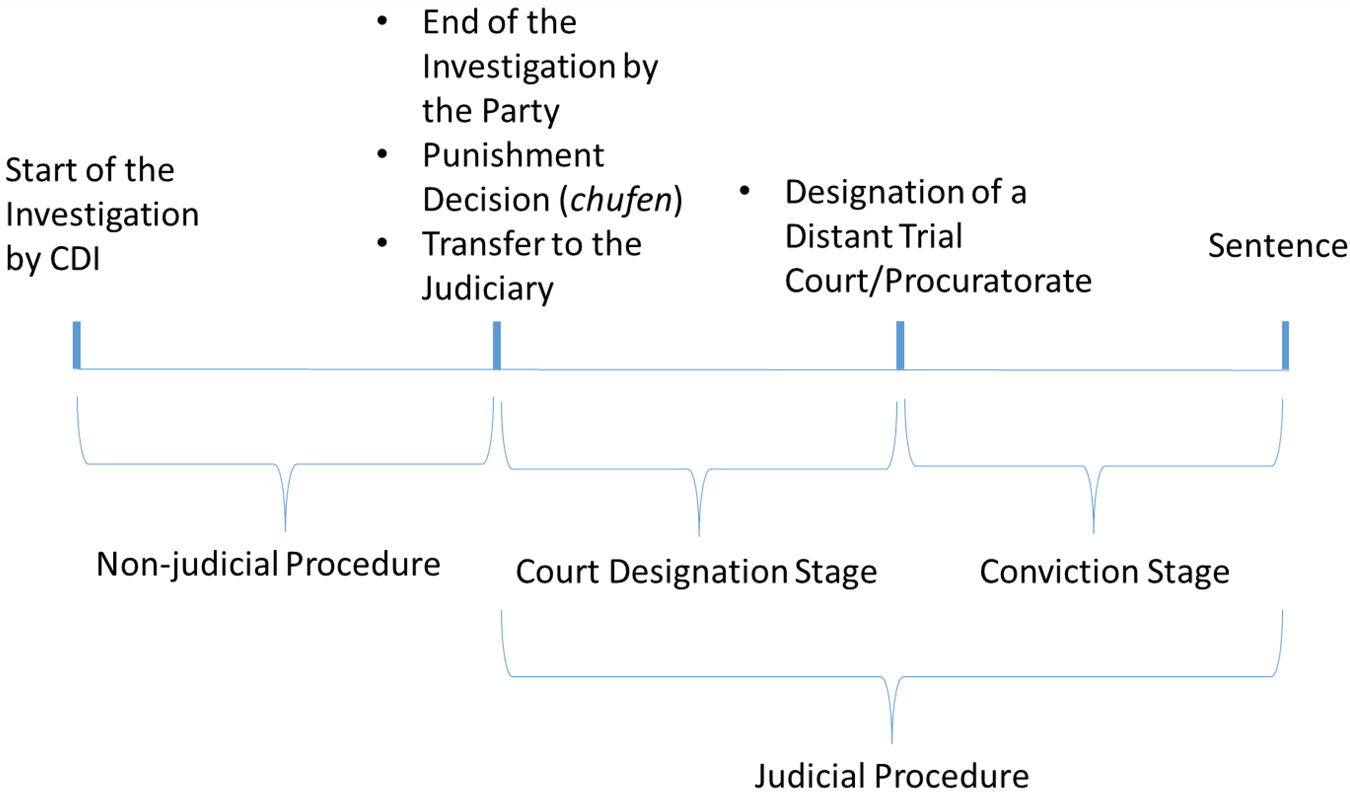
There are two stages in the judicial process once a case has been transferred: the court designation stage and the conviction stage. In this study, we examine how, during the first stage, court designation – specifically how far away the court is located from where the case originated – correlates with case severity. We also demonstrate the effect of distant trials on sentencing at the conviction stage. These stages are illustrated in Figure 1. The designation stage signals the state’s impartiality and zero tolerance by severing potential local ties. As the case proceeds to conviction, lengthy sentences further reinforce and concretize the punitive intentions of the state.
Two Stages of the Judicial Procedure

The legal system has only limited discretionary power throughout the process. After the initial investigation, the CDI submits an opinion letter to the prosecutor, which includes a brief summary of the case, the evidence for alleged crimes and recommendations for sentencing.Footnote 32 Although the final verdicts are largely based on these materials, the judicial process can still last for months or even years, allowing room for supplementary investigations and negotiation.Footnote 33 Examples of this can be seen in the cases concerning Zhu Shengwen 朱胜文, the former vice-mayor of Harbin, whose bribery charge was partially re-examined by the court following appeal, and a bureau-level local official named Li Zhujiang 李珠江, who received a more lenient sentence after the court reconsidered his confession.Footnote 34
For higher authorities, the biggest concern is not a defiant judiciary, but rather local individuals trying to sway court decisions. For example, China’s official media reported that a large state-owned enterprise (SOE) in Shaanxi province actively lobbied the local court to secure lighter sentences for its corrupt employees. In Hunan province, a letter from the local government requesting leniency was even presented as evidence in the final verdict involving corrupt officials.Footnote 35 The authorities’ concern arises from the significant influence corrupt officials have on local politics, especially in the jurisdictions where they once held power. These officials often spend years, if not decades, building extensive “power and interpersonal networks.”Footnote 36 These networks can reach far and wide if the officials served in a powerful, national level position before they fell from grace. Take Zhou Yongkang 周永康, the former domestic security chief, as an example. A prominent and powerful political figure, Zhou was not only able to form patronage networks in workplaces but also recruited clients in his hometown of Wuxi 无锡 despite never having worked there (for example, Yang Weize 杨卫泽, former Party secretary of Wuxi).Footnote 37 Thus, relocating trials for such corrupt officials to courts outside their sphere of influence appears to be a logical strategy.
China addresses the issue of interference not by strengthening the local judiciary but by making it a tool for enforcement and punishment. While CDI investigations are often criticized for their lack of transparency, the courts offer a public channel for disclosing how cases are handled. Scholars studying authoritarian legality argue that the publicity surrounding a ritualized judicial process can help to restore compliance and illustrate the consequences of defying authority to political elites.Footnote 38 Meanwhile, the establishment of legal procedures can also lead to more positive public attitudes and enhance the legitimacy of the government.Footnote 39 Courts can be used to signal how corrupt officials are penalized in a way that transcends parochial local interests and demonstrate the resolve of the centre. This study sheds light on how distant trials serve such purposes during both the court designation and conviction stages of the judicial process.
The existing literature primarily focuses on CDIs, with only a handful of studies examining judicial procedures. Some legal research identifies distant trials as a common practice for avoiding conflicts of interest, noting that these trials are still plagued by poor cross-jurisdiction cooperation and high costs.Footnote 40 There is also some evidence suggesting that distant courts may lead to higher conviction rates and encourage officials to confess to their crimes.Footnote 41 However, there is still a need for a systematic empirical analysis. This paper seeks to fill this gap by demonstrating how distant trials send credible punitive signals through geographic avoidance, dynamic court designation and concomitantly longer sentences.
Geographical Recusal in Distant Trials
Recusal measures are vital in corruption investigations, where suspects often exert significant influence over the judiciary. Historically and in contemporary China, the government has employed birthplace recusal when appointing officials to curb provincialism and facilitate top-down penetration.Footnote 42 The anti-corruption campaign has adopted a similar geographical recusal strategy to bolster its credibility.
Common recusal practices require judges to recuse themselves either voluntarily or upon request. This judge-centric recusal model can be problematic in several ways. First, the decision to recuse is contingent on the unique profile of each judge and each case, making it susceptible to manipulation.Footnote 43 Second, when a judge with conflicting interests is replaced, the plaintiff may still face overall pressure from the court.Footnote 44 Additionally, establishing expectations of impartiality is challenging, given that recusal often serves as an ex-post remedy.Footnote 45 Simply replacing a judge is unlikely to be sufficient to restore public confidence in the judicial system.Footnote 46
Based on the fact that Chinese courts are highly localized and vulnerable to local political interference,Footnote 47 the distant trial system adopts jurisdiction-based recusal that seeks to avoid case-related regions, thereby insulating trials from the influence of local officials’ current and previous workplaces. As local courts are subordinate to local Party organs and have no control over their funds and personnel,Footnote 48 justice often succumbs to local interests,Footnote 49 resulting in rampant corruption and local protectionism.Footnote 50 It is difficult, if not impossible, to shield a trial from these influences if it is held locally, as the entire judicial branch is politically, socially and economically “embedded” in local politics.Footnote 51
Recent judicial centralization reforms have effectively reduced local political intervention and protectionism.Footnote 52 However, local authorities still exert informal influence over courts as the legal system is reliant on the authorities’ cooperation in administrative affairs and for law enforcement.Footnote 53 Corruption cases involving high-ranking officials further underscore the continued need for geographic recusal. While judicial centralization reforms have centralized the discretionary power regarding court personnel and budgets at the provincial level, corrupt officials with provincial or even higher ranks could still interfere with the process.
Dynamic Court Designation in Distant Trials
Many countries have established specialized courts for dealing with corruption.Footnote 54 Although designed to improve court integrity, these courts can still fall prey to political interference.Footnote 55 A fixed court dealing only in corruption might create a focal point for political intervention, giving corrupt officials an opportunity to coordinate and launch collective actions.Footnote 56
A clear example of anti-corruption efforts failing due to the influence of powerful people comes from the former Soviet Union, which, like China, also had a one-party system. While many scholars point to nepotism and a relaxed attitude regarding corruption as the main reasons for the widespread corruption in the USSR,Footnote 57 the failure of anti-corruption agencies also played a role. In the 1980s, a special agency called the Gdlyan-Ivanov Investigatory Group was set up to combat corruption. It successfully prosecuted and imprisoned many corrupt cadres, and initially, its efforts were welcomed by the leadership. However, as its investigations went deeper, it began to uncover scandals involving multiple senior leaders; the agency then quickly became a target of regime insiders. Numerous allegations surfaced against the group, and the prosecutors were stripped of their parliamentary positions. Within weeks, all charges brought by the group were dismissed.Footnote 58
Moreover, specialized courts are not a long-term remedy in a dysfunctional judicial system. Even in democratic contexts, such as contemporary Indonesia, the limited jurisdiction of anti-corruption courts can be counterproductive, as high-ranking officials may choose to avoid the specialized court and undergo trial in the unreformed, traditional courts.Footnote 59
Distant trials increase the unpredictability for those attempting to influence the judiciary. Miscalculating where a case may be tried could render efforts to capture the court futile. To maintain this unpredictability, the court location must not be inferred from the pre-existing designation records or certain case profiles; otherwise, stable expectations of court location could be formed. This lack of predictability is not difficult to maintain in China, where the discretion to designate courts lies in the hands of the supreme legal authorities. Additionally, with over 400 intermediate people’s courts to choose from for every trial, the numerous local courts provide a wide range of options for court designation.Footnote 60
Both mechanisms aim to insulate the judicial process from local interference. Given the inaccessibility of case details, it is difficult to systematically evaluate the effectiveness of these measures. However, by designating the cases in this way, the centre conveys to both officials and the public that it is keenly aware of the possibility of local interference and that it has taken efforts to ensure the integrity of the outcome.
Hypotheses
Based on the discussion above, this paper proposes a two-stage theory that posits that the distant trial system is designed to signal the central authority’s resolve to punish corruption.
At the court designation stage, geographic recusal and the uncertain court arrangement should play a crucial role in determining the choice of court. From this, two testable hypotheses emerge. The first hypothesis posits that more serious cases generate a greater need for geographic recusal, resulting in the designation of a more distant court. There is a potential assumption here that the difficulty of influencing court decisions is inversely correlated with distance. Although geographic distance is not a precise measure of the costs and barriers associated with intervention, it is more difficult for officials to exert significant influence outside their jurisdictions.Footnote 61 Moreover, the long distance is a highly visible and straightforward deterrence signal that the higher-level authority is aware of the potential for interference. The second hypothesis proposes that the current trial location cannot be predicted based on pre-existing designation records or certain case profiles. This means that it is difficult for the allies of corrupt officials to infer where the court will be located according to historical records and case profiles. At the conviction stage, this paper hypothesizes that designating distant courts functions as a key mechanism for transmitting punitive signals. When geographic recusal is more comprehensive, even with cases of similar severity, the courts are likely to impose longer sentences on corrupt officials.
In sum, this paper proposes the following three testable hypotheses:
H1 Case Severity and Trial Location: The more serious the case, the more distant the court.
H2 Uncertainty of the Trial Location: The choice of the trial location should be difficult to predict based on pre-existing trial records or the specific case profiles.
H3 Trial Location and Penalization: Given the same level of case severity, the more distant the court, the harsher the sentence given to the corrupt official.
Data and Empirical Strategies
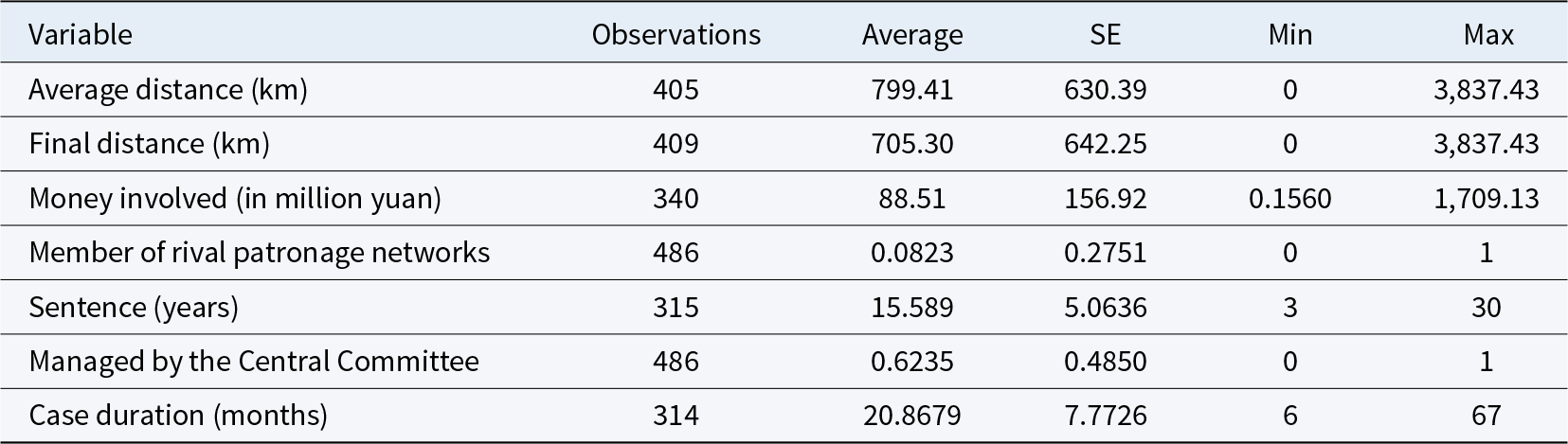
Using reports published on the CCDI official website, we compiled an original dataset detailing corruption cases involving 486 high-ranking officials. This dataset is divided into two sections. The first section covers all convicted cadres managed by the Central Committee from the 18th Party Congress until the end of 2023,Footnote 62 while the second includes all the convicted prefecture-level mayors and Party secretaries from 2012 to 2023. There are overlapping observations between the two parts – for instance, the Party secretary and the mayor of subprovincial-level cities are both centrally managed. The CCDI website provides conviction and trial records of all the cadres in our sample. The analyses primarily use the subsample of centrally managed cadres to test the hypotheses as their designated courts span across provinces. The full sample, which includes a supplementary subset of prefecture-level cadres, is used in robustness checks to confirm that the proposed patterns apply to a wider range of high-ranking officials. We present the summary statistics in Table 1.
Summary Statistics

Source: Authors’ original dataset.
Although prefecture mayors and Party secretaries only represent a portion of all prefecture-level cadres, this paper includes them in the sample for two reasons. First, it is easier to obtain lists and conviction records of mayors and secretaries from open news reports and the online encyclopaedia, Baidu, compared with other cadres working in provincial departments, local SOEs, social groups, government-affiliated institutions and universities. This ensures the completeness of the data. Second, mayors and prefectural secretaries are generally granted more discretionary power, compared to other prefecture-level cadres. They are relatively closer to officials with higher ranks in terms of substantive power, ensuring the continuity of the overall sample. For further details on the composition of the dataset, see Table A1 in the online Appendix for a summary of the ranks of officials in the sample.
Our research focuses on convicted officials. Despite the huge and ongoing momentum of the anti-corruption campaign in China, the majority of investigated officials are ultimately not criminally charged or convicted. According to the “four forms” of Party discipline investigation, only a small proportion of cases involving serious violations of Party discipline and state laws are brought to court.Footnote 63 However, once conviction procedures commence, it becomes nearly impossible for officials to evade legal sanctions. In our sample of 179 centrally managed cadres convicted before 2020, 171 (95.53 per cent) had already been sentenced by July 2024. While extrajudicial pardons may occur in some pending cases, they are rare in practice. This paper primarily focuses on the judicial process, excluding corrupt officials who are not transferred to the judiciary. For each observation, we documented detailed information, including the date of investigation, the official’s last work location before the investigation, all case-related regions disclosed by the CDI, the amount of money identified in the official report, trial location and the sentence imposed.
This paper adopts two different measures of case severity. The first, economic severity, refers to the amount of money involved in cases of corruption, bribery or embezzlement that the official has acquired by the time the investigation begins. We do not consider indirect financial losses incurred by governments and enterprises due to negligence or abuse of power. The second measure, political severity, is represented by a dummy variable that indicates whether the official has a personal connection to major rival patronage networks.Footnote 64 When a patronage group is deemed a political threat to Beijing, its members usually receive harsh punishment.Footnote 65 We hope to examine whether affiliation with such patronage networks influences court designation. See Table A4 in the online Appendix for a full list of the connected officials in the sample.
For sentencing results, this paper adopts years in prison as a proxy. Following the common practice in Chinese criminal studies, we recode life sentences as 22 years, reprieved death penalties as 24 years, and the death penalty as 30 years.Footnote 66 For the distance between the trial location and case-related regions, this paper adopts two measures:
1) Average distance. This is the average distance between the court location and all the case-related regions.Footnote 67 This measure better reflects a holistic evaluation of possible local interference based on the overall corruption records.
2) Final distance. This is the distance between the official’s last work location before the investigation and the trial location. Typically, the final posting before an official’s downfall is the one with the highest rank and greatest political influence, and determines whether the hearing is held in a court far away from that location.Footnote 68
This paper uses the total duration of the investigation as a measure of the political complexities involved and the possibility of lengthy bargaining and negotiations prior to the final sentencing. This variable, and the official’s administrative rank, are used as control variables at the conviction stage, accounting for other political considerations that may affect the sentencing. Additionally, we control for whether the officials were managed by the Central Committee when conducting regressions with the full sample, reflecting two distinct modes of court selection: for centrally managed cadres, courts are selected at the national level, while for other cadres, courts are selected within their province. Also, we include a series of controls on case circumstances (such as whether the suspect showed remorse, see Table A10 in the online Appendix for details) that could affect sentencing. OLS models are used to test H1 and H3.
Employing prefecture-level panel data with fixed effects, we examine how the pre-existing accumulated number of trial designations affects the number of designations (H2).Footnote 69 This paper only considers the trials and corruption records of cadres managed by the Central Committee because these trials are held in a wider range of prefectures nationwide, which better reflects the uncertain designation patterns.
Empirical Results
Court designation stage
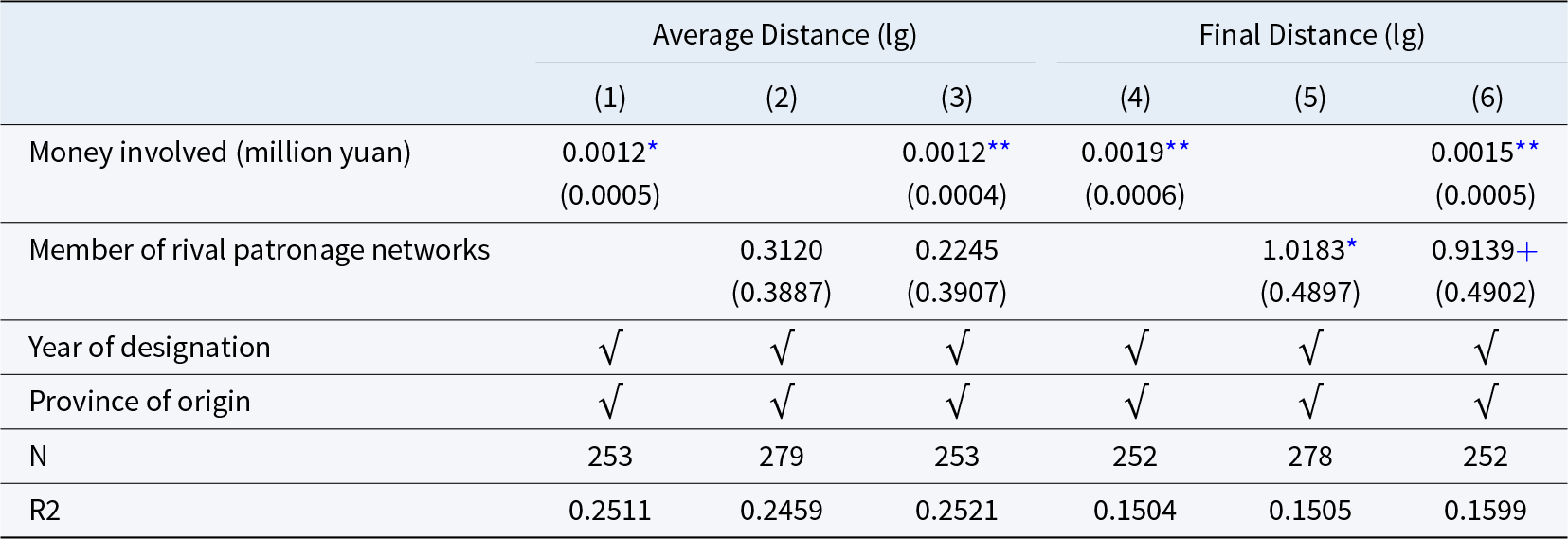
Table 2 presents tests for H1, which examine whether the severity of the case affects the distance of the appointed court.Footnote 70 In these models, we control for the origin province and the year of court designation, as the cadre’s geographical location and the temporal dynamics of the anti-corruption campaign could influence both case severity and court designation strategies. The results show that for cadres managed by the Central Committee, each 1 million yuan increase in the money involved is associated with an average increase of 0.12 per cent in average distance and a 0.19 per cent increase in final distance. However, the explanatory power (R2) of the final distance models is smaller than that of average distance ones, suggesting that the court designation process better reflects a holistic geographical recusal strategy based on an overall appraisal of all the case-related regions.
How Case Severity Affects Distance (Cadres Managed by the Central Committee)

***,**,* Notes: Standard errors in parentheses. Province of origin refers to the province where the cadre was located when investigated. p<0.001, p<0.01, p<0.05, +p<0.1.
The results remain robust after controlling for the official’s patronage network. Interestingly, patronage is positively correlated with final distance. The final distance is more evident than the holistic average distance because the case-related regions are less known to the public and other high-ranking officials until a full report is published. When handling sensitive cases involving members of rival patronage networks, it may be important to designate a court far away from the final post to send more visible punitive signals. These findings reveal the sensitivity of the court selection process, which takes into account both the case profile and corruption records. The results remain robust using the full sample (see Table A6 in the online Appendix). To enhance confidence that such designation strategies are motivated by a desire to eliminate local interference, in the online Appendix we also utilize China’s judicial centralization reform records to further demonstrate how court distance is correlated with the momentum of the reform. See Table A2 and Figure A3 in the online Appendix.
Another underlying logic of court designation is unpredictability based on the pre-existing designation records and case profiles (H2). Table 3 presents a summary of court locations.
Designation Records among Cadres Managed by the Central Committee

Source: Authors’ original dataset.
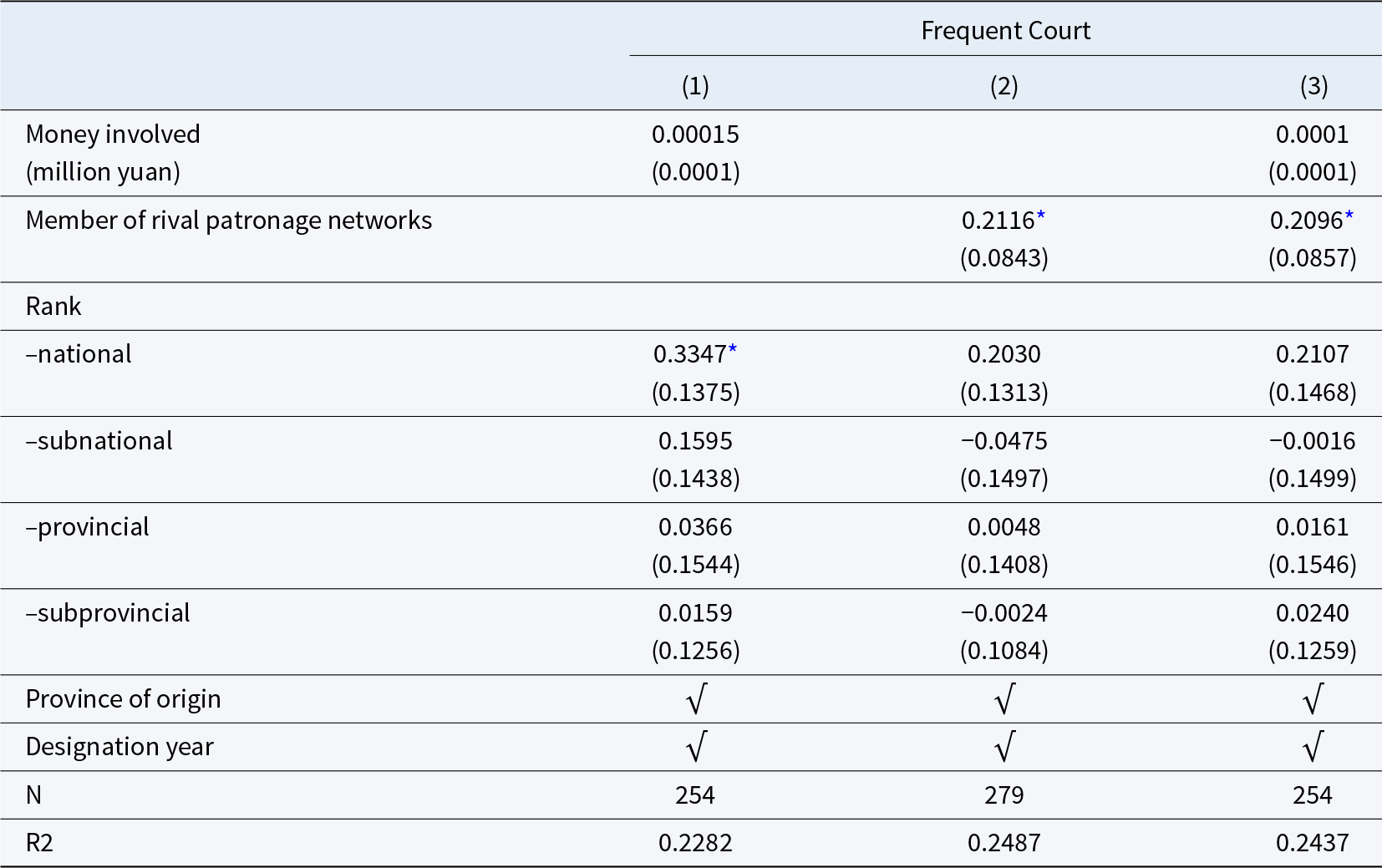
Note: The average number of trials of the prefectures that have ever held distant trials is 2.735. Our analysis uses this number as a threshold: we define prefectures designated more than twice as “frequent courts.” See Table A7 in the online Appendix for a list of frequently designated prefectures.
As is shown in Table 3, the “frequent courts” (prefectures designated more than twice) account for 38.23 per cent of all prefectures that are ever appointed, and 71.68 per cent of all cases. This raises the question of whether corrupt officials might infer that they are more likely to face trial in a specific, frequent court based on existing designation records. The data show that the probability of a certain court being selected in a certain year is very low and fluctuates drastically from year to year. As is shown in Table A9 in the online Appendix, the proportion of cases assigned to Tianjin (the most frequently designated city in the sample) never exceeds 15 per cent, even when it was at an all-time high. Moreover, the ratio is highly unstable, going from 0 per cent in 2014 to 11.1 per cent in 2015; then dropping down from 8.3 per cent in 2016 to 0 per cent again in 2017. For officials who hope to bet their limited resources on frequently designated and prominent cities like Tianjin, it is still a long shot. In fact, among all frequent courts, none ever sees a proportion higher than 20 per cent, and for most locations, the fluctuation is drastic (see Figure A8 in the online Appendix).
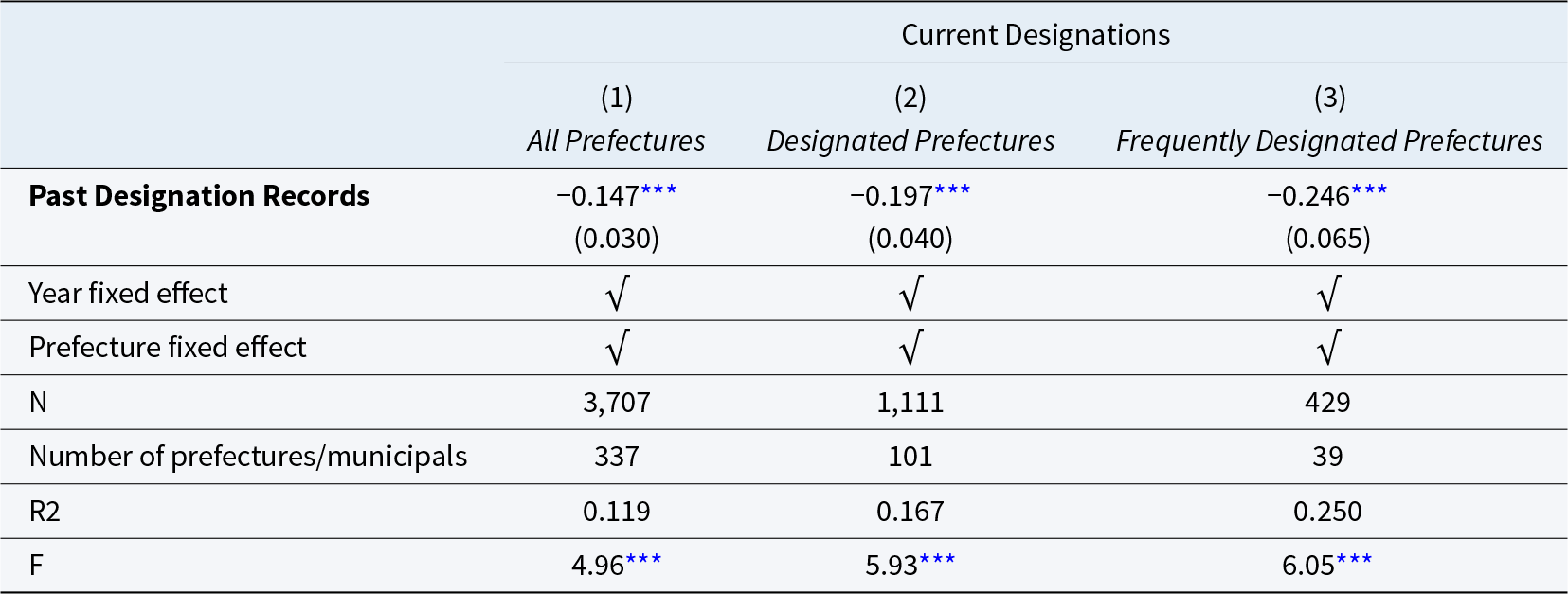
Using the prefecture-level panel data and fixed-effects model, the results in Table 4 demonstrate that the more frequently a prefecture has been designated in the past, the less likely it is to be designated this year. The results remain robust when analysing all prefectures in China, prefectures that have been designated at least once and the “frequent courts.” These results suggest that past trial records are unlikely to predict future trials. Some may argue that corrupt officials could strategically select previously less-designated prefectures as focal points, assuming they would be more likely to receive designations this year. However, the reality is that most of China’s 330 prefectures are either never designated or rarely receive designations (see Table 3). Consequently, it remains extremely challenging to accurately predict which prefecture might be chosen.
Past and Current Designations

***,**,* Notes: Standard errors in parentheses. The model has passed the LSDV and Hausman tests. The past designation record is measured by the accumulated number of past designations up until the year before a specific year. p<0.001, p<0.01, p<0.05, +p<0.1.
Regarding the uncertainty associated with case profiles, the empirical results presented in Table 5 indicate that there is no significant correlation between the economic severity of a case and frequent court designations. Members of rival patronage networks are notably more likely to be sent to frequent courts. However, as we demonstrate in the online Appendix (Table A11), when considering the probability of making an accurate prediction, it remains unlikely that officials can predict the exact court. Furthermore, our analysis shows that court selection is not solely driven by higher court capacity (see online Appendix Table A12). Together, these analyses highlight the challenges of inferring court location based on existing designation records and case profiles.
Frequent Court Designation and Case Profile

***,**,* Notes: Standard errors in parentheses. Province of origin refers to the province where the cadre was located when investigated. p<0.001, p<0.01, p<0.05, +p<0.1.
Conviction stage
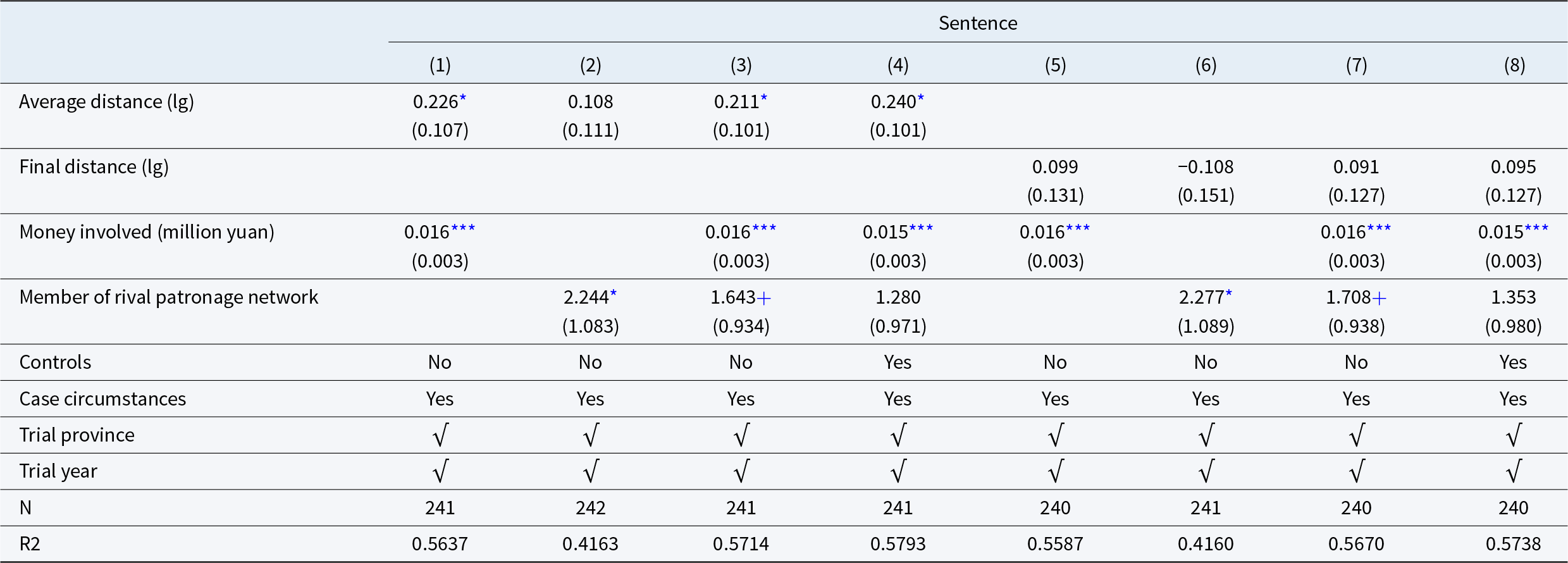
The strategic court designation demonstrates the centre’s intention to shield anti-corruption trials from political interference. However, how effective is this approach at sending credible punitive signals? Table 6 shows how court distance influences final sentencing, given the same level of case severity. By controlling for a series of case circumstances that also affect court verdicts – for instance, confessing, handing oneself in and voluntarily returning illicit gains – we make corruption cases more comparable to isolate the effect of the distance.
Court Distance and Final Sentence

***,**,* Notes: Standard errors in parentheses. Control variables include the administrative rank of the corrupt official and the total duration of the investigation as a measure for case complexity. p<0.001, p<0.01, p<0.05, +p<0.1.
The results imply that a longer average distance correlates with longer sentences, even after controlling for the amount of money involved and other case circumstances. A one-unit increase in the log average distance leads to a 0.226-year increase in sentence. Given that normal imprisonment does not usually exceed 20 years, this is a non-negligible effect. After controlling for patronage, the significant impact of average distance disappears, which further substantiates the notion that the amount of money involved in the case may be the best measure of perceived severity by the centre. Controlling for both measures of case severity, the result remains robust (see columns 3 and 4 of Table 6). However, the relationship no longer holds for the final distance, which again shows that the operation of the distant trials depends largely on a holistic evaluation of past corruption records instead of only targeting the final post. The results remain robust in the full sample (see Table A13 in the online Appendix).
The relationship between the severity of punishment and trial distance indicates that distant trials effectively transmit punitive signals from the centre. Efforts to circumvent local influences are associated with harsher penalties, sending a clear message of severe punishment for corrupt acts.
Conclusion
This study uses an original dataset to examine how the strategy of appointing distant trials operates in practice and how it sends strong signals of the centre’s resolve to punish corruption. We emphasize the strong signalling effect of trial distance, which is straightforward and highly visible to both corrupt (and would-be corrupt) officials as well as the public. We examine two mechanisms: geographic recusal and dynamic court designation. Empirical results show that court distance is inversely correlated with case severity. Additionally, it is difficult to infer a specific court location from previous designation records and case profiles, preventing the formation of a focal point for elite coordination. We further explore how such strategic designations of courts imply severe punishment. At the conviction stage, given the same level of case severity, the more distant court imposes harsher sentences, which either indicates the substantive effect of geographic recusal on the judiciary, or suggests that the court designation itself is contingent on the Party’s punitive intent. In either case, these possibilities imply that the signalling effect of a distant court is not merely symbolic but is also accompanied by substantial punitive deterrence.
This study offers a deeper understanding of the role the judicial system plays in Chinese politics. During the anti-corruption campaign, both the court arrangement and the final sentence stand out as the most visible components of the process. As noted in the literature, these elements serve to reinforce deterrence and legitimize penalization. Anyone being investigated for corruption would realize that attempts to influence the decision are ultimately futile in a courtroom located hundreds or even thousands of miles away.
China provides a unique setting for our research, given the local court system’s dependence on administrative power. As a result, local courts have long been plagued by local protectionism, complicating the central authorities’ efforts to use local judiciaries for disciplining local agents. In recent years, China has made significant strides in centralizing its judicial power. This study highlights that centralized control over local courts could be an effective strategy for addressing sensitive political issues, such as combatting corruption.
Similar arrangements for distant trials can also be found in various legal areas that are susceptible to local influences, including administrative litigation, cross-jurisdictional economic disputes and appeal cases.Footnote 71 Future studies could explore how such practices are embedded in China’s unique court and administrative hierarchy and whether they have achieved their intended goals. Such institutionalized recusal could reinforce regime support and enhance legitimacy in domains that enjoy a high level of societal consensus, such as combating corruption.Footnote 72 However, whether similar measures could produce comparable effects in other cases remains to be tested. In more complex disputes where public opinion is divided, the appointment of a distant court could potentially undermine the trust of certain parties. For example, in cross-jurisdictional economic disputes, challenges to the decisions of a non-local court are common, which may trigger doubts about the verdict and lead to repeated appeals.Footnote 73
Owing to the limited accessibility of case details and the lack of counterfactuals for comparison (since almost all officials are tried in distant courts), it is hard to infer from our data how effective the system is in actually curbing corruption. Our work focuses more on the description and the working mechanisms of the system, and how these public decisions signal the central authority’s determination to penalize corruption. We hope future studies could delve deeper into the topic through survey experiments conducted among the public and Party officials to evaluate the deterrence and legitimization effects of distant trials.
Acknowledgements
We thank Yanjun Liu and Yueduan Wang for their valuable comments. We also thank the participants of the research workshop at Peking University in November 2024 and the scholars at the “China–US Dialogue among Legal and Political Scholars” seminar in June 2025 for their valuable feedback. We are also grateful to Anchu Wang for her meticulous research assistance in data collection. This research was supported by the United Front Top Think Tank of the Central Institute of Socialism (Grant No. ZK0120250144).
Competing interests
None.
Supplementary material
An appendix is available online at https://doi.org/10.1017/S0305741025101719.
Yuan ZHOU is a master’s student at the School of Government at Peking University. His research focuses on local politics and state-building in China.
Xiao MA is an associate professor of political science at the School of Government at Peking University, and a research fellow at the Institute of National Governance Studies and the Institute of Public Governance at Peking University. His research focuses on comparative political economy and politics of development.