The term Response to Intervention (RtI) has become central in the educational lexicon in the United States (Fuchs, Fuchs, & Compton, Reference Fuchs, Compton, Fuchs, Hamlett and Lambert2012). RtI can be summarized as a prevention and identification model for determining learning disabilities (LD; Fuchs, Mock, Morgan, Young, Reference Fuchs, Mock, Morgan and Young2003) . The model is usually articulated around three tiers of support that are layered and provided to all students based on (a) their reading performance at the beginning of the year and (b) their reading growth throughout the year compared to the reading growth of other students with similar characteristics.
The premise of an effective RtI system is that Tier 1 instruction is provided with high quality to all students in the regular classroom using a scientifically-based core reading program (Baker, Fien, & Baker, Reference Baker, Fien and Baker2010). At the same time students are screened and progress monitored at least three times a year with valid and reliable fluency measures. These assessments are designed to ensure that all students are making adequate reading progress in accordance to established benchmark goals or school norms (Hasbrouck & Tindal, Reference Hasbrouck and Tindal2006; Kame’enui, Simmons, Good, & Harn, 2001). If a student in Tier 1 is below these benchmark goals or school/district norms in the beginning or the middle of the year, the student receives additional support in small groups, with an evidence-based supplemental program. This Tier 2 intervention is of utmost importance because it is conceptualized as a scaffold to prevent the development of more complex reading disabilities (RD) (Vaughn et al., Reference Vaughn, Linan-Thompson, Mathes, Cirino, Carlson, Pollard-Durodola and Francis2006). Tier 2 is typically delivered in small groups of 3–5 students (Elbaum, Vaughn, Tejero Hughes, & Watson Moody, 2000) where their growth patterns on specific reading skills are closely monitored (i.e, biweekly or monthly) to determine if they should be moved to a more intensive level of support (i.e., Tier 3) or remain in the same tier (i.e., with a similar level of support). In other words, if a student does not respond as expected, this will be the signal indicating to the teacher that the student should be moved to Tier 3 where instructional intensity is increased by, for example, reducing the number of students in the group, increasing the amount of instructional time, and/or using an evidenced-based explicit and systematic intervention (see for example, Reading Mastery (Engelman & Bruner, 1995). Tier 3 tends to be understood, in general, as a pre-referral for special education (Fuchs, Mock, Morgan, & Young, Reference Fuchs, Mock, Morgan and Young2003) requiring substantially higher resources in terms of personnel and materials.
Thus, the early identification is vital in RtI, which implies an important change in the way the concept of a LD has been traditionally understood. Moreover, the term LD could be replaced, at first, by the term “at-risk” to create a continuum between these two concepts (i.e., the student moves from an at-risk category to a learning disability (LD) if there is not enough progress in his or her learning using evidence-based programs). In this way, the change in the conceptualization of a LD also transfers the focus on the “disability” from the student to the instruction, allowing practitioners to adapt the intervention that the student is currently receiving to his/her specific needs.
The goal of the present study is to examine the effects of a Tier 2 intervention in Spanish on reading outcomes for monolingual Spanish-speaking children in the Canary Islands, Spain. To our knowledge, this is the first study conducted in Spain implementing a Response to Intervention approach to address the needs of children who are manifesting reading difficulties in the early grades.
Components of a Tier 2 Level of Support
The success of a Tier 2 level of support within an RtI model requires practitioners to be able to determine what to teach and how to teach (italics by author). The first component, the what to teach, needs to include the core components or Big Ideas of beginning reading common to alphabetic languages (i.e., phonemic awareness, phonics, fluency, vocabulary, and comprehension; (National Reading Panel [NRP], 2000; Jiménez & O’Shanahan, Reference Jiménez and O’Shanahan2008). The second component, how to teach, relates to how the instruction is delivered in terms of the pedagogical techniques, the composition of the group, and the amount of time that is spent on Tier 2 (Carnine, Silbert, Kame’enui, & Tarver, Reference Carnine, Silbert, Kame’enui and Tarver2004; Harn, Linan-Thompson, & Roberts, Reference Harn, Linan-Thompson and Roberts2008).
What to teach?
We review studies conducted in the Spanish language that provide the evidence of the importance of the Five Big Ideas in learning to read in Spanish. Given the dearth of research on the implementation of a Tier 2 intervention in Spanish for Spanish monolingual students, we also review studies conducted in the United States that include Spanish-speaking English learners receiving Spanish reading instruction. We review these studies by the Big Ideas they addressed.
Phononological awareness . Teach phonological awareness (PA) involves teaching children to manipulate phonemes in spoken syllables and words (NRP, 2000). Despite the transparency of the language, several studies indicate that students with RD in Spanish appear to have difficulties with PA (Caravolas, Lervåg, Defior, Seidlová-Málková, & Hulme, Reference Caravolas, Lervåg, Defior, Seidlová-Málková and Hulme2013; Carrillo, Reference Carrillo1994; Jiménez, Reference Jiménez1997; Jiménez & Hernández-Valle, Reference Jiménez and Hernández-Valle2000; Manrique & Signorini, Reference Manrique and Signorini1994; Signorini, Reference Signorini1997). In this sense, many studies have showed the effect of the intervention on PA in Spanish children (Defior & Tudela, Reference Defior and Tudela1994; Hernández-Valle & Jiménez, Reference Hernández-Valle and Jiménez2001; Jiménez et al., 2003; Jiménez & Rojas, Reference Jiménez and Rojas2008).
The alphabetical principle. Instruction of the alphabetical principle is a way of teaching reading that stresses the acquisition of letter-sound correspondences and their use in reading and spelling words in connected text (NRP, 2000). Understanding the alphabetic principle appears to be a key component to improving word reading and reading comprehension in Spanish (Baker, Park, & Baker, Reference Baker, Fien and Baker2010). Cuetos (Reference Cuetos2008) suggests that students with RD in Spanish tend to have a malfunction of the sublexical processes (i.e., the mechanism that recognizes the relation between graphemes and phonemes). This malfunction is expressed in turn by the student’s difficulty reading multi-syllabic words automatically (Jiménez & Hernández-Valle, Reference Jiménez and Hernández-Valle2000; Jiménez, Rodríguez, & Ramírez, Reference Jiménez, Rodríguez and Ramírez2009; Suárez & Cuetos, Reference Suárez, Cuetos and Diez2008). Some studies have examined the effect of an intervention designed to improve student understanding of the alphabetic principle and word automaticity in Spanish (Hernández-Valle & Jiménez, Reference Hernández-Valle and Jiménez2001; Ortiz, Espinel & Guzmán, Reference Ortiz, Espinel and Guzmán2002; Vaughn et al., Reference Vaughn, Linan-Thompson, Mathes, Cirino, Carlson, Pollard-Durodola and Francis2006). The findings suggested that the interventions which target the understanding of the alphabetic principle using systematic and explicit instruction appear to significantly improve student word reading in Spanish.
Fluency. Teaching fluency implies to help students to develop the ability of read texts aloud with speed, accuracy, and proper expression (NRP, 2000). Findings in Spanish indicate that students with RD tend to read slowly but accurately (Cuetos, Reference Cuetos2008; Jiménez et al., Reference Jiménez, Rodríguez and Ramírez2009). Recent findings also suggest that in Spanish just like in English, oral reading fluency appears to have a significant reciprocal relation with reading comprehension (Baker, Stoolmiller, Good III, & Baker, Reference Baker, Stoolmiller, Good and Baker2011). Moreover, Spanish students who are fluent readers are also better comprehenders than those who are less fluent (Baker et al., Reference Baker, Fien and Baker2010, Reference Baker, Park, Baker, Basaraba, Kame’enui and Beck2012; Domínguez de Ramírez & Shapiro, 2007). We located only one study that examined the effects of a fluency intervention on 11 years old students with RD (Soriano, Miranda, Soriano, Nievas, & Félix, Reference Soriano, Miranda, Soriano, Nievas and Felix2011). The intervention consisted of repeated readings plus PA training and grapheme –phoneme decoding. Twenty-four students were assigned to receive the intervention or special education classes provided by the school. Findings revealed significant differences in word reading skill gains (η2 = .41), pseudo-word reading skill gains (η2 = .45), text reading speed gains (η2 = .55), and text reading accuracy (η2 = .39) but there were no differences between the groups in comprehension gains. In sum, additional intervention studies ought to be conducted to determine whether oral reading fluency can significantly improve student overall reading skills, particularly given that in Spanish, fluency more than accuracy, appears to be an important indicator of students who might be at risk for RD.
Vocabulary. Teach vocabulary means give children the definition of words and how to use them. As the NRP (2000) suggested, vocabulary is critically important in oral reading instruction. The larger the reader’s vocabulary (oral and print) the easier it is to make sense of text. Vocabulary plays a critical role in reading comprehension because understanding a text requires knowing the meaning of the words (Anderson & Freebody, Reference Anderson and Freebody1979). The role of vocabulary knowledge is less clear in Spanish because empirical studies are sparse. However, emergent evidence indicates that vocabulary and word reading skills have a significant relation with reading comprehension in Spanish just like in English (Kim & Pallante, Reference Kim and Pallante2010; Proctor, Carlo, August, & Snow, 2005). We located one experimental study on vocabulary that was conducted in the US (Cena et al., Reference Cena, Baker, Kame’enui, Baker, Park and Smolkowski2013). The authors examined the impact of an explicit vocabulary intervention in Spanish on the expressive and receptive vocabulary knowledge of first grade Hispanic English Learners. Results indicated that the group who received scripted vocabulary intervention had a statistically significant effect on student depth of vocabulary knowledge in Spanish (η2 = .73). This study did not target only students at risk for RD, but it included Hispanic students with limited English proficiency.
Comprehension. Comprehension is the ultimate goal in reading and strategies can be taught as a set of steps that readers can use to make sense of text. In Spanish language, Cuetos (Reference Cuetos2008) pointed out that sometimes poor comprehenders are able to decode words fluently but they have a deficit in syntactic and semantic processes. Thus, not all reading comprehension difficulties can be attributed to poor decoding or oral reading fluency. In the study by Vaughn et al. (Reference Vaughn, Linan-Thompson, Mathes, Cirino, Carlson, Pollard-Durodola and Francis2006) mentioned above, part of the intervention also included comprehension activities that focused on retelling and sequencing events. Findings indicated that students in the intervention group improved, but without statistical significance, their passage comprehension compared to students in the control group (d = .55). However, in this study it is difficult to determine if this effect was because of the specific comprehension activities provided, or because of the combination of all the skills taught (i.e., word attack, oral reading fluency, vocabulary, and reading comprehension strategies).
In summary, despite the fact the instruction on the Big Ideas have based on English language studies, it is expected to work in other languages, such as Spanish. Either way, these principles are currently being applied in children who are Hispanic and who are learning to read in English and Spanish at the same time. The revision presents above in a transparent orthography, seems to point that the concurrent instruction in the Big Ideas, as a set of instructional components, could be effective for Spanish monolingual children at risk for reading difficulties.
How to teach?
Effective Approaches to Tier 2 instruction. Empirical evidence indicates that direct instruction provided in small groups appears to be more beneficial for students at risk of reading failure compared to a Tier 2 intervention that is not direct (Archer & Hughes, Reference Archer, Hughes, Archer and Hughes2011; Carnine et al., Reference Carnine, Silbert, Kame’enui and Tarver2004; Kamps et al., Reference Kamps, Abbott, Greenwood, Wills, Veerkamp and Kaufman2008; Richard-Tutor, Baker, Gersten, Baker, & Smith, 2015). Direct instruction implies the use of articulated lessons in which cognitive skills are broken down into small units, sequenced deliberately, and taught explicitly (Carnine et al., Reference Carnine, Silbert, Kame’enui and Tarver2004). Direct instruction of the Big Ideas is a central axis in any RtI reading model (Baker et al., Reference Baker, Fien and Baker2010). Although we could not locate any empirical studies that use these principles of direct instruction in Spain, several studies conducted in the United States indicate that Spanish-speaking students at risk for reading difficulties who received a Tier 2 Spanish intervention performed significantly better in letter sound identification (d = .72), PA (d = .73), word attack (d = .85), reading fluency (d = .75), passage comprehension (d = .55), and oral language (d = .35) at the end of first grade compared to students who did not receive the intervention. Also research indicates that small group sizes are an important contributing factor to the success of reading interventions (Elbaum et al., Reference Elbaum, Vaughn, Tejero Hughes and Watson Moody2000). The main reason is because by reducing the number of students in a group increases the opportunity to practice, indeed this makes easier for teachers to give students corrective feedback. In a review of Tier 2 studies (Gersten et al., Reference Gersten, Compton, Connor, Dimino, Santoro, Linan-Thompson and Tilly2008) the authors concluded that approximately 30 minutes of small group instruction every day (3–5 days per week) is highly effective for students who are struggling with learning to read.
Study purpose
According to the previous review the five components of reading have a similar relevance across alphabetic languages with different orthographic characteristics (i.e., English and Spanish). In fact, when the main focus of intervention was on each of these components, Spanish children improved their reading skills. However, there are different relevant issues which have not been included in the studies above mentioned. Firstly, all reviewed Spanish studies had selected children with RD but not “at-risk” readers. Secondly, none of these studies included an intervention on all five components simultaneously. Finally, the design typically used was a pretest-posttest control group based on product-oriented assessment but not dynamic assessment because they did not use an RtI approach. This is a critical issue for two main reasons: (1) the traditional approach does not allow to calculate the learning potential either the change or type of growth, and (2) instruction is regulated as a function of progress monitoring assessment (e.g., at least three point measures) within an RtI approach. In other words, the assessment is not dynamic in the traditional approach and, consequently, instruction is not regulated as a function of individual differences because only two assessment measures are considered (i.e., pretest-posttest). Thus, the purpose of this study was to examine the effects of a Tier 2 intervention for K-2 Spanish monolingual speakers at risk for reading difficulties. Specifically, we attempted to answer the following research question: did Spanish monolingual students at risk for reading difficulties who received a Tier 2 systematic and explicit intervention significantly increase their beginning reading skills (i.e., letter naming, phonemic awareness, pseudoword reading, oral reading fluency, vocabulary, and oral retell) compared to students at risk who received a typical remedial intervention provided by the school?
Method
Participants
Student participants. Our sample consisted of 530 students at risk for reading difficulties. In the treatment group, 321 students received a supplemental program (PREDEA) across three grades (i.e., 106 kindergartners, 115 first graders and 100 second graders). The control group was composed of a total of 209 students, 79 kindergartners, 63 first graders and 67 second graders. All students were monolingual Spanish speakers. The mean age was 5.25 years for kindergarteners, 6.35 years for first graders and 7.45 years for second graders. Approximately 61% of the sample were boys. Students with attendance problems, mental retardation, primary sensory deficit, and neurological problems were excluded.
School sites. This study was carried out in the Canary Islands, an autonomous Spanish region composed of seven islands located in the Atlantic Ocean. The sample consisted of 37 schools, 24 of these schools received the intervention and six schools were assigned to be the control group.
Intervention teachers. Fifty-three special education teachers in service delivered the instruction to the intervention group. All teachers in service had a bachelor’s degree in Special Education.
Materials and Procedure
The PREDEA intervention program. The intervention program was a modified and adapted to Spanish of Canary Islands version of the Lectura Proactiva program (Mathes, Linan-Thompson, Pollard-Duradola, Hagan, & Vaughn, Reference Mathes, Linan-Thompson, Pollard-Duradola, Hagan and Vaughn2003). To examine the effectiveness of the PREDEA program, we conducted a pilot study in 2010 in kindergarten to second grade in the Canary Islands (see Jiménez et al., Reference Jiménez, Rodríguez, Crespo, González, Artiles and Alfonso2010).
Lesson routine. Students in the treatment group who were identified as at risk for RD received the Tier 2 reading instruction outside the general classroom, in small groups of three to five students, for 30 minutes a day, five days a week, from November to June, approximately 140 sessions during the academic year. Each daily lesson was comprised of a series of six to nine activities that included several of the core components of beginning reading. Each activity followed the same model-lead-test routine, that is, first teachers modeled the activity, next the teacher provided many opportunities for students to respond, and finally, immediate corrective feedback for students who made a mistake in the activity was used. The Tier 2 intervention did not interfere with the core reading lessons offered in the general education classroom.
Professional development. All special education teachers in the treatment group were trained on the main structure of the program, and also on how to administer and score the screening and the progress monitoring measures. Throughout the year, members of our research team met with teachers once every three months to help and advise them on issues of program implementation, progress monitoring of students, or any other discussions or challenges they may have had.
Procedure to select at-risk students. To screen students who were at risk for learning disabilities, the Hong Kong Specific Learning Difficulties Behavior Checklist (Chan, Ho, Tsang, Lee, & Chung, Reference Chan, Ho, Tsang, Lee and Chung2003) was complete for each student by the homeroom teacher. All students in grades K-2, belonging to the intervention and to the control group, were screened and those who scored at or above the 75th percentile on the Hong Kong Behavior Checklist were selected for the sample. According to the review mentioned above early intervention has been shown to benefit children with RD. However, none of the reviewed studies included at-risk readers, therefore, we selected for the present study students at risk in grades K-2. If children do not learn to read in the early years, they may fall further behind in later years because they cannot read printed information, follow written instructions or communicate in writing (Gove & Wetterberg, Reference Gove and Wetterberg2011).
Control Group. Students in the control group who were identified as at risk with the Hong Kong Behavior checklist received additional support provided by the school.
The Hong Kong Specific Learning Difficulties Behavior Checklist (Chan, et al., Reference Chan, Ho, Tsang, Lee and Chung2003). The checklist was designed for the purpose of early identification of students in need of extra support in the local context, based on the local Hong Kong curriculum. A Spanish adaptation was made based on the local Canary Islands curriculum (see Jiménez, Reference Jiménez2010). Teachers filled out the checklist for each student in the classroom. Students who had a final score at or above the 75th percentile were considered at risk for RD.
Indicadores Dinámicos del Éxito en la Lectura (IDEL) [Dynamic Indicators of Basic Early Literacy Skills] (Baker, Good, Knutson, & Watson, Reference Baker, Good, Olivo, Sanford, Baker, Good, Knuston and Watson2006). This instrument was used to examine student initial status and growth on the core components of beginning reading. All students were assessed in the beginning, in the middle, and in the end of the year. Criterion-related validity is provided for each subtest, and the internal consistency of each of these subtests was not analyzed because it is constituted by a single indicator (i.e., fluency). The following IDEL subtests were used:
Fluidez en el Nombramiento de las Letras (NFL) [Letters Naming Fluency], (Plasencia-Peinado, Baker, & Good III, Reference Plasencia-Peinado, Baker, Good, Baker, Good, Knutson and Watson2006). Students are asked to name upper- and lower-case letters arranged in random order in one page. The final score is the number of letters named correctly in 1 minute. The concurrent criterion-related validity coefficient for NLF was .53 (Watson, Reference Watson2005). One month alternate-form reliability for NLF in kindergarten was .88. This measure was administered in kindergarten.
Fluidez en la Segmentación de Fonemas [Fluency in Phoneme Segmentation] (FPS), (Baker, Knutson, Good III, & Plasencia-Peinado, Reference Baker, Good, Olivo, Sanford, Baker, Good, Knuston and Watson2006). FPS assesses a student’s ability to segment words into their individual phonemes fluently. The number of correct sound segments produced in one minute determines the final score. The concurrent criterion-related validity coefficient for FPS was .25 for kinder (Watson, Reference Watson2005). One month alternate form reliability ranged was .73 for kinder and .87 for first grade. This measure was administered in kindergarten and in first grade.
Fluidez en las Palabras sin Sentido [Non Sense Word Fluency] (NWF) (Plasencia-Peinado, Baker, Good, & Peinado, Reference Plasencia-Peinado, Baker, Good, Baker, Good, Knutson and Watson2006). NWF tests the understanding of the alphabetic principle, including: (a) knowledge of letter-sound correspondences, and (b) knowledge of the ability to blend letters into words. The student is presented a sheet of paper and asked to produce verbally the individual letter sound of each letter or verbally produce, or read, the whole nonsense word. The final score is the number of letter-sounds produced correctly in one minute and the numbers of word read as a whole. The concurrent criterion-related validity coefficient was .72 for kindergarten and .60 for first grade (Watson, Reference Watson2005). One month alternate form reliability for NWF in first grade was .88 and .85 for second grade. This measure was administered in first and second grades.
Fluidez en la Lectura Oral [Oral Reading Fluency], (ORF) (Baker et al., 2006). ORF tests accuracy and fluency reading text. Three 1-minute passages are administered and the median score of the total words read correctly is the score used for decision-making and for data analysis. The concurrent criterion-related validity coefficient for ORF was .79 for first grade (Watson, Reference Watson2005). One month alternate form reliability for ORF was .91 for first grade and .92 for second grade. This measure was administered in first and second grade.
Fluidez en el Recuento Oral [Oral Retell Fluency] (ORTF) (Baker & Good, Reference Baker, Good, Baker, Good, Knuston and Watson2006). This measure assesses student ability to provide a retell about a story they just read. Students are asked to retell the passage they just completed reading. One-month alternate-form reliability for ORTF was .80 for second grade. Retell Fluency is reported to correlate with measures of oral reading fluency around .59 (Good & Kaminski, Reference Good and Kaminski2002). This measure was administered in first and second grade.
Fluidez en el Uso de Palabras [Fluency in Word Use] (WUF) (Baker, Good III, Olivo & Sanford, 2006). WUF assesses a student’s ability to provide a sentence or a definition of a particular word outside of context. The examiner counts the number of words the child produces in an utterance using the stimulus word. The final score is the total number of words in each correct utterance. Concurrent criterion-related validity coefficient was .30 for first grade (Watson, Reference Watson2005). Alternate-form reliability was .76 for kinder, .84 for first grade and .60 for second grade. This measure was administered in kindergarten, first and second grade.
Data collection procedure. In the experimental group, teachers should fill a table with the measurements obtained by the children in each variable and submit it to the coordinator of the project. In the control group, data were collected by a group of psychologists trained to administer this battery.
Analytic Model. Considering the nested nature of the study data where repeated measures were nested within students and those students were nested within different schools, we used the three-level hierarchical linear growth modeling for analysis (Raudenbush & Bryk, Reference Raudenbush and Bryk2002; Snijders & Bosker, Reference Snijders and Bosker1999). In particular, we were interested in examining the effects of the intervention on student reading growth in each grade.
Thus, the following model was applied to all the analyses in the study.
Level-1 (Time i):
 $${{\rm{Y}}_{ijk}} = {{\rm{\pi }}_{0jk}} + {{\rm{\pi }}_{1jk}} \cdot {\left( {{\rm{Assessment}}\,{\rm{Period}}} \right)_{ijk}} + {{\rm{e}}_{ijk}}$$
Level-2 (Student j):
 $${{\rm{\pi }}_{0jk}} = {{\rm{\beta }}_{00k}} + {{\rm{r}}_{0jk}}$$
 $${{\rm{\pi }}_{1jk}} = {{\rm{\beta }}_{10k}} + {{\rm{r}}_{1jk}}$$
Level-3 (School k):
 $${{\rm{\beta }}_{00k}} = {{\rm{\gamma }}_{000}} + {{\rm{\gamma }}_{001}} \cdot {\left( {{\rm{Group}}} \right)_k} + {{\rm{u}}_{00k}}$$
 $${{\rm{\beta }}_{10k}} = {{\rm{\gamma }}_{100}} + \,{{\rm{\gamma }}_{101}} \cdot {\left( {{\rm{Group}}} \right)_k} + {{\rm{u}}_{10k}}$$
Given our longitudinal design, some attrition was inevitable due to student transfer or absence and missing rates were between 6.8% and 17.0% depending on grade and test. To consider these missing data, we used the multiple imputation method (Baraldi & Enders, Reference Baraldi and Enders2010; Enders, Reference Enders2010; Rubin, Reference Rubin2004).
Results
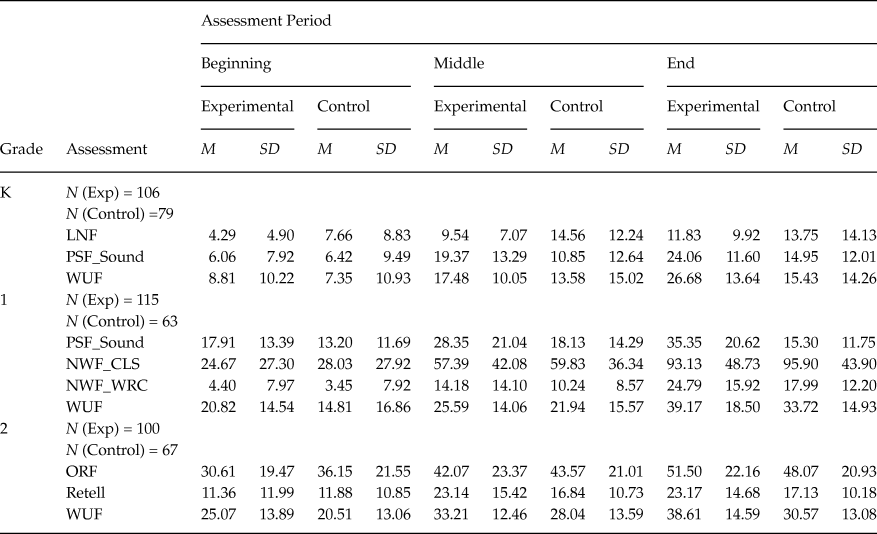
The results are presented by grade. Descriptive statistics from these assessments are presented for experimental and control group in Table 1. We present the results focusing on the test outcomes which we found significant intervention effects on.
Descriptive Statistics of Assessment Scores for Experimental and Control Group

Note: Exp: Experimental; LNF: Letter Name Fluency; PSF_Sound: Phoneme Segmentation Fluency; WUF: Words Use Fluency; NWF_CLS: Non Words Fluency_Correct Letters Sound; NWF_WRC: Non Words Fluency_Words Read Completely; ORF: Oral Retell Fluency.
Effects of the Intervention in Kindergarten
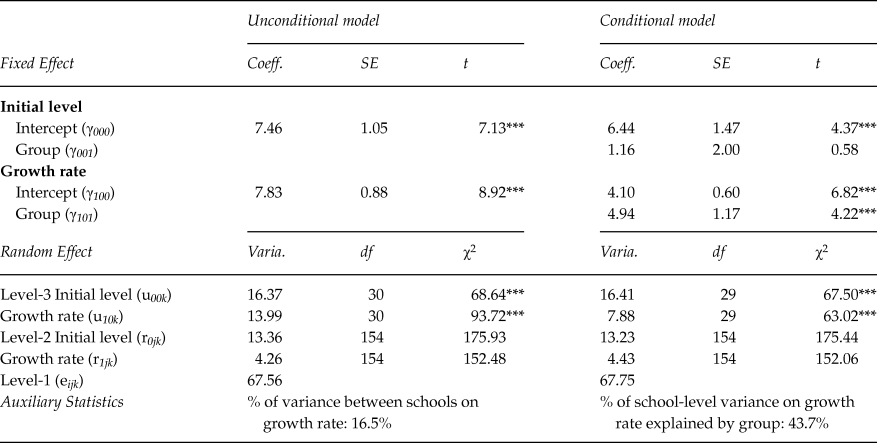
In kindergarten (Grade K), significant intervention effects were found on two outcomes: Phoneme Segmentation Fluency (PSF) – Sound and Word Use Fluency (WUF). Table 2 presents the results from the multilevel growth modeling analyses for the PSF-Sound outcome. The unconditional model in the left column shows that 16.5% of the variance in student growth rates on PSF-Sound is due to different schools, which implies that students improve their performance on PSF-Sound at different rates depending on their schools. The conditional model in the right column shows that the group difference in the initial level was not statistically significant (γ001 = 1.16, t = 0.58, p > .10), while we found significant group difference in the growth rate (γ101 = 4.94, t = 4.22, p < .001). That is, students in the experimental group had about 5-point higher growth rates on PSF-Sound than students in the control group during kindergarten. This group variable explained 43.7% of the school-level variance in the growth rate of PSF-Sound.
Effect of Intervention on Phonemic Segmentation Fluency (PSF) - Sound in Kindergarten

Note: Coeff: coefficient; Varia: variance.
*** p < .001.
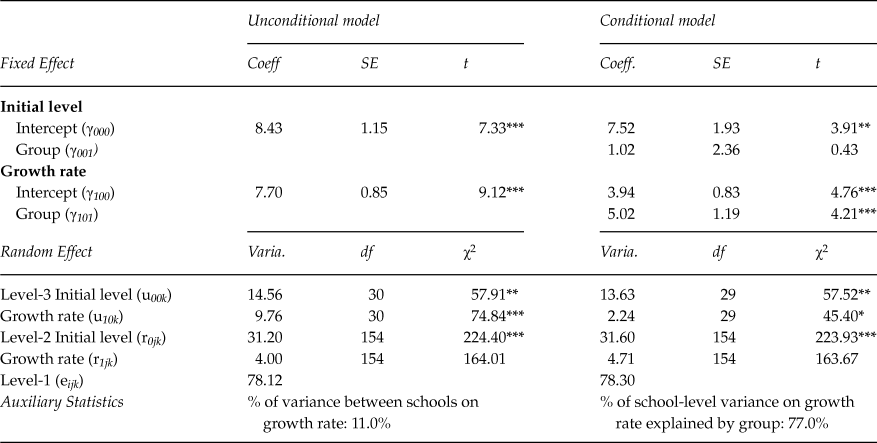
Similarly, Table 3 presents the results for the WUF outcome. The unconditional model reveals that 11% of the variance in student growth rate on WUF is found among different schools rather than between different students. The conditional model presents that there is no significant group difference in the initial level on WUF between experimental and control group (γ001 = 1.02, t = 0.43, p > .10) but the group difference is significant for the growth rate (γ101 = 5.02, t = 4.21, p < .001). Students in the experimental group had about 5-point higher WUF growth rates on average than student in the control and 77% of the school-level variance was explained by the group variable.
Effect of Intervention on Word Use Fluency (WUF) in Kindergarten

Note: Coeff: coefficient; Varia: variance.
* p < .05; **p < .01; ***p < .001.
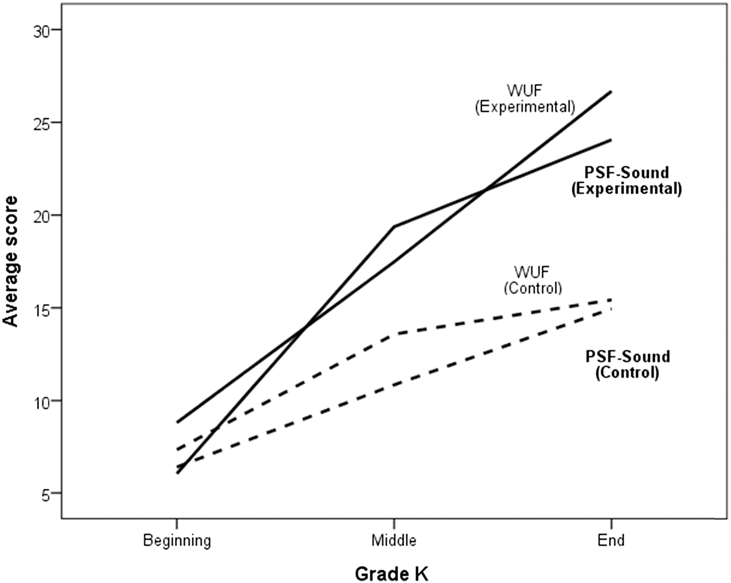
We found no significant intervention effects on the other test outcome administered in kindergarten: Letter Naming Fluency (LNF). Based on mean scores for each group, Figure 1 demonstrates the patterns of student growth on PSF-Sound and for WUF which we found significant intervention effects. This graph confirms that the experimental group had steeper improvement than the control group during kindergarten on PSF and WUF.
Growth patterns of student performance on tests between experimental and control group in Grade K (for tests with significant intervention effect).

Effects of the Intervention in Grade 1
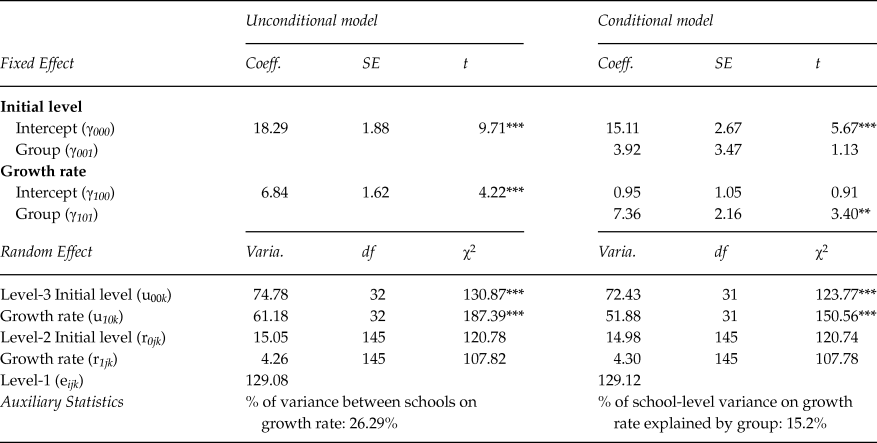
Next, in Grade 1, we found a significant intervention effect on PSF– Sound only. The unconditional model in the Table 4 shows that most variance in student growth rates on PSF-Sound (26.29) exists between different schools rather than between different students. The conditional model reveals that there is no significant group difference in the initial level of PSF-Sound in Grade 1 (γ001 = 3.92, t = 1.13, p > .10), whereas the difference in the growth rate is statistically significant between experimental and control groups (γ101 = 7.36, t = 3.40, p < .01). Students in the experimental group had about 7-point higher growth rates on PSF-Sound than students in the control group in Grade 1 and the group variable explained 15.2% of the school-level variance in the growth rate.
Effect of Intervention on Phonemic Segmentation Fluency (PSF)- Sound in First Grade

Note: Coeff: coefficient; Varia: variance.
** p < .01; ***p < .001.
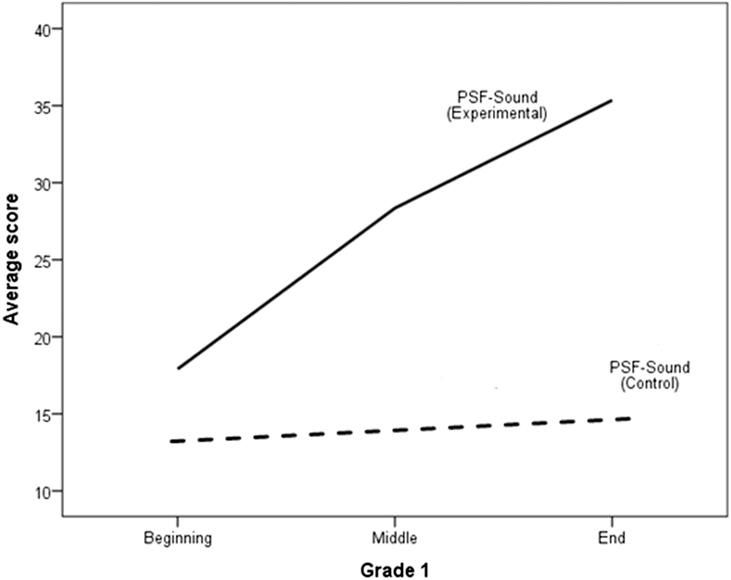
No significant intervention effects were found on the other test outcomes administered in Grade 1: Nonsense Word Fluency – Correct Letter Sound (NWF-CLS), Nonsense Word Fluency – Words Read Completely and Correctly (NWF-WRC), and WUF. Figure 2 presents the average PSF-Sound scores, clearly the students in the experimental group had a steady and higher improvement compared to the students in the control group.
Growth patterns of student performance on tests between experimental and control group in Grade 1 (for tests with significant intervention effect).

Effects of the Intervention in Grade 2
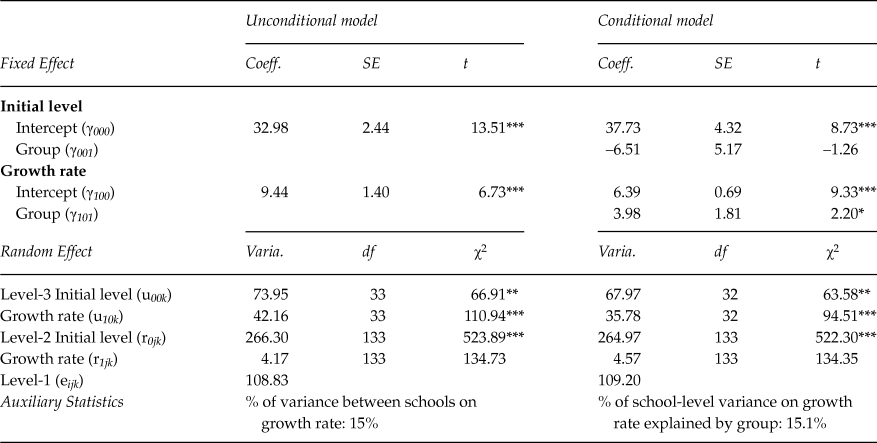
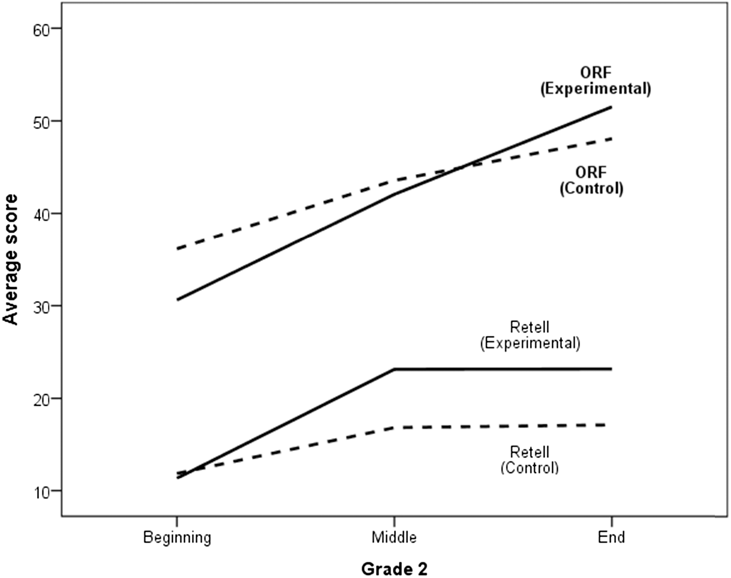
In Grade 2, significant intervention effects were found on two test outcomes including Oral Reading Fluency (ORF) and Retell. The unconditional model in Table 5 presents that 15 % of the variance in student growth rates on ORF is found between different schools rather than students. According to the conditional model, there is no significant group difference in the initial level of ORF (γ001 = –6.51, t = –1.26 p > .10) but we found a significant group difference in the ORF growth rate (γ101 = 3.98, t = 2.20, p < .05). The experimental group had about 4-point higher growth rates on ORF compare to the control group in Grade 2 and 15.1% of the school-level variance in the ORF growth rate was explained by the group variable.
Effect of Intervention in Oral Reading Fluency in Second Grade

Note: Coeff: coefficient; Varia: variance.
* p < .05; **p < .01; ***p < .001.
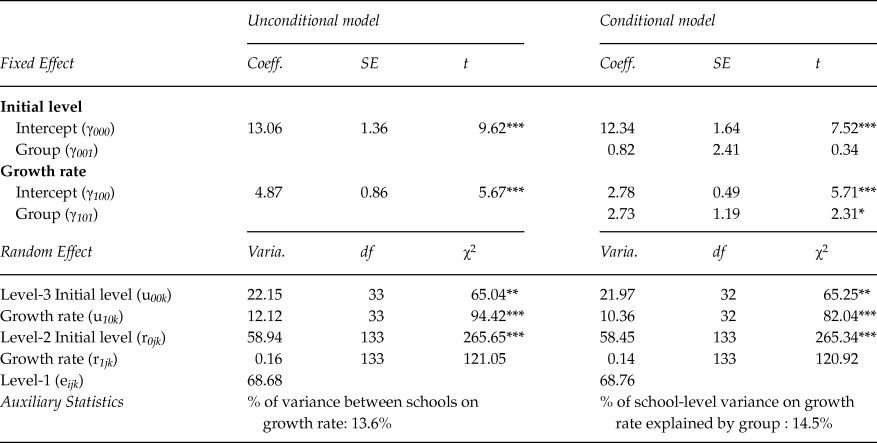
A significant intervention effect was also found for the Retell outcome in Grade 2 as presented in Table 6. According to the unconditional model in the table, 13.6% of the variance in student growth rate exists among different schools rather than students. The conditional model shows that there is no significant group difference in the initial level on Retell between experimental and control group (γ001 = 0.82, t = 0.34, p > .10) while the group difference is significant for the growth rate (γ101 = 2.73, t = 2.31, p < .05). That is, students in the experimental group improved their performance on Retell faster than students in the control group with about 3-point higher growth rates. The group variable explained about 14.5% of the school-level variance in student growth rates on Retell.
Effect of Intervention on Retell in Second Grade

Note: Coeff: coefficient; Varia: variance.
* p < .05; **p < .01; ***p < .001.
There were no significant intervention effects on the other test outcomes administered in Grade 2: WUF. Figure 3 presents the average performance changes on ORF and on Retell across three assessment periods during Grade 2 for experimental and control groups. This graph confirms that the experimental group improves their performance on ORF and Retell better than the control group.
Growth patterns of student performance on tests between experimental and control group in Grade 2 (for tests with significant intervention effect).

Discussion
The goal of the present study was to learn whether Spanish monolingual students at-risk for reading difficulties in kindergarten to second grade, who received a Tier 2 systematic and explicit intervention, significantly increased their beginning reading skills compared to at-risk students who received the typical remedial intervention provided by the school. Two major findings derived from this study. First, we found significant differences between the treatment and the control group in vocabulary in kindergarten, phonemic awareness in kindergarten and first grade, and in oral reading fluency and retell in second grade. Second, we did not find significant differences in pseudoword reading. Next we discuss these findings for each skill in the context of implementing a Tier 2 small group intervention within an RtI approach in a Spanish-speaking country.
Phonemic awareness
Results of our study indicate that students in the treatment group significantly improved their phonemic awareness (PA) skills compared to students in the control group at the end of the year in kindergarten and first grade. Moreover, we found that children who received the explicit Tier 2 intervention did not only have higher scores at the end of the academic year compared to the control group, but they also showed a greater growth pattern than the control group in phonemic awareness. This finding suggests that monitoring student growth on PA in these early grades can allow practitioners to adjust the instruction based on student needs. In other words, it is not necessary to wait until the end of the intervention to determine if students acquired PA, but if their PA skills change while the Tier 2 instruction is occurring, other adjustable variables can be modified to reflect these changes in the student’s trajectory (Vellutino, Scanlon, Small, & Fanuele, Reference Vellutino, Scanlon, Small and Fanuele2006). Previous studies conducted in the Spanish language (both with bilingual and monolingual populations) have only shown improvement in PA through pretest and posttest measures (Vaughn et al., Reference Vaughn, Linan-Thompson, Mathes, Cirino, Carlson, Pollard-Durodola and Francis2006; Jiménez et al., Reference Jiménez, Rodríguez, Crespo, González, Artiles and Alfonso2010).
Fluency
We also found significant differences in favor of the treatment group in oral reading fluency in second grade. Similar to our findings in PA in kindergarten and first grade, students who participated in our Tier 2 intervention had a greater pattern of growth in ORF than students in the control group. This finding is particularly relevant for Spanish given that Spanish-speaking children with a dyslexic profile tend to read slowly but accurately, that is, they are able to decode words because of the high letter-sound correspondence in a transparent alphabet, but this process tends to be very slow. Results found in the present study indicated how that “slowness” can be enhanced when a high quality and empirically-based program is used. Within a RtI model, the risk status which the kid begins the school year can be explained by inadequate instruction.
Comprehension
We found differences in the growth curves between the treatment and the control group in both, fluency and comprehension, suggesting that a focus on these beginning reading components lead children at risk for a LD to become more fluent and to understand better what they are reading. We believe that the improvement of oral reading fluency also lead to an improvement in reading comprehension. Reviews carried out in English (Torgesen, Rashotte, Alexander, Alexander, & MacPhee, Reference Torgesen, Rashotte, Alexander, Alexander, MacPhee and Foorman2003) have shown how early intervention programs generally improve lower-order processes, such as PA, but positive intervention effects tend to be more difficult to find in higher-level processes such as fluency and comprehension. The studies by Vaughn et al. (Reference Vaughn, Linan-Thompson, Mathes, Cirino, Carlson, Pollard-Durodola and Francis2006) and Soriano et al. (Reference Soriano, Miranda, Soriano, Nievas and Felix2011) indicated that the treatment group had better scores at the end of the intervention in fluency and comprehension, but these differences were not statistically significant.
In alphabetical systems characterized by a transparent orthography the deficits in the development of PA and in fluency are part of the specific profile of children with RD. This deficit also results in problems with comprehension. In a practical sense, when a student with RD is faced with having to read connected text, they can read it very precisely but with a high cost to their fluency which reduces their opportunities to comprehend what they read (Cuetos, Reference Cuetos2008). Our study indicates these skills will improve whether they are taught explicitly and simultaneously. As Vellutino et al. (Reference Vellutino, Scanlon, Small and Fanuele2006) pointed out the cause in the majority of impaired readers is due to experiential and instructional inadequacies rather than biologically based cognitive deficits. Our findings indicate that it is possible to modify a slow pattern of growth in the critical skill which characterized the profile of children who are at risk for RD in Spanish, PA and oral reading fluency. This implies also an improvement in reading comprehension if the students receive training and they are monitored during the intervention.
Vocabulary
We found significant differences in vocabulary knowledge between the treatment and the control group only in kindergarten but not in first and second grade. Studies about vocabulary are sparse in Spanish, while in English several studies have documented that an explicit and systematic vocabulary instruction leads to improvements in the development of vocabulary and oral comprehension, particularly in kindergarten (see Coyne, Capozzoli, Ware, & Loftus, Reference Coyne, Capozzoli, Ware and Loftus2010; Coyne, McCoach, & Kapp, Reference Coyne, McCoach and Kapp2007; Coyne, McCoach, Loftus, Zipoli, & Kapp, Reference Coyne, McCoach, Loftus, Zipoli and Kapp2009). The only two vocabulary intervention studies that were found in Spanish, were conducted with Hispanic first graders who lived in the United States and who received reading instruction in Spanish. Vaughn et al. (Reference Vaughn, Linan-Thompson, Mathes, Cirino, Carlson, Pollard-Durodola and Francis2006) did not find significant differences between pretest and posttest measures, while Cena et al. (Reference Cena, Baker, Kame’enui, Baker, Park and Smolkowski2013) found significant differences between the treatment and the control group in a researcher developed vocabulary task. This last study, however, included a heterogeneous group of students with different levels of Spanish reading and language proficiency while the Vaughn’s et al. (2006) study included only children who were identified as at risk for RD.
It is apparent that the role vocabulary plays in early reading acquisition in Spanish needs to be researched further. For English reading acquisition the role of vocabulary appears to be clearer, specifically because English has irregular words that cannot be read by decoding but only through the orthographic and semantic route. Furthermore, Kim and Pallante (2010) indicated that the relation between vocabulary and word reading in kindergartners appeared to be weak (.17 < rs <.24), and low to moderate with reading comprehension (r = .42) in first grade at least when it was measured in a Spanish speaking population (i.e., this study was conducted in Chile). The authors concluded that the more vocabulary students acquired more growth on reading comprehension would occur. Our study indicated that vocabulary instruction is important in the early grades even when students are still acquiring phonemic awareness and decoding skills. However, more research on the relationship between vocabulary and other beginning reading skills needs to be conducted in Spanish to determine the role of this component in student reading success in languages with a transparent orthography.
Alphabetic Principle
We were surprised to not find significant differences between the treatment and control group in first grade in pseudoword reading given the importance of this ability in reading acquisition in Spanish. As is well known, the transparency of the language plays a central role in the acquisition of letter-sound correspondence (Manrique & Signorini, Reference Manrique and Signorini1994; Goswani, Gombert, & de Barrera, 1998; Seymour, Aro, & Erskiner, Reference Seymour, Aro and Erskine2003). Children who experience reading difficulties in a language with a transparent orthography (i.e., Spanish) tend to have difficulties acquiring automaticity in the use of the conversion of grapheme-phoneme rules and then blending these letter sounds to read words (Castejón, Rodríguez-Ferreiro, & Cuetos, Reference Castejón, Rodríguez-Ferreiro and Cuetos2013; Cuetos, Reference Cuetos2008). In other words, the real challenge for children with reading difficulties in a transparent orthography is the blending (italics by author) of letter sounds to read words.
Thus, we hypothesized that given this well-known fact, our intervention would significantly increase student decoding skills because it was heavily emphasized. Although the intervention group has been delivered with an explicit and systematic instruction, it seems that is not a sufficient condition to get differences between the two groups. It is plausible that this skill was taught effectively across the treatment and the control groups. In Spain, general reading instruction in the early grades emphasizes the phonetic method to teach beginning reading (Eurydice, 2011). These methods include systematic instruction in letter-sound correspondence. In other words, the activities included in our Tier 2 intervention to improve student automaticity with letter-sound correspondences might have been as intensive as the activities provided by the regular classroom teachers and the interventions provided by the control schools for at-risk students of RD.
However, it should be noted, that analysis of repeated measures were conducted to explore whether any difference exist in the different points of measures. Statistical differences were found at the end of the year between the two groups when the pseudoword read as a whole was analyzed. Maybe the improvements in phonological recoding at the end of the first grade and differences between the growth curves can be found in following grades.
It is important to note that maybe the absence of significant positive effects of intervention not only on alphabet principle in first grade, but also on vocabulary in first and second grade could be mediated by individual differences in cognitive processes such us attention, working memory, executive functions, etc., which were not assessed neither were instructed in the present study. However, we consider that explicit instruction tries to minimize the effect of the cognitive mechanisms that are deficient in children with RD. Nevertheless, as suggested by Fuchs, Compton, Fuchs, Hamlett, and Lambert (Reference Fuchs, Compton, Fuchs, Hamlett and Lambert2012), the training is not the only way to think about the importance of cognition to instruction. In fact, the intervention probably could have a different impact in at-risk children of RD who have different cognitive profiles. Future research should thus to explore how cognitive characteristics may moderate instruction effects.
In the current study our main interest was to know whether what is known about effective reading interventions with English speaking at-risk students for RD in an English context can be extended to Spanish-speaking at-risk students for RD in a Spanish-speaking context. Our findings indicated that although more research on how the core components of beginning reading interact in a transparent language is still needed, children at risk for RD in Spanish can improve their skills when they receive explicit instruction in the context of RtI. Specifically, the fact of getting differences in the growth curves in phonemic awareness and in fluency for our intervention group, give us high expectations related to the dyslexics profile in Spanish. It is possible that the slow pattern, which characterizes children at risk in Spanish, can be modified if assess is delivered while the evidence-based instruction is occurring. This will have a positive impact in the ultimate goal of reading: comprehension.
Currently in Spanish educational context, children who are struggling with reading received additional support, but such support is not systematic, does not follow instructional principles from empirical evidence, and children are not assessed while the instruction is delivered to monitor the improvements on their reading skills. This study is a first attempt to develop a more systematic instruction which does not rely solely on the ability and experience of the teacher, but in a reading program which follow best practices for early reading acquisition on what and how to teach. The key is not on the scores that children reach at the end of each grade, ongoing formative assessments and collect data across the year while the instruction is occurring to observe their trajectory, in terms of slope growth curves, is the newest of that practice and is the key that allows practitioners to redirect the student´s track.
We propose that, if we adjust the instruction to the orthographic differences of the languages, and work with students on all the beginning reading skills (i.e. during the development of PA and understanding the alphabetic principle as well as during their development of fluency, vocabulary and comprehension), following features of explicit instruction, Spanish speaking children at risk for reading difficulties will also become successful readers. We hope that our study can open new research lines in the Spanish context to help us to better understand the prevention of RD and to improve systems of support for struggling readers in a Spanish-speaking context.