Introduction
Cotton textiles were arguably the most important manufactured product marketed in colonial Indonesia.Footnote 1 By 1930 the country had a sizeable domestic market of 61 million people. The densely populated core island of Java had a labour surplus and low wages that could have sustained a cotton textile industry. Nevertheless, in contrast to other large Asian countries such as India, China, and Japan, textile producers in Indonesia did not take advantage of the domestic market and low wages to create a competitive textile industry until the 1930s. The aim of this paper is to answer the question: Why did a sizeable and internationally competitive cotton textile industry fail to develop in colonial Indonesia during the nineteenth and early twentieth centuries?
The post-war development of Indonesia's cotton textile industry is well studied,Footnote 2 but little is known about its pre-war development. One explanation for the non-development of the cotton textile industry in the available literature relates to the ‘deindustrializing’ impact of colonial rule. This argument is largely based on the experience of colonial India, and maintains that India suffered deindustrialization as a consequence of growing imports of manufactures from Great Britain. Despite recent studies that offer a different understanding of industrialization and underdevelopment in India,Footnote 3 some have argued that India's experience can be extrapolated to other Asian countries, including Indonesia during the Dutch colonial era.Footnote 4 Studies of Indonesia's economic history have noted the low rate of industrialization during the colonial era, but have not specifically addressed the non-development of the cotton textile industry.Footnote 5 The general suggestion is that the manufacturing sector suffered the deindustrializing impact of Dutch colonial rule in Indonesia, which served the interests of industrial firms in the Netherlands.Footnote 6 This argument may apply to Java during part of the nineteenth century, but it does not take account of the fact that most imported textiles did not come from the Netherlands, but from other countries, including India and Japan.
Two fundamental explanations exist for the low rate of industrialization. Dick hypothesizes that, apart from the sugar industry, there was no leading sector to spur on industrialization. He also argues that the domestic market was small and fragmented, and that the manufacturing industry suffered from a lack of trade protection until the 1930s.Footnote 7 Williamson has drawn attention to the fact that the secular trend in the terms of trade and trade volatility both worked against industrialization in developing countries such as Indonesia which experienced export growth of primary commodities before the Second World War.Footnote 8 These explanations are still too broad and unspecific to account for the non-development of a cotton textiles industry in Indonesia until the 1930s. For example, they don't take account of the fact that raw cotton was produced in Indonesia, that various efforts were made to enhance cotton production in Indonesia, and that private entrepreneurs sought to establish weaving plants in Indonesia. Hence, to explain the non-development of the textile industry in pre-war Indonesia, it is necessary to adopt a broader approach that analyses the key factors relevant to each stage in the production of textiles, from raw cotton to the finishing and marketing of cloth.
Before doing so, the paper will first establish the degree to which the consumption of cotton goods in Indonesia increased from the early nineteenth century, and the degree to which local cotton and textile production met the growing demand for cotton textiles. This is followed by a section that puts the development of the industry in the context of the tariff policies in colonial Indonesia. These two sections establish the foundations for a discussion of the different stages in the production of textiles. This discussion starts with the production of raw cotton, followed by ginning and spinning, weaving, finishing, as well as the distribution of textiles, and will take the account up to the 1930s. This decade is discussed in a separate section, because it witnessed an upsurge of cotton textile production for domestic markets. The paper is necessarily based on an array of disparate sources, because the non-development of a significant textile industry in colonial Indonesia has not attracted a lot of scholarly or commercial attention in the past and therefore did not leave us with rich source materials.
Quantification: Decline and rise of the cotton textile industry
Quantification of the production and consumption of cotton textiles in Indonesia during 1820–1941 is difficult. First, consistent statistical data on domestic production are not available until the 1930s, whether of raw cotton, ginned cotton, yarn, cloth, bleached cloth, dyed cloth or garments, and even for this decade the data are incomplete. Most of the activity took place in the household and in small-scale industry and was not subject to systematic statistical reporting. Secondly, most of the relevant statistical data relate to the core island of Java. For example, foreign trade data until 1871 refer to Java only. Even for Java, most of what we know about the domestic cotton industry is of a qualitative nature only. Statistical data on the number of workshops and their employees are at best incomplete.
The general impression is that cotton spinning and weaving declined throughout the nineteenth century. It is difficult to establish the starting point of this process, as cotton textiles had long been imported into Indonesia—until the 1830s largely from India. At the same time, Java was the centre of spinning and weaving in the Indonesian archipelago and even exported some quantities to the rest of the region.Footnote 9 An overview of available information on spinning, weaving, and dyeing in Java suggests bustling activity in the 1820s, but signs of decline in weaving appear during the 1830s.Footnote 10
From the 1830s, imported cotton cloth and yarn became increasingly important in the domestic supply of cotton cloth. Local production did not disappear—in fact, Indonesia continued to produce raw cotton throughout the colonial era—but domestic production of cotton for spinning remained at around just 4,000 tons. As local cloth production increased during the 1930s (see below), the late-1920s may be taken as the end-point of the stagnation of local spinning and weaving. By then, the annual average supply of imported cotton goods (yarn and cloth) during 1925–29 was 49,000 tons, or 1.0 kg per capita, of which 94 per cent was cloth and 6 per cent yarn.Footnote 11
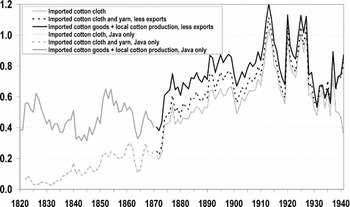
The Appendix explains the estimation of total supply of cotton textiles in Indonesia, and Figure 1 shows the resulting estimates of the supply of cotton textiles in per capita terms during 1822–1941. It is obvious that the trends are determined by imports of cotton cloth, rather than yarn imports or raw cotton production. Four periods can be distinguished:
1. 1822–1873: An almost constant level between 0.4 and 0.6 kg per capita per year is maintained, which implies the consumption of just over 1 sarong per person per year.Footnote 12
2. 1874–1899: Per capita consumption increased to 0.9 kg per capita, related to three factors. A change in trade policy during 1865–74 (see below) reduced import duties on textiles and abolished the differential rate that favoured imports from the Netherlands. Everything else remaining equal, lower import duties reduced the price of imported textiles from the Netherlands by 6.5 per cent, from Great Britain by 19 per cent, and from India by 29 per cent. For example, the price of imported unbleached madapollams (a type of cotton cloth) decreased from an average of f6.62 per 24 yards during 1867–70 to f4.65 during 1875–78.Footnote 13 Secondly, Indonesia followed the Netherlands in adopting the gold exchange standard during 1873–77, which stabilized the exchange rate.Footnote 14 Thirdly, the opening of the Suez Canal in 1869 helped to lower shipping costs between Europe and Asia. Throughout this period, private enterprise started to trickle into Indonesia to produce primary commodities for export, generating new employment and income opportunities. Improvements in transport facilities facilitated an integration and expansion of domestic markets.
3. 1900–27: Considerable fluctuations were experienced, but averaged out at 0.9 to 1.0 kg per capita. This was a period of significant economic turmoil, starting with the rubber boom immediately before the First World War, which caused major disruptions in world shipping and a decrease in textile imports. The fall in supply was compounded by a doubling of textile prices until 1920. The 1920s saw significant fluctuations caused by the bust-boom cycles, particularly in the production of rubber and sugar for export, which affected incomes and demand for textiles.
4. 1928–41: A decrease to 0.6 kg per capita in 1931 was followed by recovery. On average, per capita supply was 0.8 kg in the late 1930s. Prices of export commodities started to fall in 1928, before the 1929 crisis hit. This obviously had a profound impact on per capita supply, as export commodity prices plummeted and the country lost opportunities to export due to increasing trade protection in its traditional export markets, despite the fact that textile prices more than halved during 1930–36.
Per capita supply of cotton goods, 1820–1941 (kilograms, cumulative). Source: See Appendix. Note: 1820–70 refers to Java only and 1871–1941 to Indonesia as a whole.

Trade policies impacting on the cotton textile industry
During the seventeenth and eighteenth centuries Indonesia was dependent on imported cloth. Colonization by Hindu empires partly served the purpose of facilitating the trade of cloth from India to the Indonesian archipelago. One reason why the Dutch and British East India companies were attracted to the region was to benefit from the active inter- and intra-regional trade in textiles, particularly between India and Java. The degree of Indonesia's dependence on imported textiles is difficult to substantiate. There are various accounts of textile production in Java and textile exports from Java, underlining that imported cloth did not fully exterminate local production.Footnote 15
After the bankruptcy of the Dutch East India Company and the conclusion of the Napoleonic wars in Europe, the governmentFootnote 16 of the Netherlands planned to expand the textile industry in newly acquired Belgium.Footnote 17 As a result, it ordered Java (by implication Indonesia as a whole, as far as it was under Dutch colonial rule) in 1817 to impose a tariff of 6 per cent on imported goods, plus 60 per cent if goods were carried by foreign vessels and 30 per cent if carried by Dutch vessels.Footnote 18 As almost all imports were textiles, the differential tax rate aimed to favour textiles carried by Dutch vessels from the Netherlands, that is, from Belgium.
Indonesia's tariff changed after an Anglo-Dutch agreement in 1824. Among others, the tariff was to be 25 per cent on all woollen and cotton goods directly shipped from west of the Cape of Good Hope (that is, Great Britain and the United States), 35 per cent on such goods shipped from east of the Cape of Good Hope (as most British textiles were shipped via Calcutta or Singapore), and 6 per cent if shipped from the Netherlands (raised to 12.5 per cent in 1836 following fresh British protestations). In 1865 the tariff was simplified to 10 per cent on goods of Dutch origin, otherwise 20 per cent (reduced to 16 per cent in 1869). An Anglo-Dutch agreement of 1871 specified that for imports into some parts of Sumatra, the tariff on goods from Great Britain would be the same as for goods from the Netherlands, that is, 10 per cent. This effectively meant that the tariff on all British goods was lowered as such goods could be re-exported from those parts of Sumatra to the rest of Indonesia. This accelerated the change of the tariff in 1874 to a flat 6 per cent (raised in 1924 to 10 per cent) regardless of the origin of the goods or the nationality of the vessels.Footnote 19
Hence, during 1817–74, Indonesia's tariff favoured textiles produced in the Netherlands and shipped by Dutch vessels. In addition, the Dutch government granted a monopoly on all government-instigated trade between the Netherlands and Indonesia to the Nederlandsche Handel-Maatschappij, a private firm established in 1824. This was relevant, because the colonial government levied a tax in kind in the form of cash crops on farm households, and required these goods to be shipped to overseas markets and sold. The Nederlandsche Handel-Maatschappij orchestrated the purchase of goods, particularly textiles, in Belgium for shipment to and sale in Indonesia.
After Belgium seceded from the Netherlands in 1830–31, the Dutch government aimed to expand the nascent textile industry in the eastern part of the Netherlands through the trade of textiles by the Nederlandsche Handel-Maatschappij in the same way as it had in Belgium. At the same time, the colonial government introduced the so-called Cultivation System in Java, which forced farm households to produce cash crops that had to be sold to the colonial government in Java at a predetermined price. Farm households used part of the revenues to pay land tax. The system left the colonial government with produce that the Nederlandsche Handel-Maatschappij was commissioned to ship and auction in the Netherlands. In return, the company was obliged to purchase textiles and other import products in the Netherlands for sale in Indonesia.
When Indonesia's imports of textiles from the Netherlands started to increase during the 1830s, the British government objected to the 1824 tariff, as mentioned. An Anglo-Dutch agreement in 1836 raised the tariff on goods from the Netherlands to 12.5 per cent. However, the governor general of the Dutch East Indies concluded a secret arrangement with the Nederlandsche Handel-Maatschappij in 1835, which entitled it to a refund of the duty on exports it had orchestrated from the Netherlands to Indonesia, up to a maximum of f3 million per year.Footnote 20 Effectively, this allowed Dutch textile exporters to avoid the tariff in Indonesia, and the arrangement continued to favour the textile industry in the Netherlands, despite increasing Anglo-Dutch rivalry in textile exports to Indonesia.
In the 1870s, the Dutch parliament forced the Dutch government to revise the economic relationship between the Netherlands and Indonesia. The Cultivation System was phased out over the next few decades, private enterprise was allowed to invest in Indonesia, and the tariff in Indonesia was reduced to a flat 6 per cent. This new trade regime favoured the activities of privately owned trading firms in the Netherlands and in Indonesia. When the Nederlandsche Handel-Maatschappij ceased trading activities in 1881 to concentrate on finance, these private trading firms became more active in importing textiles into Indonesia, no longer just from the Netherlands, but also from other major textile exporting countries, particularly Great Britain (for high-quality textiles) and India (for low-quality textiles).
The tariff was later revised, but it remained non-discriminatory. For example, import duties were raised to 10 per cent on both yarn and cloth in 1924. The duty on weaving yarn (except silk) was reduced to 5 per cent in 1927 and abolished in 1932, following petitions that argued that the tariff discouraged the local weaving industry in Indonesia.Footnote 21 As in the Netherlands, the tariff was imposed in Indonesia at that time for fiscal purposes and was not intended to protect domestic producers.
Consequently, Dutch textile producers lost market share in Indonesia. The Netherlands’ share in Indonesia's textile imports decreased over time from an average of 52 per cent in 1874–1904, to 32 per cent in 1905–30, and 20 per cent in 1931–39.Footnote 22 Until the First World War, market share was lost to textiles from Great Britain and India, but during and after the First World War, to textiles from Japan. At the same time, textile exports from the Netherlands were increasingly directed towards Great Britain, Scandinavia, and British colonies in Africa.
As far as Dutch textile producers maintained market share in Indonesia, they did so through specialization.Footnote 23 They specialized in printed sarong and bleached textiles for the Indonesian batik (hand-dyed cloth) industry, while textiles imported from Great Britain consisted of luxury products. Until the late 1920s textile imports from Japan consisted largely of unbleached textiles.Footnote 24 Japan's share in Indonesia's textile imports increased significantly during the First World War when shipments from Europe were disrupted and trading companies in Indonesia turned to Japanese textile producers and shipping lines to temporarily fill the void.
During the 1930s, the colonial government abandoned the principle that Indonesia's tariff served only fiscal purposes. There were two main reasons for the change towards protective trade and industry policies in 1933. The first was the enormous decline in export revenues from plantation agriculture and mining, long the mainstay of the country's growth of exports. Hope of recovery of exports decreased during the 1930s due to mounting international protectionism. Devaluation of the currency was not an option, as the Dutch government chose to keep the guilder pegged to gold until 1936 and Indonesia had to follow suit. While foreign borrowing eased the pain of falling imports, further import restrictions were the only option in this context.
Secondly, Japan's devaluation of the yen in 1931 caused a surge in imports of cheap textiles and garments from Japan, including bleached textiles at the expense of imports from the Netherlands. During 1928–33, the Dutch and British share in Indonesian imports of cotton textiles decreased from 26 per cent and 27 per cent respectively to 7 per cent, while that of Japan increased from 26 per cent to 75 per cent.Footnote 25 The expansion of Japanese exports to Indonesia not only displaced traditional suppliers in the Netherlands and Great Britain but also budding local weaving firms (see below). The latter was a key concern of the colonial government in Indonesia, but anxieties about the disruption of the distribution system and the interests of the Netherlands were additional factors.Footnote 26 Regulating Indonesian imports through quotas served the purpose of both protecting the local weaving industry and restoring market share for Dutch textiles in Indonesia.Footnote 27
To restrict manufactured imports, the government introduced the Crisisinvoerordonnantie (Crisis Import Ordinance) in September 1933. It established the foundations for a system of import quota and licences that varied according to product, supplying country, and importing firm. Not all imported products were affected by the system. Textile products affected by the quota system were: dyed cloth (such as printed and woven sarong, 1934), bleached cloth (1934), unbleached cloth (1935), cotton blankets (1935), bath towels (1935), and cotton sewing yarn (1935).Footnote 28 Import restrictions were augmented in 1934 by the Bedrijfsreglementeeringsordonnantie (Industry Regulation Ordinance), which used a licensing system to impose limits on the productive capacity of firms in markets where competition was deemed to be or become ‘excessive’.Footnote 29 The licensing system was applied to the rapidly expanding weaving industry in 1935 (see below).
Both items of legislation gave the colonial government unprecedented powers to steer industrial development in Indonesia. Initially intended to last until 1938, the system was continued in the absence of significant export recovery and later to expand domestic production in anticipation of austerity caused by the start of the Second World War in 1939. There were numerous problems, including disagreements about the classification of imported products, the relevant product unit (for example, regarding textiles, length of cloth or weight), and the allocation of import permits to importing firms and countries of origin. Other problems involved estimating the size of the domestic market, licensed domestic production, and the carry-over of imported product stocks from previous years in order to establish the appropriate quota as well as anticipating the consequences of import restrictions on price stability in domestic markets.Footnote 30 The system was further complicated by the devaluation of the guilder relative to gold in September 1936, and the modest economic recovery that started in 1937. This regulatory system has been regarded as a tool to safeguard markets in Indonesia for producers in the Netherlands. While trade barriers indeed encouraged some Dutch textile companies to establish subsidiaries in Indonesia, the much more significant consequence of this industrial policy was a drastic increase in manufacturing production in Indonesia for local markets and the further development of the domestic distribution network.Footnote 31
Organization of production and distribution of cotton goods
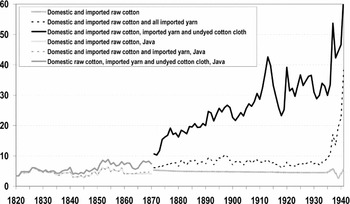
Having established the broad trends of cotton textile supply and the impact of trade policies, this paper will now assess changes in the different stages in the supply chain of cotton textiles in order to probe the factors explaining the underdevelopment of the industry in colonial Indonesia. Figure 2 offers a broad impression of the economic activities in the processing of raw cotton, imported cotton yarn, and undyed cloth. The domestic production of raw cotton for ginning and spinning remained relatively constant. Locally produced cotton yarn and imported yarn generated a modest increase in weaving activity in the 1870s, and a very significant increase from the mid-1930s. From the 1870s until the 1910s there was a steady increase in activity in the dyeing and batik industry, although with considerable variations after 1913.
Supply of cotton goods for further processing, 1820–1941 (1,000 tons, cumulative). Source: See Appendix. Note: 1820–70 refers to Java only and 1871–1941 to Indonesia as a whole.

Raw cotton production
Despite producing sufficient cotton to sustain a local textile industry in the eighteenth century, as well as being located around the equator, Indonesia was (and still is today) a marginal producer of cotton. Various native cotton varieties were produced throughout Indonesia, particularly in Java (Demak, Pati, Jepara-Rembang, Madiun and Madura), Sumatra (Palembang), and in Nusatenggara (Lombok and Flores). The colonial government had tried to encourage cotton production since the 1820s.Footnote 32 Local and imported varieties were used in a long series of government-orchestrated tests aimed at introducing cotton production and/or improving the quality of the produced cotton, particularly in Palembang. The results of all these efforts were discouraging.Footnote 33
Private interests also tried to expand cotton production. For example, in 1843 J.L. van Toll used his experience with cotton growing in Surinam to establish a cotton plantation in Cirebon in Java. Although the cotton produced was of good quality, the venture was not commercially viable and ceased in 1847. In the late-1840s, the Nederlandsche Handel-Maatschappij supported tests in Palembang to explore possibilities for large-scale cotton production, but did not persist. In 1861 an enthusiastic proponent of cotton production in Indonesia, J. J. van Limburg Brouwer, established the NV Nederlandsch-Indische Katoen-Maatschappij, which operated a cotton ginning and packing plant in Surabaya and sought to purchase locally grown cotton in Demak and Grobogan.Footnote 34 Despite high cotton prices due to the American Civil War, this venture failed to secure the required regular supplies of cotton and the company ceased operations in 1864. In 1905–07, the NV Wijnkoopsbaai Exploratiemaatschappij distributed free imported cotton seed among farmers in the Pelabuanratu region in West Java but failed to encourage local production of cotton for purchase and processing. In 1916, the NV Moluksche Handelsvennootschap established a plant in Palembang for the ginning of local raw cotton. It experienced irregular supplies and abandoned the venture in 1930. The NV Amsterdam-Soenda Compagnie was established in 1917 to produce and process cotton of a promising local variety in Flores. It ceased operations in 1924, when pests reduced yields and international cotton prices fell. In the 1930s, Dutch settlers and a Japanese company tried to grow cotton commercially in New Guinea, but began to experience pest problems within several years, and found that soil and climate were not always suitable and that yields were too low to make the ventures viable.
Unsuitable local rainfall patterns and soil conditions as well as pest problems were key reasons why cotton production remained limited. However, the main reasons why Indonesian farm households shunned cotton as a cash crop were the high risk of crop failures—the plant requires high rainfall in the initial stages and then a very dry maturing season—and low financial returns compared to other crops (f20 to f30 with a yield of only 100 kg ginned fibre per hectare).Footnote 35 Only when world prices were high did farmers increase cotton production. In Java, they only did so as a second crop on irrigated fields following the main rice crop, and only in areas where other crops would yield even lower returns than cotton.Footnote 36 Given the risk of crop failure (and the low financial yields), farmers did not put a lot of time and effort into weeding and pest control.
Cotton was generally produced for the local production of yarn from which cloth was woven for local consumption. The varieties that best suited the local climate yielded short, coarse cotton fibres, and therefore coarse cloth. Some areas exported much of their raw cotton to China and Japan, where it was blended with other fibres. Very small quantities of ginned, better quality produce were exported to Europe. Although the share of ginned cotton increased during the 1900s, most of the exported raw cotton was ginned overseas. Not surprisingly, given the uncertainty in production and trade, much of the raw cotton trade was in the hands of small Chinese traders who purchased from farmers for export. As most cotton was exported raw, the risk of contamination of the fibres by the oils from the seeds was high, and the quality of the exported cotton was on average low.
Ginning and spinning
Opportunities to expand the local production of raw cotton were limited, and the international market for yarn was very competitive. Consequently, any plans to establish major ginning and spinning ventures using local cotton were not feasible. Indonesian households did gin and spin locally produced raw cotton for their own consumption, more so in the early nineteenth century than later on. The available local ginning and spinning technologies were simple and very time-consuming,Footnote 37 and for that reason, imported yarn replaced locally spun yarn as soon as differential tariffs, which discriminated against imports from countries other than the Netherlands, were lifted in the 1860s. Imports of cotton yarn increased quickly from around 500 tons in the late-1860s to 2,500 tons in the late-1870s, then stabilized at a level of 3,000–4,000 tons per year until the late 1930s, when it expanded to 18,000 tons in 1940. Around 1890, it was reported that most weavers in Java used imported yarn.Footnote 38 In 1905, spinning was reported to be a declining sideline activity in 67 per cent of Java's regencies due to the increasing competition from imported yarn.Footnote 39 All indications are that small-scale cotton spinning was not profitable.Footnote 40
Given the success of imported yarn, why was there no effort to establish a mechanical cotton spinning venture to supply imported raw cotton to weavers in Indonesia? This was one of the recommendations of a survey of the textile industry in the 1890s.Footnote 41 As indicated above, private interests are likely to have been aware of any opportunities, given their efforts to establish ginning ventures. A possible reason was that firms were primarily interested in agricultural production, and therefore in cotton production rather than manufacturing. After all, with the exception of the processing of agricultural produce, export-oriented manufacturing was very limited in pre-war Indonesia (see also below).
Weaving
Imported yarn and locally produced cotton sustained a largely small-scale weaving industry. For the early nineteenth century, there is some evidence of the existence of significantly larger ventures spinning yarn and weaving cloth. Indigenous princely rulers maintained large workshops where high-quality textiles were produced for use in the court. Beyond that, there were various smaller weaving workshops in urban areas that also finished their produce, and that sometimes produced batik.
Almost all weaving was done by female weavers using the alat gedogan, a very basic handloom. Most weaving was a sideline activity in the household.Footnote 42 Some produce may have been sold in markets, possibly through a ‘putting out’ system under which a middleman (bakul) provided either an advance or a combination of yarn and advance to the weavers who produced the cloth for an agreed price. Most produce seems to have consisted of a coarse but strong quality cloth that was used for home consumption. Some weaving plants were established during the First World War, but they failed after it ended. In some areas of Java as well as the Outer Islands, such as the small island of Selayar, weaving for export to other parts of the archipelago continued for quite a while.Footnote 43
Nevertheless, Figure 1 shows that both yarn imports and locally produced cotton were marginal in the total supply of cotton goods. This is consistent with the impression that the available weaving technology was very labour intensive.Footnote 44 Hence, weaving gave way to imports of cloth and became a declining and relatively marginal economic activity, although the decline was regionally differentiated.Footnote 45 Qualitative impressions suggest that in some areas weaving remained more prominent than others, and even that produce from some regions was exported.Footnote 46 Observations of the state of weaving around 1890 suggest that in half of Java's 22 residencies, weaving was struggling due to the competition from imported cotton cloth.Footnote 47 Weaving was reported to have been decreasing in West Sumatra in the late-nineteenth century, and had all but disappeared in southeast Kalimantan by 1902.Footnote 48 Observations around 1905 suggest that the reported decline in weaving activity in 86 per cent of Java's regencies was largely due to the increasing availability of imported cloth that was not necessarily of superior quality but was certainly cheaper than local produce.Footnote 49
Until the 1930s, weaving took place in small-scale operations, which may have been competitive because of the weavers' ability to produce the quality and patterns that were locally preferred. They may have increasingly used imported yarn, which enhanced their competitiveness.Footnote 50 Still, various factors conspired against the local weaving industry. Sketching the situation in the early 1920s, Fievez and Meijer Ranneft offered four explanations for the decline of weaving:Footnote 51
1. inferior weaving technology and, consequently, low labour productivity and low financial returns per unit of labour, estimated at only f2.50 to f3.00 per person per monthFootnote 52
2. increasing use of low-quality yarn from Japan and India, which reduced the quality of cloth and therefore the popularity of local produce
3. small margins between the retail prices of yarn and cloth caused by the fact that weavers purchased small quantities of yarn and were dependent on a series of middlemen who supplied yarn and purchased cloth
4. the tariff on yarn was the same as on cloth (10 per cent), and discouraged weaving. (This was not unlikely, as the tariff was higher than what a weaver in Indonesia would earn turning yarn into cloth.Footnote 53 The tariff on yarn was subsequently reduced to 5 per cent in 1927 and abolished in November 1932.Footnote 54)
Thus, a combination of the limited supply of locally produced raw cotton, the greater efficiency of Dutch mechanized textile producers during 1824–74 (prices of imported Dutch textiles were generally lower than locally produced textiles), and a competitive international market during 1874–1933 conspired against the development of a weaving industry in Indonesia.
Political pressure by Dutch textile producers may have kept tariffs low and prevented the development of a textile industry in Indonesia. Sales to Indonesia indeed assisted the development of the textile industry in the Netherlands during the first half of the nineteenth century. However, the development of the Dutch textile industry since 1850 had depended largely on sales in the domestic market rather than overseas sales.Footnote 55 Moreover, Dutch producers faced stiff competition from producers in Great Britain, India, and Japan. Hence, the Indonesian share of Dutch textile exports decreased from on average 63 per cent in 1874–1904 to 41 per cent in 1905–30 and 40 per cent in 1931–39.Footnote 56 It therefore is unlikely that textile producers in the Netherlands had preferential access to Indonesia until 1933, and that any effort to secure their interests was at the expense of the development of a weaving industry in Indonesia.
It is more likely that two other factors stood in the way of the development of large-scale ventures in spinning and weaving. First, the colonial government understood that textiles (and rice) were major wage goods at a time when Indonesia was a successful exporter in competitive international markets for labour-intensive primary commodities, including sugar, rubber, tobacco, tin, tea, copra, palm oil, and fibres. Hence, any effort to extend trade protection to local producers of cloth would have raised prices of textiles to above world market levels, which would have put increasing pressure on wages and could have reduced the international competitiveness of Indonesia's export commodities.Footnote 57 Secondly, since the 1870s Indonesia's currency had been stable under the gold exchange standard, but its exports consisted largely of primary commodities for volatile international markets. Consequently, the economy experienced unstable real exchange rates, and possibly real exchange rates that made production of manufactures for exports uncompetitive.Footnote 58 This created uncertainty that deterred private investment in the manufacturing of import-competing goods such as yarn and cloth with a relatively high value-weight ratio for which few trade barriers existed.
Finishing and batik
A more significant economic activity involved the finishing (bleaching, washing, drying, dyeing, and starching) of both imported and locally produced textiles. This was also largely a cottage industry. Not much is known about this stage of the production process, except in the batik industry. Some of this work was done under the bakul system.
Perhaps the most important aspect of textile finishing was the batik industry, which used most of the imported unbleached and bleached cotton cloth. It dyed the cloth using intricate patterns that varied by region and according to fashion. Despite growing competition from imported printed cloth, the batik industry appears to have grown substantially on the back of imported unfinished cloth and new technologies.
The batik industry had been flourishing since the 1830s due to the decline of the production of printed textiles for export in India, and an increase of bleached cotton textile imports. In the 1850s it grew further as a consequence of improvements in the stamping technique in response to increasing imports of printed cloth from Europe.Footnote 59 This involved the use of a wooden or copper stamp with which the wax designs were printed on the cloth. Although women using the canting (wax pen) still had to correct blemishes of the wax print, the stamping technique increased the quantity of cloth dyed per worker, but not necessarily at the expense of the quality of the dyed cloth.
From the 1860s, imported chemical wax substitutes (such as paraffin wax since 1905) and later imported synthetic dyes assisted this process, as they were cheaper than locally produced beeswax and natural dyes. The synthetic dyes saved the labour that had previously been required for the preparation of natural dyes, and they came in a greater array of colours. The importance of imported cotton cloth and dyes for the batik industry became clear during the First World War, when the industry languished due to reduced imports.Footnote 60
Imported dyed cloth was generally of inferior quality to locally produced batik. Still, it was much cheaper and commanded a market for that reason. Nevertheless, the batik industry flourished, because it focused production on locally differentiated markets. Around 1905, two procedures were used in Java.Footnote 61 First was the highly labour-intensive hand-drawn batik, which was a highly specialized industry producing high-quality cloth that could not be copied by foreign producers of printed cloth, and second was the batik print industry, which produced for local and wider markets in Indonesia. Around 1890, all batik workshops were reported to be using imported white cotton cloth, and only four of the 22 residencies reported negative consequences on the batik industry from the import of printed textiles.Footnote 62
In 1905, 52 per cent of Java's regencies noted a decline in batik production.Footnote 63 However, it seems likely that the activity had become more regionally concentrated and in larger workshops as new technologies were developed. The continued relevance of the activity is also indicated by the fact that there were very many batik workshops. Surveys indicated 579 in 1915 and 830 in 1919, employing on average 13 people (1915: 7,606, and 1919: 10,139).Footnote 64 These numbers are most likely to be an underestimate, because in 1920–24 only the districts of Yogyakarta, Surakarta, Kediri, and Pekalongan in Java reported fewer than 1,100 to 1,300 batik workshops.Footnote 65 In addition, there is evidence of increasing Chinese and Arab participation in the stamped batik industry and the further development of the bakul system.Footnote 66 In 1930, there were 4,384 workshops in Java, employing 17,000 workers.Footnote 67 Hence, batik production remained considerable, despite the growing imports of dyed and printed cloth.
Imports, distribution, and domestic trade
From the 1870s the main importers of textiles had been Dutch-owned general trading companies. They orchestrated imports and supplied imported cloth through their regional offices, mostly to Chinese-owned domestic trading firms, who sold the cloth on to other wholesalers and retailers. Some of the larger Chinese firms may also have imported cloth themselves, particularly from India and Japan.
During the First World War, Dutch and Chinese trading firms became increasingly interested in importing from Japan, which they did until Japanese general trading companies established their own subsidiaries in Indonesia. Starting during the War, these subsidiaries organized imports of textiles from Japan, particularly cloth used in batik production. They built up a distribution network that paralleled that of Dutch trading companies and Chinese wholesalers and retailers, involving Japanese and upstart Chinese retailers.Footnote 68 The network expanded during the 1920s. Apart from Japan's competitive exchange rate, this was a key explanation for the fact that Japanese export products captured high market shares during the early 1930s.
The market for textiles in Indonesia expanded during the 1920s due to falling prices of produce, population growth, and increasing average incomes, but also due to the gradual development of transport infrastructure both in Java (in the form of railways and later roads) and between Indonesia's main islands (in the form of regular and increasingly frequent shipping connections). Both are likely to have reduced the transport margin in the retail price of produce.
Industry policies impacting on the cotton textile industry
Despite various contemporary opinions that stressed the need to encourage local manufacturing, the colonial government did little during the First World War, when the supply of imported manufactures decreased due to disrupted shipping connections between Europe and Indonesia.Footnote 69 Shipments of textiles to Indonesia were severely affected by a combination of Germany's declaration of unrestricted submarine warfare in 1917, an American embargo on the ships of neutral Netherlands in 1917, and the British seizure of neutral Dutch ships. In 1918 no Dutch textile shipments reached Indonesia and increasing imports from Japan were insufficient to compensate for the decrease in textile supplies from Great Britain and the Netherlands.
To address the situation, in 1915 the governor general of the Dutch East Indies commissioned a study to find out what could be done to further domestic industries. The issue also attracted attention in the Netherlands, where in 1914 the minister for colonies had commissioned a study into how Japan had been able to generate a large industrial sector in a relatively short time.Footnote 70 The study was expected to yield clues as to what could be done in Indonesia. Both studies eventually led to various modest industrialization initiatives.
One initiative involved the establishment of the Textielinrichting Bandung (later the Institut Teknologi Tekstil) in 1921. This was conceived of as an institution to study and improve weaving and dying techniques, and also cloth designs and patterns. It aimed to assist small-scale weaving and further rural prosperity by offering courses and lectures to disseminate improved technologies.Footnote 71 In 1926, the Institute developed an improved handloom (later called the Alat Tenun Bukan Mesin). This semi-automatic wooden loom had a flying shuttle and did not require electricity to operate. It was able to increase labour productivity because its capacity exceeded that of the traditional gedogan handlooms by a factor of 8 to 12.Footnote 72 The price of the handloom decreased quickly from f125 to f35, and to f20 in 1930.Footnote 73 By 1930, the Institute had also developed a basic power loom (later called the Alat Tenun Mesin) that exceeded the capacity of the handloom by a factor of 4 to 5, but cost f340 in 1930.Footnote 74
Both looms were relatively cheap and simple to construct. They increased labour productivity to the extent that the cloth produced by small weavers could again compete with imported cloth. Use of the looms spread quickly in the early 1930s, before the crisis started to bite. Their diffusion accelerated particularly when the impact of protectionist measures started to be felt after 1933 (see above). Consequently, while there were just 257 handlooms and 44 power looms in 1930, by 1942 there were 52,000 handlooms and 10,000 power looms; Java also had some 500,000 gedogan.Footnote 75 The new looms were adopted by both small- and medium-sized firms. Larger firms also installed imported large second-hand power looms from Japan.
Textielinrichting Bandung was not only a not-for-profit producer of the improved looms.Footnote 76 In cooperation with local indigenous officials, it started a ‘weaving school’ for men and women in 1928, where Indonesian craftsmen were trained to become producers of weaving looms and other equipment used in the weaving industry. In the 1930s, for example, it offered management and training courses to managers and skilled workers of new textile-producing ventures. It cooperated with the regional industrial consultation offices of the colonial government to further weaving in other parts of the country: three in Java and six in the rest of the country.Footnote 77 Textielinrichting Bandung combined research with education and information activities.
The number of weaving ventures increased quickly. Most had fewer than 15 looms, with up to 30 employees, but there were many medium-sized operations and several large enterprises.Footnote 78 Most of the industry grew in West Java, particularly in and around Bandung. The emergence of clusters of small weaving ventures around the town of Majalaya (close to Bandung) took place in line with cluster theory.Footnote 79 In part it was related to the established regional weaving tradition, which used the gedogan, but also to the fact that the region had produced cotton in the past and had relatively easy access to markets via Bandung, due to its location on the undulating Priangan plain and the presence of railways and relatively good roads. Its location relative to Textielinrichting Bandung and its activities were also factors, as was the interest that entrepreneurs in the region happened to take in weaving. It is possible that high population density, small farms, and an increase in indebtedness during the crisis caused small farmers to sell their land to landlords in order to use the proceeds to pay off debt and purchase weaving looms. The cost of a loom, a workshop, and equipment to process the woven cloth was estimated to be f50.Footnote 80 This sum was almost equivalent to the annual income of a poor rural household, but could possibly have been raised through the sale of land. Finally, the region was connected to Bandung's electricity net and the government assisted the establishment of weaving cooperatives.Footnote 81 By the late-1930s, about half of Indonesia's produced textiles came from the Bandung region.
News about current and expected future restrictions on textile imports fuelled growing interest in investment in weaving. The weaving industry expanded quickly from 1934 to 1935, producing, in particular, mixed cotton/rayon sarong. Fearing that an oversupply of sarong would depress the market, possibly causing bankruptcy and increasing unemployment, the government ordered the regulation of the production capacity of the weaving industry in December 1935.Footnote 82 Licences to operate a specified number of looms were required for ventures with mechanical looms or with 15 or more handlooms. This limit on the expansion of larger ventures was a major reason for the increase in the number of small-scale ventures that used fewer than 15 handlooms, particularly in the Majalaya area.
The industry in the Majalaya region soon developed institutions that facilitated its further development. Most workshops started off as household operations with one loom, expanding as opportunities increased, and owners encouraged friends and relatives to follow their example. The expansion was financed with reinvested earnings, but also with loans from well-off indigenous large landowners or from the bakul middlemen who also supplied the raw materials on credit and purchased the final produce. Weavers in the region were generally young adults (85 per cent under 30), largely female, and landless (less than 10 per cent owned land).Footnote 83
A 1937 survey found that a large number of Chinese-owned ventures were independent in name only, and were in fact controlled by groups of Chinese entrepreneurs. For that reason, as well as ongoing concerns that continued rapid increases in the number of looms would result in an oversupply of sarong in 1936,Footnote 84 the licensing system was extended in 1937 to ventures operating five handlooms or more. In 1940 it was extended to all weaving ventures operating handlooms and/or mechanical looms (thus excluding gedogan-based cottage activities), and to knitting, spinning, and dyeing (excluding batik) as well.Footnote 85 In all, the licensing system did not stem the growth in production capacity, but allowed the authorities to balance the growth of large, medium-, and small-scale ventures.
Some ventures grew in size because there were efficiency gains to be had by locating looms in one place, standardizing cloth quality, and arranging a division of labour within one enterprise. From 1936, ethnic Chinese entrepreneurs established such larger ventures in the Majalaya region, and the development of the weaving industry was taken up a notch with the introduction of electricity in 1939, which allowed the operation of power looms. The average size of the operations increased and, with it, the prominence of ethnic Chinese business groups (kongsi) in both the production and trade of cloth. They owned a greater share of the large ventures, established more of the small ventures with fewer than 15 (generally 14) looms, purchased more and more of the smaller Indonesian-owned ventures, and controlled many of the remaining small ventures through the bakul system.Footnote 86 While 43 per cent of the ventures were small-scale in 1930, by 1938 they already comprised 97 per cent of the total.Footnote 87
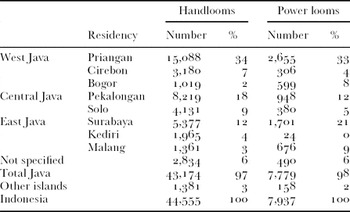
Two statistical sources give an impression of the production capacity of the textile industry in 1941: the industrial survey statistics (all firms employing mechanical power or 50 workers or more) and the statistics of the licensed capacity of weaving ventures. The first reveals that there were 272 textile factories in Indonesia in July 1941, 170 of which had mechanical power of up to 5 hp, with only nine outside Java. These firms operated 8,339 power looms, 232 heavy handlooms, and 28,262 handlooms, and employed 61,422 people of whom only a third (19,959) were women.Footnote 88 The licensing statistics are summarized in Table 1, which shows that 44,555 handlooms had been licensed by 1940. Alongside the factories there were about 16,000 small weaving ventures. Table 1 also shows that most of the production capacity was in the Priangan (Bandung), Pekalongan, and Surabaya residencies in Java, and hardly any outside Java.
Number of Licensed Looms in Indonesia, 1940—41

Note: Only licensed firms.
Source: Kroese, W.T. (1946). ‘Statistische gegevens als basis der rehabilitatieplannen der Nederlandsch-Indische textielindustrie’, Economisch-Statistische Berichten, 31, 600.
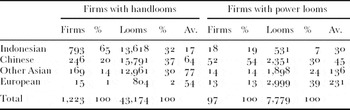
The weaving industry was segmented by the ethnicity of the owners of weaving firms, as Table 2 indicates. European-owned weaving ventures were the largest and best equipped. Indonesian ventures were numerous, but small and with few mechanized looms. Chinese and Arab-owned ventures occupied an intermediate position. It appears that during the last few years of Dutch colonial rule, Indonesian entrepreneurs in the weaving industry lost considerable ground to the Chinese.Footnote 89 While descriptions of the weaving industry in Majalaya in the mid-1930s suggested a sector dominated by indigenous Indonesian weavers, by 1940–41 most of the productive capacity was controlled by non-indigenous Indonesians. For example, in 1939, 335 of the 1,500 weaving firms in Majalaya were sold by Indonesians to Chinese.Footnote 90 An investigation into 94 sales of Indonesian-owned weaving enterprises showed that 55 per cent were bought by Chinese, 16 per cent by Arabs, and 29 per cent by other Indonesians.Footnote 91
Distribution of looms in Java by ethnicity of company owners, 1940–41

Note: Only licensed firms.
Source: Kroese, W.T. (1946) ‘Statistische gegevens als basis der Rehabilitatieplannen der Nederlandsch-Indische textielindustrie', Economisch-Statistische Berichten, 31, 600.
The largest weaving ventures in Java were the NV Preanger Bontweverij (Garut, 1932) and the NV Java Textiel Maatschappij (Tegal, 1936).Footnote 92 Many other weaving firms were established by consortia involving Dutch companies, such as textile firms, banks, and trading companies. Other major producers included C.L. Phaff and Nanyang Weaving Works (Bandung), Samsoedin and Santoso (Cirebon), NV Kantjil Mas and Kasri (Pasuruan), and Alsaid bin Awad Martak (Surabaya). The larger firms relied more on power looms, often Japanese-made, but many firms operated both power looms and handlooms. For example, British Indian-owned firm E.K.J. Muallim (Gresik, 1926) had 2,000 handlooms in 1938, 350 second-hand machine looms from Japan, and employed 4,000 workers at full capacity.Footnote 93 The firm expanded its capacity to 2,200 handlooms and 560 machine looms.Footnote 94 The diversity of producers in the textile industry reflects a principle in industry policy in Indonesia in the 1930s that was included in the Industrieplan 1941 (1941 Industry Plan), which explicitly aimed to protect smaller ventures by using the licensing system to balance the development of small-, medium-, and large-scale operations.Footnote 95
Mechanical yarn production did not increase until after the establishment of the NV Java Textiel Maatschappij in Tegal in 1936. It produced yarn with a capacity of 5,000 spindles, increasing in 1940 to 15,000 spindles (circa 1,200 tons of yarn per year).Footnote 96 It was joined by NV Nebritex (Pasuruan, 1936), a Dutch-British joint venture (annual yarn production 1,000 tons), and NV Djantra (Semarang, 1941), a Dutch joint venture with the colonial government (annual yarn production 1,000 tons or 7,500 spindles). After the start of war in Europe and the disruption of shipments from the Netherlands and the Great Britain in 1940, the colonial government issued the 1941 Industry Plan. One of its aims was to establish three additional spinning mills in East Java in Demak, Pasuruan, and Bojonegoro, which would spin the coarse cotton produced in the Demak and Banyuwangi regions. Still, the licensed mechanical spinning capacity was only 44,000 spindles by late 1941.Footnote 97
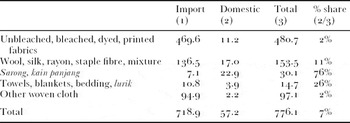
Despite the rapid development of production capacity during the 1930s, Indonesia was far from self-sufficient in textiles.Footnote 98 The self-sufficiency rate was estimated at 5 per cent in 1936 and 14 per cent in 1939.Footnote 99Table 3 shows a rate of 7 per cent in 1939, or 15 per cent if small-scale and household production is included. The degree of self-sufficiency was higher in some categories, particularly for cotton sarong with woven patterns and for cloth with mixed yarns, particularly with rayon. All in all, however, domestic textile production generated about 15–20 per cent of domestic textile consumption in 1940–41.Footnote 100 Hence, 80–85 per cent of the textile supply was still imported, either as cloth, yarn or raw cotton, not counting garments.
Supply of textiles, Indonesia 1939 (million metres)

Notes: Aggregations by length, disregarding the width of cloth. The estimate of domestic production is based on the 1939 industrial statistics, that is, on 131 medium- and large-scale textile companies. It excludes small-scale and gedogan loom production, estimated respectively at 45 and 25 million metres in 1940 (Timmermans, J.M.H. (1941). ‘Ontwikkeling van de Nederlandsch-Indische textielindustrie en de overheidsbemoeienis’, Economisch Weekblad voor Nederlandsch-Indië, Special issue, 40.
Source: Van Assen, A.H. (1941). ‘De nijverheidsstatistiek en hare resultaten ten aanzien van 1939’, Economisch Weekblad voor Nederlandsch-Indië, Special issue, 75.
Conclusion
This paper offers a nuanced analysis of the development of the cotton textile industry in Indonesia before the Second World War on the basis of disparate and incomplete sources. It establishes that economic activity in the cotton textile industry in pre-war Indonesia did not decrease, as is often suggested. In fact, activity increased as imports of unbleached and bleached cotton cloth grew significantly. Added to cloth produced from locally produced and imported yarn, imported cloth supported a growing finishing industry, which comprised a large number of small-scale ventures that produced dyed and batik cloth to suit local preferences. There were no formal barriers to entry in this industry, but the locally differentiated preference for dyed and batik cloth made it difficult for foreign competitors to imitate the products of this domestic industry. Moreover, this industry enhanced its competitiveness through increasingly low-cost imported fabrics, the development of the wax stamping technique, and increasing use of cheaper, imported chemical dyes and wax substitutes.
The paper has indicated that for more than a century—up to the late-1930s—domestic spinning and weaving remained of marginal significance and were not internationally competitive for a combination of reasons. First, indigenous spinning and weaving technologies were too labour intensive to be competitive with imported cloth and yarn, despite the fact that import prices may have exceeded world market levels due to trade policies favouring imports from the Netherlands until 1874. This disadvantage was somewhat mitigated following the introduction and spread in the 1920s of new weaving technologies that suited small-scale producers and increased their labour productivity.
Secondly, local raw cotton production had always been of marginal significance. While the production of other crops triggered the establishment of major agro-processing ventures, domestic cotton production was insufficient and the quality of the cotton was too poor to provide a basis for the start of a cotton spinning industry with imported technology.
Thirdly, starting during the First World War, the market for cotton textiles fluctuated considerably, largely in line with the boom-bust cycles of Indonesia's primary export industries and the concomitant terms of trade of the country's exports. Although impossible to prove conclusively, it is very likely that the market's instability discouraged private investment in a modern cotton spinning and weaving industry, using imported raw cotton.
Lastly, international competition in markets for yarn and cloth was fierce and delivered textiles to Indonesia at the lowest possible cost. At the same time, unfavourable real exchange rates conspired against private investment in modern spinning and weaving ventures that used imported technologies and inputs. Such ventures were only feasible with trade protection, at least in the start-up phase. For many years, the principles of Indonesia's trade policy did not allow for such protection. In addition, protective import policy could have hurt Indonesia's export performance based on competitive primary commodities, as textiles were an important wage good. Only in 1933 when the recovery of these export industries appeared impossible due to mounting international trade protection, did the colonial government reconsider its trade policies. Initially to overcome foreign exchange shortages, then as a development strategy and in anticipation of shortages during the Second World War, it opted for trade protection in the form of tariffs and quotas that discriminated against imported textiles. This triggered a rapid development of weaving in enterprises of variable sizes and of mechanical spinning ventures.
Contrary to Dick's hypothesis, the domestic market for cotton textiles was not small and fragmented. In 1930, it was 61 million people strong and, depending largely on imported textiles, it was large and integrated. Still, Indonesia's textile industry was too small to be a leading sector and thus spur a broader process of industrialization, as Dick hypothesized. Indeed, the industry was not shielded by trade protection until the 1930s, but it remains doubtful whether such shielding of cotton textiles—a very important wage good—before the 1930s would not have had adverse consequences for the country's main export industries. Williamson's hypothesis regarding the adverse impact of the secular trend in the terms of trade does apply to pre-war Indonesia, even though it ignores the possibly greater effect of instability in the terms of trade on industrial investment. In addition, this paper has shown that the terms of trade is only one of a range of factors that conspired against the development of the cotton textile industry.
Appendix: Supply of cotton textiles estimation, 1820–1941
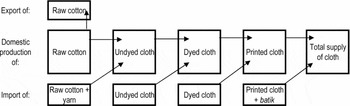
To estimate the supply of cotton textiles, this paper augments and enhances a methodology first developed by Van Zanden.Footnote 101Figure A1 shows the method to create annual estimates of the production of cotton products on the basis of foreign trade data and estimates of the domestic production of raw cotton. In the absence of further data, the method assumes that there are no losses from one stage of processing to the next. Unfortunately, quantity data are not readily available throughout the period. Only values of foreign trade are available for 1822–1914, and for 1822–1870 only for Java. Quantities were therefore estimated by dividing total values by available price data from a separate source, as explained below.
Procedure used to calculate production and supply of cotton products at different stages of processing.

Few data on cotton production are available for Indonesia. Boomgaard estimated per capita production of cotton for Java in the nineteenth century on the basis of assumed harvested area and average yield.Footnote 102 Assuming that his yield data refer to raw, unseeded cotton, this suggests per capita consumption of locally produced cotton fibre of 0.31 kg in 1815, 0.18 kg in 1840, and 0.11 kg in 1880. The estimate for 1815 would have been sufficient for the production of just one woven sarong (of 1 × 2.5 m2) per person in Java.Footnote 103 During 1842–57, annual average production in Java was 7,800 tons of raw cotton or 0.18 kg per capita during 1842–57.Footnote 104 Other sources indicate that on average only 14,300 ha per year was harvested in Java during 1880–95 and 9,100 ha during 1913–40.Footnote 105
By the 1930s, raw cotton was mainly produced in parts of Java, Sumatra (circa 30,000 ha.) and Nusatenggara (circa 6,500 ha.) and, to a lesser extent, elsewhere in the archipelago. Production may have varied from year to year, depending on rainfall. Still, harvested area was only 45,000 ha in Indonesia as a whole, much less than, for instance, the pre-war 2.3 million hectares in China. Preferred varieties were coarse and short stapled, and cotton yields were low: roughly 100 kg of fibre per ha (compared to 200 kg in the United States).Footnote 106 Production was around 4,500 tons or only about 0.07 kg per capita in 1930.
We assumed that imports of cotton textiles resumed in 1822 (see below), and that total per capita supply of cotton goods during 1820–21 was 0.31 kg, the 1815 level estimated by Boomgaard. We interpolated the estimates of per capita domestic cotton production between 1822 and 1842, 1857 and 1880, and 1880 and 1930. Domestic cotton production during 1931–41 was estimated with approximations of total harvested area.
The value and quantity of ginned and unseeded raw cotton imports, the value of imported yarn and cloth imported from Indonesia's Outer Islands and from other countries into Java are available for 1822–73Footnote 107 from the annual foreign trade statistics, as well as imports of all textile products from other countries into Indonesia as a whole for 1871–1940: Statistiek van den Handel, De Scheepvaart en de In- en Uitvoerregten, Statistiek van den Handel en de In- en Uitvoerrechten in Nederlandsch-Indië, Jaaroverzicht van de In- en Uitvoer van Nederlandsch-Indië. For 1915–40 these statistics contain both the value and quantity of imported textile products, as shown in Table A1. Unpublished 1941 trade data were obtained from Sofjan.Footnote 108
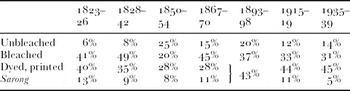
The imports of cotton cloth for 1822–1914 from the trade statistics were not disaggregated by quality of cloth. Table A.1 shows the shares of the main types of cloth for a few benchmark periods, obtained from other sources. The annual data underlying Table A.1 were used to apportion the value of cloth imports to each of these four categories for 1822–1914. Price data for these four categories of cotton cloth in Indonesia as well as prices of raw cotton in the Netherlands were used to estimate the imported quantities of raw cotton and four categories of cloth shown in Table A1 for Java during 1822–70 and for Indonesia as a whole during 1871–1914.Footnote 109 Lastly, population data 1820–70 Java and 1871–1930 Indonesia are unpublished estimates, and for 1930–41 from Van der Eng.Footnote 110 Excel worksheets containing the basic and processed data are available from the author on request.
Category shares in cotton cloth imports into Indonesia, 1823–1939

Note: Calculated with the values of different types of cotton cloth. They are based on annual data, although only benchmark periods are shown here: 1823–26 refers to imports into Batavia only; 1828–54 to Java; 1855–70 to Batavia, Semarang, and Surabaya only.
Sources: Figures for 1823–26 are calculated from Posthumus, N.W. (1921). Documenten Betreffende de Buitenlandsche Handelspolitiek van Nederland in the Negentiende Eeuw, Nijhoff, The Hague, Vol. 2, pp. 90–93; 1828–70 from Muller Szoon, H. (1857). De Nederlandsche Katoen-Nijverheid en het Stelsel van Bescherming in Nederlandsch-Indië, Kramers, Rotterdam, pp. 46–58, and tables from the Nederlandsche Staats-Courant reproduced in De Economist, 1852–72; and 1871–40 from Statistiek van den Handel en de In- en Uitvoerrechten in Nederlandsch-Indië and Jaaroverzicht van de In- en Uitvoer van Nederlandsch-Indië.