1. Introduction
The demonstrative pronoun has been argued to give rise to the definite article þe ‘the’ in early ME (see, for example, McColl Millar Reference McColl Millar2000), and soon thereafter the form of the definite article itself splits into a number of variants, one of which is vowel-less þ’/th’.Footnote 1 As I show below, this reduced form of the definite article persists throughout the ME and EModE periods. As a reduced form, þ’/th’ attaches to the following noun, as in 1. Alternatively, yet much less frequently, it can also attach to an adjacent adjective that comes before the noun.
(1)


Due to such behavior, it might be argued that the reduced determiner is a clitic in the sense of Zwicky Reference Zwicky1977, Reference Zwicky, Nevis, Joseph, Wanner and Zwicky1994, Spencer Reference Spencer1991, Anderson Reference Anderson2005, and others. In other words, the free form the has a variant th’ which is “prosodically deficient” (Anderson Reference Anderson2005:13) and therefore attaches itself to adjacent material.
In this study, I address the syntactic status of reduced th’. I show that in most cases, the form is a definite article. Yet I also present evidence from corpus data which show that in a few cases in the 16th century, reduced th’ could be interpreted as a nominal marker. Depending on whether th’ is a definite article or a nominal marker, it occupies different functional slots in the structure of the nominal. I claim that as a definite article, reduced th’ functions differently from the full form of the definite article already in the 15th century. The differences hold in the 16th century as well. Arguments from the domain of the accessibility of the antecedent are used to validate the claim that nominals with reduced th’ occupy their own functional niche in English. Once established and described, this niche is shown to contribute to a shift in the definiteness cycle (henceforth DP cycle) in that reduced th’ is a functionally weaker definite article on its way to becoming a nominal marker. I follow van Gelderen's (Reference Gelderen2007, Reference Gelderen2011) construal of the DP cycle couched in terms of Chomsky's (Reference Chomsky1995, Reference Chomsky and Belletti2004) Minimalist Program.
This paper is organized as follows. First, I make it clear that reduced th’ is not an instance of definite article reduction (section 2.1). Then I discuss the corpora from which the data for this study are taken and justify the choice of texts subjected to a detailed analysis (section 2.2). In section 3, I briefly outline the development of reduced th’ in ME and EModE and highlight the types of hosts to which it attaches. In section 4, I argue that ME th’ develops a function distinct from that of the full form of the article (sections 4.1 and 4.2) and that the divergent development remains noticeable in the 16th century data (section 4.3). Section 5 contains a proposal that accounts for the structural difference between the definite article th’ and the nominal marker th’.
2. Data and Methodology
2.1 Reduced th’ in Standard English
The aim of this section is to show that reduced th’ does not result from Definite Article Reduction (DAR). In the literature on present-day English, reduced th’ sometimes makes an appearance under the category DAR in the domain of phonology (see, for example, Petyt Reference Petyt1985; Jones Reference Jones, Upton and Wales1999, Reference Jones2002; Rupp & Page-Verhoeff Reference Rupp and Page-Verhoeff2005; Rupp Reference Rupp2007; Tagliamonte & Roeder Reference Tagliamonte and Roeder2009). Today DAR is observed in some dialects of Northern England, in which the definite article has a number of vowel-less allomorphs usually spelled as th’ and t’. The pronunciation of such reduced forms involves a variety of consonants including plosives, fricatives, and affricates, as shown by Jones (Reference Jones, Upton and Wales1999). Viereck (Reference Viereck and Fisiak1995:296) provides a map indicating that such forms are especially widespread in northern, western, and southwestern England. Likewise, Rupp (Reference Rupp2007:216), following Jones (Reference Jones, Upton and Wales1999, Reference Jones2002), offers a map indicating the northern counties where DAR is attested.
As for the mechanism of DAR, Rupp (Reference Rupp2007) notes that there are two competing theories, namely, the assimilation theory and what might be referred to as the demonstrative source theory. The former assumes, as Viereck (Reference Viereck and Fisiak1995:295, 303, note 18) does, that in the north of England in early ME, the original voiceless fricative in the definite article þe ‘the’ became /t/ as a result of assimilation to the preceding plosive, /d/ or /t/, yielding the form te. Later the vowel is dropped in te as well as in nonassimilated þe. Jones (Reference Jones2002:341ff.) rejects this theory, showing that the distribution of th’ and t’ in the present-day BrE dialects does not reflect this assimilation pattern. At the same time, there is no alternative account of DAR according to him. The demonstrative source theory, voiced most recently by Rupp (Reference Rupp2007:240ff.), argues that the immediate ancestor of the forms affected by DAR is the neuter demonstrative pronoun þæt ‘that’, which meant that te, a reflex of the final plosive in the demonstrative, historically predated þe and reduced þ’/th’.
I should emphasize, following Jones (Reference Jones, Upton and Wales1999:103) and Rupp (Reference Rupp2007:317), that reduced th’ in the ME and EModE texts, that is, the focal point of this study, is unrelated to DAR. Reduced th’ starts off in the north of England and then spreads to the south (see section 3) and develops its own characteristics. In this study, I assume, contra the demonstrative source theory, that reduced th’ comes directly from the definite article þe/the, although this point is not subject to any further corpus analysis in this paper.Footnote 2
2.2 Corpora and Methodological Issues
Two electronic corpora have been used in this study, namely, the Corpus of Middle English Prose and Verse (henceforth CMEPV) for ME data and the Penn-Helsinki Parsed Corpus of Early Modern English (henceforth PPCEME) for EModE data. I chose CMEPV over PPCEME because, as the most complete electronic collection of ME texts, it contains a fuller body of the ME data. What this choice compromises, however, is the assignment of the texts to subperiods within ME. CMEPV does not distinguish different periods within ME, and consequently, there is no way of showing the fluctuations in the number of instances of reduced th’ versus full the at particular stages of ME. Such fluctuations are indicated for EModE in table 1 in section 3. Conversely, PPCEME divides ME into the following four subperiods: ME I (1150–1250), ME II (1250–1350), ME III (1350–1420), ME IV (1420–1500). Whenever possible, I follow this periodization scheme in the main text.
It should be mentioned that there is a reliability concern when full and reduced forms of the English definite article are searched in an electronic corpus of ME. An electronic corpus may not always be reliable when it comes to an issue so sensitive to spelling. To address this concern, I compare the digital data with the facsimiles of the ME manuscripts. So far, I have consulted a number of facsimiles to make sure that what appears as a reduced form in CMEPV is in fact a reduced form in the original text. This is an ongoing task, and the electronic data have been contrasted with those of the following manuscripts: Bodleian MS Laud Misc 636 (the Peterborough Chronicle), MS Fairfax 16 (Lydgate's Resun and Sensuallyte), Auchinleck MS 19.2.1 (The Romance of Sir Beues of Hamtoun and The Romance of Guy of Warwick), Ellesmere MS EL 26 C 9 (Chaucer's Canterbury Tales), Winchester MS (Malory's works), and Caxton's first edition of Malory's works. So far, with the exception of one rather inconsequential instance, no disparity has been found between the digital data and the manuscript data.Footnote 3
The final point to be made in this section concerns the choice of texts for detailed reporting in section 4. As I show in that section, much attention was paid to nominals preceded by reduced th’ used anaphorically in prose texts. Verse was excluded to make sure that no occurrence of th’ was due to considerations of meter called upon in poetry. In attempting to identify cases of reduced th’ anaphora in the corpora, I also chose not to include collections of epistolary correspondence. Such collections, often incomplete, make it difficult to identify the antecedents of definite nominals as such nominals often have antecedents in previous letters not necessarily included in the collection. As a result, three prose texts are examined in this study, namely, Le Morte D'Arthur by Thomas Malory (1485), The Itinerary by John Leland (1534–1543), and The Lyfe of Sir Thomas Moore by William Roper (1555). The choice of such a late ME text was dictated by lack of earlier prose texts with a sizeable number of anaphoric nominals with reduced th’, while other texts, for example, English Gilds, are devoid of such instances. Instead, the texts selected are representative of a time when th’ is nothing untoward in written English, as is made clear in the next section.
3. An Overview of the Use of th’ in ME and EModE
In this section, I show that reduced th’ remains an available option throughout the ME and EModE periods. In order to get a better idea of the exact temporal span of the use of the reduced form th’, I have identified all the texts available in CMEPV that make use of the form. As is well known, throughout ME th can be spelt as þ and ð. Consequently, I have also included instances of the reduced definite article realized as þ’ and ð’. In the following part of this study, th’ is used as an umbrella form that also covers the two spelling variants. It turns out that reduced th’ is present from the beginning of ME, with relevant instances scattered throughout the period. The earliest examples of th’ come from two texts, namely, the Peterborough Chronicle and the Ormulum. The Peterborough Chronicle contains the first appearance of the reduced form of the article coming from the entry for 1137, which is 15 years later than the famous first appearance of the definite article the in 1122 (see van Gelderen Reference Gelderen2011:163). The 1137 entry is shown in 2a. In the entry for 1140, there are two further instances, both shown in 2b.
(2)
‘Then England was very much divided. Some held with the king, and some with the empress; for when the king was in prison, the earls and the rich men supposed that he never more would come out, and they settled with the empress.’
?a1160 Peterb.Chron.(LdMisc 636) an.1140 (CMEPV)
The Ormulum examples are significant because they testify to th’ being a clitic rather than an affix, as th’ attaches to an adjective preceding a noun in NP. For Anderson (Reference Anderson2005:83), clitics are phrasal affixes associated with a particular domain, namely, a phrase. The phrase in question is AP, and the clitic th’ attaches to the element at the beginning of that phrase, as can be seen in 3.
(3)
Since both the Peterborough Chronicle and the Ormulum are East Midland texts, it can be assumed that th’ develops north of the Thames. Only in the ME of 1250–1350 does it spread further south to Midlands, as I have found it attested in, for example, The Romance of Sir Beues of Hamtoun and The Romance of Guy of Warwick. These two texts appear in the Auchinleck manuscript composed in 1330–1340 in London (see Pearsall & Cunningham Reference Pearsall and Campbell Cunningham1977:vii, xi) and are available as part of CMEPV. Also, Kentish Ayenbite of Inwyt, the first southern text which has an instance of the reduced form, is a later text, composed around 1340. A complete list of works featured in CMEPV where th’ is attested is provided in appendix 1.
Appendix 3 lists all the hosts of reduced th’ in the three texts that fall under investigation in section 4. As can be seen, the majority of the hosts—although not all—have a polysyllabic structure and are of French origin.Footnote 4 It has to be noted that throughout the ME period, the appearance of reduced th’ is phonologically restricted to the contexts where the following noun or adjective begins with a vowel, preferably [a], [e], and [o], less frequently [u], [i], and [y]. Nouns and adjectives with initial [h] are not excluded from co-occurrence with the reduced article, in which case [h] is not pronounced. This is evidenced by such spelling as þonour ‘the honor’ in Harleian MS 7334 of Chaucer's Canterbury Tales or þoligast ‘the Holy Gost’ in Cambridge MS Dd. 4. 24 of Chaucer's Canterbury Tales. There are no exceptions to this rule in ME. However, van Gelderen (Reference Gelderen2011:214) provides examples from Shakespeare's First Folio, where the reduced form can also attach to nouns beginning with the consonants [b] and [f]. This could be taken as evidence for further spread of th’ in EModE.
Still, there are problems with the above assessment. A closer look at PPCEME reveals that the only text type where reduced th’ attaches to a consonant-initial host is drama. Apart from Shakespeare's plays, reduced th’ recurs in plays by Thomas Middleton, George Farquhar, and Sir John Vanbrugh, as illustrated in 4.
(4)
What is problematic about both van Gelderen's (Reference Gelderen2011:214) examples and those in 4 is the very fact that they all appear in drama. Until further evidence is found in other text types, there are two possible interpretations. First, these examples may merely point to a drama convention and can thus be dismissed as irrelevant to the issue under investigation in this study. Second, they could be considered indicative of an actual extension of the application of reduced th’, and, if so, they bear upon the cycle of the English definite article. At this point, however, the evidence is inconclusive.
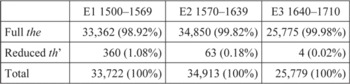
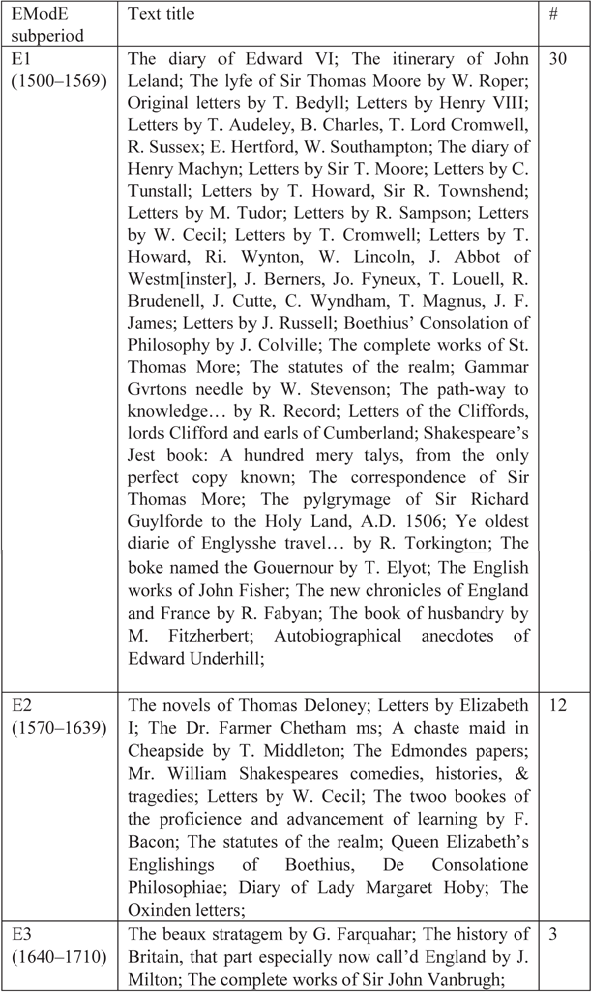
Reduced th’ cliticizing onto vowel-initial hosts persists throughout EModE. The design of PPCEME, which divides EModE into three subperiods, namely, E1 (1500–1569), E2 (1570–1639), and E3 (1640–1710), allows one to detect the dwindling frequency of the reduced form of the definite article. In table 1, the occurrences of reduced th’ in each subperiod are compared with those of the full form of the definite article. The former are in steep decline as they drop from over 1% of the overall number of the instances of the definite article in E1 to only 0.02% of the overall number in E3. Arguably, the gradual decline of reduced th’ in EModE is also reflected in appendix 2, which enumerates the PPCEME works where reduced th’ surfaces. With each subsequent subperiod of EModE the number of such titles progressively drops even though the number of words each subperiod contains is more or less constant and falls within a range between 540,000 and 630,000 words.
Distribution of full the and reduced th’ in the subperiods of EModE.

This section has demonstrated that the reduced form of the definite article is present throughout the ME and EModE periods. For lack of space, I do not address the question of why reduced th’ eventually falls out of use in standard English. A thorough investigation of this question remains to be undertaken. I now proceed to the next section, where I discuss a functional split between reduced th’ and full the, which is visible in the data from the three texts mentioned in section 2.2.
4. Reduced th’ in Selected Works of the 15th and 16th Centuries
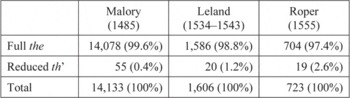
This section focuses on both forms of the definite article, full and reduced, as used in Caxton's Malory, Leland's The Itinerary, and Roper's The Lyfe of Sir Thomas Moore. Caxton's Malory is discussed in sections 4.1 and 4.2, while an analysis of the two EModE texts is presented in section 4.3. I argue that the reduced form th’ begins to acquire a function different from that of the full form the at the time. The data in table 2 show the number of reduced th’ instances against those of full the in each of the works examined.
Distribution of full the and reduced th’ in the selected works.

The percentage of the reduced form in the overall use of the definite article clearly increases from the end of the ME period to the mid-16th century. The value reached by reduced th’ in Roper, that is, 2.6% of all the instances of the definite article, exceeds the 1.08% mean average value for that period, as can be seen in table 1. Given this and the data in table 1, it is clear that reduced th’ is most richly represented in the corpora during the first seven decades of the 16th century.
4.1 The Pragmatics of the Reduced th’-Nominals in Malory's Works
In this section, I define and compare the pragmatic functions of the full form the with those of the reduced form th’ of the definite article in Caxton's English. I report my findings based on Caxton's edition of Malory's Le Morte D'Arthur. As is well known, the earliest version of Malory's works is available through the so-called Winchester Manuscript (Winchester College MS. 13) and Caxton's edition from 1485. Neither of them is a direct translation of the French original. However, as pointed out by Needham (Reference Needham, Caxton and Malory1976:1), who formulates this conclusion following Vinaver (Reference Vinaver1947/1967), both are loosely based on an unknown ME manuscript. The two surviving versions are far from identical, given that Caxton edited the manuscript text and added a preface and the table of contents. He also introduced his own book and chapter division (see Needham Reference Needham, Caxton and Malory1976:1). What is relevant to this study is that while the Winchester Manuscript contains no instances of th’, Caxton's edition offers as many as 45 such instances in the main text, including Caxton's preface but excluding the table of contents. Admittedly, as many as 10 instances surface in the table of contents, hence the number 55 in Malory's column in table 2. Yet they are all disregarded in the following discussion, as it is far from clear whether they could be taken as antecedents and how to interpret their definiteness. Similar problems have been brought up with reference to definite nominals in headlines, titles, etc. by Prince (Reference Prince and Cole1981:244) and Fraurud (Reference Fraurud1990:404).
As both the and its reduced variant serve to introduce definite nominals, it is informative at this point to highlight the pragmatic functions of the 45 nominals introduced by th’. Then I juxtapose them with those of a randomly selected sample of nominals preceded by the full article. I primarily follow Lyons's (Reference Lyons1999:3ff.) and Rupp & Page-Verhoeff's (Reference Rupp and Page-Verhoeff2005:334ff.) typologies of the uses of definite nominals, as they account for the data from Malory. Both typologies explore the means of marking a referent as identifiable, familiar, and/or unique. Thus, they invoke the notion of definiteness understood as divisible into a number of components, for example, identifiability, familiarity, or uniqueness (Lyons Reference Lyons1999:2ff.). Admittedly, the latter typology, which is based on Quirk et al. Reference Quirk, Greenbaum, Leech and Svartvik1985:266–271, distinguishes a greater variety of the uses of definite nominals, as it is designed to handle spoken Present-day English data. The distribution of many of Rupp & Page-Verhoeff's (Reference Rupp and Page-Verhoeff2005) categories in their data is very different from the one found in my historical data. For example, the deictic situational use of the th’-nominals is nonexistent in Caxton's Malory because Rupp & Page-Verhoeff (Reference Rupp and Page-Verhoeff2005) work from recorded conversations. In contrast, I have at my disposal ME prose, where a definite reference is not reinforced by visual cues present in the physical context.
The 45 nominals preceded by th’ can be assigned to four groups. First of all, there are definite nominals used anaphorically, with their antecedent appearing earlier in the text (group 1). In example 5a, the antecedent of the phrase in bold is the Archebisshop ‘the archbishop’ in the previous clause. In 5b, themperour ‘the emperor’ refers back to themperour of Rome ‘the emperor of Rome’. It is interesting to note at this point that the antecedent itself takes a reduced article in 5b. However, the nominal is not anaphoric, its definiteness being derived from the modification by the PP of Rome. Similar cases are discussed below in connection with 7a,b.
(5)
A definite nominal can also be used with an associative anaphoric reference. This means that the definite nominal and its antecedent are not identical but are instead conceptually related (group 2). By way of illustration, in 6a the specificity of thempyre ‘the empire’ follows from the picture invoked by the hyghe & myghty Emperour Lucyus ‘the high and mighty Emperor Lucius’, who is known to wield power over the Roman empire. In 6b, the definiteness of thende ‘the end’ stems from the information that the book has an ending, provided by the first clause of the example.Footnote 5
(6)
Furthermore, group 3 comprises those nominals whose definiteness hinges on the immediate presence of some language material—a phrase or a clause—that makes the nominal specific or familiar. In 7a, the PP of preesthod of the bysshop ‘of priesthood of the bishop’ describes the robe that Sir Lancelot took on. In 7b, it is the relative clause that helps identify thold wounde ‘the old wound’. The definite nominal themperour ‘the emperor’ appears in apposition to the name of the emperor in 7c and is thereby made definite. Examples such as 7a and 7b are labeled as cataphoric in the literature, as the familiarizing phrase or clause follows the definite nominal. Since the appositive and cataphoric instances in my corpus are essentially alike in that the definite nominal is positioned next to its defining material, I lump all of them together. Nothing, however, hinges upon this grouping.
(7)
Lastly, there are examples where the definite reference follows from the conventional knowledge of unique items shared by the users of English at the time, as in 8 (group 4).
(8)
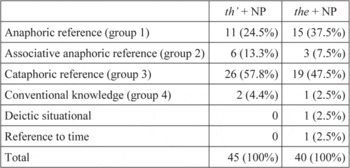
Having pragmatically categorized the nominals introduced by the reduced definite article, I randomly selected 40 nominals preceded by the full form the with a proviso that each nominal contains a noun or an adjective that also appears with the reduced form. It turns out that in terms of pragmatics, the two types of definite nominals have a very similar use and distribution. Table 3 shows the distribution of each type of nominal across the four categories mentioned, that is, group 1 through group 4. Two other categories, deictic situational and reference to time, are added as marginally relevant to the full the nominals.
Distribution of the functions of the definite nominals in Caxton's Malory.

The data in table 3 reveal similarities in the use of the full and reduced forms of the definite article rather than differences. This implies that differences are to be sought elsewhere.
4.2 Disconnect Between th’ and the in Caxton's Malory
In this section, I argue that the difference between the two forms of the definite article lies in the accessibility of the referent. Ariel (Reference Ariel1990:34) refers to definite nominals as definite descriptions and classifies them as low accessibility markers. This means that they are used when the speaker/writer decides that it may be difficult for the addressee to retrieve the antecedent. A number of factors contribute toward making the accessibility of the antecedent difficult, and I show how three of them, namely, distance, salience, and competition, help differentiate between the and th’ in Caxton's Malory.
As for distance, Ariel (Reference Ariel1990:34ff.) shows that definite descriptions tend to stay further away from their discourse antecedents than, for example, pronouns, which are high accessibility markers. She carries out an analysis of written Present-day English data, reaching the conclusion that a definite nominal usually refers back to an antecedent located higher up in the same paragraph or even in the previous paragraphs. Quite independently of Ariel (Reference Ariel1990) and without mentioning her research, Rupp & Page-Verhoeff (Reference Rupp and Page-Verhoeff2005:338-339) compare the nominals with the full definite article and the nominals with various reduced forms of the definite article (which they refer to as instances of DAR) with respect to the distance from their antecedents. As noted earlier in this section, Rupp & Page-Verhoeff's (Reference Rupp and Page-Verhoeff2005) data come from recorded conversations with speakers of the dialects spoken east of Lancaster in northern England. A major conclusion drawn from that research is that those speakers tend to resort to DAR if the distance between the nominal and its antecedent is relatively short. Inversely, a reference to a more distant antecedent calls for a full article nominal.
Given that I have definite descriptions/definite nominals in my ME data introduced by the two different forms of the definite article, I set out to compare the distance between the nominal with the full form the and its antecedent on the one hand, and the distance between the nominal with reduced th’ and its antecedent, on the other. Before the results can be discussed, a technical remark is in order. In calculating distance, Ariel (Reference Ariel1990:18) uses sentences and paragraphs as units. Using sentences and paragraphs as units does not prove feasible in analyzing my data, however, because Caxton's punctuation does not distinguish sentences or paragraphs. Instead, I chose to count the clauses, both finite and non-finite, that intervene between the antecedent and the nominal referring to it. Adopting a clause as a unit of distance between a definite nominal and its antecedent has an added advantage: A clause is also a salient unit of discourse because it frequently contains a topic, that is, given or presupposed information (see Strawson Reference Strawson1964, Fraurud Reference Fraurud1990). Topics are often definite nominals as well, as observed by, for example, Lyons (Reference Lyons1999:232). Later in this section I advocate for some relatedness between the reduced th’-nominals in Caxton and discourse topics.
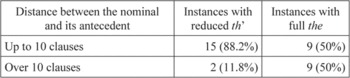
From my two sets of Caxton's data—definite nominals with reduced versus full articles—I singled out nominals with antecedents, both direct and associative, that is, the instances from groups 1 and 2 in table 3 taken together. Altogether there were 17 and 18 instances of reduced th’ and full the, respectively. It turned out that i) the average distance between a nominal with reduced th’ and its antecedent is 4.8 clauses, and ii) the average distance between a nominal with the full form of the definite article and its antecedent is 26.7 clauses.
This difference can be seen more clearly if one considers the fact, which is visible in table 4, that 15 out of 17 instances of the nominals with reduced th’ have their antecedent no further than 10 clauses back.Footnote 6 In only two instances is this distance exceeded. In contrast, the full article nominals are evenly distributed with one half of the instances anaphoric to antecedents located relatively close, that is, up to 10 clauses back, and the other half having antecedents appearing much earlier in the previous discourse.
Number of clauses intervening between a definite nominal and its antecedent.

Another factor differentiating between th’ and the in the data is salience, understood as prominence of an antecedent due to its status as a discourse topic (see Ariel Reference Ariel1990:22–23). It is crucial that a nominal with reduced th’ never has an indefinite antecedent in Caxton's Malory. In other words, the situation in example 9 is not observed with the reduced form of the definite article. In 9, the definite nominal the aduenture ‘the story’ refers back to the indefinite nominal somme straunge aduentures ‘some different stories’, and it is the full form the that introduces the definite nominal. A definite nominal with th’, if anaphoric, derives its reference from a definite nominal or a pronoun. This suggests that the reduced form th’ is inclined to appear with discourse topics. This association of reduced th’ with discourse topicality accounts for the use of th’ in examples 5a and 5b. In these examples, tharchebisshop ‘the archbishop’ and themperour ‘the emperor’ refer back to recurrent characters in the story that appear earlier as definite antecedents, that is, the Archebisshop ‘the archbishop’ and themperour of Rome ‘the emperor of Rome’, respectively.
(9)
Another piece of evidence pointing to a difference in the use of the full form the and the reduced form th’ is the fact that the full form is used in the presence of competing antecedents. In example 10, the abbay ‘the abbey’ does not refer to an abbay of Monkes ‘an abbey of monks’ but to the Abbey of Nonnes, which is where king Arthur's court was located at the time. This is clarified earlier in the text. Arguably, the full form precedes abbay ‘abbey’ because an Abbay of Monkes ‘an abbey of monks’ is a potential, although not actual, antecedent.
(10)
‘Sir Gawayne said, “He who banishes my cousin Germayne shall banish me,” so they departed and rode into a great forest and came to an abbey of monks and were taken good care of there. But when the king realized that Sir Gawayne had departed, there was great sorrow. Gaherys, Gawayne's brother, said, “We have lost two good knights because one loved the other.” So in the morning they heard their masses in the abbey and rode forth until they came to a great forest where Sir Gawayne was.’
1485(a1470) Malory Wks. (Caxton: Vinaver) 4/16 (CMEPV)
The data presented so far in this section have demonstrated some divergence in the functions of the reduced and full forms of the definite article in terms of distance, salience, and competing antecedents. The antecedent of the reduced form is easier to retrieve than that of the full form, as it is closer to the definite nominal, and it tends to be a discourse topic. Moreover, reduced th’ does not appear if there are competing antecedents in the preceding discourse. In section 4.3, the aim is to seek a similar divergence, or lack thereof, in two works composed in the 16th century.
4.3 Reduced th’ in Leland and Roper
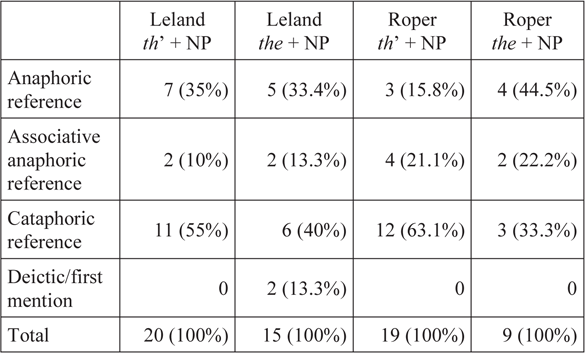
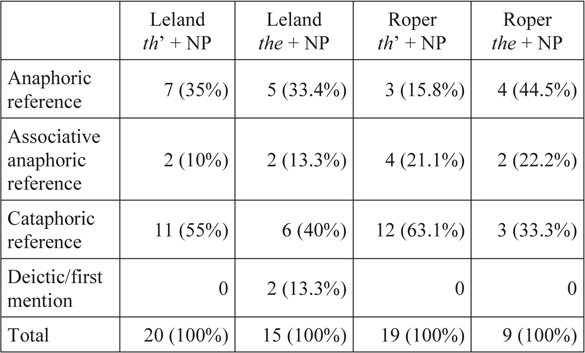
Unlike Caxton's Malory, both texts examined in this section are representative of original English prose. Composed during his journeys across England and Wales between 1535 and 1543, The Itinerary of John Leland comprises a record of the journeys, classified by PPCEME as a travelogue. The other text is an example of biographical prose in the form of The Lyfe of Sir Thomas Moore by William Roper, composed around 1555. The reduced form of the definite article surfaces 20 times in Leland and 19 times in Roper. In the first and third columns in table 5, those instances are broken down into groups based on their pragmatic functions. The reduced th’-nominals in those instances are confined to anaphoric and cataphoric functions.
In order to compare the reduced and full forms of the definite article in Leland and Roper, I also selected from those works nominals preceded by the full definite article the. Only those nominals preceded by the full form the whose head noun was the same as the one in th’-nominals were selected. As shown in the second and fourth columns in table 5, with respect to their pragmatic function, the nominals with the full form the fall into three groups, that is, anaphoric reference (including associative anaphoric reference), cataphoric reference, and first mention. These nominals are further contrasted with the th’-nominals used anaphorically in order to establish whether the differences between the and th’ observed in Caxton's Malory also hold in Leland and Roper.
Distribution of pragmatic functions of definite nominals in Leland and Roper.
The distance between a definite nominal and its antecedent, a major factor helping highlight the divide between the and th’ in Caxton's Malory, plays a similar differentiating role in Leland but less so in Roper. In Leland, the average distance between a nominal with reduced th’ and its antecedent is 3.2 clauses, while the average distance between a nominal with the full form of the definite article and its antecedent is 5.9 clauses. At the same time, in Roper, the average distance between a nominal with reduced th’ and its antecedent is 7.1 clauses, while the average distance between a nominal with the full form of the definite article and its antecedent is 4.5 clauses.
The fact that the Roper data exhibit an opposite tendency to what is attested in Leland and Caxton's Malory is unexpected. However, it can be accommodated if one takes into account relative inconsistency in the use of the two forms of the definite article throughout the data. This could be indicative of only the beginning of a drift of th’ away from the full form the. How significant a role distance really plays in this shift can be assessed after more data from a larger corpus is collected in the future.
At the same time, the argument concerning the association of the th’-nominals with salient antecedents can be upheld based on Leland and Roper. None of the 16 anaphoric reduced th’-nominals (nine in Leland and seven in Roper) has an indefinite nominal as its antecedent, which, much as in Caxton, indicates that the use of a reduced th’-nominal correlates with salient and already familiar referents, that is, discourse topics. In Leland, this correlation is exceptionally high. The anaphoric reduced th’-nominals appear only in two passages, one devoted to the town and abbey of Reading and the other to the town and abbey of Abbingdon. The choice of the head noun of such an NP is limited to abbay ‘abbey’ and abbate ‘abbot’.
Example 11 illustrates how Leland makes sure that a reduced th’-nominal refers to and marks a discourse topic. The definite nominal the late monasterie ‘the late monastery’ introduces a new referent, which is then referred to again by the regular definite nominal the abbay ‘the abbey’, whereby the reference becomes salient, only to be finally taken over by the reduced th’-nominal thabbay ‘the abbey’. Arguably, th’ enters the picture once the referent has been established as a discourse topic.
(11)
Roper's examples, it must be noted, are equally consistent with respect to discourse topics.
Likewise, competing antecedents disfavor the use of the reduced form th’, which is illustrated in example 12. It comes from a story of the abbey of Lincoln recalled by Leland during one of his journeys. The nominal the abbate ‘the abbot’ contains a full form of the article presumably because two clauses earlier there appears a potential antecedent the late abbate ‘the late abbot’. The actual antecedent of the former nominal is the indefinite nominal an abbay ‘an abbey’ introduced 13 clauses earlier.
(12)
This section has argued that the split of the English definite article into the full form the and the reduced form th’, attested from the beginning of the ME period, is also a functional split toward the end of the 15th century and in the 16th century. The reduced form turns out to be a less potent variant of the full form that typically refers to discourse topics and easily retrievable antecedents. Whether an easily retrievable antecedent also means positioned closer to the definite nominal remains yet to be confirmed. Although the evidence from Caxton's Malory and Leland suggests that it does, the evidence from Roper suggests otherwise. Still, the different functions of the reduced form th’ show that the development of this form bears upon the DP cycle in English.
5. Full the and Reduced th’ as Part of the DP Cycle
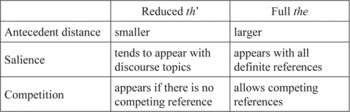
As shown in the previous section, from the end of the 15th century on, there is a division of labor in English between the full form of the definite article the and its reduced form th’ when it comes to anaphoric use.Footnote 7 This is not to imply, however, that reduced th’ fulfills a set of functions unavailable to full the. Rather, reduced th’ has a strong leaning toward only some of the functions of the, and the functions of th’ form a subset of the functions of the. The different functional preferences for both forms of the definite article at the time are summarized in table 6.
Summary of the different functions of the reduced and full forms of the definite article.

The and th’ are in an obvious way related in that reduced th’ is a development of the full form the. This relates to the work on the DP cycle by Lyons (Reference Lyons1999) and van Gelderen (Reference Gelderen2007, Reference Gelderen2011). The DP cycle is an example of a linguistic cycle, a notion familiar from grammatical-ization studies, both functionalist (for example, Givón Reference Givón1979:209, 232; Heine & Reh Reference Heine and Reh1984:68ff.) and generative (van Gelderen Reference Gelderen2008, Reference Gelderen2009a, Reference Gelderen2011). A cycle is taken to apply to language change, whereby lexical material becomes grammatical and ultimately turns to zero via erosion. A number of cycles have been discussed in the literature (see van Gelderen Reference Gelderen2009c for an overview), the most well-known being probably the negative cycle, also known as the jespersen cycle (see, for example, Hoeksma Reference Hoeksma2009, van der Auwera Reference Auwera2009).
An example of the negative cycle in the history of English, following van Gelderen Reference Gelderen2008:198, is the ME negative particle ne ‘not’ rendered more prominent due to co-occurrence with an indefinite phrase such as na thing ‘no thing’. Later, the phrase becomes part of the negation resulting in double negation ne … nought/not ‘not … not’. At the same time, the phrase loses its phrasal characteristics, including its meaning, turning into another negative marker. At the next stage, the negative particle ne ‘not’ falls out of use, leaving not/n't as the sole exponent of negation. The development na thing > nought» not < n’t instantiates erosion. The cycle can be repeated via renewal, for example, with another indefinite phrase recruited to reinforce the existing negative particle. In structural terms, the negative cycle is taken to operate through NegP, a functional phrase acknowledged since Pollock Reference Pollock1989 and Ouhalla Reference Ouhalla1990. The stages of the negative cycle are shown in the structures in 13, based on figure 1 in van Gelderen Reference Gelderen2008:198. In 13a, ne as the only negative marker heads NegP. The structure in 13b shows the indefinite phrase na thing reanalyzed as the specifier of NegP. With the former negative head ne gone in 13c, not undergoes reanalysis as the head of NegP. Note that I leave out a discussion of a motivation for the stages and reanalysis as it is outside the scope of this study. For details, see van Gelderen Reference Gelderen2008.
(13)
As for the DP cycle, the definite article is often known to originate as a demonstrative, which constitutes the first shift in the cycle. At the next stage of the cycle, the definite article, after being earlier reduced to a clitic, can proceed to become an affix marking case agreement or noun class assignment. The stages in the cycle as depicted by van Gelderen (Reference Gelderen2011:201) follow in 14.
(14)
Loss of interpretable deictic features turns a demonstrative into a definite article, which is why the latter is not expected to be used deictically. A definite article only has uninterpretable phi-features (person, number), indicated as u-F in 14c. The uninterpretable features of the definite article “add nothing independent to the meaning of the sentence” (Chomsky Reference Chomsky2000:14), but they have to be checked by the corresponding interpretable features found on the noun in NP. When the definite article no longer has uninterpretable features, it is reduced to a case/non-generic marker.
It has been a standard assumption since Abney Reference Abney1987 that the definite article heads its own functional projection, DP, which is structurally higher than NP. The designation of the definite article as head in 14b is consistent with this assumption. Accordingly, it would seem that there is no obstacle to assuming that reduced th’ routinely heads its own DP as well. In this scenario, the structure of themperour in 5b above would be the one shown in 15, where the noun joins the article in D via N-to-D movement.
(15)
There are, however, examples in the corpus—albeit very rare—that undermine this account. For example, reduced th’ is actually preceded by full the in 16a,b and by the demonstrative in 16c. The earliest instances come from The Three Kings’ Sons, a text written circa 1500.Footnote 8
(16)
The fact that the full form of the article shows up alongside reduced th’ in 16a,b, thus reinforcing the definite interpretation, points to some impoverishment of the definiteness marking function of reduced th’. It is the insights from Caxton, Leland, and Roper that shed light on how a definite article can become less and less capable of fulfilling its role. The full form of the definite article marks definiteness as expected, while the reduced form th’ does so in limited contexts only, as shown in the previous section. The ability of th’ to signal definiteness weakens as the number of functions that th’ fulfills is reduced (a preference for discourse topic antecedents, reference to easily retrievable antecedents, perhaps also to antecedents located relatively close in the preceding discourse). This results in a loss of the uninterpretable features of th’ and paves the way for its further development into a nominal marker. It can be concluded that reduced th’ is more grammaticalized than full the in that it represents a further stage in the DP cycle.
The remaining question is how to account for the sequence of the and th’. The fact that full the and reduced th’ co-occur in 16a,b suggests the presence of an additional functional layer. In fact, there is evidence for two functional layers, one headed by the and the other by th’. Given that grammaticalization typically proceeds upward (Roberts & Roussou Reference Roberts and Roussou2003, van Gelderen Reference Gelderen2004, van Gelderen & Lohndal Reference Gelderen2008), reduced th’ could be expected to be reanalyzed in a projection higher than full the. One option is to argue that both the and reduced th’ when it is not accompanied by the, head the nP layer, a functional projection below DP and above NP. Following van Gelderen Reference Gelderen2007:294, the head of this projection, n, makes sure that the head of NP is a noun. In van Gelderen & Lohndal's (Reference Gelderen2008:6) view, the two layers differ in that nP carries specificity, while DP carries definiteness. If this reasoning is correct, then themperour in 5b would have the structure in 17. A structure with full the would not be any different. The fact that an attributive adjective, if present, always follows the definite article suggests a movement of the article to D, as an adjective comes between DP and nP (Julien Reference Julien2005).
(17)
If present, a demonstrative with its interpretable features surfaces in the specifier position of DP, having moved there from a lower position.
The structure in 17 opens up the possibility for reduced th’ to be reanalyzed in a higher functional projection once its definiteness-marking capability weakens. The reanalysis takes place in accordance with van Gelderen's (Reference Gelderen2004) Late Merge Principle, an economy principle whereby, among other things, speakers tend to reinterpret a functional head as a higher functional head. Reanalyzed th’ heads DP or perhaps a different functional projection, which is shown in 18. Full the then undergoes a movement adjoining th’ in D, and so does the noun.
(18)
As for the presence of the demonstrative that as SpecD in 16c, it precludes accommodation of th’ as a definite article. The literature on early English does not report any cases of a demonstrative-definite article sequence, and such a sequence is impossible nowadays, as pointed out by van Gelderen (Reference Gelderen2011:199). This co-occurrence with the demonstrative pushes reduced th’ further toward a nominal marker status. The demonstrative in 16c also provides evidence against an account of the structures in 16 in terms of double determination à la Dahl Reference Dahl and Kortmann2003 or Schoorlemmer Reference Schoorlemmer2012. Double determination, as attested in Swedish, Norwegian, and Faroese, means that a definite article emerges twice in the same DP, most typically if an attributive adjective modifies the noun:
(19)
Schoorlemmer (Reference Schoorlemmer2012) proposes that DP is merged low, that is, between AP and NP, in order to be probed by the adjective for inflection. Only then does it reproject, that is, it sends its copy to a position above AP to assure that the adjective remains in the domain of the definite article. The resulting structure is shown in 20 (Schoorlemmer Reference Schoorlemmer2012:117).
(20)
Another reason why the double determination account fails to capture 16 is that the corpora contain no instances of such structures with an attributive adjective, hence the motivation behind the higher DP layer disappears. In my treatment, the aim of which is to account for the sequence of full the, or a demonstrative, and reduced th’, I propose nP. The definite article, in its full form and its reduced form initially as well, is the head n of nP, but it moves up to D if there is an attributive adjective. At the beginning of the 16th century, reduced th’ moves higher up the tree due to grammaticalization and is now base-generated in D as a nominal marker. An argument for such a status of th’ comes from the possibility of its co-occurrence with a demonstrative, as in 16c.
The co-occurrence of the definite article the or a demonstrative with the nominal marker th’ in 16 also indicates that the and demonstratives regained their definiteness-signaling function after th’ was no longer capable of performing it. Such regaining of a function, or renewal, frequently attested at the end of a linguistic cycle (see van Gelderen Reference Gelderen2011:214; for renewal in grammaticalization see, for example, Hopper & Traugott Reference Hopper and Traugott2003:122ff.), enables the cycle to run its course again with the vacated functional slots filled by different items.
6. Conclusion
In this paper, I presented data showing that the full form the of the definite article and the reduced form th’ are not merely different forms of the same determiner that emerged in the 16th century, at the close of the ME period. They also have somewhat different functions. By contrasting the anaphoric uses of both forms in the language of Caxton's, Leland's, and Roper's prose, it turns out that the th’-nominals can be linked to discourse topic referents; they do not appear if there are competing antecedents in the previous discourse. At this point, the evidence is not conclusive as to whether the antecedent of a DP with reduced th’ has higher accessibility than that of a DP with full the, an issue that requires attention in future research. With the difference between the and th’ described, I have argued that English at the time was more likely to have had two definite articles with different functions rather than one. The DP cycle accommodates the development of the reduced form th’ in that the function of th’ can be seen as stemming from the weakening of the function of the. As a result, reduced th’ becomes less suitable as the head of nP, where it is initially base-generated, and is reanalyzed as D. An argument was presented that th’ is reanalyzed as the head of DP, at which point it becomes a nominal marker losing its definite article status. At the same time, renewal of the DP cycle is achieved through the determiner the merging as n in nP or a demonstrative in SpecD preceding the nominal marker th’ in DP.
Appendix 1. A List of CMEPV Texts Containing th’-Nominal

Appendix 2. A List of PPCEME Texts Containing th’-Nominal
Appendix 3. List of Hosts of Reduced th’
Caxton's Malory
th'abbey
th'abyte
th'achyeuement
th'achyeuyng
th'aduenture
th'aduyse
th'affray
th'appoyntement
th'archebysshop
th'effecte
th'embassatour
th'emperour
th'empyre
th'ende
th'ermytage
th'excellent
th'exposycion
th'old
th'oppynyon
th'oryent
th'ystory
Leland
th'abbat
th'abbay
th'abbite
th'antiquite
th'archbisshop
th'este
th'office
Roper
th'adventure
th'advise
th'affaire
th'aforesaid
th'ands
th'emperour
th'entent
th'example
th'executioner
th'only
th'order