To every period of life has been given its opportunity, so that children's vulnerability, the boldness of the youth, the seriousness of the older people and the wisdom of the elderly have each their own natural characteristic which has to be appreciated in its own time.
— Marcus Tullius Cicero (Powell, Reference Powell1988)
Across the globe, population is aging at an unprecedented rate. The total number of people aged ≥90 years in the world increased from 7.8 million in 2000 to 16.5 million in 2015, and will rise to 88.4 million by 2050 (United States Census Bureau). The number of centenarians in the world will increase from 180,000 in 2000 to 3.2 million by 2050 (United Nations, 2002). A number of studies have examined why and how near centenarians and centenarians live to such an advanced age (Poon et al., Reference Poon1992; Andersen-Ranberg et al., Reference Andersen-Ranberg, Christensen, Jeune, Skytthe, Vasegaard and Vaupel1999; Perls et al., Reference Perls, Bochen, Freeman, Alpert and Silver1999; Andersen-Ranberg et al., Reference Andersen-Ranberg, Schroll and Jeune2001; Perls and Terry, Reference Perls and Terry2003; Willcox et al., Reference Willcox, Willcox, Hsueh and Suzuki2006; Poon et al., Reference Poon2007; Engberg et al., Reference Engberg, Christensen, Andersen-Ranberg, Vaupel and Jeune2008; Zeng et al., Reference Zeng, Poston, Vlosky and Gu2008).
A vast majority of the published studies on the oldest old are quantitative, aimed at testing specific hypotheses, especially regarding biological underpinnings of extreme longevity. However, qualitative research is also needed to allow these exceptionally old adults to communicate their experiences, personal views, and life strategies through their narratives. Qualitative studies enable individualized data collection, capturing the complex interactions between participants and their social environment. Participatory action research involved in qualitative interviews allows one to engage with the research participants in a meaningful and reciprocal way (Hutnik et al., Reference Hutnik, Smith and Koch2016). The small number of published qualitative studies in the oldest-old adults, primarily conducted in urban and suburban settings, have reported on stress-coping strategies, adaptiveness to losses and life changes, positive attitudes, and relationships with others (Pascucci and Loving, Reference Pascucci and Loving1997; Archer et al., Reference Archer, Brathwaite and Fraser2005; Darviri et al., Reference Darviri2009; Wong et al., Reference Wong2014; Hutnik et al., Reference Hutnik, Smith and Koch2016).
This study provides a comprehensive understanding of the positive traits among nonagenarians and centenarians (N&Cs) from the Cilento region of Italy, the center of the “Birthplace of the Mediterranean Diet” (Keys and Keys, Reference Keys and Keys1959). To our knowledge, this is the first study of N&Cs using mixed quantitative and qualitative methods in both the seniors and their young-old family members (Y-Os). It is also the first qualitative study of such individuals from Italy, and one of only three investigations of rural N&Cs, the others being those in the rural US mid-west, by Pascucci and Loving (Reference Pascucci and Loving1997) and Hinck (Reference Hinck2004), which included four centenarians and thirteen individuals aged 85–98 years, respectively.
The hypotheses for the quantitative study, based on other investigators’ (Darviri et al., Reference Darviri2009; Poon et al., Reference Poon2010; Jeste and Oswald, Reference Jeste and Oswald2014; Lavretsky, Reference Lavretsky2014; Hutnik et al., Reference Hutnik, Smith and Koch2016) as well as our previous research in a community-based sample from San Diego, California (Jeste et al., Reference Jeste2013; Martin et al., Reference Martin, Distelberg, Palmer and Jeste2015; Thomas et al., Reference Thomas2016) were (1) the N&Cs would score higher on mental well-being and lower on physical well-being compared to Y-Os; (2) and the mental well-being scores would correlate positively with scores on resilience and optimism, and inversely with severity of subjectively perceived stress, anxiety, and depression in both the groups. The semi-structured qualitative interviews of the N&Cs and Y-Os were designed to generate themes related to exceptional longevity.
Methods
Participants
Study participants included 29 individuals (19 women and 10 men) aged 90 to 101 years, who had been referred to this study by their general practitioners. We also interviewed these N&Cs’ 51 Y-O children or other family members, usually two per family (28 women and 23 men), aged 51 to 75 years. The N&Cs’ ages were validated by the inspection of the respondents’ identification cards by the general practitioners and interviewers.
The study was conducted in Cilento, an area of about 1,721 square km and a population of about 222,500 inhabitants in the Southern part of Italy. To visit and interview the older adults and their families, the interviewers traveled from villages situated on the coast to those in rural parts of Cilento. Sometimes it took up more than an hour to drive from one village to another. The nine villages were Acciaroli, Casal Velino, Futani, Vallo della Lucania, Montano Antilia, San Mauro La Bruca, Gioi, Stella Cilento, and Sessa Cilento. The older adults interviewed live in single-floor houses, and frequently have visitors. Generally, they live with a Y-O family member (usually a son or a daughter). The Y-Os interviewed showed a great sense of duty and respect toward their older relative.
Quantitative measures
We used Italian versions of standardized published measures, which were brief, easy to administer, and not distressing to the participants. Physical and mental health were measured with the Medical Outcome Study (MOS) SF-12 (Short Form - 12) (Ware et al., Reference Ware, Kosinski and Keller1996). Other measures of positive attributes included ten-item Connor Davidson Resilience Scale (Connor and Davidson, Reference Connor and Davidson2003; Campbell-Sills and Stein, Reference Campbell-Sills and Stein2007) and five-item Life Orientation Test – Revised for optimism (Herzberg et al., Reference Herzberg, Glaesmer and Hoyer2006). Negative outcomes (perceived stress, anxiety, and depression) were measured with Perceived Stress Scale (Cohen et al., Reference Cohen, Kamarck and Mermelstein1983), the Brief Symptom Inventory (Boulet and Boss, Reference Boulet and Boss1991; Derogatis, Reference Derogatis1993), and nine-item Patient Health Questionnaire (PHQ-9) (Kroenke et al., Reference Kroenke, Spitzer and Williams2001), respectively.
Qualitative interviews
A semi-structured interview was conducted in Italian over one hour by an experienced psychologist (Scelzo) who spoke the specific dialect of the Cilento region and had previous experience in interviewing very old people. She sought to gather information concerning these N&Os’ life histories in terms of traditions, culture, values, trauma, grief, losses, immigration, and personality. Most of the N&Cs were interviewed in the presence of their Y-Os so that information could be shared, especially when the N&Cs could not hear or speak properly. Most participants showed a great interest in the study.
The Italian qualitative interviews were translated into English by Scelzo. In the first stage (open coding), three authors (Scelzo, Montross, Jeste) read all the interviews and coded repeated themes. These authors also highlighted parts of the interview that seemed to be of importance for these N&Cs’ lives. Then, the three authors jointly listed all the emerging themes and their interpretation. Inter-rater reliability for identifying the themes exceeded 90%. The Y-Os’ interviews were coded in a similar fashion, with the focus being on their older relatives’ (i.e. N&Cs’) personality.
Statistical analysis
We used the generalized estimating equations to compare the two age groups by taking into account correlated outcomes among the index subject and associated family members. Spearman's correlations were employed for examining associations.
Results
Quantitative study
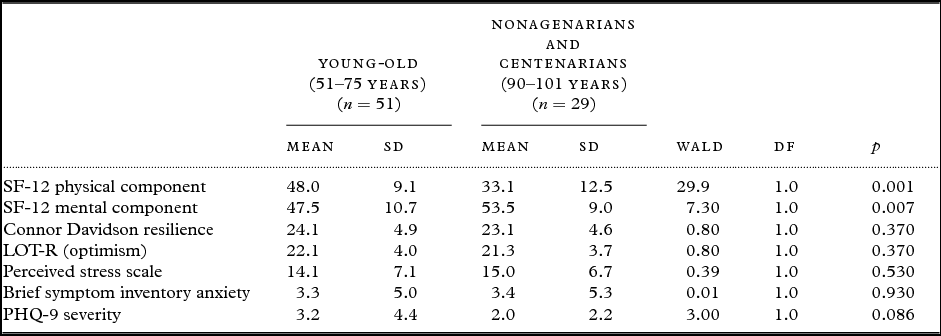
There were no significant gender differences (data not shown) on any measure among N&Cs. Compared to Y-Os, the N&Cs had significantly higher scores on SF-12 mental well-being component, despite having worse scores on physical well-being component. There were no significant group differences in the scores on resilience, optimism, perceived stress, anxiety, or depression (Table 1).
Comparison of positive traits in young-old (n = 51) versus nonagenarians and centenarians (n = 29)

Note:
SF-12 = Short Form – 12-item.
LOT-R = Life Orientation Test – Revised.
PHQ-9 = Patient Health Questionnaire – nine-item.
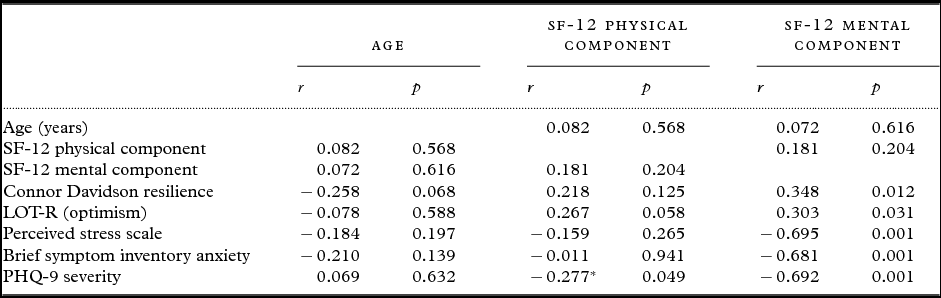
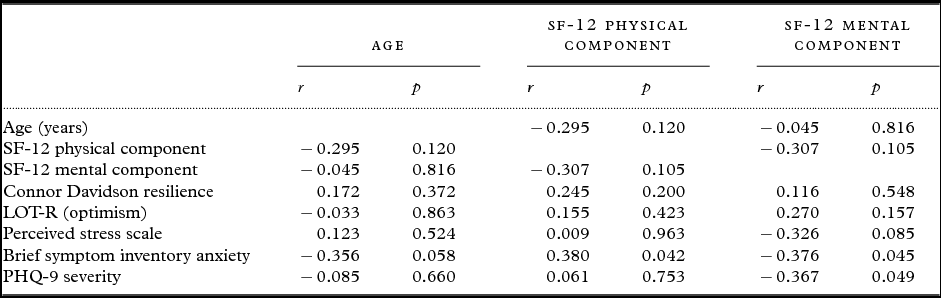
As hypothesized, the SF-12 mental component (well-being) scores in both groups correlated inversely with scores on anxiety and depression; however, only in the Y-Os, mental well-being scores correlated with resilience and optimism, and inversely with perceived stress scores (Tables 2A and 2B). Note that the sample size of Y-Os was larger (n = 51) than that of N&Cs (n = 29). There were very few significant correlations of age or SF-12 physical component score with positive traits or mental states in either group.
Spearman's correlations of positive traits in young-old (n = 51)

Spearman's correlations of positive traits in the nonagenarians and centenarians (n = 29)

Note:
SF-12 = Short Form – 12-item.
LOT-R = Life Orientation Test – Revised.
PHQ-9 = Patient Health Questionnaire – nine-item.
Qualitative interviews of nonagenarians and centenarians
Several themes emerged from the semi-structured interviews of the N&Cs, pertaining to positivity (resilience and optimism), working hard, bond with family and religion, and love of the land. Overall, the N&Cs showed a strong sense of self-efficacy and a belief in continuing to persevere regardless of setbacks. At the same time, there was a strong bond with their family, religion, and land among these villagers. The interviews with Y-Os provided external confirmation of the positive traits in their older relatives, and also emphasized the latter's tendency to exert control.
Individual themes are listed below along with representative corresponding quotes from the interviewees.
Positivity: resilience and optimism
The N&Cs recounted their recovery from losses, especially those of their loved ones, through a balance between acceptance and grit, along with optimism:
I lost my beloved wife only a month ago and I am very sad for this. We were married for 70 years. I was close to her during all her illness and I have felt very empty after her loss. But thanks to my sons I am now recovering and feeling much better. I have 4 children, 10 grandchildren, and 9 great-grandchildren. I have fought all my life and I am always ready for changes. I think changes bring life and give chances to grow.
I have had a heart condition for which I have undergone surgery but I am now okay. I have also had two very serious car accidents and I have risked losing my life. But I am still here!!
I am always thinking for the best. There is always a solution in life. This is what my father had taught me: to always face difficulties and hope for the best.
I am always active. I do not know what stress is. Life is what it is and must be faced. . . always! If I have to say, I feel younger now than when I was young!
The Y-Os expressed great appreciation for the N&Cs’ resilience and positivity:
She is very resilient: always finding a solution for every problem!
My mother is a very strong person, this is why she is well and is still alive despite the grief for my two sisters.
She was like a bersagliere (a member of the regiment of the Italian Army). She was very strong, optimistic, and positive. She loved people, she loved her family and she was always aiming to help the others.
We always come to our father. He still is our point of reference and an example for us, for the way he takes things. He is a very strong person. . . even after the loss of our mother, he appears to be strong. . .
She is always singing. She enjoys life! An example for me - for us all!
Working hard
Without exception, the N&Cs emphasized their ingrained work ethic:
Work was our life.
Work saved my life!! One day an Officer came to the barrack and asked ‘who can mend shoes?’ Me, I answered! And from there on I stayed into the barrack and mended shoes for everybody. I could have gone and fought and I am sure I would have died if it wasn't for my work!
The Y-Os echoed their respect for the N&Cs’ hard work:
I am always careful about my nanny because she is so active that if you do not pay attention, she does things she mustn't do like hanging linen!
She (my mother-in-law) was a point of reference for us all. She worked very hard, she was an angel!
Need for control
A surprisingly consistent finding was the description of the N&Cs by the next (younger) generation as controlling, domineering, and stubborn:
My mother is a very strong and stubborn person. She is an agreeable woman but she also tries to be dominant.
She is a very strong person and she always wants things to be done in her own way. My husband, her son, has to come and visit her every day. He is her reason for life. She must know everything about him, and has to be always in control. So, if I want to do something with my husband, like going away for a holiday, we cannot do it, because he doesn't want his mother to be upset by his absence. She is very dominant and has always found strength in others. He has always had this strong bond with his parents and still now looks after his mum's things rather than ours!
My father is not a sweet person. He was like a dictator, always worried about material things. He is definitely a selfish and dominant person!
Bond with family and religion
Both the N&Cs and Y-Os stressed the strong bond within the family and with their Catholic religion (God):
My family has always been very close.
I spent a lot of time knitting and sewing for my family.
I feel well and young. I am happy looking after my family.
We were a close family of 5 children. We loved each other a lot and helped each other.
I strongly believe in God and I have always been a Catholic.
My family has always been very close and we have always had so much faith in God!
I have never celebrated New Year's Eve away from my family!
What is life for me? Life to me is Acceptance! We have to accept whatever comes in our life because it is part of God's drawing.
She (the mother) is not well and my dad is really worried for her. They live in symbiosis.
She is obsessed by the order. She is a very religious person and she loves listening to recorded programs talking about that, especially now that she is not able to see very well.
She loved people, she loved her family and she was always aiming to help others.
She has always faced her life with a smile on her face, with her faith in God.
Love of the land
A noteworthy feature among these rural families was their deep and heartfelt affection for the land:
They are telling me not to go to the land anymore! The land is my life! They say I am ill but they don't know that I become ill if they do not allow me to work my land. . . I need to stay in touch with it. I cannot stay at home all the time. I feel I can die!
We all worked the land. I love the countryside and I mostly use products of our land: pulses, olive oil, wheat.
In my life I have done everything since I was 13 years old, carrying chops of wood on my head. I also used to pick olives. I have always worked the land.
She has always worked at home as a housewife and looked after her family. My father died 14 years ago at the age of 94. I know that my grandparents were 97 and 84 when they died. They all worked the land.
Land and hunting have always been what my father loved the most. He was never at home.
Discussion
Our quantitative results are similar to those from the Successful Aging Evaluation or SAGE Study at UC San Diego that included a community-based sample of over 1,500 San Diegans ages 21–100 years, in terms of the “paradox” in which older adults have better mental health than younger adults, despite declines in physical function (Jeste et al., Reference Jeste2013; Thomas et al., Reference Thomas2016). The results of the qualitative study support the published findings of positivity (resilience and optimism), hard work, and strong bond with family and God in the N&Cs.
However, two novel features of the present study were the N&Cs’ strong need for control, described by the family in terms such as “domineering,” along with a love for the land in this rural region. The Y-Os (children, caregivers, or other family members) sometimes complained about the stubbornness shown by the N&Cs when asked to stop their outdoor activities. The N&Cs’ desire for control may appear contrary to longevity research that indicates an association of longevity with a relaxed personality style and not focusing on things one cannot control. The Cilento N&Cs were still quite active and wanted to be in charge of their social life. Social engagement was stressed by both N&Cs and Y-Os for making them feel important, responsible, and connected.
Resilience was closely connected to N&Cs’ personal identity. Lavretsky (Reference Lavretsky2014) considers centenarians to be role models of resilience in that they have survived a century of major risks and threats, and successfully adapted to myriad daily stressors throughout their long life. Hill and Turiano (Reference Hill and Turiano2014) emphasize that exceptional longevity, which in a way reflects sustainability, requires a complex dynamic involving identity, tradition, and change, suggesting the importance of being resilient, optimistic, and having a purpose in life. There is growing literature suggesting that a sense of purpose in life is associated with subjectively as well as objectively measured health, functioning, and longevity (Kim et al., Reference Kim, Kawachi, Chen and Kubzansky2017). For the Cilento N&Cs, the love of land along with a strong attachment to family and religion accompanied by a focus on hard work seem to provide a sense of higher purpose and meaning to their life.
One study reported that the predictive efficacy of physical health and cognitive astuteness was overshadowed by the above-mentioned psychosocial factors (von Faber et al., Reference Von Faber2001). Another found that socialization strategies, stress-related life strategies, and adaptiveness were important elements of exceptional longevity and appeared to be effective in overcoming adversity such as bereavement and experiencing conflicts (Darviri et al., Reference Darviri2009). Hutnik and colleagues reported that centenarians had mastered the art of positive framing and developed psychological flexibility with regard to change (Hutnik et al., Reference Hutnik, Smith and Koch2016). Read and Carstensen have proposed a socio-emotional selectivity theory, according to which time horizons shrink with aging and people become increasingly selective, investing greater psychological resources in positive (emotionally meaningful) than in negative (stressful) activities and goals (Read and Carstensen, Reference Read and Carstensen2012).
N&Cs had higher scores on SF-12 mental well-being than Y-Os, but the two groups were similar in resilience, optimism, anxiety, depression, and perceived stress. The finding with SF-12 is similar to that from a number of other studies that have reported increased level of mental well-being with aging. In our SAGE study, we used the larger SF -36 scale, and obtained similar results, along with an aging-associated increase in the score on a scale for satisfaction with life. The observed lack of a group difference in resilience and optimism in Cilento is consistent with reports of a correlation between parental longevity and offspring's positive attitudes in two cohorts of over 2,000 community-dwelling older people in the Netherlands (Rius-Ottenheim et al., Reference Rius-Ottenheim2012). This might suggest a partially linked heritability of longevity and positive traits. Furthermore, resilience and optimism are relatively stable personality traits.
The present study has several limitations. It is based on retrospective accounts of life experiences and strategies, which are susceptible to bias. Also, it used semi-structured and not in-depth interviews, making a full exploration of emerging themes difficult. Similar to the Hutnik et al. study (Hutnik et al., Reference Hutnik, Smith and Koch2016), we sought to address the limitations of small-scale qualitative investigation by employing participatory action research which involved both the N&Cs and Y-Os in co-constructing their stories to generate richer in-depth data. Our sample was likely biased – i.e. we used data from relatively healthy and functional N&Cs who were capable of communicating satisfactorily with an interviewer in an hour-long interview. It is also possible that the results were skewed to the positive side because the N&Cs might be reluctant to discuss openly their weaknesses and worries in front of others, out of concern for their own reputation (Lin, Reference Lin2002; Hwang, Reference Hwang and Marsella2012). However, several participants described their losses and how they tried to overcome the adversities. Our sample size was adequate for the qualitative study in terms of reaching the saturation point, but small for the quantitative study. However, we should point out difficulties in recruiting relatively healthy N&Cs in a rural setting. Our results may not generalize to urban or suburban samples or those from other countries or cultures.
A notable strength of this study is that it is, to our knowledge, the first one to examine positive psychological traits in N&Cs from rural areas using three different methods: quantitative assessment using standardized rating scales, semi-structured qualitative interviews of these individuals in their homes, and interviews of their adult children and other family members. Thus, this study provides a more comprehensive picture of the positive traits among the N&Cs than either quantitative or qualitative studies alone can offer. Moreover, the family members’ interviews provided insight into an additional characteristic of uncompromising stubbornness and domineering personality. The love of the land felt by these exceptionally old people is also a unique feature of these persons who grew up and still live in rural surroundings.
We plan to follow these individuals longitudinally, with multi-domain assessments including state-of-the-art biomarkers. Our quantitative measures of positive traits will help us evaluate biological associations of these traits with cellular and molecular markers of inflammation, oxidative stress, and metabolic function, among others. Such studies may pave the way for developing novel biological as well as behavioral interventions to enhance positive traits in younger individuals too, thus promoting not only longevity but also health, well-being, and happiness in later life. Studying the strategies of exceptionally long-lived and lived-well individuals, who not just survive but also thrive and flourish, enhances our understanding of health and functional capacities in all age groups.
Conflicts of interest
The authors declare no potential conflicts of interest with respect to the research, authorship, and/or publication of this report.
Acknowledgments
This work was supported, in part, by a grant from the Center for Healthy Aging and the Sam and Rose Stein Institute for Research on Aging at the University of California San Diego.
We want to express our sincere appreciation to a number of individuals without whose help this study would not have been possible. First of all, we are most grateful to the study participants – the N&Cs and their family members.
Second, we greatly appreciate the contributions of a number of physicians and staff members in Cilento, who did all the ground work necessary. These include the following general practitioners who referred their patients to us for this study: Dr Luigi Buonadonna, Dr Enzo Passaro, Dr Maria Rizzo, Dr Giuseppe Scarano, Dr Antonio Polcaro, Dr Michelina De Cristofaro, and Dr Luigi di Gregorio. We also would like to thank Dr Serena Lucibello (psychologist), Dr Vincenzo Pizza (neurologist), Dr Rossella Marino, Dr Silvia Navarin, Dr Cristopher Bartoli (Cardiology assessment), Dr Marianna Rizzo (nutritionist), Dr Giovanni D'Arena (laboratory tests), and Giuseppe Pastore (data collection and project management).
Finally, we want to thank other investigators from the UC San Diego team who are involved in this comprehensive longitudinal study that will include a number of state-of-the-art biomarkers of aging and related disorders. These faculty members are Andreas Bergmann, PhD; Lori Daniels, MD, MAS, FACC; Carol Franz, PhD; Mohit Jain, MD, PhD; Ute Kilgor; Tatiana Kisseleva, MD, PhD; Rob Knight, PhD; William Kremen, PhD; Lori D. Krummen, MD; Alan Maisel, MD; Rossella Marino; Frank Peacock, MD, FACEP; Robert Rissman, PhD; Brandon Rhodes, MPS; and Robert Weinreb, MD. We also appreciate help for this study from several UC San Diego Stein Institute staff members, especially Julie Avanzino, BA; Rebecca Daly, and A'verria Martin, PhD.
Description of authors’ roles
Anna Scelzo designed and implemented the study, analyzed results, and helped prepare the paper. Salvatore Di Somma and Paola Antonini helped design the study, provided research supervision and support, and edited the paper. Lori P. Montross analyzed data and helped prepare the paper. Nicholas Schork provided supervision and edited the paper. David Brenner provided research support and edited the paper. Dilip V. Jeste designed the study, analyzed data, provided research supervision and support, and helped prepare the paper.