Introduction
Numerous studies on the parasites of freshwater fish have been carried out (e.g. Wier et al., Reference Wier, Mayberry, Kinzer and Turner1983; Kennedy et al., Reference Kennedy, Laffoley, Bishop, Jones and Taylor1986; Holland & Kennedy, Reference Holland and Kennedy1997; Hanzelova et al., Reference Hanzelova, Spakulova and Turcekova2001) and specifically on brown trout, Salmo trutta, Linnaeus, 1758 (Paggi et al., Reference Paggi, Orecchia, Del Marro, Iori and Manilla1978; Hartvigsen & Kennedy, Reference Hartvigsen and Kennedy1993; Molloy et al., Reference Molloy, Holland and Poole1993, Reference Molloy, Holland and Poole1995; Kennedy & Hartvigsen, Reference Kennedy and Hartvigsen2000; Dezfuli et al., Reference Dezfuli, Giari, De Biaggi and Poulin2001; Byrne et al., Reference Byrne, Holland, Poole and Kennedy2002). To date, very few studies exist on trout parasites in Corsica, a French island in the Mediterranean (Quilichini, Reference Quilichini2006; Quilichini et al., Reference Quilichini, Foata, Orsini, Mattei and Marchand2007) and none of these pointed out the role of trout parasites as bio-indicators. Indeed, the indicator approach is going to be increasingly important in light of the implementation of European legislation, such as the Habitats Directive and, more recently, the Biodiversity Directive.
During the past century, the Eurasian and North African range of brown trout has been extended to include discontinuous populations on all continents except Antarctica (MacCrimmon & Marshall, Reference MacCrimmon and Marshall1968).
The present survey aimed at establishing local, altitudinal and seasonal changes in parasitic helminths of this salmonid species. A method based on an indicator value index (IndVal) described by Dufrêne & Legendre (Reference Dufrêne and Legendre1997) was tested. In general, the approach used includes multivariate analysis or other specific methods for indicator species (Mouillot et al., Reference Mouillot, Culioli and Do Chi2002). Despite the obvious value of this approach, IndVal has been used only infrequently for a small number of arthropods and bird species (Hufnagel et al., Reference Hufnagel, Bakonyi and Vasarhelyi1999; Detsis et al., Reference Detsis, Diamantopoulos and Kosmas2000; Zimmer et al., Reference Zimmer, Hanson and Butler2000; Mikusinki et al., Reference Mikusinki, Gromadzki and Chuylarecki2001; Renjifo, Reference Renjifo2001) as well as for describing parasite indicator species of mammalian hosts (Foata et al., Reference Foata, Mouillot, Culioli and Marchand2006); however, this is the first time that it has been applied to fish parasites. The ecological advantages of this method in biological conservation have already been highlighted (Legendre & Legendre, Reference Legendre and Legendre1998). It was tested here, for the first time in Corsican rivers, in order to evaluate the distribution of fish parasites in response to a number of differing parameters.
Materials and methods
Sampling
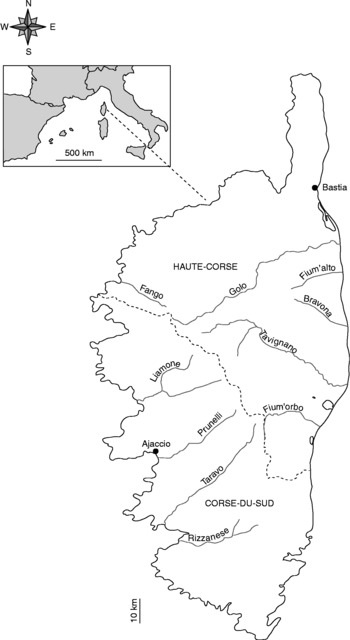
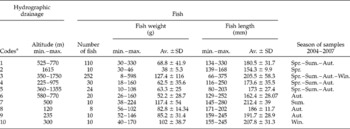
The study was carried out on 484 brown trout, collected from ten hydrographic drainage basins (fig. 1) between April 2004 and April 2007 (table 1). The sampling rivers are all fast-flowing and are among the longest in Corsica. Fish were captured by electrofishing, authorized by the National Office of Water and the Aquatic Environments (ONEMA). This technique consists of subjecting fish to a DC current (from 200 to 1000 volts, and 3–30 amp) between two electrodes plunged in water. The cathode is put in the water, and the anode is handled by the fisherman. The fish attracted or paralysed by the anode are thus easily captured with a scoop.
Map of the hydrographic drainage sampled for fish in Corsica (France).

Codes, altitude of hydrographic drainage; number, weight (g), length (mm) of fish; and season of samples.

min., Minimum; max., maximum; Av., average; SD, standard deviation; Spr., spring; Sum., summer; Aut., autumn; Win., winter.
a 1, Rizzanese; 2, Prunelli; 3, Tavignano; 4, Fium'orbo; 5, Taravo; 6, Bravona; 7, Fango; 8, Golo; 9, Liamone; 10, Fium'alto.
After electrofishing, fish were placed in plastic bags and transported to the laboratory in freezer bags with ice. The total body length (cm) was recorded for each specimen (18 cm on average). On occasion, various sampling sites were studied for the same river system (fig. 1). The intestine and stomach of brown trout were examined. All parasites collected were kept in 95% ethanol. Specimens were preserved and referred to the collection of the ‘Parasites and Mediterranean Ecosystems’ Laboratory of the University of Corsica, Faculty of Sciences and Techniques, UMR CNRS SPE 6134 (Corte, France).
Six helminth species were identified: Nicolla testiobliquum (Wisniewski, 1932); Nicolla wisniewskii (Slusarski, Reference Slusarski1958); Crepidostomum metoecus (Braun, 1900); Plagioporus stefanskii Slusarski, Reference Slusarski1958; Rhabdochona gnedini Skrjabin, 1946 (and Molnar, Reference Molnar1993), Spinitectus gordoni Cordero del Campillo & Alvarez Pellitero, 1976. These determinations were based on keys and descriptions from a number of different sources (Nicoll, Reference Nicoll1909; Slusarski, Reference Slusarski1958; Thomas, Reference Thomas1958; Moravec, Reference Moravec1968, Reference Moravec1994, Reference Moravec2002, Reference Moravec2004; Gibson et al., Reference Gibson, Jones and Bray2002).
Indicator species
Species are identified as bio-indicators when their occurrence and/or abundance within sites of a particular habitat or conservation area are high (Mouillot et al., Reference Mouillot, Culioli and Do Chi2002). In this work, IndVal combined the species relative abundance (specificity) with its relative frequency of occurrence (fidelity) for a given variable (season, altitude or river in the present study). Periods (spring, summer, autumn and winter) and ten hydrographic networks were studied. In the case of altitude, we divided samples into three strata (0–500 m; 500–1000 m; >1000 m). These sections of altitude were chosen according to various criteria: a sufficient number of trout to be relevant, similar characteristics of the rivers (currents, substrates and percentage of vegetation covering the banks).
Specificity is defined as the mean abundance of a given parasite in a given group of brown trout (this group being an area or a season, depending on the classification criterion), divided by the abundance of the same parasite species infecting all brown trout. Fidelity is the percentage of brown trout in a given group (this group being a river or an altitude class, depending on the classification criterion) infected by a given parasite. These two components were included because a species can be defined as an indicator of a group when this species is abundant in the group (relative to other groups) and when this species is present in the majority of constituents (often considered as replicates) of this group (Dufrêne & Legendre, Reference Dufrêne and Legendre1997). The IndVal values were calculated for each species, j, for each group, k, according to the formula (Dufrêne & Legendre, Reference Dufrêne and Legendre1997):

where A kj is a measure of specificity and B kj is a measure of fidelity according to the formulae:


In the present study, N individuals kj represents the mean abundance of the parasite species j for brown trout examined in group k. N individuals j+ is the sum of the mean abundances of species j within the total of brown trout. N brown trout kj is the number of brown trout belonging to the group k where the parasite species j is present. N brown trout k+ is the total number of brown trout within the group k.
The indicator value is maximum (100) for a single group when all individuals of a parasite species j are observed in all brown trout within this group, while this parasite species is absent in brown trout belonging to other groups. Conversely, when a parasite species j is absent in all brown trout within this group, its indicator value is 0. Many intermediate cases are possible. If we consider two groups of brown trout with 100 individuals in each: in the first group G1, parasite species j is only in one host, but with an abundance of 1000 individuals; in the second group G2, the same parasite species j is present in every host with an abundance of 1. Fidelity of this parasite in the group G1 is very low (BG1j = 1/100 = 0.01), while the fidelity of parasite j to the group is maximal (BG2j = 100/100 = 1). Specifity of parasite j in group G1 is AG1j = 1000/1100 = 0.91 and in group G2 is AG2j = 100/1100 = 0.091. Finally, the indicator value of this parasite is 10 times higher for the group G2 than for the group G1: IndValG1j = 100 × 0.91 × 0.01 = 0.91 and IndValG2j = 100 × 0.091 × 1 = 9.1. This simple example illustrates the capacity of the indicator value to include both specificity and fidelity in the same index. Even though parasite j was found 1000 times in a single host of group G1, the indicator value for this group was very low because the 99 remaining hosts were not infected. This last point constitutes an advantage over classical statistical tests such as ANOVA when we seek indicator species in highly variable communities such as fish or parasites and, in both cases, 1000 or 0 individuals can be sampled in two successive replicates (Mouillot et al., Reference Mouillot, Culioli and Do Chi2002).
An attempt was also made to identify indicator species for two variables. The variable k used to calculate IndVal was thus represented successively by season and host age. The indicator value of a parasite species j (IndValj) for a k variable corresponds to the higher value of IndValkj observed through the criteria, which compose the variable. These different criteria are randomly permutated within the variable in order to obtain a distribution for IndValj. The statistical significance of IndValj is evaluated by differences between observed and mean values obtained by random permutations. Ten thousand permutations were carried out and differing degrees of significance were obtained, i.e. 5%, 1% and 1‰. Calculations of IndVal values and associated tests were performed using the PC-ORD 4.0 for Windows software (McCune & Mefford, Reference McCune and Mefford1999).
Results
Indicator species for altitude
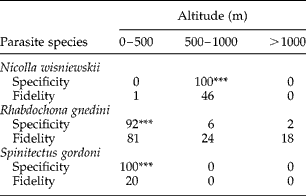
Among six parasite species, the randomization test identified three species as having a significant indicator value ( < 1‰ level of significance) (table 2). Specificity of S. gordoni (Cordero del Campillo & Alvarez-Pellitero, Reference Cordero del Campillo and Alvarez-Pellitero1976) was maximal at an altitude less than 500 m, whereas the fidelity was only of 20%. Fidelity and, especially, specificity of R. gnedini (Skrybin, 1946) were very high at altitudes from 0 to 500 m compared to altitudes greater than 500 m. Specificity of N. wisniewskii (Slusarski, Reference Slusarski1958) reached the highest value between altitudes of 500 m and 1000 m, whereas its fidelity was intermediate.
Specificity (%) and fidelity (%) of three parasites species in the brown trout, relative to altitude.
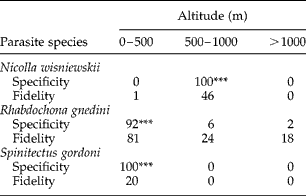
Statistically significant values ***1‰.
Indicator species of hydrographic drainage
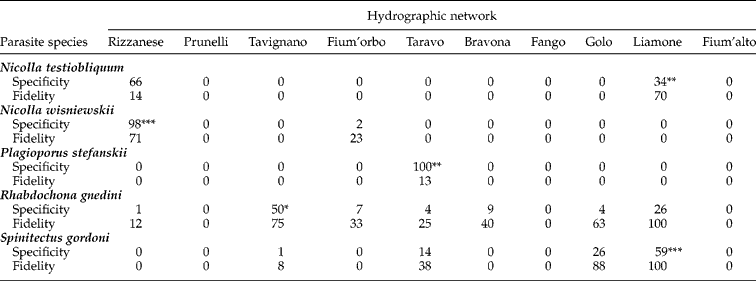
Among six parasite species, a randomization test identified five species as having a significant indicator value (5%, 1% or < 1‰ level of significance) (table 3). The trematode, N. testiobliquum (Wisniewskii, 1932), an intestinal parasite, had a fidelity more important in Liamone (70%), compared with other sampling sites. Nevertheless, the specificity of N. testiobliquum was lower than in Rizzanese. Fidelity and, especially, specificity of the other trematode, N. wisniewskii, were very high in Rizzanese. The specificity of the trematode, P. stefanskii (Slusarski, Reference Slusarski1958), was maximal in Taravo, but a weak fidelity was observed in this site. Tavignano appeared as the site in which the nematode, R. gnedini, was an indicator species due to its high fidelity. In spite of its maximal fidelity in Liamone, its weak specificity does not permit to R. gnedini to appear as an indicator in this site. Finally, the nematode S. gordoni presented the highest fidelity and specificity in Liamone.
Specificity (%) and fidelity (%) (pooled data from 2004 to 2007) of five parasite species in the brown trout in ten sampling hydrographic networks.
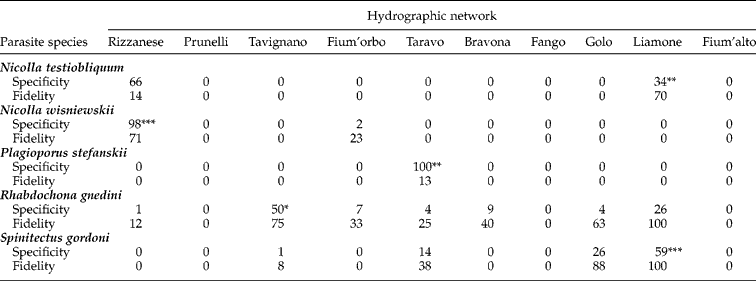
Statistically significant values * 1%, ** 5%, ***1‰.
Indicator species test for season
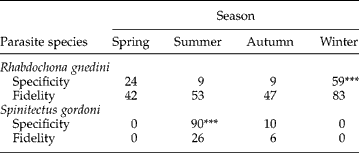
Two species were implicated among the six studied, with respect to the significance ( < 1‰) of their indicator values for season (table 4). Spinitectus gordoni has a significant IndVal in winter, whereas the IndVal value of the other nematode R. gnedini is significant in summer. The intestinal parasite S. gordoni is an indicator in summer due to its high specificity (90%), compared with the three seasons where its specificity was 0–10%. Weak fidelity was observed in summer, and lowest in autumn. Rhabdochona gnedini had a more important fidelity in winter (83%). Medium (42–53%) and similar values were recorded for the three other seasons. The specificity of this nematode was higher in winter (59%) than in spring (24%) and the lowest value (9%) was registered in summer and autumn.
Specificity (%) and fidelity (%) (pooled data from 2004 to 2007) of two parasite species in the brown trout over four seasons.
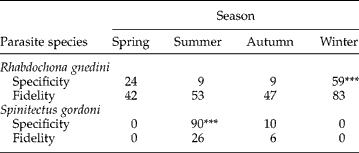
Statistically significant values ***1‰.
Discussion
In the present survey, various trends in parasite indicator species in response to altitudinal clines, specific river drainage basin effects, or seasonal factors have been reported. The combination of specificity and fidelity allowed us to identify several parasite species as indicators. The higher the specificity and fidelity, the more the parasite species is a significant indicator species.
The study showed that up to five parasite indicator species can occur in a given river drainage, three parasite indicator species relative to altitude class can be identified in brown trout and two parasite indicator species are seasonal indicators. Indeed, this statistical test identified some relationships between parasite species and hydrographic network, between parasite and altitude, and, finally, between parasite and season.
Indicator species for altitude
According to Cordero del Campillo & Alvarez-Pellitero (Reference Cordero del Campillo and Alvarez-Pellitero1976), the nematode S. gordoni was recorded in rivers in north-western Spain, where it occurs largely at elevations of less than 900 m. In the present study, two nematodes appear as indicator species at altitudes between 0 and 500 m due to their high specificity, and also fidelity for R. gnedini.
Rhabdochona gnedini is an intestinal parasite of freshwater fishes. Its presence has been reported in Salmo trutta and Onchorhynchus mykiss by Moravec (Reference Moravec2004). Moreover, it is a thermophilous species that prefers warm waters (Moravec, Reference Moravec1994, Reference Moravec2004). Chubb (Reference Chubb1982) also noted that the temperature of water is a major factor in the maturation of this parasite. Cordero del Campillo & Alvarez-Pellitero (Reference Cordero del Campillo and Alvarez-Pellitero1976) noticed that Rhabdochona sulaki ( = Rhabdochona gnedini) is also found in brown trout taken at altitudes lower than 1000 m. A correlation was established between altitude and intensity of this parasite (Quilichini et al., Reference Quilichini, Foata, Orsini, Mattei and Marchand2007). However, it appears that water temperature as related to altitude is responsible for this correlation.
The trematode N. wisniewskii is an indicator species for altitude between 500 and 1000 m.
Indicator species of hydrographic drainage
The trematodes, N. testiobliquum, N. wisniewskii and P. stefanskii, appear to be indicator species for three different rivers, because of their restricted distributions. Furthermore, N. testiobliquum is characterized by a high fidelity in Liamone. In the same way, N. wisniewskii exhibits a high fidelity and a more important specificity, whereas P. stefanskii presents a maximum specificity and a very low fidelity. According to Moravec (Reference Moravec2004), these species have a widespread European distribution, but are mostly reported in the Mediterranean basin. Even though all three are opecoelids (Jones et al., Reference Jones, Bray and Gibson2005), they do not populate the same rivers on Corsica. Despite a widespread geographic distribution, two nematodes, R. gnedini and S. gordoni, are indicator species in Tavignano and Liamone rivers.
Seasonal indicator species
Spinitectus gordoni is characterized by a high specificity value for the summer, but not high fidelity, while R. gnedini exhibits an elevated fidelity in winter and a medium specificity. According to Pereira-Bueno (Reference Pereira-Bueno1978), prevalence and intensity of fish infection reached their maxima in autumn and spring, when parasite recruitment occurs, but minima during the summer. In contrast, Saraiva et al. (Reference Saraiva, Felisberto and Cruz2002a) found highest intensities of R. gnedini during summer. One explanation for these differences may be the seasonal maturation cycle of R. gnedini, which is at least partly dependent on the water temperature (Chubb, Reference Chubb1982; Moravec, Reference Moravec2004). These variations can be related to the availability of intermediate hosts. In the life cycle of this species there is only one intermediate host – a trichoptera of the genus Hydropsyche. These observations were also reported by Saraiva et al. (Reference Saraiva, Felisberto and Cruz2002a). Our results for S. gordoni confirm the findings of Cordero del Campillo & Alvarez-Pellitero (Reference Cordero del Campillo and Alvarez-Pellitero1976), who reported the largest infrapopulation sizes during the summer period. The intermediate host of S. gordoni would most likely be an ephemeropteran. Many studies have shown that several species of the Spinitectus genus have an ephemeropteran as intermediate host. This has been reported for S. carolini, S. gracilis (Jilek & Crites, Reference Jilek and Crites1980, Reference Jilek and Crites1981, Reference Jilek and Crites1982; Gustafson, Reference Gustafson1983), S. micracanthus (Keppner, Reference Keppner1975) and S. inermis (Saraiva et al., Reference Saraiva, Moravec, Pereira and Cruz2002b), a parasite of the European eel Anguilla anguilla present in Corsica.
Comparison of the indicator and other methods
The IndVal method has numerous advantages over other measures used for ecological bio-indication (McGeoch & Chown, Reference McGeoch and Chown1998). This statistical approach allows the identification of an indicator species among parasite species having similar specificity and fidelity, but can also identify a scarce species as an indicator taxon (Mouillot et al., Reference Mouillot, Culioli and Do Chi2002). The usefulness of this method is ultimately dependent on the capacity of species to maintain high and significant indicator values when tested in different locations and periods of year (McGeoch & Chown, Reference McGeoch and Chown1998), since the abundance of all species in an assemblage may change with weather and seasonal conditions (Byong-Seol et al., Reference Byong-Seol, Seung-Yull and Jong-Yil1979; Uriarte et al., Reference Uriarte, Llorente and Valderrabano2003; Latha et al., Reference Latha, Aiyasami, Pattabiraman, Sivaraman and Rajavelu2004). However, the IndVal method may accommodate such abundance changes because IndVal also compares frequency of occurrence of parasite species between habitat types. In conclusion, to identify non-random distributions of species in ecological research we propose the application of the indicator species method as an alternative to classical tests because of its advantages, such as: (1) the taking into account of both relative abundance between, for example, hydrographic drainage, and occurrence in each hydrographic drainage; and (2) the possibility of detection of significative differences for rare species.