




No CrossRef data available.
Article contents
- Abstract
- Maternal Attachment and Adolescent Socioemotional Functioning
- Relationship Between Maternal Depression and Attachment Style
- Developmental Processes Linking Maternal Depression and Attachment to Adolescent Functioning
- The Current Study
- Methods
- Participants
- Procedure
- Maternal Measures
- Adolescent/Child Measures
- Data Analyses
- Results
- Effects of Maternal PND
- Effects of Maternal Attachment
- Intervening Variables
- Overall Model
- Relationship to Wider Psychological Functioning
- Discussion
- The Role of Maternal Attachment
- The Significance of Heightened Emotional Sensitivity: Sign of Resilience or Risk Factor for Depression?
- Further Considerations
- Appendix A
- Appendix B
- References
Socioemotional development in adolescents at risk for depression: The role of maternal depression and attachment style
Published online by Cambridge University Press: 28 March 2006
Article contents
- Abstract
- Maternal Attachment and Adolescent Socioemotional Functioning
- Relationship Between Maternal Depression and Attachment Style
- Developmental Processes Linking Maternal Depression and Attachment to Adolescent Functioning
- The Current Study
- Methods
- Participants
- Procedure
- Maternal Measures
- Adolescent/Child Measures
- Data Analyses
- Results
- Effects of Maternal PND
- Effects of Maternal Attachment
- Intervening Variables
- Overall Model
- Relationship to Wider Psychological Functioning
- Discussion
- The Role of Maternal Attachment
- The Significance of Heightened Emotional Sensitivity: Sign of Resilience or Risk Factor for Depression?
- Further Considerations
- Appendix A
- Appendix B
- References
Abstract
We examined the impact on adolescent socioemotional functioning of maternal postnatal depression (PND) and attachment style. We also investigated the role of earlier aspects of the child's development–attachment in infancy, and 5-year representations of family relationships. Ninety-one mother–child pairs, recruited in the postnatal period, were followed up at 13 years. Adolescents were interviewed about their friendships, and their level of emotional sensitivity and maturity were rated. Emotional sensitivity was heightened in girls whose mothers experienced PND; notably, its occurrence was also linked to insecure attachment in infancy and raised awareness of emotional components of family relationships at 5 years. High emotional sensitivity was also associated with adolescent depressed mood. Raised social maturity was predicted by a secure maternal attachment style and, for girls, by exposure to maternal PND. Precursors of adolescent social maturity were evident in the narrative coherence of 5-year family representations. Higher social maturity in the friendship interview was also associated with overall good adjustment.
This research was supported by the Tedworth Charitable Trust and a Medical Research Council (UK) Program Grant. We thank Sheelah Seeley for her assistance with data collection; Peter Cooper for assistance with diagnostic interviews; and Claire Kempton, Mary-Sue Moore, and Gwen Adshead for assistance with the administration and scoring of the Adult Attachment Interview. Thanks also to Françoise Hentges and anonymous reviewers for comments on the manuscript and Kim Bailey for assistance with its preparation.
Information
- Type
- REGULAR ARTICLE
- Information
- Copyright
- 2006 Cambridge University Press
Maternal postnatal depression (PND) has been associated with a diversity of adverse outcomes for offspring. Thus, cognitive impairments, altered prefrontal activity, increased negative affect, and reduced attention have all been reported in infants exposed to maternal PND. School-aged children of postnatally depressed mothers have been found to show elevated levels of depressogenic cognitions, socioemotional disturbance, and problem behaviors, the form of difficulty typically varying with the gender of the child, with boys showing more externalizing, and girls more internalizing symptoms (see review by Murray & Cooper, 2003). In contrast to the consistent evidence for an association between parental depression and difficulties in social relationships in elementary school-aged children (Billings & Moos, 1985; Goodman, Brogan, Lynch, & Fielding, 1993; Grunebaum, Cohler, Kauffman, & Gallant, 1978; Murray et al., 1999), less is known about the possible effects of parental depression on socioemotional development in adolescence. Adolescence is a time of significant transition: peer friendships increasingly replace family relationships as a principal source of support (Adler & Furman, 1988; Buhrmester, 1996; Csikszentmihalyi & Larson, 1984; Lieberman, Doyle, & Markiewicz, 1999), and become central to the individual's personal satisfaction (Adler & Furman, 1988; Buhrmester, 1996), and male–female romantic relationships begin to develop. Thus, the extent to which the socioemotional problems observed in young children exposed to maternal depression extend to adolescent functioning is of significant interest.
The increasing significance of friendships in adolescence is accompanied by two key shifts, from middle childhood, in friendship characteristics. The first is principally affective in nature, and concerns the growth in reciprocal emotional intimacy and self-disclosure (Buhrmester, 1990; Furman, Simon, Shaffer, & Bouchey, 2002; Parker & Gottman, 1989; Rubin, Bukowski, & Parker, 1997). This change is marked by the development of related capacities. Foremost among these is the development of sensitivity to the emotional responses of others, and of the self. Such sensitivity is particularly important in the context of distress; indeed, the capacity to acknowledge distress and to contemplate possible causes has been proposed as a core requirement both for engaging in meaningful interactions with others, and arriving at a mature conceptualization of the self (Harter, 1986). At the same time, adolescence is marked by a new level of emotional intensity, with depressive disorders beginning to emerge as a significant problem for the first time (Angold, Costello, & Worthman, 1998). A second, related, shift in the characteristics of friendship in adolescence is the development of more mature responses to social difficulties. This includes the ability to understand the emotions, thoughts, and intentions of others, appreciate opposing perspectives, and also to use mature judgments concerning the consequences of one's actions to guide social behavior (Beardslee, Hickey Schultz, & Selman, 1987; Rubin et al., 1997).
Exposure to maternal depression is likely to impact on both the adolescent socioemotional developments outlined above. With regard to emotional sensitivity, individuals suffering from depression experience difficulties in regulating their emotional responsiveness to others, showing raised levels of irritability, and heightened sensitivity to both negative interactions and others' approval (Gotlib, Gilboa, & Sommerfeld, 2000; Gotlib & Neubauer, 2000). In depressed mothers, such difficulties in emotional responding have been found to extend to interactions with their children (see reviews by Goodman & Gotlib, 1999; Murray & Cooper, 2003). Maternal depression is also associated with alterations in the perception of child emotional states that include a hypersensitivity to, and overestimation of, negative child emotions and behavior (Field, Healy, Goldstein, & Guthertz, 1990; Field, Morrow, & Adlestein, 1993; Griest, Wells, & Forehand, 1979; Murray, FioriCowley, Hooper, & Cooper, 1996). Thus, the offspring of depressed parents may become particularly sensitized to negative affect through processes of labeling or reinforcement during the course of interactions with their parent, or they may simply model their parent's maladaptive behavior (Field, 1984; Field et al., 1990).
Heightened sensitivity to negative affect in children of depressed mothers may also result from the child's monitoring their mother's state and initiating caring behavior in attempts to alleviate maternal distress (Murray, Woolgar, Briers, & Hipwell, 1999b; Radke-Yarrow, Zahn-Waxler, Richardson, Susman, & Martinez, 1994). On the one hand, such heightened interpersonal sensitivity and related caring for others have been seen as positive, prosocial attributes (Hay & Pawlby, 2003) that are associated with general social competence, good emotional regulation, and moral reasoning (Carlo, Koller, Eisenberg, DeSivla, & Frolich, 1996; Eisenberg et al., 1995, 1996; Fabes, Eisenberg, Karbon, Troyer, & Switzer, 1994). On the other hand, sensitivity to others' negative emotions and concern for their problems may be burdensome (Gore, Aseltine, & Colten, 1993), and have been linked to clinically significant levels of worry (Hay & Pawlby, 2003). Indeed, the heightening of emotional and interpersonal sensitivity has been considered an important part of the process whereby girls' increased risk for depression in adolescence is brought about (Zahn-Waxler, Cole, & Barratt, 1991; Zahn-Waxler & Kochanska, 1990).
With regard to the impact of maternal depression on the development of child social maturity, depressed individuals have been found to show problems in effectively taking control and resolving difficulties, and these problems appear to extend to their parenting behavior (Gelfand & Teti, 1990). For example, depressed mothers are more likely than well mothers either to abandon their initial demands or to persist in imposing nonnegotiated outcomes when confronting problems with their children (Kochanska, Kuczynski, & Maguire, 1989; Kochanska, Kuczynski, Radke-Yarrow, & Welsh, 1987). Such dysfunctional interactions may be particularly likely to occur between depressed mothers and their sons, because boys are more likely to develop provocative, oppositional styles of behavior in the context of maternal depression than are girls. Thus, not only may the offspring of depressed parents be exposed to inadequate parental models in terms of the effective management of difficulties, reduced negotiation between parent and child may also result in fewer opportunities for children to develop mature management skills themselves (Kochanska et al., 1987; Kochanska, Radke-Yarrow, Kuczynski, & Friedman, 1987). Preliminary research, in fact, has found adverse effects of maternal depression on adolescent interpersonal functioning in this area; in a study of 11- to 19-year-olds, Beardslee et al. (1987) observed low levels of mutuality and maturity in response to hypothetical social dilemmas to be associated with exposure to chronic maternal depression.
Maternal Attachment and Adolescent Socioemotional Functioning
A second important potential source of influence on the adolescent's capacity for emotional intimacy and maturity in their friendships is the way in which parents represent their own close relationships. Such representations have been extensively investigated within the framework of attachment theory by means of the Adult Attachment Interview (AAI), where representations of childhood attachment experiences are examined (Main & Goldwyn, 1998; Main, Kaplan, & Cassidy, 1985). The dimensions that distinguish secure from insecure adult attachment representations bear directly on the issues of emotional sensitivity and maturity central to adolescent friendships: thus, the secure, or autonomous, state of mind regarding attachment relationships is manifest in emotional openness, and in the capacity to reflect on emotional responses and appropriately incorporate them into decisions and behavior. Insecure adult styles are, by contrast, expressed either in terms of emotional avoidance (as in the dismissing style), or else in increased emotional reactivity, with negative emotions, in particular, threatening to overwhelm the individual (as in the preoccupied style). In each case, emotional responses remain relatively unintegrated with respect to the individual's wider experience, reducing the possibility of arriving at mature resolutions to interpersonal problems.
A number of processes may underlie links between parental representations of attachment relationships and the development of emotional sensitivity and maturity in the offspring. With regard to emotional sensitivity, one route involves the parent's ability to make accurate attributions about their child's mental and emotional experience (Fonagy, Steele, Moran, Steele, & Higgitt, 1991; Pederson, Gleason, Moran, & Bento, 1998), an ability that has been found in a number of studies, to be compromised in the context of maternal insecurity of attachment (Cohn, Cowan, Cowan, & Pearson, 1992; Crowell, O'Connor, Wollmers, Sprafkin, & Rao, 1991; Haft & Slade, 1989; Zeanah et al., 1993). A related route concerns the extent to which spontaneous family discourse makes reference to emotions, something that has been found to be strongly and specifically predictive of children's own emotion understanding (Brown & Dunn, 1996; Denham, Zoller, & Couchoud, 1994; Dunn, Brown, & Beardsall, 1991) and talk about feelings (Jenkins, Turrell, Kogushi, Lollis, & Ross, 2003). Thus, if discourse about emotions shows an exaggerated concern with negative feelings, as would be predicted for those with preoccupied attachments, or is restricted, as can be expected in the case of a dismissing parental attachment style, the child can be expected to become more or less sensitized accordingly to emotional states in themselves and others (Steele, Steele, Croft, & Fonagy, 1999; Steele, Steele, & Johansson, 2002).
With regard to the influence of parental attachment style on child maturity, the affect regulation processes involved in the development of parents' representations of their early attachment relationships are likely to bear on the emotional regulation of relationships with their own children, and provide links to the child's capacity for mature resolution of difficulties. Furthermore, the parent's capacity to reflect on relationships in a coherent manner, characteristic of those with a secure attachment style (Fonagy & Target, 1997), is likely to influence the way difficulties in relationships are discussed and resolved in the family, and thereby affect the child's own ability to generate mature solutions to social problems. A number of studies have provided evidence to support such links in relation to young children, although their application to adolescent populations has not been established. Thus, Crowell and Feldman (1988) found mothers' adult attachment representations to be related to the way in which they interacted with their preschool children during challenging play tasks. Secure mothers were able to support their children through the challenge, whereas insecure mothers were either confusing (preoccupied group), or else overcontrolling and directive (dismissing group). In addition to these dysregulating effects of insecure parental attachment on parent–child interactions, there is evidence for corresponding adverse effects on child behavior. Thus, both DeKlyen (1996) and Cowan and colleagues (Cowan, Cowan, Cohn, & Pearson, 1996) found insecure parental attachment to predict adjustment problems in 4- to 5-year-old children. Of particular relevance to the development of social maturity, Steele and colleagues found that 11-year-olds' capacity to generate resolutions to cartoon depictions of distressing emotional and social interactions was significantly related to the mother's account of her attachment relationships on the AAI (Steele et al., 2002).
Relationship Between Maternal Depression and Attachment Style
Some of the interpersonal difficulties that characterize insecure adult attachments clearly have elements in common with those expressed by depressed individuals. Indeed, a recent meta-analysis (van IJzendoorn & Bakermans-Kranenburg, 1996) showed a strong overrepresentation of insecure attachments among clinical populations in general. There is also evidence for a specific link with affective disorder, preoccupied attachments being overrepresented in depressed populations (Bifulco, Moran, Ball, & Bernazzani, 2002; Rosenstein & Horowitz, 1996). The question of whether insecure adult attachment and depression provide independent sources of influence on parenting and child outcome has received little attention, although one recent study found depression to outweigh the influence of adult attachment relationships on parental perceptions of infant negativity (Pesonen, Raikkonen, Strandberg, Keltikangas-Jarvinen, & Jarvenpaa, 2004). The relative contributions of maternal depression and insecure attachment to the socioemotional functioning of the offspring in the longer term require investigation.
Developmental Processes Linking Maternal Depression and Attachment to Adolescent Functioning
Infant attachment
Any effects of early exposure to maternal difficulties that are manifest in the functioning of adolescents are likely to be reflected in intervening developments in child functioning. The nature of the young child's attachment to their mother is a developmental outcome that has shown reliable associations with both maternal depression, as well as the mother's representations of her own attachment experience (see meta-analyses by Martins & Gaffan, 2000; van IJzendoorn, 1995). It is a basic tenet of attachment theory that the experience of close relationships in adolescence and adulthood takes place within a framework that emerges from the child's primary attachment relationships early in development (Ainsworth, Blehar, Waters, & Wall, 1978; Bowlby, 1979). It is proposed that children with a secure attachment to their primary caregiver develop a sense of trust in relationships, characterized by emotional accessibility and the capacity for empathy (Ainsworth et al., 1978; Main & Hesse, 1990). Such emotional openness, in turn, may facilitate the adaptive resolution of difficulties via association with ego resilience, and affective and behavioral self-regulation in the face of challenges (Sroufe, 1983). Accordingly, studies involving short to medium term follow-up of securely versus insecurely attached infants have found secure children to be more socially competent and positive (Elicker, Egeland, & Sroufe, 1992; Freitag, Belsky, Grossman, Grossman, & Scheuerer-Englisch, 1996; Grossman & Grossman, 1991; Park & Waters, 1989; Sroufe, 1983), to engage in more responsive interactions with peers (Kerns, 1994; Kerns, Klepac, & Cole, 1996; Pierrehumbert, Iannotti, Cummings, & Zahn-Waxler, 1989), to show better understanding of their own and other children's feelings, including negative emotions (Cassidy, Kirsh, Scolton, & Parke, 1996; Laible & Thompson, 1998; Main et al., 1985), and to be more resilient in the face of difficulties (Arend, Gove, & Sroufe, 1979; Frankel & Bates, 1990; Lutkenhaus, Grossmann, & Grossman, 1985; Sroufe, 1983; Sroufe, Carlson, & Shulman, 1993; Urban, Carlson, Egeland, & Sroufe, 1991).
Higher level child representations of relationships
Although infant attachment status has been found to predict medium-term socioemotional outcomes in children, longer term follow-up studies have not shown such reliable associations (Thompson, 1999). In part, this may reflect discontinuities in the quality of child–mother attachment itself (Bar-Haim, Sutton, Fox, & Marvin, 2000; Belsky, Campbell, Cohn, & Moore, 1996; Waters, 1979). However, it has also been suggested that intervening, higher level attachment representations that develop via ongoing mother–child interactions and discourse may become more significant as children develop increasingly sophisticated social relationships (Steele et al., 2002). Thus, Cassidy et al. (1996) observed that concurrent childhood representations of attachment relationships were an important determinant of peer status. Whether childhood representations predict subsequent socioemotional development has not been investigated.
The Current Study
We simultaneously examined these issues in the context of a prospective longitudinal study of the offspring of postnatally depressed and well mothers. We have previously reported on the children's development in infancy and through the early school years. In common with other studies, we found infants of PND mothers to be more frequently insecurely attached than those of well mothers (Murray et al., 1996), and to have difficulties in their social relationships (Murray, Sinclair, et al., 1999). We also assessed the way in which the children represented their family relationships via a doll play procedure: compared to nonexposed children, children exposed to PND showed increased awareness of the emotional experience of family members in their depictions of caretaking interactions, as well as a reduced ability to reflect on their family experiences in a coherent way (Murray, Woolgar, et al., 1999). Both these dimensions of 5-year representations are of clear relevance for the emotional sensitivity and maturity that are central aspects of adolescent social development. In the current study we examined the children's socioemotional development as they reached adolescence at the age of 13 years, when their sensitivity to emotional experiences and social maturity was assessed. As a significant body of work has suggested that schema relating to the self and others are best elicited in relatively unconstrained or spontaneous conditions (Main & Goldwyn, 1998; Murray, Woolgar, Cooper, & Hipwell, 2001; Teasdale & Barnard, 1993), we assessed adolescent socioemotional functioning by examining narrative descriptions of their own friendship experiences. Furthermore, following research indicating that cognitions relevant to depression are primarily manifest under conditions of low mood (Miranda & Persons, 1988; Teasdale, 1988), we set two conditions in which the adolescents were asked to talk about their friendships: a positive condition, in which they described a good experience, and also a negative condition in which they recounted a bad or difficult friendship experience. Indices of emotional sensitivity and maturity were derived from the resulting accounts. We examined these outcomes in relation to adolescent exposure to PND, and also in relation to the nature of maternal attachment status. We also addressed the question of whether any links between maternal PND and attachment and adolescent functioning were associated with earlier aspects of the children's development, namely, their attachment status in infancy, and the nature of their family representations at 5 years.
The following specific predictions were tested.
- In the context of accounts of negative friendship experiences, exposure to PND would predict high levels of adolescent emotional sensitivity and reduced maturity; we predicted similar effects of maternal attachment insecurity which, on the basis of previous research, we expected to be predominantly of the preoccupied form in this sample. As previous reports have suggested that girls may be particularly sensitive to maternal distress, and develop a caregiving role in response to such maternal difficulties, whereas boys are more likely to develop oppositional behaviors, we anticipated that gender would be a moderating influence, with high rates of emotional sensitivity being primarily observed in exposed girls, and low rates of maturity being predominant in exposed boys.
- Any such influences of maternal depression or insecure attachment on adolescent development would be part of a developmental pathway from earlier aspects of the child's functioning, that is, the nature of infant attachment as assessed at 18 months, and the childhood representations of family relationships assessed at 5 years. With regard to infant attachment, in line with previous research (e.g., Cohn, 1990; Renken, Egeland, Marvinney, Mangelsdorf, & Sroufe, 1989; Turner, 1991), we anticipated that the effects of insecurity would differ for boys and girls, and specifically, that insecure boys would show poorer functioning (i.e., less maturity) than insecure girls; with regard to 5-year representations, we predicted sensitivity to the emotional experience of family members would be directly associated with later emotional sensitivity, and the ability to give a coherent narrative account of family experience at age 5 would predict adolescent social maturity.
In addition to examining the precursors of emotional sensitivity and maturity in adolescent friendships, as described above, a secondary aim of the study was to address the question of the significance of these two developments for wider adolescent functioning. The prediction for social maturity was straightforward, that is, that low levels of maturity would be associated with general poor adjustment. However, with regard to emotional sensitivity, the question of whether high levels are adaptive (i.e., facilitating prosocial behavior), or maladaptive (i.e., predisposing to depression), is more complex; in view of the literature on the origins of gender differences in the occurrence of depression in this age group, we predicted that risk for adolescent depression in association with heightened emotional sensitivity would apply principally to girls (Gjerde, 1995; Nolen-Hoeksema & Girgus, 1994; Zahn-Waxler, 2000).
Methods
All participants provided written informed consent prior to taking part in this Cambridgeshire Local Ethics Committee approved study.
Participants
Assessments were carried out as part of a prospective longitudinal study of the impact of PND on child development. Primiparous mothers of healthy infants presenting between February 1986 and 1988 on the postnatal wards of the Cambridge (UK) maternity hospital, who intended to be the infant's principal caretaker, were identified with a view to recruitment in the study. Because we wished to focus on the effects of maternal depression, rather than those of general adversity, teenage and single mothers were not approached. Of the 702 women meeting study criteria who were invited to participate, all but nine (1.3%) were willing to be sent a questionnaire concerning their mood. This questionnaire, the Edinburgh Postnatal Depression Scale (EPDS; Cox, Holden, & Sagovsky, 1987), was administered by post at 6 weeks postpartum; the return rate was 97%. Women scoring over 12 on the EPDS were interviewed at 8 weeks with the Schedule for Affective Disorders and Schizophrenia (Endicott & Spitzer, 1978); 61 women who met Research Diagnostic Criteria (Spitzer, Endicott, & Robins, 1978) for depressive disorder were identified, 58 of whom were recruited for the study. Forty-two nondepressed mothers with low EPDS scores were randomly selected from the same postnatal population, potentially to serve as controls; these women were similarly interviewed to confirm they were not depressed, and were invited to participate: all agreed. Follow-up assessments were carried out when the child was 18 months and 5, 8, and 13 years old. The current research focuses on child development at 13 years, using information from prior assessments to explain variance in the dimensions examined.1
Outcome measures of specific relevance to the current research were not included at 8 years; only maternal mental state and child IQ assessments from the 8-year data collection point are included in the present report.
Fifty-three (91.4%) PND group and 41 (97.6%) comparison group families were retained at 13 years. Attrition was as follows: two dyads (both PND group) were lost to follow-up at 18 months: one family emigrated and one could not be traced; two mothers (one PND group, one control) were unwilling to continue in the study at 5 years; at 13 years, one further mother was unwilling to continue, and one adolescent was lost to follow-up when he emigrated to live with his father (both PND group).
Procedure
Adolescents and their mothers were assessed in their home. In the course of a range of assessments, the friendship interview was administered and assessments were made of adolescent mental state (interview and questionnaires). Maternal mental state was also assessed. Permission was sought to approach the school to obtain teacher reports concerning adolescent functioning.
Maternal Measures
Maternal mental state
The presence and timing of episodes of depression were assessed by a trained clinical interviewer using the Structured Clinical Interview for DSM-IV (Spitzer, Williams, & Gibbon, 1995), covering the period since the previous assessment at 8 years. All decisions regarding assigned diagnoses were made following the interviews in consultation with an independent, senior, clinician. As maternal clinical interviews were similarly conducted at 18-month, 5-year, and 8-year assessments, detailed longitudinal information relating to maternal mental state was available.
Maternal attachment
Mothers completed the AAI (George, Kaplan, & Main, 1985) when the child was 18 months of age. This was administered by a trained psychologist who was unaware of maternal mental state. The AAI examines the individual's relationship to their parents or other principal caregivers during their childhood. Individuals are asked to support statements made about the global qualities of the relationship with specific examples of childhood experiences. Direct questions are asked about experiences likely to activate the attachment response, such as rejection, loss, abuse and separation. Representations of current relationships with parents and the ongoing influences of childhood experiences are also examined.
Secure attachments are characterized by narratives that are coherent, complete and concise, with attachment evaluations being well supported by memories provided. Insecure attachments fall into two categories. Insecure–dismissing attachments are characterized by a brief, incomplete narrative in which there is a disparity between the individual's appraisals of their relationships and the examples provided, often coupled with unrealistically positive representations of attachment figures. In contrast, narratives of individuals with insecure–preoccupied attachments are overly long, include much irrelevant information while still being incomplete, and contain incoherent speech or anger towards attachment figures. In addition, both secure and insecure attachments can simultaneously be coded as unresolved, if significant loss or trauma is present with which the individual has not been able to come to terms.
AAI transcripts were scored blind by two independent trained raters and mothers were classified according to whether they were securely (autonomous–secure) or insecurely attached (Main & Goldwyn, 1998). Interrater reliability was acceptable at κ = .76; disagreements were resolved by consensus.
Adolescent/Child Measures
Mental state
Diagnostic interviews with adolescents were conducted by a clinical researcher who was blind to maternal mental state using the Kiddie Schedule for Affective Disorders and Schizophrenia, Present and Lifetime Version (Kaufman et al., 1997). As for maternal interviews, all interviews were discussed with a senior, independent, clinician before assigning diagnoses. Participants also completed the Mood and Feelings Questionnaire (MFQ), a validated self-report measure of current depressive symptomatology (Angold et al., 1995). As the frequency of actual diagnoses was small (n = 15 for lifetime depression), analyses focused on questionnaire measures of psychological functioning.
Overall adjustment
An independent measure of adolescent psychological functioning was obtained by asking teachers to complete the Strengths and Difficulties Questionnaire (SDQ), a 25-item behavioral screening measure (Goodman, 1997). The SDQ generates a “total difficulties” score, based on problems rated in emotional symptoms, conduct problems, peer relationship problems and inattention/hyperactivity. In addition, the positive dimension of prosocial behavior is rated. The SDQ has been well validated and shows reasonable sensitivity and good specificity in detecting adolescent psychiatric disorder (Goodman, Ford, Simmons, Gatward, & Meltzer, 2000).
Friendship interview
Adolescents were interviewed regarding their friendships using a semistructured format. Participants were asked to identify and describe in as much detail as possible a positive occasion, and an occasion when there had been a difficult or negative experience involving their friends within the past year. With regard to the latter, it was explained that this could include something bad happening to themselves or their friends, or the kind of misunderstanding or disagreement (however minor or trivial) that can be a normal part of friendship experiences. If an individual had difficulty identifying a specific event, the interviewer used a predetermined set of prompts (e.g., “Can you think of a particular time?” “Try thinking back over the last few months”). After each description children answered questions to assess their social and emotional understanding of the occasion, including identifying the emotions of themselves and others in the situation, and the possible reasons underlying the behaviors and emotions expressed. Narratives of the friendship interview were transcribed and scored blind by two independent raters, according to a set of predefined rules.2
Contact Lynne Murray for a copy of the scoring rules.
1. Emotional sensitivity
a. emotional expression: this rated the amount of emotional material reported, either concerning the adolescent themselves, or the experience of their friends;
b. emotional accessibility: this rated the ease with which the adolescent was able to identify an appropriate emotional experience to describe;
c. distancing: this rated emphasis on emotional responses not having been significant or important, particularly when at odds with the events reported, as well as linguistic techniques such as the use of impersonal rather than personal pronouns. Scores were reversed in the computation of emotional sensitivity.
2. Maturity
a. Comprehension of social behavior and outcomes: This rated the adolescent's understanding of different points of view, and of the reasons driving the behavior of the different protagonists, and its likely consequences.
b. Behavioral maturity: This was rated on the basis of the adolescent's descriptions of their own behavior in response to the situations described, with mature responses including appropriate responding to social challenges, actions aimed at solving social problems, or examples of rejecting personally preferred responses in favor of more socially responsible solutions.
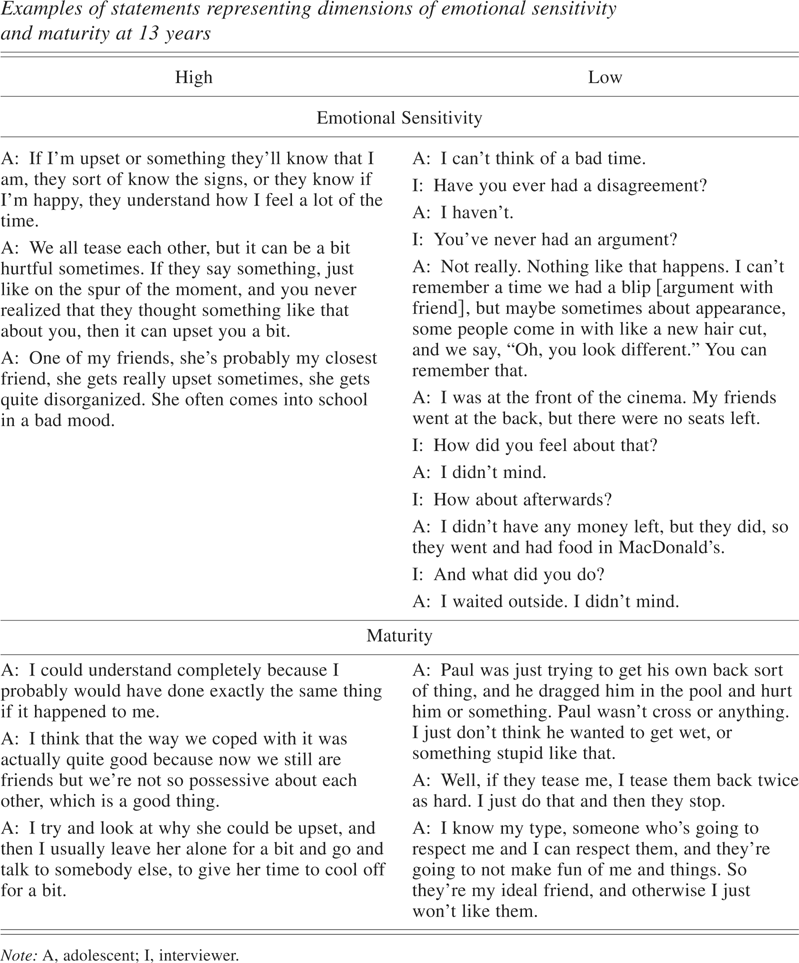
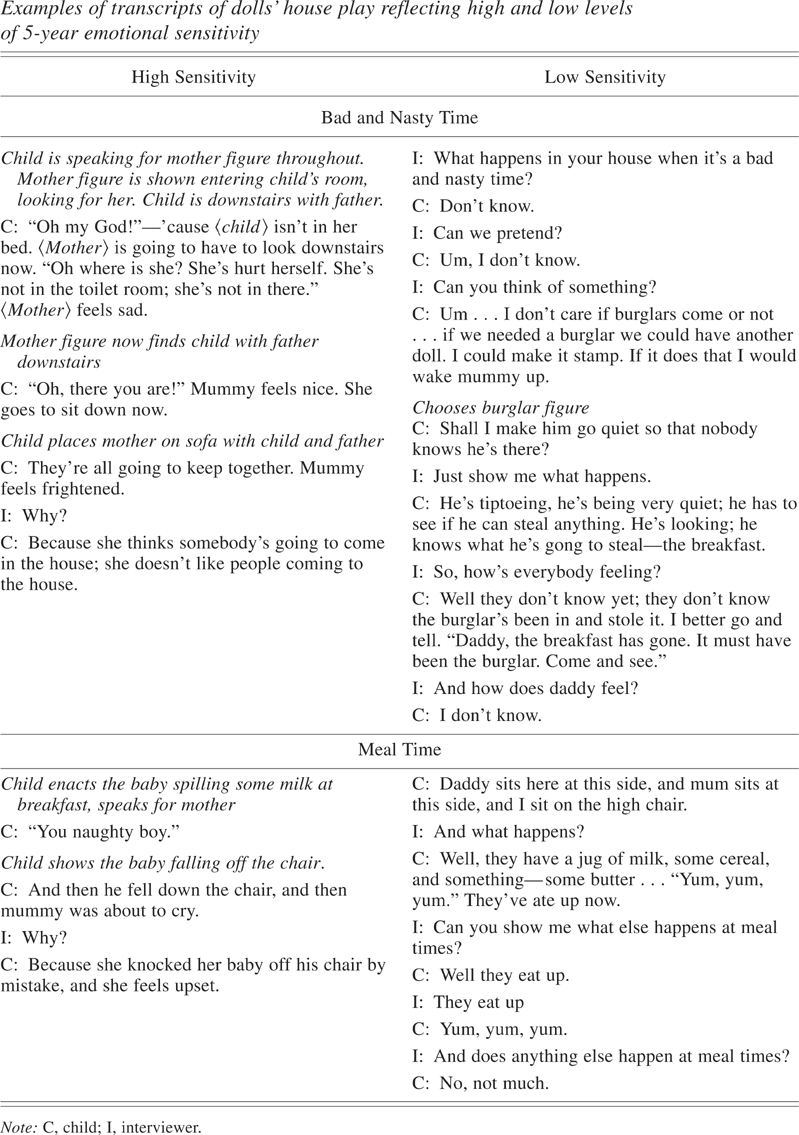
Examples of statements illustrating high and low emotional sensitivity and maturity are presented in Appendix A. Ratings were made separately for the description of the positive event and the negative event and composite scores were computed for each.
Characteristics of the emotional sensitivity and social maturity measures
Distributional analyses indicated that scores for positive experiences showed little variability. For emotional sensitivity, the distribution was significantly negatively skewed (Z = −2.68, p < .01), with 76% of scores falling above 4 on this 1–5-point scale (M = 4.15, SD = 0.61). For maturity, the distribution was significantly platykurtotic (Z = 2.61, p < .01): 92% of scores on this 1–5-point scale fell between 2.5 and 3 (M = 2.62, SD = 0.42). In contrast, scores for the negative experience were not significantly different from normal (for emotional sensitivity Z = 0.91; maturity Z = 1.01, both ns). Thus, the composite scores were analyzed only for the ratings of negative events. Chronbach's alpha indicated good internal consistency for the negative experience emotional sensitivity (α = 0.83) and maturity (α = 0.81) scores.
Interrater reliability
Eleven scripts (i.e., 12% of the sample) were independently coded by a second researcher who was also blind to all information concerning the child. Correlations for the two coders' composite ratings of emotional sensitivity and maturity were r = .95 (p < .001) and .96 (p < .001), respectively.
Validity
We addressed the validity of the emotional sensitivity and maturity rating scales by examining scores in relation to other relevant measures: we examined emotional sensitivity scores in relation to the intensity of emotional reactivity, assessed in the course of a negative mood induction procedure (Teasdale & Dent, 1987), conducted on the same occasion; thus, the degree of change in self-reported ratings of emotional intensity from pre- to postnegative mood induction showed a significant association with emotional sensitivity as assessed in the friendship interview (r = .26, n = 91, p = .012). We assessed the validity of our social maturity ratings by examining their relation to an independent measure of prosocial functioning, that is, teacher ratings on the prosocial subscale of the SDQ; again, the correlation was positive (r = .33, n = 89, p = .002). Importantly, we also found evidence for divergent validity. Thus, maturity scores were not significantly correlated with the emotional reactivity ratings (r = .12, n = 91, ns), and emotional sensitivity scores were not related to measures of prosocial adjustment (SDQ prosocial score r = .17, n = 89, ns).
Infant attachment
At the 18-month assessment, Ainsworth's Strange Situation (Ainsworth et al., 1978), a reliable and valid assessment of infant–caregiver attachment, was administered to mother–infant dyads, and videotaped assessments were coded blind by two trained raters. Infant behaviors in response to brief separations from and reunions with their parent are coded during the Strange Situation. Securely attached infants show a positive response to being reunited with their parent, and, if distressed by the separation, are easily comforted. Insecurely attached children fall into two main groups; insecure–avoidant infants show low distress at separation and little proximity seeking at reunion, whereas insecure–ambivalent infants show high levels of distress at separation and proximity seeking upon reunion, but cannot be readily consoled by their parent. In addition, infant disorganization/disorientation is coded, this categorization being characterized by deficits in any kind of organized response to separations and reunions or atypical fear responses to the parent (Main & Solomon, 1990). In the current sample all manifestations of disorganized behavior occurred in the context of insecure organized attachment strategies, and thus for the purpose of analyses, infants were simply classified as either secure or insecure. Interrater reliability for the secure/insecure classification was acceptable at κ = .84; disagreements were resolved by consensus.
Dolls' house play
Children's representations of their family experience were assessed through dolls' house play at 5 years. Details of this assessment have been presented elsewhere (Murray, Woolgar, et al., 1999). In brief, children were filmed when enacting what happened in their family during four scenarios: meal time, bedtime, a bad and nasty time, and the best and favorite time, scenes chosen to elucidate the child's perceptions of parent–child relationships in a range of settings. Children were prompted to give a commentary on their play during the enactments. Of specific theoretical relevance to the current study were ratings of the child's sensitivity to emotional experience of family members (reflected in the measure concerning personal, caretaking interactions see Appendix B for examples), and the child's capacity to give a coherent, logical account of family events (reflected in the measure of narrative coherence). In particular, we hypothesized that early sensitivity to personal and emotional experience would be a likely precursor of subsequent emotional sensitivity, and that the narrative coherence of early family depictions would be related to the later capacity to reflect in a balanced, coherent, fashion on their relationships and behave in a socially mature manner. All play sessions were scored blind to other child and family characteristics, and scales showed acceptable levels of interrater reliability (range = 0.77–0.91; Murray, Woolgar, et al., 1999).
Data Analyses
Inspection of the ratings of the adolescent emotional sensitivity and maturity scales in the context of a negative experience showed them to be suitable for parametric analyses. Therefore, in addressing the first two study hypotheses, namely that these two adolescent outcomes would be predicted by exposure to each of PND and maternal attachment security, in interaction with child gender, we used two-way analyses of variance (ANOVAs). The third study hypothesis, that any influence of exposure to PND or maternal insecure attachment on adolescent functioning would be preceded by particular child developmental trajectories, was investigated in two stages: first, the prediction of adolescent socioemotional functioning was examined with respect to (a) infant attachment using two-way ANOVAs (with gender as the second predictor) and (b) 5-year child representations of the family using partial correlation (controlling for gender). Second, we used linear regression techniques, in which the influence of the two maternal variables, along with child gender, were considered together with the relevant earlier child development measures. Third, we examined the relationship between the friendship interview measures of emotional sensitivity and social maturity in relation to wider aspects of adolescent functioning, namely the occurrence of depressive symptoms, and overall psychological adjustment, respectively, by means of regression and correlational analyses, as appropriate.
Results
Equipment problems resulted in missing data for the friendship interview for one control and two PND group participants. Thus, data were finally available for 91 adolescents (43 male, 48 female) and their mothers. Fifty-one adolescents were exposed to maternal PND, 40 were not exposed. PND and comparison groups were similar in terms of their demographic characteristics (Table 1). Participants were White, low- to middle-class families, a demographic that is representative of the population from which the sample was drawn. Participants in the index and control groups were also comparable in terms of their verbal IQ as assessed at 8 years (see Table 1). As verbal IQ represents a potential confound in narrative assessments, we also verified that verbal IQ did not correlate with the dependent friendship interview variables (for emotional sensitivity r = .11, n = 90, ns; for maturity r = .16, n = 90, ns).
Sample characteristics

Effects of Maternal PND
Two-way ANOVAs examined the prediction of adolescent emotional sensitivity and maturity (as assessed in the friendship interview) by maternal PND and adolescent gender. The results are illustrated in Figure 1a. For emotional sensitivity, there was a significant main effect of gender, F (1, 87) = 10.73, p = .002, with girls being more sensitive overall than boys. There was no main effect of PND, F (1, 87) = 1.53, ns, but there was a significant PND × Gender interaction, F (1, 87) = 5.64, p = .02. Post hoc t tests showed that PND group girls had significantly higher levels of emotional sensitivity than control group girls, t (46) = 2.62, p = .012; although boys exposed to maternal PND showed slightly lower emotional sensitivity than control group boys, this effect was not significant, t (41) = −0.79, ns.3
As there was a trend for depressive symptom levels to be higher in adolescents whose mothers had experienced PND (see Table 1: p = .056) we were concerned that differences in emotional sensitivity in relation to PND might simply be a correlate of depressive symptomatology in this group. This was not the case. When the analysis described above was repeated using analysis of covariance to control for adolescent MFQ scores, PND in interaction with gender was still a significant predictor of adolescent emotional sensitivity, F (1, 86) = 5.35, p = .023.

The effects of postnatal depression and maternal and infant attachment on adolescent socioemotional responses in relation to gender: (a) maternal depression, (b) maternal attachment, and (c) infant attachment; ([utrif ]) girls and ([bull ]) boys.
For social maturity, there was again a significant main effect of gender, F (1, 87) = 11.58, p = .001, due to girls showing higher levels of maturity than boys. There was no main effect of PND, F (1, 87) = 0.82, ns, but a significant PND × Gender interaction was again observed, F (1, 87) = 7.61, p = .007. Post hoc tests showed that exposure to PND was associated with significantly higher maturity in girls, t (46) = 2.84, p = .007; the marginally lower levels of maturity in PND group boys did not differ significantly from those in control group boys, t (41) = 1.20, ns (see Figure 1a).
Mothers who developed PND were more likely than mothers who were not postnatally depressed to experience one or more episodes of depression following the postnatal episode, with the postnatal period being defined as the first 6 months postpartum (see Table 1). We therefore examined the extent to which such subsequent exposure influenced adolescent socioemotional development. Thus, we repeated the ANOVAs described above, including the presence or absence of maternal depression outside the postnatal period as a third predictor. This third factor did not prove to be significantly related to adolescent emotional sensitivity or maturity, either by itself, or in interaction with gender and PND (all ps >.16). In addition, the previously reported significant effects of PND were retained. We also used linear regression to examine total months of exposure to maternal depression during the course of the study in relation to adolescent outcomes; in no instance did this factor prove to be significant (either by itself or in interaction with gender) once the effects of PND had been taken into account (all ps > .33).
Effects of Maternal Attachment
Maternal attachment classifications are reported in Table 1. Mothers who were postnatally depressed were significantly more likely to show insecure attachments on the AAI than control group mothers, particularly due to a high frequency of preoccupied classifications. Two-way ANOVAs examined adolescent friendship outcomes with respect to maternal attachment and child gender. For emotional sensitivity, there was a significant main effect of gender, as already described, F (1, 83) = 8.42, p = .005, but there was no main effect of maternal attachment, F (1, 83) = 0.21, ns, nor was there a significant Attachment × Gender interaction, F (1, 83) = 3.02, ns. For maturity, in addition to the main effect of gender previously described, F (1, 83) = 12.96, p = .001, there was a significant main effect of maternal attachment, F (1, 83) = 4.20, p = .044, with adolescents of insecure mothers showing lower levels of maturity; there was also a significant Attachment × Gender interaction, F (1, 83) = 5.00, p = .028. Post hoc t tests examining the interaction showed significantly lower levels of maturity in boys whose mothers had insecure as opposed to secure adult attachments, t (39) = −3.05, p = .004, but no differences in relation to maternal attachment in girls, t (44) = 0.13, ns, as illustrated in Figure 1b.
Intervening Variables
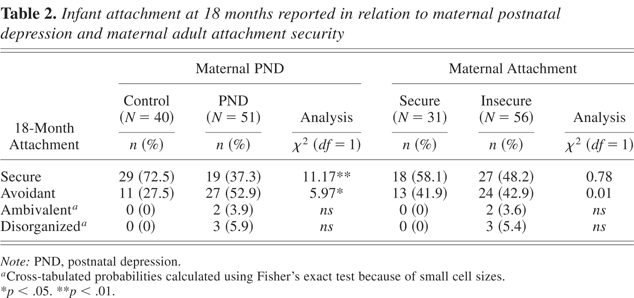
Both infant 18-month attachment and child representations at 5 years were considered as possible precursors of socioemotional representations at 13 years. Infant attachment classifications are reported in Table 2, by maternal PND and maternal attachment. As previously described for this group (Murray et al., 1996), significantly more offspring of PND mothers versus comparison mothers had insecure attachments at 18 months, particularly insecure–avoidant attachments. However, there was no association between maternal and child security of attachment (see Table 2).
Infant attachment at 18 months reported in relation to maternal postnatal depression and maternal adult attachment security
Dolls' house representations at 5 years are presented in Table 3. We have previously reported that girls exposed to maternal PND showed higher levels of awareness of emotional experience in their depictions of caretaking interactions, and gave more coherent accounts than control group girls, whereas boys showed the opposite pattern (Murray, Woolgar, et al., 1999), effects that were maintained in the current subset of the sample.4
For caretaking depictions: group, F (1, 85) = 1.74, ns; gender, F (1, 85) = 8.29, p = .005; Group × Gender, F (1, 85) = 2.84, p = .09. For narrative coherence: group, F (1, 85) = .05, ns; gender, F (1, 85) = 5.65, p = .02, Group × Gender, F (1, 85) = 4.77, p = .03.
Mean (SD) values for emotional sensitivity in depictions of caretaking and narrative coherence in dolls' house play at 5 years reported with respect to maternal postnatal depression, maternal attachment, and child gender

Attachment security at 18 months and adolescent socioemotional outcomes
We used two-way ANOVAs to examine the impact of 18-month infant attachment security in conjunction with gender on adolescent friendship interview variables. For emotional sensitivity, there was a main effect of gender, F (1, 87) = 15.47, p < .001, as reported before. There was no main effect of 18-month attachment security, F (1, 87) = 1.31, ns, but there was a significant Attachment × Gender interaction, F (1, 87) = 6.87, p = .010. Post hoc t tests showed that emotional sensitivity was higher for insecurely versus securely attached girls, t (46) = 2.72, p = .009; emotional sensitivity scores were somewhat lower for insecurely versus securely attached boys, but this effect was not significant, t (41) = 1.02, ns (see Figure 1c). For adolescent maturity, 18-month attachment security was not a significant predictor, either as a main effect, F (1, 87) = 1.78, ns, or in interaction with gender: gender, F (1, 87) = 11.47, p = .001; Attachment × Gender, F (1, 87) = 1.48, ns.
Five-year representations and adolescent socioemotional outcomes
We then examined continuities between the way family experience was represented by the children in dolls' house play at age 5, and their accounts of their friendship experiences at 13 years. Specifically, we tested our prediction that depictions of emotional experience in caretaking interactions at 5 years would be associated with emotional sensitivity at 13 years, whereas the narrative coherence of accounts of family experience at 5 years would predict social maturity at 13 years. Partial correlations were carried out controlling for gender.5
Although girls and boys showed different scores on socioemotional variables, we did not anticipate qualitative differences in the nature of the association between 5-year and 13-year socioemotional dimensions by gender. Subsidiary regression analyses confirmed that gender did not interact with either of the 5-year variables in the prediction of 13-year outcomes; therefore, partial correlations were appropriate.
Overall Model
For both adolescent emotional sensitivity and social maturity variables, we carried out regression analyses to examine the simultaneous prediction of these outcomes by those variables previously identified as being significant, including both maternal factors (PND and adult attachment security) and preceding child characteristics (18-month attachment security and doll-play variables at 5 years), as appropriate. The relatively small sample size coupled with the use of multiple, sometimes overlapping, predictors limit the power available for such an analysis; as such, we adopted a significance level of p < .10 for this set of analyses. Consecutive chronological steps were examined. Thus, for emotional sensitivity we carried out linear regression with variables entered in four logically consecutive blocks, as follows: (a) child gender, (b) maternal PND status and the PND × Gender interaction term, (c) 18-month infant attachment security and the Attachment × Gender interaction term, and (d) 5-year emotional depictions in doll play. The results are presented in Table 4. Consecutive steps in the model improved the fit when the significance of the change in R2 was considered, with the exception of Step 3, for which p > .10. The failure of the infant attachment variables to significantly improve the fit of the model may have been due to their strong association with maternal PND status, which was entered into the model in Step 2. Indeed, in the final model, only the 18-month infant attachment by gender interaction and the dolls' house variable proved to be independently significant predictors of adolescent emotional sensitivity.
Linear regression examining the cumulative prediction of 13-year emotional sensitivity by gender, maternal postnatal depression, 18-month attachment security, and 5-year emotional sensitivity in representations of maternal caretaking

For adolescent maturity, we similarly carried out linear regression analyses with the previously identified predictor variables entered in three logically consecutive blocks: (a) child gender; (b) maternal variables: PND status and PND × Gender interaction term, adult attachment security, and Attachment × Gender interaction term; (c) 5-year narrative coherence in doll play (Table 5). Once again, consecutive stages in the model proved progressively to improve the fit. In the final model, the PND × Gender interaction term, maternal attachment security, and the 5-year narrative coherence score were all significant, independent predictors of adolescent maturity.
Linear regression examining the cumulative prediction of 13-year maturity by gender, maternal postnatal depression, maternal adult attachment security, and narrative coherence in 5-year doll play
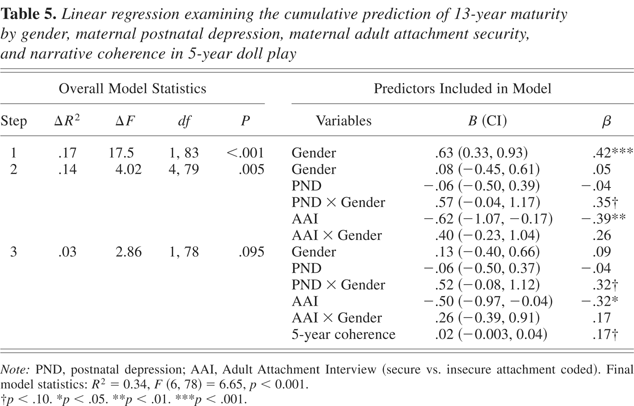
Although the total variance explained by the two final regression models was modest (R2 = .26 for emotional sensitivity, R2 = .33 for maturity), this must be considered in the light of the fact that, with the exception of gender, the most proximal predictor of the 13-year outcomes was measured 8 years previously, and in consideration of the conceptual overlap between predictors examined. Notably, for both emotional sensitivity and maturity the striking apparent differences between adolescent girls and boys, evident in the highly significant effects of gender when considered alone (Step 1 of each model), were wholly accounted for by the distinctive impact on each of maternal depression and/or maternal attachment, and their ensuing divergent developmental trajectories; the overall pattern of these links is illustrated in Figure 2.
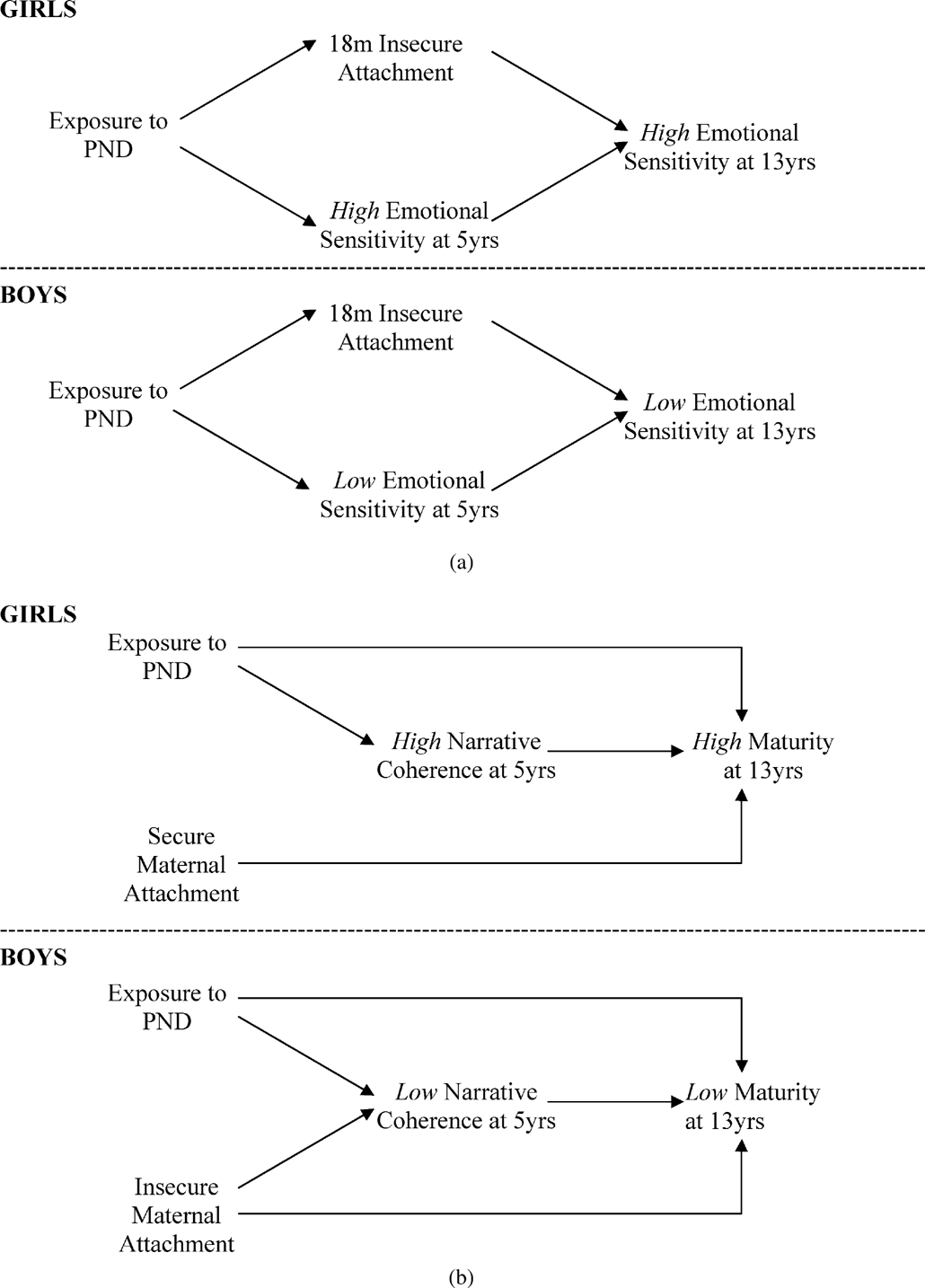
The overall patterns of pathways to emotional sensitivity and maturity in adolescents in relation to gender: the pattern of trajectories to (a) high and low emotional sensitivity and (b) high and low maturity in adolescent girls and boys.
Relationship to Wider Psychological Functioning
Finally, we addressed the issue of the significance of the adolescents' accounts of their friendships for their wider psychological functioning; we examined both their experience of depression, assessed using the MFQ, and their overall adjustment, as assessed independently in teacher reports on the SDQ (total problem scores).
Relation to current depressive symptoms
The degree of emotional sensitivity expressed in the adolescents' accounts of their negative friendship experiences correlated positively with their current depressive symptom scores on the MFQ (r = 0.27, n = 91, p = .010), but maturity ratings from the friendship interview did not (r = 0.16, n = 91, ns). In view of the suggestions that heightened emotional sensitivity may serve as a risk factor for depression only in girls, we also examined the relationships between emotional sensitivity ratings and MFQ scores according to gender. First, regression analysis was carried out, with MFQ scores as the dependent variable. Gender and emotional sensitivity were entered as predictors in the first step, and this step was significant: R2 = .10, F (2, 88) = 5.04, p = .009. When the gender by emotional sensitivity interaction term was entered in the second step, this was also significant at trend level: R2 change = .03, F (1, 87) = 3.44, p = .067. Post hoc correlational analyses of this effect supported predictions: emotional sensitivity and depressive symptoms were significantly associated in girls (r = .30, n = 48, p = .036), whereas there was no indication of such a relationship in boys (r = −.03, n = 43, ns).
Relation to overall adjustment
The degree of emotional sensitivity shown in the friendship interview was not significantly correlated with adolescent total problem scores (r = −.15, n = 89, ns). However, maturity ratings correlated significantly with the SDQ scores, higher maturity being associated with lower total problem scores (r = −.25, n = 89, p = .019).
Discussion
We examined the socioemotional functioning of a community sample of adolescents of postnatally depressed and well mothers who had been studied since infancy, as they discussed difficulties in their friendships. As well as examining the effects on friendship experience of exposure to maternal depression, we investigated the influence of maternal attachment style. Two core components of socioemotional functioning were assessed: sensitivity to emotional experience and social maturity. Emotional sensitivity was heightened in girls whose mothers had experienced depression after childbirth, an effect that was linked to insecure attachment to the mother in infancy, and to raised awareness of the emotional experience in family relationships at 5 years. Such adolescent heightened emotional sensitivity was associated with the experience of depressed mood. Higher adolescent social maturity was predicted by the presence of a secure adult attachment style in the mother and also by the occurrence of PND, although the latter effect was significant only for girls. It was again the case that the precursors of adolescent functioning were evident in early childhood, with children who were able to give coherent narrative accounts of their experience of family relationships in doll play at 5 years showing more mature responses at age 13 years. The degree of maturity expressed in the adolescents' accounts of their friendships was associated with independent reports of overall good adjustment.
Gender differences in emotional sensitivity and maturity in the context of maternal depression
The different responses of adolescent boys and girls to exposure to maternal depression were striking: exposed girls showed heightened emotional sensitivity and maturity relative to control group girls; exposed boys, on the other hand, showed the opposite pattern, although the effects in boys were nonsignificant in post hoc tests. Earlier results from this sample have also shown gender to moderate the effects of maternal depression on child functioning, in ways that are consistent with these results. For example, at age 5, index girls were, according to teacher reports, among the most prosocial, well regulated, and persistent of the study children, while boys of depressed mothers showed high rates of behavior difficulties (Sinclair & Murray, 1998). Similar effects have been widely documented in research into the effects of maternal depression on child development (Cummings & Davies, 1994; Goodman & Gotlib, 1999; Hops, 1992).
A number of processes may be involved in the development of the gender differences we observed in adolescence. With regard to emotional sensitivity, previous research has indicated that children are particularly likely to model the behavior of their same, rather than opposite, gender parent. Thus, the heightened responsiveness of girls of depressed mothers may in part arise because girls are more affected by these same characteristics in their depressed mothers (Hops, Sherman, & Biglan, 1990).
A second consideration is that mothers establish very different kinds of relationship with their daughters compared to those with their sons, and that these differences will have a bearing on child psychological development. Thus, adolescent girls tend to spend more time in the family than boys (Montemayor, 1983), and mothers discuss emotions more with their daughters, and differentially reward their emotional displays (Dunn, Bretherton, & Munn, 1987; Eisenberg, Cumberland, & Spinard, 1998; Keenan & Shaw, 1997). There is evidence that such normal differences may become exaggerated in the context of maternal depression (Murray, Kempton, Woolgar, & Hooper, 1993; Zahn-Waxler, Ridgeway, Denham, Usher, & Cole, 1993), with girls developing particularly close and intimate relationships with their depressed mothers that include more frequent discussion of negative emotions (Zahn-Waxler et al., 1993), and the child's provision of care for their distressed parent (Murray, Woolgar, et al., 1999; Radke-Yarrow et al., 1994). Such interactions may contribute both to the high emotional sensitivity seen in girls exposed to maternal depression, as well as more socially mature behavior.
The Role of Maternal Attachment
We observed a higher number of insecure maternal attachments, as assessed by the AAI at 18 months postpartum, in mothers who became depressed in the postnatal period compared to nondepressed mothers, an association consistent with previous research on attachment in clinical populations (van IJzendoorn & Bakermans-Kranenburg, 1996). Notably, the elevated rates of insecure maternal attachment observed in association with PND were entirely attributable to a higher number of preoccupied attachments; insecure–dismissing attachments were no more common among PND mothers than in the control group. This specific link between depression and a preoccupied attachment style has also been noted in previous research (Bifulco et al., 2002; Rosenstein & Horowitz, 1996).
Although there was a significant association between insecure maternal attachment and PND, there were independent effects of maternal attachment and depression on adolescent functioning. Thus, maternal attachment insecurity, unlike depression, was not associated with adolescent emotional sensitivity; however, it was associated with lower maturity in adolescent offspring, independent of maternal PND status.
The failure to identify an effect of maternal attachment on adolescent emotional sensitivity was somewhat unexpected in view of the evidence of insecure parents' poor capacities to identify their children's mental and emotional states accurately (Cohn et al., 1992; Crowell et al., 1991; Haft & Slade, 1989; Zeanah et al., 1993). It is important to note, however, that our measure of emotional sensitivity was not concerned with the accuracy of adolescent perceptions of emotion, but with their tendency to focus on emotional aspects of their relationships, a dimension that is markedly different in insecure preoccupied, as opposed to dismissing, adult attachments. Thus, sensitivity to, and expression of, emotional experiences is primarily a characteristic of preoccupied attachments, but is notably absent in dismissing attachments. The absence of a simple association between insecure maternal attachment and child emotional sensitivity in the current sample may have been due to the fact that, overall, preoccupied and dismissing styles were present in approximately equal proportions. Our sample lacked power to properly address the question of whether different insecure maternal attachment patterns were associated with different adolescent outcomes. Nevertheless, a preliminary examination suggests that this is likely to be the case, emotional sensitivity scores being highest for girls whose mothers had preoccupied attachments and lowest for boys with dismissing mothers.
The effect of maternal attachment on adolescent maturity, over and above that of maternal depression, was notable. A number of processes are likely to be compromised in the context of adult insecurity that may have an adverse impact on the development of social maturity in the offspring. One possible route concerns the parent's ability to regulate their own and their child's emotional states during parent–child interactions; adult insecurity has been found to be associated with difficulties in this domain, as well as with disturbances in child behavior (Cowan et al., 1996; Crowell & Feldman, 1988; DeKlyen, 1996). A second route concerns the promotion of child capacities to understand their own and others' mental states, a process that may also be impaired in insecure parents. Thus, as noted above, there is an increased likelihood that the adult's identification of the child's emotions will be inaccurate where the parent is insecure. In addition, it is likely that family discourse concerning personal relationships will be affected: dismissing mothers may be prone to avoid personal topics, and restrict emotional discourse, whereas in those with preoccupied attachments, balanced discussion of the causes and consequences of difficult feelings may be missing (Steele et al., 1999, 2002). In the context of adult security, by contrast, family discourse concerning the mental states and motivations underlying behavior is likely to be both more considered, as well as accurate, thus fostering the child's capacity to understand different social perspectives (Fonagy & Target, 1997). The fact that we found maternal attachment security to predict 5-year-olds' capacity to give coherent narrative accounts of their family relationships in the current study (at least in boys), and that this, in turn, was predictive of the degree of maturity shown in adolescent relationships, supports this view. These findings extend the evidence concerning the kinds of family relationships that promote the understanding of others' mental states (Denham et al., 1994; Dunn, Brown, & Beardsall, 1991; Dunn, Brown, Slomkowski, Tesla, & Youngblade, 1991; Jenkins & Astington, 1996; Meins et al., 2002; Perner, Ruffman, & Leekman, 1994; Ruffman, Perner, Naito, Parkin, & Clements, 1998) to include parental attachment security as an important source of variation. Finally, our finding that 5-year-olds' representations were predictive of adolescent accounts of relationships extends previous research showing concurrent and short-term associations between early narrative style and wider child functioning (Bretherton & Munholland, 1999; Woolgar, 1999).
The Significance of Heightened Emotional Sensitivity: Sign of Resilience or Risk Factor for Depression?
In the current study we found high levels of emotional sensitivity in girls to be associated with increased depressive symptoms. Previous research has similarly suggested that heightened emotional sensitivity may raise the risk for depression (Block, Gjerde, & Block, 1991; Gjerde, 1995; Goodyer, Herbert, Tamplin, & Altham, 2000; Gore et al., 1993; Zahn-Waxler, 2000). However, other perspectives have emerged in the research literature concerning the implications of a high level of emotional sensitivity for wider psychological functioning. Thus, such sensitivity has also been linked to certain psychological strengths, including responsible, empathic and well-regulated behaviors that may serve as protective factors in relation to the development of externalizing problems (Carlo et al., 1996; Eisenberg et al., 1995, 1996; Fabes et al., 1994; Zahn-Waxler, Klimes-Dougan, & Slattery, 2000). Emotional sensitivity has also been seen as a core component of mature self-conceptualization, and of meaningful relationships with others (Harter, 1986).
An important question arising from previous research concerns, therefore, the conditions under which emotional sensitivity becomes associated with either good adjustment, or else renders the individual vulnerable to depression. At present, these conditions are not fully understood. Longitudinal research stands to elucidate this question, but has so far largely failed to identify clear prospective links between individual differences in early psychological functioning, at least in girls, and the later emergence of depression (Zahn-Waxler et al., 2000). Consistent links between emotional sensitivity and depression have, however, emerged in adolescence (Gjerde, 1995; Gore et al., 1993), and this has contributed to the view that emotional sensitivity may act as a risk factor for depression only when occurring in combination with other developments that emerge at this time, and particularly those that may threaten emotional regulation. These include the increasing tendency in adolescence to become involved in interpersonal situations that may be stressful (Gore et al., 1993), as well as the development of higher level cognitive functions, such as rumination (Nolen-Hoeksema & Girgus, 1994; Park, Goodyer, & Teasdale, 2004; Zahn-Waxler, 2000). Of particular interest in the light of the current study findings is the fact that the vulnerability to depression conferred by emotional sensitivity, in interaction with both a ruminative cognitive style and exposure to family stress, has been found in previous research to be more prevalent in girls than in boys (Gore et al., 1993; Nolen-Hoeksema, Girgus, & Seligman, 1992; Silk, Steinberg, & Morris, 2003).
Although links between emotional sensitivity and the experience of depression may only become fully evident in the adolescent years, from a developmental psychopathology perspective it remains important to understand the pathways by which problems in regulating emotional sensitivity arise, and it may be fruitful to consider whether particular dispositional characteristics or environmental conditions determine when high emotional sensitivity is adaptive or else maladaptive. In the current study, we found that heightened emotional sensitivity in adolescent girls occurred in the context of the development of an insecure attachment relationship in infancy, an association consistent with previous research (Turner, 1991). In turn, it can be hypothesized that whether or not such sensitivity poses a risk for depression may be fundamentally affected by the nature of the individual's attachment status. Thus, in the context of security, a high degree of sensitivity to the emotional components of relationships may be advantageous, enabling the adolescent to respond adaptively while maintaining a well-regulated state; by contrast, in cases where high emotional sensitivity occurs in the context of insecurity, the individual may find themselves easily overwhelmed when difficult interpersonal situations occur, resulting in a depressive state. Family environment is also likely to be a significant determinant of the adaptiveness or otherwise of high emotional sensitivity. Given early exposure to family adversity or maternal depression, the development of high emotional sensitivity may carry negative connotations of worry and concern for others (Zahn-Waxler, 2000; Zahn-Waxler et al., 1991).
An exploratory inspection of our data supports a role for both early attachment and maternal depression in determining the psychological outcomes associated with high emotional sensitivity. Thus, high emotional sensitivity occurring in the context of a secure child attachment was unrelated to adolescent depressive symptoms, whereas in those who were insecure the association was positive. In addition, we noted a significant link between emotional sensitivity and adolescent depressive symptoms in daughters of depressed mothers, whereas no such relationship was evident in those whose mothers had been well. In sum, and consistent with the views of Zahn-Waxler and colleagues (Zahn-Waxler, 2000; Zahn-Waxler et al., 1991), a preliminary analysis suggests that both insecurity of attachment, as well as exposure to maternal depression, may be early sources of individual differences in the propensity for emotional sensitivity to be associated with either resilience or vulnerability in the face of normative adolescent developmental challenges. Systematic investigation of interactions between such early vulnerability and the consequences of emotional sensitivity represent an important area for future research concerning the causes of depression.
Further Considerations
A number of aspects of our study require further comment. First, it was notable that we failed to find an association between maternal attachment status and infant attachment security. This was surprising in the light of the extensive literature documenting the correspondence between maternal AAI and infant Strange Situation attachment status (van IJzendoorn, 1995). The nature of our sample, however, needs to be borne in mind; thus, a higher proportion of mothers coded autonomous–secure on the AAI had securely attached infants in the control group, compared to the rate in the PND group (72 vs. 20%). Indeed, mothers in the control group tended to have securely attached infants although mothers in the PND group tended to have insecure infants, regardless of maternal attachment status. Speculatively, therefore, the pattern of association between maternal and infant attachment we observed may have been a function of the use of postnatal depressive symptomatology to select women for the study. In particular, women who are insecurely attached, but who do not develop depressive symptoms following birth, as in our control group, may be relatively good at separating their own attachment experiences from their early relationship with their infant, enabling secure infant attachment to develop. In addition, where depression does occur, its negative effects may outweigh the potential benefit of maternal attachment security. This interpretation is, in fact, consistent with the findings of a recent study showing that the normal links between adult attachment status and the quality of other family relationships were obscured in the presence of depression (Dickstein, Seifer, Albus, & Magee, 2004).
Second, the nature of the effects of PND requires comment. Thus, with regard to its timing, our research has emphasized the role of early exposure in subsequent child socioemotional development: adolescent emotional sensitivity was associated with maternal depression occurring in the first few months, but it was not linked to the overall duration of exposure to depression, nor to depression that occurred after the postnatal period. Although these results are consistent with those of other reports of children of postnatally depressed mothers that have found persistent impairments in child functioning to be specifically associated with postpartum exposure (Hay et al., 2001; Sharp et al., 1995), it should be noted that, in general, research on the effects of maternal depression on child development has found that chronic, rather than brief, exposure is pernicious. In addition, the relatively small sample size of the current study places limitations on the extent to which the effects of different timings of exposure can be investigated. Caution is therefore required when considering this aspect of our results. Furthermore, although we have focused on the role of maternal behavior in the development of adolescent socioemotional functioning, there are other ways in which the children of postnatally depressed mothers may acquire vulnerability (see reviews by Goodman & Gotlib, 1999; Murray & Cooper, 2003). In particular, any difficulties in emotional responsiveness and its regulation may, in part, be linked to the heritability of temperamental traits such as neuroticism (Goldsmith, Buss, & Lemery, 1997; Plomin et al., 1993; Tellegen et al., 1988), as well as to neuroendocrine effects on the fetus that influence the capacity to regulate state and emotions (Abrams, Field, Scafidi, & Prodromidis, 1995; Field, 2002; Zuckerman, Bauchner, Parker, & Cabral, 1990).
Regardless of the precise source of the disturbances in adolescent functioning that we observed in relation to early maternal factors, the observation that these factors predict aspects of adolescent socioemotional development 13 years later is a striking and significant result. Our data suggest that early exposure sets in train a pattern of responding that has significant continuity throughout development. Furthermore, the outcomes identified have implications for our understanding of risk for depressive disorder, particularly as it occurs in girls. Future research should further consider these issues, examining how differences in socioemotional functioning might relate to earlier developments that may confer risk, as well as underlying biological and higher level cognitive processes, and the new social demands of adolescence that have been implicated in the development of disorder.
Appendix A
Appendix B
References
REFERENCES
Abrams, S. M.,
Field, T.,
Scafidi, F., &
Prodromidis, M.
(1995).
Newborns of depressed mothers.
Infant Mental Health Journal,
16,
233–239.3.0.CO;2-1>CrossRefGoogle Scholar
Adler, T., &
Furman, W.
(1988).
A model for children's relationships and relationship
dysfunctions. In
S. W. Duck (Ed.),
Handbook of personal relationships: Theory, research, and
interventions (pp.
211–228).
London:
Wiley.
Ainsworth, M. D. S.,
Blehar, M. C.,
Waters, E., &
Wall, S.
(1978).
Patterns of attachment: A psychological study of the strange
situation.
Hillsdale, NJ:
Erlbaum.
Angold, A.,
Costello, E. J.,
Messer, S. C.,
Pickles, A.,
Winder, F., &
Silver, D.
(1995).
The development of a short questionnaire for use in epidemiological
studies of depression in children and adolescents.
International Journal of Methods in Psychiatric Research,
5,
237–249.Google Scholar
Angold, A.,
Costello, E . J., &
Worthman, C. M.
(1998).
Puberty and depression: The roles of age, pubertal status and
pubertal timing.
Psychological Medicine,
28,
51–61.CrossRefGoogle Scholar
Arend, R.,
Gove, F. L., &
Sroufe, L. A.
(1979).
Continuity of individual adaptation from infancy to kindergarten: A
predictive study of ego-resiliency and curiosity in preschoolers.
Child Development,
50,
950–959.CrossRefGoogle Scholar
Bar-Haim, Y.,
Sutton, D. B.,
Fox, N. A., &
Marvin, R. S.
(2000).
Stability and change of attachment at 14, 24, and 58 months of age:
Behavior, representation, and life events.
Journal of Child Psychology and Psychiatry and Allied
Disciplines,
41,
381–388.CrossRefGoogle Scholar
Beardslee, W. R.,
Hickey Schultz, L., &
Selman, R. L.
(1987).
Level of social–cognitive development, adaptive functioning,
and DSM-III diagnosis in adolescent offspring of parents with
affective disorders: Implications for the development of the capacity for
mutuality.
Developmental Psychology,
23,
807–815.CrossRefGoogle Scholar
Belsky, J.,
Campbell, S.,
Cohn, J. F., &
Moore, G.
(1996).
Instability of attachment security.
Developmental Psychology,
32,
921–924.CrossRefGoogle Scholar
Bifulco, A.,
Moran, P. M.,
Ball, C., &
Bernazzani, O.
(2002).
Adult attachment style. I: Its relationship to clinical
depression.
Social Psychiatry and Psychiatric Epidemiology,
37,
50–59.Google Scholar
Billings, A. G., &
Moos, R. H.
(1985).
Children of parents with unipolar depression: A controlled one-year
follow-up.
Journal of Abnormal Child Psychology,
14,
149–166.Google Scholar
Block, J. H.,
Gjerde, P. F., &
Block, J. H.
(1991).
Personality antecedents of depressive tendencies in 18-year-olds: A
prospective study.
Journal of Personality and Social Psychology,
60,
726–738.CrossRefGoogle Scholar
Bowlby, J.
(1979).
The making and breaking of affectional bonds.
London:
Tavistock.
Bretherton, I., &
Munholland, K. A.
(1999).
Internal working models in attachment relationships: A construct
revisited. In
J. Cassidy &
P. R. Shaver (Eds.),
Handbook of attachment (pp.
89–111).
New York:
Guilford Press.
Brown, J. R., &
Dunn, J.
(1996).
Continuities in emotion understanding from three to six
years.
Child Development,
67,
789–802.CrossRefGoogle Scholar
Buhrmester, D.
(1990).
Intimacy of friendship, interpersonal competence, and adjustment
during preadolescence and adolescence.
Child Development,
61,
1101–1111.CrossRefGoogle Scholar
Buhrmester, D.
(1996).
Need fulfillment interpersonal competence, and the developmental
contexts of friendship. In
W. M. Bukowski,
A. F. Newcomb, &
W. W. Hartup (Eds.),
The company they keep: Friendship during childhood and
adolescence (pp.
158–185).
New York:
Cambridge University Press.
Carlo, G.,
Koller, S. R.,
Eisenberg, N.,
DeSivla, M. S., &
Frolich, C. B.
(1996).
A cross-national study on the relations among prosocial moral
reasoning, gender role orientations, and prosocial behaviors.
Developmental Psychology,
32,
231–240.CrossRefGoogle Scholar
Cassidy, J.,
Kirsh, S.,
Scolton, K. L., &
Parke, R. D.
(1996).
Attachment and representations of peer relationships.
Developmental Psychology,
32,
892–904.CrossRefGoogle Scholar
Cohn, D. A.
(1990).
Child–mother attachment of 6 year olds and social competence
at school.
Child Development,
61,
152–162.CrossRefGoogle Scholar
Cohn, D. A.,
Cowan, P. A.,
Cowan, C. P., &
Pearson, J.
(1992).
Mothers' and fathers' working models of childhood
attachment relationships, parenting styles and child behavior.
Development and Psychopathology,
63,
526–541.Google Scholar
Cowan, P. A.,
Cowan, C. P.,
Cohn, D. A., &
Pearson, J. L.
(1996).
Parents' attachment histories and children's externalizing
and internalizing behaviors: Exploring family systems models of
linkage.
Journal of Consulting and Clinical Psychology,
64,
53–63.CrossRefGoogle Scholar
Cox, J. L.,
Holden, J. M., &
Sagovsky, R.
(1987).
Detection of postnatal depression. Development of the 10-item
Edinburgh Postnatal Depression Scale.
British Journal of Psychiatry,
150,
782–786.Google Scholar
Crowell, J. A., &
Feldman, S. S.
(1988).
Mothers' internal models of relationships and children's
behavioral and developmental status: A study of mother–child
interaction.
Child Development,
59,
1273–1285.CrossRefGoogle Scholar
Crowell, J. A.,
O'Connor, E. O.,
Wollmers, G.,
Sprafkin, J., &
Rao, U.
(1991).
Mothers' conceptualizations of parent–child
relationships: Relation to mother–child interaction and child
behavior problems.
Development and Psychopathology,
3,
431–444.CrossRefGoogle Scholar
Csikszentmihalyi, M., &
Larson, R.
(1984).
Being adolescent.
New York:
Basic Books.
Cummings, E. M., &
Davies, P. T.
(1994).
Maternal depression and child development.
Journal of Child Psychology and Psychiatry and Allied
Disciplines,
35,
73–112.CrossRefGoogle Scholar
DeKlyen, M.
(1996).
Disruptive behavior disorder and intergenerational attachment
patterns: A comparison of clinic-referred and normally functioning
preschoolers and their mothers.
Journal of Consulting and Clinical Psychology,
64,
357–365.CrossRefGoogle Scholar
Denham, S. A.,
Zoller, D., &
Couchoud, E. A.
(1994).
Socialization of preschoolers' emotion understanding.
Developmental Psychology,
30,
448–455.CrossRefGoogle Scholar
Dickstein, S.,
Seifer, R.,
Albus, K. E., &
Magee, K. D.
(2004).
Attachment patterns across multiple family relationships in
adulthood: Associations with maternal depression.
Development and Psychopathology,
16,
735–751.Google Scholar
Dunn, J.,
Bretherton, I., &
Munn, P.
(1987).
Conversations about feeling states between mothers and their young
children.
Developmental Psychology,
23,
132–139.CrossRefGoogle Scholar
Dunn, J.,
Brown, J., &
Beardsall, L.
(1991).
Family talk about feeling states and children's later
understanding of others' emotions.
Developmental Psychology,
27,
448–455.CrossRefGoogle Scholar
Dunn, J.,
Brown, J.,
Slomkowski, C.,
Tesla, C., &
Youngblade, L.
(1991).
Young children's understanding of other people's feelings
and beliefs: Individual differences and their antecedents.
Child Development,
62,
1352–1366.CrossRefGoogle Scholar
Eisenberg, N.,
Cumberland, A., &
Spinard, T. L.
(1998).
Parental socialization of emotion.
Psychological Enquiry,
9,
241–273.CrossRefGoogle Scholar
Eisenberg, N.,
Fabes, R. A.,
Karbon, M.,
Murphy, B. C.,
Wosinski, M.,
Polazzi, L.,
et al.
(1996).
The relations of children's dispositional prosocial behavior to
emotionality, regulation, and social functioning.
Child Development,
67,
974–992.CrossRefGoogle Scholar
Eisenberg, N.,
Fabes, R. A.,
Murphy, B.,
Maszk, P.,
Smith, M., &
Karbon, M.
(1995).
The role of emotionality and regulation in children's social
functioning: A longitudinal study.
Child Development,
66,
1360–1384.CrossRefGoogle Scholar
Elicker, J.,
Egeland, M., &
Sroufe, L. A.
(1992).
Predicting peer competence in childhood from early
parent–child relationships. In
R. Parke &
G. W. Ladd (Eds.),
Family and peer relationships: Modes of linkage (pp.
77–106).
Hillsdale, NJ:
Erlbaum.
Endicott, J., &
Spitzer, R. L.
(1978).
A Diagnostic Interview: The Schedule for Affective Disorders and
Schizophrenia.
Archives of General Psychiatry,
35,
837–844.CrossRefGoogle Scholar
Fabes, R. A.,
Eisenberg, N.,
Karbon, M.,
Troyer, D., &
Switzer, G.
(1994).
The relations of children's emotion regulation to their
vicarious emotional responses and comforting behaviors.
Child Development,
65,
1678–1693.CrossRefGoogle Scholar
Field, T.
(1984).
Early interactions between infants and their postpartum depressed
mothers.
Infant Behavior and Development,
7,
537–540.Google Scholar
Field, T.,
Healy, B.,
Goldstein, S., &
Guthertz, M.
(1990).
Behavior-state matching and synchrony in mother–infant
interactions of nondepressed versus depressed dyads.
Developmental Psychology,
26,
7–14.CrossRefGoogle Scholar
Field, T.,
Morrow, C., &
Adlestein, D.
(1993).
Depressed mothers' perceptions of infant behavior.
Infant Behavior and Development,
16,
99–108.CrossRefGoogle Scholar
Field, T. M.
(2002).
Prenatal effects of maternal depression. In
S. H. Goodman &
I. H. Gotlib (Eds.),
Children of depressed parents (pp.
59–88).
Washington, DC:
American Psychological Association.
Fonagy, P.,
Steele, H.,
Moran, G.,
Steele, M., &
Higgitt, A.
(1991).
The capacity for understanding mental states: The reflective self in
parent and child and its significance for security of attachment.
Infant Mental Health Journal,
13,
200–217.3.0.CO;2-7>CrossRefGoogle Scholar
Fonagy, P., &
Target, M.
(1997).
Attachment and reflective function: Their role in
self-organization.
Development and Psychopathology,
9,
679–700.Google Scholar
Frankel, K. A., &
Bates, J. E.
(1990).
Mother–toddler problem solving: Antecedents in attachment,
home behavior, and temperament.
Child Development,
61,
810–819.CrossRefGoogle Scholar
Freitag, M.,
Belsky, J.,
Grossman, K.,
Grossman, K. E., &
Scheuerer-Englisch, H.
(1996).
Continuity in parent–child relationships from infancy to
middle childhood and relations with friendship competence.
Child Development,
67,
1437–1454.CrossRefGoogle Scholar
Furman, W.,
Simon, V. A.,
Shaffer, L., &
Bouchey, H. A.
(2002).
Adolescents' working models and styles for relationships with
parents, friends, and romantic partners.
Child Development,
73,
241–255.CrossRefGoogle Scholar
Gelfand, D. M., &
Teti, D. M.
(1990).
The effects of maternal depression on children.
Clinical Psychology Review,
10,
329–353.CrossRefGoogle Scholar
George, C.,
Kaplan, N., &
Main, M.
(1985).
Adult Attachment Interview.
Unpublished manuscript.
Gjerde, P. F.
(1995).
Alternative pathways to chronic depressive symptoms in young adults:
Gender differences in developmental trajectories.
Child Development,
66,
1277–1300.CrossRefGoogle Scholar
Goldsmith, H. H.,
Buss, K. A., &
Lemery, K. S.
(1997).
Toddler and childhood temperament: Expanded content, stronger
genetic evidence, new evidence for the importance of environment.
Developmental Psychology,
33,
891–905.CrossRefGoogle Scholar
Goodman, R.
(1997).
The Strengths and Difficulties Questionnaire: A research
note.
Journal of Child Psychology and Psychiatry and Allied
Disciplines,
38,
581–586.CrossRefGoogle Scholar
Goodman, R.,
Ford, T.,
Simmons, H.,
Gatward, R., &
Meltzer, H.
(2000).
Using the Strengths and Difficulties Questionnaire (SDQ) to screen
for child psychiatric disorders in a community sample.
British Journal of Psychiatry,
177,
534–539.CrossRefGoogle Scholar
Goodman, S. H.,
Brogan, D.,
Lynch, M. E., &
Fielding, B.
(1993).
Social and emotional competence in children of depressed
mothers.
Child Development,
64,
516–531.CrossRefGoogle Scholar
Goodman, S. H., &
Gotlib, I. H.
(1999).
Risk for psychopathology in the children of depressed mothers: A
developmental model for understanding mechanisms of transmission.
Psychological Review,
106,
458–490.CrossRefGoogle Scholar
Goodyer, I. M.,
Herbert, J.,
Tamplin, A., &
Altham, P. M.
(2000).
First-episode major depression in adolescents. Affective, cognitive
and endocrine characteristics of risk status and predictors of
onset.
British Journal of Psychiatry,
176,
142–149.Google Scholar
Gore, S.,
Aseltine, R. H., &
Colten, M. E.
(1993).
Gender, social-relational involvement and depression.
Journal of Research on Adolescence,
3,
101–125.CrossRefGoogle Scholar
Gotlib, I. H.,
Gilboa, E., &
Sommerfeld, B. K.
(2000).
Cognitive functioning in depression: Nature and origins. In
R. J. Davidson (Ed.),
Anxiety, depression, and emotion (pp.
133–163).
New York:
Oxford University Press.
Gotlib, I. H., &
Neubauer, D. L.
(2000).
Information-processing approaches to the study of cognitive biases
in depression. In
S. Johnson,
A. Hayes,
T. Field,
P. McCabe, &
N. Schneiderman (Eds.),
Stress, coping, and depression (pp.
117–143).
Hillsdale, NJ:
Erlbaum.
Griest, D. L.,
Wells, K. C., &
Forehand, R.
(1979).
An examination of predictors of maternal perceptions of
maladjustment in clinic-referred children.
Journal of Abnormal Psychology,
88,
277–281.CrossRefGoogle Scholar
Grossman, K. E., &
Grossman, K.
(1991).
Attachment quality as an organizer of emotional and behavioral
responses. In
P. Morris,
J. Stevenson-Hinde, &
C. Parkes (Eds.),
Attachment across the life cycle (pp.
93–114).
New York:
Routledge.
Grunebaum, H.,
Cohler, B.,
Kauffman, C., &
Gallant, D.
(1978).
Children of depressed and schizophrenic mothers.
Child Psychiatry and Human Development,
8,
219–225.CrossRefGoogle Scholar
Haft, W. L., &
Slade, A.
(1989).
Affect atunement and maternal attachment: A pilot study.
Infant Mental Health Journal,
10,
157–221.3.0.CO;2-3>CrossRefGoogle Scholar
Harter, S.
(1986).
Processes underlying the construction, maintenance, and enhancement
of the self-concept in children. In
J. Suls &
A. Greenwald (Eds.),
Psychological perspectives on the self.
Hillsdale, NJ:
Erlbaum.
Hay, D. F., &
Pawlby, S.
(2003).
Prosocial development in relation to children's and
mothers' psychological problems.
Child Development,
74,
1314–1327.CrossRefGoogle Scholar
Hay, D. F.,
Pawlby, S.,
Sharp, D.,
Asten, P.,
Mills, A., &
Kumar, R.
(2001).
Intellectual problems shown by 11-year-old children whose mothers
had postnatal depression.
Journal of Child Psychology and Psychiatry and Allied
Disciplines,
42,
871–889.CrossRefGoogle Scholar
Hops, H.
(1992).
Parental depression and child behaviour problems: Implications for
behavioural family intervention.
Behaviour Change,
9,
126–138.CrossRefGoogle Scholar
Hops, H.,
Sherman, L., &
Biglan, A.
(1990).
Maternal depression, marital discord, and children's
behaviour: A developmental perspective. In
G. R. Patterson (Ed.),
Depression and aggression in family interaction (pp.
185–208).
Hillsdale, NJ:
Erlbaum.
Jenkins, J., &
Astington, J. W.
(1996).
Cognitive factors and family structure associated with theory of
mind development in young children.
Developmental Psychology,
32,
70–78.CrossRefGoogle Scholar
Jenkins, J. M.,
Turrell, S. L.,
Kogushi, Y.,
Lollis, S., &
Ross, H. S.
(2003).
A longitudinal investigation of the dynamics of mental state talk in
families.
Child Development,
74,
905–920.CrossRefGoogle Scholar
Kaufman, J.,
Birmaher, B.,
Brent, D.,
Rao, U.,
Flynn, C.,
Moreci, P.,
et al.
(1997).
Schedule for Affective Disorders and Schizophrenia for school-age
children-present and lifetime version (K-SADS-PL): Initial reliability and
validity data.
Journal of the American Academy of Child and Adolescent
Psychiatry,
36,
980–988.CrossRefGoogle Scholar
Keenan, K., &
Shaw, D.
(1997).
Developmental and social influences on young girls' early
problem behavior.
Psychological Bulletin,
121,
95–113.CrossRefGoogle Scholar
Kerns, K. A.
(1994).
A longitudinal examination of links between mother–child
attachment and children's friendships in early childhood.
Journal of Social and Personal Relationships,
11,
379–381.CrossRefGoogle Scholar
Kerns, K. A.,
Klepac, L., &
Cole, A. K.
(1996).
Peer relationships and preadolescents' perceptions of security
in the mother–child relationship.
Developmental Psychology,
32,
457–466.CrossRefGoogle Scholar
Kochanska, G.,
Kuczynski, L., &
Maguire, M.
(1989).
Impact of diagnosed depression and self-reported mood on
mothers' control strategies: A longitudinal study.
Journal of Abnormal Child Psychology,
17,
493–511.CrossRefGoogle Scholar
Kochanska, G.,
Kuczynski, L.,
Radke-Yarrow, M., &
Welsh, J. D.
(1987).
Resolutions of control episodes between well and affectively ill
mothers and their young children.
Journal of Abnormal Child Psychology,
15,
441–456.CrossRefGoogle Scholar
Kochanska, G.,
Radke-Yarrow, M.,
Kuczynski, L., &
Friedman, S. L.
(1987).
Normal and affectively ill mothers' beliefs about their
children.
American Journal of Orthopsychiatry,
57,
345–350.CrossRefGoogle Scholar
Laible, D. J., &
Thompson, R. A.
(1998).
Attachment and emotional understanding in preschool children.
Developmental Psychology,
34,
1038–1045.CrossRefGoogle Scholar
Lieberman, M.,
Doyle, A. B., &
Markiewicz, D.
(1999).
Developmental patterns in security of attachment to mother and
father in late childhood and early adolescence: Associations with peer
relations.
Child Development,
70,
202–213.CrossRefGoogle Scholar
Lutkenhaus, P.,
Grossmann, K. E., &
Grossman, K.
(1985).
Infant–mother attachment at twelve months and style of
interaction with a stranger at the age of three years.
Child Development,
56,
1538–1542.CrossRefGoogle Scholar
Main, M., &
Goldwyn, R.
(1998).
Adult attachment scoring and classification system.
Unpublished Manuscript,
University of California at Berkley.
Main, M., &
Hesse, E.
(1990).
Parents' unresolved traumatic experiences are related in
infant disorganized attachment status: Is frightened and/or
frightening parental behavior the linking mechanism? In
M. T. Greenberg,
D. Cicchetti, &
E. M. Cummings (Eds.),
Attachment in preschool years: Theory, research, and
intervention (pp.
161–184).
Chicago:
University of Chicago Press.
Main, M.,
Kaplan, N., &
Cassidy, J.
(1985).
Security in infancy, childhood, and adulthood: A move to the level
of representation. In
I. Bretherton &
E. Waters (Eds.),
Growing points of attachment theory and research (pp.
66–104).CrossRef
Main, M., &
Solomon, J.
(1990).
Procedures for identifying infants as disorganized/disoriented
during the Strange Situation. In
M. Greenberg,
D. Cicchetti, &
E. M. Cummings (Eds.),
Attachment in the preschool years: Theory, research and
intervention (pp.
121–160).
Chicago:
University of Chicago Press.
Martins, C., &
Gaffan, E. A.
(2000).
Effects of early maternal depression on patterns of
infant–mother attachment: A meta-analytic investigation.
Journal of Child Psychology and Psychiatry and Allied
Disciplines,
41,
737–746.CrossRefGoogle Scholar
Meins, E.,
Fernyhough, C.,
Wainwright, R.,
Das, G. M.,
Fradley, E., &
Tuckey, M.
(2002).
Maternal mind-mindedness and attachment security as predictors of
theory of mind understanding.
Child Development,
73,
1715–1726.CrossRefGoogle Scholar
Miranda, J., &
Persons, J. B.
(1988).
Dysfunctional attitudes are mood-state dependent.
Journal of Abnormal Psychology,
97,
76–79.CrossRefGoogle Scholar
Montemayor, R.
(1983).
Parents and adolescents in conflict: All of the families some of the
time and some of the families most of the time.
Journal of Early Adolescence,
3,
83–103.CrossRefGoogle Scholar
Murray, L., &
Cooper, P. J.
(2003).
Intergenerational transmission of affective and cognitive processes
associated with depression: Infancy and the pre-school years. In
I. M. Goodyer (Ed.),
Unipolar depression: A lifespan perspective (pp.
17–46).
Oxford:
Oxford University Press.
Murray, L.,
FioriCowley, A.,
Hooper, R., &
Cooper, P.
(1996).
The impact of postnatal depression and associated adversity on early
mother–infant interactions and later infant outcome.
Child Development,
67,
2512–2526.CrossRefGoogle Scholar
Murray, L.,
Kempton, C.,
Woolgar, M., &
Hooper, R.
(1993).
Depressed mothers' speech to their infants and its relation to
infant gender and cognitive development.
Journal of Child Psychology and Psychiatry and Allied
Disciplines,
34,
1083–1101.CrossRefGoogle Scholar
Murray, L.,
Sinclair, D.,
Cooper, P.,
Ducournau, P.,
Turner, P., &
Stein, A.
(1999).
The socioemotional development of 5-year-old children of postnatally
depressed mothers.
Journal of Child Psychology and Psychiatry and Allied
Disciplines,
40,
1259–1271.CrossRefGoogle Scholar
Murray, L.,
Woolgar, M.,
Briers, S., &
Hipwell, A.
(1999).
Children's social representations in dolls' house play and
theory of mind tasks, and their relation to family adversity and child
disturbance.
Social Development,
8,
179–200.Google Scholar
Murray, L.,
Woolgar, M.,
Cooper, P., &
Hipwell, A.
(2001).
Cognitive vulnerability to depression in 5-year-old children of
depressed mothers.
Journal of Child Psychology and Psychiatry and Allied
Disciplines,
42,
891–899.CrossRefGoogle Scholar
Nolen-Hoeksema, S., &
Girgus, J. S.
(1994).
The emergence of gender differences in depression during
adolescence.
Psychological Bulletin,
115,
424–443.CrossRefGoogle Scholar
Nolen-Hoeksema, S.,
Girgus, J. S., &
Seligman, M. E.
(1992).
Predictors and consequences of childhood depressive symptoms: A
5-year longitudinal study.
Journal of Abnormal Psychology,
101,
405–422.CrossRefGoogle Scholar
Park, K., &
Waters, E.
(1989).
Security of attachment and preschool friendships.
Child Development,
60,
1076–1081.CrossRefGoogle Scholar
Park, R. J.,
Goodyer, I. M., &
Teasdale, J. D.
(2004).
Effects of induced rumination and distraction on mood and
overgeneral autobiographical memory in adolescent Major Depressive
Disorder and controls.
Journal of Child Psychology and Psychiatry,
45,
996–1006.CrossRefGoogle Scholar
Parker, J. G., &
Gottman, J. M.
(1989).
Social and emotional development in a relational context:
Friendship interaction from early childhood to adolescence. In
T. J. Berndt &
G. W. Ladd (Eds.),
Peer relations in child development (pp.
95–131).
New York:
Wiley.
Pederson, D. R.,
Gleason, K. E.,
Moran, G., &
Bento, S.
(1998).
Maternal attachment representations, maternal sensitivity, and the
infant–mother attachment relationship.
Developmental Psychology,
34,
925–933.CrossRefGoogle Scholar
Perner, J.,
Ruffman, T., &
Leekman, S. H.
(1994).
Theory of mind is contagious: You can catch it from your
sibs.
Child Development,
65,
1228–1238.CrossRefGoogle Scholar
Pesonen, A.,
Raikkonen, K.,
Strandberg, T.,
Keltikangas-Jarvinen, L., &
Jarvenpaa, A.
(2004).
Insecure adult attachment style and depressive symptoms:
Implications for parental perceptions of infant temperament.
Infant Mental Health Journal,
25,
99–116.CrossRefGoogle Scholar
Pierrehumbert, B.,
Iannotti, R. J.,
Cummings, E. M., &
Zahn-Waxler, C.
(1989).
Social functioning with mother and peers at 2 and 5 years: The
influence of attachment.
International Journal of Behavioral Development,
12,
85–100.CrossRefGoogle Scholar
Plomin, R.,
Emde, R. N.,
Braungart, J. M.,
Campos, J.,
Corley, R.,
Fulker, D. W.,
et al.
(1993).
Genetic change and continuity from fourteen to twenty months: The
MacArthur Longitudinal Twin Study.
Child Development,
64,
1354–1376.CrossRefGoogle Scholar
Radke-Yarrow, M.,
Zahn-Waxler, C.,
Richardson, D. T.,
Susman, A., &
Martinez, P.
(1994).
Caring behavior in children of clinically depressed and well
mothers.
Child Development,
65,
1405–1414.CrossRefGoogle Scholar
Renken, B.,
Egeland, B.,
Marvinney, D.,
Mangelsdorf, S., &
Sroufe, L. A.
(1989).
Early childhood antecedents of aggression and passive-withdrawal in
early elementary school.
Journal of Personality,
57,
257–281.CrossRefGoogle Scholar
Rosenstein, D. S., &
Horowitz, H. A.
(1996).
Adolescent attachment and psychopathology.
Journal of Consulting and Clinical Psychology,
64,
244–253.CrossRefGoogle Scholar
Rubin, K. H.,
Bukowski, W., &
Parker, J. G.
(1997).
Peer interactions, Relationships, and groups. In
N. Eisenberg (Ed.),
Handbook of psychology: Social, emotional, and personality
development (pp.
619–700).
New York:
Wiley.
Ruffman, T.,
Perner, J.,
Naito, M.,
Parkin, L., &
Clements, W. A.
(1998).
Older (but not younger) siblings facilitate false belief
understanding.
Developmental Psychology,
34,
161–174.CrossRefGoogle Scholar
Sharp, D.,
Hay, D. F.,
Pawlby, S.,
Schmucker, G.,
Allen, H., &
Kumar, R.
(1995).
The impact of postnatal depression on boys' intellectual
development.
Journal of Child Psychology and Psychiatry and Allied
Disciplines,
36,
1315–1336.CrossRefGoogle Scholar
Silk, J. S.,
Steinberg, L., &
Morris, A. S.
(2003).
Adolescents' emotion regulation in daily life: Links to
depressive symptoms and problem behavior.
Child Development,
74,
1869–1880.CrossRefGoogle Scholar
Sinclair, D., &
Murray, L.
(1998).
Effects of postnatal depression on children's adjustment to
school. Teacher's reports.
British Journal of Psychiatry,
172,
58–63.CrossRefGoogle Scholar
Spitzer, R. L.,
Endicott, J., &
Robins, E.
(1978).
Research diagnostic criteria: Rationale and reliability.
Archives of General Psychiatry,
35,
773–782.CrossRefGoogle Scholar
Spitzer, R. L.,
Williams, J. B. W., &
Gibbon, M.
(1995).
Structured Clinical Interview for DSM-IV (SCID).
New York:
New York State Psychiatric Institute, Biometrics Research.
Sroufe, L. A.
(1983).
Infant–caregiver attachment and patterns of adaptation in
preschool: The roots of maladaptation and competence. In
M. Perlmutter (Ed.),
Minnesota symposia on child psychology: Vol. 16. Development and
policy concerning children with special needs (pp.
41–83).
Hillsdale, NJ:
Erlbaum.
Sroufe, L. A.,
Carlson, E., &
Shulman, S.
(1993).
Individuals in relationships: Development from infancy through
adolescence. In
T. D. Wachs &
R. Plomin (Eds.),
Conceptualization and measurement of organism–enviroment
interaction (pp.
68–84).
Washington, DC:
American Psychological Association.
Steele, H.,
Steele, M.,
Croft, C., &
Fonagy, P.
(1999).
Infant–mother attachment at one year predicts children's
understanding of mixed emotions at six years.
Social Development,
8,
161–178.Google Scholar
Steele, M.,
Steele, H., &
Johansson, M.
(2002).
Maternal predictors of children's social cognition: An
attachment perspective.
Journal of Child Psychology and Psychiatry and Allied
Disciplines,
43,
861–872.CrossRefGoogle Scholar
Teasdale, J. D.
(1988).
Cognitive vulnerability to persistent depression.
Cognition and Emotion,
2,
247–274.CrossRefGoogle Scholar
Teasdale, J. D., &
Barnard, P. J.
(1993).
Affect, cognition and change: Remodelling depressive thought.
Hove:
Erlbaum.
Teasdale, J. D., &
Dent, J.
(1987).
Cognitive vulnerability to depression: An investigation of two
hypotheses.
British Journal of Clinical Psychology,
26,
113–126.CrossRefGoogle Scholar
Tellegen, A.,
Lykken, D. T.,
Bouchard, T. J., Jr.,
Wilcox, K. J.,
Segal, N. L., &
Rich, S.
(1988).
Personality similarity in twins reared apart and together.
Journal of Personality and Social Psychology,
54,
1031–1039.CrossRefGoogle Scholar
Thompson, R. A.
(1999).
Early attachment and later development. In
J. Cassidy &
P. R. Shaver (Eds.),
The handbook of attachment: Theory, research, and clinical
applications (pp.
265–286).
New York:
Guilford Press.
Turner, P. J.
(1991).
Relations between attachment, gender, and behavior with peers in
preschool.
Child Development,
62,
1475–1488.CrossRefGoogle Scholar
Urban, J.,
Carlson, E.,
Egeland, B., &
Sroufe, L. A.
(1991).
Patterns of adaptation across childhood.
Development and Psychopathology,
3,
445–460.CrossRefGoogle Scholar
van IJzendoorn, M. H.
(1995).
Adult attachment representations, parental responsiveness, and
infant attachment: A meta-analysis on the predictive validity of the Adult
Attachment Interview.
Psychological Bulletin,
117,
387–403.CrossRefGoogle Scholar
van IJzendoorn, M. H., &
Bakermans-Kranenburg, M. J.
(1996).
Attachment representations in mothers, fathers, adolescents, and
clinical groups: A meta-analytic search for normative data.
Journal of Consulting and Clinical Psychology,
64,
8–21.CrossRefGoogle Scholar
Waters, E.
(1979).
The reliability and stability of individual differences in
mother–infant attachment.
Child Development,
49,
483–494.Google Scholar
Woolgar, M.
(1999).
Projective doll play methodologies for preschool children.
Child Psychology and Psychiatry Review,
4,
126–134.CrossRefGoogle Scholar
Zahn-Waxler, C.
(2000).
The development of empathy, guilt and internalization of
distress. In
R. J. Davidson (Ed.),
Anxiety, depression and emotion (pp.
222–265).
Oxford:
Oxford University Press.
Zahn-Waxler, C.,
Cole, P. M., &
Barratt, K.
(1991).
Guilt and empathy: Sex differences and implications for the
development of depression. In
K. Dodge &
J. Garber (Eds.),
Emotional regulation and dysregulation (pp.
243–272).
Cambridge:
Cambridge University Press.
Zahn-Waxler, C.,
Klimes-Dougan, B., &
Slattery, M. J.
(2000).
Internalizing problems of childhood and adolescence: Prospects,
pitfalls, and progress in understanding the development of anxiety and
depression.
Development and Psychopathology,
12,
443–466.CrossRefGoogle Scholar
Zahn-Waxler, C., &
Kochanska, G.
(1990).
The development of guilt. In
R. Thompson (Ed.),
Nebraska symposium on motivation, 1988: Socioemotional
development (pp.
183–258).
Lincoln, NE:
University of Nebraska Press.
Zahn-Waxler, C.,
Ridgeway, D.,
Denham, S.,
Usher, B., &
Cole, P.
(1993).
Pictures of infants emotions: A task for assessing mothers'
and young children's verbal communications about affect. In
R. Emde,
J. Osofsky, &
P. Butterfield (Eds.),
Parental perception of infant emotions (pp.
217–236).
Arlington, VA:
National Center for Clinical Infant Programs.
Zeanah, C. H.,
Benoit, D.,
Barton, M.,
Regan, C.,
Hirshberg, L. M., &
Lipsitt, L. P.
(1993).
Representations of attachment in mothers and their one-year-old
infants.
Journal of the American Academy of Child and Adolescent
Psychiatry,
32,
278–286.CrossRefGoogle Scholar
Zuckerman, B.,
Bauchner, H.,
Parker, S., &
Cabral, H.
(1990).
Maternal depressive symptoms during pregnancy, and newborn
irritability.
Journal of Developmental and Behavioral Pediatrics,
11,
190–194.Google Scholar
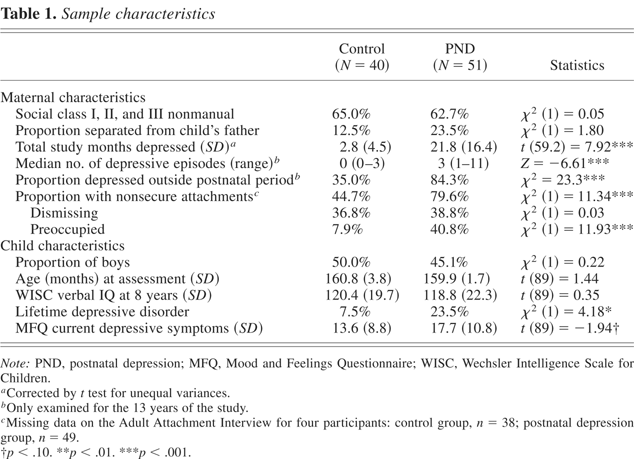
Sample characteristics
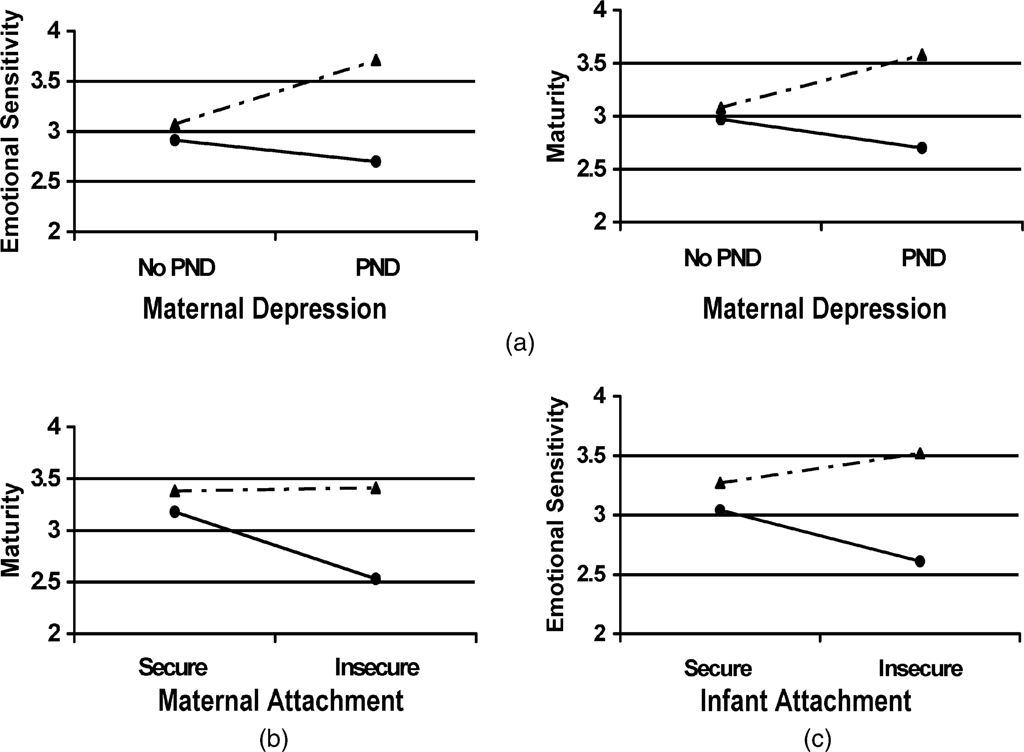
The effects of postnatal depression and maternal and infant attachment on adolescent socioemotional responses in relation to gender: (a) maternal depression, (b) maternal attachment, and (c) infant attachment; ([utrif ]) girls and ([bull ]) boys.
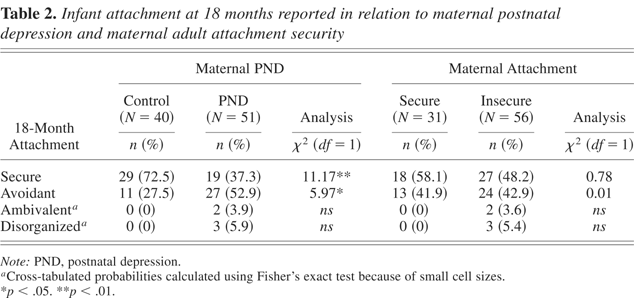
Infant attachment at 18 months reported in relation to maternal postnatal depression and maternal adult attachment security
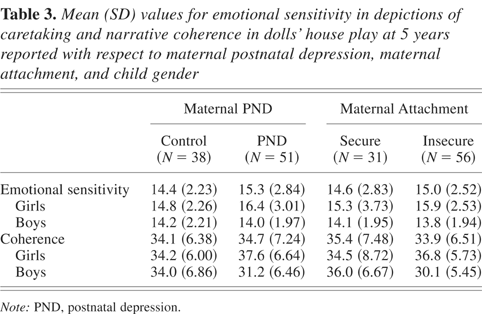
Mean (SD) values for emotional sensitivity in depictions of caretaking and narrative coherence in dolls' house play at 5 years reported with respect to maternal postnatal depression, maternal attachment, and child gender
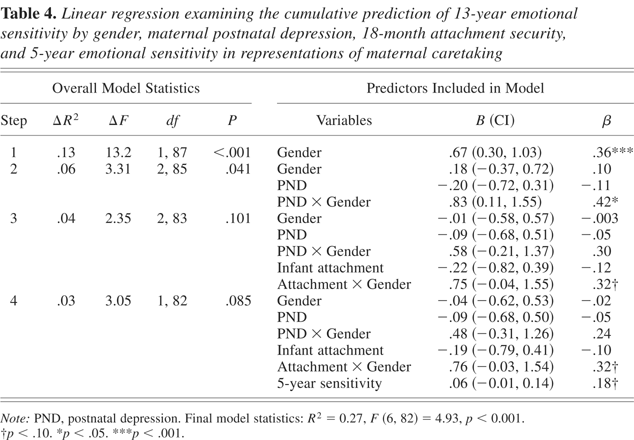
Linear regression examining the cumulative prediction of 13-year emotional sensitivity by gender, maternal postnatal depression, 18-month attachment security, and 5-year emotional sensitivity in representations of maternal caretaking
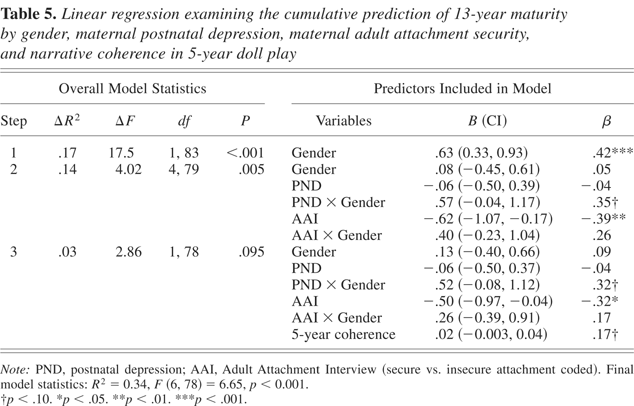
Linear regression examining the cumulative prediction of 13-year maturity by gender, maternal postnatal depression, maternal adult attachment security, and narrative coherence in 5-year doll play
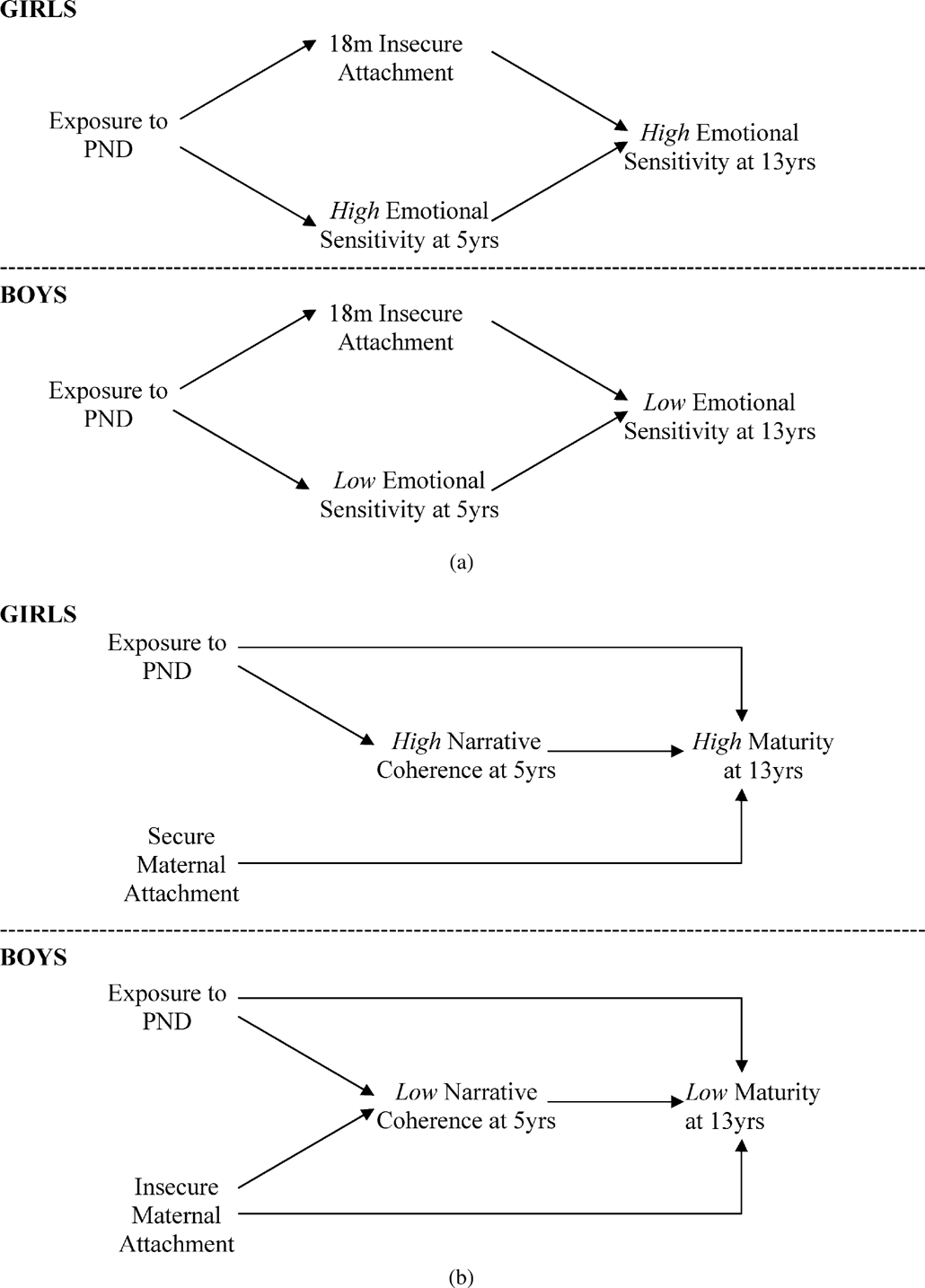
The overall patterns of pathways to emotional sensitivity and maturity in adolescents in relation to gender: the pattern of trajectories to (a) high and low emotional sensitivity and (b) high and low maturity in adolescent girls and boys.
 You have
Access
- 76
- Cited by