




No CrossRef data available.
Children's coping strategies and coping efficacy: Relations to parent socialization, child adjustment, and familial alcoholism
Published online by Cambridge University Press: 28 March 2006
Abstract
The relations of children's coping strategies and coping efficacy to parent socialization and child adjustment were examined in a sample of school-age children that included families in which some of the grandparents and/or parents had an alcoholism diagnosis. Parents and older children reported on the children's coping strategies; parents reported on their parenting behavior; and teachers reported on children's externalizing and internalizing problems. Measures of parent socialization were associated with parents' and children's reports of active coping strategies and parents' reports of both support-seeking coping and coping efficacy. Some of these relations were moderated by familial alcohol status. Children higher in parent-reported active/support-seeking coping and coping efficacy were rated lower in teacher-reported externalizing and internalizing adjustment problems. The findings were consistent with the view that active/support-seeking coping and coping efficacy mediated the association of parent socialization to children's psychological adjustment and that this relation was sometimes moderated by parental alcohol status.
This research was supported by a grant from the National Institute of Drug Abuse (DA05227; Laurie Chassin, Principle Investigator, Nancy Eisenberg, Co-Principal Investigator).
Information
- Type
- REGULAR ARTICLE
- Information
- Copyright
- 2006 Cambridge University Press
Children's constructive coping strategies are believed to buffer the effects of stressful experiences (Compas, Connor-Smith, Saltzman, Thomsen, & Wadsworth, 2001), and consequently, foster psychological well-being (Grant et al., 2003). Consistent with this view, some types of coping have been linked to psychological adjustment, although other less constructive modes of coping have been associated with poor psychological outcomes (Compas et al., 2001; Eisenberg, Fabes, & Guthrie, 1997; Sandler, Tein, & West, 1994). Thus, it is important to understand the factors that contribute to the development of different modes of coping, especially for at-risk children.
One factor of potential significance in this regard is parental socialization practices such as parental support and discipline consistency, which have been associated with individual differences in both children's coping and adjustment (Grant et al., 2003; Power, in press; Skinner & Edge, 2002). In the current study, we hypothesized that parental socialization would be associated with children's coping strategies and efficacy and that children's coping and efficacy would, in turn, be related to their psychological adjustment. In addition, because the aforementioned relations may vary depending on risk factors present within families, we examined these relations in a sample of children from homes at risk for parent alcoholism. Children of alcoholics (COAs) tend to exhibit elevated levels of a range of negative outcomes (West & Prinz, 1987), including problems with adjustment, both externalizing and internalizing (Chassin, Barrera, & Montgomery, 1997; Chassin, Pitts, DeLucia, & Todd, 1999; El-Sheikh & Buckhalt, 2003; Harter, 2000; Puttler, Zucker, Fitzgerald, & Bingham, 1998), impulsivity, and difficulties in regulating emotion and behavior (e.g., Brook, Tseng, & Cohen, 1996; Colder & Chassin, 1997; Eiden, Edwards, & Leonard, 2004; Giancola, Moss, Martin, Kirisci, & Tarter, 1996; Peterson & Pihl, 1990). Due to the role of regulation in coping (Eisenberg et al., 1997), COAs would be expected to have deficits in coping skills (Eisenberg et al., 1997), and suboptimal parenting would be expected to contribute to these deficits (Chassin et al., 1997).
Children's Coping
Compas et al. (2001) defined coping “as conscious volitional efforts to regulate emotion, cognition, behavior, physiology, and the environment in response to stressful events or circumstances” (p. 89). Within the coping research, one common approach has been to classify coping according to two broad dimensions, such as problem-focused versus emotion-focused coping (Lazarus & Folkman, 1984); however, these broad categories have been criticized for being too simplistic and for potentially making it difficult to detect associations between coping and outcomes (Carver, Scheier, & Weintraub, 1989). In response to such criticisms, Ayers, Sandler, West, and Roosa (1996) used 11 theoretically and empirically defined coping categories to identify (with confirmatory factor analyses) a four-factor model of coping that fit the data better than two-factor models of coping, a finding that has been replicated in different samples of children (Ayers et al., 1996; Sandler et al., 1994). The model consists of four conceptually distinct coping factors: active coping (cognitive decision making, direct problem solving, seeking understanding, positive thinking, and optimistic thinking), avoidant coping (avoidant actions, repression, and wishful thinking), support-seeking coping (support for actions and support for feelings), and distraction (physical release of emotions and distracting actions). Although findings in various laboratories differ somewhat, empirical data and conceptual reviews support the view that coping is multidimensional in nature (Compas et al., 2001; Skinner, Edge, Altman, & Sherwood, 2003).
In addition, investigators studying coping in children and youth have assessed both situational coping (coping in response to specific stressors) and dispositional coping (a more global measure of everyday coping). General coping styles are methods of coping that characterize a person's reactions to stress either across different situations or over time within a given situation. Individual differences in general coping styles reflect a tendency to respond in a particular way when confronted with stressful circumstances (Compas, 1987), and these differences influence the use of coping strategies in specific stressful situations (Ayers et al., 1996). In the present study, we used a global measure of coping as opposed to a measure of coping in response to a specific stressor because we hypothesized that family alcoholism and parent socialization would have effects on children's general styles of coping.
Another construct of importance within the coping literature is children's coping efficacy. Coping efficacy is a global belief that one can deal with situational demands and the emotions aroused by situations and, therefore, is the child's subjective evaluation that he or she can successfully deal with stressful situations now and in the future (Sandler, Tein, Mehta, Wolchik, & Ayers, 2000). Coping efficacy is believed to influence children's coping efforts and the use of various coping strategies, and the two are viewed as reciprocally related. As suggested by Sandler et al. (2000), if children's coping efforts are successful, their sense of efficacy will increase, and they will be more likely to use that coping strategy in the future. However, if children's coping efforts are met with negative outcomes, they may be less likely to use that strategy in the future and may feel a sense of helplessness and hopelessness, which would be expected to be associated with internalizing problems (e.g., Harter, 1999).
Although very few investigators have examined the relations of parental alcohol status to children's coping or coping efficacy (Chassin et al., 1997; Sher, 1991), children of alcoholic parents have been found to use less optimal coping strategies in adulthood (Hussong & Chassin, in press). As already noted, deficits in COAs' executive functioning and related aspects of regulation (e.g., Eiden et al., 2004; Peterson & Pihl, 1990) are likely to be reflected in the quality of COAs' coping. Thus, our first hypothesis was that children from homes with an alcoholic history would use less active, support-seeking, and distraction coping and more avoidant coping and have lower levels of coping efficacy.
Coping, Parent Socialization, and Familial Alcoholism
Although there are relatively few studies concerning the relations of parenting with effective coping strategies (Kliewer, Sandler, & Wolchik, 1994), in general, it has been argued that parental supportive rather than punitive interactions with children promote constructive coping (e.g., Eisenberg, Fabes, & Murphy, 1996; Kliewer, Fearnow, & Miller, 1996; Power, in press; Skinner & Edge, 2002). Skinner and Edge (2002) have argued that healthy self-systems for children's coping should develop if parents are supportive, provide appropriate discipline techniques to create structured and predictable contexts, and respect children while allowing freedom of expression. In such familial environments, children are likely to have positive relationships with their parents; therefore, children may be more likely to seek parental support and to listen to parents' suggestions for how to cope with stressors, a process that may allow more adaptive styles of coping to develop. As argued by Eisenberg, Cumberland, and Spinrad (1998), children who experience emotionally positive parenting during stressful situations are less likely than those with less positive parents to maintain an optimal level of arousal for learning constructive ways of regulating their emotion and behavior. Furthermore, parents in these types of families may be more likely to model constructive coping strategies.
There is some support for these predictions. Wolchik, Wilcox, Tein, and Sandler (2000) found that children's reports of parental acceptance and consistency of discipline were negatively related to their reported stress pertaining to their parents' recent divorce. Perhaps children with supportive, consistent parents were less likely than their peers to feel stressed by a recent divorce because their parents' behaviors allowed them to develop effective coping strategies. In addition, Hardy, Power, and Jaedicke (1993) found that relatively supportive parents had children with a greater variety of coping strategies. In a more direct test of the relation between parenting and child coping, Wolfradt, Hempel, and Miles (2003) found that German high school students' ratings of paternal and maternal warmth were associated with the use of more active coping. Similarly, Kliewer et al. (1996) found that children's perceptions of maternal acceptance were positively related to their use of active coping and support-seeking coping strategies, and paternal acceptance was positively related to boys' support-seeking coping. Thus, in general, supportive and consistent parenting has been related to coping strategies displayed by children, although the associations between parent socialization and child coping may differ for maternal versus paternal parenting behaviors.
A component of supportive parental socialization is reflected in parents' reactions to their children's displays of negative emotion when dealing with stressful situations. It has been argued that responding to children's negative emotions in a supportive manner can promote effective coping, whereas negative parental reactions have the potential to undermine children's coping (Eisenberg et al., 1997; Gottman, Katz, & Hooven, 1997; Skinner & Edge, 2002). Eisenberg, Fabes, Carlo, and Karbon (1992) found that parents' reports of supportive responses to children's negative emotions, which included helping their children deal with the emotions or with the emotional problem, were associated positively with children's constructive coping with real-life negative emotion. In contrast, parents' negative reactions to children's negative emotions, such as punitive responses or responses that devalued the children's emotions, tended to be related negatively to children's adaptive coping. Moreover, Eisenberg et al. (1996) found that parents' punitive or minimizing reactions to their children's negative emotions were negatively correlated with teacher-reported constructive coping (i.e., high support-seeking coping, problem-solving coping, cognitive restructuring, and low cognitive avoidance) and positively related to mother-reported avoidant coping. Conversely, the degree to which mothers reported responding in a positive, supportive manner to children's negative emotions was positively related to their own and teachers' reports of children's constructive coping (including support-seeking, cognitive restructuring, and problem-solving coping, as well as low aggressive coping).
To our knowledge, there is virtually no research on the socialization correlates of coping efficacy; however, it seems reasonable to predict that children also feel more efficacious if their parents are supportive and if parents respond to children's emotions with suggestions for solving the child's problem rather than with punitive or minimizing reactions. Consistent with this idea, Brook et al. (2002) found that adolescents' adaptive coping, a construct highly similar to coping efficacy, was positive related to paternal support, child centeredness, and availability, but not with fathers' having firm rules for their adolescents.
Unlike in most prior studies, in the present study, children's coping and coping efficacy were assessed with both parents' and children's reports. Our second set of hypotheses examined the relation of these conceptually distinct coping strategies and coping efficacy to both maternal and paternal supportive parenting and consistency of discipline. We expected active, support-seeking, and distraction coping, as well as coping efficacy, to be positively associated with both maternal and paternal supportive behavior and consistency of discipline, whereas avoidant coping was predicted to be negatively associated. Because in the past researchers have found that maternal parenting behaviors related to children's coping more frequently than paternal parenting (Kliewer et al., 1996; Ruchkin, Eisemann, & Hagglof, 1999), we examined maternal and paternal parenting separately and expected stronger relations for maternal socialization.
For multiple reasons, we expected parental socialization to be associated with inferior coping for COAs. Alcoholic parents probably tend to be poor models of effective coping given the link between alcoholism and poor emotion regulation (e.g., Sher, 1991). Alcoholic parents likely have experienced nonsupportive parenting themselves (e.g., Barnes, Reifman, Farrell, & Dintcheff, 2000), which they may model in their own child rearing. In addition, parental alcoholism can be a strong potential stressor in children's lives and can influence the quality of parental caregiving and the parent–child relationship (Chassin et al., 1997; Eiden, Edwards, & Leonard, 2002). Parents, who are struggling with alcoholism, or those dealing with an alcoholic partner, may tend to provide suboptimal parenting due to diminished capacities and psychological or material resources. In fact, adolescent COAs report receiving less parental warmth (Barnow, Schuckit, Lucht, John, & Freyberger, 2002), which might compromise the development of their coping skills. In addition, Eiden et al. (2004) found that fathers' warmth over the second year of life mediated the association between fathers' alcoholism and children's effortful control (i.e., regulation). Even if mothers are not alcoholic themselves, having an alcoholic spouse has been associated with deficits in parenting through the effects of paternal alcoholism on maternal depression and antisocial behavior (Eiden & Leonard, 2000; also see Eiden & Leonard, 1996). Therefore, our third hypothesis was that parents in families with alcoholism would be less supportive and consistent in their parenting than would parents without alcoholism.
Familial alcoholism may also moderate the relation of parental socialization to the quality of children's coping and their coping efficacy. El-Sheikh and Buckhalt (2003) found support for buffering effects of parenting on the relation between parental drinking and child outcomes. Therefore, our fourth hypothesis was that, in families with alcoholism, positive parenting may serve as a buffer against other factors (e.g., family stress and conflict) that might undermine the development of coping skills. Supportive and consistent parenting behaviors would be expected to be more strongly associated with adaptive coping and coping efficacy in families with a history of parent alcoholism than in families without such a history because these parenting behaviors may serve as a protective factor.
Even though parenting behaviors may function as a protective factor for children in families with a history of alcoholism, supportive and consistent parenting may also mediate the association of familial alcoholism to children's coping. El-Sheikh and Buckhalt (2003) found support for parenting playing both a moderating and a mediating role when examining the relations between parent alcoholism and child outcomes. Whereas moderation highlights the potential protective function of parent socialization, mediation analyses help to define the pathways through which a history of family alcoholism may exert effects. As a result, parental behaviors were examined as mediators of the association of familial alcoholism to child coping. We hypothesized that a history of family alcoholism would be associated with parental supportive and consistent parenting behaviors, which would in turn be associated with children's coping strategies and coping efficacy.
Coping and Children's Adjustment
In general, although not in all settings, some types of coping have been associated with positive developmental outcomes for children, whereas others have not (Compas et al., 2001; Kliewer et al., 1994; Sandler et al., 2000). Active coping has been positively related to adjustment, whereas disengagement modes of coping (e.g., avoidance) tend to be negatively related (Compas et al., 2001). Sandler et al. (1994) found that avoidant coping was positively associated with levels of depression, anxiety, and conduct problems when assessed concurrently. Active coping also predicted lower depression 5.5 months later, and distraction coping strategies predicted later lower levels of both depression and anxiety. In addition, children's coping efficacy has been positively associated with active coping and negatively associated with avoidant coping, and has mediated the association between quality of children's coping and their adjustment, such that higher coping efficacy was negatively associated with internalizing and externalizing problems (Sandler et al., 2000). Children without coping skills and a sense of efficacy in regard to their use are likely to experience high levels of negative emotions and, therefore, may be at risk for display externalizing behaviors because they lack strategies for dealing with stress and negative emotions.
Our next set of hypotheses examined relations between children's coping and adjustment. Based on prior research and theorizing on the regulation of emotion versus behavior (Eisenberg, Fabes, Guthrie, & Reiser, 2000), we expected some aspects of coping, particularly coping believed to modulate the experience of emotional distress (e.g., distraction coping), as well as internal feelings of coping efficacy, to be particularly related to low levels of internalizing problems (which involve emotional distress). Active coping was expected (and has been found; Compas et al., 2001) to relate to lower levels of both internalizing and externalizing problems because it is likely to affect both the internal experience of emotion and its outward expression. We tentatively hypothesized that support-seeking coping would be negatively associated with both types of problem behaviors, whereas avoidance coping would be negatively related primarily to externalizing behaviors (because it would result in avoiding conflictual interactions), although avoidance might also be positively related to internalizing because it may not provide an effective way of dealing with distress. Because COAs are at risk for both internalizing and externalizing problems, exploring the links between coping and adjustment is of particular relevance to examining factors contributing to COAs' risk for problem behaviors.
Children's Coping as a Mediator of the Relation of Parent Socialization to Children's Adjustment
Whereas research on the association between parent socialization and children's coping is limited and only suggestive, data pertaining to the relation of parent socialization to children's adjustment is abundant and fairly consistent. In general, parenting behavior that is high in warmth and support and consistent in regard to discipline, as well as low in harshness and rejection, has been related to lower levels of both internalizing and externalizing adjustment problems (e.g., Conger et al., 1993; Grant et al., 2003; Lengua, Wolchik, Sandler, & West, 2000; Patterson, 2002). Although some investigators (e.g., Grant et al., 2003) have argued that negative parenting mediates the relation between stress and children's adjustment, it also may be the case that children's coping is a mediator of the relation between parent socialization and children's adjustment. Coping is viewed as involving emotion-related regulation (e.g., Compas et al., 2001; Eisenberg et al., 1997), and the latter has been found to mediate the relation of parenting to adjustment (e.g., Brody & Ge, 2001; Eisenberg et al., 2001, 2003; Gottman et al., 1997). Moreover, Sher (1991) speculated that children's coping is a potential mediator of the relation of parental alcoholism to children's adjustment, and Eiden et al. (2004) found that paternal warm mediated the relation of fathers' alcoholism to 2-year-olds' effortful control (regulation). Therefore, our final hypothesis was that children's coping strategies and coping efficacy would mediate the patterns of associations between parenting and children's adjustment. We expected that the parents' consistent and supportive behaviors would be positively associated with their children's adaptive coping, and this adaptive coping would, in turn, be associated with the children's positive adjustment. In cases in which parental alcohol status moderated the association between parenting behaviors and coping or coping efficacy, we examined differences in coping/coping efficacy as a mediator of the relation of parenting to adjustment in the alcoholic and nonalcoholic families.
Method
Participants
The parents of the children in this study were participants in an ongoing longitudinal study examining the effects of parental alcoholism on Hispanic and Euro-American children's development. The initial sample (i.e., the parents) included an at-risk group of adolescents (generation 2 [G2]) who had at least one parent (generation 1 [G1]) with an alcoholism diagnosis and a comparison group in which neither parent (in G1) was diagnosed as alcoholic. The present study involved a follow-up to the initial study after approximately 15 years and included those adolescents (G2) and siblings who now, as adults, had children (generation 3 [G3]) between 5 and 13 years of age at the time of the follow-up assessment.
The original sample of COAs was recruited from court records of arrests for driving under the influence, health maintenance records, and community telephone screening. Interviews were conducted to determine if one of the adolescents' (G2) biological and custodial parents (G1) met the diagnostic criteria for alcoholism. A demographically matched control group was recruited using reverse telephone directories to locate control families within the same neighborhood. The control sample was matched on ethnicity, family structure, the target adolescent's (G2) age, and socioeconomic status obtained from property values. In addition, interviews were conducted to ensure that neither of the adolescents' parents (G1) met the diagnosis criteria for alcoholism. Additional information about the original recruitment procedure and representativeness of the sample can be found in Chassin, Barrera, Bech, and Kossak-Fuller (1992), Chassin, Flora, and King (2004), and Chassin et al. (1999).
Participants (G2) from the original sample were contacted about the follow-up assessment. Those participants with children (G3) and their spouses (if available) were interviewed in their homes. Information obtained at the home assessment included a diagnostic test of alcoholism status, as well as information on their parenting behavior with their own children. In addition to the home assessment, primary caregiving parents were invited to bring their children for a laboratory assessment, where they reported on their children's coping skills, coping efficacy, and parental reactions to children's negative emotions. Parents were given $70 for the home interviews and $15 for each set of questionnaires about the children's behaviors that the parents completed; families were given $50 for each laboratory assessment completed.
Data from participants who completed the laboratory assessment were used in the current investigation. This consisted of 180 families, including 293 children (M age = 7.43, SD = 2.27; 148 girls, 145 boys). Parents involved reported on up to four children (50% of the families had one child participating in the study, 40% had two children, 7% had three children, and 3% had four children). There were 286 parent questionnaires collected in the laboratory (254 were completed by mothers, 25 by fathers, 7 by maternal figures including grandmothers and stepmothers; seven of the children participating were missing parent questionnaire data primarily due to computer errors in the questionnaire survey software). Of the 293 children participating in the laboratory assessment, 251 mothers and 185 fathers completed the parenting measures collected in the home (159 children had both maternal and paternal reports of parenting collected in the home, 92 had only maternal reports, 26 had only paternal reports, and 16 parents of the children participating in the laboratory assessment did not complete the parenting measures in the home).
Of the families participating in the laboratory assessment, 85 of the families were from the group in which at least one grandparent had an alcohol diagnosis and 95 were from the original control group. In addition, 11% of the G2 mothers and 35% of the G2 fathers were diagnosed as alcoholic (14 mothers and 5 fathers who came into the laboratory received an alcoholism diagnosis). Given that all grandparents (G1) were either Euro-American or Hispanic, the children of mixed heritage were partly of these backgrounds. Sixty-four percent of the children participating in the laboratory visit were Euro-American, 30% were Hispanic, 2% were listed as African American, 4% were listed as “other,” and less than 1% was reported as American Indian. Primary caregivers who came to the laboratory reported on both maternal and paternal education: 7 and 14%, respectively, had less than a high school diploma, 31 and 33% had a high school diploma or equivalent, 37 and 31% had some college education, 13 and 8% earned a 2-year college degree, 9 and 10% had a college degree, and 3 and 5% had postbachelor education.
Because the older children in the sample could provide self-reports of their coping, children aged 8 and older (55 girls, 41 boys; M age = 10.17 years, SD = 1.56) were interviewed in the home about their coping skills (the avoidant subscale of the coping checklist and half the active coping subscale). At the laboratory assessment, children who were 7 years old or older (59 girls, 51 boys; M age = 9.93 years, SD = 1.62) completed the scales (with assistance) on the coping checklist that were not completed at the home assessment (support-seeking, distraction, and the remaining items on the active coping subscale), as well as a scale assessing coping efficacy. Coping scale items were divided between the two assessments to the limit the number of questions presented at one time so that the children's attention was not taxed. The coping questions were only to be administered to children ages 8 and older; however, we were able to have children ages 7 and older answer them when they came to the laboratory.
In addition to the information collected at the home and laboratory assessments, parents were asked to provide consent to contact a teacher who was very familiar with their child. Teachers were mailed a packet of questionnaires and mailed back the completed forms. Teachers completed questionnaires for 232 children.
Families who completed the laboratory visit were compared to families who did not participate in the laboratory assessment (either by declining participation in this wave of the data collection [for variables collected at the previous wave of data collection] or by declining participation in the laboratory visit). No differences were found in ethnicity, parent education, or grandparent alcoholism. Children with a nonalcoholic G2 parent, however, were more likely to participate in the laboratory session, χ2 (1, N = 300) = 8.41, p < .01.
Measures
Alcoholism measures
Grandparent (G1) diagnosis
Grandparents' lifetime alcoholism diagnosis was defined as alcohol abuse or dependence using DSM-III criteria, and was obtained from a computerized version of the Diagnostic Interview Schedule, Version III (CDIS-III; Robins, Helzer, Croughan, & Ratcliff, 1981). For noninterviewed grandparents, alcoholism diagnoses were based on Family History Research Diagnostic Criteria (Endicott, Anderson, & Spitzer, 1975), using information from their spouses' reports.
Parent (G2) diagnosis
At this assessment, lifetime alcohol abuse and dependence diagnoses were obtained using CDIS-III (Robins et al., 1981). Diagnoses were given if the respondent met DSM-III-R lifetime criteria for either abuse or dependence of alcohol. A composite score of parent alcohol status was created and included two groups: those with at least one parent having an alcoholism diagnosis, and cases in which neither parent received an alcohol diagnosis. Both parents had an alcoholism diagnosis in 6% of the families.
Coping measures
The children and their parents completed measures of coping and efficacy of coping. Descriptive information for the children's coping measures, including the number of participants for each scale, is presented in Table 1.
Means and standard deviations for coping and socialization measures

Coping strategies
The Children's Coping Strategies Checklist—Revision 1 (CCSC-R1; Program for Prevention Research, 1993, 1999) was used to assess children's coping strategies. The children and parents were asked to rate how often (1 = never, 4 = most of the time) the children used a particular strategy to solve their problems or to make themselves feel better when they had problems. The items reflected four dimensions of coping efforts (active, avoidance, support-seeking, and distraction strategies).
The active coping strategies dimension included six five-item subscales (in all examples, “your child” was used in the parent form of the questionnaire and needed changes for pronouns were made): (a) cognitive decision making (planning or thinking about ways to solve the problem, for example, “You” [or “Your child,” for parents] “thought about which things are best to do to handle the problem”), (b) direct problem solving (efforts to improve the problem situation, for example, “You tried to make things better by changing what you did”), (c) seeking understanding (efforts to find meaning in a problem situation or to try to understand it better, for example, “You tried to figure out why things like this happen”), (d) positive thinking (thinking about the good things that happened, for example, “You reminded yourself that overall things are pretty good for you),” (e) optimistic thinking (thinking about things in the future with a optimistic manner, for example, “You told yourself that it would be OK”), and (f) control (thinking that whatever happens can be dealt with, for example, “You told yourself [himself/herself] that you could handle this problem”).
The avoidance strategies dimension included three four-item subscales: (a) avoidant actions (efforts to avoid the problem by staying away from it or leaving it, for example, “You avoided it by going to your room”), (b) repression (repressing thinking of problems, for example, “You tried to ignore it”), and (c) wishful thinking (using wishful thinking or imagining the problem was better, for example, “You wished that bad things wouldn't happen”). Support-seeking coping strategies consisted of two four-item subscales: (a) support for actions (using other people as resources to assist in seeking solutions to the problem situation, such as seeking advice, information, or direct task assistance, for example, “You talked to someone who could help you solve the problem”), and (b) support for feelings (involving other people in listening to feelings or providing understanding to help the person be less upset, for example, “You talked about your feelings with someone who really understood”). Finally, distraction strategies consisted of two four-item subscales: (a) physical release of emotions (efforts to physically work off feelings with physical exercise, play or efforts to physically relax, for example, “You went bicycle riding”), and (b) distracting actions (efforts to avoid thinking about the problem situation by using distracting stimuli, entertainment or some distracting activity, for example, “You watched TV”). The items for each dimension were averaged to compute the score for the dimension.
As already noted, children completed the avoidance strategies (α = .70) and half of the active coping strategies (two items from each subscale) during the home assessment, and completed the other half of the active coping items (α for the complete active coping dimension = .82), as well as the support-seeking and the distraction coping scales (αs = .79 and .72) at the laboratory. Self-report data for active coping were used only for children who completed the scales at both the home and in the lab. Primary caregivers completed the active, avoidant, and support-seeking coping strategies scales (αs = .95, .70, and .92) in the lab. Because of time constraints and because we were concerned that parents would not really know if school-aged children used distraction, parents did not complete items on the distraction coping scale.
Coping efficacy
At the laboratory, children and their primary caregivers also rated the children's coping efficacy (Sandler et al., 2000). This scale consisted of seven items designed to measure the children's satisfaction with how they handled problems in the past (e.g., “Overall, how satisfied are you [is your child] with the way you [he/she] handled problems in the last month?”; 1 = not at all satisfied, 4 = very satisfied) and their anticipated effectiveness in handling future problems (e.g., “In the future, how good do you think you [your child] will usually be in handling your [his/her] problems?”; 1 = did not work at all, 4 = worked very well). The average of the seven items was computed (αs = .66 and .90 for children and caregivers, respectively).
Parenting measures
Parental (i.e., mothers' and fathers) consistency of rule enforcement/discipline, support, and punishment were assessed during the home assessment, and primary caregivers' (usually mothers') reactions to children's negative emotions were assessed at the laboratory. Descriptive information for the parenting measures is also presented in Table 1.
Consistency of rule enforcement and discipline
Both mothers and fathers rated (1 = strongly disagree, 5 = strongly agree) their own consistency of rule enforcement and discipline using eight items adapted from the Parental Behavior Inventory (Schaefer, 1965), five pertaining to the consistency of rule enforcement (e.g., “I soon forgot the rules I had made”), and three pertaining to the consistency of discipline subscale (e.g., “I punished my child for doing something one day but ignored it the next”; αs = .84 for mothers and .77 for fathers; also see Curran & Chassin, 1996).
Parental support
Mothers and fathers rated (1 = little or none, 5 = the most possible) seven items from the Network of Relations Inventory (Furman & Buhrmeister, 1985) that tap the amount of social support provided by the parents to their children (e.g., “How much can your child count on you to be there when he/she needs you, no matter what?”). Parents also completed two items on a harsh punishment scale adapted from the Parent Practices Scale (Strayhorn & Weidman, 1988). The scale measured the degree to which the parents use harsh punishment with their children (1 = never or almost never, 5 = many times each day; e.g., “Of all the times that you talk to your child about his/her behavior, what fraction are disapproval?”).
The harsh punishment scale was negatively correlated with the parents' social support scores, rs (249, 183) = −.31 and −.42, ps < .01, for mothers and fathers. Thus, the items in the harsh punishment subscale were reverse scored, and the items from the two scales were averaged to create a summary score of parental support (high social support and low harsh punishment; αs = .77 for mothers and .80 for fathers).
Coping with Children's Negative Emotions Scale (CCNES)
Primary caregivers completed the CCNES (Eisenberg et al., 1996, 1999; Fabes, Eisenberg, & Bernzweig, 1990). The CCNES consists of 12 situations in which children are likely to experience negative affect and distress. The primary caregivers rated (1 = very unlikely, 7 = very likely) how likely they were to respond to their children in six different ways in each of the 12 situations, resulting in six 12-item subscales: (a) distressed reactions: the degree to which parents experience distress when their children express negative affect (e.g., “If my child is going over to spend the afternoon at a friend's house and becomes nervous or upset because I can't stay there with him/her, … I would feel upset and uncomfortable because of my child's reaction”; α = .71); (b) punitive reactions: the degree to which parents respond with punitive reactions that decrease their exposure or need to deal with the negative emotions of their children (e.g., “If my child loses some prized possession and reacts with tears, … I would tell him/her that's what happens with you're not careful”; α = .75); (c) minimization reactions: the degree to which parents minimize the seriousness of the situation or devalue the child's problem or distressful reaction (e.g., “If my child is panicky and can't go to sleep after watching a scary TV show, … I would tell my child he/she is over-reacting”; α = .85); (d) expressive encouragement: the degree to which parents encourage their children to express negative affect or the degree to which they validate their children's negative emotional states (e.g., “If my child is afraid of injections and becomes quite shaky and teary while waiting for his/her turn to get a shot, … I would encourage my child to talk about his/her fears”; α = .89); (e) emotion-focused reactions: the degree to which parents respond with strategies that are designed to help the child feel better (e.g., “If my child is about to appear in a recital or sports activity and becomes visibly nervous about people watching him/her, … I would suggest that my child think about something relaxing so that his/her nervousness will go away”; α = .80); and (f) problem-focused reactions: the degree to which parents help their children solve the problem that caused the child's distress (e.g., “If my child falls off his/her bike and breaks it, and then gets upset and cries, … I would help my child figure out a way to get the bike fixed”; α = .73).
An exploratory factor analysis with varimax rotation was used to reduce the data from the CCNES. Two factors with eigenvalues over 1.0 emerged. The first factor accounted for 39% of the variance and reflected supportive reactions to children's distress (expressive encouragement, .81, emotion-focused reactions, .89, and problem-focused reactions, .90). The second factor accounted for 38% of the variance and reflected negative reactions (distress reactions, .77, punitive reactions, .87, and minimization reactions, .91). Based on the findings from the factor analysis, two summary scores, one for the positive subscales and one for the negative subscales, were created by averaging the scores on the three subscales that loaded together on each factor. The two indices of parental reactions to children's negative emotion, supportive reactions and negative reactions, r (283) = −.38, p < .001, were combined by taking the mean of the two scales (parental negative responses were reversed scored before creating the composite score).
Data reduction for maternal support measures
The measure of supportive behavior and the CCNES both assess the parents' support of either their children's behavior or negative emotions; therefore, a summary score of supportive behavior was created. Given that the majority of CCNES questionnaires were completed by mothers, the scores from maternal report on the CCNES and maternal supportive behavior measured in the home, which were interrelated, r (229) = .44, p < .01, were standardized and averaged. There were a total of 231 maternal reports of supportive parenting behaviors once the scores from the CCNES were combined with the home measures of supportive parenting (eight children were missing parent report on the CCNES, 25 cases of the CCNES were completed by fathers, and 29 of the mothers who completed the CCNES in the laboratory did not complete the supportive parenting measures collected in the home).
Adjustment measures
Externalizing behaviors
To measure externalizing behaviors, teachers completed the 24-item Child Behavior Checklist (Lochman & Conduct Problems Prevention Research Group, 1995). Teachers were asked to rate how often (1 = never to 4 = often) the children engaged in externalizing behaviors (e.g., “argues,” “yells at others,” “breaks rules”; α = .95).
Internalizing behaviors
Teachers completed two questionnaires about the children's internalizing behavior (see Thomas, Forehand, Armistead, Wierson, & Fauber, 1990, for a discussion of the validity of teacher reports of internalizing behaviors). The Teacher Report Index of Depression (Cole, Martin, Powers, & Truglio, 1996; Cole, Truglio, & Peeke, 1997) is a 13-item measure in which teachers report on the frequency (1 = never to 5 = often) of depressive symptoms (e.g., “Plays or works alone”; α = .90). Teachers also completed a 16-item anxiety scale, derived from items in Achenbach's Child Behavior Checklist (Kendall, Henin, MacDonald, & Treadwell, 1998). Teachers rated how often (1 = never to 5 = often) the child displayed anxiety symptoms (e.g., “Worrying,” “Nervous, highstrung, tense”; α = .88). The two internalizing scales were highly correlated, r (229) = .74, p < .01; therefore, the average of the two scales was computed and used as a measure of internalizing behaviors. Descriptive information for the adjustment variables can be found in Table 1.
Results
Results were examined using a mixed models design because mothers and fathers reported on multiple children in families with more than one child participating. In the mixed models analyses, error coefficients are allowed to vary randomly, and the lack of independence between error terms from the same reporter is statistically controlled (Bryk & Raudenbush, 1992). A two-level model was used. The data from each child were nested within each grandparent family. Three levels were not used because there was not sufficient variability at the parent level when nested at the grandparent level. The between child effects were examined while controlling for the within family effects. The degrees of freedom were estimated using the Satterthwaite approximation (because the computation of degrees of freedom is complicated and does not correspond easily to the sample size, we report ns as well as dfs).
Descriptive analyses
Analyses were conducted examining the relations between demographic factors and the variables of interest in the present study (child coping, parent socialization, and child adjustment). The demographic variable was a fixed effect in the mixed model predicting child coping or parent socialization. Because there were so few minority children who were not at least part Hispanic, Euro-American children were compared with minority status children.
The only significant association between child age and children's reported coping or coping efficacy was a negative relation of age to avoidant coping, B = −.01, t (94; n = 96) = −2.68, p < .01. In addition, parents reported that older children used more active and avoidant coping and less support-seeking coping, B = .004, .002, −.004, ts (243, 277, 257; ns = 280, 281, 283) = 3.60, 3.01, and −2.53, ps < .01. Parents reported that boys used less active coping and support-seeking coping compared to girls, Bs = −.14 and −.15, ts (252 and 260; ns = 280 and 283) = −2.41 and −1.97, ps < .02 and .05. Parents of Euro-American children reported that their children used less active coping and were lower in coping efficacy than did parents of minority children, B = .17 and .18, ts (183 and 158; ns = 280 and 282) = 2.16 and 2.36, ps < .03 and .02. When examining differences in the parent socialization measures, mothers reported less supportive parenting with older than with younger children, B = −.01, t (180; n = 231) = −3.74, p < .01, and with boys than with girls, B = −.23, t (203; n = 231) = −2.33, p < .02. Finally, teachers reported that Euro-American, compared to minority children, were higher in anxiety, B = −.24, t (71; n = 232) = −3.25, p < .01.
Relations between parents' and children's reports of children's coping
Mixed models were used to examine the relation of child-reported coping to parent-reported coping. Child- and parent-reported active coping, support-seeking coping, and coping efficacy were at least marginally positively associated, B = .21, .20, .15, ts (92, 104, 103; ns = 94, 107, 106) = 3.05, 2.53, 1.83, ps < .01, .01, .07. Child- and parent-reported avoidant coping scales were not associated, B = .01, t (92; n = 94) = .13, ns.1
Parents also completed 24 items from the COPE scale (Carver et al., 1989) to measure of their own coping behaviors. Three composite scores were computed and included active coping and planning (9 items; α = .77 and .79 for mothers and fathers, respectively), cognitive coping (9 items; α = .83 and .68 for mothers and fathers, respectively), and avoidance (6 items; α = .63 and .57 for mothers and fathers, respectively). Maternal active coping was negatively associated with child-reported distraction and positively associated with parent-reported child active coping, support seeking, and coping efficacy, Bs = −.22, .34, .49, .27, ts (86, 205, 204, 185; ns = 89, 219, 221, 220) = −1.89, 5.02, 5.61, 3.97, ps < .06, .01, .01, .01; maternal avoidant coping was positively associated with child-reported distraction and parent-reported child avoidant coping, Bs = .42, .15, ts (77, 216; ns = 89, 219) = 3.75, 3.22, ps < .01, .01; and maternal cognitive coping was negatively associated with child-reported avoidant coping and positively associated with parent-reported active coping, support-seeking, and coping efficacy, Bs = −.17, .16, .21, .12, ts (65, 199, 200, 174; ns = 82, 219, 221, 220) = −1.83, 2.54, 2.51, 1.87, ps < .07, .01, .01, .06. Paternal active coping was positively associated with parent-reported child active coping, avoidant, support-seeking, and efficacy, Bs = .22, .10, .17, .15, ts (165, 153, 162, 176; ns = 177, 178, 178, 179) = 2.80, 1.72, 1.78, 1.86, ps < .01, .09, .08, .06; paternal avoidant coping was negatively associated with both child- and parent-reported coping efficacy, Bs = −.23, −.16, ts (61, 120; ns = 67, 179) = −2.04, −1.96, ps < .05, .05.
Familial alcohol status and children's coping
To examine differences in children's coping related to parent alcohol status, the alcohol status of the parent was coded as having at least one alcoholic parent or not. Mixed model analyses were used where child coping was predicted from parent alcohol status, which was a fixed effect in the models along with child age as a control factor due to the latter's association with coping (child age was included as a control factor in the rest of the analyses). The only significant finding was that parents' reports of children's avoidant coping were higher in families with a parent alcoholism diagnosis, B = .10, t (180; n = 271) = 2.12, p = .04. The mixed models were also computed separately for boys and girls. The significant association between parent-reported avoidant coping and parent alcohol status was not significant for girls, B = .06, t (132; n = 135) = .86, ns, but was significant for boys, B = .16, t (96; n = 136) = 2.27, p = .03. No other significant associations were found.
Differences in child coping related to grandparent alcohol status were also examined. The alcohol status of the grandparent was coded as having at least one alcoholic grandparent or not. Parents of children in the grandparent alcoholic group reported lower scores on children's coping efficacy compared to parents of children in the grandparent control group, B = −.17, t (102; n = 282) = −2.32, p < .02. When the mixed models were examined separately for boys and girls, the significant association between parent-reported child efficacy and grandparent alcohol status was not significant for boys, B = −.05, t (87; n = 141) = −.47, ns, but was significant for girls, B = −.31, t (75; n = 141) = −3.14, p = .01.
Children's coping, parent socialization, and familial alcohol status
Relations of parenting to children's coping strategies
Mixed models were computed to examine the relation of children's coping strategies to parent socialization. Parent socialization measures and child age (as a control variable) were the fixed effects predicting children's coping (see Table 2).
Mixed model results for children's coping strategies related to parent socialization, controlling for child age

Because of the number of analyses, we emphasize general patterns of findings. Children's reports of active coping were at least marginally related to three of the four measures of parenting. Specifically, they were positively associated with maternal discipline consistency, maternal and paternal supportive parenting. There were few significant relations between parenting and children's reports of avoidant, support-seeking, or distraction coping.
Similar to the findings for children's reports of coping, parents' reports of children's active coping were positively related with mothers' reports of consistent discipline and supportive parenting and fathers' reports of supportive parenting. Moreover, all of the parenting variables except fathers' reports of consistent discipline were related to reports of children's support-seeking coping, and the findings generally held for both genders. There were relatively few relations between parents' reports of children's avoidant coping and the parent socialization variables. When across-reporter associations between mothers' report of children's coping (excluding any fathers' reports) and fathers' report of discipline consistency and supportive parenting were examined, controlling for child age, mothers' reports of active coping and support-seeking coping were still positively associated with fathers' report of supportive parenting, Bs = .24 and .34, ts (151 and 147; ns = 158 and 159) = 2.73 and 3.31, ps < .01.
Relations of parenting to children's coping efficacy
Because several of the associations differed by child gender, relations between children's coping efficacy and parent socialization are presented for the total sample as well as separately for girls and boys (see Table 3). Children's reports of coping efficacy were at least marginally positively related to several parenting variables, but more relations were found for boys. Boys' reports of efficacy were at least marginally positively related to mothers' reports of consistent discipline and supportive parenting. Girls' reported efficacy was marginally positively related to fathers' reports of supportive parenting.
Mixed model results for children's coping efficacy related to parent socialization, presented separately by child gender and controlling for child age

Parents' reports of children's coping efficacy were positively related to maternal consistent discipline and supportive parenting, as well as paternal supportive parenting (but not consistent discipline). This pattern of findings was clearest for supportive parenting and findings did not differ much across child gender. The association for father-reported supportive parenting was retained when only mothers' reports of coping efficacy were used in the analyses, B = .18, t (139; n = 159) = 2.09, p < .04.
Familial alcohol status and parental socialization
To examine differences in parent socialization (maternal and paternal consistency of discipline and supportive behaviors) related to parent/grandparent alcohol status, mixed model analyses were used where parent socialization was predicted from parent or grandparent alcohol status (coded as either having one alcoholic parent/grandparent or not). Parent/grandparent alcohol status was a fixed effect in the models along with child age, which was entered as a control factor. No significant associations were found between parent socialization and either parent or grandparent alcohol status.
Moderation by parental alcohol status
Mixed model analyses were computed to examine moderation between parental alcohol status and parental socialization when predicting coping and coping efficacy. Although child-reported efficacy related somewhat differently to parenting for boys and girls, we used only the total sample in these analyses to reduce the number of analyses. Composite scores were also created for maternal parenting behaviors combining maternal consistency of discipline and supportive parenting: the measures were correlated, r (229) = .35, p < .001. Because different patterns of associations were found between children's coping and the two measures of paternal parenting, paternal consistency of discipline and supportive parenting were not combined.
Interaction terms were created by centering continuous variables and multiplying parent alcohol status by the index of parental socialization (Aiken & West, 1991; Cohen, Cohen, West, & Aiken, 2003). The coping variable was the dependent variable, and child age, the parent socialization variable, parent alcohol status, and the interaction between parent socialization and parent alcohol status were entered as fixed effects.
Two (out of nine analyses) significant interaction terms were found when examining maternal parenting variables and children's coping and coping efficacy, and 4 (out of 18) of the interaction terms were significant for paternal parenting variables. Parent alcohol status moderated the associations between maternal supportive/consistent parenting and child-reported coping efficacy and parent-reported support-seeking coping, Bs for the interaction terms = −.35 and −.31, ts (74 and 219; ns = 85 and 224) = −2.23 and −2.08, ps < .03 and .04. Parent alcohol status moderated the associations between paternal consistency of discipline and children's reports of support-seeking coping, distraction coping, and coping efficacy, Bs = −.72, −.83, and −.55, ts (61, 62, 62; ns = 67) = −2.04, −2.32, and −2.08, ps < .05, .02, and .04, respectively, and also moderated the association between paternal supportive parenting and child-reported coping efficacy, B = −.62, t (62; n = 67) = −2.96, p < .01. When examining moderation between parenting and grandparent alcohol status, only one out of the 27 interaction terms was significant, and this finding was marginal.
Significant interactions terms for socialization were probed following procedures from Aiken and West (1991) and Cohen et al. (2003). Paternal consistent discipline was negatively associated with children's reports of both support-seeking and distraction coping for the alcoholic group, Bs = −.71 and −.67, ts (61 and 62) = −2.15 and −2.02, ps < .04 and .05, but was not associated with child-reported support-seeking or distraction coping for the nonalcoholic group, Bs = .01 and .16, ts (58 and 56) = .11 and 1.21, ns. Maternal supportive/consistent parenting, paternal consistent discipline, and paternal support were positively associated with children's reports of efficacy for the nonalcoholic groups, Bs = .27, .18, .38, ts (79, 62, 62) = 2.99, 1.91, 3.28, ps < .01, .06, .01, but not for the alcoholic groups, Bs = −.08, −.37, −.25, ts (78, 62, 62) = −.54, −1.49, −1.39, ns. Maternal supportive/consistent parenting was also positively related to parent-reported support-seeking coping for the nonalcoholic group, B = .52, t (193) = 6.03, p < .01, but not for the alcoholic group, B = .21, t (210) = 1.60, ns.
Parent socialization as a mediator
Mixed model analyses were computed to examine parent socialization as a mediator of the relation between familial alcoholism and children's coping. As recommended by MacKinnon, Lockwood, Hoffman, West, and Sheets (2002), mediation was considered to be significant if, in the first set of analyses, familial alcoholism predicted parent socialization, and if, in the second set of analyses, parent socialization (the mediator) predicted child coping (the dependent variable) when familial alcoholism was also entered as a fixed effect (child age was included as a control factor). Familial alcohol status did not predict parental socialization (as reported above); therefore, mediation models could not be examined.
Children's coping, parent socialization, and child adjustment
In the next set of analyses, we examined if coping mediated the relation between parenting and children's adjustment. To examine these issues, we first examined relations between coping and adjustment. Next, when relations were found, coping was examined as a mediator of the relation between parenting and children's adjustment. Mixed model analyses were computed to examine if children's coping potentially mediated the relation between parental socialization and teachers' report of children's adjustment (MacKinnon et al., 2002). Again, mediation was considered to be significant if, in the first set of analyses, socialization predicted child coping, and if, in the second set of analyses, child coping (the mediator) predicted child adjustment (the dependent variable) when socialization was also entered as a fixed effect (child age was included as a control factor). As in the previous analyses, the total sample for child-reported coping efficacy was used in these analyses. Given the similar pattern of findings between parental socialization and parents' reports of children's active and support-seeking coping, reports of these coping strategies, which were substantially correlated, r (278) = .57, p < .001, were combined by summing the mean of the two scores.
Children's coping and adjustment
Children's self-reports of coping efficacy were negatively associated with teachers' reports of the children's internalizing behaviors (see Table 4). Parents' reports of children's active/support-seeking coping were negatively associated with teachers' reports of both externalizing and internalizing problems. Parental report of child efficacy was also negatively associated with teachers' reports of child internalizing problems.
Mixed model results for teachers' report of adjustment related to child coping, controlling for child age

Coping as a mediator between parent socialization and teacher report of adjustment
Only the coping measures that were significantly associated with teachers' report of adjustment (child-reported and parent-reported coping efficacy, as well as parent-reported active/support-seeking coping) were included in the analyses because mediation requires an association between the mediator and the dependent variable when the independent variable is controlled (and findings with suppression effects for the mediator would be difficult to explain). The composite of parent-reported active/support-seeking coping, as well as the composite socialization measures of maternal supportive/consistent discipline2
Maternal supportive parenting was near significantly negatively associated with teacher-reported child externalizing behavior, B = −.08, t (125; n = 185) = −1.70, p < .09. None of the other parent socialization measures was significantly associated with child externalizing or internalizing. However, mediation does not require that the predictor and outcome variable be directly correlated (MacKinnon et al., 2002).
The number of maternal reports of supportive behavior decreased when the measure of supportive behavior in the home was combined with supportive behavior measured by the CCNES. However, the mediation analyses were similar when the maternal behavior composite included the measure of supportive behavior from the home assessment (and not the CCNES) combined with maternal discipline consistency.
Mixed model analyses examining child coping as a mediator between parent socialization and teachers' report of adjustment, controlling for child age

Children with mothers who were more supportive/consistent in their parenting and with fathers who were more supportive reported experiencing more coping efficacy. When both child-reported efficacy and maternal supportive/consistent parenting were entered as predictors of teacher-reported internalizing problems, child-reported coping efficacy remained a significant negative predictor (which indicated that child-reported coping efficacy could have mediated the association between maternal parenting and low levels of internalizing problems). Child-reported coping efficacy also remained a significant predictor of child internalizing problems when paternal supportive parenting was included as a predictor with child efficacy.
Parental reports of children's coping were also found to mediate the relation between parental socialization and teacher-reported child adjustment (see Table 5). Children with mothers higher in supportive/consistent parenting and fathers higher in supportive parenting were rated by parents as higher in active/support-seeking coping. Furthermore, indicative of mediation, children higher in parent-reported active/support-seeking coping were rated by teachers as lower on both externalizing and internalizing behaviors, even when the aforementioned parent socialization variables were included in the respective analyses. The findings were similar when parents' reports of children's coping efficacy were examined as mediators of the association between both maternal supportive/consistent parenting and paternal supportive parenting and teacher-reported internalizing problems. Parent-reported child efficacy, however, did not even marginally mediate the relation of maternal supportive/consistent parenting or paternal support to children's externalizing problems.
Because the relations of maternal supportive/consistent parenting, paternal consistency of discipline, and paternal support to child-reported coping efficacy were moderated by parental alcohol status, and because child-reported efficacy was also negatively related to teacher-reported internalizing (but not externalizing) problems, we examined differences between the alcoholic and nonalcoholic families in the mediated relation of each socialization measure to internalizing problems with child-reported coping efficacy as the mediator. In the first analysis, in which the main effects of parenting, alcohol group, and the interaction term were used to predict the mediator, maternal supportive/consistent parenting, paternal discipline consistency, and paternal supportive behavior both at least marginally predicted child-reported coping efficacy (in separate analyses), Bs = .31, .20, and .40, ts (65, 51, and 51) = 3.23, 1.89, and 3.25, ps < .01, .06, and .01; Bs = −.32, −.52, and −.83, and importantly, the interaction terms were at least marginally significant, ts (62, 51, and 51) = −1.84, −1.70, and −2.85, ps < .07, .10, and .01. In the next step, when the interaction between parent alcohol status and maternal supportive/consistent parenting, paternal consistency, or paternal support was entered with the main effects of the socialization variable and familial alcoholism, child-reported coping efficacy remained a significant or marginally significant predictor of teacher-reported internalizing, Bs = −.46, −.28, and −.41, ts (65, 50, and 46) = −3.16, −1.74, and −2.34, ps < .01, .09, and .02, for coping efficacy; Bs = .11, −.15, and .08, ts (65, 50, and 46) = .85, −1.18, and .46, ns, for parenting; Bs = −.17, .48, and −.37, ts (63, 50, and 50) = −.82, 1.31, and −.93, ns, for the interaction term. The number of participants for these analyses was 71 for maternal supportive/consistent parenting and 56 for both paternal discipline and support. Across the mixed model analyses, support was strongest for paternal supportive behavior and near significant (in at least one equation) for maternal or paternal consistency. Thus, it is plausible that child-reported efficacy mediated the relations between maternal parenting and paternal consistency of discipline and support (especially the latter) to low levels of internalizing problems and that this relation was moderated by parental alcohol status. Recall that in the previously reported moderation analyses, maternal supportive/consistent parenting, paternal consistent discipline, and paternal support were positively associated with children's reports of efficacy for the nonalcoholic groups, but not for the alcoholic groups.
We also examined differences between the alcoholic and nonalcoholic families in the mediated relation of maternal supportive/consistent parenting to both externalizing and internalizing with parent-reported active/support-seeking coping as the mediator. The first criterion for mediation was met; maternal supportive/consistent parenting significantly predicted parent-reported active/support-seeking coping, Bs = .53 and .53, ts (168 and 168) = 7.56 and 7.57, ps < .01; Bs = −.30 and −.29, and, most importantly, the interaction terms, ts (172 and 174) = −2.40 and −2.38, ps < .02. In the next step, when the interaction between parent alcohol status and maternal supportive/consistent parenting was entered with the main effects of the socialization variable and familial alcoholism, parent-reported active/support-seeking coping remained a significant predictor of both teacher-reported externalizing and internalizing, Bs = −.18 and −.26, ts (157 and 171) = −2.02 and −2.99, ps < .05 and .01, for active/support-seeking coping; Bs = .01 and .04, ts (142 and 166) = .07 and .46, ns, for maternal parenting; Bs = −.05 and .12, ts (140 and 167) = −.33 and .84, ns, for the interaction term. The number of participants was 178 for the externalizing analyses and 179 for internalizing analyses. Again, it is possible that parent-reported active/support-seeking coping mediated the relations between maternal supportive/consistent parenting to low levels of both externalizing and internalizing problems and that this relation was moderated by parental alcohol status. Recall in the initial moderation analyses that maternal supportive/consistent parenting was positively related to parent-reported support-seeking coping for the nonalcoholic group, but not for the alcoholic group. Because grandparent alcohol status did not moderate the relations of parenting (G2) to the children's coping or coping efficacy, it was not examined as a moderator of the mediated relations.
Discussion
Research on the role of parent socialization related to children's coping is quite limited. Thus, we examined the relations of children's coping strategies and coping efficacy with parental socialization, children's adjustment, and family alcohol status. We also examined moderation of the association between socialization and coping variables by familial alcohol status as well as parent socialization as a mediator of the relation of familial alcohol status to children's coping. Parent socialization was associated with some types of children's coping strategies, especially active coping, support-seeking coping, and coping efficacy; some of these relations were moderated by parent alcohol status. In addition, children higher in certain coping strategies and in coping efficacy were rated by teachers as lower in externalizing and internalizing adjustment problems. Although concurrent data cannot provide strong evidence for mediational processes, the pattern of findings was consistent with the conclusion that children's coping strategies and coping efficacy may mediate the association of parental socialization to children's psychological adjustment, and that the mediated model sometimes may differ for families with and without a history of parental alcoholism.
Contrary to expectations, parental alcoholism was related only to parents' reports of children's avoidant coping; children with an alcoholic parent were more likely to use avoidant coping. Such coping is viewed as relatively maladaptive and may be learned either through modeling or because children with alcoholic parents may learn that it often is useful to avoid stressful social interactions. Grandparent alcoholism was unrelated to children's coping. The relative dearth of differences between familial alcoholism and children's coping is surprising given the link between familial alcoholism and children's regulation. The children in this study were mostly aged 5 to 10; relations of parenting to children's coping may consolidate over time. Moreover, as children become more insightful reporters of their own coping with age, such relations might be more evident. The lack of findings may also be due to the fact that most of the alcoholic parents were fathers, and mothers may usually be a more important agent for teaching children coping skills.
Regardless of familial alcoholism, our findings indicate that parenting was related to certain types of children's coping, as well as to their coping efficacy. As we expected, higher levels of active coping as reported by children and parents generally were related to higher levels of maternal discipline consistency and supportive parenting, as well as paternal supportive parenting. The same pattern of relations was found for parents' reports of children's support-seeking strategies. As suggested by Skinner and Edge (2002), parenting behaviors high in warmth, support, and consistency may promote children's coping skills. In addition, parents who are supportive and who use consistent discipline may be better models of constructive coping. Of course, it is also possible that children with good coping skills elicit higher levels of positive parenting from their mothers and fathers or that inherited temperamental factors are partly responsible for the association between parenting and children's coping.
Very few associations, however, were found between avoidance and distraction coping strategies and parental socialization. Parenting behaviors may have less of an impact on avoidance and distraction coping strategies than active or support-seeking coping because the former types of coping are less likely to involve social interaction. Because children's coping strategies can bring them into and out of certain social contexts (Skinner & Edge, 2002), coping strategies that enhance social interaction (i.e., some types of active and support-seeking coping) might be more likely to elicit reactions from social partners and, consequently, be more closely associated with parental socialization than are coping strategies that are less likely to involve social interaction (i.e., avoidance coping and distraction) (Skinner & Edge, 2002). Coping that brings children into social contact would be more likely to allow parents to be actively involved in the children's coping, a process that could further enhance children's coping strategies. Another reason for the lack of association between parent socialization and avoidant and distraction coping could be the nature of these types of coping strategies. Some types of distraction coping strategies, as well as avoidant coping that does not involve active movement away from events or people, involve less overt behavior than support-seeking or active coping (Kliewer et al., 1996). Children may have had more difficulty recalling or even processing the use of these strategies than recalling the use of active and support-seeking strategies, and parents may not be as accurate in rating the occurrence of more covert types of strategies as they are when rating overtly exhibited coping behaviors.
We also expected children's coping efficacy to be associated with parental socialization, and this hypothesis was partially supported by the findings of the present study. The pattern of relations between children's reports of coping efficacy and parent socialization were different within child gender (although not necessarily significantly different across gender). Higher maternal discipline consistency and higher maternal supportive behaviors were related to higher child-reported coping efficacy for boys. Higher paternal support was marginally positively related to greater child-reported coping efficacy for girls. One possible reason for maternal parenting relating to boys' coping efficacy could be that mothers feel it is more important for boys to be in control of (i.e., cope with) their emotions. Clearly, boys have more difficulty with externalizing problems than do girls, especially physical aggression and overt antisocial behaviors (Dodge, Coie, & Lynam, in press), so there is reason for parents to focus on boys' coping efficacy (see Keenan & Shaw, 1997, for a review of the literature on how differential socialization practices for boys vs. girls may be related to the development of gender differences in problem behavior). In addition, higher parent-reported coping efficacy was related to higher levels of maternal and paternal supportive parenting (and the pattern of within child gender relations was similar for boys and girls). Not only are children with supportive parents likely to adopt more adaptive coping strategies than other children, but due to positive parental feedback and their history of successful coping, they also may be more likely to believe in their ability to effectively use coping strategies.
Findings regarding the associations between parent socialization and active coping were similar for parent-reported and child-reported active coping strategies. In contrast, associations with socialization were found for parents', but not children's, reports of children's support-seeking strategies and, in general, more associations were obtained for parent-reported coping strategies and coping efficacy. Except for avoidant coping, parents' reports of coping strategies and efficacy were associated with children's reports of the same construct; however, parents and children provide different perspectives on the children's coping strategies and efficacy. Children's self-reports of coping strategies and coping efficacy may have been limited by the children's reluctance to report using unsuccessful coping strategies (Compas et al., 2001), or they may not realize that they use some coping strategies. The difference in the number of findings for child- versus parent-reported coping could also be due to the facts that parents reported on both socialization and coping and that the sample size was considerably larger for parental than child reporters.
Parental alcohol status moderated several of the associations between maternal and paternal socialization and children's reports of their coping and coping efficacy. We expected that the relations between parenting and children's coping would be stronger in the alcoholic families because parenting would be a protective factor in those families; however, mothers' supportive/consistent parenting as well as fathers' consistency of discipline and supportive parenting were more strongly related to child-reported coping efficacy for children in families without alcoholism than in families with alcoholism. These findings seem to be somewhat consistent with El-Sheikh and Buckhalt's (2003) findings regarding the relation of child-reported attachment with the parent to parent- and teacher-reported social problems, in that a secure attachment to parents was a protective factor only in families without an identified drinking problem. Maternal supportive/consistent parenting was also associated with parent-reported support-seeking coping in the nonalcoholic but not in the alcoholic families, and this finding may further support the idea that parenting may be a protective factor more in the nonalcoholic than in the alcoholic families.
Unexpectedly, we also found that, in the alcoholic group, more paternal discipline consistency was associated with lower levels of child-reported support-seeking and distraction coping. Fathers of COAs who reported using consistent discipline may have been more involved with their children than those who did not report using consistent discipline. Perhaps children with alcoholic parents (the majority of whom were fathers) who are actively involved in parenting are reluctant to seek parental assistance with coping because they lack confidence that their parents will provide useful assistance in coping (due to negative examples at home), and the finding that parents' reports of children's avoidant coping were higher in alcoholic families is consistent with this explanation. These findings suggest that alcohol abuse within a family has the potential to interfere with the constructive role that positive parenting behavior can play in the development of children's coping strategies.
Paternal socialization, in comparison to maternal socialization, may have moderated more of the relations of parenting to the children's reports of their coping primarily because most of the alcoholic parents were fathers. Fathers' consistent parenting may have had a different meaning for children with alcoholic fathers than with nonalcoholic fathers. Moreover, other factors, such as parental personality, are likely related to parental alcoholism and may interact in predicting not only parents' childrearing (as was found by Brook, Whiteman, Balka, & Cohen, 1995), but also children's coping and adjustment (see Brook, Whiteman, Shapiro, & Cohen, 1996). In any case, our findings about the moderational role of parent alcohol status seem to be consistent with those of El-Sheikh and Buckhalt (2003) in demonstrating that parental alcoholism and the quality of the parent–child relationship (and family functioning) interact when predicting children's social and behavioral adjustment.
Based on past findings (Compas et al., 2001; Kliewer et al., 1994), we expected coping strategies and coping efficacy to be associated with children's psychological adjustment. Both children's and parents' reports of coping efficacy were negatively related with teacher-reported internalizing (but not externalizing) problems. Children's perceptions of their coping efficacy would be expected to relate to their feelings of control versus helplessness and depression. Consistent with Compas' review, parents' reports of children's active/support-seeking coping were negatively associated with teachers' reports of both internalizing and externalizing problems; these modes of coping can be used to modulate internal emotion and also can change a stressful situation or elicit help in changing it. Moreover, the pattern of findings is consistent with the possibility that children's coping strategies and coping efficacy sometimes mediated associations between parent socialization and adjustment. Parent-reported active/support-seeking coping mediated the negative associations of maternal supportive/consistent parenting and paternal supportive parenting with both externalizing and internalizing adjustment problems. Furthermore, both child- and parent-reported coping efficacy mediated the negative associations of maternal supportive/consistent parenting and paternal supportive parenting with children's internalizing adjustment problems. In addition, consistent with the moderated relations already discussed, parental alcoholism moderated some of the relations of socialization with adjustment, as mediated by children's coping.
Thus, children with more maternal support and consistent discipline and more paternal support displayed more active/support-seeking coping and coping efficacy (as reported by both parents and children), and those coping strategies were associated with better psychological adjustment. These findings are consistent with the conclusion that parenting behavior can influence children's coping and coping efficacy, which in turn, influence children's adjustment. However, we cannot prove causal relations, especially with concurrent data. The fact that parenting seldom predicted adjustment when controlling for coping indicates that parenting did not mediate the relations between coping and adjustment. Moreover, it is possible that a third variable, such as heredity, marital conflict, neighborhood violence, or the children's temperament, may affect parenting, children's coping, and their adjustment, and that parenting and coping do not have causal effects on adjustment. The fact that parenting was only weakly related to adjustment (see footnote 2) suggests that mediation was indirect. MacKinnon et al. (2002), like Kenny, Kashy, and Bolger (1998), have argued that mediation can occur even when an independent variable does not predict the criterion (outcome) variable (or only weakly predicts it). Thus, our findings suggest that parenting may have indirect effects on teacher-reported adjustment through its effects on coping. It is quite possible that relations of parenting to adjustment would be stronger if adjustment had been reported by the children or by a parent because problem behaviors can differ across the home and school contexts. Nonetheless, having a different reporter of adjustment than of coping and socialization is the more stringent test of mediation.
Fathers' reports of consistent discipline generally were unrelated to coping, except when moderated by familial alcoholism status. Maternal parenting may play a particularly important role in children's coping (Ruchkin et al., 1999). Also, our findings on paternal discipline consistency are similar to Brook et al.'s (2002) finding in a study including parents with substance abuse problems; paternal support, but not holding definite rules, was related to adolescents' perceptions of being an adaptive coper. However, paternal consistency was positively related to children's efficacy in nonalcoholic families. Differences in variability of maternal and paternal practices (i.e., SDs) do not seem to account for the differences in the findings for mothers and fathers. The sample size for fathers was smaller than for mothers, but fathers' supportive parenting was associated with children's coping. Fathers' discipline consistency may have less of an impact because fathers interact less with their children or because the effects of paternal consistency varied as a function of parental alcoholism.
Unexpectedly, familial alcohol status generally was not related to consistency of discipline and supportive parenting practices for either mothers or fathers using the measures in this paper; therefore, we could not examine the hypothesis that parenting practices would mediate the association between familial alcohol status and child coping. Perhaps there are larger differences related to familial alcoholism in parents' aversive, negative parenting than in the supportive and consistent parenting measured here. Only two of the nine items used in the parental support measure assessed harsh parenting, and these questions did not reflect extreme levels of negative parenting behaviors. In addition, we may have found more of a difference if the children had reported on the parents' behavior (which was not done because many of the children were young and we were concerned that some parents would object). Another consideration is that relatively few of the mothers were alcoholic, which would have reduced the odds of finding differences based on alcoholism in maternal parenting. More findings may have been obtained if all fathers had completed the CCNES (recall it was administered only in the laboratory). In addition, many of the studies in which parenting was related to familial alcohol status involved young children (Eiden & Leonard, 1996, 2000); familial alcoholism may undermine the quality of parenting less for older children who need less support and constant attention, or it may undermine different dimensions of parenting in children than in infants (e.g., parental monitoring may be very important as offspring become adolescents). The effects of familial alcoholism may also depend upon the children's developmental stage when exposed to active periods of parental drinking versus periods of recovery (Harter, 2000; Sher, 1991). Grandparent alcoholic status had little relation to coping or G2 parenting and did not moderate the relations between G2 parent socialization and children's coping. This may have been partly because we had information on only one set of grandparents.
Strengths of the current study include the fact that the measures of coping were completed by multiple reporters (parents and children), and that an independent assessment of adjustment problems was provided by teachers. In addition, this study is one of very few examining the relations of socialization to children's coping efficacy. Another strength is the focus on parental alcoholism as moderators of the targeted relations. Limitations of the current study include the relatively small sample size for child-reported coping and the lack of a measure of children's perceptions of parenting (or of observed parenting). Having a measure of children's perceptions of parenting or of observed parenting would help to eliminate any reporter bias in the cases where parents completed both the coping and parenting measures. Finally, as already noted, the results cannot establish a causal role of parent socialization to children's coping or of children's coping to children's adjustment; alternative explanations for the results are plausible. Nonetheless, the findings are consistent with the possibility of mediation by coping and coping efficacy of the relation of parental socialization with children's adjustment.
References
REFERENCES
Aiken, L. S., &
West, S. G.
(1991).
Multiple regression: Testing and interpreting interactions.
Thousand Oaks, CA:
Sage.
Ayers, T. S.,
Sandler, I. N.,
West, S. G., &
Roosa, M. W.
(1996).
A dispositional and situational assessment of children's
coping: Testing alternative models of coping.
Journal of Personality,
64,
923–958.CrossRefGoogle Scholar
Barnes, G. M.,
Reifman, A. S.,
Farrell, M. P., &
Dintcheff, B. A.
(2000).
The effects of parenting on the development of adolescent alcohol
misuse: A six-wave latent growth model.
Journal of Marriage and Family,
62,
175–186.CrossRefGoogle Scholar
Barnow, S.,
Schuckit, M. A.,
Lucht, M.,
John, U., &
Freyberger, H.-J.
(2002).
The importance of a positive family history of alcoholism, parental
rejection and emotional warmth, behavioral problems and peer substance use
for alcohol problems in teenagers: A path analysis.
Journal of Studies in Alcohol,
63,
305–315.CrossRefGoogle Scholar
Brody, G. H., &
Ge, X.
(2001).
Linking parenting processes and self-regulation to psychological
functioning and alcohol use during early adolescence.
Journal of Family Psychology,
15,
82–93.CrossRefGoogle Scholar
Brook, D. W.,
Brook, J. S.,
Whiteman, M.,
Arencibia-Mireles, O.,
Pressman, M. A., &
Rubenstone, E.
(2002).
Coping in adolescent children of HIV-positive and HIV-negative
substance-abusing fathers.
Journal of Genetic Psychology,
163,
5–23.CrossRefGoogle Scholar
Brook, J. S.,
Tseng, L.-J., &
Cohen, P.
(1996).
Toddler adjustment: Impact of parents' drug use, personality
and parent–child relations.
Journal of Genetic Psychology,
157,
281–295.CrossRefGoogle Scholar
Brook, J. S.,
Whiteman, M.,
Balka, E. B., &
Cohen, P.
(1995).
Parent drug use, parent personality, and parenting.
Journal of Genetic Psychology,
156,
137–151.CrossRefGoogle Scholar
Brook, J. S.,
Whiteman, M.,
Shapiro, J., &
Cohen, P.
(1996).
Effects of parent drug use and personality on toddler
adjustment.
Journal of Genetic Psychology,
157,
19–35.CrossRefGoogle Scholar
Bryk, A. S., &
Raudenbush, S. W.
(1992).
Hierarchical linear models: Applications and data analysis
methods.
Newbury Park, CA:
Sage.
Carver, C. S.,
Scheier, M. F., &
Weintraub, J. K.
(1989).
Assessing coping strategies: A theoretically based approach.
Journal of Personality and Social Psychology,
56,
267–283.CrossRefGoogle Scholar
Chassin, L.,
Barrera, M.,
Bech, K., &
Kossak-Fuller, J.
(1992).
Recruiting a community sample of adolescent children of alcoholics:
A comparison of three subject sources.
Journal of Studies on Alcohol,
53,
316–320.CrossRefGoogle Scholar
Chassin, L.,
Barrera, M., Jr., &
Montgomery, H.
(1997).
Parental alcoholism as a risk factor. In
S. A. Wolchik &
I. N. Sandler (Eds.),
Handbook of children's coping: Linking theory and
intervention (pp.
101–129).
New York:
Plenum Press.
Chassin, L.,
Flora, D. B., &
King, K. M.
(2004).
Trajectories of alcohol and drug use and dependence from adolescence
to adulthood: The effects of familial alcoholism and personality.
Journal of Abnormal Psychology,
113,
483–498.CrossRefGoogle Scholar
Chassin, L.,
Pitts, S. C.,
DeLucia, C., &
Todd, M.
(1999).
A longitudinal study of children of alcoholics: Predicting young
adult substance use disorders, anxiety, and depression.
Journal of Abnormal Psychology,
108,
106–119.CrossRefGoogle Scholar
Cohen, J.,
Cohen, P.,
West, S. G., &
Aiken, L. S.
(2003).
Applied multiple regression/correlation analysis for the
behavioral sciences
(3rd ed.).
Mahwah, NJ:
Erlbaum.
Colder, C. R., &
Chassin, L.
(1997).
Affectivity and impulsivity: Temperament risk for adolescent alcohol
involvement.
Psychology of Addictive Behaviors,
11,
83–97.CrossRefGoogle Scholar
Cole, D. A.,
Martin, J. M.,
Powers, B., &
Truglio, R.
(1996).
Modeling casual relations between academic and social competence and
depression: A multitrait-multimethod longitudinal study of
children.
Journal of Abnormal Psychology,
105,
258–270.CrossRefGoogle Scholar
Cole, D. A.,
Truglio, R., &
Peeke, L.
(1997).
Relation between symptoms of anxiety and depression in children: A
multitrait-multimethod-multigroup assessment.
Journal of Consulting and Clinical Psychology,
65,
110–119.CrossRefGoogle Scholar
Compas, B. E.
(1987).
Coping with stress during childhood and adolescence.
Psychological Bulletin,
101,
393–403.CrossRefGoogle Scholar
Compas, B. E.,
Connor-Smith, J. K.,
Saltzman, H.,
Thomsen, A. H., &
Wadsworth, M. E.
(2001).
Coping with stress during childhood and adolescence: Problems,
progress, and potential in theory and research.
Psychological Bulletin,
127,
87–127.CrossRefGoogle Scholar
Conger, R. D.,
Conger, K. J.,
Elder, G. H., Jr.,
Lorenz, F. O.,
Simons, R. L., &
Whitbeck, L. B.
(1993).
Family economic stress and adjustment of early adolescent
girls.
Developmental Psychology,
29,
206–219.CrossRefGoogle Scholar
Curran, P., &
Chassin, L.
(1996).
A longitudinal study of parenting as a protective factor for
children of alcoholics.
Journal of Studies on Alcohol,
57,
305–313.CrossRefGoogle Scholar
Dodge, K. A.,
Coie, J. D., &
Lynam, D.
(in press).
Aggression and antisocial behavior in youth. In
W. Damon &
R. L. Lerner (Senior Eds.) &
N. Eisenberg (Vol. Ed.),
Handbook of child psychology. Social, emotional, and personality
development
(Vol. 3, 6th ed.).
New York:
Wiley.
Eiden, R. D.,
Edwards, E. P., &
Leonard, K. E.
(2002).
Mother–infant and father–infant attachment among
alcoholic families.
Development and Psychopathology,
14,
253–278.Google Scholar
Eiden, R. D.,
Edwards, E. P, &
Leonard, K. E.
(2004).
Predictors of effortful control among children of alcoholic and
nonalcoholic fathers.
Journal of Studies on Alcohol,
65,
309–319.CrossRefGoogle Scholar
Eiden, R. D., &
Leonard, K. E.
(1996).
Parent–infant interactions among families with alcoholic
fathers.
Development and Psychopathology,
11,
745–762.Google Scholar
Eiden, R. D., &
Leonard, K. E.
(2000).
Paternal alcoholism, parental psychopathology, and aggravation with
infants.
Journal of Substance Abuse,
11,
17–29.CrossRefGoogle Scholar
Eisenberg, N.,
Cumberland, A., &
Spinrad, T. L.
(1998).
Parental socialization of emotion.
Psychological Inquiry,
9,
241–273.CrossRefGoogle Scholar
Eisenberg, N.,
Fabes, R. A.,
Carlo, G., &
Karbon, M.
(1992).
Emotional responsivity to others: Behavioral correlates and
socialization antecedents. In
W. Damon (Ser. Ed) &
N. Eisenberg &
R. Fabes (Vol. Eds.),
New directions for child development: No. 55. Emotion and its
regulation in early development (pp.
57–73).
San Francisco, CA:
Jossey–Bass.
Eisenberg, N.,
Fabes, R. A., &
Guthrie, I. K.
(1997).
Coping with stress. The roles of regulation and development.
In
S. A. Wolchik &
I. N. Sandler (Eds.),
Handbook of children's coping: Linking theory and
intervention (pp.
41–70).
New York:
Plenum Press.
Eisenberg, N.,
Fabes, R. A.,
Guthrie, I. K., &
Reiser, M.
(2000).
Dispositional emotionality and regulation: Their role in predicting
quality of social functioning.
Journal of Personality and Social Psychology,
78,
136–157.CrossRefGoogle Scholar
Eisenberg, N.,
Fabes, R. A., &
Murphy, B. C.
(1996).
Parents' reactions to children's negative emotions:
Relations to children's social competence and comforting
behavior.
Child Development,
67,
2227–2247.CrossRefGoogle Scholar
Eisenberg, N.,
Fabes, R. A.,
Shepard, S. A.,
Guthrie, I. K.,
Murphy, B. C., &
Reiser, M.
(1999).
Parental reactions to children's negative emotions:
Longitudinal relations to quality of children's social
functioning.
Child Development,
70,
513–534.CrossRefGoogle Scholar
Eisenberg, N.,
Gershoff, E. T.,
Fabes, R. A.,
Shepard, S. A.,
Cumberland, A. J.,
Lososya, S. H.,
et al.
(2001).
Mothers' emotional expressivity and children's behavior
problems and social competence: Mediation through children's
regulation.
Developmental Psychology,
37,
475–490.CrossRefGoogle Scholar
Eisenberg, N.,
Valiente, C.,
Morris, A. S.,
Fabes, R. A.,
Cumberland, A.,
Reiser, M.,
et al.
(2003).
Longitudinal relations among parental emotional expressivity,
children's regulation, and quality of socioemotional
functioning.
Developmental Psychology,
39,
2–19.Google Scholar
El-Sheikh, M., &
Buckhalt, J. A.
(2003).
Parental problem drinking and children's adjustment: Attachment
and family functioning as moderators and mediators of risk.
Journal of Family Psychology,
17,
510–520.CrossRefGoogle Scholar
Endicott, J.,
Anderson, N., &
Spitzer, R. L.
(1975).
Family history diagnostic criteria.
New York:
New York Psychiatric Institute, Biometrics Research.
Fabes, R. A.,
Eisenberg, N., &
Bernzweig, J.
(1990).
Coping with Children's Negative Emotions Scale (CCNES):
Description and scoring.
Tempe, AZ:
Arizona State University.
Furman, W., &
Buhrmeister, D.
(1985).
Children's perceptions of the personal relationships in their
social networks.
Developmental Psychology,
21,
1016–1024.CrossRefGoogle Scholar
Giancola, P.,
Moss, H.,
Martin, C.,
Kirisci, L., &
Tarter, R.
(1996).
Executive cognitive functioning predicts reactive aggression in boys
at high risk for substance abuse: A prospective study.
Alcoholism: Clinical and Experimental Research,
20,
740–744.CrossRefGoogle Scholar
Gottman, J. M.,
Katz, L. F., &
Hooven, C.
(1997).
Meta-emotion: How families communicate emotionally.
Mahwah, NJ:
Erlbaum.
Grant, K. E.,
Compas, B. E.,
Stuhlmacher, A. F.,
Thurm, A. E.,
McMahon, S. D., &
Halpert, J. A.
(2003).
Stressors and child and adolescent psychopathology: Moving from
markers to mechanisms of risk.
Psychological Bulletin,
129,
447–466.CrossRefGoogle Scholar
Hardy, D. F.,
Power, T. G., &
Jaedicke, S.
(1993).
Examining the relation of parenting to children's coping with
everyday stress.
Child Development,
64,
1829–1841.CrossRefGoogle Scholar
Harter, S.
(1999).
The construction of the self: A developmental perspective.
New York:
Guilford Press.
Harter, S. L.
(2000).
Psychosocial adjustment of adult children of alcoholics: A review of
the recent empirical literature.
Clinical Psychology Review,
20,
311–337.CrossRefGoogle Scholar
Hussong, A. M., &
Chassin, L.
(in press).
Stress and coping among children of alcoholic parents through the
young adult transition.
Development and Psychopathology.
Keenan, K., &
Shaw, D.
(1997).
Developmental and social influences on young girls' early
problem behavior.
Psychological Bulletin,
121,
95–113.CrossRefGoogle Scholar
Kendall, P. C.,
Henin, A.,
MacDonald, J. P., &
Treadwell, K. R. H.
(1998).
Parent ratings of anxiety in their children: Development and
validation of the CBCL-A.
Unpublished manuscript,
Temple University.
Kenny, D. A.,
Kashy, D. A., &
Bolger, N.
(1998).
Data analysis in social psychology. In
D. T. Gilbert,
S. T. Fiske, &
G. Lindzey (Eds.),
The handbook of social psychology
(Vol. 1,
4th ed., pp.
233–265).
New York:
McGraw–Hill.
Kliewer, W.,
Fearnow, M. D., &
Miller, P. A.
(1996).
Coping socialization in middle childhood: Tests of maternal and
paternal influences.
Child Development,
67,
2339–2357.CrossRefGoogle Scholar
Kliewer, W.,
Sandler, I., &
Wolchik, S.
(1994).
Family socialization of threat appraisal and coping: Coaching,
modeling, and family context. In
F. Nestmann &
K. Hurrelmann (Eds.),
Social networks and social support in childhood and
adolescence.
New York:
Walter de Gruyter.
Lazarus, R. S., &
Folkman, S.
(1984).
Stress, appraisal, and coping.
New York:
Springer.
Lengua, L. J.,
Wolchik, S. A.,
Sandler, I. N., &
West, S. G.
(2000).
The additive and interactive effects of parenting and temperament in
predicting adjustment problems of children of divorce.
Journal of Clinical Child Psychology,
29,
232–244.CrossRefGoogle Scholar
Lochman, J. E., &
Conduct Problems Prevention Research Group.
(1995).
Screening of child behavior problems at school entry.
Journal of Consulting and Clinical Psychology,
63,
549–559.CrossRefGoogle Scholar
MacKinnon, D. P.,
Lockwood, C. M.,
Hoffman, J. M.,
West, S. G., &
Sheets, V.
(2002).
A comparison of methods to test mediation and other intervening
variable effects.
Psychological Methods,
7,
83–104.CrossRefGoogle Scholar
Patterson, G. R.
(2002).
The early development of coercive family processes. In
J. B. Reid,
G. R. Patterson, &
J. Snyder (Eds.),
Antisocial behavior in children and adolescents: A developmental
analysis and model for intervention (pp.
25–44).
Washington, DC:
American Psychological Association.
Peterson, J., &
Pihl, R.
(1990).
Information processing, neuropsychological function, and the
inherited predisposition to alcoholism.
Neuropsychology Review,
1,
343–369.CrossRefGoogle Scholar
Power, T. G.
(in press).
Stress and coping: The parents' role.
Parenting.
Program for Prevention Research.
(1993, November).
New beginnings documentation.
Unpublished manuscript,
Arizona State University.
Program for Prevention Research.
(1999).
Manual for the Children's Coping Strategies Checklist and the
How I Coped Under Pressure Scale.
Tempe, AZ:
Arizona State University.
Puttler, L. I.,
Zucker, R. A.,
Fitzgerald, H. E., &
Bingham, C. R.
(1998).
Behavioral outcomes among children of alcoholics during the early
and middle childhood years: Familial subtype variations.
Alcoholism: Clinical and Experimental Research,
22,
1962–1972.Google Scholar
Robins, L. N.,
Helzer, J. E.,
Croughan, J. L., &
Ratcliff, K. S.
(1981).
National Institute of Mental Health Diagnostic Interview Schedule:
Its history, characteristics, and validity.
Archives of General Psychiatry,
38,
381–389.CrossRefGoogle Scholar
Ruchkin, V. V.,
Eisemann, M., &
Hagglof, B.
(1999).
Coping styles in delinquent adolescents and controls: The role of
personality and parental rearing.
Journal of Youth and Adolescence,
28,
705–717.CrossRefGoogle Scholar
Sandler, I. N.,
Tein, J-Y.,
Mehta, P.,
Wolchik, S., &
Ayers, T.
(2000).
Coping efficacy and psychological problems of children of
divorce.
Child Development,
71,
1099–1118.CrossRefGoogle Scholar
Sandler, I. N.,
Tein, J-Y., &
West, S. G.
(1994).
Coping, stress, and the psychological symptoms of children of
divorce: A cross-sectional and longitudinal study.
Child Development,
65,
1744–1763.CrossRefGoogle Scholar
Schaefer, E. S.
(1965).
Children's reports of parental behavior: An inventory.
Child Development,
36,
413–424.CrossRefGoogle Scholar
Sher, K. J.
(1991).
Children of alcoholics: A critical appraisal of theory and
research.
Chicago:
The University of Chicago Press.
Skinner, E., &
Edge, K.
(2002).
Parenting, motivation, and the development of children's
coping. In
R. A. Dienstbier (Ser. Ed.) &
L. J. Crockett (Vol. Ed.),
Nebraska Symposium on Motivation: Vol. 48. Agency, motivation, and
the life course.
Lincoln, NE:
University of Nebraska Press.
Skinner, E. A.,
Edge, K.,
Altman, J., &
Sherwood, H.
(2003).
Searching for the structure of coping: A review and critique of
category systems for classifying ways of coping.
Psychological Review,
129,
216–269.CrossRefGoogle Scholar
Strayhorn, J. M., &
Weidman, C. S.
(1988).
A parent practices scale and its relation to parent and child mental
health.
Journal of the American Academy of Child and Adolescent
Psychiatry,
27,
613–618.CrossRefGoogle Scholar
Thomas, A. M.,
Forehand, R.,
Armistead, L.,
Wierson, M., &
Fauber, R.
(1990).
Cross-informant consistency in externalizing and internalizing
problems in early adolescence.
Journal of Psychopathology and Behavioral Assessment,
12,
255–262.CrossRefGoogle Scholar
West, M. O., &
Prinz, R. J.
(1987).
Parental alcoholism and childhood psychopathology.
Psychological Bulletin,
102,
204–218.CrossRefGoogle Scholar
Wolchik, S. A.,
Wilcox, K. L.,
Tein, J-Y., &
Sandler, I. N.
(2000).
Maternal acceptance and consistency of discipline as buffers of
divorce stressors on children's psychological adjustment
problems.
Journal of Abnormal Child Psychology,
28,
87–102.CrossRefGoogle Scholar
Wolfradt, U.,
Hempel, S., &
Miles, J.
(2003).
Perceived parenting styles, depersonalization, anxiety and coping
behaviors in adolescents.
Personality and Individual Differences,
34,
521–532.CrossRefGoogle Scholar
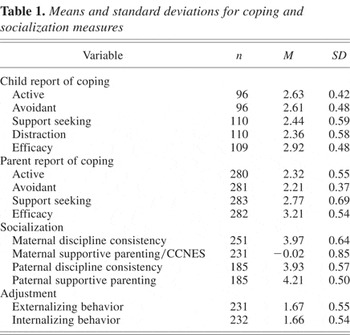
Means and standard deviations for coping and socialization measures
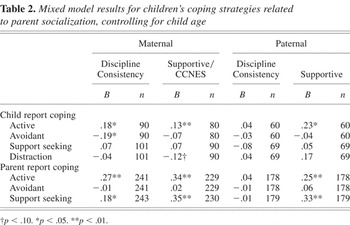
Mixed model results for children's coping strategies related to parent socialization, controlling for child age
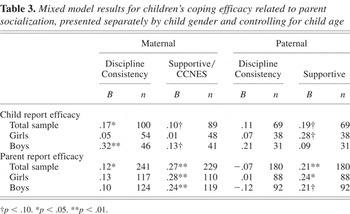
Mixed model results for children's coping efficacy related to parent socialization, presented separately by child gender and controlling for child age
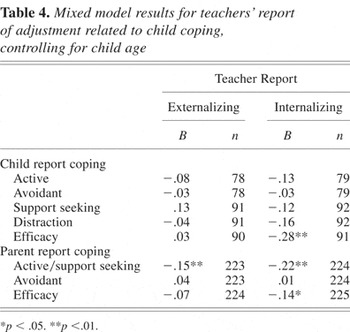
Mixed model results for teachers' report of adjustment related to child coping, controlling for child age
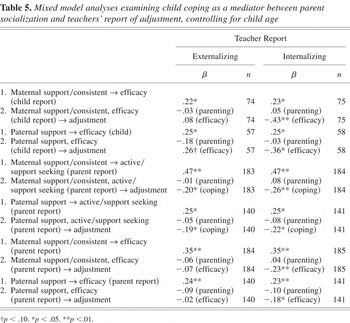
Mixed model analyses examining child coping as a mediator between parent socialization and teachers' report of adjustment, controlling for child age
 You have
Access
- 33
- Cited by