The affectional bonds between children and their parents are a highly studied mechanism for explaining individual development across the life span (Allen, Reference Allen, Cassidy and Shaver2008; Armsden & Greenberg, Reference Armsden and Greenberg1987), and show variations across stages of child development. According to attachment theory (Bowlby, Reference Bowlby1982), parent–child relationships provide a foundation for development (Collins & Laursen, Reference Collins and Laursen2004a; Steinberg, Reference Steinberg2001) and continue to serve as primary influences beyond infancy and into adolescence (Buist, Deković, Meeus, & van Aken, Reference Buist, Deković, Meeus and van Aken2002). Contrary to stable attachment representations formed in infancy and early childhood (Berry, Barrowclough, & Wearden, Reference Berry, Barrowclough and Wearden2007; Ross & Spinner, Reference Ross and Spinner2001), parent–child relationships in adolescence follow diverse trajectories and undergo changes in patterns of interacting (Buist et al., Reference Buist, Deković, Meeus and van Aken2002; Steinberg & Silk, Reference Steinberg, Silk and Bornstein2002). In general, parent–adolescent relationships commonly follow a declining trend throughout the course of adolescence, marked by decreases in closeness and increases in emotional distance as adolescents face developmental challenges (Steinberg & Morris, Reference Steinberg and Morris2001). In prior work on adolescent attachment, the declining quality of parent–adolescent relationships has been strongly linked to internalizing problems, such as depression and anxiety (e.g., Luthar & Barkin, Reference Luthar and Barkin2012).
Although a great deal of research has focused on adolescence as a significant period for studying the quality of parent–child relationships, relatively little is known concerning the specific course of changes in perceived relationship quality and its implications for developmental outcomes (Ainsworth, Reference Ainsworth1989; Buist et al., Reference Buist, Deković, Meeus and van Aken2002). Even less is known about the risk and protective processes in a group that has been identified among those most “at-risk”—following teens exposed to poverty, trauma, and discrimination—that is, youth attending high-achieving schools, mostly from affluent families (Geisz & Nakashian, Reference Geisz and Nakashian2018). It is now well established that these youth are at an elevated risk for an array of adjustment problems (e.g., depression and anxiety; see Luthar, Barkin, & Crossman, Reference Luthar, Barkin and Crossman2013; Luthar, Small, & Ciciolla, Reference Luthar, Small and Ciciolla2018). With regard to what might buffer them against stress, resilience research has shown that across diverse at-risk circumstances, the single most powerful protective factor is having a strong, supportive relationship with at least one caregiver (Cicchetti, Reference Cicchetti2012; Luthar & Eisenberg, Reference Luthar and Eisenberg2017; Masten, Reference Masten2001).
Accordingly, in this study, our first aim was to track changes in felt attachment to both parents in a sample of high-achieving students across seven annual assessments, spanning age 12 through age 18. Our second aim was to explore whether such changes in perceived relationship quality differed by parent and child gender. Finally, for our third aim, we sought to illuminate which particular dimensions of felt attachment to parents might most affect long-term adjustment of anxiety and depression, and also, whether effects were similar for mothers versus fathers. In discussions that follow, we elaborate on each of our major goals.
Changes in Perceived Parent–Child Relationship Quality in Adolescence
A major aim of this study was to track changes in felt attachment to both parents across the period of adolescence spanning middle through high school. During this transitional period, parent–child relationships play an integral role in supporting developmental changes embedded in adolescence (Allen & Land, Reference Allen, Land, Cassidy and Shaver1999). However, the developmental demands and changes implicit in adolescence provide for a potentially challenging and stressful environment (Cicchetti & Rogosch, Reference Cicchetti and Rogosch2002). Developmental changes embedded in adolescence, such as biological, cognitive, and social changes, influence unique aspects of parent–child relationships (Laursen & Collins, Reference Laursen, Collins and Vangelisti2004; Steinberg & Silk, Reference Steinberg, Silk and Bornstein2002). For example, puberty plays a role in transforming relationships, as a result of cognitive and physical changes designed to initiate a restructuring of the behavioral system (Blakemore, Burnett, & Dahl, Reference Blakemore, Burnett and Dahl2010; De Goede, Branje, & Meeus, Reference De Goede, Branje and Meeus2008; Sisk & Foster, Reference Sisk and Foster2004) and necessitate a reorganization of relationships with parents (Collins & Repinski, Reference Collins, Repinski, Montemayor, Adams and Gullotta1994; Kobak, Rosenthal, Zajac, & Madsen, Reference Kobak, Rosenthal, Zajac and Madsen2007). In addition, autonomy-related changes contribute to an adjustment of relationships and changing family dynamics (Allen, Reference Allen, Cassidy and Shaver2008; Meeus, Iedema, Maassen, & Engels, Reference Meeus, Iedema, Maassen and Engels2005; Parrigon, Kerns, Abtahi, & Koehn, Reference Parrigon, Kerns, Abtahi and Koehn2015).
As adolescents move toward increasing independence from their parents, parent–child relationships converge toward more egalitarian relationships (Allen, Reference Allen, Cassidy and Shaver2008; Meeus et al., Reference Meeus, Iedema, Maassen and Engels2005; Parrigon et al., Reference Parrigon, Kerns, Abtahi and Koehn2015). The transition to more equality in parent–adolescent relationships is accompanied by changes in support and conflict (De Goede et al., Reference De Goede, Branje and Meeus2008). Previous studies examining changes in parent–child relationship quality have found that perceived closeness and support declines during adolescence (e.g., Feinberg, McHale, Crouter, & Cumsille, Reference Feinberg, McHale, Crouter and Cumsille2003; Helsen, Vollebergh, & Meeus, Reference Helsen, Vollebergh and Meeus2000; Nickerson & Nagle, Reference Nickerson and Nagle2004, Reference Nickerson and Nagle2005; Shanahan, McHale, Osgood, & Crouter, Reference Shanahan, McHale, Osgood and Crouter2007). However, adolescents’ desire for autonomy is less about disengaging from parental control and more about engaging in family decision making and aligning assumptions and beliefs that shape relationship dynamics within the family (Collins, Laursen, Mortensen, Luebker, & Ferreira, Reference Collins, Laursen, Mortensen, Luebker and Ferreira1997; Eccles et al., Reference Eccles, Midgley, Wigfield, Buchanan, Reuman, Flanagan and MacIver1993). Despite their growing autonomy, adolescents continue to rely on their parents for social and emotional support (Berry et al., Reference Berry, Barrowclough and Wearden2007; Raudino, Fergusson, & Horwood, Reference Raudino, Fergusson and Horwood2013). Further, the quality of parent–adolescent relationships continues to be relevant (e.g., Steinberg, Reference Steinberg2001) and even becomes increasingly prominent as adolescents navigate these developmental changes (Allen, Reference Allen, Cassidy and Shaver2008).
Assessment of relationship quality
How relationship quality is measured depends on the developmental period under study, and on which respondents’ perspectives are of central interest (De Goede et al., Reference De Goede, Branje and Meeus2008). Observational techniques are predominantly used in infancy studies on parent–child relationships and sometimes with older children (Ainsworth, Reference Ainsworth1989). However, it is self-report measures that are the method of choice when the goal is to capture the adolescent's subjectively experienced quality of relationship with each parent (Armsden & Greenberg, Reference Armsden and Greenberg1987; Luthar et al., Reference Luthar, Barkin and Crossman2013). Unlike infants, adolescents have developed the cognitive capacity to reflect upon and evaluate the quality of their relationship with their parents (Allen, McElhaney, Kuperminc, & Jodl, Reference Allen, McElhaney, Kuperminc and Jodl2004).
The specific attachment dimensions we measured were those captured by the Inventory of Parent and Peer Attachment (IPPA; Armsden & Greenberg, Reference Armsden and Greenberg1987), which was conceptually grounded in Bowlby's attachment theory research, and designed to assess adolescents’ perceptions of the positive and negative aspects of relationship quality with mothers and with fathers. The IPPA measures specific dimensions of affective relationship quality across three subscales: alienation (feelings of alienation and isolation), trust (parental understanding and acceptance, respect, and mutual trust), and communication (extent and quality of verbal communication with parents) within each relationship (Armsden & Greenberg, Reference Armsden and Greenberg1987). Extending beyond the traditional qualities of attachment security relevant in early childhood (Ainsworth, Blehar, Waters, & Wall, Reference Ainsworth, Blehar, Waters and Wall1978), the IPPA closely tracks the affective and cognitive dimensions of adolescents’ perceptions of relationships with their parents (Armsden & Greenberg, Reference Armsden and Greenberg1987). The IPPA measure also assesses both the child's perspective of the child's regard for the parent and the child's perspective of the parent's regard for the child (e.g., trust: “I trust my mother/father” compared to “My mother/father understands me”).
Armsden and Greenberg specifically focused on unique features of parent–adolescent relationships (e.g., alienation, trust, and communication), given the changes taking place during adolescence. Alienation, measuring emotional and behavioral withdrawal from parents, may transpire from a sense of adolescent dissatisfaction with the amount of help they need versus the amount of help their parents think they need at this stage of development. Trust, assessing the level of understanding and respect, as well as accessibility, responsivity, and predictability and consistency of parents, is critical during a time when family dynamics and roles are changing as adolescents are trying to navigate increasing autonomy. Finally, communication, the extent and quality of verbal communication with parents, has important implications for assessing the quality of parent–child relationships, due to the need to communicate about interpersonal and psychological changes taking place during adolescence.
The role of affluence in parent–adolescent relationships
There is growing evidence that affluent youth, raised in upper-middle class, white-collar families are a “newly identified at-risk group” (Koplewicz, Gurian, & Williams, Reference Koplewicz, Gurian and Williams2009, p. 1053; Geisz & Nakashian, Reference Geisz and Nakashian2018). Recent evidence suggests that youth in high-achieving schools who are generally from affluent families face several unacknowledged pressures, (Luthar & Kumar, Reference Luthar, Kumar, Leschied, Saklofske and Flett2018). Studies have shown a u-shaped link between school level affluence and adjustment problems, indicating challenges at both socioeconomic extremes (Coley, Sims, Dearing, & Spielvogel, Reference Coley, Sims, Dearing and Spielvogel2017; Lund, Dearing, & Zachrisson, Reference Lund, Dearing and Zachrisson2017). We know that for both sets of youth, parenting matters, but several questions merit further attention. In prior efforts to understand risk and protective processes among affluent youth, there have been suggestions, for example, that there are stronger ramifications for the quality of relationships with mothers as opposed to fathers, but these have been based on cross-sectional data and using global scores of attachment (Luthar & Barkin, Reference Luthar and Barkin2012). In the present study, we provide more thorough and rigorous tests of this suggestion, via prospective analyses spanning seven annual assessments.
One of the potential causes of distress among affluent youth is excessive achievement pressures (Luthar & Kumar, Reference Luthar, Kumar, Leschied, Saklofske and Flett2018). In affluent communities, there is often an unspoken emphasis on ensuring that children secure admission to elite colleges. As a result, many adolescents feel highly driven to excel, not only at academics, but also at multiple extracurricular activities, with these pressures beginning as early as the middle school years. In addition, children's own maladaptive perfectionist strivings, characterized by an extreme manifestation of achievement failures as personal failures, contribute to elevated levels of achievement pressures. Children with maladaptive perfectionism and parents who value accomplishments disproportionately to personal character have been shown to have relatively high depression and anxiety (Ciciolla, Curlee, Karageorge, & Luthar, Reference Ciciolla, Curlee, Karageorge and Luthar2017; Luthar & Becker, Reference Luthar and Becker2002).
Aside from achievement pressures, another potential cause of adjustment disturbances among affluent youth could be disconnection and isolation from adults, both literal and emotional. Among upper-middle-class families, schedules tend to be very packed, which can sharply diminish the amount of “down time” shared between adolescents and their parents (Luthar et al., Reference Luthar, Barkin and Crossman2013; Luthar & Ciciolla, Reference Luthar and Ciciolla2016). With quantity of time spent together often being limited, the quality of relationships with parents, on both positive and negative dimensions, would logically carry considerable significance for adolescents’ adjustment (Luthar & Kumar, Reference Luthar, Kumar, Leschied, Saklofske and Flett2018).
The Role of Gender in Perceived Parent–Child Relationship Quality in Adolescence
Different patterns of change observed within parent–child relationships may depend on the gender of the adolescent and parent (Biblarz & Stacey, Reference Biblarz and Stacey2010). Although most studies have focused on the relationship with mothers or combined assessment scores across both parents (Ruhl, Dolan, & Buhrmester, Reference Ruhl, Dolan and Buhrmester2015; Sheeber, Hops, & Davis, Reference Sheeber, Hops and Davis2001), the few studies that have looked at mothers and fathers separately have demonstrated that beyond infancy, perceived relationship quality is uniquely tailored to each parent (Ainsworth, Reference Ainsworth1989; Cabrera, Fitzgerald, Bradley, & Roggman, Reference Cabrera, Fitzgerald, Bradley and Roggman2014). For example, some studies have found that adolescent relationships with mothers are typically more secure and of higher quality than those with fathers (e.g., Luthar & Barkin, Reference Luthar and Barkin2012). Previous research examining the critical importance of relationships with mothers has consistently found that adolescents feel that their mothers know them better than their fathers (Collins & Russell, Reference Collins and Russell1991).
Traditionally, across diverse cultural contexts, mothers have been regarded as the primary caregivers (e.g., Bowlby, Reference Bowlby1982; Collins & Russell, Reference Collins and Russell1991; Steinberg & Silk, Reference Steinberg, Silk and Bornstein2002). Even in more contemporary families where both parents are employed, mothers are still considered to be the primary caregivers (Gamble & Roberts, Reference Gamble and Roberts2005; Luthar & Barkin, Reference Luthar and Barkin2012). In general, mothers tend to engage in more frequent interactions with their children and are more responsive (Baumrind, Reference Baumrind1991; Lewis & Lamb, Reference Lewis and Lamb2003), whereas fathers tend to have more distant relationships with their children and are more demanding (Baumrind, Reference Baumrind1991). These findings are most likely a reflection of differences in time spent with each parent. In affluent communities, children are even more likely to spend more time with their mothers than with their fathers, as fathers are typically the primary wage earners with highly demanding jobs that require them to spend a significant amount of time away from families (Luthar & Ciciolla, Reference Luthar and Ciciolla2016; Luthar & Kumar, Reference Luthar, Kumar, Leschied, Saklofske and Flett2018). As a result of constantly shifting routines, the relationship quality between fathers and their children is often negatively impacted (Luthar et al., Reference Luthar, Barkin and Crossman2013).
In addition, adolescent girls, compared to adolescent boys, report feeling closer to their mothers and tend to experience higher quality relationships with both parents (e.g., Hay & Ashman, Reference Hay and Ashman2003; Kenny, Reference Kenny1994). Even though mothers and daughters are more likely to engage in conflict and disagreement compared to mothers and sons during adolescence (e.g., Collins & Laursen, Reference Collins, Laursen, Lerner and Steinberg2004b; Laursen, Reference Laursen2005), conflict is a normative part of parent–child relationships in adolescence and does not significantly influence adolescents’ perceptions of parental relationship quality (De Goede et al., Reference De Goede, Branje and Meeus2008). Further, studies have found that compared to boys, girls have greater emotional needs (Cyranowski, Frank, Young, & Shear, Reference Cyranowski, Frank, Young and Shear2000; Rudolph, Reference Rudolph2002) and exhibit stronger relationships with both parents overall (Buist et al., Reference Buist, Deković, Meeus and van Aken2002). Similar studies have found that adolescents typically have closer relationships with their same-sex parents (Laursen & Collins, Reference Laursen, Collins and Vangelisti2004), whereas others have failed to find any gender differences among these relationships (Laible & Carlo, Reference Laible and Carlo2004).
Mixed findings, such as these previously described, point to the need for longitudinal studies to explore the effects of gender on changes in parental relationship quality throughout adolescence (Ruhl et al., Reference Ruhl, Dolan and Buhrmester2015; Simons & Conger, Reference Simons and Conger2007). In the present study, therefore, a prospective research design that included a consistent, validated measure of perceived relationship quality across seven annual assessments (spanning age 12 through age 18) will demonstrate whether gender differences exist among parent–adolescent relationships.
Developmental Linkages of Parent–Adolescent Relationship Quality to Mental Health
In general, secure relationships with parents in adolescence predicts greater life satisfaction, better adjustment, and less psychological distress (e.g., Armsden & Greenberg, Reference Armsden and Greenberg1987; Laible, Carlo, & Raffaelli, Reference Laible, Carlo and Raffaelli2000). Adolescents who experience indifferent or neglectful parenting have been found to demonstrate significant deficits in mental health and psychosocial development (Steinberg & Silk, Reference Steinberg, Silk and Bornstein2002). Among affluent youth, psychosocial adjustment problems commonly occur when parents are perceived as being insufficiently involved in the lives of their children (Luthar et al., Reference Luthar, Barkin and Crossman2013; Luthar & Kumar, Reference Luthar, Kumar, Leschied, Saklofske and Flett2018). As suggested earlier in this paper, we believe that the strength of the parent–adolescent relationship over time will be associated with key domains of psychological functioning, specifically, internalizing indices of anxiety and depression, at late adolescence. Anxiety and depression are among the most extensively studied internalizing disorders traced back to parent–adolescent relationship quality, as well as among the most common forms of psychopathology affecting adolescents (Brumariu & Kerns, Reference Brumariu and Kerns2010). Numerous studies have corroborated the importance of establishing secure relationships with parents to promote overall self-efficacy (Arbona & Power, Reference Arbona and Power2003; Thompson, Reference Thompson2000), well-being (Nickerson & Nagle, Reference Nickerson and Nagle2004), and interpersonal functioning (Fuligni, Eccles, Barber, & Clements, Reference Fuligni, Eccles, Barber and Clements2001). For example, adolescents who reported having secure relationships with their parents had fewer symptoms of anxiety and depression and better overall adjustment (Allen, Porter, McFarland, McElhaney, & Marsh, Reference Allen, Porter, McFarland, McElhaney and Marsh2007; Flouri & Buchanan, Reference Flouri and Buchanan2003; Muris, Meesters, van Melick, & Zwambag, Reference Muris, Meesters, van Melick and Zwambag2001). By the same token, lower quality relationships with parents have been linked to later adolescent psychological distress and mental health problems, even when controlling for peer relationships and negative life events (Ein-Dor & Doron, Reference Ein-Dor, Doron, Simpson and Rholes2015; Sroufe, Reference Sroufe2005). Specifically, studies have found that poor relationship quality between adolescents and their parents was associated with anxiety (e.g., Marganska, Gallagher, & Miranda, Reference Marganska, Gallagher and Miranda2013) and depression (e.g., Buss, Reference Buss2000; Sheeber et al., 2001).
Regarding the direction of causality, longitudinal methods are optimal in trying to determine the direction of effects between the quality of parent–adolescent relationships and symptoms of anxiety and depression (Cicchetti & Sroufe, Reference Cicchetti and Sroufe2000). Cross-sectional studies analyzing these links are unable to determine whether high internalizing distress among adolescents led to poor parent–child relationship quality or whether poor parent–child relationship quality led to poor adjustment outcomes among adolescents (e.g., Adam, Gunnar, & Tanaka, Reference Adam, Gunnar and Tanaka2004). It must be acknowledged that even longitudinal designs cannot conclusively “prove” causal links (e.g., due to the possibility of temporally antecedent and later outcome variables being linked with third variables). At the same time, in the absence of experimental data manipulating relationship quality and distress to demonstrate causality (obviously impossible for ethical reasons), multiwave prospective designs are optimal for testing potential causality. Accordingly, in this study, we assessed the perceived quality of parent–adolescent relationships over seven annual assessments spanning middle school and high school and examined their links with symptoms of anxiety and depression among adolescents at the end of their senior year in high school.
The Present Study
The aim of the present study is to gain a comprehensive understanding of patterns of developmental stability and change in adolescents’ perceptions of relationship quality with each parent, using seven annual assessments based on the same conceptually sound, well-validated measure of felt attachment with both mothers and fathers. Existing research has been limited by a lack of continuous, longitudinal measures to examine a single cohort from middle school through high school. A majority of these studies have relied on using broad measures of perceived relationship quality that do not adequately assess the specific, underlying changes in adolescents’ perceptions of relationship quality with their parents (e.g., McGue, Elkins, Walden, & Iacono, Reference McGue, Elkins, Walden and Iacono2005). Thus, much understanding of changes within the parent–child relationship during adolescence is largely based on generalizations from cross-sectional studies that have relied on broad measures of parental support and closeness. To our knowledge, this is the first multiwave longitudinal study to investigate how parent–child relationships change throughout the course of adolescence while taking into account the differential influences of mothers and fathers, separately, within a sample of mostly affluent youth.
Based on past research, we expect that overall, parent–child relationships will follow a normative trend of declining closeness during early adolescence, at both the transition into middle school and again into high school, but then begin to stabilize during late adolescence. Specifically, we predict, first, that adolescents will show increases in alienation and decreases in trust and communication from middle school to high school, followed by some leveling off around middle adolescence. Second, we predict that adolescents, regardless of gender, will report having higher quality relationships with their mothers compared to fathers throughout adolescence. Third, we predict that girls, compared to boys, will report having higher quality relationships with both parents. Based on previous findings suggesting that maternal parenting is more strongly associated with children's internalizing problems (Aunola & Nurmi, Reference Aunola and Nurmi2005), we expect that adolescents’ relationships with mothers may have stronger effects on internalizing problems. Fourth, we expect that overall, perceived alienation will be more detrimental to adolescent development compared to the beneficial effects of trust and communication, in line with the notion that “bad is stronger than good”; in general, negative events have stronger, lasting impressions over positive ones (e.g., Baumeister, Bratslavsky, Finkenauer, & Vohs, Reference Baumeister, Bratslavsky, Finkenauer and Vohs2001). Again, cross-sectional findings have shown that outcomes in late adolescence show stronger associations with perceived alienation from parents than feelings of trust and communication (Luthar & Barkin, Reference Luthar and Barkin2012).
Method
Sample
This study uses data from a sample of relatively affluent youth, who were recruited from a community with a high concentration of well-educated, high-income, white-collar professionals, who comprise the New England Study of Suburban Youth (NESSY). As described in previous reports (Luthar & Barkin, Reference Luthar and Barkin2012), a cohort of 335 6th graders (48% female) were recruited from schools in an upper-middle-class New England community in 1998 and followed annually thereafter. Based on census data, students in the NESSY cohort were from upper-middle-class families with parents having median family incomes in the top 5% of the country that were three times the national level of about $50,000 at the inception of the study (US Bureau of the Census, 2000). These high-income, suburban students were predominantly Caucasian (93%), with the remainder of the sample consisting of less than 2% each of African American and Hispanic students, 3% Asian students, and the rest coming from other ethnic backgrounds. Our sample was mostly composed of two-parent families, with 79.3% of the sample being married, and only 4 parents divorcing during the course of the study (1 couple in 11th grade and 3 couples in 12th grade). In addition, our sample had an average of 1.17 siblings (SD = 0.93) with 76.6% of our sample having at least 1 sibling. Our analyses here are based on 262 students who participated in the study and provided at least one measurement of perceived relationship quality from Grades 6 to 12 and provided data on our outcomes of interest at Grade 12.
Missing data
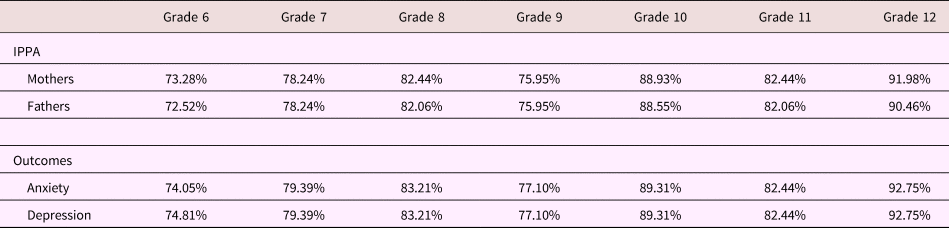
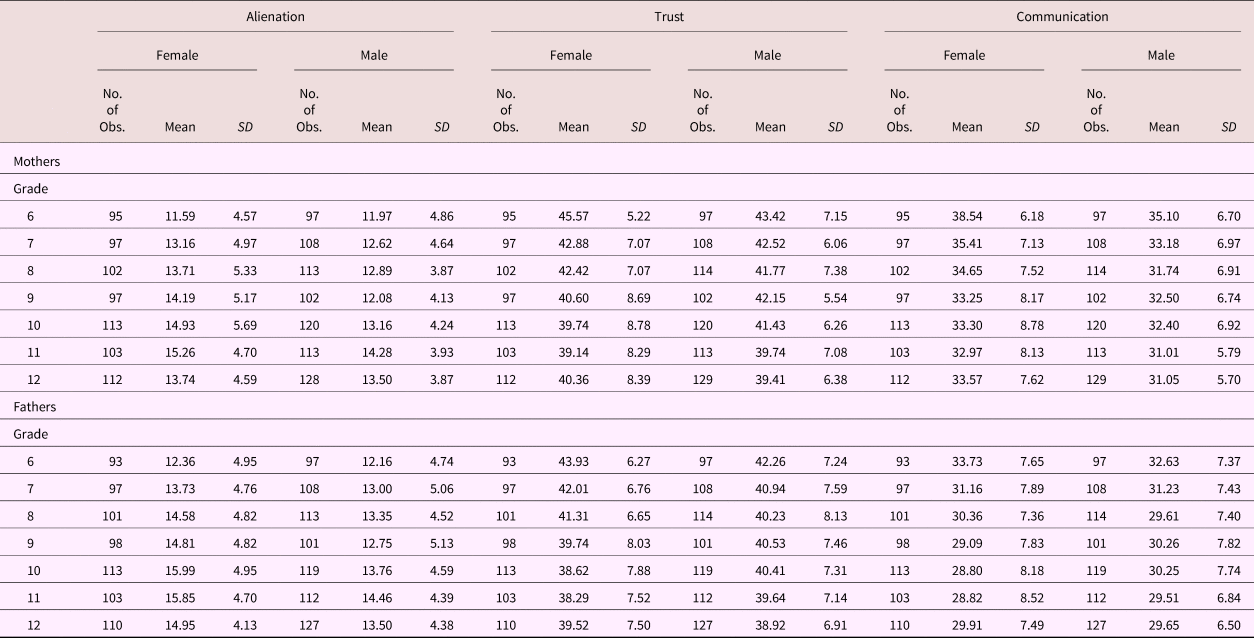
The extent of missing data was acceptable, with only 3% of participants having data at only one period and 88.2% of participants providing data for at least four out of the seven time periods assessed. Table 1 outlines the percentages of data included at each time point for the IPPA scale for both mothers and fathers, as well as our outcome variables (e.g., anxiety and depression). Table 2 also includes the total number of observations broken down by IPPA subscales at each time period for mothers and fathers. Further, there was no evidence of differential attrition from 6th to 12th grade: there were no significant differences between 12th-grade participants and nonparticipants in terms of 6th-grade anxiety (F = 0.33, p = .57) and depressive symptoms (F = 1.49, p = .22).
Percentages of data included at each time point for the IPPA measure and the outcome variables

Note: N = 262. IPPA, Inventory of Parent and Peer Attachment.
Descriptive statistics for perceived parent–adolescent relationship quality from Grade 6 to Grade 12, for males and females, separately, and for mothers and fathers, separately

Note: N = 262. No. of Obs., number of observations. On average, females provided 5.85 (SD = 1.52, range 1 to 7), 5.85 (SD = 1.52, range 1 to 7), and 5.85 (SD = 1.52, range 1 to 7) observations for mother alienation, trust, and communication, respectively, and 5.81 (SD = 1.57, range 1 to 7), 5.81 (SD = 1.57, range 1 to 7), and 5.81 (SD = 1.57, range 1 to 7) observations for father alienation, trust, and communication, respectively. On average, males provided 5.63 (SD = 1.64, range 1 to 7), 5.63 (SD = 1.64, range 1 to 7), and 5.63 (SD = 1.64, range 1 to 7) observations for mother alienation, trust, and communication, respectively, and 5.60 (SD = 1.65, range 1 to 7), 5.60 (SD = 1.65, range 1 to 7), and 5.60 (SD = 1.65, range 1 to 7) observations for father alienation, trust, and communication, respectively.
Measures
Perceived relationship quality
We used the IPPA (Armsden & Greenberg, Reference Armsden and Greenberg1987) to assess adolescents’ perceptions of the positive and negative feelings toward mothers and fathers separately. The IPPA was designed to measure specific dimensions of affective relationship quality across three subscales: alienation (feelings of alienation and isolation), trust (parental understanding, respect, and mutual trust), and communication (extent and quality of verbal communication with parents) within each relationship (Armsden & Greenberg, Reference Armsden and Greenberg1987), with 6, 10, and 9 items, respectively. Example items are as follows: Alienation: “I don't get much attention from my mother/father”; Trust: “My mother/father accepts me as I am”; Communication: “My mother/father can tell when I'm upset about something.” Participants answered a total of 50 items (25 pertaining to each parent) using a 5-point Likert scale response format (1 = almost never or never true, 2 = not very often true, 3 = sometimes true, 4 = often true, and 5 = almost always or always true). The IPPA is a widely used instrument that proved strong psychometric properties across many samples (e.g., Gullone & Robinson, Reference Gullone and Robinson2005; Pace, San Martini, & Zavattini, Reference Pace, San Martini and Zavattini2011).
In our analyses, we used the mean scores from each subscale in order to target the unique facets of change and influence within each parent–adolescent relationship. Overall, participants provided an average of 5.73 (SD = 1.59, range 1 to 7) and 5.70 (SD = 1.61, range 1 to 7) waves of data for each measure of alienation, trust, and communication for mothers and fathers respectively. The internal consistencies (Cronbach's α) for the different dimensions of perceived parent–adolescent relationship quality ranged from 0.78 to 0.92 for mothers and 0.78 to 0.90 for fathers.
Anxiety
Anxiety symptoms were measured using the total anxiety score yielded by combining the three dimensions of anxiety (social anxiety, physiological anxiety, and worry) from the Revised Children's Manifest Anxiety Scale (Reynolds & Richmond, Reference Reynolds and Richmond1985). This self-report measure consisted of 37 dichotomous-choice items, scored 0 or 1, with higher scores representing higher levels of anxiety (see Luthar & Becker, Reference Luthar and Becker2002). Reliability (Cronbach's α) for the total anxiety score at Grade 12 was 0.80.
Depressive symptoms
Depressive symptoms were assessed using the Children's Depression Inventory (Kovacs, Reference Kovacs1992), a widely used 27-item, three-choice scale designed for school-age children and adolescents. Each item consists of three choices, with scores ranging from 0 to 2, with higher scores being indicative of higher levels of depression. This measure has good psychometric properties, including criterion and concurrent validity (Kovacs, Reference Kovacs1992). Reliability (Cronbach's α) for the depressive symptoms score at Grade 12 was 0.86.
Covariates
We included gender, ethnicity, marital status, and number of siblings as key covariates in our study because of their known relationship to parent–child relationship quality. For example, research has shown that children in single-parent families have poorer relationship quality (Loeber, Drinkwater, Anderson, Schmidt, & Crawford, Reference Loeber, Drinkwater, Yin, Anderson, Schmidt and Crawford2000) and endorse higher levels of internalizing problems (Hilton, Desrochers, & Devall, Reference Hilton, Desrochers and Devall2001). We also controlled for baseline measures of anxiety and depression at the start of middle school (e.g., Grade 6), as well as at the onset of high school (e.g., Grade 9) to strengthen our longitudinal predictions of adjustment outcomes at Grade 12.
Statistical analysis
To examine changes in relationship quality and interindividual differences, we used a multiphase latent basis growth model (see Infurna & Luthar, Reference Infurna and Luthar2016; Ram & Grimm, Reference Ram and Grimm2007; Singer & Willett, Reference Singer and Willett2003). We used a multiphase model as opposed to a linear or quadratic trend model so that we could directly examine potential differences in the rate of change in each indicator across the early adolescent (middle school) versus later adolescent (high school) years. That is, for mothers and fathers each, we modeled separately the rate of change in alienation, trust, and communication for middle school (Grades 6–9) and high school (Grades 9–12).
The repeated measures of each dimension of relationship quality were modeled as a function of three latent growth factors: level, middle school slope, and high school slope. The level or intercept factor quantifies the expected level of relationship quality (e.g., alienation, trust, or communication in mother or father) at Grade 6. Middle school slope scores indicate the extent of change in the specific relationship quality during Grades 6 through 9. High school slope scores indicate the extent of change in the specific relationship quality during Grades 9 through 12. The parameter estimates for middle school slope and high school slope indicate the total amount of change, on average, that transpired during each of the time periods. The multiphase growth curve model allowed for the added flexibility of detecting nonlinear patterns of change and estimating variance parameters to examine whether there were between-person differences in the extent to which individuals differed in their changes in each facet of perceived relationship quality.
In order to make use of all available data in the data set and account for missing data, we reran all of our analyses with Mplus (version 7.11; Muthén & Muthén, Reference Muthén and Muthén2013), utilizing full information maximum likelihood estimation, to make use of all available data in the data set for unbiased parameter estimation (Graham, Cumsille, & Elek-Fisk, Reference Graham, Cumsille, Elek-Fisk, Schinka and Velicer2003; McDonald & Ho, Reference McDonald and Ho2002).
Results
Changes in perceived parent–child relationship quality in adolescence
Descriptive data are shown in Table 2, that is, means and standard deviations for each of our outcomes of interest from Grades 6 to 12. These are shown separately by mothers and fathers, as well as differentiated by adolescent gender.
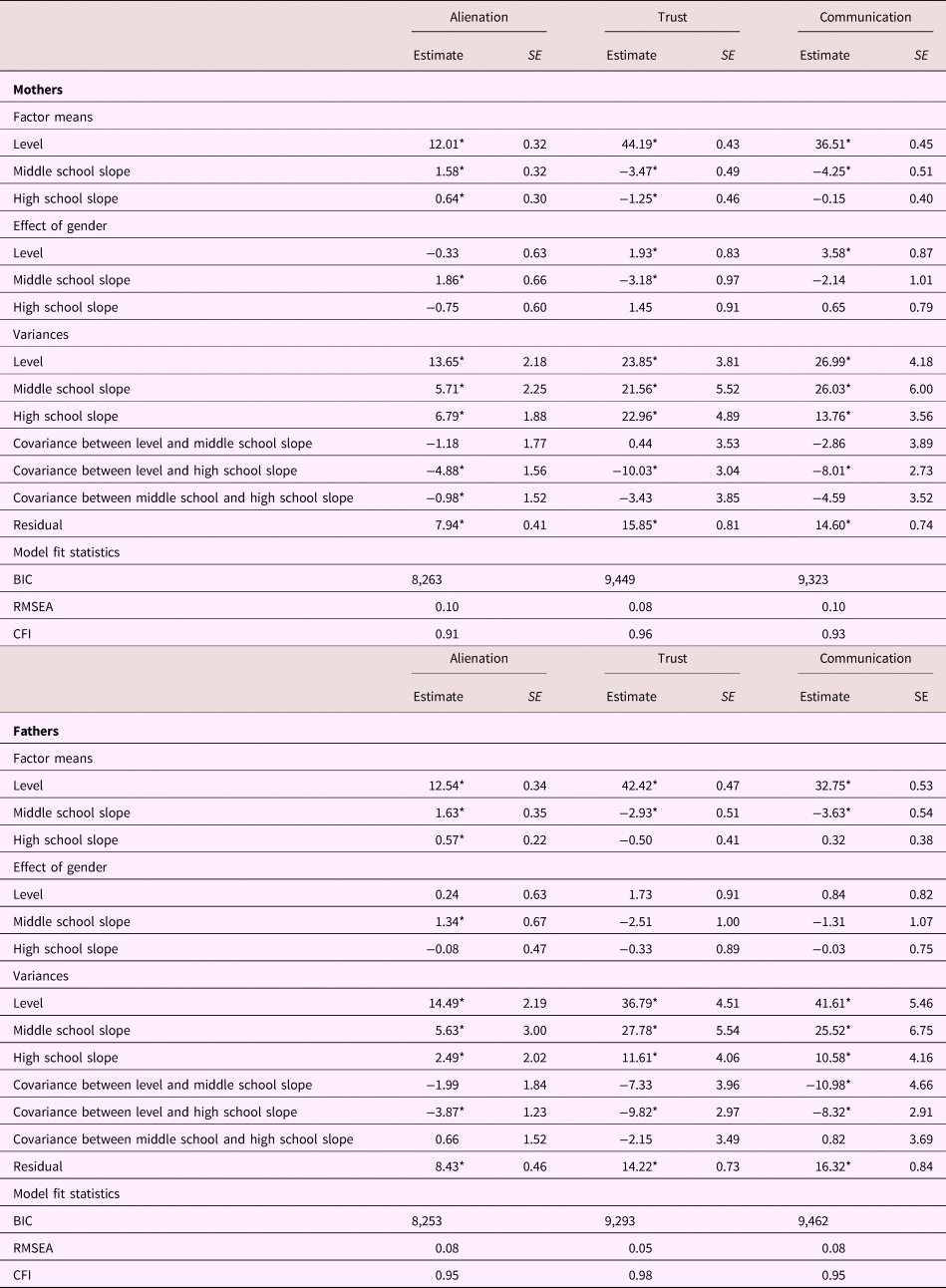
In addressing our central aims, in a first step, we examined changes in alienation, trust, and communication separately for mothers and fathers. Results from our multiphase growth models examining changes in perceived parent–adolescent relationship quality from middle school to high school are shown in Table 3, and Figure 1 graphically illustrates our findings. We found that adolescents perceived significant increases in alienation for both mothers and fathers (Figure 1a) in middle school (mothers: 1.58, p < .05; fathers: 1.63, p < .05), and during high school (mothers: 0.64, p < .05; fathers: 0.57, p < .05), with stronger increases in perceived alienation in middle school. Focusing on trust (Figure 1b), we observed that during middle school, there were significant decreases in perceived trust with both mothers and fathers (mothers: –3.47, p < .05; fathers: –2.93, p < .05) and continued decreases in perceived trust with mothers, but not fathers, during high school (mothers: –1.25, p < .05; fathers: –0.50, p > .05). With regard to communication (Figure 1c), we found that adolescents perceived significant decreases in communication with both mothers and fathers during middle school (mothers: –4.25, p < .05; fathers: –3.63, p < .05) and stable communication with both mothers and fathers during high school (mothers: –0.15, p > .05; fathers: 0.32, p > .05).
Graphical illustration of model implied change for relationship qualities of (a) alienation, (b) trust, and (c) communication. We see that alienation shows a general increase from middle school to high school, whereas trust and communication show declines from middle school to high school.

Examining changes in alienation, trust, and communication for mothers and fathers and the moderating role of gender

Note: BIC, Bayesian information criterion. RMSEA, root mean square error of approximation. CFI, comparative fit index. Mothers. alienation: parameter estimates for middle school slope latent basis slope factor: 0, 0.60, 0.85, 1, 1, 1, 1 for the time interval Grades 6 to 12. Parameter estimates for high school slope latent basis slope factor: 0, 0, 0, 0, 0.49, 0.97, 1 for the time interval Grades 6 to 12. Trust: parameter estimates for middle school slope latent basis slope factor: 0, 0.43, 0.67, 1, 1, 1, 1 for the time interval Grades 6 to 12. Parameter estimates for high school slope latent basis slope factor: 0, 0, 0, 0, 0.29, 0.74, 1 for the time interval Grades 6 to 12. Communication: parameter estimates for middle school slope latent basis slope factor: 0, 0.55, 0.75, 1, 1, 1, 1 for the time interval Grades 6 to 12. Parameter estimates for high school slope latent basis slope factor: 0, 0, 0, 0, 0.45, 0.83, 1 for the time interval Grades 6 to 12. Fathers. alienation: parameter estimates for middle school slope latent basis slope factor: 0, 0.42, 0.79, 1, 1, 1, 1 for the time interval Grades 6 to 12. Parameter estimates for high school slope latent basis slope factor: 0, 0, 0, 0, 0.76, 1.36, 1 for the time interval Grades 6 to 12. Trust: parameter estimates for middle school slope latent basis slope factor: 0, 0.24, 0.47, 1, 1, 1, 1 for the time interval Grades 6 to 12. Parameter estimates for high school slope latent basis slope factor: 0, 0, 0, 0, 0.36, 0.72, 1 for the time interval Grades 6 to 12. Communication: parameter estimates for middle school slope latent basis slope factor: 0, 0.39, 0.63, 1, 1, 1, 1 for the time interval Grades 6 to 12. Parameter estimates for high school slope latent basis slope factor: 0, 0, 0, 0, 0.60, 1.13, 1 for the time interval Grades 6 to 12.
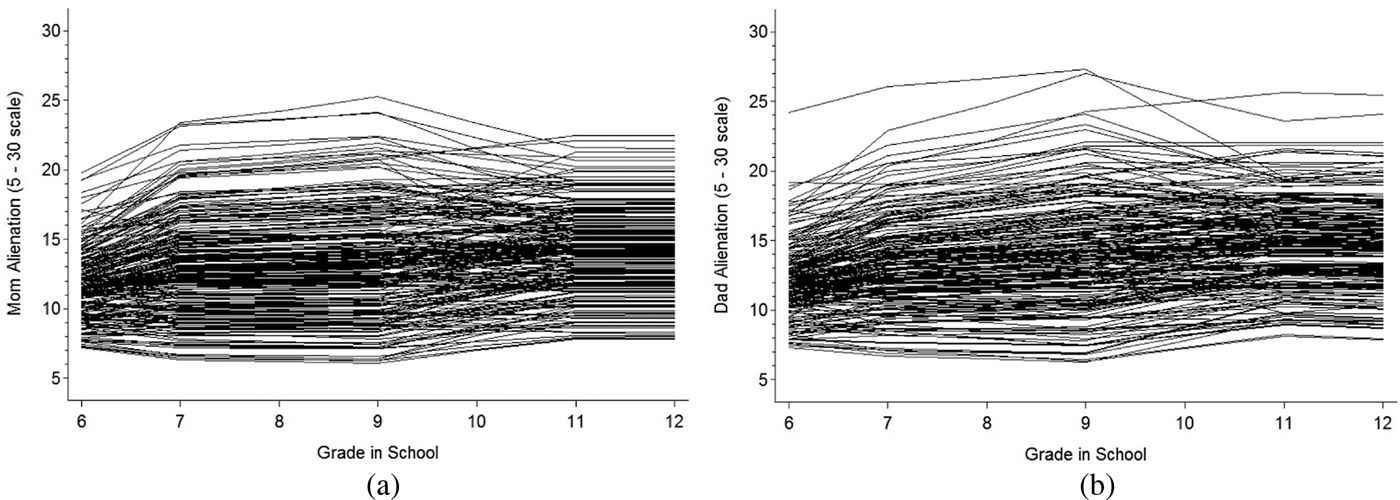
The variances in Table 3 indicate that there were significant between-person differences in levels and the extent to which specific facets of relationship quality for mothers and fathers changed from middle school to high school. Figure 2, Figure 3, and Figure 4 illustrate the large amount of between-person differences in levels of and rates of change in mothers’ and fathers’ alienation, trust, and communication from middle school to high school. This indicates that some individuals may have experienced stronger increases or decreases compared to others. In the next set of analyses, we examined whether gender moderated levels and rates of change in each facet of perceived parent–adolescent relationship quality from middle school to high school.
Graphical illustration of between-person differences in level and rates of change in (a) mothers’ and (b) fathers’ alienation from middle school to high school.

Graphical illustration of between-person differences in level and rates of change in (a) mothers’ and (b) fathers’ trust from middle school to high school.

Graphical illustration of between-person differences in level and rates of change in (a) mothers’ and (b) fathers’ communication from middle school to high school.

The role of gender in perceived parent–child relationship quality in adolescence
Table 3 shows results from our models that included gender as a predictor of level, middle school slope, and high school slope across adolescent perceptions of alienation, trust, and communication with mothers and fathers. Child gender is coded 0 = boy and 1 = girl; thus, the parameter estimates in Table 3 (second set of rows, under Mothers and Fathers each) detail whether there was an effect for girls. Focusing on alienation, we observed that compared to boys, girls perceived stronger increases in alienation from both mothers and fathers during middle school (mothers: 1.86, p < .05, fathers: 1.34, p < .05). Based on the parameters, the average increase in perceived alienation for girls was 3.44 with mothers and 2.97 with fathers. For boys, the average increase in perceived alienation was 1.58 with mothers and 1.63 with fathers. We did not find any gender differences in levels of perceived alienation at Grade 6 or changes in perceived alienation during high school for mothers and fathers.
Focusing on trust, we found that girls, compared to boys, perceived higher levels of trust at Grade 6 with mothers, but not fathers (mothers: 1.93, p < .05, fathers: 1.73, p > .06). We also found that compared to boys, girls perceived stronger declines in trust during middle school with mothers, but not fathers (mothers: –3.18, p < .05, fathers: –2.51, p > .05). We did not observe any gender differences in changes in perceived trust with either parent during high school.
Regarding communication, we found that girls, compared to boys, perceived higher levels of communication at Grade 6 with mothers only (3.58, p < .05). We did not find any significant gender differences in perceived communication with fathers at any time point.
Developmental linkages of parent–adolescent relationship quality to mental health
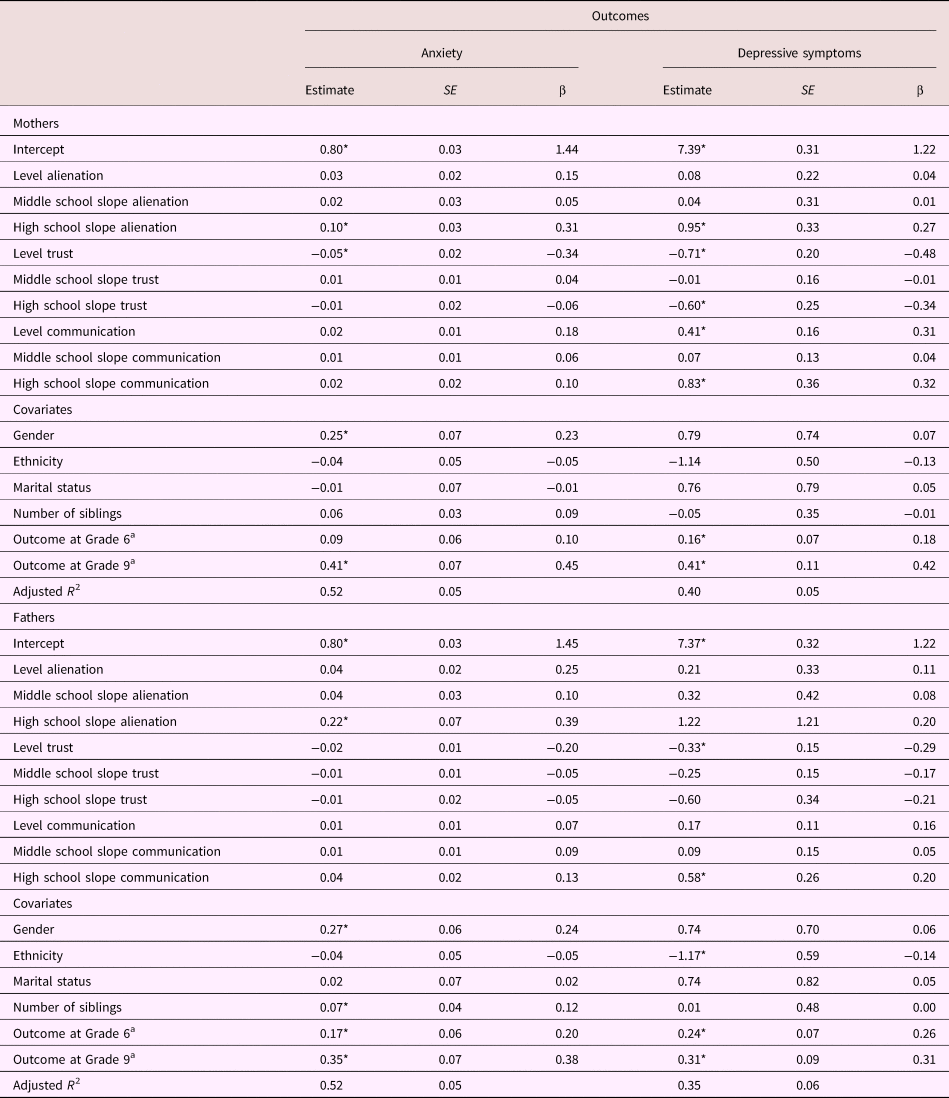
In our next set of analyses, we examined whether particular dimensions of adolescents’ felt attachment to parents from middle school to high school would predict long-term adjustment of anxiety and depressive symptoms at Grade 12, and also whether the effects were similar for mothers versus fathers. We outputted each adolescent's estimate for level (Grade 6), middle school slope, and high school slope for each subscale of perceived parent–adolescent relationship quality (alienation, trust, and communication) and used these estimates in separate regression analyses to predict each adjustment outcome (see Infurna, Gerstorf, Ram, Schupp, & Wagner, Reference Infurna, Gerstorf, Ram, Schupp and Wagner2011, for prior use of this strategy), while controlling for gender, ethnicity, marital status, number of siblings, and levels of anxiety of depressive symptoms at Grades 6 and 9. To examine the greatest explanatory power and unique effects of each facet of relationship quality across different periods of adolescence, we included all variables into the regression equation and conducted separate analyses for mothers and fathers.
Table 4 shows the results of our regression analyses for the predictive effects of level at Grade 6, middle school, and high school changes in adolescent perceptions of alienation, trust, and communication with mothers and fathers on anxiety and depressive symptoms at Grade 12. Focusing on anxiety, we found that stronger increases in perceived alienation during high school with mothers (β = 0.10) and fathers (β = 0.22) were associated with higher levels of anxiety at Grade 12. For trust, we found that lower levels of perceived trust with mothers at Grade 6 (β = –0.05) were associated with higher levels of anxiety at Grade 12. We did not find any effect of perceived communication with either parent on levels of anxiety at Grade 12. Further, when looking at the effect of perceived relationship quality with mothers on anxiety, we found that reporting higher levels of anxiety at Grade 9, but not Grade 6, was associated with reporting higher levels of anxiety at Grade 12 (β = 0.41). When looking at the effect of perceived relationship quality with fathers on anxiety, we found that reporting higher levels of anxiety at both Grade 6 (β = 0.17) and Grade 9 (β = 0.35) were associated with reporting higher levels of anxiety at Grade 12. Gender and number of siblings were also significant covariates, suggesting that girls, compared to boys, had higher levels of anxiety at Grade 12 (β = 0.27), as did adolescents with more siblings (β = 0.07).
Examining the predictive effects of level, middle school, and high school changes in relationship quality on anxiety and depressive symptoms at Grade 12 for mothers and fathers, separately

Note: N = 262. aOutcome, anxiety at Grade 6 and Grade 9 were included as covariates when the outcome was anxiety at Grade 12, and depressive symptoms at Grade 6 and Grade 9 were include as covariates when the outcome was depressive symptoms at Grade 12. *p < .05.
Focusing on depression, we found that stronger increases in perceived alienation during high school with mothers only (β = 0.95) were associated with higher levels of depressive symptoms at Grade 12. For trust, we found that lower levels of perceived trust at Grade 6 for both mothers (β = –0.71) and fathers (β = –0.33) were associated with higher levels of depressive symptoms at Grade 12. We also found that stronger decreases in perceived trust during high school, with mothers only (β = –0.60), were associated with higher levels of depressive symptoms at Grade 12. For communication, we found that higher levels of perceived communication with mothers at Grade 6 (β = 0.41) were associated with higher levels of depressive symptoms at Grade 12. We also found that stronger increases in perceived communication in high school with both mothers (β = 0.83) and fathers (β = 0.58) were associated with higher levels of depressive symptoms at Grade 12. Further, when looking at the effect of perceived relationship quality with mothers on depressive symptoms, we found that reporting higher levels of depressive symptoms at Grade 6 (β = 0.16) and Grade 9 (β = 0.41) was associated with higher levels of depressive symptoms at Grade 12. Similarly, regarding the analyses for fathers, we found that reporting higher levels of depressive symptoms at Grade 6 (β = 0.24) and Grade 9 (β = 0.31) was also associated with higher levels of depressive symptoms at Grade 12. Finally, ethnicity was also a significant covariate, suggesting that biracial status was associated with higher levels of depressive symptoms at Grade 12 (β = –1.17).
Discussion
The present study examined the course of changes in felt attachment to mothers and fathers from the perspective of high achieving school students across seven annual assessments, spanning age 12 through age 18, and how such changes in perceived relationship quality with either parent differed by gender. The study's prospective design also highlighted which particular dimensions of perceived relationship quality with mothers and fathers might affect long-term adjustment of anxiety and depressive symptoms at Grade 12. Moreover, the current study explored these relations among a sample of high-achieving adolescents, now known to be at risk for elevated distress compared to normative samples, and also known to be stretched for shared time with parents (Luthar & Kumar, Reference Luthar, Kumar, Leschied, Saklofske and Flett2018). For these reasons, there is value in illustrating the particular dimensions of parent–adolescents relationships that seem to carry particularly high “protective potential” for this at-risk group (see Luthar & Eisenberg, Reference Luthar and Eisenberg2017).
Previous studies that have examined the developmental course of parent–adolescent relationships have been limited by using either cross-sectional or short-term longitudinal data obtained from inconsistent sources and measures of perceived relationship quality. Overcoming such limitations and advancing the literature, our prospective, seven-wave study of high-achieving youth utilized a valid and reliable measure (i.e., IPPA) capable of capturing individual differences among unique features of perceived parent–adolescent relationship quality for both mothers and fathers. The IPPA subscales also provide information about the degree and affective quality of adolescent involvement with parents, which has been found to be distinct from overall attachment quality measures (Heiss, Berman, & Sperling, Reference Heiss, Berman and Sperling1996). Further, the patterns of the IPPA subscale scores highlight unique elements underlying perceived changes in parent–child relationships and the qualities that are most impactful on internalizing adjustment outcomes in adolescence.
Changes in perceived parent–child relationship quality in adolescence
Overall, we found that the perceived quality of parent–child relationships changes significantly during adolescence, a period marked by developmental demands. Specifically, we found that the quality of parent–child relationships decreased the most during middle school, at the onset of the teen years (Luthar & Ciciolla, Reference Luthar and Ciciolla2016), and somewhat stabilized by the end of high school. Taken together, our results demonstrated a general trend of decreased closeness, consistent with existing research on parent–child relationship quality in adolescence (e.g., Buist et al., Reference Buist, Deković, Meeus and van Aken2002; Steinberg & Morris, Reference Steinberg and Morris2001). Regarding the unique affective components of perceived relationship quality, we observed that perceived alienation with both mothers and fathers significantly increased during middle school and high school. Perceived trust and communication with both parents significantly decreased during middle school, although only trust continued to decrease with mothers during high school.
The developmental demands implicit in adolescence, such as the task of individuation and autonomy seeking, may account for the decreased closeness and lack of feeling understood that persist throughout middle school and high school. What is unique about the dimensions of alienation and trust that continue to change in the direction of decreased closeness is that they both share a common quality of whether or not adolescents feel understood by their parents. For example, “My mother/father understands me” and “My mother/father doesn't understand what I'm going through these days,” coming from the trust and alienation subscales, respectively, similarly account for the degree to which adolescents feel understood by their parents. Further, alienation taps into adolescents feeling detached and angry, primarily as a reaction to feeling that their needs are not being met and that they are not receiving enough attention. Similarly, trust represents how accessible and responsive adolescents perceive their parents to be and whether they feel that their parents are meeting their developmental needs (Armsden & Greenberg, Reference Armsden and Greenberg1987). As adolescents become increasingly independent during this period of development (Molloy, Ram, & Gest, Reference Molloy, Ram and Gest2011), parents may feel that they are not needed or may feel that their parental authority is being threatened. As a result, a mismatch between adolescents’ desires for increasing autonomy and opportunities for independence provided by parents (Eccles et al., Reference Eccles, Midgley, Wigfield, Buchanan, Reuman, Flanagan and MacIver1993) may account for persistent increases in perceived alienation and decreases in perceived trust throughout middle school and high school.
In addition, we found that of the three affective components of felt attachment to parents (e.g., alienation, trust, and communication), communication was the only dimension that significantly decreased in middle school but did not continue to significantly decline in high school. This finding may be accounted for by the fact that adolescents spend increasing amounts of time with peers as they enter middle school, and as a result, may disclose less about their personal feelings and experiences to their parents than they had in younger years (Laible et al., Reference Laible, Carlo and Raffaelli2000). However, as adolescents progress through high school and become closer to graduating, this group of high-achieving adolescents may rely on their parents for advice in preparation for college.
The role of gender in perceived parent–child relationship quality in adolescence
Consistent with previous research, our findings support that the trajectories of change for parent–child relationships are differentiated by gender (Buist et al., Reference Buist, Deković, Meeus and van Aken2002). We found that gender differences in felt attachment to mothers and fathers were significant for alienation in middle school. Specifically, we found that girls, compared to boys, showed stronger increases in perceived alienation in middle school for both mothers and fathers. We also found that girls, compared to boys, showed stronger decreases in perceived trust in middle school, but only for mothers. Compared to boys, girls also showed higher levels of trust and communication with mothers at Grade 6. Although we did not find initial gender differences in perceived alienation, girls reporting significantly higher levels of trust and communication with mothers reflects a higher level of felt attachment overall compared to boys. One possible explanation for these findings may be that girls typically report having higher levels of relationship quality with mothers (Buist et al., Reference Buist, Deković, Meeus and van Aken2002), leaving more room for the relationship to decline in closeness. We found that the declining quality of parent–child relationships differed by gender significantly during middle school but did not find any gender differences in high school.
In line with previous findings, we found that the onset of the teen years during middle school marked the initiation of emerging gender differences in adolescents’ perceptions of parental relationship quality (e.g., Luthar & Ciciolla, Reference Luthar and Ciciolla2016). When appraising mean level differences at each grade level, we also found that girls continued to report higher levels of alienation and lower levels of trust and communication from Grade 8 to Grade 9, with boys showing the opposite trend. Overall, girls showed stronger decreases in felt attachment to parents compared to boys. In general, we know that girls are initially closer to both parents than boys. As a result, the developmental task of individuation and separation is that much more challenging for girls. Thus, our findings may be indicative of girls losing more trust and feeling more alienated in order to increase independence and gain autonomy in adolescence. Collectively, these findings emphasize the need to consider gender of both the child and the parent in future studies on changes in relationship quality across adolescence.
Developmental linkages of parent–adolescent relationship quality to mental health
Consistent with the current literature, we found that parent–child relationships continue to be relevant and developmentally associated with adjustment outcomes beyond infancy and into adolescence (Ruhl et al., Reference Ruhl, Dolan and Buhrmester2015). Specifically, our results indicate that perceived relationship quality with parents in adolescence had significant links with psychological distress outcomes, including anxiety and depressive symptoms. Concerning the specific facets of relationship quality, perceived increases in alienation with both mothers and fathers in high school significantly predicted higher levels of anxiety at Grade 12. Lower levels of perceived trust with mothers at Grade 6 was also predictive of higher levels of anxiety at Grade 12. Regarding depression, findings were mostly significant for mothers. For mothers, our findings showed that low levels of perceived trust at Grade 6 and decreases in perceived trust and increases in alienation in high school were associated with more depressive symptoms at Grade 12. For fathers, we found that low levels of trust at Grade 6 were also linked to more depressive symptoms at Grade 12.
A surprising finding was that increases in communication in high school with both mothers and fathers were associated with higher levels of depressive symptoms measured at Grade 12. Even after controlling for baseline measures of anxiety and depressive symptoms (e.g., Grades 6 and 9), higher levels of communication with mothers and fathers were still significantly associated with more depressive symptoms at Grade 12. There are several potential explanations for this association. Although our study utilized a prospective study design, there may still be bidirectional influences and a reciprocal cycle in the association between parent–child relationship quality and mental health outcomes among adolescents (Rueter & Conger, Reference Rueter and Conger1998). Moreover, it is possible that the declining quality of parent–child relationships throughout middle school and high school may have accounted for the maintenance of depressive symptoms as well as the need for adolescents to communicate more and share their problematic experiences with their parents throughout middle school and high school. In looking more closely at the specific items from the IPPA scale, the nature of the communication questions lends itself to the reasonable assumption that adolescents suffering from depressive symptoms may have reported increases in communication toward the end of high school based on their need for emotional support. For example, one item reads, “I can count on my mother/father when I need to get something off my chest”; a child scoring high on this item is likely to be experiencing symptoms of depression. Further, the communication questions include items that are both indicative of existing adolescent problems, such as “I tell my mother/father about my problems and troubles,” and items that indicate positive aspects of communication, such as “I feel my mother does a good job as my mother,” which may be measuring distinct qualities of communicating. In future research, it may be useful to separate communication items between those based on distress and those based on positive communication. Most likely, the positive items would be related to lower depression. This possibility warrants further empirical inquiry.
In summary, from early to late adolescence, we observed patterns of change within the parent–child relationship that were associated with adolescent adjustment outcomes. Despite finding that the magnitude of changes in parent–child relationships were more pronounced in middle school, relationship quality with parents in high school generally had more predictive value of adolescent internalizing adjustment outcomes. These patterns may suggest a “recency effect” as it were, that is, if there is significant deterioration in relationship quality in the years just preceding high school (as opposed to disturbances occurring many years in the past), negative effects are likely to be seen in anxiety and depression at the end of Grade 12. In terms of ramifications for long-term adjustment, findings clearly point to the importance of initial levels of trust and changes in alienation during high school for both mothers and fathers. However, more significant findings for perceived relationship quality with mothers support prior suggestions (Luthar et al., Reference Luthar, Barkin and Crossman2013) that the quality of relationships with mothers (usually primary caregivers) can have especially strong ramifications for the long-term adjustment of adolescents.
Limitations and future directions
Although this study offers a unique contribution to the existing literature on parent–adolescent relationships, several limitations should be considered. The use of self-report data based only on the perceptions of adolescents (a) leaves open the question of how parents perceived their adolescents’ felt attachment to them, and (b) might raise concerns about shared method variance. With regard to the former, in this study, our central interest was not as much in others’ opinions of parents’ effectiveness, but rather, in adolescents’ subjective perceptions of their relationships with parents, and how these perceptions might play out in different aspects of their adjustment. Furthermore, adolescents have been found to provide a more accurate depiction of their relationship with their parents and have been similar to reports from independent observers, especially regarding unfavorable aspects of the relationship (Collins & Laursen, Reference Collins and Laursen2004a). With regard to the issue of shared variance, the simultaneous consideration of multiple relationship dimensions with each parent, for a total of six in all, would have, in essence, partialed out variance due to any global positive or negative bias in students’ reports, indicating associations unique to each. Nevertheless, future studies may consider including additional perspectives, such as observations of parent–adolescent interactions (De Goede et al., Reference De Goede, Branje and Meeus2008).
In addition, the inclusion of additional variables that may be affecting parent or family stress variables may strengthen future studies on the quality of parent–adolescent relationships. Conflict, for example, is a very normative part of parent–adolescent relationships and may be a significant variable influencing relationship quality trajectories (Collins et al., Reference Collins, Laursen, Mortensen, Luebker and Ferreira1997). Future studies will benefit from examining the role that normative increases in conflict play in typically developing adolescent–parent relationships. Another variable that could be included in future studies is birth order. Even though we accounted for number of siblings in the model, birth order could affect parent and family stress levels, depending on whether or not the participant's parent is parenting an adolescent for the first time.
This study explored an ethnically homogenous sample of affluent families from a suburban area, which may make it difficult to generalize findings to non-White families or those of lower socioeconomic status. Future studies such as this one could help illuminate general trends across diverse populations, contributing to the refinement of theories on parent–child relationships across the years spanning pre- through late adolescence. In addition, the primary outcomes of mental health that we focused on were anxiety and depressive symptoms. It will be important to explore further, in future research, whether developmental changes in perceived parent–adolescent relationship quality would be predictive of other pertinent outcomes, including academic achievement and substance (mis)use.
Finally, we stress the importance of not overinterpreting our findings on the link between the quality of parent–adolescent relationships and adjustment outcomes. Although we demonstrate that certain qualities of parent–child relationships are significantly associated with increases in anxiety and depression, additional factors, such as peers, teachers, and communities, may further account for the influence on adolescent adjustment outcomes.
In terms of implications for practice and policy, results of this study resonate with prior recommendations for increased attention to parent–adolescent relationships starting in early middle school, in the context of high achieving communities (Luthar & Ciciolla, Reference Luthar and Ciciolla2016; Luthar & Kumar, Reference Luthar, Kumar, Leschied, Saklofske and Flett2018). Associations between low levels of perceived parent–adolescent relationship quality and poor developmental outcomes have been repeatedly established among various samples of middle- to low-income families (e.g., Elder & Caspi, Reference Elder and Caspi1988; Yeung, Linver, & Brooks-Gunn, Reference Yeung, Linver and Brooks-Gunn2002). Although limited, existing research comparing these families with suburban families suggests that, on average, children's reports of closeness to parents may not differ much from those in other groups. Yet this leaves open the possibility of some cases where parent–child relationships are troubled, and it would be these youth who are especially at high risk for maladjustment.
In conclusion, findings from this multiwave study provide important insights into both patterns of change in the quality of parent–child relationships across adolescence, and on the ramifications, for adjustment by late adolescence, of different aspects of felt attachment to parents. The present findings from a sample from high-achieving youth demonstrated that decreases in perceived relationship quality followed a unique pattern of change associated with adjustment outcomes in adolescence. Results from this work have strengthened the notion that parents continue to be influential in providing support during adolescence; highlighted the importance of parents making adjustments to adolescents’ changing developmental needs; and has provided directions for how future research might focus on disentangling causal pathways underlying the dynamic interplay of these relationships.
Financial support
Suniya S. Luthar gratefully acknowledges support provided by the National Institutes of Health (Grant R01DA014385), the Rodel Foundation, and Authentic Connections. The content is solely the responsibility of the authors and does not necessarily represent the official views of the funding agencies.