Theory of Action Identification
The theory of Action Identification is based on the assessments that people always seem to be doing something, and that they seem to be quite adept at identifying what they are doing (Vallacher & Wegner, Reference Vallacher and Wegner1987, p. 3). Thus, an action can be identified at different levels ranging on a continuum from low- to high level. Lower level identities focus on the details of the action and thus indicate how the action is done (i.e. the means). On the other hand, higher-level identities indicate why the action is done (or what are its effects and/or implications), conveying a more general understanding of the action (i.e. the end). Vallacher and Wegner (1987, p.4–5) stated three theoretical principles. The first one holds that an action is maintained with respect to its prepotent identity that is the spontaneous understanding of the action, which insures the maintenance of the given action over time and across circumstances. The second principle specifies that when both a lower and a higher-level act identity are available, there is a tendency for the higher-level identity to become prepotent. The third principle holds that when an action cannot be maintained in terms of its prepotent identity, there is a tendency for a lower level identity to become prepotent. This could be the case, when the action is unfamiliar, unusual. For instance the participants in the study by Wegner, Vallacher, Macomber, Wood and Arps (1984, experiment 2) were asked to drink coffee either from a normal cup or a heavy cup. Afterwards, participants rated to what extent ‘drinking coffee’ (their action) was identified at a low- or high- level. The results showed that participants in the heavy cup condition, for whom drinking coffee was uneasy, were more inclined to identify their action at a lower level than participants in the normal cup condition. A similar pattern of results was observed in the Wegner, Connally, Shearer and Vallacher (Reference Wegner, Connally, Shearer and Vallacher1983, cited by Vallacher & Wegner, Reference Vallacher and Wegner1987) study. In this experiment, participants ate ‘Cheetos’ either in the usual manner (with their hands) or with chopsticks (one can admit that eating Cheetos with chopsticks is a perilous exercise). Once again, participants in the chopsticks condition identified their action at a lower level than did participants in the hands condition. The authors concluded that ‘difficulty in enacting an action normally identified at high level promoted a movement to a lower level of identification’.
Giving that identifying our action is a very common activity and that the level to which an action is identified has an impact on its maintenance over time and circumstances or even on a future course of action, similar processes could occur in experimental settings in which participants are led to act in an unusual or difficult manner. For instance, Vallacher (Reference Vallacher1992) considers that the understanding of the discrepant act (action identification) in the forced compliance paradigm (Festinger & Carlsmith, Reference Festinger and Carlsmith1959) could affect both arousal and dissonance reduction processes. But he concluded that ‘the extension of action identification to dissonance phenomena is sheer speculation at this point and may prove to be unfounded’ (Vallacher, Reference Vallacher1992, p. 350).
The aim of our research is to explore the link between Action Identification Theory and Cognitive Dissonance Theory, focusing on the impact of identification of a dissonant behavior on the processes of dissonance reduction.
Theory of Rationalization: A Radical Perspective on Cognitive Dissonance
On the whole, engaging in problematic behaviors, that is counter-attitudinal or counter-motivational behaviors, arouses a state of dissonance (i.e. an uncomfortable psychological state), which leads individuals to reduce it (Festinger, Reference Festinger1957). The theory of cognitive dissonance is one of the pivotal theories in social psychology (Harmon-Jones & Mills, Reference Harmon-Jones and Mills1999). As such, it has given rise to many reinterpretations and refinements (for review see Harmon-Jones & Mills, Reference Harmon-Jones and Mills1999). Beauvois and Joule (Reference Beauvois and Joule1996, Reference Beauvois, Joule, Harmon-Jones and Mills1999) proposed one of them, the so-called radical theory of dissonance. These authors define rationalization (dissonance reduction process) as a post-behavioral process through which a problematic behavior becomes less problematic for the person who has displayed it. This process is achieved either by a post-readjustment of the cognitive elements to make them conform to the reality of the behavior just accomplished -cognitive rationalization-or by performing another behavior, more problematic than the one that aroused the dissonance –behavioral rationalization.
Joule (Reference Joule1991) provides the first experimental demonstration of behavioral rationalization. He showed that when individuals were unable to rationalize cognitively (due to a lack of time), they become more inclined to rationalize through their actions. Beauvois, Joule and Brunetti (Reference Beauvois, Joule and Brunetti1993) have demonstrated that facilitating the cognitive rationalization of a problematic behavior made its rationalization in action less likely. These authors asked part of their smoker participants to justify their acceptance of a first problematic behavior (18 hours’ tobacco deprivation) before proposing a more difficult deprivation (6 days’ tobacco deprivation). The participants who had justified their first deprivation (18 hours) were less inclined to accept the 6 days’ deprivation. In the same vein, Fointiat (Reference Fointiat1998) has demonstrated that when participants were highly focused on the justification of the problematic behavior they did not use behavioral mode dissonance reduction. From Beauvois and Joule’s perspectives, these two rationalization processes are mutually exclusive (Gotz-Marchand, Gotz, & Irle, Reference Gotz-Marchand, Gotz and Irle1974; Simon, Greenberg, & Brehm, Reference Simon, Greenberg and Brehm1995) as choosing one of them makes it highly unlikely that the other will also be chosen. Moreover, Joule and Martinie (Reference Joule and Martinie2008) have put this exclusive switch model of alternate modes of dissonance reduction to the test, using the misattribution paradigm (Fointiat, Reference Fointiat1996; Wright, Rule, Ferguson, McGuire, & Wells, Reference Wright, Rule, Ferguson, McGuire and Wells1992; Zanna & Cooper, Reference Zanna and Cooper1974). Besides this exclusive model of modes of reduction (sometimes referred to as the “all-or-none model”) some researchers support a complementary model (also called “hydraulic model”, Brehm & Cohen, Reference Brehm and Cohen1962; Fointiat, Reference Fointiat1998; Leippe & Eisenstadt, Reference Leippe and Eisenstadt1994; Stone, Wiegand, Cooper, & Aronson, Reference Stone, Wiegand, Cooper and Aronson1997). For instance, Leippe and Eisenstadt (Reference Leippe and Eisenstadt1994) have demonstrated that several modes of reduction can be used, if dissonance is not completely reduced by the first mode made available. This question of alternative modes of reduction is not a new one: Festinger (Reference Festinger1957) mentioned it yet in his seminal work. But it was noticeably posed again in the 1990s when researchers examined their exclusive versus complementary nature (Gosling, Denizeau, & Oberlé, Reference Gosling, Denizeau and Oberlé2006, p. 727). From our knowledge and until now, no experimental study can decide between these two models. Gosling and his colleagues have suggested an integrative perspective: the use of the “all-or-none” model versus “hydraulic” model may depend on the importance or centrality of the attitude targeted (Leippe & Eisenstadt, Reference Leippe and Eisenstadt1994). It also depends on the reduction modes made available first. From Gosling et al.’s (2006) point of view, the divergence between these two models may be conceptualized as a question of degree: if the level of the mode made available second is not different from that of the control group, the results confirm the exclusive model; if the level of the mode made available second is different from that of the control group, the results confirm the complementary model.
We hypothesize that the identification of the problematic behavior at a low-level inhibits the cognitive rationalization (i.e. attitude change) of that behavior. Thus, we expected a lower attitude change in the low-level identity condition than in the prepotent condition and in the high-level identity condition (hypothesis 1). Moreover, in line with rationalization theory (Beauvois & Joule, Reference Beauvois and Joule1996), behavioral rationalization is expected when the problematic behavior is identified at a low level (hypothesis 2). This hypothesis is also based on a recent research (Fointiat, Priolo, Saint-Bauzel, & Milhabet, Reference Fointiat, Priolo, Saint-Bauzel and Milhabet2013) conducted in the induced hypocrisy paradigm (Aronson, Fried, & Stone, Reference Aronson, Fried and Stone1991). The participant in the study of Fointiat et al. (Reference Fointiat, Priolo, Saint-Bauzel and Milhabet2013) were led to describe their discrepant behavior (i.e. low-level identity) versus to justify their discrepant behavior (i.e. high-level identity). The results suggest that participants describing their counter-normative behaviors at a low-level were more willing to change their subsequent behavior (behavioral rationalization) than did participants justifying their problematic behavior at a high-level. From the point of view of the authors, describing their own problematic behavior led the participant to use a low-level of action identity whereas justifying their behavior led them to use a higher-level of action identity. The aim of this experiment is to provide a conceptual replication of Fointiat et al. (Reference Fointiat, Priolo, Saint-Bauzel and Milhabet2013) research in one of the classical counter-attitudinal paradigms such as the counter-motivational behavior paradigm, sometimes called the boring task paradigm (Festinger & Carlsmith, Reference Festinger and Carlsmith1959; Joule, Reference Joule1991; Michel & Fointiat, Reference Michel and Fointiat2002; Zimbardo, Weisenberg, Firestone, & Levy, Reference Zimbardo, Weisenberg, Firestone and Levy1965).
Method
Participants
Eighty-six students from the Department of Psychology at Poitiers University were recruited to take part in this experiment. Six of them were excluded from the sample because they refused to take part in the experiment. The eighty participants remaining were assigned to the four experimental conditions (N = 20 per condition). All participants were treated in accordance with ethical standards.
Overview
Our experiment illustrates a classical situation of forced compliance (Festinger & Carlsmith, Reference Festinger and Carlsmith1959). Forced compliance paradigm is undoubtedly the most famous and the most illustrative paradigm of dissonance. In such a situation, participants are led to freely perform a counter-attitudinal (e.g. advocating a counter-attitudinal essay, Brehm & Cohen, Reference Brehm and Cohen1962) or counter-motivational behavior (e.g. eating grasshoppers, Zimbardo et al., Reference Zimbardo, Weisenberg, Firestone and Levy1965; quitting smoking, Joule, Reference Joule1991). Changing attitude in the direction of the problematic behavior reduces dissonance.
Participants were recruited according to compliance without pressure techniques (Fointiat, Reference Fointiat1996; Joule, Fointiat, Pasquier, & Mugny, Reference Joule, Fointiat, Pasquier and Mugny1991;) and informed they were to take part in an experiment on language. As soon as they came into the lab, a female experimenter explained that she was studying the impact of speech deprivation on fluency and concentration. Thus, for the requirements of the experiment, she asked participants to stop speaking for 24 hours (counter motivational behavior, so-called problematic behavior) from now until tomorrow. According to dissonance literature, participants were given the choice of either agreeing or refusing to stop speaking. In the low-level identity condition, immediately after the induction of dissonance (e.g. agreeing to stop speaking for 24 hours), participants were asked to read a list of action identification carefully. This list included ten low-level identities of “stop speaking” action. Then, the experimenter administered the measures: Cognitive rationalization was measured via an attitude questionnaire and behavior rationalization was measured by asking participants to take part in a future experiment, requiring them to stop speaking for a longer period of 48 hours (target behavior). In the high-level identity condition, the experimental procedure was the same, except that the list of action identification included ten high-level identities of “stop speaking” action. In the prepotent identity condition, the experimental procedure was the same as above, except that the list of action identification was replaced by a bogus questionnaire. In the no-dissonance condition (isolated control condition), participants were not given the choice of accepting or refusing the first problematic behavior. Attitudinal measure and target behavior were presented subsequently.
Experimental design and variables
Our research illustrates a one-way independent design with three levels, such as Action Identity (prepotent identity versus low-level identity versus high-level identity). Moreover, we added an isolated control condition (no-dissonance condition).
Action identification. Inspired from Wegner et al. (1984, exp. 1) procedure, a pre-test was carried out to establish the two lists of action identities (high versus low level), but improved with the judge method. So, each judge (N = 12) was presented with thirty proposals based around the “stop speaking” action. Their instructions were to categorize each one according to whether it described the “how of the action” (how, low level) or the “why of the action” (why, high level). The only proposals retained were those that were unanimously classified in one or the other category. So, ten low-level identities of actions were retained (e.g. stopping speaking means keeping the mouth closed; stopping speaking means not making any sound) and ten high-level identities of actions (e.g. stopping speaking is a means of recharging your batteries and of realizing the importance of communication). In the prepotent identity condition, participants completed a bogus questionnaire about everyday life (e.g. what are you studying?)
Cognitive rationalization (attitude measurement)
According to previous research (e.g. Joule, Reference Joule1991), participants had to score their opinion about the difficulty of the task (stop speaking for 24 hours) on a scale ranging from 1 (very difficult) to 9 (not at all difficult).
Behavioral rationalization. Participants were asked to agree to stop speaking for 48 hours. According to the radical perspective of cognitive dissonance, dissonance can be reduced by a behavioral mode: Acceptance of an even more problematic behavior (counter motivational) than that which aroused the dissonance restores its value. In line with the literature, this very costly request is formulated within a context of freedom. Thus, behavioral rationalization is measured as the acceptance of a costly target behavior (stop speaking for 48 hours).
Results
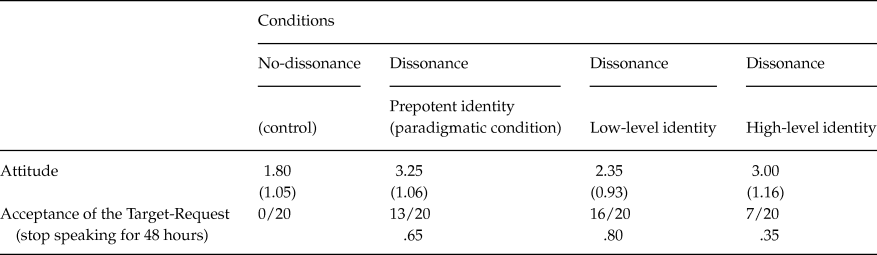
Manipulation check. At the end of the experiment, the participants had to tick, out of 20 possible identifications, those which they had read at the beginning of their participation. It was shown that all subjects were able to pick out at least 8 of the 10 identifications (low or high level depending on the conditions) read previously (results are presented in table 1).
Attitude (Standard Deviations in brackets) and acceptance of the target behaviour (percentage in brackets) in the no-dissonance condition and in the prepotent, low-level identity and high-level identity conditions

Note: N = 20 participant per cell.
The higher the score of attitude, the less difficult “stop speaking for 24 hours” is assessed.
Cognitive rationalization (Attitude). Preliminary results
As expected, the results concerning attitude change reveal a classical effect of dissonance: participants assessed the experimental task as more difficult in the no-dissonance condition (M = 1.80, SD = 1.05) than in the paradigmatic condition (M = 3.25, SD = 1.06, p = .001).
Main results
Planned contrasts (Helmert) were used to put into the test the hypothesis 1. As expected, the low-level identity condition (Mlow ident. = 2.35, SD = 0.93) was statistically different from prepotent identity condition and high-level identity condition, taken together (respectively Mprepotent ident. = 3.25, SD = 1.06 and Mhigh ident = 3.00, SD = 1.16), t(57) = 2.21, p = .03. These latter conditions were also not statistically different from each other, t(57) = .70, ns.
Moreover, pair-wise comparisons (LSD, Least Significant Difference) confirmed that low-level identity condition is statistically different from both prepotent identity condition (respectively Mlow ident. = 2.35 versus Mprepotent ident. = 3.25, p = .009) and high-level identity condition (respectively Mlow ident. = 2.35 versus Mhigh ident. = 3.00, p = .05).
A Dunett test shows that the no-dissonance condition (Mno-dissonance = 1.80, SD = 1.05) differed significantly from both the prepotent identity condition (Mprepotent ident = 3.25, SD = 1.06, p = .0001) and the high-level identity condition (Mhigh ident = 3.00, SD = 1.16, p = .001). On the other hand, no significant difference was observed between no-dissonance and low-level identity conditions.
Once again, according to cognitive dissonance theory attitude change was observed in the paradigmatic situations of forced compliance. In contrast, no attitude change was observed when participants were induced to identify their behavior at a lower level. In other words, our results show that participants in the low-level identity condition did not change their attitude whereas attitude change was observed in both high-level identity condition and prepotent identity condition.
Behavioral rationalization (behavioral change)
First of all, our results indicated once more that if free choice was not mentioned (semantic freedom), no rationalization in act was observed (behavioral rationalization; 0/20).
We then analyzed the data using logistic regression (logit model) to test the effect of the action identities, Wald χ²(2.60) = 3.60, p = .05, odds ratio = .52. To explore this effect further, we made comparisons by pairs (pair-wise comparisons). These comparisons show that the high-level identity condition (7/20) differs significantly from the prepotent identity condition (prepotent identity condition, 13/20) and low-level identity (16/20), respectively χ²(1, 60) = 3.60, p = .05, φ = .30 et χ² = 8.29, p = .004, φ = .45, these two last conditions not differing from each other, χ²(1, 40) = 1.13, ns.
Discussion
Once more, the semantic declaration of freedom is necessary to arouse dissonance. So, our results confirm that, in line with earlier research (Beauvois et al., Reference Beauvois, Joule and Brunetti1993; Fointiat, Reference Fointiat1996) no dissonance reduction procedures are observed (whether in terms of attitude change or behavioral change) when the participants are not declared to be free.
Furthermore, the results observed in the paradigmatic condition (i.e. prepotent identity condition) show both an attitude change (cognitive rationalization) and a behavioral change (behavioral rationalization). These results are not as surprising as they could seem to be: the level of the mode of reduction made available second (i.e. behavioral rationalization) is significantly higher than that of the control group. Thus, as noticed above, and according to Gosling et al. ’s (2006) integrative perspective, the results support the hydraulic model of reduction (Brehm & Cohen, Reference Brehm and Cohen1962; Fointiat, Reference Fointiat1998; Martinie & Fointiat, Reference Martinie and Fointiat2006; Stone et al., Reference Stone, Wiegand, Cooper and Aronson1997). The results suggest that participants used the first mode made available (i.e. attitude change, but they also used the second mode made available (i.e. behavioral change). It was as if the attitude change did not entirely reduce dissonance (either because the dissonance was too strong, or because this mode of reduction is not efficient enough), motivating participants to use a second mode to reduce the remaining dissonance.
More interestingly for our purposes, an effect from the identification of dissonance arousing behavior was observed (stopping speaking for 24 hours): the expected effect of dissonance (attitude change) (1) when the participants are not induced experimentally to identify their problematic behavior (prepotent identification condition), and (2) when the participants are experimentally led to identify their dissonance arousing behavior at a high level. In the first case, we are in the paradigmatic condition of induced compliance. It is hardly surprising then that a dissonance effect is observed. In the second case, still nothing surprising: according to the theoreticians of action identification, the individual has a tendency to “spontaneously” identify their action as high as possible. So it’s easy to understand that in this condition as in the preceding one, the expected change of attitude is produced.
On the other hand, this dissonance effect disappears when individuals are experimentally led to identify their problematic behavior at a lower level, that’s to say focused on the how of the action. For advocates of action identification theory, a difficult action (such as stopping speaking) will be identified at a low level, and will not permit the individual to integrate their act in a global course of action. We remember that in the research of Wegner et al. (Reference Wegner, Vallacher, Macomber, Wood and Arps1984) a weighted coffee cup can lead the individual to think of the action of “drinking coffee” at a very concrete level (e.g. lifting the cup, swallowing), while at the same time blocking access to more abstract identifications such as “relaxing”. In the same way, poor quality telephone transmission can change the identity of the action “chatting” to lower-level identities such as “making yourself understood” or “talking loudly and clearly”. The contextual indications like those which we have just mentioned, the newness of the action, the lack of familiarity of the individual with this action, at the time of its performance, focus the attention of the individual on separating their behavior into small units, thus blocking the emergence of high-level identities.
To follow this line of reasoning, according to our research, inducing a low-level identification of dissonance arousing behavior is likely to prevent individuals from understanding their action at a more abstract, general level, which allows this behavior to be considered as valuable or useful. So they are likely to find themselves unable to change their attitude to rationalize their own problematic behavior. This is what we see here. For all that, it is the participants in this same condition who are most inclined to rationalize behaviorally. This effect of rationalization in act leads us to think that the dissonance aroused by problematic behavior identified at a low level, has remained intact. As motivation is always present, the individual must resort to other means of reduction, possibly the behavioral rationalization route, as long as they are offered the opportunity. So we can understand that these participants in the low-level identity condition are also the quickest to accept behavior even more costly for themselves than that which aroused the dissonance. In other words, this interpretation leads to the following surprising result. It is the participants who find stopping speaking for 24 hours difficult who are the most likely to agree to stop speaking for 48 hours.
Of course, these initial results confirm the value of taking account not only of the counter-attitudinal or counter-motivational aspect of the dissonance inducing behavior (as is usually the case in research on forced compliance) but also of the significance which this behavior takes on in the eyes of those who perform it.