1. Introduction
In the early years of the nineteenth century cotton was the most important product in the world. The growth of the cotton industry would fuel the development of capitalism across Europe and, indeed, the rest of the world as the century advanced.Footnote 1 Kristine BrulandFootnote 2 has argued, with particular reference to Norway between 1840 and 1870, that the spread of the industry across Europe was greatly influenced by the technological advances and organisational practices developed and exported from Great Britain. Belgium, Germany, the Russian Empire, and Sweden all benefited, like Norway, from British expertise. The cotton industry in Finland developed rather later than in many other European countries, not helped by the country's location on the north-eastern shores of the Baltic, which froze for large parts of the year, cutting off supply routes and making international travel very challenging. As in other North European countries, in its early days the Finnish industry drew many of its industrialists and skilled workers from Britain. Later on, these were followed by a new social group that had emerged in Britain between the skilled workers and the mill owners: the cotton masters, technical specialists.Footnote 3 In Britain, this stratification was common in such industrial areas as Lancashire. In Finland, it was limited to industrial centres, usually small mill towns dotted along the banks of rapids where energy was easily available. Of these, Tampere was the most significant.
The first British entrepreneur to arrive in Finland in 1819 via Russia was James Finlayson, a machine builder. When Finlayson's business did not take off, he sold his enterprise in 1836 to new entrepreneurs. The most important of these was the Quaker family of the Wheelers, who were not machine builders, but who financed a new company and hired skilled workers from England, Wales and Scotland to run the day-to-day production in the Finlayson Cotton Mill. They were followed a little later by John Barker, a British technician and machine builder who had previously worked in both Belgium and Sweden. Barker brought machines and casting molds with him.
In this article, I consider the role of the British entrepreneurs in the development of Finland's cotton industry by focusing primarily on the fortunes of what became known as Finlayson's cotton mill. Early histories of Tampere and the cotton mill underestimated the significance of John Barker and the Wheeler family, and may have exaggerated the role of the Baltic German Nottbecks family.Footnote 4 This interpretation may be due to the fact that the Wheelers left Tampere in 1846 whereas the Nottbecks’ role as company managers was still significant in the early twentieth century when these accounts were written. More recent work by Roberta G. Selleck has highlighted the importance of Quaker connections in the founding years of the company, although she is mistaken in identifying Finlayson as a Quaker (see below). In this article I supplement older accounts of the cotton mill with the Company's official correspondence in the Finnish Central Archives and new material from the Wheeler family archive in the UK to show that the role of the Wheelers was more significant than has previously been thought. I explore the government policies, business and religious networks that encouraged Finnish industrialisation from the 1820s onward, and examine the roles played by the British industrialists, technicians, and industry specialists. I compare the performance of the British within the Finnish industry with that of their countrymen working in cotton in both Sweden and Russia. The performance of Finlayson's cotton mill in Tampere, Finland is compared specifically to that of the Krenholm Cotton MillFootnote 5 that was located in Narva (otherwise known as Ivanograd) in Estonia (then a part of Russia), and to the cotton industry in Łódź in Poland (then also part of Russia), as well as to the Swedish cotton industryFootnote 6 in general.
2. The context of the Finnish cotton industry (1820–1870)
Before the Napoleonic Wars Finland was part of Sweden, but during the conflicts Sweden lost Finland to Russia in 1808–1809. Under Russian rule, Finland urbanised slowly. Only 63,400 Finns, 5.4 per cent of the total number, lived in urban areas in 1820. By 1870 the figure had only risen to 131,600 (7.4 per cent of the total). Industrialisation was also slow. Finland retained the legal system that it had adopted while under Swedish control, and it also retained considerable economic autonomy as part of Russia, indeed, a customs border was established in 1812 between Russia and Finland. Russia, like Sweden and many other countries, then decided to protect its rising domestic industry by imposing high import tariffs. In the beginning Russia and Finland had the same import tariffs, but from 1840 Finnish import tariffs were lower than the Russian ones, although still quite high. This meant that the cotton industries in both Finland and Sweden were able to develop without tough competition from the more developed British cotton industry until 1860.Footnote 7
However, the customs border between Russia and Finland placed limits on the rate and extent of the growth of the Finnish cotton industry. Had the Russian import tariffs not been so draconian, the Finnish mills could have produced much more cotton for the Russian market. By comparing Finlayson Cotton Mill's output and growth to that of the Krenholm cotton mill in Estonia, the development of the Finnish cotton industry with the Swedish one and the growth of the cotton cities of Łódź in Poland and Tampere in Finland, it is possible to understand the disadvantages that Finland's industry was subjected to because of the region's customs barrier and import tariffs.
The mill in Tampere was the first to be built in Finland. It was originally established in 1820, but production did not begin in earnest until 1828. The Krenholm cotton mill only began operations in 1857, but it received substantial injections of German capital and grew very rapidly, particularly after the construction of a railway line between Narva and St Petersburg in 1870. It was situated on the banks of the Narva River (Narova), and drew much of its power from the fast flowing rapids next to it. Łódź was, like Tampere, a small town in the 1830s, sitting in the Kingdom of Poland; another autonomous part of Russia, created at the Congress of Vienna in 1815. In 1856, however, the customs border between Poland and Russia was abolished, and this, along with the construction of a railway line from the town into Russia in 1865, meant that the town's textile and especially cotton industry was able to forge a significant position in the Russian markets.Footnote 8
3. Textiles in Tampere
The first British textile entrepreneur to reach Finland was James Finlayson, a Scot with an expertise in textile machinery. He and his wife Margaret arrived in Tampere via St Petersburg.Footnote 9 Finlayson's was not the only company in Finland producing cotton texiles. A. W. Wahren, an entrepreneur from Stockholm, leased a wool spinning and weaving mill in Finland in 1838 before moving on, in 1847, to establish a cotton-spinning mill in Forssa, in southern Finland, in partnership with a group of merchants from Helsinki. He then established a weaving mill, again in Forssa, in 1854. He would eventually acquire full ownership of the spinning mill, which for decades was one of the largest industrial plants in Finland, second only to Finlayson's cotton mill. In 1843, John Barker (who we will meet later) left Finlayson's and Tampere to establish a cotton-spinning mill in the town of Turku, although this remained a small enterprise and functioned, in part, as a subcontractor to Finlayson's. In 1857, in the wake of the Crimean war, merchants and ship owners based in the town of Vaasa, in the coastal area of the Gulf of Bothnia established a cotton mill in their town. There were further cotton mills established in Finland in 1861–1865, but this was during the Cotton Famine and almost all of these ventures failed due to a shortage of raw material.
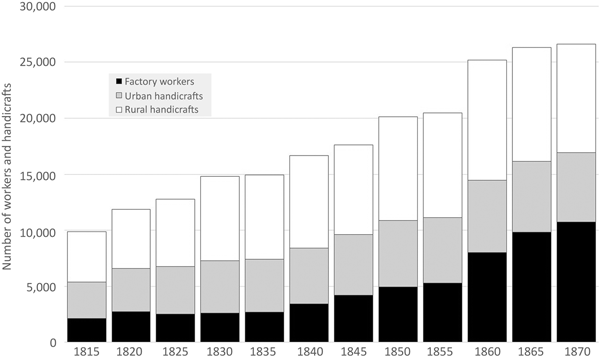
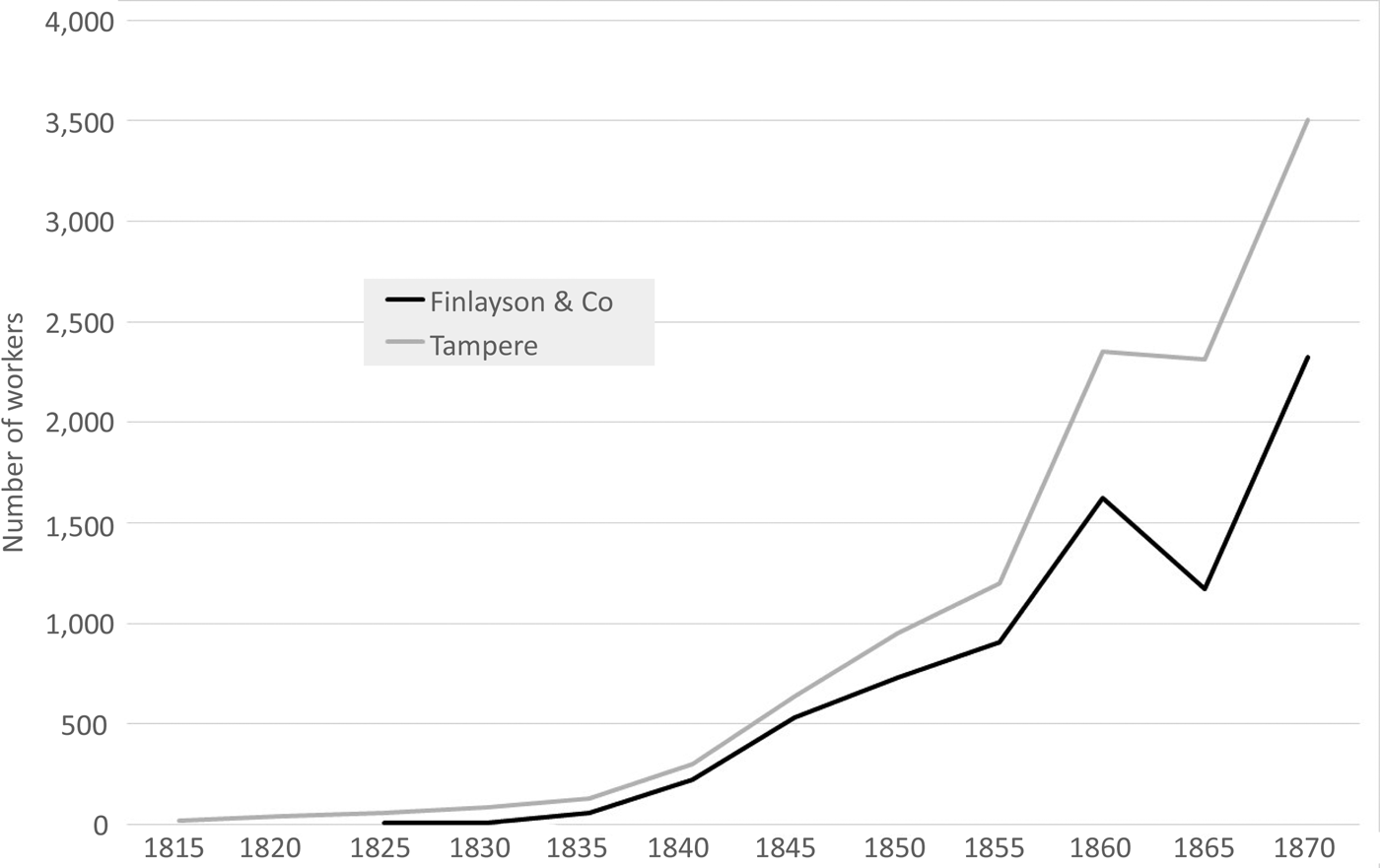
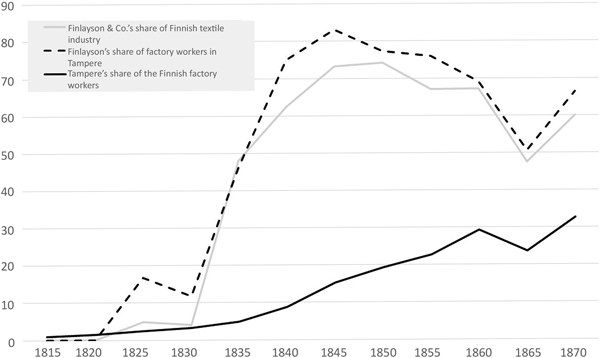
Finlayson's mill was, as Figures 1, 2 and 3 show, the largest textile mill in Finland, and crucial to the industrial development of the country. Figure 1 illustrates the small number of factory workers in Finland. Figure 2 shows the high numbers of these factory workers concentrated in Tampere and particularly at the Finlayson cotton mill, highlighting the importance of this mill for the growth and industrialisation of both Tampere and Finland. As the number of factory workers in Finland increased, Figure 3 shows that the relative share of these workers in Tampere workers rose also, so that by 1870 one third of Finnish factory workers worked in Tampere factories. By the 1850s, Tampere was known as the ‘Manchester’ of Finland. As with the companies in Forssa and Vaasa, Finlayson's relied on the input of British experts for their development and continued growth. Given the importance of cotton to Finland's industrial economy, the British entrepreneurs and the companies they founded and nurtured played an important role in the country's industrialisation.
Numbers of factory workers and craftsmen in Finland (1815–1870).

Factory workers at the Finlayson Cotton Mill and Tampere town (1815–1870).

Shares of Finnish factory workers in Tampere and Finlayson & Co. (percentages).

4. Finlayson & Co.: a business history
4.1. Origins: James Finlayson
When Russia annexed Finland from Sweden in 1809, this opened up new economic opportunities for both Finland and Tampere. Had Swedish rule continued, it is very unlikely that Tampere would have become a prominent centre of the textile industry as Sweden had towns such as Norrköping, with much deeper industrial roots, greater energy resources and better transport links. Tampere would most likely have developed into a pulp and paper industry town, like many other Finnish mill towns built on the banks of fast flowing rivers; instead, it evolved into an industrial showcase under Russian rule.
The story of Tampere's rise to prominence begins in 1812 when a Scottish cleric, John Paterson, arrived in Tampere. At that point, cotton yarn and fabrics had been imported for years to Finland, and in certain parts of the country, cotton weaving was a fairly large cottage industry.Footnote 10 Paterson was a missionary who had been on his way to India, but was diverted to Sweden because of the Napoleonic Wars. While there he established the Swedish and Finnish Bible Societies, which printed and distributed Bibles. Printing obviously requires paper, and the only paper mill in Finland was a small factory in Tampere. Paterson arrived in the town in July 1812 to visit the paper mill. He found the quality of paper adequate for his purposes and wrote in his diary that the Tammerkoski Rapids, which lay on the river just above the paper mill, were ‘among the best factory sites’ he had seen.Footnote 11 Moving on to St Petersburg, he became acquainted with his fellow Scot, James Finlayson, who he met through members of the Wheeler family. Finlayson travelled to Tampere with Paterson in 1819.Footnote 12 In the autumn of 1819, Finlayson filed a detailed petition at the Office of the Secretary of State for Finland in which he laid out his plans for an industrial enterprise and requested ownership of the Tammerkoski Rapids above the paper mill.
Czar Alexander I also made a tour of Finland in 1819, and learned of the opportunities in Tampere.Footnote 13 This may have prompted him to grant Finlayson's requests; the Scotsman was granted permission to build several factory buildings and given additional privileges and concessions besides.Footnote 14 Not only was he to be exempt from any duties on any goods he imported, and on any products he exported to Russia, he was also awarded the privilege that merchants selling his goods did not have to be members of a guild. He was further promised Finnish state aid to procure the pig iron and charcoal he would need for the foundry in which he planned to build and maintain his factory machines. The Finnish government also promised to keep him informed of any of their purchases that related to his business activities. This was, in fact, a very minor concession, as the Finnish Crown always publicly announced their purchases in order to ensure a level playing field for all businesses in Finland. Finlayson had also requested that any staff he hired from abroad would be granted freedom of religion and be exempt from Finnish military service. These requests were also granted. Furthermore, Finlayson received an unsolicited 30,000 banco-rouble loan from the Treasury of the Grand Duchy of Finland and was granted six years to realise his plans before repayments had to start.Footnote 15 Under Finnish law Finlayson could not carry out his plans without obtaining the requisite land and water rights, and to achieve this he had to become a legal resident and burgher of the town of Tampere. The latter process was carried out in no more than a day, and by Christmas 1820, the Imperial Finnish Senate, with the support of the Russian Czar when needed,Footnote 16 had secured the rights to the land and the buildings on that land and granted them to Finlayson.Footnote 17
In 1815, at the end of the Napoleonic Wars, Tampere had close to 800 inhabitants, and this number grew to 1,585 by the end of the 1820s. The concessions that Finlayson had won in 1820 were extended to all craftsmen and industrialists working in the town and these concessions would stay in place until 1905. Had Finlayson not been granted his various privileges it would have been impossible, or at least extremely risky, to build a cotton mill as far as 180 kilometres inland, as transport costs would have been prohibitive. As it was, raw cotton arriving at Finland's coastal ports had to be carried to Tampere by caravans of horses and the spun yarn and woven fabrics had to be hauled by similar caravans to other Finnish towns and cities, and on to St Petersburg. Finland's first railway, which ran from Helsinki to Hämeenlinna, some 75 kilometres short of Tampere, was built in 1860, but the line was not extended to Tampere until 1877.
The foundations of Tampere's future prosperity were thus laid in the 1820s, but before James Finlayson's first modest steps in the town could grow into Finland's foremost industrial plant other factors had to come into play.Footnote 18 Finlayson's initial plan was to build a foundry and workshop alongside his main factory building. This would allow him to build the machines he needed to produce his yarns and fabrics; he was going to introduce mechanical engineering to Finland.Footnote 19 However, after an official inspection in 1824 carried out by Nils Gustaf Nordenskiöld, the Superintendent of the Finnish Mining Board, the machine technology Finlayson proposed to use was declared outdated. Worried that the Finnish State would be the loser, after they had already invested heavily in Finlayson's venture, the Czar urged the Senate to loan Finlayson a further 36,000 banco-roubles to upgrade his plans. The Senate agreed to do so, but on the condition that Finlayson concentrated on the production of textiles rather than on the building of machines.
At the beginning of the 1830s, cotton was seen as a growth industry; there were already over 500 cotton factories and mills in Russia alone.Footnote 20 Production began at Finlayson's mill in 1828. At first, it produced wool yarns for use by craftsmen, in addition to cotton yarns that were for general consumption. By 1833, Finlayson had seven roving machines and five spinning machines running more than 500 spindles, and his factory employed 50 workers. The yarns produced in the cotton-spinning mill had given rise to a manufacturing industry that was unprecedented in Finland at that time. The Finlaysons’ home was turned into a weaving factory, with cloth being woven both there and in the homes of the local weavers. The cloth produced was sold in St Petersburg, along with yarn from the spinning mill, and taken to local markets in and around Tampere by Margaret Finlayson herself.Footnote 21
The company workshop did build further machines for the factory, so Finlayson must have had plans to expand production, but he had lost enthusiasm. He wanted to leave Tampere and invested little in the development of the factory. It is possible that Margaret Finlayson's activities in the market place may have been more productive than those of her husband. Finlayson's enterprise failed to thrive in the years between 1827 and 1836 and this failure was mirrored by the slow growth of the town during this period. Tampere grew more slowly during this period than at any other point in the remainder of the nineteenth century. Finlayson's mill continued to offer employment, but the number of craftsmen in the town did not rise and the number of merchants actually decreased by one. The population register kept by the town's only church shows that the population in 1836 was the same as in 1830: 1,585.Footnote 22 Although Finlayson's dream of becoming a machine builder did not come to fruition, he did introduce practices that were common in the industrialised United Kingdom to Finland. In the beginning, however, Finlayson's factory was hardly a trendsetter; initially it had fewer than 10 workers, and even by 1835 the workforce totalled no more than 50; although most of them were women and children, a new phenomenon in Finland.Footnote 23
4.2. Development: the Wheeler family
When James Finlayson started his business in Tampere he was almost 50 years old and appears to have been in relatively fragile health.Footnote 24 He and Margaret were childless and, having no descendants or relatives able to carry on his work, he started to look for a buyer for his tiny spinning mill which, by 1835, had seven spinning machines and 832 spindles. An additional pressure to sell may have been that Finlayson was aware that repayments on the 66,000 banco-rouble loans he had received from the Finnish Government were due to start in 1841. Voionmaa and Rasila claim that Finlayson had begun his search for a buyer as early as 1829.Footnote 25 However, the evidence suggests that he was simply trying to sell privileges, which he had obtained in 1820, but which he no longer needed once he concentrated on cotton.Footnote 26 Indeed, the cotton mill made modest progress in the beginning of the 1830s: output, sales and exports increased from 1833 to 1835.Footnote 27
In early summer 1835, Finlayson published detailed advertisements in at least two British newspapers: the Edinburgh-based Scotsman and the Belfast-based Northern Whig.Footnote 28 These highlighted the opportunities available in Tampere – such as the cheap labour – and offered the factory and associated buildings for sale at the price of 86,000 banco-roubles although, the advertisements noted, the buyer would also have had to assume liability for the 66,000 banco-rouble loans. In addition Finlayson was seeking a 20,000 rouble sales commission for himself. Given the wage rates reported in his advertisements, Finlayson was asking for the equivalent of the annual earnings of 583 of his adult women workers or 291 of his adult male workers, as a female worker earned £1 and 10s a year while the most a man could earn was £3.
Despite his advertisements in the British press, it appears from Finlayson's correspondence that he was hoping to sell his business to his Russian-based friends, the Wheelers. The head of the family, Daniel Wheeler Sr (1771–1840) was not in Europe in 1835, so his oldest son, William was taking care of the family businesses. William decided to gather together those among his St Petersburg acquaintances who might be interested in investing funds in a new company. He came to an agreement with Carl Samuel Nottbeck, an Estonian merchant who had come to St Petersburg from Tallinn, and Georg Adolf Rauch, a former physician to the wife of Czar Nicholas I, to form such a company. None of the three had any intention of moving to Tampere to take charge of the cotton mill; they appear to have been motivated by a wish to invest in cotton, which they saw as a growth field from which they hoped to make a good return. Wheeler, Rauch, and Nottbeck officially took ownership of Finlayson's company on 1 March 1836, renaming it Finlayson & Co. and sending German-born Ferdinand Uhde to Tampere as the new manager of the mill.Footnote 29 The contract of sale included a stipulation that Finlayson would remain in Tampere to help Uhde, but he did not stay for very long; James and Margaret moved back to Scotland in 1837 where, relatively shortly afterwards, they both died.Footnote 30
On the sale of the company, the Finnish Senate stated that it had no objection to the new owners retaining the privileges and concessions that Finlayson had been awarded, as long as they took responsibility for repayment of the loans from the State.Footnote 31 The Russian authorities took a somewhat different stance. Although there was a customs border between Finland and Russia, James Finlayson had held the right to export products to the Russian market. However, when the mill's production and exports began to increase under the new owners, the Russians, encouraged by Yegor Cancrin, their finance minister, took the view that the new company should not be allowed to increase its export quota. Eventually, in 1838, the Czar and his advisors stepped in once more and Finlayson & Co. were awarded a trade agreement, which allowed them to export, duty-free, 9,000 puds (151,650 kg) of cotton products annually to Russia.Footnote 32 In practice, this gave them permission to increase production tenfold: they were going to require extra buildings, new and updated machines, and more workers. They would also need the help of skilled cotton masters – and these they would bring from Britain.
The years immediately following the setting up of Finlayson & Co. were unfortunate ones for the Wheeler family. William Wheeler died in November 1836, passing his share of the company to his father, Daniel Sr, who died in 1840. William's brother Joshua was able to help the manager Uhde, with some practical matters between 1837 and 1841, but he too died in 1841.Footnote 33 By November 1841, Daniel Wheeler Jr and his sister Sarah held the majority of shares in Finlayson & Co. They oversaw the building of a new six-storey mill equipped with modern machines.Footnote 34 Daniel's health became increasingly frail, however, and the Wheelers parted company with Finlayson & Co. in 1846.Footnote 35 The company shares were then divided into 13 parts, the Nottbeck family taking six and the Rauch family seven.Footnote 36
So far this account has looked at the early history of Finlayson's from a business perspective. The story could, however, be framed more in terms of a St Petersburg-based, economic network rooted in cooperation between different protestant and missionary movements, which were active in Russia between 1817 and 1835. The Wheelers were Quakers. As mentioned above, the Finlaysons were not actually Quakers, though they may have appeared as such to locals, and there are indications that they tried to join the Society of Friends later in life.Footnote 37 The Finlaysons also knew John Paterson and his wife, who were Congregationalists. And they all had connections with the Gossnerian Pietists to which both the Nottbecks and the Rauchs belonged.Footnote 38 Ferdinand Uhde, who took over management of the mill in Tampere was also a Pietist. Footnote 39 The Quakers and Pietists both believe that human beings can, and should, further the progress of social justice. Those involved in the development of the factory at Tampere thus interpreted their business activities as works of social improvement. This thinking is reflected in the letters Uhde sent to his employers in St Petersburg. He presents the expansion of the factory as missionary work, bringing new jobs to the impoverished nation of Finland, helping it to achieve some prosperity and enabling its poor citizens to help themselves.Footnote 40 At this stage in its growth as a company Finlayson & Co. became increasingly united by religious as well as economic bonds.
Until recently it was thought that Nottbeck and Rauch were the more active partners in the company, and that the Wheeler family was more passive, simply providing funds.Footnote 41 It is now recognised that in fact it was the Wheelers who turned the fortunes of the Finlayson factory around.Footnote 42 The family was the largest investor in the company between 1835 and 1846, although they did try, unsuccessfully, to persuade more of their Quaker friends to invest in the enterprise. The Wheelers may even have been influential as early as 1819–1820, if it was they who encouraged James Finlayson to move to Tampere. Between 1836 and 1847, as we have seen, Finlayson & Co. was owned by C. S. Nottbeck, G. A. Rauch, and the Wheelers with Ferdinand Uhde managing the mill and reporting to Nottbeck, by letter, twice a week. The company had recognised they needed textile experts on hand to develop their factory, and they found these through the Wheelers’ Quaker contacts in England. Religious conviction – or soundness of character, at least – was considered a factor in the recruitment. The same network was also used to organise the import of raw cotton to Tampere. Finlayson & Co. bought their cotton through the Liverpool Quaker cotton broker and banker Isaac Cooke and, when he retired in 1840, through his company, Isaac Cooke and Sons.Footnote 43
Ferdinand Uhde was not just a hired manager; he worked with the Wheelers to create the business model for Finlayson & Co. Together they set up links that turned the Tampere cotton mill towards the Atlantic World, bringing raw cotton to Finland as return freight on Finnish ships that had been delivering Finnish timber to Britain, even though Nottbeck would have preferred the company to be tied into his Central European, Russian, and Baltic business relationships. Uhde and the Wheelers were also keen to invest in the continuous and long-term expansion of the factory. When the Wheelers had to pull out of the business and C. S. Nottbeck died in 1847, Uhde retained an important role in the company, continuing to run the factory until 1860. At that date one of Nottbeck's sons, Wilhelm von Nottbeck, who had been helping Uhde in Tampere for 24 years, took charge of the factory. He would remain at the helm for a further 30 years, although he and his family spent considerable amounts of time in St Petersburg, where his brother Carl was in charge of the company's formal headquarters. When Wilhelm was absent, the English experts and the office manager, Alexander Sommer, ran the factory.
4.3. Technology: John Barker
Most advanced states, such as the United Kingdom, were very protective of their industrial expertise. In the early nineteenth century British textile machines were the most advanced of any around the globe and gave the British industry an important competitive edge. The export of textile machines from Britain was prohibited from 1785 until 1843 in order to protect the domestic industry.Footnote 44 In the very early days of the textile industry, the building of factories went hand in hand with the building of machines. This gave birth to a small but skilled group of professional machine builders. The machines evolved quickly, and eventually, rather than continually refurbishing or updating their original machines, mill owners sought to buy new ones from specialist manufacturers. This led to the establishment of factories that specialised in building textile machinery. However, the laws banning the export of such machines set limits on the profits that the machine makers might have hoped to make, and while they could smuggle their machines out of the country, this was both expensive and risky. This led to some machine-making firms to leave Britain and move to Continental Europe, where new markets and new opportunities were opening up. John Cockerill's enterprise was one of these. The Cockerills have been seen as significant actors in the transfer of British technology to Europe. Belgium was a favoured destination after it gained independence from the Dutch in 1830 and permitted the export of machines.Footnote 45 Britain finally allowed its textile machine builders to export their machines in 1843, but it was not alone in its protectionism; many other European countries in the early phases of industrialisation maintained such prohibitions long after the Napoleonic Wars.
John Barker was one of the skilled English workmen hired to work for Cockerill's, a firm that had established a machine factory in Sersing, near Liège, Belgium in 1817.Footnote 46 It is possible that the owner of Cockerill's already knew Barker as they both came from Haslingden in Lancashire. In Sersing, Barker was put in charge of the firm's cotton machines and tasked with the modernisation of a large weaving shed.Footnote 47 Barker worked at Cockerill's until the company's orders went into decline after Belgian independence and the firm had to cut wages and lay off workers. Barker had met Samuel Owen Jr, who worked with his father in Stockholm, in Liège. Owen had tried to persuade him to move to Stockholm but Barker chose to return to England, to familiarise himself with the latest developments in machine building. After a year he returned to Cockerill's where the situation appeared to have improved, bringing with him a ‘state of the art’ machine. Believing Barker had smuggled the machine out of Britain, Cockerill refused to pay him for it. Feeling mistreated, Barker accepted Owen's offer, and in February 1833 he travelled to Tegelvik, Stockholm and established his own business, an engineering workshop. The Swedish cotton industry was taking its first steps towards modern production, and Barker's enterprise was well placed to produce the machines it needed.Footnote 48 During his time in Tegelvik, Barker built carding, spinning, and at least 25 weaving machines for Bergman & Bohnstedt's Stockholm-based spinning mill.Footnote 49 He also built weaving machines for a company in Viskafors, near Borås. This area would grow to become the second largest textile centre in Sweden after Norrkoping.Footnote 50 Barker made, or certainly designed, the moulds for the casting of his machine parts, based on the machines he had worked on at Cockerill's. He then supervised the assembly of the parts into the finished machines. Uhde – or another representative from Finlayson & Co. – appears to have visited Barker in Stockholm, probably before or during the autumn of 1835.Footnote 51 Barker then travelled to Tampere in March 1836,Footnote 52 where a new four-storey mill planned by William Wheeler and Uhde, and designed by Viborg City Architect Carl Lessig was under construction. James Finlayson himself had practically no role in the planning of this new mill, apart from offering his expert opinion in answer to technical questions.Footnote 53 English-language plans of the proposed buildings, which can be dated to 1834–1835, were presumably drawn up in connection with Barker's visit.Footnote 54 Barker shipped his tools and the machines he had built in Sweden to Finland in May 1836. The same ship carried the first 18 cast iron pillars, which would form the framework of the new mill. Footnote 55
According to Uhde, Barker was a better machine builder than a businessman. Certainly, Nottbeck reported that Barker was able to build all the machines the factory would need,Footnote 56 but he wanted to make all his tools himself – unproductive work, which took too long. In St Petersburg, Nordenskiöld, the Superintendent of Mining, had nothing good to say about Barker, which made Nottbeck even more reluctant to hire him, but Uhde brought Barker to Tampere, apparently with William Wheeler's support, suggesting that Uhde was able to act independently of the St Petersburg headquarters and Nottbeck. The latter's disapproval of Barker was evidently a matter of some concern for Uhde, however, as he often took pains to emphasise Barker's importance to the work in Tampere when submitting his reports to St Petersburg. Despite Uhde's efforts, reports of Barker's ill health, slowness, and time-consuming meticulousness found their way to the elderly Nottbeck's desk. These reports, coupled with Nordenskiöld's misgivings, may have prompted Nottbeck to insist that Barker's employment contract was to be renewed on an annual basis, at least initially, despite Uhde's arguments that this made Barker's salary – 4,500 roubles a year – too expensive.Footnote 57
Nevertheless, on his arrival in Tampere in 1836, Barker made an immediate impact. Leszig had been drawing up plans for a new, four-storey mill at Finlayson's according to instructions from James Finlayson and Uhde. Barker made it clear that he was dissatisfied with the direction the project was taking, suggesting that he had not been presented with the plans in Stockholm, but that the discussion had focused on the machines that needed to be built, or on the possibility of refurbishing the old machines that Finlayson had left behind.Footnote 58 Barker argued that, given the machines they planned to run, more space was needed; the building should have five storeys and the internal dimensions of each floor ought to be extended to 104 x 48 feet to ensure that the machines would fit comfortably within the factory halls. Once the waterwheel was added, the external dimensions of the building would extend to 136 x 54 feet. Uhde accepted Barker's recommendations, reporting to Nottbeck: ‘We must correct our calculations and follow Barker's plans.’ Barker drew up the revised plan himself, and the foundations were laid immediately. Uhde sought to reassure the St Petersburg office by noting that even although Barker may have had some shortcomings regarding theory due to his lack of education, he had plenty of practical knowledge, ideas, and problem-solving skills, in addition to which, he was also familiar with the latest developments in the cotton industry.Footnote 59 Uhde's letters to Nottbeck further suggest that Barker's experiences in England and Belgium were influencing his plans for the factory in Tampere. He was also familiar with the structure of the new steam-powered Stieglitz cotton mill, which had been built on the banks of the River Neva in St Petersburg in 1833, and was planning to use the same construction method, although with some alterations to accommodate the use of water power rather than steam. With Barker in charge, any involvement James Finlayson had in the building of the new mill came to an end.Footnote 60
4.4. The arrival of the cotton masters
The first English mule-spinning specialist to be employed in the winter of 1839 at the Finlayson factory was a man named David Armitage. He arrived in Tampere the following spring. C. S. Nottbeck had tried to hire Russian spinning specialists, but Barker and Uhde were of the opinion that all the candidates were incompetent. As it transpired, Armitage's pace of work and efforts would also prove to be disappointing at the beginning. However his spinning results improved later, and he stayed until 1845 at Finlayson & Co. Through the Wheeler family contacts, Thomas Turner, their first weaving master finally arrived in June 1839 to oversee the new weaving shed. Barker was in charge of the technical management of the factory as a whole, but saw his job as being the introduction of new technology rather than the supervision of production. Uhde felt the company needed someone with the expertise to take responsibility for the quality and smoothness of production, cooperation between the spinning and weaving arms of the business and the growth of productivity.Footnote 61 James Howarth, a technical manager found by Daniel Wheeler Jr, therefore arrived in Tampere in June 1841.Footnote 62
Thomas Turner could not stomach the new management structure – he rebelled and threatened to leave – and consequently Howarth was made responsible for spinning operations alone. The tensions between Turner and Howarth soon came to hamper cooperation between the two arms of the business. The weekly production volume of the weaving shed plummeted, with Turner blaming Howarth's spinners for the poor quality of the yarn, which he claimed was too weak for weaving and kept snapping. On investigation, however, it was shown that the defect was actually in the pasting machines in the weaving shed, which had not been properly maintained. Howarth complained that, given this situation, he could not be held responsible for the quality and volume of production, at which point Uhde promoted him to overall technical manager.Footnote 63 By 1842, therefore, Finlayson & Co. had a German, Uhde, as its general manager, but the weaving master, Turner, technical manager and spinning master, Howarth, and his assistant, David Armitage, along with the machine builder, Barker, were all British. Despite the personal antagonisms within the management team, production grew dramatically between 1839 and 1841. There was a fire in the original factory building built by James Finlayson in February 1841, but little damage was caused.Footnote 64 By the end of August 1842, Finlayson & Co. had 113 weaving machines running at Tampere and a further 24 machines being prepared in the workshop. Each weaving machine made in the factory's workshop cost the company just £8, and Barker also had some carding and spinning machines under construction for the finishing department in the spinning shed.Footnote 65
Initially, Uhde felt that in Howarth the company had appointed a true professional. As soon as he arrived, he made changes in the spinning shed regarding the batting and cleaning of the raw cotton, which made the batting machines more productive. Howarth also discarded the oldest, outdated carding machines, which Finlayson had brought from St Petersburg and ordered a spreading scutcher from a British firm, Charles C. Dyer. After Howarth was promoted over Turner's head he began to develop the weaving shed as well. Within two weeks, he managed to increase weekly production from 172 to 208 pieces of cloth, simply by making the machines run faster at 110, rather than 90 strokes per minute. He persuaded the machine operators to comply with this change by offering them a wage system that rewarded the most skilled, and therefore fastest, workers. As well as making technical changes, Howarth brought in innovations to benefit the workers: he ordered a new water supply system, and Barker bought in a gas lightning system from the Bolton-based firm of Rothwell and Co., which meant that the workforce were able to wash at the factory.Footnote 66John Barker's role and influence at the Tampere factory diminished significantly after Howarth's arrival, but Uhde managed to persuade him to stay on until the first phase of the new factory was completed.Footnote 67
Barker was first and foremost a machine builder and moderniser of old machines and his contribution was further decreased by changes in the way new technology was obtained.Footnote 68 By the mid-1840s the factory in Tampere, along with many others throughout Europe, was able to buy ready-made machines from Britain. Barker, like many other craftsmen machine builders, became redundant and he finally resigned from Finlayson's in the summer of 1843. Now when machine orders were made, technicians arrived in early spring to install the new machines and, presumably, to train the workers. They would then leave again before the long Finnish winter began.
The inadequate energy supply became an increasing problem as the mill continued to expand, placing constraints on pace of growth. When Barker left, the factory was operating 15 carding machines, 27 flyer spinning machines and two pairs of spinning mules with 6,000 spindles between them, and 163 weaving machines. Further machines were ready for use, but the power generated by the mill's original waterwheel was insufficient to bring them into operation.Footnote 69 In April 1844 a new waterwheel was installed increasing the production capacity of the spinning shed. The number of weaving machines had also increased to 209. Between 1842 and 1844 the weaving shed more than doubled its weekly output, and the growth in the productivity of each weaver was even greater as, by 1844, most weavers were operating two machines at a time. This meant that a weaver's productivity had increased more than tenfold since the days of hand weaving; a hand-loom weaver would have managed around 20 picks, or passes of the shuttle, per minute, whereas a weaver operating two machines worked at a rate of 220 picks per minute; nearly four picks per second.Footnote 70 By 1844, in less than ten years, Finlayson's small cotton mill had grown into a factory employing more than 500 workers. Ferdinand Uhde had good reason to be satisfied and wrote to Nottbeck in St Petersburg: ‘It is a great joy that the construction is done and we can now calmly and peacefully dedicate ourselves to production.’ He does not appear to have appreciated that the mill would have to be continuously developed and updated. As the demand for its products grew, the factory would require ever-greater numbers of machines and managers who could wring ever more efficiency from them and the workforce.Footnote 71
The pace of technological change was fast and James Howarth had significantly improved the efficiency of the processes in both the spinning and the weaving departments. Uhde, and the owners, had hoped that he would also improve the quality of the products but they came to realise that Howarth put quantity before quality; he had to go. It was in fact possible that Howarth and his wife were quite willing to leave Tampere. They had had a family of six children, but lost three of them between 1843 and 1844, two of them within the space of a few days when they succumbed to scarlet fever.Footnote 72 Howarth had to wait until the spring of 1845, when the sea ice melted, to leave Finland; his replacement John McMunn arrived in May 1845 to continue the succession of British managers at Finlayson's.Footnote 73
MacMunn remained at the Tampere factory for 12 years. In May, 1857 he was replaced by William Lawton, who was sacked the following year for drinking and replaced by Lucas ‘Luke’ Cooke. Kuukki, as the workers called him, died from an illness in 1864, and his post was taken initially by a man named Johnsson, about whom little is known, and shortly afterwards by James Newhouse, whom the workers called either Haussi (meaning ‘House’) or Hullu Haussi (‘Mad House’). Given this, it is perhaps not surprising that Newhouse was forced to leave Finland in 1875 after his relations with the workers broke down irretrievably. While it was likely that there had always been minor conflicts between the workers and the management, these escalated after Ferdinand Uhde left and Wilhelm von Nottbeck gave the British managers freer rein, to the extent that some of them were even violent towards the workers.Footnote 74
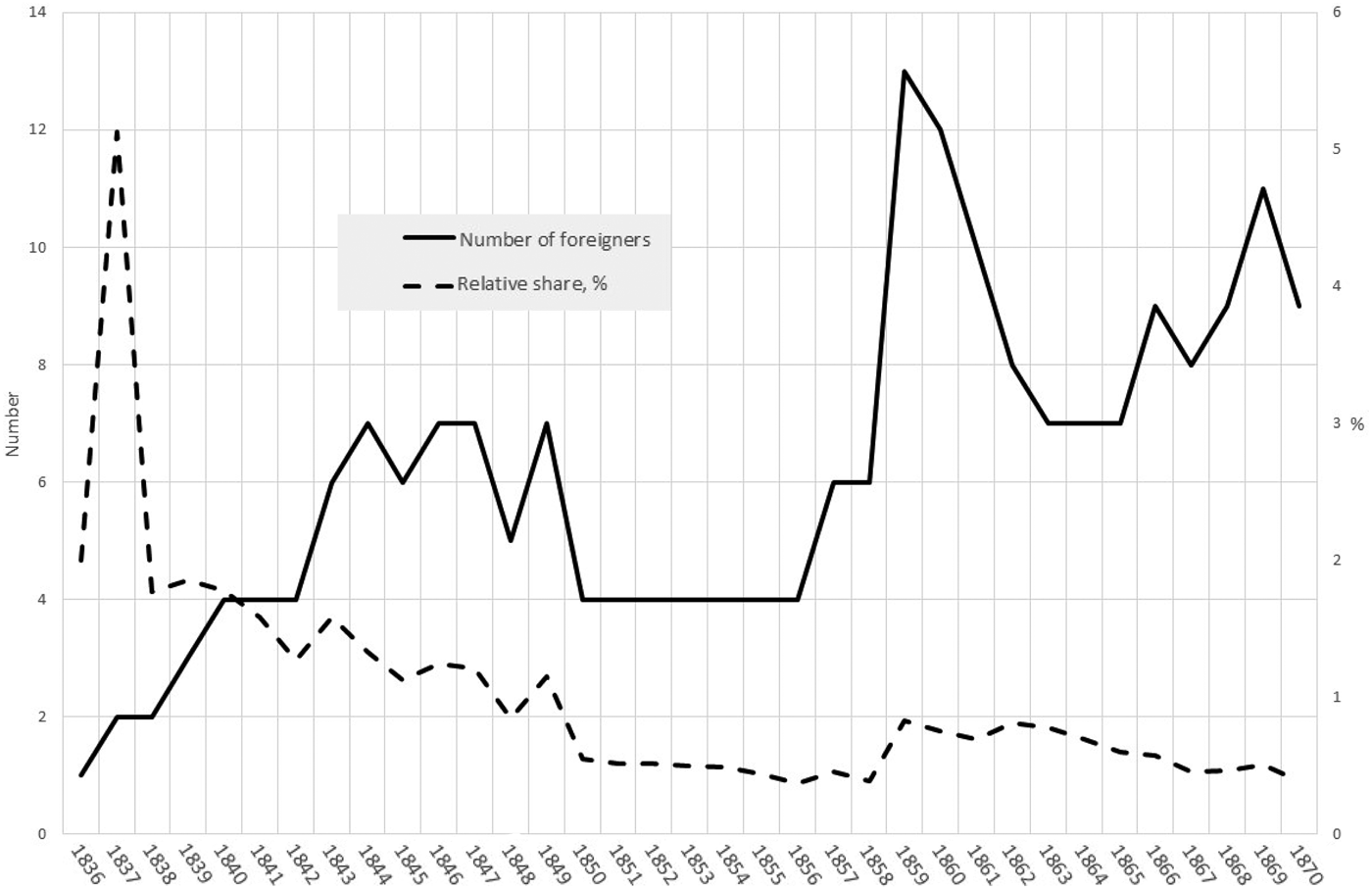
The turnover of weaving masters was much slower. Thomas Turner left shortly after Howarth, in the summer of 1846. His successor was another Englishman, John Sharples, who remained at Finlayson & Co. until his death in 1876. The foreign, largely British-born, employees working at the Tampere factory may have been small in absolute and relative numbers, as Figure 4 shows, but their expertise was essential to the growth of the company.
Number of foreigners at Finlayson & Co. and as a percentage of the labour force (1836–1870).

That said, it must be recognised that, given the speed at which textile technology was advancing, an individual's ‘expertise’ could rapidly fall out of date. When James Finlayson was building his spinning and weaving machines in Tampere, for example, he had been absent from his homeland for a number of years and had already lost touch with the latest technology. This may help to explain why his mill failed to thrive. It was certainly the case that the loaded question ‘When did you last visit Britain?’ was used in arguments between British experts;Footnote 75 the most recent newcomers being thought to have the most up-to-date knowledge and understanding of recent developments.
One example of the impact that one individual's knowledge could have on production can be seen in the case of John MacMunn. He had worked as a factory supervisor in Manchester. Uhde took him on as a professional who knew and fully understood the processes of making cotton yarn and fabrics. McMunn certainly knew the differences between the various varieties of raw cotton, the qualities of each and how they best worked together. At Finlayson's a water-twist fabric was being produced using two very different kinds of cotton – Surinam and New Orleans. According to MacMunn, this mixture was never used in England. The factory stopped mixing the two types of cotton and the quality of the company's yarn improved significantly.Footnote 76
If ‘cotton was king’ in Britain, this was increasingly the case in Finland too. As the quality of Finlayson's products improved its sales increased as domestic demand for cotton yarns and fabrics surged when imports of cotton yarn and fabric fell in the 1850s. The rate of growth and technological change was so great in the 1850s that developments at Finlayson & Co., and the repeated extensions to the factory, appear to have been almost haphazard. None of the investments made by Uhde and the company shareholders seemed to provide long-term solutions; they always had to be superseded within a few years.Footnote 77
With the outbreak of the Crimean War in 1854, the United Kingdom was pitted against Russia, causing difficulties for the British cotton masters in Tampere. The war also made the transport of raw cotton to Finland extremely difficult, because the British Navy blockaded the country's ports. Finlayson & Co. began to buy its cotton direct from the United States with the help of Swedish collaborators. The raw cotton was brought to Umeå in Sweden and then transported on small fishing boats through the blockade to Vaasa. Despite the resultant rise in transport costs, the Crimean War brought increasing profits to Finlayson's and most other Finnish cotton mills.Footnote 78
During the 1840s Finlayson & Co had never acquired a cloth-printing workshop. The company exported some fabrics to St Petersburg to be printed there, but for the most part master dyers in the Tampere area and in St Petersburg were commissioned to dye either the yarns needed to create coloured fabrics or the finished fabrics. Uhde had, in fact, been considering building a dyehouse at the Tampere site. The company decided to apply for a licence to establish such a dyehouse that would use ‘the English method’ of dyeing. This they did in April 1852 and the licence was granted the following October.Footnote 79 Uhde must have been fairly sure that application would be successful, because while he was travelling in Germany in the spring of 1852, he hired Louis Schnitt, a master dyer from Berlin. Furthermore, he bought machines for the dyehouse that summer, and even had a new building to house them constructed at the same time. Schnitt did not stay long in Tampere, and all the master dyers who followed him were, once again, British.
With the building of the new dye house, the company once again faced issues of energy supply. The Tammerkoski rapids still offered plenty of power, but the waterwheels were now outdated. Finlayson & Co. invested in its first turbines in 1852–1853, buying them from the British firm of Bryan, Donkin & Co.Footnote 80 As well as hiring British experts, Finlayson's relied almost exclusively on Britain for its technology right up until the 1870s. The British experts found Finland attractive because the country offered them – besides adventure – higher social standing and a much higher salary. They mainly arrived from the cotton centres of Lancashire, where they had worked on the factory floor as supervisors, or overseers, or as highly skilled spinners or weavers. In Finland, they were able to become spinning or weaving masters and mill managers.
4.5. The role of customs barriers
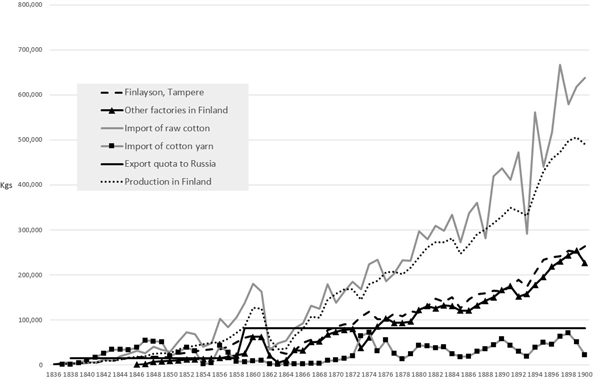
As Figure 5 illustrates, the production of cotton yarn grew rapidly at the Finlayson cotton mill and in other mills throughout Finland. Production at the Tampere factory already exceeded the Russian export quota of 147,420 kgs of yarn in 1845, when Finlayson's produced 161,000 kgs. After trade negotiations were undertaken in 1859, a new quota of 819,000 kgs was set on all exports from Finnish cotton mills to Russia; that year the Finnish mills produced 853,600 kgs.Footnote 81 In 1870 the Finlayson mill produced 846,300 kgs of cotton yarn, exceeding the entire country's export quota for the first time. Considering that the other Finnish cotton mills had produced an additional 733,000 kgs of yarn that year, cotton production in Finland was almost double the quantity which could be exported duty-free under the trade agreement. It was time for the Finnish cotton mill owners to ‘grow’ their domestic market or to recognise that there were limits to what the Finnish cotton industry should try to produce, and that they might have already surpassed those limits.Footnote 82
Production of cotton yarn at Finlayson Cotton Mill, other factories in Finland and all factories combined; set against imports of raw cotton and cotton yarn and the export quota to Russia (1836–1900) (kgs).

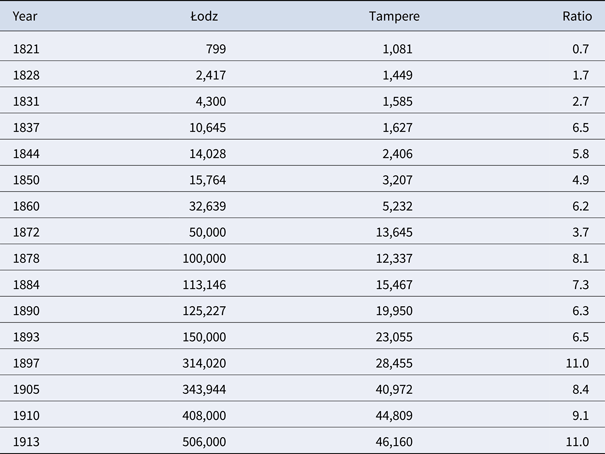
To put the limitations on the growth of the Finnish cotton industry – and of Finlayson & Co.’s factory in particular – in context it is interesting to compare the growth of Tampere with that of the city of Łódź, Poland; to compare the Finlayson cotton mill with Krenholm mill in Narva, Estonia and also to compare the Finnish cotton industry to the Swedish one. Cotton was the main industry in both Tampere and Łódź. Both cities were linked to Russian markets, but with differences in their customs borders. Table 1 shows that Łódź grew more rapidly than Tampere between 1830 and 1850, but its growth was most impressive between 1860 and 1900 when, economically speaking, Poland really became part of Russia.
Population figures for Łodz and Tampere (1821–1913)

Sources: Otto Heike, Aufbau und Entwicklung der Lodzer Textilindustrie (Mönchengladbach, 1971), 245; Viljo Rasila, Tampereen historia II: 1840–luvulta vuoteen 1905 (Tampere, 1988), 206–07; Väinö Voionmaa, Tampereen historia III: Itämaisesta sodasta suurlakon aikoihin (Tampere, 1932), 35.
When we compare the economies of Finland and Sweden and the relative performances of their cotton industries, we see that the population of Finland was smaller, the urbanisation rate lower and GDP lower than in Sweden. However, production of cotton yarn was higher in Finland, because Sweden hardly exported cotton. Sweden had lower import tariffs than Finland, which made it more vulnerable to British imports, and did not have even the limited access to Russian markets that Finland had.
Similarly, the Krenholm cotton mill in Estonia, and Finlayson's, though both under Russian rule, had different possibilities to export goods to the Russian market. When the Krenholm mill was connected to the railway at the beginning of the 1870s, its production was already four times greater than that of Finlayson's mill. Krenholm had the considerable advantage in that it lay close to the expanding city of St Petersburg, which provided an almost insatiable demand for the mill's products. How large might the Tampere factory have grown, if it too had free access to the Russian markets? Had this been the case, the Finnish mill would have had to compete against the many Polish, Estonian, and Russian mills within the Russian Empire. Productivity would have been key to Finlayson's survival in such a competitive environment.
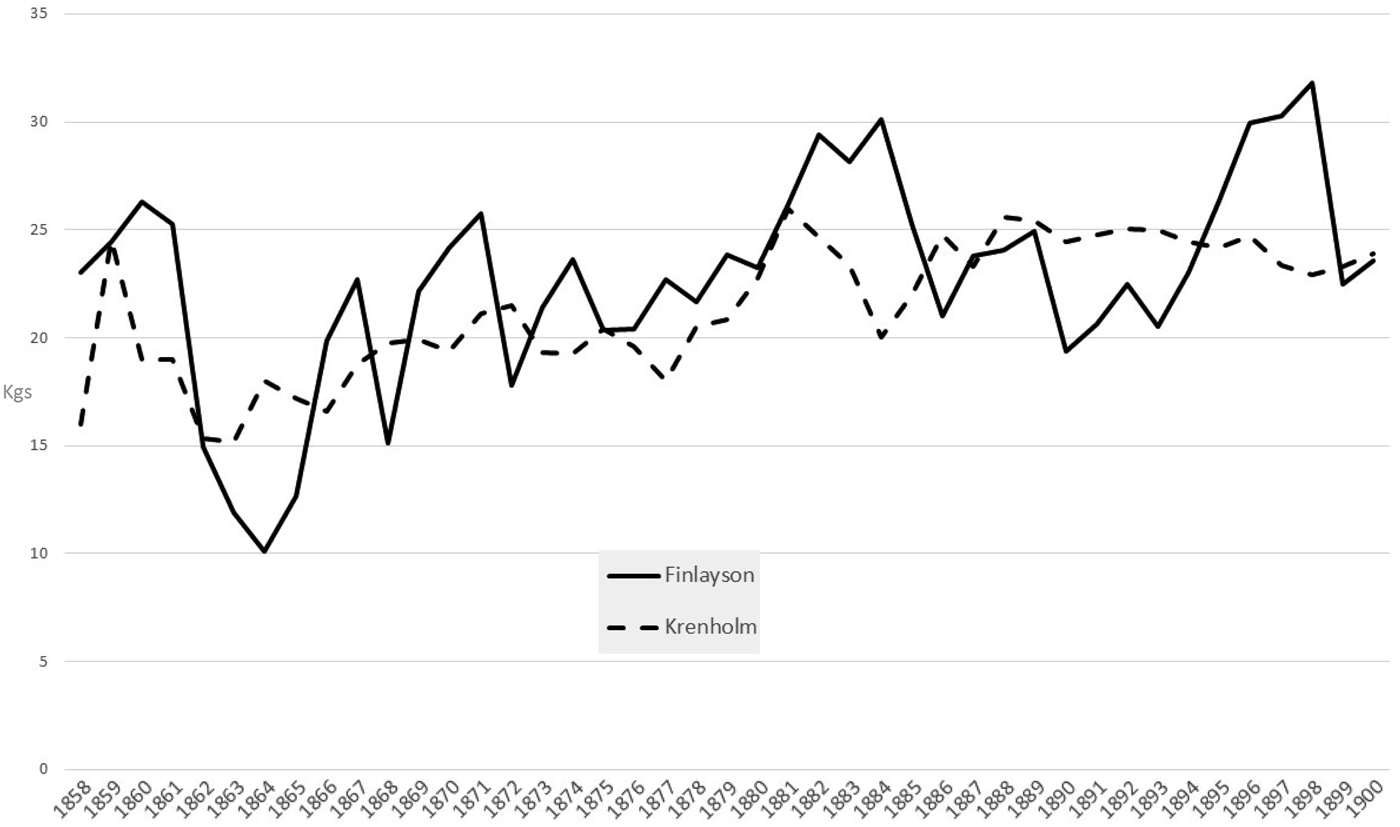
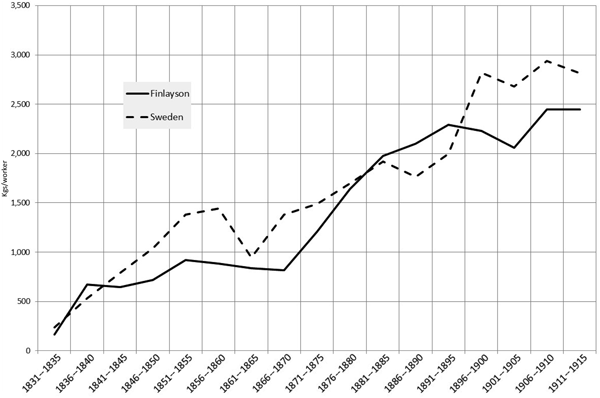
Although output at the Krenholm mill was much greater than that of Finlayson‘s factory the two enterprises produced roughly the same per spindle (Figure 6). If we compare the weight of yarn produced per worker at Finlayson's with the average amount produced by workers in cotton mills in Sweden (see Figure 7) the two appear to have been remarkably similar, making it quite obvious that Finlayson's was as efficient as its counterparts in both Estonia and Sweden.
Annual yarn production per spindle at Finlayson and Krenholm (1858–1900) (kgs).

Five-year average spinning production in (1831–1915) (Yarn/kgs/worker).

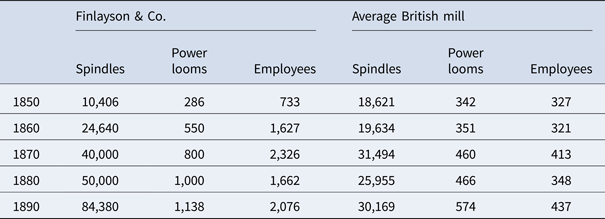
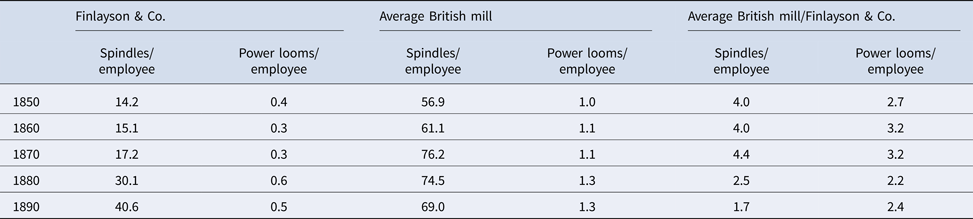
If, on the other hand, comparison is made with British mills, it is clear that the difference between the levels of technology being used by Finlayson & Co. and in the average British mill was vast. If we compare the combined spinning and weaving departments at Finlayson & Co. with the British cotton mills that also undertook both spinning and weaving (Tables 2 and 3), it evident that from 1860 onwards, Finlayson & Co. was much larger than an equivalent British factory: it had more spindles and power looms, and a larger workforce, employing at least three times as many workers both in absolute numbers and relative to each spindle.Footnote 83
Number of spindles and power looms at Finlayson & Co., compared with averages for English combined spinning and weaving mills (1850–1890)

Sources: ELKA FCMA, statistics; D. A. Farnie, The English cotton industry and the world market 1815–1896 (Oxford, 1979), 316.
Ratio of workforce (spindles and power looms/employees) use between Finlayson & Co. and Britain combined mill average in 1850–1890

Sources: ELKA FCMA, statistics; Farnie, The English cotton industry and the world market 1815–1896, 316.
While there had been technological progress in Finland, the country had come late to the industrial revolution, and was trying to catch up quickly. Waterpower was initially very important for Finlayson's mill, as it was throughout Finland, but when the factory grew as large as it eventually did, it was obvious that steam power had to be a more efficient choice. By the mid-1860s production at the mill was being affected by the seasons, as during dry summers the water flow, and therefore the energy potential of the river and its rapids fell. As the factory expanded there were also difficulties in arranging the gearing of the machinery so that waterpower could be distributed evenly throughout the factory. This contributed to the decision made by Finlayson & Co. in 1866 to use steam engines alongside the available hydropower.Footnote 84
In Britain, fierce competition forced owners to refurbish or replace their machines frequently. For many years, Finlayson & Co. invested in new machines to increase the numbers of their spindles and power looms, but kept their old machines running alongside the new. The number of weaving machines at the factory grew by 140 per cent between 1849 and 1860, from 228 to 550, but the weaving department increased the amount of cloth it was producing threefold: the new machines had introduced greater automation and were much more efficient. When, in 1869 and 1870, a series of fires at the factory destroyed several spinning machines, they were replaced by with a significant number of newer, bigger machines. The focus of production shifted from mule spinning to throstle and ring spinning, which may be one of the main reasons for the acceleration in productivity that the company enjoyed over the course of the 1870s and 1880s.
The Finnish cotton industry enjoyed some advantages over their British counterparts. During the years 1820–1870 Finlayson's market for cotton goods within Finland was protected from global competition by relatively high import tariffs set by the Finnish Senate. Wages in the Finnish textile industry were also low. These two factors in combination made Finlayson & Co. exceptionally profitable, and therefore the owners of the company, unlike their British counterparts, faced no pressure to enhance their productivity. This may also explain why Finlayson & Co. were able to establish and maintain their own metal workshop and dyeing department, as well a large pool of unskilled workers. In Britain, where competition was very fierce, all such amenities would have been outsourced to keep costs low and maximise profits.
5. Conclusion
Finlayson's remained the largest industrial enterprise in Finland until the Second World War and was still a significant company until the 1970s, having merged with other cotton mills in Forssa and Vaasa in the 1930s and 1960s, respectively. The cotton industry declined swiftly from the 1980s. In a final twist to the story, the Finlayson trademark was sold in 2014 to three Finnish businessmen. Their new company designs goods in Finland but manufactures them in Asia. The history of the Finlayson cotton mill – and the Finnish cotton industry as a whole – is thus part of the narrative of global industrialisation from start to finish. It is a small addition to the story of the growth of the textile industry that had its roots in England and swept across continental Europe, carried by entrepreneurs, financiers and fundholders, and skilled experts. From very early in the nineteenth century, one Belgium-based British family, the Cockerills, helped to speed the spread of innovations made by British textile companies across Europe. Because Britain had prohibited the export of textile machines only knowledge and expertise could be carried to the continent and many men, such as James Finlayson, chose to take this path. Compared to the Cockerills, James Finlayson played a very minor role in the dissemination of textile technology across Europe despite the eventual success of the company he founded. Initially, although Finlayson & Co. was run as a commercial enterprise, it only kept afloat because it was adopted as a pet project by the Russian Czar. At the latter's behest the Finnish Senate took care of the company's needs, making it possible for the factory, which sat in the inland town of Tampere, to import all its raw materials duty-free, and to export its products to St Petersburg without tariff. Without these concessions Finlayson's venture would probably have folded very quickly. The company further benefited from the fact that Finland was part of Russia until 1917. During this period, the Imperial government ensured that the cotton industries in both Russian and Finland were able to rely on protective customs policies.
Finlayson and Barker suffered from poor health. Both saw themselves more as technical experts than as having entrepreneurial skills or business acumen. Uhde certainly believed that Barker was not up to the job of technical manager for the entire mill in Tampere. Nevertheless, Barker was able to start his own business with government help but it, like Finlayson's venture before it, enjoyed little success. It took more Britons, the Quaker Wheeler family, to turn the fortunes of Finlayson's enterprise around. During the 1830s and 1840s they invested in the rapid expansion of the company and built up the necessary business networks, ably assisted by their manager, Ferdinand Uhde. In technical matters Uhde had initially relied on John Barker, even although the latter had arrived in Tampere with a somewhat chequered past. Barker took charge of the construction and equipping of Finlayson & Co.’s mill at Tampere, basing his plans for the building and making the required machines along English lines. Although Barker had effectively led the mechanisation of the textile industry, first in Sweden and then in Finland, he became redundant when the United Kingdom lifted its embargo on the export of machinery, and Uhde and others could buy the machines directly from specialist British firms.
Finlayson & Co. grew until it owned the largest industrial plant in the Nordic countries, so it had a huge influence on industrialisation within Finland. It is important to understand, however, that, unlike factories in Sweden and Norway, the Finlayson mill was originally established mainly to produce yarns and cloth for export to Russia, not primarily to supply the domestic market. Nevertheless by 1853, Finlayson & Co.’s domestic sales had surpassed their exports. Had they not done so, the company would have struggled, as they were already exporting the full quota of goods they were allowed to Russia and faced stiff completion from other Finnish factories and high quality, if expensive, imports from Britain. The production processes at the Finlayson factory were improved by the expertise of foreign – mostly British –professionals. Other cotton factories in northern Europe – Sweden, Norway and Russia – hired their technical staff from England and Scotland as well.
As a town, Tampere was probably a disappointing destination for foreigners; it was small and offered few recreational opportunities, although the river and its rapids did offer good fishing for salmon and trout, at least until the early years of the twentieth century. Routes to the west and south were cut off in winter; passage out of Finland essentially ceased between November and April. Despite the fortunes of Finlayson & Co. the town and its industrial suburbs still had fewer than 10,000 inhabitants in 1870, and fewer than 100 of those were British. Although the English-speaking community was small, it had its own choir, and other social opportunities. Despite its size, it was not always peaceful, however. James Finlayson quarrelled with the town authorities and with the local clergy as well as with his colleagues. Turner and Howarth could not stand each other, and were often at daggers drawn, while Barker let his resentment over his shrinking influence at the growing factory be known. By the 1870s the workforce were openly rebelling against what they saw as abuses of power by their British managers.
While Finland's annexation as an autonomous part of Russia has been viewed by some as advantageous for the country's economy, the customs border imposed by the Russians acted as a trade barrier and set limits on how far the Finnish textile industry could expand. It is apparent that the technology and practices were brought to the Tampere factory by the British experts employed by Finlayson & Co. The company made it as advanced and as efficient as those of equivalent enterprises in Sweden, Estonia and Poland. Had it been possible to produce more for the Russian market, the company of Finlayson & Co. and the town of Tampere may have both grown more rapidly, and the entrepreneurs and investors might have realised even greater profits, although the political consequences for Finland and its people may have been less welcome.
Acknowledgements
This article is part of Finlayson's Cotton Mill History (1820–2020) project. The author thanks the foundation, founded by the shareholders of the Finlayson Mill (Finlaysonin tehtaan osakasten perustama avustussäätiö), which provided funding for this project to Tampere University. Many thanks especially to Fabrice Bensimon, Kristine Bruland and Jane Humphries for all of their helpful comments on this article.