Introduction
The development of theories attempting to explain judicial behaviour in causal-positive rather than legal-normative terms was initially an all-American enterprise. The approach was first promoted by the American legal realist movement. Jerome Frank, Karl Llewellyn, Leon Green, Max Radin, Felix S. Cohen, and their like-minded fellows in law schools across the US argued, against the orthodoxy of the day, that lawmaking inhered in judging. They called for the empirical study of adjudication looking beyond the justifications judges adduce for their verdicts.Footnote 1 Explicitly aiming at building theories that would enable predictions, they argued that lawyers should look behind the language of judicial opinions, and the ‘paper rules’ invoked therein to uncover the judges’ ‘real’ motives. The first systematic empirical research, however, was the work of academics affiliated with political science departments rather than law schools. Herman Pritchett (Reference Pritchett1948), Robert Dahl (Reference Dahl1957), Walter Murphy (Reference Murphy1964), Sydney Ulmer (Reference Ulmer1965), Glendon Schubert (Reference Schubert1958, Reference Schubert1965), and Martin Shapiro (Reference Shapiro1964) pioneered the field and established it as a distinct sub-discipline of American political science.
In Europe, meanwhile, this sort of approach had remained unknown. European political scientists did study and compare legislative and executive bodies, but they ignored the courts. The perception prevailed that courts and judges were outside politics (see von Beyme, Reference Beyme2001; Rehder, Reference Rehder2007). The judiciary was the province of lawyers, and judges were not viewed as lawmakers. Their task was to apply the law, not to make it. Moreover, far from questioning the prevailing mythology of judging, many legal scholars seemed anxious to perpetuate it. When politicians and legislators, unhappy to see their reforms quashed by judicial fiat, accused the men in robes of frustrating the will of the elected legislative majority, many prominent law professors went out of their way to defend ‘their’ courts. Responding to politicians who accused the Constitutional Council of behaving like a ‘gouvernement des juges’, French constitutional law specialists, for example, insisted that the Council was outside politics and that all it was doing was to ‘apply the constitution, all the constitution and only the constitution’ (see e.g. Favoreu and Philip, Reference Favoreu and Philip2005: 310–1 and 468–70). Law professors in Germany, Spain or Italy (Schlink, Reference Schlink1989, Reference Schlink1993; Stone Sweet, Reference Stone Sweet2000) also behaved like loyal supporters rather than neutral observers of their constitutional tribunal. The law literature on the European Court of Justice (ECJ) did not have a critical tone either. While praising the Court for doing the ‘right thing’, students of European Union (EU) law readily dismissed less favourable views of its jurisprudence as unsupported or erroneous (see Rassmussen, Reference Rassmussen1986: 147–54; Schepel and Wesseling, Reference Schepel and Wesseling1997: 178–9). In such a context, any attempt to explain the judges’ decisions in terms of strategic decision-making and preference maximization appeared subversive. The judges’ allies in academia would invariably discard it as an attempt to undermine the institution of judicial review.Footnote 2
Hence it should come as no surprise that the first academics to study European courts in a political perspective were American political scientists. Judicial Politics in West Germany: A Study of the Federal Constitutional Court by Donald Kommers (Reference Kommers1976) was the first account of the jurisprudence of the German Federal Constitutional Court (GFCC) by a non-lawyer. The book also provided the first systematic analysis of the socio-economic background of the judges who were then serving or had served on the German tribunal. Likewise, Alec Stone Sweet’s doctoral dissertation The Birth of Judicial Politics in France, published in 1992, was the first attempt to apply the methods of political science to the study of French judges. Conceptualizing the Council as a third chamber, Stone Sweet’s seminal work had little in common with the existing French literature on the institution. In a similar vein, in the 1990s, when political science ‘discovered’ the ECJ (Mattli and Slaughter, Reference Mattli and Slaughter1998: 177), it was largely the result of efforts by scholars hailing from American universities. Many of the most prominent names in the political science literature on the ECJ are American academics (see Mattli and Burley, Reference Mattli and Burley1993; Mattli and Slaughter, Reference Mattli and Slaughter1998; Alter, Reference Alter1998, Reference Alter2001; Conant, 2002; Stone Sweet, Reference Stone Sweet2004; Cichowski, Reference Cichowski2007; Carrubba et al., Reference Carrubba, Gabel and Hankla2008). In the meantime, however, inspired by their American colleagues, some European political scientists have become interested in courts and judicial politics (see Landfried, Reference Landfried1984, Reference Landfried1988, Reference Landfried1992; Stüwe, Reference Stüwe1997, Reference Stüwe2001; von Beyme, Reference Beyme2001, Reference Beyme1997: ch. 17; Brouard, Reference Brouard2009; Hönnige, Reference Hönnige2007). A handful of academic lawyers, weary of the mythology of judging, have also embraced the approach as a way of demonstrating that courts are not merely, as Montesquieu had it, ‘the mouth that pronounces the words of the law’ (see Meunier, Reference Meunier1994; Troper and Champeil-Desplats, Reference Troper and Champeil-Desplats2005). As a result, many more people now acknowledge the political dimension of judicial decision-making. The causal-positive studies of judicial institutions that have a long tradition in the United States are, at last, becoming part of mainstream European political science.
Judicial behaviour has been theorized in various ways. Some theories have emphasized the values and ideological preferences of judges, whereas others have stressed the role of institutional factors as the main determinants of judicial decision-making. Reflecting the growing influence of economic thinking on political and social science, recent studies draw heavily on the insights of rational choice theory, neo-institutionalism,Footnote 3 delegation theory, game theory, and strategic accounts of decision-making in general (Epstein and Knight, Reference Epstein and Knight2000). At first blush, an overview of the literature suggests a fragmented field with competing theories making mutually exclusive claims about the way certain variables affect the jurisprudence of particular tribunals or the voting behaviour of particular judges. Moreover, it has been argued that the methods employed by political scientists to study the American judiciary could not be applied to the study of judicial politics in Europe (Stone Sweet, Reference Stone Sweet2000: 49; Volcansek, Reference Volcansek2000: 7; Rehder, Reference Rehder2007: 17). This study, however, attempts to refute these views. While showing that European courts, both at national and supranational levels, are more amenable than commonly thought to the kind of empirical and theoretical analysis used in research on the US Supreme Court, it draws on Segal (Reference Segal1999) and Vanberg (Reference Vanberg2005) to argue that the various attitudinal and institutionalist approaches used by scholars on both sides of the Atlantic can be reconciled within a general, unifying theory of judicial behaviour. The emerging theory provides a powerful framework to assess the weight and interactions of a wide range of determinants of judicial decision-making across countries and legal systems.
The article is organized as follows. I begin with an overview of the various models of judicial decision-making developed and represented in the literature on American and European courts. On the basis of this overview, the second section moves on to discuss how the various models and approaches can be reconciled and made to fit within a single overarching theory of judicial behaviour. The variables identified by the models, I argue, can be understood as belonging to distinct levels of analysis, with high-level variables influencing low-level determinants of judicial behaviour. In short, public support and political fragmentation are macro variables that determine the courts’ degree of political autonomy, whereas attitudes and other institutional constraints are, respectively, micro and meso determinants of the degree of behavioural latitude of the individual judge. Finally, I conclude with a couple of suggestions for future research and some caveats about aspects of the activity of judicial institutions that fall outside the scope of the outlined theory.
The models developed and used by social scientists: attitudinal and institutionalist approaches
A convenient way of summarizing the theoretical debate about judicial decision-making is to contrast: (1) the attitudinal; (2) the institutional internalist; and (3) the institutional externalist approach.
The attitudinal model
The central proposition of the attitudinal model is that judges decide cases in light of their brute policy preferences. In short, Justice Samuel Alito votes for conservative decisions because he is extremely conservative and Stephen Breyer votes for liberal decisions because he is very liberal.
The attitudinal model implies that a change in judicial personnel may bring about a change in judicial policies, thus inviting those who hold the power to appoint judges to pick individuals that share their political agenda. The model, however, does not need to assume a perfect match between a judge’s attitudes and the policy preferences of the judge-recruiting authority. Indeed, some variants of the model assume that the policy preferences of the appointing authority are a good indicator of the policy preferences of its appointees. But many do not make that assumption. Early works on judicial politics used the social backgrounds or personal attributes of judges as a proxy variable for their attitudes (e.g. Ulmer, Reference Ulmer1970). More recent studies have looked at past voting records, explaining later votes by reference to the attitudes assumed to be revealed in previous decisions (Danelski, Reference Danelski1966; Segal and Cover, Reference Segal and Cover1989). Scholars have also used newspaper editorials and pre-nomination speeches to locate judges in some ideological space (typically left/right, in the United States, or liberal/conservative).Footnote 4
With Harold Spaeth and Jeffrey Segal (Spaeth and Segal, Reference Spaeth and Segal1992, Reference Spaeth and Segal2002) currently its leading advocates, the attitudinal model has dominated the judicial politics literature on the Supreme Court since the 1960s (see Epstein and Knight, Reference Epstein and Knight2000). On the other hand, it was, until very recently, virtually absent in research on European, and generally speaking, courts outside the United States. The conventional explanation pointed out the secrecy surrounding judicial deliberations and the prohibition of separate opinions on European courts (Stone Sweet, Reference Stone Sweet2000: 49; Rehder, Reference Rehder2007: 17). Even where they are allowed – as in Germany, Spain, Portugal and on the European Court of Human Rights (ECHR) – dissenting opinions tend to be rare.Footnote 5 These features of the judicial process were thought to rule out any empirical testing of the attitudinal model in Europe (see e.g. Volcansek, Reference Volcansek2000: 7). Three recent studies, however, have shown that the attitudinal model can be fruitfully applied to European courts too. In his study of the two Iberian constitutional tribunals, Pedro Magalhes (Reference Magalhes2003: 304) finds that Portuguese judges are less likely to veto a piece of legislation supported by the party that appointed them. He also finds that, although dissent is rare in the Spanish Constitutional Tribunal, a statute is less likely to be ruled unconstitutional as the number of judges appointed by the party in power increases (2003: 310). Comparing the success rate of French and German parliamentary opposition in challenging the constitutionality of legislation, Christoph Hönnige (Reference Hönnige2007, 2010), similarly to Magalhes, uses the political orientation of the appointing authorities as a proxy for the judges’ policy preferences. His statistical analysis of all abstract review cases between 1974 and 2002 lends support to the hypothesis that a statute is more likely to be annulled as the number of sitting judges appointed by the opposition increases (Hönnige, Reference Hönnige2007: ch. 6). The success rate of the French Socialist opposition, for example, is shown to have been higher in the 1993–94 period – when six out of the nine judges had been appointed at a time when the Socialists were in power – than in the 1989–93 period – when the proportion was four out of nine (Hönnige, Reference Hönnige2007: 190–6). These two studies confirm that the party affiliation of the appointing authority is a valuable but nonetheless very crude proxy for judicial preferences. Only where separate opinions are both allowed and fairly common can researchers paint a more accurate picture of the ideological positions of individual judges, as shown by Eric Voeten’s study of voting patterns in the ECHR (Voeten, Reference Voeten2007). Analysing the votes of 97 judges on 709 cases between 1960 and 2006, Voeten clearly shows that the Strasburg court has both an activist and a restraint wing. Moreover, he finds statistically significant support for the view that judges appointed by aspiring EU members as well as governments favourably disposed toward European integration tend to be more activist (i.e. more likely to rule in favour of the applicant than in favour of the State).
Institutionalist models
Proponents of both institutional externalist and institutional internalist theories of judicial decision-making generally accept the view that judges are policy seekers. But they argue that, in pursuing their policy goals, judges are often severely constrained by their institutional environment (Gillman and Clayton, Reference Gillman and Clayton1999).
The institutional internalist model: judicial decision-making as a collegial game. The institutional internalist model emphasizes the collegial structure of judicial bodies and the dynamic of the judicial deliberative process. The model’s central claim is that judges readily move away from their ideological ideal-point so as to effectively weigh on the court’s final decision, or, at least, its long-term policies. Suppose, for instance, that judge X is hostile to the nationalization policy of a left-wing parliamentary majority but there is no other judge on the court sharing the same brute preferences or, at least, there are not enough judges sharing the same brute preferences to form a voting majority. Even though X would have preferred a ruling declaring nationalizations unconstitutional altogether, she might nonetheless be willing to join a coalition of judges that will issue an opinion stipulating that a nationalization bill will be declared constitutional if it provides for generous compensation of the dispossessed shareholders. If the alternative to joining the coalition is allowing another group of judges to get away with a ruling more favourable to the parliamentary majority – giving carte blanche to parliament to go ahead with the nationalization – she should have a strong incentive to join the coalition. ‘If you can’t beat them, join them’: by moving away from her ideological ideal-point to join the coalition, X would secure a higher pay-off. The collegial dynamic may often prove more complex and further institutional constraints may come into play. Rules setting the quorum for valid decisions, the majority required to strike down laws and the powers of the chief justice or court president to assign opinions to particular judges may matter too.
Developed in the American context, the institutional internalist approach has featured prominently in recent research on the US Supreme Court (Murphy, Reference Murphy1964; Epstein and Knight, Reference Epstein and Knight1998; Davis, Reference Davis1999; Maltzman et al., Reference Maltzman, Spriggs and Wahlbeck1999, Reference Maltzman, Spriggs and Wahlbeck2000). In Europe, it has been invoked to explain decision-making on the French Constitutional Council (Meunier, Reference Meunier1994: part 1). In addition, it has been argued that the importance of internal deliberation constitutes a distinctive feature of the European model of constitutional adjudication (Ferejohn and Pasquino, Reference Ferejohn and Pasquino2002, Reference Ferejohn and Pasquino2004). Practical obstacles, however, stand in the way of a more widespread use of the internalist approach in the European context. Although there are good (institutional) reasons to believe that collegial deliberation plays a bigger role in European judicial politics, the empirical evidence that could substantiate hypotheses of this kind is very hard to come by. In the United States, the Supreme Court’s conference meetings – where, after hearing the oral argument, the justices discuss the case at hand and take a preliminary vote – have been described as ‘Washington’s best kept secret’ (Spaeth and Segal, Reference Spaeth and Segal2002: 282). But researchers have had access to the conference notes and so-called docket books made available by former justices (Epstein and Knight, Reference Epstein and Knight1998: xiv–v). Databases on this and other aspects of the Supreme Court’s operations have been compiled (see Spaeth, Reference Spaeth2001a, Reference Spaethb),Footnote 6 enabling researchers to reconstruct the deliberative process from the grant of certiorari to the decision on the merits (see Epstein and Knight, Reference Epstein and Knight1998; Johnson et al., Reference Johnson, Spriggs and Wahlbeck2005). In Europe, by contrast, no such data are available. European courts meet in closed sessions and no record of the deliberation is made public. Even where dissenting opinions are permitted, the deliberative moment remains an essentially secret affair. In that respect – but in that respect alone – to say that European courts are ‘black boxes’ (Stone, Reference Stone1992: 116) is not entirely inaccurate. Any account of judicial decision-making in terms of collegial interactions and internal strategies is bound to remain speculative.Footnote 7 This helps to explain why those who have conducted research on European courts have neglected the internal dimension of judicial decision-making. Instead of looking at the interactions within the courts, their studies, privileging the institutional externalist model, tend to focus on the interactions between the courts and actors outside the judiciary.
The institutional externalist model. As its name suggests, the institutional externalist model emphasizes the broader institutional context in which courts and judges operate. It acknowledges that judicial bodies do not operate in a vacuum. Judges anticipate the reactions of other actors to their decisions; just as other actors may anticipate judicial rulings. The product of the judicial decision-making process is a function of the interactions between the court and its political and institutional environment. It does not mean that judges do not seek to further their policy goals. But it implies that, in seeking to maximize their policy preferences, judges are, to a large extent, constrained by their political and institutional environment.
Scholars have focused on various institutional variables to explain variations in judicial policy-making over time and among countries: constitutional rigidity (Alter, Reference Alter1998: 135–42, Reference Alter2001: 195–8; Lijphart, Reference Lijphart1999: 228–30; Stone Sweet, Reference Stone Sweet2004: 25–6); the ideological distance between the disputants or between that of the legislative majority and the opposition when the latter challenges a law before the courts (Stone Sweet, Reference Stone Sweet1999); the number of veto-players in the legislative or constitution-amending process (Tsebelis, Reference Tsebelis2002); the policy preferences of the legislature and the executive (Eskridge, Reference Eskridge1991a, Reference Eskridgeb; Volcansek, Reference Volcansek2001); public support (Lijphart, Reference Lijphart1999: 216–31; Volcansek, Reference Volcansek2000: 11; Vanberg, Reference Vanberg2001, Reference Vanberg2005); or precedents (see Spaeth and Segal, Reference Spaeth and Segal1999; Shapiro and Stone Sweet, Reference Shapiro and Stone Sweet2002: ch. 2; Stone Sweet, Reference Stone Sweet2004).
The suggestion that constitutional rigidity has an influence on judicial lawmaking rests on a very simple intuition. If the legislature can easily reverse the rulings of the supreme or constitutional court by changing the law or by amending the constitution, the judges have an incentive to defer to the policy preferences of the legislature because issuing a ruling only to see the legislature overturn it could damage the institutional standing of the court. Conversely, if the legislative or constitution amending process is long and costly (high level of legislative or constitutional rigidity), the court should be less anxious to confront the legislature and veto its bills because a judicial veto is less likely to be overturned. Accordingly, one should expect courts and judges to be more assertive at the constitutional than at the statutory level, where overriding the decisions of the courts only requires a simple majority. At the constitutional level, one should expect judicial activism to be highest in countries with very rigid constitutions. Some comparative studies lend empirical support to this hypothesis (e.g. Lijphart, Reference Lijphart1999: 228–30). In addition, it has been argued that one reason the ECJ has been able to play such a prominent role in European integration is that overturning its decisions on treaty interpretation requires a unanimous agreement of the Member States and a long, cumbersome, and uncertain (recall the failure of the Constitutional Treaty) ratification process (see Alter, Reference Alter1998: 135–42; Stone Sweet, Reference Stone Sweet2004: 25–6). Given the rigidity of the EU and EC Treaties, the Court of Justice need not fear any reaction from Member State governments or legislatures.
However, constitutional rigidity alone is not a perfect predictor of judicial behaviour. Examining the strength of judicial review and constitutional rigidity in 36 democracies, Arend Lijphart finds a statistically significant but only moderate correlation between judicial review and constitutional rigidity. In his regression analysis, constitutional rigidity explains only 15% of the variance in judicial activism (Lijphart, Reference Lijphart1999: 229–30). At a theoretical level, it seems that rigidity can only account for variations among countries with different constitutional settings. It cannot explain variations among countries whose constitutions are equally rigid. Nor can it explain variations in judicial activism over time within the same constitutional arrangement.
Therefore, instead of looking solely at the relative rigidity of the rules governing the adoption of laws or constitutional amendments, scholars have investigated and theorized the impact of other relevant actors involved in the constitution-amending (or legislative) process – parliamentary majority, opposition, the cabinet, public opinion, etc. – on judicial behaviour. Amending a constitution commonly requires an agreement between the parties composing the legislative majority and the opposition (super-majority requirement). The same goes for the passage, modification or abrogation of ordinary laws in two chamber legislatures. Indeed, in situations where each chamber is dominated by a different coalition, the successful adoption of any bill will de facto presuppose an agreement between the two coalitions. Accordingly, the level of convergence between majority and opposition, as anticipated by the court, rather than the degree of constitutional or legislative rigidity, may turn out to be the main determinant of judicial behaviour. If the level of convergence is high (i.e. if majority and opposition share the same policy preferences), one should expect the court to be deferential and to refrain from issuing rulings likely to trigger a political backlash. Indeed, whenever both the majority and the opposition dislike a ruling, the likelihood that they take action to overturn it should be high. Conversely, if the level of convergence is low – because majority and opposition have antagonistic policy preferences – one should expect the court to behave in a less deferential and more activist manner. As the risk of being overturned seems more remote, the judges will feel freer to write their brute policy preferences into their decisions and, consequently, controversial rulings will be more likely. Further institutional constraints may bear on the court’s decision-making calculus. In the United States, for example, the Constitution gives the President the power to veto legislation passed by the Senate and the House. Therefore, given the constitutional requirement of a two-thirds majority in both houses to override the presidential veto, one could reasonably expect the anticipated position of the President on a particular bill to be part of the Supreme Court’s decision-making strategy, at least at the level of statutory interpretation.
As it deals with strategic interactions between two or more actors, this sort of thinking invites the use of game theory. Many of the recent political science studies on the American Supreme Court (see Marks, Reference Marks1989; Eskridge, Reference Eskridge1991a, Reference Eskridgeb; Ferejohn and Weingast, Reference Ferejohn and Weingast1992) and courts outside the US (Vanberg, Reference Vanberg2001, Reference Vanberg2005; Carrubba, Reference Carrubba2005) draw on game theory to sharpen their analysis of judicial behaviour. The game-theoretic models presented in this scholarship start from the players’ utility function (i.e. their cost/benefit calculus) and strategy space (i.e. the strategies available to them given the institutional setting). These two elements specified; they move on to derive equilibria, which are predictions of how the players will interact. Equilibria are stable outcomes from which no player will be willing to depart unilaterally. The type of equilibrium concept most frequently encountered in the literature is the Nash equilibrium in its simple or refined form (such as the perfect Bayesian equilibrium, the sub-game perfect equilibrium, etc.). Roughly, an interaction constitutes a Nash equilibrium when the strategy chosen by each player is his best response to the other player’s best response.
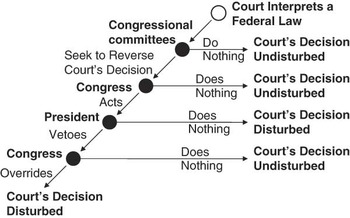
Largely drawing on Brian Marks’ dissertation (Marks, Reference Marks1989), William Eskridge made non-technical use of game theory in two seminal articles on the Supreme Court’s interpretation of federal legislation (Eskridge, Reference Eskridge1991a, Reference Eskridgeb). Depicting the Supreme Court as a strategic decision-maker, he modelled the Court’s choices as a function of the sitting justices’ brute preferences but also of the preferences of Congress, congressional committees, and the President. According to his separation-of-powers model, the Supreme Court would behave differently depending on the distribution and convergence of the policy preferences of these actors. Figure 1.1 shows the extended form of the game.
Extended form of the separation-of-powers game (adapted from Eskridge 1991b)

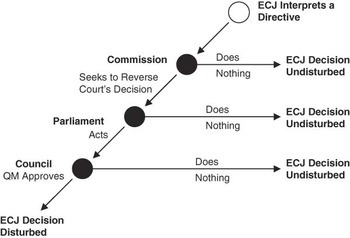
At the initial stage of the sequence of play, the Court interprets a federal statute. At the next stage, the relevant congressional committee has to decide how to react to the ruling. The committee may choose to do nothing, in which case the ruling is left untouched. But it may also decide to refer to Congress a bill overturning the ruling. If it does, Congress will have to choose whether to adopt or to reject this attempt to override the Court. If Congress adopts the bill (or a modified version thereof), the President will have to decide whether to veto the bill or to sign it into law. Then, if the President puts his veto, Congress will have to decide, by a two-thirds majority, whether to override it, and so on. Assuming the players have complete information about each other’s preferences, their choices and the final outcome – whether the Court’s decision is reversed or left undisturbed – should depend on the distribution of preferences. Figure 1.2 represents an equilibrium in which the distribution of preferences favours the Court.
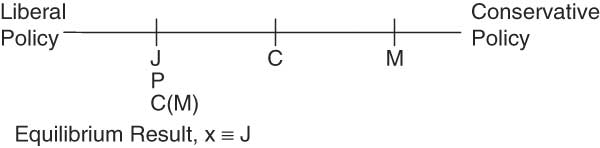
Unconstrained court (adapted from Eskridge 1991b)
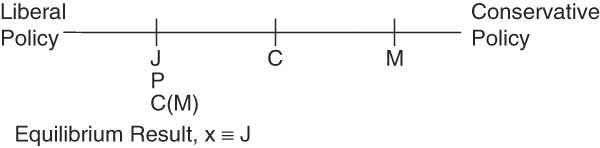
The letters stand for the ideal points of the different actors in a one-dimensional policy space (liberal/conservative – it could as well be left/right or, in the EU, pro-integration/anti-integration). J denotes the preferred position of the court, based on the attitudes of the median (or pivot) member of the CourtFootnote 8; M is the preferred position of the median member of Congress; P is the ideal point of the President; and C represents the most preferred position of the key committees in Congress that decide whether to propose a bill to their respective houses, whereas C(M) denotes the committees’ indifference point in relation to M (they have no preference for a policy at M over a policy at C(M) and vice-versa). In such circumstances, the model predicts the Supreme Court will be able to vote its preferred position into its decisions. Its liberal policies will prevail over the more conservative positions of Congress and the congressional committees. The reason is that the committees will have no incentive to set the legislative process into motion by referring an override bill to Congress. Though they would obviously prefer an outcome closer to their ideal point, the committees are unlikely to get one by proposing an override bill to Congress, as the ideal point of Congress (M) is not closer to their ideal point (C) than the Court’s decision (J). In the American context, congressional committees hold considerable power over the legislative process because they assume the role of agenda-setter (Eskridge, Reference Eskridge1991b: 367–74). Yet they lose control of their bills as soon as they refer them to Congress, as members of Congress will normally amend and rewrite them in accordance with their own policy preferences (or, more precisely: in accordance with the policy preferences of the median member of Congress). Therefore, going back to the distribution of preferences depicted in Figure 1.2, if the committees were to refer a bill overriding the decision of the Court to Congress, the most likely outcome would be the enactment of a statute reflecting the policy preferences of the median member of Congress (M). From the committees’ perspective, this outcome would not be better than the Court’s ruling. Other things being equal, this equilibrium holds as long as the Supreme Court makes a decision at or to the right of C(M). On the other hand, if the decision of the Court were to fall left of C(M), the committees would have an incentive to set the legislative process into motion, as the enactment of a statute overriding the Court would leave them better off. It might be in the Supreme Court’s interest, however, to vote in a sophisticated fashion so as to avoid a congressional override, even when the court’s ideal point is to the left of C(M). Figure 1.3 depicts an equilibrium in which the distribution of preferences should force the Court to move away from its ideal position.
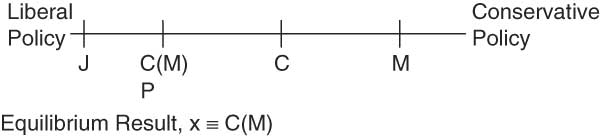
Constrained court (adapted from Eskridge 1991b)
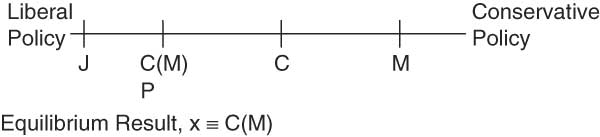
As they both prefer an outcome to the right of J, Congress and the congressional committees would probably take steps to override the Court if the Justices were to issue a ruling at J. The resulting outcome would reflect the ideal point of Congress (M). M being closer to C than J (M > C), the committees would be willing to set the legislative process into motion by referring an override bill to Congress. Yet, making a ruling at J is not the Court’s best strategy in such situation. Instead, the Court would be better off issuing a ruling at C(M), because then committee members would have no incentive to refer an override bill to Congress. From the Court’s point of view, though C(M) is inferior to J (C(M) < J), C(M) is nonetheless superior to M (C(M) > M). Hence, assuming the Court will always prefer an outcome closer to its preferred position, Eskridge’s model predicts that the Court will sometimes refrain from writing its brute preferences into its decisions. Note that while Eskridge suggests that the President is not an important player under the conditions represented in Figures 1.2 and 1.3, he also argues that the President may help the Court prevail over Congress and congressional committees when it is aligned with the Court and there is no two-thirds majority in the legislature to override the President’s veto. Figure 1.4 describes such a situation.
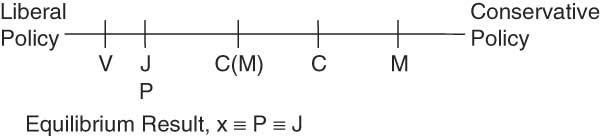
Unconstrained court and presidential veto (adapted from Eskridge 1991b)
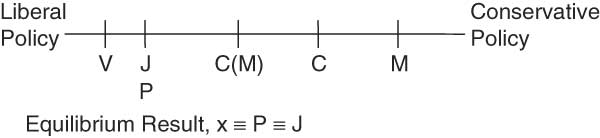
Here V denotes the ‘veto median’, the point at which one-third of the legislators are on one side of the policy outcome, and two-thirds on the other. The figure shows that the Court need not fear an override statute even if it issues a ruling at J – outside the zone comprised between C(M) and (M) where congressional committees might not be willing to cooperate with Congress to overturn the Court. Indeed, even if the committees refer a bill to Congress and Congress passes it, the President will veto the bill because his preferred position coincides with the Court’s ideal point. In such a situation, knowing that congressmen will unite to form a two-thirds majority against an outcome only if that outcome is at or to the left of V, one should expect the committees and Congress to renounce the overriding the presidential veto, because V is worse than J (V < J) from their point of view.
Eskridge’s model, of course, can be refined in various ways and applied to other institutional contexts. In Figure 2.1, we see it applied to the ECJ under the co-decision procedure.
The European Court of Justice in the Codecision game

Under the co-decision procedure, overriding an ECJ decision interpreting a directive requires a Commission proposal, the approval of the European Parliament (EP) and that of a qualified majority (QM) in the Council, which represents the governments of the Member States. From Figure 2.1 it is easy to see that the ECJ needs to be aligned with just one of the three players in the co-decision game to prevent the enactment of override legislation. As for the US Supreme Court, the model predicts that ideological fragmentation among the institutions involved in the legislative process will result in equilibrium outcomes favourable to the ECJ. Figure 2.2 illustrates one such outcome.
European Court of Justice with Commission support

Here the judges are in position to issue a ruling on their ideal point (J) because the Commission (Com) has no interest in proposing an override directive. What is more, even if the Commission were to make a proposal, the EP and the Council’s QM would not be able to agree on an override bill as long as the Court’s decision is somewhere in the space between QM and EP. This is because every outcome in that range is Pareto-optimum from the viewpoint of the Parliament and the Council’s QM. Any change to the outcome would necessarily make one of the two players worse off.
To demonstrate the empirical validity of his approach William Eskridge carried out a fairly comprehensive study of legislative materials (Eskridge, Reference Eskridge1991b). A comparable research in the EU context is yet to be conducted. But the policy debate about the definition of working hours in labour law shows the analytical leverage of this kind of strategic approach in the context of the EU legislative process. In the SIMAP Footnote 9 and Jaeger Footnote 10 cases, the ECJ held that, under the 1993 Working Time Directive, on-call duties should count as working hours for the purpose of work and rest calculation when employees are required to be present on site. The two rulings had a profound effect on the health care sector in Member States where medical staff and junior doctors were traditionally required to be resident on site while on call.Footnote 11 At any rate, the budgetary consequences were such that, when the Commission made a proposal for a new working time directive, the Council insisted on having the definition of working hours altered to exclude on-call duties. This was clearly an attempt to overrule the ECJ jurisprudence. The Council and national governments, however, could not convince the EP to support their override attempt. In April 2009, after years of negotiations, MEPs rejected the redefinition of working hours and, with it, the directive.Footnote 12 According to the Parliament, on-call time must remain working time in accordance with the jurisprudence of the ECJ.Footnote 13 In other words, the Court’s case law was left undisturbed because MEPs preferred it to the proposal supported by the Council. The episode of the Working-Time Directive shows the potential of institutional externalist models of judicial behaviour in the EU context while lending support to those who argue that the large number of veto-players in the EU legislative process favours the ECJ (Tsebelis and Garrett, Reference Tsebelis and Garrett2001; Tsebelis, Reference Tsebelis2002).Footnote 14
Institutional and ‘legal’ determinants of judicial behaviour. Another set of variables discussed in the literature on judicial politics are central to what is known as the ‘legal model’ (see Spaeth and Segal, Reference Spaeth and Segal2002: 48–76). The legal model claims that the determinants of judicial behaviour are by and large what the judges say they are in their opinions. That is, the outcome of the judicial process is essentially a function of the plain meaning of constitutional and statutory provisions, legislative intent, and precedents.
Legal scholars and political scientists tend to disagree about the extent to which such variables really shape judicial behaviour. At one end of the spectrum, as noted previously, many legal academics still describe the operations of judicial institutions as if judges were robots programmed to apply perfectly determinate rules. At the other end, specialists of US judicial politics view Supreme Court justices as purely outcome-oriented policy-seekers (Spaeth and Segal, Reference Spaeth and Segal2002). Between those two extremes, students of comparative judicial politics usually take a middle course. While rejecting the notion that courts are outside politics, they do not rule out the possibility that, via the judges’ preferences, legal rules – whether characterized in terms of plain meaning, legislative intent or precedents – may play a role in judicial politics. Vanberg and Volcansek, for example, explicitly accept that doctrinal consistency or the guaranty of principles enshrined in constitutional texts might be among the goals pursued by judges, at least occasionally (see Volcansek, Reference Volcansek2001: 352–3; Vanberg, Reference Vanberg2005: 26). It is also worth noting that, in fact, many strategic accounts of judicial decision-making implicitly assume that ‘legal’ variables do have some impact on judicial outcomes. Indeed, if constitutional rigidity or the threat of legislative override has an effect on judicial conduct, the reason must be that changes in constitutional language and clear expressions of legislative will have an impact on the courts. Or else, if judges could ignore the plain meaning of constitutional and statutory provisions at no cost, constitutional amendments and legislative attempts to override court rulings would be pointless exercises.
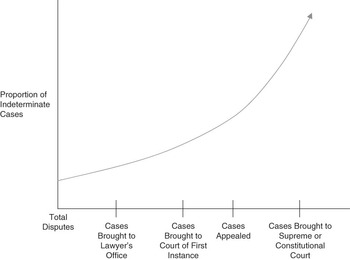
This being said, there are good reasons to believe that the effect of ‘legal’ variables on judicial behaviour in general and on supreme and constitutional courts in particular is rather modest. Legal rules are often indeterminate and do not always yield a single right answer to the question raised by litigants in a particular case. They are, in that sense, ‘incomplete contracts’ that leave the judges a lot to fill in. When one considers the whole set of situations governed by legal rules and the situations that give rise to litigation, it usually turns out that those cases for which the rules of the legal system are the most indeterminate are also the most litigated. Clear and straightforward constitutional provisions fixing, say, the minimum age for candidates to the office of president or the number of seats in the legislature are rarely, if ever, invoked by litigants in the cases that are actually brought before supreme and constitutional courts. The disputes adjudicated by high courts typically involve highly indeterminate rights provisions and standards such as ‘due process of law’, ‘equality’, the ‘free development of one’s personality’, or some other equally vague ‘fundamental’ principles (see Schauer, Reference Schauer1985; Mélin-Soucramanien, Reference Mélin-Soucramanien1997). Considering the incentives of litigants, this is hardly surprizing. Litigation is generally time-consuming and sometimes very expensive. Therefore, as long as courts are expected to abide by legal rules that are clear and unequivocal vis-à-vis a certain social dispute or a certain class of social disputes, potential litigants, other things being equal, will have an incentive to cooperate, and to find some sort of settlement rather than take their dispute to the courtroom. If a party is sure to lose in the courts because the law says she ought to lose, then why litigate? Of course, litigants or potential litigants are not always familiar with the law applying to their situation and they may at times wrongly believe that the law is on their side. In such a case, however, a visit to their lawyer will usually suffice to dissuade them from bringing their case to the courts. Some ‘clear’ cases will, from to time-to-time, seep through this first filter, and reach first instance tribunals. But few of them will be appealed and even fewer will make it to the highest rung of the judicial hierarchy. Overall, as in Figure 3, we will find that the cases actually litigated and adjudicated are precisely the cases vis-à-vis, which the law is the most indeterminate.Footnote 15
Litigation and the indeterminacy of legal rules

Because clear cases do not represent a significant share of the disputes actually adjudicated by judicial bodies, legal rules cannot be a major determinant of judicial behaviour. What is more, even when we observe a rise in the number of clear cases travelling up the judicial ladder, the increase does not necessarily mean that legal variables are playing a greater role in judicial decision-making. Indeed, the increase may in fact be an indication that judges are either disregarding clear and unambiguous legal rules or have signalled their intention to do so, thus encouraging litigants to file lawsuits they would not otherwise have filed.
Unlike legislative and constitutional norms, precedents are judge-made rules fashioned in the judicial forum in the course of adjudicating particular cases. For that reason, one might be inclined to think they have a stronger effect on judicial decision-making. Some studies draw on the notion of path-dependency to argue that precedents and judge-made law develop in a self-reinforcing manner as a process exhibiting increasing returns (see Shapiro and Stone Sweet, Reference Shapiro and Stone Sweet2002: ch. 2; Stone Sweet, Reference Stone Sweet2004: 30–41). The concept of path-dependency is typically associated with historical institutionalism. But the argument is consistent with the assumption of many rational choice approaches that judges seek to maximize their influence on policy-making. When judges are expected to adjudicate like cases alike, the parties to a dispute may try to anticipate the outcome of future judicial proceedings based on their knowledge of past rulings. From the judge’s perspective, the expectation that she will treat similar cases the same way works both as a power-enhancing mechanism and as a constraint. Were this expectation to disappear, her influence would not extend beyond the parties directly involved in the cases she effectively decides. It is because particular rulings are interpreted in light of the expectation that like cases will be treated alike that judges are able to fashion general policies through the resolution of particular disputes. On the other hand, the judges’ desire to preserve this belief and the overall influence of their institution can be at variance with their preferences regarding the outcome of a particular case. In such situations, judges face a trade-off between abiding by controlling precedents in order to preserve the court’s authority at the expense of satisfying their brute preferences, and satisfying their immediate preferences at the risk of undermining the court’s mid- or long-term influence. In any event, this strongly speaks for the view that judges cannot afford to completely ignore their own precedents.
But, whether and to what extent this is an accurate description of reality remains to be demonstrated empirically. Analysing the decisions of the ECJ over four decades, Stone Sweet finds a steady increase in the annual number of references to previous cases (Stone Sweet, Reference Stone Sweet2004: 97–99). In short, the Court of Justice cites itself more often as its body of case law expands. This, however, cannot be sufficient to demonstrate path-dependency. An equally plausible alternative explanation is that citing precedents fulfils a merely persuasive function. Judges cite precedents to persuade their audience that their pronouncements are principled and not arbitrary. They pick and choose those that suit the solution they have already reached to lend it a veneer of consistency and objectivity. To borrow a distinction developed by Elster, (Reference Elster1982), Alec Stone Sweet’s argument about the impact of precedents on the ECJ’s jurisprudence might be seen as failing to distinguish between the judges’ reasons for action and their justifications for action. In one of the rare empirical studies taking the distinction seriously, Spaeth and Segal (Reference Spaeth and Segal1999) contend that precedents have only a modest impact on the voting behaviour of US Supreme Court justices. Although the justices write opinions that are larded with references to precedents, it seems, more often than not, that they would not vote differently in the absence of precedents in the policy area under consideration.
More generally, it is not clear why the indeterminacy hypothesis should not apply to precedents too. Where precedents are clear and unequivocal and as long as the judges do not give any sign that they are willing to reconsider their position, litigants should face the same disincentives to litigate as when constitutional and statutory provisions make plain what the outcome of the judicial process should be.
Reconciling the attitudinal, internalist and externalist schools: toward a unified theory of judicial-behaviour
The attitudinal, institutional internalist and institutional externalist approaches are commonly regarded as providing competing accounts of judicial decision-making. This view is certainly correct if each approach pretends to explain all decisions, of all courts, in all countries, all of the time. However, the picture looks different if no such claim to universality is attributed to these theories. If we admit that the collegial dynamic might be more important in some courts than in others, that the judges’ attitudes may matter more in certain policy areas, or that the importance of the positions of the other political actors may vary widely from one country to the next and over time, reconciling the insights of the three schools begins to appear possible.
Beginning with the advocates of the attitudinal model (Segal, Reference Segal1999: 238; Spaeth and Segal, Reference Spaeth and Segal2002: 92–7), the literature offers some indications that the three schools, moderating their claims, are converging toward what might be viewed as a general theory of judicial decision-making. Attitudinalists now provide an institutional explanation for the importance of attitudes in explaining the behaviour of Supreme Court justices. They stress the fact that justices are appointed for life; that they have virtually complete control over their docket; that their decisions cannot be appealed in any other court; and that it is extremely difficult for the other branches of government to reverse judicial declarations of unconstitutionality because of the rigidity of the constitution-amending process (Spaeth and Segal, Reference Spaeth and Segal2002: 92–7). Add to that opinion polls showing broad support for the Supreme Court as institution (see Gibson et al., Reference Gibson, Caldeira and Baird1998) and a legislative process that tends to be relatively transparent and it becomes clear that the justices operate in a very favourable institutional environment, where they are often able to write their brute preferences into their decisions. In other words, it is in that kind of institutional configuration that the values and ideologies of the sitting judges are most likely to be a good predictor of their decisions. By contrast, where some or all of these institutional features are absent, attitudes and collegial accounts of judicial behaviour should prove less relevant.
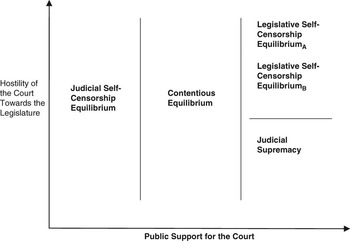
A good starting point to combine the findings and insights of the three approaches in a more systematic way is the sophisticated formal model developed by Vanberg (Vanberg, Reference Vanberg2001, refining Reference Vanberg2005). Describing the interactions between a court and a legislature as a two-player game, the model incorporates public support for the court and transparency (the public’s awareness that the policy issue under consideration is being dealt with by the Court and the legislature) as parameters of legislative and judicial behaviour. Moreover, the model does not assume that the players have complete information about each other’s preferences or about public support and transparency, whereas Eskridge (Reference Eskridge1991a, Reference Eskridgeb) and Volcansek (Reference Volcansek2001) presuppose that legislators have complete information about judges’ preferences and vice versa. Vanberg assumes that legislators may not always be certain that the Court shares their policy preferences when they draft legislation. In a similar fashion he assumes that judges and members of the legislature are not always sure that they will enjoy public support or that the environment will be transparent on a particular issue. In the model, the court’s utility function has two components: (1) a policy preference, the court wants the law to reflect its preferred policy; and (2) an institutional concern, the court wants to avoid non-compliance on the part of the legislature. The legislature’s utility function meanwhile has three components: (1) legislators want to implement their policy preferences; but (2) legislating is costly; and (3) attempts to evade judicial pronouncements may result in a public backlash, damaging the legislature’s political capital. From these assumptions we can derive six perfect Bayesian equilibria corresponding to positions of varying judicial strength vis-à-vis the legislature. In Figure 4 the six equilibria are plotted against the parameters of public support and ideological divergence.
Legislative-Judicial Equilibria as a function of ideological convergence and public support

Provided the legislative process is transparent, courts should be most powerful where public support is high. High levels of political support should be associated with the equilibria on the right-hand side of Figure 4. Judicial supremacy and legislative self-censorship would seem to be the dominant equilibria in the political systems which have the most activist courts: the US, Germany, France and Hungary (Alizivatos, Reference Alizivatos1995; Tate and Vallinder, Reference Tate and Vallinder1995; Lijphart, Reference Lijphart1999; Scheppele, Reference Scheppele1999; Sadurski, Reference Sadurski2005). When judicial supremacy is the dominant equilibrium, the legislature, acting on the belief that the court is likely to share its policy preferences, will legislate without fear of being overturned by the judges. But every time this expectation turns out to be wrong, the court will not hesitate to confront the legislature, because, thanks to a transparent environment, and high-public support, the judges need not worry about non-compliance. This suggests that high rates of judicial annulments are most likely to be found where a powerful court faces legislators who often wrongly believe that the judges are on their side. By contrast, where legislators expect – rightly or wrongly – the court to be divergent, the model predicts that, other things being equal, they will prefer to refrain from passing legislation. The studies of Christine Landfried on the German legislative process (Landfried, Reference Landfried1984) and Alec Stone on French judicial politics (Stone, Reference Stone1992) are consistent with this prediction. They show that the fear of judicial annulment may induce self-censorship on the part of legislative majorities. German politicians call the phenomenon ‘Karlsruhe Astrologie’. Trying to guess how the judges will respond to their policy initiatives, the legislators prefer to water down their bills or abandon them altogether rather than endure a judicial veto (von Beyme, Reference Beyme1997: 311).
Courts are likely to be the weakest where they enjoy little public support and legislators feel safe to evade rulings they dislike. The Russian Constitutional Court, a shadow of its former self since its re-establishment by President Boris Yeltsin in 1993, seems to be a prime example of a court operating in an equilibrium characterized by legislative/executive supremacy and judicial self-censorship (see Epstein et al., Reference Epstein, Knight and Shvetsova2001; Trochev, Reference Trochev2008). Between judicial self-censorship and judicial supremacy, there will of course be contentious situations where no player has the upper hand. In political systems with modestly powerful courts, such as Italy or Spain (Cooter and Ginsburg, Reference Cooter and Ginsburg1996; Lijphart, Reference Lijphart1999; Volcansek, Reference Volcansek2000), this would appear to be the dominant equilibrium.
The comparative static of Vanberg’s model further helps to analyse how, within the same system, changes in political and institutional parameters – public support, transparency and the intensity of legislative and judicial preferences – can lead to a change in the prevailing equilibrium. Judicial power is not constant over time. The Russian case shows how a once mighty court may recede into insignificance. Conversely, research on French judicial politics has demonstrated how a once weak judicial body, as the Constitutional Council was until the early 1980s, can become a powerful actor exerting a strong influence on the legislative process (Stone, Reference Stone1992; Brouard, Reference Brouard2009). In Germany, the Federal Constitutional Court saw its popularity drop significantly in the mid-1990s in the wake of the controversy sparked by a series of rulings on sensitive issues. To contain the backlash, the Karlsruhe judges kept a low profile and exerted more restraint until the Court’s approval ratings recovered and the Court could be restored to its status as the most respected political institution of post-war Germany (see Vanberg, Reference Vanberg2005). Another interesting feature of Vanberg’s formal model is that it makes it possible to analyse the consequences of changes in the specified parameters across issue areas and for the same issue over time. This is important because the preferences of judges and legislators are likely to vary in their intensity across policy areas as well as over time. Similarly, because public opinion tends to be more sensitive to certain issues than others judges may not be able to rely on public support to the same extent in all issue areas (e.g. divorce and decree-laws in Italy, see Volcansek, Reference Volcansek2000, Reference Volcansek2001).
Macro, meso, and micro variables of judicial behaviour
Political fragmentation takes centre-stage in most institutional externalist accounts of judicial power. Whether judicial power is explained by constitutional rigidity (Lijphart, Reference Lijphart1999) or, in a more sophisticated fashion, by the ideological distance among the actors involved in the legislative or constitution-amending process (Eskridge, Reference Eskridge1991a, Reference Eskridgeb; Tsebelis and Garrett, Reference Tsebelis and Garrett2001; Tsebelis, Reference Tsebelis2002; Ríos-Figueroa, Reference Ríos-Figueroa2007), externalist approaches differ more in their operationalization than in the importance given to political fragmentation. Vanberg’s analysis, however, suggests that public support may give the courts a high degree of political autonomy even in the absence of political fragmentation.Footnote 16
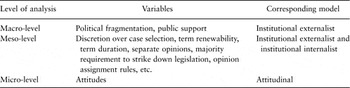
Political fragmentation and public support determine at the higher-level of analysis the extent of the courts’ power. At the same time, they seem to influence the effect of lower-level variables, which determine not so much the overall power of the courts as the latitude of behaviour of individual judges. One way of bringing together the various strands of research examined in this paper into a broader, unified theoretical framework is to think of the lower-level variables as meso and micro factors nested within the higher-level macro variables, as summarized in Table 1.
Macro, meso and micro variables of judicial behaviour

This way of thinking implies that, when public support is low and there is little political fragmentation, variations in the ideological outlook of judges, the transparency of the political process, the rules of case selection or the procedural constraints of judicial deliberation will have little to no effect on judicial outcomes. Accordingly we should expect attitudinal and institutional internalist models to have significantly less explanatory force in such contexts than they would in political systems with high levels of public support for the courts and/or high political fragmentation.Footnote 17
On the other hand, when judges can effectively rely on public support and/or the level of political fragmentation makes overrides unlikely, meso- and micro-level variables should have a more substantial effect on judicial outcomes. Micro variables are themselves nested within the meso-level of analysis. In other words, the amount of variation in judicial behaviour that can be accounted for by attitudinal factors will itself depend on the extent to which the courts’ various institutional meso variables affect the courts’ internal deliberation processes. Here, perhaps, lie some of the major differences between the US Supreme Court and European courts. In the US, life-appointment, discretion over case selection, the simple majority requirement to strike down federal and state legislation together with the possibility to express dissent through separate opinions all conspire to create an environment favouring individualistic behaviour rather than cooperation among the justices. Although some of these institutional features can also be found in European courts, no one has all of them simultaneously. As previously mentioned, expressing dissent through a separate opinion is not a permissible option in most European courts. Because it deprives judges in the minority of a means to put pressure on the majority by calling into question the authority of its decisions, the absence of separate opinions is thought to reinforce the collegial dynamic of the judicial decision-making process, making European courts more deliberative (Ferejohn and Pasquino, Reference Ferejohn and Pasquino2002: 20–22). Also, whereas the certiorari procedure grants the US Supreme Court complete discretion to select, out of the several thousands petitions for review it receives every year, the few cases that will be given a full hearing, most European courts have only limited control over their agenda. The Italian Constitutional Court, for example, is not allowed to hear individual complaints. Until a recent reform, the French Constitutional Council could only hear cases brought by MPs or the executive against legislative bills awaiting promulgation. Constraints of this kind and, more generally, restrictive access rules and mandatory review make it more difficult for judges to decide when the time is ripe and the political climate favourable to take a stance on a sensitive issue. By the same token, judges may be forced to review trivial cases while being kept out of more serious policy debates for want of a litigant willing to raise the right legal question. To be sure, the GFCC allows its judges to file dissenting opinions and combines generous access rules with a case selection system that closely resembles the US certiorari procedure. However, the practice of letting the two main parties, the SPD and the CDU-CSU, appoint half the judges each ensures a certain continuity and balance in the ideological composition of the Court. Moreover, the effect of the little variation that might take place is further mitigated by the requirement of a super-majority (5:3) to invalidate legislation (see Hönnige, Reference Hönnige2007).
These institutional meso variables provide an explanation for why studies of European judicial politics based on the attitudinal approach have found statistical correlations between attitudes and behaviour that are weaker than those found in research on the US Supreme Court (see Brouard, Reference Brouard2009; Magalhes, Reference Magalhes2003; Hönnige, Reference Hönnige2007, Reference Hönnige2009; compare with Spaeth and Segal, Reference Spaeth and Segal2002).Footnote 18
Mobilizing public support and building judicial legitimacy
Other factors, such as the position of the law professoriate towards the courts, affect judicial behaviour in a more indirect fashion through the mediation of public support in countries where it is the principal source of judicial power.
In Vanberg’s game-theoretical model both public support and transparency are treated as exogenous variables, that is, as something judges and legislators have no influence upon. In the real world, however, judges and legislators believe they can exert some influence on the public. More than to persuade the other branches to accept the pronouncements of the courts, judicial opinions and occasional statements in public forums serve to publicise policy issues and to mobilize the public in favour of the judges (Staton, Reference Staton2006). Along with social activists and interest groups, legislators are aware of the endogenous character of public support, too. When a court appears ready to stand in the way of their preferred policies, many politicians are quick to condemn ‘judicial activism’, a creeping ‘gouvernement des juges’ or an illegitimate ‘Richterstaat’.
Admittedly, these aspects of judicial politics are hard to formalize and to capture in game-theoretic models. But that is no explanation as to why they have remained just as under-researched as they are under-theorized. In discussing the judicialization of French politics, Alec Stone Sweet suggests that the Constitutional Council has responded to the opposition’s increasing reliance on constitutional referrals as a weapon against the executive and its parliamentary majority by, among other things, justifying its rulings more carefully (Stone Sweet, Reference Stone Sweet1999). The rise in the average number of paragraphs (‘considérants’) in Council opinions seems to validate that claim.Footnote 19 An empirical finding that is also consistent with the more general proposition that judges tend to write opinions that are both lengthier and more carefully reasoned when they risk being perceived as agents of a political minority trying to impose its policy preferences on democratically elected legislators. Counting the number of words and paragraphs in judicial opinions, however, is a very rudimentary way of analysing the rhetorical strategies of judges.
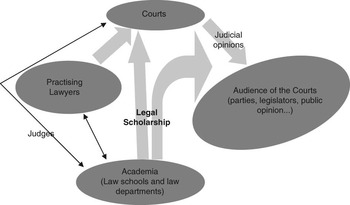
The role of the law professoriate in furthering judicial legitimacy is another element deserving scholarly attention. The doctrinal activity of lawyers and law professors has been characterized as a form of ‘highly specialized lobbying’ (Shapiro and Stone Sweet, Reference Shapiro and Stone Sweet1994: 415). But precious little is known about how this lobbying takes place and how effective it is across countries and legal cultures. Figure 5, however, suggests a way of thinking about the role of legal scholarship in fostering public support for the courts.
The Legal Community and the Production of Legal Rhetoric

The function of legal scholarship in a legal community comprizing law professors, judges and practicing lawyers can be seen as essentially persuasive and rhetorical. It is about using linguistic symbols to induce co-operation in beings that respond to linguistic symbols (Burke, Reference Burke1950). Legal scholars produce monographs and journal articles where they develop doctrines and normative arguments (a) to help the courts persuade their audience (litigants, legislators, public opinion, etc.) that the outcome of the judicial process is fair and legitimate, or (b) to support practising lawyers and their clients in their effort to lobby the courts. As people move back and forth between academia, law practice and the courts (the simple arrows in Figure 5), legal scholarship becomes even more infused with the concerns and perspectives of the actors of the judicial process. Judges and practitioners publish in law reviews and intervene in law school seminars while law professors are appointed to the bench or act as consultants for law firms. These are some of the reasons why, in legal scholarship, arguments about the evolution of law are so often ‘conflated with normative philosophy about the way an author wishes case law to develop’ (Conant, 2007: 46–47). Put in comparative perspective, this analysis suggests that the law professoriate should be in a better position to bolster or to undercut the legitimacy of judicial institutions where it presents a united front. Conversely, it should be less influential where scholars are divided between detractors and panegyrists of the courts. The scholarship on EU law provides perhaps one of the best examples of a community of scholars united in the cause of judicial power and in advancing the interests of a judicial institution. Pro-integration authors often directly affiliated to EU institutions have produced a body of scholarship almost uniformly favourable to the ECJ which proved quite effective in persuading national courts to accept the supremacy of EU law (Rassmussen, Reference Rassmussen1986: 147–154; Schepel and Wesseling, Reference Schepel and Wesseling1997; Alter, Reference Alter2001). In similar fashion, the largely uncritical, and at times even subservient, attitude of French and German constitutional law professors towards their constitutional court has probably worked to reinforce the legitimacy of judicial review in the eyes of the public (Schlink, Reference Schlink1989, Reference Schlink1993; Stone, Reference Stone1992: 93–116). In the US, by contrast, the fact that constitutional law scholars are divided along partisan lines between critics and advocates of the Supreme Court appears to limit their impact on judicial legitimacy (see Post, Reference Post2009).
Conclusion
The general theory sketched out in this paper synthesises the insights of various theoretical approaches and strands of empirical research. In doing so, it also generates new questions and hypotheses that point the way forward for future research. Using multi-level modelling, large-n cross-national studies of judicial behaviour, for example, could try to test the hypothesized relationship among public support, political fragmentation, discretion over case selection, majority requirements for invalidating statutory legislation and attitudes. Less ambitiously, more qualitative research could investigate the extent to which the law professoriate is united in its critique or in its support of the courts across countries and legal sub-disciplines to establish how it affects public support. Other research questions would include how judges tailor their argumentation to the beliefs and perceptions of their audiences about what constitutes legitimate judicial behaviour, or how they invoke the language of rights and appeal to such notions as democracy and the rule of law to legitimize their actions. In any case, regardless of the scope of their enquiry, whether large-n multi-country analysis or single-country case studies, researchers should not embrace any variant of the attitudinal, institutional internalist or externalist models as if it provided an all-purpose, self-contained explanation, but should be aware of the ways in which different factors at distinct levels of analysis may interact to shape judicial behaviour.
This being said, the theory, at least in the form outlined here, is not without its limitations. First, it does a better job of explaining decision-making in high courts than in lower tribunals. For judges at the bottom of the judicial heap, managing a huge caseload is likely to be a more pressing concern than public support or the threat of legislative override. Moreover, judges on lower courts face specific institutional constraints arising from the hierarchical structure of the judicial system. Obviously, to arrive at a truly general theory, we will need to supplement our theory of judicial behaviour with an account of the particular constraints under which these judges operate. Second, at the institutional externalist level, a focus on the relationships between the courts and the other branches of government may not be the best approach for courts such as the ECJ or the ECHR. Arguably, the major source of external institutional constraints for a judicial body like the ECJ – which formally lacks the power to invalidate national laws and judicial decisions – is not the threat of legislative override but the need to ensure that domestic courts cooperate and apply its jurisprudence (Alter, Reference Alter2001).
Another, perhaps more fundamental limitation of the theory is inherent to all rational choice accounts of human behaviour. Rational choice theories take individual preferences as given. They do not explain preference formation – how people came to have the preferences they happen to have. Assuredly this is not reason enough to dismiss them out of hand. But it remains a serious limitation. If, for example, we want to explain the attitudes of national judges towards legal integration in the European Union or the doctrinal divergence between American and European courts on religious freedom and the treatment of religious minorities, treating judicial preferences as given will simply not do. To arrive at a meaningful comparison, we will need to supplement the sort of rational choice account presented here with a more sociological account of cultural norms and institutions.