




No CrossRef data available.
Heritage Trouble: Recent Work on the Protection of Intangible Cultural Property
Published online by Cambridge University Press: 24 May 2005
Abstract
A major factor driving contemporary concerns about the fate of intangible cultural property is the rise of the Information Society, which has proven adept at stripping information from the cultural contexts that give it meaning. Efforts to preserve intangible heritage have tended to follow Information Society models by proposing that heritage be inventoried, then removed from the public domain and returned to the exclusive control of its putative creators. This essay reviews recent scholarly work and policy initiatives related to intangible cultural property, with an eye toward identifying their merits and flaws. It argues for a more ecological perspective, one that takes account of the unpredictable quality of information flows as well as the costs of attempting to manage them. Also explored are some of the difficult, unanswered questions about whether all intangible cultural heritage is equally worthy of protection.
Information
- Type
- Research Article
- Information
- Copyright
- © 2005 International Cultural Property Society
When comparing today's discussions of cultural property with those taking place only two decades ago, one is immediately struck by the radical broadening of the field's scope. Prior to the early 1980s, “cultural property” was invoked largely to denote portable works of art and architectural monuments that embodied the history and identity of particular peoples or nation-states. Today the expression is applied to things as disparate in their scale and characteristics as human remains, art genres, and regional landscapes. Indigenous-rights advocates have gone so far as to identify biological species (as distinct from plant or animal populations) as items of cultural or intellectual property.1
On the insistence that Australia's native species are the intellectual property of Aboriginal Australians, see “Aboriginals up in Arms over Symbols, The Australian, 29 January 2002, 2, accessed via Lexis-Nexis. On landscape as indigenous intellectual and cultural property, see Ross Barnett, “Sacred Sights,” The Australian, 5 March 2004, 14, accessed via Lexis-Nexis; on the heritage status of places construed more broadly, an indispensable recent work is Thomas F. King, Places That Count. The status of history and prehistory as intellectual or cultural properties is taken up in George P. Nicholas and Kelly P. Bannister, “Copyrighting the Past?”
The force that John Henry Merryman refers to as “cultural internationalism” emerged in the late nineteenth and early twentieth centuries in response to concerns about the destruction of cultural treasures in wartime. What drove efforts to protect cultural property was an emerging conviction that, as the Hague Convention of 1954 put it, “damage to cultural property belonging to any people whatsoever means damage to the cultural heritage of all mankind, since each people makes its contribution to the culture of the world.”2
Quoted in John Henry Merryman, “Two Ways of Thinking About Cultural Property,” 836. Useful sources for historical and theoretical background on international efforts to protect indigenous heritage include S. James Anaya, Indigenous Peoples in International Law, and Lawrence Rosen, “The Right to be Different.” On the question of whether privately held art should be seen as public cultural property, an important work is Joseph L. Sax, Playing Darts with a Rembrandt.
In tandem with a marked expansion of scope there has arisen a tendency to substitute the expression “cultural heritage” for cultural property. This shift, by no means consistent or complete, signals growing doubt about the universality of Western notions of property and widespread recognition that culture cannot be reduced to an inventory of objects without marginalizing its most important features.3
See especially Lyndel V. Prott and Patrick J. O'Keefe, “‘Cultural Heritage’ or ‘Cultural Property?’” Although Prott and O'Keefe's arguments for using “cultural heritage” in preference to “cultural property” are persuasive, the latter's inscription in law and international treaties makes it an unavoidable element of contemporary debate. A concise comparison of definitions of cultural property has been posted on the Internet by the Department of Arts Policy and Management, City University of London, at <www.city.ac.uk/artspol/cult-def.html> accessed 24 June 2004. Two recent essays that explore the implications of the now-conventional juxtaposition of culture and property are Michael Rowlands, “Cultural Rights and Wrongs,” and Michael F. Brown, “Heritage as Property.” For an explanation of the many difficulties that attend the concept of “cultural heritage,” see Janet Blake, “On Defining the Cultural Heritage.”
This article reviews recent work in the area of heritage protection, with particular emphasis on books, essays, and policy documents published since 2000 that focus on intangible cultural property. I write as an anthropologist who only recently has begun to grapple with the sophisticated debates on cultural property offered by art historians, museum professionals, and legal scholars, many of whom have been thinking about these questions for decades. I have experienced a newcomer's thrill when encountering the dazzling erudition of the field's leading figures as well as a newcomer's perplexity at the narrowness with which certain influential arguments are formulated. It is impossible to survey the emerging literature without noticing that some of the assumptions which undergird debates on cultural property fail to serve the field's expanding ambitions. What made perfect sense when debate focused primarily on the fate of paintings, churches, and archaeological sites becomes questionable when applied to other kinds of cultural productions.
Much as early work in cultural property led scholars to rethink the meaning of property, so work on intangible cultural heritage must remain attentive to the broader significance of information, including the practical, political, and moral impact of its proposed regulation. Information answers to its own rules. Most conspicuously, it can reside in an infinite number of places simultaneously. The homelessness of information undermines the distinction between real and counterfeit, just as it weakens the bonds that tie units of information together in meaningful systems.4
An engaging survey of the effects of our ability to reproduce images, texts, and sounds at will is Hillel Schwartz, The Culture of the Copy.
My goal in the present essay is to identify the roots of what can be defined loosely as “heritage trouble”—that is, diffuse global anxiety about the movement of information among different cultures—and to assess proposed strategies for responding to it. I shall underscore the virtues of thinking about information ecologically, as a total system of mutually influencing relationships and forces.5
To the best of my knowledge, the concept of “information ecology” has remained underdeveloped, although it is increasingly used in library science and among knowledge-management consultants in business contexts. See, for example, Thomas H. Davenport, Information Ecology.
These issues are explored, with particular reference the management of business information, in Davenport, Information Ecology, 28–45.
Stuart Kirsch and others have argued that a second major factor promoting anxiety about cultural heritage is the global diffusion of western property models. For details, see Kirsch, “Property Limits.”
BACKGROUND: THE RISE OF THE INFORMATION SOCIETY
Public discussions of intangible cultural heritage that began in the 1990s were shaped by a cluster of interrelated social forces. Arguably the most important was the rise of what has been variously labeled the “Information Society,” the “Information Age,” the “Knowledge Economy,” or, most recently, the “Network Society.” The latter appellation is associated with the work of Manuel Castells, who in a series of influential books and articles has argued that new information technologies have transformed global society just as radically as the Industrial Revolution changed the nineteenth-century world. In a summary assessment of his theory of the Network Society, Castells identifies its three major effects: (1) the creation of new economies based on information rather than on the manufacture of material goods; (2) the globalization of corporations and public institutions, with a corresponding shift in power away from the traditional nation-state; and (3) the forging of new networks that, among other things, reconfigure labor relations, politics, and economic activity.8
Castells offers a concise summary of these themes in the essay “Materials for an Exploratory Theory of the Network Society.”
There are reasons to be skeptical of Castells' sweeping claims, not the least of which is that the United States, presumably the apotheosis of the Network Society, continues to spend more on old-fashioned durable goods and energy resources, now largely imported from other countries, than it generates in information exports, suggesting that this new economy may not be as sustainable as its prophets believe.9
For a vigorous critique of the work of Castells and like-minded social theorists, see Christopher May, The Information Society.
Globalization has become a convenient scapegoat for anything that seems unjust or disorienting about contemporary life. Yet all but the most intransigent globophobes admit that its effects are not entirely negative. The salience of intangible cultural property as a matter of worldwide concern, as well as the ability of advocacy groups to muster international support for heritage protection, are both examples of globalization's positive effects. There is little question, however, that the intrusion of cosmopolitan news and entertainment media into even the most isolated outposts of humanity has evoked anxiety in many quarters. Citizens fear that their languages, traditional practices, and values are being subverted by cultural influences originating elsewhere, mostly in the developed West. Time itself is thus transformed from a local phenomenon to a global one, pushed by 24-hour news reporting and nonstop trading in world financial markets. These factors have led to demands that the movement of alien images and information be regulated in the interests of local cultural integrity. In Europe and the United States, a juggernaut of media consolidation has given rise to fears that artistic creativity and the expression of diverse viewpoints are seriously imperiled.10
On information's transformation of time and space, see Paul Virilio, The Information Bomb,113. Works that consider the impact of monopoly control of global media include Peter Drahos and John Braithwaite, Information Feudalism; Lawrence Lessig, Free Culture; Kembrew McLeod, Owning Culture; and Siva Vaidhyanathan, Copyrights and Copywrongs.
Academic opinion in the past decade has steadily shifted from an indulgent view of cultural mixing, characterized by appreciation for its charming ironies and postmodern playfulness, to a more critical stance emphasizing the extent to which the global flows of culture may threaten a community's sense of its own authenticity. A rare dissent is registered by the economist Tyler Cowen, whose book Creative Destruction reviews the evidence and concludes that global monopolies and imported technologies often promote local creativity by creating lucrative markets for innovative, high-quality artistic productions. Examples include Tuvan throat singing from Mongolia, local interest in which has been stimulated by sales of recordings abroad and a recent American feature film, and the colorful cotton molas produced by the Kuna people of Panama, a synthetic art form that combined a tradition of bark painting with sewing techniques and materials acquired from Europeans.11
Tyler Cowen, Creative Destruction, 24–33,
More is at stake than authenticity in the contemporary crisis of cultural heritage. By its nature, the Information Society undermines social norms and institutions, thus magnifying the importance of culture, defined narrowly as a set of values and moral commitments. Cultural identity itself may become, as the anthropologist Simon Harrison has observed, a scarce resource to be defended as another form of property, either personal or collective. Heritage, the retrospective expression of culture, is likewise transformed into a highly politicized commodity.12
Simon Harrison, “Identity as a Scarce Resource.” On the impact of the Information Society on culture, see especially Scott Lash, Critique of Information, 26–27.
Meanwhile, the rising economic importance of information has served to magnify the value of IPR. Copyrights, patents, trademarks, and trade secrets have become keys to prosperity in an era when controlling prototypes is at least as profitable as actually replicating them.13
Lash, op. cit., 81–82.
CULTURAL APPROPRIATION IN THE CONTEXT OF INFORMATION SOCIETIES
An unsettling characteristic of the Information Society is its power to strip the smallest bits of performative content (i.e., information, in the Batesonian sense of “a difference that makes a difference”) from their value-context and then use technology to put these bits to work, typically with the goal of realizing a profit. This ability to pluck images, sounds, and practices from their original setting and relocate them elsewhere has received various labels, the broadest being “cultural appropriation.” Questions of cultural appropriation have given rise to a wave of work assessing the movement of cultural elements from the politically weak to the politically strong. The reverse process, appropriation of cultural products by the weak (e.g., the flamboyant violation of copyrights on popular music and film common in the developing world) is either ignored entirely or celebrated as an act of cultural resistance.14
My allusion to the work of Gregory Bateson draws on his essay, “Form, Substance, and Difference,” in Steps to an Ecology of Mind, 453. The literature on cultural appropriation is too vast to inventory here. Two influential works that bring together a range of perspectives and case-study material are Rosemary J. Coombe, The Cultural Life of Intellectual Properties, and Bruce Ziff and Pratima V. Rao, eds., Borrowed Power. More recent essay-length works that explore different aspects of appropriation include S. Michelle Erasmus, “Repatriating Words”; Thomas Heyd, “Rock Art Aesthetics and Cultural Appropriation”; Peter Shand, “Scenes from the Colonial Catwalk”; Rebecca Tsosie, “Reclaiming Native Stories”; and James O. Young, “The Ethics of Cultural Appropriation.”
Cultural appropriation is held to be wrong for two main reasons. First, it is disrespectful of the cultural values of the source community, which rarely has sanctioned the imitation of its creations by outsiders. Second, it subjects that community to material harm, either by denying it legitimate economic benefits or by undermining shared understandings essential to its social health.
Respect is notoriously difficult to guarantee by legislative means, even if minority communities can be afforded legal safeguards to protect them from overt discrimination. For this reason, critiques of cultural appropriation gravitate to the question of material damages, with an eye toward the promotion of legal reforms that would compensate communities for such harms and, better still, prevent them from happening in the first place. The goal of rectifying civil wrongs thrusts heritage protection into the provinces of intellectual property and tort law. It is therefore hardly surprising that legal scholars have done much of the heavy lifting in debates about cultural ownership.15
Studies of heritage protection and IPR published since 2000 by legal scholars include Rachael Grad, “Indigenous Rights and Intellectual Property Law”; William J. Hapiuk, Jr., “Of Kitsch and Kachinas”; Sarah Harding, “Defining Traditional Knowledge”; Terri Janke, “Minding Culture”; Amina Para Matlon, “Safeguarding Native American Sacred Art by Partnering Tribal Law and Equity”; Owen Morgan, “Protecting Indigenous Signs and Trade Marks”; James D. Nason, “Traditional Property and Modern Laws”; Gelvina Rodriguez Stevenson, “Trade Secrets”; Coenraad J. Visser, “Making Intellectual Property Laws Work for Traditional Knowledge”; and Daniel Wüger, “Prevention of Misappropriation of Intangible Cultural Heritage Through Intellectual Property Laws.” For sheer comprehensiveness of legal research, Silke von Lewinski, ed., Indigenous Heritage and Intellectual Property has few peers.
A typical article on law and intangible heritage goes something like this. The author notes the injustices arising from the ability of outsiders to alienate elements of traditional knowledge or expressive culture at will, largely because folklore is legally defined as residing in the public domain, where it is accessible to all. There is then a review of ways that existing intellectual property law might be modified to encompass folklore and traditional knowledge—say, by making it subject to trade-secrets statutes, broadening the definition of trademark, or by inventing marks of authenticity for folkloric products. This is followed by a systematic survey of other areas of law that might offer additional protections: land titling, antidefamation statutes and notions of group libel, historic-preservation law, civil-rights law, legislation mandating the repatriation of human remains and sacred objects, and international human-rights protocols. The prototype article closes by observing that none of these legal strategies fit the circumstances of intangible heritage particularly well and that it probably makes sense to create new sui generis regulatory regimes to meet the specific needs of traditional communities, especially indigenous ones.16
Recent contributions from fields other than law include Michael F. Brown, Who Owns Native Culture?; Elizabeth Coleman, “Aboriginal Art and Identity”; Stuart Kirsch, “Lost Worlds”; Mary Riley, ed., Indigenous Intellectual Property Rights; and Peter Seitel, ed., Safeguarding Traditional Cultures.
Anthropologists, who have also been prominent contributors to cultural-property debates, share the progressive sentiments that motivate legal scholarship on cultural protection, but they often express uneasiness about law's received categories. Most social anthropologists, in fact, have never met a category they weren't prepared to deconstruct—or, as the expression goes, to “problematize.” From this habit of mind arises the impulse to reject the commodification inherent in the very notion of cultural property and to express doubts about the way the culture concept in general is represented in international forums such as UNESCO. Objections to granting culture transcendent legal status stress the concept's tendency to freeze social life in time, to imagine stable boundaries where none exist, and to attribute to social groups (especially indigenous ones) a vague, even mystical otherness. These familiar arguments reflect an underlying resentment that anthropology's concept of culture was hijacked by global policymakers just as many anthropologists were preparing to abandon it.17
Among many recent forays into the debate about culture are Jane K. Cowan, Marie-Bénédicte Dembour, and Richard A. Wilson, “Introduction,” in Culture and Rights; Thomas Hylland Eriksen, “Between Universalism and Relativism”; Clifford Geertz, Available Light, 68–88; and Peter J. M. Nas, “Masterpieces of Oral and Intangible Heritage.” For a study of how notions of indigenous culture play out in a bioprospecting controversy, see Shane Greene, “Indigenous People Incorporated?”
In the most recent work, however, scholars are moving beyond the critique of culture to a more pragmatic appreciation of the concept's utility. Bruce Robbins and Elsa Stamatopoulou urge anthropologists to get past their fear of “theoretical incorrectness” and recognize that pursuit of cultural rights offers the advantage of helping indigenous peoples achieve a degree of self-determination without directly challenging the territorial integrity of the nation-state. They view the culture concept's vagueness as an asset rather than as a liability.18
Bruce Robbins and Elsa Stamatopoulou, “Reflections on Culture and Cultural Rights,” especially 422 and 426. Various anthropologists have come to similar conclusions, although by different analytical routes. See, for example, James Clifford, “Indigenous Articulations,” and the essays in Erich Kasten, ed., Properties of Culture–Culture as Property.
Anthropologists may be making peace with culture, but they are also beginning to question the validity and political implications of “the indigenous” as a category of people. In North and South America, indigenousness is easy to define, at least in principle: it refers to the descendants of the New World's original inhabitants. (Because of generations of intermarriage and cultural blending, however, the question of which individuals qualify as indigenous remains irksome.) In regions such as South Asia and Africa, in contrast, claims of prior occupation may be extremely divisive in political arenas already plagued by violence and instability. The rise of indigenism and the special rights that it typically advances—to say nothing of the romance and primal authenticity with which native culture is imbued in the popular imagination—have made it increasingly attractive to claim, or reclaim, an indigenous identity. Debates about indigenous identities seem destined to intensify in the coming years.19
For an assessment of the global indigenous-rights movement, see Ronald Niezen, The Origins of Indigenism. Recent critiques of the notion of indigenousness include John R. Bowen, “Should We Have a Universal Concept of ‘Indigenous Peoples' Rights?’” and Adam Kuper, “The Return of the Native.”
In legal scholarship, initial enthusiasm about prospects for modifying intellectual property laws to protect intangible heritage seems to be cooling. The most recent work is characterized by greater skepticism about the utility of IPR law, recognition of the value of legal flexibility, and an openness to alternative formulations. One of the most persistent alternatives, dating back to the path-breaking work of Darrell Posey and Graham Dutfield in the mid-1990s, insists that indigenous cultures must be seen as total social systems in which land, the natural environment, social practices, and traditional knowledge form a seamless whole. Expressing sentiments similar to Posey and Dutfield's, Russel L. Barsh declares that for indigenous peoples “knowledge is indistinguishable from land and culture,” an observation that Barsh uses to argue against piecemeal, reductionist legal strategies of cultural protection.20
Work raising doubts about IPR approaches includes Sarah Harding, “Cultural Property and the Limitations of Preservation,” and Stephen D. Osborne, “Protecting Tribal Stories.” My allusion to the work of Darrell A. Posey and Graham Dutfield refers to Beyond Intellectual Property. The passage by Russel Barsh is from “How Do You Patent a Landscape?” 40.
At a high level of abstraction, Barsh's observation is surely correct. Still, I've yet to meet an indigenous person incapable of telling the difference between, say, a mountain and a ritual, even if the two are linked symbolically. What Barsh means by knowledge is really closer to wisdom, understanding permeated by moral meaning. The gap between “data” on the one hand and “wisdom” on the other is the crux of the conflict between Information Societies and folkloric ones. As the anthropologist Marilyn Strathern observes, “The market thus disembeds what is usable, whereas the thrust of the indigenous IPR movement is to re-embed, re-contextualize, indigenous ownership in indigenous traditional culture. Tradition, we may remark, is an embedding concept.”21
Marilyn Strathern, Property, Substance, and Effect, 167.
Although the speed and pervasiveness of this disembedding are surely new, the reduction of sacred wholes to their component parts has been with us since the Enlightenment. And since the Enlightenment, antireductionists have come forward to oppose the analytical dismantling of whatever has arrested the attention of scientists and humanist intellectuals: sacred texts, the human body, works of art, or the speciation of the planet's flora and fauna. When President George W. Bush implements a policy that limits research involving embryonic stem cells, he is taking a similarly antireductive stance—in this case, by refusing to allow unrestricted access to cells that may have originated in a human fetus, which Bush and others insist must be seen as a sacred whole rather than as a morally neutral aggregation of tissues.
This observation should not be interpreted as a defense of current information practices or criticism of efforts to restrict exploitation of indigenous knowledge. It is simply to note that the rejection of categorical distinctions is a time-honored tactic for setting one group apart from others. It may serve a useful purpose—for instance, by challenging the views of policymakers who gravitate too readily toward conventional categories (“art,” “biological knowledge,” “monument,” “property”) that may mean something quite different, or be meaningless altogether, for particular communities. But in a world organized around the parsing of differences, insistence that no distinctions are legitimate presents a formidable obstacle to legal reform. It makes a compelling sound bite but contributes little to the cause of intercultural dialogue. In the case of indigenous-rights policies, the claim that land and culture are indistinguishable also casts a shadow over the aspirations of those indigenous peoples who lack a traditional land base but maintain commitments to native values.
Less sweeping in their claims, but more subtly subversive in their implications, are emerging ethnographic studies of views of cultural ownership in specific places, as distinct from the abstract and often romanticized depictions of traditional ownership practices that typically dominate policy discussions in multilateral organizations such as UNESCO. Many of these studies come from Papua New Guinea, a region that has turned exchange relations into an art form. In one such study, James Leach shows that for the people of Papua New Guinea's Rai Coast, elements of culture are seen as more useful and productive in circulation than when returned to their source. These customary practices and beliefs challenge UNESCO's view that the default setting for human communities is an overwhelming desire to possess and control cultural property. For Leach's Rai Coast interlocutors, repatriation severs relationships instead of strengthening them. The case illustrates how matters that seem relatively simple from afar reveal surprising complexities on the ground.22
James Leach, “Owning Creativity”; see also Jacob L. Simet, “Copyrighting Traditional Tolai Knowledge?”; Marilyn Strathern, “Multiple Perspectives on Intellectual Property”; and the essays in Lawrence Kalinoe and James Leach, eds., Rationales of Ownership.
INFORMATION SOCIETY SOLUTIONS TO INFORMATION SOCIETY PROBLEMS?
A significant landmark in global efforts to protect traditional knowledge and cultural productions is UNESCO's adoption of the Convention for the Safeguarding of the Intangible Cultural Heritage (CSICH) at the organization's 32nd General Conference in 2003. The convention calls for a range of measures “aimed at ensuring the viability of the intangible cultural heritage, including the identification, documentation, research, preservation, protection, promotion, enhancement, transmission, particularly through formal and non-formal education, as well as the revitalization of the various aspects of such heritage.”23
Article 2, section 3.
The CSICH should be seen in the context of UNESCO's broader efforts to promote global information democracy while at the same time validating the right of nations to defend their cultures against unwanted external influence. The most controversial measure under consideration is a draft treaty, usually referred to as the Convention on Cultural Diversity, that proposes to defend local cultures by validating the right of member states to control the importation of alien cultural products, including books, films, and recorded music. Such a policy is vigorously opposed by the world's largest media corporations, disproportionately based in the United States, who denounce it as a threat to free expression and an unwelcome restraint of trade.24
On the proposed cultural diversity convention, see Peter Ford, “Global Pushback Against ‘Titanic’ Culture,” Christian Science Monitor, 20 October 2003, 1. Ironically, at least some media critics in the United States are beginning to complain that globalizing media have undermined the quality of American arts and culture as well. See David Kipen, “Offshoring the Audience,” for an assessment of how pressures to make movies that sell as well abroad as in the U.S. now militate against screenplays that address uniquely American experiences and dilemmas.
One of the ironies of the CSICH is that its language and administrative strategies are patterned on the very Information Society practices they are ostensibly trying to counter. The convention portrays intangible heritage as an objectified resource amenable to modern management techniques. In such a legalistic vision, heritage cannot be protected until it is thoroughly documented. Hence the CSICH's call for preparation of “one or more inventories of the intangible cultural heritage present in [each nation's] territory.” The scale of the required list-making beggars the imagination, especially for large or conspicuously multiethnic states such as Russia, China, India, and Canada, to say nothing of Papua New Guinea, and Peru. The policy is oddly reminiscent of early anthropology, which was driven by the conviction that primitive cultures should be documented in their entirety—from basketry techniques and healing arts to kinship systems and religious beliefs—because their extinction was inevitable. The discipline long ago concluded that documentation has only a modest role in the preservation of culture. To think otherwise is to make the classic error of mistaking a map for the territory it represents. So although there is nothing obviously harmful about the CSICH's ambitious program of cultural documentation, one struggles to imagine how it will protect cultures as living, dynamic systems. Perhaps it is enough that the convention ratifies the importance of folkloric cultures by putting the status of local knowledge on the world's agenda as an issue worthy of attention.25
The passage quoted from the CSICH is from Article 12, section 1. I express my reservations about the CSICH in greater detail in “Safeguarding the Intangible.” My essay prompted a thoughtful rejoinder from Richard Kurin, director of the Smithsonian Center for Folklife and Cultural Heritage, who participated actively in UNESCO debates about the specific language of the CSICH. Although acknowledging the convention's flaws, Kurin argues that the CSICH will have a constructive effect because it asserts that “the practice of one's culture is a human right” and confirms that “all cultures give purpose and meaning to lives and thus deserve to be safeguarded.” See Kurin, “Tangible Progress.”
The CSICH has inspired a handful of national campaigns to use electronic resources to combat the loss of local traditions. India, for example, has announced plans to “carry out extensive documentation of intangible heritage to provide the preservation of each expression of heritage by making exhaustive inventories and storing them electronically for the future.” Unfortunately, there is reason to doubt that such technocratic and top-down approaches to heritage protection have much to offer. First, experts in library science and data management are beginning to confront the startling fragility of electronic records. Digital media degrade far faster than was once recognized. Worse still, the technologies required to read them change so rapidly that within a decade or two many records are orphaned, made unreadable because no one possesses the obsolete equipment required to access them. Second, the Internet and other intrusions of the Information Society have pushed many native peoples toward greater secrecy. The notion that knowledge must be recorded by outsiders in order to save it from loss is impossible to reconcile with the inward-looking, protective turn now observed in many indigenous communities. This shift in the direction of secrecy drives indigenous demands for the “repatriation of information”—that is, the return (and, in rare cases, the destruction) of ethnographic texts and images that communities wish to see removed from the public domain on the grounds that the knowledge documented in these materials should never have been public in the first place. Even when specific indigenous communities do not actively endorse greater secrecy, they are increasingly fearful that documentation of their intangible heritage will not protect it but simply facilitate its exploitation, thus giving the notion of “heritage protection” an Orwellian connotation. Their preferred strategy is, as one anthropologist has put it, “security through obscurity.”26
Information on India's heritage protection plan is from Akshaya Mukul, “Government's Intangible Heritage Plan,” Times of India, 2 October 2003, <www.timesofindia.com>, accessed 26 October 2003. On the fragility of digital records, see Alexander Stille, “Are we losing our memory?” The practical, legal, and ethical issues surrounding group secrecy, are discussed in Brown, Who Owns Native Culture? 27–42, and Harding, “Cultural Secrecy and the Protection of Cultural Property.” The expression “security through obscurity” comes from Eric C. Kansa, personal communication.
A more promising Information Society tactic has been adopted by the World Intellectual Property Organization (WIPO) and the American Association for the Advancement of Science, both of which now sponsor online “prior art databases,” to which India and China are prominent contributors. The idea behind the databases is to publish traditional pharmacopoeias and thereby prevent patent applicants who draw on them from claiming they have discovered something novel. Whether the prior-art approach can prevail over the indigenous move toward greater secrecy remains to be seen.27
World Intellectual Property Organization (WIPO), “Portal of Online Databases and Registries of Traditional Knowledge and Genetic Resources” <www.wipo.int/tk/en/databases/tkportal/index.html Geneva>, accessed 28 July 2004; American Association for the Advancement of Science (AAAS), “Traditional Ecological Knowledge Prior Art Database” <ip.aaas.org/tekindex.nsf Washington, DC>, accessed 28 July 2004.
LESSONS, QUESTIONS, PROSPECTS
Weighty questions remain unresolved in global discussions about intangible cultural heritage. One concerns the balance between heritage as a resource for all of humanity and as something that properly belongs to, and remains controlled by, its communities of origin. Most major policy documents on this subject begin by declaring that folklore and traditional knowledge are the common heritage of all humankind. They then outline schemes that would effectively remove much of this knowledge from the global commons and privatize it in the communities where it is thought to have arisen, and where it may be considered communal property. In a discussion of similar tensions in the world of tangible cultural property, John Merryman distinguishes between cultural internationalists and cultural nationalists, the latter holding that items of cultural heritage properly reside in their communities or nations of origin. The internationalist side of the debate has been most recently voiced in the controversial Declaration on the Importance and Value of Universal Museums issued by directors of some of the world's most important art museums. There is little doubt, however, that cultural nationalists are in the ascendancy today.28
John Henry Merryman, “Two Ways of Thinking About Cultural Property,” especially 846. The difficulty of reconciling the universal and local ownership of cultural heritage is explored in Blake, “On Defining the Cultural Heritage.” The Declaration on the Importance and Value of Universal Museums was issued in 2002, and copies are available in multiple sources on the Internet.
The contradiction between rhetorical appeals to notions of common human heritage and policies designed to slow the movement of traditional knowledge into the public domain is addressed in a recent essay by the legal scholar and anthropologist Rosemary Coombe, long an incisive commentator on issues of intellectual property and the global ecology of information. Coombe observes that the lively public domain sought by cultural internationalists can only prosper if minority cultures survive the current process of globalization. A cultural public domain, she asserts, depends on responsibilities as well as rights. Such responsibilities would include repudiation of “takings of cultural goods” that “create cultural, social and political harms to peoples for whom cultural forms are more tightly interwoven with specific forms of subsistence in local lifeworlds of meaning.” Without a better balance of openness and discretion, in other words, the cultural public domain could be reduced to an ideal devoid of content. This illustrates an aspect of what Tyler Cowen calls the “paradox of diversity.” “[T]he world as a whole may be more diverse,” he writes, “if some societies refuse to accept diversity as a value. Those cultures will continue to generate highly unique creations, given their status as cultural outliers.” Conversely, generalized diversity may produce greater uniformity because of the cultural blending that it inevitably produces.29
Rosemary J. Coombe, “Fear, Hope, and Longing for the Future of Authorship and a Revitalized Public Domain in Global Regimes of Intellectual Property,” 1185; Cowen, Creative Destruction, 146.
Coombe's powerful argument for more aggressive sequestration of traditional knowledge leads inevitably to another unresolved question in these debates: Is this best accomplished through modifications of existing law, or should the global community craft sui generis regimes to do the job? The case-study material presented in Coombe's essay suggests that the creative use of legal mechanisms already in place can accomplish a great deal. Despite more than a decade of calls for sui generis alternatives, relatively few proposals have been laid out in a detailed way, I suspect because when committed to formal language their many flaws are readily apparent. An example is offered by the legal scholar Susan Scafidi, who has proposed a new category of copyright-like protections for “cultural products” such as ethnic festivals.30
Susan Scafidi, “Intellectual Property and Cultural Products.”
Also rarely discussed is how the world community should respond to intangible heritage that is inconsistent with emerging global moral and ethical norms. What are we to make of the complaint that, for instance, the global ban on commercial whaling is ethnocentric and destructive of traditional Japanese cuisine and Japanese heritage in general? Similar questions have long taken center stage in debates about multiculturalism and democracy, but they are increasingly framed in terms of “rights to heritage,” thus piggybacking on public enthusiasm for heritage in its multiple forms.31
Calvin Sims, “Japan, Feasting on Whale, Sniffs at ‘Culinary Imperialism’ of U.S,” New York Times, 10 August 2000, A1. A Japanese dentist quoted in the article remarks, “As a child, we ate miso soup with whale meat every New Year's Eve. It was a centuries-old tradition in my village. You can't imagine how precious this soup is to me right now.” In comments on an earlier draft of this paper, Stuart Kirsch pointed out that the renewal of traditional whaling among the Makah Indians of Washington State is justified in language similar to that of advocates for Japanese whaling. He wondered why I do not mention the Makah case in the same paragraph. He makes a valid point, although I would insist that the scale of whaling in the two cases is so different that the Makah merit different treatment.
See, for instance, the website entitled “Protestant Parades in Northern Ireland,” <www.ulsterloyal.freeservers.com/parades_culture_tradtion.html>, accessed 26 July 2004. One of the few works that addresses awkward conflicts about the nature and value of “heritage” is Robert Shannan Peckham, ed., Rethinking Heritage. For observations on the politics of remembering and forgetting, see David Lowenthal, The Heritage Crusade and the Spoils of History.
Equally challenging is the question of who controls the representation of a community's heritage, especially if de facto ownership of heritage, intangible or otherwise, becomes enshrined in formal law.33
An essay that sounds a cautionary note in this regard is Madhavi Sunder, “Intellectual Property and Identity Politics.” See also her “Cultural Dissent.”
For a vigorous defense of cultural rights, see Bruce Robbins and Elsa Stamatopoulou, “Reflections on Culture and Cultural Rights.” In contrast, the political scientist Brian Barry, in Culture and Equality, argues that most important collective rights are adequately encompassed, and with fewer risks to individual freedom, by a broad interpretation of liberal theories about individuals' right of free association. A centrist position not unsympathetic to cultural rights but sensitive to their potential problems is argued in Lawrence G. Sager, “The Free Exercise of Culture.”
INFORMATION ECOLOGY REVISITED
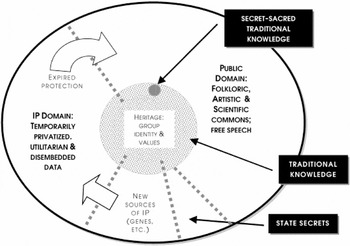
If we look at the information ecosystem in its totality (see Figure 1), it is obvious that heritage-protection efforts have largely been focused on the IP Domain–specifically, the possible extension of the rights of the IP Domain to traditional communities, which ideally would be complemented by more restricted access for private industry. This is justified but by no means unproblematic. It is easy to declare that intangible cultural property now enjoys protections analogous to copyright or patent. It is another matter to determine what qualifies as intangible culture in the first place and then to devise cost-effective mechanisms to protect it. The contemporary heritage crisis invites sweeping claims of cultural ownership that have little basis in fact. In an ethnographic study of American Neo-pagans, for example, Sabina Magliocco mentions that in 1993 neo-pagan groups were denounced by Lakota Indian elders: “Members of the Lakota delegation [to an international gathering of religious leaders] assumed that certain Pagan practices such as worshipping in a circle, invoking the four directions, and purifying with burning herbs were imitations of Native American practice, whereas in fact these particular practices developed independently in Europe, an example of polygenesis [independent invention].”35
Two key works that come closest to following an ecological approach to information rights are James Boyle, Shamans, Software, and Spleens, and Rosemary J. Coombe, The Cultural Life of Intellectual Properties. Also notable for its holism is Graham Dutfield, “The Public and Private Domains.” On Lakota claims of ownership of religious practices, see Sabina Magliocco, Witching Culture, 234.

Intangible cultural heritage and the information ecosystem (after Graham Dutfield, “The Public and Private Domains,” 286)
Efforts to regulate “traditional” expressive culture are bound to have a chilling effect on fair use and artistic expression, especially given the constantly changing, entirely negotiable content of heritage. Free expression is not a social good that trumps every other, of course. Neither is it a right that we should jettison casually. An ecological approach to the IP Domain requires that we maintain a legal high-wire act: balancing the sometimes opposed goals of heritage preservation and the values of an open society.
Subject to more limited consideration, at least thus far, is the public domain and the ways it might be reinvented to promote cultural diversity at the global level. A handful of innovative approaches are worthy of note. The California-based organization Creative Commons, a pioneer in the creation of voluntaristic alternatives to copyright, is working on plans to create a framework for the sharing of scientific databases that will also respect indigenous canons of confidentiality. The Creative Commons is explicitly advancing a vision of a broadened rather than a more restrictive public domain, which admittedly is difficult to square with indigenous concerns about the preservation of knowledge in its original context. But the organization's inventiveness may inspire other groups actively seeking alternatives to existing IPR practices. At the opposite end of the public domain spectrum, but equally intriguing, are efforts to bolster protections for the “Secret-Sacred” zone of the information ecosystem by creating indigenous archives or “keeping places” to secure intangible heritage under conditions of confidentiality consistent with local norms. Because such norms may be illiberal from the perspective of democratic values, however, they raise formidable questions that will be resolved only after vigorous debate and a fair amount of compromise.36
Creative Commons provides background information on its history and goals in its website, <www.creativecommons.org>. A statement by the College of Indigenous Aboriginal Peoples of New South Wales, Australia, explains that part of its mission is to serve as a “keeping place for the safe protection of Indigenous Intellectual and Cultural Property and the advancement of shared scholarship with Bundjalung Elders” <www.dev.scu.edu.au/schools/ciap>, accessed 28 July 2004.
An important strategy for survival in situations of ecological stress is cross-breeding or hybridity. New circumstances may require new regulatory approaches. Yet perhaps because hybridity has come to be seen as part of the problem rather than part of the solution, much discussion has focused on whether customary law offers a viable alternative to western IPR concepts. This is appealing because of its consonance with a politics of ethnic sovereignty. One must ask, though, whether the world will be a better place if we replace one expansive, flawed, ethnocentric system by a thicket of small-scale, flawed, ethnocentric systems whose sole virtue is that local communities are familiar with them. Even sympathetic observers acknowledge that wholesale acceptance of customary law would force large multicultural states to deal with dozens or even hundreds of legal systems on a daily basis. Such an explosion of legal diversity would impose an immense administrative burden and conflict with the liberal democratic principle (admittedly, more often declared than realized in fact) that all citizens should be subject to the same laws.37
Silke von Lewinski, “Final Considerations,” in S. von Lewinski, ed., Indigenous Heritage and Intellectual Property, 386–387, regarding the difficulties of recognizing customary law in pluralist states.
An alternative to formal recognition of customary law is the development of hybrid approaches that interweave elements of western law and local, traditional rules for the circulation of knowledge. Drawing on ideas originating in Papua New Guinea, Marilyn Strathern provides examples of what such hybrid approaches might look like, and we have reason to hope that similarly imaginative thinking will arise elsewhere. The much-cited Bulun Bulun decision in Australia (Bulun Bulun and Milpurrurru v. R & T Textiles, 1998) may be a harbinger of change because it acknowledges that Aboriginal clan communities have specific fiduciary rights in religious art that must be reckoned with outside their communities, although these rights do not legally qualify as joint authorship.38
See especially Strathern's Property, Substance, and Effect, 179–203, as well as Dutfield, “The Public and Private Domains,” 289, and Kirsch, “Property Limits.” The Bulun Bulun case is formally known as Bulun Bulun and Muilpurrurru v. R & T Textiles Pty Ltd [1998] 1082 FCA (3 Sept. 1998).
In keeping with a holistic perspective, I close with a final question that expands the analytical frame beyond the information ecosystem. My query is inspired by a provocative essay on human rights by the political philosopher Wendy Brown. Human rights are important, Brown says, but are they “the most that can be hoped for at this point in history?” Might not an unrelenting focus on human rights stand in the way of more far-reaching possibilities for making the world a better place? Human rights advocacy, Brown avers, “is a politics and it organizes political space, often with the aim of monopolizing it.”39
Wendy Brown, “‘The Most We Can Hope for …’.”
Similarly unsparing questions must be asked about our current enthusiasm for the management of intangible cultural property. Heritage preservation is, or should be, a means to the end of fostering societies in which minority communities have a voice in decisions about their future and where they can attain the same prosperity available to everyone else, should they choose to do so. Cultural heritage is important to their well-being, but it is not the only issue that merits attention. What about public health, education, and self-government? As the legal scholar Michael H. Davis asks, can massive cultural appropriation of the intangible cultural heritage of indigenous peoples be treated as an autonomous issue, or does it follow more or less inevitably from the power difference between small-scale societies and the world's industrial giants? If the latter, then will new laws regarding folklore and traditional knowledge make much of a difference?40
Michael H. Davis, “Some Realism About Indigenism.”
When confronted by the ambitious schemes now emerging on the heritage-protection front—proposals that illuminate with remarkable fidelity Max Weber's vision of a world driven by bureaucratic logic and a compulsion to rationalize—one sometimes wonders whether all the legal creativity risks missing the point. For if global cultural diversity is preserved on digital recording devices while the people who gave rise to this artistry and knowledge have disappeared, then efforts to preserve intangible heritage will be judged a failure. That unhappy prospect should always be kept in mind as we consider comprehensive plans that presume to manage the intellectual and artistic achievements of the world's most vulnerable societies.
ACKNOWLEDGMENTS
This article benefited greatly from the thoughtful criticism of Alexander Bauer, Stuart Kirsch, John H. Merryman, Daniel Shapiro, and Madhavi Sunder, for which I am grateful. Any errors of fact or interpretation are my own.
References
American Association for the Advancement of Science
(AAAS).
Traditional Ecological Knowledge Prior Art Database. 28 July
2004 <ip.aaas.org/tekindex.nsf>.
Anaya, S. James.
Indigenous Peoples in International Law.
New York:
Oxford University Press,
1996.
Barry, Brian.
Culture and Equality.
Cambridge, Mass.:
Harvard University Press,
2001.
Barsh, Russel L.
“How Do You Patent a Landscape? The Perils of Dichotomizing
Cultural and Intellectual Property.”
International Journal of Cultural Property
8, no. 1
(1999):
14–47.Google Scholar
Bateson, Gregory.
Steps to an Ecology of Mind.
New York:
Ballantine,
1972.
Blake, Janet.
“On Defining the Cultural Heritage.”
International and Comparative Law Quarterly
49
(2000):
61–85.Google Scholar
Bowen, John R.
“Should We Have a Universal Concept of ‘Indigenous
Peoples' Rights?’ Ethnicity and Essentialism in the
Twenty-First Century.”
Anthropology Today
16, no. 4
(August 2000):
12–16.Google Scholar
Boyle, James.
Shamans, Software, and Spleens: Law and the Construction of the
Information Society.
Cambridge, Mass.:
Harvard University Press,
1996.
Brown, Michael F.
Who Owns Native Culture?
Cambridge, Mass.:
Harvard University Press,
2003.
Brown, Michael F.
“Safeguarding the Intangible.”
Center for Arts and Culture,
Washington, D.C.
<http://www.culturalcommons.org/comment-print.cfm?ID=12>, accessed 27 August 2004.
Brown, Michael F.
“Heritage as Property.” In
Property in Question: Value Transformation in the Global
Economy, edited by
Katherine Verdery,
Caroline Humphrey.
Oxford:
Berg
2004.,
49–68.
Brown, Wendy.
“‘The Most We Can Hope for …’: Human Rights
and the Politics of Fatalism.”
South Atlantic Quarterly
103, no. 2-3
(2004):
451–463.Google Scholar
Castells, Manuel.
“Materials for an Exploratory Theory of the Network
Society.”
British Journal of Sociology 51, no.
1
(2000):
5–24.Google Scholar
Clifford, James.
“Indigenous Articulations.”
The Contemporary Pacific 13, no.
2
(2001):
468–490.Google Scholar
Coleman, Elizabeth.
“Aboriginal Art and Identity: Crossing the Border of
Law's Imagination.”
Journal of Political Philosophy 12, no.
1
(2004):
20–40.Google Scholar
Coombe, Rosemary J.
The Cultural Life of Intellectual Properties: Authorship,
Appropriation, and the Law.
Durham, N.C.:
Duke University Press,
1998.
Coombe, Rosemary J.
“Fear, Hope, and Longing for the Future of Authorship and a
Revitalized Public Domain in Global Regimes of Intellectual
Property.”
DePaul Law Revew
53
(2003):
1171–1191.Google Scholar
Cowen, Tyler.
Creative Destruction: How Globalization is Changing the World's
Cultures.
Princeton, N.J.:
Princeton University Press,
2002.
Davenport, Thomas H.
Information Ecology: Mastering the Information and Knowledge
Environment.
New York:
Oxford University Press,
1997.
Davis, Michael H.
“Some Realism About Indigenism.”
Cardozo Journal of International and Comparative Law
11, no. 3
(2003):
815–830.Google Scholar
Drahos, Peter,
with John Braithwaite.
Information Feudalism: Who Owns the Knowledge Economy?
New York:
The New Press,
2003.
Dutfield, Graham.
“The Public and Private Domains: Intellectual Property Rights
in Traditional Knowledge.”
Science Communication
21
(2000):
274–295.Google Scholar
Erasmus, S. Michelle.
“Repatriating Words: Local Knowledge in a Global
Context.”
American Indian Quarterly 26, no.
2
(2002):
286–307.Google Scholar
Eriksen, Thomas Hylland.
“Between Universalism and Relativism: A Critique of the
UNESCO Concept of Culture.” In
Culture and Rights: Anthropological Perspectives, edited by
Jane K. Cowan,
Marie-Bénédicte Dembour,
and
Richard A. Wilson,
127–148.
Cambridge:
Cambridge University Press,
2001.
Geertz, Clifford.
Available Light: Anthropological Reflections on Philosophical
Topics.
Princeton, N.J.:
Princeton University Press,
2000.
Grad, Rachael.
“Indigenous Rights and Intellectual Property Law: A Comparison
of the United States and Australia.”
Duke Journal of Comparative and International Law 13, no.
1
(2003):
203–231.Google Scholar
Greene, Shane.
“Indigenous People Incorporated? Culture as Politics, Culture
as Property in Pharmaceutical Bioprospecting.”
Current Anthropology 45, no.
2
(2004):
211–237.Google Scholar
Hapiuk, William J., Jr.
“Of Kitsch and Kachinas: A Critical Analysis of the Indian
Arts and Crafts Act of 1990.”
Stanford Law Review
53
(2001):
1009–1075.Google Scholar
Harding, Sarah.
“Cultural Secrecy and the Protection of Cultural
Property.” In
Topics in Cultural Resource Law,
69–78.
Washington, DC:
Society for American Archaeology,
2000.
Harding, Sarah.
“Cultural Property and the Limitations of
Preservation.”
Law and Policy 25, no.
1
(2003):
17–36.Google Scholar
Harding, Sarah.
“Defining Traditional Knowledge–Lessons from Cultural
Property.”
Cardozo Journal of International and Comparative Law 11, no.
2
(2003):
511–518.Google Scholar
Harrison, Simon.
“Identity as a Scarce Resource.”
Social Anthropology 7, no.
3
(1999):
239–251.Google Scholar
Heyd, Thomas.
“Rock Art Aesthetics and Cultural Appropriation.”
The Journal of Aesthetics and Art Criticism 61, no.
1
(2003):
37–46.Google Scholar
Janke, Terri.
“Minding Culture: Case Studies in Intellectual Property and
Traditional Cultural Expression,”
<www.wipo.int/tk/en/studies/cultural/minding-culture/studies/finalstudy.pdf>
(2003).
Accessed 20 July 2004
Kalinoe, Lawrence, and
James Leach, eds.
Rationales of Ownership: Ethnographic Studies of Transactions and
Claims to Ownership in Contemporary Papua New Guinea.
New Delhi:
UBS Publishers' Distributors Ltd.,
2001.
Kasten, Erich, ed.
Properties of Culture–Culture as Property: Pathways to Reform
in Post-Soviet Siberia.
Berlin:
Dietrich Reimer Verlag,
2004.
King, Thomas F.
Places That Count: Traditional Cultural Properties in Cultural
Resource Management.
Walnut Creek, Cal.:
AltaMira Press,
2003.
Kipen, David.
“Offshoring the Audience.”
Atlantic Monthly
(Boston),
June 2004,
115–120.
Kirsch, Stuart.
“Lost Worlds: Environmental Disaster, ‘Cultural
Loss,’ and the Law.”
Current Anthropology 42, no.
2
(2001):
167–198.Google Scholar
Kirsch, Stuart.
“Property Limits: Debates on the Body, Nature and
Culture.” In
Transactions and Creations: Property Debates and the Stimulus of
Melanesia, edited by
Eric Hirsch and
Marilyn Stathern,
21–39.
New York:
Berghahn Books,
2004.
Kuper, Adam.
“The Return of the Native.”
Current Anthropology 44, no.
3
(2003):
389–402.Google Scholar
Kurin, Richard.
“Tangible Progress.”
Center for Arts and Culture,
Washington, D.C.
<http://www.culturalcommons.org/kurin.htm>,
accessed 27 August 2004.
Lash, Scott.
Critique of Information.
London:
Sage Publications,
2002.
Leach, James.
“Owning Creativity: Cultural Property and the Efficacy of
Custom on the Rai Coast of Papua New Guinea.”
Journal of Material Culture 8, no.
2
(2003):
123–144.Google Scholar
Lessig, Lawrence.
Free Culture: How Big Media Uses Technology and the Law to Lock Down
Culture and Control Creativity.
New York:
Penguin,
2004.
Lowenthal, David.
The Heritage Crusade and the Spoils of History.
Cambridge:
Cambridge University Press,
1998.
Magliocco, Sabina.
Witching Culture: Folklore and Neo-Paganism in America.
Philadelphia:
University of Pennsylvania Press,
2004.
Matlon, Amina Para.
“Safeguarding Native American Sacred Art by Partnering Tribal
Law and Equity: An Exploratory Case Study Applying the Bulun
Bulun Equity to Navajo Sandpainting.”
Columbia Journal of Law and the Arts
27
(2004):
211–247.Google Scholar
May, Christopher.
The Information Society: A Sceptical View.
Cambridge, U.K.:
Polity Press/Blackwell,
2002.
McLeod, Kembrew.
Owning Culture: Authorship, Ownership, and Intellectual Property
Law.
New York:
Peter Lang,
2001.
Merryman, John Henry.
“Two Ways of Thinking About Cultural Property.”
American Journal of International Law
80
(1986):
831–853.Google Scholar
Morgan, Owen.
“Protecting Indigenous Signs and Trade Marks: The New Zealand
Experience.”
Intellectual Property Quarterly 1, no. Winter
(2004):
58–84.Google Scholar
Nas, Peter J. M.
“Masterpieces of Oral and Intangible Heritage.”
Current Anthropology
43, no. 1
(2003):
139–148.Google Scholar
Nason, James D.
“Traditional Property and Modern Laws: The Need for Native
American Community Intellectual Property Rights Legislation.”
Stanford Law and Policy Review
12, no. 2
(2001):
255–266.Google Scholar
Nicholas, George P., and
Kelly P. Bannister.
“Copyrighting the Past? Emerging Intellectual Property Rights
Issues in Archaeology.”
Current Anthropology 45, no.
3
(2004):
327–350.Google Scholar
Niezen, Ronald.
The Origins of Indigenism: Human Rights and the Politics of
Identity.
Berkeley, Cal.:
University of California Press,
2003.
Osborne, Stephen D.
“Protecting Tribal Stories: The Perils of
Propertization.”
American Indian Law Review
28
(2003):
203–236.Google Scholar
Peckham, Robert Shannan, ed.
Rethinking Heritage: Cultures and Politics in Europe.
London:
I.B. Taurus,
2003.
Posey, Darrell A., and
Graham Dutfield.
Beyond Intellectual Property: Toward Traditional Resource Rights for
Indigenous Peoples and Local Communities.
Ottawa:
International Development Research Centre,
1996.
Prott, Lyndel V., and
Patrick J. O'Keefe.
“‘Cultural Heritage’ or ‘Cultural
Property?’”
International Journal of Cultural Property
1
(1992):
307–320.Google Scholar
Riley, Mary, ed.
Indigenous Intellectual Property Rights: Legal Obstacles and
Innovative Solutions.
Lanham, Md.:
AltaMira Press,
2004.
Robbins, Bruce, and
Elsa Stamatopoulou.
“Reflections on Culture and Cultural Rights.”
South Atlantic Quarterly 103, no. 2/
3
(2004):
419–434.Google Scholar
Rosen, Lawrence.
“The Right to be Different: Indigenous Peoples and the Quest
for a Unified Theory.”
Yale Law Journal 107, no. 1 (October
1997):
227–259.Google Scholar
Rowlands, Michael.
“Cultural Rights and Wrongs: Uses of the Concept of
Property.” In
Property in Question: Value Transformation in the Global
Economy, edited by
Katherine Verdery and
Caroline Humphrey,
207–226.
Oxford:
Berg,
2004.
Sager, Lawrence G.
“The Free Exercise of Culture: Some Doubts and
Distinctions.” In
Engaging Cultural Differences: The Multicultural Challenge in
Liberal Democracies, edited by
Richard Shweder,
Martha Minow, and
Hazel Rose Markus,
165–176.
New York:
Russell Sage Foundation,
2002.
Sax, Joseph L.
Playing Darts with a Rembrandt: Public and Private Rights in
Cultural Treasures.
Ann Arbor, Mich.:
University of Michigan Press,
1999.
Scafidi, Susan.
“Intellectual Property and Cultural Products.”
Boston University Law Review
81
(2001):
793–842.Google Scholar
Schwartz, Hillel.
The Culture of the Copy: Striking Likenesses, Unreasonable
Facsimiles.
New York:
Zone Books,
1996.
Seitel, Peter, ed.
Safeguarding Traditional Cultures: A Global Assessment.
Washington, D.C.:
Center for Folklife and Cultural Heritage, Smithsonian
Institution,
2001.
Shand, Peter.
“Scenes from the Colonial Catwalk: Cultural Appropriation,
Intellectual Property Rights, and Fashion.”
Cultural Analysis
3
(2002):
47–88.Google Scholar
Simet, Jacob L.
“Copyrighting Traditional Tolai Knowledge?” In
Protection of Intellectual, Biological, and Cultural Property in
Papua New Guinea, edited by
Kathy Whimp and
Mark Busse,
62–80.
Canberra:
Asia Pacific Press/Conservation Melanesia,
2000.
Stevenson, Gelvina Rodriguez.
“Trade Secrets: The Secret to Protecting Indigenous
Ethnobiological (Medicinal) Knowledge.”
New York University Journal of International Law and Politics
32
(2000):
1119–1174.Google Scholar
Stille, Alexander.
“Are We Losing Our Memory? or the Museum of Obsolete
Technology.” In
The Future of the Past,
299–310.
New York:
Farrar, Straus and Giroux,
2002.
Strathern, Marilyn.
“Multiple Perspectives on Intellectual
Property.” In
Protection of Intellectual, Biological, and Cultural Property in
Papua New Guinea, edited by
Kathy Whimp and
Mark Busse,
47–61. Canberra,
2000.
Strathern, Marilyn.
Property, Substance, and Effect: Anthropological Essays on Persons
and Things.
London:
Athlone Press,
1999.
Sunder, Madhavi.
“Intellectual Property and Identity Politics: Playing with
Fire.”
Journal of Gender, Race, and Justice
4, no. 1
(2000):
69–98.Google Scholar
Tsosie, Rebecca.
“Reclaiming Native Stories: An Essay on Cultural Appropriation
and Cultural Rights.”
Arizona State Law Journal
34
(2002):
299–358.Google Scholar
Vaidhyanathan, Siva.
Copyrights and Copywrongs: The Rise of Intellectual Property and How
It Threatens Creativity.
New York:
New York University Press,
2001.
Virilio, Paul.
The Information Bomb.
London:
Verso,
2000.
Visser, Coenraad J.
“Making Intellectual Property Laws Work for Traditional
Knowledge.” In
Poor People's Knowledge: Promoting Intellectual Property in
Developing Countries, edited by
J. Michael Finger and
Philip Schuler,
207–240.
Washington, D.C.:
World Bank/Oxford University Press,
2004.
von Lewinski, Silke, ed.
Indigenous Heritage and Intellectual Property: Genetic Resources,
Traditional Knowledge and Folklore.
The Hague:
Kluwer,
2004.
Wüger, Daniel.
“Prevention of Misappropriation of Intangible Cultural
Heritage Through Intellectual Property Laws.” In
Poor People's Knowledge: Promoting Intellectual Property in
Developing Countries, edited by
J. Michael Finger and
Philip Schuler,
183–206.
Washington, D.C.:
World Bank/Oxford University Press,
2004.
Young, James O.
“The Ethics of Cultural Appropriation.”
Dalhousie Review
80
(2000):
301–316.Google Scholar
Ziff, Bruce, and
Pratima V. Rao, eds.
Borrowed Power: Essays on Cultural Appropriation.
New Brunswick, N.J.:
Rutgers University Press,
1997.
Intangible cultural heritage and the information ecosystem (after Graham Dutfield, “The Public and Private Domains,” 286)
 You have
Access
- 150
- Cited by