1 Introduction
A representation of a non-negative real number x in a real base
 $\beta>1$
is an infinite sequence
 $a_0a_1a_2\cdots $
of non-negative integers such that
 $x=\sum _{i=0}^\infty ({a_i}/{\beta ^{i+1}})$
. These representations were first considered by Rényi [Reference Rényi23] and Parry [Reference Parry21] for points x in the unit interval with digits
 $a_n$
belonging to the set
 $\{0,1,\ldots ,\lceil \beta \rceil -1\}$
. Typically each point in
 $[0,1)$
has uncountably many representations [Reference Sidorov25]. The largest in the lexicographic order is called the greedy expansion and the smallest is called the lazy expansion. An interesting feature of these extreme cases is that they can be generated dynamically by iterating the so-called greedy
 $\beta $
-transformation
 $T_\beta $
and lazy
 $\beta $
-transformation
 $L_\beta $
, respectively (see §2.2 for definitions). The dynamical properties of
 $T_\beta $
and
 $L_\beta $
are now well understood since the seminal works of Rényi and Parry; for example, see [Reference Dajani and Kraaikamp11]. Pedicini [Reference Pedicini22] extended the definition of real base representations by considering digits
 $a_i$
belonging to some fixed finite set of reals
 $\Delta $
. In the last fifteen years, generalizations of classical results such as characterizations of greedy and lazy expansions and the properties of their underlying dynamical systems have been obtained; see, for example, [Reference Baker and Steiner2, Reference Dajani and Kalle7, Reference Komornik, Lai and Pedicini16]. To distinguish the general digit set from the classical case, we refer to the resulting representations as
 $(\beta ,\Delta )$
-representations.
In a recent work, the first two authors introduced the notion of expansions of real numbers in a real Cantor base [Reference Charlier and Cisternino5]. One starts with an infinite sequence
 ${\boldsymbol {\beta }}=(\beta _n)_{n\ge 0}$
of real bases greater than
 $1$
and satisfying
 $\prod _{n=0}^\infty \beta _n=\infty $
, and representations of a non-negative real number x are infinite sequences
 $a_0a_1a_2\cdots $
of non-negative integers such that
 $x=\sum _{n=0}^{+\infty }({a_n}/{\beta _n\cdots \beta _0})$
. In this initial work, generalizations of several combinatorial results of real base representations were obtained, such as Parry’s criterion for greedy
 $\beta $
-expansions [Reference Charlier and Cisternino5, Theorem 26] or the Bertrand–Mathis characterization of sofic
 $\beta $
-shifts [Reference Charlier and Cisternino5, Theorem 48]. The latter result was obtained for periodic Cantor bases, which are called alternate bases and are central in the present paper.
Representations involving more than one base have recently gained momentum, as shown by the five simultaneous and independent works [Reference Caalima and Demegillo4, Reference Charlier and Cisternino5, Reference Li18, Reference Neunhäuserer20, Reference Zou, Komornik and Lu27]. In particular, these papers all present a generalization of Parry’s theorem to their respective frameworks. But so far, all the research has been concentrated on the symbolic properties of these representations.
The aim of this paper is to study the measure-theoretical dynamical behaviors of the greedy and lazy expansions in a periodic Cantor base
 ${\boldsymbol {\beta }}=(\beta _0,\ldots ,\beta _{p-1},\beta _0,\ldots , \beta _{p-1},\ldots )$
, which we refer to as an alternate base. This is done by introducing two new transformations, the alternate greedy transformation
 $T_{{\boldsymbol {\beta }}}$
and the alternate lazy transformation
 $L_{{\boldsymbol {\beta }}}$
, iterations of which generate the greedy and lazy alternate base expansions, respectively. We find for each transformation a natural invariant ergodic measure absolutely continuous with respect to an appropriate generalization of the Lebesgue measure and calculate its measure-theoretical entropy (Theorems 4.12 and 5.3). Using tools from ergodic theory, we are able to exhibit some statistical properties of these expansions, such as the frequency of digits in the greedy expansion of a typical point (Proposition 4.18). Furthermore, we show that the dynamical system underlying the greedy expansion is measure-theoretically isomorphic to the dynamical system underlying the lazy expansion (Proposition 5.1) as well as to the dynamical system underlying a natural generalization of the so-called
 $\beta $
-shift (Proposition 6.2); as a consequence, the three transformations have the same dynamical behavior. Another interesting property of the alternate base expansions is that when each p-term is written as one fraction, one is able to rewrite the series involved in the form
 $x=\sum _{n=0}^{+\infty }({d_n}/{(\beta _{p-1}\cdots \beta _0)^n})$
, with
 $d_n$
belonging to some fixed digit set
 $\Delta _{{\boldsymbol {\beta }}}$
of real numbers; see formula (13). This algebraic operation transforms the alternate base expansion into a
 $(\beta _{p-1}\cdots \beta _0, \Delta _{{\boldsymbol {\beta }}})$
-representation. We give a sufficient condition for this transformed representation to be greedy or lazy (Theorem 7.6).
The paper is organized as follows. In §2 we provide the necessary background on measure theory and on expansions of real numbers in a real base. In §3 we introduce the greedy and lazy alternate base expansions and define the associated transformations
 $T_{{\boldsymbol {\beta }}}$
and
 $L_{{\boldsymbol {\beta }}}$
. Section 4 is concerned with the dynamical properties of the greedy transformation. We first prove the existence of a unique absolutely continuous (with respect to a generalization of the Lebesgue measure, which is defined in (8) and called the p-Lebesgue measure)
 $T_{{\boldsymbol {\beta }}}$
-invariant measure and then prove that this measure is equivalent to the p-Lebesgue measure and that the corresponding dynamical system is ergodic. We then express the density function of this measure and compute the frequencies of letters in the greedy
 ${\boldsymbol {\beta }}$
-expansions. In §§5 and 6 we prove that the greedy dynamical system is isomorphic to the lazy one, as well as to a suitable extension of the
 $\beta $
-shift. In §7 we show that the
 ${\boldsymbol {\beta }}$
-expansions can be seen as
 $(\beta _{p-1}\cdots \beta _0)$
-representations over general digit sets and we compare both frameworks.
2 Preliminaries
2.1 Measure-preserving dynamical systems
In this subsection we summarize the ergodic properties that will be used throughout this paper; for more detail we refer the reader to [Reference Boyarsky and Góra3, Reference Dajani and Kraaikamp10, Reference Furstenberg13, Reference Hawkins15, Reference Viana and Oliveira26].
A probability space is a triplet
 $(X,\mathcal {F},\mu )$
where X is a set,
 $\mathcal {F}$
is a
 $\sigma $
-algebra over X, and
 $\mu $
is a measure on
 $\mathcal {F}$
such that
 $\mu (X)=1$
. For a measurable transformation
 $T\colon X \to X$
and a measure
 $\mu $
on
 $\mathcal {F}$
, the measure
 $\mu $
is T-invariant, or equivalently, the transformation
 $T\colon X\to X$
is measure-preserving with respect to
 $\mu $
, if for all
 $B \in \mathcal {F}$
,
 $\mu (T^{-1}(B))=\mu (B)$
. A (measure-preserving) dynamical system is a quadruple
 $(X,\mathcal {F}, \mu ,T)$
where
 $(X,\mathcal {F}, \mu )$
is a probability space and
 $T\colon X\to X$
is a measure-preserving transformation with respect to
 $\mu $
. A dynamical system
 $(X,\mathcal {F}, \mu ,T)$
is ergodic if all
 $B\in \mathcal {F}$
such that
 $T^{-1}(B)=B$
satisfy
 $\mu (B)\in \{0,1\}$
, and it is exact if
 $\bigcap _{n=0}^{\infty } \{T^{-n}(B) : B\in \mathcal {F}\}$
only contains sets of measure
 $0$
or
 $1$
. Clearly, any exact dynamical system is ergodic. Two dynamical systems
 $(X,\mathcal {F}_X, \mu _X,T_X)$
and
 $(Y,\mathcal {F}_Y, \mu _Y,T_Y)$
are (measure-preservingly) isomorphic if there exist
 $M\in \mathcal {F}_X$
and
 $N\in \mathcal {F}_Y$
with
 $\mu _X(M)=\mu _Y(N)=0$
and
 $T_X(X \setminus M) \subset X \setminus M$
,
 $T_Y (Y \setminus N)\subset Y \setminus N$
, and if there exists a bijective map
 $\psi \colon X \setminus M\to Y \setminus N$
which is bimeasurable with respect to the
 $\sigma $
-algebras
 $\mathcal {F}_X\cap (X\setminus M)$
and
 $\mathcal {F}_Y\cap (Y\setminus N)$
and such that for all
 $B\in \mathcal {F}_\mathcal {Y}\cap (Y\setminus N)$
,
 $\mu _Y(B)=\mu _X(\psi ^{-1}(B))$
, and finally, such that for all
 $x\in X\setminus M$
,
 $\psi (T_X(x))=T_Y(\psi (x))$
. Here and throughout the paper, for a subset A of X, the notation
 $\mathcal {F}\cap A$
designates the
 $\sigma $
-algebra
 $\{B\cap A : B\in \mathcal {F}\}$
over A.
With any given dynamical system
 $(X,\mathcal {F}, \mu ,T)$
, one associates a non-negative real number
 $h_{\mu }(T)$
, called the measure-theoretical entropy of T, that measures the average amount of information gained by each application of T. Moreover, the entropy is an isomorphic invariant, in the sense that isomorphic systems have the same entropy. Formally, the measure-theoretical entropy is defined as
 $$ \begin{align*} h_{\mu}(T)=\sup_{\alpha} \lim_{n\to \infty} \frac1n H_\mu\bigg(\bigvee_{i=0}^{n-1} T^{-i}(\alpha) \bigg), \end{align*} $$
where
 $\alpha $
denotes a finite (measurable) partition of X,
 $\bigvee _{i=0}^{n-1} T^{-i}(\alpha )$
is the refined partition consisting of all sets of the form
 $A_{i_0}\cap T^{-1}(A_{i_1})\cap \cdots \cap T^{-(n-1)}(A_{i_{n-1}})$
with
 $A_{i_j}\in \alpha $
, and
 $$ \begin{align*} H_\mu\bigg(\bigvee_{i=0}^{n-1} T^{-i}\alpha \bigg)= -\sum_{D\in \bigvee_{i=0}^{n-1} T^{-i} \alpha} \mu (D) \log (\mu (D)). \end{align*} $$
Given a dynamical system
 $(X,\mathcal {F},\mu ,T)$
and
 $A\in \mathcal {F}$
with
 $\mu (A)>0$
, one can restrict the dynamics to the sub-probability space
 $(A,\mathcal {F}\cap A, \mu _A)$
where
 $\mu _A(C)={\mu (C)}/{\mu (A)}$
for
 $C\in \mathcal {F}\cap A$
. This is done by defining, for
 $x\in A$
, the first return time
 $r(x)=\inf \{n\ge 1 : T^n(x)\in A\}$
. By the classical Poincaré recurrence theorem,
 $r(x)$
is finite for
 $\mu _A$
-almost all
 $x\in A$
. We then define
 $T_A\colon A\to A$
by setting
 $T_A(x)=T^{r(x)}(x)$
. This function is defined almost everywhere, but by throwing away a set of measure zero one can assume with no loss of generality that
 $r(x)$
is finite on A. The induced dynamical system
 $(A,{\mathcal F}\cap A, \mu _A, T_A)$
inherits many nice properties of the original system. For example,
 $T_A$
is measure-preserving with respect to
 $\mu _A$
. If the original system is ergodic, then the induced system is also ergodic. The converse holds true if
 $\mu (\bigcup _{n=0}^{\infty }T^{-n}(A))=1$
. A famous result of Abramov [Reference Abramov1] relates the entropy of the original system to the entropy of the induced system. To be more precise, the theorem states that if
 $(X,\mathcal {F}, \mu ,T)$
is measure-preserving and ergodic, then
 $h_{\mu }(T)=\mu (A) h_{\mu _A}(T_A)$
.
For two measures
 $\mu $
and
 $\nu $
on the same
 $\sigma $
-algebra
 $\mathcal {F}$
, we say that
 $\mu $
is absolutely continuous with respect to
 $\nu $
if for all
 $B\in \mathcal {F}$
,
 $\nu (B)=0$
implies
 $\mu (B)=0$
, and we say that
 $\mu $
and
 $\nu $
are equivalent if they are absolutely continuous with respect to each other. In what follows, we will be concerned with the Borel
 $\sigma $
-algebras
 $\mathcal {B}(A)$
, where
 $A\subset {\mathbb R}$
. In particular, a measure on
 $\mathcal {B}(A)$
is absolutely continuous if it is absolutely continuous with respect to the Lebesgue measure
 $\lambda $
restricted to
 $\mathcal {B}(A)$
. The Radon–Nikodym theorem states that
 $\mu $
and
 $\nu $
are two probability measures such that
 $\mu $
is absolutely continuous with respect to
 $\nu $
, then there exists a
 $\nu $
-integrable map
 $f\colon X\mapsto [0,+\infty )$
such that for all
 $B\in \mathcal {F}$
,
 $\mu (B)=\int _B f\, d\nu $
. Moreover, the map f is
 $\nu $
-almost everywhere unique. Such a map is called the density function of the measure
 $\mu $
with respect to the measure
 $\nu $
and is usually denoted
 ${d\mu }/{d\nu }$
.
2.2 Real base expansions
Let
 $\beta $
be a real number greater than
 $1$
. A
 $\beta $
-representation of a non-negative real number x is an infinite sequence
 $a_0a_1a_2\cdots $
over
 ${\mathbb N}$
such that
 $x=\sum _{i=0}^\infty ({a_i}/{\beta ^{i+1}})$
. For
 $x\in [0,1)$
, a particular
 $\beta $
-representation of x, called the greedy
 $\beta $
-expansion of x, is obtained by using the greedy algorithm. If the first N digits of the
 $\beta $
-expansion of x are given by
 $a_0,\ldots ,a_{N-1}$
, then the next digit
 $a_N$
is the greatest integer such that
 $$ \begin{align*} \sum_{n=0}^N\frac{a_n}{\beta^{n+1}}\le x. \end{align*} $$
Note that, by definition of the greedy algorithm, the
 $\beta $
-expansion of a real number
 $x\in [0,1)$
is written over the restricted alphabet
 $[\kern-1.5pt[ 0,{\lceil {\beta }\rceil }-1]\kern-1.5pt] $
. Here and throughout the text, for
 $i,j\in {\mathbb Z}$
, the notation
 $[\kern-1.5pt[ i,j]\kern-1.5pt] $
designates the interval of integers
 $\{i,\ldots ,j\}$
. The greedy
 $\beta $
-expansion can also be obtained by iterating the greedy
 $\beta $
-transformation
 $$ \begin{align*} T_{\beta}\colon [0,1) \to [0,1),\ x \mapsto \beta x - {\lfloor{\beta x}\rfloor} \end{align*} $$
by setting
 $a_n={\lfloor {\beta T_{\beta }^n(x)}\rfloor }$
for all
 $n\in {\mathbb N}$
.
Example 2.1. In this example and throughout the paper,
 $\varphi $
designates the golden ratio, that is,
 $\varphi =({1+\sqrt {5}})/{2}$
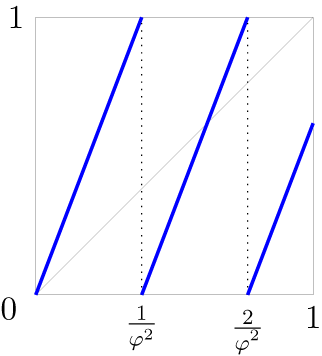
. The transformation
 $T_{\varphi ^2}$
is depicted in Figure 1.
The transformation
 $T_{\varphi ^2}$
.

Real base expansions have been studied form various points of view. We refer the reader to [Reference Lothaire19, Ch. 7] for a survey on their combinatorial properties and [Reference Dajani and Kraaikamp10] for a survey on their dynamical properties. The following fundamental dynamical result summarizes results from [Reference Parry21, Reference Rényi23, Reference Rohlin24].
Theorem 2.2. There exists a unique
 $T_\beta $
-invariant absolutely continuous probability measure
 $\mu _\beta $
on
 $\mathcal {B}([0,1))$
. Furthermore, the measure
 $\mu _\beta $
is equivalent to the Lebesgue measure on
 $\mathcal {B}([0,1))$
and the dynamical system
 $([0,1),\mathcal {B}([0,1)),\mu _{\beta },T_{\beta })$
is ergodic and has entropy
 $\log (\beta )$
.
Remark 2.3. It follows from Theorem 2.2 that
 $T_{\beta }$
is non-singular with respect to the Lebesgue measure, that is, for all
 $B\in \mathcal {B}([0,1))$
,
 $\lambda (B) = 0$
if and only if
 $\lambda (T_{\beta }^{-1}(B))=0$
.
In what follows, we let
 $$ \begin{align*} x_\beta=\frac{{\lceil{\beta}\rceil}-1}{\beta-1}. \end{align*} $$
This value corresponds to the greatest real number that has a
 $\beta $
-representation over the alphabet
 $[\kern-1.5pt[ 0,{\lceil {\beta }\rceil }-1]\kern-1.5pt] $
. Clearly, we have
 $x_\beta \ge 1$
. The extended greedy
 $\beta $
-transformation, denoted
 $T_\beta ^{{\mathrm {ext}}}$
, is defined in [Reference Dajani and Kraaikamp11] as
 $$ \begin{align*} T_\beta^{{\mathrm{ext}}}\colon [0,x_\beta) \to [0,x_\beta),\quad x\mapsto \begin{cases} \beta x-{\lfloor{\beta x}\rfloor} &\text{if } x\in[0,1),\\ \beta x -({\lceil{\beta}\rceil}-1) &\text{if }x\in[1,x_\beta). \end{cases} \end{align*} $$
Note that for all
 $x\in [({{\lceil {\beta }\rceil }-1})/{\beta },{{\lceil {\beta }\rceil }}/{\beta })$
, the two cases of the definition coincide since
 ${\lfloor {\beta x}\rfloor }={\lceil {\beta }\rceil }-1$
. The extended
 $\beta $
-transformation restricted to the interval
 $[0,1)$
yields the classical greedy
 $\beta $
-transformation defined above. Moreover, for all
 $x\in [0,x_\beta )$
, there exists
 $N\in {\mathbb N}$
such that for all
 $n\ge N$
,
 $(T_\beta ^{{\mathrm {ext}}})^n(x) \in [0,1)$
.
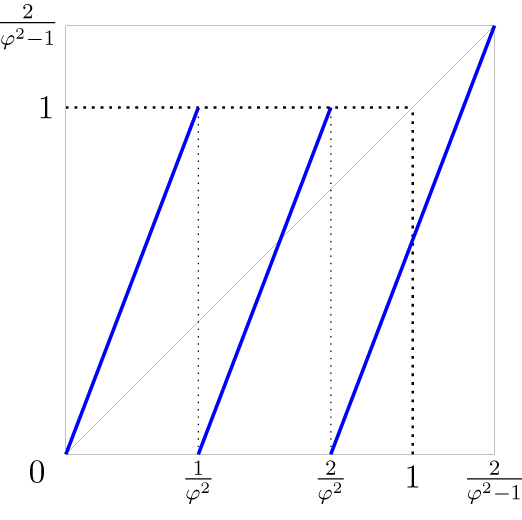
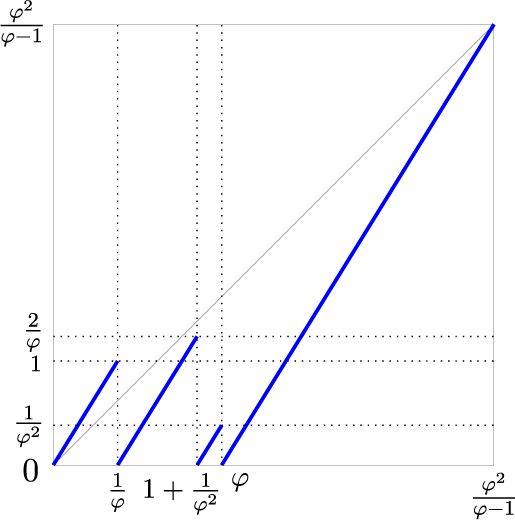
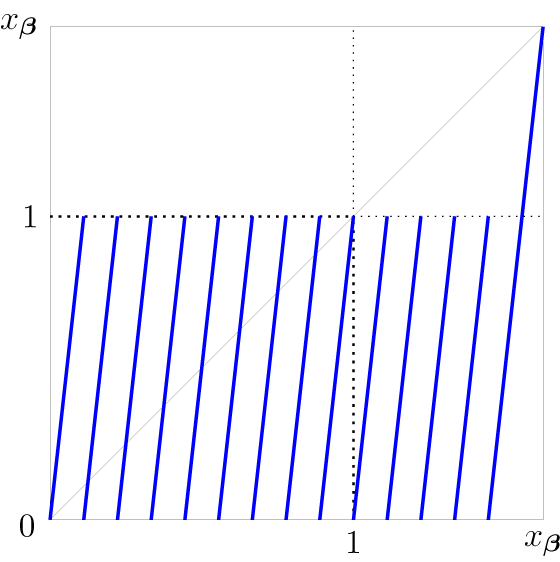
Example 2.4. We continue Example 2.1. The extended greedy transformation
 $T_{\varphi ^2}^{{\mathrm {ext}}}$
is depicted in Figure 2.
The extended transformation
 $T_{\varphi ^2}^{{\mathrm {ext}}}$
.

In the greedy algorithm, each digit is chosen as the largest possible among
 $0,1,\ldots ,{\lceil {\beta }\rceil }-1$
in the position considered. At the other extreme, the lazy algorithm picks the smallest possible digit at each step [Reference Erdös, Joó and Komornik12]: if the first N digits of the expansion of a real number
 $x\in (0,x_\beta ]$
are given by
 $a_0,\ldots ,a_{N-1}$
, then the next digit
 $a_N$
is the smallest element in
 $[\kern-1.5pt[ 0,{\lceil {\beta }\rceil }-1]\kern-1.5pt] $
such that
 $$ \begin{align*} \sum_{n=0}^N\frac{a_n}{\beta^{n+1}}+\sum_{n=N+1}^{\infty}\frac{{\lceil{\beta}\rceil}-1}{\beta^{n+1}}\ge x, \end{align*} $$
or equivalently,
 $$ \begin{align*} \sum_{n=0}^N\frac{a_n}{\beta^{n+1}}+\frac{x_\beta}{\beta^{N+1}}\ge x. \end{align*} $$
The
 $\beta $
-representation thus obtained is called the lazy
 $\beta $
-expansion of x. The lazy
 $\beta $
-transformation dynamically generating the lazy
 $\beta $
-expansion is the transformation
 $L_{\beta }$
defined as follows [Reference Dajani and Kraaikamp10]:
 $$ \begin{align*} L_{\beta}\colon (0,x_\beta] \to (0,x_\beta],\quad x\mapsto \begin{cases} \beta x &\text{if } x\in (0,x_\beta-1],\\ \beta x -{\lceil{\beta x -x_\beta}\rceil} &\text{if }x\in (x_\beta-1,x_\beta]. \end{cases} \end{align*} $$
Observe that for all
 $x\in ({x_\beta -1}/{\beta },{x_\beta }/{\beta }]$
, the two cases of the definition coincide since
 ${\lceil {\beta x -x_\beta }\rceil }=0$
. Moreover, since
 $L_\beta ((x_\beta -1,x_\beta ])=(x_\beta -1,x_\beta ]$
, the lazy transformation
 $L_\beta $
can be restricted to the length-one interval
 $(x_\beta -1,x_\beta ]$
. Also note that for all
 $x\in (0,x_\beta ]$
, there exists
 $N\in {\mathbb N}$
such that for all
 $n\ge N$
,
 $L_\beta ^n(x)\in (x_\beta -1,x_\beta ]$
. Furthermore, for all
 $x\in (x_\beta -1,x_\beta ]$
and
 $n\in {\mathbb N}$
, we have
 $a_n={\lceil {\beta L_{\beta }^n(x)-x_\beta }\rceil }$
.
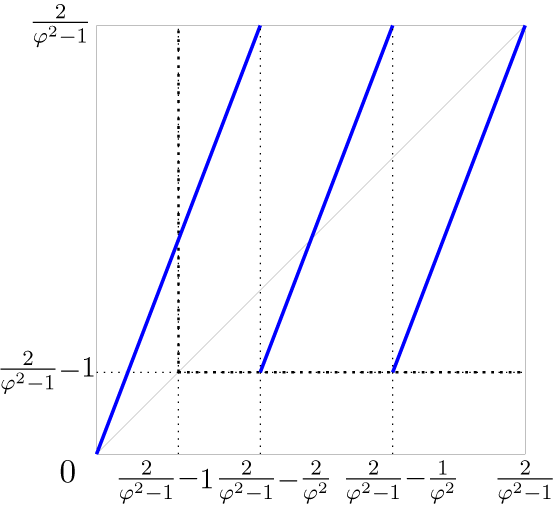
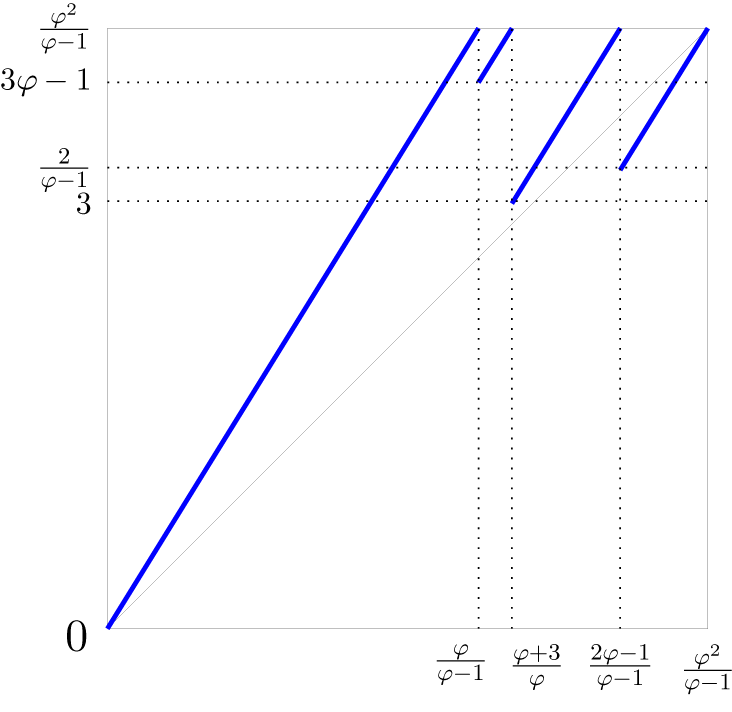
Example 2.5. The lazy transformation
 $L_{\varphi ^2}$
is depicted in Figure 3.
The transformation
 $L_{\varphi ^2}$
.

It is proven in [Reference Dajani and Kraaikamp11] that there is an isomorphism between the greedy and the lazy
 $\beta $
-transformations. As a direct consequence of this property, an analogue of Theorem 2.2 is obtained for the lazy transformation restricted to the interval
 $(x_\beta -1,x_\beta ]$
.
3 Alternate base expansions
Let p be a positive integer and
 ${\boldsymbol {\beta }}=(\beta _0,\ldots ,\beta _{p-1})$
be a p-tuple of real numbers greater than
 $1$
. Such a p-tuple
 ${\boldsymbol {\beta }}$
is called an alternate base and p is called its length. A
 ${\boldsymbol {\beta }}$
-representation of a non-negative real number x is an infinite sequence
 $a_0a_1a_2\cdots $
over
 ${\mathbb N}$
such that
 $$ \begin{align} x\ = & \qquad\qquad\frac{a_0}{\beta_0} &+ & \qquad\quad\frac{a_1}{\beta_1\beta_0} &+ \quad \cdots \quad &+ \quad\frac{a_{p-1}}{\beta_{p-1}\cdots\beta_0} \nonumber\\ &+ \quad\frac{a_p}{\beta_0(\beta_{p-1}\cdots\beta_0)} &+ &\quad \frac{a_{p+1}}{\beta_1\beta_0(\beta_{p-1}\cdots\beta_0)} &+ \quad \cdots \quad &+ \;\ \frac{a_{2p-1}}{(\beta_{p-1}\cdots\beta_0)^2} \nonumber \\ &+ \qquad \cdots. \end{align} $$
We use the convention that for all
 $n\in {\mathbb Z}$
,
 $\beta _n=\beta _{n \bmod p}$
and
 ${\boldsymbol {\beta }}^{(n)}=(\beta _n,\ldots ,\beta _{n+p-1})$
. Therefore, equality (1) can be rewritten as
 $$ \begin{align*} x=\sum_{n=0}^{+\infty}\frac{a_n}{\prod_{k=0}^n\beta_k}. \end{align*} $$
The alternate bases are particular cases of Cantor real bases, which were introduced and studied in [Reference Charlier and Cisternino5].
In this paper, our aim is to study the dynamics behind some distinguished representations in alternate bases, namely the greedy and lazy
 ${\boldsymbol {\beta }}$
-expansions. Firstly, we recall the notion of greedy
 ${\boldsymbol {\beta }}$
-expansions defined in [Reference Charlier and Cisternino5] and we introduce the greedy
 ${\boldsymbol {\beta }}$
-transformation dynamically generating the digits of the greedy
 ${\boldsymbol {\beta }}$
-expansions. Secondly, we introduce the notion of lazy
 ${\boldsymbol {\beta }}$
-expansions and the corresponding lazy
 ${\boldsymbol {\beta }}$
-transformation.
3.1 The greedy
 ${\boldsymbol {\beta }}$
-expansion

For
 $x\in [0,1)$
, a distinguished
 ${\boldsymbol {\beta }}$
-representation, called the greedy
 ${\boldsymbol {\beta }}$
-expansion of x, is obtained from the greedy algorithm. If the first N digits of the greedy
 ${\boldsymbol {\beta }}$
-expansion of x are given by
 $a_0,\ldots ,a_{N-1}$
, then the next digit
 $a_N$
is the greatest integer such that
 $$ \begin{align*} \sum_{n=0}^N \frac{a_n}{\prod_{k=0}^n\beta_k}\le x. \end{align*} $$
Note that, by the definition of the greedy algorithm, for every
 $n\in {\mathbb N}$
, the nth digit of the
 ${\boldsymbol {\beta }}$
-expansion of a real number
 $x\in [0,1)$
belongs to the restricted alphabet
 $[\kern-1.5pt[ 0,{\lceil {\beta _n}\rceil }-1]\kern-1.5pt] $
. The greedy
 ${\boldsymbol {\beta }}$
-expansion can also be obtained by alternating the
 $\beta _i$
-transformations: for all
 $x\in [0,1)$
and
 $n\in {\mathbb N}$
,
 $a_n={\lfloor {\beta _n(T_{\beta _{n-1}}\circ \cdots \circ T_{\beta _0}(x))}\rfloor }$
. The greedy
 ${\boldsymbol {\beta }}$
-expansion of x is denoted
 $d_{{\boldsymbol {\beta }}}(x)$
. In particular, if
 $p=1$
then it corresponds to the usual greedy
 $\beta $
-expansion as defined in §2.2.
Example 3.1. Consider the alternate base
 ${\boldsymbol {\beta }}=(({1+\sqrt {13}})/{2}, ({5+\sqrt {13}})/{6})$
already studied in [Reference Charlier and Cisternino5]. The greedy
 ${\boldsymbol {\beta }}$
-expansions are obtained by alternating the transformations
 $T_{({1+\sqrt {13}})/{2}}$
and
 $T_{({5+\sqrt {13}})/{6}}$
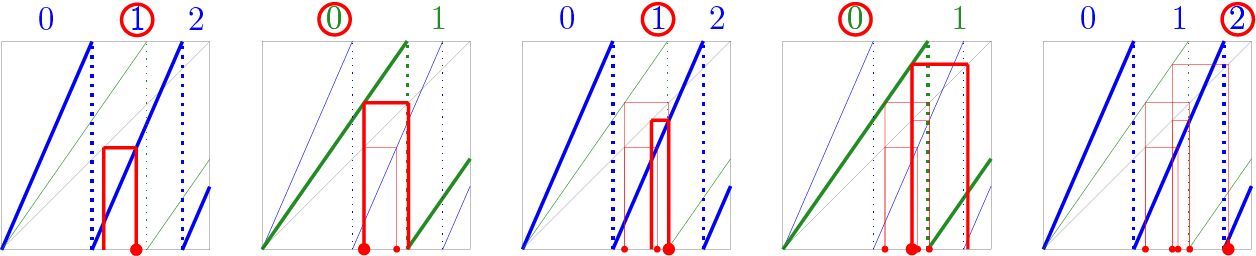
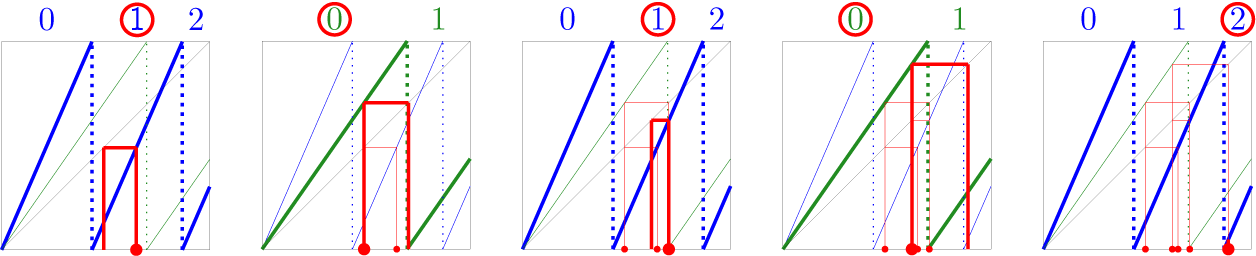
, which are both depicted in Figure 4. Moreover, in Figure 5 we see the computation of the first five digits of the greedy
 ${\boldsymbol {\beta }}$
-expansion of
 $({1+\sqrt {5}})/{5}$
.
The transformations
 $T_{({1+\sqrt {13}})/{2}}$
(blue) and
 $T_{({5+\sqrt {13}})/{6}}$
(green).

The first five digits of the greedy
 ${\boldsymbol {\beta }}$
-expansion of
 $({1+\sqrt {5}})/{5}$
are
 $10102$
for
 ${\boldsymbol {\beta }}=(({1+\sqrt {13}})/{2}, ({5+\sqrt {13}})/{6})$
.

We now define the greedy
 ${\boldsymbol {\beta }}$
-transformation by
 $$ \begin{align} T_{{\boldsymbol{\beta}}}\colon [\kern-1.5pt[ 0,p-1]\kern-1.5pt]\times [0,1) \to [\kern-1.5pt[ 0,p-1]\kern-1.5pt]\times [0,1),\quad (i,x) \mapsto ((i+1)\bmod p, T_{\beta_i}(x)). \end{align} $$
The greedy
 ${\boldsymbol {\beta }}$
-transformation generates the digits of the greedy
 ${\boldsymbol {\beta }}$
-expansion as follows. For all
 $x\in [0,1)$
and
 $n\in {\mathbb N}$
, the digit
 $a_n$
of
 $d_{{\boldsymbol {\beta }}}(x)$
is equal to
 ${\lfloor {\beta _n\pi _2(T_{{\boldsymbol {\beta }}}^n(0,x))}\rfloor }$
where
 $$ \begin{align*} \pi_2\colon{\mathbb N}\times {\mathbb R}\to {\mathbb R},\quad (n,x)\mapsto x. \end{align*} $$
As in §2.2, the greedy
 ${\boldsymbol {\beta }}$
-transformation can be extended to an interval of real numbers bigger than
 $[0,1)$
. To do so, we define
 $$ \begin{align} x_{{\boldsymbol{\beta}}}=\sum_{n=0}^{\infty}\frac{{\lceil{\beta_n}\rceil}-1}{\prod_{k=0}^n\beta_k}. \end{align} $$
It can be easily seen that
 $1\le x_{{\boldsymbol {\beta }}}<\infty $
. This value corresponds to the greatest real number that has a
 ${\boldsymbol {\beta }}$
-representation
 $a_0a_1a_2\cdots $
such that each digit
 $a_n$
belongs to the alphabet
 $[\kern-1.5pt[ 0,{\lceil {\beta _n}\rceil }-1]\kern-1.5pt] $
, that is,
 $x_{{\boldsymbol {\beta }}}$
is the real number having
 $({\lceil {\beta _0}\rceil }-1)({\lceil {\beta _1}\rceil }-1)\cdots $
as a
 ${\boldsymbol {\beta }}$
-representation. Similarly, for all
 $n\in {\mathbb Z}$
, the largest number that has a
 ${\boldsymbol {\beta }}^{(n)}$
-representation
 $a_0a_1a_2\cdots $
such that each digit
 $a_m$
belongs to the alphabet
 $[\kern-1.5pt[ 0,{\lceil {\beta _{n+m}}\rceil }-1]\kern-1.5pt] $
is given by
 $$ \begin{align*} x_{{\boldsymbol{\beta}}^{(n)}}=\sum_{m=0}^{\infty}\frac{{\lceil{\beta_{n+m}}\rceil}-1}{\prod_{k=0}^m\beta_{n+k}}. \end{align*} $$
Hence, for all
 $n\in {\mathbb Z}$
, we get
 $$ \begin{align} x_{{\boldsymbol{\beta}}^{(n)}}= \frac{x_{{\boldsymbol{\beta}}^{(n+1)}}+{\lceil{\beta_n}\rceil}-1}{\beta_n}. \end{align} $$
We define the extended greedy
 ${\boldsymbol {\beta }}$
-transformation, denoted
 $T_{{\boldsymbol {\beta }}}^{{\mathrm {ext}}}$
, by
 $$ \begin{align} T_{{\boldsymbol{\beta}}}^{{\mathrm{ext}}}\colon &\bigcup_{i=0}^{p-1} (\{i\} \times [0 , x_{{\boldsymbol{\beta}}^{(i)}} ) )\to \bigcup_{i=0}^{p-1} (\{i\} \times [0 , x_{{\boldsymbol{\beta}}^{(i)}}) ),\nonumber\\ &(i,x) \mapsto \begin{cases} ((i+1)\bmod p,\beta_i x -{\lfloor{\beta_i x}\rfloor}) & \text{if } x \in [0,1),\\ ((i+1) \bmod p, \beta_i x-({\lceil{\beta_i}\rceil}-1)) & \text{if } x \in[1,x_{{\boldsymbol{\beta}}^{(i)}}). \end{cases} \end{align} $$
The greedy
 ${\boldsymbol {\beta }}$
-expansion of
 $x\in [0,x_{{\boldsymbol {\beta }}})$
is obtained by alternating the p maps
 $$ \begin{align*} {\pi_2 \circ T_{{\boldsymbol{\beta}}}^{{\mathrm{ext}}} \circ \delta_i}_{| [0,x_{{\boldsymbol{\beta}}^{(i)}})} \colon [0,x_{{\boldsymbol{\beta}}^{(i)}})\to [0,x_{{\boldsymbol{\beta}}^{(i+1)}}) \end{align*} $$
for
 $i \in [\kern-1.5pt[ 0,p-1]\kern-1.5pt]$
, where
 $$ \begin{align*} \delta_i\colon {\mathbb R}\to\{i\}\times{\mathbb R},\ x\mapsto (i,x). \end{align*} $$
Proposition 3.2. For all
 $x\in [0,x_{{\boldsymbol {\beta }}})$
and
 $n\in {\mathbb N}$
, we have
 $$ \begin{align*} \pi_2 \circ (T_{{\boldsymbol{\beta}}}^{{\mathrm{ext}}})^n \circ \delta_0 (x) =\beta_{n-1}\cdots\beta_0 x -\sum_{k=0}^{n-1} \beta_{n-1}\cdots \beta_{k+1}c_k \end{align*} $$
where
 $(c_0,\ldots ,c_{n-1})$
is the lexicographically greatest n-tuple in
 $\prod _{k=0}^{n-1}\ [\kern-1.5pt[ 0,{\lceil {\beta _k}\rceil }-1]\kern-1.5pt] $
such that
 ${\sum _{k=0}^{n-1} \beta _{n-1}\cdots \beta _{k+1}c_k}/{\beta _{n-1}\cdots \beta _0} \le x$
.
Proof. We proceed by induction on n. The base case
 $n=0$
is immediate: both members of the equality are equal to x. Now suppose that the result is satisfied for some
 $n\in {\mathbb N}$
. Let
 $x\in [0,x_{{\boldsymbol {\beta }}})$
. Let
 $(c_0,\ldots ,c_{n-1})$
be the lexicographically greatest n-tuple in
 $\prod _{k=0}^{n-1}\ [\kern-1.5pt[ 0,{\lceil {\beta _k}\rceil }-1]\kern-1.5pt] $
such that
 ${\sum _{k=0}^{n-1} \beta _{n-1}\cdots \beta _{k+1}c_k}/{\beta _{n-1}\cdots \beta _0} \le x$
. Then it is easily seen that for all
 $m< n$
,
 $(c_0,\ldots ,c_m)$
is the lexicographically greatest
 $(m+1)$
-tuple in
 $\prod _{k=0}^m\ [\kern-1.5pt[ 0,{\lceil {\beta _k}\rceil }-1]\kern-1.5pt] $
such that
 ${\sum _{k=0}^m \beta _m\cdots \beta _{k+1}c_k}/{\beta _m\cdots \beta _0} \le x$
. Now, set
 $y=\pi _2\circ (T_{{\boldsymbol {\beta }}}^{{\mathrm {ext}}})^n \circ \delta _0 (x)$
. Then
 $y\in [0,x_{{\boldsymbol {\beta }}^{(n)}})$
and by the induction hypothesis, we obtain that
 $y=\beta _{n-1}\cdots \beta _0 x-\sum _{k=0}^{n-1} \beta _{n-1}\cdots \beta _{k+1}c_k$
. Then, by setting
 $$ \begin{align*} c_n= \begin{cases} {\lfloor{\beta_n y}\rfloor} &\text{if } y\in[0,1),\\ {\lceil{\beta_n}\rceil}-1 &\text{if } y\in[1,x_{{\boldsymbol{\beta}}^{(n)}}), \end{cases} \end{align*} $$
we obtain that
 $\pi _2\circ (T_{{\boldsymbol {\beta }}}^{{\mathrm {ext}}})^{n+1} \circ \delta _0 (x) =\beta _n\cdots \beta _0 x-\sum _{k=0}^n\beta _n\cdots \beta _{k +1}c_k$
. In order to conclude, we have to show that:
-
(a)
${\sum _{k=0}^n\beta _n\cdots \beta _{k +1}c_k}/{\beta _n\cdots \beta _0}\le x$
; -
(b)
$(c_0,\ldots ,c_n)$
is the lexicographically greatest
$(n+1)$
-tuple in
$\prod _{k=0}^n\ [\kern-1.5pt[ 0,{\lceil {\beta _k}\rceil }-1]\kern-1.5pt] $
such that (a) holds.


By definition of
 $c_n$
, we have
 $c_n\le \beta _n y$
. Therefore,
 $$ \begin{align*} \sum_{k=0}^n\beta_n\cdots \beta_{k +1}c_k &=\beta_n\sum_{k=0}^{n-1}\beta_{n-1}\cdots \beta_{k+1}c_k+c_n\\ &= \beta_n(\beta_{n-1}\cdots\beta_0x-y)+c_n \le\beta_n\cdots \beta_0x. \end{align*} $$
This shows that (a) holds.
Let us show (b) by contradiction. Suppose that there exists
 $(c_0',\ldots ,c_n')\in \prod _{k=0}^n\ [\kern-1.5pt[ 0,{\lceil {\beta _k}\rceil }-1]\kern-1.5pt] $
such that
 $ (c_0',\ldots ,c_n')>_{\mathrm {lex}}(c_0,\ldots ,c_n)$
and
 ${\sum _{k=0}^n\beta _n\cdots \beta _{k +1}c_k'}/ {\beta _n\cdots \beta _0}\le x$
. Then there exists
 $m\le n$
such that
 $c_0'=c_0,\ldots ,c_{m-1}'=c_{m-1}$
and
 $c_m'\ge c_m+1$
. We again consider two cases. First, suppose that
 $m<n$
. Since
 $(c_0',\ldots ,c_m')>_{\mathrm {lex}}(c_0,\ldots ,c_m)$
, we get
 ${\sum _{k=0}^m\beta _m\cdots \beta _{k+1}c_k'}/{\beta _m\cdots \beta _0}> x$
. But then
 $$ \begin{align*} \sum_{k=0}^n\beta_n\cdots \beta_{k+1}c_k' \ge \beta_n\cdots \beta_{m+1}\sum_{k=0}^m\beta_m\cdots \beta_{k+1}c_k'>\beta_n\cdots \beta_0 x, \end{align*} $$
a contradiction. Second, suppose that
 $m=n$
. Then
 $$ \begin{align*} \beta_n\cdots \beta_0 x \ge \sum_{k=0}^n\beta_n\cdots \beta_{k+1}c_k' \ge \sum_{k=0}^{n-1}\beta_n\cdots \beta_{k+1}c_k+c_n+1, \end{align*} $$
hence
 $\beta _n y\ge c_n+1$
. If
 $y\in [0,1)$
then
 $c_n+1={\lfloor {\beta _ny}\rfloor }+1>\beta _ny$
, a contradiction. Otherwise,
 $y\in [1,x_{{\boldsymbol {\beta }}^{(n)}})$
and
 $c_n+1={\lceil {\beta _n}\rceil }$
. But then
 $c_n'\ge {\lceil {\beta _n}\rceil }$
, which is impossible since
 $c_n'\in [\kern-1.5pt[ 0,{\lceil {\beta _n}\rceil }-1]\kern-1.5pt] $
. This shows (b) and ends the proof.
The restriction of the extended greedy
 ${\boldsymbol {\beta }}$
-transformation to the domain
 $[\kern-1.5pt[ 0,p-1]\kern-1.5pt] \times [0,1)$
yields the greedy
 ${\boldsymbol {\beta }}$
-transformation initially defined in (2). Moreover, the subspace
 $[\kern-1.5pt[ 0,p-1]\kern-1.5pt] \times [0,1)$
is an attractor of
 $T_{{\boldsymbol {\beta }}}^{{\mathrm {ext}}}$
in the sense given by the following proposition.
Proposition 3.3. For each
 $(i,x)\in \bigcup _{i=0}^{p-1}(\{i\}\times [0,x_{{\boldsymbol {\beta }}^{(i)}}))$
, there exists
 $N \in {\mathbb N}$
such that for all
 $n\ge N$
,
 $(T_{{\boldsymbol {\beta }}}^{{\mathrm {ext}}})^n(i,x)\in [\kern-1.5pt[ 0,p-1]\kern-1.5pt] \times [0,1)$
.
Proof. Let
 $(i,x)\in \bigcup _{i=0}^{p-1}(\{i\}\times [0,x_{{\boldsymbol {\beta }}^{(i)}}))$
. On the one hand, if
 $(T_{{\boldsymbol {\beta }}}^{{\mathrm {ext}}})^N(i,x)\in [\kern-1.5pt[ 0,p-1]\kern-1.5pt] \times [0,1)$
for some
 $N \in {\mathbb N}$
, then clearly
 $(T_{{\boldsymbol {\beta }}}^{{\mathrm {ext}}})^n(i,x)\in [\kern-1.5pt[ 0,p-1]\kern-1.5pt] \times [0,1)$
for all
 $n\ge N$
. On the other hand, if
 $(T_{{\boldsymbol {\beta }}}^{{\mathrm {ext}}})^n(i,x)\notin [\kern-1.5pt[ 0,p-1]\kern-1.5pt] \times [0,1)$
for all
 $n\in {\mathbb N}$
, then we would get that
 $x=x_{{\boldsymbol {\beta }}}^{(i)}$
, since at each step n the greedy algorithm would pick the maximal digit
 ${\lceil {\beta _{i+n}}\rceil }-1$
.
Example 3.4. Let
 ${\boldsymbol {\beta }}=(({1+\sqrt {13}})/{2}, ({5+\sqrt {13}})/{6})$
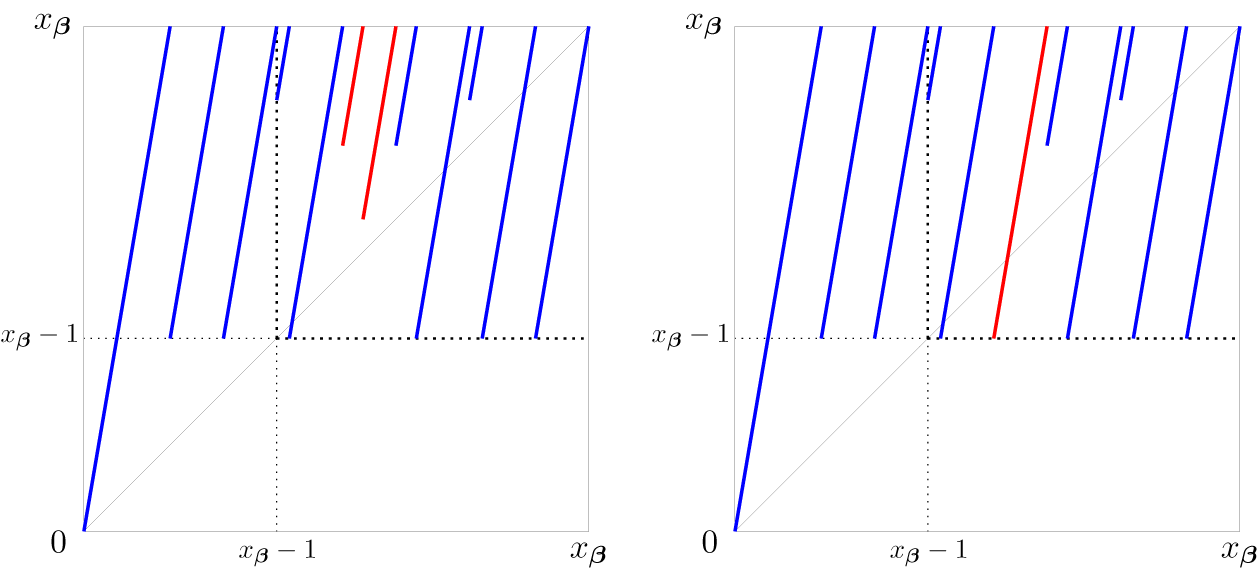
be the alternate base of Example 3.1. The maps
 ${\pi _2 \circ T_{{\boldsymbol {\beta }}}^{{\mathrm {ext}}}\circ \delta _0}_{| [0,x_{{\boldsymbol {\beta }}})}\colon [0,x_{{\boldsymbol {\beta }}})\to [0,x_{{\boldsymbol {\beta }}^{(1)}})$
and
 ${\pi _2 \circ T_{{\boldsymbol {\beta }}}^{{\mathrm {ext}}} \circ \delta _1}_{| [0,x_{{\boldsymbol {\beta }}^{(1)}})}\colon [0,x_{{\kern-0.5pt\boldsymbol {\beta }}^{(1)}}) \kern1.2pt{\to} [0,x_{{\boldsymbol {\beta }}})$
are depicted in Figure 6.
The maps
 ${\pi _2 \circ T_{{\boldsymbol {\beta }}}^{{\mathrm {ext}}}\circ \delta _0}_{| [0,x_{{\boldsymbol {\beta }}})}$
(blue) and
 ${\pi _2 \circ T_{{\boldsymbol {\beta }}}^{{\mathrm {ext}}} \circ \delta _1}_{| [0,x_{{\boldsymbol {\beta }}^{(1)}})}$
(green) with
 ${\boldsymbol {\beta }}=(({1+\sqrt {13}})/{2}, ({5+\sqrt {13}})/{6})$
.

3.2 The lazy
${\boldsymbol {\beta }}$
-expansion

As in the real base case, in the greedy
 ${\boldsymbol {\beta }}$
-expansion, each digit is chosen as the largest possible at the position considered. Here, we define and study the other extreme
 ${\boldsymbol {\beta }}$
-representation, called the lazy
 ${\boldsymbol {\beta }}$
-expansion, taking the smallest possible digit at each step. For
 $x\in [0,x_{{\boldsymbol {\beta }}})$
, if the first N digits of the lazy
 ${\boldsymbol {\beta }}$
-expansion of x are given by
 $a_0,\ldots ,a_{N-1}$
, then the next digit
 $a_N$
is the smallest element in
 $[\kern-1.5pt[ 0,{\lceil {\beta _N}\rceil }-1]\kern-1.5pt] $
such that
 $$ \begin{align*} \sum_{n=0}^N\frac{a_n}{\prod_{k=0}^n\beta_k} +\sum_{n=N+1}^{\infty}\frac{{\lceil{\beta_n}\rceil}-1}{\prod_{k=0}^n\beta_k} \ge x, \end{align*} $$
or equivalently,
 $$ \begin{align*} \sum_{n=0}^N\frac{a_n}{\prod_{k=0}^n\beta_k} +\frac{x_{{\boldsymbol{\beta}}^{(N)}}}{\prod_{k=0}^N\beta_k} \ge x. \end{align*} $$
This algorithm is called the lazy algorithm. For all
 $N\in {\mathbb N}$
, we have
 $$ \begin{align*} \sum_{n=0}^N \frac{a_n}{\prod_{k=0}^n\beta_k}\le x, \end{align*} $$
which implies that the lazy algorithm converges, that is,
 $$ \begin{align*} x=\sum_{n=0}^\infty \frac{a_n}{\prod_{k=0}^n\beta_k}. \end{align*} $$
We now define the lazy
 ${\boldsymbol {\beta }}$
-transformation by
 $$ \begin{align*} L_{{\boldsymbol{\beta}}}\colon &\bigcup_{i=0}^{p-1} (\{i\} \times (0,x_{{\boldsymbol{\beta}}^{(i)}}] ) \to \bigcup_{i=0}^{p-1} (\{i\} \times (0,x_{{\boldsymbol{\beta}}^{(i)}}] ),\\ &(i,x) \mapsto \begin{cases} ((i+1)\bmod p, \beta_i x) & \text{if } x \in (0,x_{{\boldsymbol{\beta}}^{(i)}}-1],\\ ((i+1)\bmod p, \beta_i x-{\lceil{\beta_i x-x_{{\boldsymbol{\beta}}^{(i+1)}}}\rceil}) & \text{if } x \in (x_{{\boldsymbol{\beta}}^{(i)}}-1,x_{{\boldsymbol{\beta}}^{(i)}}]. \end{cases} \end{align*} $$
The lazy
 ${\boldsymbol {\beta }}$
-expansion of
 $x\in (0,x_{{\boldsymbol {\beta }}}]$
is obtained by alternating the p maps
 $$ \begin{align*} {\pi_2 \circ L_{{\boldsymbol{\beta}}} \circ \delta_i}_{| (0,x_{{\boldsymbol{\beta}}^{(i)}}]} \colon (0,x_{{\boldsymbol{\beta}}^{(i)}}]\to (0,x_{{\boldsymbol{\beta}}^{(i+1)}}] \end{align*} $$
for
 $i\in [\kern-1.5pt[ 0,p-1]\kern-1.5pt]$
. The following proposition is the analogue of Proposition 3.2 for the lazy
 ${\boldsymbol {\beta }}$
-transformation, and can be proved in a similar fashion.
Proposition 3.5. For all
 $x\in (0,x_{{\boldsymbol {\beta }}}]$
and
 $n\in {\mathbb N}$
, we have
 $$ \begin{align*} \pi_2 \circ L_{{\boldsymbol{\beta}}}^n \circ \delta_0 (x) =\beta_{n-1}\cdots\beta_0 x-\sum_{i=0}^{n-1} \beta_{n-1}\cdots \beta_{i+1}c_i \end{align*} $$
where
 $(c_0,\ldots ,c_{n-1})$
is the lexicographically smallest n-tuple in
 $\prod _{k=0}^{n-1}\ [\kern-1.5pt[ 0,{\lceil {\beta _k}\rceil }-1]\kern-1.5pt] $
such that
 $({\sum _{i=0}^{n-1} \beta _{n-1}\cdots \beta _{i+1}c_i}/{\beta _{n-1}\cdots \beta _0}) + \sum _{m=n}^{\infty }(({{\lceil {\beta _m}\rceil }-1})/{\prod _{k=0}^m \beta _k}) \ge x$
.
Note that for each
 $i\in [\kern-1.5pt[ 0,p-1]\kern-1.5pt]$
,
 $$ \begin{align*} L_{{\boldsymbol{\beta}}}(\{i\} \times(x_{{\boldsymbol{\beta}}^{(i)}}-1,x_{{\boldsymbol{\beta}}^{(i)}}] ) \subset \{(i+1)\bmod p\} \times(x_{{\boldsymbol{\beta}}^{(i+1)}}-1,x_{{\boldsymbol{\beta}}^{(i+1)}}]. \end{align*} $$
Therefore, the lazy
 ${\boldsymbol {\beta }}$
-transformation can be restricted to the domain
 $\bigcup _{i=0}^{p-1} (\{i\} \times (x_{{\boldsymbol {\beta }}^{(i)}}-1,x_{{\boldsymbol {\beta }}^{(i)}}])$
. The (restricted) lazy
 ${\boldsymbol {\beta }}$
-transformation generates the digits of the lazy
 ${\boldsymbol {\beta }}$
-expansions of real numbers in the interval
 $(x_{{\boldsymbol {\beta }}}-1,x_{{\boldsymbol {\beta }}}]$
as follows. For all
 $x\in (x_{{\boldsymbol {\beta }}}-1,x_{{\boldsymbol {\beta }}}]$
and
 $n\in {\mathbb N}$
, the digit
 $a_n$
in the lazy
 ${\boldsymbol {\beta }}$
-expansion of x is equal to
 ${\lceil {\beta _n\pi _2(L_{{\boldsymbol {\beta }}}^n(0,x))-x_{{\boldsymbol {\beta }}^{(n+1)}}}\rceil }$
.
Similarly to the greedy case, we obtain that the subspace
 $\bigcup _{i=0}^{p-1} (\{i\}\times (x_{{\boldsymbol {\beta }}^{(i)}}-1,x_{{\boldsymbol {\beta }}^{(i)}}])$
is an attractor of
 $L_{{\boldsymbol {\beta }}}$
.
Proposition 3.6. For each
 $(i,x)\in \bigcup _{i=0}^{p-1} (\{i\} \times (0,x_{{\boldsymbol {\beta }}^{(i)}}])$
, there exists
 $N \in {\mathbb N}$
such that for all
 $n\ge N$
,
 $L_{{\boldsymbol {\beta }}}^n(i,x)\in \bigcup _{i=0}^{p-1} (\{i\}\times (x_{{\boldsymbol {\beta }}^{(i)}}-1,x_{{\boldsymbol {\beta }}^{(i)}}])$
.
Proof. Let
 $(i,x)\in \bigcup _{i=0}^{p-1}(\{i\}\times (0,x_{{\boldsymbol {\beta }}^{(i)}}])$
. On the one hand, if
 $L_{{\boldsymbol {\beta }}}^N(i,x)\in \bigcup _{i=0}^{p-1} (\{i\}\times (x_{{\boldsymbol {\beta }}^{(i)}}-1,x_{{\boldsymbol {\beta }}^{(i)}}])$
for some
 $N \in {\mathbb N}$
, then clearly
 $L_{{\boldsymbol {\beta }}}^n(i,x)\in \bigcup _{i=0}^{p-1} (\{i\}\times (x_{{\boldsymbol {\beta }}^{(i)}}-1,x_{{\boldsymbol {\beta }}^{(i)}}])$
for all
 $n\ge N$
. On the other hand, if
 $L_{{\boldsymbol {\beta }}}^n(i,x)\notin \bigcup _{i=0}^{p-1} (\{i\}\times (x_{{\boldsymbol {\beta }}^{(i)}}-1,x_{{\boldsymbol {\beta }}^{(i)}}])$
for all
 $n\in {\mathbb N}$
, then we would get that
 $x=0$
, since at each step the lazy algorithm would pick the minimal digit, which is always
 $0$
.
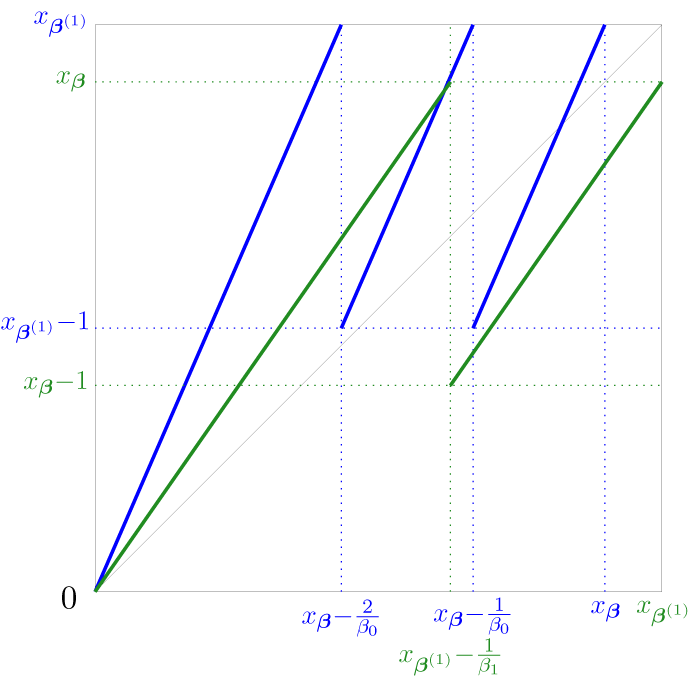
Example 3.7. Consider again the length-two alternate base
 ${\boldsymbol {\beta }}=(({1+\sqrt {13}})/{2}, ({5+\sqrt {13}})/{6})$
from Examples 3.1 and 3.4. We have
 $x_{{\boldsymbol {\beta }}}=({5+7\sqrt {13}})/{18}\simeq 1.67$
and
 $x_{{\boldsymbol {\beta }}^{(1)}}=({2 + \sqrt {13}})/{3} \simeq 1.86$
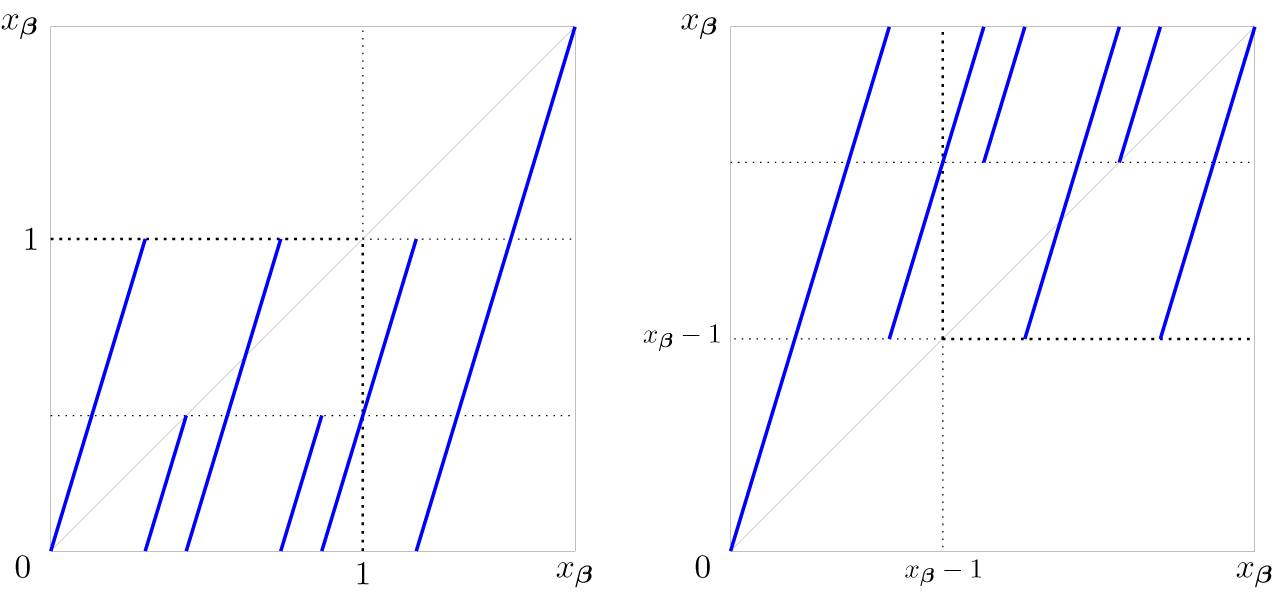
. The maps
 ${\pi _2 \circ L_{{\boldsymbol {\beta }}} \circ \delta _0}_{| (0,x_{{\boldsymbol {\beta }}}]}\colon (0,x_{{\boldsymbol {\beta }}}]\to (0,x_{{\boldsymbol {\beta }}^{(1)}}]$
and
 ${\pi _2 \circ L_{{\boldsymbol {\beta }}} \circ \delta _1}_{| (0,x_{{\boldsymbol {\beta }}^{(1)}}]}\colon (0,x_{{\boldsymbol {\beta }}^{(1)}}]\to (0,x_{{\boldsymbol {\beta }}}]$
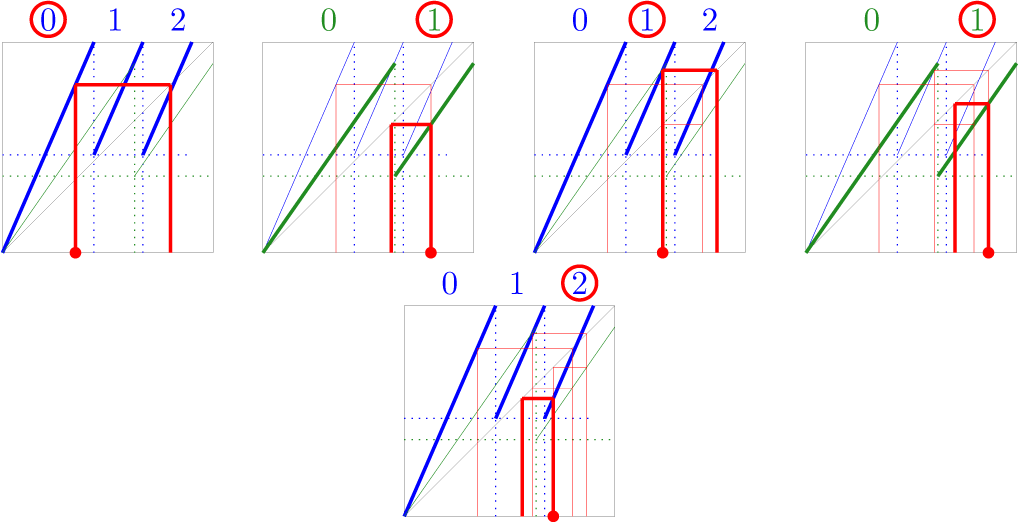
are depicted in Figure 7. In Figure 8 we see the computation of the first five digits of the lazy
 ${\boldsymbol {\beta }}$
-expansion of
 $({1+\sqrt {5}})/{5}$
.
The maps
 ${\pi _2 \circ L_{{\boldsymbol {\beta }}} \circ \delta _0}_{| (0,x_{{\boldsymbol {\beta }}}]}$
(blue) and
 ${\pi _2 \circ L_{{\boldsymbol {\beta }}} \circ \delta _1}_{| (0,x_{{\boldsymbol {\beta }}^{(1)}}]}$
(green) with
 ${\boldsymbol {\beta }}=(({1+\sqrt {13}})/{2}, ({5+\sqrt {13}})/{6})$
.

The first five digits of the lazy
 ${\boldsymbol {\beta }}$
-expansion of
 $({1+\sqrt {5}})/{5}$
are
 $01112$
for
 ${\boldsymbol {\beta }}=(({1+\sqrt {13}})/{2}, ({5+\sqrt {13}})/{6})$
.

3.3 A note on Cantor bases
The greedy algorithm described in §§3.1 and 3.2 is well defined in the extended context of Cantor bases, that is, sequences of real numbers
 ${\boldsymbol {\beta }}=(\beta _n)_{n\in {\mathbb N}}$
greater than
 $1$
such that the product
 $\prod _{n=0}^{\infty }\beta _n$
is infinite [Reference Charlier and Cisternino5]. In this case, the greedy algorithm converges on
 $[0,1)$
: for all
 $x\in [0,1)$
, the computed digits
 $a_n$
are such that
 $\sum _{n=0}^{\infty } ({a_n}/{\prod _{k=0}^n \beta _k})=x$
. Therefore, the value
 $x_{{\boldsymbol {\beta }}}$
defined as in (3) is greater than or equal to
 $1$
. However, it might be that
 $x_{{\boldsymbol {\beta }}}=\infty $
. For example, this is the case for the Cantor base given by
 $\beta _n=1+({1}/({n+1}))$
for all
 $n\in {\mathbb N}$
.
Note that the restriction of the transformation
 $\pi _2 \circ (T_{{\boldsymbol {\beta }}}^{{\mathrm {ext}}})^n \circ \delta _0$
to the unit interval
 $[0,1)$
coincides with the composition
 $T_{\beta _{n-1}}\circ \cdots \circ T_{\beta _0}$
. Thus, when restricted to
 $[0,1)$
, Proposition 3.2 can be reformulated as follows.
Proposition 3.8. For all
 $x\in [0,1)$
and
 $n\in {\mathbb N}$
, we have
 $$ \begin{align*} T_{\beta_{n-1}}\circ \cdots \circ T_{\beta_0}(x) =\beta_{n-1}\cdots\beta_0 x-\sum_{k=0}^{n-1} \beta_{n-1}\cdots \beta_{k+1}c_k \end{align*} $$
where
 $(c_0,\ldots ,c_{n-1})$
is the lexicographically greatest n-tuple in
 $\prod _{k=0}^{n-1}\ [\kern-1.5pt[ 0,{\lceil {\beta _k}\rceil }-1]\kern-1.5pt] $
such that
 ${\sum _{k=0}^{n-1} \beta _{n-1}\cdots \beta _{k+1}c_k}/{\beta _{n-1}\cdots \beta _0} \le x$
.
For all
 $k\in [\kern-1.5pt[ 0,n-1]\kern-1.5pt] $
, the transformation
 $L_{\beta _k}$
is defined on
 $(0,x_{\beta _k}]$
and can be restricted to
 $(x_{\beta _k}-1,x_{\beta _k}]$
. So, the restricted transformations
 $L_{\beta _0}^{{\mathrm {restr}}},\ldots ,L_{\beta _{n-1}}^{{\mathrm {restr}}}$
cannot be composed with one another in general. Therefore, even if the lazy algorithm can be defined for Cantor bases, provided that
 $x_{{\boldsymbol {\beta }}}<\infty $
, we cannot state an analogue of Proposition 3.8 in terms of the lazy transformations for Cantor bases.
Even though this paper is mostly concerned with alternate bases, let us emphasize that some results are indeed valid for any sequence
 $(\beta _n)_{n\in {\mathbb N}}\in ({\mathbb R}_{>1})^{{\mathbb N}}$
, and hence for any Cantor base. This is the case for Propositions 3.8 and 4.3, Corollary 4.4, and Proposition 4.14.
4 Dynamical properties of
$T_{{\boldsymbol {\beta }}}$

In this section we study the dynamics of the greedy
 ${\boldsymbol {\beta }}$
-transformation. First, we generalize Theorem 2.2 to the transformation
 $T_{{\boldsymbol {\beta }}}$
on
 $[\kern-1.5pt[ 0,p-1]\kern-1.5pt] \times [0,1)$
. Second, we extend the result obtained to the extended transformation
 $T_{{\boldsymbol {\beta }}}$
. Third, we provide a formula for the density functions of the measures found in the first two parts. Finally, we compute the frequencies of the digits in the greedy
 ${\boldsymbol {\beta }}$
-expansions.
4.1 Unique absolutely continuous
$T_{{\boldsymbol {\beta }}}$
-invariant measure

In order to generalize Theorem 2.2 to alternate bases, we start by recalling a result of Lasota and Yorke.
Theorem 4.1. [Reference Lasota and Yorke17, Theorem 4]
Let
 $T\colon [0,1)\to [0,1)$
be a transformation for which there exists a partition
 $[a_0,a_1),\ldots ,[a_{K-1},a_K)$
of the interval
 $[0,1)$
with
 $a_0<\cdots <a_K$
such that for each
 $k \in [\kern-1.5pt[ 0,K-1]\kern-1.5pt] $
,
 $T_{|[a_k,a_{k+1})}$
is convex,
 $T(a_k)=0$
,
 $T'(a_k)>0$
and
 $T'(0)>1$
. Then there exists a unique T-invariant absolutely continuous probability measure. Furthermore, its density function is bounded and decreasing, and the corresponding dynamical system is exact.
We then prove a stability lemma.
Lemma 4.2. Let
 $\mathcal {I}$
be the family of transformations
 $T\colon [0,1)\to [0,1)$
for which there exist a partition
 $[a_0,a_1),\ldots ,[a_{K-1},a_K)$
of the interval
 $[0,1)$
with
 $a_0<\cdots <a_K$
and a slope
 $s>1$
such that for all
 $k\in [\kern-1.5pt[ 0,K-1]\kern-1.5pt] $
,
 $a_{k+1}-a_k\le {1}/{s}$
, and for all
 $x\in [a_k,a_{k+1})$
,
 $T(x)=s(x-a_k)$
. Then
 $\mathcal {I}$
is closed under composition.
Proof. Let
 $S,T\in \mathcal {I}$
. Let
 $[a_0,a_1),\ldots ,[a_{K-1},a_K)$
and
 $[b_0,b_1),\ldots ,[b_{L-1},b_L)$
be partitions of the interval
 $[0,1)$
with
 $a_0<\cdots <a_K$
,
 $b_0<\cdots <b_L$
, and let
 $s,t>1$
such that for all
 $k\in [\kern-1.5pt[ 0,K-1]\kern-1.5pt] $
,
 $a_{k+1}-a_k\le {1}/{s}$
, for all
 $\ell \in [\kern-1.5pt[ 0,L-1]\kern-1.5pt] $
,
 $b_{\ell +1}-b_\ell \le {1}/{t}$
, and for all
 $x\in [0,1)$
,
 $S(x)=s(x-a_k)$
if
 $x\in [a_k,a_{k+1})$
and
 $T(x)=t(x-b_\ell )$
if
 $x\in [b_\ell ,b_{\ell +1})$
. For each
 $k\in [\kern-1.5pt[ 0,K-1]\kern-1.5pt] $
, define
 $L_k$
to be the greatest
 $\ell \in [\kern-1.5pt[ 0,L-1]\kern-1.5pt] $
such that
 $a_k+({b_\ell }/{s})< a_{k+1}$
. Consider the partition
 $$ \begin{align*} &\bigg[a_0+\frac{b_0}{s},a_0+\frac{b_1}{s}\bigg),\ldots, \bigg[a_0+\frac{b_{L_0-1}}{s},a_0+\frac{b_{L_0}}{s}\bigg), \bigg[a_0+\frac{b_{L_0}}{s},a_1\bigg)\\ &\vdots \\ &\bigg[\kern-1.2pt a_{K-1}\kern-1.2pt{+}\kern-1.2pt\frac{b_0}{s},a_{K-1}\kern-1.2pt{+}\kern-1.2pt\frac{b_1}{s}\!\bigg),\ldots, \bigg[\kern-1.2pt a_{K-1}\kern1pt{+}\kern1pt\frac{b_{L_{K-1}-1}}{s},a_{K-1}\kern1pt{+}\kern1pt\frac{b_{L_{K-1}}}{s}\!\bigg), \bigg[\kern-1pt a_{K-1}\kern1pt{+}\kern1.2pt\frac{b_{L_{K-1}}}{s},a_K\kern-1.5pt\!\bigg) \end{align*} $$
of the interval
 $[0,1)$
. For each
 $k\in [\kern-1.5pt[ 0,K-1]\kern-1.5pt] $
and
 $\ell \in [\kern-1.5pt[ 0,L_k-1]\kern-1.5pt] $
,
 $a_k+({b_{\ell +1}}/{s})-a_k-({b_\ell }/{s})\le {1}/{ts}$
and
 $a_{k+1}-a_k-({b_{L_k}}/{s})=(a_{k+1}-a_k-({b_{L_k+1}}/{s}))\kern1.2pt{+}\kern1.2pt({b_{L_k+1}\kern1.2pt{-}\kern1.2pt b_{L_k}}/{s})\kern1.2pt{\le} {1}/{ts}$
. Now, let
 $x\in [0,1)$
and
 $k\in [\kern-1.5pt[ 0,K-1]\kern-1.5pt] $
be such that
 $x\in [a_k,a_{k+1})$
. Then
 $S(x)=s(x-a_k)\in [0,1)$
. We distinguish two cases: either there exists
 $\ell \in [\kern-1.5pt[ 0,L_k-1]\kern-1.5pt] $
such that
 $x\in [a_k+({b_\ell }/{s}),a_k+({b_{\ell +1}}/{s}))$
, or
 $x\in [a_k+({b_{L_k}}/{s}),a_{k+1})$
. In the former case,
 $S(x)\in [b_\ell ,b_{\ell +1})$
and
 $T\circ S(x)=t(S(x)-b_\ell )=ts(x-(a_k+({b_\ell }/{s})))$
. In the latter case, since
 $a_{k+1}-a_k\le {b_{L_k+1}}/{s}$
, we get that
 $S(x)\in [b_{L_k},b_{L_k+1})$
and hence that
 $T\circ S(x)=t(S(x)-b_{L_k})=ts(x-(a_k+({b_{L_k}}/{s})))$
. This shows that the composition
 $T\circ S$
belongs to
 $\mathcal {I}$
.
The following proposition provides us with the main tool for the construction of a
 $T_{{\boldsymbol {\beta }}}$
-invariant measure.
Proposition 4.3. For all
 $n\in {\mathbb N}_{\ge 1}$
and all
 $\beta _0,\ldots ,\beta _{n-1}>1$
, there exists a unique
 $(T_{\beta _{n-1}}\circ \cdots \circ T_{\beta _0})$
-invariant absolutely continuous probability measure
 $\mu $
on
 $\mathcal {B}([0,1))$
. Furthermore, the measure
 $\mu $
is equivalent to the Lebesgue measure on
 $\mathcal {B}([0,1))$
, its density function is bounded and decreasing, and the dynamical system
 $([0,1),\mathcal {B}([0,1)),\mu ,T_{\beta _{n-1}} \circ \cdots \circ T_{\beta _0})$
is exact and has entropy
 $\log (\beta _{n-1}\cdots \beta _0)$
.
Proof. The existence of a unique
 $(T_{\beta _{n-1}}\circ \cdots \circ T_{\beta _0})$
-invariant absolutely continuous probability measure
 $\mu $
on
 $\mathcal {B}([0,1))$
, the fact that its density function is bounded and decreasing, and the exactness of the corresponding dynamical system follow from Theorem 4.1 and Lemma 4.2. With a similar argument to [Reference Dajani and Kalle8, Lemma 2.6], we can conclude that
 ${d\mu }/{d\lambda }>0 \ \lambda $
-almost everywhere on
 $[0,1)$
. It follows that
 $\mu $
is equivalent to the Lebesgue measure on
 $\mathcal {B}([0,1))$
. Moreover, the entropy equals
 $\log (\beta _{n-1}\cdots \beta _0)$
since
 $T_{\beta _{n-1}}\circ \cdots \circ T_{\beta _0}$
is a piecewise linear transformation of constant slope
 $\beta _{n-1}\cdots \beta _0$
[Reference Dajani and Kalle9, Reference Rohlin24].
The following consequence of Proposition 4.3 will be useful for proving our generalization of Theorem 2.2.
Corollary 4.4. Let
 $n\in {\mathbb N}_{\ge 1}$
and
 $\beta _0,\ldots ,\beta _{n-1}>1$
. Then for all
 $B\in \mathcal {B}([0,1))$
such that
 $(T_{\beta _{n-1}}\circ \cdots \circ T_{\beta _0})^{-1}(B)=B$
, we have
 $\lambda (B)\in \{0,1\}$
.
For each
 $i\in [\kern-1.5pt[ 0,p-1]\kern-1.5pt]$
, we let
 $\mu _{{\boldsymbol {\beta }},i}$
denote the unique
 $(T_{\beta _{i-1}}\circ \cdots \circ T_{\beta _{i-p}})$
-invariant absolutely continuous probability measure given by Proposition 4.3. We use the convention that for all
 $n\in {\mathbb Z}$
,
 $\mu _{{\boldsymbol {\beta }},n}=\mu _{{\boldsymbol {\beta }},n \bmod p}$
. Let us define a probability measure
 $\mu _{{\boldsymbol {\beta }}}$
on the
 $\sigma $
-algebra
 $$ \begin{align} \mathcal{T}_p =\bigg\{ \bigcup_{i=0}^{p-1} (\{i\}\times B_i) : \text{ for all } i\in[\kern-1.5pt[ 0,p-1]\kern-1.5pt],\ B_i\in\mathcal{B}([0,1)) \bigg\} \end{align} $$
over
 $[\kern-1.5pt[ 0,p-1]\kern-1.5pt]\times [0,1)$
as follows. For all
 $B_0,\ldots ,B_{p-1}\in \mathcal {B}([0,1))$
, we set
 $$ \begin{align} \mu_{{\boldsymbol{\beta}}}\bigg(\bigcup_{i=0}^{p-1}(\{i\}\times B_i)\bigg) =\frac{1}{p}\sum_{i=0}^{p-1}\mu_{{\boldsymbol{\beta}},i}(B_i). \end{align} $$
We now study the properties of the probability measure
 $\mu _{{\boldsymbol {\beta }}}$
.
Lemma 4.5. For
 $i\in [\kern-1.5pt[ 0,p-1]\kern-1.5pt]$
, we have
 $\mu _{{\boldsymbol {\beta }},i}=\mu _{{\boldsymbol {\beta }},i-1}\circ T_{\beta _{i-1}}^{-1}$
.
Proof. Let
 $i\in [\kern-1.5pt[ 0,p-1]\kern-1.5pt]$
. By the definition of
 $\mu _{{\boldsymbol {\beta }},i}$
and by Proposition 4.3, it suffices to show that
 $\mu _{{\boldsymbol {\beta }},i-1}\circ T_{\beta _{i-1}}^{-1}$
is a
 $(T_{\beta _{i-1}}\circ \cdots \circ T_{\beta _{i-p}})$
-invariant absolutely continuous probability measure on
 $\mathcal {B}([0,1))$
. First, we have
 $\mu _{{\boldsymbol {\beta }},i-1}(T_{\beta _{i-1}}^{-1}([0,1)))=\mu _{{\boldsymbol {\beta }},i-1}([0,1))=1$
. Second, for all
 $B\in \mathcal {B}([0,1))$
, we have
 $$ \begin{align*} \mu_{{\boldsymbol{\beta}},i-1}\circ T_{\beta_{i-1}}^{-1}\kern0.5pt((T_{\beta_{i-1}}\circ \cdots \circ T_{\beta_{i-p}}\kern-0.1pt)^{-1}(B)) &=\mu_{{\boldsymbol{\beta}},i-1}((T_{\beta_{i-1}}\circ \cdots \circ T_{\beta_{i-p}}\kern1pt{\circ}\kern1pt T_{\beta_{i-p-1}}\kern-1pt)^{\kern0.2pt-1}\kern-0.4pt(B))\\ &=\mu_{{\boldsymbol{\beta}},i-1}((\kern0.1ptT_{\beta_{i-2}}\circ \cdots \circ T_{\beta_{i-p-1}}\kern0.2pt)^{-1}(T_{\beta_{i-1}}^{-1}\kern-1pt(B))\kern0.2pt)\\ &=\mu_{{\boldsymbol{\beta}},i-1}(T_{\beta_{i-1}}^{-1}(B)). \end{align*} $$
Third, for all
 $B\in \mathcal {B}([0,1))$
such that
 $\lambda (B)=0$
, we get that
 $\lambda (T_{\beta _{i-1}}^{-1}(B))=0$
by Remark 2.3, and hence that
 $\mu _{{\boldsymbol {\beta }},i-1}(T_{\beta _{i-1}}^{-1}(B))=0$
since
 $\mu _{{\boldsymbol {\beta }},i-1}$
is absolutely continuous.
Proposition 4.6. The measure
 $\mu _{{\boldsymbol {\beta }}}$
is
 $T_{{\boldsymbol {\beta }}}$
-invariant.
Proof. For all
 $B_0,\ldots ,B_{p-1}\in \mathcal {B}([0,1))$
,
 $$ \begin{align*} \mu_{{\boldsymbol{\beta}}}\bigg(T_{{\boldsymbol{\beta}}}^{-1} \bigg( \bigcup_{i=0}^{p-1} (\{i\}\times B_i)\bigg) \bigg) &=\mu_{{\boldsymbol{\beta}}}\bigg( \bigcup_{i=0}^{p-1}T_{{\boldsymbol{\beta}}}^{-1}(\{i\}\times B_i) \bigg)\\ &=\mu_{{\boldsymbol{\beta}}}\bigg( \bigcup_{i=0}^{p-1}(\{(i-1)\bmod p\}\times T_{\beta_{i-1}}^{-1}(B_i)) \bigg)\\ &=\frac{1}{p}\sum_{i=0}^{p-1}\mu_{{\boldsymbol{\beta}},i-1}(T_{\beta_{i-1}}^{-1}(B_i))\\ &=\frac{1}{p}\sum_{i=0}^{p-1}\mu_{{\boldsymbol{\beta}},i}(B_i)\\ &= \mu_{{\boldsymbol{\beta}}}\bigg( \bigcup_{i=0}^{p-1} (\{i\}\times B_i) \bigg) \end{align*} $$
where we applied Lemma 4.5 for the fourth equality.
Corollary 4.7. The quadruple
 $( [\kern-1.5pt[ 0,p-1]\kern-1.5pt] \times [0,1),\mathcal {T}_p,\mu _{{\boldsymbol {\beta }}},T_{{\boldsymbol {\beta }}})$
is a dynamical system.
Let us define a new measure
 $\lambda _p$
over the
 $\sigma $
-algebra
 $\mathcal {T}_p$
. For all
 $B_0,\ldots ,B_{p-1}\in \mathcal {B}([0,1))$
, we set
 $$ \begin{align} \lambda_p\bigg(\bigcup_{i=0}^{p-1} (\{i\}\times B_i)\bigg) =\frac{1}{p}\sum_{i=0}^{p-1}\lambda(B_i). \end{align} $$
We call this measure the p-Lebesgue measure on
 $\mathcal {T}_p$
.
Proposition 4.8. The measure
 $\mu _{{\boldsymbol {\beta }}}$
is equivalent to the p-Lebesgue measure on
 $\mathcal {T}_p$
.
Proof. This follows from the fact that the p measures
 $\mu _{{\boldsymbol {\beta }},0},\ldots ,\mu _{{\boldsymbol {\beta }},p-1}$
are equivalent to the Lebesgue measure
 $\lambda $
on
 $\mathcal {B}([0,1))$
.
Next, we compute the entropy of the dynamical system
 $(\kern-0.5pt [\kern-1.5pt[ 0,p\kern1pt{-}\kern1pt1]\kern-1.5pt] \kern1.2pt{\times}\kern1.2pt [0,\kern-0.1pt 1),\mathcal {T}_p, \mu _{{\boldsymbol {\beta }}}, T_{{\boldsymbol {\beta }}}).$
To do so, we consider the p induced transformations
 $$ \begin{align*} T_{{\boldsymbol{\beta}},i}\colon {\{i\}\times[0,1)}\to {\{i\}\times[0,1)},\quad (i,x)\mapsto T_{{\boldsymbol{\beta}}}^p(i,x) \end{align*} $$
for
 $i\in [\kern-1.5pt[ 0,p-1]\kern-1.5pt]$
. Note that indeed, for all
 $(i,x)\in [\kern-1.5pt[ 0,p-1]\kern-1.5pt]\times [0,1)$
, the first return of
 $(i,x)$
to
 ${\{i\}\times [0,1)}$
is equal to p. Thus
 $T_{{\boldsymbol {\beta }},i}={T_{{\boldsymbol {\beta }}}^p}_{| \{i\} \times [0,1)}$
. For each
 $i\in [\kern-1.5pt[ 0,p-1]\kern-1.5pt]$
, the induced transformation
 $T_{{\boldsymbol {\beta }},i}$
is measure-preserving with respect to the measure
 $\nu _{{\boldsymbol {\beta }},i}$
on the
 $\sigma $
-algebra
 $\{\{i\}\times B : B\in \mathcal {B}([0,1))\}$
defined as follows: for all
 $B \in \mathcal {B}([0,1))$
,
 $$ \begin{align*} \nu_{{\boldsymbol{\beta}},i}(\{i\}\times B)=p \mu_{{\boldsymbol{\beta}}}(\{i\}\times B). \end{align*} $$
Lemma 4.9. For every
 $i\in [\kern-1.5pt[ 0,p-1]\kern-1.5pt]$
, the map
 ${\delta _i}_{|[0,1)}\colon [0,1)\to \{i\}\times [0,1),\ x\mapsto (i,x)$
defines an isomorphism between the dynamical systems
 $$ \begin{align*} ( [0,1), \mathcal{B}([0,1)), \mu_{{\boldsymbol{\beta}},i}, T_{\beta_{i-1}}\circ\cdots\circ T_{\beta_{i-p}} ) \end{align*} $$
and
 $$ \begin{align*} ( \{i\} \times [0,1), \{\{i\}\times B : B\in\mathcal{B}([0,1))\}, \nu_{{\boldsymbol{\beta}},i}, T_{{\boldsymbol{\beta}},i} ) \end{align*} $$
Proof. This is a straightforward verification.
Proposition 4.10. The entropy of the dynamical system
 $( [\kern-1.5pt[ 0,p\kern1pt{-}\kern1pt1]\kern-1.5pt] \kern1pt{\times}\kern1pt [0,1),\mathcal {T}_p, \mu _{{\boldsymbol {\beta }}}, T_{{\boldsymbol {\beta }}})$
is
 $({1}/{p}) \log (\beta _{p-1}\cdots \beta _0)$
.
Proof. Let
 $i\in [\kern-1.5pt[ 0,p-1]\kern-1.5pt]$
. By Abramov’s formula (see §2.1), we have
 $$ \begin{align*} h_{\mu_{{\boldsymbol{\beta}}}}(T_{{\boldsymbol{\beta}}}) =\mu_{{\boldsymbol{\beta}}}(\{i\} \times [0,1))\, h_{\nu_{{\boldsymbol{\beta}},i}}(T_{{\boldsymbol{\beta}},i}) =\frac1p\, h_{\nu_{{\boldsymbol{\beta}},i}}(T_{{\boldsymbol{\beta}},i}). \end{align*} $$
Since the entropy is invariant under isomorphism, it follows from Proposition 4.3 and Lemma 4.9 that
 $h_{\nu _{{\boldsymbol {\beta }},i}}(T_{{\boldsymbol {\beta }},i})= \log (\beta _{p-1}\cdots \beta _0)$
. Hence the conclusion.
Finally, we prove that any
 $T_{{\boldsymbol {\beta }}}$
-invariant set has p-Lebesgue measure
 $0$
or
 $1$
.
Proposition 4.11. For all
 $A\in \mathcal {T}_p$
such that
 $T_{{\boldsymbol {\beta }}}^{-1}(A)=A$
, we have
 $\lambda _p(A)\in \{0,1\}$
.
Proof. Let
 $B_0,\ldots ,B_{p-1}$
be sets in
 $\mathcal {B}([0,1))$
such that
 $$ \begin{align*} T_{{\boldsymbol{\beta}}}^{-1}\bigg(\bigcup_{i=0}^{p-1}(\{i\}\times B_i)\bigg) =\bigcup_{i=0}^{p-1}(\{i\}\times B_i). \end{align*} $$
This implies that
 $$ \begin{align} T_{\beta_{i-1}}^{-1}(B_i)=B_{(i-1)\bmod p} \quad\text{for all }i\in[\kern-1.5pt[ 0,p-1]\kern-1.5pt]. \end{align} $$
We use the convention that
 $B_n=B_{n \bmod p}$
for all
 $n \in {\mathbb Z}$
. An easy induction yields that for all
 $i \in [\kern-1.5pt[ 0,p-1]\kern-1.5pt]$
and
 $n\in {\mathbb N}$
,
 $(T_{\beta _{i-1}}\circ \cdots \circ T_{\beta _{i-n}})^{-1}(B_i)=B_{i-n}$
. In particular, for
 $n=p$
, we get that for each
 $i \in [\kern-1.5pt[ 0,p-1]\kern-1.5pt]$
,
 $(T_{\beta _{i-1}}\circ \cdots \circ T_{\beta _{i-p}})^{-1}(B_i)=B_i$
. By Corollary 4.4, for each
 $i\in [\kern-1.5pt[ 0,p-1]\kern-1.5pt]$
,
 $\lambda (B_{i})\in \{0,1\}$
. By definition of
 $\lambda _p$
, in order to conclude, it suffices to show that either
 $\lambda (B_i)=0$
for all
 $i\in [\kern-1.5pt[ 0,p-1]\kern-1.5pt]$
, or
 $\lambda (B_i)=1$
for all
 $i\in [\kern-1.5pt[ 0,p-1]\kern-1.5pt]$
. From (9) and Remark 2.3, we get that for each
 $i\in [\kern-1.5pt[ 0,p-1]\kern-1.5pt]$
,
 $\lambda (B_i)=0$
if and only if
 $\lambda (B_{i+1})=0$
. The conclusion follows.
We are now able to state our generalization of Theorem 2.2 to alternate bases.
Theorem 4.12. The measure
 $\mu _{{\boldsymbol {\beta }}}$
is the unique
 $T_{{\boldsymbol {\beta }}}$
-invariant probability measure on
 $\mathcal {T}_p$
that is absolutely continuous with respect to
 $\lambda _p$
. Furthermore,
 $\mu _{{\boldsymbol {\beta }}}$
is equivalent to
 $\lambda _p$
on
 $\mathcal {T}_p$
and the dynamical system
 $( [\kern-1.5pt[ 0,p-1]\kern-1.5pt] \times [0,1), \mathcal {T}_p, \mu _{{\boldsymbol {\beta }}}, T_{{\boldsymbol {\beta }}})$
is ergodic and has entropy
 $({1}/{p})\log (\beta _{p-1}\cdots \beta _0)$
.
Proof. By Propositions 4.6 and 4.8,
 $\mu _{{\boldsymbol {\beta }}}$
is a
 $T_{{\boldsymbol {\beta }}}$
-invariant probability measure that is absolutely continuous with respect to
 $\lambda _p$
on
 $\mathcal {B}([0,1))$
. Then we get from Proposition 4.11 that for all
 $A\in \mathcal {T}_p$
such that
 $T_{{\boldsymbol {\beta }}}^{-1}(A)=A$
, we have
 $\mu _{{\boldsymbol {\beta }}}(A)\in \{0,1\}$
. Therefore, the dynamical system
 $( [\kern-1.5pt[ 0,p-1]\kern-1.5pt] \times [0,1), \mathcal {T}_p, \mu _{{\boldsymbol {\beta }}}, T_{{\boldsymbol {\beta }}})$
is ergodic. Now, we obtain that the measure
 $\mu _{{\boldsymbol {\beta }}}$
is unique as a well-known consequence of the ergodic theorem; see [Reference Dajani and Kalle9, Theorem 3.1.2]. The equivalence between
 $\mu _{{\boldsymbol {\beta }}}$
and
 $\lambda _p$
and the entropy of the system were already obtained in Propositions 4.8 and 4.10.
For p greater than
 $1$
, the dynamical system
 $([\kern-1.5pt[ 0,p-1]\kern-1.5pt] \times [0,1),\mathcal {T}_p,\mu _{{\boldsymbol {\beta }}}, T_{{\boldsymbol {\beta }}})$
is not exact even though for all
 $i\in [\kern-1.5pt[ 0,p-1]\kern-1.5pt]$
, the dynamical systems
 $([0,1), \mathcal {B}([0,1)), \mu _{{\boldsymbol {\beta }},i}, T_{\beta _{i-1}}\circ \cdots \circ T_{\beta _{i-p}})$
are exact. It suffices to note that the dynamical system
 $([\kern-1.5pt[ 0,p-1]\kern-1.5pt] \times [0,1),\mathcal {T}_p,\mu _{{\boldsymbol {\beta }}}, T_{{\boldsymbol {\beta }}}^p)$
is not ergodic for
 $p>1$
. Indeed,
 $T_{{\boldsymbol {\beta }}}^{-p}(\{0\}\times [0,1))=\{0\}\times [0,1)$
whereas
 $\mu _{{\boldsymbol {\beta }}}(\{0\}\times [0,1))={1}/{p}$
.
4.2 Extended measure
In order to study the dynamics of the extended greedy
 ${\boldsymbol {\beta }}$
-transformation defined in (5), we define extended measures
 $\mu _{{\boldsymbol {\beta }}}^{{\mathrm {ext}}}$
and
 $\lambda _{{\boldsymbol {\beta }}}^{{\mathrm {ext}}}$
by extending the domain of the measures
 $\mu _{{\boldsymbol {\beta }}}$
and
 $\lambda _p$
defined in (7) and (8), respectively. First, we define a new
 $\sigma $
-algebra
 $\mathcal {T}_{{\boldsymbol {\beta }}}^{{\mathrm {ext}}}$
on
 $\bigcup _{i=0}^{p-1} (\{i\}\times [0,x_{{\boldsymbol {\beta }}^{(i)}}) )$
as follows:
 $$ \begin{align*} \mathcal{T}_{{\boldsymbol{\beta}}}^{{\mathrm{ext}}} =\bigg\{ \bigcup_{i=0}^{p-1} (\{i\}\times B_i) : \text{ for all } i\in[\kern-1.5pt[ 0,p-1]\kern-1.5pt],\ B_i\in\mathcal{B}([0, x_{{\boldsymbol{\beta}}^{(i)}})) \bigg\}. \end{align*} $$
Second, for
 $A\in \mathcal {T}_{{\boldsymbol {\beta }}}^{{\mathrm {ext}}}$
, we set
 $\mu _{{\boldsymbol {\beta }}}^{{\mathrm {ext}}}(A)=\mu _{{\boldsymbol {\beta }}}(A\cap ([\kern-1.5pt[ 0,p-1]\kern-1.5pt]\times [0,1)))$
and
 $\lambda _{{\boldsymbol {\beta }}}^{{\mathrm {ext}}}(A)= \lambda _p(A\cap ([\kern-1.5pt[ 0,p-1]\kern-1.5pt]\times [0,1)))$
.
Note that, in the previous section, we could have denoted the
 $\sigma $
-algebra
 $\mathcal {T}_p$
by
 $\mathcal {T}_{{\boldsymbol {\beta }}}$
and similarly, the measure
 $\lambda _p$
by
 $\lambda _{{\boldsymbol {\beta }}}$
. We chose to only emphasize the dependence on p since the definitions of
 $\mathcal {T}_p$
and
 $\lambda _p$
indeed only depend on the length p of the corresponding alternate base
 ${\boldsymbol {\beta }}$
.
Theorem 4.13. The measure
 $\mu _{{\boldsymbol {\beta }}}^{{\mathrm {ext}}}$
is the unique
 $T_{{\boldsymbol {\beta }}}^{{\mathrm {ext}}}$
-invariant probability measure on
 $\mathcal {T}_{{\boldsymbol {\beta }}}^{{\mathrm {ext}}}$
that is absolutely continuous with respect to
 $\lambda _{{\boldsymbol {\beta }}}^{{\mathrm {ext}}}$
. Furthermore,
 $\mu _{{\boldsymbol {\beta }}}^{{\mathrm {ext}}}$
is equivalent to
 $\lambda _{{\boldsymbol {\beta }}}^{{\mathrm {ext}}}$
on
 $\mathcal {T}_{{\boldsymbol {\beta }}}^{{\mathrm {ext}}}$
and the dynamical system
 $(\bigcup _{i=0}^{p-1}(\{i\}\times [0,x_{{\boldsymbol {\beta }}^{(i)}}) ), \mathcal {T}_{{\boldsymbol {\beta }}}^{{\mathrm {ext}}}, \mu _{{\boldsymbol {\beta }}}^{{\mathrm {ext}}}, T_{{\boldsymbol {\beta }}}^{{\mathrm {ext}}})$
is ergodic and has entropy
 $({1}/{p})\log (\beta _{p-1}\cdots \beta _0)$
.
Proof. Clearly,
 $\mu _{{\boldsymbol {\beta }}}^{{\mathrm {ext}}}$
is a probability measure on
 $\mathcal {T}_{{\boldsymbol {\beta }}}^{{\mathrm {ext}}}$
. For all
 $A\in \mathcal {T}_{{\boldsymbol {\beta }}}^{{\mathrm {ext}}}$
, we have
 $$ \begin{align*} \mu_{{\boldsymbol{\beta}}}^{{\mathrm{ext}}}((T_{{\boldsymbol{\beta}}}^{{\mathrm{ext}}})^{-1}(A)) &=\mu_{{\boldsymbol{\beta}}}((T_{{\boldsymbol{\beta}}}^{{\mathrm{ext}}})^{-1}(A)\cap ([\kern-1.5pt[ 0,p-1]\kern-1.5pt]\times[0,1)))\\ &=\mu_{{\boldsymbol{\beta}}}((T_{{\boldsymbol{\beta}}}^{{\mathrm{ext}}})^{-1}(A\cap ([\kern-1.5pt[ 0,p-1]\kern-1.5pt]\times[0,1)))\cap ([\kern-1.5pt[ 0,p-1]\kern-1.5pt]\times[0,1)))\\ &=\mu_{{\boldsymbol{\beta}}}(T_{{\boldsymbol{\beta}}}^{-1}(A\cap ([\kern-1.5pt[ 0,p-1]\kern-1.5pt]\times[0,1))))\\ &=\mu_{{\boldsymbol{\beta}}}(A\cap ([\kern-1.5pt[ 0,p-1]\kern-1.5pt]\times[0,1)))\\ &=\mu_{{\boldsymbol{\beta}}}^{{\mathrm{ext}}}(A) \end{align*} $$
where we used Proposition 4.6 for the fourth equality. This shows that
 $\mu _{{\boldsymbol {\beta }}}^{{\mathrm {ext}}}$
is
 $T_{{\boldsymbol {\beta }}}^{{\mathrm {ext}}}$
-invariant on
 $\mathcal {T}_{{\boldsymbol {\beta }}}^{{\mathrm {ext}}}$
. The conclusion then follows from the fact that the identity map from
 $[\kern-1.5pt[ 0,p-1]\kern-1.5pt] \times [0,1)$
to
 $\bigcup _{i=0}^{p-1} (\{i\}\times [0,x_{{\boldsymbol {\beta }}^{(i)}}) )$
defines an isomorphism between the dynamical systems
 $([\kern-1.5pt[ 0,p-1]\kern-1.5pt] \times [0,1), \mathcal {T}_{p}, \mu _{{\boldsymbol {\beta }}}, T_{{\boldsymbol {\beta }}})$
and
 $(\bigcup _{i=0}^{p-1} (\{i\}\times [0,x_{{\boldsymbol {\beta }}^{(i)}}) ), \mathcal {T}_{{\boldsymbol {\beta }}}^{{\mathrm {ext}}}, \mu _{{\boldsymbol {\beta }}}^{{\mathrm {ext}}}, T_{{\boldsymbol {\beta }}}^{{\mathrm {ext}}})$
.
4.3 Density functions
In the next proposition, we express the density function of the unique measure given in Proposition 4.3.
Proposition 4.14. Consider
 $n\in {\mathbb N}_{\ge 1}$
and
 $\beta _0,\ldots ,\beta _{n-1}>1$
. Suppose that:
-
• K is the number of not onto branches of
$T_{\beta _{n-1}}\circ \cdots \circ T_{\beta _{0}}$
; -
• for
$j\in [\kern-1.5pt[ 1,K ]\kern-1.5pt] $
,
$c_j$
is the right-hand-side endpoint of the domain of the jth not onto branch of
$T_{\beta _{n-1}}\circ \cdots \circ T_{\beta _{0}}$
; -
•
$T\colon [0,1)\to [0,1)$
is the transformation defined by
$T(x)=T_{\beta _{n-1}}\circ \cdots \circ T_{\beta _{0}}(x)$
for
$x\notin \{c_1,\ldots ,c_K\}$
and
$T(c_j)=\lim _{x \to c_j^{-}}T_{\beta _{n-1}}\circ \cdots \circ T_{\beta _{0}} (x)$
for
$j\in [\kern-1.5pt[ 1,K]\kern-1.5pt] $
; -
• S is the matrix defined by
$S=(S_{i,j})_{1\le i,j,\le K}$
where where
$$ \begin{align*} S_{i,j} =\sum_{m=1}^\infty \frac{\delta(T^{m}( c_i)>c_j) }{(\beta_{n-1}\cdots\beta_0)^m}, \end{align*} $$
$\delta (P)$
equals
$1$
when the property P is satisfied and
$0$
otherwise;
-
•
$1$
is not an eigenvalue of S; -
•
$d_0=1$
and
$\begin {pmatrix} d_1 \cdots d_K \end {pmatrix} =\begin {pmatrix} 1 \cdots 1 \end {pmatrix}(-S+ \text {Id}_K)^{-1}$
; -
•
$C=\int _0^1 (d_0 + \sum _{j=1}^{K}d_j\sum _{m=1}^{\infty } ({\chi _{[0,T^{m}(c_j)]}}/{(\beta _{n-1}\cdots \beta _0)^m} ))\, d\lambda $
is the normalization constant.


Then the density function of the
 $(T_{\beta _{n-1}}\circ \cdots \circ T_{\beta _0})$
-invariant measure given by Proposition 4.3 with respect to the Lebesgue measure is
 $$ \begin{align} \frac{1}{C}\bigg(d_0 + \sum_{j=1}^{K}d_j \sum_{m=1}^{\infty} \frac{\chi_{[0,T^{m}(c_j)]}}{(\beta_{n-1}\cdots\beta_0)^m} \bigg). \end{align} $$
Proof. This is an application of the formula given in [Reference Góra14, Theorem 2].
In [Reference Góra14] Gora conjectured that
 $1$
is not an eigenvalue of the matrix S if and only if the dynamical system is exact. Thus, if Gora’s conjecture were true, thanks to Proposition 4.3, the hypothesis that
 $1$
is not an eigenvalue of the matrix S could be removed from the statement of Proposition 4.14. In particular, Proposition 4.14 would then provide the density function of the
 $(T_{\beta _{n-1}}\circ \cdots \circ T_{\beta _0})$
-invariant measure given by Proposition 4.3 without any further conditions.
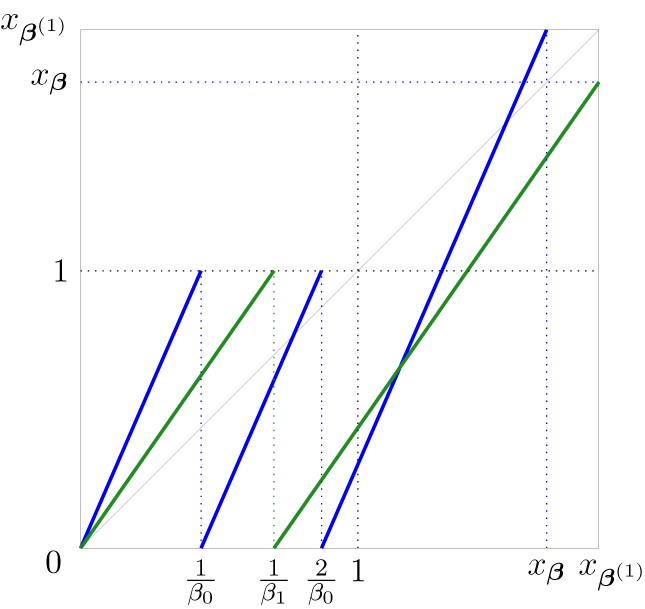
Example 4.15. Consider once again the alternate base
 ${\boldsymbol {\beta }}=(({1+\sqrt {13}})/{2}, ({5+\sqrt {13}})/{6})$
. The composition
 $T_{\beta _1} \circ T_{\beta _0}$
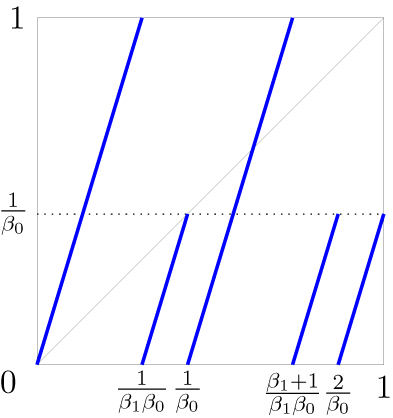
is depicted in Figure 9. Since
 ${1}/{\beta _0}=\beta _1-1$
, keeping the notation of Proposition 4.14, we have
 $K=3$
,
 $c_1={1}/{\beta _0}$
,
 $c_2={2}/{\beta _0}$
and
 $c_3=1$
. We have
 $T(c_1)=T(c_2)=T(c_3)=c_1$
. Therefore, all elements in S equal
 $0$
,
 $d_0=d_1=d_2=d_3=1$
and
 $C=1+({3}/{\beta _0(\beta _1\beta _0-1)})=1+({3}/{\beta _0^2})$
. The density of the unique absolutely continuous
 $(T_{\beta _1} \circ T_{\beta _0})$
-invariant probability measure is
 $$ \begin{align*} \frac1C \bigg(1+\frac{3}{\beta_0}\chi_{[0,{1}/{\beta_0}]}\bigg). \end{align*} $$
For example,
 $\mu ([0,{1}/{\beta _0})) = ({13+\sqrt {13}})/{26}$
. Moreover, it can be checked that
 $\mu ((T_{\beta _1} \circ T_{\beta _0})^{-1}[0,{1}/{\beta _0}))=\mu ([0,{1}/{\beta _0}))$
.
The composition
 $T_{\beta _1}\circ T_{\beta _0}$
with
 ${\boldsymbol {\beta }}=(({1+\sqrt {13}})/{2}, ({5+\sqrt {13}})/{6})$
.

We obtain a formula for the density function
 ${d\mu _{{\boldsymbol {\beta }}}}/{d\lambda _p}$
by using the density functions
 ${d\mu _{{\boldsymbol {\beta }},i}}/{d\lambda }$
for
 $i\in [\kern-1.5pt[ 0,p-1]\kern-1.5pt]$
. We first need a lemma.
Lemma 4.16. For all
 $i\in [\kern-1.5pt[ 0,p-1]\kern-1.5pt]$
, all sets
 $B\in \mathcal {B}([0,1))$
and all
 $\mathcal {B}([0,1))$
-measurable functions
 $f\colon [0,1)\to [0,\infty )$
, the map
 $f\circ \pi _2\colon [\kern-1.5pt[ 0,p-1]\kern-1.5pt]\times [0,1)\to [0,\infty )$
is
 $\mathcal {T}_p$
-measurable and
 $$ \begin{align*} \int_{\{i\}\times B} f\circ \pi_2\ d\lambda_p =\frac{1}{p}\int_{B} f d\lambda. \end{align*} $$
Proof. This follows from standard arguments by using the definition of the Lebesgue integral via simple functions.
Proposition 4.17. The density function
 ${d\mu _{{\boldsymbol {\beta }}}}/{d\lambda _p}$
of
 $\mu _{{\boldsymbol {\beta }}}$
with respect to the p-Lebesgue measure on
 $\mathcal {T}_p$
is
 $$ \begin{align} \sum_{i=0}^{p-1} \bigg(\frac{d\mu_{{\boldsymbol{\beta}},i}}{d\lambda}\circ \pi_2\bigg)\cdot \chi_{\{i\} \times [0,1)}. \end{align} $$
Proof. Let
 $A\in \mathcal {T}_p$
and let
 $B_0,\ldots ,B_{p-1}\in \mathcal {B}([0,1))$
such that
 $A=\bigcup _{i=0}^{p-1}(\{i\}\times B_i)$
. It follows from Lemma 4.16 that
 $$ \begin{align*} \int\limits_{A} \sum_{i=0}^{p-1} \bigg(\frac{d\mu_{{\boldsymbol{\beta}},i}}{d\lambda}\circ \pi_2\bigg)\cdot \chi_{\{i\} \times [0,1)}\ d\lambda_p &=\sum_{i=0}^{p-1} \int\limits_{\{i\}\times B_i} \frac{d\mu_{{\boldsymbol{\beta}},i}}{d\lambda}\circ \pi_2\ d\lambda_p\\ &=\frac{1}{p}\sum_{i=0}^{p-1} \int\limits_{B_i} \frac{d\mu_{{\boldsymbol{\beta}},i}}{d\lambda}\ d\lambda\\ &=\frac{1}{p}\sum_{i=0}^{p-1}\mu_{{\boldsymbol{\beta}},i}(B_i)\\ &= \mu_{{\boldsymbol{\beta}}}(A).\\[-40pt] \end{align*} $$
Note that formula (11) also holds for the extended measures
 $\mu _{{\boldsymbol {\beta }}}^{{\mathrm {ext}}}$
and
 $\lambda _{{\boldsymbol {\beta }}}^{{\mathrm {ext}}}$
on
 $\mathcal {T}_{{\boldsymbol {\beta }}}^{{\mathrm {ext}}}$
.
4.4 Frequencies
We now turn to the frequencies of the digits in the greedy
 ${\boldsymbol {\beta }}$
-expansions of real numbers in the interval
 $[0,1)$
. Recall that the frequency of a digit d occurring in the greedy
 ${\boldsymbol {\beta }}$
-expansion
 $a_0a_1a_2\cdots $
of a real number x in
 $[0,1)$
is equal to
 $$ \begin{align*} \lim_{n\to \infty} \frac1n \#\{0\le k<n : a_k=d\}, \end{align*} $$
provided that this limit exists.
Proposition 4.18. For
 $\lambda $
-almost all
 $x\in [0,1)$
, the frequency of any digit d occurring in the greedy
 ${\boldsymbol {\beta }}$
-expansion of x exists and is equal to
 $$ \begin{align*} \frac{1}{p}\sum_{i=0}^{p-1} \mu_{{\boldsymbol{\beta}},i} \bigg(\bigg[\dfrac{d}{\beta_i},\dfrac{d+1}{\beta_i} \bigg)\cap [0,1) \bigg). \end{align*} $$
Proof. Let
 $x\in [0,1)$
and let d be a digit occurring in
 $d_{{\boldsymbol {\beta }}}(x)=a_0a_1a_2\cdots $
. Then for all
 $k\in {\mathbb N}$
,
 $a_k=d$
if and only if
 $\pi _2(T_{{\boldsymbol {\beta }}}^k(0,x))\in [{d}/{\beta _k},({d+1})/{\beta _k})\cap [0,1)$
. Moreover, since for all
 $k\in {\mathbb N}$
,
 $T_{{\boldsymbol {\beta }}}^k(0,x)\in \{k\bmod p\}\times [0,1)$
, we have
 $$ \begin{align*} \chi_{[{d}/{\beta_k},({d+1})/{\beta_k})\cap [0,1)} (\pi_2(T_{{\boldsymbol{\beta}}}^k(0,x))) &=\chi_{\{k\bmod p\}\times ([{d}/{\beta_k},({d+1})/{\beta_k})\cap [0,1))} (T_{{\boldsymbol{\beta}}}^k(0,x))\\ &=\sum_{i=0}^{p-1} \chi_{\{i\}\times ([{d}/{\beta_i},({d+1})/{\beta_i})\cap [0,1))} (T_{{\boldsymbol{\beta}}}^k(0,x)). \end{align*} $$
Therefore, if it exists, the frequency of d in
 $d_{{\boldsymbol {\beta }}}(x)$
is equal to
 $$ \begin{align*} \lim_{n\to\infty} \frac1n \sum_{k=0}^{n-1} \sum_{i=0}^{p-1} \chi_{\{i\}\times ([{d}/{\beta_i},({d+1})/{\beta_i})\cap [0,1))} (T_{{\boldsymbol{\beta}}}^k(0,x)). \end{align*} $$
Yet, for each
 $i\in [\kern-1.5pt[ 0,p-1]\kern-1.5pt]$
and for
 $\mu _{{\boldsymbol {\beta }}}$
-almost all
 $y\in [\kern-1.5pt[ 0,p-1]\kern-1.5pt]\times [0,1)$
, we have
 $$ \begin{align*} &\lim_{n\to \infty} \frac1n \sum_{k=0}^{n-1} \chi_{\{i\}\times ([{d}/{\beta_i},({d+1})/{\beta_i})\cap [0,1))} (T_{{\boldsymbol{\beta}}}^k(y))\\ &\quad= \int_{[\kern-1.5pt[ 0,p-1]\kern-1.5pt]\times[0,1)} \chi_{\{i\}\times ([{d}/{\beta_i},({d+1})/{\beta_i})\cap [0,1))}\, d{\mu_{\boldsymbol{\beta}}}\\ &\quad=\mu_{{\boldsymbol{\beta}}} \bigg(\{i\}\times \bigg(\bigg[\dfrac{d}{\beta_i},\dfrac{d+1}{\beta_i}\bigg )\cap [0,1)\bigg) \bigg)\\ &\quad=\frac{1}{p}\mu_{{\boldsymbol{\beta}},i} \bigg(\bigg[\dfrac{d}{\beta_i},\dfrac{d+1}{\beta_i} \bigg)\cap [0,1)\bigg) \end{align*} $$
where we used Theorem 4.12 and the ergodic theorem for the first equality. The conclusion now follows from Proposition 4.8.
Note that, when
 $p=1$
, Proposition 4.18 yields the classical formula
 $\mu _\beta ([ {d}/{\beta }, ({d+1})/{\beta }) \cap [0,1))$
for the frequency of the digit d, where
 $\mu _\beta $
is the measure given in Theorem 2.2.
5 Isomorphism between greedy and lazy
${\boldsymbol {\beta }}$
-transformations

In this section we show that
 $$ \begin{align} \phi_{{\boldsymbol{\beta}}}\colon \bigcup_{i=0}^{p-1} (\{i\} \times [0,x_{{\boldsymbol{\beta}}^{(i)}}) ) \to \bigcup_{i=0}^{p-1} (\{i\} \times (0,x_{{\boldsymbol{\beta}}^{(i)}}] ),\quad (i,x)\mapsto (i, x_{{\boldsymbol{\beta}}^{(i)}}-x) \end{align} $$
defines an isomorphism between the greedy
 ${\boldsymbol {\beta }}$
-transformation and the lazy
 ${\boldsymbol {\beta }}$
-transformation.
We consider the
 $\sigma $
-algebra
 $$ \begin{align*} \mathcal{L}_{{\boldsymbol{\beta}}} =\bigg\{ \bigcup_{i=0}^{p-1} (\{i\}\times B_i) : \text{ for all } i\in[\kern-1.5pt[ 0,p-1]\kern-1.5pt],\ B_i\in\mathcal{B}((0, x_{{\boldsymbol{\beta}}^{(i)}}] ) \bigg\} \end{align*} $$
on
 $\bigcup _{i=0}^{p-1} (\{i\} \times (0,x_{{\boldsymbol {\beta }}^{(i)}}] )$
.
Proposition 5.1. The map
 $\phi _{{\boldsymbol {\beta }}}$
is an isomorphism between the dynamical systems
 $(\bigcup _{i=0}^{p-1} (\{i\} \times [0, x_{{\boldsymbol {\beta }}^{(i)}}) ), \mathcal {T}_{{\boldsymbol {\beta }}}^{{\mathrm {ext}}}, \mu _{{\boldsymbol {\beta }}}^{{\mathrm {ext}}}, T_{{\boldsymbol {\beta }}}^{{\mathrm {ext}}})$
and
 $(\bigcup _{i=0}^{p-1} (\{i\} \times (0, x_{{\boldsymbol {\beta }}^{(i)}}] ), \mathcal {L}_{{\boldsymbol {\beta }}}, \mu _{{\boldsymbol {\beta }}}^{{\mathrm {ext}}}\circ \phi _{{\boldsymbol {\beta }}}^{-1}, L_{{\boldsymbol {\beta }}})$
.
Proof. Clearly,
 $\phi _{{\boldsymbol {\beta }}}$
is a bimeasurable bijective map. Hence, we only have to show that
 $\phi _{{\boldsymbol {\beta }}}\circ T_{{\boldsymbol {\beta }}}^{{\mathrm {ext}}}=L_{{\boldsymbol {\beta }}}\circ \phi _{{\boldsymbol {\beta }}}$
. Let
 $(i,x)\in \bigcup _{i=0}^{p-1} (\{i\} \times [0,x_{{\boldsymbol {\beta }}^{(i)}}) )$
. First, suppose that
 $x\in [0,1)$
. Then
 $$ \begin{align*} \phi_{{\boldsymbol{\beta}}}\circ T_{{\boldsymbol{\beta}}}^{{\mathrm{ext}}}(i,x) =((i+1)\bmod p, x_{{\boldsymbol{\beta}}^{(i+1)}}-\beta_ix+{\lfloor{\beta_i x}\rfloor} ) \end{align*} $$
and
 $$ \begin{align*} L_{{\boldsymbol{\beta}}}\circ \phi_{{\boldsymbol{\beta}}}(i,x) =((i+1)\bmod p, \beta_i(x_{{\boldsymbol{\beta}}^{(i)}}-x) -{\lceil{\beta_i(x_{{\boldsymbol{\beta}}^{(i)}}-x)-x_{{\boldsymbol{\beta}}^{(i+1)}}}\rceil} ). \end{align*} $$
Second, suppose that
 $x\in [1,x_{{\boldsymbol {\beta }}^{(i)}})$
. Then
 $$ \begin{align*} \phi_{{\boldsymbol{\beta}}}\circ T_{{\boldsymbol{\beta}}}^{{\mathrm{ext}}}(i,x) =((i+1)\bmod p, x_{{\boldsymbol{\beta}}^{(i+1)}}-\beta_ix+{\lfloor{\beta_i}\rfloor}-1 ) \end{align*} $$
and
 $$ \begin{align*} L_{{\boldsymbol{\beta}}}\circ \phi_{{\boldsymbol{\beta}}}(i,x) =((i+1)\bmod p, \beta_i(x_{{\boldsymbol{\beta}}^{(i)}}-x) ). \end{align*} $$
In both cases, we easily get that
 $\phi _{{\boldsymbol {\beta }}}\circ T_{{\boldsymbol {\beta }}}^{{\mathrm {ext}}}(i,x)=L_{{\boldsymbol {\beta }}}\circ \phi _{{\boldsymbol {\beta }}}(i,x) $
by using (4).
Thanks to Proposition 5.1, we obtain an analogue of Theorem 4.13 for the lazy
 ${\boldsymbol {\beta }}$
-transformation.
Theorem 5.2. The measure
 $\mu _{{\boldsymbol {\beta }}}^{{\mathrm {ext}}}\circ \phi _{{\boldsymbol {\beta }}}^{-1}$
is the unique
 $L_{{\boldsymbol {\beta }}}$
-invariant probability measure on
 $\mathcal {L}_{{\boldsymbol {\beta }}}$
that is absolutely continuous with respect to
 $\lambda _{{\boldsymbol {\beta }}}^{{\mathrm {ext}}}\circ \phi _{{\boldsymbol {\beta }}}^{-1}$
. Furthermore,
 $\mu _{{\boldsymbol {\beta }}}^{{\mathrm {ext}}}\circ \phi _{{\boldsymbol {\beta }}}^{-1}$
is equivalent to
 $\lambda _{{\boldsymbol {\beta }}}^{{\mathrm {ext}}}\circ \phi _{{\boldsymbol {\beta }}}^{-1}$
on
 $\mathcal {L}_{{\boldsymbol {\beta }}}$
and the dynamical system
 $(\bigcup _{i=0}^{p-1} (\{i\} \times (0,x_{{\boldsymbol {\beta }}^{(i)}}] ), \mathcal {L}_{{\boldsymbol {\beta }}}, \mu _{{\boldsymbol {\beta }}}^{{\mathrm {ext}}}\circ \phi _{{\boldsymbol {\beta }}}^{-1}, L_{{\boldsymbol {\beta }}})$
is ergodic and has entropy
 $({1}/{p})\log (\beta _{p-1}\cdots \beta _0)$
.
Similarly, we have an analogue of Theorem 4.12 for the lazy
 ${\boldsymbol {\beta }}$
-transformation, by considering the
 $\sigma $
-algebra
 $$ \begin{align*} \mathcal{L}_{{\boldsymbol{\beta}}}^{{\mathrm{restr}}} =\bigg\{ \bigcup_{i=0}^{p-1} (\{i\}\times B_i) : \text{ for all } i\in[\kern-1.5pt[ 0,p-1]\kern-1.5pt],\ B_i\in\mathcal{B}((x_{{\boldsymbol{\beta}}^{(i)}}-1, x_{{\boldsymbol{\beta}}^{(i)}}] ) \bigg\}. \end{align*} $$
Remark that in the lazy case, we denote the restricted
 $\sigma $
-algebra by
 $\mathcal {L}_{{\boldsymbol {\beta }}}^{{\mathrm {restr}}}$
since there is a dependence on the alternate base
 ${\boldsymbol {\beta }}$
and not only on its length p as in the greedy case. We also set
 $$ \begin{align*} \phi_{{\boldsymbol{\beta}}}^{{\mathrm{restr}}}\colon [\kern-1.5pt[ 0,p-1]\kern-1.5pt] \times [0,1) \to \bigcup_{i=0}^{p-1} (\{i\} \times (x_{{\boldsymbol{\beta}}^{(i)}}-1,x_{{\boldsymbol{\beta}}^{(i)}}] ),\quad (i,x)\mapsto (i, x_{{\boldsymbol{\beta}}^{(i)}}-x) \end{align*} $$
and
 $$ \begin{align*} L_{{\boldsymbol{\beta}}}^{{\mathrm{restr}}}\colon &\bigcup_{i=0}^{p-1} (\{i\} \times (x_{{\boldsymbol{\beta}}^{(i)}}-1,x_{{\boldsymbol{\beta}}^{(i)}}] ) \to \bigcup_{i=0}^{p-1} (\{i\} \times (x_{{\boldsymbol{\beta}}^{(i)}}-1,x_{{\boldsymbol{\beta}}^{(i)}}] ),\\ & (i,x) \mapsto ((i+1)\bmod p, \beta_i x-{\lceil{\beta_i x-x_{{\boldsymbol{\beta}}^{(i+1)}}}\rceil}). \end{align*} $$
Theorem 5.3. The measure
 $\mu _{{\boldsymbol {\beta }}}\circ (\phi _{{\boldsymbol {\beta }}}^{{\mathrm {restr}}})^{-1}$
is the unique
 $L_{{\boldsymbol {\beta }}}^{{\mathrm {restr}}}$
-invariant probability measure on
 $\mathcal {L}_{{\boldsymbol {\beta }}}^{{\mathrm {restr}}}$
that is absolutely continuous with respect to
 $\lambda _p\circ \phi _{{\boldsymbol {\beta }}}^{-1}$
. Furthermore,
 $\mu _{{\boldsymbol {\beta }}} \circ (\phi _{{\boldsymbol {\beta }}}^{{\mathrm {restr}}})^{-1}$
is equivalent to
 $\lambda _p\circ (\phi _{{\boldsymbol {\beta }}}^{{\mathrm {restr}}})^{-1}$
on
 $\mathcal {L}_{{\boldsymbol {\beta }}}^{{\mathrm {restr}}}$
and the dynamical system
 $(\bigcup _{i=0}^{p-1} (\{i\} \times (x_{{\boldsymbol {\beta }}^{(i)}}-1,x_{{\boldsymbol {\beta }}^{(i)}}] ), \mathcal {L}_{{\boldsymbol {\beta }}}^{{\mathrm {restr}}}, \mu _{{\boldsymbol {\beta }}} \circ (\phi _{{\boldsymbol {\beta }}}^{{\mathrm {restr}}})^{-1}, L_{{\boldsymbol {\beta }}}^{{\mathrm {restr}}})$
is ergodic and has entropy
 $({1}/{p})\log (\beta _{p-1}\cdots \beta _0)$
.
Remark 5.4. We deduce from Proposition 5.1 that if the greedy
 ${\boldsymbol {\beta }}$
-expansion of a real number
 $x\in [0,x_{{\boldsymbol {\beta }}})$
is
 $a_0a_1a_2\cdots $
, then the lazy
 ${\boldsymbol {\beta }}$
-expansion of
 $x_{{\boldsymbol {\beta }}}-x$
is
 $({\lceil {\beta _0}\rceil }-1-a_0)({\lceil {\beta _1}\rceil }-1-a_1)({\lceil {\beta _2}\rceil }-1-a_2)\cdots $
.
6 Isomorphism with the
${\boldsymbol {\beta }}$
-shift

The aim of this section is to generalize the isomorphism between the greedy
 $\beta $
-transformation and the
 $\beta $
-shift to the framework of alternate bases. We start by providing some background on the real base case.
Let
 $D_\beta $
denote the set of all greedy
 $\beta $
-expansions of real numbers in the interval
 $[0,1)$
. The
 $\beta $
-shift is the set
 $S_\beta $
defined as the topological closure of
 $D_\beta $
with respect to the prefix distance of infinite words. For an alphabet A, we let
 $\mathcal {C}_{A}$
denote the
 $\sigma $
-algebra generated by the cylinders
 $$ \begin{align*} C_A(a_0,\ldots,a_{\ell-1})=\{w \in A^{{\mathbb N}} : w[0]=a_0,\ldots,w[\ell-1]=a_{\ell-1}\} \end{align*} $$
for all
 $\ell \in {\mathbb N}$
and
 $a_0,\ldots ,a_{\ell -1}\in A$
, where the notation
 $w[k]$
designates the letter at position k in the infinite word w, and we call
 $$ \begin{align*} \sigma_A\colon A^{{\mathbb N}} \to A^{{\mathbb N}},\quad a_0a_1a_2\cdots\mapsto a_1a_2a_3\cdots \end{align*} $$
the shift operator over A. If no confusion is possible, we simply write
 $\sigma $
instead of
 $\sigma _A$
. Then it is a folklore fact (similar to [Reference Dajani and Kraaikamp10, Example 1.2.19]) that the map
 $\psi _{\beta }\colon [0,1) \to S_\beta , x \mapsto d_\beta (x)$
defines an isomorphism between the dynamical systems
 $( [0,1),\mathcal {B}([0,1)), \mu _\beta ,T_\beta )$
and
 $(S_\beta ,\mathcal {C}_{A_\beta }\cap S_\beta , \mu _{\beta }\circ \psi _{\beta }^{-1},\sigma _{|S_\beta })$
where
 $A_\beta $
denotes the alphabet of digits
 $[\kern-1.5pt[ 0,{\lceil {\beta }\rceil }-1]\kern-1.5pt] $
.
Let us now extend the previous notation to the framework of alternate bases. Let
 $A_{{\boldsymbol {\beta }}}$
denote the alphabet
 $[\kern-1.5pt[ 0,\max \nolimits _{i\in [\kern-1.5pt[ 0,p-1]\kern-1.5pt]}{\lceil {\beta _i}\rceil }-1]\kern-1.5pt] $
, let
 $D_{{\boldsymbol {\beta }}}$
denote the subset of
 $A_{{\boldsymbol {\beta }}}^{\mathbb N}$
made up of all greedy
 ${\boldsymbol {\beta }}$
-expansions of real numbers in
 $[0,1)$
, and let
 $S_{{\boldsymbol {\beta }}}$
denote the topological closure of
 $D_{{\boldsymbol {\beta }}}$
with respect to the prefix distance of infinite words:
 $$ \begin{align*} D_{{\boldsymbol{\beta}}}=\{d_{{\boldsymbol{\beta}}}(x) : x \in [0,1)\} \quad \text{and} \quad S_{{\boldsymbol{\beta}}}=\overline{D_{{\boldsymbol{\beta}}}}. \end{align*} $$
The following lemma was proved in [Reference Charlier and Cisternino5, Proposition 32].
Lemma 6.1. For all
 $n\in {\mathbb N}$
, if
 $w\in S_{{\boldsymbol {\beta }}^{(n)}}$
then
 $\sigma (w)\in S_{{\boldsymbol {\beta }}^{(n+1)}}$
.
Consider the
 $\sigma $
-algebra
 $$ \begin{align*} \mathcal{G}_{{\boldsymbol{\beta}}}= \bigg\{ \bigcup_{i=0}^{p-1}(\{i\}\times C_i) : \text{ for all } i\in[\kern-1.5pt[ 0,p-1]\kern-1.5pt],\ C_i\in \mathcal{C}_{A_{{\boldsymbol{\beta}}}}\cap S_{{\boldsymbol{\beta}}^{(i)}} \bigg\} \end{align*} $$
on
 $\bigcup _{i=0}^{p-1} (\{i\}\times S_{{\boldsymbol {\beta }}^{(i)}})$
. We define
 $$ \begin{align*} &\sigma_p\colon \bigcup_{i=0}^{p-1} (\{i\}\times S_{{\boldsymbol{\beta}}^{(i)}}) \to \bigcup_{i=0}^{p-1} (\{i\}\times S_{{\boldsymbol{\beta}}^{(i)}}),\quad (i,w)\mapsto ((i+1)\bmod p,\sigma(w))\\ &\psi_{{\boldsymbol{\beta}}}\colon [\kern-1.5pt[ 0,p-1]\kern-1.5pt]\times[0,1)\to \bigcup_{i=0}^{p-1} (\{i\}\times S_{{\boldsymbol{\beta}}^{(i)}}),\quad (i,x)\mapsto (i,d_{{\boldsymbol{\beta}}^{(i)}}(x)). \end{align*} $$
Note that the transformation
 $\sigma _p$
is well defined by Lemma 6.1.
Proposition 6.2. The map
 $\psi _{{\boldsymbol {\beta }}}$
defines an isomorphism between the dynamical systems
 $$ \begin{align*} ([\kern-1.5pt[ 0,p-1]\kern-1.5pt] \times [0,1),\mathcal{T}_p,\mu_{{\boldsymbol{\beta}}},T_{{\boldsymbol{\beta}}}) \quad\text{and}\quad \bigg(\bigcup_{i=0}^{p-1} (\{i\}\times S_{{\boldsymbol{\beta}}^{(i)}}),\mathcal{G}_{{\boldsymbol{\beta}}},\mu_{{\boldsymbol{\beta}}}\circ \psi_{{\boldsymbol{\beta}}}^{-1},\sigma_p\bigg). \end{align*} $$
Proof. It is easily seen that
 $\psi _{{\boldsymbol {\beta }}}\circ T_{{\boldsymbol {\beta }}}=\sigma _p\circ \psi _{{\boldsymbol {\beta }}}$
and that
 $\psi _{{\boldsymbol {\beta }}}$
is injective. Moreover,
 $\psi _{{\boldsymbol {\beta }}}([\kern-1.5pt[ 0, p-1]\kern-1.5pt]\times [0,1))=\bigcup _{i=0}^{p-1} (\{i\}\times D_{{\boldsymbol {\beta }}^{(i)}})$
and
 $\mu _{{\boldsymbol {\beta }}}(\psi _{{\boldsymbol {\beta }}}^{-1}(\bigcup _{i=0}^{p-1} (\{i\}\times D_{{\boldsymbol {\beta }}^{(i)}}))\,{=}\,1$
.
However, although
 $\psi _{{\boldsymbol {\beta }}}$
is continuous, it does not define a topological isomorphism since it is not surjective.
Remark 6.3. In view of Proposition 6.2, the set
 $\bigcup _{i=0}^{p-1} (\{i\}\times S_{{\boldsymbol {\beta }}^{(i)}})$
can be seen as the
 ${\boldsymbol {\beta }}$
-shift, that is, the generalization of the
 $\beta $
-shift to alternate bases. However, in the previous work [Reference Charlier and Cisternino5], what we called the
 ${\boldsymbol {\beta }}$
-shift is the union
 $\bigcup _{i=0}^{p-1} S_{{\boldsymbol {\beta }}^{(i)}}$
. This definition was motivated by the following combinatorial result [Reference Charlier and Cisternino5, Theorem 48]: the set
 $\bigcup _{i=0}^{p-1} S_{{\boldsymbol {\beta }}^{(i)}}$
is sofic if and only if for every
 $i\in [\kern-1.5pt[ 0,p-1]\kern-1.5pt]$
, the quasi-greedy
 ${\boldsymbol {\beta }}^{(i)}$
-representation of
 $1$
is ultimately periodic. In summary, we can say that there are two ways to extend the notion of
 $\beta $
-shift to alternate bases
 ${\boldsymbol {\beta }}$
, depending on the way we look at it: either as a dynamical object or as a combinatorial object.
Thanks to Proposition 6.2, we obtain an analogue of Theorem 4.12 for the transformation
 $\sigma _p$
.
Theorem 6.4. The measure
 $\mu _{{\boldsymbol {\beta }}}\circ \psi _{{\boldsymbol {\beta }}}^{-1}$
is the unique
 $\sigma _p$
-invariant probability measure on
 $\mathcal {G}_{{\boldsymbol {\beta }}}$
that is absolutely continuous with respect to
 $\lambda _p\circ \psi _{{\boldsymbol {\beta }}}^{-1}$
. Furthermore,
 $\mu _{{\boldsymbol {\beta }}}\circ \psi _{{\boldsymbol {\beta }}}^{-1}$
is equivalent to
 $\lambda _p\circ \psi _{{\boldsymbol {\beta }}}^{-1}$
on
 $\mathcal {G}_{{\boldsymbol {\beta }}}$
and the dynamical system
 $ (\bigcup _{i=0}^{p-1} (\{i\}\times S_{{\boldsymbol {\beta }}^{(i)}}),\mathcal {G}_{{\boldsymbol {\beta }}},\mu _{{\boldsymbol {\beta }}}\circ \psi _{{\boldsymbol {\beta }}}^{-1},\sigma _p)$
is ergodic and has entropy
 $({1}/{p}) \log (\beta _{p-1}\cdots \beta _0)$
.
Remark 6.5. Let
 $D_{{\boldsymbol {\beta }}}'$
denote the subset of
 $A_{{\boldsymbol {\beta }}}^{\mathbb N}$
made up of all lazy
 ${\boldsymbol {\beta }}$
-expansions of real numbers in
 $(x_{{\boldsymbol {\beta }}}-1, x_{{\boldsymbol {\beta }}}]$
and let
 $S_{{\boldsymbol {\beta }}}'$
denote the topological closure of
 $D_{{\boldsymbol {\beta }}}'$
with respect to the prefix distance of infinite words. From Remark 5.4, it is easily seen that
 $$ \begin{align*} &\theta_{{\boldsymbol{\beta}}}\colon \bigcup_{i=0}^{p-1} (\{i\}\times S_{{\boldsymbol{\beta}}^{(i)}}) \to \bigcup_{i=0}^{p-1} (\{i\}\times S_{{\boldsymbol{\beta}}^{(i)}}'),\\ &\quad(i,a_0a_1\cdots)\mapsto (i,({\lceil{\beta_i}\rceil}-1-a_0)({\lceil{\beta_{i+1}}\rceil}-1-a_2)\cdots) \end{align*} $$
defines an isomorphism from
 $(\bigcup _{i=0}^{p-1} (\{i\}\times S_{{\boldsymbol {\beta }}^{(i)}}),\mathcal {G}_{{\boldsymbol {\beta }}},\mu _{{\boldsymbol {\beta }}}\circ \psi _{{\boldsymbol {\beta }}}^{-1},\sigma _p)$
to
 $(\bigcup _{i=0}^{p-1} (\{i\}\times S_{{\boldsymbol {\beta }}^{(i)}}'),\mathcal {G}_{{\boldsymbol {\beta }}}', \mu _{{\boldsymbol {\beta }}}\circ \psi _{{\boldsymbol {\beta }}}^{-1}\circ \theta _{{\boldsymbol {\beta }}}^{-1},\sigma _p')$
where
 $$ \begin{align*} \mathcal{G}_{{\boldsymbol{\beta}}}' &=\bigg\{\bigcup_{i=0}^{p-1}(\{i\}\times (C_i\cap S_{{\boldsymbol{\beta}}^{(i)}}')) : C_i\in \mathcal{C}_{A_{{\boldsymbol{\beta}}}}\bigg\}, \\ \sigma_p' &\colon \bigcup_{i=0}^{p-1} (\{i\}\times S_{{\boldsymbol{\beta}}^{(i)}}') \to \bigcup_{i=0}^{p-1} (\{i\}\times S_{{\boldsymbol{\beta}}^{(i)}}'),\ (i,w)\mapsto ((i+1)\bmod p,\sigma(w)). \end{align*} $$
We then deduce from Propositions 5.1 and 6.2 that
 $\theta _{{\boldsymbol {\beta }}}\circ \psi _{{\boldsymbol {\beta }}}\circ (\phi _{{\boldsymbol {\beta }}}^{{\mathrm {restr}}})^{-1}$
is an isomorphism from
 $(\bigcup _{i=0}^{p-1} (\{i\}\times (x_{{\boldsymbol {\beta }}^{(i)}}-1,x_{{\boldsymbol {\beta }}^{(i)}}]), \mathcal {L}_{{\boldsymbol {\beta }}}^{{\mathrm {restr}}}, \mu _{{\boldsymbol {\beta }}} \circ (\phi _{{\boldsymbol {\beta }}}^{{\mathrm {restr}}})^{-1}, L_{{\boldsymbol {\beta }}}^{{\mathrm {restr}}})$
to
 $(\bigcup _{i=0}^{p-1} (\{i\}\times S_{{\boldsymbol {\beta }}^{(i)}}'), \mathcal {G}_{{\boldsymbol {\beta }}}', \mu _{{\boldsymbol {\beta }}}\circ \psi _{{\boldsymbol {\beta }}}^{-1}\circ \theta _{{\boldsymbol {\beta }}}^{-1}, \sigma _p')$
. It is easy to check that, as expected, for all
 $(i,x)\in \bigcup _{i=0}^{p-1}(\{i\}\times (x_{{\boldsymbol {\beta }}^{(i)}}-1,x_{{\boldsymbol {\beta }}^{(i)}}]$
, we have
 $\theta _{{\boldsymbol {\beta }}}\circ \psi _{{\boldsymbol {\beta }}}\circ (\phi _{{\boldsymbol {\beta }}}^{{\mathrm {restr}}})^{-1}(i,x)=(i,\ell _{{\boldsymbol {\beta }}^{(i)}}(x))$
where
 $\ell _{{\boldsymbol {\beta }}}(x)$
denotes the lazy
 ${\boldsymbol {\beta }}$
-expansion of x.
7
${\boldsymbol {\beta }}$
-expansions and
$(\beta _{p-1}\cdot \cdot \cdot \beta _0,\Delta _{{\boldsymbol {\beta }}})$
-expansions


By rewriting equality (1) from §3 as
 $$ \begin{align} x&= \frac{\beta_{p-1}\cdots\beta_1 a_0 + \beta_{p-1}\cdots\beta_2 a_1 + \cdots +a_{p-1}}{\beta_{p-1}\cdots\beta_0} \nonumber\\ & \quad + \frac{\beta_{p-1}\cdots\beta_1 a_p + \beta_{p-1}\cdots\beta_1 a_{p+1} + \cdots +a_{2p-1}}{(\beta_{p-1}\cdots\beta_0)^2}\nonumber \\ & \quad + \cdots \end{align} $$
we can see the greedy and lazy
 ${\boldsymbol {\beta }}$
-expansions of real numbers as
 $(\beta _{p-1}\cdots \beta _0)$
- representations over the digit set
 $$ \begin{align*} \Delta_{{\boldsymbol{\beta}}}=\bigg\{\sum_{i=0}^{p-1}\beta_{p-1}\cdots\beta_{i+1} c_i : \text{ for all } i\in [\kern-1.5pt[ 0,p-1]\kern-1.5pt],\ c_i\in [\kern-1.5pt[ 0,{\lceil{\beta_i}\rceil}-1]\kern-1.5pt] \bigg\}. \end{align*} $$
In this section, we examine some cases where by considering the greedy (respectively, lazy)
 ${\boldsymbol {\beta }}$
-expansion and rewriting it as (13), the representation obtained is the greedy (respectively, lazy)
 $(\beta _{p-1}\cdots \beta _0,\Delta _{{\boldsymbol {\beta }}})$
-expansion. We first recall the formalism of
 $\beta $
-expansions of real numbers over a general digit set [Reference Pedicini22].
7.1 Real base expansions over general digit sets
Consider an arbitrary finite set
 $\Delta =\{d_0,d_1,\ldots ,d_m\}\subset {\mathbb R}$
where
 $0=d_0<d_1<\cdots <d_m$
. Then a
 $(\beta ,\Delta )$
-representation of a real number x in the interval
 $[0,{d_m}/({\beta -1}))$
is an infinite sequence
 $a_0a_1a_2\cdots $
over
 $\Delta $
such that
 $x=\sum _{n=0}^\infty {a_n}/{\beta ^{n+1}}$
. Such a set
 $\Delta $
is called an allowable digit set for
 $\beta $
if
 $$ \begin{align} \max_{k\in[\kern-1.5pt[ 0,m-1]\kern-1.5pt] }(d_{k+1}-d_k)\le \frac{d_m}{\beta-1}. \end{align} $$
In this case, the greedy
 $(\beta ,\Delta )$
-expansion of a real number
 $x\in [0,{d_m}/({\beta -1}))$
is defined recursively as follows: if the first N digits of the greedy
 $(\beta ,\Delta )$
-expansion of x are given by
 $a_0,\ldots ,a_{N-1}$
, then the next digit
 $a_N$
is the greatest element in
 $\Delta $
such that
 $$ \begin{align*} \sum_{n=0}^N\frac{a_n}{\beta^{n+1}} \le x. \end{align*} $$
The greedy
 $(\beta ,\Delta )$
-expansion can also be obtained by iterating the greedy
 $(\beta ,\Delta )$
- transformation
 $$ \begin{align*} T_{\beta,\Delta}\colon \bigg[\kern-1pt 0,\dfrac{d_m}{\beta-1}\kern-1pt\bigg) \to \bigg[\kern-1pt0,\dfrac{d_m}{\beta-1}\kern-1pt\bigg),\quad x \mapsto\! \begin{cases} \beta x-d_k &\kern-2pt\text{if }x\kern1.2pt{\in}\kern1.2pt\bigg[\kern-1pt\dfrac{d_k}{\beta}, \dfrac{d_{k+1}}{\beta}\kern-1pt\bigg),\ k\kern1pt{\in}\kern1pt[\kern-1.5pt[ 0,m-1]\kern-1.5pt], \\\\[-5pt] \beta x-d_m &\kern-2pt\text{if }x\in\bigg[\dfrac{d_m}{\beta},\dfrac{d_m}{\beta-1}\bigg) \end{cases} \end{align*} $$
as follows: for all
 $n\in {\mathbb N}$
,
 $a_n$
is the greatest digit d in
 $\Delta $
such that
 ${d}/{\beta }\le T^n_{\beta ,\Delta }(x)$
[Reference Dajani and Kalle7].
Example 7.1. Consider the digit set
 $\Delta =\{0,1,\varphi +({1}/{\varphi }),\varphi ^2\}$
. It is easily checked that
 $\Delta $
is an allowable digit set for
 $\varphi $
. The greedy
 $(\varphi ,\Delta )$
-transformation
 $$ \begin{align*} T_{\varphi,\Delta}\colon \bigg[0,\dfrac{\varphi^2}{\varphi-1}\bigg)\to \bigg[0,\dfrac{\varphi^2}{\varphi-1}\bigg),\quad x\mapsto \begin{cases} \varphi x & \text{if }x\in \bigg[0,\dfrac{1}{\varphi}\bigg),\\\\[-6pt] \varphi x - 1 & \text{if }x\in\bigg[\dfrac{1}{\varphi}, 1+\dfrac{1}{\varphi^2}\bigg),\\\\[-6pt] \varphi x - (\varphi+\dfrac{1}{\varphi}) & \text{if } x\in\bigg[1+\dfrac{1}{\varphi^2},\varphi\bigg),\\\\[-6pt] \varphi x - \varphi^2 & \text{if } x \in\bigg[\varphi, \dfrac{\varphi^2}{\varphi-1}\bigg) \end{cases} \end{align*} $$
is depicted in Figure 10.
The transformation
 $T_{\varphi ,\Delta }$
for
 $\Delta =\{0,1,({\varphi +1})/{\varphi },\varphi ^2\}$
.

Similarly, if
 $\Delta $
is an allowable digit set for
 $\beta $
, then the lazy
 $(\beta ,\Delta )$
-expansion of a real number
 $x\in (0,{d_m}/({\beta -1})]$
is defined recursively as follows: if the first N digits of the lazy
 $(\beta ,\Delta )$
-expansion of x are given by
 $a_0,\ldots ,a_{N-1}$
, then the next digit
 $a_N$
is the smallest element in
 $\Delta $
such that
 $$ \begin{align*} \sum_{n=0}^N\frac{a_n}{\beta^{n+1}} +\sum_{n=N+1}^{\infty}\frac{d_m}{\beta^{n+1}} \ge x. \end{align*} $$
The lazy
 $(\beta ,\Delta )$
-transformation
 $$ \begin{align*} &L_{\beta,\Delta}\colon \bigg(0,\dfrac{d_m}{\beta-1}\bigg] \to \bigg(0,\dfrac{d_m}{\beta-1}\bigg],\\[4pt] &\quad x \mapsto \begin{cases} \beta x &\text{if }x\in \bigg(0,\dfrac{d_m}{\beta-1}{-}\dfrac{d_m}{\beta}\bigg].\\\\[-9pt] \beta x-d_k &\text{if }x\in \bigg(\dfrac{d_m}{\beta-1}{-}\dfrac{d_m-d_{k-1}}{\beta},\dfrac{d_m}{\beta-1}{-}\dfrac{d_m-d_{k}}{\beta}\bigg],\ k\in[\kern-1.5pt[ 1,m]\kern-1.5pt], \end{cases} \end{align*} $$
can be used to obtain the digits of the lazy
 $(\beta ,\Delta )$
-expansions: for all
 $n\in {\mathbb N}$
,
 $a_n$
is the smallest digit d in
 $\Delta $
such that
 $({d}/{\beta }) +\sum _{k=1}^{\infty }({d_m}/{\beta ^{k+1}}) \ge L^n_{\beta ,\Delta }(x)$
[Reference Dajani and Kalle7].
In [Reference Dajani and Kalle7, Proposition 2.2], it is shown that if
 $\Delta $
is an allowable digit set for
 $\beta $
then so is the set
 $\widetilde {\Delta }:=\{0,d_m{-}d_{m-1},\ldots , d_m{-}d_1,d_m\}$
and
 $$ \begin{align*} \phi_{\beta,\Delta}\colon \bigg[0,\dfrac{d_m}{\beta-1}\bigg) \to \bigg(0,\dfrac{d_m}{\beta-1}\bigg],\quad x \mapsto \dfrac{d_m}{\beta-1}-x \end{align*} $$
is a bicontinuous bijection satisfying
 $L_{\beta ,\widetilde {\Delta }}\, \circ \,\phi _{\beta ,\Delta } = \phi _{\beta ,\Delta }\, \circ \,T_{\beta ,\Delta }$
.
Example 7.2. Consider the digit set
 $\widetilde {\Delta }$
where
 $\Delta $
is the digit set from Example 7.1. We get
 $\widetilde {\Delta }=\{0,1-({1}/{\varphi }),\varphi ,\varphi ^2\}$
. The lazy
 $(\varphi ,\widetilde {\Delta })$
-transformation
 $$ \begin{align*} L_{\varphi,\widetilde{\Delta}}\colon \bigg(0,\dfrac{\varphi^2}{\varphi-1}\bigg]\to \bigg(0,\dfrac{\varphi^2}{\varphi-1}\bigg],\ x\mapsto \begin{cases} \varphi x & \text{if }x\in \bigg(0,\dfrac{\varphi}{\varphi-1}\bigg],\\\\[-9pt] \varphi x - \bigg(1-\frac{1}{\varphi}\bigg) & \text{if }x\in\bigg(\dfrac{\varphi}{\varphi-1}, \dfrac{\varphi+3}{\varphi}\bigg],\\\\[-9pt] \varphi x - \varphi & \text{if } x\in\bigg(\dfrac{\varphi+3}{\varphi},\dfrac{2\varphi-1}{\varphi-1}\bigg],\\\\[-9pt] \varphi x - \varphi^2 & \text{if } x \in\bigg(\dfrac{2\varphi-1}{\varphi-1}, \dfrac{\varphi^2}{\varphi-1}\bigg] \end{cases} \end{align*} $$
is depicted in Figure 11. It is conjugate to the greedy
 $(\varphi ,\Delta )$
-transformation
 $T_{\varphi ,\Delta }$
by
 $\phi _{\varphi ,\Delta }\colon [0,{\varphi ^2}/({\varphi -1})) \to (0,{\varphi ^2}/({\varphi -1})],\ x \mapsto {\varphi ^2}/({\varphi -1})-x$
.
The transformation
 $L_{\varphi ,\widetilde {\Delta }}$
for
 $\Delta =\{0,1,\varphi +({1}/{\varphi }),\varphi ^2\}$
.

7.2 Comparison between
${\boldsymbol {\beta }}$
-expansions and
$(\beta _{p-1}\cdot \cdot \cdot \beta _0,\Delta _{{\boldsymbol {\beta }}})$
-expansions


The digit set
 $\Delta _{{\boldsymbol {\beta }}}$
has cardinality at most
 $\prod _{i=0}^{p-1} {\lceil {\beta _i}\rceil }$
and can be rewritten as
 $\Delta _{{\boldsymbol {\beta }}}=\mathrm {im}(f_{{\boldsymbol {\beta }}})$
where
 $$ \begin{align*} f_{{\boldsymbol{\beta}}}\colon \prod_{i=0}^{p-1}\ [\kern-1.5pt[ 0,{\lceil{\beta_i}\rceil}-1]\kern-1.5pt] \to{\mathbb R},\quad (c_0,\ldots, c_{p-1}) \mapsto \sum_{i=0}^{p-1}\beta_{p-1}\cdots \beta_{i+1}c_i. \end{align*} $$
Note that
 $f_{{\boldsymbol {\beta }}}$
is not injective in general. Let us write
 $\Delta _{{\boldsymbol {\beta }}}=\{d_0,d_1,\ldots ,d_m\}$
with
 $d_0<d_1<\cdots < d_m$
. We have
 $d_0=f_{{\boldsymbol {\beta }}}(0,\ldots ,0)=0$
,
 $d_1=f_{{\boldsymbol {\beta }}}(0,\ldots ,0,1)=1$
, and
 $d_m=f_{{\boldsymbol {\beta }}}({\lceil {\beta _0}\rceil }-1,\ldots ,{\lceil {\beta _{p-1}}\rceil }-1)$
. In what follows, we suppose that
 $\prod _{i=0}^{p-1}\ [\kern-1.5pt[ 0,{\lceil {\beta _i}\rceil }-1]\kern-1.5pt] $
is equipped with the lexicographic order
 $(c_0,\ldots ,c_{p-1})<_{\mathrm {lex}}(c^{\prime }_0,\ldots ,c^{\prime }_{p-1})$
if there exists
 $i\in [\kern-1.5pt[ 0,p-1]\kern-1.5pt]$
such that
 $c_0=c_0',\ldots ,c_{i-1}=c_{i-1}'$
and
 $c_i<c_i'$
.
Lemma 7.3. The set
 $\Delta _{{\boldsymbol {\beta }}}$
is an allowable digit set for
 $\beta _{p-1}\cdots \beta _0$
.
Proof. We need to check condition (14). We have
 $d_0=0$
and
 $$ \begin{align*} d_m=f_{{\boldsymbol{\beta}}}({\lceil{\beta_0}\rceil}-1,\ldots,{\lceil{\beta_{p-1}}\rceil}-1) \ge \sum_{i=0}^{p-1}\beta_{p-1}\cdots \beta_{i+1}(\beta_i-1) =\beta_{p-1}\cdots\beta_0-1. \end{align*} $$
Therefore, it suffices to show that for all
 $k\in [\kern-1.5pt[ 0,m-1 ]\kern-1.5pt] $
,
 $d_{k+1}-d_k\le 1$
. Thus, we only have to show that
 $f(c_0',\ldots ,c_{p-1}')-f(c_0,\ldots ,c_{p-1})\le 1$
where
 $(c_0,\ldots ,c_{p-1})$
and
 $(c^{\prime }_0,\ldots ,c^{\prime }_{p-1})$
are lexicographically consecutive elements of
 $\prod _{i=0}^{p-1}\ [\kern-1.5pt[ 0,{\lceil {\beta _i}\rceil }-1]\kern-1.5pt] $
. For such p-tuples, there exists
 $j\in [\kern-1.5pt[ 0,p-1]\kern-1.5pt]$
such that
 $c_0=c^{\prime }_0,\ldots ,c_{j-1}=c^{\prime }_{j-1}$
,
 $c_j=c^{\prime }_j-1$
,
 $c_{j+1}={\lceil {\beta _{j+1}}\rceil }-1,\ldots ,c_{p-1}={\lceil {\beta _4{p-1}}\rceil }-1$
, and
 $c^{\prime }_{j+1}=\cdots =c^{\prime }_{p-1}=0$
. Then
 $$ \begin{align*} f(c_0',\ldots,c_{p-1}')-f(c_0,\ldots,c_{p-1}) &=\beta_{p-1}\cdots\beta_{j+1} -\sum_{i=j+1}^{p-1}\beta_{p-1}\cdots\beta_{i+1}({\lceil{\beta_{i}}\rceil}-1)\\ &\le \beta_{p-1}\cdots\beta_{j+2} -\sum_{i=j+2}^{p-1}\beta_{p-1}\cdots\beta_{i+1}({\lceil{\beta_i}\rceil}-1)\\ & \ \, \vdots\\ &\le \beta_{p-1}-({\lceil{\beta_{p-1}}\rceil}-1)\\ &\le 1.\\[-35pt] \end{align*} $$
Since
 $x_{{\boldsymbol {\beta }}}={d_m}/{\beta _{p-1}\cdots \beta _0-1}$
, it follows from Lemma 7.3 that every point in
 $[0,x_{{\boldsymbol {\beta }}})$
admits a greedy
 $(\beta _{p-1}\cdots \beta _0,\Delta _{{\boldsymbol {\beta }}})$
-expansion.
Proposition 7.4. For all
 $x\in [0,x_{{\boldsymbol {\beta }}})$
, we have
 $T_{\beta _{p-1}\cdots \beta _0,\Delta _{{\boldsymbol {\beta }}}}(x) \le \pi _2 \circ (T_{{\boldsymbol {\beta }}}^{{\mathrm {ext}}})^p \circ \delta _0(x)$
and
 $L_{\beta _{p-1}\cdots \beta _0,\Delta _{{\boldsymbol {\beta }}}}(x) \ge \pi _2 \circ L_{{\boldsymbol {\beta }}}^p \circ \delta _0(x)$
.
Proof. Let
 $x\in [0,x_{{\boldsymbol {\beta }}})$
. On the one hand,
 $T_{\beta _{p-1}\cdots \beta _0,\Delta _{{\boldsymbol {\beta }}}}(x)=\beta _{p-1}\cdots \beta _0 x -d$
where d is the greatest digit in
 $\Delta _{{\boldsymbol {\beta }}}$
such that
 ${d}/{\beta _{p-1}\cdots \beta _0} \le x$
. On the other hand, by rephrasing Proposition 3.2 in terms of the map
 $f_{{\boldsymbol {\beta }}}$
when n equals p, we get
 $\pi _2 \circ (T_{{\boldsymbol {\beta }}}^{{\mathrm {ext}}})^p \circ \delta _0(x)=\beta _{p-1}\cdots \beta _0 x -f_{{\boldsymbol {\beta }}}(c)$
where c is the lexicographically greatest p-tuple in
 $\prod _{i=0}^{p-1}\ [\kern-1.5pt[ 0,{\lceil {\beta _i}\rceil }-1]\kern-1.5pt] $
such that
 ${f_{{\boldsymbol {\beta }}}(c)}/{\beta _{p-1}\cdots \beta _0} \le x$
. By definition of d, we get
 $d\ge f_{{\boldsymbol {\beta }}}(c)$
. Therefore, we obtain that
 $T_{\beta _{p-1}\cdots \beta _0,\Delta _{{\boldsymbol {\beta }}}}(x) \le \pi _2 \circ (T_{{\boldsymbol {\beta }}}^{{\mathrm {ext}}})^p \circ \delta _0(x)$
. The inequality
 $L_{\beta _{p-1}\cdots \beta _0,\Delta _{{\boldsymbol {\beta }}}}(x) \ge \pi _2 \circ L_{{\boldsymbol {\beta }}}^p \circ \delta _0(x)$
then follows from Proposition 5.1.
In what follows, we provide some conditions under which the inequalities of Proposition 7.4 happen to be equalities.
Proposition 7.5. The transformations
 $T_{\beta _{p-1}\cdots \beta _0,\Delta _{{\boldsymbol {\beta }}}}$
and
 ${\pi _2 \circ (T_{{\boldsymbol {\beta }}}^{{\mathrm {ext}}})^p \circ \delta _0}_{|[0,x_{{\boldsymbol {\beta }}})}$
coincide if and only if the transformations
 $L_{\beta _{p-1}\cdots \beta _0,\Delta _{{\boldsymbol {\beta }}}}$
and
 ${\pi _2 \circ L_{{\boldsymbol {\beta }}}^p \circ \delta _0}_{|(0,x_{{\boldsymbol {\beta }}}]}$
do.
Proof. We only show the forward direction, the backward direction being similar. Suppose that
 $T_{\beta _{p-1}\cdots \beta _0,\Delta _{{\boldsymbol {\beta }}}}={\pi _2 \circ (T_{{\boldsymbol {\beta }}}^{{\mathrm {ext}}})^p \circ \delta _0}_{|[0,x_{{\boldsymbol {\beta }}})}$
and let
 $x\in (0,x_{{\boldsymbol {\beta }}}]$
. Since
 $x_{{\boldsymbol {\beta }}}={d_m}/{\beta _{p-1}\cdots \beta _0-1}$
and
 $\Delta _{{\boldsymbol {\beta }}}= \widetilde {\Delta _{{\boldsymbol {\beta }}}}$
, we successively obtain that
 $$ \begin{align*} L_{\beta_{p-1}\cdots\beta_0,\Delta_{{\boldsymbol{\beta}}}}(x) &=L_{\beta_{p-1}\cdots\beta_0,\Delta_{{\boldsymbol{\beta}}}} \circ\phi_{\beta_{p-1}\cdots\beta_0,\Delta_{{\boldsymbol{\beta}}}}(x_{{\boldsymbol{\beta}}}-x)\\ &=\phi_{\beta_{p-1}\cdots\beta_0,\Delta_{{\boldsymbol{\beta}}}} \circ T_{\beta_{p-1}\cdots\beta_0,\Delta_{{\boldsymbol{\beta}}}} (x_{{\boldsymbol{\beta}}}-x)\\ &=\phi_{\beta_{p-1}\cdots\beta_0,\Delta_{{\boldsymbol{\beta}}}} \circ\pi_2\circ (T_{{\boldsymbol{\beta}}}^{{\mathrm{ext}}})^p\circ\delta_0(x_{{\boldsymbol{\beta}}}-x)\\ &=\pi_2\circ\phi_{{\boldsymbol{\beta}}}\circ(T_{{\boldsymbol{\beta}}}^{{\mathrm{ext}}})^p\circ\delta_0(x_{{\boldsymbol{\beta}}}-x)\\ &=\pi_2\circ L_{{\boldsymbol{\beta}}}^p\circ\phi_{{\boldsymbol{\beta}}}\circ \delta_0(x_{{\boldsymbol{\beta}}}-x)\\ &={\pi_2 \circ L_{{\boldsymbol{\beta}}}^p \circ \delta_0}(x).\\[-42pt] \end{align*} $$
The next result provides us with a sufficient condition under which the transformations
 $T_{\beta _{p-1}\cdots \beta _0,\Delta _{{\boldsymbol {\beta }}}}$
and
 ${\pi _2 \circ (T_{{\boldsymbol {\beta }}}^{{\mathrm {ext}}})^p \circ \delta _0}_{|[0,x_{{\boldsymbol {\beta }}})}$
coincide. Here, the non-decreasingness of the map
 $f_{{\boldsymbol {\beta }}}$
refers to the lexicographic order: for all
 $c,c'\in \prod _{i=0}^{p-1}\ [\kern-1.5pt[ 0,{\lceil {\beta _i}\rceil }-1]\kern-1.5pt] $
,
 $c<_{{\mathrm {lex}}}c'\implies f_{{\boldsymbol {\beta }}}(c) \le f_{{\boldsymbol {\beta }}}(c')$
.
Theorem 7.6. If the map
 $f_{{\boldsymbol {\beta }}}$
is non-decreasing then
 $T_{\beta _{p-1}\cdots \beta _0,\Delta _{{\boldsymbol {\beta }}}}\!={\pi _2 \circ \! (T_{{\boldsymbol {\beta }}}^{{\mathrm {ext}}})^p \circ \delta _0}_{|[0,x_{{\boldsymbol {\beta }}})}$
.
Proof. We keep the same notation as in the proof of Proposition 7.4. Let
 $c'\in \prod _{i=0}^{p-1}\ [\kern-1.5pt[ 0,{\lceil {\beta _i}\rceil }-1]\kern-1.5pt] $
such that
 $d=f_{{\boldsymbol {\beta }}}(c')$
. By definition of c, we get
 $c\ge _{{\mathrm {lex}}} c'$
. Now, if
 $f_{{\boldsymbol {\beta }}}$
is non-decreasing then
 $f_{{\boldsymbol {\beta }}}(c)\ge f_{{\boldsymbol {\beta }}}(c')=d$
. Hence the conclusion.
The following example shows that considering the length-p alternate base
 ${\boldsymbol {\beta }}=(\beta ,\ldots ,\beta )$
with
 $p\in {\mathbb N}_{\ge 3}$
, it may happen that
 $T_{\beta ^p,\Delta _{{\boldsymbol {\beta }}}}$
differs from
 ${\pi _2 \circ (T_{{\boldsymbol {\beta }}}^{{\mathrm {ext}}})^p \circ \delta _0}_{|[0,x_{{\boldsymbol {\beta }}})}$
. This result has already been proved in [Reference Dajani, de Vries, Komornik and Loreti6].
Example 7.7. Consider the alternate base
 ${\boldsymbol {\beta }}=(\varphi ^2,\varphi ^2,\varphi ^2)$
. Then
 $\Delta _{{\boldsymbol {\beta }}}=\{\varphi ^4 c_0 + \varphi ^2 c_1 +c_2 : c_0,c_1,c_2 \in \{0,1,2\}\}$
. In [Reference Dajani, de Vries, Komornik and Loreti6, Proposition 2.1], it is proved that
 $T_{\beta ^n,\Delta _{{\boldsymbol {\beta }}}}=T_{\beta }^n$
for all
 $n\in {\mathbb N}$
if and only if
 $f_{{\boldsymbol {\beta }}}$
is non-decreasing. Since
 $f_{{\boldsymbol {\beta }}}(0,2,2)=2\varphi ^2 +2>\varphi ^4=f_{{\boldsymbol {\beta }}}(1,0,0)$
, the transformations
 $T_{\varphi ^6,\Delta _{{\boldsymbol {\beta }}}}$
and
 ${\pi _2 \circ (T_{{\boldsymbol {\beta }}}^{{\mathrm {ext}}})^3 \circ \delta _0}_{|[0,x_{{\boldsymbol {\beta }}})}$
differ by [Reference Dajani, de Vries, Komornik and Loreti6, Proposition 2.1].
Whenever
 $f_{{\boldsymbol {\beta }}}$
is not non-decreasing, the transformations
 $T_{\beta _{p-1}\cdots \beta _0,\Delta _{{\boldsymbol {\beta }}}}$
and
 ${\pi _2 \circ (T_{{\boldsymbol {\beta }}}^{{\mathrm {ext}}})^p \circ \delta _0}_{|[0,x_{{\boldsymbol {\beta }}})}$
can either coincide or not. The following two examples illustrate both cases. In particular, Example 7.9 shows that the sufficient condition given in Theorem 7.6 is not necessary.
Example 7.8. Consider the alternate base
 ${\boldsymbol {\beta }}=(\varphi ,\varphi ,\sqrt {5})$
. Then
 $\Delta _{{\boldsymbol {\beta }}}=\{\sqrt {5}\varphi c_0 + \sqrt {5}c_1 +c_2 : c_0,c_1 \in \{0,1\},\ c_2 \in \{0,1,2\} \}$
. However,
 $f_{{\boldsymbol {\beta }}}(0,1,2)=\sqrt {5}+2\simeq 4.23$
and
 $f_{{\boldsymbol {\beta }}}(1,0,0)=\sqrt {5}\varphi \simeq 3.61$
. It can be easily checked that there exists
 $x \in [0,x_{{\boldsymbol {\beta }}})$
such that
 $T_{\sqrt {5}\varphi ^2,\Delta _{{\boldsymbol {\beta }}}}(x) \ne \pi _2 \circ (T_{{\boldsymbol {\beta }}}^{{\mathrm {ext}}})^3 \circ \delta _0(x)$
. For example, we can compute
 $T_{\sqrt {5}\varphi ^2,\Delta _{{\boldsymbol {\beta }}}}(0.75) \simeq 0.15$
and
 $\pi _2 \!\circ \!(T_{{\boldsymbol {\beta }}}^{{\mathrm {ext}}})^3 \!\circ \! \delta _0(0.75) \simeq 0.77$
. The transformations
 $T_{\sqrt {5}\varphi ^2,\Delta _{{\boldsymbol {\beta }}}}$
and
 ${\pi _2 \!\circ \!(T_{{\boldsymbol {\beta }}}^{{\mathrm {ext}}})^3 \!\circ \delta _0}_{|[0,x_{{\boldsymbol {\beta }}})}$
are depicted in Figure 12, where the red lines show the images of the interval
 $[({\sqrt {5}+2})/{\sqrt {5}\varphi ^2},({\sqrt {5}\varphi +1})/{\sqrt {5}\varphi ^2} )\simeq [0.72,0.78)$
, that is, where the two transformations differ. Similarly, the transformations
 $L_{\sqrt {5}\varphi ^2,\Delta _{{\boldsymbol {\beta }}}}$
and
 ${\pi _2 \circ L_{{\boldsymbol {\beta }}}^3 \circ \delta _0}_{|(0,x_{{\boldsymbol {\beta }}}]}$
are depicted in Figure 13. As illustrated in red, the two transformations differ on the interval
 $\phi _{\sqrt {5}\varphi ^2,\Delta _{{\boldsymbol {\beta }}}}([({\sqrt {5}+2})/{\sqrt {5}\varphi ^2},({\sqrt {5}\varphi +1})/{\sqrt {5}\varphi ^2} ))\simeq (0.82,0.89]$
.
The transformations
 $T_{\sqrt {5}\varphi ^2,\Delta _{{\boldsymbol {\beta }}}}$
(left) and
 ${\pi _2 \circ (T_{{\boldsymbol {\beta }}}^{{\mathrm {ext}}})^3 \circ \delta _0}_{|[0,x_{{\boldsymbol {\beta }}})}$
(right) with
 ${\boldsymbol {\beta }}=(\varphi ,\varphi ,\sqrt {5})$
.

The transformations
 $L_{\sqrt {5}\varphi ^2,\Delta _{{\boldsymbol {\beta }}}}$
(left) and
 ${\pi _2 \circ L_{{\boldsymbol {\beta }}}^3 \circ \delta _0}_{|[0,x_{{\boldsymbol {\beta }}})}$
(right) with
 ${\boldsymbol {\beta }}=(\varphi ,\varphi ,\sqrt {5})$
.

Example 7.9. Consider the alternate base
 ${\boldsymbol {\beta }}=(\tfrac 32,\tfrac 32,4)$
. We have
 $\Delta _{{\boldsymbol {\beta }}}=[\kern-1.5pt[ 0,13]\kern-1.5pt] $
. The map
 $f_{{\boldsymbol {\beta }}}$
is not non-decreasing since we have
 $f_{{\boldsymbol {\beta }}}(0,1,3)=7$
and
 $f_{{\boldsymbol {\beta }}}(1,0,0)=6$
. However,
 $T_{9,\Delta _{{\boldsymbol {\beta }}}}={\pi _2 \circ (T_{{\boldsymbol {\beta }}}^{{\mathrm {ext}}})^3 \circ \delta _0}_{|[0,x_{{\boldsymbol {\beta }}})}$
and
 $L_{9,\Delta _{{\boldsymbol {\beta }}}}={\pi _2 \circ L_{{\boldsymbol {\beta }}}^3 \circ \delta _0}_{|[0,x_{{\boldsymbol {\beta }}})}$
. The transformation
 $T_{9,\Delta _{{\boldsymbol {\beta }}}}$
is depicted in Figure 14.
The transformation
 $T_{9,\Delta _{{\boldsymbol {\beta }}}}$
where
 ${\boldsymbol {\beta }}=(\tfrac 32,\tfrac 32,4)$
.

The next example illustrates that it may happen that the transformations
 $T_{\beta _{p-1}\cdots \beta _0,\Delta _{{\boldsymbol {\beta }}}}$
and
 ${\pi _2 \circ (T_{{\boldsymbol {\beta }}}^{{\mathrm {ext}}})^p \circ \delta _0}_{|[0,x_{{\boldsymbol {\beta }}})}$
indeed coincide on
 $[0,1)$
but not on
 $[0,x_{{\boldsymbol {\beta }}})$
.
Example 7.10. Consider the alternate base
 ${\boldsymbol {\beta }}=({\sqrt {5}}/{2},{\sqrt {6}}/{2},{\sqrt {7}}/{2})$
. Then
 $f_{{\boldsymbol {\beta }}}(0,1,1)>f_{{\boldsymbol {\beta }}}(1,0,0)$
and it can be checked that the maps
 $T_{{\sqrt {210}}/{8},\Delta _{{\boldsymbol {\beta }}}}$
and
 ${\pi _2 \circ (T_{{\boldsymbol {\beta }}}^{{\mathrm {ext}}})^3 \circ \delta _0}_{|[0,x_{{\boldsymbol {\beta }}})}$
differ on the interval
 $[{f_{{\boldsymbol {\beta }}}(0,1,1)}/{\beta _2\beta _1\beta _0},{f_{{\boldsymbol {\beta }}}(1,0,1)}/{\beta _2\beta _1\beta _0})\simeq [1.28,1.44)$
. However, the two maps coincide on
 $[0,1)$
.
Finally, we provide a necessary and sufficient condition for the map
 $f_{{\boldsymbol {\beta }}}$
to be non-decreasing.
Proposition 7.11. The map
 $f_{{\boldsymbol {\beta }}}$
is non-decreasing if and only if for all
 $j\in [\kern-1.5pt[ 1,p-2]\kern-1.5pt] $
,
 $$ \begin{align} \sum_{i=j}^{p-1}\beta_{p-1}\cdots\beta_{i+1}({\lceil{\beta_i}\rceil}-1)\le \beta_{p-1}\cdots\beta_j. \end{align} $$
Proof. If the map
 $f_{{\boldsymbol {\beta }}}$
is non-decreasing then for all
 $j\in [\kern-1.5pt[ 1,p-2]\kern-1.5pt] $
,
 $$ \begin{align*} \sum_{i=j}^{p-1}\beta_{p-1}\cdots\beta_{i+1}({\lceil{\beta_i}\rceil}-1) &= f_{{\boldsymbol{\beta}}}(0,\ldots,0,0,{\lceil{\beta_j}\rceil}-1,\ldots,{\lceil{\beta_{p-1}}\rceil}-1)\\ &\le f_{{\boldsymbol{\beta}}}(0,\ldots,0,1,0,\ldots,0)\\ &=\beta_{p-1}\cdots\beta_j. \end{align*} $$
Conversely, suppose that (15) holds for all
 $j\in [\kern-1.5pt[ 1,p-2]\kern-1.5pt] $
and that
 $(c_0,\ldots ,c_{p-1})$
and
 $(c_0',\ldots ,c_{p-1}')$
are p-tuples in
 $\prod _{i=0}^{p-1}\ [\kern-1.5pt[ 0,{\lceil {\beta _i}\rceil }-1]\kern-1.5pt] $
such that
 $(c_0,\ldots ,c_{p-1}) <_{{\mathrm {lex}}}(c_0',\ldots ,c_{p-1}')$
. Then there exists
 $j\in [\kern-1.5pt[ 0,p-1]\kern-1.5pt]$
such that
 $c_0=c_0',\ldots ,c_{j-1}=c_{j-1}'$
and
 $c_j\le c_j'-1$
. We get
 $$ \begin{align*} f_{{\boldsymbol{\beta}}}(c_0,\ldots,c_{p-1}) &\le \sum_{i=0}^j\!\beta_{p-1}\cdots\beta_{i+1}c_i' \kern1pt{-}\kern1pt \beta_{p-1}\cdots\beta_{j+1} +\!\kern-2pt\sum_{i=j+1}^{p-1}\!\kern-2.5pt\beta_{p-1}\kern-0.5pt\cdots\kern-0.5pt\beta_{i+1}({\lceil{\beta_i}\rceil}\kern1pt{-}\kern1pt1)\\[-2pt] &\le \sum_{i=0}^j\beta_{p-1}\cdots\beta_{i+1}c_i'\\ &\le f_{{\boldsymbol{\beta}}}(c_0',\ldots,c_{p-1}').\\[-39pt] \end{align*} $$
Corollary 7.12. If
 $p=2$
then
 $T_{\beta _1\beta _0,\Delta _{{\boldsymbol {\beta }}}}={\pi _2 \circ (T_{{\boldsymbol {\beta }}}^{{\mathrm {ext}}})^2 \circ \delta _0}_{|[0,x_{{\boldsymbol {\beta }}})}$
. In particular,
 ${T_{\beta _1\beta _0,\Delta _{{\boldsymbol {\beta }}}}}_{|[0,1)}=T_{\beta _1} \circ T_{\beta _0}$
.
Example 7.13. Consider once more the alternate base
 ${\boldsymbol {\beta }}=(({1+\sqrt {13}})/{2}, ({5+\sqrt {13}})/{6})$
from Example 3.1. Then
 $\Delta _{{\boldsymbol {\beta }}}=\{ 0,1,\beta _1,\beta _1+1, 2\beta _1, 2\beta _1+1\}$
and
 $x_{{\boldsymbol {\beta }}}= ({2\beta _1+1})/ {\beta _1\beta _0-1}= ({5 +7 \sqrt {13}})/{18}$
. The transformations
 ${\pi _2 \circ (T_{{\boldsymbol {\beta }}}^{{\mathrm {ext}}})^2 \circ \delta _0}_{|[0,x_{{\boldsymbol {\beta }}})}$
and
 ${\pi _2 \circ L_{{\boldsymbol {\beta }}}^2} \circ {\delta _0}_{|(0,x_{{\boldsymbol {\beta }}}]}$
are depicted in Figure 15. By Corollary 7.12, they coincide with
 $T_{\beta _1 \beta _0,\Delta _{{\boldsymbol {\beta }}}}$
and
 $L_{\beta _1 \beta _0,\Delta _{{\boldsymbol {\beta }}}}$
, respectively.
The transformations
 ${\pi _2 \circ (T_{{\boldsymbol {\beta }}}^{{\mathrm {ext}}})^2 \circ \delta _0}_{|[0,x_{{\boldsymbol {\beta }}})}$
(left) and
 ${\pi _2 \circ L_{{\boldsymbol {\beta }}}^2 \circ \delta _0}_{|(0,x_{{\boldsymbol {\beta }}}]}$
(right) for
 ${\boldsymbol {\beta }}=(({1+\sqrt {13}})/{2}, ({5+\sqrt {13}})/{6})$
.

8 Further work
In this work, we concentrated on measure-theoretical aspects of alternate base expansions. A natural question would be to consider the topological point of view. For example, it would be of interest to prove that the topological entropies of the topological dynamical systems under consideration coincide with the measure-theoretical entropy
 $({1}/{p})\log (\beta _{p-1}\cdots \beta _0)$
found in this paper. In particular, this would prove that the measure-theoretical dynamical systems studied in this paper are all of maximal entropy.
Acknowledgements
We thank the referee for the recommended modifications and we thank Julien Leroy for suggesting Lemma 4.5, which allowed us to simplify several proofs. Célia Cisternino is supported by the FNRS Research Fellow grant 1.A.564.19F.