

According to attachment theory, early experiences with one's caregiver help create internal representations or working models of attachment (Bowlby, Reference Bowlby1969/1988). These internal working models help determine the emotional availability and responsiveness of a child's caretaker, and extend across the lifespan. As such, these internal working models and individual differences in attachment styles — the fundamental way people think, feel, and behave in close relationships — are associated with different patterns of emotion regulation within romantic relationships (e.g., Butner, Diamond, & Hicks, Reference Butner, Diamond and Hicks2007; Diamond & Hicks, Reference Diamond and Hicks2005; Pietromonaco & Barrett, Reference Pietromonaco and Barrett1997). Little research exists, however, on examining the role that intrapersonal strategies associated with individual differences in attachment may have on romantic partners’ emotional exchanges, specifically the transmission of emotions between partners.
Expanding upon the traditional intrapersonal perspective, past research has suggested that individual differences in attachment may have moderating effects on several aspects of shared emotions within couples (Butner et al., Reference Butner, Diamond and Hicks2007). Counter to their predictions, results showed lower covariation of similar emotions at the same time (emotional synchrony) of negative affect for couples with greater attachment anxiety; however, in accordance with predictions, partners with high levels of attachment avoidance were less likely to show mutual influence on each other's rates of change of positive affect (coupling). This work shows that individual differences in attachment anxiety and avoidance can influence partners' emotional connectedness; however, we are unaware of research investigating how individual attachment dynamics may influence how one's partners emotions can predict their partner's at a subsequent time point (emotion transmission; Larson & Almeida, Reference Larson and Almeida1999).
The present study assesses whether individual differences in attachment styles, specifically attachment anxiety and avoidance, may moderate emotion transmission between partners and addresses the question, ‘Are there attachment related dynamics that may impede or exacerbate the transmission of emotions between partners?’ We use daily diaries and second-by-second momentary emotional experience from couples to examine whether attachment security is related differentially to the amount of emotion transmission within the dyad, and whether this is more apparent across a timespan of days or seconds using a prospective-change model of emotion transmission. Ultimately, this study hopes to gain further understanding of the dynamic nature of how emotions become interconnected in close relationships, and the role that attachment at an individual level plays in moderating this linkage.
Attachment and Emotion Regulation
The attachment system is responsible for the emotional-motivational bonding activities with significant others, particularly under times of distress (Bowlby, Reference Bowlby1969/1988). Early interactions help shape one's general internal working models, or representations of the self and others, and help influence emotion regulation strategies. These working models are thought to guide social information processing, emotional reactions to interpersonal threats and rewards, and (ultimately) behaviour that is carried forward throughout the lifespan (Ainsworth, Blehar, Waters, & Wall, Reference Ainsworth, Blehar, Waters and Wall1978; Bowlby, Reference Bowlby1969, Reference Bowlby1982; Pietromonaco & Feldman Barrett, Reference Pietromonaco and Feldman Barett2000). It is important to consider, however, that an individual's working model of attachment may be dependent on a specific relationship; suggesting fluidity across relationships and time (Fraley, Heffernan, Vicary, & Brumbaugh, Reference Fraley, Heffernan, Vicary and Brumbaugh2011; Holmes & Johnson, Reference Holmes and Johnson2009). For example, one's working model of attachment may be different for their parents based on inconsistent interactions (insecure attachment), as compared to their romantic partner who has shown repeated and consistent interactions (secure attachment; Feeney, Reference Feeney, Cassidy and Shaver1999). Irrespective of general versus specific relationship working models of attachment, their relation to emotion regulation strategies, as described below, remains consistent.
Individuals with a secure attachment style have an inner sense of security that allows them to deal actively and constructively with negative affect. These attributes serve to maintain and increase overall wellbeing (Mikulincer & Florian, Reference Mikulincer, Florian, Simpson and Rholes1998). In contrast, individuals with an insecure attachment style — anxious and avoidant — show poor emotion regulation strategies. Based on their internal working models, anxiously attached individuals have a negative view of self and positive view of other. As such, these individuals report needing consistent reassurance from their romantic partners, and are hypervigilant to relationship threats (Mikulincer & Shaver, Reference Mikulincer, Shaver and Baldwin2005). Avoidantly attached individuals have a positive view of self and negative view of others, and therefore seek distance from their romantic partners (Mikulincer, Florian, Cowan, & Cowan, Reference Mikulincer, Florian, Cowan and Cowan2002; Shaver & Hazan, Reference Shaver, Hazan, Perlman and Jones1993). Given the fact that attachment dynamics are associated with different emotion regulation strategies, it could be suggested individual differences in attachment insecurity may also have an impact on emotional connections between romantic partners. Specifically, attachment avoidance may impede (disengagement), while attachment anxiety may exacerbate (hypervigilance), interactions that foster emotional connectedness.
Attachment and Emotion Transmission
Emotions between partners can become linked over time, and as such, interpersonal processes may play a large role in shaping the emotional experiences of romantic partners (Butner et al., Reference Butner, Diamond and Hicks2007; Saxbe & Repetti, Reference Saxbe and Repetti2010; Schoebi, Reference Schoebi2008). The interconnectedness of partners’ emotions has been examined in a number of ways (see Butler, Reference Butler2011, for a review). For example, one method aims to understand how partners’ emotional experiences are related to one another at the same time. This concurrent day-to-day covariation of similar emotions is defined as synchrony. Another method examines how partners may influence each other's changes in affect — the coupling of emotions (Butner et al., Reference Butner, Diamond and Hicks2007). A commonly used model is the prospective change over time model, which examines how one partner's emotions at time 1 are used to predict the other partner's emotions at time 2, while controlling for the first partner's prior emotion (emotion transmission; Larson & Almeida, Reference Larson and Almeida1999). Most research has focused on the transmission of negative emotions between partners, whereby one partner's emotional distress increases negative or reduces positive affect in the other partner (e.g., Hatfield, Cacioppo, & Rapson, Reference Hatfield, Cacioppo and Rapson1994). Emotion transmission has been well documented in the literature and has been shown to occur in mother-child dyads in the transmission of anger (Downey, Purdie, & Schaffer-Neitz, Reference Downey, Purdie and Schaffer-Neitz1999), as well as the transmission of anxiety in couples (Thompson & Bolger, Reference Thompson and Bolger1999), for example.
To the best of our knowledge, no studies have examined how individual differences in attachment may moderate the emotion transmission between partners. One study has, however, examined attachment as a moderator of emotional synchrony and coupling between partners using a diary methodology in which both partners in romantic couples reported daily on their positive and negative emotional experience (Butner et al., Reference Butner, Diamond and Hicks2007). Results indicated that partners’ level of positive and negative affect covaried, above and beyond the influence of the emotional tone of their shared daily interactions. Attachment anxiety affected the pattern of synchrony for negative emotion, such that high-anxious couples showed the lowest synchrony of negative affect. This result appears to be counterintuitive due to the hypervigilance properties associated with attachment anxiety. In contrast, the coupling of positive emotion was found to be negatively associated with attachment avoidance — partners with high levels of avoidance were less influenced by their partner's positive affect. Given the complexity and partially unexpected nature of the findings, it is difficult to conclude what effect individual differences in attachment dynamics may have on the transmission of emotions based on this single study. As relationship distress prevention and therapeutic programs often focus on couples’ emotions and attachment dynamics (e.g., Johnson & Greenberg, Reference Johnson, Greenberg, Jacobson and Gurman1995), understanding how differences in attachment may impact the transmission of emotions between partners is a notable gap in the literature.
Present Study
The present study adds further knowledge of how emotions between partners become linked, and what role (if any) individual factors play at the dyadic level. This study examines the effects of attachment avoidance and anxiety on emotion transmission using a prospective-change model of emotional experience between partners, and builds upon the literature in two distinct ways. First, we specifically asked couples about their emotions that arose directly due to their partner. Prior research examining attachment and emotional synchrony and coupling has used the Positive and Negative Affect Schedule (PANAS) on a daily basis (Watson, Clark, & Tellegen, Reference Watson, Clark and Tellegen1988), which assesses states of positive and negative affect (Butner et al., Reference Butner, Diamond and Hicks2007). The PANAS refers to any emotions a person has experienced that day and does not distinguish between emotions arising due to different stimuli. Nevertheless, failing to specify the origin of the emotion, whether it was stimulated by something within the romantic relationship (e.g., conflict) or outside the relationship (e.g., work stress), could obscure the results. Based on the nature of attachment and its focus on interpersonal relationship dynamics, it may be that attachment is more likely to impact transmission of relationship-relevant emotions within the dyad, as compared to emotions relevant to things outside the relationships (e.g., having a bad day at work or an annoying interaction with a friend). Second, we aim to understand the temporal precedence in which dyadic emotion connections may occur (see Butler & Randall, Reference Butler and Randall2013). To do this we investigate individual attachment influences on levels of emotion transmission using two timeframes: daily diaries and second-by-second momentary emotional experience ratings during a conversation.
As noted above, individual differences in attachment dynamics are associated with specific emotion regulation strategies; attachment avoidance is associated with disengagement, whereas attachment anxiety is associated with hypervigilance to emotions (Mikulincer, Shaver, & Pereg, Reference Mikulincer, Shaver and Pereg2003; Shaver & Hazan, Reference Shaver, Hazan, Perlman and Jones1993). Although one study unexpectedly found that anxiety decreased emotional connection between partners (Butner et al., Reference Butner, Diamond and Hicks2007) we propose the following hypotheses based on the larger attachment literature:
H1: High attachment avoidance in partners (both actor and partner effects) is expected to be associated with lower levels of emotion transmission.
H2: High attachment anxiety in partners (both actor and partner effects) is expected to be associated with higher levels of emotion transmission.
Methods
Participants
Participants included a community sample of heterosexual, committed couples recruited by ads posted on Craig's List from a Southwestern part of the United States. The full sample included 44 couples, but only a subset completed all measures necessary for the present analyses, therefore the present study included 30 male/female dyads, ranging in age from 20.8 to 69.3 years old (M = 33.5, SD = 14.2). Approximately 46.7% of the sample was married. Relationship length ranged from 4 months to 39 years; on average, participants reported being in a relationship with their partner for 6.8 years (SD = 8.2 years). Participating couples had to meet the following criteria: (1) both individuals were over the age of 18, (2) in a romantic relationship for at least 6 weeks, and (3) both individuals were willing to participate in a study. Participants that completed all portions of the study received US$90.
Procedures
Data for this study was collected in three parts: an initial baseline questionnaire, a laboratory session and a 7-day diary. Interested participants were mailed an informed consent form and a packet of baseline questionnaires, including a measure of attachment (described below). They were instructed to complete the questionnaires separately and not discuss their answers with their partner. The baseline questionnaire took approximately 1 hour to complete. The baseline questionnaire was returned to the research assistant upon arrival for the couple's laboratory session. During the laboratory session, couples were asked to have a video-recorded 20-minute conversation with their partner about the importance of a healthy lifestyle, and the positive and negative impact they have on each other's health behaviours. Following the conversation, partners were asked to watch their interaction on a computer monitor in the lab, and using a rating dial continuously rate how they were feeling during the conversation (second-by-second; see Measures for more details). Upon completion of the laboratory session, participants were asked to complete a 7-day diary twice daily (once around the middle of the day; e.g., 12:00 noon) and the other in the evening (e.g., 6:00 p.m.). Data was collected twice daily in order to account for the interpersonal nature of emotions changing over the course of the day (Laurenceau & Bolger, Reference Laurenceau and Bolger2005). All constructs were assessed with single-face valid items in attempt to avoid participant burden and increase compliance. For each item, participants responded with respect to either the time period since they last completed the questions or, for the first day's entry, since they awoke that morning.
Measures
Attachment
The 12-item Experience in Close Relationships (ECR) Inventory — short form (Wei, Russell, Mallincrokrodt, & Vogel, Reference Wei, Russell, Mallincrokrodt and Vogel2007) assessed differences in attachment avoidance (e.g. “I try to avoid getting too close to my partner”) and anxiety (e.g. “I worry that romantic partners won't care about me as much as I care about them”). Participants were asked a series of questions and were asked to indicate whether the relevant behaviours were generally characteristic of the self (1 = strongly disagree; 7 = strongly agree). Cronbach's alphas were .82 and .70 for the avoidance and anxiety dimensions, respectively. Although the alpha for anxiety is slightly low, it is in line with the suggestion that instruments should have a reliability of .70 or better (Nunnally, Reference Nunnally1978).
Daily emotion
The daily diaries included two items assessing positive and negative emotions towards one's partner (‘To what extent did you experience positive (or negative) feelings such as joy or relaxation (anger or sadness) due to your partner?’). The scales ranged from 0 = not at all to 10 = extremely.
Laboratory emotion experience (rating-dial)
We assessed emotional experience using a bipolar rating dial (Leveson & Gottman, Reference Levenson and Gottman1983). Each partner was given a box with a rating dial, which turned 180 degrees and clearly labelled with anchors of frowning (negative) and smiling (positive) faces on the left and right sides, respectively. Prior to the rating dial task, a research assistant demonstrated how to use the rating dial and informed participants to continuously rate how they remembered feeling during the conversation. The rating dial ratings provided a continuous measure of emotional experience (negative to positive) in second-by-second increments. The dial was calibrated so that it ranged from a signal of 0 = very negative to 5 = very positive.
Data Analysis
Dyadic data that includes repeated measures over time has many sources of interdependence (Kashy, Donnellan, Burt, & McGue, Reference Kashy, Donnellan, Burt and McGue2008). For example, partners’ average emotions can be correlated (between-person covariation of intercepts), their rates of change can be correlated (between-person covariation of slopes), and their emotional fluctuations can be correlated (between-person covariation of residuals). In addition, there can be autocorrelation of one person's emotion with their own emotion the next day (within-person covariation of residuals). In order to account for these sources of interdependence we used the standard two-intercept dyadic longitudinal model discussed by Laurenceau and Bolger (Reference Laurenceau and Bolger2005) and Kenny, Kashy, and Cook (Reference Kenny, Kashy and Cook2006). This model accommodated all sources of non-independence, and allowed for predictions of one partner's emotion from the other partner's same emotion at a prior time point while controlling for the first partner's prior emotion (prospective change model). This model provides separate estimates of effects for men and women, allowing us to explore gender differences, although we did not have any a priori hypotheses.
Intuitively, dyadic diary data is thought of in terms of a three-level model, whereby each day is nested within people that are nested within dyads; however, conducting analysis in this manner has several statistical problems (see Raudenbush, Brennan, & Barnett, Reference Raudenbush, Brennan and Barnett1995). In order to deal with these problems and based on the recommendations in the field, we collapsed the 3-level-model into two levels: (1) time-lagged emotion and (2) nested within people. In order to address the level 3 (dyads), we created a dummy coded variable that simultaneously estimates separate level 1 models for each partner. Specific to our data, two dummy code variables were created for the males and females in order to distinguish which level 1 model applied to each partner. First, the ‘Male’ is scored as 0 if the partner is a female and 1 if the partner is a male. The reverse is done for the ‘Females’, where 0 is scored if the partner is a male and 1 if the partner is a female. The level 1 models are then embedded within one equation:
 \begin{eqnarray*}
{\rm Emotion}_{{\rm day}\;{\rm i,}\;{\rm couple}\;{\rm j,}\;{\rm gender}\;{\rm g }} \; &=& \;{\rm \pi }_{\rm 1 ijm} \;({\rm Male)}\\
&&+ \;{\rm \pi }_{{\rm 2ijf}} \;({\rm Female)}\;{\rm + }\;{\rm e}_{{\rm ijg}}\end{eqnarray*}
In the above equation, π1ijm refers to the level 1 model for males and π2ijfrefers to the level 1 model for females. As this equation does not include an intercept term, separate intercepts for the males and females are calculated. Our final level-1 model for transmission was:
 \begin{eqnarray*}
&&{\rm Emotion}_{{\rm day}\;{\rm i,}\;{\rm couple}\;{\rm j}} \\
&&\quad = \;({\rm Male)^{*}}\;[{\rm \beta }_{{\rm 0j}} \;{\rm + }\;{\rm \beta }_{{\rm 1j}} \;{\rm (partner}\;{\rm (same)}\;{\rm lagged} {\hbox{-}}\;\\
&& \quad {\rm emotion}_{{\rm ij}} {\rm )}{+}{\rm \beta }_{{\rm 2j}} \;({\rm own}\;{\rm (same)}\;{\rm lagged {\hbox{-}} emotion}_{{\rm ij}} )]\\
&&\quad{\rm + }\;{\rm (female)^{*}}\;[{\rm \beta }_{{\rm 0j}} \;{\rm + }\;{\rm \beta }_{{\rm 1j}} \;{\rm (partner}\;{\rm (same)}\;{\rm lagged} {\hbox{-}}\; \\
&&\quad {\rm emotion}_{{\rm ij}} {\rm )}\;{\rm + }\;{\rm \beta }_{{\rm 2j}} \;({\rm own}\;{\rm (same)}\;{\rm lagged {\hbox{-}} emotion}_{{\rm ij}} )]\\
&&\quad + \;{\rm e}_{{\rm ijg}}
\end{eqnarray*}
We used the partner's same emotion lagged as the transmission variable, which makes this a prospective change model. We could predict the transmission term as the partner's emotion predicting changes in the other partner's emotions, controlling for the receiving partner's own prior emotion. Both the positive and negative relationship-emotions were centred on the partner's own mean and captured the prospective change of partners’ emotions. We also treated all predictors as fixed effects; therefore there was only one level 2 equation of the form:
 \begin{equation*}
{\rm \beta }_{{\rm 0j}} \; = \;\Upsilon _{00} \; + \;U_{{\rm 0j}}\end{equation*}
In the above equation ϒ00 refers to the overall intercept (i.e., participants’ average emotion) and U 0j refers to the random intercept variance. When substituted back into the level-1 model these terms are multiplied by the ‘Male’ and ‘Female’ dummy codes, which allows separate estimates of each intercept and random intercept variances, as well as the covariance among those terms.
An actor-partner version of the prospective change model was used to test both actor and partner attachment security as moderators of emotion transmission (Cook & Kenny, Reference Cook and Kenny2005; Kenny et al., Reference Kenny, Kashy and Cook2006). All predictors were treated as fixed effects due to the relatively small sample size. To test hypothesis 1, the model included the actor and partner effects of attachment avoidance, the actor and partner effects of the lagged emotion variable and the interactions of actor and partner avoidance by lagged partner emotion. The lagged partner emotion term represents transmission and the interaction of that term with the avoidance terms provides the focal test of our hypothesis. We ran the same model replacing attachment avoidance with attachment anxiety to test hypothesis 2.
Proc Mixed in SAS version 9.2 was used for all analyses (SAS Institute, 2004). We conducted preliminary analyses on time as a predictor variable and found that it had no main effect on any of the emotion variables; thus, it was not included as a predictor. We did not find a significant effect of age on attachment avoidance, F(1, 25) = .58, ns, or attachment anxiety F(1, 25) = 1.24, ns. Additionally, we did not find a significant effect of relationship length on attachment avoidance, F(1, 28) = 2.25, ns, or attachment anxiety, F(1, 28) = 0.86, ns. Based on this, we ran all models without age and relationship length included as covariates. Finally, to control for Type I error, we applied a Bonferroni correction to the significance tests. We had a total of four significance tests. Specifically, we tested effects of attachment avoidance and anxiety separately for men and women. Therefore we set our critical p value at .0125 (.05/4).
Results
Descriptive Statistics
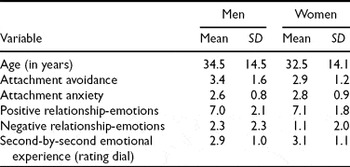
Table 1 provides means and standard errors for all study variables. Before turning to the specific hypothesis testing, we first examined the main effects of attachment style on emotion.
Descriptive Statistics for All Variables

Note: There were no significant differences between men and women.
Levels of daily emotion
We found a significant main effect of attachment avoidance on positive relationship-emotions, F(1, 733) = 13.78, p < .001, but there was no sex difference. Overall, more avoidant people reported less positive relationship-emotions, b = −0.46, p < .001. There was no significant interaction of sex and attachment anxiety on levels of positive relationship-emotions, F(1, 733) = 2.06, ns. Additionally, there was no effect of attachment anxiety on levels of positive relationship-emotions, F(1, 733) = 2.38, ns.
We found a significant interaction of sex and attachment avoidance for negative relationship-emotions, F(1, 722) = 6.37, p = .012. Overall, highly avoidant men showed significantly greater negative relationship-emotions, b = 0.57, p < .001, compared to less avoidant men. There was no effect of attachment avoidance on negative relationship-emotions for women, b = 0.09, ns. There was also a significant interaction of sex and attachment anxiety on negative relationship-emotions, F(1, 722) = 7.17, p = .008. Overall, highly anxious men showed significantly greater negative relationship emotions, b = 0.88, p = .01, compared to less anxious men. There was no effect of attachment anxiety on negative relationship-emotions for women, b = −0.21, ns. In summary, consistent with prior findings, attachment insecurities predicted less positive relationship-emotions and greater negative relationship-emotions (Berscheid, Reference Berscheid, Kelley, Berscheid, Christensen, Harvey, Huston, Levinger, McClintock, Peplau and Peterson1983; Simpson, Reference Simpson1990), and our results show that this may be truer for men than women.
Laboratory emotional experience
Results revealed a main effect of attachment avoidance on second-by-second momentary emotional experience, F(1, 3957) = 10.03, p = .002, but there was no sex difference. Overall, more avoidant people reported less positive momentary emotional experience, b = −0.16, p = .002. There was no significant interaction of sex and attachment anxiety on how participants rated their momentary emotional experience, F(1, 3957) = 2.90, ns. Additionally, we found no effect of attachment anxiety on how participants rated their momentary emotional experience, F(1, 3957) = .01, ns.
Hypothesis 1: Attachment Avoidance and Emotion Transmission
We hypothesised that high attachment avoidance in partners would be associated with lower levels of emotion transmission. Results show the hypothesis was not supported. In fact, some evidence suggests that the reverse occurred.
Positive relationship-emotions
As predicted, results showed a significant interaction between attachment avoidance and the transmission parameter (partner lagged emotion) for positive relationship-emotions for women, F(1, 603) = 6.75, p = .01, but the effect was in the opposite direction to what we hypothesised. Specifically, highly avoidant women were more likely to show transmission of partner's positive relationship-emotions (actor effect), b = 6.63, t(603) = 3.35, p = .001. There was no effect of avoidance on women's emotions being transmitted to men, F(1, 603) = 0.26, ns.
Negative relationship-emotions
Overall, there was no significant interaction between attachment avoidance and the degree of transmission of negative relationship-emotions. Specifically, one's own attachment avoidance did not interact with the transmission parameter for negative relationship-emotions for either men or women (actor effect); Men: F(1, 585) = 2.46, ns; Women: F(1, 585) = 0.66, ns. Additionally, the partner's attachment avoidance did not predict the transmission of negative relationship-emotions for either men or women (partner effect); Men: F(1,585) = 3.66, ns; Women: F(1, 585) = 0.52, ns.
Laboratory emotional experience
Using second-to-second measures of emotional experience, we found no interaction between attachment avoidance and the degree of emotion transmission. Specifically, one's own attachment avoidance did not interact with the transmission parameter for ratings of emotional experience for either men or women (actor effect); Men: F(1, 3773) = 0.07 ns; Women: F(1, 3773) = 0.03, ns. Additionally, the partner's attachment avoidance did not affect the transmission of negative other-emotions for either men or women (partner effect); Men: F(1, 3773) = 0.02, ns; Women: F(1, 3773) = 0.58, ns.
Hypothesis 2: Attachment Anxiety and Emotion Transmission
We hypothesised that high attachment anxiety in partners would be associated with higher levels of emotion transmission. Again, we found no support for our hypothesis, but instead found some evidence of the reverse pattern.
Positive relationship-emotions
Results showed no interaction between attachment anxiety and the amount of transmission of positive relationship-emotions. Specifically, one's own attachment anxiety did not interact with the transmission parameter for positive relationship-emotions for either men or women (actor effect); Men: F(1, 603) = 0.36, ns; Women: F(1, 603) = 0.00, ns. Additionally, there was no effect of the partner's attachment anxiety on the transmission of positive relationship-emotions for either men or women (partner effect); Men: F(1,603) = 3.20, ns; Women: F(1, 603) = 0.51, ns.
Negative relationship-emotions
We found no interaction between attachment anxiety and the amount of transmission of negative relationship-emotions. Specifically, one's own attachment anxiety did not interact with the transmission parameter for negative relationship-emotions for either men or women (actor effect); Men: F(1, 585) = 0.06, ns; Women: F(1, 585) = 0.05, ns. Additionally, the partner's attachment anxiety did not affect the transmission of negative relationship-emotions for either men or women (partner effect); Men: F (1, 585) = 1.52, ns; Women: F(1, 585) = 0.08, ns.
Laboratory emotional experience
As predicted, we found a significant interaction between attachment anxiety and the degree of emotion transmission for the second-by-second emotion ratings, but again it was in the direction opposite to our prediction. Attachment anxiety predicted less emotion transmission for the men. For men, both their own attachment anxiety, F(1, 3773) = 6.71, p = .01, and their partner's attachment anxiety, F(1, 3773) = 9.04, p = .003, predicted less emotion transmission, b = −.03, t(3773) = −3.01, p = .003.
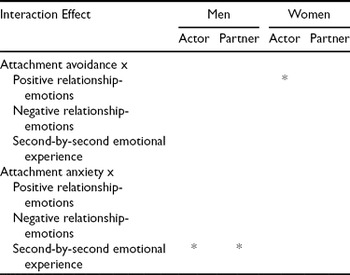
In summary, contrary to our predictions, the results suggest attachment avoidance can increase, whereas attachment anxiety can reduce emotion transmission between partners (see Table 2). Specifically, highly avoidant women showed more transmission of their partner's daily positive emotions, and attachment anxiety predicted less second-by-second ratings of emotion transmission for the men (actor and partner effects).
Summary of Significant Findings

Note: Asterix indicate a significant effect at p < .0125.
Discussion
We began this study with the overarching question of whether and how attachment dynamics may influence emotion transmission of relationship-related emotions between partners. Specifically, we hypothesised that high avoidance in partners would be associated with lower levels, whereas high anxiety in partners would be associated with higher levels of relationship-relevant emotion transmission. Our results were contrary to our hypotheses, but replicated existing literature that also showed counter-intuitive effects of attachment dynamics on emotional linkage between partners (Butner et al., Reference Butner, Diamond and Hicks2007).
One possible reason for the replicated but unexpected findings is that historically the influences of attachment on emotion regulation in relationships have been viewed at an individual level, rather than as a dyadic construct (e.g., Diamond & Hicks, Reference Diamond and Hicks2005; Diamond, Hicks, & Otter-Henderson, Reference Diamond, Hicks and Otter-Henderson2008; Mikulincer & Shaver, Reference Mikulincer, Shaver and Zanna2003). Importantly, the dyad is a higher-level system, which has emergent properties that cannot be explained at an individual level (Butler, Reference Butler2011; Rohrbaugh & Shoham, Reference Rohrbaugh, Shoham and Friedman2011). Therefore, it could be that although individual attachment dynamics influence how an individual regulates his or her emotions (e.g., disengage or become hypervigilant), one's relationship may serve as an emotion regulator above and beyond one's individual attachment dynamics (see Butler & Randall, Reference Butler and Randall2013). Thus, hypotheses on emotional connectedness between partners derived purely from an individual-level consideration may not be appropriate for explaining dyadic phenomena.
Effects of Attachment Dynamics on Emotion Transmission
Attachment avoidance
We predicted that couples with greater attachment avoidance would show less emotion transmission, due to the well-established disengagement properties related to attachment avoidance (e.g., Shaver & Mikulincer, Reference Shaver, Mikulincer and Gross2007). Contrary to our predictions, attachment avoidance actually increased the level of emotion transmission between partners; however, this effect was only for women and for positive relationship-emotions. Specifically, high avoidant women were more likely to show transmission of their partner's positive relationship relevant emotions.
In considering this unexpected finding, we realised that there are two views of avoidance-related attachment (Mikulincer & Shaver, Reference Mikulincer, Shaver and Zanna2003). One view posits that avoidant individuals have an active attachment system, but that it prods them toward defensive behaviours such as disengaging when faced with stressors. The other view posits that avoidant individuals have a relatively inactive attachment system, thus accounting for their aloof behaviour in relationship contexts. Focusing on the second view, it could be suggested that avoidant individuals are not necessarily prone to actively disengaging, especially under low stress conditions. Indeed, in situations that would reinforce their positive view of self they could be even more susceptible than secure individuals to picking up their partner's emotions. The present results are in accord with this idea, as it was the transmission of positive relationship relevant emotions that was enhanced for avoidant women. Given the relatively wide range of relationship length in our study, it could be that couples who have been together longer have figured out what works in the context of their specific relationship. For example, men with avoidant women may, over time, realise that being open to expressing positive things about the relationship actually makes their avoidant partner behave less distantly, while voicing their negative emotions about the relationship (e.g., nagging) only drives their partner further away. Therefore, attachment avoidance at an individual level may have an effect on the dyadic emotion pattern between partners that is more complex than simple disengagement.
Attachment anxiety
Based upon the hypervigilant behaviours associated with attachment anxiety (Mikulincer & Shaver, Reference Mikulincer, Shaver and Baldwin2005), we predicted that couples with higher levels of attachment anxiety would show greater emotion transmission. Contrary to our predictions, couples with greater attachment anxiety showed less emotion transmission. This effect was specifically found for men, such that men were less likely to show transmission if either they or their partner had high attachment anxiety. Simply stated, in highly anxious relationships, men were less likely to show evidence of transmission of their partners’ emotions. Interestingly, these findings replicate those of Butner et al.'s (Reference Butner, Diamond and Hicks2007), which found that high anxious men with high anxious women (high anxious couples) showed the lowest covariation of daily negative affect.
What might account for this replicated pattern of unexpected results? Anxious individuals use more emotion-focused coping (Lazarus & Folkman, Reference Lazarus and Folkman1984), such as ignoring the problem or keeping oneself busy, which may contribute to them not openly discussing the issue with their partner. If highly anxious partners are distracting themselves from their negative emotional experience in an effort to have less negative interactions (Feeney, Noller, & Callan, Reference Feeney, Noller, Callan, Bartholomew and Perlman1994), it could be inferred that the other partner would not show transmission of their emotions. For example, if couples know that when one partner is upset they do not want to talk about it and would rather do something to take their mind off the negative emotion (Cassidy & Berlin, Reference Cassidy and Berlin1994), the neutral partner may not be likely to show transmission of that emotion; doing so would be counter-productive and not yield positive results for the couple. Thus, similar to avoidance, individual attachment anxiety may generate dyad-level emotional patterns that go beyond simple hyperactivation.
Limitations and Future Directions
The results of the present study need to be considered in the light of several limitations. First, this study used secondary data from a larger study that was originally gathered to investigate relationships, eating behaviours, and emotions (e.g., Burke, Randall, Corkery, Young, & Butler, Reference Burke, Randall, Corkery, Young and Butler2012). Because not all couples completed the necessary study measures, we had a reduced sample size, which limits the generalisability of our results. We do, however, acknowledge that our use of repeated measures data (i.e., daily diary and second-by-second momentary experience) helped account for the small sample size.
Second, while the participants completed an attachment measure, this measure was not of central interest in the larger study so the less reliable short form was used (Experience in Close Relationships — short form; Wei et al., Reference Wei, Russell, Mallincrokrodt and Vogel2007). It is possible that a more comprehensive assessment of attachment dynamics (e.g., internal working models) could alter the results. For example, it may be beneficial to consider measurement of general versus relationship-specific working models of attachment (Fraley et al., Reference Fraley, Heffernan, Vicary and Brumbaugh2011). Having a more specific assessment of attachment to one's current romantic partner would allow us to understand how emotion transmission may occur within a specific relationship, as compared to across all relationships where it may not be as relevant. Additionally, it would be beneficial to examine how attachment may influence emotion transmission between partners using diary items or laboratory tasks specific to examining attachment related dynamics. For example, since the attachment system is activated particularly under times of stress (Bowlby, Reference Bowlby1988), partners' emotions should be measured during a stressful interaction. Future research should make use of paradigms in which the attachment system is clearly activated (e.g., talking about something stressful in one's relationship).
Third, couples in the present study varied a great deal on their relationship length. For example, some couples were in relationships for as long as 39 years. Undoubtedly, after such time, couples would learn how to ‘deal with’ their partner's idiosyncrasies (in respect to attachment), and how to navigate their relationship. One simplistic possibility is that relationship length may be a moderator of emotion transmission, whereby partners early in their relationship may be less susceptible to emotional transmission as compared to couples who have been together longer. Secondary analyses showed this was not the case in the present data.
Lastly, additional research should focus on other moderating factors such as how long partners have known one another and been involved in a romantic relationship. It could be suggested that partners who have been together longer may be either more or less likely to experience emotion transmission. On one hand, longer-term couples may be more interdependent and more likely to experience one another's emotions. On the other hand, couples may learn to cope with their partner by avoiding the transmission of negative emotions, especially if it may be detrimental to the relationship (see dyadic coping literature; Bodenmann, Reference Bodenmann, Revenson, Kayser and Bodenmann2005). Thus it may be that in new relationships simpler patterns of attachment dynamics emerge that are more in line with theorising about attachment at the individual level, especially when the partners are still learning to accommodate each other's emotional responses. As such, we may need to consider more reciprocal and complex dyadic attachment processes in order to predict emotional connections in longer term relationship.
Overall, a large question still exists — when do interpersonal emotion connections occur? Several studies have used a variety of time points ranging from one observation per day (Butner et al., Reference Butner, Diamond and Hicks2007) to four time points per day (morning/upon waking, late morning/before lunch, afternoon/leaving work, and evening/before bed; Saxbe & Repetti, Reference Saxbe and Repetti2010); however, these studies examined other interpersonal processes (coupling, covariation/synchrony), and did not specifically examine interpersonal emotion transmission. Using data from a variety of time-frames (daily diaries and second-by-second laboratory emotional experience), we were not able to model emotion transmission between partners. Thus, we would argue that future research should combine multiple observations per day and multiple observations per hour, in order to best assess under what conditions, and for whom, emotion transmission occurs (Butner et al., Reference Butner, Diamond and Hicks2007; Butler & Randall, Reference Butler and Randall2013).
Conclusions
The present study is the first to examine how attachment dynamics impact emotion transmission between partners using a prospective-change model of emotional experience. Importantly, the results replicated unexpected findings from a study that focused on emotional synchrony (Bunter et al., Reference Butner, Diamond and Hicks2007), rather than transmission, suggesting that attachment anxiety may reliably reduce (rather than enhance) dynamic emotional connections in close relationships. Understanding couples’ emotional connectedness, and whether or not this depends on one's individual attachment, may have an impact on therapeutic interventions to foster attachment security, such as Emotion Focused Therapy (Johnson & Greenberg, Reference Johnson, Greenberg, Jacobson and Gurman1995). These interventions may achieve their therapeutic effects through the mediating variable of emotional transmission or connectedness between partners. Together, the present study provides preliminary evidence to suggest understanding the complex emotional connectedness between partners may have important significance for relationship researchers and mental health professionals alike.
Acknowledgments
The authors would like to thank David Sbarra and Noel Card for their comments on an earlier version of this manuscript. This research was conducted at the University of Arizona and supported in part by the Frances McClelland Institute for Children, Youth, and Families, in the Norton School of Family and Consumer Sciences.