Introduction
Advance care planning (ACP) is an important element of end-of-life care in nursing homes, especially for residents having dementia who often lack the competence to make decisions toward the end of life. Advance care planning concerns the discussion with the resident and/or his/her representative about the goals and desired direction of care, particularly end-of-life care, in the event that the resident is or becomes incompetent to make decisions (as defined in the 2009 MeSH database). The goal of this early initiated and ongoing process of communication is to give weight to the resident's values, attitudes, and wishes in their end-of-life care (Teno, Reference Teno2003; Robinson et al., Reference Robinson2010).
Advance care planning can result in the making and documenting of advance directives (i.e. patient-oriented orders or living wills such as a “Do Not Attempt Cardiopulmonary Resuscitation” order) or the authorization of a legal representative (i.e. a surrogate decision-maker who can make decisions for the resident in case of loss of competence) (Martin et al., Reference Martin, Thiel and Singer1999; Dobalian Reference Dobalian2006; Silveira et al., Reference Silveira, Kim and Langa2010). In addition to these patient-driven directives, a resident's end of life can also be determined by physicians’ treatment orders such as GP orders, which are instructions from the general practitioner placed in the resident's medical file governing the use of specific treatments toward the end of life. These GP orders can be seen as part of the general care planning process in nursing homes, providing a plan for current and continuing healthcare. They can be written in discussion with the individual or can be completed for an individual who lacks capacity in their best interest (National End of Life Care Programme, 2007; 2010). In Belgium, they are not legally binding, being advisory only (Belgisch Staatsblad, 2002).
Previous studies on ACP in the nursing home have not distinguished between these three forms of care planning and have reported mostly on the nursing home population as a whole (Brown Reference Brown2002; Allen et al., Reference Allen2003; Cantor et al., Reference Cantor and Pearlman2004; Daaleman et al., Reference Daaleman, Williams, Preisser, Sloane, Biola and Zimmerman2009; de Gendt et al., Reference de Gendt, Bilsen, Vander Stichele and Deliens2010b) rather than specifically on nursing home residents living with dementia. However, ACP is of particular importance for residents with dementia because of the progressive nature of the illness. Most individuals with dementia will decline into a state in which they can no longer communicate their treatment wishes (Triplett et al., Reference Triplett2008). Further, earlier research mainly concerned US studies focusing on patient-oriented orders such as the completion of living wills (Janofsky et al., Reference Janofsky and Rovner1993; Bradley et al., Reference Bradley, Wetle and Horwitz1998; DeLaGarza et al., Reference DeLaGarza, Andersen, Mach and Bennett2001; McAuley et al., Reference McAuley, Buchanan, Travis, Wang and Kim2006; Monturo et al., Reference Monturo and Strumpf2007; Jones et al., Reference Jones, Moss and Harris-Kojetin2011). In addition, where existing research does focus on individuals with dementia, it is mostly restricted to the study of do-not-hospitalize and do-not-resuscitate orders (Dautzenberg et al., Reference Dautzenberg, Hooyer, Schonwetter, Dermout, vd Veer and Duursma1996; Lambourne et al., Reference Lambourne and Lambourne2001; Sulmasy et al., Reference Sulmasy, Sood and Ury2004; Lamberg et al., Reference Lamberg, Person, Kiely and Mitchell2005; Levy et al., Reference Levy, Fish and Kramer2005; Messinger-Rapport et al., Reference Messinger-Rapport and Kamel2005; Dobalian Reference Dobalian2006; Mitchell et al., Reference Mitchell, Teno, Intrator, Feng and Mor2007; Maust et al., Reference Maust, Blass, Black and Rabins2008), whereas wishes about other important medical decisions, such as intensifying pain and symptom management, palliative sedation, foregoing food and fluids, and antibiotics or other treatments, have been addressed in only a limited manner restricted to a few studies (Triplett et al., Reference Triplett2008). Finally, we identified only one study that addressed the association between advanced directives and quality of care where the completion of an advanced directive was associated with greater use of hospices and fewer concerns with communication. However, this study was not dementia-specific and limited only to the USA (Teno et al., Reference Teno, Gruneir, Schwartz, Nanda and Wetle2007).
Therefore, this study addresses the prevalence and some associated outcomes of these advance directives, authorization of a legal representative, and GP treatment orders among deceased nursing home residents with dementia in Flanders, Belgium. Our research questions are:
• What is the prevalence and content of advance directives, authorization of a legal representative, and general practitioner treatment orders among deceased nursing home residents with dementia in Flanders, Belgium?
• Are patient characteristics and the provision of palliative care associated with the presence of advance directives or GP orders?
• Is place of death and quality of dying associated with the presence of an advance directive or GP order?
Methods
Design and research procedure
A retrospective cross-sectional postmortem survey was conducted in nursing homes in Flanders, the Dutch-speaking part of Belgium, where about 60% of the Belgian population lives (approximately 6 million people). All nursing homes for elderly people recognized as high-care nursing homes (N = 594) were approached using contact information from the Flemish Ministry of Health. The treating physician in these homes was the resident's general practitioner.
The administrator of each nursing home received a questionnaire asking them to report the number of residents who had died during September and October 2006 (recall period of maximum two months) (de Gendt et al., Reference de Gendt, Bilsen, Vander Stichele and Deliens2010b), and to pass a structured questionnaire for each of these deceased residents to the nurse mostly involved in that resident's care, or to the head nurse if no nurse could be identified. The questionnaires were accompanied by a letter of recommendation, signed by six nursing home umbrella organizations. Non-responders received a follow-up letter one month later. If there was still no response after three weeks, a telephone call was made. The Medical Ethical Commission of the University Hospital of Brussels approved of the study (de Gendt et al., Reference de Gendt, Bilsen, Vander Stichele and Deliens2010b). Anonymity was guaranteed for residents and respondents.
As was described in a previous publication (de Gendt et al., Reference de Gendt, Bilsen, Vander Stichele and Deliens2010a), nurses reported 1,240 deaths of residents in 345 Flemish nursing homes (58% response rate). To identify residents with dementia, we asked the nurse whether this resident was diagnosed with dementia and, if so, its severity, with the response options “moderate” and “severe”. Where this question was unanswered (N = 68), the case was not included in this study. The total number of deceased residents with dementia was 764. Sex and age characteristics of our sample were compared with sex and age characteristics of nursing home deaths in a representative death certificate study in 2001 in Flanders. There were no significant differences (data not shown in tables).
The nurse most closely involved in the deceased resident's care filled in a structured questionnaire surveying:
• the resident's characteristics at time of death, e.g. age, gender, level of dependency, having an involved friend or family caregiver, and activities of daily living (ADL) based on a modified version of the Katz ADL scale (Katz, Reference Katz1983), the Belgian Evaluation Scale for ADL (BESADL), a federally mandated and validated instrument used by Belgian health insurance institutions to allocate finances to each nursing home. Resident dependency is based on bathing, dressing, transfer, toileting, continence, eating, and disorientation in time and space. In contrast to the original scale, each function has four instead of three possible scores and, capitals O (lowest dependency), A, B, and C (highest dependency) are assigned on the basis of a combination of scores (Aerneart et al., Reference Aerneart and Delesie1999; Paquay et al., Reference Paquay2004)
• documentation of the resident's wishes in an advance patient directive (i.e. advance treatment directive or authorization of a legal representative in a written living will in case the resident loses competence)
• documentation in the resident's file of GP treatment orders regulating the use of specific treatments at the end of life
• whether death was expected or not
• provision of palliative care by the GP, nursing home caregivers, a palliative home care team, and/or by a hospital
• symptom presence in the last week of life, as measured by the Edmonton Symptom Assessment Scale (0, absence of symptoms; 10, worst possible symptom presence) (Chang et al., Reference Chang, Hwang and Feuerman2000). Results concern patients with a score >4 on each symptom. A cut of 4 is generally presumed to indicate a clinically relevant symptom score (Parker et al., Reference Parker, Porock and Zweig2004).
• estimated quality of life during the last week of life assessed on a 7-point Likert scale (1, very poor; 7, excellent) and mildness of death assessed on a 7-point Likert scale (1, not mild death; 7, mild death) (van den Block et al., Reference van den Block2007b).
• place of death.
Statistical analysis
All analyses were performed with PASW statistical software, version 17.0 (SPSS Inc., Chicago, IL). Shown cut-off scores are >4 for the Edmonton Symptom Assessment System (ESAS), the estimated quality of life and mildness of death. Differences in distribution were calculated using χ2 tests. We used multivariate logistic regression (stepwise conditional) analysis to calculate odds ratios correcting for resident characteristics, palliative care, and other variables significant in the bivariate analysis. For Table 3, we examined associations between a documented care plan (dependent variable) and resident characteristics, palliative care, and other outcomes (independent variables). For Table 4, we examined associations between a documented care plan (independent variable) and resident outcomes (dependent variables).
Results
Of all 764 residents dying with dementia, 285 (37.3%) had moderate and 479 (62.7%) severe dementia.
Resident characteristics
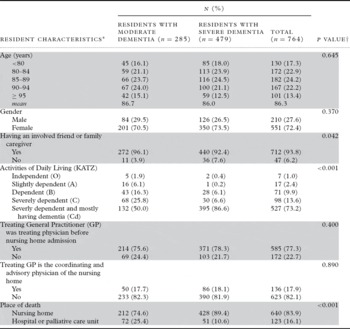
Of residents dying with dementia, 59.8% were 85 years or older at time of death, 72.4% were female, and 93.8% had an involved friend or family caregiver while in the nursing home (Table 1). Of all residents dying with dementia, 83.9% (74.6% for moderate dementia; 89.4% for severe dementia) died in the nursing home as opposed to the hospital or palliative care unit (16.1%). Compared with residents with moderate dementia, those with severe dementia were more likely to have died in the nursing home.
Characteristics of deceased residents with moderate and severe dementia in Flemish nursing homes

* Missing values for age n = 12, for gender n = 3, for involved friend or family caregiver n = 5, for KATZ-scale n = 44, for GP n = 7, for CRA is treating GP n = 5, place of death n = 1.
† Differences are tested using χ2, significance level at 0.05.
Prevalence and content of documented care planning
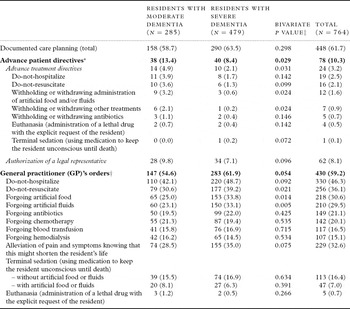
Table 2 shows that 61.7% of the deceased nursing home residents with dementia had some type of documented care plan.
Prevalence and content of documented care planning among deceased nursing home residents with dementia

* Missing values for advance patient directives n = 2.
† Missing values for GP orders n = 4.
‡ χ2 test.
An advance patient directive was present in 10.3% of cases. A legal representative was appointed in 8.1% of cases and an advance treatment directive in 3.2% of cases. The most frequent treatment directives were do-not-hospitalize (2.5%) and do-not-resuscitate orders (2.1%).
GP orders were reported in 59.2% of which the most frequent were do-not-hospitalize orders (46.3%), do-not-resuscitate orders (36.1%), and forgoing artificial food (30.6%) or fluids (29.5%) orders. For five residents (0.7%), a documented agreement concerning euthanasia was available in the resident's file.
Advance patient directives were more common among residents with moderate dementia than among those with severe dementia (13.4% vs 8.4%) whereas GP orders were more common among residents with severe dementia than among those with moderate dementia (61.9% vs 54.6%).
Clinical characteristics and palliative care
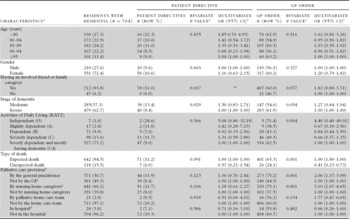
Multivariate logistic regression analysis (Table 3) indicates that residents who died unexpectedly were half as likely to have a GP order than those who died expectedly (OR 0.41; CI, 0.23–0.73). Residents receiving palliative care from nursing home caregivers or from their GP were, respectively, three times (OR 3.10; CI, 2.07–4.65) and twice (2.06; CI, 1.37–3.09) as likely to have a GP order as those not receiving this palliative care. The multivariate logistic regression model comparing residents with and without a patient directive showed no significant results.
Patient characteristics and palliative care provision associated with the prevalence of documented care planning among deceased nursing home residents with dementia (n = 764)

a Missing values for age n = 12, for gender n = 3, for involved friend or family caregiver n = 5, for stage of dementia n = 0, for KATZ-scale n = 44, for type of death n = 4, for palliative care n = 32.
b Multiple responses possible.
c Palliative care provided by nursing home caregivers can be a patient discussion performed by a palliative task group, the involvement of a palliative care reference nurse, or the involvement of a coordinating and advisory physician.
d Palliative care provided in hospital can be the involvement of a mobile palliative care support team of the hospital or being admitted to an inpatient palliative care unit.
e χ2 test.
f Odds ratios based on logistic regression analysis with the presence of a documented care plan as dependent variable (ref = no documented care plan).
** Involved friend or family caregiver not included in multivariate model. In the GP order model we excluded 18 cases in the reference category (no GP order) because these cases had a patient directive.
Place of death and quality of dying
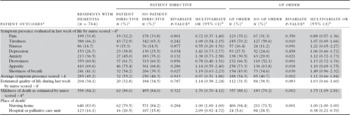
Bivariate analysis in Table 4 indicates that residents who had a patient directive had significantly more depressive symptoms and shortness of breath (more than 4 on the ESAS scale from 0 to 10) than those without a patient directive. These differences did not remain in the multivariate analyses.
Association between documented care planning and patient outcomes among deceased nursing home residents with dementia

a Missing values for place of death n = 1, for estimated quality of life n = 166, for estimated quality of dying n = 101, for pain n = 176, for tiredness n = 178, for nausea n = 178, for depression n = 191, for anxiety n = 180, for drowsiness n = 180, for appetite n = 175, for shortness of breath n = 178, for average symptom presence n = 185.
b Edmonton Symptom Assessment Scale, ESAS (0, absence of symptom; 10, worst possible symptom presence) Results concern patients with a score >4 on each symptom.
c Scores were assessed on a 7-point Likert scale (1, very poor; 7, excellent). Results concern patients with a score >4.
d Scores were assessed on a 7-point Likert scale (1, not mild death; 7, mild death). Results concern patients with a score >4.
e Seven residents died in a palliative care unit. None of them had a patient directive; two had a GP order.
f Column percentages.
g χ2 test.
h Logistic regression analysis using patient outcomes as dependent variables (reference scores are >4 for all symptoms, mildness of death, and quality of life). The presence of a documented care plan is the independent variable (ref = no documented care plan). We controlled for patient characteristics, palliative care, and other outcome variables. In the GP order model, we excluded 18 cases in the reference category (no GP order) because these cases had a patient directive.
Residents with a GP order were 1.7 times more likely to have a mild death (more than 4 on the ESAS scale from 0 to 10, OR 1.75; CI, 1.09–2.81) than those without a GP order. The odds of dying in a hospital were three times lower if there was a GP order (OR 0.38; CI, 0.21–0.70) present.
Separate analyses for advance treatment directives and legal representative showed similar results (not shown in tables).
Discussion
The results of this study show that GP orders were relatively common, whereas advance patient directives and the authorization of a legal representative were quite uncommon among deceased nursing home residents with dementia in Flanders, Belgium. In contrast with advance patient directives, GP orders appear to be more frequent among residents with severe dementia than among those with moderate dementia. Receiving palliative care from nursing home caregivers was associated with having a GP order, as was receiving palliative care from the GP; GP orders also appear relevant in affecting place and mildness of death.
A first key finding is the rather low prevalence of documented advance treatment directives among deceased residents with dementia, both moderate (4.9%) and severe (2.1%). Especially when comparing residents with severe dementia with the prevalence of 5% found among all deceased nursing home residents in Flanders (de Gendt et al., Reference de Gendt, Bilsen, Vander Stichele and Deliens2010a), this result is remarkable, considering that many of these nursing home residents with dementia will lose the ability to make decisions at the end of life. The results correspond with earlier research from the USA showing that residents with dementia are less likely to have directives limiting care than cancer residents (Mitchell et al., Reference Mitchell, Kiely and Hamel2004). Further, the authorization of a legal representative is not common in Belgium (8.1%) despite the fact that almost all deceased nursing home residents with dementia had a support person while in the nursing home. Because persons having dementia are likely to lack the capacity for decision-making at the end of life, planning should start in the earlier stages of dementia when people are still competent and able to express values and preferences (Malcomson et al., Reference Malcomson and Bisbee2009; Sampson Reference Sampson2010).
This study has some limitations. First, we studied the prevalence of documented care planning only, whereas the quality of the ACP process was not investigated, nor was the involvement of the deceased nursing home residents with dementia with their families, or the presence of verbal non-documented agreements. Second, since a retrospective research design was used, recall bias cannot be ruled out. However, this was limited by minimizing the time between the resident's death and the completion of the questionnaire. Additionally, we needed to rely on the nurse's judgment of the diagnosis of dementia, and the assessment of mildness of death and symptom burden, but given that the nurse has a gate-keeping position in the care of nursing home residents and, as main caregiver, a privileged insight into the development of the residents’ health status, the possibility of misclassifications in dementia severity is probably low. Further, previous studies have shown that congruence concerning symptoms or other subjective assessments is not always high between respondents. Finally, we did not survey background information regarding the respondents.
This is the first nationwide study to describe such a diverse range of end-of-life decisions in this population, i.e. non-treatment decisions, intensified alleviation of pain and/or symptom management knowing that this might shorten the resident's life, and the use of life-ending drugs with the explicit intention of ending life and terminal sedation (Daaleman et al., Reference Daaleman, Williams, Preisser, Sloane, Biola and Zimmerman2009). This study is also representative for the whole of Flanders. Also, to our knowledge, this study is the first in Belgium to look at the prevalence and associated outcomes regarding documented advance patient directives and GP orders with a focus on nursing home residents with dementia.
Our results further show that patient-driven directives (present in one out of ten cases) are reported far less often than physician-driven orders (six out of ten). The high prevalence of GP orders confirms that some type of care planning regulating end-of-life decision-making seems necessary at the end of life of residents having dementia, but at the same time might indicate that these advance decisions may not always be made in consultation with the residents themselves. It can therefore be assumed that such GP orders are in place only when death of the resident is near or when the resident with dementia is no longer able to participate in the decision-making. Further research should study in more detail how GP orders are established and how often patients are involved in the decision-making process.
Several reasons might explain the low prevalence of patient-driven directives. Dementia is not always formally diagnosed by clinicians (De Lepeleire et al., Reference de Lepeleire, Heyrman, Baro, Buntinx and Lasuy1994; Lopponen et al., Reference Lopponen, Raiha, Isoaho, Vahlberg and Kivela2003; Chodosh et al., Reference Chodosh2004; Lliffe et al., Reference Lliffe, de Lepeleire, van Hout, Kenny, Lewis and Vernooij-Dassen2005), disclosed, or recognized as a possibly terminal illness (Wolf-Klein et al., Reference Wolf-Klein, Pekmezaris, Chin and Weiner2007; Chang et al., Reference Chang and Walter2010; Jordan Reference Jordan2010); estimation of life expectancy is difficult (Mitchell et al., Reference Mitchell, Kiely and Hamel2004; Sachs et al., Reference Sachs, Shega and Cox-Hayley2004; Di Giulio et al., Reference Di Giulio, Toscani, Villani, Brunelli, Gentile and Spadin2008; Banerjee Reference Banerjee2010); and physicians often hesitate to discuss end-of-life care issues with residents (Eliasson et al., Reference Eliasson1999; Curtis et al., Reference Curtis, Patrick, Caldwell and Collier2000; Tierney et al., Reference Tierney, Dexter, Gramelspacher, Perkins, Zhou and Wolinsky2001; Brown Reference Brown2002; Deschepper et al., Reference Deschepper2006; Meeussen et al., Reference Meeussen2011). Not only might clinicians be hesitant to start ACP conversations but the residents themselves might also wait too long; whether, when, and how residents express their wishes seems to be influenced by several intrinsic factors (e.g. the desire to spare surrogates the burden of difficult decisions) as well as extrinsic factors (e.g. the resident's declining health) (Deschepper et al., Reference Deschepper2008; Black et al., Reference Black2009; Fried et al., Reference Fried, Redding, Robbins, Paiva, O'Leary and Iannone2010). On a nursing home level, completion of advance directives can also be influenced by the nursing home culture (Mezey et al., Reference Mezey, Mitty, Rappaport and Ramsey1997; Molloy et al., Reference Molloy2000; Levy et al., Reference Levy, Fish and Kramer2005; Morrison et al., Reference Morrison, Chichin, Carter, Burack, Lantz and Meier2005; Caplan et al., Reference Caplan, Meller, Squires, Chan and Willett2006).
The results of our study can also be explained by the rather late implementation of ACP policy in Flemish nursing homes. Attention increased mainly after 2000 resulting in an ACP policy in the majority (95.1%) of nursing homes in Flanders in 2006 (de Gendt et al., Reference de Gendt, Bilsen, Vander Stichele and Deliens2010b) but apparently leading to more GP orders than patient-driven directives. Our results therefore suggest that ACP is not yet a basic part of end-of-life care for residents with dementia in Flemish nursing homes.
Where patient directives or GP orders were present, they mainly concerned the same treatments, i.e. do-not-hospitalize and do-not-resuscitate orders. Prevalence figures for these treatments correspond to figures found in other international studies (Dautzenberg et al., Reference Dautzenberg, Hooyer, Schonwetter, Dermout, vd Veer and Duursma1996; Lamberg et al., Reference Lamberg, Person, Kiely and Mitchell2005; Dobalian Reference Dobalian2006; Mitchell et al., Reference Mitchell, Teno, Intrator, Feng and Mor2007; Maust et al., Reference Maust, Blass, Black and Rabins2008). Other important end-of-life care issues which are prevalent in the treatment of residents with dementia, i.e. use of antibiotics or administration of artificial food and fluids, were only regulated in one in five cases (van der Steen et al., Reference van der Steen, Ooms, van der and Ribbe2002; Koopmans et al., Reference Koopmans, van der Sterren and van der Steen2007; Mitchell et al., Reference Mitchell2009; van der Steen Reference van der Steen2010).
Another main finding is the association between GP orders and the provision of palliative care by the nursing home caregiver and by the GP. Since causality cannot be inferred with certainty from this study, this could either imply that the provision of palliative care leads to more care planning or that the presence of GP orders triggers palliative care provision.
Finally, the association we found between the presence of a care plan and several important resident outcomes is an important result of this study and further strengthens the case for documented care plans. In particular, the presence of documented GP orders in a resident's file appears to influence where they will die. When a GP order was present, residents were less often transferred to hospital at the very end of life, indicating that residents died in their substitute home, i.e. the nursing home (Mezey et al., Reference Mezey, Dubler, Mitty and Brody2002; van den Block et al., Reference van den Block, Deschepper, Bilsen, van Casteren and Deliens2007a). Since most GP orders are do-not-hospitalize orders, the results underline the positive effect of such orders on place of death. We might assume that the decision to forgo hospitalization is based on this order and therefore aids the nursing home staff in their decision-making, since the GP is often not present in the nursing home at the time of an acute event requiring a hospitalization decision. A recent study also showed that terminal hospitalizations decreased when the rate of do-not-resuscitate orders increased in nursing homes (Teno et al., Reference Teno, Gozalo, Mitchell, Bynum, Dosa and Mor2011). The association between patient directives and place of death showed the same tendency but was not significant, probably due to a lack of power.
Also, after controlling for other differences in a multivariate regression analysis, including the provision of palliative care by the GP and/or nursing home caregivers, deceased nursing home residents with dementia who had a GP order were judged by the nurse to have had a milder death. However, this might be a highly subjective judgment; we found no direct association between GP orders and the more objective assessments of symptom manage-ment.
In conclusion, whereas GP orders are relatively common among residents with dementia in Belgium, advance patient directives and the authorization of a legal representative are quite uncommon. Nursing home residents receiving palliative care are more likely to have a GP order. GP orders appear very relevant in affecting place of death.
Conflict of interest
None.
Description of author's roles
An Vandervoort formulated the research questions, analyzed the data, and wrote the paper. Lieve van den Block and Jenny T. van der Steen supervised in formulating the research questions, analysis of the data, and writing of the paper. Robert Vander Stichele supervised the data collection, assisted in designing the study, supervised in formulating the research questions, analysis of the data, and writing of the paper. Johan Bilsen designed the study, collected the data, and supervised in formulating the research questions, analysis of the data, and writing of the paper. Luc Deliens supervised the data collection, assisted in designing the study, and supervised in formulating the research questions, analysis of the data, and writing of the paper.
Acknowledgments
We thank Cindy de Gendt (MA, PhD) for her contribution to study conception and data collection; the four umbrella nursing home organizations (Vereniging van Vlaamse Steden en Gemeenten, Verbond der Verzorgingsinstellingen, Federatie Onafhankelijke Seniorenzorg, and the Federatie van Rustoorden van België), Crataegus, and the Federation Palliative Care Flanders for their support given to this study by signing the recommendation letter enclosed with the questionnaire, Jane Ruthven for English editing, and all participating nursing homes and respondents for providing the study data. Various grants from the Research Council of the Vrije Universiteit Brussel funded this study.