Introduction
In the wake of the Supreme Court’s landmark decision in Lawrence v. Texas (539 U.S. 558 [2003]) striking down statutes prohibiting homosexual sodomy, nearly every major public opinion survey tracked a decline in public support for homosexuality as an acceptable behavior (Bowman Reference Bowman2004). This decline reversed a growing acceptance of homosexuality that tracks as far back as most public opinion polls have asked the question. Yet a similar opinion backlash did not follow subsequent Court action on lesbian, gay, bisexual, and transgender rights (Flores and Barclay Reference Flores and Scott2016). This overall dynamic follows the general argument of Ura (Reference Ura2014), who shows that initial backlashes against controversial decisions later transmute into greater perceived legitimacy of these same decisions.
These nonlinear movements in tolerance of homosexuality following Lawrence and subsequent decisions only added to the confusion surrounding Supreme Court impact on public opinion. Scholars have long noted that there is a reciprocal relationship between the perception of the Court as an institution and approval of particular decisions (Mondak and Smithey Reference Mondak and Shannon1997). One side of this relationship has been relatively well explored—the impact of decisions on perception of the Court (see, e.g., Gibson, Caldeira, and Spence Reference Gibson, Gregory and Lester2003; Gibson and Caldeira Reference Gibson and Gregory2009; Gibson and Nelson Reference Gibson and Michael2014, Reference Gibson and Michael2015; Christenson and Glick Reference Christenson and David2015; cf. Bartels and Johnston Reference Bartels and Christopher2013). Scholars appear to be content with a model that suggests that certain decisions may reduce evaluations of the Court as an institution, at least among individuals who disagree with the decisions, but that impact is temporary (Mondak and Smithey Reference Mondak and Shannon1997; Gibson et al. Reference Gibson, Gregory and Lester2003; Gibson and Nelson Reference Gibson and Michael2015). Further, the effect of negative decisions in the aggregate is largely canceled out by increases in support from individuals who agree with a given decision.
On the other side of the reciprocal relationship—the ability of the Supreme Court to mold public opinion through its decisions—disagreement is far more widespread. Scholars have long searched for evidence that the Supreme Court, as the most highly regarded federal institution in the United States (Kritzer Reference Kritzer2005), has a legitimating (positive) effect on public opinion, subject to an initial backlash in some areas (Ura Reference Ura2014).
However, a necessary, although not sufficient, condition for a Supreme Court decision to have persuasive impact on the individuals in the polity is that citizens must be aware of the case being before the Court. Any study positing that the Court acts in individual cases with regard to a potential public reaction (e.g., Clark Reference Clark2009, Reference Clark2011; Black et al. Reference Black, Ryan J. Owens and Patrick2016) assumes that the public can potentially monitor the Court’s actions and opinions. But it seems unlikely that all citizens are equally likely to become aware of the Court’s actions. Knowledge of the Court as an institution varies systematically (Gibson and Caldeira Reference Gibson and Gregory2009); awareness of its decisions seems likely to vary systematically as well.
Crucially, attention to the Court’s output may depend on differences in individuals’ ability to comprehend, and motivation to seek out, information about national governmental institutions. Such differences would imply that a more educated and elite subset of the population monitors the Court most closely. This subset would then diffuse perceptions of the Court’s output to the population more generally. Such a dynamic might mimic the elite-driven origins of public opinion posited by Zaller (Reference Zaller1992).
If so, then many theories of the relationship between the Court and the mass public would require reassessment in light of the conditional nature of this relationship, as political information tends to become distorted as it travels from person to person through a social network (Carlson Reference Carlson2018). In this article, we attempt to develop a more complete understanding of the important step before this persuasion, legitimation, and diffusion take place: explaining the variation in the awareness of Supreme Court cases. We do this using data collected specifically for that purpose, making the argument that the institution of the Court itself, the media, and individual differences all play a varying role in how citizens find out about issues before the Court and the decisions that the Court makes. We find that the Court does indeed increase awareness of its cases via the issuance of decisions, and this effect is conditional on a case’s initial salience and the political sophistication of individuals in the population. Cases with lower initial salience experience a magnified effect of decision issuance, while individuals with greater education, newspaper consumption, and political knowledge are likelier to respond to decision issuance with greater case awareness.
Public Awareness of Political Events
In recent years, the view of the typical member of the American public as lacking ideological (or any other) constraint or any consistent set of attitudes altogether has been challenged. Even though they possess limited political knowledge, people are capable of making reasoned decisions based on heuristics derived from life experiences or cues from trusted sources of information (Sniderman, Brody, and Tetlock Reference Sniderman, Brody and Philip1991; Zaller Reference Zaller1992; Sniderman Reference Sniderman1993). This ability may be contingent on individual differences in education, cognitive ability, political sophistication, media consumption, or other factors (Bullock Reference Bullock2011; Boudreau and MacKenzie Reference Boudreau and Scott2014; Mérola and Hitt Reference Mérola and Matthew2016). For instance, individuals pay a cost for their attention to the news media, and that cost is related to their cognitive capacity; people with greater capacity pay less of a cost to remain abreast of current events, while those with fewer cognitive skills accept more of a cost. As a result, the absorption of news events is uneven across the public, and individuals can only be counted on to absorb that information that they believe will provide them with new knowledge (Sniderman et al. Reference Sniderman, Brody and Philip1991; Sniderman Reference Sniderman1993; Lupia and McCubbins Reference Lupia and Matthew1998; Baum Reference Baum2003).
The understanding of how individuals receive and process political information is further complicated by the medium by which the message is communicated. The mechanism by which the public receives information evolves quickly as technology provides ever-increasing and ever-more targeted ways to generate information. Much of what political scientists know about how citizens get their political information occurs in a world dominated by major television networks, not the fractured and polarized media that characterizes the modern news environment (Johnston and Bartels Reference Johnston and Brandon2010; Davis and Dunaway Reference Davis and Johanna2016).
Despite the fracture of media, individuals retain some skills at processing that information, but scholars do not fully understand the conditions under which individuals pay more or less attention to a particular event. Delli Carpini and Keeter (Reference Delli, Michael and Scott1996) have demonstrated that the amount of the public’s factual knowledge about politics has remained largely consistent over time, suggesting a limited capacity inside an environment with substantially more information. Baum (Reference Baum2003) argues that if individuals’ attention capacities have remained fairly constant and their capacity to screen out unwanted information has remained robust, then there remain only two plausible explanations for any change in attentiveness to news events (for Baum, foreign policy crises). First, the perceived benefit or impact of information about issues has increased. Second, alternatively, the cognitive cost of paying attention to such information may have declined.
The first possibility, according to Baum, is implausible. Public opinion surveys routinely indicate that individuals see little benefit to added information. Despite sea changes in the media environment, political knowledge and participation in politics have remained largely constant, suggesting Americans adapt to new sources of information in ways not fully understood by political communication scholars (Bennett Reference Bennett1986; Niemi, Mueller, and Smith Reference Niemi, John and Tom1989; Delli Carpini and Keeter Reference Delli, Michael and Scott1996; Baum Reference Baum2003; Davis and Dunaway Reference Davis and Johanna2016). Lupia (Reference Lupia2016), however, makes the argument that traditional metrics of political knowledge on their own can fall short of a complete explanation of the nuance and dimensionality of political sophistication, especially given that the public ignores most of the information to which it is exposed.
Supreme Court decisions, as discrete and predictable political events, give scholars an opportunity to assess the degree to which individuals pay attention to the political process. In particular, one might expect that as the media fractures and individuals grow to rely on media sources beyond broadcast networks and newspapers, the effect of Court decisions on public awareness of an issue would be uneven—increasing salience in some components of the polity and having no effect on others. If so, then the dynamics of strategic anticipation (Clark Reference Clark2011; Black et al. Reference Black, Ryan J. Owens and Patrick2016) and backlash and legitimation (Ura Reference Ura2014) between the Court and the public would be conditional on which portions of the polity are paying attention.
Supreme Court Decisions as Political Events
One might suspect uneven dispersion of awareness because there is a widely held belief that knowledge about political issues tends to be domain specific (Iyengar Reference Iyengar, Ferejohn and Kuklinski1990)—meaning that knowledge varies across issue areas, depending on whether an individual’s personal priorities are more general and not issue specific (e.g., Zaller Reference Zaller1992). For most Americans, there are some political issues that are of interest under some circumstances. Such individuals tend to pay attention to politics only when a particularly high-profile debate arises involving issue areas in which they perceive themselves as having a substantial personal stake (Hoekstra Reference Hoekstra2000; Baum Reference Baum2003). Moreover, paying attention to the Supreme Court is an activity that has different costs and benefits for different individuals. Those with greater cognitive ability to understand the issues before the Court face fewer costs in consuming such information, while those with greater interest in politics and current affairs attain greater benefits from such consumption.
There is a fair amount of evidence of this phenomenon in studies of the impact of Supreme Court decisions on public opinion. Franklin and Kosaki find that opinion change in response to Supreme Court decisions is contextual in that it depends on an individual’s social interactions. They argue that “homogeneity in the social environment is the key variable in attitude change in response to court decisions” and that those who are “solidly embedded in their environment … are most likely to be affected by the group norms” (Reference Franklin and Liane1989, 764).
Work on public awareness of Court decisions has established that Supreme Court decisions can influence the public consciousness (Franklin, Kosaki, and Kritzer Reference Franklin, Liane and Herbert1993; Franklin and Kosaki Reference Franklin1995). Franklin et al. (Reference Franklin, Liane and Herbert1993) use a rolling cross-section (60 interviews weekly across a 29-week period) to assess the impact of Supreme Court decisions on public awareness; they find strong evidence that the public is aware of Supreme Court decisions. Focusing on Court decisions in the 1991–92 term, they also find that Court decisions made later in the term tend to produce greater increases in awareness; they speculate that the Court’s tendency to hold more controversial decisions for later in the term helps explain this phenomenon. Relative to presidential events over a different time period (early Reference Franklin, Liane and Herbert1993), they conclude that “Supreme Court decisions draw substantially more limited notice. Even the more visible Court decisions we studied showed only a third to a half the level of awareness as some Presidential events” (22). Nonetheless, there appears to be less “background noise” (random fluctuation in public awareness) for Court decisions than for presidential events.
Hoekstra (Reference Hoekstra2003, 3) argues that “if citizens learn about different Court decisions based on information available and salient to them, then looking for uniform national level effects is misguided.” Hoekstra finds that attentiveness rates are higher in affected communities than those reported by Franklin et al. (Reference Franklin, Liane and Herbert1993) for comparable cases, suggesting that attention might vary by level of interest in a particular case.
We aim to test the proposition that awareness varies by case salience and individual differences in political sophistication and motivation. Different subgroups within the population may be more interested in a case than the population as a whole. If, as scholars who study news media and political awareness suggest, news attention is focused on an individual’s interests and rarely reflects a broad desire to be an educated participant across the issues of the day, then different classes of individuals should pay more attention to different Supreme Court cases than the rest of the population.
Media Coverage of Supreme Court Decisions
For Supreme Court decisions to have such an impact, they must overcome media coverage of the Supreme Court that is sporadic, inconsistent, and nonreflective of the diversity of the Supreme Court’s docket (Slotnick and Segal Reference Slotnick and Jennifer1998; Spill and Oxley Reference Spill and Zoe2003; Zilis Reference Zilis2015). In particular, media coverage tends to focus on civil rights and civil liberties issues while ignoring economic cases decided by the Court (or not decided, in the case of high-profile cert. denials; Spill and Oxley Reference Spill and Zoe2003, 28). When the media do report Supreme Court decisions, the coverage is often cursory: Spill and Oxley (Reference Spill and Zoe2003, 27), in their study of print and television coverage of the 1998 term, report that half of the stories they analyzed were 16 sentences or fewer in length (18.3 sentences, on average, for newspaper stories and only 10.3 sentences for television stories). Newspaper stories tend to reflect more of the legal components of a case than television stories, adding focus on case facts, issue history, and the Court’s justification for the decision, while television coverage is more likely to focus on the political implications of the Supreme Court’s decisions. These differences in coverage may suggest that individuals who read newspapers receive different information about the Court than those who rely solely on television for their political information (Johnston and Bartels Reference Johnston and Brandon2010). As a result, one might speculate that newspaper readers and television viewers may react differently to the same event; Spill and Oxley (Reference Spill and Zoe2003, 29) raise (yet reject) the possibility that “differing levels of [diffuse] support for the Court between the more and less attentive segments of the public result from the sources of their digested information.”Footnote 1
While there has been considerable attention given to how the media (mis)covers the Supreme Court (Slotnick and Segal Reference Slotnick and Jennifer1998; Spill and Oxley Reference Spill and Zoe2003; Zilis Reference Zilis2015), that research has not translated into substantial study of the impact of that media coverage, leaving scholars to do little more than speculate on the relationship between media coverage and support for the Supreme Court (but see Linos and Twist Reference Linos and Kimberly2016 and Hitt and Searles, Reference Hitt and Kathleenforthcoming). We add one piece to that puzzle, looking at the determinants of public awareness of Supreme Court activity.
The argument that the Court affects public opinion on issues (Franklin and Kosaki Reference Franklin and Liane1989; Flemming, Bohte, and Wood Reference Flemming, John and Wood.1997; Johnson and Martin Reference Johnson and Andrew1998; Hoekstra Reference Hoekstra2003; Scott and Saunders Reference Scott and Kyle2006) and that discrete Supreme Court decisions affect the reservoir of support for the Court (Mondak and Smithey Reference Mondak and Shannon1997; Gibson et al. Reference Gibson, Gregory and Lester2003; Bartels and Johnston Reference Bartels and Christopher2013; Gibson and Nelson Reference Gibson and Michael2014; Christenson and Glick Reference Christenson and David2015) presuppose that the public is aware of these Court activities. Black et al. (Reference Black, Ryan J. Owens and Patrick2016) extend this argument further by arguing that the Court promulgates opinion of greater textual clarity (readability) when it anticipates it is ruling against public opinion; the potential for opinion awareness in the public is a fundamental element of this argument. Scholars can safely assume that landmark decisions permeate the indifference of at least some of the public. But scholars know far less about the impact of less salient decisions on public awareness of the Court’s activities. In this article, we attempt to address the impact of Court decisions on public awareness. We test responses to three Supreme Court decisions from the 2004 term of the Court: Van Orden v. Perry, which ruled on public display of the Ten Commandments (545 U.S. 677 [2005]); Roper v. Simmons, which ruled on the juvenile death penalty (543 U.S. 551 [2005]); and Gonzales v. Raich, which ruled on medical marijuana (545 U.S. 1 [2005]).
Hypotheses
At the core of our argument are the notions that media coverage is essential to public awareness of the decisions and that not all Supreme Court decisions receive equal amounts of media attention (Slotnick and Segal Reference Slotnick and Jennifer1998). Accordingly, we first argue the following hypotheses:
Hypothesis 1: The public will be more likely to be aware of a Supreme Court case after the Court issues a decision than before the decision.
Hypothesis 2: The more media attention given a Supreme Court case and decision, the more likely that individuals will be aware of the Court decision.
Hypothesis 1 sets out the basic premise that the Court can increase issue awareness simply by making a decision. But such a straightforward hypothesis does not tell us much about how media coverage influences public perception of issues about which the Court has made a decision. Media attention varies not across individuals but across cases, requiring analysis of several Supreme Court decisions and the media coverage given each case. Furthermore, one might mistake general attention to the Supreme Court for media attention to a particular case, so respondents may recall hearing something in the news that deals with the Supreme Court (particularly in late June) and attribute it to a particular case. Appropriate research design can certainly test this possibility and consider ways to reduce the problem of spurious results affecting the findings.
Individuals also vary considerably in their attentiveness to current political events (Davis and Dunaway Reference Davis and Johanna2016). The quantity and quality of the information they receive will certainly influence their ability to appreciate the events of the day. Because Supreme Court decisions generally do not permeate the public consciousness the way major news events (presidential campaigns, wars) do and the attention given them in the media is brief rather than extended, we expect that those individuals who pay more attention to the news will be more likely to be aware of Supreme Court decisions.
Hypothesis 3: The more attention individuals pay to the news, the more likely they will be aware of a Supreme Court decision.
Finally, as we suggested above, the impact of Supreme Court decisions will vary across subgroups of the population. Individuals vary in their knowledge of politics, their cognitive abilities to understand political news, and their desire to be informed (Bullock Reference Bullock2011; Boudreau and MacKenzie Reference Boudreau and Scott2014; Mérola and Hitt Reference Mérola and Matthew2016). Therefore, variation in respondents’ ability and motivation to obtain and process news about the Court should be associated with variation in respondents’ awareness of individual decisions.
Hypothesis 4: As respondents’ political ability and motivation to be informed rises, the more likely they are to be aware of Supreme Court decisions.
This hypothesis is largely consistent with the notion that political information is not spread evenly throughout the populace; rather, different groups of people have different levels of information about different components of the national political agenda.
Methodology
The potential methodological flaws mentioned earlier suggest that an ideal research strategy requires development of a survey instrument tailored to the purpose of assessing the impact of the many hypothesized factors, including Supreme Court decisions, on awareness of cases before the Court. Doing so involves creating questions that map directly to Supreme Court cases and timing waves of the survey to match important dates in the progression of a Supreme Court case, particularly the day the Court issues a decision. We do so using a quasi-experimental research design (Achen Reference Achen1987) that allows us to test the impact of the Van Orden, Roper, and Gonzales decisions on public opinion. The predictable nature of the Supreme Court decision cycle allowed us quasi-experimental leverage over the main stimulus in this research design (Cook and Campbell Reference Cook and Donald1979).
We administered a four-wave, repeated cross-section survey with approximately 300 respondents in each wave. The survey was a random-digit-dialing telephone survey of all American households with home telephones in the continental United States.Footnote 2 Respondents were randomly selected within the household once the household was contacted.Footnote 3 Average survey length in all four waves (the instrument remained the same for all four waves) was 14 minutes. The first wave occurred from February 15 to February 28, 2005. The second wave was completed between March 8 and April 19, 2005. The third wave was administered from June 28 to July 26, 2005, followed by a fourth wave administered from October 3 to October 24, 2005. The waves bracket oral arguments for Van Orden and a case with which it was consolidated, McCreary County v. ACLU (125 S. Ct. 2722 [2005]), between waves 1 and 2, the decisions in Van Orden/McCreary County and Gonzales (between waves 2 and 3), and the decision in Roper (also between waves 1 and 2). For each model estimated below, the waves are collapsed into pre- and postdecision waves; for Roper, waves 2–4 are postdecision waves, while waves 3 and 4 are postdecision waves for the Ten Commandments and medical marijuana cases. For the Ten Commandments cases, wave 1 precedes oral arguments, wave 2 precedes the decision, and waves 3 and 4 follow the decision.
Some have criticized the use of repeated cross-sections to measure the impact of Supreme Court decisions, arguing that, among other problems, repeated cross-sections require that between-subject change be measured, whereas panel studies can measure within-subject change (Hoekstra Reference Hoekstra2003).Footnote 4 Aside from the prohibitive cost of panel studies and problems of mortality, panel surveys inevitably serve to cue respondents to pay attention to external stimuli (here, Supreme Court decisions), thereby introducing bias into our measurement of the dependent variable and creating the possibility that respondents only report having heard of the cases because they were asked about them in an initial wave of the survey. Although there are certainly trade-offs in the approach, we prefer to use the repeated cross-section approach to avoid priming interview subjects in a way that makes generalizing from the sample to the population problematic.
Finally, we add a question designed to account for the possibility that respondents misrepresent their awareness of an issue or misjudge heightened coverage of the Supreme Court for coverage of a particular issue. In all four waves of the survey, respondents were asked about their opinions on same-sex marriage and whether they have heard of a Supreme Court case about same-sex marriage, years before the Court actually took up the issue. We compare those results to the results for the real cases to strengthen our causal claim that it is coverage about a particular decision, not just increased coverage of the Court, that individual respondents report when they answer the question. Several other methods to handle misreporting are possible, including “recall” questions about an issue that do not mention the Supreme Court (Franklin et al. Reference Franklin, Liane and Herbert1993; Hoekstra Reference Hoekstra2000, Reference Hoekstra2003).
Measuring Media Coverage
In order to find the best proxy that we can for salience in the public sphere and provide a context for our further analysis of the effects of these decisions, we performed a content analysis of news stories germane to the policy areas of the three Supreme Court cases we will further analyze below. We conducted this analysis using articles found in four nationally circulated newspapers—the New York Times, USA Today, the Los Angeles Times, and the Washington Post—over the course of the yearlong cycle covered by our study by using Lexis-Nexis, similar to the multipaper measurement strategy of case salience employed by Clark, Lax, and Rice (Reference Clark, Jeffrey and Douglas2015). We searched for articles in these papers between the beginning of the term (October 1, 2004) up until the date before the decision was announced, and then we searched again for articles in the month following the decision announcement to gauge coverage before and after decisions.Footnote 5
Not surprisingly, the issue area most present in the media coverage over the time period of the three discussed in this article was the Ten Commandments issue, with 13 stories published before the decision and nine in the month afterward. In contrast, the juvenile death penalty was the second-most covered, with nine stories before the decision and 10 stories in the month afterward. Strikingly, we found no stories on the medical marijuana case before the decision and eight in the month afterward. Therefore, the effect of the decision announcement on case awareness seems likely to be moderate or muted for the Ten Commandments and juvenile death penalty issues and pronounced for medical marijuana.
While not a direct measure, these results seem to validate the idea that there may be an underlying continuum of salience that, in turn, provides a context in which the Supreme Court, when it decides some issues, especially those not frequently discussed in the public sphere but that become salient in it, may be able to affect issue awareness.
Measuring Political Sophistication
Hypothesis 4 conjectures that individual differences in cognitive ability and motivation likely condition awareness to cases before the Court, before and after decisions are announced. To capture this general concept, we follow the advice of Lupia (Reference Lupia2016), which is to go beyond the standard metrics of sophistication and use measures appropriate to the question at hand. We factor analyzed respondents’ political knowledge (itself based on an additive index of five questions), level of education, and newspaper consumption (in number of days per week read). These variables capture respondents’ political knowledge, cognitive ability, and motivation to seek out information.Footnote 6 The first eigenvalue of this factor analysis was 1.12, while the second-highest eigenvalue was 0.03, indicating that these three variables jointly track the same latent concept (Kaiser Reference Kaiser1960). Interestingly, when we added television news consumption to this factor, about 75% of its variance was unique from the other components of the factor. We therefore excluded television news consumption from the factor used in the analysis below.
We interact our political sophistication composite variable with the pre-/postdecision dummy variable in the model to demonstrate the conditional nature of the relationship between political sophistication, decision announcements, and case awareness. It seems likely that the effect of decision announcements will be greater among more sophisticated individuals, particularly in cases of only moderate public salience (which receive little predecision media coverage, such as the medical marijuana case).
Control Variables
In the analysis below, we control for a variety of factors that might also influence awareness of Supreme Court cases. First, as affect toward the Court is positively associated with knowledge of the Court (Gibson and Caldeira Reference Gibson and Gregory2009), we control for individuals’ rating of the Court on a 0–100 feeling thermometer. Second, as wealthier individuals may be more likely to have the leisure time to pay attention to national politics, we control for respondents’ income based on a 1–6 ordinal scale. Third, given that one of the cases we study (Van Orden) deals explicitly with religious issues, we control for individuals’ religious beliefs in three ways: with dummy variables for self-reported evangelical and Catholic identities, respectively, and a 0–5 ordinal scale of religious service attendance. Fourth, we control for individuals’ self-reported ideology, to ensure that our results are not biased by a systematic tendency of liberals or conservatives to pay greater attention to the Court—a possibility, given the salience of the Court in conservative media since Roe v. Wade. Finally, we include dummy variables for female and white respondents to determine whether demographic differences are associated with differences in awareness of the Court. These control variables adjust for the fact that not all observable covariates may be perfectly balanced between waves.
Results
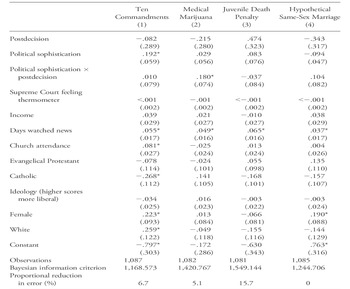
Table 1 presents the results of our estimation of probit models for each of the three “real” Supreme Court decisions and the one hypothetical case that was inserted in the survey to verify that respondents were not reacting to the general rise in media attention to the Court that comes at the end of the Court’s term in June (Franklin and Kosaki Reference Franklin1995). The (at the time hypothetical) same-sex-marriage question also serves to verify the validity of the question used in each of the three models: some criticize a question asking the respondent whether they have heard of a particular case as prone to respondents misreporting what they have and have not heard (Franklin et al. Reference Franklin, Liane and Herbert1993; Hoekstra Reference Hoekstra2003). As these results indicate, there is no significant increase in awareness of a same-sex-marriage case following the June decision period for the Court, so it would seem that respondents are responding to real rather than imagined stimuli.
Probit Estimates of the Effect of Supreme Court Decisions on Case Awareness
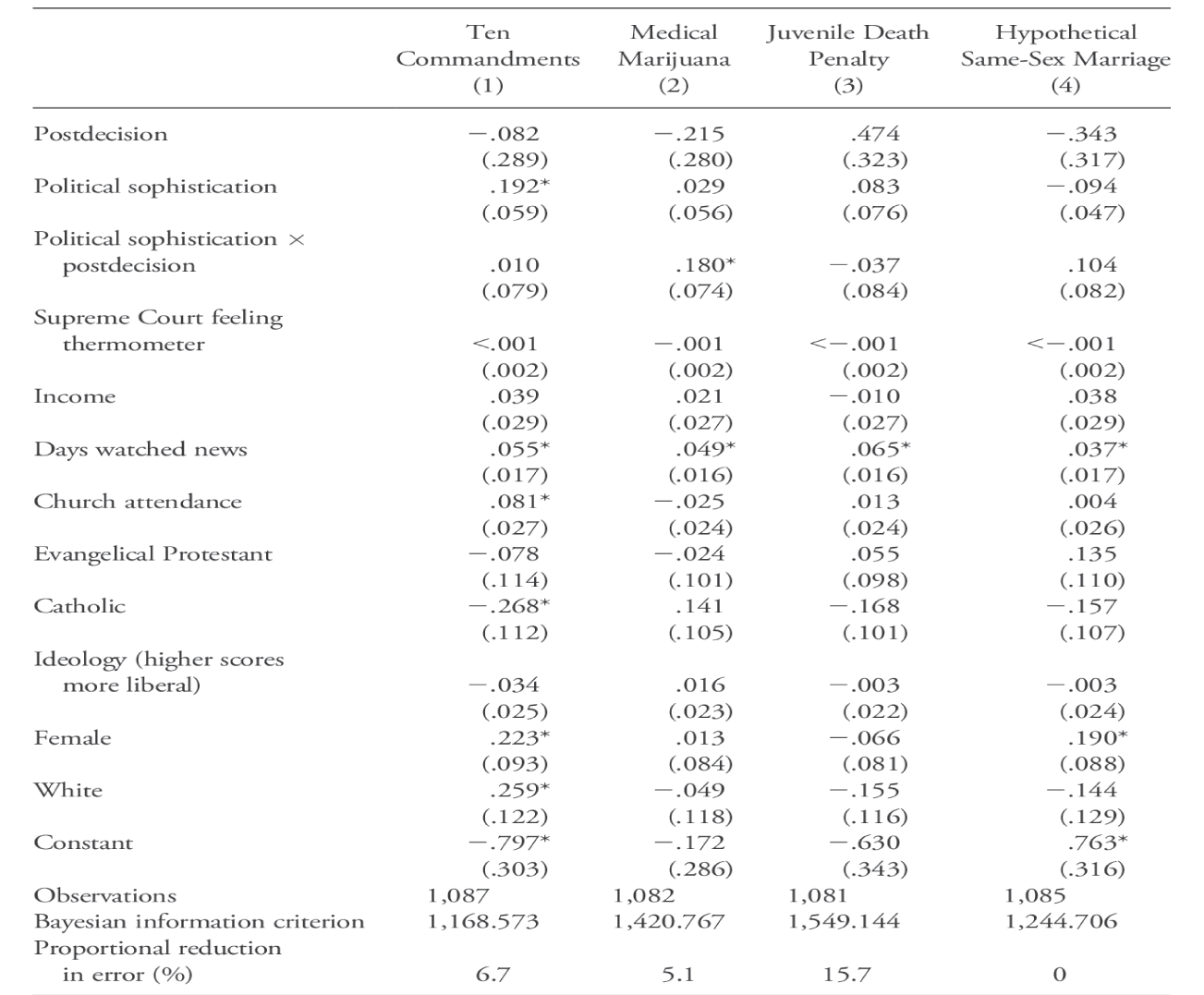
Note.— Robust standard errors in parentheses. Dependent variable = has respondent heard of the case? (1 = yes).
* Significant at 5%.
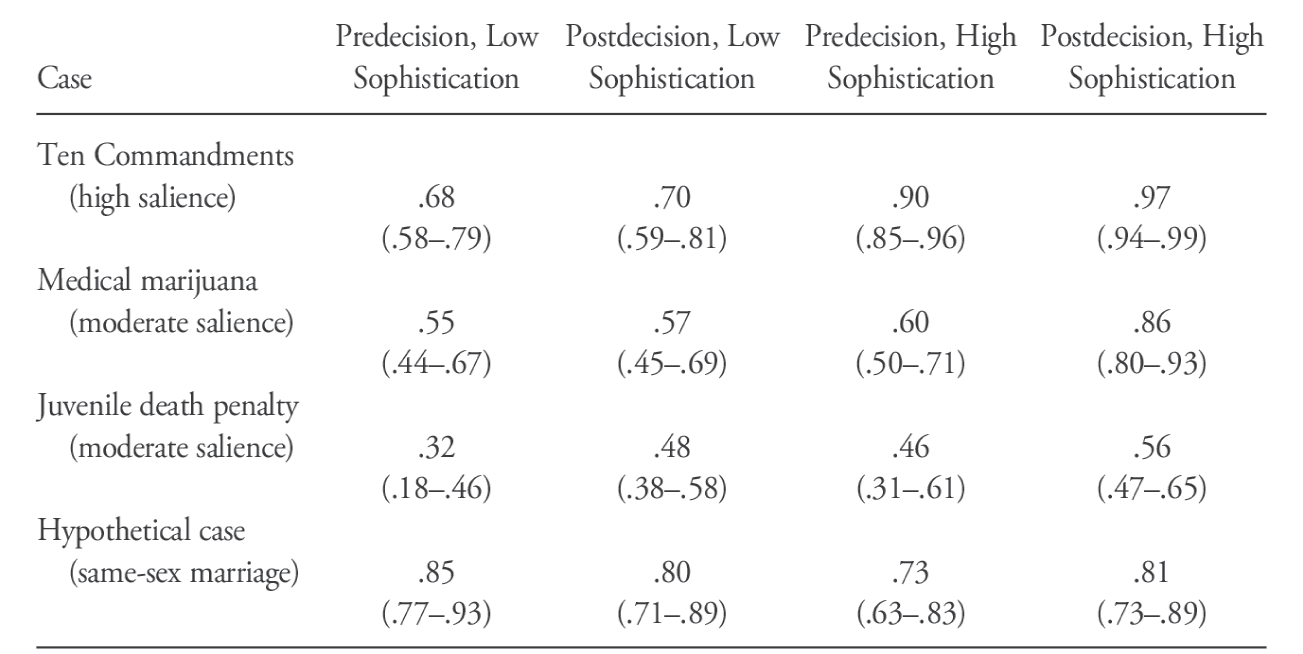
Our first hypothesis is strongly supported by the results. Respondents are more likely to report hearing of a decision in the postdecision waves for each real case, and the effects have practical as well as statistical significance. As Ai and Norton (Reference Ai and Edward2003) note, since we include an interaction term in these models, the sign and statistical significance of the coefficients associated with those interactions may be misleading. Therefore, table 2 reports the predicted probability of awareness for the three real and one hypothetical case in our study before and after the decision announcement, for individuals with high (+2 standard deviations) and low (−2 standard deviations) levels of political sophistication. For each predicted probability, index values were set at the mean value for interval variables, the median value for ordinal variables, and the modal value for binary variables.
Predicted Probability of Case Awareness, before and after Decisions
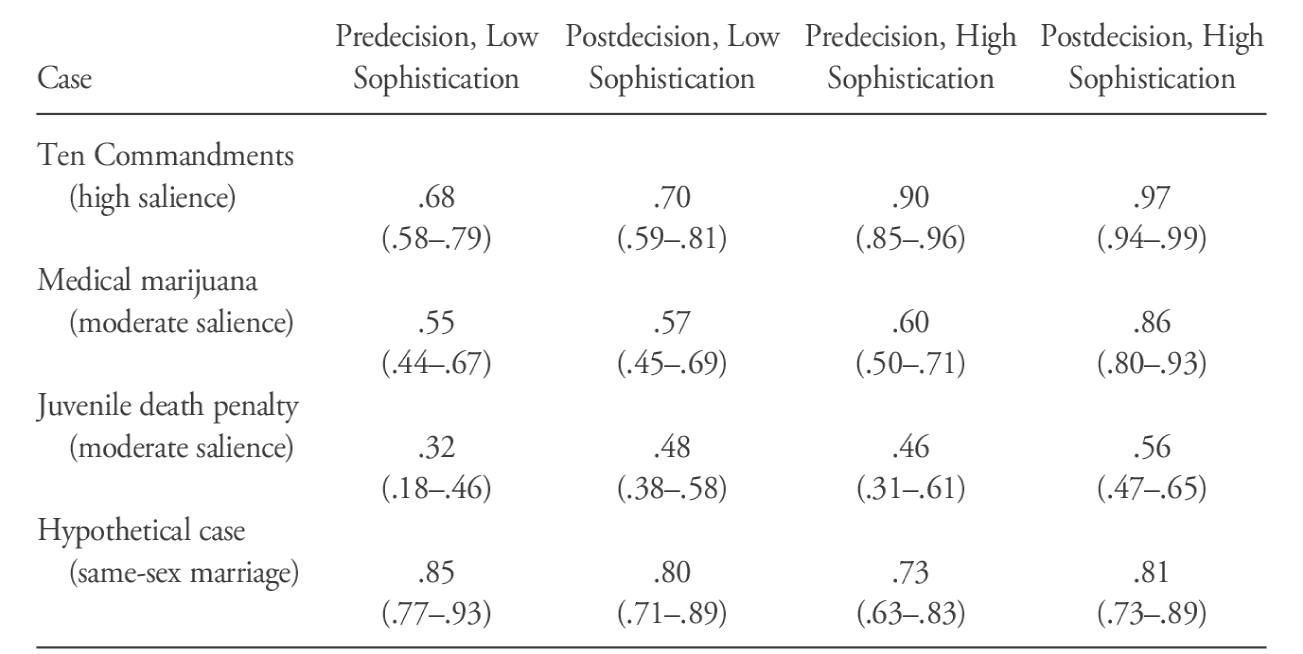
Note.— Predicted probabilities estimated via the margins command in Stata 14.1. Ninety-five-percent confidence intervals (in parentheses) estimated via the delta method. Index values set at the mean for interval variables, the median for ordinal variables, and the mode for binary and categorical variables. Low sophistication is equivalent to 2 standard deviations below the mean; high sophistication is equivalent to 2 standard deviations above the mean.
For more politically sophisticated individuals, the predicted probability of awareness of the Ten Commandments case increases by seven percentage points after the decision, to 97%. Yet, as table 2 shows, among the more sophisticated, baseline awareness of more salient cases like Van Orden is quite high even before the decision is announced. For the other two cases, the effect is even more substantial. For the medical marijuana case, more sophisticated respondents had a predicted probability of hearing of the case of 60% before the decision and 86% after the decision, an increase of 26 percentage points. For the juvenile death penalty case, decided in March and not June, the predicted probability of hearing of the case among more sophisticated individuals was 46% before the decision and 56% after the decision, an increase of 10%.
Table 2 shows that high-sophistication individuals are likelier to report more awareness of cases before and after decisions. Table 2 further shows that the effect of the Court’s own activities varies by the salience of the case itself. The largest and most statistically durable effect of decision announcements in table 2 is the 26% increase in the probability of awareness of the medical marijuana case among high-sophistication individuals. The marijuana case received a flurry of newspaper coverage at the time of the decision and very little before the decision, indicating that media activity can increase awareness of moderately salient Court cases among more sophisticated individuals.
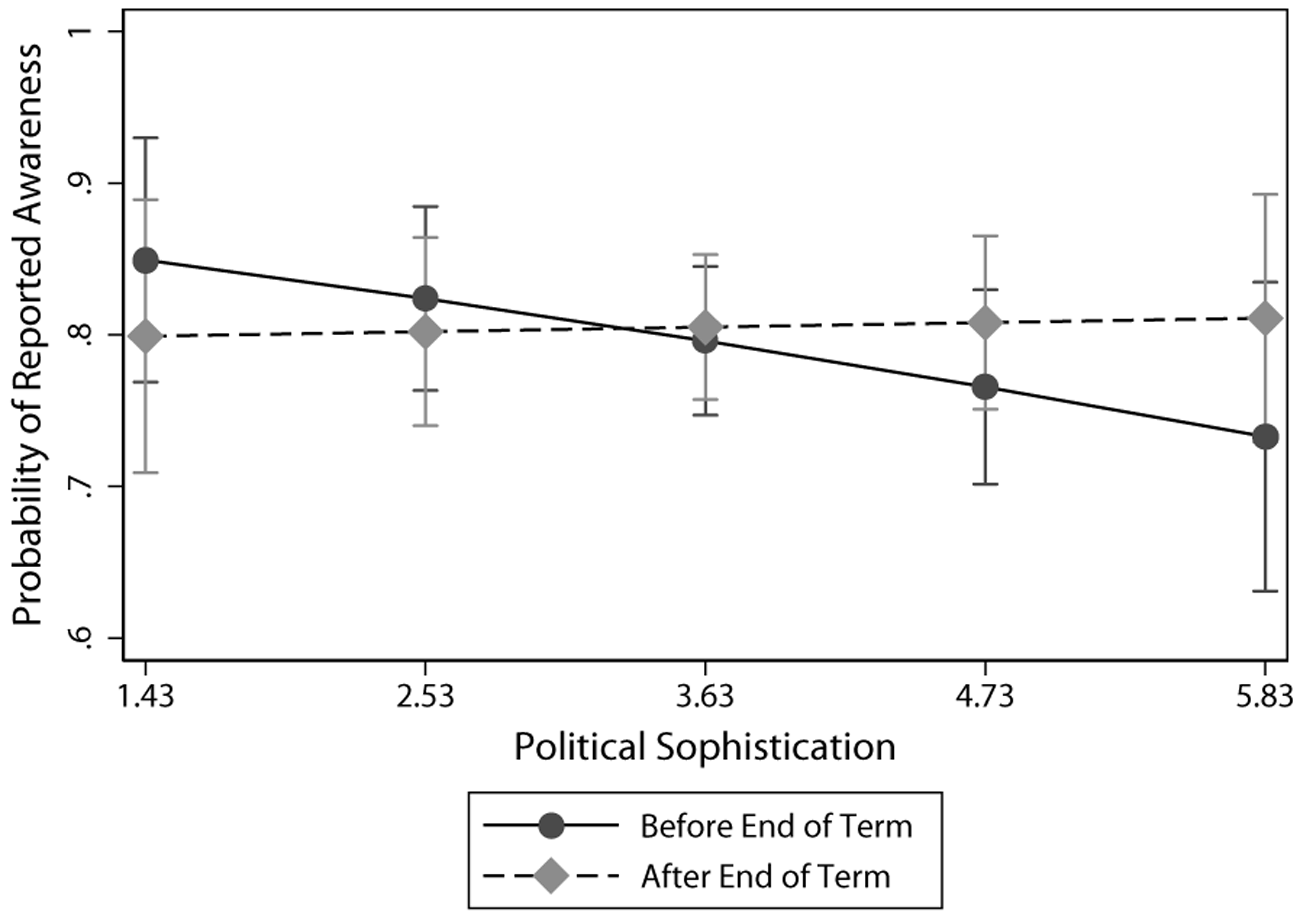
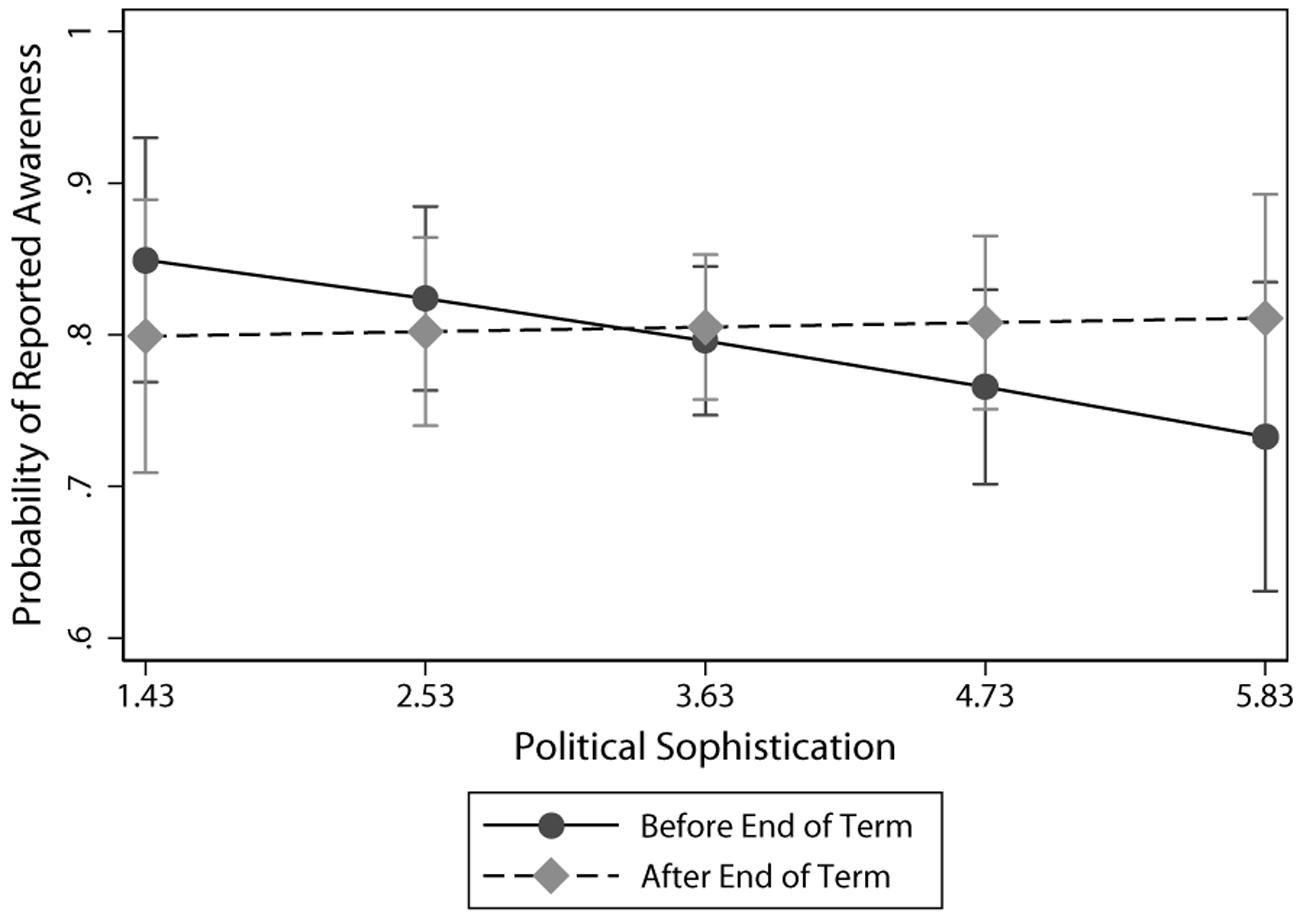
In contrast, while many respondents did mistakenly report awareness of a hypothetical case, the flurry of decision announcements at the end of the Court’s term was associated with an interesting and unexpected dynamic in self-reported “awareness.” Before this flurry of media activity, less sophisticated respondents were 85% likely to report false awareness, compared to 73% among more sophisticated respondents. Intriguingly, the predicted probability of awareness rises (although these changes are within the confidence intervals) among these more sophisticated individuals by the end of the Court’s term. It is possible that consuming news about the Court inspired this false recall or, perhaps, given the flurry of coverage, that these individuals were more reluctant to admit they had not heard of something. Regardless of the precise mechanism, this dynamic is worthy of further study.
These effects suggest that the Court can make itself heard through the noise of other political events and that the effect may actually be greatest not on those cases, like the Ten Commandments case, that are already the subject of the greatest attention but on cases that may operate at the margins of the public’s (and the media’s) attention before the Court issues its ruling. Moreover, high-sophistication individuals exhibited a generally stronger response to the stimulus of decision announcements, indicating that increases in awareness are primarily driven by an elite subset of the population.
At the same time, we find an interesting relationship between media coverage and increases in awareness. Media coverage was far greater on the Ten Commandments case than on the other two cases, but the effect was smaller. One might consider this to be a product of the baselines in a statistical as well as a substantive sense. Statistically, the median respondent is closer to a probability of 1, so any marginal effect calculated using a maximum likelihood technique would be smaller, even if the coefficients were the same for postdecision across models. In a substantive context, though, the same concern is relevant: the public clearly reports high levels of awareness for the Ten Commandments cases throughout the waves, while the shifts are more noticeable in Roper and Gonzalez. This may prove to be the situation in which the media is most helpful to the Court: not in aiding awareness of decisions at the top of its agenda but in promoting awareness of those cases that, while salient, may not be “the” case for a term. These findings offer conditional support for hypothesis 2.
We reinforce existing studies (Franklin and Kosaki Reference Franklin1995; Hoekstra Reference Hoekstra2003) in finding that individuals who pay more attention to current events, measured by television news viewing, are more likely to demonstrate an awareness of the Court decisions. We therefore reject the null hypothesis 3. The effect is consistent across the three cases. The effects are substantively modest: an additional day of television news viewing (from 5 to 6 days) increases the probability of hearing about the Ten Commandments case by 1.1%.
Interestingly, increases in television news consumption are positively and statistically significantly associated with reported awareness of the hypothetical same-sex-marriage case. As we discuss below, general political sophistication (the ability and motivation to process political information) is not associated with awareness of the hypothetical case. As such, our results suggest that viewers of television news may be more likely to be misinformed about current events or overconfident in their knowledge of current events or both.
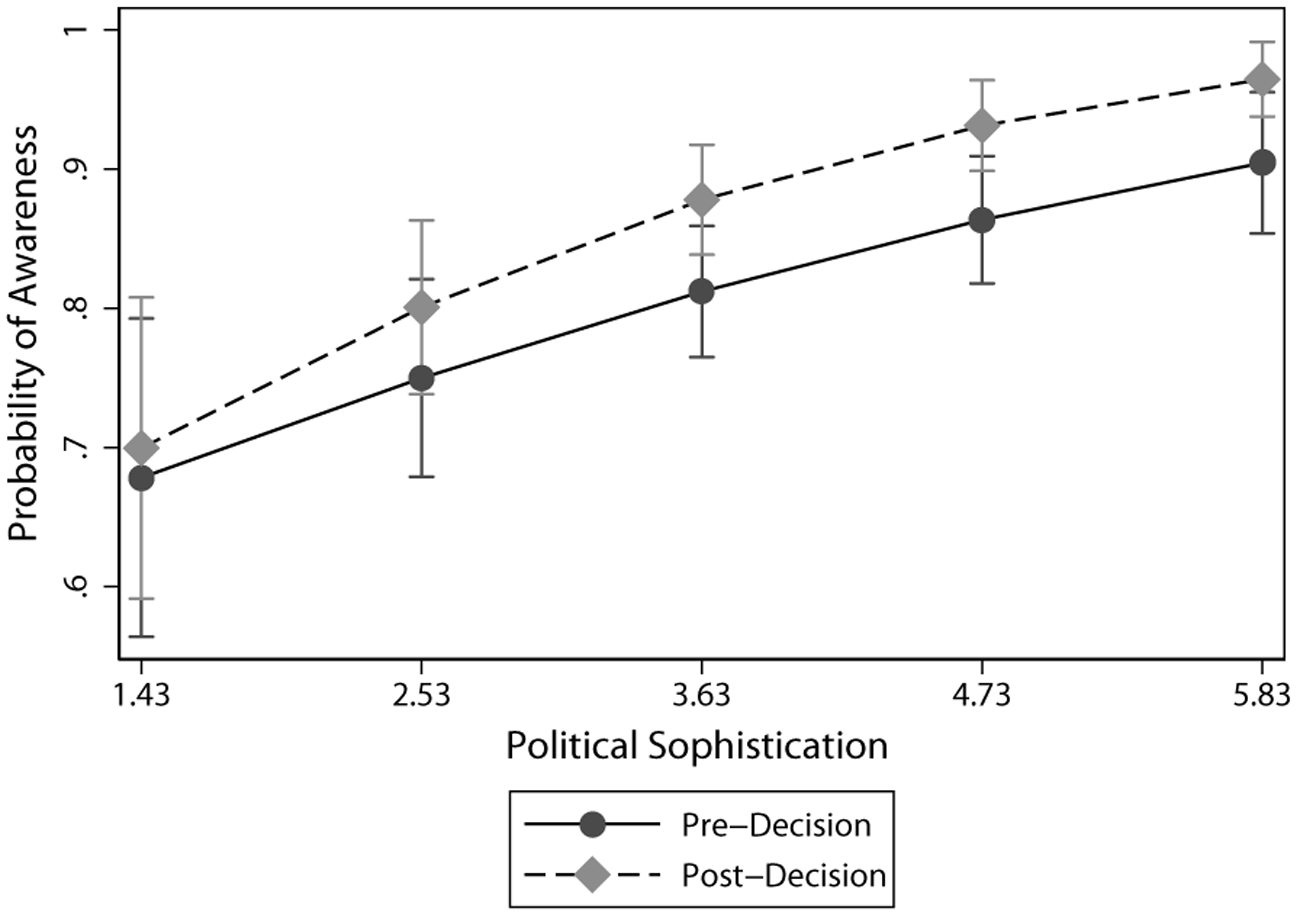
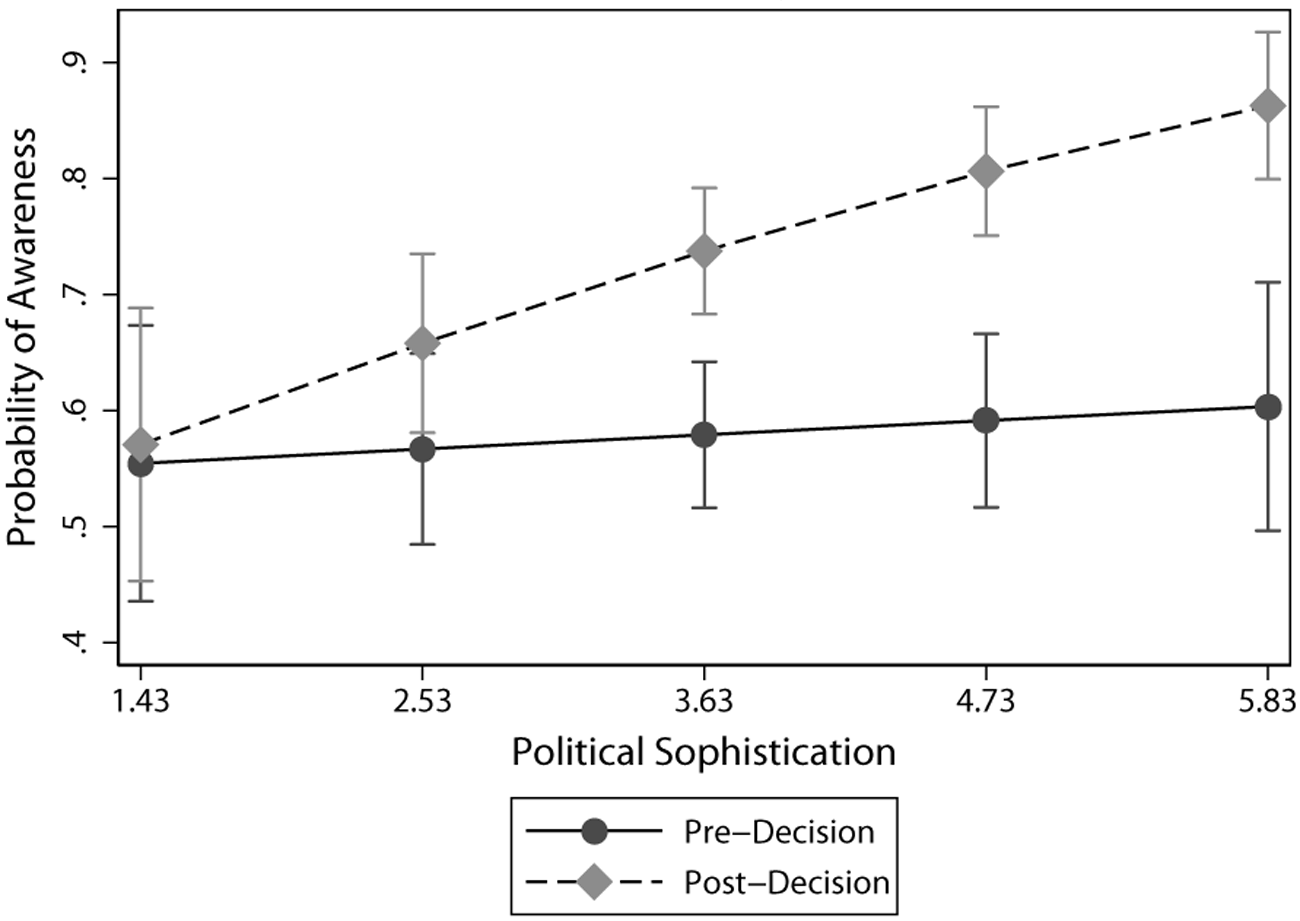
We also hypothesized that individuals with greater cognitive ability and motivation to seek out political information would report greater awareness of cases. We measured this concept, which we term political sophistication, by factor analyzing education, political knowledge, and newspaper consumption. As Ai and Norton (Reference Ai and Edward2003) show, the statistical significance and sign of interaction coefficients in nonlinear models can be misleading, and therefore graphical interpretation is preferable.
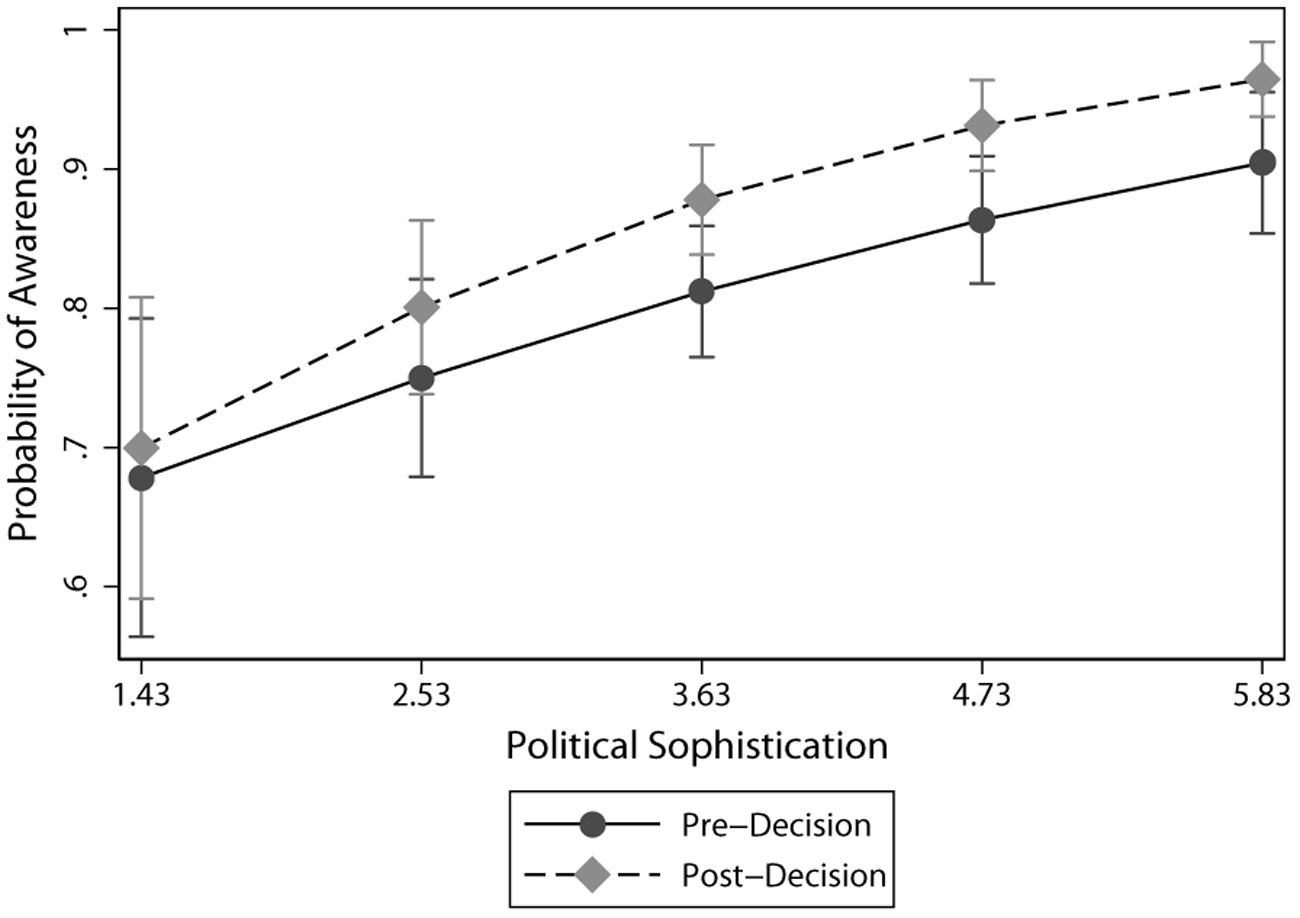
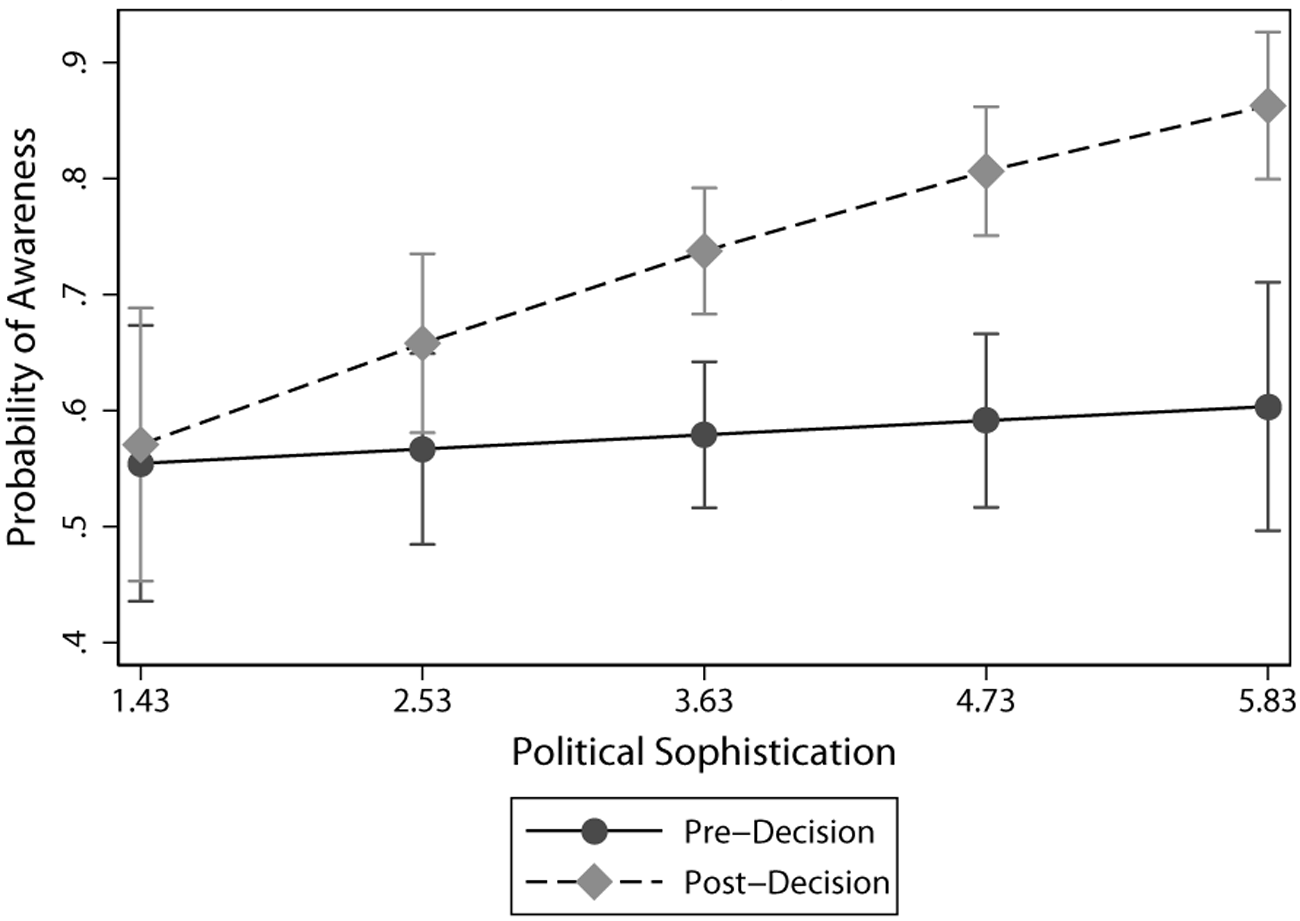
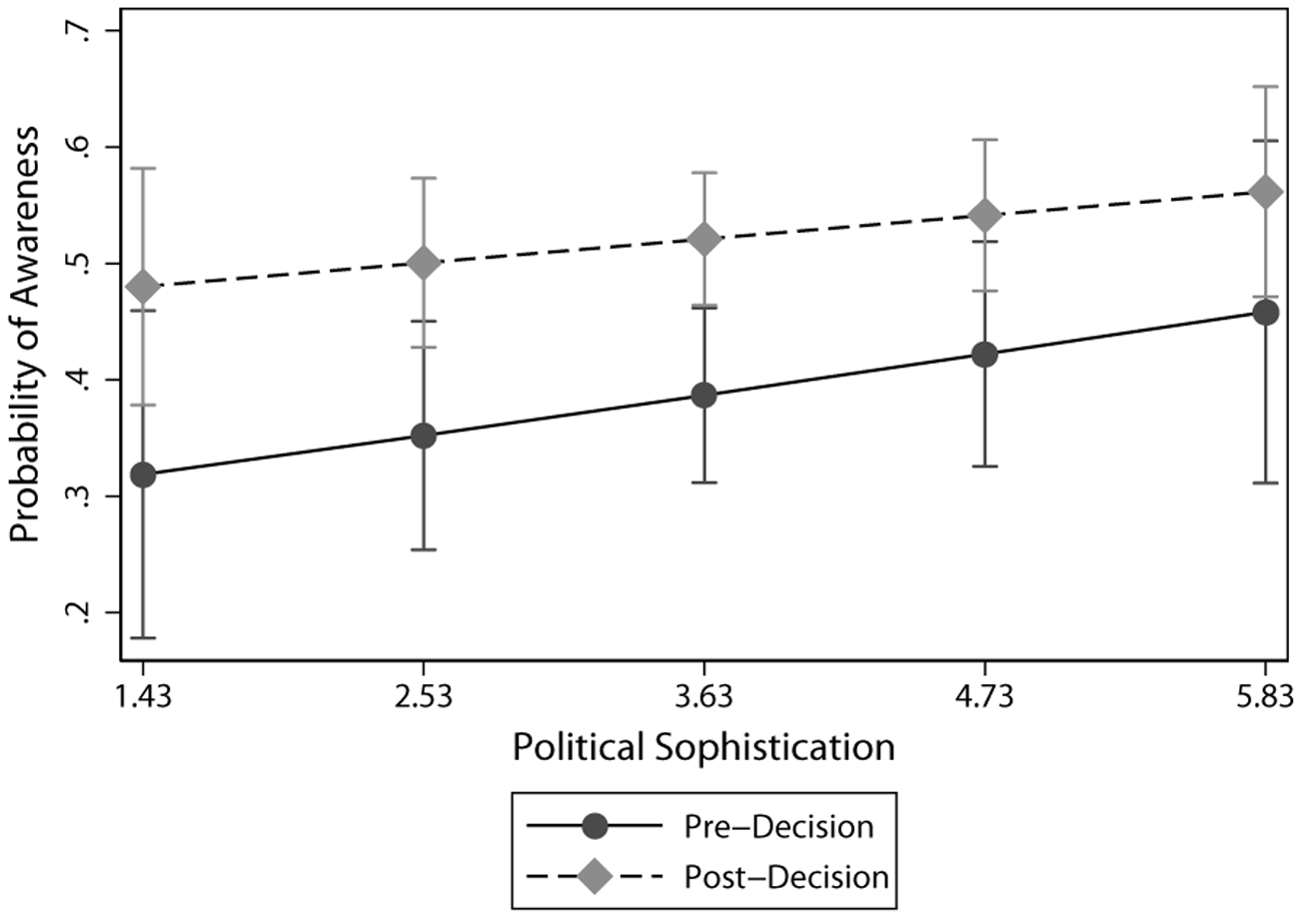
Figures 1 –4 therefore show the predicted probability of case awareness across a ±2 standard deviations range of political sophistication, before and after decision announcements. Figures 1–3 show that for the real cases, more sophisticated individuals are more likely to report awareness, both before and after decisions are announced. The effect of political sophistication is more modest in the juvenile death penalty case. This dynamic is unsurprising, given that it received less media coverage than the other case of moderate salience (medical marijuana; see table 1).
Effect of political sophistication on Ten Commandments case awareness
Effect of political sophistication on medical marijuana case awareness
Effect of political sophistication on juvenile death penalty case awareness
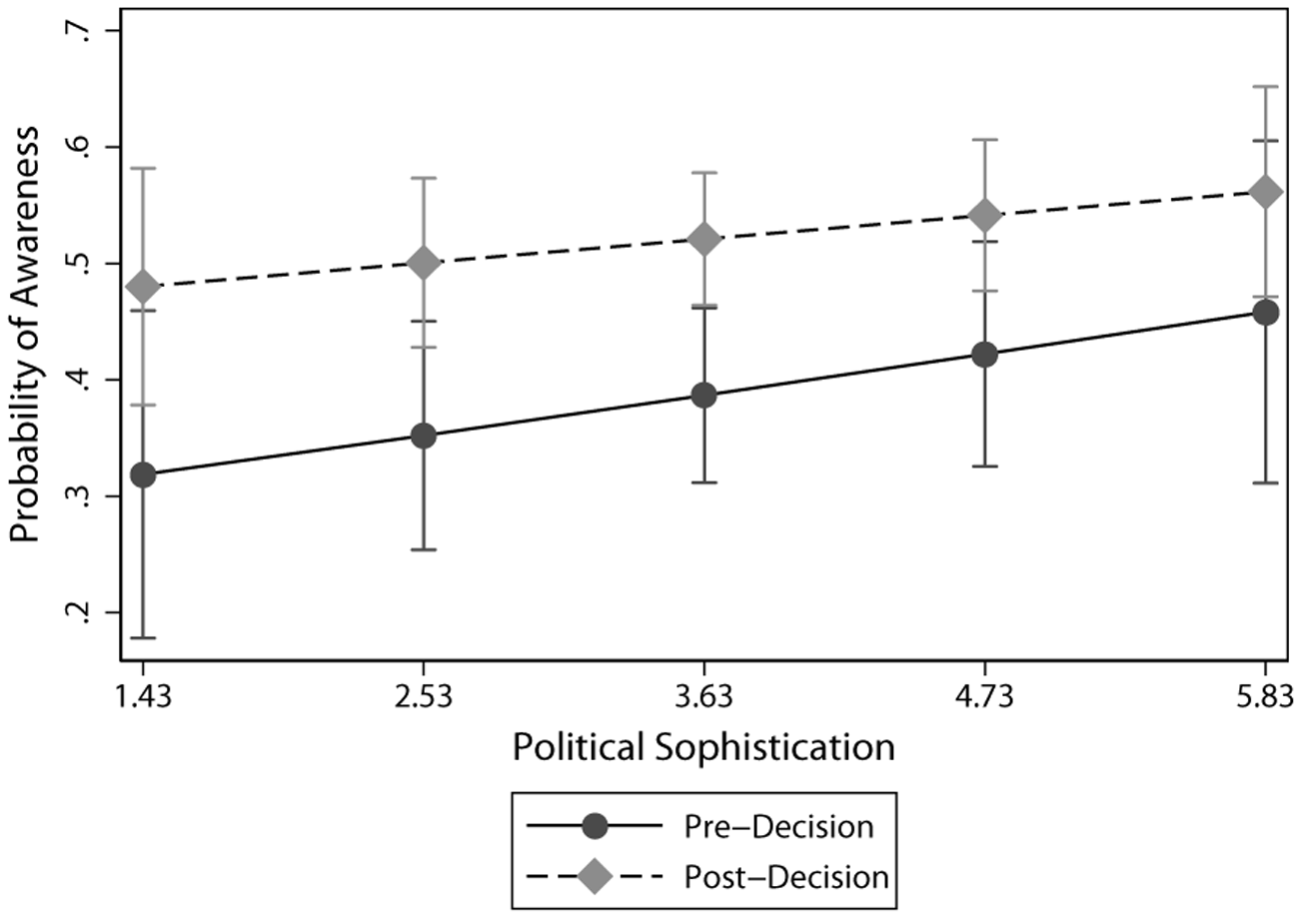
However, even for this case, going from 2 standard deviations below the mean of sophistication to 2 standard deviations above the mean raises the predicted probability of awareness from 47% (95% confidence interval [CI]: 38–57) to 57% (95% CI: 48–65) after the decision was announced. The confidence intervals overlap, but only barely, and the magnitude and direction of association are in the hypothesized directions. Further, figure 4 shows an essentially flat (after the end of the term) and negative (before the end of the term), not statistically significant, relationship between sophistication and awareness of the hypothetical case. These results are generally supportive of hypothesis 4. While the effect precision and size vary somewhat by case, individuals with greater cognitive ability and motivation are more aware of the Court’s activities.
Effect of political sophistication on hypothetical case “awareness”
Discussion and Conclusion
Previous attempts to ascertain the impact of Supreme Court decisions on public awareness of the issues surrounding Supreme Court cases have left scholars with a fairly solid impression that these decisions can affect awareness of cases. The issuance of the decisions themselves is associated with an increase in issue awareness, but the properties of that increase have not been fully explored. We add to the existing literature in several ways. First, we collect predecision data on awareness, something only Franklin et al. (Reference Franklin, Liane and Herbert1993) have done before. The predecision data allow a stronger claim about awareness and the decision itself, and our research design allows for some confidence in the claim that the issuance of the decision is a potential proximate cause of the increased issue awareness, although to be sure dispositive causal inference with observational data such as these is always fraught with difficulty.
Second, we find that the marginal impact on awareness of decisions is actually greater for lower-salience cases. Franklin and Kosaki (Reference Franklin1995) argue that greater levels of media coverage translate into greater awareness, but our findings suggest that some cases benefit from already high levels of awareness, and it is less salient cases (still not typical Supreme Court decisions) that benefit the most from the issuance of the decision and the attendant media coverage. We found a greater impact for the decision for the medical marijuana and juvenile death penalty cases than we observed for the Ten Commandments case, which was far and away the leader in media coverage. We certainly do not argue that there is a perfect inverse relationship between media coverage and public awareness, but we do suggest that the benefit Supreme Court cases gain from media coverage is not universal.
Third, our analysis attempted a more refined understanding of who paid attention to Supreme Court decisions. We found that the effects of Court decisions are more widely spread across the public than previously expected; generally, with one notable exception, no subgroup of individuals in any of the cases we measured was more or less likely to have heard of a Supreme Court case postdecision. The effect was evenly spread, suggesting the Court may effectively transcend uneven and incomplete media coverage (Slotnick and Segal Reference Slotnick and Jennifer1998; Spill and Oxley Reference Spill and Zoe2003). The implications for these findings are heartening from the perspective of concern about the Court’s presence in the American public. In the same breath that we are told that more Americans can name the Seven Dwarfs than Supreme Court justices, we find that people do attend to the decisions (if not the personalities) of the Court, reinforcing the positivity bias the Court enjoys (Gibson and Caldeira Reference Gibson and Gregory2009).
However, we do find that some respondents—those with greater combined levels of education, political knowledge, and newspaper consumption—generally exhibited greater awareness of cases, before and after decisions. This dynamic suggests that only a subset of the public monitors the Court most closely. Given the prominence of awareness (or at least potential awareness) in theories of congressional and public constraint on the Court (Clark Reference Clark2011; Black et al. Reference Black, Ryan J. Owens and Patrick2016), future work might explore the implications of this sophistication bias in awareness for these theories of constraint. In particular, any constraining effect the public has on the Court may be conditional on the preferences not of a typical citizen but of an educated and elitist subset of the population.
The data for this study were collected in 2006. The media environment in the intervening decade changed. In particular, consumers’ media choices expanded dramatically, and viewers increasingly became able to primarily consume news that aligned with their partisan viewpoint (Arceneaux and Johnson Reference Arceneaux and Martin2013; Prior Reference Prior2013). The impact of these changes on the dynamics we report here cannot be ascertained without commissioning a costly new nationally representative rolling cross-section survey. However, we speculate that the fragmentation and polarization of the media environment would alter the dynamics of awareness we observed in 2006 if and only if two conditions were met: first, that partisan news outlets covered Court cases of moderate salience at different rates than the traditional press, and second, if the rate of consumption of partisan media (with its assumed differential coverage of the Court) by politically sophisticated versus less sophisticated individuals differed from the consumption rates of traditional media within these subsets of the population. If both of these conditions did not hold, then we would expect to find the same dynamics of differential awareness of cases as a function of individual-level sophistication, case salience, and Court activity today as we observed in 2006. Future work should seek to ascertain whether these posited conditions hold today.
Our work also has implications for the fast-moving and important literature on the effect of individual Court decisions on diffuse support for the Court in the mass public (e.g., Bartels and Johnston Reference Bartels and Christopher2013; Christenson and Glick Reference Christenson and David2015; Gibson and Nelson Reference Gibson and Michael2015). Our results indicate that if a Court decision can affect its diffuse support, such effects would probably be strongest among the educated, elite subset of the population that is most likely to become aware of such a decision in the first place.
Future research should continue to evaluate the link between media coverage and case salience. One certainly cannot expect the media to closely cover every Supreme Court decision (and many do not merit the coverage), but the true ability of the media may be to raise the level of the Supreme Court decisions that fall behind what may be considered “landmark” decisions—the one or two cases the Court decides each term that define the image of the Court. We suggest here that coverage of the other cases may be the place where the media has its greatest impact in a world marked by increasingly diverse sources of information.
Appendix A
Question Wordings and Response Options
Decision Awareness
-
• Next, I will ask a few questions about some U. S. Supreme Court cases. First, have you heard or read about the Supreme Court case concerning the Ten Commandments?
-
• Have you heard or read about the Supreme Court case concerning medical marijuana?
-
• Have you heard or read about the Supreme Court case concerning the death penalty for people who commit murder before they turn 18?
-
• Have you heard or read about the Supreme Court case concerning same-sex marriage?
Religious Preference
Do you consider yourself Catholic, Protestant, other Christian, Jewish, Muslim, some other religion, or do you have no religious preference?
(If Protestant, some other religion, or other Christian) What specific denomination is that?
[While we recognize the vast number of ways in which evangelicalism may be defined, we have defined evangelical Protestants by their denominational affiliation. A list of 42 evangelical denominations, compiled by Layman (Reference Layman2001), was used to code whether or not a denomination was evangelical. We coded the following as Protestant evangelical denominations: Seventh Day Adventist, American Baptist Association, Baptist Bible Fellowship, Baptist General Conference, Baptist Missionary Association of America, Conservative Baptist Association of America, General Association of Regular Baptist Churches, National Association of Free Will Baptists, Primitive Baptists, Reformed Baptist, Southern Baptist Convention, Mennonite Church, Evangelical Covenant Church, Evangelical Free Church, Congregational Christian, Brethren in Christ, Mennonite Brethren, Christian and Missionary Alliance, Church of God (Anderson, IN), Church of the Nazarene, Free Methodist Church, Salvation Army, Wesleyan Church, Church of God of Findlay, Ohio, Plymouth Brethren, Independent Fundamentalist Churches of America, Lutheran Church-Missouri Synod, Wisconsin Evangelical Lutheran Synod, Congregational Methodist, Assemblies of God, Church of God, International Church of the Four Square Gospel, Pentecostal Church of God, Pentecostal Holiness Church, Church of God of the Apostolic Faith, Church of God of Prophecy, Apostolic Pentecostal, Cumberland Presbyterian Church, Presbyterian Church in America, Evangelical Presbyterian, Christian Reformed Church, Adventist, Baptist, Holiness, Church of God, Independent-Fundamentalist, Pentecostal, and the Churches of Christ. We also made other coding decisions for other denominations reported outside of the above coding scheme in the same vein using available research.]
Religious Attendance
How often do you go to religious services?
-
0. Never
-
1. A few times a year
-
2. Once or twice a month
-
3. Almost every week
-
4. Once a week
-
5. More often than once a week
Ideology
We hear a lot of talk these days about liberals and conservatives. When it comes to politics, do you usually think of yourself as a liberal, a conservative, a moderate, or haven’t you thought about that?
-
1. A strong conservative
-
2. Conservative
-
3. More like a conservative
-
4. Moderate, Neither, Haven’t Thought About
-
5. More like a liberal
-
6. A not very strong liberal
-
7. A strong liberal
[The measure results from a standard branching American National Election Studies style question.]
Political Knowledge
Just a few more questions. Do you happen to know what job or political office is now held by Dick Cheney?
Whose responsibility is it to determine if a law is constitutional or not? The President, Congress, or the Supreme Court?
How much of a majority is required for the US Senate and House to override a presidential veto?
Do you know which party currently has the most members in the US House of Representatives?
Would you say that one of the parties is more conservative than the other at the national level?
[We coded these five questions (correct answer = 1, incorrect answer = 0) into an additive index of political knowledge, ranging from 0–5. With small exceptions, this follows Delli Carpini and Keeter (Reference Delli, Michael and Scott1996).]
Other Notes
All questions had appropriate refusal and “don’t know” categories but were not reported in here in the interests of space. Also included in the survey and data set were standard demographic variables such as gender, age, race, and income. All measures were constructed using common codings.
Appendix B
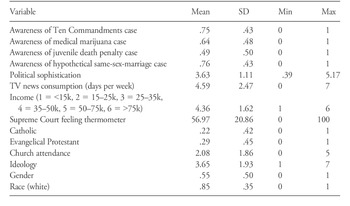
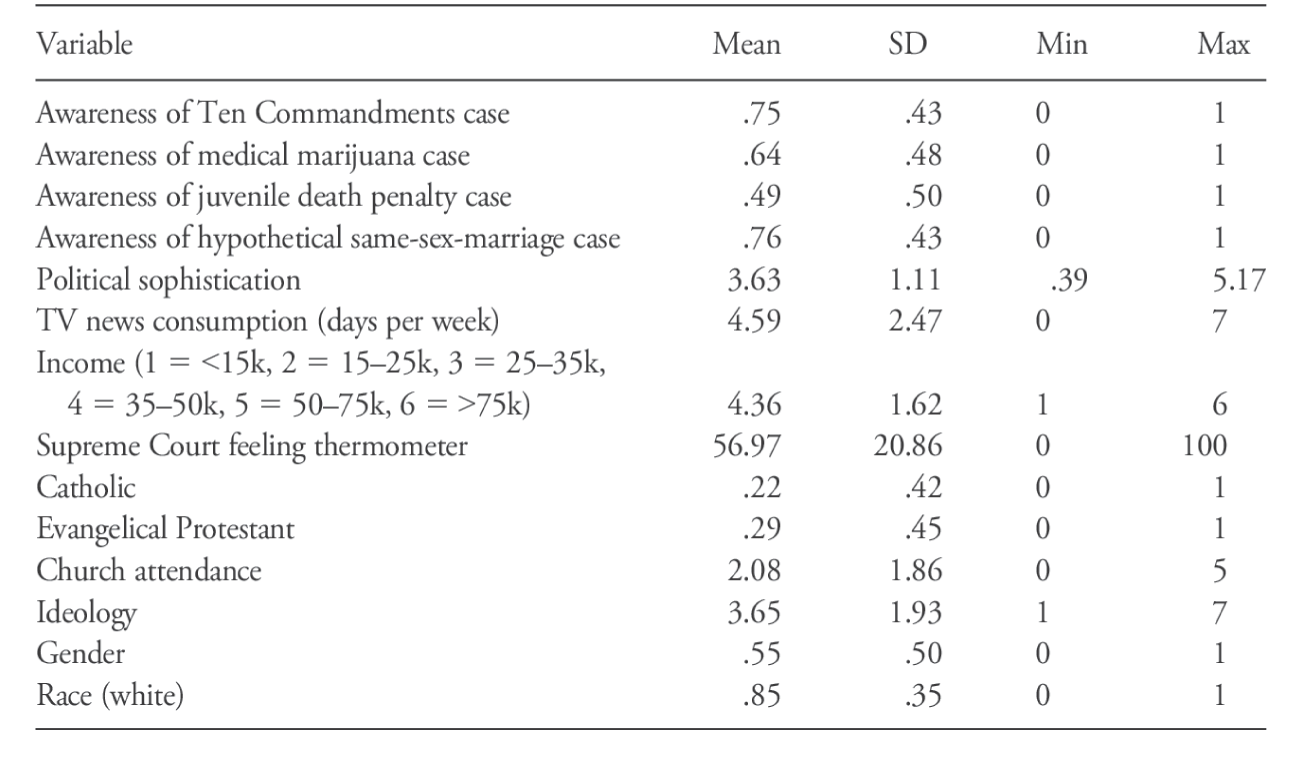
Summary Statistics
Appendix C
Notes on Survey Design, Sampling, and Response Rates
The survey data analyzed in this study comes from a nationwide telephone survey of adult US residents conducted by the Indiana University Center for Survey Research in Bloomington, Indiana (http://www.indiana.edu/~csr/). Average survey length in all four waves (the instrument remained the same for all four waves) was 14 minutes. The first wave occurred between February 15 and February 28, 2005. The second wave was completed between March 8 and April 19, 2005. The third wave was administered from June 28 to July 26, 2005, followed by a fourth wave administered from October 3 to October 24, 2005. The waves bracket oral arguments for Van Orden/McCreary County and Gonzales (between waves 1 and 2), the decisions in Van Orden/McCreary County and Gonzales (between waves 2 and 3), and the decision in Roper (between waves 1 and 2).
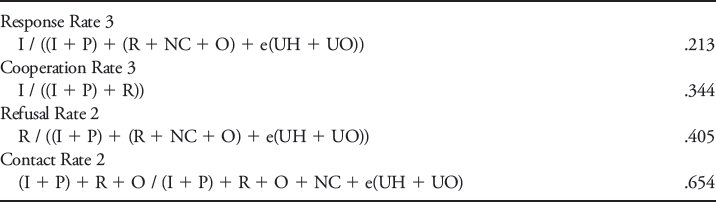
The response rates over each cross-sectional strobe were compiled using standards set by the American Association for Public Opinion Research. These standards (and their definitions) are available at http://aapor.org. For more detail, go to https://www.aapor.org/Education-Resources/For-Researchers/Poll-Survey-FAQ/Response-Rates-An-Overview.aspx. The various rates are within accepted limits.