1. Introduction
In 2016, Language Teaching published a review of research on English language teaching (ELT) and learning in Argentina between 2007 and 2013 (Porto, Montemayor-Borsinger, & López-Barrios, Reference Porto and Byram2016). This review was the first to represent South America in the journal. The review included an overview of the Argentine system of education and language education with a focus on English. The authors organised and analysed the works of Argentine educators published in Argentinian outlets around the following topics: (1) imagination, emotion, and affect, (2) interculturality, (3) teacher education and professional development, (4) content and language integrated learning (CLIL) and interdisciplinarity, (5) digital technologies, (6) individual learner differences, (7) language skills, (8) learning language systems, (9) English for academic and specific purposes, (10) testing, assessment, and evaluation, and last (11) materials and course design. The authors concluded that such a diversity of topics exhibited the multiplicity of interests found in the ELT professional community in Argentina.
As an update to that article, the aim of this review is to analyse the ELT research carried out and published in Argentina between 2014 and 2018. On this occasion, 115 publications were analysed in terms of topic and research methodologies. First, ELT in Argentina is briefly described (for a detailed report see Porto, Reference Piquer, Ponce, Padula, Baduy, Bogliotti, Ledesma and Pérez2014 and Porto et al., Reference Porto and Byram2016). Second, we describe the decisions and criteria for creating the corpus. We then examine the papers according to nine topics, which we list later. Last, we synthesise commonalities and differences in terms of topics and research practices with the previous review (Porto et al., Reference Porto and Byram2016) and put forward implications for future reviews and empirical studies.
2. ELT in Argentina
According to federal agreements on curriculum guidelines (Consejo Federal de Educación, Reference Connell2012), the teaching of foreign languages in the state sector often includes English, French, German, Italian, and Portuguese among others (e.g., Chinese or Mapudungun) and it should be guided by an intercultural and plurilingual perspective that enables learners to develop a comprehensive sociocultural and critical identity. In practice, English is almost exclusively selected as the additional language taught given its international status (Porto, Reference Piquer, Ponce, Padula, Baduy, Bogliotti, Ledesma and Pérez2014). The private sector may include other languages and offer provision in more than two or three languages at the same time.
In a country with a decentralised educational system, each province delineates their own curriculum for kindergarten, primary, secondary, and tertiary education. Drawing on federal agreements (Consejo Federal de Educación, Reference Connell2012), English is a mandatory subject as from Year 4 in primary education in most provinces (provision depends on the state budget and teaching workforce supply) and across the six years of secondary education. It is often allocated two or three weekly hours per each school year, and teachers are encouraged to follow a communicative approach to ELT. In practice, teachers may favour grammar teaching around which vocabulary, language functions, and language skills are built. It should be noted that there are no national or regional exams for any subjects in Argentina. In the case of higher education, university courses offer English language courses framed as English for specific or academic purposes (ESP/EAP) aligned with the minors or majors in which students are enrolled. A common feature is to favour reading comprehension and systematic use of Spanish (usually the students’ first language (L1)) as a central scaffolding tool for second language (L2) learning.
3. The corpus: scope and inclusion criteria
The inputs for this review originate in three main sources: conference proceedings, academic journals and edited collections published between 2014 and 2018. Inclusion criteria follow those established for the previous review:
research whose quality, scope and relevance were consistent with current topics and trends in ELT globally but involved work using local data on local issues and topics. Furthermore, we exclude from this review any Argentinean authors who publish internationally. (Porto et al., Reference Porto and Byram2016, pp. 361–362)
And because we herein review empirical research related to the learning and teaching of English as a foreign language (EFL), we also disregarded:
(a) papers focusing on the description and analysis of specific literary works, or monolingual or contrastive descriptions of English whose aim was not specifically pedagogic, and (b) papers describing a theoretical perspective or reporting a given experience or making recommendations. (Porto et al., Reference Porto and Byram2016, p. 362)
Due to a lack of academic databases specialised in published research related to the teaching and learning of foreign languages in Argentina, we examined the websites of universities and the main colleges of education with foreign language programs, as well as those of professional organisations catering for EFL education in search for their academic publications. As academic journals specialised in foreign language education are scarce in Argentina, related research is often published in journals from an education department or in those with a broader interest in language and linguistics.
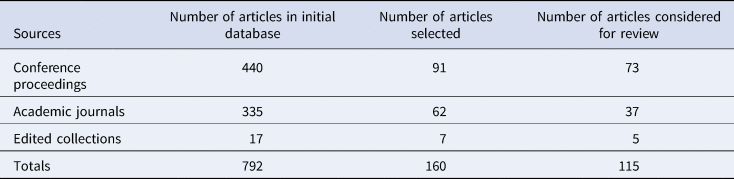
Once the relevant publications were tracked (14 journals, 22 conference proceedings, and two edited collections), we gathered 792 possible research items. Next, we selected the papers that were empirical research. This reduced the corpus to 160 items: 91 articles from 16 conference proceedings (57% of the sources), 62 from eight academic journals (39%) and seven articles from two edited collections (4%) (Table 1). In the process of writing the review, we discarded about a quarter of the articles, thus reducing the sources to 115 items, as on closer inspection we detected duplicate reports or missing/limited information such as the selection procedures for the corpus or the participants, or contextual description.
Corpus sources and data culling

In the sections that follow, the publications are organised and reviewed according to nine topics: (1) interculturality and citizenship, (2) language teacher education and professional development, (3) technology-enhanced language learning (TELL), (4) learner differences, (5) language skills development, (6) language systems, (7) EAP and ESP, (8) assessment, and (9) language curriculum development. These topics, randomly sequenced, represent the thematic areas which emerged during the categorisation of each paper. It should be clarified that some papers fitted into more than one category (e.g., language skills and ESP). In such cases, a paper was categorised under the broader theme for the sake of organisation of this review (e.g., a paper about reading authentic materials was included under reading).
4. The intercultural and citizenship dimensions of ELT
Our previous review article (Porto et al., Reference Porto and Byram2016) showed that little attention was given to the intercultural dimension of ELT then, with one article addressing attitudes toward internationalisation such as openness to otherness and tolerance, and another exploring how literature contributes to developing intercultural competence, mainly by developing imagination of the world of others. There was no reference to citizenship considerations. In the present review, the interest in this area is still insufficient in our view, with only six investigations in three provinces that focus on various dimensions: in-service teacher beliefs; student teachers participating in an arts-based pedagogic intervention designed as action research; student teachers designing didactic sequences on the theme of identity and implementing them in secondary schools; curriculum development in state primary schools; an interdisciplinary project with college students in didactics courses in various disciplines; and coursebook thematic analysis. This finding is significant because it means that the local academia is not addressing an area that Byram (Reference Byram2018) considers to be inescapable, namely the conceptualisation of intercultural citizenship in foreign language education as an ‘educational philosophy’ (p. 73) rather than an optional approach or pedagogy, relevant as well in the preparation of future professionals of the language. This is not a limitation that applies only to Argentina, and Byram (Reference Byram2014, Reference Byram2016) has pointed out the need for the routinisation and systematisation of an intercultural citizenship basis for world language education, which is yet to be explored locally.
In our context, Salcedo and Sacchi (Reference Rowsell and Vietgen2014), Basabe, Tamagni Baigorria, and Schiel Yicarean (Reference Basabe, Tamagni Baigorria and Schiel Yicarean2016) and Braun (Reference Braun, Anglada, Sapag, Banegas and Soto2015) carried out investigations that help understand, albeit partially, why intercultural aims have not been embraced as part of the moral and ethical dimensions of language teaching. The difficulty lies in narrow conceptualisations of the cultural. For instance, Salcedo and Sacchi (Reference Rowsell and Vietgen2014) explored the beliefs of 25 in-service teachers in elementary or high schools in Río Cuarto in Córdoba province about culture, the teaching of culture, and their training to teach culture. Using a mixed methods design (a questionnaire and interviews), their findings showed that participants considered culture an integral part of language learning and teaching and expressed feeling well-prepared to address this dimension. However, the in-depth interviews showed that, in the classroom, they tended to focus on the cultural products (e.g., food, music, dances) of English- speaking communities, which is a superficial approach, and acknowledged that their pedagogical knowledge was insufficient. Similarly, Braun's (Reference Braun, Anglada, Sapag, Banegas and Soto2015) action research, designed as curriculum development for the enhancement of intercultural competence in primary state schools in La Pampa, showed that students tended to consider the foreign culture as superior to their own. As Braun herself acknowledges, this finding is worrisome but does not cloud the promising results: the surveys administered to the primary school students and the interviews with the English teachers and headmistresses indicated a positive impact on students’ motivation and learning. In turn, Basabe et al. (Reference Basabe, Tamagni Baigorria and Schiel Yicarean2016) designed an experiential visual literacy, arts- and literature-based, pedagogic proposal for the ELTE (English language teacher education) programme in La Pampa province. Thirty-two student teachers in their early twenties enrolled in the course Cultural Studies in 2014, explored national cultures through art (paintings, films, video clips, and magazine covers), and represented their views on globalisation using selfies in combination with drawing, painting, and poster-making over 17 weeks. Findings showed that, while participants engaged with the proposed tasks during the course, they did not recall them as significant in the deferred feedback they provided. Worth noting is that this study is alone in attempting to explore the importance of arts-based approaches to meaning making acknowledged in the literature (Rowsell & Vietgen, Reference Rose and Martin2017) within English language education, and further research is clearly needed. Furthermore, and sadly, the authors remark that they did not examine ‘the role of English in the activities under consideration’ and this is a limitation. In intercultural citizenship theory and pedagogy (Byram, Golubeva, Han, & Wagner, Reference Byram, Golubeva, Han and Wagner2017), the linguistic and communicative dimensions are not forgotten but rather complement the intercultural and citizenship tenets.
In a pioneering, large-scale longitudinal action research study epistemologically grounded in critical social positioning and involving three secondary schools in the city of Santa Fe, Coudannes Aguirre and Andelique (2016) describe a complex design that involved the creation of ten interdisciplinary projects especially developed to cater for the themes of identity and citizenship in the South American context, chosen on the basis of a survey administered to the students attending these schools. Students of a general didactics course at the local national university observed lessons in these schools, collected data, administered open questionnaires to the students and interviewed their teachers. On this basis and over two years, they designed pedagogic proposals, which they then implemented collaboratively with the classroom teachers. The team wrote reflection logs and produced a video describing the development of the project as part of the action research cycle. As an illustration, one interdisciplinary team included a teacher of English with university student teachers of philosophy, chemistry, and biology; another involved an English teacher working with university student teachers of history, geography, and philosophy and college students of nutrition. The collaborative and interdisciplinary orientation to address citizenship themes in schools is at the forefront in theorisations of intercultural citizenship (Wagner, Conlon Perugini, & Byram, Reference Vázquez and González2018). With a narrower focus but similar interdisciplinary and collaborative basis and research design, Braun and Monserrat's (Reference Braun, Monserrat, Baduy, Bogliotti, Ledesma and Pérez2017) action research involved university students in La Pampa attending the courses Intercultural Studies, English Didactics and the practicum. Students designed didactic sequences on the theme of identity and implemented them in local secondary schools together with their teachers and a language assistant from Britain. Data gathered in the secondary schools comprised learner narratives in video and other formats, presentations on a variety of themes (the school, local festivals, the local national park), posters, photographs, and a survey administered to the students. Findings showed that the experience proved motivating for the secondary school students as they became intercultural mediators and worked in collaboration to share their productions with the school community. The experience was also challenging for the student teachers as it involved a re-conceptualisation of teacher education based on intercultural citizenship premises. Both studies are in tune with recent developments in intercultural citizenship in world language education that foregrounds collaborative, interdisciplinary work carried out transversally in schools and universities to address socially relevant themes in an internationalist perspective and that connect with local communities beyond the classroom and the school (Byram, Reference Byram2018; Byram & Wagner, Reference Byram and Wagner2018; Wagner et al., Reference Vázquez and González2018).
Finally, Sergi (Reference Sarasa and Solís2017) analysed four General English coursebooks to investigate whether they catered for the development of intercultural communicative competence. Contrary to the expectation that standardised tests and materials do not usually focus on the skills associated with intercultural communicative competence, the author showed that these skills were in fact taken care of and concluded that the reason is that they are needed for life and work in current times. Specifically, she found that the lead-in section of these textbooks included rich cultural elements, a focus on cultural values and Socratic questions to foster critical thinking. Raising awareness of the limitation that most of the cultural representations in this section of the coursebooks centred on British and American insights, the author pointed out the need for teachers to complement these textbooks with Socratic questions to develop criticality, reflection, and awareness in the advanced English language classroom.
Overall, while there are few studies designed on the basis of intercultural citizenship principles for world language education, they are solid, significant, and anchored to the tenets postulated by Byram and his colleagues, namely centred on collaboration, interdisciplinary focus, socially relevant themes, internationalist perspectives (beyond exclusive attention to the nation), and bonds with the community beyond the classroom and the school. There is a need for the local academia to embrace this line of work more wholeheartedly as it is an inescapable dimension in language teaching (Byram, Reference Byram2008; Kubanyiova & Crookes, Reference Insirillo and Ortiz2016; Leung & Scarino, Reference Laucírica, Gastaldi and Grimaldi2016). This perspective is best realised through collaborative, interdisciplinary, internationalist, community-based, and arts-based projects implemented transversally at all levels of education, including the education of future professionals of the language (Byram, Reference Byram2018; Byram & Wagner, Reference Byram and Wagner2018; Wagner et al., Reference Vázquez and González2018). An area within intercultural citizenship that remains to be explored in the country is social justice in language education (Osborn, Reference Orta González, Castro, Lanzi de Zeitune and Villagra Márquez2008), non-existent in the period reviewed.
5. English language teacher education
This section reviews those empirical studies that examine ELTE at both pre-service and in-service levels. In Argentina, initial and post-graduate ELTE programmes are offered by public and private universities and tertiary institutions (Amez & Dobboletta, Reference Amez, Dobboletta and Banegas2017). In line with international perspectives (Walsh & Mann, Reference Wagner, Conlon Perugini and Byram2019), ELTE is anchored in sociocultural and critical theories within education and is embraced as a process that combines general education knowledge, content knowledge, and pedagogical content knowledge. In Argentina, it is agreed that pedagogical content knowledge should be the cornerstone of all ELTE endeavours as the focus is on teaching English rather than studying the language as a system. Therefore, studies in ELTE emphasise informed teacher reflection, the practicum in pre-service ELTE, and professional practice. In this section, the term student-teacher refers to students completing initial/pre-service ELTE programmes. Studies in this section seem to cluster around these interconnected categories: (1) criticality, (2) identity, (3) feedback, and (4) teacher educators’ practices. We consider them interconnected as teachers’ and teacher educators’ practices and perceptions run across them.
5.1. Criticality
According to Banegas and Villacañas de Castro (Reference Banegas and Villacañas de Castro2016), criticality in ELT refers to the promotion of both critical pedagogies and critical thinking to empower learners and educators in their contexts and situated social practices. Under this broad term, the seven studies reviewed in this section show that critical pedagogies may be linked to post-method pedagogies in ELT (Kumaravadivelu, Reference Kubanyiova and Crookes2003). Post-method pedagogies seek to help create ELT approaches and practices that respond to the particularities, practicalities, and possibilities found in specific contexts by those who enact language teaching and learning processes.
Post-method pedagogies usually gain traction in pre-service ELTE and among experienced educators in Argentina. By means of a survey, Soto (Reference Sollier2014) investigated a group of student-teachers’ perceptions of post-method pedagogy in ELT. Findings showed that even when the student-teachers valued a prescriptivist approach to grammar teaching, they believed that local and context-responsive pedagogies should be incorporated in ELT through teacher-made materials. Moving beyond ELTE programmes, Tavella and Fernández (Reference Suárez, Tuero and Natal2017) carried out a survey among university ESP tutors to gain insights regarding their professional practices as manifested in course design, materials, and activities. The authors conclude that, inadvertently, the tutors’ practices have shifted and exhibit features of post-method pedagogies as they have developed courses that include topics, input material, and activities that respond to the particularities and practicalities of the context in which they teach. The authors also noted higher levels of reflection and self-evaluation among the ESP tutors, and a sharper focus on learners’ present and future professional needs.
At the intersection of critical pedagogy and critical thinking skills, four studies examined the development of higher-order thinking skills among student-teachers. Basabe and Germani (Reference Basabe and Germani2014) examined the impact of critical pedagogy and critical literacy through discussions on literary texts with student-teachers. Drawing on data collected through focus groups, classroom observation, and interviews with the student-teachers, the authors concluded that there was an increase in teamwork among the student teachers and that they developed higher levels of reflection and confidence to discuss controversial topics such as non-binary sexualities. However, the student-teachers still exhibited a tendency to use description over evaluative comments to discuss a literary piece. Aware of the necessity of imbuing ELT with higher-order thinking skills, Sollier (Reference Sergi2015) analysed student-teachers’ writing of learning objectives in lesson plans. By conducting content analysis, the author reported that student-teachers showed a tendency to include lower-order thinking skills aims, and when they included aims to promote critical thinking, these were not anchored in activities that would scaffold higher-order thinking skills development. With a focus on helping student-teachers become aware of criticality, Caielli and Williams (Reference Busso, López, Moyetta, Raffo and Rezzano2018) analysed a group of student-teachers’ perceptions of their learners by means of critical discourse analysis (CDA). The authors analysed how student-teachers described learners from a vulnerable socio-economic context. They concluded that studies of this nature can help teacher educators guide student-teachers by making them aware of their linguistic choices when referring to learners and educational settings embedded in contexts under difficult circumstances. As part of a larger exploratory-interpretive research project on language teacher cognition (Borg, Reference Borg2006), Regueira, Del Potro, and Di Virgilio (Reference Porto, Montemayor-Borsinger and López-Barrios2018) examined the perceptions of a group of student-teachers towards the use of English and L1 Spanish in their practicum experience. Results showed that through formative interaction with teacher educators and peers, the student-teachers developed a critical approach to language teaching, which allowed them to see the affordance of including learners’ L1 (Spanish) as another tool for English language learning.
Critical thinking skills and critical issues can be developed and addressed among graduated teachers. Martino (Reference Martínez and Picchio2014) employed a qualitative research framework to study how teachers’ perceptions on gender affect learning among primary school learners. While the teachers indicated that a topic such as sports was more welcomed among boys, they acknowledged that choice of topics should be inclusive and gender-neutral. In secondary education, Valsecchi, Sacchi, Salcedo, Baldocchi, and Roccia (Reference Valenti, Galimberti, Anglada, Sapag, Banegas and Soto2016) utilised a sequential research strategy (survey followed by semi-structured interviews) to gather EFL teachers’ beliefs about different aspects of ELT in one Argentinian city. Results yielded teachers’ particular interest in reflecting on the critical roles of culture, technology, and writing skills in the EFL lesson. The authors believed that studies in the field of language teacher cognition can shed light on teacher education programmes and professional development opportunities to promote critical and informed reflections between external theories (content knowledge) and teachers’ beliefs and personal theories drawn on personal trajectories as learners and teachers.
From a different angle but still connected to criticality in ELTE, Montserrat and Mórtola (Reference Mickan and Wallace2018) employed document analysis to examine the history and present of linguistic policies of foreign language teaching in Argentina. The authors argue that the hegemony of EFL in primary and secondary education has been favoured by central and regional policy makers in the country. Such policies, they show, have been enacted at the expense of other modern foreign and heritage languages in Argentina, and therefore, the so-called plurilingualism and linguistic diversity promoted in official documents is marginalised or simply absent in practice.
A common concern across these studies is the need to implement context-responsive pedagogies that value local social practices and provide educators with pedagogical resources to enable learners to develop their critical thinking skills. In addition, the studies above illustrate that critical thinking and critical pedagogies in relation to potential topics and cognitive development in ELT should be considered among both student-teachers and experienced teachers regardless of the level of education they may teach. More importantly, these studies should be seen as a warning sign: ELT needs to engage in pedagogies that do more than superficial language learning. EFL should be seen as another opportunity in the curriculum for the development of critical citizenship, plurilingualism, and empowerment; this highly complex conceptual shift should start in initial teacher preparation.
5.2. Identity
With the exception of Mulone (Reference Moyetta, Moyetta, Raffo and Rezzano2017), studies into teacher identity concentrated on student-teachers’ trajectories employing narrative inquiry (Barkhuizen, Reference Barkhuizen, McKinley and Rose2020) within one academic year. Despite this difference, the studies reviewed in this section adopt a qualitative research paradigm to explore how the authors (researchers examining their own practice or interviewing present and past student-teachers) have made an imprint on (future) teachers’ sense of professional identity.
Inscribed in narrative inquiry, Sarasa (Reference Sapag, Boldrini, Banegas, López-Barrios, Porto and Waigandt2014, Reference Sarasa2017) carried out small-scale studies with her own pre-service student-teachers to understand their trajectories while attending the author's module on communication. Through student-teachers’ reflections materialised into narrative and poem writing, the author concluded that her own practices allowed them to reflect on and develop their own present and future professional selves thanks to the autonomy and reflection dimensions featured in the module. In a similar vein, Sarasa and Solís (Reference Sarasa2017) explored the storied construction of future teachers’ professional identity as expressed in multiple narratives and journal entries co-composed with ten student-teachers at a state university. The authors reported that the narratives co-constructed with their student-teachers permitted the understanding of student-teachers’ re-negotiation of present and future professional and personal identities through their university-based trajectories.
De Laurentis (Reference De Francesco, Lauría, Roseti, Gastaldi and Grimaldi2015) reconstructed a narrative experience carried out with her student-teachers to explore the impact of culture as a tool to comprehend reality and narrativity as a natural form to organise experience in their identity construction. In this sense, the student-teachers developed awareness of their own perceptions of culture together with meta-analysis of narrative inquiry in their own development as future teachers. In turn, Mulone (Reference Moyetta, Moyetta, Raffo and Rezzano2017) conducted research into EFL teachers’ own professional identity after graduation. Data obtained from a survey and interviews revealed that as teachers gained experience and reflected on their lived experiences at university, they evolved from a limited and stereotyped perspective of EFL teacher identity to a more complex, broad, and realistic view. The participating teachers believed that their language teacher identity should not ignore wider educational imperatives and key issues and should also include social dimensions such as gender equality or wellbeing.
The five papers reviewed in this section share a similar concern: the centrality of ELTE programmes in teachers’ personal and professional trajectories and how ELTE practices exert an enormous influence on becoming EFL teachers. However, the area of teacher identity in ELTE could benefit from longitudinal studies which examine how specific aspects of ELTE programmes exercise their influence and enter into dialogue with external factors on (future) teachers’ identity.
5.3. Feedback
Feedback is a dominant focus within the studies that examine ELTE, particularly in pre-service programmes. The studies reviewed in this section reveal the authors’ interest in understanding student-teachers’ perceptions and characteristics of effective feedback, and how feedback influences their performance in the practicum and academic writing.
Regarding feedback during the practicum experience, papers examined student-teachers’ perceptions (Percara, Reference Panzachi Heredia, Fernández Beschtedt, Castro, Formiga and Risso Patrón2015) and lesson plans (Rodríguez, Castro, García Álvarez, Scilipoti, & Tacconi, Reference Byram2015) and teacher educators’ perceptions and post-observation feedback (Percara, Reference Panzachi Heredia, Fernández Beschtedt, Castro, Formiga and Risso Patrón2015; San Martín, Faletti, & Helale, Reference Salcedo, Sacchi, Banegas, López-Barrios, Porto and Soto2016). The results from these four studies showed that while teacher educators valued and exhibited formative, guided, and indirect feedback to encourage student-teachers’ reflection and self-discovery on lesson planning and delivery, student-teachers preferred direct formative feedback as it provided them with acute and expert information about their performance. Teacher educators’ feedback was found to help student-teachers develop self-awareness of strengths and room for improvement and manage to identify potential courses of action.
In relation to feedback on academic writing, López Casoli and Berardo (Reference López Casoli, Berardo and Riestra2018) analysed student-teachers’ and teacher educators’ perceptions of written feedback in essays and other genres that employ academic/formal English. Similar to the studies on feedback during the practicum, student-teachers and teacher educators held divergent views regarding the benefits of direct and indirect written feedback. While the former was preferred by student-teachers to improve accuracy, the latter was employed by teacher educators to raise student-teachers’ language awareness and noticing.
While these papers adopted a qualitative perspective and focused on perceptions and practices, future studies should extend research on feedback to areas such as linguistic and textual accuracy in the case of academic writing and local knowledge generation in the case of feedback during the practicum experience.
5.4 Teacher educators’ practices
While almost all the studies reviewed in the previous subsections investigated aspects of teacher educators’ practices or were conducted by teacher educators in their own modules, a few papers reported on teacher educators’ interest in improving their own or others’ overall practices. Such a focus seems to acknowledge the influential role that teacher educators’ practices have in shaping future teachers’ professional lives. It also recognises the need to investigate ways in which teacher educators’ declarative knowledge of ELT methods and approaches are reflected in their own teaching.
Marconi (Reference Mahmoudi and Mahmoudi2016) analysed her own teacher educator's practices with a group of student-teachers at a university ELTE programme to find ways of improving her teaching and the student-teachers’ overall experience. Through an interventionist model which combined her pedagogical and research interests, she designed lesson plans for a group of secondary school learners, which were reviewed by the student-teachers before implementation. Drawing on data collected by means of questionnaires, the experience allowed the student-teachers to become aware of aims, activity sequencing and pedagogical adaptations to suit different learners’ needs.
Yuni and Díaz (Reference Warschauer, Zheng and Park2015) studied how three different tertiary ELTE programmes supported their student-teachers to exercise their agency in making pedagogical decisions. Following a qualitative research approach, the authors carried out interviews and classroom observations with teacher educators. The authors found three dominating models of teacher educators’ practices: transmission, co-construction, and eclecticism, in which the teacher educators refrained from direct instruction.
Basabe (Reference Basabe, Gastaldi and Grimaldi2016) studied the teaching of literature in an ELTE programme at a state university. To this effect, he interviewed teacher educators in charge of literature modules and found that even when the ELTE programme sought to promote three literature teaching models, cultural, linguistic, and personal growth (Carter & Long, Reference Cardini, Soliz, Moyetta, Raffo and Rezzano1991), primacy was given to linguistic and cultural models.
As a preliminary conclusion, we may advance that Argentina can offer varied contributions in the field of pre-service ELTE at undergraduate level. With some exceptions, the papers reviewed above investigate the relationship between teacher educators, particularly those in charge of the practicum and ELT pedagogy modules, and student-teachers in relation to criticality, identity, feedback, and meaningful and formative practices that go beyond instrumental learning. As in the previous review on Argentina (Porto et al., Reference Porto and Byram2016), these studies confirm teacher educators’ interest in reflecting, revisiting, and enhancing their practices as they grow aware of the impact these have on student-teachers’ professional development.
6. TELL
TELL is currently viewed as an umbrella term to encompass different digital tools employed with clear language learning purposes (Walker & White, Reference Walker and White2013). TELL research gravitates on the inherently symbiotic and ubiquitous relationship between (language) pedagogy and information and communication technologies (Chappelle & Sauro, Reference Chappelle and Sauro2017). Between 2014 and 2019, TELL gained traction in a variety of contexts as the eight studies reviewed below show. Such an interest in research on TELL seems to be the consequence of educators who had implemented TELL in their practices and sought to measure the effects of such a change among their learners.
Two studies address teachers’ beliefs and TELL practices in secondary education. Roccia and Sacchi (Reference Requena, Liruso, Bollati, Banegas, López-Barrios, Porto and Soto2015) reported a qualitative multiple-case study including interviews and lesson plan analysis in which they examined the beliefs of four EFL teachers about ICT in language learning. The four participants believed that technology integration was important in the EFL context. However, despite the fact that teachers held this belief, technology was not systematically included in the course curriculum. These beliefs are corroborated in a study carried out in another city within a similar setting. In a survey-based study, Alcaráz (Reference Alcaráz, Leceta and Cúneo2015) collected data from 450 secondary school learners and 12 teachers from one city to analyse the use of netbooks provided by the government in the EFL class in state secondary education. The results indicated that netbooks were not systematically used in class, and only a limited number of participants reported their use to watch video segments for guided listening skills development.
In contrast, TELL seems to find more traction among ELTE and ESP tutors and learners. Studies focused on TELL in higher education showed researchers’ interests in understanding tutors’ and learners’ use of information and communication technologies (ICT) and its impact on different areas of learning such as reading skills or intercultural awareness (Gava & Anglada, Reference Gava, Dalla Costa, Kofman, Padilla Sabaté and Riestra2015). Two studies looked at (self-) assessment of TELL among tutors’ practices. According to these investigations (Innocentini & Forte, Reference Hanks2016; Massa, Morchio, & Schander, Reference Martino2016), tutors should create and evaluate their online materials and their multimedia-based activities against criteria that are the result of consensus between tutors and learners. Regarding learners, Castiñeira and Mucci (Reference Castellano, Garay, García, Anglada, Sapag, Banegas and Soto2014, Reference Castiñeira and Mucci2017) and Orta González and Castro (Reference Oliva, de Maussion, Romano and Amado2017) found that while virtual learning environments (VLEs) were used for completing language learning skills, particularly reading and writing, they were also employed for interactional purposes among learners. These studies also concluded that social networks (e.g., Facebook) or self-managed websites (e.g., blogs) and shared folders embedded in VLEs were a powerful tool for strengthening writing skills development, highlighting learners’ personal and interpersonal skills within a collaborative environment, and for developing critical and creative thinking skills.
What the reports summarised above show is that even when VLEs and blended learning approaches are employed, TELL is always used as an addition to face-to-face language learning. However, studies found in international outlets (e.g., Banegas & Manzur Busleimán, Reference Banegas and Manzur Busleimán2014) reported the use of TELL for entirely online ELTE programmes in the country. Concerning research methods, the papers employed exploratory and action research frameworks to collect data, particularly using interviews, reflective journals, and surveys. While these endeavours contribute to our understanding of TELL, future studies should gather data over longer periods of time and provide in-depth data analysis and discussion. Lastly, research concentrates heavily on higher education settings. Hence, there is a need for more studies in primary and secondary education and language schools, especially to gain an insight into views and practices on remote teaching and learning.
7. Learner differences in English language learning
A multiplicity of learner internal and external factors influences the complex process of foreign language learning (Lightbown & Spada, Reference Levi and Inbar-Lourie2006; Mahmoudi & Mahmoudi, Reference Machado, Lucas, Berardo, Romano and Amado2015). Based on our analysis, the papers reported in this section cluster around three sets of individual differences pertaining to cognitive and affective factors: strategies and learner autonomy, beliefs and attitudes, and affectivity. These three individual differences exhibit authors’ interests in understanding and improving connections between affective factors and academic performance.
7.1. Strategies and learner autonomy
Another set of six studies focuses on vocabulary learning strategies that contribute to learner autonomy (Gu, Reference Grundnig, Himelfarb, Fernández Beschtedt, Castro, Formiga and Risso Patrón2020). The studies are discussed below according to the research methods employed.
With the aim of exploring vocabulary learning strategies among different learners, three research projects used surveys, thus becoming studies based on self-reporting. For example, for comparative purposes, learners from state secondary schools and a university-based secondary school (San Martín & Helale, Reference San Martín, Altamirano, Villanueva de Debat, Banegas, López Barrios, Porto and Soto2017), and teenage learners from a bilingual school and a language school (Alcázar & Altamirano, Reference Alcázar, Altamirano, Barbeito, López-Barrios and Pasquale2017) completed surveys to indicate their preferred strategies for vocabulary learning. In both cases, no significant differences were found as all the learners exhibited a limited number of strategies for vocabulary retention in particular. In another study based on self-reporting, Insirillo and Ortiz (Reference Innocentini, Forte and Feraco2018) identified the frequency of use and the variety of strategies employed by higher education learners attending an ESP course. Results revealed a scarce number of highly used vocabulary strategies. While these studies provide helpful hints with direct pedagogical implications, there should be further efforts for data triangulation and evidence of learners’ actual behaviour.
Closer to experimental designs, three studies dealt with the direct instruction of specific vocabulary learning strategies with higher education learners. Gava, Dalla Costa, and Kofman (Reference Gastaldi, Grimaldi, Mónaco, Gastaldi and Grimaldi2016) provided explicit instruction of strategies for learning collocations and idiomatic expressions. Drawing on surveys and pre- and post-tests, the authors concluded that learners developed autonomy to understand and use collocations and idiomatic expressions. In a similar vein, González de Gatti and Sánchez (Reference González de Gatti, Orta González, Sánchez, Padilla Sabaté and Riestra2016) provided a group of student-teachers with direct instruction of affixes as a strategy for solving gap-filling exercises. According to the data gathered by means of pre- and post-tests, student-teachers improved their performance at the levels of word formation and reading comprehension skills. Another study (González de Gatti, Orta González, & Sánchez, Reference González Carrera, Sosa, Cardozo, Banegas, López-Barrios, Porto and Waigandt2016) focused on strategies for vocabulary retention included an experimental group and a control group. The experimental group received explicit instruction in the use of concordancers to find examples of words belonging to the same semantic field. The authors concluded that the experimental group outperformed the control group in activities which required learners to employ words sharing the same semantic field. Similarly, through the inclusion of control and experimental groups, Valenti and Galimberti (Reference Valcarce, Fernández, Fernández Beschtedt, Castro, Formiga and Risso Patrón2015) carried out a longitudinal study to analyse the effect of the development of metacognitive strategies sometimes aided with ICT on ESP students’ efficiency and autonomy. The authors established a correlation between the development of metacognitive strategies and a better performance as the students of the experimental group outperformed those of the control group in the first stage of this research work. The experimental group also revealed a higher degree of accuracy accompanied by a higher degree of explicitness by the end of the academic year.
While in the previous review (Porto et al., Reference Porto and Byram2016) papers featured research on learning strategies for language skills development, grammar, and lexis, the papers between 2014 and 2018 not only focused on vocabulary learning but also signalled that interest in learning strategies was mostly circumscribed to one large group of researchers established at one specific university. We hope that researchers engage in longitudinal studies to measure the sustainability of their practices and learners’ (perceived) performance.
7.2. Beliefs and attitudes
In this section, three studies related to learners’ beliefs and attitudes are reported. The two first studies in this area refer to secondary school learners, the last one to university students. Barbeito, Placci, Ponce, and Galfioni (Reference Barbeito, Placci, Ponce, Galfioni, Maldonado, Bono and Sigal2016) investigated pupils’ beliefs regarding learning English in the secondary school context. A total of 1,600 fifth-year (16–17 year olds) learners of state and private schools completed a questionnaire consisting of a Likert scale and open questions related to the role of grammar, motivation, learning strategies, materials and use of technology, time devoted to English teaching, use of the target language in class, and discipline. Findings indicated that learners preferred both a deductive and an inductive approach to grammar teaching, that they attributed a key role to grammar in the learning process, and stated the importance of appealing content topics. Additionally, learners expressed they would use learning strategies if they were taught, that they expected teachers to cover most of the coursebook contents and to use other materials, that more class hours would be necessary, and that teachers made little use of the L2 in class. In the other study, San Martín, Altamirano, and Villanueva de Debat (Reference San Martín, Faletti, Helale, Padilla Sabaté and Riestra2016) examined the vocabulary learning beliefs and perceptions of adult and teenage learners in two educational settings: formal (schools) and non-formal education (language schools). The first involved 81 beginning EFL learners from three different institutions, whereas the second included 29 adult learners. The study aimed at finding similarities and/or differences between the two. Data were gathered through a structured questionnaire tapping into the learners’ vocabulary learning strategies, their beliefs about vocabulary learning and the perception of their own vocabulary learning. Irrespective of the age and learning context, results revealed many similarities in both groups, which led authors to consider the social construction of beliefs, for example, the role of aptitude in vocabulary learning, as an influential factor. Results of this study could have an impact on teachers’ vocabulary teaching practices, e.g., by reflecting on the way learners view their vocabulary learning process.
Piquer, Ponce, and Padula (Reference Pico, Sleibe Rahe de Paradelo, Romano and Amado2017) investigated the development of beliefs about the relationship between language and culture in the context of a plurilingual and pluricultural pre-bachelor degree course at a state university. The research aimed at finding out how these beliefs evolved as a group of nine students advanced in their study of English and French. To this end, two open-ended questionnaires were implemented, one at the beginning of the first academic year and another at the end of the second year. A content analysis of the data indicated that subjects’ initial beliefs conceived culture as the customs of native speakers, and that the target culture became explicit in class through the experiences of visitors to the L2 countries. Results suggested that the intercultural approach followed in class had a degree of impact on the initial beliefs, but the causes of the stability of deeply ingrained beliefs should be the object of further investigation.
The previous review by Porto et al. (Reference Porto and Byram2016) expressed the need to involve larger populations in the study of beliefs and attitudes. This is now noticeable in the study by Barbeito et al. (Reference Barbeito, Placci, Ponce, Galfioni, Maldonado, Bono and Sigal2016) which involved 1,600 pupils in both public and private secondary schools, and in San Martín, Altamirano and Villanueva de Debat's (Reference San Martín, Faletti, Helale, Padilla Sabaté and Riestra2016) study of 130 learners in different types of secondary schools as well as in adult education. The geographical distribution of these studies is still the same as in the previous review; again, studies tapping into beliefs and attitudes of learners in other locations and different sociocultural settings would be welcome.
7.3. Affectivity
Three studies addressed the age factor and the affective dimension. We begin with González (Reference González de Gatti, Sánchez, Orta, Romano and Amado2018), Fernández, Marchegiani, Picelille, and Raspa (Reference Fernández, Tavella, Gastaldi and Grimaldi2015) and Fernández and Raspa (Reference Fernández, Marchegiani, Picelille, Raspa, Leceta and Cúneo2016), who studied a population usually under-represented locally, namely senior learners in university settings. González (Reference González de Gatti, Sánchez, Orta, Romano and Amado2018) explored the motivations to study English and related affective factors of a group of 60 adult learners taking part in a university program for adult learning in different disciplines in an exploratory study in the city of Buenos Aires using a questionnaire. Findings showed that a desire for personal growth and a pleasurable setting for learning were significant aspects for this age group. Focusing on university students in their mid and late adulthood (40–65 years of age) learning English, Fernández et al. (Reference Fernández, Tavella, Gastaldi and Grimaldi2015) studied their learning styles, preferences, and motivations as well as the profile and role of the English teacher of this population. Undertaken in 2013–2014 and using a mixed methods design with questionnaires, 80 adult students and 40 cross-curricular teachers of English participated, and findings showed that these adult learners were autonomous, committed to their process of continuing education or lifelong learning, and their affective filter tended to be high. Negative emotional and motivational factors such as anxiety, alienation, embarrassment, or self-consciousness, among others, interfered with the reception and processing of comprehensible input. Consequently, teachers needed to take on an important role as facilitators. In a subsequent study, Fernández and Raspa (Reference Fernández, Marchegiani, Picelille, Raspa, Leceta and Cúneo2016) explored in greater depth the learning preferences of 30 adult students in the same context. They implemented a lesson that consisted of different tasks that catered for each of Gardner's (Reference Ferrara, Gastaldi and Grimaldi1983) Multiple Intelligences. After reading a short story, students were asked to visualise it, reflect on it in writing, retell it orally, debate a theme, conceptualise it using mind maps or similar formats, collaboratively write a dialogue among the characters, read aloud a scene and act it out, and do inferencing tasks. These student outcomes became the data types, followed by a questionnaire. Findings revealed the diversity of student preferences in this age group, pointing to the need to offer classroom tasks centred not only on verbal-linguistic intelligence but also on the intrapersonal, interpersonal and logical-mathematical intelligences.
In a different context, Soto and Waigandt (Reference Soto, Banegas, López-Barrios, Porto and Soto2018) investigated the academic emotions that affect learner performance in oral presentations in a higher education setting. Participants in their exploratory study were ESP undergraduates at Bioengineering and Bioinformatics programmes, who performed oral presentations in pairs or small groups and completed a self-report instrument. Students completed an online questionnaire that comprised 26 questions exploring students’ emotions before, during and after giving their oral presentations. Findings showed that the achievement and epistemic emotions prevailed, with some social emotions also arising. The researchers explored implications, mainly related to the need to foster learner awareness about the fact that emotions can be consciously managed, controlled, shaped, and transformed, as well as teacher awareness of the need to teach strategies to this aim.
In sum, while research in this area is very scarce, it addresses significant topics that resonate with the global research agenda and comprise age factors, particularly the needs and affects of adult learners ranging from 40 to 65, and the role of emotions in world language education (Dewaele, Reference de-Matteis, Granato and Negrín2018; Bigelow, Reference Bigelow2019), including academic environments.
Comparing the number of papers of the 2007–2013 review (Porto et al., Reference Porto and Byram2016) with this one, little has changed in the area of learner differences: the same number of papers are found in strategies and learner autonomy (seven) and in beliefs and attitudes (three), and there is a minor difference in motivation, preferences, and emotions (three and four). By the nature of this line of inquiry, more case studies would be welcome to observe the extent to which contextual factors found in other geographical and cultural settings exhibit similarities and differences with trends observed in Argentina.
8. Skills development
Research under this theme comprises the four skills. However, the majority of the selected papers concentrate on writing, reflecting the interest of local researchers in this area as a tangible measure of learners’ L2 development. Unlike research on reading (see sections 8.1 and 10.1), studies on listening and speaking are scarce, represented by only one paper in each category, indicating an area in which more work is needed. Despite these differences in focus, the papers included in the following two sub-sections exhibit that skills development overlap with other of the categories such as TELL or feedback reviewed in this article. In this regard, the studies illustrate that in terms of research and practice, skills development may act as a space in which other areas are subsumed in a dialogic manner.
8.1. Reading, listening, and speaking
Reading researchers are interested in discovering the factors that improve the reading performance of their students. Vázquez and González (Reference Varela, Verdelli, Gastaldi and Grimaldi2015) examined the extent to which the redundancy effect influenced the L2 reading comprehension skills of two groups of learners whose ages and English language proficiency differed widely. There were 59 participants, of whom 24 were teenagers with low-intermediate proficiency and 35 were advanced EFL majors. Each group was divided into two sets. One was exposed to a single mode of instruction (reading alone) while the other was presented with a dual format (reading and listening simultaneously). Results revealed that students presented with the single mode of instruction outperformed the other group in the reading comprehension task, independently of their command of the language. Furthermore, when comparing results obtained in both read-only groups (low-intermediate and advanced), the students with higher proficiency obtained better results.
Regarding listening, in an action research project, Spataro (Reference Soto, Waigandt, Banegas, López-Barrios, Porto and Waigandt2015) explored how five listening sessions were designed on Moodle 2.3 based on the review of possible activities that aid perception skills and the ways in which ICTs have been used to design online listening activities. Participants were 15 voluntary, intermediate EFL majors. Data were collected from students’ records of the online activities, personal journals after each session, a final questionnaire and pre- and post-IELTS (International English Language Testing Scheme) listening tests. Findings showed that the self-access perception activities designed with different ICT tools were successful. Comparison of the average marks of the pre- and post-tests showed that there was a slight improvement in performance.
Turning to speaking, in a multi-case study, Laucírica (Reference Kumaravadivelu2016) investigated the impact of two-month direct teaching and practice of communicative strategies in a pre-sessional EFL course for newcomers to an ELTE programme, which was later replicated with 4th year ELTE at tertiary level. In both cases, the corpus comprised recorded oral productions and class observations. Findings showed gains in fluency and confidence but no gains in declarative knowledge. It should be noted that the teaching and practice centred on formulaic phrases (see Pérez & Zinkgraf, Reference Percara2017; Rodeghiero, Reference Roccia, Sacchi and Somale2017; Valcarce & Fernández, 2017, who studied formulaic phrases in writing) and explicitly encouraged students to interact on the basis of the values of respect, cooperation, kindness, and solidarity, which are the values upon which intercultural citizenship education builds. In this sense, the study addressed the challenges of language education to contribute to the development of democratic societies and the evolution of individuals and societies – a goal of education (UNESCO, Reference Tavella, Fernández, Moyetta, Raffo and Rezzano2015; Council of Europe, Reference Coudannes Aguirre and Andelique2018).
8.2. Writing
Here, research can be classified into the following themes: genre-related issues (Ginevra, Reference Gava and Dalla Costa2014; Cangialosi, Reference Canavosio, Salinas, Basso, Ávalos, Gargiulo, Rodríguez and Villanueva de Debat2016; López Casoli & Selesán, Reference López Casoli, Borgnia and Perduca2016; Calvo & Ríus, Reference Caielli and Williams2017; Oliva & de Maussion, Reference Natal, Suárez, Tuero, Gastaldi and Grimaldi2017; López Casoli & Borgnia, Reference López Casoli, Berardo and Perduca2018), contrastive rhetorics (Pico & Sleibe Rahe de Paradelo, Reference Perticone, Fernández Beschtedt, Castro, Formiga and Risso Patrón2017), student writing using digital technologies (Dalla Costa & Gava, 2016, Reference Dalla Costa, Gava, Banegas, López-Barrios, Porto and Soto2017; Gava & Dalla Costa, Reference Gava, Anglada, Anglada, Sapag, Banegas and Soto2018), note taking (Vázquez & González, Reference Vázquez and González2018), feedback (López Casoli & Berardo, Reference Lightbown and Spada2017; Machado & Lucas, Reference López, Viejobueno, Barbeito, López-Barrios and Pasquale2017; Machado, Lucas, & Berardo, Reference Machado, Lucas and Riestra2017), and formulaic sequences (Pérez & Zinkgraf, Reference Percara2017; Rodeghiero, Reference Roccia, Sacchi and Somale2017; Valcarce & Fernández, 2017).
Beginning with genre-related topics, in a descriptive study underpinned by systemic functional linguistics and genre pedagogy, Ginevra (Reference Gava and Dalla Costa2014) explored the difficulties college students experienced in the writing of argumentations in English. The corpus was formed by 38 argumentative texts produced by future teachers and translators of English. The texts were divided in clauses and were analysed quantitatively in terms of projection and expansion relations. The lexico-grammatical features of four elements of the genre were analysed, namely theoretical frame, thesis, arguments, and thesis re-instantiation. Findings showed that even though the texts displayed these elements in different degrees, the students were not able to manipulate the discursive resources to reflect upon the material and symbolic objects proposed to them. Similar difficulties were observed by Cangialosi (Reference Canavosio, Salinas, Basso, Ávalos, Gargiulo, Rodríguez and Villanueva de Debat2016), who explored interruptions in the flow of information in students’ writings that affected communication. Participants were ten 2nd year ELTE student-teachers who wrote an article on one specific topic. The researcher undertook three levels of analysis, namely macrotheme-macronew (text level); hypertheme-hypernew (paragraph level); and theme-rheme (clause level). Findings showed that even though most compositions presented many problems at the level of organisation of information, students attempted to keep a thematic progression as well as a line of development, either through comparison or parallelism in each paragraph of their compositions. As mentioned before, these difficulties at the level of organisation and macrostructure were also pinpointed by reading researchers (González, Otero, & Rocca, Reference González, Albini, Rocca, Moyetta, Raffo and Rezzano2014) and in this sense, the importance of selective feedback (see Machado et al., Reference Machado, Lucas and Riestra2017 reported later) is to be highlighted.
Framed within systemic functional linguistics (Halliday, Reference Gu and Webb2004) and genre theories (Rose & Martin, Reference Romano, Martínez, Ávalos, Gargiulo, Rodríguez and Villanueva de Debat2012), Calvo and Ríus (Reference Caielli and Williams2017) and Oliva and de Maussion (Reference Natal, Suárez, Tuero, Gastaldi and Grimaldi2017) studied texts (description of places) produced by new university students enrolled in university English programmes before and after explicit teaching of the genre description. Calvo and Ríus (Reference Caielli and Williams2017) focused on the use of cohesive devices (reference, ellipsis, substitution, and lexical cohesion) and their findings showed that writing performance improved very slightly after the explicit teaching of specific genre conventions. Specifically, the students used cohesive devices more frequently and they displayed a greater variety of devices but sometimes this use was incorrect. In turn, with the same corpus, Oliva and de Maussion (Reference Natal, Suárez, Tuero, Gastaldi and Grimaldi2017) analysed the use of verb processes, forms and tenses to discover only very modest improvements mainly in verb forms and tenses. In both cases, the researchers concluded that more nuanced and sustained instruction might have been necessary. López Casoli and Selesán (Reference López Casoli, Borgnia and Perduca2016) studied the use of connectors with ELTE. They compared connector usage in two different types of texts within the exposition genre (compare-contrast and cause-effect). Results showed that genre influenced the appropriateness and type of connectors used. Finally, López Casoli and Borgnia (Reference López Casoli, Berardo and Perduca2018) investigated the types of connectives used in two sorts of academic texts (narrative and cause and effect) by ELTE students. The study concentrated on the influence of the text type on the amount and type of connectives used and on their suitability. For this, a corpus consisting of both types of texts written as a home assignment was compiled. A similar number of samples was obtained (41 narrative, 32 cause-effect) and their average length was found to be similar. The quantitative analysis indicated that writers used twice as many connectives in cause-effect as in narrative essays, that connectives of result/inference were the most frequent for both kinds of texts, and that cause/effect essays displayed the greatest variety of connectives used. Results confirmed the hypothesis that the kind of essay may determine the quantity and type of connectives used. A high incidence of erroneous use of connectives was also found in the corpus so that the findings point to the need of associating text types and their typical connectives.
Within contrastive rhetoric, Pico and Sleibe Rahe de Paradelo (Reference Perticone, Fernández Beschtedt, Castro, Formiga and Risso Patrón2017) carried out an action-research with 17 advanced language students in English programmes to determine whether awareness of contrastive rhetorics can improve the writing performance of argumentative texts in L2. Data comprised interviews and argumentative texts produced by the students before and after explicit instruction. Findings showed that explicit instruction in contrastive rhetorics significantly improved argumentative writing in L2 mainly at the macrostructural level, with increased metalinguistic awareness but little improvement in the appropriation of the grammatical features of the genre, the implication being that more contextualised grammatical instruction is needed in this setting.
Dalla Costa and Gava (2016, Reference Dalla Costa, Gava, Banegas, López-Barrios, Porto and Soto2017) and Gava and Dalla Costa (Reference Gava, Anglada, Anglada, Sapag, Banegas and Soto2018) have investigated college student writing using digital technologies for a number of years. In a quasi-experimental, mixed methods study using questionnaires, surveys and essay writing assignments, they researched the impact of an online discussion forum (ODF) as a pre-writing activity on the productions and perceptions of 32 ELTE students enrolled in an English language course in their 2nd year at a national university. Their findings showed that the cognitive and social opportunities afforded by digital technologies favoured the collaborative construction of knowledge through online dialogue and the application of higher order thinking skills, which became evident in the students’ contributions to the ODF, their opinions about the online activity, and their productions in the writing task.
Considering that systematic note-taking instruction seemed to be almost non-existing, Vázquez and González (Reference Vázquez and González2018) proposed a framework for direct note-taking instruction and analysed its impact on the recall of information when listening to lectures in a foreign language, taking into account the quality of the recalled ideas (main and secondary). Participants were 38 secondary school students in their 4th year with a pre-intermediate level of English, who completed a pre-questionnaire about their experiences with note taking. Then, they took a pre-test, in which they listened to a short lecture, took notes, and wrote a free-recall task without access to their notes. Four lessons on note-taking instruction followed and students took a post-test resembling the pre-test. For analysis, the researchers quantified the idea units, main and secondary, in the lectures and in the recalled texts by the students and compared results. Findings showed that students remembered both more main and secondary ideas after receiving instruction on note taking.
Focusing on feedback, Machado et al. (Reference Machado, Lucas and Riestra2017) studied the influence of different kinds of feedback on writing with 1st year ELTE with different levels of linguistic competence. In a first quantitative investigation, their aim was to shed light on how students interpreted teacher feedback and elaborated on it to then examine if this feedback contributed to the rewriting process. Findings were inconclusive as only half the students were able to identify their errors and correct them. On a second, qualitative stage, the researchers compared comprehensive feedback (i.e. the teacher corrected all errors) and selective feedback (the teacher focused on a selection of errors; in this case, ideas, cohesion, and coherence). Students produced an essay and were divided into two groups, each of which received either kind of feedback. Findings showed that those who received selective feedback produced better organised second drafts. A post survey revealed that students valued selective feedback as they said they had more difficulties with content, cohesion, and coherence. It should be noted that this finding aligns with the research on reading (González et al., Reference González, Albini, Rocca, Moyetta, Raffo and Rezzano2014) and writing (Ginevra, Reference Gava and Dalla Costa2014; Cangialosi, Reference Canavosio, Salinas, Basso, Ávalos, Gargiulo, Rodríguez and Villanueva de Debat2016) reported earlier, which also pointed out these difficulties. Machado et al.'s (Reference Machado, Lucas and Riestra2017) contribution resides in their highlighting of the importance of providing selective feedback – a recommendation that can be complemented by Pico and Sleibe Rahe de Paradelo's (Reference Perticone, Fernández Beschtedt, Castro, Formiga and Risso Patrón2017) finding reported before concerning the usefulness of explicit instruction in contrastive rhetorics to improve L2 writing at the macrostructural level.
López Casoli and Berardo (Reference Lightbown and Spada2017) analysed written indirect teacher feedback, in particular questions intended to guide students, taken from 36 narrative pieces produced by advanced ELTE students. Findings showed that students addressed 64% of the teacher questions with 84% accuracy. The researchers highlighted that feedback, in order to be effective, had to be unambiguous and moderate in quantity as students tended to feel overwhelmed when there were too many questions or these were unclear, in which case they opted for not editing those sections. In the same context and with the same participants and corpus, Machado and Lucas (Reference López, Viejobueno, Barbeito, López-Barrios and Pasquale2017) analysed the impact of indirect teacher feedback, this time focusing on commentaries, imperatives, statements, exclamations, metalanguage, symbols, and combined comments. Findings showed that the most effective forms were imperatives, statements, commentaries, and metalanguage while exclamations and symbols were less effective, in general left unedited by students.
In another line of research, Valcarce and Fernández (2017), Rodeghiero (Reference Roccia, Sacchi and Somale2017) and Pérez and Zinkgraf (Reference Percara2017) studied formulaic sequences (FS), as these play a pivotal role in language learning and teaching because they enable L2 learners to use the language fluently and productively. They used biographies from a vocabulary-focused perspective. Valcarce and Fernández (2017) investigated which FS a group of 79 1st year students of the Teacher and Translation Training Courses mastered and how accurately they employed them with the aim of identifying their language needs in relation to formulaicity and biography writing. Using corpus analysis, findings showed that students produced non-native combinations, which suggests that their formulaic competence was underway but also that as language learners, they were equipped with compensation strategies, which they employed when they were urged to convey meaning and their formulaic knowledge was limited. In a case study in a state secondary school context, Rodeghiero (Reference Roccia, Sacchi and Somale2017) explored the effects of explicit instruction of two FS, at the age of and from an early age, on biography writing with 24 students attending their 3rd year. The study employed a quasi-experimental design with a pre-test, an intervention with form-focused instruction, and a post-test. Both tests involved the writing of a biography on the same theme. Results showed that, even at a beginner level and in a foreign language context with very limited exposure to the L2, explicit instruction was beneficial for these particular students’ learning of FS as observed in the post-test biographies. The researcher concluded that further research is necessary to examine the effects of explicit instruction of FS on the acquisition of more target FSs, differing in factors such as frequency or register or over time, and in more spontaneous written and oral production, with a larger number of participants. As this report shows, only one study reviewed here (Laucírica, Reference Kumaravadivelu2016) focused on explicit instruction of FS to improve oral skills and this area is clearly under-researched. Finally, Pérez and Zinkgraf (Reference Percara2017) characterised advanced EFL university learners’ use of FS lexically expressing a cause-effect relation in the writing of essays. The students were in either ELTE or Translation programmes. Of all those who took the module English IV between the years 2008 and 2014, 237 learners gave their written consent for their first written essay to be included in the corpus. Using comparative corpus analysis (native and learner corpora) in relation to the nouns effect, impact, and influence as appearing in the corpus of written essays, learners seemed to be sensitive to native speaker preferences as shown in the relative frequency of the FS involving these three nouns. However, closer analysis of the concordance lines obtained shed light on different degrees of unawareness as regards collocates (verbs accompanying the nouns) and the typical modality and aspect that modify these FS. The researchers concluded that there was still a wide distance for learners to cover on their way towards native-like choices and recommended continuous, cyclical and recurrent exposure to target forms in order to reach higher levels of proficiency in terms of formulaicity and naturalness.
Overall, research on skills in general English courses shows that research on listening and speaking is almost non-existent in Argentina and research on reading is scarce, although this last one is prominent in EAP/ESP settings. There is, however, a strong, varied and well-developed body of work on the writing skill, studied in different contexts and consistent with the variety and breadth of current research in this area in other parts of the world. The investigation of reading and writing in digital environments (Warschauer, Zheng, & Park, Reference Walsh and Mann2013), an area that was poorly investigated a few years ago (see Porto et al., Reference Porto and Byram2016), is now beginning to gain momentum. However, one limitation that we mentioned in our previous review article (Porto et al., Reference Porto and Byram2016) is observed here too, namely the lack of research in specific areas such as the cultural dimension of reading (Porto & Byram, Reference Porto2017) and the connection between reading and writing (Warschauer et al., Reference Walsh and Mann2013).
9. English language systems
This section includes studies related to the acquisition of morphosyntax, lexis, and phonology, with some following a descriptive approach and others an experimental one. A common interest across the papers included in the following sub-sections is the authors’ interests in developing teaching strategies that support learner's language awareness enhancement in terms of fluency and accuracy.
9.1. Vocabulary
Papers in this section have two main research foci: descriptive and experimental. The first concentrates on the characteristics of the vocabulary dealt with in class (Sapag & Boldrini, Reference San Martín, Helale, Barbeito, López-Barrios and Pasquale2017) or used by the learners in their production (Zinkgraf & Verdú, Reference Yuni and Díaz2015; Zinkgraf, Rodríguez, Castro, & Verdú, Reference Zinkgraf, Verdú, Fernández Beschtedt, Castro, Formiga and Risso Patrón2015; Grundnig & Himelfarb, Reference González, Otero and Rocca2017). The experimental studies test the effectiveness of teaching procedures on students’ lexical development (González de Gatti, Sánchez, & Orta, Reference González de Gatti, Sánchez, Padilla Sabaté and Riestra2017; Zinkgraf & Verdú, Reference Zinkgraf, Verdú, Anglada, Sapag, Banegas and Soto2017).
Sapag and Boldrini (Reference San Martín, Helale, Barbeito, López-Barrios and Pasquale2017) looked into the authenticity of the vocabulary content of elementary level EFL lessons observed in secondary school and language school contexts. In these lessons, less than a third of the lexis was taught at the learners’ request, indicating that a part of the vocabulary treated in class purposefully responded to a need from learners to express personal meanings or fill an individually motivated comprehension gap. Moreover, authors found that most of the learner-selected words were relevant to the topic and activity dealt with. In this sense, they contended that the vocabulary was authenticated by the learners because it fulfilled a relevant and meaningful productive or receptive communicative purpose.
Zinkgraf et al. (Reference Zinkgraf, Verdú, Fernández Beschtedt, Castro, Formiga and Risso Patrón2015) studied the use of discourse-organising FS by advanced EFL majors. To this end, authors analysed a corpus of 237 academic essays from several cohorts of the programme in search of the formulaic sequences used to organise learners’ discourse and compared it with native speaker occurrences in the British National Corpus (BNC). Findings showed that students’ pattern of use and frequency rate of some FS such as ‘as a result of’ or ‘on the other hand’ coincided with those found in the BNC, whereas other constructions deviated from the instances contained in that corpus. Moreover, authors found learners seemed to prefer connectors as discourse-organisers rather than linking FS. The same learner corpus was used by Zinkgraf and Verdú (Reference Yuni and Díaz2015) to study the frequency of use of FS with the word ‘fact’ by both advanced EFL learners and competent users of English. Findings revealed a degree of overuse of certain FS compared with expert use, and the presence of non-target like FS.
In a similar vein, Grundnig and Himelfarb (Reference González, Otero and Rocca2017) developed a vocabulary teaching procedure aimed at undergraduate students of Tourism at a national university. The proposal drew on two corpora studies, one of vocabulary in research article abstracts from the field of tourism, and one of students’ use of lexis in oral presentations. The first analysis revealed the proportion of general, academic and technical vocabulary which served as a basis for the analysis of the learner corpus. In this way, they compared students’ lexical performance with the lexical content of the abstracts in order to determine the students’ frequency and quality of use of tourism vocabulary. Findings from the learner corpus indicated high use of general vocabulary and low use of academic vocabulary, whereas the proportion of technical vocabulary was similar to that found in the abstracts. These kinds of studies are infrequent in the national context and should be extended to more areas, as work in the description of learner corpora could have important pedagogical implications.
Zinkgraf and Verdú (Reference Zinkgraf, Verdú, Anglada, Sapag, Banegas and Soto2017) reported on an experimental study in which 13 advanced ELTE students were explicitly taught a series of FS extracted from course materials to assess the impact of instruction on their production of target-like samples of the FS in both controlled and spontaneous use. Results indicated that, in controlled use, learners occasionally resorted to variations of the FS, whereas in spontaneous use some subjects correctly produced the form of the FS but failed to employ them to express the intended meaning or used them in an unsuitable context. In their study, González de Gatti et al. (Reference González de Gatti, Sánchez, Padilla Sabaté and Riestra2017) set out to test the effectiveness of instructing advanced ELTE students in the use of a vocabulary learning strategy (VLS) consisting of keeping a record of word information related to synforms, i.e., words with similar formal characteristics but with different meanings, as in ‘affect’/‘effect’. Results indicated a better performance of the experimental group, thus demonstrating the effectiveness of the procedure.
9.2. Phonology and grammar
This section analyses papers related to the acquisition of phonology and grammar. The four studies related to the acquisition of pronunciation followed an experimental design. The two first set out to test how non-native speakers (NNS) of English of limited proficiency perceived segmental and suprasegmental features in the speech of a native speaker (NS) (Panzachi Heredia, Reference Osborn2017) and of a fluent NNS (Vázquez & González, Reference Vázquez and González2016). The next studies (Castellano, Garay, & García, Reference Cascone, Meoño Ortiz and Rezzano2015; Perticone, Reference Pérez, Zinkgraf, Fernández Beschtedt, Castro, Formiga and Risso Patrón2017) concentrated on learners’ awareness of their own pronunciation.
In her study, Panzachi Heredia (Reference Osborn2017) examined the impact of nuclear stress placement on intelligibility and comprehensibility. A group of 29 upper-intermediate ELTE students were divided into three experimental groups corresponding to three versions of a recorded text: one with correct accentuation (A), one in which accents were placed on words not carrying new or contrasting information (B), and one with no nuclear stress (C). Members of the three experimental groups were further grouped according to their listening performance. Findings showed that target-like accent placements (A) allowed faster comprehension than the two other versions (B, C) of the lecture, and that listening comprehension skills accounted for a comparatively higher performance. Consequently, accentuation was found to have an impact on comprehensibility especially for the subjects with weaker listening skills. In a related study, Vázquez and González (Reference Vázquez and González2016) investigated the influence of two variables (sounds and sentence stress and their influence on comprehensibility). The novelty of this study is that it involved NNS listeners, as similar studies involve NSs as judges. Two groups of pre-intermediate teenage EFL learners rated the comprehensibility of two recorded passages – one with faulty pronunciation of sounds and one with inappropriate use of sentence stress – and engaged in a free written recall of the main points and a true/false comprehension activity. Results revealed that both variables tended to affect comprehension to a similar extent, and thus contradict findings from studies with NSs judging NNS’ output, as in the latter, inaccuracies in suprasegmentals tended to affect comprehensibility more than sounds.
In the first study of learners’ own awareness of their pronunciation performance Perticone (Reference Pérez, Zinkgraf, Fernández Beschtedt, Castro, Formiga and Risso Patrón2017) explored the feasibility of ear training to raise awareness of advanced ELTE students’ ability to detect L2 pronunciation features. Both the production of the palate-alveolar affricates and the perception of falling-rising pitch accents were selected for analysis and samples of both features were intensified or altered using speech synthesis in order to train learners’ perception skills. To this end, samples of 20 students’ oral production were collected over a period of one academic year. Pre- and post-test results showed moderately positive effects of the procedure on the recognition of the selected features. The second study (Castellano et al., Reference Cascone, Meoño Ortiz and Rezzano2015) aimed to assess the impact of monitoring strategies on intermediate ELTE students. To this end, a group of ten students recorded themselves reading selections from the course materials and self-assessed their performance using a grid designed for self, peer and teacher assessment. For this longitudinal research, the recordings were subsequently assessed by a peer and one of the instructors. Subjects received the three assessments and were asked to work on the feedback. Improved test grades indicated positive gains in terms of learner performance, and comments in reflexive journals revealed that subjects found the experience highly beneficial.
One paper dealt with aspects of EFL learner grammar. In a descriptive study, López and Viejobueno (Reference López Casoli and Selesán2017) analysed the realisation of non-canonic syntactic structures (extraposition and clefting) in a corpus of argumentative essays written by advanced EFL majors. Students were taught these constructions in a prior seminar on syntax so that they were expected to have developed an awareness for the correctness and suitability of these constructions. Results indicated prominent use of extraposition (e.g., to do this would be pointless / it would be pointless to do this) and very scant use of clefting (e.g., It was a sweater that I bought / What I bought was a sweater). The authors hypothesised that the simpler structure of extraposition could account for its frequent use to the detriment of the more complex clefting patterns, and that the underuse of this structure could be an avoidance strategy.
In comparison with the previous review, the number of papers on vocabulary and phonology has not changed, but there is a noticeable decrease in studies of learners’ morphosyntactic development, which may point to a shift of interest after intense engagement around the topic. The recommendation made in the previous review still holds for the present one: there is a paucity of studies of learners of lower proficiency and in school contexts. This should be addressed to raise awareness of the effect of the conditions under which school learners develop L2 competence, so as to design suitable materials and teacher development initiatives for said contexts.
10. Teaching English for academic and specific purposes
EAP and ESP is a well-established field in South America, and Argentina boasts a longstanding tradition. Papers are classified in two groups: (1) experiences with reading comprehension processes, and (2) materials and studies of specialist genre and linguistic analysis. Despite this classification, it should be noted that a commonality across the papers is their focus on researching EAP and ESP practices and learner development through a textual grammar lens that draws on systemic functional linguistics (e.g., Anglada, Reference Anglada and Banegas2020).
10.1. Reading
Reading researchers in ESP/EAP are interested in discovering the factors that impinge on reading with the aim of enabling students’ access to research published in English. This body of work is considerable and addresses non-English majors with some degree of specialist knowledge but limited L2 proficiency. The nine papers in this section are grouped in three categories. Firstly, studies that determine a specific difficulty resulting from the linguistic features of specialist discourse both at the more local (lexico-grammatical) or global (textual) levels, or the influence of learner variables that constrain comprehension. Secondly, those of an explanatory nature that consist of testing a hypothesis or studying the effect of certain variables on reading performance. Thirdly, papers reporting the design and implementation of a course or teaching experience.
The papers by Cascone, Meoño Ortiz, and Rezzano (Reference Carter and Long2014), Delmas, Roseti, González, De Francesco, and Regueira (Reference Delfederico, Weht, Moyetta, Raffo and Rezzano2015), González, Albini, and Rocca (Reference González and Albini2017), and González et al. (Reference González, Albini, Rocca, Moyetta, Raffo and Rezzano2014) conform the first group. Cascone et al. (Reference Carter and Long2014) examined ESP students’ ability to establish a cause-effect (CE) relationship on different functional levels (textual, logical and experiential) in a popular science text. A total of 48 students were asked to carry out two reading tasks to identify CE relationships. Results indicated a higher number of CE relationships were identified at the experiential level compared with those at the logical level. In their study, Delmas et al. (Reference Delfederico, Weht, Moyetta, Raffo and Rezzano2015) posited that the type of rhetorical organisation of a specialist text (1: expositive and 2: debate (a) with consecutive or (b) alternate organisation) impinges on the quantity and quality of information that can be immediately retrieved. Students were divided in groups according to a reader profile established by a standardised test to measure their English lexico-grammatical knowledge and their skill in L1 reading. After completing reading tasks involving texts with the three argumentative sequences, results demonstrated that students recalled more information from the texts with the first two types of argumentative sequences and less from the texts of the alternate organisation type. This indicates that more emphasis is needed on this type of rhetorical organisation when designing instructional practices. Drawing on genre analysis, information processing, and systemic functional linguistics, González et al. (Reference González and Albini2017) investigated the linguistic resources used in the conclusions of abstracts in research articles (RA) of humanities and arts. A linguistic analysis showed that conjunctions, logical metaphors or no particular resources were employed to state conclusions in RA. To test which of the three better aided ESP students’ understanding, an instrument was created consisting of three versions of one abstract from both disciplines: one containing a conjunction, one with an ideational metaphor, and one in which the conclusions section was not specifically marked as such. Three random groups of students from the intermediate level course read two abstracts and formulated both a general hypothesis based on the bibliographic references and a specific one based on the abstract. Data analysis showed that conclusions introduced by a logical metaphor best focused readers’ attention on that section of the abstract than those that did not make use of a particular marker. Regarding the effect of learner variables on reading comprehension, González et al. (Reference González, Albini, Rocca, Moyetta, Raffo and Rezzano2014) examined the influence of the students’ self-reported English proficiency on their university experience by means of two reading tasks. Data were obtained from two intact groups of humanities students on an intermediate level ESP course. Prompted by the noticeable differences found in the performance of both tasks by both groups, authors checked the results against the information concerning both learner variables and found a possible explanation for the discrepancy.
The second group includes the experimental studies by González and Albini (Reference González, Banegas, López-Barrios, Porto and Waigandt2018), Bron, De Francesco, and Roseti (Reference Bron, De Francesco, Roseti, Gastaldi and Grimaldi2016), and González Carrera, Sosa, and Cardozo (Reference Gómez Calvillo, Moyetta, Negrelli, Gastaldi and Grimaldi2017). González and Albini (Reference González, Banegas, López-Barrios, Porto and Waigandt2018) explored the impact of familiarising students with the mini genre of research article abstracts. This is necessary, the authors contended, because the genre circulates outside the students’ field of experience so that they may be unaware of its functions and characteristics. Two groups of an intermediate level ESP course tested their degree of access to the main ideas in three versions of an abstract from the field of applied linguistics according to its rhetorical organisation: canonic, and two variants of non-canonic organisation. Results of the pre-test indicated that those students who analysed the non-canonic version retrieved the least information, thus demonstrating the impact of type of rhetorical organisation on comprehension. After a pedagogic intervention, the post-test showed that instruction led to improved student performance. Nevertheless, the complexity English nominal constructions pose to Spanish-speaking ESP students led Bron et al. (Reference Bron, De Francesco, Roseti, Gastaldi and Grimaldi2016) to address the comprehension difficulty of such constructions at a semantic-pragmatic level and to explore the effectiveness of their explicit instruction. To this end, the authors elaborated a pedagogic intervention based on a classification of three types of nominal constructions and tried it for two months with a group of university ESP students. The test administered after the intervention indicated a low performance of around the 50% mark in the experimental group and similar results for the control group, which suggested that the length of the intervention may not have been enough to produce a significant difference. In an intervention study carried out with engineering undergraduates, González Carrera et al. (Reference Gómez Calvillo, Moyetta, Negrelli, Gastaldi and Grimaldi2017) examined the effect of providing marginal L1 glosses in reading texts on learning and retaining vocabulary over time, and its impact on reading comprehension. About 200 students in their first level of English attended lessons specifically designed to this aim. Results from vocabulary and reading comprehension tests using an unglossed text indicated that although no statistically significant mean difference could be observed, the experiment revealed a higher level of reading comprehension than that of the previous year, when students had not been introduced to the glossing technique.
Reports of experiences in the teaching of ESP/EAP reading build the third group. Innocentini, Forte, and Feraco (Reference Innocentini and Forte2017) report on an innovative type of reading comprehension task that required responding to hypothetical reasons why a specific text could be useful to fulfil a real-life purpose for students’ future professional needs. These problem-solving tasks were implemented in an ESP course for agricultural students with the purpose of fostering critical thinking as well as their strategic and communicative competence. The tasks proved successful in the attainment of the intended aims of going beyond the mere extraction of information from a text. Martínez and Picchio (Reference Marconi2014) described the design and implementation of a course for low English proficiency social science masters aiming at the development of academic reading skills. The course had a duration of 40 hours and materials consisted of a corpus of scientific articles chosen partly by the instructors and partly by the participants. The final assessment, a home assignment involving the search and description of research articles in line with the participants’ MA thesis projects, was successfully completed by most of the participants.
Both the previous review and this one report a similar number of papers related to research in ESP/EAP reading, and the interest in both the description and reading practices of academic genres, notably abstracts, expands to different academic disciplines. We expect further growth in this area in the coming years, given the influence of Systemic Functional Linguistics in Applied Linguistics research in Argentina.
10.2. Genre and linguistic analysis
Researchers interested in this dimension explicitly said they aimed to enable their students to improve comprehension and production skills in the specific genres that are frequent in their particular disciplines. Four studies described academic genres in different disciplines (Busso & López, Reference Byram2017; Cardini & Soliz, Reference Cardinali and Waicekawsky2017; Delfederico & Weht, Reference De Laurentis2017; Moyetta, Reference Montserrat and Mórtola2017) and two analysed lexical characteristics (Dúcculi, Muñoz, & Beck, Reference Dewaele2015; Cardinali & Waicekawsky, Reference Carbonetti, González, Gastaldi and Grimaldi2017).
Busso and López (Reference Byram2017), Delfederico and Weht (Reference De Laurentis2017), Cardini and Soliz (Reference Cardinali and Waicekawsky2017) and Moyetta (Reference Montserrat and Mórtola2017) listed and classified the academic and professional genres in English that exist in Chemistry, Economic Sciences, Medicine, and Industrial Design. In all cases, the authors carried out document analysis using the bibliography lists of the obligatory subjects in the specific courses of studies. They first listed the documents in English, classified them in genres and then characterised those genres using genre and textual linguistics theories as well as multilevel typologies. Findings showed the prevalence of key genres in each discipline: university book, research article in journal, best practices handbook and farmacopea (Chemistry and Pharmacy), university book, journal article, research project, abstract, medical essay (Medicine) and university book and research article (Industrial Design).
Two papers focused on lexical analysis of specialised discourse (Dúcculi et al., Reference Dewaele2015; Cardinali & Waicekawsky, Reference Carbonetti, González, Gastaldi and Grimaldi2017). Motivated by the need to compile a specific word list for the field of ecology, Dúcculi et al. (Reference Dewaele2015) set out to compile a corpus of research articles of that discipline. After a general analysis of the corpus, high frequency and high range words were identified and recategorised according to semantic and pragmatic criteria. Then, the total number of words (types) as well as their frequency (tokens) and range (number of texts in which words appear) were identified and the relation between types and tokens was computed as well. Words were then classified according to three categories (general, academic and grammatical), and the coverage of each category in the corpus was determined. A considerable number of high frequency and high range words were identified as general and academic lexis. Since they were all recognised as belonging to the specialised field of ecology, authors posited the unsuitability of this classification and proposed a reclassification into technical and nontechnical words, according to contextual constraints, which could yield more usable data for the design of ESP/EAP curricula and materials. Cardinali and Waicekawsky (Reference Carbonetti, González, Gastaldi and Grimaldi2017) carried out a study with qualitative methodology aimed at identifying specific lexis in the field of geology to compile a corpus of specific vocabulary to aid in materials design. Using the theoretical framework provided by the system of appraisal as discussed in Cardinali and Waicekawsky (Reference Carbonetti, González, Gastaldi and Grimaldi2017) that proposes tools for the identification, analysis, and interpretation of the resources that create evaluative prosodies, the researchers analysed the Introduction and Discussion of two research articles in English (applied linguistics and psychology) with the purpose of identifying the prosodies that are construed in these segments in order to compare them and describe their use in different fields. Findings indicated that researchers construed evaluations and established prosodies strategically in relation to the arguments that were presented in the segments in agreement with their rhetorical function and the construal of the researcher's identity.
Overall, all the studies in this section point to the need to familiarise students with the academic genres they will be encountering when they enter their academic communities, with particular attention to genre characteristics at the contextual, functional, semantic/lexical, and formal levels. Compared with the findings in Porto et al. (Reference Porto and Byram2016), a broader spectrum of disciplines and text types is covered in the present review, thus contributing to the description of English specialized discourse with a view to facilitating teaching and learning as well as communication among academics in international communities.
11. Assessment
This section reviews studies on assessment practices in the development of language skills and the acquisition of the language systems, as well as with the evaluation of foreign language teaching programmes. A commonality across the studies is the authors’ deployment of corpus analysis to examine learning artefacts such as assignments.
Research on assessment of language areas focuses on writing (Dalla Costa, Martínez, & Romano, Reference Dalla Costa, Gava, Banegas, López-Barrios, Porto and Waigandt2016; Canavosio, Salinas, & Basso, Reference Calvo, Ríus, Romano and Amado2017; Romano & Martínez, Reference Rodríguez, Castro, García Álvarez, Scilipoti, Tacconi, Castro, Formiga and Risso Patrón2017), pronunciation (Bombelli & Soler, Reference Bombelli, Soler, Ávalos, Gargiulo, Rodríguez and Villanueva de Debat2017; Capell & Giménez, Reference Cangialosi, Banegas, López Barrios, Porto and Soto2017) and reading skills in EAP/ESP contexts (De Francesco, Lauría, & Roseti, Reference Dalla Costa, Martínez, Romano, Gastaldi and Grimaldi2016).
The papers dealing with the assessment of writing focus on inter-rater reliability. They all refer to the writing of expository essays by intermediate ELTE students collected during formal assessment practices such as final exams. Dalla Costa et al. (Reference Dalla Costa, Gava, Banegas, López-Barrios, Porto and Waigandt2016) analysed five samples representing qualitatively different productions. Results indicated that the quantifiable language features of the written production exhibited higher levels of inter-rater reliability whilst assessors produced more discrepant judgements in the more qualitative aspects (content and organisation), thus indicating an area of lower inter-rater reliability. Another study by Romano and Martínez (Reference Rodríguez, Castro, García Álvarez, Scilipoti, Tacconi, Castro, Formiga and Risso Patrón2017) focused on the assessment criteria used by seven course instructors, and the relation between the criteria and the aspects of the writing focused on when marking. Each instructor selected two papers marked by them and wrote a report describing and justifying their decisions. Both the corrections and the raters’ observations were analysed in terms of how raters judged the accuracy, content, and organisation of the written productions, so as to determine the areas of agreement and disagreement among the assessors. Results indicated that organisation and content stand out as the strongest indicators of successful task completion, and content development was found to be the most frequent cause of failure in the samples that were below the passing standards. In a related study, Canavosio et al. (Reference Calvo, Ríus, Romano and Amado2017) analysed the comments related to language use and content and organisation formulated by the raters in a corpus of 257 essays to establish the relative weight attributed by the assessors to both areas, and to determine the quality of the comments in terms of positive or negative feedback, and their nature, as general or specific comments.
Two studies examined the assessment of pronunciation. Capell and Giménez (Reference Cangialosi, Banegas, López Barrios, Porto and Soto2017) investigated the pronunciation features skilled raters pay most attention to when assessing the oral production of post-intermediate ELTE students. To this end, a group of 22 students read aloud a familiar dialogue and carried out a conversation in response to a prompt given. Samples from the top and the weakest performer were selected, and raters found a more differentiated performance at the micro level (e.g., tone unit division, prominence, pauses, segmental production) than at the macro level, (intelligibility and fluency). The analysis of the raters’ marking performance indicated a tendency to concentrate more on the micro than on the macro aspects and that the acceptable performance of the low performer at the macro level was overshadowed by the poor handling of the micro level components. The paper by Bombelli and Soler (Reference Bombelli, Soler, Ávalos, Gargiulo, Rodríguez and Villanueva de Debat2017) focused on inter-rater reliability in the assessment of pronunciation of advanced EFL majors. The authors aimed to establish the reliability of three assessment methods: impressionistic, using a holistic, and an analytic rating scale. The hypothesis was that rating scales will prove more reliable than impressionistic marking. Five experts rated 32 recordings of students’ oral performance (reading aloud a short tale and a brief individual oral presentation), and rated it using the different instruments. The statistical treatment of the data indicated significant differences in the means of each assessment procedure and pointed to the higher reliability of analytic scales. The authors concluded with a number of caveats that surfaced throughout the practice of using this instrument in real exam conditions and identified measures to improve it.
The study by De Francesco et al. (Reference Dalla Costa, Martínez, Romano, Gastaldi and Grimaldi2016) originated in the field of ESP/EAP and aimed at testing an instrument to assess students’ reading comprehension skills through the reformulation of different kinds of texts in the L1. Authors analysed samples from first-year non-language majors non-randomly divided into a control and an experimental group. The task consisted in the L1 formulation of a hypothesis based on the title and the abstract of a research article related to the students’ field, and the writing of a sentence synthesising the content of the abstract. Using analytic band scales describing the performance in both criteria, expression was rated according to its coherence and content respect to its correctness. The authors justified the usefulness of these assessment tasks on the principles of authenticity (a real task in the professional context), interactivity (the possibility of accessing information in the L2), and construct validity, and recognised their positive impact on rater reliability.
The last two papers dealt with (a) the implementation of a foreign language teaching programme at a national university and (b) secondary school learners’ L2 reading comprehension skills in a school district. Gastaldi, Grimaldi, and Mónaco (Reference Gardner2016) evaluated the programme implemented at Litoral National University (UNL) that departs from the typical ESP/EAP reading comprehension course deployed at Argentinian universities and focuses on the development of the four skills and communicative ability. The authors analysed the different dimensions that impinged on the programme: normative, curriculum, instructors, students and infrastructure. Data were collected from students and instructors, and interviews were conducted with the academic secretaries of the schools that conform the UNL to seek their opinion of the programme. Survey data indicated that both students and teachers had positive views, and the interview data gleaned recommendations regarding the normative, curriculum, students’, and instructors’ dimensions. Regueira, Williams, and Caielli (Reference Regueira, Del Potro and Di Virgilio2017) reported on the implementation of a research project under way at the National University of Mar del Plata that aimed to test the reading comprehension skills attained by secondary school students in their final class. In this paper, the authors described the piloting stage with a sample of around 100 students from public and private schools in the local school district. The pilot tests involved solving closed and open-ended reading comprehension activities set around three text types indicated by the national curriculum: an argumentative article, an information leaflet and a fable. Results of the piloting stage allowed adjustments in the instrument for its future large-scale implementation.
On balance, research on assessment has experienced a remarkable growth compared with the previous review, in which three papers were reported compared with eight in the time span reported here. Research focused on assuring inter-rater reliability features prominently, thus making a valuable contribution to the improvement of assessment practices. Although the previous review recommended engaging in assessment in the context of learning disabilities as well as in self-assessment, these remain as desiderata.
12. Language curriculum development
In this review, materials, published and teacher-made, and course design and evaluation are understood as realisations and components of language curriculum development (Mickan & Wallace, Reference Mayol, Banegas, López-Barrios, Porto and Soto2020). On a close reading of the publications collected, three foci emerged: (1) curriculum evaluation at the levels of policy, syllabus and course implementation, (2) materials development, and (3) coursebook evaluation. A common thread across such foci was authors’ interest in understanding the tensions and possibilities between policy and practice; hence their adoption of document analysis and/or small-scale intervention projects that seek to align L2 provision and learner needs.
In the first group, researchers showed an interest in understanding the historical and educational reasons behind foreign language provision in primary (Varela & Verdelli, Reference Valsecchi, Sacchi, Salcedo, Baldocchi, Roccia, Maldonado, Bono and Sigal2016) and university education (Carbonetti & González, Reference Capell, Giménez, Ávalos, Gargiulo, Rodríguez and Villanueva de Debat2016). Both studies agreed that instrumental motives have pushed the overwhelming presence of English at the expense of other languages, particularly in the state sector. In private schools with heritage links, other languages such as French, Italian, or German were offered. In university education, undergraduate courses in biology, medicine or chemistry only offered English, whereas philosophy or sociology offer courses in German or French together with English.
Within the first focus, Esquerre (Reference Dúcculi, Muñoz and Beck2016) analysed the curriculum of an initial English language teacher education programme to determine the extent to which its main objectives were realised in the modules offered and its assessment rationale and criteria. The author found a strong correlation between such elements of a programme but she noted the absence of elements that could encourage continuing professional development after graduation. While Esquerre's (Reference Dúcculi, Muñoz and Beck2016) study remained at document analysis, Mayol (Reference Massa, Morchio, Schander, Gastaldi and Grimaldi2014) is an example of course implementation and evaluation. Through a survey-based study, she asked her ESP learners to measure the effectiveness of the content, material, and teaching strategies underpinning her ESP courses.
Regarding materials development, two studies emphasised the need for teachers to create and examine their own materials in higher education, particularly in ESP and ELTE courses. Fernández and Tavella (Reference Esquerre, Gastaldi and Grimaldi2016) created their own materials and adapted published coursebooks to respond to their ESP learners’ language needs and cultural identities. By means of feedback sheets, the authors concluded that their materials enhanced learner motivation and autonomy as the texts and activities were contextualised in the learners’ reality and future needs. In higher education, Gómez Calvillo, Moyetta, and Negrelli (Reference Ginevra2016) analysed and adapted their materials for a reading comprehension course so that learners could benefit from contrastive analysis between Spanish (L1) and English. Despite the promising outcomes of this study, the project did not include implementation and evaluation of effects among the learners.
The remaining focus on coursebook evaluation is represented in six publications. Three of those concentrated on the teaching of collocations in EFL coursebooks used in secondary education in Argentina (Suárez & Tuero, Reference Spataro, listening, Anglada, Sapag, Banegas and Soto2015; Natal, Suárez, & Tuero, Reference Mulone2016; Suárez, Tuero, & Natal, Reference Suárez and Tuero2017). The authors concluded that collocations were not included systematically in the coursebooks. Requena, Liruso, and Bollati (Reference Regueira, Williams, Caielli, Ávalos, Gargiulo, Rodríguez and Villanueva de Debat2016) analysed the visual component of EFL coursebooks to understand the nature of visual interaction for the development of visual literacy and critical thinking. The results demonstrated that the coursebooks offered little engagement with the target audience – young learners – as visuals mostly served a cosmetic and decorative purpose. Two different studies, (de-Matteis, Reference Delmas, Roseti, González, De Francesco and Regueira2017; Ferrara, Reference Fernández, Raspa, Gastaldi and Grimaldi2017) examined coursebooks for English for aviation and general English respectively. Both studies suggest that teachers should select coursebooks on clear criteria based on contextual affordances and learner needs.
While the studies reviewed in this section offer insights into course design implementation and materials, researchers interested in this area should aim at producing in-depth publications which draw on triangulation and rigorous quantitative and qualitative analysis. Studies in this area should also be based on updated theoretical underpinnings; however, we are aware of the lack of financial resources to access quality articles published in high-impact journals. The 2007–2013 review (Porto et al., Reference Porto and Byram2016) acknowledged the presence of topics ranging from visual literacy in coursebooks to the development of ESP curricula – in the sense of Mickan and Wallace (Reference Mayol, Banegas, López-Barrios, Porto and Soto2020) – and pleaded for more attention to materials (conventional and digital) catering for the needs of state-run schools. The present review shows the prominence of coursebook analysis, but scant attention to the development of context-sensitive materials.
13. A focus on research practices
In this section we turn our attention to the research traditions and practices observed in the ELT professional community of practices represented in this review.
The studies synthesised above around nine different but intersecting themes illustrate deep-seated research approaches in the field of language teaching. Small-scale qualitative studies as well as single or multiple-case studies (e.g., Roccia & Sacchi, Reference Requena, Liruso, Bollati, Banegas, López-Barrios, Porto and Soto2015) often based on the authors’ own practices or contextual proximity feature interviews, classroom observations (e.g., Basabe & Germani, Reference Basabe and Germani2014), or, to a lesser extent, ethnographic narrative inquiry (e.g., Sarasa, Reference Sarasa2017). Quantitative studies have been deployed to understand, for example, student-teachers’ perceptions through online surveys (e.g., Soto, Reference Sollier2014; Soto & Waigandt, Reference Soto, Banegas, López-Barrios, Porto and Soto2018), students’ writing performance through corpus-based research (e.g., Oliva & de Maussion, Reference Natal, Suárez, Tuero, Gastaldi and Grimaldi2017), or students’ linguistic performance through tests as part of quasi-experiments/interventionist studies which include control and experimental groups (e.g., Vázquez & González, Reference Varela, Verdelli, Gastaldi and Grimaldi2015). Mixed-method approaches have also been identified, usually in the form of sequential research where a survey is followed by interviews (e.g., Valsecchi et al., Reference Valenti, Galimberti, Anglada, Sapag, Banegas and Soto2016). Other research traditions identified have been action research (e.g., Spataro, Reference Soto, Waigandt, Banegas, López-Barrios, Porto and Waigandt2015; Braun & Monserrat, Reference Braun, Monserrat, Baduy, Bogliotti, Ledesma and Pérez2017), document research of curriculum (e.g., Esquerre, Reference Dúcculi, Muñoz and Beck2016) or coursebook (e.g., Ferrara, Reference Fernández, Raspa, Gastaldi and Grimaldi2017) analysis, together with approaches that use artistic forms of expression (e.g., Basabe et al., Reference Basabe, Tamagni Baigorria and Schiel Yicarean2016).
The research traditions identified above seem to cluster around teacher research (Borg & Sanchez, Reference Borg and Sanchez2015). Most of the studies were conducted by educators (teachers and/or teacher educators) with their own learners or intact classes. Hence, teacher research not only became an instrument of reviewing their own professional practice but also constituted a space which integrated professional development, teaching, learning, and inquiry. While teacher research contributes to narrowing the gap between research and practice (Hanks, Reference Halliday2019) through small-scale studies that prioritise specific circumstances, we also think it is revealing of a characteristic of research practices in Southern countries as described by Connell (Reference Castiñeira and Mucci2017): ‘research, across much of the developing world [is] a mass of short-term, under-funded research projects on applied problems. These typically depend on methodologies imported from the metropole, are held to orthodoxy by “accountability” mechanisms, and rarely produce conceptual innovation’ (p. 12). We therefore suggest we need reports that aim at: (1) including rigorous and sophisticated description of research methods to secure transparency, (2) engaging in various types of triangulation to ensure trustworthiness and confirmability, (3) moving beyond, in several cases, participants’ self-reporting, and (4) ensuring that concluding statements are robustly substantiated on the findings included in the paper. Possibly due to the limited length of the articles or authors’ knowledge of research or preference for teacher research, authors do not seem to describe ethical procedures, acknowledge limitations or discuss their findings through critical eyes and cross-referencing the literature, which, in most cases, appears outdated or fails to recognise the works of other colleagues within Argentina. Consequently, many of the studies may seem cryptic or difficult to replicate as there is little information that can help readers fully comprehend the nature of the data collected.
As previously noted, the reported research is mostly driven by pedagogical motivations and it explicitly or implicitly originates in formally constituted projects by research teams in higher education settings (N = 89, 79%), in a practitioner's endeavour to transform their teaching practices (N = 15, 13.04%) or in postgraduate theses or academic coursework (N = 11, 9.56%). As regards the research themes, a comparison with the previous review (Porto et al., Reference Porto and Byram2016) reveals that the labels for the emerging topics have remained almost identical, but some variation in the themes dealt with therein can be noticed. Some likely reasons for the emergence of new topics or the disappearance of others can be found in that research projects end and new ones are proposed, or that the paper reported findings from concluded postgraduate work. Additionally, a glimpse into the settings in which research is carried out reveals that the higher education sector, with ELTE programmes (50,43%) followed by ESP/EAP (21,73%) still account for the majority of the research outputs, but that there is a growing interest in instructed foreign language learning and teaching in schools and language schools (21,73%). Research in senior education is a new addition with three papers (2,60%); language policy issues (3,47%) are also represented.
As we constructed the corpus, two issues emerged that prompted us to eliminate several articles from the review. On the one hand, the questionable practice of salami slicing of data sets was found particularly around those who investigated formulaic sequences or individual learning strategies. In all these cases, the conceptual framework and research procedures were identical, and the findings, unsurprisingly, almost identical. What could have been simply treated as data saturation was employed to increase the quantity of outputs at the expense of quality and researchers’ reputation. On the other hand, but associated to the first issue, the misuse of data sets and the dissemination of findings in both Spanish and English has led to instances of near duplication or partial self-plagiarism. In this latter case, authors may need to explicitly acknowledge in their papers that one version is based on another version and that the publication of a version in Spanish seeks to share the findings with colleagues in other fields (e.g., general education) or specialised in languages other than English. These two issues are both a warning and an invitation to reflect on local research practices, knowledge about research, and knowledge flow and impact within the community.
14. Conclusion
Considering the limitations and difficulties that exist in undertaking research in Argentina (lack of access to high impact publications and software for data analysis, difficulty of accessing the national system of teacher-researchers and the national research council CONICET, limited possibilities of training in research skills, among others), this review article shows that research in ELT in the country is broad and varied, and in tune with current international developments in the different fields explored.
There are several areas in which further work is needed. First, research in Argentina tends to be conducted mainly in two contexts involving, on the one hand, university students majoring in ELT education, translation, or English Studies, and on the other, university students from different areas of research who attend courses in English for academic or specific purposes. We believe that this focus is narrow and can be expanded by broadening two dimensions, namely context and participants. In terms of context, more research is needed in mainstream EFL classrooms in primary and secondary schools as well as in language schools. In terms of participants, studies focusing on beginners and older learners are scarce. In all cases, research tends to focus on universities and less often on schools, with almost no exploration of how language learning takes place in informal contexts, or the different funds of knowledge beyond universities and schools where learners live their lives and use languages every day such as the home, community centres, clubs, parks, and so on. In all cases, the gaze is narrow too in the temporal span, with almost no longitudinal studies in any of the reported areas.
Second, research in language skills and language systems generally addresses reading and writing with little attention to speaking and listening. We hypothesise that this limitation originates in traditional conceptions of literacy centered on the printed word, now outdated but still quite strong in the country as this review shows. There is no attention given to broader conceptualisations of literacy based on multimodality, multiliteracies, embodiment, and performativity. Local contextual factors surely play a role. For instance, classrooms at all levels of education tend to be overcrowded – something that may discourage teachers from addressing speaking and listening more enthusiastically, let alone multiliteracies and multimodalities. In this regard, we also note that while technology-enhanced teaching could offer a solution, research in this period in this area shows that technology is used to merely complement and support existing programmes, modules, and courses, but not as an instrument to enable the development of these skills in genuine contexts; for example, through transregional and transnational projects among foreign language students.
Third, in terms of language teacher education, professional development, and curriculum development, there is an overriding emphasis on teacher cognition, and teacher/student beliefs, perceptions, and preferences. While this is important to have a clear portrait of the variation in this respect in the second biggest country in South America, there is an urgent need to explore what teachers and students actually do in classrooms and beyond classrooms, with innovative research designs that address the micro-dimensions of learning and that go beyond the predominant use of instruments like surveys and questionnaires.
Fourth, some of the research we have reviewed – for instance on vocabulary and phonology – while of interest in themselves, present disturbing and challenging implications. Some of these studies are grounded on theories geared to the NS-NNS dichotomy and the concept of target-like proficiency. It is not surprising then that, in this review, translanguaging theories and translingual practices do not feature at all. We observe an urgent need to address these dimensions, particularly as their social inclusion basis is significant for a country with several indigenous live languages (Aymara, Caiwá, Chiriguano, Chiripá, Chorote, Guaraní, Mapudungun, Wichí, Mocoví, Nivaclé, Pilagá, Quechua, Tapieté, Toba) as well as several heritage and foreign languages.
Fifth, the conceptualisations that emerge in this review of what language learning means are also rather unsettling. We have already mentioned the preponderance given to conceptions of literacy around the printed word, views of proficiency centered on linguistic competence and the native speaker as model, and the lack of any reference to translanguaging or multimodal and multiliteracies perspectives. It is no surprise then that assessment focuses on language skills and the acquisition of language systems, with great attention to micro-elements (connectors, collocations, prepositions, specific vocabulary and so on) and particular areas such as reading and writing. While we, of course, appreciate their significance, we believe the focus needs to be complemented with the investigation of alternative forms of assessment that take account of learners as whole beings who can show their learning using all the languages and resources available to them, including different mediums and semiotic repertoires (digital, visual, auditory, performative, artistic, and more). For this to happen, we envision that language assessment literacy (Levi & Inbar-Lourie, Reference Leung and Scarino2020) is an urgent need in our teacher education programmes in the country.
Finally, there is an urgent need to consider the current troubled sociopolitical landscapes: hatred, segregation, suspicion of the other, conflict, struggle, racism, sexism, xenophobia, human rights abuse, environmental depredation, climate change, and other threats. Though present in this review, intercultural citizenship education in the language classroom, but also across all levels of education and subject domains, is needed to foster democratic values based on an ethical relationship with others, both human and non-human (planet Earth, animals, plants, the environment). These values are those of solidarity, empathy, love, care, and respect, among others, which can be developed using an intercultural citizenship core that complements more utilitarian, and necessary, purposes.
Acknowledgements
We are sincerely grateful to Dr. Graeme Porte for his valuable support and guidance during the long process of writing this article. We are also thankful to two anonymous reviewers for their insightful comments and suggestions.
Melina Porto holds an MA ELT (Essex University), a Ph.D. in Sciences of Education (Universidad Nacional de La Plata – UNLP – Argentina), and a postdoctoral degree in Humanities and Social Sciences (Universidad de Buenos Aires, Argentina). She is a researcher (National Research Council, CONICET), Professor (UNLP), and Honorary Research Fellow (University of East Anglia). Her research focuses on intercultural citizenship in foreign language education.
Mario López-Barrios is Professor of Foreign Language Teaching and former Director of the Ph.D. Programme, Facultad de Lenguas, Universidad Nacional de Córdoba, Argentina (UNC). He holds a B.A. in Language Education in English and German (UNC), and a Dr. Phil. from the University of Kassel, Germany. His areas of interest are foreign language learning and teaching, materials development, history of foreign language teaching, and teacher education.
Darío Luis Banegas is Lecturer in TESOL in the School of Education, University of Strathclyde (UK). He is an associate fellow with the University of Warwick (UK), and an online teacher educator with Lenguas Vivas Bariloche (Argentina). He has edited volumes on language teaching and teacher education with Bloomsbury and Palgrave. His main teaching and research interests are content and language integrated learning, action research, and curriculum development.