Implications
At a time of rapid change in animal genetics, with the development of genome-wide analyses with potential applications in the improvement of traits related to livestock welfare, the authors were interested in reviewing the knowledge obtained so far on the quantitative genetics of behavioural traits in four main livestock productions: cattle, pigs, poultry and fish. The mixing of complementary information from these different livestock productions gives arguments for the integration of behaviour into selective breeding programmes.
Introduction
Today, the breeding of livestock species is moving towards the complementary use of local breeds and high-production genotypes to ensure stable production in a wide range of climates and production systems (Food and Agricultural Organization (FAO), 2006), in an attempt to overcome the worldwide nutritional and ecological challenges of the 21st century (Knap, Reference Knap2005; Ten Napel et al., Reference Ten Napel, Bianchi and Bestman2006). The adaptation of animals to the stress elicited by their physical and social environments is one of the first functions under consideration when the objective is to increase production in diversified breeding systems. At all times, animals respond behaviourally to challenges in order to maintain homoeostasis (Koolhaas et al., Reference Koolhaas, de Boer and Bohus1997). Density, food allowance, housing conditions, that is, more or less extensive husbandry and more or less close relationships with other group members, progeny and humans, are among the many factors mediating the behavioural strategies of an animal. High-production livestock genotypes are exported more and more frequently to South America and other tropical countries. Their capacity for adaptation to hot conditions will have a large role to play in their survival, especially when they are sent to countries with both a warmer climate and a lower feed allowance than their country of origin.
Adaptability is defined as the degree to which animals adapt to different environments (Barker, Reference Barker2009) and is related to functional traits (reproduction and health) that preserve or enhance fitness, that is, survival. In general, functional traits show low heritability and depend more on genotype–environment interactions than production traits (Frankham, Reference Frankham2009). As a consequence, their improvement through artificial selection is inherently more difficult than that of production traits. The behaviour of an animal (e.g. feeding behaviour, maternal behaviour) contributes to its fitness and can be used as a welfare indicator because its modification may reveal both the existence of stressors and a lack of adaptation to these stressors. Through behavioural adaptation, the animal adjusts its behaviour to favour its fitness in the local environment. Resource allocation theory states that when too much energy is allocated to production, an animal will be unable to cope successfully with environmental changes and/or novel pressures of selection (Beilharz et al., Reference Beilharz, Luxford and Wilkinson1993; Schütz et al., Reference Schütz, Kerje, Jacobsson, Forkman, Carlbörg, Andersson and Jensen2004). More robust animals are those that maintain performance despite environmental changes (Knap, Reference Knap2005).
In recent decades, a combination of genetic selection for production traits and changes in production systems has induced a rise in the prevalence of behavioural disorders (Rauw et al., Reference Rauw, Kanis, Noordhuizen-Stassen and Grommers1998; Rauw, Reference Rauw2007). Animals may even develop redirected behaviours, including stereotypes, when stressors act intensively (Dantzer and Mormède, Reference Dantzer and Mormède1983; Bizeray et al., Reference Bizeray, Leterrier, Constantin and Faure2000). Livestock management can expose animals to multiple stressors that may cause poor welfare and possibly production loss. Genetic research designs are developed to allow the investigation of behavioural genetic strategies that can be used to reduce the sensitivity of an animal to its physical environment, to limit excessive fear of humans and to eliminate social disorders that environmental modifications cannot resolve. Livestock face acute stressors when they endure a sudden, even if temporary, change of environment or a perturbation within their environment. They may also face chronic stressors when the aversive perturbation either occurs for a long continuous period of time or is temporary but repeated over time. Chronic stressors may have long-term effects on fitness.
The review was performed to investigate whether trends can be observed, across the four major livestock productions: cattle, pigs, poultry and fish, in the genetic capacity of animals for behavioural adaptation to acute and chronic changes in their physical and social environments. Estimates of heritability and genetic correlations between behaviour and production traits will be summarized. The results from experiments of divergent selection for behaviour will also be presented. From this information, we will evaluate whether or not genetic strategies that are common to several species can be used to improve the behavioural adaptation of livestock to farming conditions.
On-farm assessment of behavioural adaptation in livestock
Impact of domestication and selective breeding on livestock behaviour
Previous species-specific reviews on this topic have described the high degree of genetic variation in livestock behaviour (cattle: Boissy et al., Reference Boissy, Le Neindre, Gastinel and Bouix2002; pig: Mercat and Mormède, Reference Mercat and Mormède2002; poultry: Mignon-Grasteau and Faure, Reference Mignon-Grasteau and Faure2002; fish: Vandeputte and Prunet, Reference Vandeputte and Prunet2002). Animal behaviour and welfare are affected by domestication and selective breeding in different ways, according to the number of traits targeted. In addition, the pressures of selection on different traits may interact and balance each other in selective programmes, so that the consequent modifications in behaviour may sometimes be limited.
For domestication, species and animals have been chosen for their relatively low sensitivity to the stress of confinement and for social skills that enable reproduction even when the population density is high (Mignon-Grasteau et al., Reference Mignon-Grasteau, Boissy, Bouix, Faure, Fisher, Hinch, Jensen, Le Neindre, Mormède, Prunet, Vandeputte and Beaumont2005). Some features of domestication, if extreme, may decrease the capacity of an animal for adaptation. Gregariousness was boosted strongly in laying hens, and as a result these animals show difficulties in coping with social changes (Väisänen et al., Reference Väisänen, Lindqvist and Jensen2005). Domesticated populations have diverged from their wild ancestors with respect to a decreased level of activity, as observed in poultry (Jensen et al., Reference Jensen, Keeling, Schütz, Andersson, Mormede, Brandstrom, Forkman, Kerje, Fredriksson, Ohlsson, Larsson, Mallmin and Kindmark2005; Branciari et al., Reference Branciari, Mugnai, Mammoli, Miraglia, Ranucci, Dal Bosco and Castellini2009) and pigs (Bergeron et al., Reference Bergeron, Gonyou and Eurell1996). Fish species for which domestication is at a relatively early stage will shed new light on the topic of this review in comparison with other species. As a result of poikilothermy and because they are raised in fluctuating environments, fish are highly sensitive to stressors in the physical environment. They allocate much energy to maintaining homoeostatic balance when they face environmental perturbations such as changes in the water quality, which occur frequently. This process of coping starts at the fingerling stage, when the eggs are exported to countries and regions with greatly different production ecology from that of the original home of the fish (with respect to water quality, management and pathogens). It appears that the domestication of fish reduces their sensitivity to stressors. Hatchery-reared fish generally exhibit different distribution in the water column, higher boldness and a higher risk of predation when foraging than wild fish (trout: Johnsson and Abrahams, Reference Johnsson and Abrahams1991; Lepage et al., Reference Lepage, Øverli, Petersson, Jarvi and Winberg2000; Alvarez and Nicieza, Reference Alvarez and Nicieza2003; Sundstrom et al., Reference Sundstrom, Petersson, Hojesjo, Johnsson and Järvi2004; salmon: Einum and Fleming, Reference Einum and Fleming1997; Johnsson et al., Reference Johnsson, Höjesjö and Fleming2001).
Intensive genetic selection for production causes significant changes in a limited number of traits (e.g. muscle growth, milk yield and egg production). As side-effects, some harmful morphological changes can be observed, and physiological and behavioural disorders may emerge (Rauw et al., Reference Rauw, Kanis, Noordhuizen-Stassen and Grommers1998; Rauw, Reference Rauw2007). Intensive selection for a few traits tends to increase sensitivity to stressors in the physical environment. This was shown by Väisänen and Jensen (Reference Väisänen and Jensen2003) and Huff et al. (Reference Huff, Huff, Rath, Donoghue, Anthony and Nestor2007) in the males of modern breeds of poultry, which display greater difficulties in adjusting to a novel environment than their wild ancestors. However, the main alterations observed relate to the global activity of animals and their social behaviour.
Pigs seem to be the most physically sound, whereas both broiler chickens and dairy cows suffer from leg weakness, with the result that disorders of locomotion are reported in these species (Le Bihan Duval et al., Reference Le Bihan Duval, Beaumont and Colleau1996; Løvendahl and Munksgaard, Reference Løvendahl and Munksgaard2005) and morphological changes can also develop in Atlantic salmon (Gjerde et al., Reference Gjerde, Pante and Baeverfjord2005). Livestock species show increased appetite and feeding activity, which is required to sustain their increased genetic potential for production (e.g. dairy cattle: Dado and Allen, Reference Dado and Allen1994; brown trout: Mambrini et al., Reference Mambrini, Sanchez, Chevassus, Labbé, Quillet and Boujard2004). Pure line broilers illustrate an extreme case in which selection has increased appetite and growth so greatly that the feed supplied to the breeding animals has to be restricted severely in order to maintain their reproductive potential (Beaumont et al., Reference Beaumont, Lebihan-Duval, Mignon-Grasteau and Leterrier2010).
In poultry, there is evidence that chronic stressors have made modern laying hens more fearful of humans than their ancestors (Jones et al., Reference Jones, Beuving and Blokhuis1988). Selection for early sexual maturity and egg production in hens has increased aggression and social dominance, which leads to higher levels of feather pecking and cannibalism in a large variety of environments (Craig et al., Reference Craig, Jan, Polley and Bhagwat1975; Kjaer and Mench, Reference Kjaer and Mench2003). Beak trimming, which was introduced to reduce the prevalence of these behavioural disorders, now causes welfare concern because it inflicts pain in both the short and the long term (Gentle et al., Reference Gentle, Hughes, Fox and Waddington1997). In fish, an increase in aggression is often feared because the recent selection for growth, which was applied to high-density stocks, has been successful. In pigs and cattle, there is no clear evidence that selection for growth has had a negative influence on the aggression of animals towards other group members, progeny or humans.
Surveys on the genetics of behaviour in livestock science
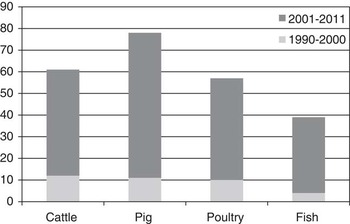
Literature surveys on the genetics of behaviour have emerged only recently, with most studies starting at the end of the 20th century. Over the last two decades, publications relating to cattle and pigs were more numerous, but genetic studies accounted for a lower proportion (3.5% and 7.5%, respectively) than in studies on poultry and fish (∼10% in the two livestock productions over the 2001 to 2011 period; Figure 1). In human society, genetic selection of livestock is a controversial practice. On the grounds of the evident physical modifications and more subtle changes in homoeostasis that may lead to pathology, genetic selection is sometimes claimed to lead to deterioration in animal welfare (Grandin and Deesing, Reference Grandin and Deesing1998; Beaumont et al., Reference Beaumont, Lebihan-Duval, Mignon-Grasteau and Leterrier2010; Oltenacu and Broom, Reference Oltenacu and Broom2010). On the other hand, maternal behaviour that is beneficial to animal welfare can be detrimental to the safety of the handler. In addition, modern poultry may no longer be adapted to large spaces because their drive for foraging, and their motivation to use space and general activity have been decreased by genetic selection (Branciari et al., Reference Branciari, Mugnai, Mammoli, Miraglia, Ranucci, Dal Bosco and Castellini2009). Welfare is dependent on the animal's perception of its environment and its reaction to environmental stimuli (Dantzer and Mormède, Reference Dantzer and Mormède1983), which may evolve with selection. Herein, we use behaviour as an indicator of welfare, assuming that this external response is well correlated to the inner state of the animal. Dawkins (Reference Dawkins2004) presented the many advantages of using behaviour in this context, because its measurement is the result of the animal's decision-making processes and, ultimately, it is the expression of the animal's motivational affective state.
Scientific publications dedicated to the genetics of behaviour in cattle, pigs, poultry and fish (Source: Web of Science database http://apps.webofknowledge.com/; keywords: (heritability or QTL) and behaviour and (cattle or poultry or pig or fish) – accessed 15/02/2012). QTL = quantitative trait loci.

Studies have targeted hotspot issues that are species specific. A good relationship between livestock and humans is a priority in large mammals. In pigs, there has also been increased interest in sociality because welfare policies recommend raising these animals in groups. In fish and poultry, experimental approaches that include a greater number of traits can be implemented.
In this review, we will refer mainly to estimates of heritability obtained from the statistical analysis of phenotypes collected either from selection nucleus populations or from experimental lines obtained by divergent selection for a behavioural trait of interest. The emergence of genomic tools has shed light on novel methodologies of investigation and selection in livestock, with the possibility of targeting genes of interest directly. The detection of quantitative trait loci (QTL) in experimental populations is a powerful approach to understanding the genetics of behavioural adaptation to farming conditions. However, the proportion of QTL detected for behavioural traits is low (<3% in the four livestock productions studied, http://www.animalgenome.org/cgi-bin/QTLdb/index).
Behavioural tests used to assess the genetics of adaptation
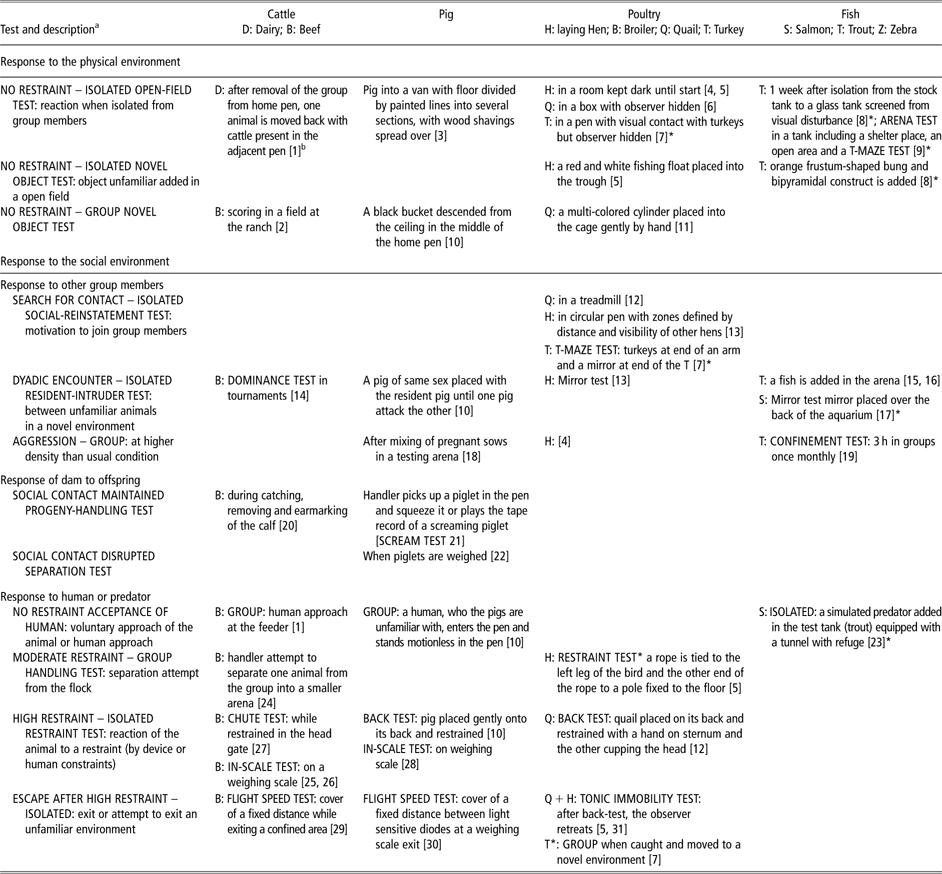
Tests developed in model species such as laboratory mice can be used for quantitative genetic studies in livestock (Table 1) because they are reasonably meaningful for a wide range of species. However, readers should be aware that different motivational systems and cognitive abilities exist in different species (Dantzer, Reference Dantzer2001), so that there are some limits to the extrapolation of results across species. The tests are usually intended to elicit a response in the animal either to its physical environment or, as independently as possible, to its social environment. Response to an acute stress can be assessed in isolated animals placed in an unfamiliar environment or in presence of other group members. The open-field test, which investigates the animal's reaction to a non-social situation, is a basic test that is common to the four livestock productions. Its principle is to induce a conflict between aversion and voluntary exploration of a novel environment. Locomotion and exploration are good indicators of adaptation to change, if they decrease as fast as the animal adjusts to novelty. However, some animals may react with a state of apparent tetany when they enter the test environment. This observation illustrates that a large range of variation in the behavioural response to challenges exists among families, populations and species. This remark is valid for most recorded behaviours: they show phenotypic variation in relation to different coping strategies that distinguish between animals with a fight–flight response and those with a freeze–hide response (Koolhaas et al., Reference Koolhaas, de Boer and Bohus1997). Accordingly, the novel object test can be used to differentiate between shy and bold animals.
Tests used for the genetic assessment of the behavioural response of animals to stressors in the physical and social environments of production in cattle, pig, poultry and fish
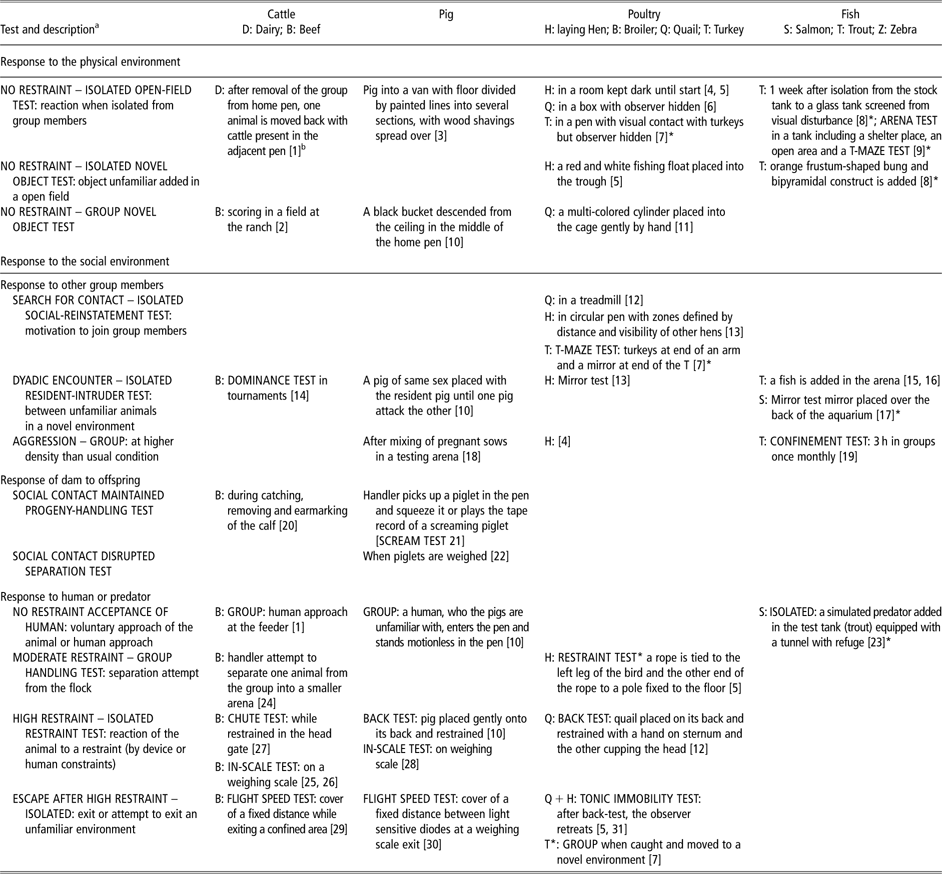
aTest is defined according to the level of restraint applied by the experimenter on the animal, whether the test is performed on animals isolated from the rearing group (ISOLATED) or on animals kept among the rearing group (GROUP) and the name of the test (in capital). When the experimental condition is specific, precisions on the test are given in the cell of the species.
bGenetic references associated, describing the test or referring to it in a previous publication: [1] Gutierrez-Gil et al. (Reference Gutierrez-Gil, Ball, Burton, Haskell, Williams and Wiener2008); [2] Silva et al. (Reference Silva, Gonzalo and Cañón2006); [3] Désautés et al. (Reference Désautés, Bidanel, Milan, Iannuccelli, Amigues, Bourgeois, Caritez, Renard, Chevalet and Mormède2002); [4] Rodenburg et al. (Reference Rodenburg, Buitenhuis, Ask, Uitdehaag, Koene, van der Poel, van Arendonk and Bovenhuis2004); [5] Schütz et al. (Reference Schütz, Kerje, Jacobsson, Forkman, Carlbörg, Andersson and Jensen2004); [6] Mignon-Grasteau et al. (Reference Mignon-Grasteau, Roussot, Delaby, Faure, Mills, Leterrier, Guéméné, Constantin, Mills, Lepape and Beaumont2003); [7] Huff et al. (Reference Huff, Huff, Rath, Donoghue, Anthony and Nestor2007); [8] Thomson et al. (Reference Thomson, Watts, Pottinger and Sneddon2011); [9] Ruiz-Gomez et al. (Reference Ruiz-Gomez M de, Huntingford, Øverli, Thörnqvist and Höglund2011); [10] Velie et al. (Reference Velie, Maltecca and Cassady2009); [11] Schweitzer and Arnould (Reference Schweitzer and Arnould2010); [12] Mills and Faure (Reference Mills and Faure1991); [13] Wirén and Jensen (Reference Wirén and Jensen2010); [14] Sartori and Mantovani (Reference Sartori and Mantovani2010); [15] Øverli et al. (Reference Øverli, Pottinger, Carrick, Øverli and Winberg2002); [16] Pottinger and Carrick (Reference Pottinger and Carrick1999); [17] Vollestad and Quinn (Reference Vollestad and Quinn2003); [18] Løvendahl et al. (Reference Løvendahl, Damgaard, Nielsen, Thodberg, Su and Rydhmer2005); [19] Øverli et al. (Reference Øverli, Sorensen, Kiessling, Pottinger and Gjoen2006); [20] Hoppe et al. (Reference Hoppe, Brandt, Erhardt and Gauly2008); [21] Grandinson et al. (Reference Grandinson, Rydhmer, Strandberg and Thodberg2003); [22] Hellbrügge et al. (Reference Hellbrügge, Tölle, Bennewitz, Henze, Presuhn and Krieter2008); [23] Einum and Fleming (Reference Einum and Fleming1997); [24] Gauly et al. (Reference Gauly, Mathiak, Kraus and Erhardt2001); [25] Morris et al. (Reference Morris, Cullen, Kilgour and Bremner1994); [26] Schmutz et al. (Reference Schmutz, Stookey, Winkelman-Sim, Waltz, Plante and Buchanan2001); [27] Hoppe et al. (Reference Hoppe, Brandt, König, Erhardt and Gauly2010); [28] Holl et al. (Reference Holl, Rohrer and Brown-Brandl2010); [29] Burrow (Reference Burrow1997); [30] Crump et al. (Reference Crump, Hansson, Graser and Sokolinski2005); [31] Satterlee et al. (Reference Satterlee, Jones and Ryder1993).
*Tests used for breed comparison only.
The behavioural response depends on conditional factors. It may be relatively less intense when the test is performed in the home environment rather than in a novel environment, when a period of adaptation to change precedes recording, when other group members are present in the neighbourhood or when humans are not visible or remain at a distance. Conversely, a relatively strong response is elicited when the change is made more suddenly (e.g. switching on the light, forceful handling to move the animal to the experimental location).
Different tests have been developed to account for different social contexts and various levels of restraint in beef cattle. These tests have been modified more recently for use in pigs. The interference from humans is variable: the animals may be relatively unrestrained, given more room to allow the expression of motivational processes among the rearing group, or tightly restrained, so that both sources of social interaction (humans and other group members) can have confounding effects on reactivity. The docility test, the output of which depends on the animal's voluntary cooperation, elicits a less intense response than the on-scale test or the chute test.
Single-trait assessment of behaviour is influenced strongly by the environment and past experience of the animal (Forkman et al., Reference Forkman, Boissy, Meunier-Salaun, Canali and Jones2007). Moreover, interactions between the physical and the social environment may affect the behavioural response in all the tests that are described in the review. Experimental designs often target several behavioural components; this results in a non-specific response but gives a clear advantage in the assessment of the animal's personality. Even if the use of behavioural tests is generalized to different species, the correlation between reactivity in an experimental environment and reactivity under commercial farming conditions remains generally unknown. This point should be clarified before selection is considered on the basis of the behaviour elicited by a test situation. Furthermore, there is an obvious lack of standardization in test situations (e.g. ground surface, luminosity, temperature) that can strongly affect the estimation of genetic parameters for behavioural traits. Despite the evidence that the environment can have a considerable influence on behaviour (Grandinson et al., Reference Grandinson, Rydhmer, Strandberg and Thodberg2003), few experiments have been carried out to estimate the interaction between genotype and environment with regard to behavioural traits.
Genetics of the behavioural response to changes in the physical environment
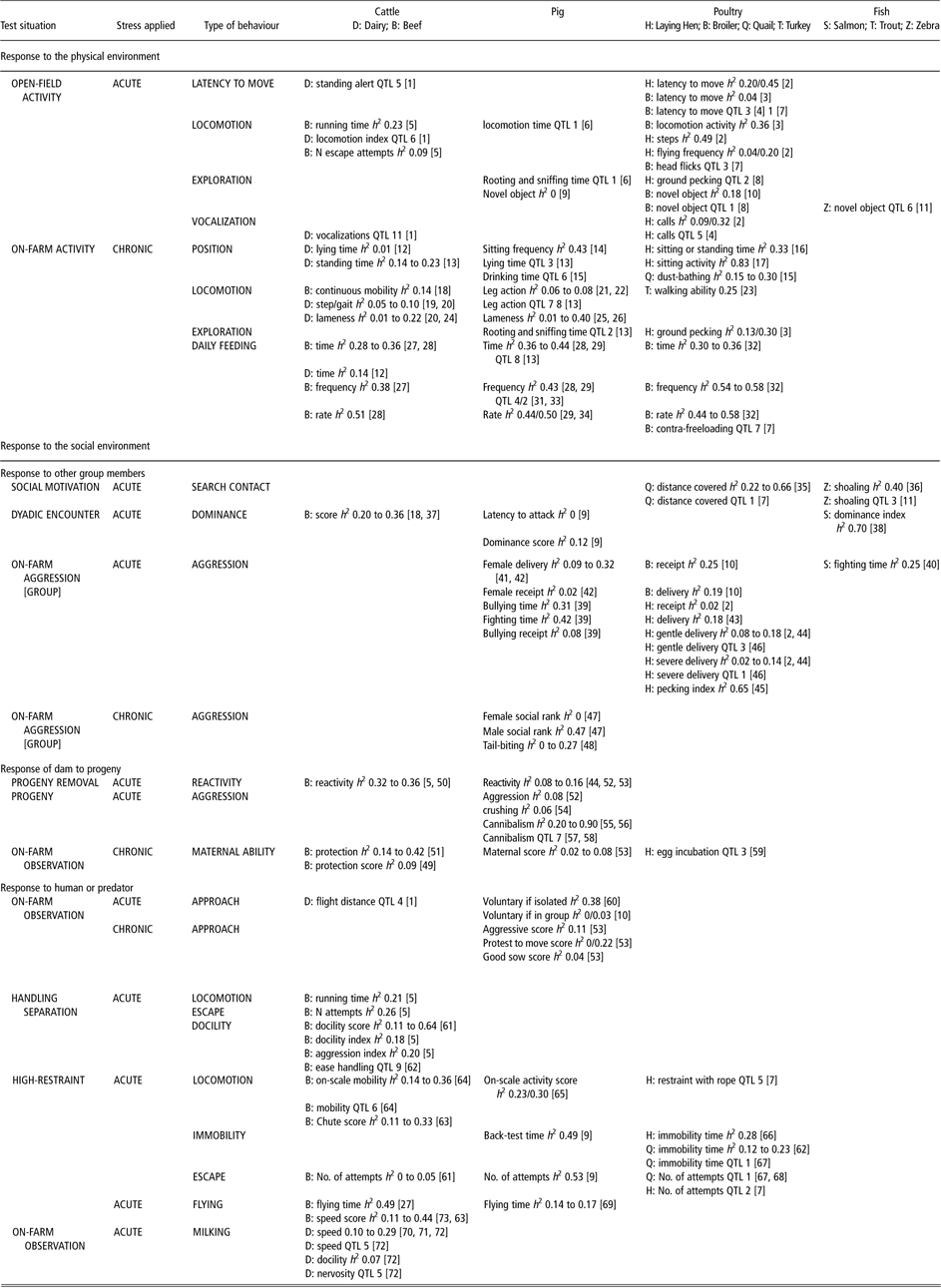
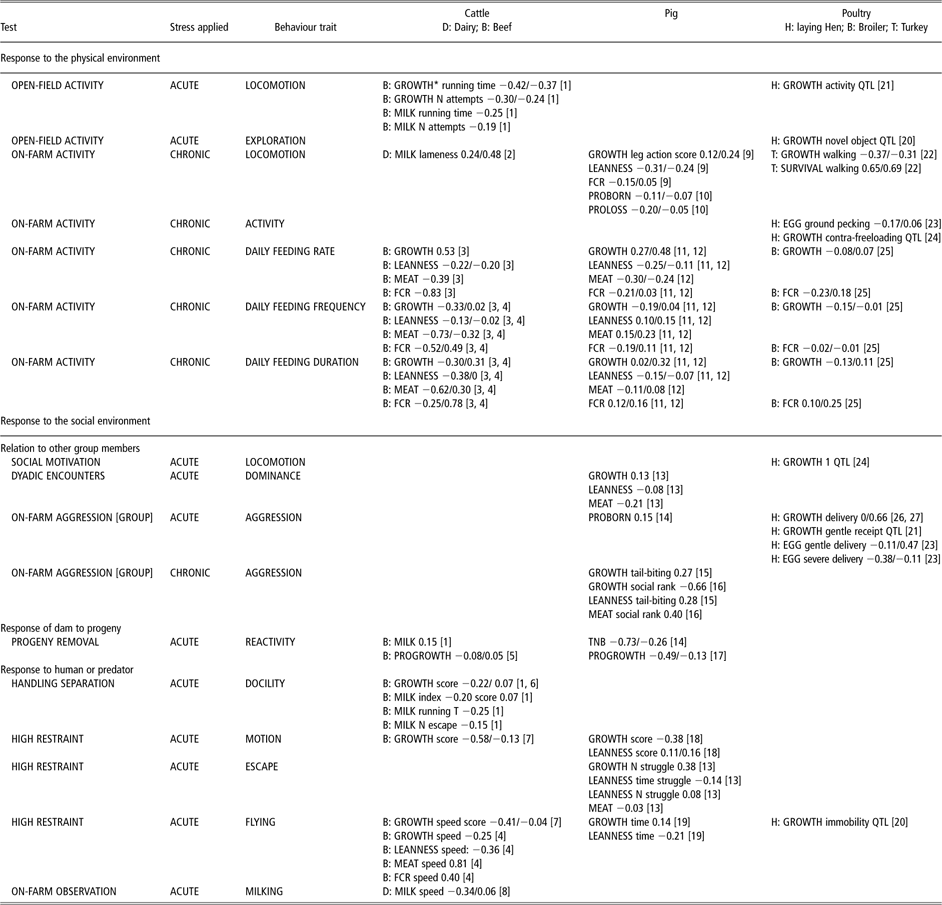
Estimates of the heritability of the behavioural responses to acute and chronic changes in the physical environment are presented in Table 2. Genetic correlations with production traits are shown in Table 3.
Estimates of heritability (h 2) and QTL identification* for the behavioural response of animals to stressors in the physical and social environments of production in cattle, pig, poultry and fish
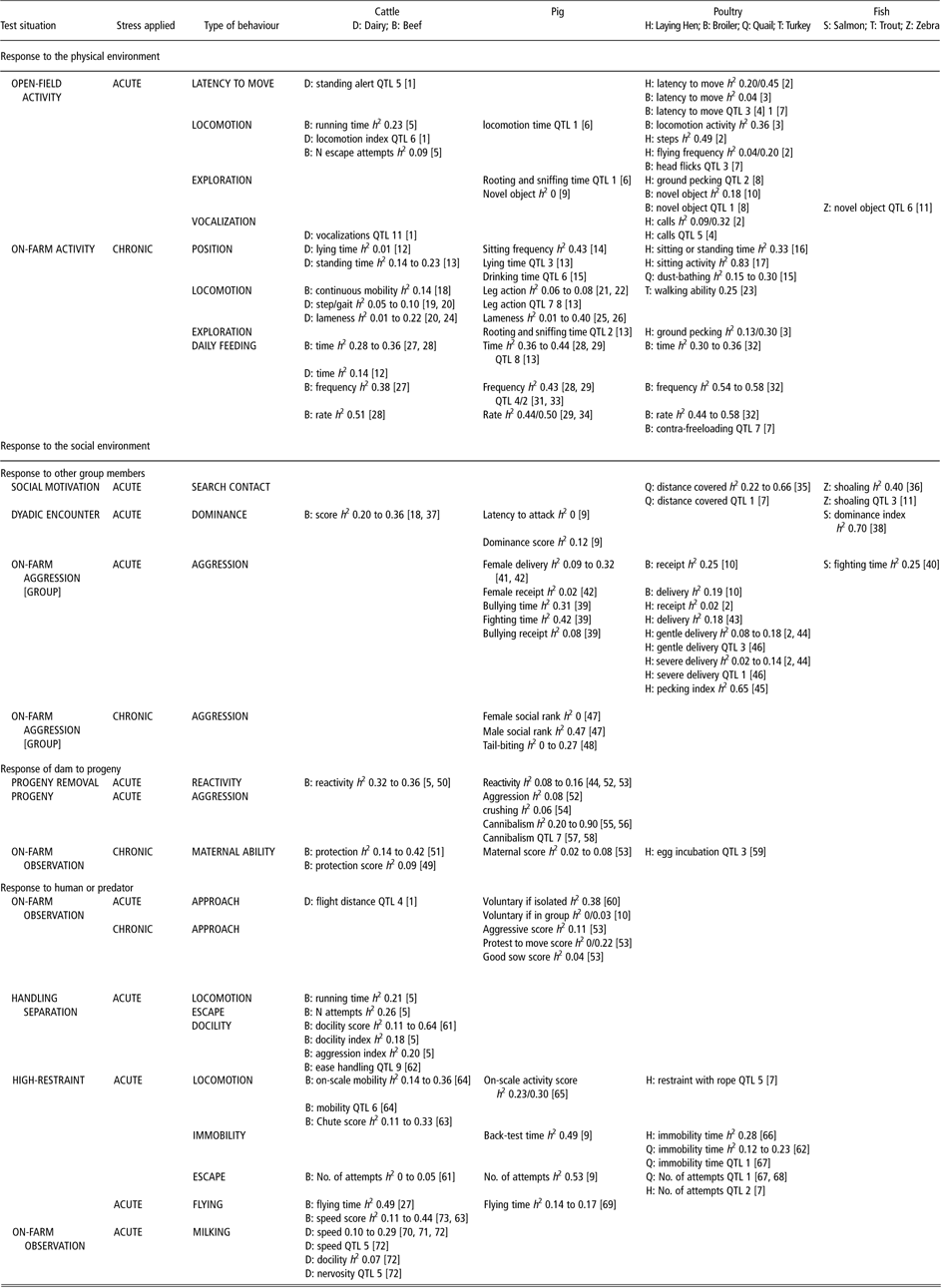
QTL = quantitative trait loci.
*The number of different chromosomes where QTL region(s) were detected is specified.
References: [1] Gutierrez-Gil et al. (Reference Gutierrez-Gil, Ball, Burton, Haskell, Williams and Wiener2008); [2] Rodenburg et al. (Reference Rodenburg, Buitenhuis, Ask, Uitdehaag, Koene, van der Poel, van Arendonk and Bovenhuis2004); [3] Mignon-Grasteau and Faure (Reference Mignon-Grasteau and Faure2002); [4] Buitenhuis et al. (Reference Buitenhuis, Rodenburg, Siwek, Cornelissen, Nieuwland, Crooijmans, Groenen, Koene, Bovenhuis and van der Poel2004); [5] Phocas et al. (Reference Phocas, Boivin, Sapa, Trillat and Le Neindre2006); [6] Désautés et al. (Reference Désautés, Bidanel, Milan, Iannuccelli, Amigues, Bourgeois, Caritez, Renard, Chevalet and Mormède2002); [7] Schütz et al. (Reference Schütz, Kerje, Jacobsson, Forkman, Carlbörg, Andersson and Jensen2004); [8] Buitenhuis et al. (Reference Buitenhuis, Rodenburg, Siwek, Cornelissen, Nieuwland, Crooijmans, Groenen, Koene, Bovenhuis and van der Poel2005); [9] Velie et al. (Reference Velie, Maltecca and Cassady2009); [10] Bessei (Reference Bessei1995); [11] Wright et al. (Reference Wright, Nakamichi, Krause and Butlin2006); [12] Løvendahl and Munksgaard (Reference Løvendahl and Munksgaard2005); [13] Reiner et al. (Reference Reiner, Kohler, Berge, Fischer, Hubner-Weitz, Scholl and Willems2009); [14] McGlone et al. (Reference McGlone, Akins and Green1991); [15] Gerken and Petersen (Reference Gerken and Petersen1992); [16] Heil et al. (Reference Heil, Simianer and Dempfle1990); [17] Mills et al. (Reference Mills, Wood-Gush and Hughes1985); [18] Silva et al. (Reference Silva, Gonzalo and Cañón2006); [19] Laursen et al. (Reference Laursen, Boelling and Mark2009); [20] Boelling et al. (Reference Boelling, Fogh and Nielsen2007); [21] Grindflek and Sehested (Reference Grindflek and Sehested1996); [22] Stalder et al. (Reference Stalder, Knauer, Baas, Rothschild and Mabry2004); [23] Quinton et al. (Reference Quinton, Wood and Miller2011); [24] Boettcher et al. (Reference Boettcher, Dekkers, Warnick and Wells1998); [25] Lundeheim (Reference Lundeheim1987); [26] Fan et al. (Reference Fan, Onteru, Mote, Serenius, Stalder and Rothschild2009); [27] Nkrumah et al. (Reference Nkrumah, Crews, Basarab, Price, Okine, Wang, Li and Moore2007); [28] Robinson and Oddy (Reference Robinson and Oddy2004); [29] von Felde et al. (Reference von Felde, Roehe, Looft and Kalm1996); [30] Labroue et al. (Reference Labroue, Guéblez and Sellier1997); [31] Houston et al. (Reference Houston, Haley, Archibald and Rance2005); [32] Howie et al. (Reference Howie, Avendano, Tolkamp and Kyriazakis2011); [33] Zhang et al. (Reference Zhang, Ren, Ren, Ma, Guo and Huang2009); [34] Gilbert et al. (Reference Gilbert, Al Aïn, Bidanel, Lagant, Billon, Guillouet, Noblet and Sellier2009); [35] Craig et al 1965 in Mignon-Grasteau and Faure (Reference Mignon-Grasteau and Faure2002); [36] Wright et al. (Reference Wright, Rimmer, Pritchard, Krause and Butlin2003); [37] Sartori and Mantovani (Reference Sartori and Mantovani2010); [38] Riddel and Swain (Reference Riddel and Swain1991); [39] Turner et al. (Reference Turner, Roehe, D'Eath, Ison, Farish, Jack, Lundeheim, Rydhmer and Lawrence2009); [40] Vollestad and Quinn (Reference Vollestad and Quinn2003); [41] Løvendahl et al. (Reference Løvendahl, Damgaard, Nielsen, Thodberg, Su and Rydhmer2005); [42] Hellbrügge et al. (Reference Hellbrügge, Tölle, Bennewitz, Henze, Presuhn and Krieter2008); [43] Kjaer and Sørensen (Reference Kjaer and Sørensen1997); [44] Su et al. (Reference Su, Kjaer and Sørensen2005); [45] Craig and Muir (Reference Craig and Muir1993); [46] Buitenhuis et al. (Reference Buitenhuis, Rodenburg, van Hierden, Siwek, Cornelissen, Nieuwland, Crooijmans, Groenen, Koene and Korte2003); [47] Jonsson (Reference Jonsson1985); [48] Breuer et al. (Reference Breuer, Sutcliffe, Mercer, Rance, O'Connell, Sneddon and Edwards2005); [49] Morris et al. (Reference Morris, Cullen, Kilgour and Bremner1994); [50] Le Neindre et al. (Reference Le Neindre, Grignard, Trillat, Boissy, Menissier, Sapa and Boivin2002); [51] Hoppe et al. (Reference Hoppe, Brandt, Erhardt and Gauly2008); [52] Grandinson et al. (Reference Grandinson, Rydhmer, Strandberg and Thodberg2003); [53] Vangen et al. (Reference Vangen, Holm, Valros, Lund and Rydhmer2005); [54] Grandinson et al. (Reference Grandinson, Lund, Rydhmer and Strandberg2002); [55] Van der Steen et al. (Reference Van der steen, Schaeffer, de Jong and de Groot1988); [56] Knap and Merks (Reference Knap and Merks1987); [57] Quilter et al. (Reference Quilter, Blott, Wilson, Bagga, Sargent, Oliver, Southwood, Gilbert, Mileham and Affara2007); [58] Chen et al. (Reference Chen, Guo, Yang, Yang, Zhang, Yang, Yan, Perez-Enciso, Ma, Duan, Brenig and Huang2009); [59] Xu et al. (Reference Xu, Shen, Zhou, Luo, Kang, Liang, Zeng, Nie, Zhang and Zhang2010); [60] Hemsworth et al. (Reference Hemsworth, Barnett, Treacy and Madgwick1990); [61] Gauly et al. (Reference Gauly, Mathiak, Kraus and Erhardt2001); [62] Gill et al. (Reference Gill, Boldt, Abbey, Wegenhoft, Lunt, Sawyer, Herring and Sanders2007); [63] Hoppe et al. (Reference Hoppe, Brandt, König, Erhardt and Gauly2010); [64] Schmutz et al. (Reference Schmutz, Stookey, Winkelman-Sim, Waltz, Plante and Buchanan2001); [65] Holl et al. (Reference Holl, Rohrer and Brown-Brandl2010); [66] Craig and Muir (Reference Craig and Muir1989); [67] Beaumont et al. (Reference Beaumont, Roussot, Feve, Vignoles, Leroux, Pitel, Faure, Mills, Guémené, Sellier, Mignon-Grasteau, Le Roy and Vignal2005); [68] Minvielle et al. (Reference Minvielle, Kayang, Inoue-Murayama, Miwa, Vignal, Gourichon, Neau, Monvoisin and Ito2005); [69] Jones et al. (Reference Jones, Hermesch and Crump2009); [70] Schutz and Pajor (Reference Schutz and Pajor2001); [71] Visscher and Goddard (Reference Visscher and Goddard1995); [72] Hiendleder et al. (Reference Hiendleder, Thomsen, Reinsch, Bennewitz, Leyhe-Horn, Looft, Xu, Medjugorac, Russ, Kühn, Brockmann, Blümel, Brenig, Reinhardt, Reents, Averdunk, Schwerin, Förster, Kalm and Erhardt2003); [73] Burrow (Reference Burrow2001).
Genetic correlations (minimum/maximum) and identified chromosomal co-location between the behavioural response of animals to stressors in the physical and social environments and production traits in cattle, pig and poultry
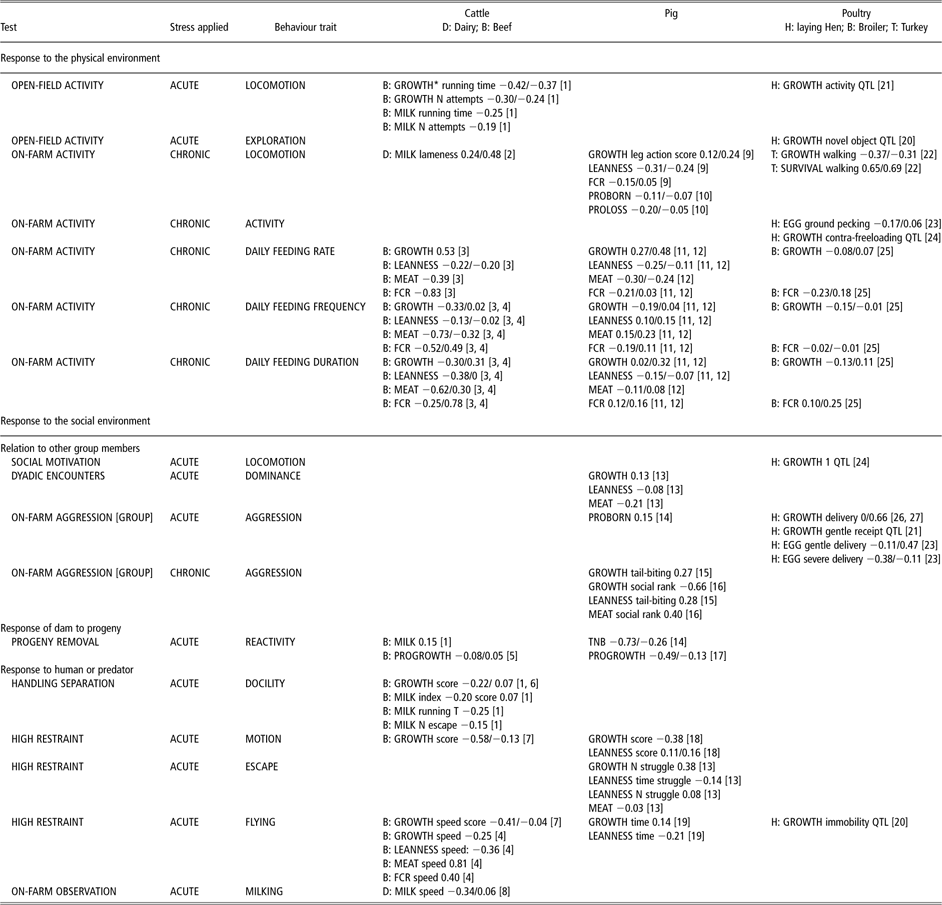
QTL = quantitative trait loci; ECG = electrocardiogram; FCR = feed conversion ratio.
*GROWTH: growth rate; MILK: milk yield; LEANNESS: modified from results on backfat depth; MEAT: meat production assessed from muscle areas and carcass lean content; FCR: feed conversion ratio; TNB: total number born; PROGROWTH: progeny growth; PROBORN: progeny number born; PROLOSS: progeny loss. Precisions on the definition of the trait are specified where necessary.
[1] Phocas et al. (Reference Phocas, Boivin, Sapa, Trillat and Le Neindre2006); [2] Lyons et al. (1991); Groen et al. (1995); Pryce et al. (1997); van Dorp et al. (1998) in Ingvartsen et al. (Reference Ingvartsen, Dewhurst and Friggens2003); [3] Robinson and Oddy (Reference Robinson and Oddy2004); [4] Nkrumah et al. (Reference Nkrumah, Crews, Basarab, Price, Okine, Wang, Li and Moore2007); [5] Hoppe et al. (Reference Hoppe, Brandt, Erhardt and Gauly2008); [6] Gauly et al. (Reference Gauly, Mathiak, Kraus and Erhardt2001); [7] Hoppe et al. (Reference Hoppe, Brandt, König, Erhardt and Gauly2010); [8] Visscher and Goddard (Reference Visscher and Goddard1995); [9] Serenius et al. (Reference Serenius, Sevón-Aimonen and Mäntysaari2001); [10] Serenius et al. (Reference Serenius, Sevón-Aimonen, Kause, Mäntysaari and Mäki-Tanila2004); [11] von Felde et al. (Reference von Felde, Roehe, Looft and Kalm1996); [12] Labroue et al. (Reference Labroue, Guéblez and Sellier1997); [13] Velie et al. (Reference Velie, Maltecca and Cassady2009); [14] Hellbrügge et al. (Reference Hellbrügge, Tölle, Bennewitz, Henze, Presuhn and Krieter2008); [15] Breuer et al. (Reference Breuer, Sutcliffe, Mercer, Rance, O'Connell, Sneddon and Edwards2005); [16] Jonsson (Reference Jonsson1985); [17] Grandinson et al. (Reference Grandinson, Lund, Rydhmer and Strandberg2002); [18] Holl et al. (Reference Holl, Rohrer and Brown-Brandl2010); [19] Jones et al. (Reference Jones, Hermesch and Crump2009); [20] Schütz et al. (Reference Schütz, Kerje, Jacobsson, Forkman, Carlbörg, Andersson and Jensen2004); [21] Van der poel et al. in Buitenhuis et al. (Reference Buitenhuis, Rodenburg, Siwek, Cornelissen, Nieuwland, Crooijmans, Groenen, Koene, Bovenhuis and van der Poel2005); [22] Quinton et al. (Reference Quinton, Wood and Miller2011); [23] Buitenhuis et al. (Reference Buitenhuis, Rodenburg, Siwek, Cornelissen, Nieuwland, Crooijmans, Groenen, Koene, Bovenhuis and van der Poel2004); [24] Schütz et al. (Reference Schütz, Kerje, Carlborg, Jacobsson, Andersson and Jensen2002); [25] Howie et al. (Reference Howie, Avendano, Tolkamp and Kyriazakis2011); [26] Bessei (Reference Bessei1984); [27] Su et al. (Reference Su, Kjaer and Sørensen2005).
Response to acute stressors
The genetic variation in the response to an open field or novel object has been investigated mainly in poultry. Latency to move and locomotion in the open field show highest heritability in broilers and hens (Table 2). Exploration of a novel object is moderately heritable in broilers, and a few QTL were identified that correlated with a QTL for growth on Golgi-localized, gamma-ear-containing, Arf-binding protein 1 (GGA1) in hens (van der Poel et al. in Buitenhuis et al., Reference Buitenhuis, Rodenburg, Siwek, Cornelissen, Nieuwland, Crooijmans, Groenen, Koene, Bovenhuis and van der Poel2005). Breed variation in excitability in a novel environment also exists in pigs (Shea-Moore, Reference Shea-Moore1998). The gene associated with the porcine stress syndrome impairs the capacity for adaptation to stressors. Therefore, nn pigs have been eradicated from various populations. Behavioural differences have also been found among other genotypes: pigs with the genotype Nn at the locus for the ryanodyne receptor gene RYR(1) are less active than NN pigs in the open-field test (Fabrega et al., Reference Fabrega, Font, Carrión, Velarde, Ruiz-de-la-Torre, Diestre and Manteca2004). Désautés et al. (Reference Désautés, Bidanel, Milan, Iannuccelli, Amigues, Bourgeois, Caritez, Renard, Chevalet and Mormède2002) found different QTL in pigs to be associated with locomotion on SSC1, or with exploration on SSC8. In beef cattle, locomotion in open field shows moderate heritability and is correlated unfavourably with growth and milk production (Phocas et al., Reference Phocas, Boivin, Sapa, Trillat and Le Neindre2006). In dairy cattle, QTL associated with vocalization and locomotion when isolated from the herd are located mainly on BTA16 and BTA19 (Gutierrez-Gil et al., Reference Gutierrez-Gil, Ball, Burton, Haskell, Williams and Wiener2008). Using different strains of zebra fish, several QTL for boldness when facing novel objects have been highlighted. In addition, a genomic region that influences anti-predator behaviour shows some co-location with QTL for resistance to heat shock and growth capacity in water of varying salinity (Wright et al., Reference Wright, Nakamichi, Krause and Butlin2006).
Response to chronic stressors
When exposed to chronic stressors, the reactions of animals can be more durable. For example, exposure to high ambient temperature has a direct impact on animal survival and health, and is associated with modification in locomotion and feeding activities. These behavioural responses indicate the level of heat tolerance of an animal. Thermal stress has a significant impact on feed intake and feed efficiency in poultry (Chen et al., Reference Chen, Huang, Gourichon, Lee, Tixier-Boichard and Bordas2008).
Global activity
Global activity is assessed by postural changes and locomotion, with low to moderate heritability reported in the three terrestrial species (min h 2 = 0.05; max h 2 = 0.35). In pigs, lameness is more heritable than locomotion (h 2 < 0.10). Conversely, locomotion shows breed variation in genetic estimates for dairy cattle, and high heritability was observed (Boelling et al., Reference Boelling, Fogh and Nielsen2007). Moreover, locomotion is a good indicator of health because it is genetically correlated with the presence of claw disorders (r g > −0.40; Laursen et al., Reference Laursen, Boelling and Mark2009). On the basis of the results from a study of divergent selection for growth, Nestor et al. (Reference Nestor, Anderson, Patterson and Velleman2008) showed alteration in walking ability in turkeys. Walking ability was moderately heritable and correlated favourably with survival (r g > 0.60) and with hip and leg strength (r g > 0.85; Quinton et al., Reference Quinton, Wood and Miller2011). At the genetic level, ease of locomotion is correlated positively with growth in pigs and milk yield in dairy cattle, whereas a negative correlation with growth was found in broilers (Table 3). In pigs, several QTL related to chronic activity were detected mainly on SSC5 and SSC7 and SSC8 (Reiner et al., Reference Reiner, Kohler, Berge, Fischer, Hubner-Weitz, Scholl and Willems2009). The QTL for chronic locomotion detected on SSC8 may be similar to the one for exploration in open field.
Using a divergent selection for dustbathing activity in quail, Gerken et al. (Reference Gerken, Bamberg and Petersen1988) found a negative relationship with fear-related traits (i.e. latency to emerge from a box and response to a tonic immobility test), which was interpreted as a response to the anxiety associated with not performing this maintenance activity. Later, Olsson and Keeling (Reference Olsson and Keeling2005) suggested that the selection operates directly on the fear response because dustbathing is realized only when the bird is not at risk of predation. The pre-laying behaviour of laying hens (sitting activity) is among the rare stereotypes observed in livestock. Experimental selection for this trait showed that the reestablishment of normal behaviour (increased sitting activity) is possible (Mills et al., Reference Mills, Wood-Gush and Hughes1985). However, Beaumont et al. (Reference Beaumont, Lebihan-Duval, Mignon-Grasteau and Leterrier2010) did not find sufficient ethical grounds to select for this behaviour, especially now that hens are reared on the floor instead of in cages, which increases their general activity and energy expenditure.
Feeding activity
In recent years, the genetics of feeding activity (duration, rate and frequency of visits to the food source) has been studied increasingly because of its relationship to feed efficiency, and because measurement has been facilitated by the use of automatic devices. Genetic variation in feeding activity exists in the three terrestrial species reviewed and shows large breed variation (e.g. cattle: Nkrumah et al., Reference Nkrumah, Crews, Basarab, Price, Okine, Wang, Li and Moore2007; pig: Labroue et al., Reference Labroue, Guéblez and Sellier1997; poultry: Howie et al., Reference Howie, Avendano, Tolkamp and Kyriazakis2011). Feeding frequency and feeding rate are more heritable (min = 0.38; max = 0.58) than feeding duration (Table 2). The genetic correlations between feeding behaviour (duration) and daily feed intake are null to positive in mammals and negative in broilers. Animals that show a genetic predisposition to eat more are known to grow faster but they also store more body fat than others. Growth is correlated favourably with feeding rate in cattle and pigs. Feeding rate is correlated unfavourably with meat production, whereas feeding duration and leanness show negative or null genetic associations (Labroue et al., Reference Labroue, Guéblez and Sellier1997; Robinson and Oddy, Reference Robinson and Oddy2004). Growth and leanness are not genetically correlated with feeding frequency in pigs, but a G/A substitution at the MC4R gene (SSC1), which encodes a melanocortin receptor, has a positive effect on fatness, growth and daily feed intake, probably mediated through the central control of appetite (Kim et al., Reference Kim, Larsen, Short, Plastow and Rothschild2000). Zhang et al. (Reference Zhang, Ren, Ren, Ma, Guo and Huang2009) identified a QTL for the number of visits of pigs to the feeder on SSC7 that did not co-locate with QTL for feed intake and conversion neither to the QTL for feeding frequency (Houston et al., Reference Houston, Haley, Archibald and Rance2005), and a suggestive QTL on SSC9 that may co-locate with a growth QTL. In broilers, feeding activity is not genetically correlated with growth (Howie et al., Reference Howie, Avendano, Tolkamp and Kyriazakis2011), which suggests that no substantial change in this activity has been induced by selective breeding in that species.
Residual feed intake (RFI) is a measure of feed efficiency that accounts for the animal's energy requirements for production and maintenance. The RFI indirectly measures the quantity of buffer resource available for global activity, and a genetic association between the two traits has been found in the three terrestrial species (hens: Braastad and Katle, Reference Braastad and Katle1989; Luiting and Urff, Reference Luiting and Urff1991; cattle: Richardson et al., Reference Richardson, Kilgour, Archer and Herd1999; Herd et al., Reference Herd, Oddy and Richardson2004; pigs: Sadler et al., Reference Sadler, Johnson, Lonergan, Nettleton and Dekkers2011): animals with lower RFI are less active. Chronic frustration associated with the reduced feeding activity of the animals may also appear. Negative phenotypic correlations have been estimated between RFI and the response to acute stress in poultry and cattle (Luiting and Urff, Reference Luiting and Urff1991; Richardson and Herd, Reference Richardson and Herd2004; Rauw, Reference Rauw2007). The reduction of RFI by selection should increase feed efficiency, with a low impact on growth, but at the expense of reduced feeding activity, owing to its positive correlation with feeding duration (pig: r g = 0.44, von Felde et al., Reference von Felde, Roehe, Looft and Kalm1996; beef cattle: r g = 0.35, Robinson and Oddy, Reference Robinson and Oddy2004). Montanholi et al. (Reference Montanholi, Swanson, Palme, Schenkel, McBride, Lu and Miller2010) observed that high-RFI steers make more visits to the feeder during the night than more efficient steers. Altan et al. (Reference Altan, Akbas and Aksit2004) found that low-RFI quail were less fearful, whereas Minvielle et al. (Reference Minvielle, Mills, Faure, Monvoisin and Gourichon2002) did not find any significant correlation between RFI and the results of the tonic immobility test. In laying hens selected for lower RFI, reduced sensitivity to stress is observed under natural conditions (Schütz et al. Reference Schütz, Kerje, Carlborg, Jacobsson, Andersson and Jensen2002), but these genotypes are selected in cages.
Perspectives in selective breeding that account for behavioural adaptation to changes in the physical environment
Reducing the sensitivity of animals to stress is a major issue in the successful expansion of production. The strategies used to produce animals that are able to overcome the perturbations in their physical environment and return to homoeostasis are dependent on the type of stress the animals face. On the one hand, Mormède et al. (Reference Mormède, Foury, Terenina and Knap2011) suggest that animals that produce a strong physiological response to acute stress adapt better to the stressor. The parallel cannot be made for behavioural responses where a phase of inhibition of all behavioural patterns is followed by a phase of activity. Selection for a greater activity or a greater exploration in the open field could be a strategy used to increase the capacity of livestock to adapt to acute stressors. However, in beef cattle, the genetic correlations of behavioural responses in the open-field test to production traits contradict this assumption. Conversely, a high degree of heritability has been found for latency to move and locomotion in laying hens. Selection for reduced reactivity to stress could be foreseen in that species to decrease the distress caused by changes in the physical environment. This strategy is acceptable provided that an optimum value is targeted, that favourable genetic correlations with production traits are estimated and that farming conditions are improved at the same time to avoid placing animals under conditions of stress.
When faced with long-term stressors or repeated modifications in their environment, animals with a lower perception of stress should be preferred to avoid large unfavourable effects on production (Forkman et al., Reference Forkman, Boissy, Meunier-Salaun, Canali and Jones2007). Animals displaying more exploration might also show a higher behavioural adaptation in both the short and the long term; this trait deserves further genetic investigation. Abnormal behaviours (e.g. pre-laying behaviour in hens, circular shoaling in Atlantic salmon) show substantial genetic variation and heritability but have not been selected against because these reactions do not necessarily indicate poor welfare (Dawkins, Reference Dawkins2004) and they may help the animal to cope with its physical environment.
Within a line or a rearing group, animals can exhibit different feeding strategies but achieve the same feed intake (Tolkamp et al., 1998 in Howie et al., Reference Howie, Avendano, Tolkamp and Kyriazakis2011). This behavioural flexibility could be used for selective breeding in specific environments, especially in broilers, in which feeding behaviour shows low genetic correlation with growth. This strategy based on feeding behaviour traits could be complementary to strategies based on feed consumption if it is confirmed such as in pigs that different chromosomal regions affect the two traits categories. Selection for lower RFI is a sensitive approach that should be addressed with caution because it might reduce the buffer capacity of the animal in its reaction to stress (Rauw, Reference Rauw2007), especially under hot conditions. For instance, laying hens with high RFI cope better with high temperatures (Bordas and Minvielle, Reference Bordas and Minvielle1997) but are more fearful of humans (Schütz et al., Reference Schütz, Kerje, Carlborg, Jacobsson, Andersson and Jensen2002) and do not require social reinstatement as strongly as hens with low RFI (Väisänen et al., Reference Väisänen, Lindqvist and Jensen2005).
Traits related to global activity (drinking and locomotion) are important indicators of animal welfare and, although less heritable, they are easier to record and analyse than health traits. Accounting for ease of locomotion in selective breeding may be a useful strategy to limit the deterioration of welfare observed in dairy cattle and broilers, and also to prevent lameness in pigs, if it were recorded at a young age. The genetics of chronic activity should be analysed in high-production genotypes because their heat tolerance is reduced compared with that of less productive animals (Ravagnolo and Misztal, Reference Ravagnolo and Misztal2000; Kadzere et al., Reference Kadzere, Murphy, Silznikove and Maltz2002; N'Dri, Reference N'Dri2006; Gaughan et al., Reference Gaughan, Mader, Holt, Sullivan and Hahn2010). The QTL approach of Reiner et al. (Reference Reiner, Kohler, Berge, Fischer, Hubner-Weitz, Scholl and Willems2009), used to analyse drinking activity in pigs, suggests that this trait has a polygenic determinism, which would make its selection more difficult. Reduction of the weight allotted to various production traits in breeding programmes may be a solution to improve the capacity of animals to adapt to hot conditions (Bessei, Reference Bessei2006).
Future studies will need to demonstrate that both acute and chronic responses are complementary in the development of resilience to sudden modifications in the physical environment, and in the eventual development of tolerance when the modification lasts for a long time.
Genetics of the behavioural response to changes in the social environment
Estimates of the heritability of behavioural responses to acute and chronic changes in the social environment are presented in Table 2, with distinction between cases in which the animal is expected to react to environmental changes that involve other group members, progeny or the farmer. The genetic correlations with production traits are given in Table 3.
Interactions with other group members
Behavioural response to acute stress
The comfort provided by the presence of other group members after a period of isolation is a welfare-related concept that has been used in the estimation of the genetic tendency towards social motivation in quail and fish models. The experimental approach used to assess re-grouping in fish (shoaling) is similar to the social-reinstatement test used in quail, and is interpreted as an anti-predator response. Associated traits show moderate heritability (min = 0.22; max = 0.66). QTL were detected in the two species and an association with a QTL for growth was found in hen (Schütz et al., Reference Schütz, Kerje, Jacobsson, Forkman, Carlbörg, Andersson and Jensen2004; Wright et al., Reference Wright, Nakamichi, Krause and Butlin2006). A large study was designed by Mills and Faure (Reference Mills and Faure1991) to test the genetic impact of social skills on growth, survival and other behaviours in Japanese quail. More social birds (high line) had more affiliation with other group members (use of distress calls), benefited from facilitated access to feed among the flock, performed more non-aggressive pecking and were more easily captured than less social birds (low line). Social motivation persisted in adulthood but was correlated with greater aggression. In subsequent generations, birds from the high line became more sensitive to both acute social stressors (mixing with unfamiliar animals) and chronic social stressors (rearing in large groups), and thus developed a lower capacity for adaptation. They showed social attraction towards any other group member, whereas quail from the low line showed bonding with familiar animals (Schweitzer et al., Reference Schweitzer, Poindron and Arnould2009). Formanek et al. (Reference Formanek, Houdelier, Lumineau, Bertin, Cabanès and Richard-Yris2008) showed that selection to be also efficient when applied on juvenile quails.
Conversely, social aggression used to establish dominance is assessed most often with the resident–intruder test, which was developed for mice and then generalized to livestock species. Heritability shows mainly low values in mammals (min = 0; max = 0.36) and high values in fish (h 2 > 0.40; Table 2). Growth is reduced genetically in pigs that are aggressive towards intruders (Velie et al., Reference Velie, Maltecca and Cassady2009). Measurement of aggressiveness within a group is an alternative procedure that elicits a response to crowding. In fish and poultry, social competition is evaluated mainly by measurement of survival rate and growth, but tests of aggression also exist (Table 1). The outcome of aggression refers to complex genetic determinism that depends on morphological aspects of the opponents (body weight and fur or feather pigmentation) and is strongly sex related.
Lahti et al. (Reference Lahti, Laurila, Enberg and Piironen2001) found evidence of a genetic basis for aggressive behaviour in brown trout; they observed that sea-run populations were more aggressive than lake-run or non-migratory populations. Conversely, Reinhardt (Reference Reinhardt2001) did not find such a difference in Masu salmon. Divergent selection for plasma cortisol responsiveness to an acute confinement stress in trout showed that fish from the high line were more mobile in the presence of an intruder (Øverli et al., Reference Øverli, Pottinger, Carrick, Øverli and Winberg2002) than fish from the low line; this suggests a link between fear and an aggressive response.
Aggression shows higher heritability in pigs than in poultry and salmon (h 2 = 0.25), with the duration of fighting after mixing being more heritable (h 2 = 0.43) than the number of aggressive episodes and the score of skin lesions (Turner et al., Reference Turner, Roehe, D'Eath, Ison, Farish, Jack, Lundeheim, Rydhmer and Lawrence2009). A candidate gene approach emphasized that the AVPR1B gene, which encodes a vasopressin receptor, and the NR3C1 gene, which encodes a glucocorticoid receptor, are involved in the causation of aggression (Muráni et al., Reference Muráni, Ponsuksili, D'Eath, Turner, Kurt, Evans, Thölking, Klont, Foury, Mormède and Wimmers2010). Age was shown to be an important source of variation in hens, and the heritability of feather pecking increases with age. Buitenhuis et al. (Reference Buitenhuis, Rodenburg, van Hierden, Siwek, Cornelissen, Nieuwland, Crooijmans, Groenen, Koene and Korte2003) found different QTL on several chromosomes that were related to receiving feather pecking at young and adult ages. When attacker and receiver were distinguished, the heritability of being aggressive was moderate (h 2 > 0.20) and higher than that of receiving aggression in both pigs and poultry. Genetic correlations between aggression and growth vary among studies in poultry and pigs; they are unfavourable to production in salmon (Vollestad and Quinn, Reference Vollestad and Quinn2003). In hatcheries, strong genotype–environment interactions control aggression (Mesa, Reference Mesa1991; Vandeputte and Prunet, Reference Vandeputte and Prunet2002). Selection for rapid growth yields a correlated response in aggression only when food is defensible (experiment on medaka: Ruzzante and Doyle, Reference Ruzzante and Doyle1991). In Atlantic salmon, as in rainbow trout, the cortisol response to acute confinement (crowding) is highly heritable (h 2 = 0.41: Pottinger and Carrick, Reference Pottinger and Carrick1999; h 2 = 0.50: Fevolden et al., Reference Fevolden, Roed and Fjalestad2002) and predicts the behavioural response of fish in a number of situations (Øverli et al., Reference Øverli, Sorensen, Kiessling, Pottinger and Gjoen2006). With divergent selection, the highly responsive fish were more active but showed a slower return to feeding activity when placed in a novel environment than poorly responsive fish (Øverli et al., Reference Øverli, Winberg and Pottinger2005; Schjolden et al., Reference Schjolden, Backstrom, Pulman, Pottinger and Winberg2005). The social effects observed on growth relied on the mixing of lines with different personalities. Furthermore, Ruiz-Gomez et al. (Reference Ruiz-Gomez M de, Kittilsen, Höglund, Huntingford, Sørensen, Pottinger, Bakken, Winberg, Korzan and Øverli2008) demonstrated the complexity of the relationship between line and behaviour; inconsistent changes in behaviour were shown after a change of country. Three suggestive QTL for cortisol response to confinement were mapped in sea bass (Massault et al., Reference Massault, Hellemans, Louro, Batargias, Van Houdt, Canario, Volckaert, Bovenhuis, Haley and de Koning2010), and major genes for the same trait are suspected in rainbow trout (Vallejo et al., Reference Vallejo, Rexroad III, Silverstein, Janss and Weber2009). Two studies of divergent selection for behavioural response in the resident–intruder test were implemented by Bakker (Reference Bakker1985) and Francis (Reference Francis1984) on three-spined sticklebacks and paradise fish, respectively. The two experiments showed unequal responses but highlighted a common genetic basis of aggressiveness and sexual behaviour. The high line consisted almost entirely of males and the low line of females.
In the pig, aggression between sows is moderately heritable (h 2 = 0.30) and shows a low but favourable correlation with piglet production (Hellbrügge et al., Reference Hellbrügge, Tölle, Bennewitz, Henze, Presuhn and Krieter2008). Assessments on rangeland show that the heritability of aggressiveness in cattle, although rarely estimated, is around 0.36 (Silva et al., Reference Silva, Gonzalo and Cañón2006).
Behavioural response to chronic stress
Social behaviour is associated positively with welfare in mammalian breeds that are less intensively selected for production (Le Neindre, Reference Le Neindre1984; Breuer et al., Reference Breuer, Sutcliffe, Mercer, Rance, O'Connell, Sneddon and Edwards2005). Social rank at the feeder is highly heritable in male pigs with genetic correlations unfavourable to growth but favourable to meat content in pigs (Jonsson, Reference Jonsson1985). Behavioural responses to chronic stressors in the physical environment may translate into some stereotypes such as long-lasting deviant relationships with other group members and altered relationships with humans. For instance, in pigs, tail-biting is a redirected foraging behaviour that would corresponds to the behaviour shown before feeding. Breuer et al. (Reference Breuer, Sutcliffe, Mercer, Rance, O'Connell, Sneddon and Edwards2005) identified genetic variation in tail-biting in Landrace pigs (h 2 = 0.27) but none in Large White pigs. Wilson et al. (Reference Wilson, Zanella, Ventura, Johansen, Framstad, Janczak, Zanella and Nelbergs2010) performed a genome-wide association study in which different chromosomal regions were suggested to be associated with severe tail-biting. At the genetic level, tail-biting is correlated positively with growth and leanness (Breuer et al., Reference Breuer, Sutcliffe, Mercer, Rance, O'Connell, Sneddon and Edwards2005).
It was shown recently that mild and severe feather pecking correspond to different neural mechanisms, which involve responses to acute and chronic stressors in hens (Hugues and Buitenhuis, Reference Hugues and Buitenhuis2010). Indeed, feather pecking is a normal behaviour, but when its intensity increases, it corresponds to a redirected behaviour (also related to foraging and exploration) that results from multiple causes, including fear (Keeling and Jensen, Reference Keeling and Jensen1995). There is considerable breed variation in feather damage and cannibalism, and the phenotypic relationship between the two traits varies between populations. The heritability of feather pecking ranges from moderate to high values and severe pecking is correlated unfavourably to egg production (Buitenhuis et al., Reference Buitenhuis, Rodenburg, Siwek, Cornelissen, Nieuwland, Crooijmans, Groenen, Koene, Bovenhuis and van der Poel2004). The genetic analysis of feather pecking in hens is a topic on which much progress has been made in the last two decades towards a deep understanding of its biological pathways. There is evidence that many genes with minor effects are involved in the causation of feather pecking; QTL have been found, with a majority on GGA1. Keeling et al. (Reference Keeling, Andersson, Schütz, Kerje, Fredriksson, Carlborg, Cornwallis, Pizzari and Jensen2004) showed that a QTL for feather damage in chickens coincided with the dominant white pigmentation locus. Biscarini et al. (Reference Biscarini, Bovenhuis, van der Poel, Rodenburg, Jungerius and van Aendonk2010) carried out a genome-wide association study and detected different chromosomal regions involved in feather damage in hens.
Laying hen populations divergently selected for feather pecking were created successfully in parallel to a control line (Kjaer et al., Reference Kjaer, Sorensen and Su2001; Su et al., Reference Su, Kjaer and Sørensen2005). More aggressive birds (high line) vocalized and walked for a longer time in an open-field test than birds from the low line (Jones et al., Reference Jones, Blockhuis and Beuving1995) in association with a neural hyperactive disorder. This was interpreted as indicating differences in social motivation. Flisikowski et al. (Reference Flisikowski, Schwarzenbacher, Wysocki, Weigend, Preisinger, Kjaer and Fries2009) demonstrated an association with a dopamine receptor, DRD4, on GGA5, which is known to be associated with exploration behaviour. The same kind of selection was implemented in naked-neck broilers by Boulay et al. (Reference Boulay, Arnould, Mignon-Grasteau and Chapuis2006), who measured the number of pecks delivered on a bunch of feathers. Birds from the high line exhibited lower pecking activity and higher feather coverage. In fact, the animals reacted to the modification of their physical environment rather than the modification of their social environment. In both experiments, egg production was lower in the high line. Feed efficiency was lower in hens from the high line as a result of their poor feather condition when compared with that of hens from the low line.
Female feather pecking is associated favourably with earlier egg-laying (Jensen et al., Reference Jensen, Keeling, Schütz, Andersson, Mormede, Brandstrom, Forkman, Kerje, Fredriksson, Ohlsson, Larsson, Mallmin and Kindmark2005), but the egg production of those who show feather pecking is lower than that of non-peckers (Buitenhuis et al., Reference Buitenhuis, Rodenburg, Siwek, Cornelissen, Nieuwland, Crooijmans, Groenen, Koene, Bovenhuis and van der Poel2004).
Maternal behaviour
The survival of progeny depends strongly on maternal care during the first days of life. Bonding is more critical in cattle than in pigs because it is an exclusive link, which makes adoption more difficult in bovine species (Poindron, Reference Poindron2005). The intensity of stress is increased with human handling or with disruption of contact with the progeny. Several indications of maternal care after birth have been scored in cows (Grignard, Reference Grignard2001; Phocas et al., Reference Phocas, Boivin, Sapa, Trillat and Le Neindre2006) and sows (Vangen et al., Reference Vangen, Holm, Valros, Lund and Rydhmer2005), in order to evaluate the behavioural response to acute and chronic social stressors (e.g. birth v. maternal ability during lactation). Higher heritability was observed for the reaction of the dam to removal of the newborn and handling by humans in beef cattle (∼0.30) than in sows (Grandinson et al., Reference Grandinson, Rydhmer, Strandberg and Thodberg2003; Hoppe et al., Reference Hoppe, Brandt, Erhardt and Gauly2008). Maternal ability score during lactation in pigs also shows low heritability (Vangen et al., Reference Vangen, Holm, Valros, Lund and Rydhmer2005). Heritability is higher in Herefords than in Angus cows and has been shown to vary with age in that breed (Hoppe et al., Reference Hoppe, Brandt, Erhardt and Gauly2008).
In pigs, abnormal maternal behaviour, including crushing but also savaging the progeny, is an important issue in female European lines. Savaging of progeny is moderately to highly heritable. On-farm assessment has been rarely analysed and provides very low values of heritability. The postural reaction of the female to a screaming piglet produced the highest estimate (h 2∼0.10). This could be a sign of a higher genetic predisposition to react to involuntary crushing in some sows, and these sows also benefit from a higher genetic merit for progeny growth (Grandinson et al., Reference Grandinson, Lund, Rydhmer and Strandberg2002). Several QTL related to maternal cannibalism have been observed, with a promising one on the X chromosome (Quilter et al., Reference Quilter, Blott, Wilson, Bagga, Sargent, Oliver, Southwood, Gilbert, Mileham and Affara2007; Chen et al., Reference Chen, Guo, Yang, Yang, Zhang, Yang, Yan, Perez-Enciso, Ma, Duan, Brenig and Huang2009). In hens, Xu et al. (Reference Xu, Shen, Zhou, Luo, Kang, Liang, Zeng, Nie, Zhang and Zhang2010) found three QTL involved in egg incubation behaviour, which was put at a disadvantage by selective breeding; among these QTL one was linked to the DRD1 gene, which encodes a dopamine receptor.
Phocas et al. (Reference Phocas, Boivin, Sapa, Trillat and Le Neindre2006) found, in beef cattle, that the more maternal cows showed a slightly higher milking ability, but Hoppe et al. (Reference Hoppe, Brandt, Erhardt and Gauly2008) found no association of maternal reaction to progeny removal with progeny growth. Higher maternal ability is genetically correlated with lower progeny mortality in pigs (Grandinson et al., Reference Grandinson, Rydhmer, Strandberg and Thodberg2003; Hellbrügge et al., Reference Hellbrügge, Tölle, Bennewitz, Henze, Presuhn and Krieter2008), whereas Hoppe et al. (Reference Hoppe, Brandt, Erhardt and Gauly2008) found no genetic association in cattle.
Response to human or predator
Genetic influences on fear of humans have been identified by comparison of various genotypes and crosses in the four livestock productions (cattle, Morris et al., Reference Morris, Cullen, Kilgour and Bremner1994; poultry and laying hens, Craig et al., Reference Craig, Craig and Dayton1983; duck, Arnaud et al., Reference Arnaud, Gardin, Sauvage, Bernadet, Couty, Guy and Guémené2010; red jungle fowl, Håkansson et al., Reference Håkansson, Bratt and Jensen2007; rainbow trout, Woodward and Strange, Reference Woodward and Strange1987; pig, Terlouw, Reference Terlouw2005). Fear of humans is correlated unfavourably with growth at the genetic level. Although the response to human handling is an important trait in fish, the heritability of associated behavioural traits has not been investigated, according to the literature. In zebrafish, the QTL detected for shoaling tendency could not be linked to QTL for growth or fatness (Wright et al., Reference Wright, Nakamichi, Krause and Butlin2006).
In cattle, there is large variation among breeds with respect to the fear of human handling. Limousine cows are more fearful than Jersey cows when reared in their natural environment, but the difference disappears if they are placed in a similar environment (Fisher et al., Reference Fisher, Morris, Matthews, Pitchford and Bottema2001). Under moderate restraint, the heritability of the docility score is generally moderate, but it is higher in Simmental than in Limousine cows and null in Angus (Gauly et al., Reference Gauly, Mathiak, Kraus and Erhardt2001). Schmutz et al. (Reference Schmutz, Stookey, Winkelman-Sim, Waltz, Plante and Buchanan2001) found co-locating QTL involved in the determinism of a mobility score and habituation to handling with high restraint in beef cattle and suggested an association with genes encoding for dopamine receptors. The reaction of cattle to a crush or a weighing scale is assessed with a test that is used in the United States and Australia as an on-farm selection criterion for personality in calves (Fisher et al., Reference Fisher, Morris, Matthews, Pitchford and Bottema2001; Beckman et al., Reference Beckman, Speidel, Brigham, Garrick and Enns2005), and this trait has the advantage of a null or negative association with growth. A few QTL that influence the unprovoked flight distance of cattle from a feeder, and habituation (represented by the difference in score between two repeats of the same behavioural test), have been detected and co-location or pleiotropic effects between them were found (Gutierrez-Gil et al., Reference Gutierrez-Gil, Ball, Burton, Haskell, Williams and Wiener2008). Some QTL have been detected that are common to the test situations described above, on chromosomes BTA1, BTA5 and BTA9. In dairy cattle, behaviour at milking shows moderate heritability and a low but unfavourable genetic correlation with milk yield. A large favourable correlation between behaviour at milking and handling exists (r g = 0.74), and neither trait is genetically correlated with aggression at feeding (Burrow, Reference Burrow1997). It would be of interest to investigate whether the QTL observed on BTA5 that are associated with ease of handling in dairy cattle and beef cattle refer to the same gene.
In pigs, the response to humans often implies a voluntary approach by the animal to the human, and shows higher heritability when assessed on animals isolated from other group members and when close contact with the human is assessed (h 2 = 0.50; Table 2). The flight score shows lower heritability in pigs than in cattle. A lower flight speed is correlated favourably with growth in both species, and with leanness in cattle but not in pigs. Vangen et al. (Reference Vangen, Holm, Valros, Lund and Rydhmer2005) found moderate heritability (min = 0; max = 0.22) for the response of sows to handling during routine management. The restraint-back test is commonly used in quail and pigs, although the subsequent tonic immobility induced by release of the animal is an innate anti-predator response in birds only (Gallup and Gordon, Reference Gallup and Gordon1979). This test enables the assessment of emotional reactivity, which influences the facility of handling (Mignon-Grasteau and Faure, Reference Mignon-Grasteau and Faure2002) and relates to the coping strategies of proactive and reactive animals. Restlessness during the back test shows an unfavourable genetic correlation with leanness in pigs (Velie et al., Reference Velie, Maltecca and Cassady2009).
In poultry, the response of tonic immobility shows higher (moderate) heritability in pigs than in laying hens and Japanese quail (Table 2). Relationships to production traits are not obvious (e.g. Schütz et al., Reference Schütz, Kerje, Jacobsson, Forkman, Carlbörg, Andersson and Jensen2004). In quail, Minvielle et al. (Reference Minvielle, Mills, Faure, Monvoisin and Gourichon2002) observed the absence of genetic correlation between tonic immobility and production traits, which contradicts the hypothesis that fear and production are related. Similarly, the QTL found for the duration of tonic immobility did not co-locate with the QTL for growth and feed intake (Beaumont et al., Reference Beaumont, Roussot, Feve, Vignoles, Leroux, Pitel, Faure, Mills, Guémené, Sellier, Mignon-Grasteau, Le Roy and Vignal2005; Minvielle et al., Reference Minvielle, Kayang, Inoue-Murayama, Miwa, Vignal, Gourichon, Neau, Monvoisin and Ito2005). In hens, different QTL influence fear of humans in birds of different ages and co-locate with QTL for exploration of a novel object. Divergent selection for the duration of tonic immobility was analysed extensively in Japanese quail by Mills and Faure (Reference Mills and Faure1991) and Jones et al. (Reference Jones, Mills, Faure and Williams1994) and in hens by Campo and Carnicer (Reference Campo and Carnicer1993). Quail selected for a long period of tonic immobility exhibit stronger fear reactions to various stimuli, human included (e.g. Minvielle et al., Reference Minvielle, Mills, Faure, Monvoisin and Gourichon2002; Faure et al., Reference Faure, Arnould, Beaumont, Guemene, Leterrier, Mills and Richard2006).
Perspectives on selective breeding that account for behavioural adaptation to changes in the social environment
In fish, modifications observed in other livestock species, with respect to negative social interactions, should be considered to anticipate behavioural problems associated with intense selection for growth.
Selection against aggression, applied on young mammals, would be of double benefit if it also made dams more maternal (Løvendahl et al., Reference Løvendahl, Damgaard, Nielsen, Thodberg, Su and Rydhmer2005; Hellbrügge et al., Reference Hellbrügge, Tölle, Bennewitz, Henze, Presuhn and Krieter2008). Aggression and maternal behaviour are genetically correlated negatively in both the pig and some cattle breeds, making it possible to improve both behaviours. A strong limitation on their use in selection, however, is that social traits are poorly repeatable in these species (Janczak et al., Reference Janczak, Pedersen, Rydhmer and Bakken2003; Hoppe et al., Reference Hoppe, Brandt, Erhardt and Gauly2008). However, selection against aggression and for ease of handling is promoted in beef cattle, and the use of a behavioural index is recommended (Gauly et al., Reference Gauly, Mathiak, Kraus and Erhardt2001; Benhajali et al., Reference Benhajali, Boivin, Sapa, Pellegrini, Boulesteix, Lajudie and Phocas2010). In dairy cattle, Bowman et al. (Reference Bowman, Visscher and Goddard1996) incorporated measurement of both docility and milking speed in their breeding programme, which had the objectives of reducing fear and increasing maternal care. There are also several sources of evidence of a positive genetic relationship between fear of humans and aggression in hens (e.g. Rodenburg et al., Reference Rodenburg, Buitenhuis, Ask, Uitdehaag, Koene, van der Poel, van Arendonk and Bovenhuis2004). In general, the behavioural response to humans can be related to social tendencies or maternal behaviour (in mammals) because fear modulates all reactions. Insights from research using fish models will help to increase the general understanding of the biological mechanisms behind fear and aggression. As in cattle, selection of pigs for docility can make sense, but the best genetic strategy to apply is not straightforward. The example of quail, which shows that selection for social motivation is successful at any age but that too great an increase in sociality is risky because it can increase aggression, ought to be kept in mind (Richard et al., Reference Richard, Arnould, Guemene, Leterrier, Mignon-Grasteau and Faure2008). In any species, optimum behaviour must be targeted in selective breeding in order to avoid deviant responses.
Although it is possible to select against behaviours genetically, the improvement of farm conditions is in many cases chosen as a solution to prevent stereotypes such as tail-biting activity in pigs. However, Craig and Adams (Reference Craig and Adams1984) considered that genetic selection is needed to reduce cannibalism in hens, together with feather pecking and injuries caused by escape and behaviour related to avoidance of humans. Feather condition might be useful as a criterion for selection, but discrepancies between studies are highlighted, which stresses the complexity of this social disorder and the attempt to develop realistic tactics. Beaumont et al. (Reference Beaumont, Lebihan-Duval, Mignon-Grasteau and Leterrier2010) recommend selecting against mortality instead.
Attention should also be paid to the fact that, although the animal is the statistical unit used by geneticists, the group is often the unit studied by ethologists. Variation between and within breeds and populations in the behavioural response to stressors can be large. A major limitation to the success of selection for behaviour is the relationships with other group members, which make individual responses interdependent among the group. An indirect appreciation of sociality can be obtained with the use of social models for production traits. Bijma (Reference Bijma2011) and Rutten et al. (Reference Rutten, Bovenhuis, Komen and Bijma2006) reported significant heritable components of social interactions that had effects on growth in beef cattle, laying hens, quail and pigs, but not in cod or Nile tilapia. This approach, which enables integration of both the animal's performance and its influence on that of other group members in the genetic evaluation, is attractive because it promotes sociality indirectly. Biscarini et al. (Reference Biscarini, Bovenhuis, van der Poel, Rodenburg, Jungerius and van Aendonk2010) showed the advantages of a social genetic model used to select against feather pecking in hens. A better understanding of the molecular mechanisms of action of the genes located on GGA1 (which have a strong effect on growth and a wide array of pleiotropic effects on welfare traits) may precede marker-assisted selection (Wirén and Jensen, Reference Wirén and Jensen2010).
Conclusions
Accounting for behavioural traits in selective breeding could together improve animal welfare and improve production, reduce labour costs and increase handler safety. The four livestock productions studied do not face the same farming conditions and intensity of selection. The tests and behavioural traits used in experimental design are extrapolated from one species to another, but their validation as predictors of the animal's capacity to adapt to environmental changes is lacking. The rare genes identified that are associated with behaviour relate to motivational processes that demonstrate clearly that behavioural traits are important welfare indicators. Further genetic characterization, including the discovery of epistatic, pleiotropic and dominance effects among adaptive traits and production traits, and the use of high-output recording techniques are required for the development of strategies of selection. A synthetic variable that encompasses several traits recorded in different tests may be more appropriate than a single-trait approach in selective breeding. Both behavioural and physiological measures should be implemented because they are interdependent in allowing the interpretation of the level of welfare (Dawkins, Reference Dawkins2004).
Behavioural traits can be as heritable as some production traits that are considered for genetic improvement. The responses to both acute and chronic stressors need to be considered when analysing the capacity of an animal to adapt behaviourally to changes in the environment because they refer to different mechanisms of adaptation. In all species, some behavioural traits and production traits are controlled partially by the same pool of genes, either favourably in terms of improving both animal welfare and production (e.g. lower fear and growth) or unfavourably (e.g. feeding duration and feed efficiency in mammals). The results are influenced by the past history of selection of the species studied. Given the trade-off between fitness and production, it is time to define breeding goals that are more balanced between production and fitness traits (Kanis et al., Reference Kanis, van den Belt, Groen, Schakel and de Greef2004; Olsson et al., Reference Olsson, Gamborg and Sandøe2006; Barker, Reference Barker2009). Knowledge of the genetics of behavioural adaptation will expand in the coming decades and should stimulate a greater dynamic in livestock breeding programmes.