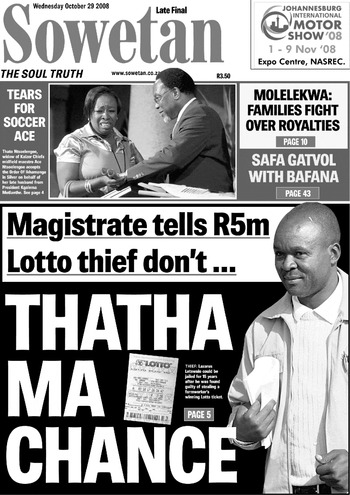
As a relative latecomer to the global lottery industry, the South African government launched a National Lottery on 2 March 2000, six years after the country's first democratic election. The lottery operator encouraged people to ‘Tata ma chance, tata ma millions’ (Take a chance, take millions), an invitation South Africans found hard to resist (as did a ‘Lotto thief’, see Figure 1). But, despite this invocation of ‘chance’, and contrary to the claims that gambling is seen as a means to procure wealth through magical rather than more economically rational routes (Comaroff and Comaroff Reference Comaroff and Comaroff1997; Reference Comaroff and Comaroff1999; Reference Comaroff and Comaroff2000: 318–28), gambling among Cape Town's poor is experienced as a means through which unpredictability is controlled rather than invited. It is seen as being governed by forms of causation other than luck, as exhibiting a formalized and institutionalized character, or even as being ‘downright respectable’ (Krige Reference Krige2011). It is an economic activity rather than a leisure pursuit: a technology to reach the inaccessible arena of the market, just as likely to yield a return as other activities such as informal trading. The lottery appears to be a means of shoring up the once-predictable flows of money and power, relying on unseen forces as a means to avoid unpredictable situations or to manipulate risk, and hence almost to ‘calculate’ risk in relation to other, often equally ‘chancy’, economic scenarios.
Front page of The Sowetan

According to the National Centre for the Study of Gambling in South Africa (NCSG), 82 per cent of adultsFootnote 1 play the lottery regularly (Caelers Reference Caelers2006: 4; Collins Reference Collins2006). Punters can buy their tickets from licensed vendors at local corner shops, large retailers, newsagents, service stations, supermarkets, post offices and over the Internet. Apart from the proliferation of lottery vendors and players, the games on offer and the amounts of draws per week have also multiplied. Besides the main lottery, where participants choose six numbers out of a possible forty-nine, the operators have also introduced a LottoPlus game,Footnote 2 PowerBallFootnote 3 and SportstakeFootnote 4 games, and a variety of instant-win scratch cards. Alongside the lottery, many legal sports-betting shops, bingo halls, casinos and small gambling parlours have also started to dot the South African urban and semi-urban post-apartheid landscape. This presents a marked historical and political shift in the place that legal gambling occupies in the daily lives of most South Africans.
LEGAL GAMBLING AND A DIVIDED NATION
From 1673 (Rule and Sibanyoni Reference Rule and Sibanyoni2000: 1), successive Dutch and British colonial governments prohibited gambling and introduced laws to proscribe betting activities in South Africa (Lotter Reference Lotter1994: 193). These laws culminated in the apartheid government's draconian efforts to uproot ‘immoral’ gambling in ‘white’ South Africa (ibid.: 192–3). The National Party's Calvinistic attitude to gambling was tempered, however, by economic and political expediency in the so-called black homeland states (Sallaz Reference Sallaz2009: 143–9). Noting the immense popularity of casinos in Lesotho and SwazilandFootnote 5 during the 1960s (Sallaz Reference Sallaz2005: 42), the apartheid government proclaimed the Self Governing Territories Constitution Act in 1971, allowing homeland authorities in Transkei, Ciskei, Bophutswana and Venda to legalize gambling in order to attract capital (Hughey and Mobilia Reference Hughey, Mobilia, Eadington and Cornelius1997: 2–28). Although black communities protested against this liberalization, the homeland authorities were ‘buffered from civil society’ (Sallaz Reference Sallaz2009: 137) and stood to gain from the enormous financial benefits that their licence-granting powers afforded (ibid.: 145–8). For its part, the National Party overlooked the racial desegregation, notorious striptease shows, pornography and prostitution at homeland casinos (Crush and Wellings Reference Crush and Wellings1983; Lotter Reference Lotter1994: 194), in part because these institutions upheld the fiction of the homelands' political independence (Sallaz Reference Sallaz2009: 143–9). While the homeland authorities benefited from casinos in their territories, these were wholly owned and controlled by white business interests (Rule and Sibanyoni Reference Rule and Sibanyoni2000: 8; Sallaz Reference Sallaz2009: 143–5). In the 1980s, the Ciskei and Transkei authorities launched state lotteries to augment their incomes.Footnote 6 Both lotteries were poorly administered, and records of the revenues were unreliable (National Lottery Board 2003: 5–6; 2004: 5).
GAMBLING FOR DEMOCRACY
At the end of apartheid the South African government was virtually bankrupt, while the incorporation of former homelands into nine new provinces posed enormous fiscal and judicial challenges. The discrepancies between the South African Gambling Act of 1965 and the gambling laws of the former homelands created legal loopholes in the transitional legal system (Carnelley Reference Carnelley2001) that saw a massive upsurge of gambling ‘entrepreneurs’ (Parliamentary Monitoring Group on Gambling 2001). Slot machines and blackjack tables appeared in bars and restaurants; gambling parlours opened in the suburbs; various charities advertised bingo, other lotteries and scratch cards. Gambling was rife and seemed to have ‘mushroomed almost out of control’ (Auret Reference Auret2006; Erwin Reference Erwin2002; Mabuza Reference Mabuza2003a; Wiehahn Reference Committee1995). It is in this context that the nascent province of KwaZulu-Natal launched a successful Lotto in May 1992 to finance ‘upliftment’ projects for disadvantaged communities in its expanded jurisdiction (Ross Reference Ross2001). Despite its success, pressure from religious and community groups, gambling entrepreneurs and political leaders began to lobby for the state to put forward a unitary national policy on gambling (Erwin Reference Erwin2002).
To this end, the state appointed two committees, the 1992 Howard Commission and the 1995 Wiehahn Commission, to make recommendations concerning a national gambling industry. Both commissions advised the government to legalize gambling and to institute a national lottery in order to create jobs, stimulate the economy and raise state revenue (Howard Reference Commission1993; Wiehahn Reference Committee1995). They also noted that the gambling industry was one of the few industries where black economic restitution could quickly be obtained (Erwin Reference Erwin2002; cf. Mabuza Reference Mabuza2003a). When the National Lottery was finally launched in March 2000, both the KwaZulu-Natal and the Transkei lotteries were closed down (National Lottery Board 2003; Ross Reference Ross2001). The national legislature was given exclusive power to regulate lotteries and sports pools, while the provincial legislatures were tasked with regulating casinos and other forms of gambling (Carnelley Reference Carnelley2001: 3).
At the time, the Minister of Trade and Industry praised the lottery as ‘a tool for [national] progress, advancement and personal growth’. He made much of its potential to raise revenues, to contribute to the country's Reconstruction and Development Plan (RDP) and to donate to good causes (Mabuza Reference Mabuza2003a).Footnote 7 Uthingo Pty Limited, the company that won the bid to run the National Lottery, earned many plaudits for its Black Economic Empowerment (BEE) credentials (70 per cent of its ownership was black). Its charismatic chief executive, Humphrey Khoza, was the first black president of the South African Chamber of Business and an ordained priest. His admirers asserted that ‘When Khoza said the lottery was a licence to dream … [p]eople believed him and started to buy tickets’ (Radebe Reference Radebe2004).
When Uthingo's licence came up for renewal in 2006, a number of politically connected competitors registered their interest. Although Uthingo's successful rival, Gidani, was ‘89.2 per cent Black Majority owned’ (Anon 2010a), its winning bid sparked a lengthy legal battle in the Pretoria High Court. Uthingo's lawyers pointed out that three key players in Gidani were also national executive committee members of the ruling African National Congress (ANC) and that this presented a conflict of interest (da Costa and Carter Reference da Costa and Carter2007: 1; Gordin Reference Gordin2007; Sapa 2007). Gidani retorted that the Minister of Education had interests in Uthingo (da Costa and Carter Reference da Costa and Carter2007: 1). While the courts deliberated, the lottery was suspended for seven months (Mbanjwa Reference Mbanjwa2007: 1). In October 2007, the courts declared that they did not regard the ANC members as political office bearers under the Lotteries Act and upheld Gidani's bid. Gidani upped the revenue paid to the Lottery Distribution Fund to 34 per cent of revenues and gave government a 20 per cent shareholding (Anon 2009a; Peters Reference Peters2007: 6).Footnote 8
Like its predecessor (Peters Reference Peters2007: 6; Ross Reference Ross2001), however, Gidani came under fire for the inefficiency with which it distributed money to good causes and especially to the poor (Anon 2009b: 20; Howroyd Reference Howroyd2009: 20; Kamaldien Reference Kamaldien2009: 1, 4; Vos Reference Vos2009: 4). Much was also made of the Lottery Board members' large salaries (Kamaldien Reference Kamaldien2009: 1, 4; Vos Reference Vos2009: 4). Gidani responded to the negative publicity by saying that it did not have the authority to make grants (Vos Reference Vos2009: 4); it accused NGOs of being ‘irresponsible [in] relying on Lotto for operational costs’ (Naidoo Reference Naidoo2008a, Reference Naidoo2008b) and ‘doing less and less in the form of fund-raising’ (Peters Reference Peters2007: 6); and it pointed out that Gidani's good intentions were essentially restrained by its need to comply with various laws and government interests (Naidoo Reference Naidoo2008a).
BOTH BENEFICIARIES AND VICTIMS
Interestingly, both the apartheid and the post-apartheid governments have justified the legalization of gambling in terms of the economic development of marginalized black communities (Erwin Reference Erwin2002). In other parts of the world where lotteries generate public revenues for similar ‘good causes’, many critics have pointed out that governments are effectively encouraging vulnerable people to gamble – most notably the poor (Freund and Morris Reference Freund and Morris2005; Guryan and Kearney Reference Guryan and Kearney2008; Haisley et al. Reference Haisley, Mostafa and Loewenstein2008; Nyman et al. Reference Nyman, Welte and Dowd2008; Lang and Omori Reference Lang and Omori2009; Wisman Reference Wisman2006) and less educated (Clotfelter and Cook Reference Clotfelter and Cook1989; Forrest and Gulley Reference Forrest and Gulley2009; Rogers and Webley Reference Rogers and Webley2001). They often assert that gambling is habit-forming and addictive and, as such, raises public health issues (Binde Reference Binde2005: 470).
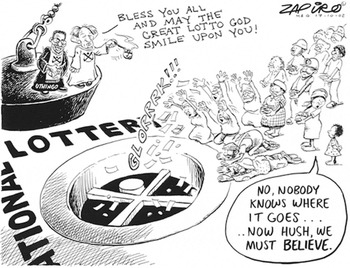
In South Africa, such criticisms are inflected by the devastating legacies of apartheid and the ravages of the post-apartheid government's economic liberalization policies. In this climate the Department of Trade and Industry (DTI), under whose jurisdiction the lottery falls, often clashes with the Department of Social Welfare and Parliament as they push for more lottery games. Although the DTI frequently lauds the lottery as a means to generate money for the poor (Auret Reference Auret2006), its aim of channelling disposable income from the upper and middle classes to the ‘poorest of the poor’ has not been realized. Various studies have shown that most of the country's lottery players are very poor and play the lottery regularly (Caelers Reference Caelers2006: 4; Collins Reference Collins2006; Collins and Barr Reference Collins and Barr2001; Power Reference Power2003; Rule and Sibanyoni Reference Rule and Sibanyoni2000).Footnote 9 Numerous politicians, academics and pressure groups have pointed out that the poor cannot afford to play the lottery, that it exacerbates a ‘vicious cycle of poverty’ (Anon 2001: 3; Leeman Reference Leeman2001: 5; Sapa 2002; Smith Reference Smith2003: 3; and see the cartoon in Figure 2), and that educational disadvantages make the poor more likely to believe the lottery's promises of riches (Hooper-Box Reference Hooper-Box2003; Power Reference Power2003).
Cartoon by Zapiro© 2002–2011 Zapiro (All rights reserved)/Printed with permission from www.Zapiro.com

In 2008, amidst another public backlash at the Lotto's failure to distribute enough money to worthy causes while ‘making the poor poorer’ (Anon 2009b: 20; Howroyd Reference Howroyd2009: 20), the DTI admitted that it was concerned about the proliferation of betting activities in South Africa. It subsequently set up commissions to study the gaming industry (Khanyile Reference Khanyile2008) and the impact that the greater accessibility of gambling had on the poor – inviting the present author to make a presentation of my research findings to the Department in Pretoria on 12 May 2010. Publicly the DTI was at least moving away from its confident focus on the gambling industry's job creation and income generation potential to a greater focus on gambling's detrimental social impact.
EDUCATING POOR CONSUMERS
Although the DTI and spokespeople for the gambling industry often point out that consumer spending on gambling is dwarfed by, for instance, that on mobile phones (Erwin Reference Erwin2002; Mabuza Reference Mabuza2003a, Reference Mabuza2003b; Power Reference Power2003), they have embraced calls for aggressive public education on the risks of gambling. To this end, the industry created the National Responsible Gambling Programme (NRGP)Footnote 10 to educate and inform the public about ‘problem gambling’. It funds large-scale media campaigns targeted at a general audience as well as smaller projects that admonish pensioners to ‘play smart’, pupils to take ‘risks wisely’ and teachers and adult beneficiaries of social grants to ‘wise up to responsible gambling’.
Informed by research done by the National Centre for the Study of Gambling (NCSG), the NRGP's educational programmes are largely aimed at poor black consumers who, by virtue of their extreme poverty, wager more than they can supposedly afford. Barring cognitive (Ross et al. Reference Ross, Sharp, Vuchinich and Spurrett2008) and psychological pathologies, the NCSG ascribes such ‘problem gambling’ to excessive desires (Collins Reference Collins2003; Collins and Barr Reference Collins and Barr2001), and/or ‘ignorance and poor life management skills’ (Caelers Reference Caelers2006: 4; Collins Reference Collins2006). Not surprisingly, the NRGP's remedies for ‘problem gambling’ among the poor focus almost exclusively on ‘financial literacy’, with particular emphasis on the management of household budgets. In line with neo-liberal economic theory, the NRGP and the NCSG do not see ‘problem gamblers’ as victims of unscrupulous gambling operators or of the state (cf. Clotfelter and Cook Reference Clotfelter and Cook1991) but as slaves of their own ‘inner urges’ (cf. Wiehahn Reference Committee1995: 612) and victims of circumstance.
GAMBLING AMONGST THE POOR
Apart from evidence that people do not gamble less when they know more about their odds of winning (Williams and Connolly Reference Williams and Connolly2006), and that gamblers often ‘switch off’ rational decision making when they gamble (Sevigny and Ladoucer Reference Sevigny and Ladoucer2003), the NRGP's emphasis on education is based on a number of flawed conceptions about the ‘economic’ lives and motivations of those they want to educate. As such, they assume ignorance combined with excessive new greed, fuelled by political liberation, as prime economic movers in gambling behaviour.
In the academic literature, a bevy of scholars have recently suggested that the ‘irrationalities’ that mark the flow of capital post-1971 have infected the ways in which poor people behave ‘economically’. Frequently they have asserted that conceptions of risk and chance have started to invade the economic system beyond the gambling industry (Giddens Reference Giddens1991; Hacking Reference Hacking1990) and that the logics of the casino now inform many economic decisions. In this tradition, Comaroff and Comaroff (Reference Comaroff and Comaroff1997; Reference Comaroff and Comaroff1999; Reference Comaroff and Comaroff2000: 318–28) described gambling as a cornerstone of what they have termed ‘millennial capitalism’: a new stage in capitalism where an increased climate of risk is coupled with magical notions about the production of value. Thus both the South African state and those of its citizens who risk an enormous amount of money on gambling and economic pursuits with uncertain outcomes purportedly partake in an ‘occult economy’ where they deploy ‘magical means for material ends’. The lottery, with its promises of enormous riches, and its twin industry of muthi (medicine/witchcraft substances) sellers and number diviners supposedly exemplify this trend.
In the course of anthropological research in Cape Town's Khayelitsha and Langa townships between September 2008 and January 2011, I found no evidence of the NRGP's hypothesis that economic greed and ignorance motivate the behaviour of poor lottery players. My research comprised daily participant observation in both townships, hundreds of interviews with lottery players and operators, and a randomly sampled questionnaire with 200 participants. My research also repudiates the notion that poor lottery players in Cape Town are taking more risks as they are drawn into the logics of neo-liberalism. Instead, people's lottery participation showed many continuities with earlier forms of gambling, of risk taking and of making a living in highly unreliable and precarious economic conditions.
It is nothing new
In the first place, the ‘culture of immediate gratification’ that supposedly fuels the upsurge of gambling activities in post-apartheid South Africa is not new. To a large extent, the concern expressed by government, research bodies and religious organizations over the effects of gambling on poor black people continues colonial and apartheid discourses on ‘native gambling’ (Hellman Reference Hellmann1940; Krige Reference Krige2010; Longmore Reference Longmore1956; Phillips Reference Phillips1938). Despite the most earnest entreaties of successive governments and other organizations, and their best efforts to clamp down on gambling, historical records contain numerous references to the longstanding and enthusiastic fervour with which South Africa's working classes have gambled (Crush Reference Crush1994; Delius and Glaser Reference Delius and Glaser2002). From seventeenth- and eighteenth-century slaves at the Cape (Ross Reference Ross1983: 7, 58, 79) to nineteenth-century miners on South Africa's gold and diamond fields (van Onselen Reference van Onselen1982), and from early twentieth-century amakholwa (Christian converts) who invested vast amounts in crude pyramid schemes (La Hausse Reference La Hausse1992) to apartheid township residents (Bozzoli Reference Bozzoli1991; Dugmore Reference Dugmore1993; Longmore Reference Longmore1956), South Africans living on the margins of privilege have long been keen ‘gamblers’.
Very little anthropological research focuses on gambling in South Africa. However, a host of anthropologists have mentioned it in their ethnographies of working-class ‘black’ and ‘coloured’ people. Mayer (Reference Mayer1971: 188) remarked that dice playing was a favourite pastime of Xhosa gangs in the city. Reynolds (Reference Reynolds1989: 56, 57, 86, 98, 168) noted that children in Crossroads played card and gambling games to order and classify their environment in the face of the loss of traditional ways of doing so. Schapera (Reference Schapera and Nader1969) described gambling in the context of the disruptive influence of a money economy among the Kgatla. Countless others refer to gambling as a male pastime in shebeens (unlicensed drinking establishment), in migrant hostels and in other places where black men congregated (see Ross Reference Ross1983; Reference Ross1999: 55).
Everyone gambles
Secondly, the ubiquity of gambling activities amongst poor people in South Africa's townships cautions against treating the lottery or casino gambling as exceptional instances where people wager on an unknown outcome. ‘Risky’ informal gambling is widespread, multiform and forms a significant part of daily life in most informal settlements. In the townships of Cape Town where I did my research, people often told stories about the rich local businessmen and BEE beneficiaries who won and lost millions of rands in exclusive card games. No one knew for certain where these games were played, but quite a few of my interviewees claimed to know of a ‘security’ (security guard) employed by the men while the game was in progress. Whether factually true or not, these rumours point to a general acceptance that everyone gambles, even when they do not need the money.
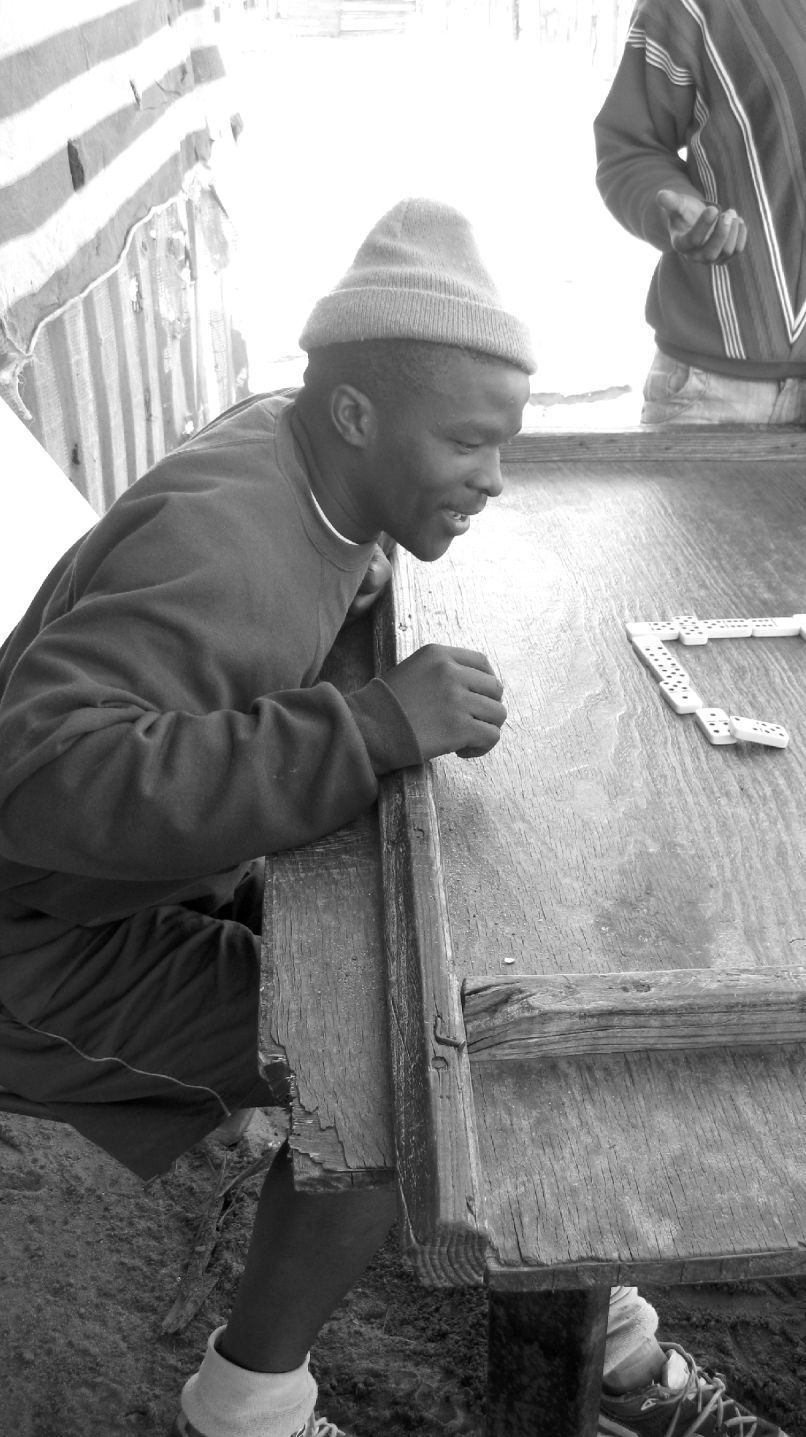
This assertion was borne out by the enormous diversity of gamblers and gambling games in Cape Town (see Figure 3). Groups of young men and criminal gangs regularly play dice in shebeens and on street corners. For the most part, these games are aimed at the redistribution of money in a tight-knit group (cf. Mitchell Reference Mitchell1988; Scott Reference Scott, Ingold, Riches and Woodburn1991), with many a participant stabbed or shot for leaving the game before everyone agreed that it was over. Women of all ages play large sums of money on ‘calling cards’ and umjiqka, card games similar to ‘snap’ where each player bets on the outcome of every upturned card. Just before Christmas, the stakes in umjiqka games in Khayelitsha increase significantly as women gamble feverishly to secure a big pot of money for home improvements, gifts, drinks and festive foods. Some women bet up to R500 per card (about £45). A plethora of other card games draw enthusiastic crowds to the intimate spaces of people's living rooms and back yards over weekends.
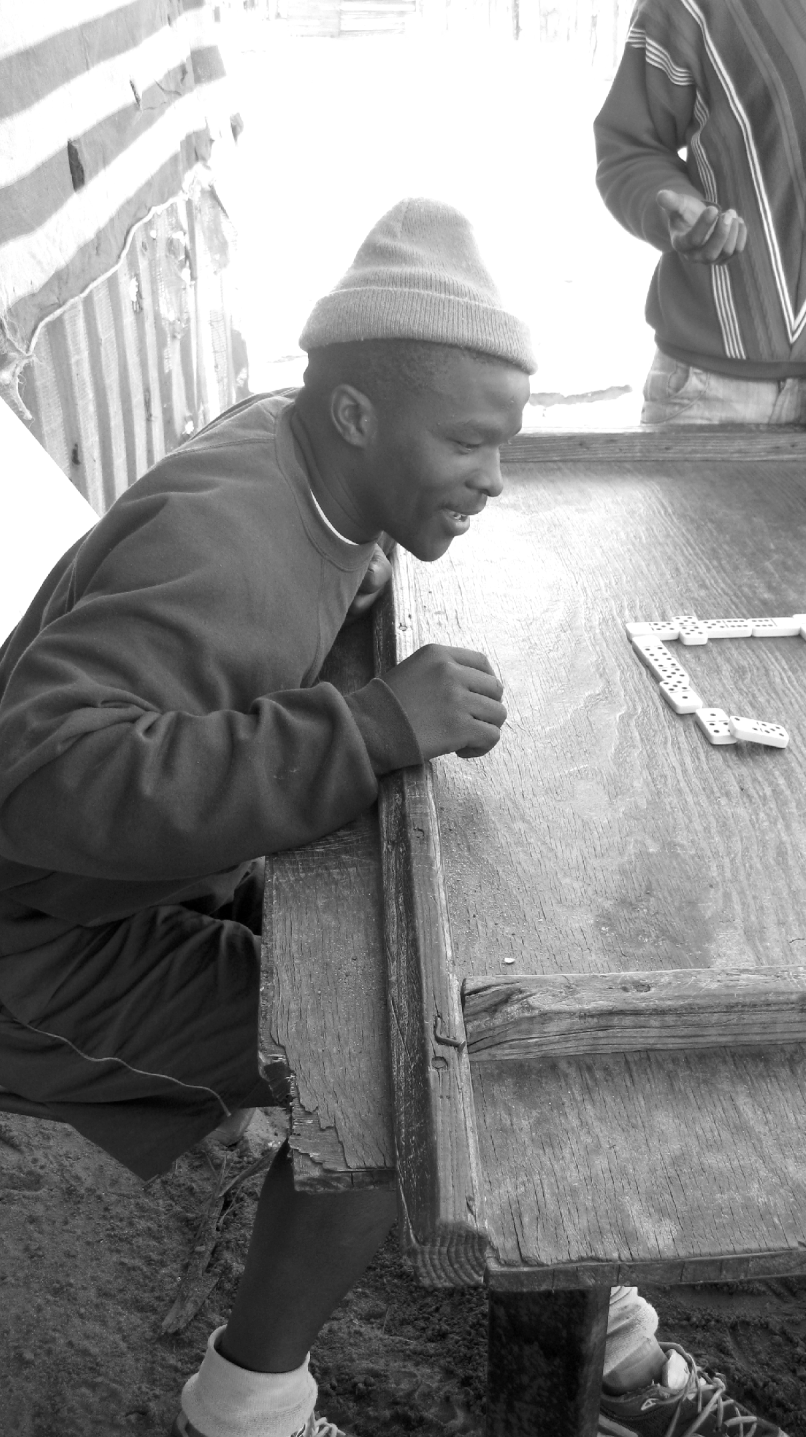
Dominoes player
There are also sporadic instances where people bet on dog and rooster fights, soccer games and WWF-style wrestling matches.Footnote 11 Recently, several betting syndicates have also sprung up around the hunting of game for muthi purposes in the Cape's nature reserves. People place bets on specific hunting dogs and their likelihood of making a kill or taking down an animal (Lewis Reference Lewis2010a: 3).
Schoolteachers often complain that primary school children from as young as seven play ‘spin’ (betting on head/tails as a coin is tossed) during classes. Apart from the distraction this offers in lessons, many children lose their lunch money in this way. High school children continue to play spin but many move on to faster, higher-stake dice games, often in the presence of more experienced older men outside the school gates (cf. Reynolds Reference Reynolds1989: 56, 98, 168). In order to participate in these dice games, children may pilfer small amounts of cash from the change they get whenever their parents send them to the local spaza (informal corner shop). Older children may also rob younger ones of their lunch money for this purpose.
Stokvels (rotating credit associations), usually geared to promoting informal savings, regularly organize prize draws, bucket games (where the participants have to flip a coin into a cup placed at the bottom of a water-filled twenty gallon drum) and raffles. Churches and other social groups also use lotteries and prize draws to generate money. Local supermarkets, spaza shops and other businesses also frequently advertise prize draws and try to attract new customers with large jackpots and attractive prizes. Every local newspaper offers its readers the opportunity to win money, cars, vacations and consumer goods through their scratch cards and expensive SMS competitions.
The popularity of mobile phones in the townships has expanded the reach of gambling operators and placed gambling opportunities literally in the hands of anyone with a mobile phone. Thus, almost every one of my interviewees had entered Vodacom's competition to win a BMWFootnote 12 in 2007 and continue to text their nine letters into the operator's weekly R1 million draw, at R2.50 per entry. They also spend considerable sums of money on entering other mobile text competitions like the Childrens' Trust's ‘Winikhaya’ (Win a house) competition (at R7.50 per entry) and on television game shows where the texts cost up to R25 per entry. In the wake of these text competitions, an overabundance of mobile phone advertising businesses have sprung up to offer customers the opportunity to play simulated roulette, one-arm jack and scratch-card type games, often with offers of real prize money (often ‘paid out’ as airtime credits). These games are not confined to mobile phone operators and gaming businesses, however. ‘Respectable’ businesses have also turned to raffles and lottery-type competitions in their bid to attract customers. First National Bank, for instance, ran a text campaign which offered its customers the opportunity to win a ‘million a month’.
Gambling as work
Thirdly, although much of the literature agrees with the NRGP's depiction of gambling as a leisure activity outside of the ‘real’ economic sphere, there is increasing evidence that working-class people do not, as the concerned politicians and NGOs insisted, ‘play’ with their money. Often, they do not view gambling as mere ‘fun’ or as a leisure consumer product. And again, such local perceptions have historical and cultural roots. Thus the early amakholwa's investments in ‘people's banks’ were intimately tied to their material expectations of their new faith, to their efforts to establish a distinctive group identity, and to the material conditions under which their pastors had to make a living (La Hausse Reference La Hausse1992). Similarly, gambling constituted an important part of women shebeen owners' economic survival skills in unwelcoming urban areas during apartheid (Bozzoli Reference Bozzoli1991; Feinstein Reference Feinstein2005: 50). Other studies have shown that it was not only black working-class people who viewed gambling as an income-generating activity and a form of ‘business’ (Hellman Reference Hellmann1940; Phillips Reference Phillips1938; Longmore Reference Longmore1956), but that dog-racing in poor white neighbourhoods in Johannesburg was also regarded as a livelihood (Krige Reference Krige2010). Krige's recent study of fahfee, a longstanding illegal numbers lottery in Johannesburg, shows that both runners and players viewed the game as a legitimate economic activity that allowed participants to accumulate money (ibid.; cf. Matyu Reference Matyu2008).
Beyond the economic viability of gambling businesses, some social scientists have also pointed out that gambling fulfilled an important political function too. For instance, ‘coloured’ gamblers in Johannesburg gambled in political defiance of the racist capitalism of apartheid, and treated gambling activities as an important marker of their class identity (Dugmore Reference Dugmore1993).
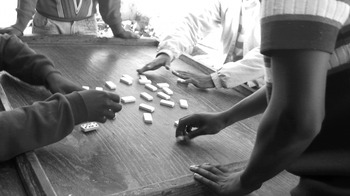
My own research in Cape Town showed that large numbers of unemployed men play dominoes and pool for money, with many of them claiming that it is their only form of income (see Figure 4). Several of my male interviewees plied their skills at a pool hall or shebeen in order to buy necessities such as food. Some of these games are played with matchsticks for relatively small stakes, like a plate of food at the nearest shisa nyama (informal stall that sells barbecued meat) or a couple of beers. Others are serious events in which people wager large sums of money on the outcome of a game. Dominoes and pool players often emphasized their skills and experience while effectively denying the statistical probability that winning depended on their drawing good tiles or ‘shooting’ first. The majority claimed that a skilful player could play himself out of a tight spot by relying on his experience and almost preternatural ability to read the game.
Unemployed men playing dominoes

Since these were seen as games of skill, people could ‘work’ at a specific game and ‘earn’ a living. Even the mobile phone lotteries were frequently viewed as requiring skill, with many interviewees pointing out that people who phoned in to television shows often lost because they gave the wrong answers. They also spent many of their free airtime minutes on repetitively texting answers to competitions, pointing out that this ‘work’ would translate into winnings. My interviewees were sceptical about winners in the newspapers and on television who claimed that they had only sent a single entry into a competition. Many of them mentioned that the winner of the Vodacom BMW competition had texted over R50,000's worth of airtime to win the car, and must have been texting ‘full-time’ to enter that number of texts in the competition.
My interviewees also insisted that the owners and organizers of various gambling games were entrepreneurs and were just trying to ‘make a business’. In betting on three-cap gambling (where a hustler hides a marker under one of three hollow containers, shuffles them around and then makes the punter guess where it is), for instance, punters were said not to be taking a ‘chance’ but engaging the owner in a contest of skill. People similarly viewed poker and a variety of card games as contests and dismissed the importance of the supposedly random way in which cards are dealt. Although a number of my interviewees, notably the Born Again Christians, cast moral opprobrium on the customers of gambling establishments, few of them cast aspersions on their owners, often claiming that such ownership was ‘just a business’. They similarly viewed ‘sober’ liquor shop and shebeen owners as respectable businesspeople.
Local definitions of gambling
In the fourth place, the NRGP's definition of gambling does not chime with their target audience's own definitions and understandings of what gambling is. As such, the NRGP's definition of gambling as a leisure activity ‘strictly demarcated from the everyday world around it’ (Reith Reference Reith1999: 1) has little relevance in township life. Gambling is rife, widespread and frequently viewed as a business rather than leisure activity. But there is another aspect of the NRGP's definition of gambling that is at odds with local perceptions, namely to classify as gambling those activities whose outcomes are premised on random or ‘chance’ occurrences. This emphasis on chance or risk is a historical product of discursive processes in the West and of changes within the Western economic tradition itself (ibid.: 14–23). To a large extent, such a definition overlooks the situational and social definitions of gambling in South Africa's townships. In interviews, researchers at the NCSG have referred to indigenous explanations of excessive gambling as a form of mysticism and asserted that the NCSG was not interested in the business of ‘belief’. They preferred to find more ‘rational explanations’ for problem gambling and were justifiably excited about the ‘cutting-edge’ cognitive studies at their centre.
In my interviews with women township residents, the majority asserted that they did not gamble but often admitted to playing the National Lottery and participating in a variety of other lotteries. They explained that people only ‘gambled’ at places where a lot of time was spent in repetitive gambling acts such as spinning the wheel, rolling the dice or pulling one-arm slot machines in casinos. That people generally spent very little time actually buying Lotto tickets, and that the results of the Lotto were delayed beyond the immediate situation of buying tickets, meant that many of my interviewees did not see it as gambling. They also asserted that gambling was a problem activity in which only a few people participated. Since ‘everyone’ played the lottery, it was not a form of gambling. This reasoning is also common in other parts of the world (Casey Reference Casey2006; Lange Reference Lange2001).
In the townships, gamblers were also portrayed as people who stayed in one place for long periods of time playing uncommon or unknown games. For example, slot- and limited payout machines were not normally found in the townships. People who wanted to play these machines had to travel to casinos such as Grand West in Cape Town or to tote shops in the city that had limited payout machines in their back parlours. In most cases, people had to use public transport to get to these places or imagined them inaccessible.Footnote 13
Despite this conceptual distance from casinos, many stories circulated about old people who lost their pensions at casinos. On the one hand, these bankrupt pensioners were described as illiterate and too trusting. On the other hand, they were labelled as ‘gamblers’ who selfishly did not think of their many dependants or the family members who had to help them out when they were in financial difficulties. For similar reasons, many people described dice players as ‘gamblers’. These negative social evaluations of ‘gamblers’ have little to do with ideas about the supposed link between hard work and ‘decent’ earnings that set gambling apart from ‘work’ in the West (Reith Reference Reith1999; cf. Sahlins Reference Sahlins1996). Indeed, a variety of respected social institutions, most notably prosperity gospel and African Independent Churches, sanction people's expectations of getting money from ‘nowhere’. My Born Again interviewees often asserted that God could instantly make people prosperous and frequently claimed that they could ‘win the lottery without a ticket’. Similarly, many Christians in Independent churches tried to appease their ancestors and thus reinstate a flow of material ‘blessings’ into their lives.
Beyond these perceptions, economic realities in South Africa have also severed the link between work and income in the townships. As many as 43.7 per cent of households in South Africa are dependent on government grants for an income (Statistics South Africa 2010b: 6, 37–8). This figure is much higher in townships (cf. MacGregor Reference MacGregor2005: 43–55).
Limits to desire: witchcraft and gambling
The Western subject-centred discourse of economics portrays the unexplained gambling and excessive spending behaviours of people in terms of a competition of individual desires and wills, making desire the ‘constitutive feature of modern subjectivity’ (Margolis Reference Margolis, Brodie and Redfield2002: 23). However, in my research, many people defined gambling in terms of inappropriate social behaviour, often caused by external agents. In the South African context, possession and witchcraft narratives reveal the limits of desire and suggest the need for a non-psychological and non-contractual way of thinking about the self. Thus bewitched gamblers are often defined not by the depth of their desires but by their permeability.
Many of my interviewees described ‘problem gamblers’ as victims of witchcraft or of the overwhelming powers of other players who used strong muthi in their vicinity. My interviewees seldom concentrated on the gambler's obsessive behaviour or his wilful actions and instead often used a particular person's disastrous gambling behaviour as a starting point for a long explanation of witchcraft more broadly. Thus Eirie, a gossip in Khayelitsha, spoke about a local middle-aged man who would refuse to leave the dice game, not even to eat or relieve himself, for days on end. The poor man's wife and children had to constantly carry food to the spot where the men played, while his little son had to empty the glass bottles he urinated in. Apart from this hardship, the family was also plagued by unexplained illnesses and deaths while the man's once-successful shisa nyama business was virtually bankrupt within a week ‘for no reason’. Some township residents also saw strange lights outside the accursed family's shack. The man's gambling, then, was caused by the same witchcraft that destroyed the rest of his family – and, Eirie mused, it would probably consume the poor man totally.
Being in the vicinity of someone who used strong muthi was equally dangerous. The dice players I spoke to often admitted that they would only join a game once they had convinced themselves that their potential fellow players were not using muthi, even if they were using it themselves. They were especially careful of men who touched their pockets or who shouted too loudly – certain evidence that the suspected players were activating the muthi by spitting it out of their mouths. The problem, many of my interviewees complained, was that people who used strong muthi were also invincible and undetectable. Thus it was often only once you were ‘caught’ in a game that you realized that a player had unusually ‘strong dice’. There are many stories of people zombified by such games, driven to bankruptcy and unable to move until the witch sated his appetite. A few of my interviewees were lucky enough to escape such situations and described the strong pull they felt at the time and the superhuman strength it required to break free. Two of them never played dice again.
Some of my interviewees, especially the ones that went to prosperity gospel churches such as the Universal Church of the Kingdom of God, also described how demons forced people to gamble their money away. My friends explained that the demon ‘takes over’ its host's body in such moments, and that the host was therefore often unaware of its presence. Of my interviewees who had gone through this experience and who had been exorcized, almost all remarked that they could not remember anything about the time when the demons presumably resided in them. Once inside a body, the demons were said not only to block the flow of God's blessings into the unfortunate person's life but also actively to force them into destructive behaviour. It is in the context of my interviewees' permeable bodies that the weaknesses of the economic theories on gambling are illustrated.
RISKY LIVES AND MAKING A PLAN
At the heart of the alarm over poor people's irresponsible gambling, the NRGP's budget exercises, and their definition and treatment of problem gamblers is a very peculiar conception of risk. The NRGP's budgeting tools, for instance, assume that with the careful, predictable and measured allocation of a set income, an individual can not only end his/her exposure to risk but also extend that protection into the future through savings. Similarly, the NRGP defines problem gamblers as people who spend money on gambling that should rightly have gone to essential (predictable) household expenses (Anon 2010c). In these conceptions, there is the assumption of a rational subject that decides to engage with risk in highly contained situations. Such considerations do not take into account, however, that life for poor people is frequently indeterminate and unpredictable, and that these indeterminacies pervade all aspects of life (cf. Malaby Reference Malaby2003; Ross Reference Ross2010). Such considerations also do not allow for the infiltration of social indeterminacies into strictly economic ones.
In the field, the abstractions of economics proper raise interesting methodological and analytical issues (cf. Nattrass Reference Nattrass2002). This was particularly true of the accounting principles that guided the NRGP's educational emphasis on financial budgeting. I took some booklets, similar to the ones used by the NRGP, to a few of my interviewees. They were familiar with the format and laughingly explained that all development projects in the area, whether concerned with ‘HIV/AIDS, housing or music’ taught people to budget. They dutifully ‘budgeted’ in the workshops but confided that the exercise was ‘useless’; few of them had the predictable incomes and fixed expenses that the booklets listed.
South Africa's labour force has steadily been shrinking since 1996, with 25.2 per cent of people of working age officially unemployed (Statistics South Africa 2010a: 1–3). Statistics South Africa defines employed persons as ‘those aged 15–64 years who, during the reference week, did any work for at least one hour; or had a job or business’ (Statistics South Africa 2011: xvi). Despite the minimal definition of employment, these figures are much higher in the townships. In Khayelitsha for instance, it is estimated that between 46.3 per cent (Nattrass Reference Nattrass2002: 13) and 50.81 per cent (Statistics South Africa 2003) of adults are unemployed, with 90 per cent of households earning less than R3,500 (about £320) a month (Anon 2010b; Department of Cooperative Governance 2010).
Of the employed people I interviewed, many complained about the fact that most employers were now working through labour brokers, who take 20–40 per cent of earnings for the duration of employment. As much of this work was seasonal and contractual, people did not experience job security even if they received a monthly salary. In this regard, Bähre (Reference Bähre2010) found that social workers often encouraged even ‘normally’ employed people in Cape Town's townships to apply for social grants in order to buffer them from the vagaries of the job market and the threat of HIV-related illnesses. In Cape Town's townships, people regularly had to accommodate and feed family members from rural areas who came to the city to look for work. HIV/AIDS was also putting enormous strains on family support structures in both locations (Ross Reference Ross2010). The social safety nets offered by municipal and NGO groups were often dependent on the capriciousness of political will and funders' whims. In February 2010, for instance, the Khayelitsha pensioners' outings, paid for by the municipality, were cancelled abruptly because of budget restraints, while many schools stopped their feeding schemes for similar reasons.
Not surprisingly, the majority of households in Khayelitsha and Langa were dependent on government child support grants, old age pensions and disability grants (cf. Lewis Reference Lewis2010b: 1). Getting access to these grants was contingent, however, on the complex and highly inefficient bureaucracy of the ‘Department of Horror Affairs’.Footnote 14 Of my interviewees who had access to social welfare grants, many complained about erratic payments, about the bribes they had to pay officials to deal with their cases, and about the mysterious ways in which their details were changed on the national database.
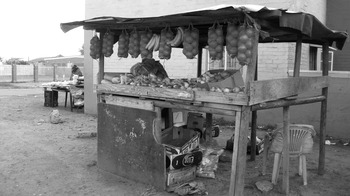
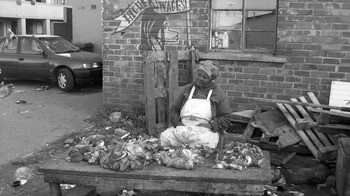
Since social grants were so meagre (Bähre Reference Bähre2010), the majority of my interviewees had to ‘make a plan’. Besides their social grants, they were also dependent on a range of largely unstable and informal income streams (cf. Nattrass Reference Nattrass2002). Women were often dependent on small informal trading businesses where they sold vegetables, sweets, ices, second-hand clothes, baked goods, barbecued meat and plates of cooked food or other necessities from their homes or near taxi ranks and bus stops. Although some of these businesses were rather lucrative, their profitability was often undercut by events beyond their powers. Thus many women who sold ice-cream, frozen chickens and cooked food lost large amounts of perishable stock when the national electricity supplier, ESKOM, rolled out its load-shedding programme during 2007/8.Footnote 15 A large number of people in townships also make use of illegal electricity connections which are subject to occasional disconnections by the utility supplier's ‘agents’ (Tau Reference Tau2008) and sporadic surges that burn out appliances. Apart from these factors, small traders also lose their stock to health inspectors and policemen who periodically seize fake merchandise and goods sold without a trading licence. My interviewees often described the bribes they paid to law enforcement officers as an unplanned ‘tax’. The majority of these small traders were living hand to mouth and had no capital for expanding their businesses. In a study of the informal trade in townships, Neves and du Toit show that it is not always clear whether vendors are eating their stock or selling their groceries. In either event, they extract ‘significant resources from enterprises for household use (“off-take”)’ (Neves and du Toit 2009; Neves and du Toit, this volume).
Fruit seller

Meat seller

Next to the major thoroughfares and in parts of the townships where the government has built houses, many people have also converted old shipping containers into hair salons, car repair shops, shebeens, corner shops, and telephone/Internet cafes. Although these shops sometimes do a brisk trade, their turnover is often constrained by the poverty of their clients, by theft, and by armed robberies.
Homeowners or people who rent RDPFootnote 16 houses often sell illegal electricity to their neighbours or to the people who, in turn, rent shacks in their back yards. They charge a monthly fee of R50–R100 per person for electricity (cf. Luhanga Reference Luhanga2009) and about R200–R400 per shack. Though they often quoted set monthly rates, many of these landlords accepted lower payments or delayed terms; they frequently struggled to get their renters to pay on time. Most people also loaned out small amounts of cash to friends and neighbours at high interest rates. However, since people often defaulted on their repayments, few lenders managed to make a ‘business’ of cash loans, and frequently resorted to borrowing from other lenders when they needed money for transport, food, school fees, mobile phone top-ups or pre-paid electricity. As one woman asserted, ‘We are all little mashonisas (informal moneylenders/loansharks) in this place.’
TATA MA CHANCE
Amidst these indeterminacies and insecurities, township residents often explained their economically ‘unwise’ or risky decisions to loan money to someone they knew was unemployed, to rent out shacks to people who only got child support grants, and to give orphans credit for groceries, as ‘taking a chance’. They often explained that their decisions were based not on the immediate economic circumstances of their debtors, as ‘we are all poor’, but on judgements of people's abilities to ‘make a plan’. Acutely aware that other local people were, like them, dependent on multiple activities and sources of income, my interviewees asserted that they could not know the specifics of everyone's ‘plans’; their debtors might be waiting for a loan repayment from someone else, for a stokvel payout, for funeral insurance, or for a disability grant for an illness. Since people did not have control over the workings of government departments or the bureaucracies that handled funeral and life insurance payments, and since they could seldom demand money from a stokvel out of turn, their ‘plans’ could not depend on strict time frames. As many of my interviewees asserted, you could get your grant, your stokvel bonus and your mother's life insurance payout all in one day. In the meantime, you had to take chances on a variety of plans, knowing that those plans were equally based on the chances that other people were taking.
Apart from the acceptance that poor people lived uncertain ‘economic’ lives and that such living happened against the backdrop of a social matrix of indeterminacy, the belief in the (material) agency of invisible forces was also widespread. Township residents' understanding of witchcraft (cf. Ashforth Reference Ashforth2000; Niehaus Reference Niehaus2001) and the work of demons negated the possibility of risk-free or ‘safe’ living upon which much economic theory is based. Thus my interviewees often asserted that even the rich and those who have had jobs for many years could lose it all in an instant, struck down by the work of invisible forces. Car accidents and illnesses were seldom ascribed to random occurrences, while violent and ‘unexplained’ deaths spurred witch hunts and exorcisms.
RISK AND THE NATIONAL LOTTERY
It is in this larger context of economic and ontological uncertainties that poor township residents participated in the lottery. They then took a ‘chance’ on the lottery in the same way that they took a chance on someone repaying an unsecured loan or investing in businesses with low turnovers and no profits. And, as with dubious loans, they sometimes got their money back and sometimes earned a little ‘bonus’ on top. Thus although almost 70 per cent of my interviewees reported never winning anything in the lottery, 80 per cent of them kept on ‘taking a chance’. The chances that people took on the lottery were very small, however, with the average spend on lottery tickets R52 per month or just over R13 per week. Furthermore, like their other ‘plans’, lottery tickets were bought not from discretionary incomes but from the same pool of money from which people bought (and sold) their groceries.
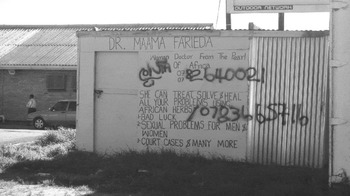
And although everyone I interviewed said that they would like to win the lottery, they had very modest hopes of actually doing so, even when they used muthi. In this regard, people could buy an enormous array of potions, soaps, lotions, powders, sticks and drinks that promised to secure them a lucky draw. Local newspapers published numerous advertisements that promoted these products while people were bombarded with endless flyers promising that a certain prophet, ‘professor’, ‘doctor’, imam (Muslim cleric), sangoma (traditional healer), iqhirha (herbalist) or diviner could help win them the Lotto jackpot. Although most of these remedies and consultations were dependent on a concentrated willingness to believe in their effectiveness (cf. Kirsch Reference Kirsch2004), people were acutely aware that many diviners were also just ‘trying to make a business’ and that they would not turn a paying customer away if asked for outcomes that were beyond their abilities to effect. My interviewees laughingly remarked that although the majority of these diviners were living in shacks and could clearly not help themselves, they sometimes took a chance on them.
A traditional healer advertises help in combating ‘Bad Luck’

Despite its remove from a local social matrix, people did not situate the lottery in the anonymous world of economic risk. Many of my interviewees explained that the lottery ‘owners’ were part of a predatory political elite and that they decided on winners based on their own ‘plans’. In political terms, some of my interviewees insisted that the lottery owners tried to win votes for the ANC in the Western Cape by choosing many winners from the province. Others were adamant that no one in the Western Cape would win the lottery as long as the Democratic Alliance was in charge. People set very little store by the truth of the lottery's provincial breakdown of winners. Economically, many of my interviewees maintained that the lottery owners often chose poor black people to win the lottery because they were more vulnerable than ‘whites’. In this regard, there were many rumours and stories about people dying in mysterious circumstances soon after winning, with the money presumably going back to the lottery ‘owners’. This deep cynicism about the workings of the lottery extended to its use of supposedly impartial technologies such as its ticket machines and the live lottery draw on television. My interviewees asserted that only a fool would believe that the lottery owners could not ‘control the balls’ and programme the machines to their liking. It was well known that the suspension of the buying of lottery tickets just before the draw allowed the ‘owners’ to manipulate the system.
CONCLUSION
Observers and academics have been hard pressed to explain poor people's seemingly irrational participation in the South African National Lottery. Given the odds against winning, many have suggested that poor people should not play the lottery or gamble at all. Thus the NRGP explained the enthusiasm with which poor people participated in the lottery as reflecting financial ignorance and new forms of greed, fuelled by political liberation. They hoped that poor people would minimize their ‘gambling’ behaviour once they participated in the NRGP's financial literacy and public awareness campaigns.
Of the few academics who have analysed the South African lottery, Comaroff and Comaroff (Reference Comaroff and Comaroff1997; Reference Comaroff and Comaroff1999; Reference Comaroff and Comaroff2000: 318–28) have been most influential. They asserted that neo-liberal economic policies sever the link between production and value, a link that regular people restore through an ‘occult economy’ where they deploy ‘magical means for material ends’. According to the Comaroffs (Reference Comaroff and Comaroff2000: 318–28), the lottery, with its promises of enormous riches (not coupled with work or production), and its twin industry of muthi sellers and number diviners supposedly exemplify this occult economy.
This article has attempted to put paid to both the NRGP and the Comaroffs’ interpretations of the popularity of the South African National Lottery in favour of a more contextual understanding of risk. Contrary to the NRGP and the Comaroffs’ contentions that gambling or excessive risk taking are new and stem from economic and political liberation, I have traced a long history of enthusiastic gambling among working-class South Africans. Furthermore, a cursory look at the economic behaviour of working-class people in the townships suggests that it is hard to separate gambling from other ‘risky’ income streams. In fact, ‘making a plan’ and ‘tata ma chance’ go hand-in-hand in the townships, with many people seeing gambling as a type of ‘work’ alongside other limited and precarious income opportunities.
Given the pervasiveness of risky economic decisions, it is perhaps not surprising that locals did not, in line with the NRGP and high economic theories, define gambling as an activity whose outcome is dependent on chance. Neither did they define gambling as an activity that gave people access to money they did not work for; people could ‘work’ at gambling while prosperity gospel churches promised riches directly from God. Instead, people in Khayelitsha and Langa defined gambling in social and situational terms as an anti-social repetitive activity in which people played uncommon games for immediate selfish returns. Some people then traced the origin of these activities to witchcraft and demonic possession.
In view of this local definition, only one of my interviewees defined playing the lottery as ‘gambling’. Others asserted that they did not spend much time playing the lottery, that the results were delayed beyond the immediate situation of buying tickets, that they spent very little money, and that, unlike ‘gambling’, the lottery was played by ‘everyone’. When one looks at poor people's actual lottery participation, it is clear that they were not victims of ‘irrational’ millennial hopes; they made very modest investments in the lottery, both financially and in terms of hope. As such, lottery players in Khayelitsha and Langa did not believe that their use of muthi would guarantee returns and situated the Comaroffs’ ‘occult [economists]’ within the same economic context in which they were ‘making plans’ and ‘taking chances’. Their engagement with the peddlers of luck was then contingent on the same kinds of insecurities and risks that defined their everyday lives.
It is against this background of constant risk taking that the popularity of the South African National Lottery can be located, not as an irrational, financially illiterate or millennial activity but as a rather mundane investment in another possible future return. And, unlike other ‘investments’, the lottery's payout is not dependent on the immediate social indeterminacies that hamper rent collection, loan repayments, stokvel payments, informal businesses and jobs. Instead, the lottery's return is dependent on the capricious ‘plans’ of the South African political elite. These ‘plans’ are political and economic in ways that allow the poor to take a ‘chance’ on their outcomes.
ACKNOWLEDGEMENTS
The research and writing of this article were funded by a grant from the Economic and Social Research Council of the UK (award RES-062-23-1290), which I gratefully acknowledge. Opinions expressed are my own.