Introduction
HOW do rebels govern after winning civil war? Rebels who have seized control not only face hardened cleavages within the state, but are also threatened by the prospect of renewed rebellion from already organized wartime rivals.Footnote 1 Rebel governments therefore pursue postwar governing strategies that help to ensure state stability. This article examines how wartime politics explains subnational variation in the postwar governing strategies that are used and their consequences for differential outcomes in development across the state.
I theorize about the links between wartime rebel-civilian relations and postwar governance. During war, rebel groups may establish strong local ties with civilians in parts of the country to establish control and to extract support, resources, and information.Footnote 2 After rebel victory, the postwar political arena is divided into rebel government strongholds, where the new rebel government has strong ties; unsecured terrain, where no armed groups sustain wartime ties; and rival strongholds, where the rebel government's rivals have strong ties. I argue that the (non)existence of these ties informs strategies for consolidating power after war. In its own strongholds, the new rebel government leverages its ties to encourage community-led political control, security, and reconstruction efforts. The state allocates fewer resources to these strongholds, since control is already secured through its local ties. In unsecured terrain, the rebel government bolsters state reach by deploying progovernment bureaucrats to build state presence. Bureaucrats in turn offer state-provided public goods in exchange for civilian support, which results in greater development gains. But in rival strongholds, cooptation proves less successful due to hardened cleavagesFootnote 3 and because rivals can easily leverage their own ties to recruit for renewed violence.Footnote 4 Facing this threat, the rebel government eschews cooptation efforts through development and instead allocates resources toward the military to violently sever the rival's local ties.
I examine Zimbabwe's Liberation War (1972–1979) and its postwar politics (1980–1987). The war featured two contesting rebel groups—the Zimbabwe African People's Union (zapu) and the Zimbabwe African National Union (zanu)—that had similar goals but operated primarily within different territories. When war ended in 1979, zanu renamed itself zanu-pf (Patriotic Front) to run for elections and, after winning the first independent elections in 1980, began to consolidate power across the state. By 1987, zapu was subsumed under zanu-pf, cementing the state's one-party rule. Zimbabwe's experience offers insights into a class of rebel victories in sub-Saharan Africa that either grew out of independence movements or had Marxist-Leninist roots, such as those in Angola and Eritrea. The strategies used to consolidate power in Zimbabwe may also contribute to our understanding of other, less ideological rebel governments with strong wartime ties to civilians, such as those in Burundi and Côte d'Ivoire.
I draw on both quantitative and qualitative evidence to demonstrate support for my argument. First, I provide quantitative evidence of subnational variation in development outcomes across Zimbabwe from large-scale education reform—a cornerstone development initiative under the new government. In 1980, zanu-pf made public secondary schooling available to black Zimbabweans and began an ambitious school construction project across the country that would increase secondary school enrollment by ten times. This shock to development provides a useful test for the deployment of development funding in different parts of the state. I use primary evidence from archives and interviews and additional secondary sources to code a measure of rebel-civilian ties under both zanu and zapu at the district level. I then use a difference-in-differences (did) identification design to causally identify increases in educational attainment in rebel government strongholds, unsecured areas, and rival strongholds. I find that education attainment increases were the highest in unsecured areas, lower in government strongholds, and lagged far behind the rest of the country in rival strongholds.
Second, I provide qualitative evidence for the argument's mechanism. I trace zanu-pf’s governing strategies to demonstrate how wartime relationships in different parts of Zimbabwe factored into the ruling party's actions. Specifically, in its strongholds, zanu-pf was able to rely on its wartime partisans and institutions to ascertain continued support on the ground and to encourage community volunteerism for lower-cost postwar reconstruction and development. In unsecured areas, zanu-pf formally expanded its wartime institutions and deployed trusted bureaucrats to key development positions from which they were able to control development funding contingent on local loyalty toward the ruling party. In rival strongholds where the rival maintained ties and civilians resented top-down control, zanu-pf faced resistance to cooptation strategies. To mitigate threats of renewed war in this third group, the government withheld development and instead deployed violence in an attempt to break down the ties between ex-zapu combatants and civilians.
My work offers novel insights into how the microdynamics of civil war can shape state-building efforts and distributive politics. Although scholarship on conflict has theorized extensively on rebel governance,Footnote 5 it has only more recently begun to address how rebel ties in local communities affect postwar politics.Footnote 6 This article explores wartime rebel-civilian ties as one explanation for subnational variation in strategies to consolidate power after war and provides an explanation for how governments with wartime origins might act to eliminate internal threats, to strengthen bureaucracy, and to engage in development to establish a monopoly over violence.Footnote 7 By arguing that wartime rebel politicization can facilitate postwar power consolidation through continued local social control, I make the case that postwar state building begins during war—providing an important explanation for why rebel victories may see less conflict recurrence than other forms of conflict termination.Footnote 8
Theory
Although a government may buy its supporters to stay in power during peacetime,Footnote 9 a post–civil war government must contend with conflict recurrence,Footnote 10 which is a difficult task for several reasons. First, war weakens existing state institutions.Footnote 11 A new rebel government must remake bureaucratic institutions to ascertain loyalty and to decrease the likelihood of resuming war. Second, the post–civil war landscape is complicated by polarized civilian loyalties,Footnote 12 which is particularly problematic if rival supporters are territorially concentrated because that increases the ease of recruitment into a new civil war.Footnote 13 Third, the costs of postwar reconstruction are high, yet citizens expect the new government to engage in reconstruction and fulfill wartime promises.Footnote 14 Despite international aid, resource constraints add to heightened postconflict political tensions and increase the likelihood of defection to rivals.
To manage citizen demands and to reduce the likelihood of conflict occurrence, the rebel government must sustain control over its existing strongholds, establish control over the rest of the country, and subdue its rivals to reduce their capacity for rebellion. I explain how rebel-civilian ties arising out of rebel governance can help to achieve these goals and then theorize about subnational variation in postwar governing strategies and its implications for differential development outcomes.
The Benefits of Rebel-Civilian Ties
I focus on the role of rebel-civilian ties within rebel governance. During war, rebels bargain with civilians for material support.Footnote 15 Rebel groups may attempt to partner with or co-opt local civilian institutions or militias as a governance tactic.Footnote 16 Literature on rebel governanceFootnote 17 emphasizes different aspects of state making and finds varying determinants of rebel governance. Some scholars identify differences in rebel rule depending on the civilian collective action that already exists.Footnote 18 Others consider how rebels provide law, order, public goods, and protection not only to address existing state weakness and lawlessness, but also to demonstrate the group's political goals.Footnote 19 Rebel groups, particularly those that are more ideological, also build local systems of taxation, judicial courts, public goods provision, and other subnational bureaucratic structures aimed at demonstrating and promoting governance.Footnote 20
Rebel-civilian relations is foundational to rebel governance and represents negotiated control between citizens and rebels in the face of potential violence.Footnote 21 The nature of these ties falls along a spectrum from temporary and violent on one end, to organized and durable on the other. To increase the likelihood of organized ties, the rebel governance and civilian victimization literatures suggest the importance of time horizonsFootnote 22 and legitimacy through the successful framing of war goals.Footnote 23 As time horizons and legitimacy increase, rebel-civilian relations become increasingly organized and durable; relations are underpinned by the threat of direct violence, but are not overtly or indiscriminately violent.Footnote 24 But when military contestation escalates,Footnote 25 rebel-civilian relations become more temporary and overtly violent; rather than engaging in systematic cooperation with a particular group, civilians are coerced into one-time interactions with different actors for their own security. Many cooperate for their own safety before fleeing the territory and becoming internally displaced or refugees as they seek to escape violence. In such cases, rebel-civilian interactions contribute little to rebel governance.
Following this logic, rebel governance is unlikely under temporary ties. Instead, only organized and durable rebel-civilian ties are useful for a new rebel government both during and after war. During war, the rebel group exerts social controlFootnote 26 over the broader community through persuasion and coercionFootnote 27 by deputizing and empowering key civilian supporters living within the community to help conduct such work on their behalf. Although rebel institutions and politicization efforts often seem all-encompassing, in civil war, many civilians seek to avoid associating themselves with armed groups or playing any part in the conflict.Footnote 28 Key civilian supporters of the rebels thus organize and demand material support from the local population, many of whom would otherwise prefer to minimize contact with armed parties. Forming ties with legitimate, exisiting local leaders or seeking new leaders allows rebels to induce community cooperation with reduced violence under the shadow of coercion.
After war, such rebel-civilian ties do not disappear. Instead, postwar governing strategies are likely linked to wartime governance in regard to both coercion and organization as rebels and their supporters continue to coproduce local legitimacy to establish social order. I argue that rebel groups that have successfully established local control through rebel-civilian ties may also more easily be able to carry out postwar governance at the statewide level using strategies similar to those they used in wartime.Footnote 29 Indeed, just as armed rivals can remobilize local ties after war for recruitment,Footnote 30 so too can a new rebel administration remobilize ties to increase the efficiency of governance. For example, civil wars often overturn local social hierarchies, elevating youths and women from their traditional roles to active members of local security and spy networks.Footnote 31 Similarly, rebels can leverage leaders (traditional, ethnic, or religious, among others) who were supportive during war to galvanize the community after war and to help organize civilian-led reconstruction and local goods provision.Footnote 32 All these ties can be remobilized after war so that these tasks can be performed at low cost to the new government and thereby ease resource constraints.
But the new rebel government is not the only group with ties to civilians; as mentioned above, its wartime rivals have ties that they can mobilize too. Postwar security threats are most likely to grow out of rivals that contested for—but failed to capture—power during civil war. These rivals include other ex-rebel groups as well as the ex-government's party, which was removed from power. During the civil war, these groups may have similarly formed organized ties on the ground, positioning themselves to easily recruit for a subsequent rebellion in the postwar period. Ex-government forces may also have previously organized their own supporters during the ex-government's time in power. Furthermore, rivals have ready access to weaponry and trained forces, allowing for quick mobilization. Thus, in addition to institutional and governing decisions, the new rebel government must also contend with its rivals’ capacity to organize for and fight a new civil war.
Subnational Variation in Postwar Governing Strategies
Because government and rival ties exist in different geographic areas, the postwar landscape can broadly be characterized by the three types of territories mentioned above: rebel government strongholds, areas where the new rebel government has high capacity for sustaining control due to its preexisting ties to civilians; unsecured terrain, areas where the relative capacity is low for all groups involved, meaning that no group has an upper hand in terms of local rebel-civilian ties and local legitimacy; and rival strongholds, areas where the rebel government's rival has high capacity. Upon victory, the rebel government faces differing degrees of resistance and should deploy different strategies to establish control.
Rebel Government Strongholds
Within rebel-government strongholds, resistance to state control should be the lowest because the new rebel government can remobilize wartime organizational capabilities for postwar control. The rebel government focuses on enlisting wartime supporters to reduce the costs associated with governing and maintaining control. Continuity from war to postwar governance can take many forms, depending on the way rebels governed.Footnote 33 For example, Dozo hunters in Côte d'Ivoire informally provided security both during and after civil war, and zone commanders continued to engage in some local development postwar.Footnote 34 In Burundi, the Imbonerakure youth militia was—and still is—used to ensure support and to informally collect party taxes. Regardless of whether such delegated governance comes in the form of local security, taxation, goods provision, or some combination of the three, the key point is that the rebel government benefits from initially relying on its wartime ties for local support.
This relationship is sustained because civilian supporters also benefit from the postwar continuity of rebel-civilian relations. When rebels appoint key civilian supporters to oversee rebel institutions during war, those supporters experience an increase in power within their communities. After war, some may even gain formal leadership positions in the local government or administration. To retain power or to enrich themselves, they are incentivized to continue organizing support for the government and to help keep the community in line. In some cases, even among non-elite civilians in strongholds, intrinsic support for the new government will likely endure in the postwar period. If it does, the new rebel government and its local civilian supporters can more easily mobilize this base to participate in local initiatives.
Unsecured Terrain
Outside of wartime strongholds, the rebel government has few to no supporting institutions or civilians through with which it can maintain political control. In unsecured areas, the rebel government is unclear about the level of civilian support and also lacks local agents. To establish control, it focuses on increasing its presence and cultivating influence by deploying its supporters as bureaucrats or government officials to oversee governance. It may even expand its wartime institutions—ones that worked well for the group during war—to remake the state in its own image.Footnote 35 After war, implementing its institutions in these areas is imposed top-down rather than built through the bottom-up approach that commonly characterizes guerrilla warfare.
The rebel government should therefore send supporters to unsecured terrain rather than rely on sympathetic local elites to help consolidate control because its supporters are more trustworthy. In unsecured terrain, even in coethnic areas, local leaders have no ties to the rebel government. They are conduits between communities and the stateFootnote 36 rather than agents of the state.Footnote 37 Therefore, the rebel government must also identify sympathetic coethnic leaders, seek efficient leaders who possess their own local capacity to control, and recruit those who are willing to be agents of the state. It is a costly and time-consuming process that deployed bureaucrats can help with.Footnote 38 By sending bureaucrats into unsecured territory, the new rebel government attempts to establish a foothold in non-stronghold terrain.
Notably, citizens in unsecured terrain may resent top-down rule, particularly if preexisting intrinsic support—for example, through partisanship or coethnicity—is missing. But because rival alternatives are also absent during this postwar period, the new rebel government must seize the opportunity to navigate unfamiliar terrain and increase its presence and influence. The government and its deployed bureaucrats’ incentives align to co-opt civilians: bureaucrats are beholden to the state and are motivated to perform well (whether in terms of development or in cultivating political support) for career reasons.Footnote 39 Bureaucrats may also derive personal benefit from engaging in state building because (upon arrival) they hold little local legitimacy on their own. They are incentivized to provide the community with access to state development funding to retain their authority.Footnote 40 The bureaucrats’ actions therefore have the dual result of increasing development to co-opt support while helping to “shape identities and communities in ways that make them easier to control.”Footnote 41 Further, while citizens in unsecured areas may or may not view the state favorably, resources deployed there can be used to bring local leaders—and thus local voters—in line with the state.Footnote 42 In the aggregate, the new rebel government may find bureaucrat-led co-optation through development funding a useful strategy for increasing state capacity and cultivating supporters, and thus, they impose top-down control in these crucial territories.
Rival Strongholds
On the one hand, we should expect the new rebel government to also use a co-optation strategy in rival strongholds and invest in bolstering its reach through deployed bureaucrats and development. Such a strategy, if successful, would engender goodwill from the international community—an important ally for funding postwar reconstruction. But I argue, on the other hand, that rebel governments would perceive a strategy of simply expanding institutions through deployed bureaucrats as unlikely to succeed in these strongholds because of the civilian ties formed with rival groups during war. As the rebel government seeks to assert control over these territories, rivals’ control over these areas is already secured. Their continued ties with citizens make it easier (or perhaps more imperative) for citizens to reject the new government's institutions either out of support for the rivals or under rival coercion. Compared with unsecured terrain, rival strongholds are more likely to refuse state controlFootnote 43 thereby denying any attempts at state co-optation through bureaucratic development and the provision of public goods.
In denying attempts at control, rival strongholds pose the greatest security threat to the new government because they are the areas where dual sovereignties arise;Footnote 44 wartime rivals can regroup their forces and foment renewed civil war. Faced with a resentful population that can be readily recruited for a new war, the rebel government should allocate resources toward security—not development—in rival strongholds. Specifically, military action should be dedicated to breaking down ties between rivals and civilians by targeting civilians and have as its goal reducing both recruitment into opposition ranks and civilian aid to rebellion efforts.Footnote 45
It may be argued that the rebel government can distribute patronage among supporters in rival strongholds. But the problem of an organized and potentially violent rival illustrates why a strategy of rewarding only supporters would prove dangerous to a new rebel government trying to stay in power. Even if it can win electorally by buying its supporters (in a clientelistic sense), it must still stave off potential civil war emerging from rival terrain. And although initially the biggest threat of rival strongholds are the ties between ex-combatants and civilians, rivals can also quickly move into unsecured terrain. The rebel government's path to consolidating power must therefore include establishing control over unsecured terrain first to guard against the spread of rival recruitment efforts beyond rival strongholds.
Observable Implications on Development Outcomes
I have thus far argued that the new rebel government uses different strategies to consolidate power: relying on wartime supporters, deploying bureaucrats to control development, and coercion. The argument I have laid out has observable implications on development outcomes.
First, we should expect development outcomes to be highest in unsecured terrain. In areas where control is yet unsecured, the rebel government attempts to increase state presence and party influence over civilians by deploying loyal bureaucrats and increasing public goods. Second, we expect development to be lowest in rival strongholds. There, co-optation is unlikely to work, thus, the new rebel government eschews development in favor of using violent coercion to break down rival ties to the civilian population. Third, in government strongholds, wartime ties are used to sustain control and support from the bottom up. We should therefore expect the level of development in these areas to fall somewhere between unsecured terrain and rival strongholds: the rebel government neither spends more for co-optation nor withholds funding nor destroys through violence. Heightened development may come from collective action at the local level under the new rebel government's loyal local leaders, but such development is unlikely to surpass state-led development efforts. Figure 1 summarizes the argument. I formally hypothesize:
—H1. The greatest strides in development are made in unsecured terrain, followed by the rebel government's wartime strongholds, and then the opposition strongholds.
Rebel Government Strategies and Development Outcomes

Implications and Scope Conditions
The theory's main implication is that wartime rebel-civilian ties matter for postwar governance because it represents an additional strategy within the new government's tool kit for preventing the recurrence of civil war. Projecting power across the state and engaging in state-building measures are far more complicated than governance on the ground. But as the new government expands its control, its wartime experiences—and the citizens who support it—can be invaluable during the politically tense immediate postwar period. The theory highlights how the geographical coverage of wartime rebel-civilian ties play a crucial role in reducing budget constraints. As the depth and breadth of these ties increase, the need to consolidate power through co-optation and coercion from the top down decreases. In sum, wartime state building helps to alleviate the pressures and costs of postwar state building.
This theory is primarily useful for understanding rebel groups that control the government after war—either through military force or through elections—rather than through some form of power sharing or negotiated settlement. The theory also assumes that there is at least one viable postwar rival that had contested for power during civil war but did not win it.Footnote 46 I do not distinguish between military and political victories because they both lead to the same outcome—a rebel group becomes the ruling party after civil war. For my argument, military and political victories are only distinguishable as a scope condition if one of the following two conditions is true: (1) military victories eliminate rivals prior to war's termination and thus, the new government does not need to go through the process of consolidating power as outlined in the theory, or (2) military victories rely on military power to exert control after war and thus bypass rebel-civilian ties altogether. But neither is the case.
With respect to the first condition, military victories involve capturing the center, which can occur without eliminating rivals, as occurred in Angola, Mozambique, and Rwanda, among others. The rebel governments in those countries spent their initial postwar years attempting to spread their institutions and to increase supporters, contending with violence in rival strongholds while attempting to use top-down development to exert control.Footnote 47 Even under military dominance, no rebel group can assert complete political control. In cases like the National Patriotic Front of Liberia, for example, wartime territorial control and military strength did little to sustain postwar power. With respect to the second condition, military victories do not necessarily ignore rebel governance and rely only on military power. Notably, some military victories, like those in Côte d'Ivoire, Eritrea, and Uganda, also engaged heavily in rebel governance and subsequently used wartime rebel-civilian ties to their advantage in establishing postwar dominance.
In the next section, I provide a brief background on Zimbabwe. I then quantitatively test the theory's observable implications on development. Last, I turn to qualitative data to demonstrate support for the theory's overall argument in postindependence Zimbabwe.
Zimbabwe Liberation War
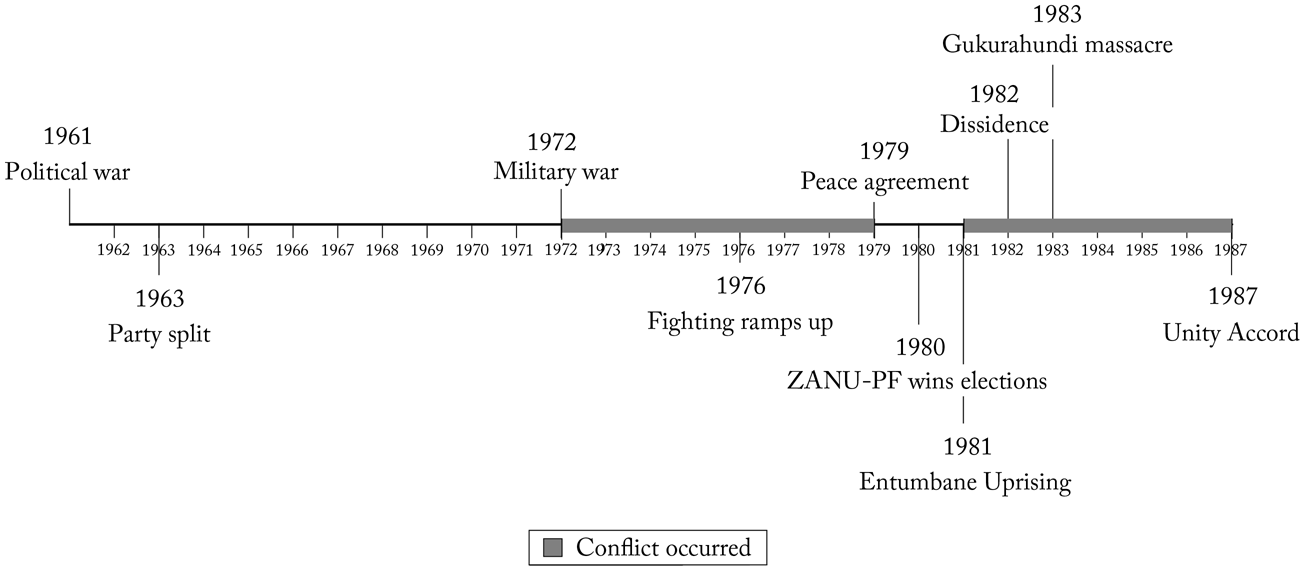
The Zimbabwe independence movement began in 1960. Just three years later, the movement split into two—the Zimbabwe African People's Union (zapu) and the Zimbabwe African National Union (zanu)—due to tensions over how the issue of independence should be approached. The independence movement escalated to war in 1972 as guerrilla activity increased along the Zimbabwe-Zambia border. By then, both zapu and zanu had developed distinct military wings—the Zimbabwe People's Revolutionary Army (zipra) and the Zimbabwe African National Liberation Army (zanla), respectively. See Figure 2 for the conflict timeline.
Zimbabwe Conflict Timeline

zapu and zanu initially coexisted uneasily in Zambia. Although both fought for independence from Great Britain, they vied for civilian support and clashed with each other in training camps and on the battlefield. When Mozambique gained its independence from Portugal in 1975, the new government opened its border to one of the two rebel groups in Zimbabwe to reduce intergroup fighting and zanu moved its military bases to Mozambique. The resulting patterns of control under the two rebel groups reflect this shift from the Zambian to the Mozambican border. zapu recruited from the west (the Zambian and Botswanan border), while zanu recruited from the east (the Mozambican border). Fighting between the two groups subsequently decreased, but clashes in which they vied for control continued to occur.
Despite tensions, the two rebel militaries briefly teamed up to launch a final assault against the colonial Rhodesian forces. The alliance was fraught with intergroup tensions and in-fighting, but successfully forced the colonial government to the bargaining table. The war ended in December 1979, and, as noted above, zanu renamed itself as zanu-pf for the elections. ZANU-PF decisively won the first national election in 1980 and Robert Mugabe was sworn in as Prime Minister.
But postindependence peace was short-lived, as ex-zanu and ex-zapu soldiers brought their rivalry to the newly integrated Zimbabwean military. The two militaries clashed in the Entumbane Barracks in the Matabelelands, and secret zapu weapon caches were allegedly discovered in Gweru. zanu purged zapu politicians from the government following these events. Ex-zipra members in the army, fearing for their lives amidst accusations of treasonous behavior, deserted en masse in 1982. Although most returned to their homes or fled to South Africa, some of the deserters banded together within zapu strongholds in an attempt to fight a new war.
The ex-zipra dissidents failed to incite rebellion. Almost immediately after assuming power in 1980, zanu-pf deployed bureaucrats across the country to expand its influence and demanded party loyalty from citizens. Further, Mugabe assembled a militia, the Fifth Brigade, to brutally put down Matabeleland dissidence and to terrorize civilians through Gukurahundi, a series of massacres of ethnic Ndebeles, from 1983 to 1987. The combination of pro–zanu-pf district administrators and the brutal massacres drastically decreased civilian support for the revitalization of the zapu in rival strongholds. Gukurahundi and dissident activity ended with the Unity Accord in 1987, in which the zapu leadership was subsumed under zanu-pf. This cemented the party's control for subsequent decades.
Research Design and Data
I use a mixed-methods approach to provide evidence for my theory. I begin by showing quantitative evidence of differences in postwar development in the three different kinds of territories. To do so, I use a did identification design and leverage a cornerstone school construction program that was implemented in 1980. These results help to establish that there are indeed differential outcomes based on zanu and zapu wartime ties with civilians. I then turn to qualitative evidence for mechanism testing. Using archival documents and interview data, I trace how wartime organizational structures were replicated in postwar governance and how that subsequently led to the development patterns observed quantitatively. When pieced together, the different forms of evidence provide a nuanced view of how wartime rebel-civilian ties affected postwar Zimbabwean politics.
I use primary data from the Jesuit Archives (ja), the Mafela Trust (mt), and the National Archives of Zimbabwe (naz) collected with the help of two Zimbabwean research assistants.Footnote 48 Archival materials include a variety of reports from missionaries and Rhodesian government officials during the civil war, newspaper sources, and zipra records collected after the war. I also draw on twenty-five zipra interviews from the mt and fourteen interviews from the naz with civilians who were wartime collaborators.Footnote 49 I supplement these archival data with eight self-conducted interviewsFootnote 50 and secondary sources from ethnographic work conducted in the decades after the war. The variety of sources consulted provide grounded insights into wartime rebel-civilian relations and the postwar political order in the 1980s.
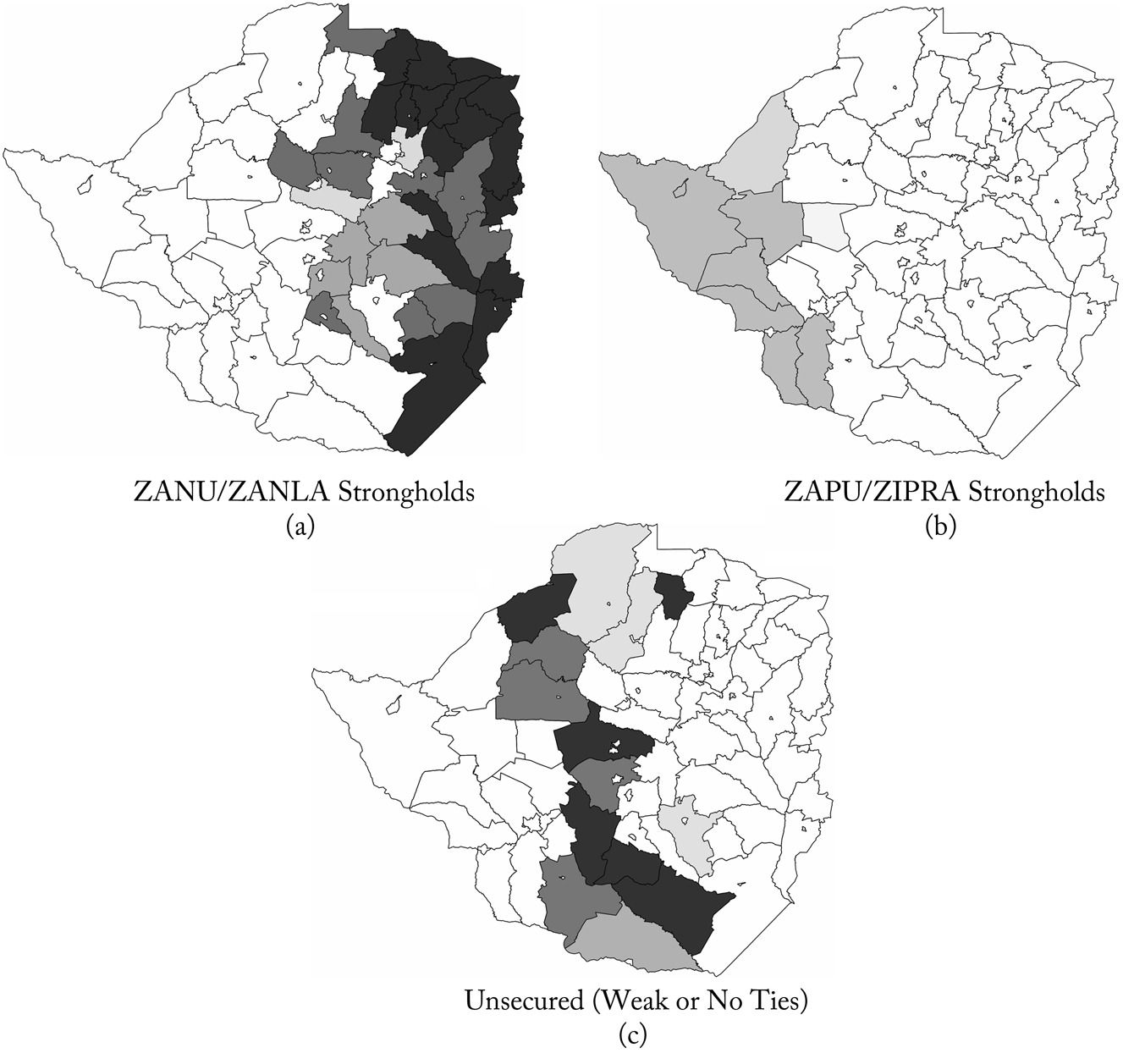
The explanatory variable is rebel-civilian ties under zanu and zapu during the Liberation War. Because the war took place several decades ago, there is a dearth of data and as such, no conflict-events data set exists. I therefore code a novel measure of rebel-civilian ties at the district level using archival documents, interviews, and secondary sources. I restrict the sample to rural districts to increase comparability because rebel-civilian relations are primarily a rural phenomenon, particularly in the case of Zimbabwe. I code at the district level both because it is the relevant administrative unit of analysis for bureaucratic appointments and development in Zimbabwe and because it is the most politically salient administrative level in subnational Zimbabwean politics.Footnote 51
I first code for rebel operational presence—meaning that the two groups were attempting to establish sociopolitical influence by building ties with civilians and engaging in rudimentary rebel governance—in a particular district. For both groups (zanu/zanla and zapu/zipra), rebel operational presence is coded as from 0 to 1 in increments of 0.25, where 0 indicates zero to few rebel operations in the area, and 1 indicates frequent and intense rebel operations.
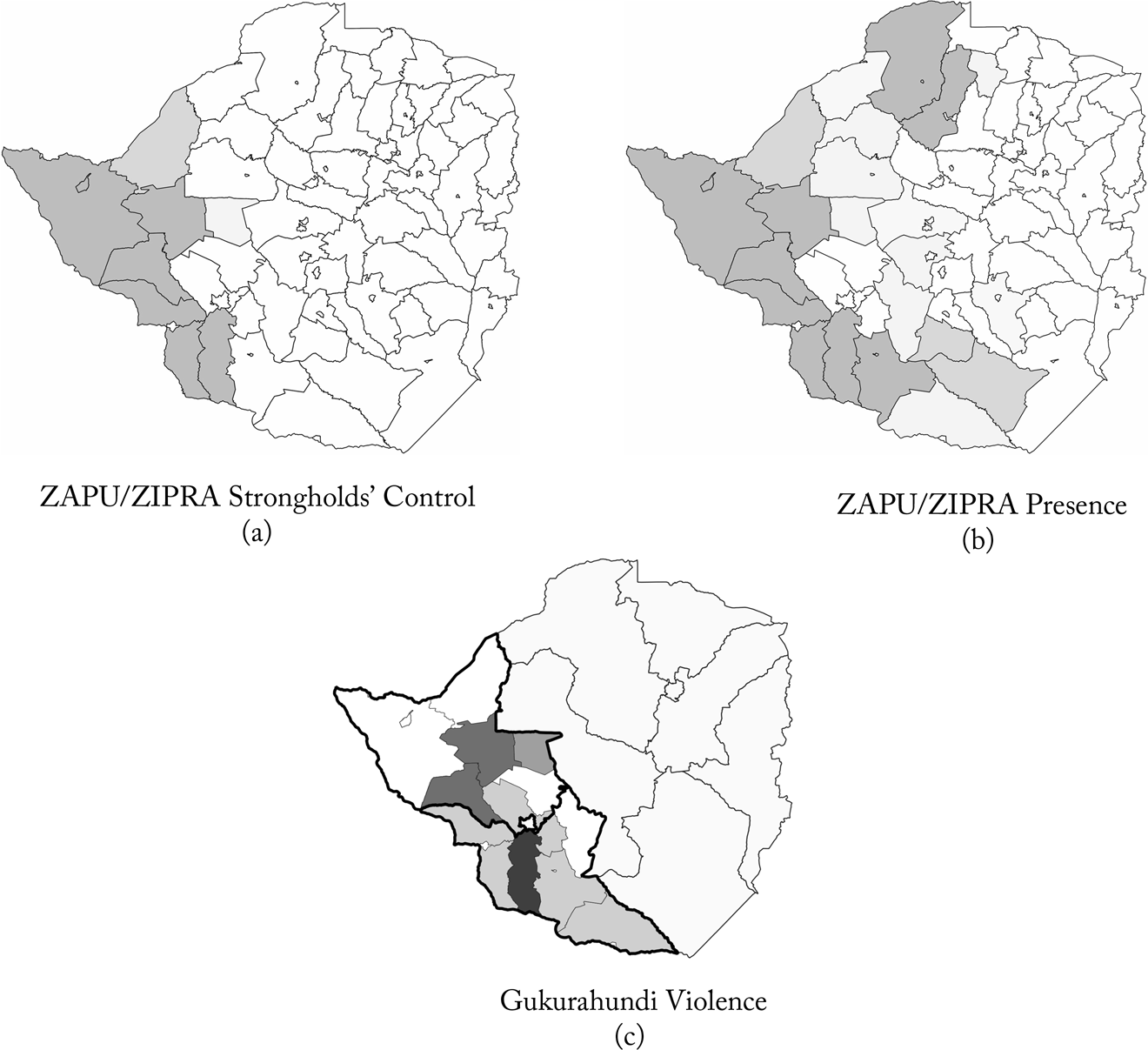
I then code for relative parity in operations under the two rebel groups: from 0 to 1 in increments of 0.25, indicating unsecured civilian support. This variable is coded as 0 if an area saw only rebel operations from one side of the conflict, 0.25 if the absolute value of the difference in operational presence between the two groups is 0.75 (that is, one side had an operational presence value of 1 while the other's was 0.25), 0.5 if the absolute value of the difference in operational presence is 0.5, and 0.75 if the absolute value of the difference in operational presence is 0.25. Unsecured is coded as 1 if rebel operational intensities were fairly equal, leading to little or no differential influence and giving the new government strong incentives not to give up ground to the opposition after war. zanu/zanla and zapu/zipra strongholds are then coded as rebel operational presence, if the variable unsecured is coded as 0. In both cases, the resulting rebel stronghold coding ranges from 0 to 1 in increments of 0.25, while unsecured areas are not considered a stronghold territory for either side. The maps for these variables are shown in Figure 3 (a–c).
Rebel-Civilian Tiesa
a The darker the area, the greater the degree of control in (a) and (b) and the greater the parity of influence in (c).

This coding strategy was developed to match the qualitative events on the ground and draws from many existing historical and ethnographic studies of different districts in the country. The resulting maps in Figure 3 are indicative of zanu's shift from Zambia to Mozambique. While zapu derived its strength from the west, zanu's control was strongest along the east. In section A1 of the supplementary material, I provide an additional explanation of how different sources in the archives are used for coding.Footnote 52 In section A2, I provide a selection of coding narratives for each area type to ground the coding decisions in real cases.
Quantitative Analysis: Postwar Education
I examine development through education attainment. Following my hypothesis on development outcomes, I expect educational attainment to be greatest in unsecured terrain, lesser in zanu strongholds, and least in zapu strongholds.
Educational attainment is a useful test in Zimbabwe for several reasons. First, although the new zanu-pf government undertook several public works after the war, the unparalleled success of its education development initiative during the first decade of independence provides a clear and measurable outcome for causally identifying development gains across the country.Footnote 53 Prior to 1980, black Zimbabweans were barred from public secondary schooling. Immediately after elections, the government declared universal education for the entire country and embarked on a massive initiative to build schools to accommodate the influx of new students to secondary schools. The new mandate largely succeeded in opening up education to black Zimbabweans. Under the program, within the first decade of independence the number of secondary schools increased by more than eight times.Footnote 54 This shock to the education system allows me to cleanly test development effects. In comparison, other development efforts were less pronounced, less immediately measurable, and more likely to be confounded by prewar factors, such as preexisting public goods distribution.
Second, school building initiatives are part of a wider class of comparable reforms that not only benefit from civilian volunteerism as demonstrated through qualitative evidence, but are also visible goods over which the state can claim credit. Beneficiaries of distributive politics may differ based on the goodFootnote 55 and, where the government must win over a large sector of the population to prevent defection to its rival, broad public goods, such as school-building initiatives, become the more effective choice.Footnote 56 In sum, educational attainment outcomes should clearly demonstrate the effects of the government strategies outlined in the theory.
Education Outcomes
I use data on educational outcomes from a 5 percent sample of the Zimbabwe 2012 Population Census, made available through ipums.Footnote 57 The census data records the highest educational level for each individual respondent. I drop all individuals who identified as white, immigrant, or non-Zimbabwean. I then create an aggregate variable coded from 0 to 3, where 0 indicates no formal schooling, 1 indicates some primary schooling, 2 indicates having completed primary school, and 3 indicates some secondary schooling.
I use this coding scheme for two reasons. First, Zimbabwe's secondary schooling is split into lower and upper secondary schooling and students must pass rigorous testing to continue to the upper secondary level. Many rural Zimbabweans exit the school system after having completed the lower level of secondary school. This may confound school construction effects and thus, I choose to not use “completed secondary schooling” as a fourth category. Second, I collapse the coding into these categories rather than use individual grade levels because a subset of the respondents did not specify the grade level that they had completed—only the school (primary or secondary) they attended. Using a grade-level coding would therefore require dropping these individuals from the sample altogether.
In section A11 of the supplementary material, I show that the results are robust to alternative ways of coding education including a zero to four category coding that includes “completed secondary schooling” as the last category; a scale from zero to eleven to indicate the grade level completed, ranging from no school to completing lower secondary school; and a scale from zero to thirteen to indicate the grade level completed, from no school to completing upper secondary school.
Difference-in-Differences Design
The did design identifies changes in educational attainment in unsecured areas and zanu strongholds in comparison to zapu strongholds, the baseline category. The treatment onset variable post captures individuals who were of secondary school age at the onset of education reforms. The pretreatment group includes all who were older than eighteen by 1980. These individuals should have missed the opportunity to take advantage of the mass proliferation of education that began in 1980 under the universal education program. I code post to capture partial treatment, such that individuals who were twelve by 1981 have a post value of 1, indicating that they were best poised to take advantage of the secondary schooling made available to black Zimbabweans by the end of 1980. Individuals between the ages of thirteen and seventeen by 1981 are coded partial values in sixths. The equation is:
 $${\rm educatio}{\rm n}_{i, b, d} = \tau _1( {\,post_b \times {\rm unsecure}{\rm d}_d} ) + \tau _2( {\,post_b \times {\rm ZANU\;stronghol}{\rm d}_d} ) + \gamma _i + \kappa _b + \eta _d + \epsilon _{i, b, d}, \;$$
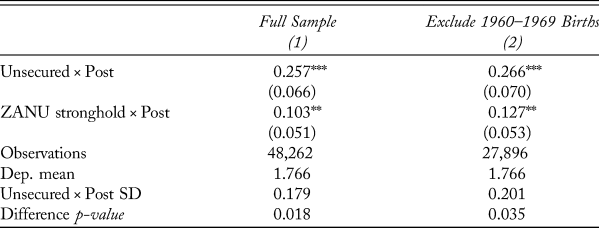
where i is the individual respondent in the 2012 census, γ i is the respondent gender, κ b is birth-year fixed effects, and η d is district fixed effects.Footnote 58 Standard errors are clustered at the district level. The sample used for the education variable includes those born between 1950 and 1971 to eliminate potential effects of war for those born in 1972 or later. I present two regressions in Table 1 below. First, I show the full sample of those born between 1950 and 1971; second, I show robustness to dropping those who were born between 1960 and 1969, as they would have started secondary school during the war and may have been adversely affected by conflict.
Educational Attainmenta

* p < 0.1, ** p < 0.05, *** p < 0.01; robust standard errors in parentheses; clustered at the district level
a Sample is attenuated to respondents living in rural districts and who were born from 1950 to 1971. Regressions include district fixed effects, birth-year fixed effects, and gender fixed effects. Education is coded as follows: 0 = no formal education, 1 = incomplete primary, 2 = complete primary, 3 = incomplete secondary, and 4 = complete secondary.
Results
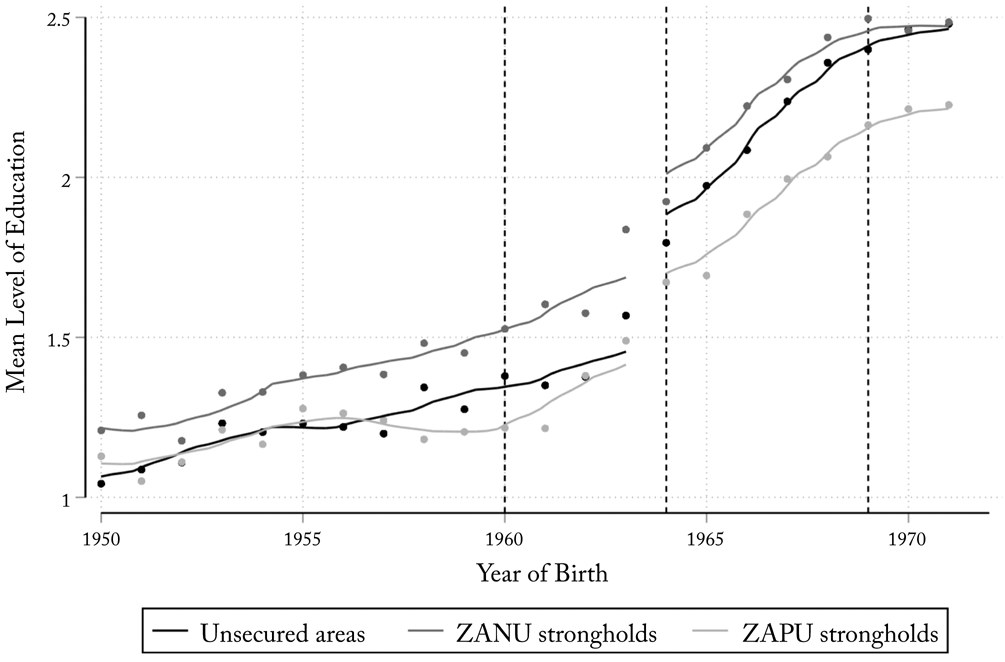
Figure 4 plots the growth in educational attainment in unsecured areas, which, compared to zanu and zapu strongholds, features low degrees of civilian ties for individuals born between 1950 and 1972. Two observations should be noted. First, simply allowing black Zimbabweans to attend secondary school had clear, nationwide effects. Those who were too old to have benefited from the education reform, that is, individuals born before 1964, had a mean level of education lower than secondary school (less than 2 on the zero-to-four category coding), while the level of education of those born in and after 1964 soon increased to include some secondary school. This pattern is true for all three types of territories.
Mean Level of Education across Birth Cohortsa
aPlot depicts education gains across different territory types. Population is subsetted to rural citizens. Education is coded as follows: 0 = no formal education, 1 = incomplete primary, 2 = complete primary, and 3 = incomplete secondary. In the first specification, the variable post is greater than zero at the 1963 dotted line. The second specification drops those who were born between the 1960 and 1969 dotted lines.

Second, comparing the territories shows clear evidence consistent with the argument: education levels in unsecured areas grew at a faster rate than in government strongholds, while rival strongholds lagged behind both.Footnote 59 The figure shows that the educational gap between unsecured areas and the rebel government's strongholds closes substantially as a result of the school construction and education reforms. As my theory suggests, unsecured areas are the primary beneficiary of development, that is, the new rebel government does not reward only its wartime supporters. And zapu strongholds, which start off with education levels similar to the unsecured areas, lag behind significantly following the postindependence education reforms. These levels accord with the qualitative evidence that I show in the next section: in unsecured terrain, district-level bureaucrats leveraged development funding to win supporters and to dissuade communities from supporting the opposition. In pro-zanu strongholds, wartime supporters organized communities to fundraise and build schools themselves while civilians were discouraged by their local leaders from demanding more. Voluntary resources may have been overshadowed by state-provided resources, which is consistent with slower education gains. Unsecured areas and government strongholds performed far better than rival strongholds, which is unsurprising given the government's reluctance to provide resources to these rival strongholds and the state-sponsored mass killings that occurred there during this period.
In Table 1, the coefficients also show that educational attainment in pro-zanu strongholds and unsecured areas grew more quickly than in zapu strongholds, the baseline category (column 1). The difference between unsecured areas and zanu stronghold territories is statistically significant at p < 0.018, indicating support for my argument that the government used resources for top-down control in unsecured areas that would be especially useful for consolidating power. This result is robust to excluding those who came of secondary school age during the war (column 2).
Robustness Checks and Alternative Explanations
The results are robust to a variety of different specifications, including alternative operationalizations of the education and the post variables, and different sample populations excluding individuals who migrated between 2002 and 2012 and districts in which the Shona ethnic group is 80 percent or the population or greater.Footnote 60 These results are presented in section A11 of the supplementary material and show stable and statistically significant coefficients across all specifications. In addition, as one test of the parallel trends assumption, in section A6 of the supplementary material, I provide results for placebo cutoffs to confirm that the estimated positive treatment effect can indeed to attributed to the postwar era.
Three alternative explanations may confound these findings. First, conflict may have affected the populations in various parts of the country differently given varying exposure to conflict and ideology as well as cultural differences. This concern is mitigated by the did design; conflict should not differentially affect only those who were of secondary school age after the start of the war compared with those who turned eighteen by 1980. I show a variety of placebo outcomes using the same identification strategy, which provides reassurance that the estimated effects are not due to factors unrelated to development funding for education. Estimates for placebo outcomes are available in section A7 of the supplementary material.
Second, the treatment variables are coded such that strongholds and unsecured areas do not overlap. This may raise concerns that the coding strategy mutes the variation in rebel ties within unsecured areas by treating areas in which both groups had low presence as similar to areas in which both groups made strong efforts toward forming civilian ties. To account for these concerns, I run a did regression interacting unsecured areas with presence of zanu politicization. If it is rebel presence, rather than social control through a monopoly over civilian ties, that plays a role, this coefficient should be statistically significant. Results indicate that it is indeed parity between zanla and zipra operational presence—rather than the individual groups’ strength of presence—that affected education spending under deployed bureaucrats after war. Section A11 shows that coefficients remain stable and statistically significant for unsecured and zanu stronghold variables. The interaction of between presence and unsecured is statistically insignificant and close to zero. This finding also partially addresses the second concern above, that the levels of conflict itself do not explain these results.
Third, ethnicity may be a confounder for two reasons. First, there may be differences in preexisting intraethnic cooperation: villages with stronger rebel-civilian ties may have had greater community collective action to begin with. And in line with the ethnicity literature,Footnote 61 homogeneous villages may be better able to engage in the local coproduction of reconstruction and in-group policing. Thus, if strongholds are more homogeneous, it may affect local organizational capacity regardless of rebel-civilian ties. I argue that this is not a concern because in Zimbabwe, ethnic heterogeneity varies at the district level, whereas the ethnic cooperation thesis (and the collective action prescribed by rebel-civilian ties) is primarily salient at the village level. In Zimbabwe, villages fall within traditional chieftaincies and are ethnically homogeneous across all three types of territories. Thus, we should witness no differences with respect to intraethnic cooperation.
An alternative ethnic hypothesis is favoritism in the distribution of public goods through district administrators. But ethnic favoritism, both in regard to the Shona and Ndebele split as well as to within-group subethnic differences, would imply greater targeting of resources toward coethnics. This would bias my results toward zero, since I find greater development in unsecured districts that tend to be more heterogeneous at the district level. To provide some evidence against the role of ethnicity—both ethnic cooperation and ethnic favoritism—I isolate my sample to only districts that are 80 percent Shona or greater. Although this does not capture subethnic differences, it does capture the main ethnic cleavage between the Shona and the Ndebele during that period. Within this subsample, there is ethnic homogeneity at both the village and district levels. In section A5 of the supplementary material, I show that the results are stable and statistically significant.
Qualitative Evidence
I now turn to qualitative evidence to illustrate the mechanism of my theory. This section identifies three strategies that zanu-pf pursued simultaneously to consolidate power and, as I have argued, that produced the differential rates of postwar educational attainment. First, zanu-pf leveraged strong rebel-civilian ties formed during the war to secure political control after it and to extract volunteer work in strongholds to offset developmental costs. Second, zanu-pf expanded its system of wartime institutions across the country, appointing partisan bureaucrats who often disbursed development funds in exchange for government support. Third, where bureaucrats failed to establish control, zanu-pf resorted to targeted military oppression against civilians to consolidate power. Each of these strategies is described below.
Rebel-Civilian Ties from Wartime to Postwar Governance
While zanu/zanla maintained no outright military control over territory in Zimbabwe during the war, it established social control over civilian life through its ties with key individuals in local communities. There were two main forms of local organization in zanla strongholds: youth collaborators and village committees. Youth collaborators (mujibas) were teens or young adults who acted as spies for the rebel groups and as liaisons between rebels and civilians. Wartime-collaborator interviews indicate that mujibas had intimate knowledge of rebel whereabouts and were in charge of delivering messages and materials for the rebels.Footnote 62 They helped rebels gather information on the groundFootnote 63 by conducting reconnaissance on opposing forces and identifying sellouts in the village during mandatory ideological meetings (pungwes) between rebels and villagers.Footnote 64 In total, an estimated fifty thousand collaborators oversaw operational zones that covered several villages each.Footnote 65
In addition, zanla rebels created village committees—village-level party cells—tasked with organizing support for zanla by gathering food and materials from the community for the rebels.Footnote 66 These village committees reflected grassroots support from citizensFootnote 67 as well as a method for the rebels to establish social control.Footnote 68 Committees played an important role in setting up the pungwes and ensuring community attendance.Footnote 69 Village committees were organized according to hierarchical bureaucracy. At the lowest level, village committees consisted of several positions and were headed by a chairman. Several village committees made up a base committee, which aggregated further into district committees and provincial committees. zanla conferred governing power and legitimacy to village committee members by relying on the support and blessing of traditionally important nongoverning figures (such as spirit mediums).Footnote 70 This strategy worked because traditional leaders—chiefs—were tied to the colonial state and had little legitimacy among civilians in many parts of the country.
In the first few years of Zimbabwe's independence, mujibas and village committee members helped zanu-pf to exert local control. First, zanu-pf drew upon these civilians to win the election. In particular, relations between the zanla and mujibas were exploited during the demobilization and electoral campaigning period (1979), a time when ex-combatants were instructed to assemble in specific areas to guard against electoral violence. As a zipra ex-combatant noted, while zipra soldiers assembled, zanla camps were filled with mujibas posing as ex-combatants—not with actual zanla soldiers.Footnote 71 This allowed zanla rebels to return to rural areas, where they worked with other mujibas to ensure civilian electoral support and prevent zapu from campaigning in zanu-pf strongholds.Footnote 72 Outside of zanu-pf wartime strongholds, zanu-pf set up local party committees for campaigning but had “very little infrastructure” and “existed much more as formal party machines geared to the election, than the para-guerrilla bodies.”Footnote 73 In these areas, zanu-pf were less successful electorally.Footnote 74
Initially after winning elections, zanu-pf continued to leverage primarily village committees to minimize the need for immediate state resources. Postwar development and reconstruction benefited greatly from civilian volunteerism, and zanu-pf's initial successes in rebuilding Zimbabwe could partially be credited to active civilian communities that engaged in volunteerism (“self-help”) to coproduce local development.Footnote 75 Civilian input into government initiatives began almost immediately after independence, particularly in areas that retained strong relations with zanla. For example, immediately after war, the government identified local needs by relying on “[village committees] developed during the liberation war in the communal areas.”Footnote 76 These village committees were instrumental in helping to collect and disburse necessary aid for the local community.Footnote 77
zanu-pf's use of local party organization for locally provided public goods helped to offset expensive development costs. The success of this strategy is highlighted in the aforementioned education reform of 1980, which was a particularly expensive endeavor. Organized community cooperation was necessary to mitigate resource constraints related to the school construction program. As a 1983 Ministry of Education Report notes, “The increasing demand … has resulted in parents undertaking more self-help projects to provide classrooms.”Footnote 78 The government encouraged volunteer efforts ranging from community fundraising to labor for building schools using government-purchased materials.Footnote 79 This capacity to mobilize civilians was particularly helpful in zanu's wartime strongholds. For example, ex-combatants returned to the communities in which they had operated where they inspired local volunteerism and held friendly competitions between civilians and ex-combatants for speedy fundraising and school construction.Footnote 80 Today, zanu-pf politicians continue to credit this period of volunteerism for the education reform's successes.
Expanding Wartime Institutions to Establish Control
By 1984, zanu-pf had formally implemented a hierarchical state developmental bureaucracy that would mirror its wartime party-cell structure.Footnote 81 There were multiple key actors: village development committees (vidcos) at the village level and ward development committees (wadcos) at the ward level, local government promotional officers (lgpos), and district administrators.Footnote 82 vidcos and wadcos comprised locally elected community members while lgpos and district administrators were deployed bureaucrats. Specifically, lgpos were party political commissars during the civil war who were not necessarily well-educated but played a significant role in local development.Footnote 83 District administrators were well-educated wartime supporters who oversaw district-level development.Footnote 84
vidcos and wadcos were officially designed to make decisions about local developmental needs, but in reality, they enabled top-down state control over development affairs. Piloted first in 1981,Footnote 85 they were “party committees and cells carried over from the liberation war whose partisan and authoritarian practices pervaded both popular participation and democratic developmentalism.”Footnote 86 Procedurally, lgpos would first be responsible for setting up vidcos in villages. In theory, vidco members would be directly elected by their village and, once vidcos were established, they would report village-level development needs to ward-level wadcos. wadcos then reported to the district administrator. Finally, the district administrator would make decisions about development funding for local projects.
This developmental hierarchy was implemented throughout the country, but because vidcos and wadcos comprised local community members, state control played out differently across the country. In rebel government strongholds in which zanu-pf had strong roots, progovernment leaders assumed positions in new vidcos and wadcos and carried on zanu-pf's work on the ground.Footnote 87 Notably, these leaders did not encourage peasant politicization so as to minimize civilian demands for government services. Rather, they encouraged loyalty to party goals, helping the government sustain support by ensuring the continuation of successful party cells and curbing civilian voices that threatened state support.Footnote 88 Reflecting the coercion that underlies wartime social control, civilians resented empty development promises but “had learned the dangers of challenging guerrilla commands” during war and recognized that they “had to take orders … from zanu-pf's top officials so that they would not invite punishments.”Footnote 89
Where wartime party ties were weaker or nonexistent, community-elected leadership would have been less likely to be pro–zanu-pf and therefore would have been less amenable to state control. Outside of strongholds, centralized development was imposed because the local government “acted with an autonomy from the zanu(pf) leadership … and, notably in Matabeleland and parts of Midlands and Mashonaland West, they were not loyal to zanu(pf).”Footnote 90 These unsecured areas (Midlands and Mashonaland West) and rival strongholds (Matabeleland), would have been far less amenable to state control. Similarly, civilians would not have been socialized by guerrillas during war and would be more willing to voice discontent. To prevent political heterogeneity at the local level, zanu-pf's deployed bureaucrats—the progovernment district administrators and lpgos—played a significant role in establishing control by leveraging development funding from the top down. While establishing vidcos, lpgos “had to carry out political re-orientation for the members of these committees; and one of the key attributes of being a member was loyalty to the state and the party.”Footnote 91 Further, vidcos and wadcos were unable to empower citizen input because they controlled no development funding; rather, all money was funneled through the district administrator. Development schemes and funding were contingent on a progovernment stance, and thus development was distributed through a carrots-and-sticks approach. Local development became “an appendage of central government, severely marginalized, under-resourced and dependent on central government for both their funding and staffing.”Footnote 92
Specifically, in unsecured areas where loyalty was possible, the state attempted to “firm up control for the emerging state” by pushing forward “development functions, drought relief, participating in vaccination campaigns, etc.”Footnote 93 This strategy bought zanu-pf control within a few short years. “Loyalty ran very deep. In the rest of the country outside of [rival strongholds], loyalty to zanu-pf was a given.”Footnote 94 Local leaders and civilians declined to help ex-zipra dissidents because of their new association with the state, despite being previously sympathetic to zapu.Footnote 95 For example, the Gokwe District, an unsecured area that was sympathetic to zapu during the war, was turned into a no-go zone for ex-zipra dissidents. zanu-pf had begun deploying bureaucrats into Gokwe by 1981.Footnote 96 By 1984, the district council announced that it was 100 percent pro–zanu-pf and citizens began reporting dissidents to authorities.Footnote 97 Grant budgets provide one indicator that progovernment sentiments were well-rewarded. Gokwe saw its grant budget from the central government increase almost ten times, from Z$582,397 in 1983 to Z$5,546,059 in 1984. Grant figures remained high at over five million dollars for two years before being reduced to Z$1,495,49 in 1986 and Z$454,902 in 1987.Footnote 98 Although the increases and decreases in grant money were backed by changes in government policy,Footnote 99 the sharp increase and subsequent decline in funding align with the Gokwe district council's pro–zanu-pf position in 1984, the near elimination of the dissident threat in 1986, and the Unity Accord signed in 1987.
In rival strongholds, the expansion of wartime institutions through this hierarchical development structure was far less successful because the zapu had strong ties to civilians and also maintained its own party cells. Initially, after elections, citizens in the Matabeleland provinces “seemed to be waiting for ‘permission’” from zapu to cooperate with the new government because they were afraid of being accused by zapu of selling out to zanu-pf.Footnote 100 Civilians also rejected zanu-pf bureaucrats. It was not until veteran zapu leaders took control of local councils that citizens begrudgingly began to participate. In contrast to the voluntary school-building efforts in zanu-pf strongholds, citizens in zapu strongholds refused to participate in rebuilding or raising money for government schools.Footnote 101 Once the hierarchical development structure was formalized, development in the Matabeleland provinces suffered further: “vidco members were targets of dissidents who regarded them as sell outs, while on the other hand the state would only channel development aid through these institutions.”Footnote 102 zanu-pf was unable to control civilians and thus development was underfunded and of low quality.Footnote 103 Instead, development in these opposition areas only began after 1987, when zanu-pf had consolidated control.Footnote 104
Violence and Coercion
As described above, civilian support for zapu in rival strongholds rendered the deployed-bureaucrats approach ineffective for establishing control. But zanu-pf faced an additional hurdle in gaining control over rival strongholds because the ex-combatants initially refused to disarm.Footnote 105 As in many postwar states, ex-rebels in Zimbabwe feared that disarmament meant marginalization.Footnote 106 Armed ex-zipra combatants stationed themselves outside the country as well as within it and even recruited additional members in late 1980 “as a reserve against a rainy day.”Footnote 107 Some ex-zipra commanders declined to be integrated into the new national army and instead posted themselves in the capital as well as in Bulawayo and in the Gwaai River Mine—zapu strongholds—in anticipation of renewed violence. The zipra Revolutionary Council had in fact advocated a return to violence because it believed that if violence were to break out, zipra would be able to win control due to its military strength.Footnote 108 The situation further deteriorated beginning in 1982 when ex-zipra soldiers deserted the army and fled to the Matabelelands, where they mounted a low-scale insurgency as ex-zapu dissidents.
Faced with the looming threat of armed rivals and a population resistant to state control, zanu-pf deployed targeted military oppression against civilians in rival strongholds. As noted above, Mugabe created the Fifth Brigade—a North Korea-trained military force separate from the national army that comprised primarily of ex-zanla troops—and used it to sever zapu's ties in the Matabeleland provinces. The brigade was deployed first in Matabeleland North in 1983, and then in Matabeleland South in 1984.Footnote 109 Figure 5c outlines these two provinces in thick black, along with the estimated population-weighted instances of violence from the Gukurahundi massacres.Footnote 110
Postwar Security Deploymenta
aFigure (c) shows the population-weighted Gukurahundi-related violence in the Matabeleland provinces (outlined in thick black), where the Fifth Brigade was deployed for indiscriminate violence (Catholic Commission for Justice and Peace in Zimbabwe 1997, p. 77–78). This violence count includes all state forces, militias, and dissidents. There was also violence outside of the Matabeleland provinces, but it was selective targeting by police and local progovernment militias against opposition supporters.

Notably, even though the Fifth Brigade was created to prevent insurrection from ex-zipra forces, its purpose was not only to weed out dissidents but also to coerce control over civilians. It was trained primarily to break down civilian resolve and to prevent support for renewed violence by targeting civilians and unleashing mass atrocities across areas loyal to the zapu.Footnote 111 Because zanu-pf had not been present in the Matabelelands during the war, and indeed had very little information about the region locally, it was unable to identify where—and through whom—the organized ties ran.Footnote 112 The use of indiscriminate violence was therefore a counterinsurgency method of “draining the sea:”Footnote 113 using barbarism and brute forceFootnote 114 in an attempt to eliminate any civilian ties to the zapu. Harkening back to wartime methods of politicization once again, the Fifth Brigade forced civilians to reenact pungwes, to sing zanu liberation songs, and to pledge support to the ruling party. The Gukurahundi massacres caused an estimated twenty thousand civilian deaths during this periodFootnote 115 and created an atmosphere of civilian fear that prevented locals from supporting the ex-zipra troops. The Fifth Brigade was successful in severing ex-zipra capacity to recruit. Unlike in the first civil war when civilians willingly supported the zapu, the renewed violence saw only transactional relationships in which under duress, civilians aided dissidents.Footnote 116
In summary, this section identified three strategies the new rebel government pursued to consolidate postwar power across Zimbabwe: mobilizing rebel-civilian ties, formalizing and expanding wartime institutions, and military oppression. While not exhaustive, these strategies represent key ways that rebel governments navigate postwar state building when the strength of civilian ties for themselves and their rival(s) vary across the country.
Conclusion
I examine the case of Zimbabwe to argue that local social control arising from rebel-civilian ties is leveraged as a resource for governance after rebel victory. I argue that postwar state building starts during war. In its strongholds, the new rebel government can rely on its wartime ties to facilitate governance and control. Outside of strongholds, the government must expand its control to consolidate power. Therefore, to build state capacity and co-opt support, it deploys supporters to areas that lacked civilian ties during war. In addition, the new government's monopoly over violence is most threatened in rival strongholds, where rivals had built ties with civilians during war. The new rebel government deploys violence in these areas to break down rival-civilian ties and to coerce control. The rebel government's different priorities—and thus its different strategies for governance—in each of these regions then leads to differential development outcomes.
I combined archival data with a did causal identification strategy to show that educational attainment increased the most in unsecured terrain, followed by zanu strongholds. I then examined qualitative evidence to argue that these outcomes can be explained by rebel-civilian ties under zanu and zapu that affected postwar political strategies. In zanu/zanla strongholds, individual citizens played an instrumental role in the war effort under village committee structures and teams of youth collaborators. Wartime relationships and structures that emerged on the eve of independence were subsequently maintained after war. The resulting postwar development machine was one that involved a significant group of pro–zanu-pf supporters. These local civilian leaders continued to provide information to the state and to organize voting during elections to ensure zanu-pf's political control. They also engaged communities in postwar self-help and aided the new government in ensuring unquestioning local party support. In unsecured areas, deployed bureaucrats and the expansion of wartime hierarchy facilitated top-down control through state-controlled development funding. As a result, educational attainment—arguably Zimbabwe's largest postwar developmental reform—saw greater increases in unsecured areas in comparison to rebel government strongholds and even more so in comparison to rival strongholds. In rival strongholds, cooptation attempts were rejected by local civilians who had strong ties to zapu. zanu-pf faced threats to power consolidation and therefore shifted toward a violent strategy to sever zapu's ties to civilians.
The findings in this article add to our understanding of how wartime processes affect postwar distributive politics and state building, which in turn speak to the strategies that rebel governments use to consolidate power. This is not to suggest that all rebel victories must follow the same path; indeed, Zimbabwe's experience is a confluence of not only wartime factors, but also precolonial development and regional politics. The ruling party's roots in Marxism, for example, influence how it organized during and after the war. And rarely do we witness atrocities that rise to the level of the Gukurahundi massacres. But the patterns presented in this article may elucidate similar ways in which wartime rebel-civilian ties and social control affect postwar politics.
Other cases of rebel victories in sub-Saharan Africa bear similarities to Zimbabwe's use of wartime supporters, expansion of its wartime institutions, and coercive violence. As noted above, the Imbonerakure youth militia in Burundi have been used for security and taxation during and after war, while National Council for the Defense of Democracy–Forces for the Defense of Democracy (cndd-fdd) supporters have won local government positions that were leveraged to engage in local community development in the party's name. In Uganda, the statewide spread of resistance councils was a key strategy for the National Resistant Movement's (nrm) expansion of power after war even as it fought a northern insurgency from resistant areas. Angola offers an important example of the dangers of rival social control. Because the People's Movement for the Liberation of Angola (mpla) itself had few ties to civilians outside of urban areas, its main governing strategy focused on spreading bureaucrats to establish top-down control in rural areas. The significant resistance and subsequent decades of war can largely be attributed to rival National Union for the Total Independence of Angola's (unita) ties to civilians on the ground, leading to the rejection of mpla bureaucrats and unita's successful efforts to recruit and resume war. In the aggregate, these experiences suggest that wartime rebel-civilian ties are a fruitful and important avenue for continued research.
Supplementary Material
Supplementary material for this article can be found at https://doi.org/10.1017/S0043887121000174.
Data
Replication files for this article can be found at https://doi.org/10.7910/DVN/2AISQ9.
Acknowledgements
Many thanks to Antonella Bandiera, Robert Bates, Regina Bateson, Jeremy Bowles, Kaitlyn Chriswell, Colleen Driscoll, Jeffry Frieden, Guy Grossman, Dorothy Kronick, Horacio Larreguy, Gwyneth McClendon, Pablo Querubin, Pia Raffler, Cyrus Samii, Jake Shapiro, Monica Toft, and Alice Xu, as well as participants of APSA 2019, the Northeast Workshop in Empirical Political Science, and the Harvard-Tufts-MIT-Yale Political Violence Conference for helpful feedback. I am grateful to the editors of World Politics and the three anonymous reviewers, all of whom helped to improve this article substantially. In Zimbabwe, Gerald Mandisodza and Chikwava Sigauke provided excellent research assistance.
Funding
This research is supported by Harvard University's Weatherhead Center for International Affairs, Institute for Quantitative Social Science, and Center for African Studies, and by a Jennings Randolph Peace Scholar award from the United States Institute of Peace. The views expressed in this article are those of the author and do not necessarily reflect the views of the United States Institute of Peace.