Acute kidney injury can persist in a subset of patients with emerging evidence that delayed renal recovery as it is associated with poor outcomes.Reference Kellum, Sileanu, Bihorac, Hoste and Chawla1,Reference Chawla, Bellomo and Bihorac2 The duration of acute kidney injury in adult patients after cardiac surgery has been shown to be directly proportional to mortality.Reference Brown, Kramer, Coca and Parikh3 Prior study results have demonstrated that acute kidney injury and renal dysfunction are common in adults with CHD.Reference Dimopoulos, Diller and Koltsida4–Reference Kwiatkowski, Price and Axelrod6 Madsen and colleagues reported an increased risk of chronic kidney disease in children with CHD that experience acute kidney injury after cardiac surgery.Reference Madsen, Goldstein, Froslev, Christiansen and Olsen7 Recognising the negative consequence of acute kidney injury that persists beyond 7 days, the 16th Acute Disease Quality Initiative (ADQI) Workgroup proposed the term acute kidney disease to define acute kidney injury stage 1 or greater than continues 7 more more days after an initial acute kidney injury event, but does not yet meet criteria for chronic kidney disease.Reference Chawla, Bellomo and Bihorac2
We recently reported that acute kidney injury occurred in 13.2% of young adults admitted to our cardiac intensive care unit post-operatively.Reference Fuhrman, Nguyen, Sanchez-de-Toledo, Priyanka and Kellum8 Acute kidney injury in this cohort was associated with a longer duration of mechanical ventilation and intensive care unit length of stay. Given that there are currently more adults living with CHD than children, there is an urgency to investigate the complications that can occur over the lifetime of these patients.Reference Jenkins, Correa and Feinstein9 Many adults with CHD undergo multiple cardiac surgeries resulting in an increased cumulative risk of acute kidney injury. The purpose of this study was to determine the rates of acute kidney disease and persistent renal dysfunction at the time of hospital discharge in young adults with CHD who developed acute kidney injury during an admission to the cardiac intensive care unit. We also sought to identify potential associations of persistent renal dysfunction at the time of hospital discharge and acute kidney disease with mortality and length of stay
Materials and methods
Study population
This single-center retrospective study was approved by the Institutional Review Board at the University of Pittsburgh. All patients with CHD between the ages of 18–40 years admitted to the cardiac intensive care unit at the University of Pittsburgh Medical Center Children’s Hospital of Pittsburgh between 2010 and 2014 were included in the study. Data was obtained from the University of Pittsburgh Pediatric High-Density Intensive Care database, which includes all patients admitted to the paediatric or cardiac intensive care unit between 2010 and 2014. The final data set was de-identified for use in the analysis. We included patients that had sufficient information to categorise acute kidney injury status by the Kidney Disease Improving Global Outcomes Criteria.Reference Mizuno, Sato and Ishikawa10
Exposure and outcome definitions
Any patient meeting the criteria for stage 1 or more acute kidney injury according to the Kidney Disease Improving Global Outcomes criteria using both urine output and/or serum creatinine was deemed to have acute kidney injury. Baseline serum creatinine was defined as the median of all of the creatinine values available in 6 months prior to intensive care unit admission. If no serum creatinine was available, we assumed an estimated glomerular filtration rate of 75 ml/minute/1.73 m2 and back calculated a reference creatinine using the Modification of Diet in Renal Disease Equation as per international guidelines.Reference Mizuno, Sato and Ishikawa10,Reference Levey, Bosch and Lewis11,Reference Zavada, Hoste and Cartin-Ceba12 Severe acute kidney injury was defined as acute kidney injury stages 2 or 3. A patient was deemed to have persistent renal dysfunction at the time of hospital discharge if their serum creatinine remained ≥ 1.5 times the baseline creatinine. A serum creatinine ≥ 1.5 times the baseline creatinine between 7 and 28 days after the diagnosis of acute kidney injury was defined as acute kidney disease.Reference Chawla, Bellomo and Bihorac2 We used 28 days in an attempt to better capture acute kidney disease attributable to the hospitalisation, rather than an event after discharge. However, given that the ADQI Workgroup defined acute kidney disease: Improving Global Outcomes Work Group – defined acute kidney disease using a timeframe of up to 90 days, and we conducted a sensitivity analysis using these criteria.Reference Chawla, Bellomo and Bihorac2 Nephrotoxin medication days were defined as the number of days where at least one of the three doses or more distinct nephrotoxic medications was administered in the first 7 days of intensive care unit admission (see Supplementary Table S1). Severity of illness was quantified using the Sequential Organ Failure Prediction score.Reference Vincent, Moreno and Takala13
Statistical analysis
Continuous variables are presented as medians (interquartile range (IQR)) and categorical variables are presented as numbers (percentages). Multivariable logistic regression was used to identify factors independently associated with the risk of death 5 years after hospital discharge. We determined factors independently associated with hospital length of stay using negative binomial regression. Results are presented as an odds ratio (OR) with 95% confidence interval (CI) for multivariable logistic regression and an incidence rate ratio with 95% CI for zero truncated negative binomial regression. Statistical significance was set at a p-value of ≤ 0.05. All statistical analyses were performed using SAS 9.4 (SAS Institute, Cary, NC, United States of America) and Stata 16.0 (Stata Corp., College Station, TX, United States of America).
Results
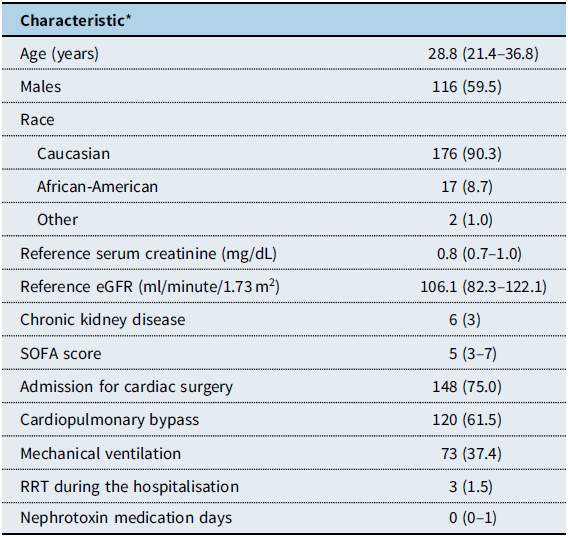
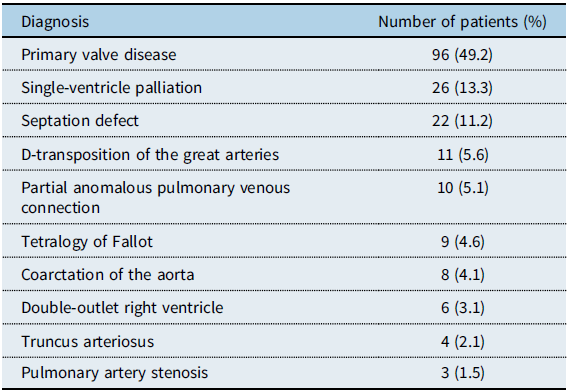
A total of 195 patients were included in the study. No patients had a history of heart, liver, or renal transplantation. The median age was 28.8 years with 59.5% of patients being male (Table 1). In 87.7% of the patients, a creatinine from the prior 6 months was available and it is used to define the baseline value, while in the remaining patients, a reference creatinine was back calculated. The median baseline/reference estimated glomerular filtration rate (IQR) was 106.1 (82.3–122.1) ml/minute/1.73 m2 with few patients having a documented history of chronic kidney disease (3%) or requiring renal replacement therapy during their hospital admission (1.5%). The majority of patients were admitted for cardiac surgery (75%) requiring cardiopulmonary bypass (61.5%). The primary reason for admission based on ICD-9 codes in the remaining 48 patients included cardiac catheterisation (n = 15), cardiomyopathy (n = 9), sepsis (n = 8), endocarditis (n = 8), venous thromboembolism (n = 7), and cerebral vascular accident (n = 1). The most common cardiac diagnoses represented included pulmonary valve stenosis, insufficiency of the aortic valve, and tricuspid atresia (Table 2).
Demographic characteristics and clinical data

Abbreviations: eGFR = estimated glomerular filtration rate; RRT = renal replacement therapy; SOFA = sequential organ failure assessment.
* Data are expressed as median (interquartile range) or n (%).
Primary cardiac diagnoses

Of the total patients, 89 (45.6%) met the criteria for acute kidney injury, 59.6% (53/89), 29.2% (26/89), and 11.2% (10/89) were classified as stages 1, 2, and 3, respectively. Persistent renal dysfunction at the time of hospital discharge was present in 15.3% of all patients and 33.7% of patients were diagnosed with acute kidney injury during their hospitalisation. The occurrence of acute kidney disease was 10.8% of the entire patient cohort and 23.6% of those with acute kidney injury.
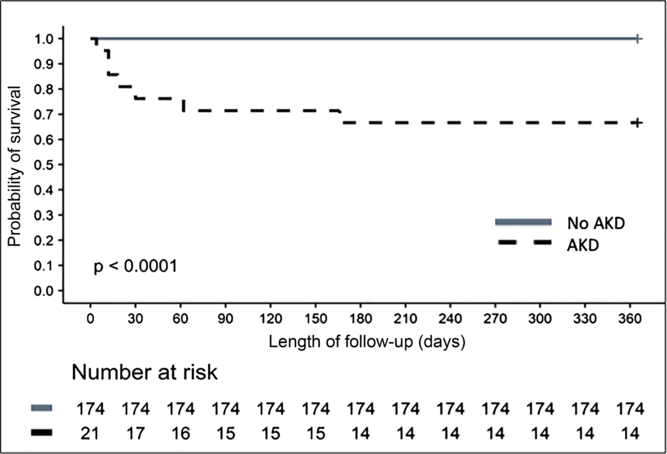
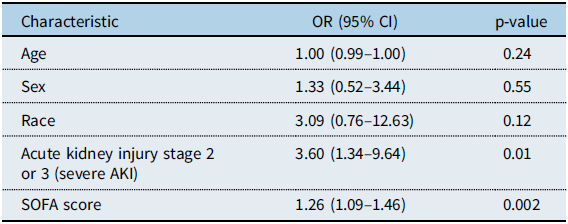
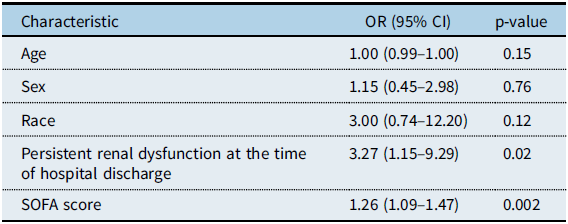
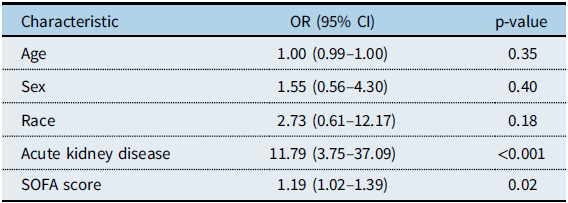
A total of 28 patients (14.4%) died within 5 years after hospital discharge. Of the patients that died, 7 of the deaths occurred at 1 year, 8 at 2 years, 2 at 3 years, 4 at 4 years, and 7 at 5 years. All patients who died in the first year of follow-up met the criteria for acute kidney disease (Fig 1). Combined stages 1, 2, and 3 acute kidney injury were not associated with death at 5 years. However, a diagnosis of severe acute kidney injury (OR, 3.60; 95% CI: 1.34–9.64), persistent renal dysfunction at the time of hospital discharge (OR, 3.27; 95% CI: 1.15–9.29), and acute kidney disease (OR: 11.79; 95% CI: 3.75–37.09) were independently associated with risk of death at 5 years (Tables 3–5). When acute kidney disease was defined as a serum creatinine ≥ 1.5 times the baseline creatinine between 7 and 90 days after the diagnosis of acute kidney injury, three additional patients met the criteria for acute kidney disease. The association of acute kidney disease and risk of death at 5 years did not significantly differ (OR: 11.13; 95% CI: 3.79–32.68).
One-year probability of survival for patients with acute kidney disease (AKD) when compared to those with full recovery (no AKD) after hospital discharge.

Multivariable logistic regression of risk of death at 5 years including severe acute kidney injury

Abbreviations: CI = confidence interval; OR = odds ratio; SOFA = sequential organ failure assessment.
Multivariable logistic regression of risk of death at 5 years including persistent renal dysfunction

Abbreviations: CI = confidence interval; OR = odds ratio; SOFA = sequential organ failure assessment.
Multivariable logistic regression of risk of death at 5 years including acute kidney disease

Abbreviations: CI = confidence interval; OR = odds ratio; SOFA = sequential organ failure assessment.
The median (IQR) hospital and intensive care unit length of stay for the entire cohort was 5 (4–8) days and 3 (2–4) days, respectively. The duration of hospitalisation was significantly longer for those with persistent renal dysfunction (Incidence Rate Ratio: 1.96; 95% CI: 1.53–2.51). When compared to patients that did not meetthe criteria for persistent renal dysfunction at the time of discharge, patients with persistent renal dysfunction remained in the hospital 5.8 days longer (6.2 days versus 12 days) after adjusting for age, sex, race, and severity of illness
In a subgroup analysis including exclusively surgical patients (n = 147), the results were similar to the analyses including the entire patient cohort. A diagnosis of acute kidney disease (OR: 12.86; 95% CI: 2.65–62.41) was independently associated with the risk of death at 5 years. The duration of hospitalisation was significantly longer for surgical patients with persistent renal dysfunction (Incidence Rate Ratio: 1.80; 95% CI: 1.34–2.41). When compared to surgical patients that did not meet the criteria for persistent renal dysfunction at the time of discharge, patients with persistent remain dysfunction remained in the hospital 5.2 days longer (6.6 days versus 11.8 days) after adjusting for age, sex, race, and severity of illness
Discussion
We demonstrated that acute kidney injury was common in a cohort of 195 CHD patients aged 18–40 who were admitted to a children’s hospital tertiary care cardiac intensive care unit. Persistent renal dysfunction at the time of hospital discharge occurred in one-third of the patients with acute kidney injury and 23.6% of these patients met the criteria for acute kidney disease. Importantly, persistent renal dysfunction at the time of hospital discharge and acute kidney disease were independently associated with an increased risk of death after hospital discharge. Death within the first year after hospital discharge only occurred in patients with acute kidney disease. The majority of patients had a normal baseline estimated glomerular filtration rate and only 3% had a documented history of chronic kidney disease, and would likely have been deemed low risk for kidney disease.
To our knowledge, this is the first study evaluating the risk of acute kidney injury and subsequent renal dysfunction after admission to the intensive care unit exclusively in patients ≥ 18 years of age with a diagnosis of CHD. Using Danish regional population-based registries, Madsen and colleagues explored the association of chronic kidney disease with cardiac surgery-associated acute kidney injury diagnosed within 5 days of their first cardiac surgery occurring between 2005 and 2010.Reference Madsen, Goldstein, Froslev, Christiansen and Olsen7 Their patient cohort was younger than ours with the majority of the patients less than 1 year of age at the time of surgery. They report a cumulative incidence of chronic kidney disease of 12% with a median follow-up time of 4.9 years for patients who experienced cardiac surgery associated-acute kidney injury.
Although this is the first study to show the potential risk of poor outcomes for young adults with CHD where acute kidney injury remains present at the time of hospital discharge, prior study results have shown similar results in other patient groups. Brown and colleagues demonstrated that in adult patients with acute kidney injury after cardiac surgery, long-term survival was significantly altered by acute kidney injury duration. When compared to patients without acute kidney injury, a hazard ratio for mortality 5 years after cardiac surgery was 3.40 (95% CI: 2.73–4.25) in patients that had ≥ 7 days of acute kidney injury and 1.94 (95% CI: 1.51–2.49) in patients that had 3–6 days of acute kidney injury. Also in adult patients, Swaminathan et al reported that more rapid recovery of renal function after cardiac surgery-associated acute kidney injury was significantly associated with improved 3-year survival.Reference Swaminathan, Hudson and Phillips-Bute14
The frequency of acute kidney injury in this cohort of all patients admitted to the cardiac intensive care unit was greater when compared to that found in our previous investigation including exclusively post-operative patients.Reference Fuhrman, Nguyen, Sanchez-de-Toledo, Priyanka and Kellum8 This is most likely due to the inclusion of urine output criteria in defining acute kidney injury for this investigation in contrast to our previous study. It has been shown that excluding urine output criteria when defining acute kidney injury can decrease the sensitivity for detection.Reference Kaddourah, Basu, Bagshaw, Goldstein and Investigators15
There are several limitations to our study. It was limited to a single institution and our results may not be generalisable to other centres. Although we acquired creatinine values after hospital discharge from the University of Pittsburgh Medical Center system including scanned laboratory results from other centres, there may be missing creatinine values from patients who had laboratory follow-up at other institutions. We did not collect data on the cause of death. Baseline variables to better characterise patient risk, such as ejection fraction, cardiopulmonary bypass time, and surgical risk score were not available in the database. Also, we did not take into consideration potential changes in muscle mass, fluid status, or renal function reserve that may have occurred and confounded the assessment of kidney function.
In summary, our analysis suggests that acute kidney injury is common during intensive care unit admission and persistent renal dysfunction at the time of hospital discharge is associated with poor outcomes in young adults with CHD. There are currently no clear guidelines for monitoring after the discharge of young adults with CHD that meet the criteria for acute kidney injury during a hospital admission and when nephrology follow-up is warranted. Given the potential deleterious consequence of persistent renal dysfunction after hospital discharge, renal protective strategies after discharge, such as post-discharge medication planning or possibly a follow-up with a nephrologist, should be implemented for these patients.
Supplementary material
To view supplementary material for this article, please visit https://doi.org/10.1017/S1047951120003923.
Acknowledgements
None.
Financial support
The research reported in this publication was supported by the National Institute of Diabetes and Digestive and Kidney Diseases of the National Institutes of Health under Award Number K23DK116973. The content is solely the responsibility of the authors and does not necessarily represent the official views of the National Institutes of Health.
Conflicts of interest
None.
Ethical standards
The authors assert that all procedures contributing to this work comply with the ethical standards of the relevant national guidelines on human experimentation and with the Helsinki Declaration of 1976, as revised in 2008, and has been approved by the Institutional Review Board of the University of Pittsburgh.