Introduction
Bipolar disorder (BD), characterized by periods of alternating depressive, manic and remitted mood states, affects roughly 2.6% of the U.S. population (Kessler et al., Reference Kessler, Berglund, Demler, Jin, Merikangas and Walters2005) and is the sixth most disabling illness in the world (Murray & Lopez, Reference Murray and Lopez1994). Even during periods of euthymia, residual functional disability is common (Harrow, Goldberg, Grossman, & Meltzer, Reference Harrow, Goldberg, Grossman and Meltzer1990), and most patients do not regain prior levels of daily functioning after illness onset (Tohen et al., Reference Tohen, Zarate, Hennen, Khalsa, Strakowski, Gebre-Medhin and Baldessarini2003). Thus, it appears that even when mood is relatively stable, patients continue to suffer from functional disability.
BD patients display a heterogeneous cognitive profile, as some patients present with mild to moderate cognitive impairment in executive functioning (EF), attention, verbal learning, and visual-spatial abilities (Bearden, Hoffman, & Cannon, Reference Bearden, Hoffman and Cannon2001), while others remain relatively cognitively intact (Burdick et al., Reference Burdick, Russo, Frangou, Mahon, Braga, Shanahan and Malhotra2014). Among patients with cognitive deficits, recent meta-analyses have demonstrated that impairment in executive function, response inhibition, episodic learning and memory, and psychomotor speed persists even during periods of euthymia (Bourne et al., Reference Bourne, Aydemir, Balanza-Martinez, Bora, Brissos, Cavanagh and Goodwin2013; Robinson & Ferrier, Reference Robinson and Ferrier2006). Cognitive impairment has been linked to decreased functional outcome in psychiatric populations (Green, Kern, & Heaton, Reference Green, Kern and Heaton2004; Sanchez-Moreno et al., Reference Sanchez-Moreno, Martinez-Aran, Tabares-Seisdedos, Torrent, Viete and Ayuso- Mateos2009; Velligan et al., Reference Velligan, Mahurin, Diamond, Hazleton, Eckert and Miller1997), and some researchers have demonstrated that lower scores in EF predict future deficits on measures of functional outcome in euthymic bipolar patients (Bonnin et al., Reference Bonnin, Martinez-Aran, Torrent, Pacchiarotti, Rosa, Franco and Vieta2010; Martino et al., Reference Martino, Marengo, Igoa, Scapola, Ais, Perinot and Strejilevich2009). For example, Martino et al. (Reference Martino, Marengo, Igoa, Scapola, Ais, Perinot and Strejilevich2009) reported that poorer baseline response inhibition predicted lower scores on the Functioning Assessment Short Test (FAST; Rosa et al., Reference Rosa, Sanchez-Moreno, Martinez-Aran, Salamero, Torrent, Reinares and Vieta2007) one year later in a sample of 35 euthymic bipolar patients. Thus, tests of EF, particularly response inhibition, appear to explain some of the functional impairment experienced by those with BD.
Bipolar disorder is also associated with increased medical health burden. Bipolar patients are more likely to develop cardiovascular disease (CVD) and are typically diagnosed with CVD at an earlier age than normally aging older adults (Goldstein, Kemp, Soczynska, & McIntyre, Reference Goldstein, Kemp, Soczynska and McIntyre2009; Kilbourne et al., Reference Kilbourne, Cornelius, Han, Pincus, Shad, Salloum and Haas2004; Murray, Weiner, Prabhakar, & Fiederowicz, Reference Murray, Weiner, Prabhakar and Fiederowicz2009). Several indices of CVD and atherosclerosis are compromised earlier in BD patients, including altered heart rate variability, pulse wave velocity, and augmentation index (Cohen et al., Reference Cohen, Kaplan, Kotler, Mittelman, Osher and Bersudsky2003; Henry, Minassian, Paulus, Geyer, & Perry, Reference Henry, Minassian, Paulus, Geyer and Perry2009; Lee, Kim, Hong, & Joo, Reference Lee, Kim, Hong and Joo2012; Migliorini, Mendez, & Bianchi, Reference Migliorini, Mendez and Bianchi2012; Sodhi et al., Reference Sodhi, Linder, Chenard, Miller, Haynes and Fiederowicz2012). These studies demonstrate an age-related decline in cardiovascular health in bipolar patients, particularly in those markers implicating vascular integrity. However, less is known about associations between vascular health and cognitive impairment in euthymic BD patients.
Given the increased risk for cardiovascular problems in BD, it is also of interest to understand how cerebrovascular function may differ in those with the disorder. Cerebral blood flow (CBF) refers to the amount of blood (in milliliters) delivered to 100 grams of brain tissue per minute. It can be used as an index of the amount of glucose and oxygen delivered to regions of interest, and is a measure of cerebrovascular integrity thought to mediate neural activity. Thus, investigating CBF and its relationship to cognitive performance may elucidate the relative contribution of neurovascular health to cognition in BD.
The few studies investigating the relationship between resting state CBF (rsCBF) and cognitive performance outside of the scanner in large healthy cohorts independently of clinical samples have yielded mixed findings. One study by Tekeuchi et al. (Reference Takeuchi, Taki, Hashizume, Sassa, Nagase, Nouchi and Kawashima2011) reported a positive association between scores of general intelligence and rsCBF using pulsed arterial spin labeling (ASL) in 63 healthy individuals. Another group examined the association between tests of EF and rsCBF in 490 healthy participants and reported that significant associations were largely absent (Richard Jennings et al., Reference Richard Jennings, Allen, Gianaros, Thayer and Manuck2014), despite negative correlations between performance on the Stroop interference task and rsCBF in the putamen and right insula. Thus, additional studies are needed to better understand these effects in psychiatrically healthy populations.
Studies investigating rsCBF in bipolar participants using positron emission tomography (PET) and single photon emission computed tomography (SPECT) have reported reduced perfusion in BD patients in frontal, parietal and temporal cortical and subcortical regions (Bhardwaj, Chakrabarti, Mittal, & Sharan, Reference Bhardwaj, Chakrabarti, Mittal and Sharan2010; Culha et al., Reference Culha, Osman, Dogangun, Filiz, Suna, Kalkan and Beyza2008). Specifically, Bhardwaj et al. (Reference Bhardwaj, Chakrabarti, Mittal and Sharan2010) compared CBF in manic BD, depressed BD and healthy participants using SPECT imaging and reported reduced perfusion in the left frontal, parietal and anterior cingulate (AC) regions during mania and reduced perfusion in bilateral anterior temporal cortices in depression. Another SPECT study demonstrated that hypoperfusion in the cingulate gyrus was of greatest significance in a sample of euthymic bipolar patients compared to controls (Culha et al, Reference Culha, Osman, Dogangun, Filiz, Suna, Kalkan and Beyza2008), indicating this region may be particularly susceptible to changes in vascular health. Few studies have examined the association between regional rsCBF and cognition in BD patients. Deckersbach et al (2005) administered a verbal learning task on eight euthymic and eight control subjects during a PET scan and reported that patients demonstrated worse task performance and less perfusion in the dorsolateral prefrontal cortex (DLPFC) and left hippocampal regions. Thus, there is some evidence to suggest altered CBF in BD populations as well as a relationship between executive function and measures of CBF, although there is some inconsistency in sampling characteristics and CBF quantification techniques across studies. In particular, frontal, parietal and AC regions appear to be most vulnerable to these alterations in CBF.
To the best of our knowledge, only one study has investigated how rsCBF is related to neuropsychological performance outside of the scanner. Benabarre et al. (Reference Benabarre, Vieta, Martinez-Aran, Garcia-Garcia, Martin, Lomena and Valdes2005) collected SPECT and neuropsychological data from 26 manic, hypomanic, depressed, and euthymic BD participants and reported that frontal dysfunction, including executive impairment, was associated with greater resting perfusion in bilateral anterior regions of the frontal lobe, bilateral parietal lobes and bilateral AC. Results of this study suggest that one possible contribution to the pathophysiology of cognitive impairment in BD may be explained by neurovascular alterations observed when the brain is not actively engaged in a cognitive task. However, given the heterogeneity of mood states in their BD sample, it is difficult to determine the degree to which this relationship may be independent of effects of mood on cognition, CBF, or both. More studies are needed to understand the unique contribution of neurovascular compromise to cognitive impairment in BD, while controlling for the effects of mood state.
Despite the lack of existing literature using cerebral perfusion techniques to examine the association between cognition and brain function in BD, there are several task-based fMRI studies investigating the brain response-cognition relationship in other psychiatric groups at-risk for cognitive impairment. Several of these studies have reported regional upregulation of neural activity, including the AC, inferior parietal lobule (IPL) and the DLPFC, despite relatively normal cognitive functioning (Kim et al., Reference Kim, Tura, Potkin, Fallon, Manoach, Calhoun and Turner2010; Wagner et al., Reference Wagner, Sinsel, Sobanski, Kohler, Marinou, Mentzel and Schlosser2006). Our own group has previously demonstrated that while there was no brain-behavior relationships observed in the healthy controls (HCs), better performance on a verbal memory task was related to greater activation in temporal and frontal regions among individuals diagnosed with schizophrenia (Eyler, Jeste, & Brown, Reference Eyler, Jeste and Brown2008). Thus, there is some literature to suggest a differential, perhaps compensatory, relationship between cognition and neural activity in psychiatric samples when compared to HC groups. However, additional studies are needed to disentangle the differential effects of cerebrovascular health on cognitive performance in BD specifically.
ASL magnetic resonance imaging (MRI) is a noninvasive neuroimaging method for measuring CBF by magnetically labeling arterial water as an endogenous diffusible tracer to quantify CBF (Liu & Brown, Reference Liu and Brown2007). ASL offers several advantages over PET/SPECT imaging methods as it (1) does not require intravenous contrast agents or radioactive isoforms; (2) is easily repeatable due to short administration times; and (3) can quantify CBF both during brain activation and at rest (Kim, Reference Kim1995). Importantly, this technique has recently been shown to be sensitive subtle changes in blood flow that may exist between psychiatric groups (Almeida et al., Reference Almeida, Mourau-Miranda, Alzenstein, Versace, Kozel, Lu and Phillips2013). Multiphase pseudo-continuous arterial spin labeling (MP-PCASL) is a modification of the pseudo-continuous ASL (PCASL) that acquires multiple RF phase offsets rather than two offsets (tag and control states) used in the conventional PCASL. Furthermore, this method provides more robust CBF measures while retaining the high sensitivity of the conventional PCASL (Jung, Wong, & Liu, Reference Jung, Wong and Liu2010). To our knowledge no studies have used MP-PCASL in a BD sample.
Given the current evidence of differential perfusion and executive dysfunction in bipolar patients and in closely related disorders, we sought to examine the relationship between rsCBF and executive function using the MP-PCASL imaging method and the Delis-Kaplan Executive Functioning System (D-KEFS) Color-Word Interference test of response inhibition (Delis, Kaplan, & Kramer, Reference Delis, Kaplan and Kramer2001). We hypothesized that (a) BD patients would perform worse on the D-KEFS Color-Word interference test; (b) BD patients would display lower WB and regional perfusion in bilateral anterior cingulate, inferior parietal and dorsolateral prefrontal cortices; (c) performance on the response inhibition task would be associated with the level of CBF; and that (d) this relationship would differ between the BD and healthy control (HC) groups. In addition, we were interested to explore associations between demographic and clinical characteristics of bipolar disorder, CBF and response inhibition to determine if these explanatory variables play a role in any brain-behavior relationships observed in our analysis.
Methods
Participants
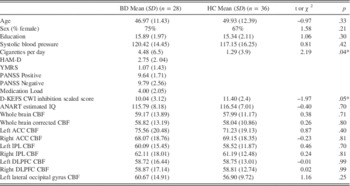
All procedures were approved by the University of California, San Diego (UCSD) and San Diego Veterans Affairs Healthcare System Institutional Review Boards. Twenty-eight euthymic BD and 36 age- and education-comparable healthy participants were enrolled in the study. Participants were eligible if they were between the ages of 30 and 79, right handed, free from substance abuse for 6 months and substance dependence for 12 months, never diagnosed with a serious neurological or medical condition, suitable for MRI (i.e., no implanted medical devices), and a native English speaker. BD patients met DSM-IV criteria for bipolar I disorder, were on stable doses of medication for at least 6 weeks, and reported their first mood episode as occurring between the ages of 13 and 30. BD patients were also excluded from the study if they were experiencing a mood episode or had a history of any other Axis I DSM-IV diagnosis. Written informed consent was obtained by all participants in the study. Demographic and clinical rating information are presented in Table 1.
Demographics and clinical characteristics of participants.

*p<.05.
HAM-D=Hamilton Depression Rating Scale; YMRS=Young Mania Rating Scale; PANSS=Positive and Negative Syndrome scale; DKEFS CWI=Delis- Kaplan Executive Function System Color Word Interference; ANART=American National Adult Reading Test; BP=blood pressure; ACC=anterior cingulate cortex; IPL=inferior parietal lobule; DLPFC=dorsolateral prefrontal cortex; CBF=cerebral blood flow.
Clinical Interview and Neuropsychological Testing
The expanded version of the Structured Clinical Interview for DSM-IV (SCID-IV; Spitzer, Williams, Gibbon, & First, Reference Spitzer, Williams, Gibbon and First1995) was administered to all BD patients. Subjects were considered euthymic if they met cutoff scores on the Hamilton Depression Rating Scale (HAM-D≤7; Trajkovic et al., Reference Trajkovic, Starcevic, Latas, Lestarevic, Ille, Bukumeiric and Marinkovic2011), the Young Mania Rating Scale (YMRS≤6; Young, Biggs, Zeigler, & Meyer, Reference Young, Biggs, Zeigler and Meyer1978), and the Positive and Negative Syndrome Scale (PANSS positive≤21 and PANSS negative≤21; Kay, Fiszbein, & Opler, Reference Kay, Fiszbein and Opler1987). Comparison participants were administered the Mini International Psychiatric Interview (Sheehan et al., Reference Sheehan, Lecruibier, Sheehan, Amorim, Janavs, Weiller and Dunbar1998). The Framingham Stroke Risk profile (D’Agostino, Wolf, Belanger, & Kannel, Reference D’Agostino, Wolf, Belanger and Kannel1994) was also administered as a self-report measure of vascular risk markers. Low (1) or high (2) medication load values were assigned for each BD participant based on current psychiatric medication dosage and duration of use. These values were then summed across medication type to represent a unique medication load variable for each BD participant (Hassel et al., Reference Hassel, Almeida, Kerr, Nau, Ladouceur, Fissell and Phillips2008). All participants performed the D-KEFS Color Word Interference subtest, based on the original Stroop task, to assess for inhibitory response (Delis, Kaplan, & Kramer, Reference Delis, Kaplan and Kramer2001).
Imaging Data Acquisition and Processing
Participants were scanned at the UCSD Center for Functional Magnetic Resonance Imaging using a 3 Tesla GE Discovery MR750 whole-body imaging system with an eight-channel head coil. A high-resolution T1-weighted anatomical scan was acquired using a fast spoiled gradient echo pulse sequence [echo time (TE)=4 ms, flip angle=90°, 1 mm3 resolution]. Images from the scan were used to create ROIs for different anatomical regions (see the next section) as well as to create a gray matter mask, down-sampled to the resolution of the whole-brain baseline ASL data.
A three-dimensional spoiled gradient echo sequence was used to collect the time-of-flight angiogram scan [TE=2.9 ms, repetition time (TR)=20 ms, flip angle=20°, 0.86×1.7×2.5 mm3 resolution, field of view (FOV)=22 cm, axial slice thickness=10 cm) to define the location for PCASL labeling. Specifically, the imaging volume was prescribed to visualize the arteries above the vertebral crossing into the brain but below the confluence to the basilar artery. Within these two spatial boundaries, we reviewed the axial images individually and selected the slice that was the most perpendicular to the bilateral vertebral and carotid arteries. This location was then set as the labeling plane for the WB PCASL scan (see next paragraph) to achieve optimal tagging efficiency.
Whole brain ASL data were acquired using a multiphase pseudo-continuous arterial spin labeling sequence with a single shot spiral readout. The scan parameters were: FOV=22 cm, matrix=64×64, labeling duration=2000 ms, post-labeling delay=1600 ms, TR=4200 ms, TE=3.3 ms, single shot spiral readout (24.7 ms duration), 20 axial slices, slice thickness=5.0 mm, spacing=1 mm, # of repetitions=64, total scan time=4:30 min. The slices were acquired in a sequential manner (inferior to superior; interslice interval=28 ms), such that effective post-labeling delay monotonically increases with the distance of the slice from the tagging plane. To achieve CBF quantification in physiological units of (mL/100 g-min), a 32-s cerebrospinal fluid reference scan was obtained to measure the equilibrium magnetization of cerebral spinal fluid (TR=4000 ms, TE=3.4 ms, NEX=9, with 90° excitation pulse turned off for the first 8 repetitions; Chalela et al., Reference Chalela, Alsop, Gonzalez-Atavales, Maldjian, Kasner and Detre2000) and a 32-s minimum contrast scan was acquired to adjust for coil inhomogeneities (TR=2000 ms, TE=11 ms, NEX=2; Wang, Qui, & Constable, Reference Wang, Qiu and Constable2005). To correct for blurring in spiral images caused by off-resonance fields, a field map was acquired using a spoiled gradient echo sequence (TR=500 ms, TE1=6.5 ms, TE2=8.5 ms, Flip Angle=45°, scan time=1:16 min).
Structural imaging data processing
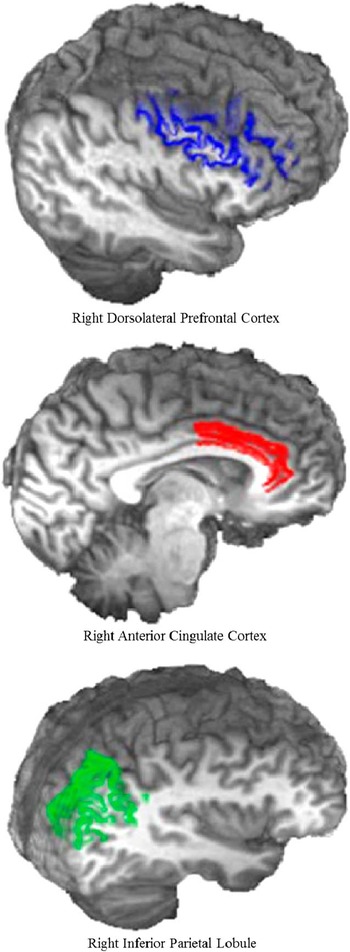
Cortical surfaces on all T1 anatomical images were reconstructed and parcellated into regions of interest using FreeSurfer software (Dale, Fischl, & Sereno, Reference Dale, Fischl and Sereno1999). Manual editing was performed to ensure proper gray and white matter differentiation and ROI segmentation. The newly created FreeSurfer masks were aligned to ASL anatomical space for further processing in Analysis of Functional NeuroImages (AFNI) package (Cox, Reference Cox1996). We examined total gray matter perfusion [average perfusion across all 66 cortical parcellations in the Desikan-Killiany atlas (Desikan et al., Reference Desikan, Segonne, Fischl, Quinn, Dickerson, Blacker and Killiany2006)], six regional perfusion values—bilateral anterior cingulate, bilateral inferior parietal, and bilateral dorsolateral prefrontal cortex, and WB corrected perfusion subtracting these six regions. The anterior cingulate cortex (ACC; BA 24, 32, and 33) was chosen because of its association with cognitive processes such as task selection and cognitive control (Kerns et al., Reference Kerns, Cohen, MacDonald, Cho, Stenger and Carter2004; MacDonald, Cohen, Stenger, & Carter, Reference MacDonald, Cohen, Stenger and Carter2000). The ACC ROI was constructed by calculating the weighted average CBF of the caudal and rostral divisions of the ACC derived from the Desikan-Killiany atlas parcellation. The dorsolateral prefrontal gyrus (DLPFC; BA 9) was also included due to research consistently implicating this region in executive dysfunction (MacDonald et al., Reference MacDonald, Cohen, Stenger and Carter2000) as well as processing speed and working memory impairment in BD subjects (Chen, Suckling, Lennox, Ooi, & Bullmore, Reference Chen, Suckling, Lennox, Ooi and Bullmore2011; McKenna, Sutherland, Legenkaya, & Eyler, Reference McKenna, Sutherland, Legenkaya and Eyler2014). This ROI consisted of the weighted average of caudal and rostral divisions of the middle frontal gyrus. Finally, the inferior parietal lobule (IPL; BA 40) was chosen for its involvement in visuospatial attention to task-relevant stimuli (Coderre & van Heuven, Reference Coderre and van Heuven2013; Corbetta, Miezin, Shulman, & Petersen, Reference Corbetta, Meizin, Shulman and Petersen1993; Culham & Kanwisher, Reference Culham and Kanwisher2001; Milham, Banich, & Barad, Reference Milham, Banich and Barad2003). See Figure 1 for an example of these ROIs for one participant. WB corrected values were computed by calculating the weighted mean of all cortical and subcortical gray matter structures excluding the bilateral ACC, IPL, and DLPFC regions used for ad-hoc a-priori analyses.
Sagittal view of the right dorsolateral prefrontal cortex (blue), anterior cingulate cortex (red), and inferior parietal lobule (green) regions of interest for one study participant.

MPPCASL imaging data processing
ASL data were processed using the Cerebral Blood Flow Biomedical Informatics Research Network (CBFBIRN) central database established at the UCSD Center for Functional MRI (Shin, Ozyurt, & Liu, Reference Shin, Ozyurt and Liu2013). The raw ASL, field map and anatomical data were uploaded to the CBFBIRN database. The post processing included field map and motion correction of the raw ASL data, skull stripping and tissue segmentation of the anatomical data, and conversion of the perfusion signal into absolute physiological units. Quantified CBF maps for each participant were downloaded to a local server where they were blurred to 4 mm full-width at half maximum and co-registered to the corresponding FreeSurfer segmented image using programs available in the AFNI package. CBF voxels with negative values were replaced with zero and a conservative threshold (10–150) removed voxels with CBF values that were outside the expected physiological range. Whole brain gray matter (GM) CBF and regional CBF values were then extracted and entered into Statistical Package for Social Sciences (SPSS) 14.0 (2005) for subsequent analysis.
Statistical Analyses
Variables were checked for normality and extreme data points were assigned values at the 1st or 99th percentile of the distribution. Independent samples t tests were used to investigate group differences in quantitative variables. Chi-square analysis examined group differences in categorical variables.
Linear regressions were performed to assess the relationship between group, CBF and cognitive performance in the whole brain GM, ACC, IPL, and DLPFC regions. The interaction of group and CBF was also tested in the model. To account for individual differences in brain size while minimizing age or sex confounds, ROI analyses controlled for the number of voxels in the left lateral occipital gyrus. Although still significant, this ROI was not related to age and was slightly less related to gender (r=−0.3; p=.02) compared to WB size. Due to this relationship, gender was also tested in the above models. Given the wide age range present in both groups in this sample, we also examined age effects by adding age into our model and examining group-by-age interactions.
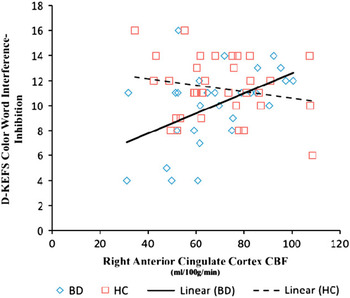
Scatter plot demonstrating the interaction of group [Bipolar (BD) vs. Healthy Control (HC)] and cerebral blood flow in the right anterior cingulate cortex on performance on the Delis-Kaplan Executive Function System (D-KEFS) Color Word Interference Inhibition subtest. Interaction was significant at p=.002.

Finally, exploratory correlational analyses were conducted to determine whether clinical and demographic characteristics were related to either CBF or cognition such that controlling for them might influence the observed brain-behavior relationships. Variables of interest included systolic blood pressure, smoking, caffeine intake, age and clinical variables (i.e., number of depressed, manic episodes, and medication load) in the BD group only. Measures that were independently and significantly correlated with both CBF and response inhibition were further examined using Sobel’s test to determine whether observed brain behavior relationships were explained by the inter-relationship of these factors. We used a significance value of p<.1 to identify candidate variables with potential for explaining brain-behavior relationships.
Results
Groups were comparable on age, education, estimated verbal IQ, and gender (Table 1). BD participants performed significantly worse on the D-KEFS Color-Word Interference Inhibition subtest (Cohen’s d=0.48; t=-1.97; p=.05) compared to healthy controls, although group means were within normal limits according to normative data. There were no group differences in CBF in the WB, WB corrected, bilateral ACC, bilateral IPL, or bilateral DLPFC.
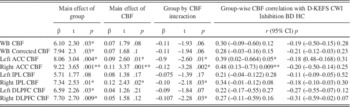
In addition to a main effect of group on response inhibition, the regression models revealed a main effect of CBF on response inhibition for bilateral ACC, right IPL and bilateral DLPFC, indicating that higher CBF in these regions was associated with better performance. These main effects were qualified by a significant group-by-CBF interaction in bilateral ACC (Figure 2), right IPL, and right DLPFC. Group-wise correlations investigating this relationship revealed that better inhibitory performance was associated with higher rsCBF in bilateral ACC regions in BD subjects, although there was no relationship in the HC participants. Although the correlation patterns were similar, no significant group-wise correlations between inhibitory performance and CBF in the right IPL and right DLPFC were present. A similar interaction was marginally significant for WB corrected perfusion (Table 2). All results were deemed significant if p<.05. Including age and gender as a covariate did not change the significance of these effects, and there were no age-by-group interactions present (data not shown).
Main effect, interaction, and Pearson correlation terms relating whole brain and regional CBF to inhibitory performance in BD and HC subjects

*p≤.05.
**p≤.001.
WB=whole brain; ACC=anterior cingulate cortex; IPL=inferior parietal lobule; DLPFC=dorsolateral prefrontal cortex; CBF=cerebral blood flow; BD=bipolar disorder; HC=healthy controls; D-KEFS CWI Inhibition=Delis- Kaplan Executive Function System Color Word Interference; β=unstandardized beta coefficient; t=t-score; r=Pearson correlation coefficient; CI=confidence interval.
Finally, our exploratory analysis revealed that a greater number of lifetime manic episodes in the BD group was associated with increased rsCBF in the whole brain, bilateral ACC, left IPL, and left DLPFC (r’s range from 0.37 to 0.50; p’s range from.01 to.05), but no association with inhibitory performance was present (all r’s less than 0.20). On average, the BD group smoked significantly more cigarettes per day than HC participants (t=2.19; p=.04). The number of cigarettes smoked per day was negatively associated with both response inhibition (r=−0.52; p=.008) and CBF in the WB, bilateral ACC, and right IPL (r’s range from −0.31 to −0.39; p’s range from .06 to.1) in the BD group only at our threshold of p<.1 (described above). However, Sobel’s test revealed that including this variable in the model did not significantly decrease the relationship between CBF and response inhibition in any of these regions (Sobel’s test statistics range from −0.17 to 0.63; all p’s >.05). Medication load in the bipolar group was not related to CBF in any region or inhibitory performance. Bipolar subjects reported higher diastolic blood pressure (t=2.29; p=.02) and marginally greater Framingham stroke risk (t=1.89; p=.06) than those in the HC group, but neither were associated with CBF or response inhibition. Systolic blood pressure, smoking status (smoker vs. non-smoker) and caffeine intake were not associated with CBF in any region or task performance.
Discussion
This study aimed to examine the association between CBF and response inhibition in samples of euthymic bipolar and healthy control participants to better elucidate the relative contribution of neurovascular integrity to poorer cognitive performance in BD patients. Although BD subjects did perform relatively worse on the D-KEFS Color-Word interference task of response inhibition, no group differences in resting state CBF were found in the whole brain, anterior cingulate cortex, inferior parietal lobule, or dorsolateral prefrontal cortex. Of interest, better response inhibition in the bipolar group was associated with higher CBF values in bilateral ACC regions, while no significant relationship between inhibitory performance and CBF was found in the comparison group. The results of this study demonstrate that levels of rsCBF are differentially related to cognitive performance in the BD group compared to the group without BD.
These findings are consistent with existing fMRI studies that find activation of the ACC and DLPFC during the original Stroop task (Matsumoto & Tanaka, 2000) in healthy samples. Furthermore, dysfunction in these regions during inhibitory task performance has also been noted in samples of BD patients (Blumberg et al., Reference Blumberg, Leung, Skudlarski, Lacadie, Fredericks, Harris and Peterson2003; Kronhaus et al., Reference Kronhaus, Lawrence, Williams, Frangou, Brammer, Williams and Phillips2006; Roth et al., Reference Roth, Koven, Randolph, Flashman, Pixley, Ricketts and Saykin2006; Strakowski et al., Reference Strakowski, Adler, Holland, Mills, DelBello and Eliassen2005). In contrast to previous PET/SPECT studies investigating rsCBF in BD, we did not observe regional or WB group differences in perfusion. Only one other study has related cognitive performance to CBF during rest in BD and reported that increased CBF was associated with lower cognitive performance across several domains (Benabarre et al., Reference Benabarre, Vieta, Martinez-Aran, Garcia-Garcia, Martin, Lomena and Valdes2005). These inconsistencies with our own findings may be explained by previous studies’ inclusion of BD participants in different mood states (e.g., manic, depressed, and euthymic), the large age range in our sample, or the use of PET/SPECT technology in previous investigations.
This is the first study to examine the relationship between cognition and rsCBF in a sample of euthymic BD patients using the MP-PCASL neuroimaging technique described above. Our main finding that better response inhibition was associated with higher levels of rsCBF in our euthymic bipolar sample may reflect a vascular compensatory mechanism that is present during periods of rest. Of note, despite the fact that BD patients performed worse than comparison participants on the response inhibition task, their level of performance did not fall in the impaired range relative to the test’s normative group. Perhaps enhanced CBF in the BD group is evidence of a compensatory upregulation of cerebrovascular function that is helping to maintain unimpaired, though relatively poorer inhibitory performance. One mechanism proposed to explain this vascular compensatory response suggests that variability in the heterogeneity of blood transit time results in altered CBF to maintain the maximum amount of oxygen extraction into the tissue (Jespersen & Ostergaard, Reference Jespersen and Ostergaard2012). Although vascular compensation has not been previously demonstrated in either euthymic or acute BD samples, this relationship has been shown in other psychiatric and non-psychiatric populations with high vascular risk. A recent ASL study reported that younger adults at greater vascular risk for Alzheimer’s disease (possession of APOE e 4) also showed a relationship between better executive functioning and higher levels of rsCBF in the ACC (Wierenga et al., Reference Wierenga, Clark, Dev, Shin, Jurick, Rissman and Bondi2013). Additionally, older PET/SPECT studies have demonstrated neural compensation in other, closely related, psychiatric samples (Ragland et al., Reference Ragland, Gur, Glahn, Censits, Smith, Lazarev and Gur1998; Weinberger, Berman, & Zec, Reference Weinberger, Berman and Zec1986). Using PET technology in patients diagnosed with schizophrenia, Ragland et al. (Reference Ragland, Gur, Glahn, Censits, Smith, Lazarev and Gur1998) demonstrated increased CBF in the parahippocampal gyrus with better performance on the Wisconsin Card Sort Task (WCST) in the absence of brain-behavior relationships in frontal regions typically subserving inhibitory function. The authors conclude that their results may demonstrate a compensatory upregulation of alternative brain regions in the presence of frontal dysfunction. In their SPECT study, Paulmen et al. (Reference Paulmen, Devous, Gregory, Herman, Jennings, Bonte and Raese1990) reported a positive relationship between performance on the WCST and rsCBF in parietal regions in their sample of patients diagnosed with schizophrenia. Importantly, the authors report that, although task performance was worse in the patient group, mean scores fell only within the mildly impaired range. Taken together, our results and previous studies suggest that there may be a period preceding cognitive decline in at-risk psychiatric populations in which there is recruitment of extra neural and vascular resources, both during task performance and at rest. Furthermore, our results indicate that the anterior cingulate cortex may be particularly sensitive to these effects in BD. Although age did not mediate the relationship between cognition and perfusion in our sample, some studies also show greater cognitive deficits in older adults with BD compared to younger ones (Burt, Prudic, Peyser, Clark, & Sackeim, Reference Burt, Prudic, Peyser, Clark and Sackeim2000; Friedman, Culver, & Ferrell, Reference Friedman, Culver and Ferrell1977; Savard, Rey, & Post, Reference Savard, Rey and Post1980). Thus, future longitudinal studies in BD are needed to track the trajectory of cerebrovascular function as cognitive impairment becomes more pronounced.
The lack of association between response inhibition and rsCBF in the ACC, IPL and DLPFC in our comparison group is consistent with some previously reported studies (Richard Jennings, 2014; Weinberger, Berman, & Zec, Reference Weinberger, Berman and Zec1986), but not others (Ragland et al, Reference Ragland, Gur, Glahn, Censits, Smith, Lazarev and Gur1998; Takeuchi et al., Reference Takeuchi, Taki, Hashizume, Sassa, Nagase, Nouchi and Kawashima2011). Weinberger et al. (Reference Weinberger, Berman and Zec1986) reported no relationship between performance on the WCST and rsCBF in the DLPFC in their sample of healthy controls using Xe 133 inhalation methodology. Similarly, Richard Jennings et al. (Reference Richard Jennings, Allen, Gianaros, Thayer and Manuck2014) used a more recent pulsed ASL method and concluded there was no relationship between the Stroop task and rsCBF in their healthy sample. The results of this study highlight that although the nature of the relationship in comparison participants may be inconclusive, inhibitory performance is differentially modulated by CBF in bipolar individuals compared to age and education matched controls. However, given discrepancies in the existing literature, more studies are needed to understand and identify mechanisms driving these differences.
To further explore these relationships, we conducted an exploratory analysis to better characterize clinical indicators that may explain differences in brain-behavior relationships we observed between our groups. Our analysis revealed that BD participants smoked significantly more cigarettes per day compared to the HC group. Previous studies using PET/SPECT imaging have demonstrated increased rsCBF in chronic smokers (Blose et al., Reference Blose, Coad, Amen, Willeumier, Taylor and Golden2014) or following acute nicotine consumption (Domino et al., Reference Domino, Minoshima, Guthrie, Ohl, Ni, Koeppe and Zubieta2000). However, somewhat surprisingly, our sample demonstrated the opposite effect: individuals who reported greater nicotine consumption had lower CBF and response inhibition scores. It is possible that higher nicotine use in BD patients may serve as an indicator of greater clinical severity, although our euthymic sample makes it difficult to directly test this hypothesis. Furthermore, this was the only clinical variable that was associated with both response inhibition and regional resting state perfusion (albeit at a more liberal p<.1 threshold use to capture potential mediators) in our BD sample. However, adding the number of cigarettes per day to our a-priori models did not significantly diminish the relationship between response inhibition and CBF in any regions of interest, indicating that the brain-behavior relationship observed in this group was not driven by any clinical or demographic variables collected in this study.
The results of this study should be interpreted within the context of several limitations. Although the use of psychotropic medication in BD has been linked to cognitive impairment and changes in brain function (Phillips, Travis, Fagiolini, & Kupfer, Reference Phillips, Travis, Fagiolini and Kupfer2008), greater medication load was not associated with rsCBF or response inhibition in our BD sample. However, this study was not designed to disentangle the individual effects of different types of medication (e.g., lithium vs. anti-psychotics). The cross-sectional nature of our research design does not allow us to draw causal conclusions about the relationship between CBF and cognition in BD. Future longitudinal studies are needed to better understand the pathophysiology that determines cognition in this population. Our self-report assessment of clinical and health variables may be susceptible to response bias. The small sample size and multiple statistical tests involved in our exploratory analysis may have limited our ability to detect relationships. Finally, our strict inclusion/exclusion criteria may limit the generalizability of these findings, as these results are limited to individuals in the euthymic state. Our efforts to recruit euthymic participants may have restricted our sample to patients exhibiting less illness severity.
Despite these limitations, the present study offers a novel perspective on the contributions of cerebrovascular integrity to cognitive performance in bipolar disorder. Our results replicate previous findings demonstrating lower response inhibition in BD and implicating the dorsal prefrontal cortex, inferior parietal lobule, and anterior cingulate as important structures that subserve this cognitive task. The study extends on this literature to suggest that individual variability in task performance in BD and HC groups may be differentially modulated by the degree of CBF within these regions. In particular, the anterior cingulate may be particularly sensitive to subtle, potentially compensatory, neurovascular changes associated with BD. Future longitudinal studies are needed to determine the trajectory of this relationship and whether it changes with age.
Acknowledgments
This study was funded, in part, by the National Institute of Mental Health grant R01-MH083968-03 and T32 Fellowship MH019934. The authors have no financial disclosures. We thank Allison Kaup, Vicki Wang, Heather Larabee, Alexandrea Harmell, Stephanie Taube, Rebecca Daly, Yadira Maldonado, and Amanda Shelton for their assistance, and the Desert Pacific Mental Illness Research Education and Clinical Center for infrastructure support. We also thank the San Diego Depression and Bipolar Support Alliance, International Bipolar Foundation, San Diego Chapter of the National Alliance for Mental Illness, and the dedicated volunteer participants.